Nahum
Introduction
11Message (prophecy, burden) about Nineveh [the capital of Assyria]. The writing with a vision of Nahum (Hebr. Nachom) – the Elkoshite. [Elkosh is an unknown city, perhaps Capernaum.]Alef-Kaf on God's wrath against Nineveh
[The opening passage (verses 1-10) is well structured on many levels. The passage forms a seven-step chiasm centered around . The last letter in verses 1, 2a, 2b, and 3c is YHWH – the personal name of the Lord. The numerical value of these four letters is 10 (jod), 5 (He), 6 (Vav) and 5 (He). The sum gives the numerical value 26, which is the same number as the number of words in these four lines (verses 1-3)! JHVH is mentioned seven times in total, and with this Bible code, it becomes eight times.
There is also an alphabetical pattern of half the alphabet, from the first letter Alef in to the eleventh letter Kaf in . However, the pattern is broken in (Zajin) and 6a (jod). In , Yod is found after the prefix Vav (and). The following passages in the OT have alphabetical patterns, see ; ; ; ; ; ; ; ; ; ; ; ; ; .] א – Alef
2God (El)
is jealous [does not share his place with idols, see ; ]
and a vengeful God
is the Lord (Yahweh). The Lord (Yahweh) is a vengeful God
and full of wrath.
The Lord (Yahweh) is vengeful toward his enemies,
and he has reserved his wrath for his adversaries.
3The Lord (Yahweh) is patient (slow to anger) [] and great in power
and will surely purge the guilty. ב – Bet
In the whirlwind and in the storm he makes his way,
the clouds are the dust at his feet.
[; ; ; ; ; ]
ג – Gimel
4He rebukes the sea and makes it dry [; ; ]
and dries up all the rivers. ד – Dalet
He withers away (Hebr. ). Bashan [the Golan Heights] and [the mountain range] Carmel
and the flowers of Lebanon wither away.
[Some manuscripts have withered (Hebr. ) in both lines, while some have "fades away" (Hebr. ) beginning with .]
ה – He
5The mountains shake before him
and the hills melt away. ו – Vav
The earth rises in his presence,
the world and everything that dwells upon it.[ז – Zajin]
6Who can stand (endure) before his wrath (words of anger)?
Who can endure (bear) his burning anger? [Here the alphabetical pattern is broken. The first word "before" begins with Lamed, and the second word is zaam, which begins with the letter Zajin.] ח – Chet
His fury is like a fire that has been unleashed
and the rocks are shattered (broken apart) before him.
ט – Tet
7Good is the Lord (Yahweh),
a stronghold (strong protection; a secure fortress) in the day of distress [in difficulties] [; ]. [י – Yod]
And he
knows (Hebr. yada) those who take refuge
[put their hope and trust] in him.
[כ – Kaf]
8But with a flood [that overflows],
he will make a complete end (Hebr. kalah) of her place [destroy Nineveh],
and darkness will pursue (chase) his enemies. [Here in , the alphabetical pattern ends. The tenth letter Yod is found in in the main word "knows," but the prefix Vav (used). The eleventh letter Kaf is found in the word "complete destruction" in . The placement allows the opening phrase "with a flood" to be linked to the previous verse. The two words are literally "and-with-flood overflow," forming a parallel to "know" and the Lord completely enveloping those who take refuge in him.]Complete destruction – mem, lamed, and aleph
9What [Hebr. ma] are you plotting against the Lord (Yahweh)?
He will bring [Nineveh] to completion (an end – Hebr. kalah).
It shall not rise (Hebr. lo-taqom) again (return) a second time
– the disaster (distress) [the suffering and distress caused by Assyria]. 10For even though they are like a thorny bush
filled with strong drink in a drunken state,
they [the enemies] are consumed (Hebr. achal)
like dry tinder – completely (Hebr. male)! [Here the text expresses such total destruction from the very first moment that there is nothing left to destroy, and therefore misfortune need not strike a second time, since everything is already gone. Drunkenness is used figuratively for defeat in battle, see ; ; , and reappears in .
The last word of the verse (Hebr. male) consists of three letters: Mem, Lamed and . These exact letters are found in the initial letters of the opening words of this section (verses 9-10; ma, lo and achal). The last word – complete – together with the pattern reinforces complete destruction.]Prophetic words to Assyria and Judah
Nineveh on the way to its downfall
11[The rest of chapter 1 now follows with prophetic provisions about judgment for Assyria and salvation for Judah. Nineveh was plundered and burned in 612 BC by allied forces from Persia, Media, and Babylon. From you [Nineveh] comes the one who gives evil counsel against the Lord (Yahweh), who is an advisor in wickedness.] 12Thus says the Lord (Yahweh):
"Though they are at full strength, yes, they are many,
they shall be struck down and disappear,
and even though I have afflicted you,
I will afflict you no more. 13Now I will break the yoke from you
and I will tear your bonds (that bind you) to pieces."Judgment against the king of Nineveh
14The Lord (Yahweh) has given this command concerning you [the king of Nineveh]:
"Your name shall not be spread abroad (sown like seed).
From the houses of your idols [temples]
I will destroy (cut down) your carved and metal-plated idols.
I will prepare your grave
for you have become worthless (cursed)."Deliverance for Judah
15His feet are seen on the mountains,
he who brings good news and proclaims peace (shalom, all kinds of prosperity)! "Celebrate your feasts, Judah, fulfill (redeem – Hebr. shalem) your promises, for never ever will Belial [literally: the worthless one, but also a Jewish name for Satan] cross [your path],
his wickedness will be wiped out (cut off)"
[This verse is a key verse in Nahum! The prophet Isaiah uses similar words about how the captive Jews will return from exile in Babylon to Judah, see . In the Greek translation Septuagint, the Greek word euangelizo is used, from which we have derived the word “evangelist”! Here we also sense how God proclaims his peace (shalom) to all peoples in all times!]The fall of Nineveh
[The watchmen on the wall in Nineveh cry out:]
21Destroyers (divisive people, those who crush and scatter) have come against you!
[Literally: before or in front of your face.]
Man the ramparts,
guard the roads,
fasten your belt (remake your lands with strength) [prepare for battle, see also ; ]
and gather great strength (as much as you can).
2The Lord (Yahweh) takes away the pride of Jacob
as well as the pride of Israel,
for the plunderers have plundered them of everything
and destroyed their vines.Prophetic vision
3The shields of the warriors are stained red [red-colored or splattered with blood],
the brave men are scarlet.
They blaze like fire in the steel of the chariots [they sparkle in the sun or are like flaming torches] on the day they are ready [to attack]
and the spears of cypress tremble.
[The Greek translation has "horses" instead of cypresses, i.e., the horses are agitated.]
4The chariots race wildly (like madmen) through the streets,
they chase across open fields [in rows].
It is like watching torches,
they race back and forth like ball lightning. 5He [probably referring to the king of Assyria] thinks to himself about his mighty ones,
they stumble in their march,
they rush to her wall
and the siege ramp is prepared.The plunder
6The gates of the rivers have been opened
and the palace is dissolved (has melted away, is consumed, destroyed).
7The queen [queen of Nineveh] is exposed—she is taken away [into exile]
and her maidservants wail with a voice like doves beating their breasts.
8But Nineveh has been like a pool of water since ancient times,
yet they flee.
[She cries:] "Stop, stop,"
but no one looks back.
[Her plunderers cry out:]
9Take the spoils of silver, take the spoils of gold,
for there is no end to the accumulated riches
with all the precious vessels.
10She is desolate, empty, and like a heap of rubbish.
Their hearts melt and their knees knock together,
there are convulsions in their hips and their faces have been blackened.
11
Relief from Nineveh showing Assyrians fighting a lion. Dated to 645-635 BC.
that was the feeding place for the young lions,
where lions and lionesses walked
and the lion cubs had nothing to fear?
12The lion tears enough for its cubs
and chokes its lioness
and fills its cave with prey
and its den with torn flesh. 13Behold, I am against you,
declares (says, proclaims) the Lord of hosts (Yahweh Sebaot),
and I will burn your chariots in smoke
and the sword shall devour your young lions [your warriors].
I will wipe out (cut off) your prey (booty) from the earth
and the voices of your messengers will never be heard again.
The reason for the judgment
31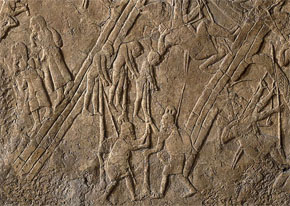
The Assyrian king Sennacherib attacked Lachish in Judea in 701 BC. The attack is documented on a large relief that also shows Jewish prisoners being impaled on wooden stakes. The wall panel is in the British Museum in London.
She is full of lies
and plunder (violence),
never letting go of her prey (never ceasing to bring in spoils). [The Assyrians were known for cheating in settlements. Their cruelty is also confirmed by monuments with inscriptions describing how prisoners were impaled alive on stakes, flayed, beheaded, dragged behind horses, and hanged. The royal chronicles also describe how the Assyrians went on military campaigns. They killed or exiled people, razed cities to the ground, plundered, burned trees, and destroyed farmland.] 2Whips crack [from the horses with battle chariots],
wagon wheels rumble (like thunder),
horses gallop
and wagons bounce along, 3riders prepare themselves,
swords like flames [glowing]
and flashing spears;
multitudes of the slain
and heaps of dead bodies,
there is no end to the bodies
and one stumbles over their bodies.
[This is the reason:]
4Because of the great fornication among the luxury prostitutes [literally: "whoring beautiful grace/charm" – Hebr. zanah tov chen],
the sorcerers' mistresses (Hebr. baalah)
who sell countries through their fornication
and families through their witchcraft. 5Behold, therefore, I am against you, declares (says, proclaims) the Lord of hosts (Yahweh Sebaot),
and I will take off your shirt over your face
and I will show the nations your nakedness
and the kingdoms your shame. 6I will cast abominations (detestable things) upon you
and make you worthless
and make you a place of refuse.
7It shall come to pass that all who see you shall flee from you and say:
"Nineveh is destroyed,
who will mourn for her?
Where shall I look for those
who can comfort you?"
8Are you better than [the Egyptian city] No-Amon, which was among the rivers [Nile Delta],
which had water all around it,
whose rampart was the sea
and whose wall was the sea? [No-Amon means City of the God Amon, also known as Thebes (present-day Luxor), and was the capital of Upper Egypt. The city was destroyed by the Assyrians in 663 BC.] 9Kush [present-day Sudan and parts of Ethiopia] and Egypt were your strength
and it was unlimited.
Put [present-day Libya] and the Libyans
were your helpers.
10Nevertheless, she was carried away,
she went into captivity.
Her young children were smashed in the streets
and they cast lots for her honorable men
and all her great men were bound in chains.
11You [Nineveh] shall be drunk, you shall faint [image of defeat in battle, see ; ; ],
even you shall seek refuge (strong protection, a refuge) from your enemies. 12All your fortresses will be like fig trees with the first harvest of figs;
if they are shaken, they fall into the mouths of those who eat them.
[A fig tree usually produces three harvests per year.]
13Behold, your people in your midst are like women [physically weaker than strong soldiers],
the gates of your land are wide open to your enemies,
fire has devoured your gates. 14Draw water for yourself for the siege,
strengthen your fortresses.
Go to the clay and make yourself mortar,
seize the molds to make bricks. 15There the fire will consume you,
the sword will exterminate (cut you down),
it will consume you
like harmful caterpillars.
Multiply like caterpillars,
multiply like locusts (make sure you become many).
16You have multiplied your merchants beyond the stars of heaven (so that they have become more numerous than the stars),
the larvae spread out and flee. 17Your crowned ones (exalted individuals) are like grasshoppers
and your masters of ceremonies are like swarms of grasshoppers
that stay in the wall on cold days,
but when the sun rises they flee
and no one knows where they are (their whereabouts are unknown).
18Your shepherds are asleep, O king of Assyria,
your nobles are resting,
your people are scattered over the mountains
and there is no one to gather them together. 19There is no one to ease your pain,
your wounds are serious (incurable).
All who hear the rumor about you
clap their hands over you (applaud).
Over whom has your wickedness not passed continuously?
[Who has not experienced your endless wickedness?]


