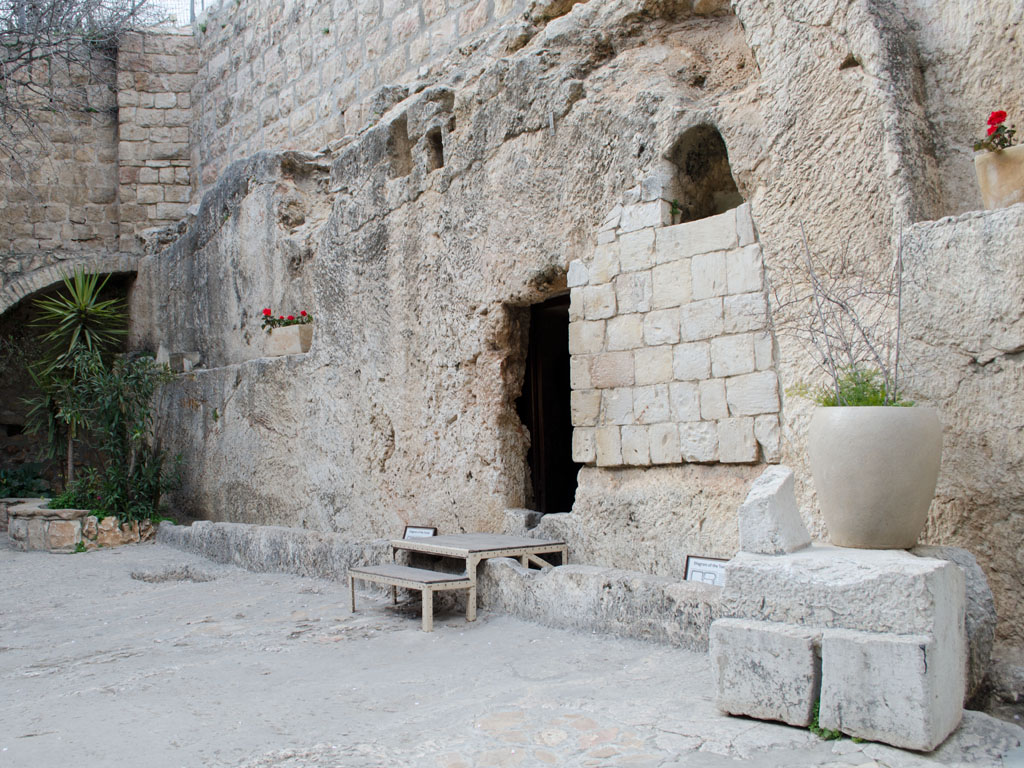
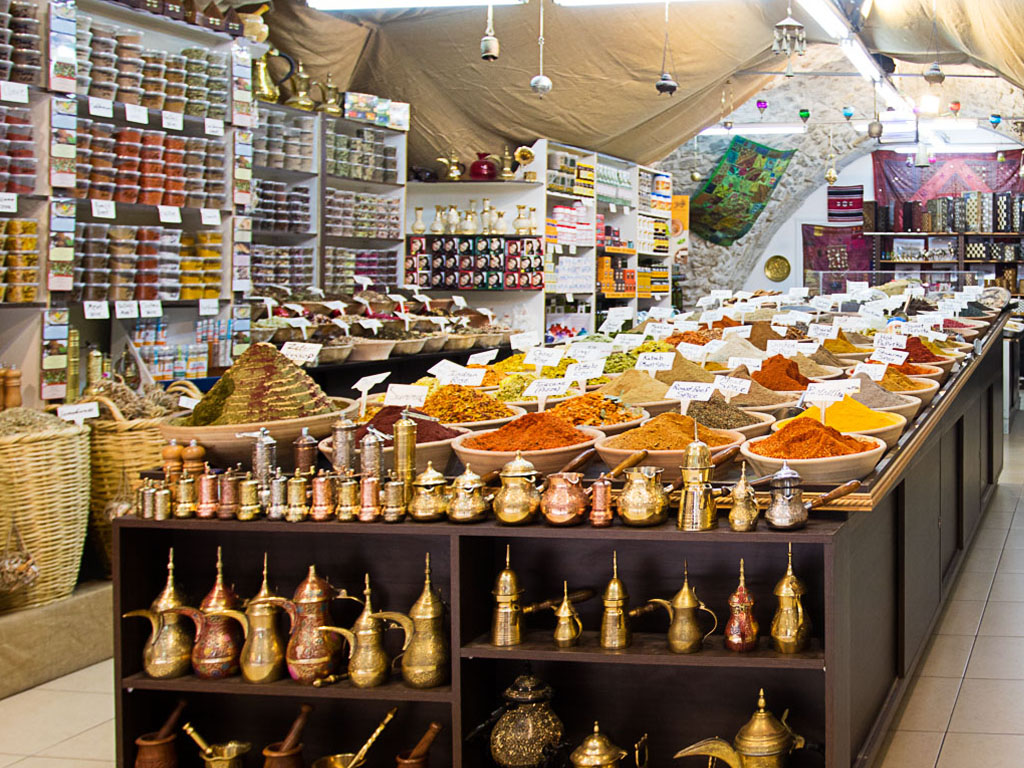
Mark
Jesus' preparation
11
The Jordan River flows from north to south through Israel. It was at this river that John baptized and Jesus was also baptized.
Behold, I send my messenger before you,
he shall prepare the way before you. []
3A voice cries out in the wilderness:
Prepare the way for the Lord,
make straight paths for him! [The last quotation comes from . As was customary at that time, only the greatest prophet Isaiah is mentioned as the main source, even though Malachi is also referred to first.] 4John came (appeared), he [was the messenger spoken of by the prophets] who baptized in the desert and preached the baptism of repentance [which was an outward baptism of purification in water as a sign of repentance of the heart] for the forgiveness of sins. 5All of Judea and everyone in Jerusalem went out to him (in a constant stream), and they confessed their sins and were baptized by him in the Jordan River. 6John was clothed in camel's hair and had a leather belt around his waist [which brings to mind earlier prophets such as Elijah, see ]. He lived on locusts and wild honey. [John the Baptist's lifestyle stood in stark contrast to many of the religious leaders who lived in luxury. Locusts and wild honey were common food in the desert.] 7He preached: "After me comes one who is stronger than I, and I am not worthy to stoop down and untie the straps of his sandals [which was a slave's task]. 8I have baptized you with water, but he will baptize you with the Holy Spirit." 9
The Jordan Valley near Bethany. The Judean Mountains can be seen in the background.
"The time is fulfilled (complete, accomplished)! The kingdom of God is at hand!
[An era is complete. Now a new era is beginning when the kingdom of God is near.] Repent (change your way of thinking and acting)
and believe (trust, have confidence in) the gospel (the good news, the message of victory)!" [The word gospel means "good news" or "message of victory". The word was used in the Roman world to refer to the good news that couriers from the front lines came and read aloud in Rom after great victories.] 16
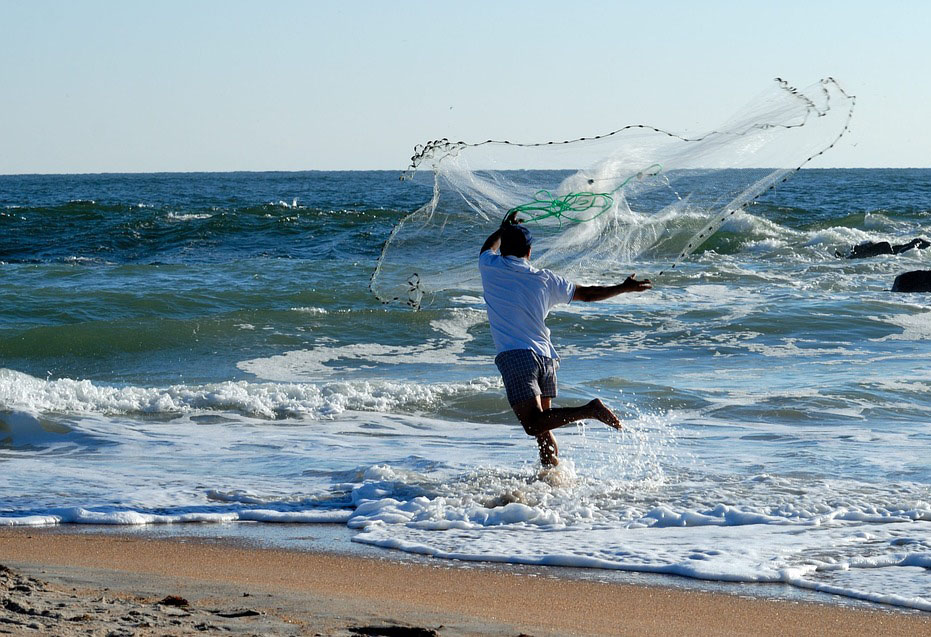
Even today, it is common to fish with cast nets.
Jesus teaches and heals in the synagogue (Luke 4:31-37)
21
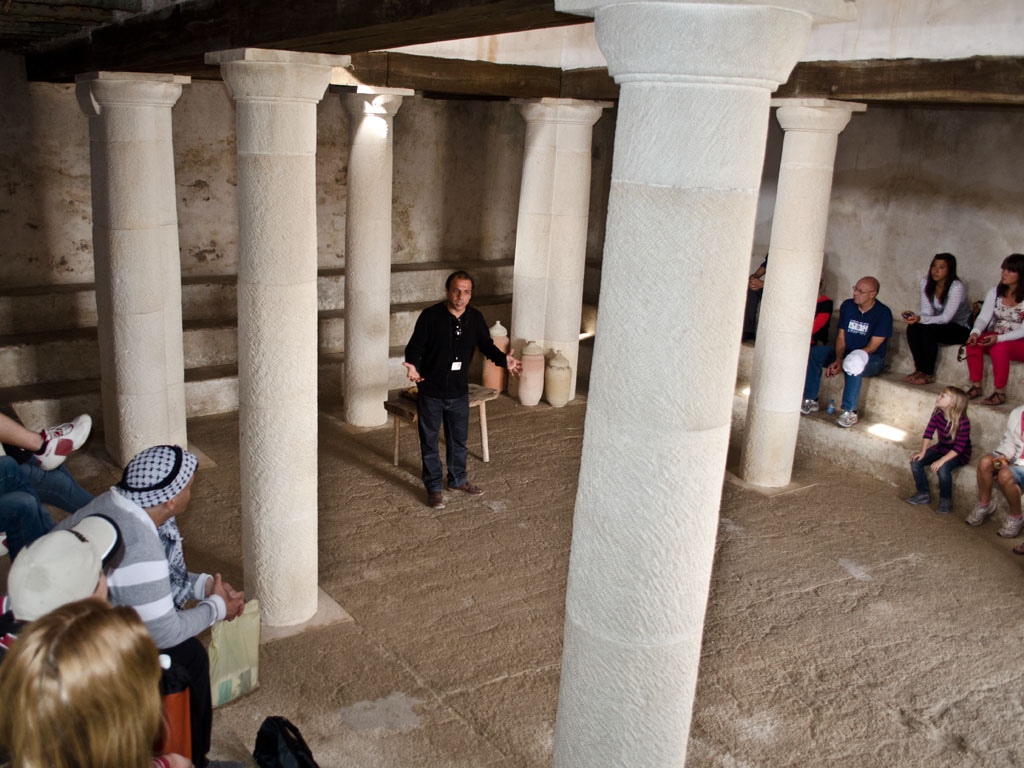
The ruins of the city of Capernaum are a popular tourist destination. The picture was taken from inside the remains of a synagogue from the 4th century, which is believed to have been built on top of the synagogue that existed in Jesus' time.
27They were all terrified (on the verge of being terrified) and began to ask each other (demanding answers from each other): "What is this? A new teaching, with power behind the words! Even the unclean spirits obey him, and they obey him." 28The news about him immediately spread throughout Galilee.Peter's mother-in-law and other sick people are healed (Matt. 8:14-17, Luke 4:38-41)
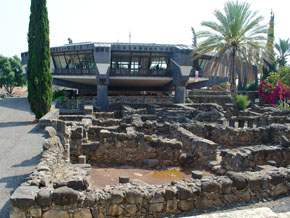
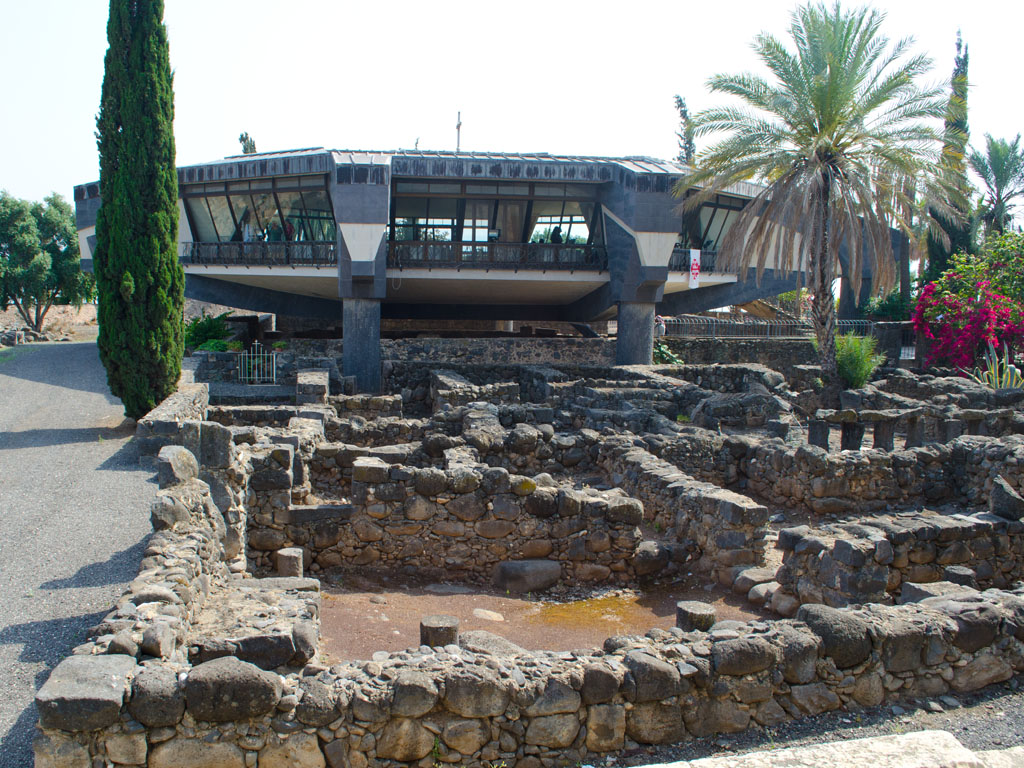
The ruins of what is believed to be Peter's house still remain. It was a simple dwelling like so many others in Capernaum. Over the centuries, pilgrims have left inscriptions on the walls, and several chapels and churches have been built on the site where the house stood. The most recent is an octagonal church built on pillars in 1990.

Sunrise over the Sea of Galilee.

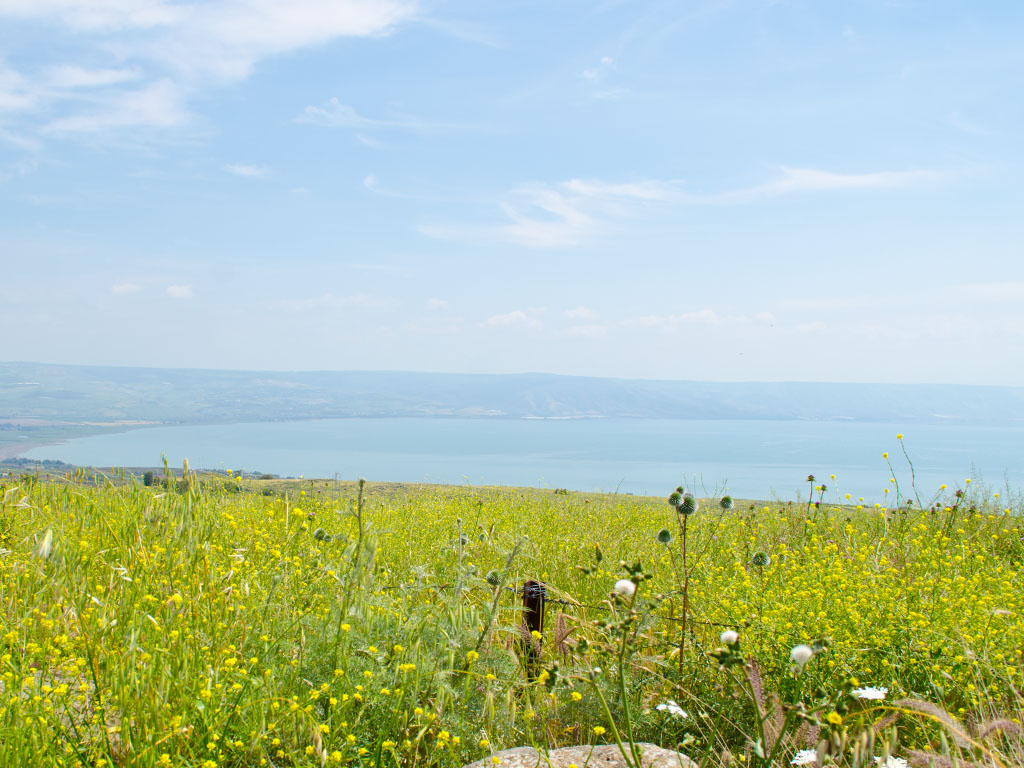
View from Mount Arbel over the northern part of the Sea of Galilee.
A lame man in Capernaum is forgiven and healed (Matt. 9:2-8, Luke 5:17-26)
21
A roof is being built in the traditional way in the open-air museum "Nazareth Village" in Nazareth.
©Nasareth Village

Aerial photo of Capernaum. It was here along the shore that Jesus called his disciples.
©BiblePlaces.com
"Can the wedding guests [the groom's friends who are responsible for organizing the festivities] fast while the groom is with them? As long as they have the groom with them, they cannot fast. 20But the day will come when the bridegroom is taken away from them, and then they will fast. 21No one sews a patch of unshrunk cloth on an old cloak (garment).
In that case, the patch would tear away even more from the cloak
and the tear would be worse [than it was before].
22Nor does anyone pour new wine into old wineskins (leather bags),
for in that case the wineskins would burst and the wine would run out,
and the wineskins would be ruined (unusable). No, fresh wine is poured into new wineskins [which are malleable, Gk. kainos, the focus is on the quality of the skin rather than its age]." 23
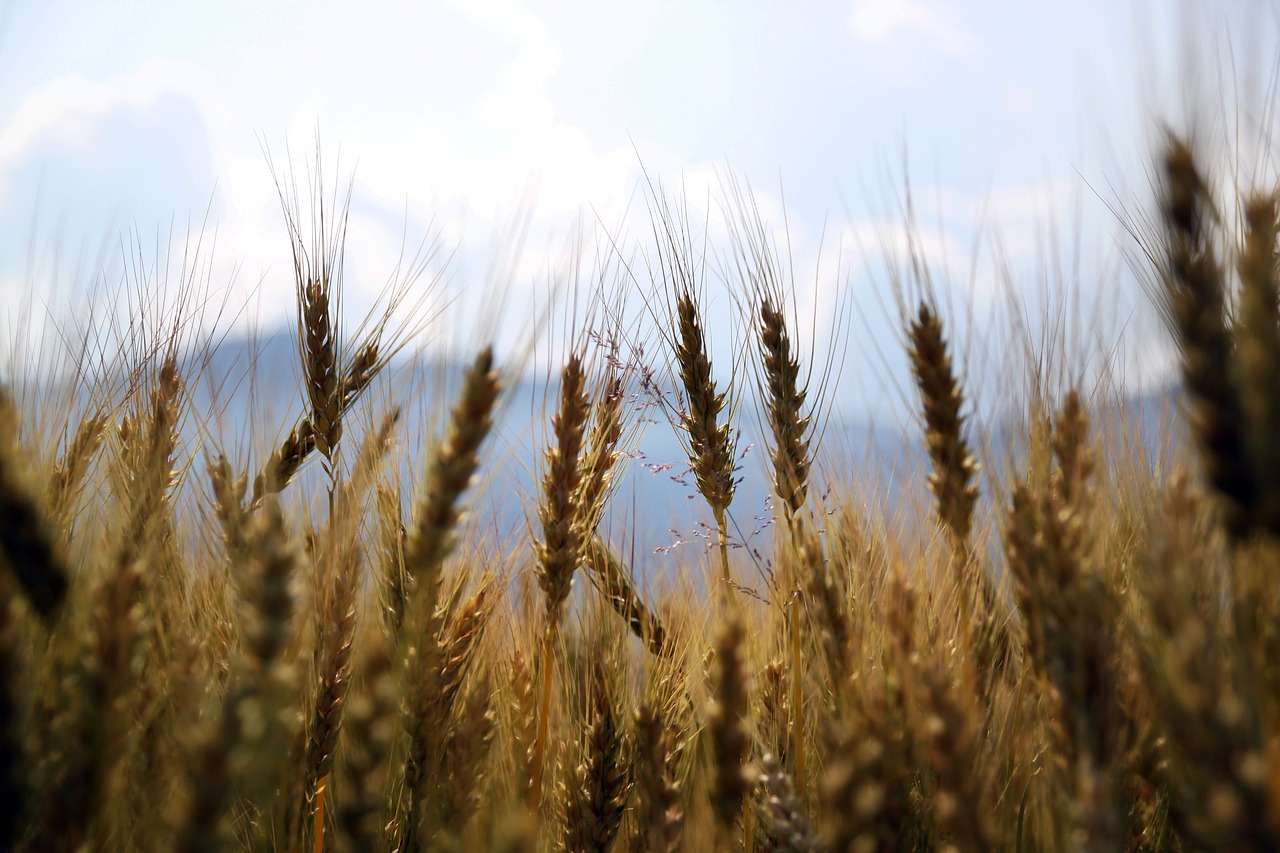
A cornfield in Galilee.

In the synagogue, people sat along the walls so that everyone could see each other. The picture is from a newly built reconstruction of the synagogue in Nazareth from Jesus' time.
"Is it lawful (and right) on the Sabbath [according to the teaching in the Books of Moses, see ] –
to do good or to do evil,
to save life or to destroy life?" [In the parallel passage in and in Luke, on two other occasions when the question of healing on the Sabbath was raised (; ), Jesus argues on the basis of the principle accepted by the Pharisees that it is permissible to alleviate the suffering of animals, within certain limits, on the Sabbath; how much more so human suffering? See also , ; .]
But they [did not answer, but] were silent. 5After looking at them in anger (moving his gaze from one side to the other), grieved (saddened) at the hardness of their hearts, Jesus said to the man, "Stretch out your hand." He stretched it out, and his hand was completely restored. [Jesus was holy angry at the spiritual leaders' insensitivity to the man's suffering and the entire Jewish teaching system, where literal interpretation was more important than the heart and spirit behind the commandments. The word "saddened" is in the present participle form, which emphasizes Jesus' continuous sorrow over the spiritual situation, while the anger in Jesus' gaze is in the aorist form, which emphasizes that it is temporary. The words "hardness of heart" describe the process of how their hearts became more and more hardened as Jesus looked at them.] 6The Pharisees went out and immediately began to make plans with the Herodians [who sympathized with and supported Herod Antipas and the Roman government] on how they could kill Jesus. [They were filled with darkness and murderous intent. Immediately after Jesus asked whether it was right to save lives or destroy lives, see , they went away and planned how to kill Jesus.] 7
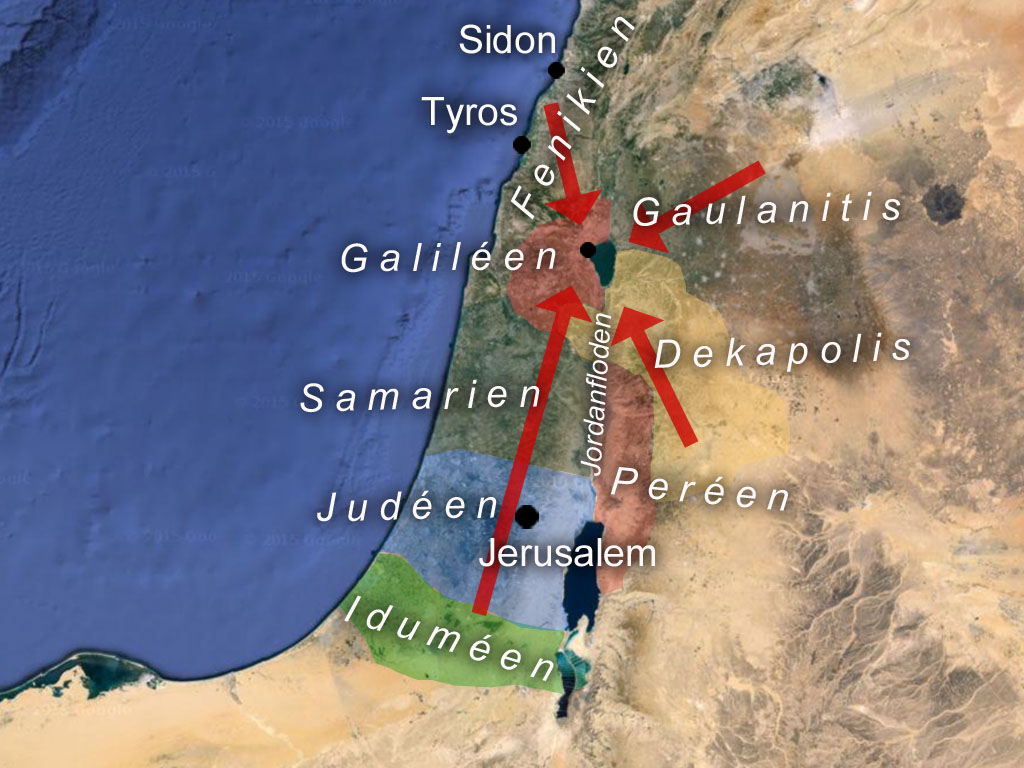
Those who followed Jesus came from all directions. The list begins with the surrounding area of Galilee, followed by the regions to the south, east, and finally northwest.
Show in atlas

Galilee is hilly, with many mountains and valleys. The picture is from the road leading up to Mount Arbel on the western side of the Sea of Galilee.
16Simon, whom he named Peter,
17James, the son of Zebedee,
John, the brother of James – Jesus gave them [James and John, the Hebrew] the name Boanerges, which means sons of thunder (tumult) [perhaps because of their hot temper, see ] –
18Andrew,
Philip [Greek word meaning "one who loves horses"],
Bartholomew [also called Nathanael],
Matthew,
Thomas [Hebrew word meaning "twin," see ; ],
James, son of Alphaeus,
Thaddaeus [Greek word meaning "one who has a warm heart" or "beloved child". He was also called Jude, son of James; he probably changed his name to avoid being associated with Judas Iscariot],
Simon "the Zealot" (fanatic, zealot, nationalist, Selot) [literally "Simon the Canaanite," the Aramaic equivalent of the Greek term "Zealot," both words meaning "the devoted, zealous, fanatical," may also indicate that he was involved in the Jewish resistance movement against the Roman Empire before becoming a disciple of Jesus],
19Judas Iscariot, the one who betrayed him. [Three groups emerge when the apostles are listed. Simon, Philip, and James are always mentioned as the first names in each group, see ; ; .] 20Then he went to a house [presumably Peter's house in Capernaum] and the people gathered again, so that he and his disciples did not even have time to eat. 21When his relatives [his family, see verses 31-32] heard about this, they went out to take him away by force (to arrest him) [and bring him back to Nazareth]. They said (repeatedly, their main topic of conversation was) that he was out of his mind (out of his senses). 22The scribes who had come down from Jerusalem [to Galilee] said that he was possessed by Beelzebub, and that it was through the prince of evil spirits that he cast out demons. 23He called them [the Pharisees from Jerusalem together with the local Jewish leaders in Capernaum] and spoke to them in parables (illustrations and comparisons to explain): "How can Satan cast out Satan? [Jesus explains the absurdity of this claim with two parables that everyone can agree with:] 24If a kingdom is divided (fighting against itself),
it cannot stand. 25If a family is divided (fights against itself),
it cannot [either] stand. [If this is true for nations and families, then it is also true for Satan:] 26If Satan rises up (rebels) against himself and is divided, he cannot stand and is finished. 27No one can enter and plunder a strong man's possessions unless he first binds the strong man. Then he can plunder his house. [Jesus likens himself to the one who is stronger than Satan and has bound him.] 28Truly, people will be forgiven for everything, for their sins and for their blasphemies, no matter how they blaspheme. 29But whoever blasphemes against the Holy Spirit will never be forgiven, but is guilty of an eternal sin." [Anyone who believes they have committed this sin most likely has not. This statement was directed at the Pharisees who said that God's goodness was the work of the devil and were about to fall into this grave sin. , with its amazing promise, is easily forgotten – "people will be forgiven for everything"!] 30They had said that he had an unclean spirit. 31Now Jesus' brothers [James, Joses, Jude, and Simon, see ] and his mother came. They stayed outside [Peter's house where Jesus was teaching] and sent for him. 32A large crowd sat in a circle around Jesus, and they said to him, "Look, your mother and your brothers are standing outside, asking for you." [Jesus' family had decided to come and take him away by force because they thought he had gone mad, see .] 33Then he answered them, "Who are my mother and my brothers?" 34And looking at those who were sitting around him, he said, "Here are my mother and my brothers. 35Whoever does the will of God is my brother and sister and mother."Jesus speaks in parables
1 (of 4) The Parable of the Soils – The Attitude of the Heart (Matt. 13:1-9, Luke 8:4-8)
41
A recently plowed field near the Sea of Galilee.
3"Listen! [Jesus both begins and ends the first parable with the exhortation to 'listen,' see . This invites the audience to participate, to stop their ongoing conversations and listen to the important message that follows.]A sower went out to sow. 4As he sowed, some seeds fell along the path,
and the birds came and ate them up.
5Other seeds (exactly the same seeds, with the same conditions) fell on rocky ground,
where they did not have much soil,
and they sprouted immediately because the soil was shallow.
6But when the sun rose, they were scorched,
and since they had no root, they withered away.
7Others (exactly the same seeds, with the same conditions) fell among thorns,
and the thorns grew up and choked them,
and they bore no fruit.
8Others (exactly the same seeds, under the same conditions) fell on good soil and yielded (again and again, continuously) fruit,
some thirty times (more than what was sown),
others sixty times more,
and some a hundred times more." 9He said, "Whoever has ears to hear, let him listen (take in and understand my teaching)." [Jesus explains the parable in verses 13-20. Israel has a subtropical climate. They sow during the autumn rainy season and harvest in the spring before the dry hot summer. The image for this parable is a field with a well-trodden path running straight through it. At the outer edges toward the mountain, the soil is thinner, and thorns grow toward the ditch edges. A sower spreads seeds by hand. The different types of soil are not visible to the naked eye because the entire field has recently been plowed. The parable does not say anything about the proportions of good and bad soil, but generally speaking, a field consists mostly of good soil.] 10As soon as he was alone, those around him, together with the twelve, began to ask him about the parables. 11He said to them, "The mystery (secret, hidden plan) of the kingdom of God has been given to you (you have been given the gift of understanding), but to those outside, everything is just parables. 12This is so that [the prophecy in would be fulfilled]: they will see with their eyes
but not perceive
and hear with their ears
but not understand,
so that they will not turn back (return)
and be forgiven."
13[The parable of the sower and this quote from Isaiah confused the disciples. Did Jesus deliberately hide the truth from some people by speaking only in parables?] 14The sower sows the Word. [The Word can refer to the message that Jesus preached or to Jesus himself. The parable is about how people respond to the message and to Jesus.] 15Those along the road are those who receive the word [in their hearts], but when they hear it, Satan immediately comes and takes away the word that was sown in them. [The word "road" can also mean ingrained ways of thinking, thought patterns, i.e., preconceived notions and misconceptions of God's word that become a hard surface that prevents the seed from penetrating the soil.] 16The same is true of those [people who are likened to the seed] who were sown on rocky ground, they are those who hear the word and immediately receive it with joy, 17but have no root in themselves. They endure for a while, but as soon as suffering (problems, hard pressure) and persecution (oppression) come because of the word, they immediately fall away (they take offense, the word becomes a stumbling block). 18Those who have been sown among thorns are those who hear the word, 19but worldly cares, the lure of wealth, and all kinds of desires crowd in and choke the word, so that it does not bear fruit. [The root word for "thorns" is extremes. There is a connection to teachings that emphasize a single truth one-sidedly, see .] 20Those who are sown in the good soil are those who hear the word and accept it and bear fruit thirty times what was sown, sixty times, and a hundred times as much.2 (of 4) The parable of the oil lamp – the message must not remain hidden (Luke 8:16-18)

Clay oil lamps were the usual source of light in Jesus' time.
3 (of 4) The parable of the growing seed—God's kingdom grows
26
Fields ripe for harvest.
first the leaf (the stalk),
then the ear (which protects the wheat grains),
then the fully developed wheat in the ear.
29When the harvest is ripe (literally "when the fruit allows it"), he immediately sends the sickle [he sends in the harvesters], for then it is harvest time."4 (of 4) The parable of the mustard seed—God's kingdom begins small (Matt. 13:31-32, Luke 13:18-19)
30Jesus said, "What shall we compare (liken) the kingdom of God to? What parable (image) shall we use to illustrate (explain) it? [Jesus involves his listeners in his sermon.] 31It is like a mustard seed. When sown, it is the smallest of all seeds on earth [among the herbs], 32but once it is sown, it grows and becomes larger than all the herbs and has such large branches that the birds of the sky can build nests in its shade." [The main point is the humble beginnings of the kingdom of God and its enormous growth potential.]Jesus explains the parables
33With many such parables he preached the word to them in a way they could understand. [The last part can also be translated "as far as they could understand."] 34He spoke to them only in parables, but when he was alone with his disciples, he explained everything (literally "unraveled," gave more information and explanations so that the spiritual truths in the parables became clear). [At this point, Jesus only used parables when speaking to the people; later, he also used other teaching styles, see, for example, ; . However, Mark emphasizes the importance of understanding Jesus' teaching, and for those who are indifferent or unwilling to understand, everything Jesus says remains incomprehensible parables.]Jesus' power
35
View of the northern part of the Sea of Galilee, seen from the Golan Heights on the eastern side.

Rock tombs have been found in Kursi on the eastern side of the Sea of Galilee. It may have been here that Jesus met the man who was severely tormented by the powers of darkness.
The man replied, "My name is Legion, for we are many." [Legion means thousands and is a Latin loanword for a large army. A Roman legion consisted of about 6,000 men. The term suggests both that the man had a large number of demons and that their nature was violent and warlike.] 10He begged Jesus many times not to drive them out of the area [the region of the Gerasenes, see ]. 11A large herd of pigs [about 2,000 pigs, see ] was grazing there by the mountain. [Pigs were unclean animals to the Jews.] 12All the unclean spirits begged him, "Send us into the pigs; let us go into them!" 13He gave them permission. Then the unclean spirits came out of the man and entered the pigs, and the herd rushed down the cliff into the lake. About 2,000 pigs drowned. 14Those who were tending them fled and told this in the city and in the countryside. The people there came out to see what had happened. 15When they came to Jesus and saw (looked closely at) the man who had been possessed by the legion sitting there, clothed and in his right mind, they were afraid. 16Those who had witnessed it told the people in detail what had happened to the possessed man and what had happened to the pigs. 17Then they asked Jesus to leave their area. [The economic value of the pigs was somewhere around seven years' wages. The owners cared more about the economic loss than the fact that a tormented man had been healed.] 18As Jesus was getting into the boat, the man who had been possessed asked to go with him. 19But Jesus did not allow it, saying, "Go home to your family, your relatives, and your countrymen, and tell them everything the Lord has done for you and how he has had mercy on you." 20The man went away and proclaimed throughout the Decapolis (the area of the ten cities) all that Jesus had done for him, and everyone was amazed (surprised, shocked). [The formerly demonized man now becomes the first Gentile evangelist mentioned by Mark. The Decapolis was a region consisting of ten loosely connected cities east of the Jordan River and the Sea of Galilee. They had been freed from Jewish rule in 63 BC when the Roman general Pompey conquered the area. Pigs were sometimes used as sacrificial animals in pagan temples. The worst example in Jewish history was when Epiphanes desecrated the temple in Jerusalem and sacrificed pigs on an altar to Zeus in 167 BC.]Jesus raises Jairus' daughter and heals a sick woman (Matt. 9:18-26, Luke 8:41-56)
21When Jesus had returned by boat to the other side of the lake [presumably back to Capernaum], a large crowd gathered around him where he was by the lake. 22Then one of the synagogue leaders, named Jairus, came there. When he saw Jesus, he fell at his feet 23and begged him earnestly, "My little daughter [twelve years old, see ] is dying. Come and lay your hands on her, so that she may be saved and live." 24
In the crowd around Jesus, the woman touches the hem of his cloak. The painting, called "Encounter," is in a chapel in Magdala. The chapel is designed like a synagogue and is located on the lower floor of the large church "Duc In Altum" (Latin for "put out into the deep," from Luke 5:4), built in 2014. The floor of the chapel is the stone pavement excavated from the fish market of the city, which is several thousand years old.

Picture of a man praying at the Western Wall in Jerusalem, wearing a prayer shawl, tallit, with four corner tassels.
Those who were crying and lamenting were probably hired mourners. Rabbi Judah, who lived a century after Jesus, writes that even the poorest in Israel should hire at least two flute players and one mourner. The statement referred to a husband's responsibility at his wife's funeral, but we can assume that a similar custom existed when children died. Matthew's description explicitly mentions flute players, see . As a synagogue leader, Jairus was a well-known and highly respected person in the community. Since it was known that his daughter was dying, , and the funeral was to take place quickly before sunset, it is likely that the mourners and flute players were already in place and ready to begin their lamentation as soon as the girl died. 39When he entered, he said to them, "Why all this commotion and weeping? The little girl is not dead; she is asleep." 40Then they began to laugh at him (mock him).
After he had sent them all out, he took (under his guidance) the child's father and mother and his disciples [Peter, James, and John] and went in where the child was lying. 41He took her firmly by the hand and said to her [in Aramaic, the language spoken by Jesus and his disciples], "Talitha koum!" This means, "Little girl, I say to you, get up!" 42Immediately the girl got up and began to walk around; she was 12 years old. Her parents were immediately overcome with emotion (they were beside themselves; "in ecstasy" – Gk. ekstasis). 43But he strictly forbade them to let anyone know what had happened. Then he asked them to give her something to eat. 61
The entrance to a modern reconstruction of the Nazareth synagogue in the Nazareth Village open-air museum.
"Where did he get these ideas?
What wisdom has he received [without having been taught by any rabbi]?
How can he perform such powerful deeds with his hands? 3Isn't he the carpenter, the son of Mary and the brother of James, Joses, Jude, and Simon? [The Greek word tekton, often translated as carpenter, can also mean stonemason.] Do not his sisters live here with us?" They took offense at him (rejected his authority; he became a stumbling block). 4Then Jesus said to them, "A prophet is not despised (but honored, respected), except in his hometown and among his own family (his own house)." 5He could not do any mighty work there, except that he laid his hands on a few sick (weak) people and healed them. 6He was amazed at their unbelief. [Jesus' human side is visible here as he is surprised and astonished at their lack of faith in him.] He went on to the villages (around Nazareth in Galilee, as in a circle) and taught.Jesus' ministry in Galilee (6:7-7:23)
7
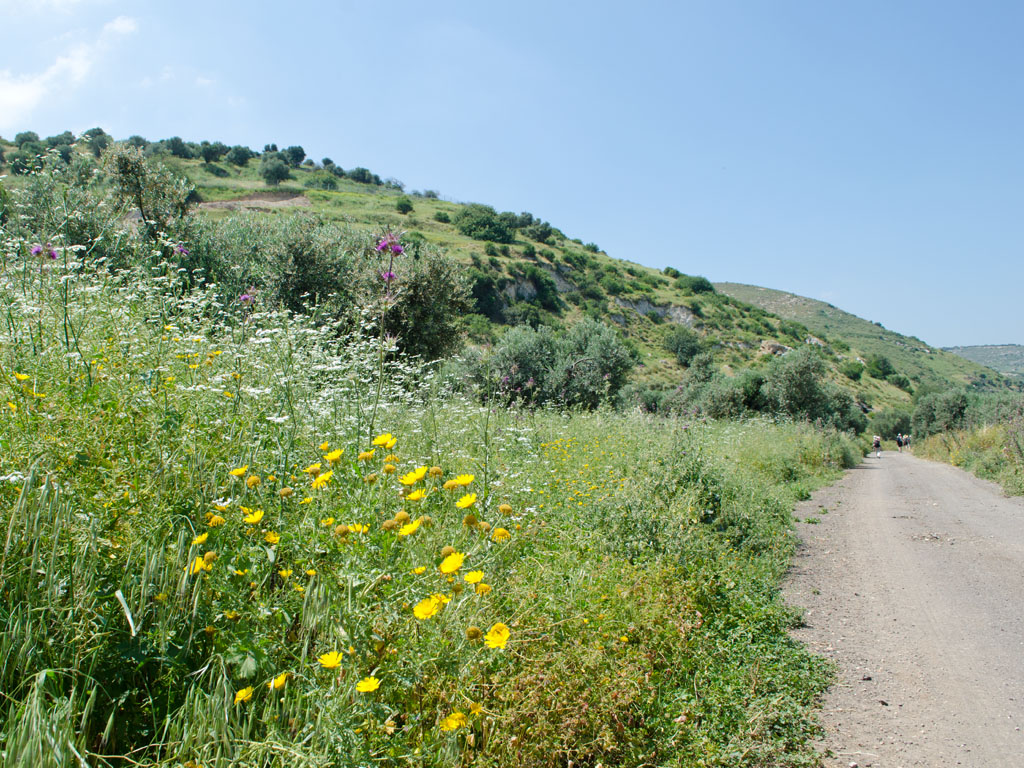
One of the roads between Capernaum and Nazareth through the hilly landscape of Galilee, which is green in the spring.

Herod Antipas ruled over Galilee and Perea and lived in Tiberias, which he had built in 20 CE.
Show in atlas

High up on the mountain, the remains of Herod's fortress Machaerus can be seen on the eastern side of the Dead Sea. In the background on the other side is the Judean desert.
©Khaled Al-Bajjali
"Ask me now for whatever you want, and you shall have it." 23He promised and swore an oath: "Whatever you ask me, I will give you, even if it were half my kingdom." 24[The men were in one banquet hall and the women in another.] Then she went out and asked her mother, "What shall I ask for?" She replied, "The head of John the Baptist." 25She immediately rushed back to the king and asked him, "I want you to give me the head of John the Baptist on a platter right now." 26The king was deeply saddened, but for the sake of his oath and his guests, he did not want to refuse her 27but immediately sent a guard [one of his personal soldiers] with orders to fetch John's head. The soldier went and beheaded him in prison 28and then brought his head on a platter and gave it to the girl, and the girl gave it to her mother. 29When John's disciples heard this, they came and took his dead body and laid it in a tomb. 30
View of the northern part of the Sea of Galilee, seen from Korazin.
He began to teach them many things (many different subjects and areas). 35When the day was already far spent [after three in the afternoon], his disciples came to him and said, "This place is uninhabited, and the hour is already late. 36Rev and send them away so they can buy something to eat in the countryside and in the towns. 37But he replied, "You can give them something to eat!"
They replied, "Should we go and buy bread for 200 denarii [daily wages] and give them something to eat?" [A denarius was a common worker's daily wage, see . Two hundred denarii was equivalent to eight months' wages. At once, the disciples began to calculate how much it would cost to buy food for the people. Presumably, the food would cost that much, and it is not unlikely that they had that amount in the treasury. It is difficult to compare with today's prices, but if a day's wage is $100, then two hundred days' wages would be $4 per family, if there were 5,000 families gathered there.] 38He said to them, "How many loaves do you have? Go and see!"
When they had found out, they replied, "Five loaves and two fish." 39
Planting at the entrance to the Jerusalem Botanical Garden. The area features a "biblical trail" with many of the plants mentioned in the Bible.

Jesus walks on water. Painting by Russian artist Ivan Aivazovsky.
The sick are brought to Jesus (Matt. 14:34-36)
53When they had crossed the lake, they came to the region of Gennesaret [which was a fertile plain south of Capernaum]. They anchored a little way off. 54When they got out of the boat, the people immediately recognized him [as the one who heals people]. 55They ran around to the sick throughout the whole region and carried them out on their beds to where they heard he was. 56And wherever he went, to villages, towns, or the countryside, they laid the sick in the marketplaces [the open marketplaces in the towns and villages] and begged him to let them at least touch the tassel of his cloak [as the woman with the bleeding had done, see ]. And all who touched him were healed.God's Commandments and Human Rules (Matt. 15:1-20)
71
Ceremonial hand washing at the Western Wall in Jerusalem.
5The Pharisees and the scribes asked him, "Why do your disciples not live according to the tradition of the fathers, but eat bread with unclean hands?" [The criticism was directed at the disciples' behavior, but it applied to Jesus. Who did he think he was, disregarding centuries of Jewish tradition?] 6He replied, "Isaiah was right when he prophesied about you []: This people honors me with their lips (they say the right things),
but their hearts are far from me. 7Their worship is completely meaningless (vain),
because they teach human doctrines (teachings). 8You have abandoned (renounced) God's commandments (instructions) but hold fast to human traditions." 9He also said to them, "In an elegant way, you completely abolish God's commandments so that you can hold on to your own statutes! 10Moses said [in one of the Ten Commandments, see ; ]: 'Honor (value, respect) your father and your mother'
and [where the violation of this commandment is described in ]:
'Anyone who curses (curses) his father or mother shall be put to death. 11But you say that if a man says to his father or mother, 'What I could have helped you with is instead korban,' [As in verses 3-4, Mark explains the Jewish concepts to his readers.] Korban is [the Hebrew word for] a temple offering. [This was a type of vow offering where the giver promised to give a gift at a later date, but managed the money until the promise was fulfilled.] 12In this way, he does not need to show respect for his father or mother. Thus, you nullify the word of God because of your tradition. [According to the Pharisees' rules, the giver was released from the responsibility of supporting his parents, which clearly violated the commandment to honor one's parents (). The Pharisees were well aware that these systems were being abused, but as long as it generated income for the temple, they turned a blind eye.] 13You nullify the authority of God's word through the traditions (ordinances) that you have inherited and passed on. This is just one of many examples of how you constantly do this.What is clean and what is unclean?
[The people had withdrawn when the Pharisees and scribes arrived, see . Perhaps they did so voluntarily out of respect and reverence for their leaders, or perhaps the visitors from Jerusalem pushed their way forward and took over the scene.] 14When Jesus had called the people back, he said to them: "Listen to me and understand [what I am saying]!
15Nothing that enters a person from the outside [food eaten without ceremonially clean hands] can make them unclean.
No, it is only what comes out of a person that makes them unclean." 17When he had left the crowd and entered the house [presumably Peter's house in Capernaum], his disciples asked him about the parable [it was Peter who raised the question, see ]. 18He replied, "Are you also completely without understanding (unable to comprehend)? Do you not realize that what enters a person from the outside cannot defile them, 19since it does not enter his heart but his stomach and then goes out into the latrine?"
With that, he declared all foods clean. [This is an explanation and conclusion that Mark adds when he writes the Gospel. It would be several years before Peter understood this statement by Jesus, see .]
20Jesus said, "It is what comes out of a person that makes them unclean. 21For from within, from the heart of men, come forth: [Jesus had explained the first part of the statement in – that it is not food that enters a person that defiles them, see verses 18-19. Now he explains what the second half of the statement means, what it is that defiles. It is the evil that comes out of a person's heart and mind that defiles them. It is a list of thirteen points. The first seven points are all in the plural, suggesting that they are repeated actions. The last six are in the singular.]
evil thoughts,
illicit sex (fornication) [plural], [The Greek word porneia is used here, and the root word means "to sell oneself into slavery." Our word "pornography" is a compound word made up of this very word porneia and grafo, which means "something written or drawn," i.e., a description either in text or graphically of someone selling themselves sexually. The word porneia is often translated as fornication and is a general term for all sexual impurity. When the words fornication and adultery are mentioned in the same list, fornication refers to an unmarried person who has sexual relations with others, while adultery refers to a married person who is unfaithful in their marriage.]
theft [plural],
murder [plural],
22adultery [plural] (a married person who is unfaithful in their marriage),
covetousness [plural] (greed for more and more material wealth),
malice [plural] (all kinds of destructive evil that seeks the downfall of oneself and others),
deceit (fraud), promiscuity (frivolity in all areas of life),
envy (literally "evil eye," describing someone who, out of jealousy, actively seeks opportunities to cause problems for others),
blasphemy (abusive, harshly contemptuous speech),
pride (arrogance toward God and other people)
and foolishness (stupidity, recklessness). 23All these evils come from within and make a person unclean."Jesus to Gentile regions (7:24-8:10)
24
Jesus travels west to the area around the coastal city of Tyre.
Show in atlas

Jesus moves from the coastal region of Phoenicia to the Decapolis on the eastern side of the Sea of Galilee.
Show in atlas
[This was not the first time Jesus did not want those who had been healed to tell others about it, see ; ; ; ; ; , ; . Sometimes the commotion surrounding the healings meant that Jesus could no longer remain in the cities, see . After the first miracle of feeding the multitude, the people wanted to force him to become king, see ; . There are also examples where Jesus encourages the healed to tell others. A man who had been freed was urged to tell others about his deliverance in the Decapolis region, see . Jesus was consistent; on occasions when he knew that spreading rumors about the miracles would counteract his purpose, he asked those who had been healed not to spread the word. On other occasions, he encouraged people to spread the message about him.
Jesus knew that his primary mission here on earth was the cross. Physical healing is temporary. What good is it for a person to gain the whole world but lose their life, see . At the same time, Jesus always feels compassion for individuals and cannot help but intervene, see . We know that Jesus was led by the Holy Spirit and did good and freed all who were bound, see . The miracles confirmed who he was, see , and after healing on the Sabbath, Jesus says that he is only doing his Father's will, see .] 81[This is the second miracle of the loaves. Earlier that spring, Jesus had performed a miracle of the loaves for 5,000 Jude on the western side of the Sea of Galilee, see . Although Mark does not specify where the second feeding miracle takes place, it is likely that Jesus is somewhere on the eastern side of the Sea of Galilee. The phrase "at that time" links the event to Jesus' journey outside the Jewish areas to Tyre and Sidon and then back via Decapolis, see .]At that time [when they were on the eastern side of Lake Galilee], a large crowd had gathered again, and they had nothing to eat. So Jesus called his disciples to him and said to them, 2"I feel compassion for the people (from the bottom of my heart); they have been with me now for three days and have nothing [left] to eat. 3If I send them home without food, they will become exhausted [and collapse] on the way home. Some of them have come from far away." [Many had come from towns and villages. It was the third day. They may have brought a little food for a day or so, but they were more concerned with being healed and hearing Jesus' teaching than thinking about their need for food. It had been a few weeks since the last miracle of the loaves, which took place at Easter when the grass was green after the rains, see . At this time of year, most of the grass is burnt away and the temperature is well over thirty degrees during the day. Jesus cares about the well-being of the people so that they can make the journey home in the heat.] 4The disciples said to him, "Where can we find enough bread here in the wilderness [in these uninhabited areas] to feed all these people?" 5He asked, "How many loaves of bread do you have?"
"Seven," they replied. 6He commanded the people to sit down on the ground. After taking the seven loaves and giving thanks to God, he broke them and gave them to the disciples (the giving continued continuously) so that they could distribute them, and they distributed them to the people. 7They also had a few small fish. After he had asked God's blessing over them, he said that they should also be distributed. 8Everyone ate and was satisfied, and seven large baskets of leftover pieces were collected. [Here, a different word for basket is used than in the miracle of the 5,000 men. These seven baskets were large baskets, the word is used, for example, in , and could hold a person.] 9There were about 4,000 who had eaten [excluding women and children, see ]. Then he sent them home, 10and immediately got into the boat with his disciples and went to the region of Dalmanutha. [On the western side of the Sea of Galilee, just north of Tiberias. The area around the city of Magdala, see .]Back in Galilee
11
Mount Arbel rises behind Magdala on the western side of the Sea of Galilee.
Jesus warns against false teachings (Matt. 16:5-12)
14They [the disciples] had forgotten to bring bread [probably because of the hasty departure]. They had no more than one loaf of bread with them in the boat. 15
Sourdough has long been used in baking. In 2019, amateur Egyptologist Seamus Blackley (also known as the creator of Xbox) used substance from bread found in Luxor from Pharaoh Mentuhotep II, who reigned from 2046 to 1995 BC, and baked bread with the sourdough.
"Twelve," they replied. 20[Jesus continues:] "And after the seven loaves for the 4,000, how many large baskets full of leftovers did you get then?"
"Seven," they replied. 21He said, "Do you still not understand?" [Jesus was not talking about ordinary bread but was referring to the Pharisees' twisted teachings and Herod's wickedness, see . Why worry about bread when they had the Creator of heaven and earth in the boat – the one who had already shown them many times that he could miraculously provide for them!]A blind man outside Bethsaida is healed
22
Three of Jesus' disciples (Peter, Andrew, and Philip) came from this fishing village in the northern part of the Sea of Galilee. Two different sites have long been candidates for Bethsaida: the traditional Et Tell, 2 km north of the lake, and El Araj, located right next to the Jordan River at its outlet into the Sea of Galilee. The first excavations in El Araj began in 2014, and in 2021 a mosaic floor was found in a 1,500-year-old church. This church is probably the one mentioned by Willibald, an English bishop from Eichstaett, who visited the area around 725 AD and mentions that he visited a church built in Bethsaida, the hometown of Peter and Andrew.
Then Peter answered, "You are the Anointed One (Messiah, Christ)." 30But he forbade them to tell anyone. 31Then he began to teach them [for the first time] that the Son of Man must suffer many things (it is absolutely necessary) and be rejected by the elders and chief priests and scribes, and that he must be killed and rise after three days. 32He spoke plainly (openly, so that there could be no misunderstanding) about this. Then Peter took him aside and began to rebuke him sternly. 33But Jesus turned around [and turned his back on Peter], looked at his disciples, and rebuked Peter, saying, "Get behind me, Satan! What you are thinking is not God's thoughts but human thoughts." 34Then he called the crowd to him, along with his disciples, and said to them:
"If anyone wants to follow (walk behind) me
he must deny (completely reject; say no to; renounce) himself [his own agenda]
and take up his cross
and follow me (be/walk with me on the path) [become my disciple]. [A disciple of Jesus must leave his own behind, walk in the footsteps of the Master, and follow his example in everything – yes, even be prepared to suffer and die for his sake.] 35For whoever wants to save (would like to preserve) his life,
will lose (destroy; totally ruin) it,
but whoever loses (would now lose anyway) his life for my sake and for the sake of the gospel (the good news),
he will save (he is the one who will preserve) it. [Gk. psuche means both life and soul and is used in both senses here in verses 35-37, see also . To 'deny oneself' in is not about a lack of self-esteem and self-confidence. Jesus' followers have reason to have a better self-image than anyone else. The fatherly love God feels for his children is enormous and is not based on deeds but on childhood, see , etc. Earlier in the Beatitudes, Jesus had preached about the heavenly reward and what it means to gain life, see . Based on "gaining the whole world" in , self-denial is about putting God and his kingdom first.] 36For what does it profit a man to gain the whole world
and [at the same time] lose (forfeit) his life (his soul)? 37What would a person give in exchange for his life (as a ransom for his soul)?
38For whoever is ashamed [would feel personal shame] of me and my words in this unfaithful and sinful generation,
the Son of Man will also be ashamed of him
when he comes [at the time when it is time for him to come] in his Father's glory with the holy angels [to establish the millennial kingdom, see ]."
91Jesus said to them, "I tell you the truth, some who are standing here will not taste (meet) death until they see the kingdom of God come in [its] power." [Possible explanations for this verse are that it refers to the day of Pentecost, when the Holy Spirit was poured out. However, it is more likely that it is a prediction of the next event a week later, when three of the disciples will see a glimpse of Jesus in his glory in his kingdom, see . It can hardly be a prediction of Jesus' second coming, since Jesus never claimed to know the time of this, see . At the Ascension, the disciples pressed him for an answer as to when he would establish the kingdom, but Jesus asked them to focus instead on being useful here and now, see .] 2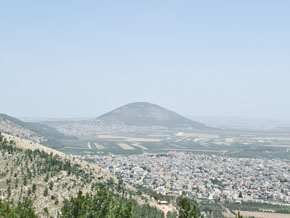
The picture was taken just outside Nazareth, looking east towards Mount Tabor (Tavor) rising alone on the Jezreel Valley.
[The Bible does not specify which mountain this took place on. They had recently been in Caesarea Philippi in the north, see , and afterwards it is mentioned that they are in Galilee, see . The two most common alternatives suggested by Bible scholars are the high mountain Hermon in the north, not far from Caesarea Philippi, or Mount Tabor in southern Galilee, which can be reached in four days from Caesarea Philippi.]His appearance was transformed before them, 3and his clothes became dazzling white (glittering, sparkling) like snow, so white that no fuller in the world could bleach them. [A fuller was a person who cleaned or bleached fabric that was to be dyed, see also ; ; ; .] 4Then Elijah appeared to them with Moses, and they were talking with Jesus. [Six days after Peter's words that Jesus is the Messiah, see , three of his disciples see how Jesus' human nature fades and his divinity shines through. Moses and Elijah represent the Old Testament. Together, they confirm that Jesus is the one who fulfills the teachings (Torah) and the promises of the prophets.] 5Peter answered [even though no one had asked him, he interrupted their conversation] and said to Jesus, "Master, it is good (wonderful) for us to be here. Let us make three huts [he was probably referring to the huts that were built during the celebration of the Feast of Tabernacles], one for you, one for Moses, and one for Elijah." 6He did not know what to say, so terrified [by what they saw] were the disciples. [Although this event probably takes place in the spring, Peter makes connections to the Feast of Tabernacles, Sukkot, which is celebrated in the fall. During this festival, people build huts with roofs of leaves under the open sky to commemorate the Israelites' journey through the desert after their exodus from Egypt. According to Jewish belief and tradition, the festival is also associated with both the coming of the Messiah and the beginning of the Messianic age, see . These connections to messianic expectation are clear when Jesus visits Jerusalem during Sukkot, see, for example, , , , .] 7Then a cloud came and overshadowed them, and a voice came from the cloud, saying, "This is my Son, my beloved. Listen to him always (hear and learn from him all the time)!" [The cloud is an image of God's presence. In the Old Testament, it covered the tabernacle, see , and rested over the temple in Jerusalem, see .] 8Suddenly, when they looked around, they saw no one except Jesus. 9On the way down the mountain, he instructed (forbade, warned) them not to tell anyone what they had seen until the Son of Man had risen from the dead. [Peter writes about this experience on the mountain more than 35 years later, see .] 10They kept this to themselves and discussed among themselves what it meant to rise from the dead. 11They asked him, "Why do the scribes say that Elijah must come first?" 12He replied, "It is true that Elijah comes first [before the Messiah] and restores everything [as it is written in Mal. 4:5-6]. Why does it say that the Son of Man must suffer greatly and be despised (treated without respect)? 13I tell you that Elijah has already come, and they did to him whatever they wanted, just as it is written about him." [Jesus is referring to John the Baptist, whom Herod Antipas had imprisoned and killed, see .] 14[A day has passed since Jesus took three disciples up the mountain, see .]
15As soon as all the people saw Jesus, they were amazed (seized with awe) [his face and person were still shining] and ran forward to welcome him. 16He asked the scribes, "What are you discussing with them (what are you arguing and questioning)?" 17A man from the crowd answered him, "Teacher, I brought my son to you because he has a mute spirit (a demon that prevents him from speaking). 18When it takes hold of him (becomes his master), it throws him down, and he foams at the mouth, grinds his teeth, and becomes stiff (has convulsions). I asked your disciples to drive it out, but they could not (did not have the power)." 19Jesus answered them, "O faithless generation (a generation that does not want to believe)! How long must I be with you? how long will I tolerate (accept, endure) you? Bring him to me!" 20So they brought him to Jesus. As soon as the spirit (demon) saw Jesus, it began to convulse and shake the boy, and he fell to the ground and rolled around repeatedly, foaming at the mouth. 21Jesus asked his father, "How long has this been happening?" He replied, "Ever since he was a child. 22The demon has often thrown him into fire and water to try to kill him. But if you can (have the power and ability) [to do anything], have mercy on us [my son and me] and help us (come quickly, we are crying out for help to be healed)!" 23Jesus said to him, "If you can (have the power and ability) [to do anything], say it." All things are possible to (all things are possible for) those who believe. 24Immediately the boy's father cried out (with a broken voice, uncontrollably) in tears, "Lord, I believe (trust, rely on you)! Help my unbelief (come quickly to my aid and heal my unbelief, whenever I am weak in faith)!" 25Now when Jesus saw that a large crowd of people were running toward them, he spoke sternly to the unclean spirit (demon) and said to it, "You mute and deaf spirit (demon), I command you to leave him and never enter him again!" 26The demon screamed and struggled and violently shook the boy and came out. The boy lay [still and lifeless] like a corpse, and many said he was dead. 27But Jesus took him firmly by the hand and began to lift him up, and he got up. 28When Jesus had gone indoors (entered a house) and the disciples were alone with him, they asked, "Why couldn't we drive it out?" 29He replied, "This kind [this family of demons] cannot be driven out except by prayer and fasting." [The last part, "and fasting," is missing in some later manuscripts. Lack of prayer (and also fasting) reduces fellowship with God. This leads to a shift in focus from faith in God's power to one's own limited ability. The disciples had already been given authority to cast out demons in .]Jesus speaks again about his death and resurrection (Matt. 17:22-23, Luke 9:43-45)
30They left there and walked through Galilee [without passing through the cities]. He wanted to avoid attention (did not want anyone to know), 31because he was teaching his disciples [and was in the middle of an important topic]. He said to them, "The Son of Man will be handed over to men [present tense; it is something that has already begun to happen], and they will kill him, but when he is killed, he will rise again after three days." 32But they did not understand what he was saying and were afraid to ask him [what it meant].Jesus teaches his disciples
33
Even today, you can visit Capernaum, Jesus' hometown.
Be inclusive – whoever is not against us is for us (Matt. 10:40-42, Luke 9:49-50)
[John, the youngest disciple, remembers a time when they tried to stop a man who did not do things exactly the same way they did. Now he asks Jesus if they had been too critical in condemning him.] 38John said to him, "Teacher, we saw someone who does not follow us casting out demons in your name, and we tried to stop him because he was not with us (one of your disciples)." 39But Jesus said, "Do not stop (forbid) him! No one who performs a miracle (powerful deed, mighty wonder) in my name can immediately afterward speak ill of me. 40Whoever is not against us is for us. 41 Anyonewho gives you a cup of water in my name because you belong to the Anointed One (Messiah, Christ) will certainly not lose his reward.
[In the midst of Jesus' teaching on humility, see verses 33-37, and the warning not to lead any of these little ones astray, see , comes this incident where the disciples tried to stop someone who was working for Jesus. A similar incident had happened centuries earlier when Moses called seventy elders and they received the gift of prophecy. Eldad and Medad were not among them, but they prophesied nonetheless. Joshua tried to get Moses to stop Eldad and Medad, but Moses replied, "Are you jealous for my sake? I wish that all the Lord's people were prophets and that the Lord would put his Spirit on them all!" See .]Watch over your life so that you do not lead anyone astray (Matt. 18:6-9, Luke 17:1-2)
42
In Capernaum, millstones were made from volcanic basalt, which is common in the area. The coarse texture is well suited for grinding wheat.
It is better for you to enter life maimed
than to have both hands and go to Gehenna (hell). 44The earliest manuscripts do not include : "Where their worm does not die, and the fire is not quenched." Identical to . 45If your foot causes you to sin, cut it off!
It is better for you to enter life lame
than to have both feet and be thrown into Gehenna (hell). 46The earliest manuscripts do not include : "Where their worm does not die, and the fire is not quenched." Identical to . 47If your eye causes you to sin, tear it out!
It is better for you to enter the kingdom of God with one eye
than to be thrown into Gehenna (hell) with both eyes intact. 48where their worm [the worm that eats them] does not die, and the fire is not quenched.' [Quote from – the last verse in Isaiah in a passage that speaks of 'new heavens and a new earth', see .] [The point is to counteract sin by all means, not to expose oneself to tempting situations, to throw away things that lead astray. It is our lack of self-control that is the problem. Jesus says "it is your hand, your foot, your eye" – take responsibility.]
49
A Christian is likened to salt and is supposed to influence their surroundings.
Jesus goes to Judea and Pereen (Matt. 19:1)
101Then he left there [from Capernaum in Galilee] and went to the region of Judea and the country across the Jordan. People gathered around him in crowds again, and he taught them as he used to. [A similar opening phrase is used in and describes a longer journey. Jesus crosses the Jordan River and now heads east and probably also down to Perea, the area east of the Jordan River and the Dead Sea.] 2
The Pharisees were often critical of Jesus.
"Because your hearts are so hard, he gave you that commandment. 6In the beginning of creation,
'God created them male and female.'
[] [Jesus takes the discussion to a higher level. Marriage was established long before Moses received all the commandments and instructions on Mount Sinai. God's original intention for marriage is evident in creation.] 7Therefore a man shall leave [his emotional and financial dependence on] his father and mother
and cleave to (be united with) his wife, 8and the two shall become one flesh.' []
So they are no longer two, but one flesh.
9What God has joined together,
let no man put asunder." 10When they had entered the house [where they lived somewhere in Judea or Perea], the disciples asked him about this again [they brought up the subject again]. [Several times before, Jesus had given deeper teaching to the disciples in a house. The phrase "in the house" used here and in ; , becomes a symbol of spiritual revelation. Mark and his readers/listeners must undoubtedly have thought of their own homes where the congregation met.] 11He replied, "Anyone who divorces his wife and marries another woman commits adultery against her. 12If she divorces her husband and marries another man, she commits adultery. Marriage is "until death do them part," see ; . As in the Sermon on the Mount, Jesus sets a higher standard than Moses. The only reason for divorce for believing couples is unfaithfulness. Paul also mentions a case where one person is saved and the other wants to divorce. In that case, it cannot be prevented, see . God hates divorce, see Mal. 2:16, because he personally knows the deep pain it causes, see Jer. 3:8. It is interesting that in the next paragraph, Jesus highlights and blesses children, who often suffer in a divorce. 13People brought little children (ages 2-11) to him so that he might touch them, but the disciples rebuked them (repeatedly) without success. 14When Jesus saw this [from inside the house where he was, see ], he was upset (he felt deep pain and anger because something wrong was happening), and said to them, "Don't stop the children from coming to me, because God's kingdom belongs to people like them. 15I tell you the truth: Anyone who does not receive (welcome, accept) the kingdom of God like a child [who completely trusts and depends on his parents] will never enter it." 16He took them (one by one) in his arms and blessed them passionately (sincerely, tenderly) by laying his hands on them. [The parents probably hadn't expected anything as grand as Jesus blessing them, but only a quick touch as suggests, but Jesus goes further and takes them one by one in his arms and blesses them heartily.] 17
The stone tablets with the Ten Commandments in the Ark of the Covenant. Photo from the model of the tabernacle in Timna Park.
"Why do you call me good?
There is no one good except one,
and that is God!
19You know the commandments (instructions):
You shall not murder.
You shall not commit adultery.
You shall not steal.
You shall not bear false witness (speak untruthfully).
You shall not defraud (cheat) anyone through dishonesty.
Honor (value, respect) your father and your mother." [Jesus quotes the commandments from the second stone tablet, which deal with our relationships with our fellow human beings, see ; . Two commandments are given extra attention. Instead of starting with the commandment "honor your father and mother," Jesus chooses to put this last. The commandment "do not covet anything that belongs to your neighbor" is not included; instead, deception, cheating, and dishonesty are mentioned, which clearly refer to this commandment. Perhaps Jesus wanted to highlight these two commandments and help the young man examine his life. How had he treated his parents? Had he been completely honest in his business dealings?] 20Then he answered him, "Teacher, I have kept all these things wholeheartedly (guarded) since I was young." [He believed he had kept the commandments ever since he became morally competent, which was at the age of thirteen. In today's Judaism, this occurs at the bar mitzvah, which means becoming a "son of the commandment." That Zechariah and Elizabeth followed the Lord's commandments and precepts is referred to as something positive in . In , it is also apparent that the man feels that something is missing. The question he seems to be asking is why he has not yet found peace in his heart, even though he has tried to keep all the commandments.] 21As Jesus looked at him, he felt deep love (which was selfless, giving) for him and said, "One thing you lack (one thing remains; prevents you from reaching your goal – Gk. hustereo), go and sell everything you own and give the money to the poor, and you will receive treasure (wealth) in heaven. Then come and follow me (walk the same path that I walk)!" 22At these words, the man's face darkened [Greek metaphor for when a storm is coming, the root word also means to feel hatred], and he went away sad, for he owned many things. [The word for "owned many things" was often used to mean owning land and real estate.] 23
Jesus' parable that it is easier for a camel to pass through the eye of a needle than for a rich man to enter the kingdom of God puzzled his disciples.
"I tell you the truth (truly, amen):
Anyone who has left
houses [plural], brothers, sisters, mother, father, children, or lands
for my sake and for the sake of the gospel 30will receive a hundredfold.
Even now, in this age, he will receive
houses [plural], brothers, sisters, mothers, children, and lands
in the midst of persecution,
and eternal life in the age to come. [Everything in the list is mentioned in the plural, even mothers. However, fathers are not mentioned, which probably indicates that there is only one Father who is in heaven, see .] 31Many who are [now] first will [then] be last,
and many who are [now] last will [then] be first." On the way to Jerusalem
32
The Jordan Valley. In the background are the Judean Mountains and the road up to Jerusalem.

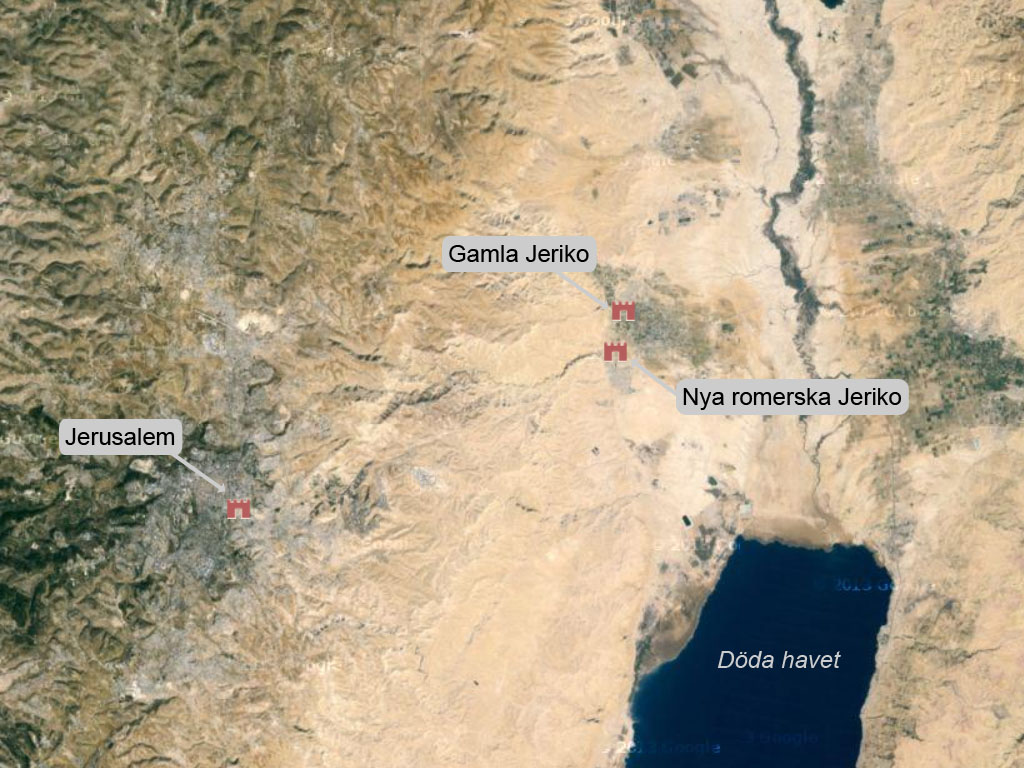
Herod the Great built the new Roman Jericho just south of the old city of Jericho.
Another difference, which is also not a contradiction, is that Matthew writes that there were two blind men, while Mark and Luke write that there was only one. Of the two men who received their sight, Mark chooses to focus on the one blind man named Bartimaeus.] 47When Bartimaeus heard that it was Jesus from Nazareth, he began to shout (again and again), "Jesus, Son of David, have mercy on me (show me grace and compassion, at once)!" 48Many people sharply rebuked him (gave him a clear warning) to be quiet, but he only shouted even more (called out uncontrollably): "Son of David, have mercy on me." 49
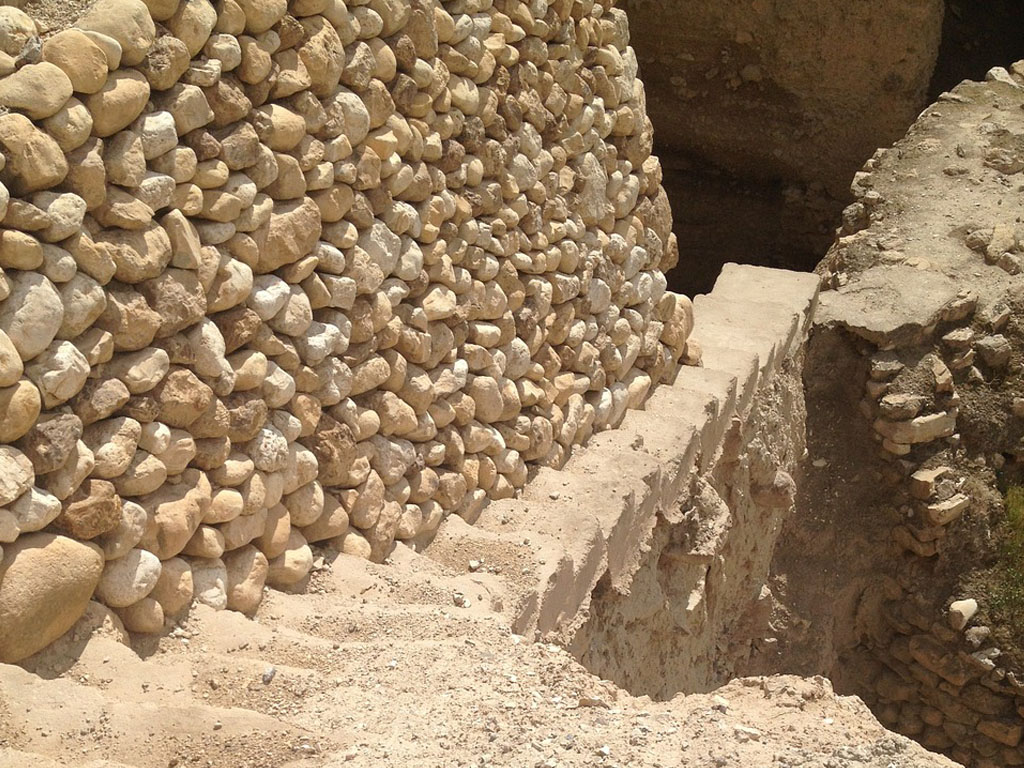
Excavations from the ancient city of Jericho (Tell es-Sultan). It is one of the world's oldest cities, and also the lowest, 258 meters below sea level.
They called the blind man and said, "Take heart (be calm)! Get up! He is calling you!" 50He threw off his outer garment, jumped up, and came to Jesus. [Bartimaeus leaves everything he has, unlike the rich man, see .] 51Jesus asked him, "What do you want me to do for you?"
The blind man answered him, "Rabbouni [Aramaic word meaning 'my great Master'], let me regain my sight." 52Jesus said to him, "Go [you are free to go wherever you want], your faith has healed (saved) you." Immediately he received his sight and [did not go back but] followed Jesus on the road. 
Bedouin with a donkey in Jerusalem.
The last week of Jesus' life occupies one third of the Gospel of Mark. Three festivals are celebrated in the Jewish spring month of Nisan. The first is Passover, which begins on the afternoon of the 14th of Nisan. Jewish days begin in the evening, so a few hours later it is the next day, the 15th of Nisan, and the first day of the Feast of Unleavened Bread. Two or three days later, the Feast of Firstfruits, Bikkurim, is celebrated. In the year 30 CE, Bikkurim falls on Sunday, the 17th of Nisan, which is the third day of the Feast of Unleavened Bread. A summary based on the time indications in the Gospels and how the feast days fall in the year 30 CE could be: 8th of Nisan Jesus arrives in Bethany six days before the feast, see
9th of Nisan Weekly Sabbath
10th of Nisan Entry into Jerusalem, see
11th of Nisan The next day – the fig tree is cursed, the temple is cleansed, see
12th of Nisan
Morning – the fig tree has dried up, see
Morning – teaching in the temple, see
Afternoon – prophetic words on the Mount of Olives, see
Two days left until the feast – plans to kill Jesus, see
13th of Nisan
Evening or morning – Jesus is anointed in Bethany, see
Afternoon – preparation for the Last Supper, see
14th Nisan
Evening – the Last Supper, Jesus' arrest in Gethsemane, see
Night – before the Sanhedrin, see
Dawn – before Pilate, see
Third hour – crucifixion, see
Ninth hour – Jesus' death, see
Passover – a lamb is sacrificed in the temple, see ; ;
15th of Nisan 1st day of the Feast of Unleavened Bread, Holy Sabbath, see
16th of Nisan 2nd day of the Feast of Unleavened Bread, weekly Sabbath
17th of Nisan 3rd day of the Feast of Unleavened Bread, Feast of Firstfruits, Bikkurim
Dawn – the tomb is empty, see ; ;
There are different views on whether the Last Supper is a traditional Passover meal on the 15th of Nisan, see ; , or eaten the evening before Passover on the 14th of Nisan, see ; . The headings in Mark and Luke follow the days 10th – 17th of Nisan.
10th of Nisan (Saturday evening – Sunday afternoon) Jesus rides into Jerusalem on a donkey
111As they approached Jerusalem, and were at Bethphage and Bethany near the Mount of Olives, he sent two of his disciples
2and said to them, "Go into the village ahead of you. As soon as you enter it, you will find a colt tied there that no one has ever ridden. Untie it and bring it here. 3If anyone asks you why you are doing this, say, 'The Lord needs it and will send it back soon [after he has used it].'" 4They went and found a colt tied at the gate, outside at the street corner, and they untied it. 5Some of those standing nearby asked, "What are you doing, untying the colt?" 6They [the two disciples] answered as Jesus had instructed them, and they were allowed to go. 7They brought the colt to Jesus and put their outer garments on it, and he sat on it. [In biblical times in the Middle East, the horse symbolized war and the donkey symbolized peace. The entry into Jerusalem is a sign from Jesus that he is a king, but not a political or warlike king as many had imagined. Matthew, who writes for Jewish readers and often links events to prophetic predictions, also includes a reference to Zechariah in his account of the entry. "Behold, your King comes to you humbly, riding on a donkey, on a colt, the foal of a beast of burden," see ; .] 8
From the Mount of Olives, Jesus rode down toward the Kidron Valley and into the temple.
"Hosanna (Lord save us)!
Blessed (praised) is he who comes in the name of the Lord!
10Blessed is the kingdom of our father David that is coming!
Hosanna in the highest!" 11Jesus entered Jerusalem, went into the temple area, and studied in detail everything that was going on there. [He saw how people were buying and selling, using the temple area as a shortcut between the city and the Mount of Olives, see . However, he waited until the next day before doing anything about it.] It was already late [and the city gates were about to close], so he went [back] out to Bethany with the twelve. [Martha, Mary, and Lazarus lived in Bethany. Jesus often stayed with them when he visited Jerusalem.]11th of Nisan (Sunday evening – Monday afternoon)
12
A fig tree in Israel.
[The fig tree is created to bear fruit before it produces leaves. This fig tree had broken his command and was hypocritical, pretending to have something it did not have. The fig tree is often a symbol of the nation of Israel. Both this event and the next one, when the temple is cleansed, are two highly symbolic acts.] 15
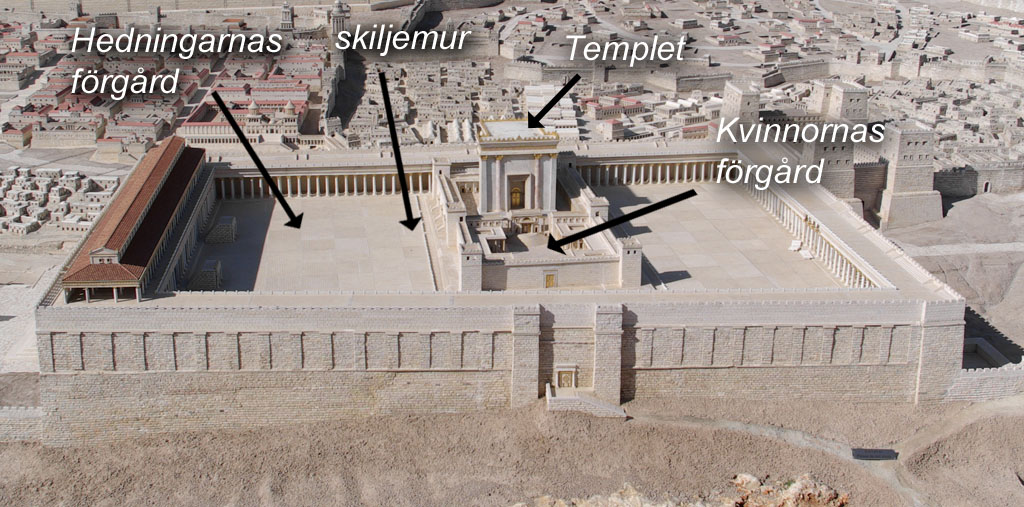
The temple in Jerusalem consisted of several different sections. A dividing wall separated the inner section, which only Jude were allowed to enter. The first section of the temple building was called the "women's courtyard," where both Jewish women and Jewish men could make offerings in the offering boxes, see Mark 12:42. Inside, via the Nicanor Gate, was the men's courtyard and the inner parts of the temple, where only priests were allowed to enter.
16He also did not allow goods (household items) to be carried across the temple grounds. [Many took the shortcut across the temple grounds between Jerusalem and the Mount of Olives.] 17He taught them, saying, "Is it not written []: 'My house shall be called a house of prayer for all peoples (nations).'
But you have made it a 'den of robbers' []." [Only Mark includes the last part, "for all nations," in the quotation from Isaiah; see ; . The cleansing of the temple shows both symbolically and practically how Jesus opens up a place for all nations to worship God. The choice of the word "robbers" instead of "thieves" shows that the temple had become a den of organized crime that robbed openly, unlike a thief who steals unnoticed.] 18The chief priests and the scribes heard this, and they began to plan (look for an opportunity) to get rid of him. They were afraid of him, because the whole crowd was amazed (overwhelmed) by his teaching. 19When evening came, he [Jesus and his disciples] went out of the city [to Bethany].12th of Nisan (Monday evening – Tuesday afternoon)
The fig tree illustrates spiritual truths (Matt. 21:20-22, 6:14-15)
20
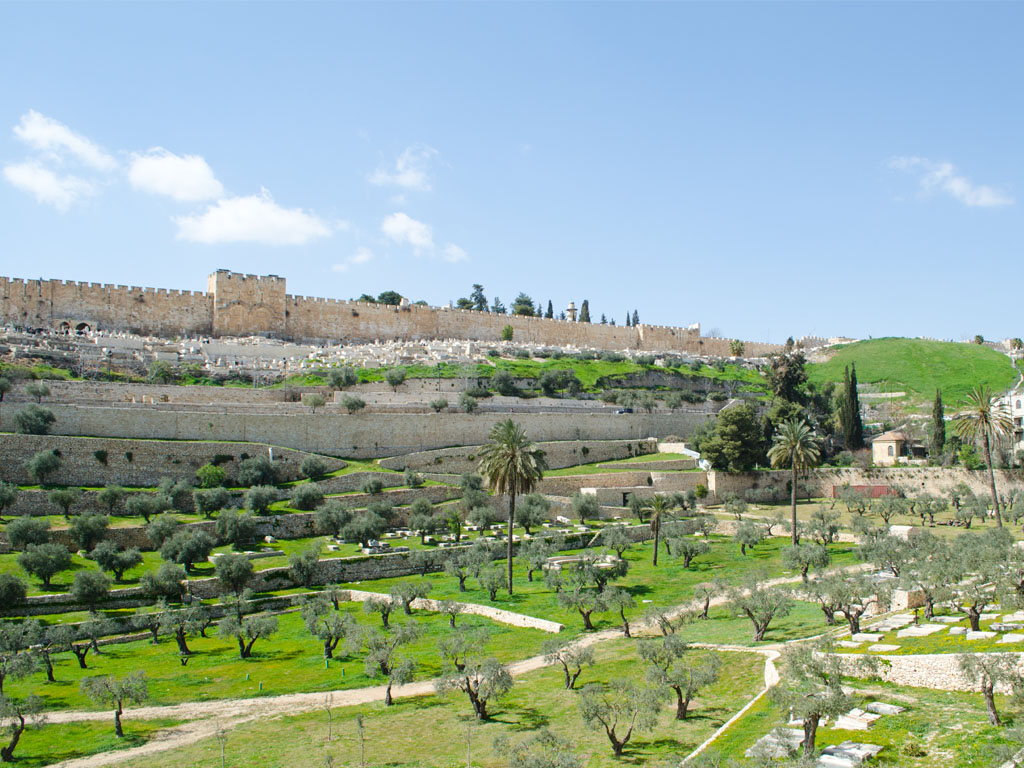
The Kidron Valley on an early spring day. In the middle of the eastern wall surrounding the temple site, you can see the walled-up Golden Gate.
"Have faith in God (hold fast to God's faithfulness)! [Literally: "have faith/faithfulness in/from God." The Greek is ambiguous, the word God is in the genitive, which means that the phrase can also be translated: "Have God's faith/faithfulness!"] 23I tell you the truth, if anyone (anyone at all) commands (says with authority to) this mountain [and Jesus takes the Mount of Olives where they are standing as an example]: 'Rev and throw yourself into the sea!' and does not doubt in his heart, but believes that what he says will happen, then it will be done (done for) him.
[Jesus now teaches based on what just happened with the fig tree and emphasizes the importance of acting wholeheartedly in trust in God, see verses 20-23.] 24Therefore [because of the fact that what one says in faith happens], I tell you: Whatever you ask for and seek [no matter how big or how much – as long as it is according to God's will, see ], believe that you [actually] have received [actively received] it, and it will be yours (it will be so for you). [; ] 25When you stand praying [the usual position for a Jew to pray], [then] forgive (let go of) [if] you have anything against anyone, so that your Father who is in heaven may also forgive you [forgive you; release you from] your transgressions (missteps, offenses)." 26[The earliest manuscripts do not include : "But if you do not forgive, neither will your Father in heaven forgive your transgressions." Compare .] 27
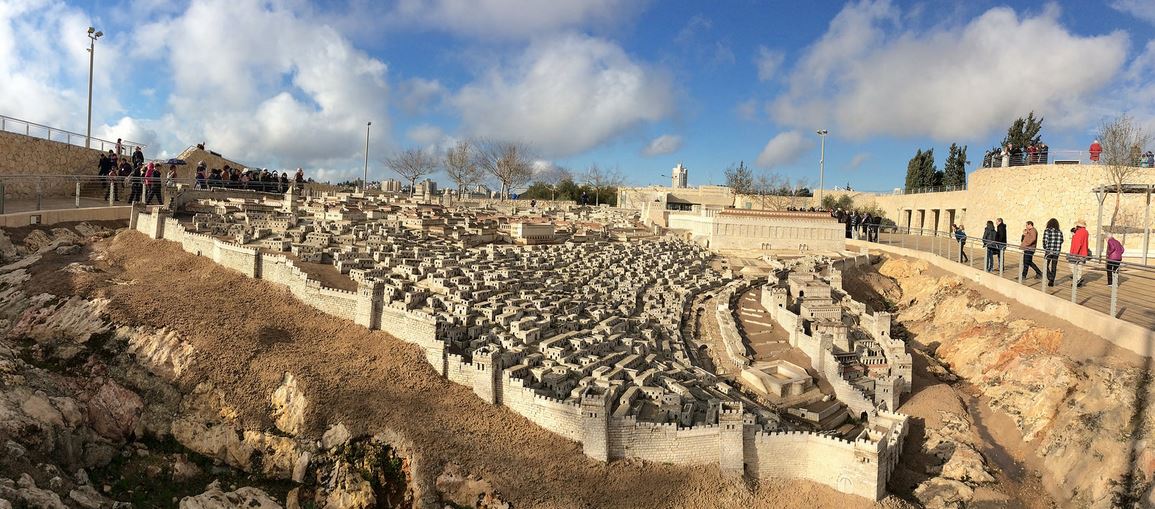
The Israel Museum in Jerusalem has a large outdoor model of Jerusalem as it looked in Jesus' time, on a scale of 1:50.

Between Jerusalem and Tel Aviv lies Yad Hashmona. Here there is a biblical garden with, among other things, an agricultural watchtower, built as in biblical times. The village was founded in 1971 by eight Finnish volunteers.
Question 1 (of 4) – The Pharisees' question about taxes (Matt. 22:15-22, Luke 20:20-26)
13They [the Sanhedrin, the religious leadership] then sent some Pharisees and Herodians to him to trap him with some word [some phrase he had said].
14They came to him and said, "Teacher, we know that you are trustworthy and do not take sides, but treat everyone equally. You teach the way of God correctly. Is it right (according to God's commandment) to pay [individual and annual] taxes to Caesar (the emperor) or not?" [If Jesus answered "yes," it would anger the Jews who hated the Roman occupation, while a "no" could lead to prosecution for rebellion against the Roman state.] 15
A denarius depicting Emperor Tiberius (reigned 14-37 AD).
They replied, "Caesar's." [Caesar was both the name and title of the Roman emperor.] 17Then Jesus said to them, "Give to Caesar what belongs to Caesar, and to God what belongs to God!" They were completely speechless before him (they lost their composure, stood as if petrified, and marveled at him). [Man is created in the image of God, see . Just as the coin was stamped with the emperor's image and belonged to him, man bears God's image in his heart and belongs to him.] 
Along the slope of the Mount of Olives are over 150,000 tombs, the oldest of which are 3,000 years old. The burial ground is desirable because, according to Jewish belief, those buried here will be the first to rise when the Messiah returns. The prophet Zechariah writes that the Messiah will set his feet on this very mountain (Zechariah 14:4).
If a man dies without children, his [younger unmarried] brother shall marry the widow
and raise up offspring for his brother. [An accurate summary of , which guarantees a childless widow's livelihood in a society where she would otherwise be forced into begging. The custom also preserves the name of the deceased husband. These marriages are called levirate marriages, from the Latin word levir, meaning brother-in-law. The custom already existed before Moses received God's commandments and instructions on Mount Sinai, see .]
20There were seven brothers. The first took a wife, but died without leaving any children. 21The second [younger brother] married her and died without leaving any children, and the third did the same. 22None of the seven had any children. Finally, the woman also died. 23At the [now alleged] resurrection, when they rise, which of these will she be the wife of? All seven were married to her." [The Sadducees wanted to show the absurdity of a resurrection using this example, which they probably used as an argument in earlier discussions with the Pharisees. The example may come from a story from the Apocrypha, Tobit 3:7-15, where a woman married seven men without having children. They assumed that the resurrected body would be like the current human body, see also Paul's reasoning on the same subject in .] 24Jesus answered them [the Sadducees, see ]: "Is it not here [in the following two points] that you are mistaken (going astray)? [Yes, it is!] It is because you do not understand (know) the Scriptures [which teach about the resurrection] nor the power of God [which can raise the dead]. 25In the resurrection [in the resurrected life with resurrection bodies], people do not marry or are given in marriage, but are like angels in heaven. [Jesus also mentions angels in passing, which they did not believe in.] 26But concerning the resurrection of the dead, have you not read in the book of Moses [, which was the part of the Bible they believed in] about [the burning] bush, how God said to Moses, 'I am the God of Abraham, the God of Isaac, and the God of Jacob'? 27He is not the God of the dead but of the living. You [Sadducees] are very mistaken (have completely lost your way)."Question 3 (of 4) – What is the greatest commandment? (Matt. 22:34-40, Luke 10:25-28)

On the menorah standing at the Knesset in Jerusalem is the text: "Hear, Israel," Hebr. shema Yisrael.
"The most important (first) commandment is this: 'Hear, O Israel!
The Lord our God, the Lord is one (the only one).
30You shall love [selflessly and generously] the Lord your God
with all your heart,
with all your soul,
with all your mind (intellect – Gk. dianoia)
and with all your strength.' [The quotation is from . This is also the opening phrase of the Jewish creed, shema, which every devout Jew recites every morning and evening. To the three components (heart, soul, and strength), Jesus adds a fourth – the mind! All four phrases begin with the Greek preposition ex, which means not only to love God 'with your heart' and 'from your heart', but also 'from the depths of your heart as a starting point'.] 31The second is this:
'You shall love [selflessly and generously] your neighbor (your fellow human being) as yourself.' []
There are no other commandments greater than these." 32Then the scribe said to Jesus, "Well said, Teacher! It is true as you say: He is one (the only one), and there is no one else but him. 33To love him [selflessly and generously]
with all your heart,
with all your mind (your insight and understanding – Gk. synesis)
and with all your strength
and to love your neighbor (your fellow man) as yourself,
is more than all burnt offerings and [other] sacrifices." 34When Jesus heard that the man answered wisely (sensibly, insightfully), he said, "You are not far from the kingdom of God." After this, no one dared to ask him any more questions.Question 4 (of 4) – What do you think about the Messiah? (Matt. 22:41-46, Luke 20:41-44)
35When Jesus was teaching in the temple, he asked, "How can the scribes say that the Anointed One (Messiah, Christ) is the son of David?" 36David himself said, through [inspired by] the Holy Spirit: 'The Lord [Yahweh – God the Father] said to my Lord [Adonai – God's Son, the Messiah]:
Sit at my right hand until I make your enemies your footstool.' [Quote from , which is a coronation psalm, composed to be used when a new king ascends the throne. It is messianic and describes how God the Father crowns Jesus. Hebrew uses two different words for Lord, first Yahweh and then Adonai.]
37David calls him Lord, so how can he be David's son?"
The large crowd listened to him eagerly (with pleasure). 38Jesus continued his teaching and said, "Beware (be constantly on guard) of the scribes! [Most of the scribes were Pharisees.] They love to walk around in long robes and be greeted with respect in the marketplace. 39and sit in the best seats in the synagogue [where they could look out over the congregation] and have the places of honor [the seats of honor closest to the host] at banquets [where they reclined at the table]. 40They devour (rob, destroy) the property (houses) of widows [seduce and exploit widows, who were the most vulnerable in society] and then pray long prayers for show (to cover up and hide their ugly intentions). They will receive a harsher judgment."The widow's offering (Luke 21:1-4)
41
The women's courtyard contained the offering boxes.
Its value was 1/128 of a denarius, which was a worker's daily wage. Since Mark is writing for readers in Rom. and the western part of the Roman Empire, he explains that two "lepta" were equivalent to one "quadrans" (a shilling, see ). This was the lowest coin value in that part of the Roman Empire, and its value was 1/64 of a denarius. 43He called his disciples to him and said to them, "I tell you the truth, this widow, who is afflicted with poverty [perhaps due to the exploitation of the Pharisees, see ], put in more than all the others who put anything into the temple treasury. 44All the others gave out of their abundance, but she gave out of her poverty, all she had, even what she needed to live on (her entire livelihood)."The destruction of the temple is predicted (Matt. 24:1-2, Luke 21:5-6)
131
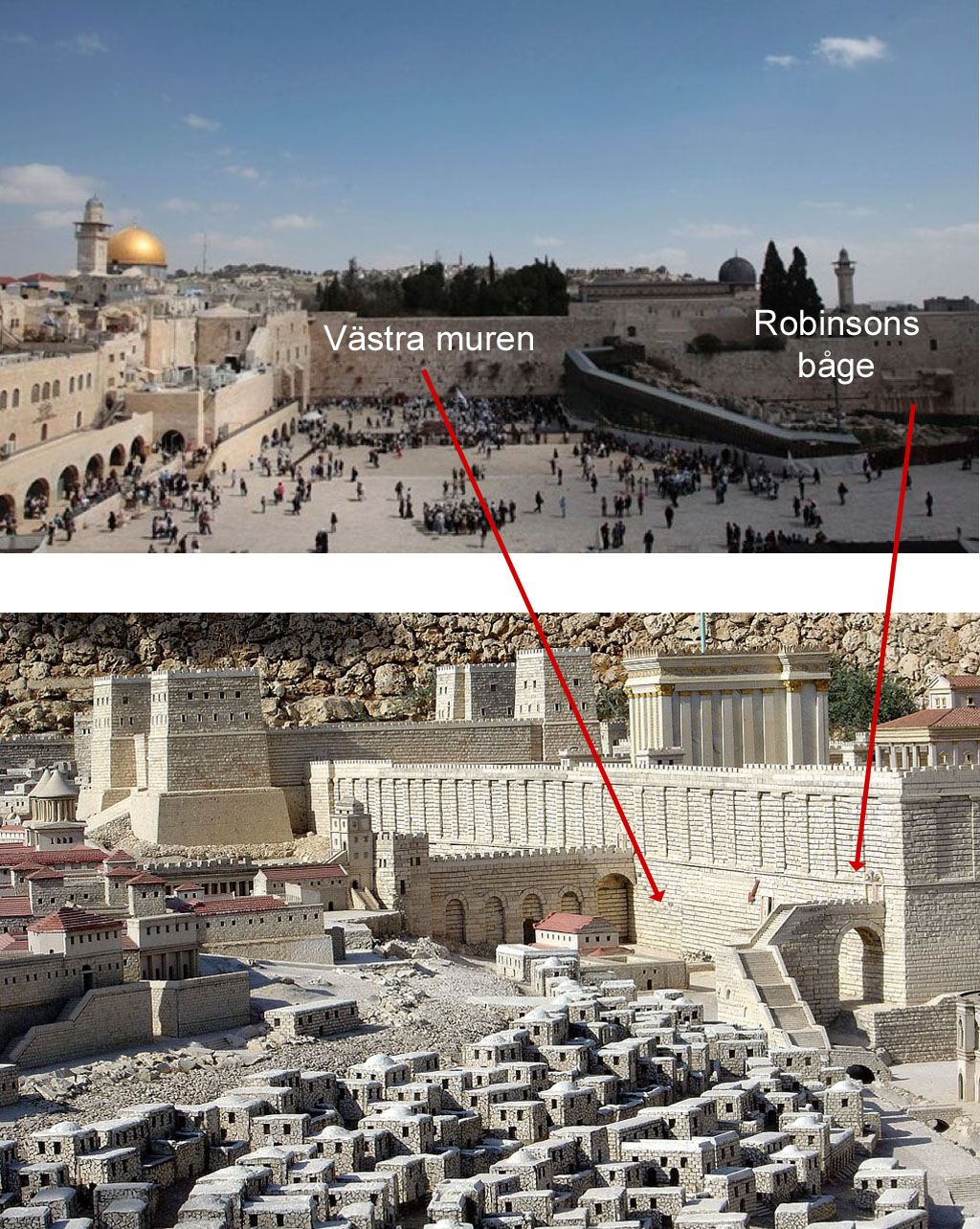
The Western Wall in modern times and in Jesus' time. Even today, you can see the attachment for the staircase in the southwest corner called "Robinson's Arch."
Jesus teaches about the last days
[Jesus goes to the Mount of Olives, located one and a half kilometers east of Jerusalem. From there, they could see all of Jerusalem and the temple they had just left.] 3When Jesus sat down on the Mount of Olives opposite the temple, Peter, James, John, and Andrew asked him privately:
4"When will this happen [the destruction of the temple, see ]? What will be the sign when all this is about to happen (be fulfilled)?"Be on your guard so that you are not led astray (Matt. 24:4-14, Luke 21:8-19)
5
The Mount of Olives seen from the Old City of Jerusalem.
"Be on guard (be careful)
so that no one deceives you! 6Many will come in my name and say,
'I am [the Messiah]',
and they will deceive many (lead many astray). 7When you hear of wars and rumors (threats) of wars,
do not be frightened (surprised, alarmed),
for this must happen, but it is not yet the end. 8Nation (ethnic groups) will rise against nation,
and kingdom against kingdom.
There will be
earthquakes [sea storms, tsunami waves] in various places
and famines (food crises; crop failures).
These are only the beginning (the first birth pains before a new birth). 9Be constantly on guard (be careful).
You will be handed over to courts and beaten in synagogues, and you will be brought before governors and kings for my sake, and you will stand as witnesses before them. 10But first [before the end], the gospel (the good news) must be preached to all nations. 11When they take you away [to court] and hand you over, do not worry about what you will say [in your defense]. Instead, say whatever is given you at that moment, for it is not you who speak, but the Holy Spirit. 12A brother will betray a brother to death, and a father will betray a child. Children will rise up against their parents and have them put to death. 13You will be hated (despised) by all for my name's sake. But whoever endures to the end will be saved (redeemed)." 14"When you see 'the abomination that causes desolation' [as mentioned by the prophet Daniel, see , in ], standing (standing, stepping forward) where it should not be [in the temple of Jerusalem] – may the reader understand this – then those who are in Judea should flee to the mountains. 15Whoever is on the roof should not go down to get anything out of the house, 16and those who are in the field should not turn back to get their cloaks. 17Woe [expression of intense despair] to those who are pregnant or nursing babies at that time. 18Pray that it will not happen in winter. 19For then there will be 'great distress' (great hardship, suffering, and oppression), such as has not been since the beginning of the world until now, nor ever will be. 20Unless those days were shortened, no flesh (Gk. sarx) [no human being; no living thing] would survive. But for the sake of the elect [God's chosen people], he has shortened those days. 21If anyone says to you, 'Here is the Anointed One (Messiah, Christ),' or 'There he is,' do not believe it. 22For false messiahs [saviors] and false prophets will arise and perform signs [miracles whose purpose is to confirm that the one performing them is true] and wonders (which arouse amazement) to deceive, if possible, even the elect. 23Be on your guard at all times! I have told you everything in advance." [Jesus now returns to the second question about the signs before his second coming. The day when Jesus returns to establish his kingdom on earth will not go unnoticed. Great signs will occur before Jesus sets his feet on the Mount of Olives east of Jerusalem, see .] 24But in those days, after that tribulation [immediately after it, see ] the sun will be darkened
and the moon will no longer give its light. [Quotation from ; ; ; et al. about God's judgment on the world.]
25The stars will fall from the sky [; ]
and the powers of the heavens will be shaken.' 26Then they will see the Son of Man coming on the clouds of heaven with great (royal) power and glory (majesty). 27He will then send out his angels. They will gather his chosen ones from the four corners of the earth, from the farthest (most distant) reaches of the earth to the farthest reaches of the heavens." []When will Jesus return? – You can know approximately (Matt. 24:32-35, Luke 21:29-33)
28
In March, the fig trees begin to bud in Israel and the leaves sprout.
29In the same way, when you see all these things happening [all these signs described in this chapter], you can know that he is near, that he is right at the door [ready to come]. [Here, the word "doors" is plural. It could refer to a double door or that his arrival is a process in several stages.] 30I tell you the truth (truly, amen): This generation (this people) will not pass away (die) until all this happens. 31Heaven and earth will pass away, but my words will never pass away." [The Greek word for generation, genea, means both "generation" and "people." The same "generation" that heard Jesus utter these words would also witness the destruction of the temple and Jerusalem 40 years later in 70 CE, which must have felt like the end of the Jewish people or even the end of the world. This promise also means that the Jewish people will be preserved as a "people" until Jesus' return, see .]When will Jesus return? No one knows exactly, so be alert! (Matt. 24:36-44, Luke 21:34-36)
32"But as for that [exact] day or hour (moment) [when Jesus will return to establish the kingdom], no one knows, not even the angels in heaven, not even the Son – no one except the Father. 33Be constantly on your guard, watch (be ready, prepared); for you do not know when the time will come. 34It will be like when a man has [already] gone away. He left his house and gave his slaves authority, each with his task, and he commanded the gatekeeper to watch constantly (be alert and vigilant). 35Watch, therefore, for you do not know when the master of the house will come, whether in the evening, at midnight, at dawn, or in the morning. 36Otherwise, he may come suddenly and find you asleep. 37What I say to you, I say to everyone: Watch (be attentive, active, alert)!" 141It was two days before Passover (Pesach) and the Feast of Unleavened Bread. The chief priests and the scribes were looking for a cunning way to arrest Jesus and kill him. 2They said, "Not during the festival, lest there be an uproar among the people." [The English word "Easter" is a transliteration of the Hebrew word Pesach, see . Easter is celebrated in memory of the Exodus from Egypt. Pesach begins on the afternoon of the 14th of Nisan. A few hours later, after sunset, it is the 15th of Nisan and the Feast of Unleavened Bread (Hebr. chag ha-masot) begins. These two feasts are closely related and are often referred to as a single entity. Two days earlier, probably in the late afternoon before sunset on the 12th of Nisan, Jesus finished his speech on the Mount of Olives. In 30 CE, it was Tuesday afternoon.] 
The ruins of Bethany and the road between Jerusalem and Jericho. Photo from 1894.

30 silver coins.

One of the alleys in the old city of Jerusalem. Although the ground level has been raised since Jesus' time, the streets have the same layout as they always have had.
If one reads only verses 12-16, it can be interpreted that the Last Supper is a traditional Passover meal on the evening of the 15th of Nisan. In context, however, only the events of one day seem to have been described since . The Core Bible follows John's chronology, which explicitly states that the meal took place before Passover, see .]14th of Nisan (Wednesday evening – Thursday afternoon)
17
Reconstruction of the dining room, triclinium, where people reclined at the table in a finer Roman house. The picture was taken at the museum in the Spanish city of Zaragoza. Here, Emperor (Caesar) Augustus founded the city of Caesaraugusta around 10 BC.

Today, a special chalice is often used for the wine and small round wafers, but originally the Last Supper was a normal meal shared among friends. Bread was the staple food and wine the usual drink.
"Take, eat, this is (represents) my body."
23He took a cup [of wine], and when he had given thanks, he gave it to them, and they all drank from it. 24He said to them,
"This is (represents) my blood of the covenant (strongest form of contract), [my blood] which is poured out (spilled) for many. 25I tell you the truth, I will not drink the fruit of the vine until the day I drink it anew (in a new way, with a new quality) in the kingdom of God." 26After singing a hymn, they went out to the Mount of Olives. [According to Jewish tradition, was sung before the meal and after the meal.] 27Then [as they walked out of Jerusalem via the Kidron Valley toward Gethsemane], Jesus said to them: You will all fall away (take offense, abandon me), for it is written: I will strike (kill) the shepherd,
and the sheep of the flock will be scattered.
[Jesus quotes freely from .]
28But after my resurrection, I will go before you to Galilee." 29Peter answered him, "Even if everyone else falls away (takes offense, abandons), I will never do so!" 30Jesus said to him, "I tell you the truth, this night, before a [single] rooster crows twice [as a warning of what is about to happen], you will have denied me three times." 31But Peter insisted emphatically (with many words and repeatedly), "Even if I have to die with you, I will never, no never, deny you!" All the other disciples said the same thing. 
At the foot of the Mount of Olives lie the Church of All Nations and the Garden of Gethsemane.
Jesus prays for the first time
35[It is now around midnight.] Jesus went a little further away, threw himself to the ground, and prayed that, if possible, he might be spared from this hour. 36He said, "Abba (Dad)! Father! Everything is possible (all things are possible) for you: Take this cup away from me, but not what I want (desire), but what you want." ["Abba" means dad in Aramaic, the everyday language of Jesus' time. The first words a small child learned were abba (father) and immah (mother). The expression "Abba Father" shows the openness and close family relationship that prevails in prayer. "Cup" here refers to a measured portion of suffering, see also .] 37When he returned [to Peter, James, and John an hour later] and found them asleep, he said to Peter, "Simon, are you asleep? Couldn't you even stay awake for an hour? 38You must watch (be awake, alert) and pray, so that you will not fall into temptation! The spirit is willing, but the flesh is weak [the sinful nature can easily be tempted]."Jesus prays a second time
39He went away again and prayed with the same words. 40When he came back, he found them asleep again, for their eyes were heavy with sleep. They did not know what to say to him.Jesus prays a third time
41He came back a third time and said to them, "Are you still sleeping and resting? Enough. The hour has come, now the Son of Man will be handed over to the hands of sinners. 42Rev, let us go. The one who is going to betray me is near. [Jesus probably now saw between the trees the torchlight of the large crowd approaching.] 43While he was still speaking, Judas, one of the twelve, arrived. With him was a large crowd [Roman soldiers, see , and temple guards, see ] with swords and clubs, sent by the chief priests and the scribes and the elders of the people [these three groups were part of the Sanhedrin – the highest court of the Jews]. 44The traitor (the one who would betray him) had agreed with them on a sign, saying, "The one I kiss is the one; arrest him and take him away under guard." [The customary greeting at that time, a kiss expressing respect and reverence, became here a sign of betrayal.] 45When Jude arrived, he went straight up to Jesus and said, "Rabbi (my teacher)!" and kissed him intensely. 46They seized Jesus and arrested him. 47But one of those standing nearby drew his sword and struck the high priest's servant, cutting off his ear. [It was Peter who struck the servant named Malchus, see . Peter probably aimed for the throat, but Malchus ducked so that only his ear was hit. Jesus healed him, see . The fact that only John mentions the names may be because he wrote his gospel last, when Peter was already dead, while the other gospel writers were more cautious and did not want to reveal his name because it could have legal consequences for Peter.] 48Jesus said to them, "As if I were a criminal (a robber who robbed and attacked people), you have come out with swords and clubs to arrest me. 49Day after day I sat in the temple teaching, and you did not arrest me! But [this happened so that] the Scriptures might be fulfilled." 50Then they all [the disciples] abandoned him and fled. [In Greek, there is a strong emphasis that they all did this and Jesus was left alone with those who had arrested him.]A young man flees naked
51A young man followed Jesus, wearing only a linen cloth (linen sheet) on his body. They seized him, 52but he left the linen cloth behind and ran away naked. [Only Mark mentions this event. Perhaps it was the Gospel writer himself, whose family lived in Jerusalem, see . The word for linen is only used here and in , where it describes the linen cloth in which Jesus' dead body was wrapped. Regardless of who the man was, the event shows the aggressive attitude of the people who tried to capture him. The threat to Jesus' followers was real.] [The Sanhedrin, the highest decision-making body among the Jews with 71 members from the Pharisees and Sadducees, was wholly or partly gathered at the home of the high priest, waiting for Jesus to be brought there, see . The council could never bring charges on its own initiative; only if witnesses came and requested that their case be heard was the matter taken up. That is why someone had to denounce him, and testimony against him was also needed.] 53They brought Jesus to the high priest [Caiaphas, see ]. There all the chief priests and the elders and the scribes gathered together. 54Peter followed at a distance all the way to the high priest's courtyard. [The disciple John was also there, and it was he who arranged for Peter to enter through the gate, see .] There he sat among the servants [both the servants of the house and the temple guards who had just been involved in arresting Jesus] and warmed himself by the fire. 55The chief priests and the whole council [Sanhedrin] sought false testimony against Jesus so that they could condemn him to death, but they did not succeed. 56Many testified (again and again) falsely against him, but their testimony did not agree. 57Then some stood up and gave this false testimony against him: 58"We heard him say, 'I will destroy this temple made with hands and in three days build another not made with hands. 59But their testimony did not agree. 60Then the high priest stood up among them and asked Jesus, "Are you not going to answer their testimony against you?" 61But Jesus remained silent and did not answer. [He fulfilled the prophecy of .] Then the high priest asked him, "Are you the Anointed One (Messiah, Christ), the Son of the Blessed One?" 62
The high priests' judgement: "He is guilty!" Painting by Nikolai Ge.
All those [gathered in the Sanhedrin] condemned him to death. 65Some then began to spit on him, covered his eyes, and struck him with their fists, saying, "Prophesy!" Even the guards struck him [in the face] with their palms. 66
Model of Jerusalem seen from the southwest. The large building on the left is the house of the high priest Caiaphas.
A little later [an hour, see ], those who were standing there [at the gate] came up to Peter and said, "Surely you are one of them too, for you are from Galilee!" [Rev in Galilee, people spoke a broader, more rural dialect that could not be hidden, see .]. 71Then he began to curse [wishing himself cursed by God if what he said was not true] and swore again [by God's name and then said], "I do not know the man you are talking about." 72Immediately after this, a rooster crowed a second time. Then Peter remembered what Jesus had said to him: "Before the rooster crows twice, you will deny me three times." He broke down in loud tears [and went outside, see ]. [Mark divides the day of Jesus' death into sections of three hours each:
• at dawn (6:00 a.m.),
• the third hour (9:00 a.m.),
• the sixth hour (12:00 p.m.),
• the ninth hour (3:00 p.m.),
• evening (6:00 p.m.), ] 151
The Sanhedrin met in the northern part of the temple building. In the northwestern corner of the temple area was the Antonia Fortress.

Ecce Homo ("behold the man" in Latin), Antonio Ciseris' depiction of Pontius Pilate presenting a wounded Jesus to the people of Jerusalem.
But they only shouted even louder, "Crucify him!" 15Pilate, wanting to do what the people demanded, released Barabbas. He had Jesus flogged [whipped so that the skin on his back was torn] and then handed him over to be crucified. [Jesus was falsely accused of the same crime that Barabbas was guilty of. Bar-Abbas, "the son of the father," was acquitted, while the Son of God was executed. The point is clear: Jesus is the one who takes our punishment upon himself in exchange for our freedom.] 16The soldiers brought him into the courtyard [inner courtyard], that is, into the residence (praetorium), and gathered the entire battalion (cohort) [consisting of 600 soldiers, see ] around him. 17They dressed him in purple [probably a faded purple royal robe, see ]. Then they twisted (wove) a crown of thorns and put it on him, 18and began to salute him, "Hail, King of the Jews!" [They mimicked the salute "Hail, Caesar, King."] 19Again and again they struck him on the head with a stick while spitting on him. They fell to their knees and paid homage to him. 20When they had mocked him, they took off the purple [cloak] and put his own clothes on him. On the way to Golgotha [The vertical pole was permanently attached to the place of execution, which was often located on a hill just outside the city. The condemned man had to carry the crossbeam, which weighed 40-50 kg, there himself. According to Roman law, government officials could force anyone to carry luggage and equipment for a Roman mile, which is equivalent to 1.5 km, see also . Simon, who was born in the city of Cyrene in North Africa, was on his way into the city. Instead, he was forced to turn back to carry Jesus' crossbeam to Golgotha.]
They took Jesus [outside the city] to crucify him.
21
Jesus was crucified outside the city, see [Heb 13:12]. Golgotha was probably located on a hill near one of the main roads, clearly visible to everyone passing to and from the city.
The fact that Simon's sons are mentioned by name is probably because they are known to the readers of the Gospel of Mark. In the Epistle to the Romans, Paul sends special greetings to Rufus and his mother, see . If it is the same Rufus, Simon's family later belonged to the congregation in Rom.] 22They took Jesus to Golgotha, [an Aramaic word] which translated means "place of the skull." [The name may have arisen because the place looked like a skull, or because there were many skulls there from previous executions and crucifixions.] 23They offered him wine mixed with myrrh [to ease his suffering], but he did not accept it. 24They crucified him and divided his clothes among themselves by casting lots. 25
The Hebrew initial letters form the tetragrammaton JHVH, see [John 19:20-22].
"King of the Jews." [The four Gospel writers all mention that the sign read "King of the Jews." However, they choose to include different parts of the opening words. This is not a contradiction; rather, together they give the full picture. The sign probably read: "This is Jesus of Nazareth, King of the Jews," which is the sum of , and . The text was written in Hebrew, Latin, and Greek. The Hebrew initial letters form the tetragrammaton JHVH, see .] 27Along with him, they crucified two robbers, one on his right and one on his left. 29Those who passed by mocked (reviled) him, shaking their heads and saying, "You who would destroy the temple and rebuild it in three days! 30Save yourself and come down from the cross!" 31In the same way, the chief priests, together with the scribes, mocked (joked about) him among themselves, saying, "He saved (redeemed) others, but he cannot save himself! 32Let the Anointed One (Messiah, Christ),the Kingof Israel,come down from the cross now, so that we may see and believe in him!" Even those who were crucified with him mocked (insulted, reviled) him. 33At the sixth hour (midday), darkness came over the whole land and lasted [for three hours] until the ninth hour (three o'clock in the afternoon). 34At the ninth hour (three o'clock), Jesus cried out in a loud voice [and quoted in Aramaic, but with some Hebrew features]:
"Eloi, Eloi, lema sabaktani?" This means:
"My God, my God, why have you forsaken me?"
35Some of those standing there heard this and said, "Listen, he's calling Elijah." [It was a common Jewish belief that the prophet Elijah could come and rescue a righteous man in distress.]+E3714 36But one of them [perhaps the Roman officer mentioned in ] ran and filled a sponge with sour wine [cheap wine drunk by slaves and soldiers], put it on a stick, gave it to him to drink, and said [to the crowd]: "Wait (leave him alone), let's see if Elijah comes and takes him down." 37But Jesus cried out in a loud voice and gave up his spirit. 38Then the curtain in the inner temple was torn in two, from top to bottom. [The curtain separated the most holy part of the temple. The fact that it was torn from top to bottom emphasizes that it was God who opened the way for man to have fellowship with him. According to early Jewish tradition, which in some parts may be exaggerated, it consisted of two thick pieces of fabric woven into one piece, hung half a meter apart. Each curtain was 18 meters high, nine meters wide, and a few centimeters thick, and it took 300 priests to lift it.] 39When the officer [who was in charge of the execution] standing opposite him saw how he gave up his spirit, he said, "This man must have been the Son of God!" 40There were also some women who were watching what was happening from a distance. Among them were Mary from [the town of] Magdala [on the western side of Gennesaret, whom Jesus had freed from seven demons, see ], Mary, mother of the younger James and Joses [perhaps Jesus' mother, see , or the wife of Clopas, see ]
and Salome [mother of the disciples James and John, married to Zebedee, see .] 41They had followed Jesus while he was in Galilee and served (supported) him. There [at the cross] were also many other women who had followed him up to Jerusalem.
[These women were eyewitnesses to several major events in Jesus' life, his death, see verses 40-41, burial, see , and resurrection, see . These three women, along with others from Galilee, were in Jerusalem to serve him.] 
In the Garden Tomb in Jerusalem, you can visit a rock-cut tomb from this period. It is older than the tomb in which Jesus was laid and cannot be the new, unused tomb that Joseph of Arimathea had cut out, see Matt. 27:60.
15th – 16th Nisan (Thursday evening – Saturday afternoon) [Jesus rests in the tomb. In the year 30 CE, there are two Sabbaths in succession. The first day of the Feast of Unleavened Bread, the 15th of Nisan, is a holy Sabbath. It is followed by the weekly Sabbath, the 16th of Nisan, which lasts from Friday evening to Saturday afternoon, see .]
17th of Nisan (Saturday evening – Sunday afternoon)

Spice shop in the old town of Jerusalem. After the Sabbath, shops often open at 8 p.m. and stay open for a few hours.
©Anders Wester

In the garden tomb in Jerusalem there is one of many rock-cut tombs in Jerusalem.
Jesus appears to two disciples (Luke 24:13-35)
12After this [on the same day, see ], he appeared in another form (different outward appearance) to two of them who were going out to the country [to Emmaus, eleven kilometers outside Jerusalem]. 13They returned [to Jerusalem] and told the others, but they did not believe them. 14After this, he also appeared to the eleven while they were at table, and he rebuked them sharply for their unbelief and hardness of heart, because they had refused to believe those who had seen him after he had risen. 15And he said to them, "As you go out into the whole world [enter everywhere – into every structured order and every complex system], preach (proclaim) [then] the gospel (the good news; the glad tidings) [of reconciliation and salvation] to all creation [to everything created, established, arranged, and set up]. 16Whoever believes and is baptized will be saved (safe, whole, preserved, healed, provided for, liberated, and have eternal life), but whoever does not believe will be condemned. 17These signs will faithfully follow (always be present) those who continually believe (trust in, lean on me): In my name they will cast out demons, they will speak new (completely new, better) languages (tongues), 18and they shall pick up (lift away) snakes [literally snakes, or an image of the devil]. If they drink anything deadly, it shall not harm them, and when they lay their hands on the sick (those who are completely without strength, weak), they shall be healed. 19After that, when the Lord Jesus had spoken to them [the eleven disciples], he was taken up into heaven and sat down at the right hand of God. 20They went out and preached everywhere (in all places), and the Lord worked (labored) with them and confirmed the word through the signs (miracles, wonders) that accompanied them.
The End of the Gospel of Mark
The last twelve verses of the Gospel of Mark are usually called the longer ending of the Gospel of Mark. There is also a shorter ending in another set of manuscripts, as well as variants with both the short and long endings. The shorter ending reads:
"And they briefly told those around Peter everything they had been commanded. Through this, Jesus himself sent out, from east to west, the holy and imperishable proclamation of eternal salvation. Amen."
The oldest and best manuscripts (Codex Vaticanus and Sinaiticus) from the 4th century have as the last verse. However, in one manuscript (Vatican MS) there is a space between and the Gospel of Luke, as if the writer was waiting for more material. Justin Martyr includes the verses in the Diatessaron (written 160-175 AD) and Irenaeus (ca. 170 AD) refers to them. A little later, Eusebius (260-339 AD) and Jerome (340-420 AD) explicitly write that the verses are missing from the texts they had access to. The most common explanation is that the longer endings were added in the 2nd century by someone who wanted to compile the resurrection stories in the other Gospels. The content of these verses is based on material from the other Gospels and the Acts of the Apostles.