First letter to Timothy
Greetings
[From:] 11Paul, apostle (messenger, ambassador) of the Anointed One Jesus (Messiah/Christ Jesus' apostle)
on behalf of God, our Savior,
and the Anointed One (Messiah, Christ) Jesus, our hope.
2To Timothy,
[my] true (real) child in the faith. [The Greek word for child used here is not huios – an adult son. Instead, Paul writes teknon, which literally means "to be born of someone" and emphasizes the relationship between parent and child – a beloved family member. Timothy came from Derbe (located in present-day central Turkey) where Paul met him during his first missionary journey. Timothy's mother was Jewish and his father was Greek, see . He accompanied Paul on several of his journeys and became his closest co-worker. Paul was his spiritual father.] Grace (undeserved favor) [power],
mercy (compassion expressed in action)
and peace
from God the Father and the Anointed One (Messiah, Christ) Jesus, our Lord.
[The expression grace and peace is common in Paul's writings, but the addition of "mercy" is found only here in the pastoral epistles. Jesus spoke in the Sermon on the Mount that those who are merciful will themselves receive mercy, see .]Warning against false teachings
3As I commanded (admonished, exhorted) you when I was going to Macedonia, I want you to stay in Ephesus and command (admonish) certain people there not to teach other [false] doctrines 4or devote themselves to myths and endless genealogies. Such things lead to disputes and do not serve God's plan of salvation through faith. [These myths were probably speculations about Old Testament characters, see . This type of teaching seems to have characterized these false teachers in Ephesus and on Crete, see ; . Paul may also be referring to early Gnostic teachings that flourished in Ephesus. Among these people may have been women from the female-dominated cult of Artemis who advocated the supremacy of women over men, see .
Perhaps Timothy wanted to accompany Paul, since he had traveled with him for many years, but he was needed in Ephesus to confront those who were teaching false doctrines.] 5The goal of the command (admonition, exhortation) is
love [which is selfless and generous] from a pure heart,
a good conscience,
and a sincere (genuine) faith.
6Some have missed that goal and instead have fallen into empty talk [that does not transform hearts, see ]. 7They want to be Torah teachers ("law experts" – Gk. nomo-didaskalos, see ) but understand neither what they are saying nor what they are so confidently pronouncing. 8But we know that the law [Gk. nomos] is good [], if used correctly (in a lawful manner – Gk. nomimos). [The entire Word of God is good and shows what is right and pleasing to God, see ; ; ; . It is like a mirror that gives insight into sin, see ; . The entire Old Testament points to Jesus, see ; . Misuse includes, for example, demanding that Gentiles follow the parts that were only intended for Jews, see , or turning it into a legalistic system, see ; ; .] 9We know that the law is not for the righteous [who already live holy and righteous lives], but for: lawless (Gk. anomos)
and rebels,
godless (ungodly, completely lacking respect and reverence for God)
and sinners,
unholy
and unspiritual, [These three pairs correspond to the first commandments concerning God. The remaining ones follow the commandments concerning how we should treat our fellow human beings.]
murderers of fathers (parricides)
and murderers of mothers (matricides; those who beat and even kill their parents),
[corresponding to the commandment to honor one's parents, see ] murderers,
[corresponding to the commandment not to murder, see ] 10fornicators (those who live in sexual immorality – Gk. porneia),
practicing homosexuals, [The Greek word arsenokoites is used. It describes the active partner in a male homosexual relationship. The word consists of two words, arsen meaning man and koitai meaning "bed." These two words are used in the Greek translation of and it is likely that Paul constructs this new Greek word to give a clear reference to this particular verse. Corresponds to the commandment against adultery, see .]
slave trader (kidnappers, someone who trades in people),
[Corresponds to the commandment not to steal, see ] liars,
perjurers (who bear false witness, swear falsely)
[Corresponds to the commandment not to bear false witness against your neighbor, see ] and everything else that goes against sound (healthy) doctrine, 11according to the gospel of the glory of the Blessed (happy, fortunate) God, which has been entrusted to me. [The law has no saving power; it is a yardstick that can convince people of sin and show that a savior is needed, see . The law is likened to a schoolmaster. The Greek word in Galatians, paidagogos, was used for a slave who was assigned to supervise the family's children and lead them to school. The law brings us to the gospel – the good news of salvation in Jesus who died for all who have broken the law.]Paul's experience of grace
12I [Paul] am forever grateful to the one who has given me all the strength I need, the Anointed One (Messiah, Christ) Jesus our Lord, because he considered me faithful and put me in his service [for him], 13even though I was previously
a blasphemer [who spoke disparagingly about Christians and Jesus],
a persecutor [of Christians because of their faith],
and a cruel (arrogant, violent) man [who attacked and beat up Christians]. [There is an increasing scale of evil in these verbs. The first sin is only about words. The second is about physical persecution because of a different faith, ultimately resulting in abuse and cruelty.] Despite this, I encountered mercy (compassion) because I had acted without knowing any better in my unbelief. 14The grace (favor) [power] of our Lord has flowed over me in an infinitely powerful way, with faith and love in the Anointed One (Messiah, Christ) Jesus. [Through the faith that unites me with Jesus, the undeserved favor of our Lord has washed over me and given me selfless, giving love.] 15This is a word to be trusted (credible) and worth taking to heart: "The Anointed One (Messiah, Christ) Jesus came into the world to save (rescue, heal, liberate) sinners,"
and among them I am the greatest (highest in rank). [This phrase, "this is a trustworthy saying," is used a total of five times in the pastoral letters. The other four are: ; ; ; . These are fundamental truths of the Christian faith.
One can see a clear development in Paul's humility when he describes himself. Around 55 AD, he calls himself "the least of the apostles," see . A few years later, around 61 AD, he describes himself as "the least of all saints," see . And here, in the mid-60s AD, he calls himself "the chief of sinners."]
16I received mercy (compassion), so that the Anointed One (Messiah, Christ) Jesus might show all his patience toward me as the first, an example for [encouraging] those who are to believe in him and gain eternal life. [Paul shifts his focus from himself to God and bursts into spontaneous praise.] 17Now to the eternal King (King of eternities, he who is Lord of time, who has always been and always will be),
incorruptible (indestructible, immortal),
invisible,
the only God.
To him be honor and glory forever and ever! Amen (yes, it is true). Admonish so that no one else will shipwreck their faith
[Paul now returns to the exhortation to rebuke false teachers.] 18This task of commanding (admonishing, exhorting) [those who teach false doctrines, see verses 3 and 5] I now entrust to you, my child Timothy, in accordance with the prophetic words that were once spoken over you. By virtue of them, you shall fight the good (honorable) fight, 19in faith and with a clear conscience. Some have rejected this and have suffered shipwreck in their faith. 20Among them are Hymenaeus and Alexander, whom I have handed over to Satan so that they may be taught not to blaspheme. [The expression "handed over to Satan" may refer to their being expelled from the church community, see . The goal is always forgiveness and restoration, see ; .]Instructions for church life
Prayer
[Although a new paragraph begins here, there is a connection to the previous topic where some have suffered shipwreck in the faith. Prayer, which is primarily communion with God, keeps a person on the path of faith.]
21Therefore, I urge you [Timothy] first of all (as something very important that must be given priority) to prayers (personal specific needs, even under cries or loud weeping, see ),
confidential prayers (interactive two-way dialogue, conversation, worship, and devotion in intimacy with God) [the most common word for prayer in the NT, see ],
intercessions (pleading for the needs of others and that God's will be done in their lives) [The root word means "to hit the target"The verb is used in where the Spirit helps us to find God's will in prayer. The noun is only used here and in . In the apocryphal book of 2 Maccabees 4:8, the word is used to refer to an audience with the king. Intercession is a confidential consultation with God.]
and thanksgiving [all four words are plural in Greek, referring to persistent prayer], for all (categories of) people, 2for kings and all those in authority, so that we may live a quiet and peaceful life, in all godliness and dignity. [Nero was emperor of the Roman Empire from 54 to 68 AD. He came to power at the age of seventeen and his life was marked by scandals, see . Nero accused the Christians of causing the great fire in Rom in 64 AD, and a cruel persecution broke out. It was during these turbulent times, in the mid-60s, that Paul wrote this letter and appealed for prayer and thanksgiving for Nero, among others.] 3This [praying for the salvation of all people, regardless of status and rank] is good (right, honorable) and pleasing to God our Savior, 4who desires (wishes) all people to be saved (liberated, rescued, preserved) and come to the knowledge (recognize; have a personal experience of) of the truth. 5For God is one, and one is the mediator between God and men – a man: the Anointed One (Messiah, Christ) Jesus – 6he who gave himself as a ransom for all, the testimony [that would be given about God's purposes for them] when the time (literally: when their own times) was fulfilled. 7For this reason, I have been appointed a preacher and apostle – I speak the truth and do not lie – a teacher of the Gentiles in faith and truth. 8I therefore want (it is my desire) that you pray (talk confidentially with God): The men in every place [in every house church in Ephesus] with holy, uplifted hands,
without (free from) anger [an agitated inner stance against someone/something, see ]
and arguing [a discussion that leads nowhere]. [The main point is the attitude of the heart in prayer. Praying with uplifted hands was the usual Jewish way of praying, see ; ; . Standing upright with clean hands describes someone who seeks God with honest motives and a pure heart, see .]
9Women likewise,
adorned with modest clothing, with modesty and good judgment (self-discipline), not with [braided/artificial] hairstyles and gold or pearls or expensive clothing [that requires great expense], 10but as is [always] proper for women who profess godliness: with (through) good deeds. [The construction of the sentence with the Greek word hosautos, translated as "in the same way," means that the verb "pray," which comes first in Greek, probably applies to both men and women. This goes hand in hand with Paul's letter to the Corinthians, which he wrote from Ephesus. There, both men and women pray and prophesy (), and Paul addresses this in relation to clothing style. The Corinthians were to follow the custom of the time of wearing head coverings, and it is emphasized that worship was to be conducted in an orderly manner. Clothing was not to be offensive to the prevailing culture.] The role of women
[The following two verses are structured in a chiastic pattern where the word quietness, Gk. hesuchia, frames the context. The word is also used in about living in quietness, security, and peace. It describes a peaceful attitude where one is secure in oneself. The expression "to be still and submit" was also used In Jewish tradition. This was how a rabbi was taught, see ; ; . The well-known verse from illustrates this godly attitude: "Be still and know that I am God." In contrast to the prevailing Jewish tradition, women's education is encouraged. This exhortation stands in contrast to the foolish women in who are constantly being taught but never succeed in coming to an understanding of the truth.] 11A woman should quietly (calmly)
learn (be a disciple – Gk. manthano) in all submission [].
12
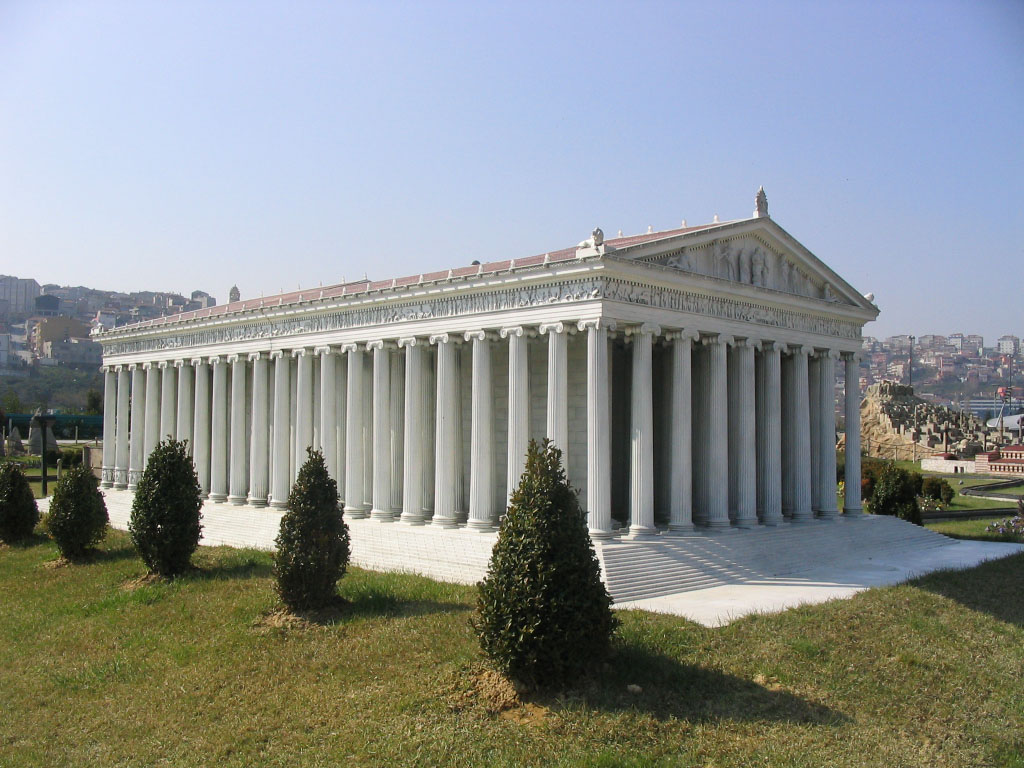
Ephesus was famous for its large Temple of Artemis. Since 2003, this 1/25 scale model of the temple has been on display at the Miniatürk open-air museum in Istanbul.
,
nor to dominate (Gk. authenteo) over a man,
but she is to be silent (calm and peaceful). [This verse is one of the more controversial in the Bible. The reason is that, depending on the translation, the role of women in teaching is affected. Since the woman Priscilla taught Apollos here in Ephesus, and Timothy was taught by his mother and grandmother, the verse cannot forbid women from teaching, see ; . In that case, Paul would contradict Jesus, who sent some women with the mission of telling the disciples about his resurrection, see , and also the Old Testament, where Huldah, Deborah, and Miriam were godly female leaders.
The verse is often divided into two parts. First, Paul seems to forbid a woman to teach, then comes the word "or" followed by the second prohibition: to have authority over a man. The problem with this interpretation is that the word "or" (Gk. oude, found 31 times in Paul's letters) is always used to combine two thoughts into a whole. The chiastic structure means that the meaning could also be "teach dominantly." What also complicates the interpretation is that Paul does not use the usual word exousia for authority. Instead, he chooses authenteo, which is only used here in the entire Bible. Even in ancient sources, the word is unusual. In writings from a couple of hundred years BC, the word seems to refer to the person responsible for someone's death and has sexual connotations, while in more modern texts it seems to refer to control and authority. The origin of the word has to do with "the one who performs something and the one who is responsible." The word was also used in Gnosticism, and by using this word, Paul may have been specifically referring to early Gnostic teachings that flourished in Ephesus along with the female-dominated cult of Artemis. They taught that Eve existed spiritually before Adam, and that she was not deceived but rather enlightened by the serpent. The use of the singular form "woman" here may refer to a specific woman in Ephesus. In 1 Tim. 1:19, two men are named. The introduction in refers not only to men, but also to women. In the neighboring city of Thyatira, a woman taught "deep truths about Satan" and led many astray, see .] 13
The goddess Artemis, the mother of all women, was worshipped in Ephesus.
and then Eve.
14It was not Adam
who was deceived,
but the woman [Eve] who was deceived,
and fell into transgression. [Unlike the cult of Artemis, which was based in Ephesus, where women were worshipped as the origin of all things, it was God who had created humankind. Gnostic myths vary greatly, but what they have in common is that there are several spiritual levels, with the God of the Bible being one of the lower gods. The serpent and Eve are savior figures who rescue Adam. They enlighten him about the spiritual world, which is far higher than the material world. Eve is also said to have been created before Adam and to be the mother of various sons by different fathers, one of whom was Adam. There are endless variations, but the theme is the same. Eve was the origin and the one who enlightened Adam and gave him knowledge, Gk. gnosis. It may be this type of false teachings, myths, and endless genealogies that Paul refers to in .] 15But she will be saved through childbearing [despite the curse, see ],
if they [women] continue to live in
faith,
love [which is unselfish and giving]
and holiness
with good sense.
[The Greek word sophrosyne describes a well-balanced mind characterized by self-discipline and self-awareness.] [In , "the woman" referred specifically to Eve; here the meaning is broadened to women in general. The word "through" does not mean that it is because of childbearing that a woman is saved. This is clear because the next phrase explicitly says that she must "continue in faith, love, and holiness." What Paul seems to be emphasizing is that childbearing and motherhood are not sinful but something beautiful and morally pure. The reason may be that there were some in Ephesus who forbade marriage and taught that celibacy was necessary for salvation, see . Paul speaks positively about family life and encourages widows to remarry, see . Another interpretation is that this is a reference to "the seed of the woman" in , which is the Messiah – the savior of the world.]Church leadership
31[The church needs leadership. The biblical model always points to shared leadership: Jesus sent out the disciples two by two; there are five ministries in ; church leaders are always mentioned in the plural, see Acts 20:17. The Greek word for church leader is episkopos (singular) – "one who watches over" and describes the task of a church leader. The same men, from Ephesus, who in are called elders, Gk. presbyteros (plural), are called episkopous (plural) in . Here too, in the letter to Timothy, both of these Greek words are used synonymously in the plural, see .]This is a trustworthy (reliable) saying: "Anyone who longs (seeks, strives) to be a church leader (Gk. episkopos – "one who watches over")
is striving for a good (noble) task." [The primary factor in church leadership is the Spirit of God who calls leaders and places this desire on their hearts, see . It is the task of the church to discern and confirm those who are called to this task, see . This is the second time this phrase, "this is a trustworthy saying," is used out of a total of five times in the pastoral epistles. The other four are: ; ; ; .]
Qualifications for church leaders
[First and foremost, there must be a willingness and desire to lead a church, but that is not enough. The areas that need to be tested, see , are the leader's personal character, ability to care for his family, suitability for teaching, and experience.] 2A church leader must be: blameless (nothing to criticize), [The leader must have a good reputation both inside and outside the church. This does not mean that he is sinless. It is about an attitude where the leader is quick to ask God and people for forgiveness. It is about a life that is not marred by scandals and unresolved disputes; a tree is known by its fruit, see .]
the husband of one wife, [It is likely that the term "husband of one wife" refers to fidelity to his wife and someone who does not flirt with other women. It is a "one-woman" type of man. The corresponding term "wife of one husband" is used in about women. In the same passage, Paul urges younger widows to remarry after their husbands have died, see ; ; . Paul himself was unmarried, see , and his recommendations, see ; , seem to suggest that an unmarried man is also qualified.]
sober (alert, attentive, collected, balanced), [The word refers to self-control and applies to alcohol, but also to all other areas. It describes someone who has a clear perspective, can think objectively, and does not make sudden changes or get tossed about.]
sensible (good judgment, serious, has a sound mind), [The Greek word sophrosyne describes a well-balanced mind characterized by self-discipline and self-awareness.]
respectable (orderly),
hospitable (welcoming, receiving strangers),
a good teacher.
[In , the gifts of shepherd and teacher go together.] 3not abuse wine (literally "not one who sits long at wine"),
not be violent (combative),
but be kind (understanding, forgiving),
peaceful,
free from greed (not love money and be greedy, literally "not a friend of silver coins").
4He should take good care of his family and make sure that the children [younger children who still live at home] obey and show all respect. 5For if someone does not know how to take care of his own family, how can he take care of God's church?
6He must not be a recent convert (literally a "young plant" or "newly planted"),
lest he become arrogant (develop pride) and fall under the same judgment that the devil [once] did.
[When in his arrogance he wanted to be like God, see .]
7He must also have a good reputation among outsiders,
so that he does not get a bad reputation and get caught in the devil's trap. Qualifications for church servants
8In the same way, church servants should be worthy of respect,
not be hypocrites (false),
not abuse wine,
not be after money,
9hold fast to the mystery (secret) of the faith [which was previously hidden, but is now revealed, see ; ] with a clear conscience. 10But even they must first be tested. Then they can become church servants if there is nothing to be said against them. 11Women [may refer to the wives of church servants or female church servants] should likewise be worthy of respect,
not slander anyone (literally Gk. diabolos – the name of the devil; i.e., someone who divides and splits and acts devilishly),
sensible [same word as in for a church leader],
sober
and faithful in all things.
[The same Greek word, gyne, is used for both woman and wife; it is the context that determines how it should be translated. On the question of whether a woman can serve as a church minister, Paul makes it clear when he writes to the Christians in Rom. Of the nine people he calls co-workers, five are women, see . Phebe, who delivered the letter to Rome, was explicitly a church servant in the city of Cenchrea, the eastern port of Corinth, see .] 12A church servant (Gk. diakonos) should be the husband of one wife [same expression as in ],
take good care of his children and his family.
13Those who serve (Gk.diakoneo) well (in a good and noble way) [refers primarily to church servants, but also applies to church leaders] gain a good position [a good reputation, influence in the church]
and gain great boldness in the faith of the Anointed One (Messiah, Christ) Jesus. [Paul concludes this passage in the same way he begins in , that it is a good task to be a leader. The same word for good is used in verses 1 and 13 and frames this passage. It is also found centrally in .]The Truth
The church is the pillar and foundation of truth
14I [Paul] am writing this to you [Timothy] in the hope of coming to you soon. [At about the same time that Paul writes this letter to Timothy in Ephesus, he also writes to Titus that he plans to spend the winter in Nicopolis, see . Nicopolis is located on the eastern coast of present-day Greece. Paul probably hoped to visit Timothy before continuing eastward, but we do not know if he did so.] 15But if I am delayed, I want you to know how to conduct yourself in God's house, which is
the church of the living God,
the pillar and foundation of truth.
16It is acknowledged (everyone agrees, confesses) that the mystery (secret) of our faith, which was previously hidden, contains a wonderful revelation about him [Jesus] who was: revealed (made visible) in the flesh [when Jesus was born as a human being],
proved righteous through the Spirit (in the Spirit),
seen by angels (messengers),
preached (openly proclaimed) among the Gentiles (the non-Jewish peoples),
believed in throughout the world,
taken up in glory. [These six verses are probably parts of a hymn of praise from that time.]
The truth will be attacked
[As the pillar and foundation of truth, see , it is important to understand that the church is subject to the attacks of the evil one.] 41But the Spirit clearly says that in the last days [not some distant time, but fairly soon after Paul wrote this, see ] some will abandon (fall away from) the faith and follow (devote themselves to) deceiving spirits and teachings of evil spirits, 2led astray by hypocritical liars who are branded in their consciences (without compassion, they can oppress and harm people). 3They forbid people to marry and command them to abstain from food that God has created to be received with thanksgiving by those who believe and know the truth. 4Everything God has created [referring primarily to food] is good [], and nothing is to be rejected when received with thanksgiving [at meals, see ; ]. 5It is sanctified by God's word and prayer [the same unusual word is also used in ]. [These false teachers who ravaged Ephesus were precursors to the Gnostics of the second century. Already here we see the strong dualism where the spirit is good and everything human is evil. They taught that all bodily needs were evil, which Paul opposes. Of course, humans can abuse sexuality and food, but in itself this is something good if used as God intended.]The responsibility of a servant
6When you present this to your brothers and sisters in faith, you are a good servant to the Anointed One (Messiah, Christ) Jesus, who draws nourishment from the words of faith and good teaching that you have followed. 7But reject (avoid, have nothing to do with) the myths (fables, legends) of ungodly and old women. [May refer to Jewish legends such as the apocrypha or Gnostic ideas. In Ephesus in particular, there was widespread worship of Mother Earth. The term "old women" was also used for "wise women." They were female priestesses who passed on these legends in these religions.] Instead, train yourself in godliness. 8"Physical training is useful (helps)
to some extent (gives a small short-term benefit),
while godliness (reverent worship) is useful (helps)
in every way,
for it has the promise of life,
both in this life and in the life to come." [Physical training is the Greek word gymnasia. It can refer to physical training in general or to asceticism, see , where one forces the body into obedience in order to achieve a higher spirituality.] 9This is a trustworthy saying (credible) and worthy of full acceptance. [The phrase "This is a trustworthy saying" probably refers to , and especially the last part, but it can also refer to . The phrase is used a total of five times in the pastoral letters. Previously in ; , and also in and .] 10That is why we constantly work and struggle (give our utmost), for we have set our hope on the living God who is the Savior of all people, first and foremost for those who believe. 11You must impress this upon them and teach it. 12No one should despise you because you are young, but be (continue to be) an example to the believers in
word and deed (behavior, way of life),
in love [which is selfless and generous],
faith (faithfulness), and purity. [In this culture, people were considered young until the age of 40. If Timothy was about 15 when Paul took him on his second journey, see , he was now in his 30s.
Of these five qualities, the first two are outward qualities that are easy to see. Paul wanted Timothy to be known for speaking wise words instead of ill-considered, heated words, and also to live as he taught. The last two qualities, faith and purity, are not directly visible, but have more to do with inner character. The word faith refers both to belief in God and to faithfulness in a mission. Central to these five qualities is selfless, giving love as the driving force behind everything a Christian does. The best way to show the right way is to live by it yourself.] 13Until I come, continue to
read aloud from Scripture [mainly the Old Testament, but some New Testament letters were also in circulation, see .],
encourage (comfort, help, stand by someone, admonish)
and teach (instruct, guide). [Christian worship followed the same pattern as the Jewish gathering in the synagogue, where someone expounded on the text after it was read. Jesus followed this pattern in Nazareth, and Paul and Barnabas did the same in Antioch in Pisidia, see ; . Encouragement and teaching go hand in hand. Both words are found together in .] 14Do not neglect the gift that is in you, which was given to you through prophecy when the elders laid their hands on you. [The laying on of hands was a way of setting someone apart for service, see ; ; ; . An example of this is found in . The gift may be leadership, discernment, or perhaps evangelism, see , ; .] 15Think about this, live by this so that everyone can see your progress. 16Be careful with yourself [how you live your life] and your teaching [your theology] and persevere faithfully in this [your ministry, see verses 13-14]. [Order is important; personal life comes before what someone teaches.] When you do this, you will save both yourself and those who listen to you. [The best antidote to false teachings is to present and teach the truth and to live in truth yourself, see verses 6-7.]Instructions to various groups in the church (5:1-6:2)
Treat the church as your own family
[How we view people affects how we speak to them. Paul urges Timothy to relate to everyone in the church as if they were his own family. These instructions help Timothy with how to rebuke and speak the truth in a loving way, see .] 51Do not be harsh (literally, "do not strike down," do not speak harsh words) with an older man,
but encourage him (admonish, stand by his side) as [you would speak to] a father,
[admonish and encourage]
younger men as brothers, 2older women as mothers
and younger women as sisters in all purity. Widows
[Throughout the Bible, God's care for widows and orphans is evident. The church should take care of them, see ; ; . Already in the church in Jerusalem, help for widows was organized, see . Now, thirty years later, this aid took up a large part of the congregation's activities, and Paul is careful to identify those who really need help.] 3Honor (value, give financial support to) widows, those who are truly widows. [The word honor is used only once more by Paul. There it is a direct quotation of the commandment to honor one's father and mother, see . The word echoes the exhortations concerning widows found in the Old Testament, see ; .]Who is a true widow?
4But if a widow has children or grandchildren, they should first learn to show respect for their own family and repay what they owe their parents, for this is [good, right, and] pleasing to God. 5She who is truly a widow, and has been left alone (single, isolated), has put her hope in (has her expectation in) God and perseveres (remains; endures) [continues to stand firm] in invocation [in prayers offered for specific needs] and prayer [in worship, devotion, and intimacy with God] night and day. 6But the [widow] who lives for luxury [who always indulges in wasteful extravagance and frivolous pleasure] is dead while still alive (literally: has died).
7Teach them [probably referring to the widows] this so that no one can accuse them (there is nothing to criticize). [Now follows a warning to the families in the church:]
8If anyone does not take care of (provides for, plans for, literally "thinks ahead for") his loved ones, and especially his own family, he has denied the faith and is worse than an unbeliever.
[Paul had previously written to the Ephesians and specifically urged children to honor their parents, see . Jesus himself made sure that his mother was provided for when he died, see .]Church widow
9To be counted as a church widow (registered widow) [to be included on the list of widows who are to receive support], she must
be at least sixty years old
and have been the wife of one husband. [The term "the wife of one man" corresponds to the expression "the husband of one wife," see . The word probably refers to fidelity to her husband, and not to the woman having been married only once, since Paul encourages remarriage in the event of death, see . Sixty years was the age at which one was considered old in ancient times.]
10She should be known for good (honorable) deeds:
raising children [her own, or caring for orphans],
showing hospitality,
washing the feet of the saints [being willing to serve others],
helping those in need
and using every opportunity to do good. [It is not entirely clear whether these church widows also received support. Perhaps they also had a function in the church; mentions the ministry of intercession. There are tomb inscriptions from Rom, albeit a few hundred years later, which state that a church widow named Regina was not a burden to the church. Another argument for the widows not only being cared for but also having a function is the various qualifications that the widow is expected to have. Various qualifications are also mentioned for elders and deacons, the clearest parallel being "the wife of one husband." A Syrian text from the early 200s, Didascalia Apostolorum, regulates various functions in the congregation. It prohibits women from teaching, especially widows. This suggests that widows did in fact teach and that the text seeks to prevent this from happening.]Younger widows
11Younger widows [younger than sixty, but probably much younger than that, see ] should be rejected [from becoming church widows, see ].
It is easy for them to be drawn into a promiscuous lifestyle (driven by lust) and led away from the Anointed One (Messiah, Christ) and want to marry. 12In this way, they bring judgment upon themselves because they have denied their first faith (faithfulness). [The word faith can refer either to faith in Jesus or to faithfulness, in which case it refers to a vow of faithfulness not to marry, as these church widows gave. However, it is not remarriage itself that is the problem; Paul encourages it in . It seems to have more to do with how they lived their lives and that they may have married non-believing men. As the next verse shows, the main problem was a dissolute lifestyle that had a negative impact on many.] 13At the same time, they [these younger widows] learn to be lazy as they go about their homes. Not only do they become lazy, but they also become gossipy and nosy, talking about things that are not proper. [Pastoral home visits may have been part of the role of a church widow. This freedom to touch, visit, and serve others could be abused. In , Paul warned against fables, legends, and heretical teachings from women. This warning is also found in the next letter, see . Perhaps this group was particularly susceptible to the influence of early Gnostic teachings.
The following example from the Roman satirical poet Juvenal gives an insight into the kind of gossip that was common among women at that time: "She knows everything that happens in the world ... She knows who is in love with whom, and which Casanova the women are fighting over; she can tell who made which widow with children, in which month, how each woman behaves with her lover and what she says to them ..."] 14I therefore want [as a general rule] younger widows to marry, bear children, manage their homes, and give the adversary [the devil or opponents of the church, see ] no opportunity to speak ill of them. 15Some have already turned away and begun to follow Satan. [If these younger widows were allowed to continue in their lifestyle, supported by the church, it would damage the reputation of the entire church in society. It was necessary for Timothy to address the behavior of these young widows in all purity, see . The exhortation to marry is not contrary to what Paul writes in 1 Cor. 7, where he recommends that widows should remain single. The decisive factor in this context is whether the person living alone has the gift to do so, see .] [The exhortation in also applies to wealthy women who had their own households:]
16If a believing woman has widows in her household, she should take care of them and not burden the church, so that it can take care of those who are truly widows. [An example of a woman who took care of widows was Dorcas in Joppa, see , . Another example of a wealthy woman is Lydia, who came from the city of Thyatira, only ten miles from Ephesus, see .]Elders
The worker is worthy of his wages
17The elders who do their leadership duties well should be considered worthy of double honor [sufficient financial support, perhaps twice as much support as a widow received, see ], especially those who work in preaching and teaching. 18Scripture says: You shall not muzzle an ox while it is treading out the grain [; ]
and the worker is worthy of his wages. [; ; ]
Accusations and rebuke
[Paul had already mentioned that the church needed to be on guard against those who spoke ill of its leaders, see , . Here are the guidelines for distinguishing between false and genuine accusations. It is the same principle found throughout the Bible with multiple witnesses, see ; .] 19Do not bring an accusation against any of the elders unless there are two or three witnesses. 20Those [church leaders] who sin (an ongoing action, consciously continuing to act wrongly) in front of everyone, you shall rebuke in front of everyone so that the others may also take warning. 21I solemnly charge you before God and the Anointed One (Messiah, Christ) Jesus and the chosen messengers (angels): keep (protect) this [these rules] without prejudice and without acting partial.Appointing leaders
22Do not be too quick to lay hands on anyone. [Replace an elder who has been deposed, or appoint someone new as an elder.] Do not participate in the sins of others. [One way to protect yourself from a situation where a leader must be corrected is to not be too quick to appoint someone to a leadership position. Anyone who is involved in appointing a church leader too hastily, before the person has proven themselves faithful, is complicit in the negative consequences that can so easily arise. In Antioch in Syria, they prayed and fasted before sending Barnabas and Paul on their first missionary journey, see .] Keep yourself pure.
23[Paul seems to be reminded that this statement about purity can be overinterpreted, so he gives personal advice to Timothy.]
No longer drink only water,
but use a little wine for your stomach (Gk. stomachos) and your frequent illnesses (weaknesses). [One of the issues with the false teachers in Ephesus was that they taught asceticism. They forbade marriage and abstained from certain foods and drinks, see . Perhaps Timothy had been influenced by them and needed Paul's advice in this area. The qualifications for both church leaders and church servants include a requirement of moderation in the use of alcohol. see , . It seems that Timothy did not drink wine at all, but only water, so Paul is forced to urge Timothy to actually drink a little wine for the sake of his health. It is possible that Luke the physician was at Paul's side when he wrote this, see . In some regions and cities with poor access to fresh water (where water from winter rains was stored in reservoirs instead), this was often unhealthy due to bacteria, and wine was safer to drink.] [Back to the discussion of why one should not be too quick to appoint new elders:]
24Some people's sins
are obvious and are judged in advance,
while others' sins only come to light later. 25In the same way, good (honorable) deeds are obvious,
and those that are not cannot remain hidden [forever; they will become visible].Slaves
[Paul has given instructions to various groups in the church, see chapter 5. The last group is slaves. Roman society was dependent on slaves. In the early days, about ninety percent of the population were slaves. Even though slavery had declined, about half of the Roman population were slaves when Paul wrote this letter. The slaves who worked in mines and fields often had a very difficult life, while those who served in homes could have a more tolerable life. Some of these slaves were well educated and served as scribes and doctors. Paul had previously written that in Jesus, no one is a slave or free anymore, see . What did that statement mean in a church that was growing and consisted of both slaves and slave owners?] 61All who bear the yoke of slavery should consider their rulers (Gk. despotes) worthy of all respect, so that the name and teaching of God may not be blasphemed. 2Those who have believing masters should not look down on them because they are brothers [in the faith], but on the contrary, serve them all the more willingly because those who receive their good service are believers and beloved. Thus you should teach and exhort.Final exhortations
Pride and greed are often the driving forces behind unwholesome teachings
3If anyone spreads other teachings and does not adhere to the sound (healthy) words of our Lord Jesus the Anointed One (Messiah, Christ) and the teaching that belongs to godliness [the gospel, as opposed to myths, see ], 4he is arrogant and ignorant. He has a sick desire (unhealthy strong zeal) to discuss (debate) and argue about words.
This leads to
envy (resentment),
strife (factions, division),
slander (hostility),
malicious suspicion (an attitude of always thinking the worst of people)
5and constant strife (conflict) between people with corrupt minds
who have lost sight of (been deceived about) the truth
when they claim that godliness is profitable. [It is striking how these characteristics stand in sharp contrast to the qualifications for a leader in the church, see . Paul now elaborates on the danger of materialism. The subject is taken up in the following paragraphs, see verses 6-10, but also in verses 17-19. The letter has a chiastic structure, which means that the subject recurs and belongs together.]Contentment
6But godliness combined with contentment is truly a great gain. 7We brought nothing into this world,
so we cannot take anything out of it either. 8If we have food and clothing, we should be content with that.The love of money is dangerous
9But those who want (strive, plan for, and have as their sole ambition) to become rich fall into temptations and snares and many foolish and harmful desires that drag people down into ruin and destruction. 10For the love of money (literally "friendship with silver coins")
is a root of all (kinds of) evil [plural, as just mentioned in verses 4-5, 9]. [This proverb is often misquoted as "money is the root of all evil," which is not true. One example is the Fall, before money even existed, see . Paul instead states that it is the friendship and love of money that is the root of the evil mentioned in the previous verses. It is greed and covetousness that cause envy, slander, divisions, disputes, temptations, and harmful desires.] Some, in their attempts (longing for something without shying away from anything), have strayed from the faith and pierced themselves with many pains (pangs of conscience).Flee some things—fight for others
[A person who wants to follow God needs to flee from certain things, follow others, and fight the good fight of faith to keep them. The first three verbs could be translated with words that all begin with the letter f: flee, follow, and fight. Paul now exhorts his spiritual son Timothy:] 11But you, man of God (you who belong to God, who are set apart for his service):
Flee (constantly)
all these things [word battles and the love of money, see verses 3-10].
Follow (strive constantly for):
righteousness (living right, in complete harmony with God's will),
godliness,
faith,
love [which is unselfish and giving],
perseverance (steadfastness) [character that remains firm even under trials],
gentleness (meekness; balanced and controlled strength that is free from vindictiveness and bitterness).
12Fight (battle) [be constantly engaged in]
the good (honorable) fight (battle) of faith [as on a battlefield or in a competition in an Olympic arena]!
Hold fast to (seize; grasp, get hold of) [truly seek to win] the eternal life to which you were called (out into) and to which you also confessed by making the good confession before [the eyes of] many witnesses. [Probably refers to Timothy's baptism or ordination to ministry.] 13I [Paul] command you [Timothy] before God (in his presence), who gives life to all living things,
and before Jesus the Anointed One (Messiah, Christ),
who testified with the good confession before Pontius Pilate.
[Jesus' mission was to bear witness to the truth, see .]
[This is what I command you:]
14Keep this commandment (your mission)
spotless (pure)
and blameless (so that there is nothing to criticize).
[Be true, live in such a way that no one can criticize it.] Do this until our Lord Jesus the Anointed One (Messiah, Christ) is revealed [when he returns to reign here on earth]. 15His revelation will be visible at his appointed times.
[The plural form of times suggests that God's kingdom is revealed gradually in several stages, see .] He who is the Blessed (happy, fortunate), only Mighty One (Gk. dunastes) [the only ruling dynasty],
King of kings and Lord of lords. 16He alone is immortal and dwells in unapproachable light,
whom no man has seen or can see –
to him belong honor and eternal power. Amen (so be it). Exhortation to the rich
17Exhort those who are rich in this age (the world) not to be proud or to put their hope in something as uncertain as wealth, but in God, who richly provides us with everything to enjoy. 18Urge them to do good, to be rich in good (honorable) deeds, to be generous and to share. 19Then they will store up a treasure that is a good foundation for the future (literally: for what is to come) [in the age to come], so that they may gain (hold on to; get hold of, see ) true life.Remain faithful
20Dear Timothy, keep what has been entrusted to you (financial term for something that has been deposited in an account).
Turn away from ungodly, empty talk and objections from what is called knowledge (Gk. gnosis) without being so. 21Some have professed this and have strayed from the faith.