Luke
The Evangelist's Foreword
11It is a well-known fact that many have already recorded (written about) the great events that have taken place among us, 2just as it has been told to us by those who from the beginning [of Jesus' ministry] were eyewitnesses and became servants of the Word. 3After thoroughly familiarizing myself with everything from the very beginning, I have decided to write it down in a detailed and structured way for you, most honorable (excellent) Theophilos [which means “the one who loves God” or “loved by God”], 4so that you may have complete certainty in (feel sure, not have to doubt) what you have been taught [by oral tradition]. [Luke wants to be clear that he is not going to introduce any new ideas. He wants to summarize and clarify what others have already written and the oral tradition that existed about Jesus. One of the sources was probably the Gospel of Mark and perhaps also the Gospel of Matthew. Luke expresses his gratitude for what has already been written, but sees the need to recount the life of Jesus to help Theophilus and his non-Jewish Christian friends understand the Gospel. These first four verses are one long well-structured sentence in Greek.]John the Baptist and Jesus’ Childhood (1:5-2:52)
An Elderly Couple Miraculously Have a Baby!
5
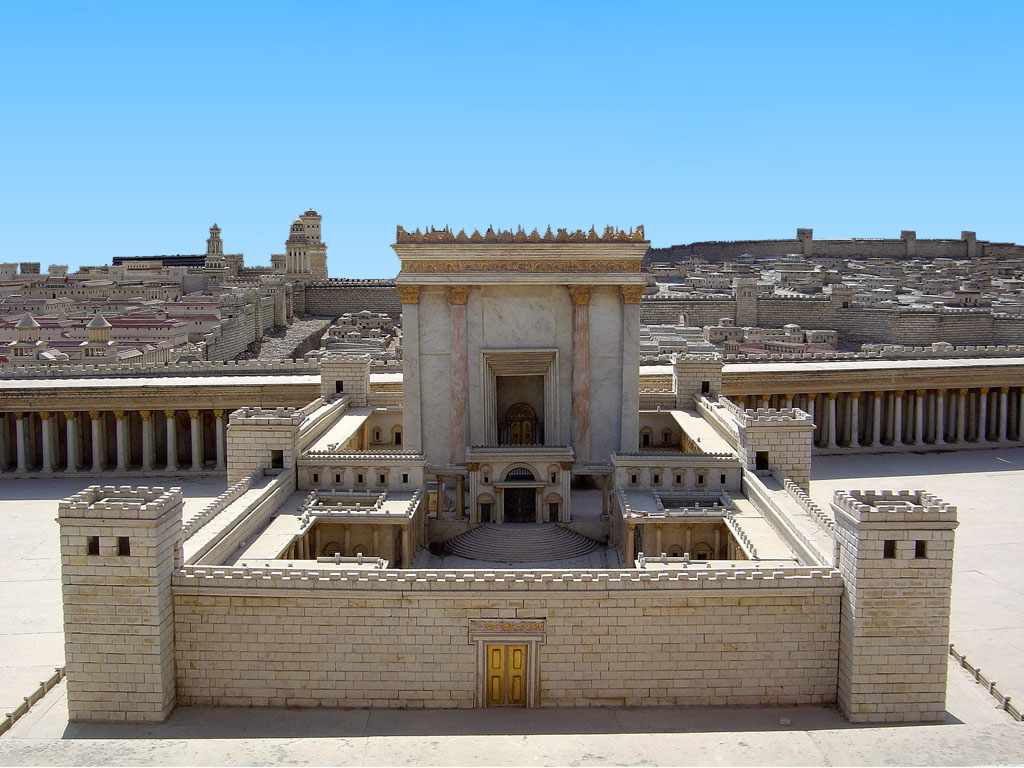
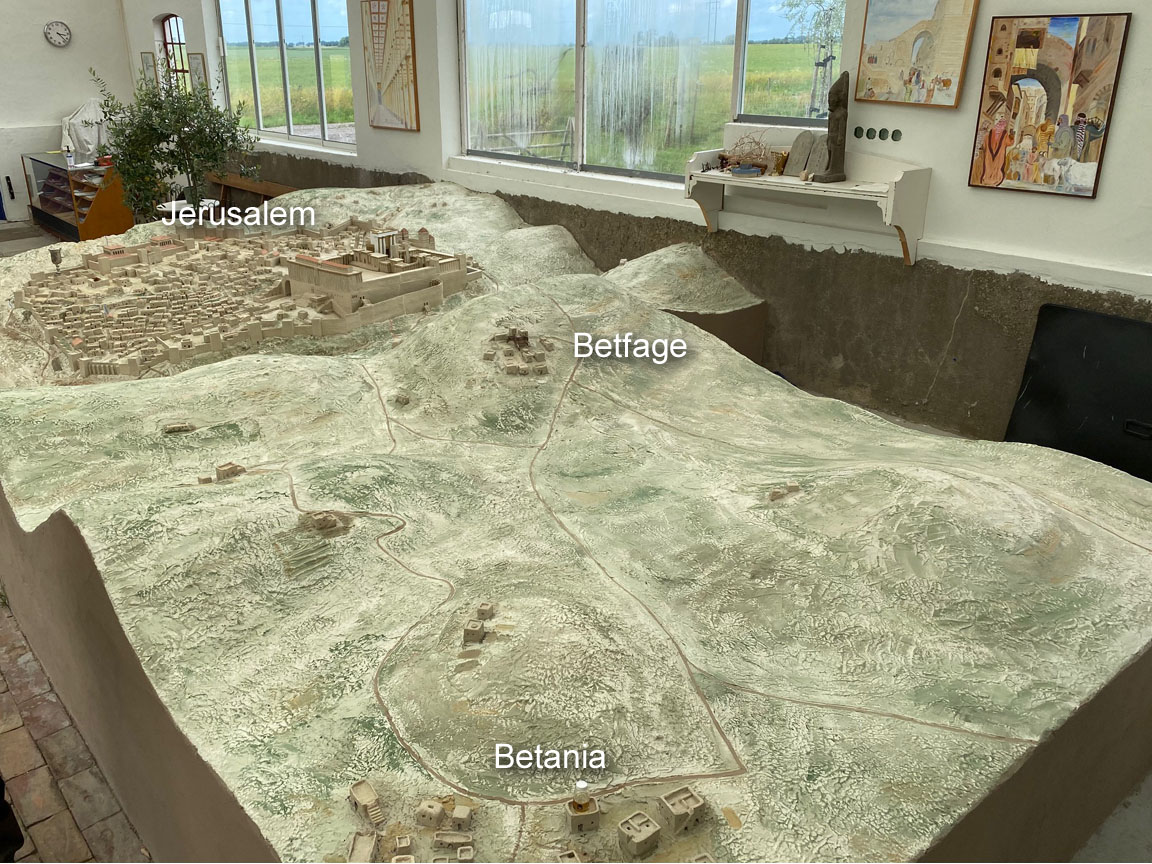
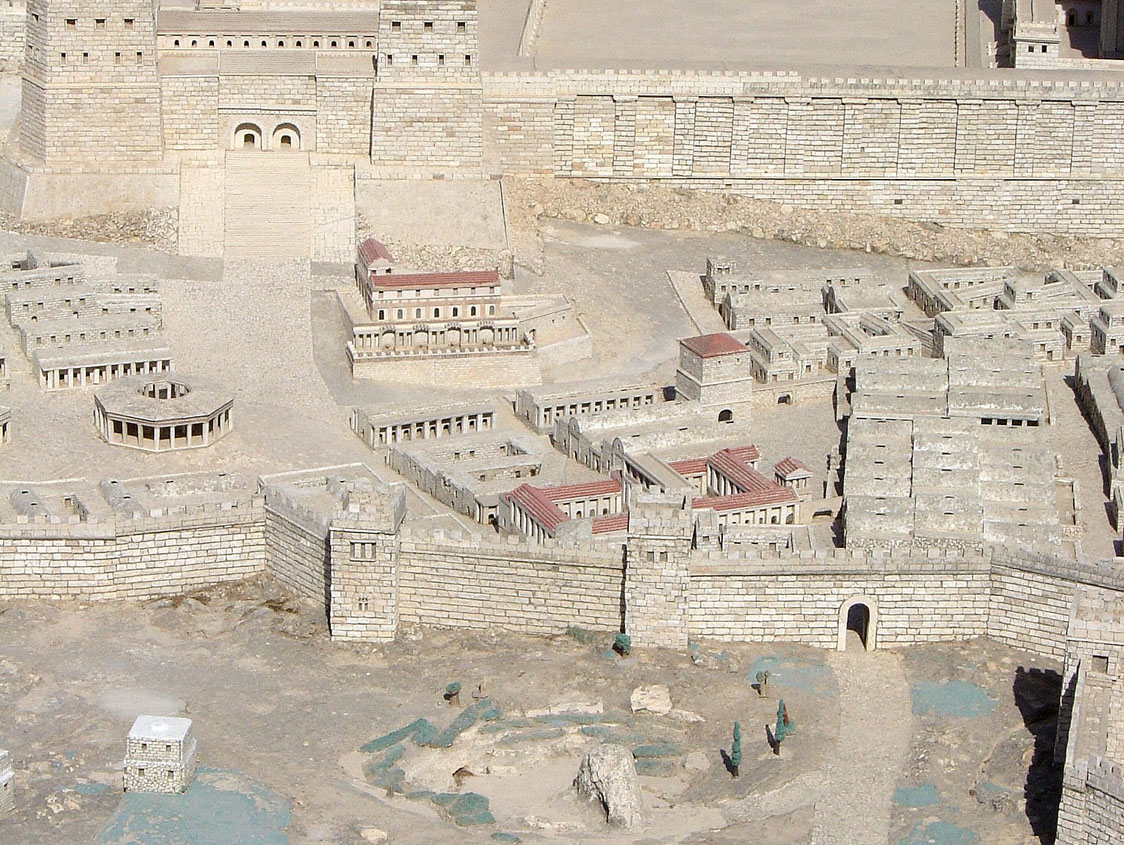
The Israel Museum in Jerusalem has a large outdoor model of Jerusalem as it looked in Jesus' time, on a scale of 1:50. The temple seen from the east.

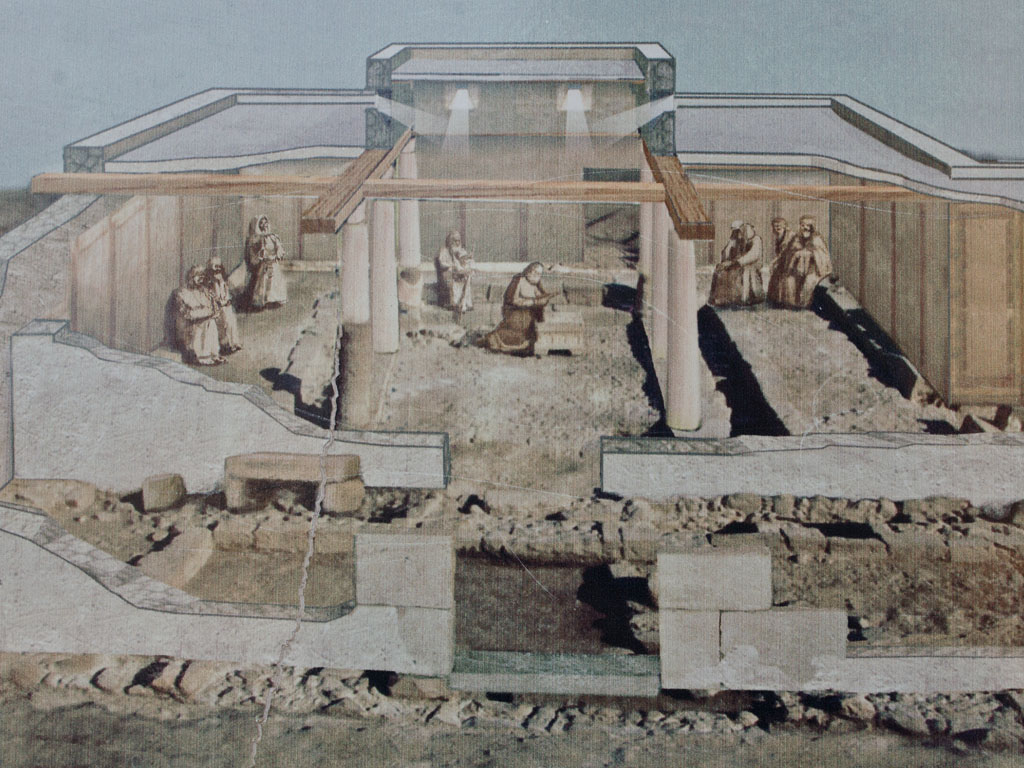
The sanctuary consisted of two rooms, the Holy of Holies and the Holy Place. The angel probably stands between the altar of incense and the seven-branched candlestick.
“Do not be afraid, Zechariah,
for your prayer has been heard.
Your wife Elizabeth will bear you a son,
and you will name him John. [The name John comes from the Hebrew , which in turn is a short form of . The name is composed of the name of God (Hebr. Jahveh) and the word for mercy (Hebr. chanan). The meaning is ’God has mercy’ or ’the Lord is gracious’.]
14You will have great joy and delight, yes,
and many will rejoice at his birth, 15for he will be great in the sight of the Lord.
He will not drink wine nor strong drink,
and even in his mother’s womb he will be filled with the Holy Spirit.
16And many of the sons (children) of Israel he [John] will turn [back from sin] to [love and serve] the Lord their God.
17He will go before the Lord in the spirit and power of Elijah to
’turn the hearts of the fathers to the children’ [; ]
and the disobedient to the understanding of the righteous,
so that the Lord may have a prepared people.” 18Zechariah said to the angel, “How can I be sure of this? I am old, and my wife is old.” 19The angel answered him and said: “I am Gabriel. I stand before God (in His presence) [that is his mission]. I have been sent to tell you this good news. 20Behold, you will be silent, unable to speak until the day when this happens, because you did not believe my words [which are the words of God], which will be fulfilled [regardless of your belief or disbelief] when the time comes.”[The angel’s name, Gabriel, means man of God or warrior of God. He was sent 600 years earlier to Daniel, see Dan 8:16. Six months later, after the visit to Zechariah, he is sent to Mary, see . Zechariah asked for a sign in and he receives a sign that prevents him from speaking in unbelief, see also where muteness can be a sign.] 21The people were waiting for Zechariah and wondering why he was lingering in the temple. [The people had stopped praying and started worrying about what had happened. According to the Talmud (a Jewish book summarizing and commenting on the Old Testament), the priest was only supposed to be in the Holy Place for a short time.] 22When he [finally] came out, he could not talk to them. [He was expected to speak the Aaronic blessing over the people, see . Instead, Zechariah gestures and tries to explain without words that he has experienced something special.] They understood that he had had a vision in the temple. He made signs to them again and again because he was unable to speak. 23When the time of his service was over [after the Sabbath that ended his weekly service], he went home. [Zechariah and Elizabeth lived in the countryside somewhere in Judea, see . Once home, he must have tried to explained what had happened in the temple.] 24After a while his wife Elizabeth became pregnant, and for five months she remained in seclusion (hidden). She said to herself: 25“The Lord has done this to me. Now he has thought of me and delivered me from my shame among men.” [From the angel’s message they understood that their son would have an important divine mission, see , which needed to be prepared for in prayer and seclusion.]The angel’s Message to Mary
26
The modern city of Nazareth, located high on a mountain.
and be called the Son of the Most High.
The Lord God will give him
the throne of his ancestor David.
33He will reign as King over the house of Jacob [Israel] forever (through the ages);
there will be no end to his kingdom.” 34
Nazareth in 1842.
Mary and Elizabeth
39
Sunset in Ein Kerem.
“You are blessed (fortunate, enviable) above all other women, [you have been given a unique privilege]
and blessed is the child you carry within you.
43But who am I (how have I deserved this honor),
that the mother of my Lord comes to me? 44Behold, at once when my ears heard the sound of your greeting,
the child kicked with jubilant joy in my womb. 45Blessed (happy, fortunate) is she who believed (was faithful),
for it will be done as it has been said to her from the Lord [through the angel Gabriel].” Mary’s Song of Praise - Exalt the Lord
[Mary bursts out in praise. The first word in the Greek is the verb exalt (Gk. megaluno). It sets the tone for the whole song. The Latin translation has the same word order, which is why this piece has come to be called the Magnificat, from the Latin word for exalt. Mary was already familiar with the Scriptures at a young age, and the whole hymn has a biblical feel. There are many similarities with Anna’s song of praise when God gave her a son, see . The song is structured as a psalm, as are the songs of Zechariah and Simeon, see ; .] 46Then Mary said: “My soul exalts the Lord [I constantly praise and speak of the Lord’s greatness], 47and my spirit rejoiced (leaped for joy) in (because of) God,
my Savior (Rescuer, Deliverer)! [; ; ]
48For he has seen (considered) the low estate (humility) of his handmaid. [; ]
Behold, from this hour all generations (generation after generation)
will call me blessed (joyful, happy) [; ]. 49For the Mighty One has done great things (marvelous things) for me [; , ],
and holy (set apart) is his name. []
50His mercy (love towards those who suffer) is upon those
who fear him from generation to generation. [] [Mary begins praising God for what he has done for her, see verses 48-50. The second part is prophetic, looking forward to what the Son will do for Israel. It is not uncommon for psalms to be structured in this way, see ; ; ; ; .] 51He has done mighty works of power with his arm [; ].
He has dispossessed those who have haughty thoughts in their hearts. 52He has overthrown powerful rulers (leaders) from their thrones
and exalted those of low rank.
53He has filled the hungry (needy) with his good gifts [],
and sent away the rich empty-handed. []
54He has taken care of (helped and stood up for) his servant Israel [],
he has remembered his mercy (grace).
55He spoke to our fathers (has given the promise),
to Abraham and his children (seed, descendants) forever (to the age of time).” [Mary had understood that Jesus was the Lord’s Anointed One who would fulfill the promise God had made to Abraham, see ; ; .] 56Mary stayed with her for about three months [until John the Baptist was born], and then returned home. [The Jewish custom was that the mother did nothing but rest during the first three months of pregnancy.]The Birth of John the Baptist
57Now the time came for Elizabeth to give birth, and she gave birth to a son. 58Her neighbors and relatives rejoiced with her when they heard that the Lord had shown her great mercy [honored and showered his love on her]. [The circumcision of Jewish boys is a sign of God’s eternal covenant with Abraham, see . The ceremony is called brit mila and is performed on the eighth day after birth, even if it is a Sabbath. The Hebrew word for circumcision is mila and the covenant is brit. At the same time, the child also received his name. During the ceremony the first part of is quoted.] 59On the eighth day, they came to circumcise the baby; they wanted to call him Zechariah after his father. 60 60But his mother answered, “No, his name will be John.” [The name the angel told Zechariah his son would have, see .] 61Then they said to her: “But none of your relatives have that name.” 62So with signs they asked his father what he wanted the child to be called. 63He asked for a writing tablet and wrote: “John [Heb. Jochanan] is his name.” Everyone was surprised (shocked). 64At once Zechariah’s mouth was opened, and his tongue was loosened. He began to speak, praising (thanking, glorifying) God. 65All their neighbors were filled with fear, and everywhere in the hill country of Judea people were talking about what had happened. 66Everyone who heard it took it to heart and said: “What will become of this child?” For indeed the hand of the Lord was with him. 67Now his father Zechariah was filled with the Holy Spirit, he prophesied and said: [Earlier the child and his wife Elizabeth had been filled with the Spirit, see verses 15 and 41. It is not unlikely that Zechariah sings out the following verses. Verses 68-75 are one long sentence in Greek.]
68“Blessed (praised, exalted) is the Lord, the God of Israel,
for he has come (visited) and redeemed (delivered) his people.
69He has raised up a mighty Savior for us,
in the house (lineage) of his servant David. [’Mighty Savior’ is literally ’horn of salvation’. The horn of a wild ox is a metaphor for military strength and victory.] 70Just as he promised through his holy prophets, long ago (ages past),
71so that we might be saved from our enemies
and from all those who hate us. [He has raised the Savior because:] 72He wanted to show mercy (grace, faithful love) to our fathers
and remember his holy covenant, 73the oath he made to our father Abraham []: 74that we, delivered from the hand of our enemies,
may serve him without fear,
75in holiness and righteousness
before him in all our days. 76And you, little child [my beloved John], will be called a prophet of the Most High,
for you will go before the Lord and prepare his ways [],
77and give knowledge of salvation to his people
through the forgiveness of their sins. [] 78This will happen thanks to the inward mercy (grace) of our God,
a light from on high will dawn on us [a metaphor for the Messiah, see ],
79to shine on those who sit in darkness and the shadow of death [],
and lead our feet into the way of peace. []” 80The child grew and became strong in spirit. He dwelt in the deserts (the uninhabited regions) until the day of his appearance to Israel [when he began his public ministry and was called John the Baptist]. 21
Marble relief from the end of the first century illustrating a Roman tax census. Roman citizens were counted every five years.
Quirinius was born in 45 BC in Rome. He made a career in the army and in 15 BC Augustus appointed him proconsul of Crete and Cyrene. After returning to Rome in 12 BC, he was reassigned to Syria in 11-7 BC. Since the governor of Syria, Saturninus, died at this time, and it was some time before Varus took office, it is not unlikely that Quirinius was then put in charge of the tax collection. It was his first tax assessment. He later carried out a second tax assessment in 6 AD when he returned to Syria.
Our Western calendar was developed by the monk Dionysius Exiguus in Rome in 525 AD, before which time had been reckoned based on major events or different rulers. However, it turned out that he was wrong by a few years about Anno Domini, which means ’Year of the Lord’ in Latin. Today, most scholars believe that the birth of Jesus occurred sometime between 8 and 4 BC.] 3They all set out [traveled, crossed the country] to register for taxes, each to his own town [where their family records were kept]. 4Joseph also went up from Galilee, [out] from the city of Nazareth to the city of David, which is called Bethlehem, in Judea – because he was of the house and lineage (family – Gk. ) of David. 5He came to pay his taxes with Mary, his betrothed, who was visibly pregnant (“great with child” – Gk. ). [This is the only time the word is used. The root word has to do with "waves" and denotes how the pregnancy is visible, i.e. after week 16 (4 months) or more. The name "City of David" often refers to Jerusalem, which was the city David occupied, see , but is also used for Bethlehem, as it was his birthplace, see . Bethlehem literally means “house of bread”. It is no coincidence that Jesus who is the “bread of life”, see , is born in Bethlehem as prophesied, see ; . Bethlehem is just south of Jerusalem – the city that you always go “up” to, no matter what direction you come from, see e.g. .] 6
©Anders Wester
An event that Affects Everyone
8
The fields outside Bethlehem.
“Do not be afraid! Behold, I have good news of great joy for all the people. 11For today [this very night] a Savior (Deliverer) has been born to you in the city of David [Bethlehem, see ], who is the Anointed One (Messiah, Christ), the Lord. [Savior (Gk. Soter) comes from the verb sozo which describes one who saves, heals and delivers. The title is used for the first time in , referring to the Lord. It describes how Jesus has qualities that belong only to God.] 12This will be the sign for you [the way you recognize him]:
You will find a newborn child (Gk. brephos) [cf. ] wrapped in strips [of linen] and lying in a manger.” 13Suddenly a great angelic army joined with the angel, and they praised God and said: 14“Glory, in the highest [in the highest heavens],
to God
and on earth peace (complete harmony),
among (within) men – his good pleasure (good will; purpose, joy).” [Structurally, the words glory/peace, heaven/earth and God/man belong together and form a chiastic pattern in which God is at the center and binds heaven and earth together. In the NT, the Greek word doxa (glory) refers to the glory of the Father and the Son in all their splendor and magnificence, reflected by the angels sent on a heavenly mission, see . Literally in the Greek it says “God in the highest” i.e. in the heavens, just as Jesus taught us to pray: “Our Father who art in heaven”, see .] 15When the angels had gone from them [back] to heaven, the shepherds said to one another, “Let us now [at once] go over [all the way] to Bethlehem and see that (the word – Gk. rhema) which the Lord has made known to us!” 16So they hurried there and found Mary and Joseph and the newborn baby lying in the manger. 17When they had seen it, they told what had been said to them [by the angel] about this child, 18and all who heard it were amazed (astonished) at what the shepherds told them. 19But Mary kept all this within herself and pondered it in her heart (pondering all that had happened, comparing what had been said by the shepherds with the message given earlier by the angel Gabriel). 20The shepherds returned [to the sheep] and honored and praised God for all they had heard and seen, for everything was just as it was told to them.Circumcision and Naming
21When eight days had passed and he was to be circumcised, he was given the name Jesus, which the angel had given him before he was conceived in the womb. [The naming was part of the Jewish ceremony of circumcision of a boy. It took place in the family home. More details are described when John the Baptist went through the same ritual, see . The name Jesus is derived from the name Joshua, which in Hebrew is composed of two words. The first part is Yahweh, which is the name of God, and the last part is Hosea, which means ’one who saves, redeems’. The name Jesus literally means “God is salvation”.]Jesus is Presented in the Temple

Model of the Second Temple. Located at the Temple Institute in Jerusalem.
Every firstborn son who opens the womb
will be sanctified unto the Lord. [] [The principle of sanctifying the first applied to crops, animals and people. It was a constant reminder that everything belongs to the Lord and that every good gift comes from him. The commandment was observed one month after birth, see Num. 8:16. The father handed his son over to a priest in the temple and received him back for a prescribed symbolic sum of five pieces of silver. The ceremony known as Pidjon haben, Hebrew for ’redemption of the child kicked in her ’, is still practiced by Orthodox Jews today. A firstborn from a priestly family (the kohen) is not covered by the commandment. That is why there is no mention of this around the birth of John, see .
There is also a deeper meaning in this commandment. The firstborn son represents the whole people, and when he was consecrated to the Lord, it recalled God’s call to the whole people. God calls Israel his firstborn son, see .]
24And [they also came there] to sacrifice according to what is said in the teaching of the Lord: A pair of turtledoves or two young pigeons. [, a poor family's offering.] [Two doves were sacrificed for Mary's purification. This was to take place 40 days after the birth, see . , which Luke quotes in part, begins "If she cannot afford to sacrifice a year-old lamb, she should take two turtledoves or two other doves." In other words, Joseph and Mary were poor, see . The wise men had not yet come with their gifts, see . In a larger perspective, no lamb is sacrificed for Jesus. Instead, he becomes the Lamb of God sacrificed for the sins of the world, see .]
[Joseph and Mary were careful to follow Moses' teaching, see , , ; . The Greek word nomos, which is a broad word meaning doctrine, standard, or law, is used five times in this chapter. In the Greek translation of the OT, the Septuagint, it is used to translate Torah (which means teaching). Luke gives two different rituals which both took place in the temple. Following tradition, Joseph took Jesus with him on the 31st day of Pidjon haben (redemption). Ten days later, the family went together to the temple to sacrifice the two doves for Mary's purification. It is on that occasion that the meeting with Simeon and Anna takes place, see verses 25-38.
Another interpretation is that Jesus is sanctified for service in the temple since the payment of the five silver coins is not mentioned. In that case, it may explain why Jesus wants to stay there as a twelve-year-old, see Luke 2:49. In Luke's account there are several parallels with the story of Anna leaving Samuel in the temple, see .]Simeon Sees Jesus
25In Jerusalem there lived a man named Simeon. He was righteous and godly and was waiting for the deliverance (comfort) of Israel. The Holy Spirit was upon him, 26and it had been revealed to him by the Holy Spirit that he would not see death until he had seen the Lord's Anointed. [Literally, "Christ of the Lord," Christ being the Greek translation of the Hebrew Messiah, which means anointed.] 27Guided by the Spirit, he came to the temple. When the parents brought in the child Jesus to do with him as was the custom according to the teaching, 28Simeon took him in his arms and praised God, saying: 29"Ruler, now you let your servant go away in peace,
in accordance with your word (which you have promised).
30For my eyes have seen your salvation 31which you have prepared in the sight of all nations, 32a light of revelation to the Gentiles
and of glory to your people Israel.” [In a clear way, the old Jew Simeon illustrates the salvation God has prepared for his people, see . Jesus is literally placed in the arms of the Jewish people when Simeon takes him in his arms, see .] 33His father and mother were astonished (they were amazed and surprised) at what was spoken of him. 34Simeon blessed them and said to his mother Mary: "Behold, this child is set for the fall and vindication of many in Israel
and for a sign that arouses opposition (which is contradicted).
35This is so that it will be revealed
what many people are thinking in their hearts
A sword will also go through your soul." [God's word is like a sword, see . The last part is about the pain Mary will also go through when Jesus dies on the cross.] Anna Sees Jesus
36There was also a prophetess, Anna the daughter of Phanuel, of the tribe of Asher. She was very old. She had lived with her husband for seven years after her marriage 37and had been a widow for eighty-four years. [Eighty-four years may refer either to her present age or to her widowhood, in which case she is over a hundred years old. Either way, the description in the previous verse that she was "very old" is correct] She never left the temple but worshipped day and night with fasts and prayers. [She spent a lot of time in prayer and fasting in the women's court, always attending the daily prayer at nine, twelve and three o'clock, but also the evening prayer, see .] 38At that very hour she came in and gave thanks to God and spoke about him [Jesus] to all who were waiting for the redemption (ransom) of Jerusalem. [Simeon's song of praise and Anna's testimony are framed with the phrase that they were waiting for the deliverance of Israel and the redemption of Jerusalem, see verses 25 and 38. The word for redeem was just used for the ransom of people, see , and may be a connection to Pidjon haben, see . Through the redeemed firstborn son comes deliverance.]Back to Nazareth
39After Joseph and Mary had done everything according to the Lord's teaching, they returned to their hometown of Nazareth in Galilee. 40The boy grew and became strong in spirit, filled with wisdom, and the grace of God (favor, blessing, pleasure, joy) was upon him. [The chronology of Jesus' early years from the accounts of Luke and Matthew: - Jesus is born in Bethlehem, see .
- The 8th day – circumcision and naming in the home, see .
- The 31st day – Pidjon haben, redemption of the firstborn in the temple, see .
- The 40th day – Mary's purification in the temple, see .
- The visit of the wise men, see .
- The flight to Egypt, see .
- Back to Nazareth in Galilee, see .
It is likely that Joseph and Mary reside in Bethlehem until the visit of the Wise Men and the flight to Egypt.]Jesus in the Temple

Jesus in the Temple by William Holman Hunt, 1854-60.

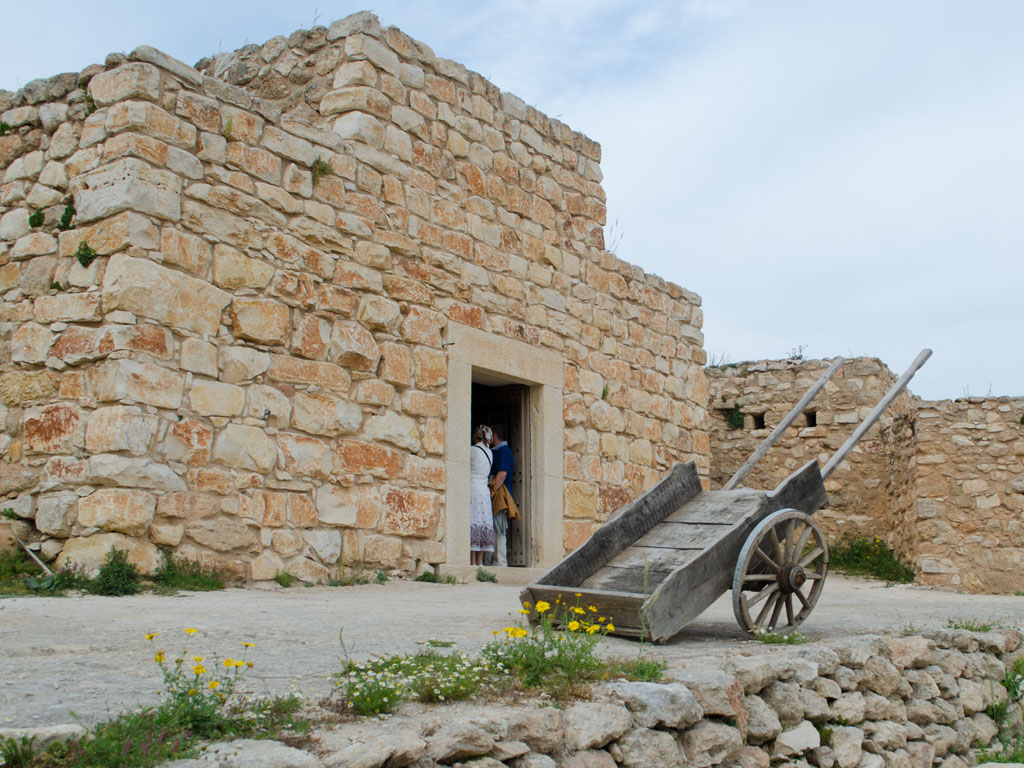
The picture is from a house in "Nazareth Village," an open-air museum that illustrates what life was like in Jesus' time.
Preparation for Jesus' ministry

During excavations in Caesarea in 1961, a stone was found with the inscription: "Pontius Pilate, governor of Judea." It is part of a larger tribute to the Roman emperor Tiberius, which confirms the Bible's account that they were contemporaries. The original can be seen at the Israel Museum and a copy is also at Herod's palace in Caesarea.
Show in atlas
[At the same time as the Emperor in Rome, the following local leaders were active:]
Pontius Pilate was the governor (a verb: acted as leader and administrator – Gk. hegemoneuo) of Judea [reigned 26-36 AD],
Herod [Antipas] was a tetrarch (a verb; literally: ‘rule over a quarter’ – Gk. tetrarcheo) i Galilee [son of Herod the Great, reigned 4 BC-39 AD],
his brother Philip was tetrarch of Iturea and Trakonitis [son of Herod the Great, ruled north of Galileen 4 BC-34 AD],
Lysanias was the tetrarch of Abilene. [Little is known about this small area in the north around the city of Abilene, two miles northwest of Damascus.]
2
In 1990, Caiaphas' ossuary was found in southern Jerusalem. It can be seen at the Israel Museum in Jerusalem.

Road construction in Eilat by the Red Sea.
"The voice of one crying in the desert (wilderness):
Prepare the way of the Lord,
making his paths straight.
5Every valley (ravine) will be filled,
every mountain and hill will be lowered.
What is crooked (distorted) should be straightened,
and uneven roads smoothed.
6All men (all flesh) will see (understand)
the salvation (deliverance) [glory] of God." [One of the distinctive features of Luke's Gospel is that it emphasizes how salvation is for all people. This perspective is also seen in the quotation from Isaiah. Unlike Matthew and Mark who only quote , see ; , Luke also includes the last part of where it says that "all flesh" will see God's salvation, see Isa 40:5. Luke follows the Greek translation of the OT, Septuagint. In that verse, the Hebrew word kavod, which describes "the glory of the Lord" and his presence, is translated "the salvation of God."] 7John then said to the crowds [Sadducees and Pharisees, see ] who were coming in a steady stream [from villages and towns] to be baptized by him, "You poisonous serpents, who has secretly persuaded you that you can escape the coming judgment [God's wrath against sin]? 8Therefore bear (produce) [such] fruits as belong (are worthy; are consistent with) repentance (the changed mindset) []. And do not begin to say within (to) yourselves [do not set out to defend yourselves by thinking], 'We have Abraham for a father.' For I tell you that out of these stones God is able to raise up children for Abraham. 9The axe is already set to the root of the trees. Every tree that does not bear good fruit is cut down and thrown into the fire."How to Bear Fruit?

John directed his teaching to different groups and what they needed to repent from.
©FreeBibleImages.org
An Expectation of the Coming Messiah
15
At the southern baptismal site of Qasr el Yahud, just before the Jordan River flows into the Dead Sea, there are still white doves today.
The family tree has 77 names that can be divided into eleven groups with seven names in each. In addition to the literal meaning, there can be a deeper meaning in names. The meaning of the last ten names from Adam to Noah form a sentence that speaks prophetically about Jesus! It is important to emphasize that word symbolism is not an exact science, see for more information.] 23Jesus was about thirty years old when he began his ministry [ states that a priest should be 30 years old when he enters the ministry] It was believed (the general opinion was) that
he was the son of Joseph,
son-in-law of Heli [Mary's father],
24
The meaning of the last ten names from Adam to Noah form a sentence that speaks prophetically about Jesus! The common thread throughout the Bible is already visible in the Books of Moses, where these names are mentioned for the first time, see Gen. 5.
son of Levi,
son of Melki,
son of Janna,
son of Joseph, 25son to Mattathias,
son of Amos,
son of Nahum,
son of Esli,
son of Naggai,
26son to Maath,
son of Mattathias,
son of Semei,
son of Joseph,
son of Judah,
27son to Johanan,
son of Rhesa,
son of Zerubbabel,
son of Shealtiel, [Exile in Babylon]
son of Neri, 28son to Melchi,
son of Addi,
son of Cosam,
son of Elmodam,
son to Er,
29son to Jose,
son of Eliezer,
son of Jorim,
son of Matthat,
son of Levi,
30son to Simeon,
son of Judah,
son of Joseph,
son of Jonan,
son of Eliakim,
31son to Melea,
son of Menna,
son of Mattatha,
son of Nathan,
son of David, 32son to Jesse (Jishai),
son of Obed (Oved),
son of Boaz,
son of Salma,
son of Nahshon (Nachshon),
33son to Amminadav,
son of Admin,
son of Arni,
son of Hezron,
son of Perez,
son of Judah,
34son to Jacob,
son of Isaac,
son of Abraham,
son of Terah (Terach),
son of Nahor (Nachor),
35son to Serug,
son of Reu,
son of Peleg,
son of Eber,
son of Shelah (Shelach),
36son to Kenan,
son of Arphaxad,
son of Shem,
son of Noah (Noach),
son of Lamech,
37son to Methuselah (Metushelach),
son of Henok,
son of Jared (Jered),
son of Mahalalel,
son of Kenan,
38son to Enoch,
son of Seth,
son of Adam,
son of God. 41
East of Jerusalem lies the Judean Desert. It was in this area that Jesus spent forty days.
1. Turning Stones into Bread
3Then the devil said to him, "If you are the Son of God, command that this stone become bread (food)." [If stones could become Abraham's children () or give the Israelites water in the desert (), then they could also become bread and satisfy Jesus' hunger. The devil tempts Jesus to use his ability for his own needs, see also . In , stones and bread are plural.] 4But Jesus answered, "It is written []: Man will not live by bread alone." [ has the full quote that man will not live by bread alone, but by every word that proceeds from the mouth of God.]
2. Worship Me
[The order of Luke's account differs from Matthew's and he shifts places between the second and third temptations. By putting the Jerusalem event last, he emphasizes the city of Jerusalem which has a central place in his two books. It is likely that Matthew's order is the chronological one because the description and conjunctions are more precise. He uses the Greek tote which indicates time, whereas Luke uses the Greek kai which does not indicate any temporal order.] 5The devil took him up [on a high mountain, see ] and in a moment he showed him all the kingdoms of the world. [It was as if he traveled around the world and saw all the kingdoms of the world in a vision, and perhaps especially the great Roman Empire, which was the dominant world power at that time.] 6He said to Jesus, "I will give you all this power (authority) and glory, because it has been put into my hands and I can give it to whomever I want. 7If you worship me [just once], all this will be yours." [The devil offers a shortcut, without death and suffering on the cross, to becoming the Messiah who will rule the earth.] 8Then Jesus said to him, "It is written []: You [singular] should worship the Lord your God, only (Gk. monos) him you [singular] should serve (worship)."
3. Throw Yourself Down from the Temple
9He brought him to Jerusalem and put him on the highest place of the temple [may refer to the temple building or the whole temple area] and said to him, "If you are the Son of God, throw yourself down from here. 10As it is written []: He will command his angels to preserve (protect) you 11and they will lift you up in their hands, so that your foot will not strike a stone." 12Jesus answered and said to him, "It is said [Scripture says in Deut 6:16]: You [singular] should not test (tempt) the Lord your God."
13When the devil had tested him in every way, he left him [temporarily] for another more convenient time. 14Jesus returned in the power of the Spirit to Galilee, and word of him spread throughout that region. 15He taught in their [the Jewish people's] synagogues and was praised by all. 16
The entrance to a modern reconstruction of the Nazareth synagogue in the Nazareth Village open-air museum.

In 1946, the large Isaiah Scroll (1QIsa) was found in Qumran on the northern shore of the Dead Sea. The image shows three columns with Isaiah 61:1-2 marked. These were the lines Jesus read in the synagogue in Nazareth.
18"The Spirit of the Lord is upon me, because He has anointed me to preach (proclaim)
the good news (gospel) to the poor. [The word gospel means 'glad tidings' or 'message of victory'. The word was used in the Roman world for the joyful message the couriers from the front came to read in Rome after great victories. Some manuscripts also include the phrase 'bind up the broken-hearted'] He has sent me on a mission to proclaim (shout out)
freedom to the captives (captured and abducted) and sight to the blind.
To set free (send out into freedom – Gk. apostello)
those who are oppressed (literally: 'beaten to pieces', those who are under burdens, living in misery).
19To preach (proclaim, openly tell about) a year of grace [jubilee] from the Lord." [A year when God's salvation, grace and favor abound, see .] [Jesus ends the reading abruptly (after the first of three stanzas in Isa 61:2) and does not include: "and a day of vengeance of God". This must have aroused wonder, but also eventually caused anger, see . the audience there in Nazareth would surely have wanted Jesus to read these words of vengeance, lay out the text and proclaim judgment on the Romans and the Gentiles who occupied their land. Instead, he gives two examples of Gentiles, during the time of the great prophets Elijah and Elisha, to whom God showed mercy, see verses 25-27. When Jesus comes back to earth the second time, it is to fulfill the last part of this prophecy in Isaiah. Then he will judge, give joy instead of sorrow, garments for celebration instead of ashes and mourning, etc., see ; ; ; .] 20
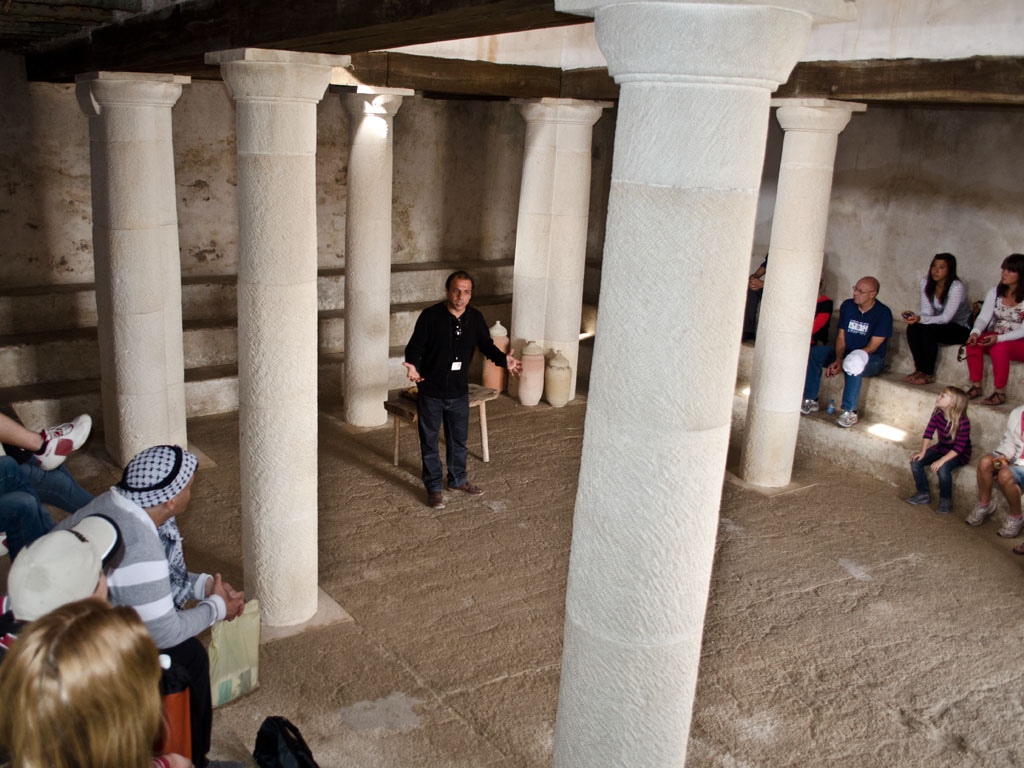
In the synagogue, people sat along the walls so that everyone could see each other. The picture is from a newly built reconstruction of the synagogue in Nazareth from Jesus' time.
Jesus Teaches with Power (Mark 1:21-28)

Jesus moves from his hometown of Nazareth to Capernaum, where he lives in Peter's house.
Show in atlas
He continued to teach the people on the Sabbath. 32They were amazed (completely overwhelmed and surprised) at his teaching, for his words had authority (power). [It was common to raise an issue and then quote what other previous rabbis had said, but Jesus spoke with an authority and truth of his own that stunned the people.] 33In the synagogue there was a man possessed by an unclean demonic spirit, and he cried out loudly: 34"Stop (let us alone)! What do you have to do with us, Jesus of Nazareth? Have you come to destroy us? I know who you are, O Holy One of God." 35But Jesus forbade him (gave a stern rebuke): "Be quiet! Come out of him!" The demon threw the man down in their midst and came out of him without hurting him. 36All of them marveled (became speechless, frozen with wonder bordering on fear) and asked each other, "What about his words? With power and authority he commands the unclean spirits, and they go out." 37The word about him spread throughout the region.Peter's Mother-in-law and Other Sick People are Healed (Matt 8:14-16, Mark 1:29-34)

The ruins of the city of Capernaum are a popular tourist destination. The picture was taken from inside the remains of a synagogue from the 4th century, which is believed to have been built on top of the synagogue that existed in Jesus' time.

Magdala was discovered by chance in 2009 when a hotel was to be built just north of Tiberias. Magdala had been buried under mud for almost 2,000 years. One of the finds was the best-preserved synagogue from the time of Jesus. Road works in December 2021 led to the discovery of a second synagogue just 160 meters from the first, but on the other side of Route 90.

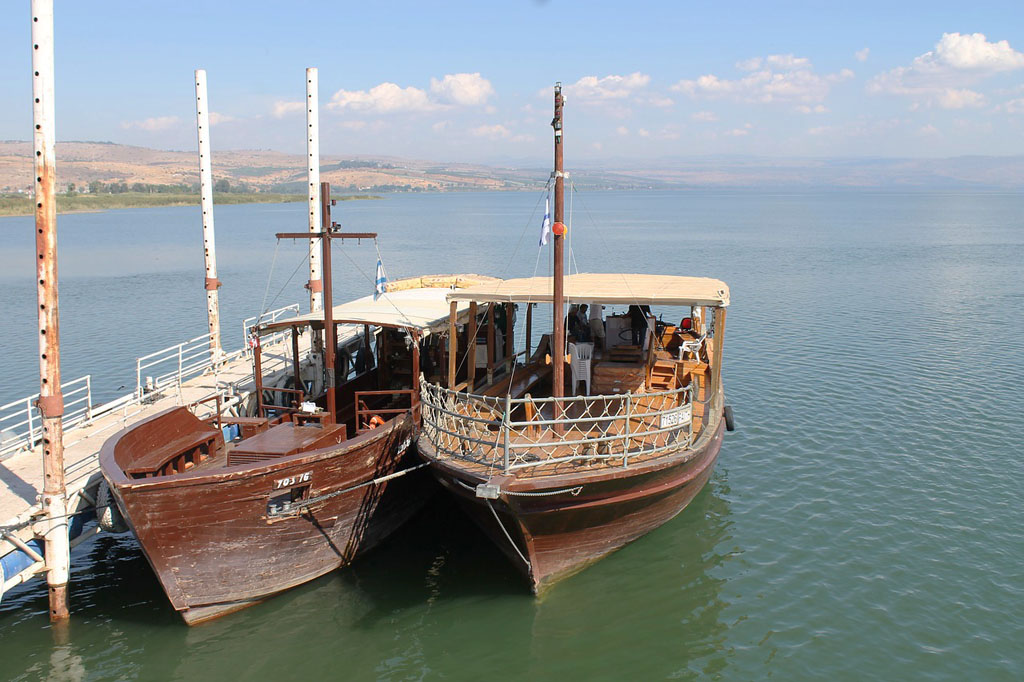
Two sightseeing boats off Ginosar on the western shore of the Sea of Galilee.
Simon Peter's Big Fish Catch
4When he had finished speaking, he said to Simon, "Put out into deep water and lower your nets there for a catch." 5Then Simon said, "Master, we have worked hard all night without getting anything, but since you say so, I will lower the nets." 6When they had done so, they caught so many fish in their nets that they began to break. 7
After the miraculous catch of fish, Simon Peter is called to become a fisher of men.
Jesus said to Simon: "Do not be afraid, from now on you will catch (spare, free) people." [The word "catch" literally means to catch alive, save and spare lives. Whoever is 'caught' by Jesus receives new life. The word is only used here and in , where it is used of people held captive in the devil's snare. Both Peter and the devil capture people, but Jesus' servants "capture" to free and the devil to bind to do his will.] 11When they had brought the boats ashore, they left everything and followed him. [Peter, James and John had already followed Jesus before, see . Now they went a step further and left their jobs to go into full-time service for Jesus. The extra catch shows Jesus' concern for the disciples' families, they do not suffer hardship and have time to hire new fishermen.] 12Once when Jesus was in one of the [Jewish] towns [somewhere in Galilee, see Luke 4:43], a man came who was full of leprosy. [The Greek word leprosy is a general term for various skin diseases. Most biblical scholars believe that it is not the leprosy that exists today, also known as Hansen's disease] When the man saw Jesus, he fell on his face and begged him, "Lord, if you are willing, you can make me clean." 13Jesus stretched out his hand, touched him [making Jesus ceremonially unclean] and said, "I want to. Be clean!" Immediately the leprosy disappeared. 14Jesus forbade him to tell anyone [whom he would meet on the way to the temple in Jerusalem], saying, "Go and show yourself to the priest and offer the sacrifice for your purification that Moses has appointed [Lev. 14:1-32]. It will be a testimony to them." [Mark tells how the man disobeyed Jesus' command, see Mark 1:45.] 15But word about him kept spreading, and large crowds gathered to hear him and be healed of their diseases. 16But he withdrew (repeatedly) to desolate places to pray. [Jesus' popularity drove him to pray even more, not just once but often.] 17It happened one day when he was teaching [in Peter's house in Capernaum, see Mark 2:1], that Pharisees and the chief teachers of the Torah were sitting there [in the audience]. [The Greek text portrays Jesus as being fully occupied with teaching the people, as opposed to the Pharisees and scribes, who should have been the ones teaching and demonstrating the power of God. Luke uses an unusual word for "scholar" here (Greek nomo-didaskalos) which can be translated as having the highest academic title of doctor in the subject of the Pentateuch. The word is used of Gamaliel, see Acts 5:34.] They [the Pharisees and the chief teachers] had come from every village in Galilee [such as Tsippori, Tiberias, Gamla, Magdala] and Judea [from major cities such as Hebron] and from Jerusalem. The power of the Lord was on Jesus so that he could heal [the sick who had come]. 18Then some [four men, see Mark 2:3] came carrying a stretcher with a man who was paralyzed, and they tried to bring him in [to the house] and set him down before Jesus. 19When they could not get in with him because of all the people, they went up on the roof, removed the tiles, and lowered him on his stretcher right in front of Jesus. 20When he saw their faith [both in the sick man and his four friends], he said, "My friend, your sins are forgiven." 21The scribes and Pharisees thought (had an inner dialog): "What a blasphemer! Who can forgive sins but God?" 22But Jesus knew their thoughts (and inner reasoning) and said to them, "What are you thinking in your hearts? 23Which is easier, to say, 'You are forgiven of your sins,' or, 'Get up and walk'? 24But that you may know that the Son of Man has power (authority) here on earth to forgive sins, I tell you" – so he then said to the paralyzed man – "Get up, take your stretcher (bed) and go home!" [In the middle of the answer to the scribes, Jesus addresses the paralyzed man instead, and the sentence ends not in words, but in action!] 25And he rose up before them, and took the stretcher that he had lain on, and went home, praising God. 26All of them were amazed and praised God, and they were filled with fear, saying, "It is incredible (unimaginable, something we could not dream of in our wildest imagination), what we have seen today." 27After this, Jesus went out [from the house in Capernaum after the healing of the paralyzed man], and saw a tax collector (publican) named Levi [also called Matthew] sitting at the customs house. He said to him, "Follow me." 28He left everything and got up and followed him. [Levi is probably his family name, while Matthew is his first name. The customs station was located on the outskirts of the city, either on the "Via Maris" trade route that ran from Damascus to the Mediterranean Sea, or on the Sea of Galilee where ships to be cleared arrived from territories outside the rule of Herod Antipas.]Feasting or Fasting?

The ruins of Capernaum. Somewhere in the more affluent neighborhoods, Matthew lived and invited people to a party.

"Nobody tears off a piece from a new (fresh, malleable) garment
and sews it onto an old (stiff) garment.
If you do that, you will tear the new (fresh) [garment]
and the piece from the new (fresh) one will not fit the old one.
37In the same way, fresh (new) wine
is not poured into old wine bags (leather bags).
If this were done, the fresh (new) wine would burst the wineskins [as it ferments],
and the wine would spill and the wineskins would be destroyed.
38No, fresh wine is poured into new (fresh) wine bags. [Two different words for new are used in these verses. The Greek word kainos refers to something new, but has little to do with the age of the cloak or wineskin, focusing more on its quality and malleability. The synonyms fresh and malleable want to show this meaning. The second word is neos which refers to age and is translated 'fresh'. The slightest trace of impurity in a sack starts the fermentation process. Therefore, it is important that completely clean sacks are used. Since there is no container or bag that can withstand the gases produced by the fermentation process, the new wine, which is the better one, can refer to non-alcoholic wine that has not fermented.] 39No one who is accustomed to drinking old wine longs for new, for he says: 'The old is good (better).' " [It is not Jesus who says "the old is better", but he quotes the generally prevailing opinion. In the context, where the new in two examples stood for the Kingdom of God that Jesus presented, this becomes an ironic condemnation. The Pharisees were satisfied with the old and had no desire for anything new. The power of habit is great.] 61
Fields ripe for harvest.
One of the synagogues Jesus visited during his travels was the one in Magdala on the western side of the Sea of Galilee. The events in this chapter may have taken place there or in some other part of Galilee.

Painting of the synagogue in Magdala, which was discovered by chance in 2009 when a hotel was to be built in the area. The city had been lost for almost 2,000 years and covered by mud. In the spring of 2014, the site was opened to the public, and here you can visit the best-preserved synagogue from Jesus' time and one of the places Jesus visited.
"I want to ask you a question:
Is it lawful to do good on the Sabbath,
or to do evil,
to save life,
or to destroy life?"
10He looked around at them all (moving his gaze from one side to the other) and then said to the man, "Stretch out your hand." He did so, and his hand was completely restored. 11They were filled with senseless hatred (madness, insanity without logic) and discussed among themselves what they should do with Jesus. 12At that time [sometime during his ministry in Galilee], Jesus went up on a mountain to pray, and spent the whole night in prayer to God. 13When day came, he gathered his disciples (followers), and from among them he chose twelve, whom he called apostles (messengers, ambassadors): 14Simon, whom he also named Peter,
and his brother Andrew,
and James,
and John,
and Philip,
and Bartholomew [also called Nathanael],
15and Matthew,
and Thomas [Hebrew word meaning "twin"; ],
and James, son of Alphaeus,
and Simon, who was called the Zealot [literally "the devoted, zealous, fanatical" and suggests that he was involved in the Jewish resistance movement against the Roman Empire before becoming a disciple of Jesus],
16and Judas Iskariot, who became a traitor. [Three groups emerge when the apostles are listed. Simon, Philip, and James are always mentioned as the first names in each group, see ; ; . Jesus now calls the twelve disciples apostles. Luke is the Gospel writer who most frequently uses this title for the twelve. A disciple is someone who follows and is taught by his teacher and becomes more and more like him, see . An apostle is a disciple who is sent out as an ambassador to represent his master. The twelve were still Jesus' disciples, but now they also became his messengers. The twelve apostles have a special status because they were called by Jesus himself to be eyewitnesses and spread his word, see ; . The general apostolic ministry still exists today as one of the five ministries, see ; .] THE SERMON ON THE PLAIN (6:20-49)
[The following sermon has come to be known as the Sermon on the Plain. It has many similarities with the Sermon on the Mount in , and both were delivered in the same region fairly early in Jesus' ministry. In the area around the Sea of Galilee, there are both mountains and plains in the mountainous landscape, so "the plain" and "the mountain" may refer to the same place. Then, as now, it was common for teachers to repeat important parts of their teaching on several occasions. However, it is most likely that it is the same sermon, with the difference that Matthew and Luke choose to emphasize different parts.
What is special about Luke's account is the division around the number four. He chooses to include four blessings and four woes, see verses 20-26. Central to this are four commandments about love and four practical examples of how to love one's enemy, see verses 27-30. The sermon ends with four parables, see verses 39-49. The number four, used to refer to the four cardinal directions, often symbolizes the whole earth. This division around the number four reinforces the Gospel of Luke's focus on Jesus' message applying to the whole world. Matthew, who addresses the Jews, chooses to include more examples from the Books of Moses.
Subsequent events also indicate that it is the same sermon. Both Gospels write about the healing of an officer's servant, see ; . The fact that the twelve are called just before the Sermon on the Plain here in Luke, while Matt. places that event later, in chapter 10 after the Sermon on the Mount, may suggest that these are different sermons. However, it is not unusual for Matt. to have a more thematic presentation, and he connects the prayer for workers for the harvest with the answer to prayer in the next verse when the disciples are called, see .] 17Jesus came down [from the mountain] with them [the twelve] and stood in a place on the plain. There were many of his disciples there, and a large crowd from all over Judea and Jerusalem [in the south] and from the coastal region around Tyre and Sidon [in the west]. 18had come to listen to him and have their illnesses healed. Those who were tormented by unclean spirits were helped, 19and the whole crowd tried to touch him, because power was constantly flowing from him, and he healed everyone. [Jesus begins to speak to his disciples, but also addresses the whole crowd, see ; .] 20He lifted up his eyes and looked at his disciples and said: "Blessed (happy, enviable) are you [my disciples] who are poor [without your own wealth, influence, and honor in this world],
for yours is the kingdom of God.
[Here, the present tense is used instead of the future tense – the kingdom of God, where God's laws prevail, is available right now. In , there is also a spiritual dimension to being poor, where one is a 'spiritual beggar' who is completely dependent on God in everything.] 21Blessed (happy, enviable) are you [my disciples] who hunger now,
for you shall be filled.
Blessed (happy, enviable) are you [my disciples] who weep now,
for you shall laugh.
22Blessed (happy, enviable) are you [my disciples] when people hate (despise, detest) you,
and reject you and revile you and make your name hateful, because of the Son of Man. 23Rejoice in that day and leap for joy (an overwhelming joy that makes it impossible to sit still),
for your reward in heaven is great. For in the same way their fathers treated the prophets. [The opposite of blessing is often curse, but here we see Jesus' compassion and love as he expresses his despair in four parallel verses.] 24But woe to you [expression of intense despair] who are rich (now living in material abundance),
for you have already received your comfort (help, encouragement, deliverance).
[The word paraklesis is used here and is the same word that describes the Holy Spirit. Those who put their trust in money seek their comfort and help from the spirit of the world instead of from the Spirit of God.] 25Woe to you [expression of intense despair] who are full now,
for you will be hungry.
Woe to you [expression of intense despair] who laugh now,
for you will mourn and weep.
26Woe to you [expression of intense despair], when all (categories of) people speak well of you,
for in the same way their fathers did with the false prophets." [In verses 27-28, four parallel synonymous commandments are given: to love, do good, bless, and pray for those who hate you. It is clear that love is not a feeling but a decision of the will that is expressed in concrete actions.] 27"But to you who listen [continuously to me], I say: Love your enemies [always show those who are openly hostile selfless and generous love],
do good to those who hate you [always treat them well, see ]. 28Bless (speak well of) those who curse [express disgust by invoking judgment upon] you
and pray for those who revile (threaten, wrong; falsely accuse) you.
[Literally: 'pray around them', i.e. surround them with prayer so that they do not carry out their threats but repent.] [In verses 29-30, Jesus gives four practical examples of how to show your enemy selfless and generous love. The four points are well structured, with a verb describing an evil deed followed by the believer's response. Throughout history, 'fight or flight' has been the rule when encountering one's enemy. Here, Jesus shows a new way: Stand your ground and amaze your enemy! See also .] 29If someone strikes you [contemptuously] on one cheek,
[then] turn (hold out) the other also. [In it says that it is the 'right cheek'. It is almost impossible for a right-handed person to strike someone on the right cheek with a fist from the front. One can only strike the other person's left cheek. This suggests that it is probably not a normal punch that is meant, but a contemptuous blow with the back of an open right hand against someone's right cheek.] And if anyone takes your cloak [outer garment],
[then] do not prevent him from taking your tunic (undergarment) as well. [Undress completely naked!] [If one could not repay a loan, the cloak could be taken as collateral, but had to be returned before sunset, see . Not only giving up one's cloak, but also beginning to take off one's undergarments in court would be surprising. Nudity was taboo In Jewish tradition, and the shame fell less on the person who was naked than on those who saw it or caused it, see .]
30To everyone who asks you, give! [Greek here, as in , has Jesus' exhortation at the end of the sentence. Give to everyone who asks or requests something, but not always everything they ask for, see ; ; ; .] And if anyone takes [steals – literally: lifts/carries away] what is yours,
[then] do not demand it back [from him]." [This verse has come to be known as "the golden rule," but Jesus was not the first to formulate such a thought. Those who listened to Jesus must have known the great rabbi Hillel, who many years earlier had summarized Moses' teaching with the words: "Do not do to your neighbor what you yourself hate. This is the whole Torah – the rest is commentary." Jesus' exhortation did not contain any prohibition. There is a big difference between avoiding doing harm and actively putting yourself in another person's situation and doing good! The golden rule forces us to ask the question: "How would I want to be treated if I were in my fellow human being's place?"] 31"Whatever you want others to do for you,
do for them. [Literally: "And just as you want/desire people to do to you, do so to them." With three examples (loving, doing good, and lending), Jesus now develops this golden rule in verses 32-34. It is not difficult to be kind and generous to those who treat you the same way. Jesus shows another approach that is completely in line with God's will and which he richly rewards, see , which also begins by repeating these three key words.] 32Suppose you [only] love those who love you,
do you expect thanks [reward from God, see ] for that?
Even sinners love those who love them.
33Suppose you [only] do good to those who do good to you,
do you expect thanks [reward from God, see ] for that?
Even sinners do that.
34Suppose you [only] lend [with interest] to those from whom you expect to get it back,
do you expect thanks [reward from God, see ] for that?
Even sinners lend to sinners and expect to get back the same [agreed] amount. 35No, [instead] love your enemies (those who are hostile)
and do good
and lend without expecting (hoping for) anything in return
[without despairing of anyone or feeling despair over how the borrower handles the help].
Then your reward (payment for the service; your divine compensation) be great, and you shall become the sons of the Most High,
for he is good (gracious, benevolent, kind) to the ungrateful and wicked (the morally corrupt) [who cause grief, anger, trouble, and pain]. 36Be merciful (compassionate, sympathetic),
just as your Father is merciful.Acquit and be generous (Matt. 7:1-5)
[Now follow four exhortations in two pairs:] 37Do not judge (discern – Gk. krino) [do not be too quick to decide and criticize others],
so that you will not be (would be) judged.
Do not condemn [declare anyone guilty, do not judge anyone]
so that you will not be (would be) condemned.
Acquit (forgive; acquit completely) [let it go],
and you will be acquitted (forgiven; completely free).
38Give [make it a habit to be generous],
and you will receive (and it will be given to you). A good (generous) measure, [well] packed,
shaken and overflowing (abundant)
shall be put (given) into your bosom [cloak].
For with the measure you use [usually use],
it will [also] be measured to you."
[At the market, the wheat was poured into a measure, which was then shaken to level it off. If the seller was generous, he would then fill the measure even more so that it overflowed. The buyer could use his "bosom" (the upper part of his cloak), where the wide fabric was naturally shaped like a hollowed-out pocket with the help of the belt.]1. Blind leaders
[The word "parable" literally means "to cast aside." Now follow four parables with practical examples from everyday life to illustrate and explain the spiritual truths Jesus conveyed.] 39He also told them a parable: "Can a blind man guide a blind man? [No, of course not.]
Will not both of them fall into the ditch? [Yes, they will.]
40A disciple is not above his teacher, but when he is fully trained, he will be like his teacher. [So be careful who you follow.]2. The splinter and the beam
[Speaking of blindness:] 41Why do you see the speck (the splinter, the sawdust, the grain) in your brother's eye,
without even considering (being aware of) the beam in your own eye?
42How can you say to your brother,
'Brother, let me remove the splinter (stick, sawdust, grain) from your eye',
when you yourself do not see the beam in your own eye?
You hypocrite [who does not practice what you preach but "judges under a theatrical mask" (Gk. hypokrites, from hypo – under and krino – to judge/distinguish), i.e., acts hypocritically]!
First remove the beam from your own eye,
then you will see clearly and remove the speck from your brother's eye. [This parable is related to the previous one, as both the speck and the beam are causes of blindness. Anyone who checks another person's vision must have better vision than the person they are helping. Anyone who removes a speck must first have removed the beam from his own eye. Before you judge/assess someone else, examine yourself first. A leader must have greater spiritual clarity than his students. He must himself practice the truths he teaches.]3. The tree and its fruit (Matt. 7:15-20)
[Jesus builds on the previous parable of the beam (which comes from a tree), see verses 41-42, with another parable:] 43There is no good tree that bears bad fruit,
nor is there any bad (rotten) tree that bears good fruit. 44A tree is recognized by its fruit,
for you do not pick figs from thorns
or harvest grapes from a thorn bush. 45A good person brings forth what is good
from the good storehouse (treasure; treasury) of his heart [],
and an evil [person] brings forth what is evil
from the evil [from the evil storehouse of his heart].
For out of the abundance (surplus) of the heart, her mouth speaks (preaches) [long or short harangues come out]. [In Greek, people are described in definite terms: "the good person" and "the evil person." See also on the power of the tongue. Since the beginning, there has been a spiritual law that nature bears fruit 'after its kind', see . What is inside the heart will sooner or later be revealed in people's words and actions.] 46Why do you call me 'Lord, Lord' without doing what I say? [The repetition of "Lord" indicates that one truly believed that one was doing God's will.] 47Everyone who comes to me and hears [actively listens to] my words and does [actively acts on] them, I will show you [in the following illustration] who he is like: 48He is like a man who, when building a house, digs deep
and lays the foundation on the rock [chooses to build his life, his ministry, and everything he does on Jesus].
When the river floods, the water rushes against the house but cannot shake it,
because it was well built on the rock. 49But anyone who hears and does not [practice my word],
he is like a man who builds a house on sand [human thoughts and ideas, the earthly],
without laying a foundation.
The river crashes against the house,
and it immediately collapses, and the destruction is great." [It is not enough to say the right things – those who hear Jesus' words must also act on them. All people build their lives, all are affected by storms, the question is on what foundation the house is built.] 
Even today, you can visit Capernaum, Jesus' hometown.
An officer's servant is healed 71When Jesus had finished all his speech [] to the people, he entered Capernaum [where he stayed in Peter's house].
2A Roman officer (centurion) there had a servant who was sick and near death. The officer valued this servant greatly. 3When he heard about Jesus, he sent some of the Jewish elders [the Jewish leaders in Capernaum] to ask him to come and save his servant's life. [Here, the preposition dia is used before the Greek word sozo, which means both healed and saved. The preposition, which means "through," reinforces his desire for his servant to be "through-healed," i.e., completely healed at once.] 4They came to Jesus and pleaded with him earnestly, saying, "He is worthy of having you do this for him, 5for he loves [sincerely – in a selfless, generous way] our people and has even built a synagogue for us." [A Roman centurion commanded about eighty Roman soldiers. Although he earned twenty times more than an ordinary soldier, building the synagogue was a great sacrifice. His love for the Jewish people was demonstrated in practical action. Archaeologists have found several inscriptions from this period showing that it was not unusual for Gentiles to pay for Jewish synagogues. Cornelius was also a Roman centurion who gave of his resources to the Jews, see .]
6Jesus then went with them. But when he was almost at the house, the Roman officer sent some friends to say, "Lord, don't trouble yourself. I am not worthy to have you come under my roof. 7Therefore, I did not consider myself worthy to come to you myself. But just say the word, and my servant (boy) will be healed. 8I myself am a man who [daily] stands under the command of others and has soldiers under me. If I say to one of them, 'Go,' he goes, or to another, 'Come,' he comes, and if I say to my servant, 'Do this,' he does it. 9When Jesus heard this, he marveled at him (Jesus is amazed and surprised) and said to the people who followed him, "I tell you, not even in all Israel have I seen such great faith." 10When the messengers [the officer's friends] returned to the house, they found the servant well. [The same word, "amazed," in is used to describe Jesus' amazement at the unbelief he encountered when he visited the synagogue in his own hometown, see .]A widow's son is raised in Nain
11
The modern city of Nain, where Jesus raised a widow's son. It was here that Jesus approached the city 2,000 years ago, along the road that had roughly the same route then as it does now.

Illustration by Scottish artist William Hole, 1846-1917.
This boy is the first of three people whom Jesus raises from the dead. The others are Jairus' daughter and Lazarus, see ; . Several unnamed people are also raised at Jesus' death, see . The Old Testament also mentions three people who are resurrected. Elijah resurrects a widow's son, , and his successor Elisha resurrects two people, see ; .]John the Baptist's questions (Matt. 11:2-19)
18
High up on the mountain, the remains of Herod's fortress Machaerus can be seen on the eastern side of the Dead Sea. In the background on the other side is the Judean desert.
©Khaled Al-Bajjali
"What did you go out into the desert to see? A reed swaying in the wind? 25No, what did you go out to see? A man dressed in fine (luxurious, soft) clothes? No, those with fine clothes are usually found in royal palaces. 26What did you go out to see? A prophet? Yes, I tell you, and even more than a prophet (more special, more significant). 27It is about him that it is written []: 'Behold, I send my messenger before you, who will prepare the way for you. 28I tell you, among those born of women there is no one greater than John, yet the least in the kingdom of God is greater than he." [A new era with the age of the church is about to dawn. In the kingdom of God, the least now has greater privileges than the great forerunner John the Baptist.] [The following two verses may be a comment by Luke, or a continuation of Jesus' speech. It depends on what "heard him" refers to. Regardless, it is clear that Jesus affirms John the Baptist, and that the dividing line between those who accepted the message and those who did not still remains.] 29When all the people, even the tax collectors, heard him [Jesus praising John the Baptist or John the Baptist preaching in the desert], they gave God the glory (they agreed that God's way was right), because they had been baptized by John [the baptism of repentance]. 30But the Pharisees and the teachers of the law rejected (did not care about) God's will for them [which was the message of repentance and belief in the coming Messiah], because they had not been baptized by him [John the Baptist]. 31[Jesus continues:] "What shall I compare this generation of people to? What are they like? 32They are like little children sitting in the marketplaces (gathering places) and calling out to their companions: 'We have played the flute for you [played wedding],
and you have not danced.
We have mourned [played at funerals],
and you have not lamented (beaten your breasts to show grief).' [Human nature is never satisfied – it wants God to dance to its tune, to conform to its whims.]
33John has come without eating bread or drinking wine, and you say, 'He is possessed.' 34The Son of Man has come, eating and drinking, and you say, 'Look, what a glutton and drunkard (fond of wine), a friend of tax collectors [known for using questionable methods and lining their own pockets] and sinners (those who actively live in sin).' 35But wisdom [which both John the Baptist and Jesus preached and demonstrated] has been vindicated by all her children [the followers of Jesus and John]."A woman anoints Jesus' feet
36
Reconstruction of the dining room, triclinium, where people reclined at the table in a finer Roman house. The picture was taken at the museum in the Spanish city of Zaragoza. Here, Emperor (Caesar) Augustus founded the city of Caesaraugusta around 10 BC.
[The verbs in the previous verse give a detailed description of every movement the woman makes. Her participation in the dinner is not so surprising. When a teacher was invited to eat, listeners were welcome to stand along the walls and listen, but the way she approached Jesus was unusual, especially considering her reputation.] 39
An artist's depiction of a fine meal in a triclinium, which consisted of three couches arranged in a U-shape. The name comes from "tri," meaning three, and "kline," meaning couch.
He replied, "Teacher, say it." 41[Jesus now tells a parable:] "A moneylender had two men who owed him money. One owed 500 denarii [daily wages], the other 50 [daily wages]. 42When they were unable to pay, he forgave the debts of both. Which of them will love him more?" [The parable makes it clear that everyone has sinned and is indebted to God, see . A denarius was a worker's daily wage. One owed twenty months' wages, the other two. The two debts do not represent the magnitude of sin, but awareness of one's sin. In the minds of all those present, Simon was considered ten times better than the woman, and the woman was identified with the person in the parable who owed the most. But the parable does not say that Simon was less guilty before God. The woman knew that she had sinned against God, while Simon was unaware of his deplorable condition.] 43Simon replied, "I suppose it is the one who was forgiven the most." Jesus said to him, "You have judged correctly." 44Then he turned to the woman and said to Simon, "Do you see this woman?
You did not give me water for my feet when I entered your house,
but she has washed my feet with her tears and dried them with her hair. 45You did not give me a welcome kiss,
but she has kissed my feet ever since I came in. 46You did not anoint my head with oil [ordinary olive oil],
but she has anointed my feet with balm [expensive perfumed oil].
47That is why I tell you that all her many sins are forgiven. Her great love shows it. But the one who has been forgiven little loves little." 48Then he said to her, "Your sins are forgiven." 49But those who were at the table began to say to one another, "Who is this who even forgives sins?" 50He said to the woman, "Your faith has saved (rescued, healed, restored) you. Go in peace!" [It is not because she served Jesus and washed his feet and anointed them that her sins are forgiven; it is because of her faith in Jesus. She shows great love in gratitude for his forgiving all her sins.]Women who followed Jesus
81
Path in Galilee.
Mary, called Magdalene [meaning "she from Magdala," a fishing village between Tiberias and Capernaum], from whom seven demons had gone out.
3Joanna, wife of Chuza, who was Herod [Antipas]' steward (responsible for family affairs – Gk. epitropos). [The gospel reached the highest echelons of society.]
Susanna
and many others [women who had been healed by Jesus]. These women supported them [Jesus and the disciples] with their own resources (possessions).Jesus speaks in parables
The parable of the seed and the four types of soil (Matt. 13:1-9, Mark 4:1-9)
4
A recently plowed field near the Sea of Galilee.
5"A sower went out to sow his seed.
As he sowed, some fell by the way,
and it was trampled underfoot
and the birds of the air ate it up.
6Some fell on rocky ground [the thin layer of soil covering the rock],
but as soon as it began to grow (sprout), it withered away,
because the ground had no moisture. [The scorching sun quickly dried out the soil, and without roots, what had been sown withered away, see .] 7Some fell among thorns [seeds and roots, usually at the edges of the field],
but the thorns grew up with the grain
and choked it.
8Some fell on good soil,
and when it grew up,
it yielded a hundredfold." Then he cried out in a loud voice, "Whoever has ears to hear, listen carefully to what I have said!" [Jesus explains the parable in verses 11-15. Israel has a subtropical climate. They sow during the autumn rainy season and harvest in the spring before the dry, hot summer. The image for this parable is a field with a well-trodden path running straight through it. A sower spreads seed by hand. The different types of soil are not visible to the naked eye because the entire field has been recently plowed. The parable does not say anything about the proportions of good and bad soil, but generally speaking, a field consists mostly of good soil.] 9His disciples asked him what this parable meant. 10He said, "You have been given the gift of knowing (having personal experience of and a clearer understanding of) the mysteries (secrets, hidden plans) of the kingdom of God, but for others they are in parables. This is so that [] may be fulfilled: 'They will not see, though they look, and they will not understand, though they listen. 11"This is the meaning of the parable: The seed is the word of God.
12The seed that fell by the way are those who have heard, but then the devil comes and takes the word from their hearts [often through ingrained thought patterns], so that they no longer believe and are saved (preserved, healed, restored, receive eternal life). [The word "road" can also mean habitual thought patterns, i.e., preconceived notions and experiences of God's word that trample it down. For the message to take root, faith is also required, see .] 13The seed that fell on the rock [the thin layer of soil over the rock] are those who receive the word with joy, but have no root. They believe for a while, but in times of trial they fall away (withdraw, keep themselves at a distancee).
14The seed that fell among thorns are those who hear, but later in life (journey) are choked by:
anxiety (worries about tomorrow, concern for all the material things in this world)
and wealth
and lust [interests apart from God]. They do not complete what they have begun (the fruit does not ripen). [Thorns are weeds with thorns and a strong root system; they can grow up to two meters high and crowd out all other vegetation. The Greek word used for thorn is akantha. The root word means extremes, or taking something to the utmost point. It is therefore an interest, a doctrine, or something else that takes all the focus. It is a frightening coincidence that it is precisely a crown of thorns that is placed on Jesus' head when he is crucified.]
15But the seed that fell on the good soil are those who, when they hear the word with an honest and good heart, hold on to it and bear fruit by being persistent. The parable of the oil lamp (Mark 4:21-25)

Clay oil lamps were the usual source of light in Jesus' time.
16[Jesus continues to speak in parables:] "No one lights an oil lamp and puts it under a bushel basket or under a bed, but on a lampstand, so that those who come in may see the light. 17There is nothing hidden that will not be revealed, and nothing concealed that will not be brought to light. [Although the parables were now hidden from many, the kingdom of God would soon become visible.] 18Pay attention to how you hear. For whoever has [spiritual knowledge] will be given more, and from whoever does not have [spiritual knowledge], even what he thinks he has will be taken away. 19[Jesus' claims and conflict with the Pharisees also led his family to believe that he was out of his mind. Therefore, they came from Nazareth to Capernaum to take him away by force, see ].
Jesus' mother and his brothers came to him [while he was teaching in Peter's house]. They could not get to him because of all the people. 20Then someone told him, "Your mother and your brothers are standing outside, wanting to see you." 21But he replied to those who had brought the message, "My mother and my brothers are those who hear the word of God and do it." Jesus' power

The shore at Capernaum.
Terrified but also amazed (surprised, shocked), they said to each other, "Who is this man who even commands the winds and the water, and they obey him?" 26
Rock tombs have been found in Kursi on the eastern side of the Sea of Galilee. It may have been here that Jesus met the man who was severely tormented by the powers of darkness.
He replied, "Legion," for many demons had entered him. ["Legion" means thousands and is a Latin loanword for a large army. A Roman legion consisted of over 6,000 men. The term suggests both that the man had a large number of demons and that their nature was violent and warlike.] 31
View of the northern part of the Sea of Galilee, seen from the Golan Heights on the eastern side.
Jesus got into the boat and returned [to the western side of the Sea of Galilee]. 38The man from whom the demons had gone out begged to go with him, but Jesus sent him away, saying, 39"Go back home [to your house, your family, your relatives, and your countrymen] and tell them everything God has done for you." He went away and told the whole town what Jesus had done for him.Jesus raises Jairus' daughter and heals a sick woman (Matt. 9:18-26, Mark 5:22-43)
40When Jesus returned [to Capernaum in Galilee], the people welcomed him with joy, for they were all waiting for him. 41Then a man named Jairus, who was a leader of the synagogue, came forward. He fell at Jesus' feet and begged him to come to his house, 42for he had an only daughter, twelve years old, and she was dying.
As Jesus was going there, the crowd pressed in on him from all sides. [The word is also translated "suffocate" in . It describes how the people pressed against him along the streets of Capernaum.] 43There [among the crowd] was a woman who had been bleeding for twelve years [and had spent all her money on doctors] and could not be healed by anyone. [For as long as the girl had lived, this woman had suffered from these chronic hemorrhages. The phrase about her spending all her money on doctors is missing from the earliest manuscripts, probably added by a scribe to harmonize with .] 44
Picture of a man praying at the Western Wall in Jerusalem, wearing a prayer shawl, tallit, with four corner tassels.
Like all Jews, Jesus wore tassels on the four corners of his outer garment. The tassels, Hebrew tsitsit, were always visible to remind people of the 613 commandments in the Torah, see . Like many other regulations, the tassels had sometimes become merely a religious status symbol, which Jesus condemned, see . Even today, Jews wear tzitzit. Today's tassels consist of 8 threads with 5 knots. The reason is that the numerical value of the word tzitzit is 600, which added to 8 and 5 equals 613. Archaeological finds from caves near the Dead Sea confirm that the tradition is reliable. The 2,000-year-old tassels, preserved in the desert climate, look the same as the tassels worn by Jews today.
The reason why the woman wanted to touch the tassel may be the Bible verse in , which states that "the sun of righteousness," referring to the coming Messiah, "shall arise with healing in its wings." The word often translated as "wing" is the same word used for "corner" in , where the commandment to wear four tassels on the "corners" of one's clothing is instituted. The corner tassel is also a symbol of power and authority. When David cut off the corner tassel of Saul's robe, he had taken the king's authority, see . Another example is Ruth, who asked Boaz to spread his cloak over her, see . When the woman with the issue of blood touched Jesus' cloak, she touched Jesus' power and authority. Normally, the person the woman touched would become unclean, but instead it was the woman who was healed and made clean.] 45
In the crowd around Jesus, the woman touches the hem of his cloak. The painting, called "Encounter," is in a chapel in Magdala. The chapel is designed like a synagogue and is located on the lower floor of the large church "Duc In Altum" (Latin for "put out into the deep," from Luke 5:4), built in 2014. The floor of the chapel is the stone pavement excavated from the fish market of the city, which is several thousand years old.
[Several of those around him probably replied, "It wasn't me."] When they all denied it, Peter said, "Master (Gk. epistates), [who did not touch you?] The crowd is pressing in on you from all sides." 46But Jesus said, "Someone touched me [in a special way], for I felt [healing] power go out from me." 47When the woman realized that she could not escape unnoticed, she came trembling and fell down before him. In front of all the people, she explained why she had touched him and that she had been healed at that very moment. 48Jesus said to her, "My daughter, your faith has saved (rescued, delivered) you. Go in peace." [This is the only instance in the Gospels where Jesus addresses someone as "daughter." These loving words calm the woman's fear, which is described in more detail in .] 49While Jesus was still speaking, some people came from the synagogue leader's house and said, "Your daughter has died. Why continue to trouble the Teacher (Gk. didaskalos)?" [Peter uses the stronger word Master, see .] 50Jesus heard this and answered him [the synagogue ruler, see Mark 5:36]: "Do not be afraid (stop feeling fear and anxiety), continue to believe (just believe), and she will live again." [Jesus was on his way to the house of Jairus, the synagogue ruler. On the way there, they are delayed by the crowd and by a woman being healed. Jesus urges Jairus to keep the same faith he had from the beginning when he came to Jesus, see .] 51When he arrived at the house, he did not allow anyone to accompany him except Peter, John, James, and the girl's father [Jairus] and mother. 52Everyone was crying and mourning for her.
But Jesus said, "Don't cry, for she is not dead, she is asleep." 53Then they laughed at him [the flute players and the crowd who were wailing, see ], because they knew she was dead. 54But he took her by the hand and called out in a loud voice, "Girl, get up!" 55Her spirit returned, and she immediately got up. Then he told them to give her something to eat. 56Her parents were completely beside themselves (utterly distraught, "in ecstasy" – existemi). But Jesus commanded them not to tell anyone what had happened. 91Jesus called the twelve [apostles] together and gave them power (authority) over all evil spirits and the power to heal diseases (chronic, incurable diseases). 2He sent them out (Gk. apostello) to proclaim the kingdom of God and to heal the sick. [Jesus' ministry included both words and deeds, see . Jesus had previously called the twelve disciples to be apostles, see . The word apostle means messenger, and the verb form of the same Greek word is used here for "sent out." They are still disciples who follow and learn from Jesus, see, for example, . Now they are sent out two by two to do the same thing they have seen Jesus do, see ]. 3He said to them, "Take nothing for your journey, no staff, no bag [with provisions and luggage], no bread, no money, and no two tunics (tunics, long shirt-like undergarments). 4When you enter a house, stay there until you leave that place [unlike other itinerants who went around begging from every house]. 5If they do not receive you, leave that town and shake the dust off your feet. It will be a testimony against them." [According to Jewish custom, one shook the dust off one's feet after passing through a pagan area to show that one wanted nothing to do with them. Here, the symbolism is that the Jewish city that did not want to know the disciples is no better than a pagan city. This exhortation from Jesus is also practiced later, see ; .] 6They went out and walked from village to village, preaching the gospel and healing the sick everywhere. 
Herod Antipas ruled over Galilee and Perea and lived in Tiberias, which he had built in 20 CE.
Show in atlas
They replied, "We have no more than five loaves of bread and two fish – unless we go and buy food for all these people." 14There were about 5,000 men [not counting women and children, see ].
Then he said to his disciples, "Have them sit down in groups of about 50 each." 15They did so and had everyone sit down. 16Then he took the five loaves and the two fish, looked up to heaven, and blessed them. [Jesus probably recited the Jewish blessing Hamotzi: "Blessed are you, Lord, King of the universe, who brings forth bread from the earth."] He broke the loaves and gave (continuously, the verb form describes a continuous giving) to the disciples, so that they could distribute them to the people. 17Everyone ate and was satisfied, and then they gathered up what was left over – twelve baskets full of bread. [This was a small basket tied to the waist for packing and provisions during a journey. It was probably the disciples' baskets that were used during the distribution of food. They also received food for the journey ahead!] 18Once, when he had withdrawn to pray, and the disciples were with him, he asked them, "Who do the people say that I am?" 19They replied, "John the Baptist. Others say [the great prophet] Elijah [who was expected to return in the last days, see ], and others that one of the old prophets has risen." 20Then he asked them, "But who do you say I am?" Peter answered, "You are the Anointed One (Messiah, Christ)." 21But Jesus forbade them to tell anyone. [Both the disciples' and the Jewish people's hopes for the Messiah were liberation from the Romans, but that was not why Jesus had come this time.] 22He said, "The Son of Man must suffer many things and be rejected by the elders, the chief priests, and the scribes [these groups were part of the Sanhedrin – the highest court of the Jews]. He must be killed but be raised on the third day." 23Then Jesus said to everyone [the disciples and the crowd, see ]: "If anyone wants to follow (go behind) me
he must deny (reject; say no to; refrain from) himself [his own agenda]
and daily take up his cross
and follow me (be/walk with me on the road) [become my disciple]. [At the end of the verse, the Greek has another word for following (namely akoloutheo), which means to walk the same path as or to walk together on the road with. The letter a comes from the Greek Alpha (the first) and stands as a prefix meaning 'without' (often in connection with renunciation and hardship), but also as an abbreviation of hama (an adverb denoting close connection but also occurring in the sense of union and the formation of a unity). Jesus' disciples must leave their own behind, walk in the footsteps of the Master, and follow his example in everything – yes, even be prepared to suffer and die for his sake.] 24For whoever wants to save (would like to preserve) his life,
will lose (destroy; totally ruin) it,
but whoever loses (would now lose) his life for my sake,
he will save (he is the one who will preserve) it. [Gk. psuche, which includes both life and soul, is used in both senses here in , see also . Denying oneself () is not about lacking self-esteem or self-respect – Jesus' followers have reason to have a better self-image than anyone else. God's fatherly love is enormous and is not based on deeds but on childhood, see . Jesus had previously preached about the heavenly reward and what it means to gain life, see . The question in the next verse makes it clear that self-denial is about putting God and his kingdom first.] 25For what does it profit a man if he gains the whole world
but loses (totally destroys; ruins) himself or [himself] is lost?
26Whoever is ashamed of me and my words, the Son of Man will be ashamed of him [] when he comes in his glory and that of the Father and the holy angels [to establish the millennial kingdom, see ]. 27I tell you the truth: Some of those standing here will not taste death before they see the kingdom of God." [Possible explanations for this verse are that it refers to the day of Pentecost, when the Holy Spirit was poured out. However, it is more likely that it is a prediction of the next event a week later, when three of the disciples will see a glimpse of Jesus in his glory in his kingdom, see . It can hardly be a prediction of Jesus' second coming, since Jesus never claimed to know the time of this, see . At the Ascension, the disciples pressed him for an answer as to when he would establish the kingdom, but Jesus asked them to focus instead on being useful here and now, see .] 28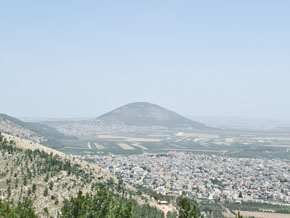
The picture was taken just outside Nazareth, looking east towards Mount Tabor (Tavor) rising alone on the Jezreel Valley.
While everyone [the whole crowd] was amazed (began to speculate on the reason for Jesus' actions), he said to his disciples [as they walked through Galilee, see ]: 44"Listen to what I say (literally 'put these words in your ears', do not forget these words, listen carefully now): The Son of Man will be delivered into the hands of men." 45But they did not understand this statement (word – Gk. rhema) [about his suffering and death]. It was hidden from them so that they could not understand it, and they did not dare to ask him about this statement.Jesus teaches the disciples
46But a discussion arose among the disciples, concerning the question of which of them was the greatest (had the most value, influence, and authority). 47Jesus knew what they were thinking in their hearts. He took a child and placed it beside him 48and said to them, "Whoever welcomes this child in my name welcomes me. Whoever welcomes me welcomes the one who sent me. For whoever is least among you all, he is [the one who is truly] great." [The Greek word paidion describes a small child up to school age. Jesus is probably in Peter's house in Capernaum, see , so it is not unlikely that it is Peter's child that Jesus brings forward to teach about humility in an illustrative way.]Be inclusive—whoever is not against us is for us (Mark 9:38-40)
[John, the youngest disciple, remembers a time when they tried to stop a man who did not do things exactly the same way they did. Had they been too critical in condemning him?] 49John said to him, "Master, we saw a man who does not follow us casting out demons in your name, and we forbade (prevented) him again and again because he was not with us (one of your disciples)." 50But Jesus said, "Stop hindering him. Whoever is not against you is for you."FROM GALILEE TO JERUSALEM (9:51-19:27)
51When the time drew near (the days were coming to an end) for Jesus to be lifted up, he turned his face toward Jerusalem, determined to go there. [Jesus now begins to move toward Jerusalem. There are still three months left until he enters Jerusalem, but from now on, his sights are set on the final phase of his ministry here on earth. The word "lifted up" can refer both to "going up" to Jerusalem and to "ascending to heaven." In , , , Luke uses a similar word for Jesus' ascension, and it is likely that it refers to this as well. Even though Jesus has suffering and the cross ahead of him, he does not focus on that, but on the final goal when he will be with his Father in heaven again!]
52
View of the area of Samaria from the city of Samaria.
54When his disciples James and John [the brothers whom Jesus called "sons of thunder," see ] found out about this, they said, "Lord, do you want us to call down fire from heaven to destroy them [just as Elijah did]?" [] 55But Jesus turned and rebuked them, 56and they went to another village [that welcomed them]. [The reason for wanting to call down fire may be that in the same area in Samaria, Elijah had been protected from two attacks by calling down fire from heaven. The third time they came against him, however, the officer humbled himself and fifty men were spared, see . Jesus had not come to judge the world but to give people a chance to repent, see . In just a few years, the same John who wanted to destroy the city here will preach the gospel together with Philip and Peter, and multitudes will be saved, see .]The demands of discipleship (Matt. 8:19-22)
[Jesus is in the process of selecting seventy disciples to prepare the way for him, heal the sick, and proclaim that the kingdom of God is near, see . Jesus is three months away from his death, and this mission will require complete devotion. Below are three examples of candidates, the first and last of whom volunteer, and Jesus must test the authenticity of their commitment. Just as Elisha had to truly put God's kingdom first in order to be with Elijah and share in the double blessing, Jesus requires his future disciples to put discipleship first.] 1. Material renunciation 57As they were walking along the road [toward Jerusalem], a man said to him, "Lord, I will follow you wherever you go."
58Jesus replied, "Foxes have dens and birds have nests, but the Son of Man has no place to lay his head." [At first glance, the answer seems unrelated to what the man said; he wanted to follow Jesus! But God looks not only at the outward appearance but at the heart, see . It seems that the man did not really know that discipleship would mean giving up comfort and material security.]2. No excuses
59To another, Jesus said, "Follow me!" But the man replied, "Lord, let me first go and bury my father." 60Then Jesus said, "Let the dead bury their dead, but you go and proclaim the kingdom of God." [Jewish burial took place in two stages. As soon as possible, preferably on the same day, the deceased was buried in a tomb. The family then observed a seven-day mourning period, followed by thirty days of less intense mourning. It was not until a year later that the eldest son was responsible for moving the bones to a so-called ossuary. It is highly unlikely that Jesus would have met this eldest son in the few hours before his father was buried; instead, it was sometime after the first burial. What the man is actually saying is that he is asking for a delay of perhaps up to eleven months before he intends to follow Jesus. By then it is too late, Jesus has already risen and this mission is over.]3. Highest priority
61Another man said, "Lord, I want to follow you, but first let me say goodbye to those at home." 62Jesus replied, "No one who puts a hand to the plow and looks back is fit for the kingdom of God." [Here we see another similarity with Elisha's calling, where Elijah allowed him to say goodbye to his family, see . But here we see that Jesus' calling is more radical than that of even the most radical prophet of Old Testament times.]Jesus sends out the seventy (Matt. 11:21-24)
101After this, the Lord appointed seventy others [in addition to the twelve, see ] and sent them out two by two ahead of him to every town and place where he himself was about to go. [Some manuscripts have seventy-two instead of seventy.] 2He said to them,
"Yes, the harvest is plentiful (abundant), but the workers are few. Therefore, ask the Lord of the harvest to send (would drive) out workers into his harvest. [The Greek verb deomai means to plead (for a great personal need), see also ; . The verb deo means 'to bind/stick together'. Here there is a hint that the one who prays connects himself with the answer to his prayer in order to see it fulfilled. Previously, the twelve had been sent out, see , now more are sent out to bring in the harvest. The Greek word for 'send out' is ekballo, which literally means 'to drive/throw out'. Even those who are already called need renewed zeal and enthusiasm in their mission to go out into the fields.
In we find the same phrase as here, but with a slight difference in nuance. In Matthew it says "send out workers" while Luke has "workers send out" (Gk. ergates ekballo). This wording emphasizes the workers a little more than the sending itself, which is then described in more detail in verses 3-12.] 3
Sandal on a statue from Rom, circa 31 BC - 14 AD. Can be seen at the Metropolitan Museum of Art in New York.

View from the ruins of the city of Korazin. Three kilometers further down lies Capernaum on the Sea of Galilee.
[Jewish city on the western side of the Sea of Galilee.]
Woe to you, Bethsaida!
[Jewish city along the northern coast of the Sea of Galilee.]
For if the mighty works (miracles, powerful wonders) that have been done in you had been done in Tyre and Sidon [two pagan cities in Phoenicia on the Mediterranean], they would have repented long ago and sat in sackcloth and ashes. 14But [the pagan cities] Tyre and Sidon will be treated more leniently at the judgment than you [Jewish cities Capernaum and Bethsaida]. 15And you, Capernaum [the city where Jesus had done most of his work], do you think you will be exalted to heaven? No, you will be thrown down to Hades (the realm of the dead). 16Whoever listens to you [my disciples whom I send out to the cities],
listens to me.
Whoever rejects you,
rejects me.
Whoever rejects me
rejects the one who sent me [God himself]." 17The seventy returned rejoicing and said, "Lord, even the demons obey us in your name." 18He said to them, "I saw Satan [the prince of all demons who must obey you] thrown down from heaven like lightning (quickly and spectacularly). 19Behold, I have given you authority to tread on serpents and scorpions, and authority over all the power of the enemy. Nothing shall by any means hurt you. 20But [even though this is great and amazing], do not rejoice that the spirits obey you, but [rejoice instead] that your names are written (recorded, engraved) in heaven." 21At that moment, Jesus was filled with joy in the Holy Spirit and said [in prayer]: "I praise you, Father, Lord of heaven and earth,
for hiding these things from the learned and wise
and revealing them to infants (the ignorant, the helpless, those who cannot yet speak).
Yes, Father, this is what you have decided. 22All things have been entrusted to me by my Father.
No one knows who the Son is,
except the Father,
and no one knows who the Father is,
except the Son
and those to whom the Son chooses to reveal it." 23Then Jesus turned to his disciples [the twelve and perhaps also the seventy] and said only to them (speaking privately with them): "Blessed (happy, enviable) are the eyes that see what you see! [Rejoice in your salvation, that your names are written in heaven, see . A similar statement is found in .] 24I tell you, many prophets and kings longed to see and hear what you see and hear [right now], but did not see or hear it." 25A lawyer [expert on how Moses' teachings should be interpreted] stood up to test Jesus (put him to the test) and said, "Teacher, what must I do to inherit eternal life?" [His intentions are not entirely honest; he is more interested in seeing how Jesus handles theological questions.] 26Jesus answered him [by asking a counter-question]: "What is written in the teaching [the Books of Moses, the Torah – Gk. nomos]? What do you read there (how do you interpret that passage)?" 27He answered [by quoting and ]: "You shall love [selflessly and generously] the Lord your God,
with all your heart,
with all your soul,
with all your strength
and with all your mind (intellect – Gk. dianoia);
and your neighbor (your fellow human being) as yourself."
28Jesus said to him, "You have answered correctly. Do this and you will live [experience a blessed life here on earth and eternal life in the kingdom of God]." 29
Even today, the several thousand-year-old road from Jerusalem winds its way down to Jericho along the edge of the ravine. This is the scene of the parable of the Good Samaritan.
"A man [a jew] was traveling from Jerusalem down to Jericho. He was attacked by robbers who took his clothes and beat him, then left him there half dead. [Jericho is a city 30 km northeast of Jerusalem. The road between these cities stretches through mountains and desert with an elevation difference of over 1,000 meters. It was not uncommon for gangs of robbers to operate in these areas.] 31By chance, a priest was coming down [towards Jericho] on the same road, and when he saw him, he passed by on the other side of the road. 32In the same way, a Levite came to the place. He saw him, but passed by on the other side of the road. [In Jericho lived thousands of priests and Levites. The priests were responsible for the sacrifices, and the Levites served under the priests in the temple as assistants, doorkeepers, musicians, and singers. A priest or Levite served five times a year in the temple. It says that they 'were passing by the same road', which means that they were on their way home from Jerusalem after such a period of service. They had just 'served God' in the temple for a week, but it seems to have been only an outward duty. They had no special time to keep, they are on their way home, yet they choose to deliberately look the other way and pass by a fellow human being in need.] 33But a Samaritan (Gk. samarites) [Samaritans and practitioners of the Samaritan faith] who was traveling came and saw him lying there, and he was filled with compassion. [The Jews wanted nothing to do with the disreputable Samaritans, see .] 34The Samaritan went to him, bandaged his wounds, and poured oil and wine on them [cleaned and disinfected them]. Then he lifted him onto his donkey, took him to an inn, and cared for him. 35The next day he took out two denarii and gave them to the innkeeper, saying, 'Take care of him, and I will pay you any additional expenses when I return.' [Two denarii was equivalent to two days' wages, which was enough for a person to stay at an inn for two months.] 36Which of these three, in your opinion, proved to be a true neighbor?" 37He [the scribe, see ] replied, "The one who showed mercy (grace) to him." Then Jesus said to him, "Go and do likewise (act in the same way)."Hos Martha and Mary's
38
Bethany is located three kilometers east of Jerusalem. This is where Martha, Mary, and Lazarus lived, whom Jesus often visited when he was in Jerusalem.
Show in atlas
'Father [Gk. pater, the literal meaning of the root pa is someone who nourishes, protects, and sustains]!
Hallowed be your name (hallowed be your name). []
Your kingdom come (come/establish – your kingdom)!
3Give us each day
our daily [physical and spiritual] bread.
4And forgive us our sins,
for we ourselves forgive everyone who is indebted to us.
And lead us not into temptation (trial).' " [The Greek word peirasmos has a broad meaning of both trial and temptation. The nuance between the English words does not exist in Greek. God Himself does not tempt anyone, but it is the evil one and our flesh that tempt us to sin, see ; ; . That is why we need to pray. On the other hand, the Spirit can lead us into situations where our faith is tested, see .] [In the Sermon on the Mount a few years earlier, Jesus taught about prayer, explaining that prayer is neither a display nor a babbling of empty words, see ; . This version is shorter than Matthew's in most manuscripts, but contains the same main points. There are some differences in wording: Luke has "sins" (Gk: hamartia), while Matt. has "debts" (Gk: opheilema), see .]
5Then he said to them [and Jesus now continues to teach about prayer by giving two parables]: Parable 1 – Knocking on a friend's door"Suppose one of you has a friend, and you go to him in the middle of the night and say to him, 'Dear friend, can you lend me three loaves of bread [loaves],
6a good friend of mine who is traveling has come to visit me, and I have nothing to set before him. 7Then perhaps he will answer from inside, 'Leave me alone. The door is already locked, and my children are with me in bed. I cannot get up and give you anything. 8I tell you, even if he inside does not get up and give him anything out of friendship, he will do so because the one who asks is so insistent, and he will give him everything he needs. 9Therefore, I say to you: Ask [ask again and again], and it will be given to you.
Seek [search and investigate again and again], and you will find.
Knock [knock again and again], and it will be opened to you.
10For everyone who asks [and keeps asking], he receives [actively and willingly accepts],
and whoever seeks [and keeps searching and investigating], he finds [more and more],
and for whoever knocks [and keeps knocking], it will be opened (opened up)." [The point of the parable is that if we have faith that our friend will open the door in the middle of the night when we knock on his door, how much more will our heavenly Father answer our prayers when we pray to him. Verses 9-10 each have six verbs arranged symmetrically in triplets. The active present tense (keep asking, seeking, and knocking) shows that this is about persistent prayer. The passive future tense (will be given and will be opened) in frames and indicates that God is the subject, i.e., he is the one who will answer prayers and he is the one who will open doors. This is reinforced by the fact that the last verb in is also in the passive form. The Greek words for finding and opening are used in both verses, but the words at the end of the first line of each verse differ: in , the word is for giving/allocating (didomi), while has the word for receiving and accepting (lambano). The verb forms show that what is given (in the passive form) here is urged to be willingly received (in the active form). See also .]Parable 2 – A father gives good gifts to his son (Matt. 7:9-11)
11"Is there any father among you who would give his son a snake when he asks for a fish? 12or a scorpion when he asks for an egg? 13If you who are evil [you who began in evil – sinful nature – consciously] have seen fit to give your children good gifts – how much more will your Father in (from; who is from) heaven [i.e., your heavenly Father] give the Holy Spirit to those who ask [and continue to ask] him? 14Jesus cast out a deaf-mute demon [the man was also blind, see ]. When the demon had been cast out, the man who had been mute began to speak, and the crowd marveled (was amazed, surprised, and fascinated by Jesus). 15But some of them [the Pharisees from Jerusalem together with the local Jewish leaders in Capernaum, see ; ] said, "He casts out demons with the help of Beelzebub, the prince of evil spirits." [Beelzebub literally means "lord of the flies," another name for Satan.] 16Others wanted to test him and asked for a sign from heaven. 17But Jesus, knowing their thoughts, said to them, "A kingdom divided against itself cannot stand, and a house divided against itself will fall. 18If Satan is now fighting against himself, how can his kingdom stand? I ask this because you claim that I drive out demons with the help of Beelzebub. 19If I drive out demons with Beelzebub, with whose help do your sons drive them out? They will be your judges. 20But if it is with God's finger (power) that I cast out demons, then God's kingdom is already here. [When they accused Jesus of using satanic power, they were also accusing their 'own sons' – their own countrymen. All of Jesus' disciples were Jude. It may be that the high priest Skevas is one of those Jesus is speaking to here, in which case he is referring to Skevas' seven sons who were involved in exorcism and occult spells, see .] 21When a strong man [in this case Satan], armed from head to toe, guards his palace, his possessions are safe. [The devil is likened here to a strong man who guards his kingdom and keeps his possessions, people, captive and bound.] 22But when the one who is stronger [Jesus] comes, attacks, and defeats him, he takes away all the weapons (all his armor) that he had placed his hope in. The victor then distributes the spoils [frees the people who were bound by the devil]. 23Whoever is not with me [does not take my side and believe in me]
is against me,
and whoever does not gather with me [does not engage in my victory and what I do],
scatters. [It is impossible to be neutral in spiritual matters; if you do not take a stand for Jesus, you are against him. Jesus continues to speak and describes what happens to a person who has been freed from evil spirits but has not invited Jesus to be Lord of their life.] 24When an unclean spirit leaves a person, it moves through waterless (dry) places, seeking a temporary resting place but finding none. Then it says, 'I will return to the house I left. 25When it returns, it finds the house cleaned and put in order. 26Then it goes away and brings seven other spirits, even more evil (worse, more harmful) than itself, and they enter and settle there (permanently). For that person, the situation now becomes even worse than it was at the beginning." 27When Jesus said this, a woman in the crowd cried out, "Blessed is the woman who bore you and nursed you!" [Literally, "Blessed is the womb that bore you and the breasts that nursed you."] 28But he replied, "Yes, but rather say, Blessed (happy, enviable) are those who listen to God's word and keep it." [Mary was blessed, but not primarily because she was Jesus' mother, but because she had taken God's word to heart.]Jesus speaks to the people
[It is the last winter before the crucifixion, and Jesus is in Judea. Although he has been with the people for several years and they have heard his words and seen all his miracles, they are not satisfied. They have just pretended that they would begin to believe in him if only he performed a supernatural sign from heaven, see .] 29As the people flocked to him in greater numbers, he began to speak: "This generation is an evil generation. It wants signs [miracles proving that he was sent by God], but it will receive no sign other than the sign of Jonah. 30Just as Jonah became a sign to the people of Nineveh, so the Son of Man will be a sign to this generation. [Jesus was referring to his own death and resurrection, which would eventually become a sign for them. Just as Jonah was in the fish for three days, Jesus would rise from the grave after three days, see .] 31The Queen of the South will rise up at the judgment with the people of this generation and condemn them. She [a pagan] came from the ends of the earth to hear the wisdom of Solomon [she saw no signs] – and here is more [wisdom] than Solomon! 32People from Nineveh will rise at the judgment together with the people of this generation and judge them. They [the pagans of Nineveh] repented [without seeing any signs] when Jonah preached – and here is more [gracious preaching of repentance] than Jonah!"[Here stands Jesus, one who is greater than both Solomon and Jonah, in their midst.] The lamp of the body is the eye (Matt. 6:22-23)
33No one lights a lamp and then puts it in a secluded place or under a bushel [Gk. modios – a measure that held just under nine liters and was used to measure dry goods]. They put it on a lampstand so that those who come in can see the light. [Jesus is the light of the world, shining openly before all. It is not hidden away in some secret corner.] 34The lamp of the body is the eye. [The eye is often a symbol of the heart.] When your eye is healthy (clear, focused), your whole body is full of light, but when it is corrupted, your body is also dark. [If a person has genuine and pure motives, she will see Jesus and her whole life will overflow with God's light; otherwise, Jesus' light and purity will blind her.] 35Therefore, make sure that the light within you is not darkness. 36If your whole body is full of light and no part of it is dark, then it will be completely illuminated, as when the light of a lamp gives you light."Voes at the home of a Pharisee (Matt. 23:1-36)
37While Jesus was speaking, a Pharisee invited him to have lunch at his home. [Literally "the first meal of the day," breakfast or early lunch.] When he arrived, he reclined at the table. [People did not sit but reclined at the table with their feet turned away from the half-meter-high table, which was often U-shaped. This way, everyone could see each other, and the servants could serve in the middle. There was also a hierarchy, with the most important seats closest to the host. People reclined on mats, leaning on their left elbow and eating with their right hand.] 38When the Pharisee saw that Jesus did not wash before the meal, he was surprised (he began to speculate on the reason why Jesus did so). [According to Jewish tradition, one was to ceremonially purify oneself by sprinkling water in a special way before a meal.]
39Then the Lord said to him, "You Pharisees, you clean the outside of the cup and dish, but inside you are full of greed (plunder) and wickedness. 40You are foolish (illogical)! [This word is not a curse, but focuses on someone being thoughtless and not reasoning logically. Jesus would never go against his own word and call someone a 'fool', see . He wants to challenge the Pharisees to think for themselves and not just follow their contemporaries and the traditions of the time.] Has not he who made the outside also made the inside? 41But give what is inside [give from the heart, give of the food that is in the dishes] to the poor, and everything will be clean for you. [The Pharisees devoted themselves to external ceremonial rules in order to appear righteous before people, but Jesus points out that they must instead give from the heart and with true love for God and people. Then the outside will also be clean.] 42
Mint in a garden in Jerusalem.
45One of the teachers of the law [who interpreted the books of Moses and taught the rules for how they should be followed in every detail] then said to Jesus, "Teacher, when you say these things, you insult us too." 46Jesus replied: "Yes, woe [expression of intense despair], also to you, teachers of the law! You load people down with heavy burdens (backpacks with packs), but you yourselves do not lift a finger to lighten the burdens. 47Woe to you [expression of intense despair]! You build tombs (monuments, memorials) for the prophets whom your fathers murdered. 48You are witnesses and give your full support to what your ancestors did. They killed the prophets, and you build their tombs. [They focused more on honoring the prophets' tombs, the outward appearance, but ignored their message.] 49Therefore, God's wisdom has said: I will send them prophets and apostles, and some of them they will murder and persecute. [In the continuation of the Gospel of Luke, the Acts of the Apostles, it is described how several of the apostles suffer martyrdom for their faith.] 50So this generation will be held accountable for the blood of all the prophets that has been shed since the world was cast down [Gk. apo kosmos katabole – i.e., from the Fall when God's orderly world system was destroyed], 51from the blood of Abel [the first martyr] to [throughout the Old Testament until the high priest] the blood of Zechariah, who was killed between the altar and the temple. Yes, I tell you: It will be demanded [; ] of this generation.
[Abel was the first to be killed in the Old Testament, see . Zechariah was the last, see . The Book of Chronicles is the last book in the Hebrew Bible. Jesus' point is that throughout the Bible, true followers of God have often been persecuted.] 52Woe to you [expression of intense despair], lawyers! You have taken away the key to knowledge [of God and salvation, and replaced it with your religious traditions, which are heavy burdens]. You yourselves have not entered, and you have hindered those who were entering." [The religious leadership was not only unhelpful, but became an obstacle to those who were truly seeking God. Their religious system was not just neutral; it worked against God. When the truth is revealed, there is a way of repentance that leads to freedom and forgiveness. Unfortunately, they did not choose that path, and the result was a bitter hatred of Jesus. They were exposed themselves and now do everything they can to find fault with Jesus. The same words that describe Herodias' hatred of John the Baptist, see , are used in the next verse to describe the Jewish leaders' bitterness toward Jesus. In Gal. 5:1, the same word is translated as "slavok," in contrast to the freedom found in Jesus.] 53When Jesus had left there [the Pharisee's house], the scribes and Pharisees began to persecute him bitterly (their hatred for him took deeper root within them and became like a slavok that bound them). They showered him with many questions (which he had to answer immediately, without time to think or explain), 54while they lay in wait, waiting for him to say something they could accuse him of.Do not fear people—fear God (Matt. 10:26-33)
[Jesus had begun to speak to the people about the sign of Jonah and that the lamp of the body is the eye, see . After breakfast at a Pharisee's house, thousands of people now come to hear Jesus teach.] 121Meanwhile [while Jesus was inside the Pharisee's house], thousands of people had gathered [myriads, the highest Greek numerical value 10,000, but also figuratively for a large crowd], so that they were trampling on each other. Jesus first turned to his disciples and said: "Beware of the leaven of the Pharisees, which is hypocrisy! [Jesus has just exposed the Pharisees' religious facade, see .]. 2There is nothing hidden
that will not be revealed,
and nothing concealed
that will not be made known. 3Therefore, whatever you have said in the darkness
will be heard in the light,
and what you have whispered in private (in the innermost rooms, chambers),
will be proclaimed from the rooftops. 4
If you bought four sparrows at the market, you got a fifth one for free, just as merchants today have offers such as "buy five, pay for four." The point is that none of these, not even the fifth extra sparrow, are forgotten by God.
Whoever acknowledges (confesses, recognizes) me before men,
the Son of Man will also acknowledge (confess, recognize) him before the angels of God [on the day of Judg., see ; ]. 9But whoever denies me before men,
he will be denied before the angels of God.
10Anyone who speaks against the Son of Man will be forgiven,
but anyone who speaks against the Holy Spirit
will not be forgiven, either in this age or in the age to come. [Anyone who believes they have committed this sin has most likely not done so. This statement was directed at the Pharisees.]
11When you are brought before synagogues, authorities, and rulers, do not worry about how you will defend yourselves or what you will say. 12The Holy Spirit will teach you what to say at that moment." Parable about the folly of greed
13Someone in the crowd said to him, "Teacher, tell my brother to divide the inheritance (their father's property or land) with me." [The eldest son received a double portion compared to the other sons, see . If there were disputes over the distribution, the rabbis would normally resolve them.] 14But Jesus said to him, "Man, who made me a judgment or arbitrator between you two?" 15Then he said to them [the two brothers], "Be on your guard (protect yourselves) against all kinds of greed (covetousness), for a person's life does not consist in the abundance of his possessions (that is not what determines your quality of life)." 16Then he told them a parable:
"A rich man had fields that yielded very good harvests. 17So he thought (reasoned back and forth with himself): 'What shall I do, for I have no place for my crops? 18Then he said [and in Greek the word 'I' is used eight times and 'my' four times]: This is what I will do, I will tear down my barns and build bigger ones, and there I will store all my grain and all my goods. 19Then I can say to myself (my soul): 'You now have plenty in store, enough for many years to come. Take it easy now, eat, drink, and be merry. 20But God said to him, 'You are foolish (not thinking logically)! Tonight your soul will be demanded of you. Everything you have gathered, who will get it? 21This is how it will be for anyone who stores up treasures for themselves but is not rich in [rich in their relationship with] God."Focus on the right things (Matt. 6:25-33)
22Then Jesus said to his disciples, "Therefore I tell you [because it is foolish to focus only on accumulating riches in this world, as the parable of the rich man showed, see verses 16-21]:
Do not worry about your life (Gk. psuche) [earthly life] what you will eat, or for your body, what you will wear. [] 23Life (the soul; the whole human being) is more than food,
and the body more than clothing!Look at the ravens
24Look at the ravens and learn from them. They neither sow nor reap,
they have neither storehouse (an inner chamber with hidden treasures) nor barn,
and yet God feeds them.
How much more valuable are you than the birds? [The raven was an unclean bird, see . In God's answer to Job, he asks rhetorically who provides food for the raven, see . This also brings to mind Elijah, who was fed in a supernatural way by ravens, see . In comparison to the rich man who built barns, see , the ravens have no barns – they trust in God. Even though the birds do not sow or reap, they are not idle. They sing and praise God, gather food, and build nests. The conclusion is that if God sustains the birds in his creation, how much more will he provide for his beloved children?] 25Which of you by worrying can add a single cubit to your stature? [A cubit (Gk. pechus) is mainly used to measure length but also time. The Roman cubit was 45 cm and was about the length of a man's forearm, the distance between the elbow and the middle finger. The measure of time was not precisely defined, but it described a short period of time. It could refer to the brief moment it took to take a step and move forward one cubit. In relation to years, a pechys could correspond to an hour or a day. The conclusion is that worry cannot extend our life's journey by even a single step – a few seconds, hours, or days. Nor can worry bring about a major change such as increasing our height by half a meter.
There is also a connection to the next paragraph that Jesus' listeners were familiar with. The person who winds up spun yarn () does so between the index finger and thumb and around the elbow, which corresponds to a cubit.] 26If you cannot do even this little, why do you worry about everything else? Look at the lilies
27Consider (examine carefully, learn from) the lilies (wildflowers), how they grow. They do not labor (work hard to the point of exhaustion)
or spin. But I tell you that not even Solomon in all his splendor (majesty) was dressed like one of them [].
28If God clothes the grass of the field,
which today is green and tomorrow is thrown into the oven,
how much more will he clothe you?
How little (short-lived) faith (faithfulness, trust) you have! Seek first the kingdom of God
29Do not seek (do not be fixated on) what you will eat and drink, and do not worry. [This is the only time the Greek word meteorizomai is used for worry in the New Testament. It can describe how a ship is tossed by the waves of the sea, and the image then becomes one of worry, where one is tossed between hope and fear. Another meaning is something high in the air. The word "meteor" comes from this word. The meaning then becomes not to place disproportionately high expectations on earthly things such as security, which only leads to worry and disappointment.] 30For all these things [food and drink] the Gentiles seek (pursue, strive for), but your Father knows that you need them. 31No, seek (be fixated on) his kingdom, and you will receive the other things as well. 32Do not be afraid, little flock!
For it is your Father's good will (great joy) to give you the kingdom. [The word for flock was most often used to refer to a flock of sheep. Compared to the kingdoms of the world, the twelve were a small group, like a small flock of sheep. But they have a good shepherd who protects them. They also have a share in the kingdom of God, which means the king's protection, privileges, provision, etc. There is no reason to worry!] 33Sell what you own and give to the poor (donate to charity). Get a purse that does not wear out, an inexhaustible treasure in heaven, where no thief can reach and no moth can destroy. 34For where your treasure is,
there your heart will be also." 35[Jesus continues to teach:] "Tuck in your clothes and keep your lamps (lanterns) burning. [Literally 'remake your lands', i.e. tie up your coat to be ready.] 36Be like servants waiting for their master to come home from the wedding feast [which could last up to seven days], so that they can immediately open the door when he comes and knocks [on the door]. 37Blessed (happy, fortunate) are those servants whom their master finds awake (alert, watchful, alive) when he returns. Truly (Amen), I say to you, he will fasten his clothes and have them sit down to eat, and he himself will come and serve them. 38Whether he comes during the second watch (9 p.m. to midnight) or the third (midnight to 3 a.m.) – blessed (happy, fortunate) are those servants. [In the Middle East, the sun sets at around 6 p.m. and rises again twelve hours later. The Romans divided the night into four watches and the Jews into three. Since Luke refers to the Roman system in , it is likely that the same three-hour shift system was used here as well. Regardless of the exact times, the master of the servants comes at night when the servants are most tired.] 39I want you to understand this [Jesus gives another parable to illustrate how important it is to be awake]: If a homeowner (father) knew what time (hour) the thief would come, he would not allow anyone to break into his house. 40Be ready (prepared), you too [like the servants in the first parable, and the master in the second], for the Son of Man will come when (the hour; at the moment when) you do not expect (anticipate, assume, think) it [personally do not believe or consider it to be an appropriate time]. To whom does the parable apply, should we wait for your return?
41Then Peter asked, "Lord, are you talking about us [the twelve disciples] in this parable, or about everyone?" [Jesus teaches about the joy that awaits servants who are dressed for service, have their lamps burning, and are not slumbering when the Lord returns, see verses 35-40. Peter wonders who he is talking about. Jesus responds by asking a rhetorical question, in which Peter, the disciples, and all who act in this way are identified with a wise steward. In the parallel passage , the answer is clear that not only the disciples should watch, but "all should watch." Everyone will be held accountable based on their knowledge, which is the conclusion in verses 47-48.] 42The Lord said, "Who is the faithful and wise steward (who has been given responsibility to oversee and lead a certain area) whom his master has put in charge of his servants to give them their food (each one's daily ration) at the proper time? 43Blessed (happy, fortunate) is that servant who is busy doing what he is supposed to do (carrying out his duties) when his master returns. 44I tell you the truth, he will put that servant in charge of all he owns. 45But if that servant says in his heart, 'My master is delayed' (it will be a while before he comes), and he begins to beat the other servants, both men and women, and eat, drink, and get drunk, 46then his master will come on an unexpected day and at an unexpected hour and cut him in two [punish him severely], and assign him a place among the unfaithful (unreliable) [hypocrites, those who call themselves servants but deliberately do the opposite of their calling]. 47The servant who knows his master's will but does not prepare himself or act according to his will shall be beaten with many blows. 48But the one who does not know [has relatively little knowledge of his master's will] and does something deserving of punishment shall be whipped with a few blows. Much will be required of the one who has been given much [by God], and even more will be required of the one to whom people have entrusted much [the one who is responsible for caring for others, for distributing food, the task in ].Fire and division – not peace (Matt. 10:34-39)
49"I have come to set fire to the earth (cast fire) – I wish it were already burning! [In nature, fire provides heat and light, but at the same time it also consumes the material that burns. Fire refines metals so that only what is genuine remains. In the Bible, fire is used as an image of God's holiness, judgment and baptism in the Holy Spirit. Jesus' desire for the fire to burn probably refers to several things – that the fire of trial would refine believers to live completely surrendered to him, that the day of Pentecost was already here so that believers were burning with the Holy Spirit and were bright lights in a dark world. This is what happened when God's word was revealed in the hearts of the travelers to Emmaus, and it was like a fire within them, see .] 50But I have a baptism to be baptized with [the baptism of suffering, his death and resurrection], and I am hard pressed until it is accomplished. 51Do you think I came to bring peace on earth? No, I tell you, but rather division (separation, division). [The peace that Jesus gives is between God and man, see . We are urged to strive for peace with all, see , but not everyone wants it, see . It is not God's will, nor is he the cause of division, but it is inevitable. There is conflict between light and darkness, between God's children and the devil's children, and this conflict even reaches members of the same family. When a person is saved and lives in the light, the contrast to their former life in darkness becomes very apparent. Former friends can become enemies when they feel judged, see .] 52For from now on, five in the same family will be separated, three against two and two against three. [Now an example is given from a family of five:] 53father against son and son against father,
mother against daughter and daughter against mother,
mother-in-law against [future or newlywed] daughter-in-law (bride – Gk. numphe) and daughter-in-law against mother-in-law." [Quote from . One group is father and mother, and on the other side son, daughter, and a newly married daughter-in-law. The word bride is used. Since Hebrew culture has a more binding engagement than today's Western tradition, an engaged woman is considered a bride for a period of one year. The term "newlywed wife" is also used. It seems to be the younger generation that has accepted Jesus and the older generation that is opposed to him. Before Jesus returns to establish the millennial kingdom On judgement day, the gospel may divide generations, see also ; ; .] 54He also said to the people, "When you see a cloud rising in the west [over the Mediterranean], you immediately say that it will rain, and so it does. 55When a south wind blows, you say there will be a heat wave, and so it happens. 56Hypocrites (who only put on a show for others), you can interpret the appearance of the earth and the sky. Why can't you interpret this time?" [The people were accustomed to interpreting the fairly predictable weather in Israel. Western winds brought rain. Southern winds brought desert heat, a phenomenon called the Sirocco. They could recognize natural weather changes, but were completely lacking in spiritual insight. Unwilling to see their own need for repentance and change.]God's judgment is coming—repent now
57"Why don't you judge (decide) for yourselves what is right? 58When you are on your way to the judge with your adversary, do everything you can along the way to reconcile with him while you are on your way. Otherwise, he will drag you before the judge, and the judge will hand you over to the court officer (Gk. praktor, who acted as a collector for the state), and the court officer will throw you into prison. 59I tell you, you will not get out until you have paid the last penny." [Here, the Jewish copper coin "lepta" is mentioned, which was the lowest denomination in the entire Roman Empire. Its value was 1/128 of a denarius, which was a worker's daily wage. The point of the parable is that God will judge the world, and while we are still walking here on earth, we need to receive His grace and be right with Him.]Life is unpredictable – repent now
131At the same time, some people came and told Jesus [the latest news] about the Galileans whose blood Pilate had mixed with their sacrifices. [Pontius Pilate was known for his cruelty. In the creed, we read how Jesus was "crucified under Pontius Pilate." The Jewish historian Josephus recounts several massacres carried out by Pilate. He was responsible to the Roman emperor for the regions of Judea and Samaria and lived in Caesarea on the Mediterranean coast. Jerusalem was part of his territory, and during Jewish holidays he was stationed there because of the risk of unrest and rebellion among the Jews. By killing these Galileans and burning them together with the sacrificial animals inside the temple in Jerusalem, he wanted to set a deterrent example. It may have been supporters of the resistance group mentioned in who lost their lives.
The common Jewish belief was that if you did good, good things happened, and if you did evil, evil things happened. People ask Jesus if those who died were greater sinners than others because this misfortune befell them.] 2
Jesus refers to one of the towers surrounding the Pool of Siloam in southern Jerusalem.
©Anna Carlsson
The parable of the fig tree that did not bear fruit
[Jesus now tells a parable to those who brought him the news of the massacre that took place in Jerusalem, see verses 1-6. Instead of speculating about why they had to suffer and die, they should have asked: "Why am I still alive?" Jesus urges them to look at their own lives and repent.] 6Jesus told this parable: "A man had a fig tree planted in his vineyard. He came to see if there was any fruit on it, but found none. [The fig tree is often a symbol of the nation of Israel, and the owner is God.] 7Then he [the owner] said to the gardener, 'Listen, for three years [from the age, about five years after it was planted, when it was normal to expect the tree to start producing a harvest] I have come looking for fruit on this fig tree and found none. Cut it down (literally 'cut it out')! Why should it take up space (suck the soil dry, take sunlight from other trees)?' 8The gardener replied, 'Sir, leave it alone for one more year, and I will dig around it and fertilize it. 9Perhaps it will bear fruit next year, but if not, you can cut it down.'" [Jesus is the intercessor who pleads with his people to repent and bear fruit. A little later in , Jesus weeps and prays over Jerusalem.]A woman's back is healed after eighteen years of illness
[This is the second time Jesus heals on the Sabbath. The first time was a man with a withered hand, see , and now it is a woman with a crooked back. Based on all the healings Jesus performed and all the parables he told, Luke consistently chooses to include an example of a man and a woman in his Gospel, using this narrative technique to show that Jesus does not differentiate between women and men.] 10Jesus was teaching in one of the synagogues on the Sabbath [a Saturday, the Jewish day of rest]. 11There [in the synagogue] was a woman who had been ill for eighteen years because of a spirit (demon of illness). She was bent over [Gk. sygkypto – literally: "bent over"; she had a curved back (sometimes called a hunchback) and walked bent forward, the medical term is hyperkyphosis] and could not straighten up. 12When Jesus saw her, he called her over and said, "Woman [not a harsh address, but filled with respect and tenderness], you have been freed from your illness," 13and he laid his hands on her, and immediately she straightened up and praised (thanked) God! 14But the synagogue leader, upset (angry) that Jesus healed on the Sabbath, said to the people [but directing his criticism at Jesus]: "There are six days on which work should be done; come and be healed on one of them, and not on the Sabbath." 15Then the Lord answered the synagogue leader: "You hypocrites (you religious leaders who are only putting on a show)! Is it not true that you all untie your ox or donkey from the manger and lead it out and give it water, even on the Sabbath? 16Shouldn't this woman, a daughter of Abraham whom Satan [which literally means "the adversary"] has kept bound for eighteen long years, be freed from her bondage (chain) on the Sabbath?" [For eighteen years, the woman had been going to the synagogue, even on days other than the Sabbath, but had not been healed.] 17And when he said this (these things), all who were against him (all his opponents) were ashamed, and all the people (the whole crowd) rejoiced over all the wonderful things [in the plural] that were done through him [under his authority].The kingdom of God
18
Mustard seeds are 1-2 millimeters in diameter and the bush can grow to a height of 2-3 meters.
The parable of the leaven (Matt. 13:33)
20Again he said, "What shall I compare the kingdom of God to? 21It is like leaven (yeast) that a woman takes and hides (mixes – Gk. ekgrupto) in three measures (Gk. saton – equivalent to 13 liters) of flour [a total of about 40 liters] until the whole dough has been leavened [affected by the yeast]." [Luke alternates between man and woman when compiling his gospel, see where "a man sows" and 21 where "a woman hides". The main point is how God's kingdom starts small but will grow. At the same time, the parable also suggests that God's kingdom grows disproportionately. A planted mustard seed becomes only a bush, not a tree. Already 30-60 days after sowing, mustard seeds can be harvested from the mustard bush, which is then a few decimeters high. The bush can continue to grow and reach a height of 2-3 meters, but then it no longer yields a harvest. This may be a hint that the Kingdom of God bears good fruit in small contexts. Leaven is consistently used in the Bible as a symbol of false teachings. In the midst of the growing Kingdom of God, there is also evil. In the story that precedes these parables, the ruler of the synagogue was someone who did not want to see people healed, see verses 10-17! See also comments in .] 22Jesus went through towns and villages teaching as he made his way to Jerusalem. [Already in , Jesus begins to go toward Jerusalem, but it is not until that he goes directly toward his goal.] 23Someone asked him, "Lord, are only a few people going to be saved?" [This was a theoretical question, probably asked by a Pharisee or a scribe. Jesus begins by giving a practical and personal exhortation to each person to be ready, for what does it matter if few or many others are saved if you yourself are lost? Finally, in verses 29-30, he answers the question by saying that many Gentiles from all corners of the earth will be saved.] 24Strive [as if you were competing in an Olympic event or fighting for your life; the verb form also indicates a passive component – i.e., allowing God to work in the midst of the struggle] to enter through the narrow (cramped) door [the doorway to a house where a wedding feast is to be held]. [Jesus is the door, the only way to God, see ; .] For many, I tell you, will try (seek; strive) to enter but will not be able to. 25Once the master of the house [Jesus] gets up and quickly closes the door, you will stand outside and knock, saying, 'Lord, open to us!' He will answer you, 'I don't know where you are from.' [Which family or household you belong to.] 26Then you will say, 'We ate and drank in your company [though not as true friends and guests as in ], and you taught in our streets. 27But he will reply, 'I don't know where you are from. [Which family or household you belong to.] Depart from me, all you who practice unrighteousness.' 28There you will weep and gnash your teeth (there will be anguish, hatred, and evil), when you see Abraham, Isaac, and Jacob and all the prophets in the kingdom of God, while you yourselves are cast out. [Many Jews considered themselves to belong to the kingdom of God because they were born Jude, while Jesus teaches that one must be born again.] 29People will come from east and west, from north and south, and sit at the table [participate in the heavenly banquet] in the kingdom of God. 30Those who are [now] last will [then] be first, and those who are [now] first will [then] be lastJesus and Herod
31Just then some Pharisees [from Galilee or Perea, the regions over which Herod Antipas was ruler] came to him and said, "Get away from here immediately, because Herod wants to kill you." 32But he replied, "Go and tell that fox [Jewish idiom for being cowardly and easily frightened] that I cast out demons and heal the sick today and tomorrow, and on the third day I will reach my goal (I will accomplish my purpose here). 33But today and tomorrow and the day after tomorrow I must continue on my way [Herod or anyone else cannot hinder God's plan], for it is not fitting that a prophet should be killed anywhere but in Jerusalem."Jesus mourns over Jerusalem (Matt. 23:37-39)
34"O Jerusalem, Jerusalem [the repetition of the name describes a strong emotional attachment]. You who habitually murder the prophets and stone those who are sent to you (as messengers)! How many times have I wanted (longed to) gather (protect) your children, as a hen gathers (protects, warms) her chicks under her wings, but you have refused. 35Behold, your house is left to you desolate (devoid of its own resources) [without God's protection]. I tell you, you will not see me again until the day when you say, 'Blessed is he who comes in the name of the Lord. '" []Jesus heals on the Sabbath
[After Saturday's service in the synagogue, the guest speaker was often invited to a Sabbath meal by the leader, see . This is probably what happened here, but the intentions were not good. The Pharisees watched him to see if he would do anything they could accuse him of.] 141When Jesus went in to eat at the home of one of the leading Pharisees on the Sabbath, they watched him closely. 2Then a man stood before him who suffered from water retention. [Luke uses the medical term we call edema. Presumably, his legs were swollen. It is a secondary disease; primarily, he suffered from heart failure.] 3Jesus asked the teachers of the law and the Pharisees, "Is it lawful to heal on the Sabbath or not?" 4But they were completely silent. He took hold of the man, healed him [his heart], and let him go. 5Then he said to them, "If any of you have a son or an ox that falls into a well, will you not immediately pull him out, even if it is the Sabbath?" 6They could not answer him.A parable to the guests
7When he noticed how the guests chose the best seats [closest to the host], he told them a parable: 8"When you are invited to a wedding feast, do not take the places of honor at the table. Perhaps someone more distinguished than you is among the guests? 9Then the one who invited both you and him will come and say to you, 'Give him your place! ' Then you will be ashamed and have to take the lowest place. 10No, when you are invited, go and take the lowest place. When the host comes, he will say to you, 'My friend, move up higher!' Then you will be honored in the presence of all the other guests. 11For everyone who exalts himself will be humbled, and he who humbles himself will be exalted." [Perhaps Jesus had the man who had just been healed in mind. He was near the house but did not seem to have been invited to share in the meal, see .]A parable for the host
12He also said to the one who had invited him [Jesus had just spoken to the guests, now he turns to the host]: "When you give a luncheon [literally 'the first meal of the day', breakfast or early lunch] or a dinner (a large festive meal), do not invite only your friends, your brothers and sisters, your relatives, or your rich neighbors, as you are in the habit of doing. They will invite you back, and that will be your reward. 13No, when you invite people to a feast, invite the poor, the disabled, the lame, and the blind. 14Blessed (happy, fortunate) are you then, because they cannot repay you. You will be rewarded at the resurrection of the righteous."A parable about the meal in God's kingdom (Matt. 22:1-14)
15
Jesus tells a parable about a banquet in God's kingdom to which everyone who wants to come is invited!
The first said to him, 'I have bought a field and must go out and see [inspect] it. I am sorry I cannot come. Please accept my apology.' [The field had already been bought, but he seems worried that he made a bad deal.] 19Another said, 'I have bought five pairs of oxen, and I am going out to try them (examine and approve them). Please accept my apology.' [Usually, people owned one or two oxen, so this was a wealthy man who had acquired ten more.] 20Another said, 'I have just gotten married, so I cannot come.' [His wife would probably have been happy to attend the party, and there was room for more people.] [These three excuses touched on three areas: possessions, work, and family. In their proper place, all of these things are good and blessed by God, see . In Jesus' first parable about soil, thorns are likened to things that choke the word of God. Jesus says that this parable is the basis for understanding all the other parables, see . In the explanation of the thorns, three reasons are given that coincide with the three excuses in this parable. They do not finish what they have started because of anxiety, wealth, and pleasure-seeking, see .] 21The servant returned and told his master what they had replied. Then the master was seized with anger and said to his servant, 'Hurry out into the streets and alleys of the city [it is urgent because everything is ready for the feast] and bring here the poor, the crippled, the blind, and the lame. 22Then the servant said, 'Sir, what you commanded has been done, but there is still room.' 23Then the master said to the servant, 'Go out to the highways and byways [outside the city] and persuade (urge) the people to come in, so that my house may be full. 24For I tell you that none of those who were invited will taste my mealSalvation is free—a life of discipleship costs everything! (Matt. 10:34-39)
[Salvation is free, but it still costs everything. Immediately after the parable of the free invitation to the banquet, there follows a section about the cost of following Jesus.] 25Large crowds followed Jesus. [Many people flocked to Jesus for various reasons. Jesus is more interested in quality than quantity.] He turned and said to them: 26"If anyone comes to me and does not hate (love me more than)
his father and mother,
his wife and children [or chooses not to marry, see ],
his brothers and sisters
and even his own life [this earthly life],
he cannot be my disciple. [In Jewish culture, these sayings, which are exaggerations, are common and are called hyperboles. Even in English, one can say, for example, that one loves red houses but hates yellow ones, thereby expressing a preference for a certain color without literally hating the other. Matthew translates a similar context as "whoever is more a friend of," see . Nevertheless, the words are very sharp and force us to consider where our loyalty lies. Who do we ultimately trust, is Jesus foremost? It is typical of Luke to include four points, see .] 27Whoever does not carry his cross and follow me cannot be my disciple. [Earlier in , Jesus says that to follow him, one must "deny oneself and take up one's cross daily." Now follow two parables that show that this is not an impulsive decision but requires careful consideration.] 28If any of you wants to build a tower, does he not first sit down and calculate the cost to see if he can complete it? 29Otherwise, if he lays the foundation but does not finish, everyone who sees it will begin to mock him 30and say, 'That man began to build but could not finish. 31Or what king goes to war against another king without first sitting down and considering whether he can attack the one coming against him with 20,000 men with his own 10,000? 32If he cannot, he sends a delegation and asks for peace while the other is still far away. 33Therefore, none of you can be my disciple unless he gives up (renounces, says goodbye to) everything he has. 34
A Christian is likened to salt and is supposed to influence their surroundings.
This passage began with "great multitudes," see . Just as a little salt is enough to flavor an entire dish, it is not the number of disciples that determines whether they influence the world around them, but rather their quality that is decisive.] Listen, you who have ears to hear." [This phrase is often used when a passage may be difficult to understand without the help of the Holy Spirit.]Jesus teaches
151
Sheep grazing along the valley on Mount Zion in Jerusalem.
The Parable of the Lost Sheep (Matt. 18:10-14)
3Then Jesus told this parable: 4Which one of you, having a hundred sheep and losing one, would not leave the ninety-nine in the wilderness [the usual grazing place for sheep flocks] and go in search of the one that is lost until he finds it? 5When he finds it, he rejoices and puts it on his shoulders, 6and when he comes home, he calls his friends and neighbors together and says to them, 'Rejoice with me, for I have found my sheep that was lost. 7I tell you, there will be more joy in heaven over one sinner who repents (totally changes his way of thinking and acting) than over ninety-nine righteous people who have no need of repentance."The parable of the lost coin

A coin could easily have fallen onto the simple earthen floor.
The found son
11He [Jesus] went on to say: "A man (a certain person) had two sons. [The younger is described in verses 12-24 and the older in verses 25-32.] 12The younger of them [probably unmarried and under 18] said to his father, "Father, give me my share of the estate right now." So he divided his property between them. [The older son received a double portion, see ; in this case, with two sons, he received two-thirds and the younger son received one-third.] 13Not many days later, the younger son gathered all he owned [sold his share of the divided inheritance] and went away to a distant country. He squandered his wealth by living a dissolute life [literally: 'living without saving or holding back']. 14When he had used up everything he had, a severe famine came upon the land and he began to suffer hardship (be in debt, fall behind with payments). 15So he went away and forced himself on (literally: 'stuck himself to') one of the inhabitants of the country [who reluctantly employed him because he was so insistent]. He sent him out to his fields to tend pigs. [An abominable job for a Jew since pigs were considered unclean animals, see ; .] 16He longed to fill his stomach with the pods that the pigs ate, but no one gave him anything. [Some manuscripts have 'fill his belly with pods'. This reinforces the contrast with his former life of abundance when he could choose to eat the best; now he would eat anything to satisfy his hunger. Sin plunges a person deeper and deeper into misery and degradation.] 17But when he had come to his senses (reached the end of himself), he said [reflectively]: 'How many of my father's employees have food in abundance, and here I am, about to starve to death. 18I will break up (get up) and go to my father and say to him, 'Father, I have sinned against heaven and against you (before you), 19I am no longer worthy to be called your son. Treat me as one of your employees.'" 20So he broke up and went to his own father.
While he was still far away, his father saw him [which suggests that the father was waiting and looking for his son]. The father was deeply moved (felt great compassion) and ran to him and embraced him and kissed him repeatedly. [In this culture, an older Jewish man never ran. The reason was that in order to run, he had to fasten his cloak, which exposed his bare legs, which was shameful. What motivated the father to bear that shame? According to the Talmud (a Jewish text that summarizes and comments on the Old Testament), there is a ceremony called kezazah. It was practiced if a Jewish son left the Jewish community, lived with gentiles, and then returned home. The elders of the city met him at the city gate and smashed a pot in front of the man – symbolizing the broken relationship with his family, the Jewish faith, and the community. He was not welcome back.
The reason the father runs may be that he wants to meet his son before the elders of the community have time to perform this ceremony. The father was willing to bear the shame in order to restore his son!] 21But the son said to him, 'Father, I have sinned against heaven and against you (before you), I am no longer worthy to be called your son. 22But the father said to his servants, 'Quickly bring out the finest (most honorable) robe and put it on him, and bring [give him] a ring for his hand and sandals for his feet. [Both the ring and the sandals were signs that he was now a free man; slaves were barefoot.] 23Bring the fattened calf [which was intended for a special festive occasion] and slaughter it, so that we may eat and celebrate, 24for my son was dead but has come to life again, he was lost but has been found.'
And they began to celebrate. 25Meanwhile, his older son was out in the fields [working]. As he was coming home and approaching the house, he heard music (polyphonic instrumental music – Gk. symphonia) and dancing. 26So he called one of the hired boys and asked what was going on. 27He replied, 'Your brother has come home, and your father has slaughtered the fattened calf because he has him back safe and sound. 28But he [the older brother] became angry and refused to go in. Then his father came out and tried to persuade him. 29But he replied to his father, 'All these years I have served you, and I have never broken any of your commands. Yet you have not given me even a small goat so that I could celebrate (rejoice) with my friends. 30But when that one, your son [a phrase expressing contempt], comes home, who has squandered your wealth with prostitutes, then you slaughtered the fat calf for him! [This is the older brother's statement. It is not certain that the younger son had been with prostitutes, but it may reflect what the older son had in his heart and would have done in a similar situation.] 31The father said to him, 'My child (a word for child that focuses on him being a member of the family), you are always with me, and everything I have is yours. 32But it was right to celebrate and be happy, because this brother of yours was dead but has come back to life, he was lost but has been found.'" [This is the last of three parables about how something lost is found. It is clear that the parables were directed at the Pharisees who complained that sinners came to listen to Jesus' teaching, see . The older brother describes a self-righteous person, the younger brother a sinful person who repents.]the unrighteous steward
161
It was not unusual for wealthier families in Jesus' time to have servants. One of the servants had overall responsibility for the household and the other servants.
The steward said, 'Take your promissory note, sit down immediately, and write fifty.' [50% less debt, a discount of 500 denarii.] 7Then he asked the next one, 'How much do you owe?
He replied, 'A hundred kor of wheat.' [A kor was a barrel of about 390 liters. The debt was equivalent to the harvest from 100 hectares (1 km²) and was worth 2,500 denarii – eight years' wages for a worker.]
Then he said, 'Take your promissory note and write eighty.' [20% less debt, a discount of 500 denarii.] 8His master [the employer, the rich man] praised the dishonest steward for his ingenuity (skill, his practical way of acting)." [This is the climax and surprise of the parable – how can the owner praise the dishonest steward who has reduced his income? The parable does not tell us exactly how the steward went about it, but he reduced the debts, which put his master in a better position with those who owed him money. Perhaps he waived the interest on the debt or removed his own share. The word "shrewdness" here is a neutral word that does not imply any moral judgment, but only that it was logical and clever thinking.] Use money to do good"The people of this world (age) act more shrewdly (skillfully, wisely) toward their own kind [their own] than the people of light do.
9I tell you: Make friends for yourselves with the help of unrighteous mammon (treacherous riches, money), so that they [the people you have helped here in earthly life] will welcome you into the eternal dwellings on the day mammon loses its value.
[The "clever" and wise thing that the steward does, see , is that he no longer wastes money on himself by living in luxury but secures his future with it. Gathering treasures in heaven is about being generous.] 10Whoever is faithful (reliable, trustworthy) in the least (in a very small matter) [in small things]
is also faithful in much [in large things],
and he who is unrighteous (unjust, deceitful, dishonest) in the least (in a very small matter) [in small things],
is also unrighteous in much [in large things].
11If you have not been faithful in the matter of unrighteous mammon (possessions, money),
who will entrust you with true riches [the gospel, spiritual gifts]?
12If you have not been faithful with what belongs to others,
who will give you what belongs to you? 13No servant [a special word for a slave who served in homes] can serve two masters.
Either he will hate one
and love the other,
or he will stick with one
and despise the other.
You cannot serve both God and mammon (wealth)."Self-righteousness does not impress God
[Jesus has told four parables. Three in which something lost is found, and finally the parable of the dishonest steward, see . The parables were directed at the disciples, but the Pharisees were also listening.] 14All this was heard by the Pharisees, who loved money, and they mocked him. [Here a more hostile word is used than in , where they muttered irritably. The word here is literally "to turn up one's nose at someone." They said nothing, but their body language showed their contempt for Jesus.] 15Jesus said to them, "You are the kind of people who declare yourselves righteous before men [by putting on an outward show], but God knows your hearts. What is highly prized by men [money and status] is detestable to God." [Jesus continues to speak to the Pharisees, who were experts in the teachings of Moses and the prophetic writings:] 16"The teaching [the books of Moses, the Torah – Gk. nomos] and the prophets [proclaimed and prophesied about the Messiah]
until John [the Baptist]. [Nomos is a broad word meaning doctrine, norm, law, and can refer to the entire teaching of the Bible or just the Books of Moses. This first part of the sentence lacks a verb in Greek, so translators fill in that nomos and the prophets "proclaimed," "had their time," "applied," "prophesied about the Messiah," etc. Since the next verse () says that nomos will not pass away, the meaning cannot be that the first covenant and Moses' teaching have become invalid. However, a shift has taken place with John the Baptist beginning to preach the gospel, which is the good news. It is likely that the verb "proclaimed" – which is used later in the sentence about the gospel – also refers to the first part. In the parallel passage, the verb "prophesied" is used, see . The Scriptures prophesied about the Messiah: where and when he would be born, that he would be born of a virgin, and how he would die, see ; ; ; .]
Since then, the good news (the gospel) has been proclaimed,
and everyone is trying to seize it (take it by force; push their way in). [The word can be interpreted negatively as trying to seize by force, or positively as eagerly pushing one's way in. The meaning seems to be that when John began to preach that "the kingdom of God has come near," an eager longing arose among the people to seize it, but not everyone did so in the right way, i.e., through a change of heart and faith in Jesus. Many resorted to wrong methods, so that Jesus even had to hide that he was the Messiah and forbid his disciples and others to tell about him. The word "by force" (used in the parallel passage in ) is the same word used in when they tried to force Jesus to become king.] 17But it is easier for heaven and earth to pass away than for even the smallest stroke [Gk. keraia, which distinguishes the Hebrew letters] in the teaching (Gk. nomos) to fall away (lose its meaning).
[The Greek word keraia corresponds to the Hebrew word kotz, see . An equivalent in the Latin alphabet is, for example, the lower horizontal line that distinguishes the letter E from F.] 18Anyone who divorces his wife and marries another commits adultery, and anyone who marries a divorced woman commits adultery." [Now Jesus brings up a topic that was widely discussed among the rabbis. This is not a complete exposition on divorce. The reason he brings this up may be that the Pharisees, who saw themselves as so faithful to Moses' teaching, had completely missed the heart of the matter of marriage. Some Pharisees, such as Rabbi Hillel, had a liberal view and allowed divorce for something as trivial as burnt food, based on . Matthew deals more thoroughly with the intention of the law in the Sermon on the Mount, see . The teaching on divorce is also more detailed in Matthew. It is preceded by teaching on forgiveness, which is always God's goal. Then, after the teaching on the meaning of marriage, there follows an event where Jesus cares for and blesses the children, those who are most affected by divorce, see .]The rich man and Lazarus

Painting by Fedor Bronnikov, 1886.
- What we do in this life has consequences after death.
- We should help the poor.
- Jesus uses a contemporary term, "Abraham's bosom," but changes certain details.
The English word "lazaret" (a place for people with infectious diseases) has its origin in the biblical name Lazarus.] 171
Olive press in Nazareth Village built in the same way as in Jesus' time. This larger model was powered by a donkey connected to a yoke.
A parable about the necessity of forgiveness
[Jesus continues to teach his disciples about forgiveness, and now tells a parable about our obligation to forgive one another.] 7"Would any of you say to your servant when he comes in after plowing the field or tending the sheep, 'Come at once and sit down at the table'? 8Instead, does he not say, 'Prepare my supper, put on your apron and serve me while I eat and drink; then you may eat and drink yourself'? 9He does not thank the servant for doing what he is supposed to do, does he? 10In the same way, when you have done everything you have been commanded [forgiven one another, see ], you should say, 'We are only servants (unworthy of receiving any special reward), we have only done our duty.The grateful Samaritan

A Samaritan priest on his way to the annual Samaritan Passover celebration on Mount Gerizim, a two-thousand-year-old tradition that is still practiced today.
©Emanuel Gillberg
Jesus will return
22Then Jesus said to his disciples, "The days will come when you will long to see one of the days of the Son of Man [when he reigns fully here on earth], but you will not get it. [There will be difficult times of persecution and trials when you will wish that he were here on earth in his glory with his kingdom.] 23People will say to you, 'Look, there he is,' or 'Look, here he is. Don't go out there, don't follow them. 24For as the lightning flashes and lights up the sky from one end to the other, [just as suddenly and completely visible to all] so will the Son of Man be revealed on his day. 25But first he must suffer many things and be rejected by this generation. 26In the days of the Son of Man [when he returns to reign fully here on earth]: Then it will be like in the days of Noah. [] 27People were eating and drinking, marrying and giving in marriage, up to the day Noah entered the ark. Then the flood came and destroyed them all.
[Eating, drinking, and marrying are not wrong in themselves – the sin was that people lived only for these things and ignored God.]
28Then it will be as in the days of Lot. People ate, drank, bought, sold, planted, and built. 29On the day Lot left Sodom, fire and brimstone rained down from heaven and destroyed them all. [Society had changed since Noah's days: in addition to eating and drinking, people also bought, sold, planted, and built. There was economic prosperity and abundance. This is not wrong in itself, but the sin was that they did not want to know God. There were not even ten righteous people in the city, see . Note that "married and were given in marriage" is not included here. It is implied that people no longer married and promised each other fidelity, but lived in loose relationships.
The conclusion from these two examples was that people lived as usual. The day Noah entered the ark and the day Lot left the city were like any other day. There was no special sign in the sky that morning. What they also have in common is that the righteous are saved before the judgment comes.] 30In the same way, it will be on the day when the Son of Man is revealed. [When Jesus returns to judge the earth.] 31On that day, anyone on the roof, with their belongings in the house, should not go down to get them, and anyone in the fields should not turn back. [That is how quickly and suddenly it will happen.] 32Remember Lot's wife. [In it is told how she turned back and longed for Sodom, which became her downfall.] 33Whoever tries to preserve his life [this earthly life] will lose it, but whoever loses his life will save it. 34I tell you: That night, two will be lying in the same bed.
One will be taken and the other left behind. 35Two shall be grinding together.
One shall be taken and the other left. 36Two shall be in the field.
One shall be taken and the other left behind." [ is not included in the Greek text of Nestle Aland and the oldest manuscripts, but it is found in some Greek, Latin, and Syriac manuscripts from the Middle Ages. It may be an addition by a scribe to correspond to .] ["Taken away" can refer to being taken away literally and captured during an invasion by an enemy army. Spiritually, one can be taken away to judgment or to the kingdom of God. Regardless of what "taken away" refers to, people will be separated when the kingdom of God and the Son of Man come.] 37Then they asked him, "Where, Lord?"
He replied, "Where the [dead] body is, there the eagles (vultures) will gather." [This proverb is based on . The point is that eagles, or vultures as the word can also mean, can be seen circling their prey from a long distance. When Jesus returns, it will be seen from a long distance and it will be obvious. In the parallel passage in Matt. 24:27-28, the image of lightning is also used, which is visible to everyone in the sky, see .]About prayer
The parable of the widow and the judge
181And he [Jesus] then told a parable to show them [the disciples] that it is necessary to always pray (worship, commune with God) and not lose heart (not give up; literally: "not yield to evil" – Gk. me egkakeo).
[This parable is related to the question of the time before Jesus returns in the previous paragraph () and in the conclusion here when "he returns," see . Part of the content of the prayers is certainly "Thy kingdom come," see . Prayer and personal communion with God are necessary in order not to give up, see also ; ; .]
2He said, "In a certain city there was a judge who did not fear God and had no respect for people. [He did whatever he wanted.] 3In that town there was a widow who kept coming to him and saying, 'Help me get justice against my adversary. 4For a long time he refused, but finally he said to himself, 'Even though I do not fear God or respect people 5I will judge fairly (give her justice). If I don't, she will always bother me, and eventually attack me.'" [Literally, "hit me and give me a black eye."] 6The Lord said, "You hear what the unjust judge says. 7Will not God [who is righteous] give justice to his chosen ones who cry out to him day and night? Will he delay long before helping them? 8I tell you, he will quickly (immediately, suddenly) give them justice (help them). But the question is, will the Son of Man find faith [such persevering faith as the widow had] here on earth when he comes?" [This parable is not a comparison in which God is like this unjust judge whom the woman must pester and threaten, but a contrast. If an unjust judge finally gives in, how much more will a righteous and loving God hear his children when they pray!]The parable of the Pharisee and the tax collector
9Jesus also told this parable to some who were convinced that they themselves were righteous while looking down on everyone else: 10
Prayer at the Western Wall in Jerusalem.
'God, I thank you that I am not like other people; thieves (fraudsters), unjust, adulterers – or like that [disreputable] tax collector. 12I fast twice a week, I give a tenth of all I earn.' [The Jewish custom was to pray standing and pronouncing the words, see ; . It was common for orthodox Jews to fast on Mondays and Thursdays. The preposition "to" in (Gk. pros) can also be translated "about" or "for." It either relates to how he stood or how he prayed. Perhaps he considered himself superior and stood and "prayed for himself." Based on the context and his arrogant prayer, it is more likely that the preposition describes how he prayed. He prayed "about" himself, or even worse, "to" himself by praising his own goodness.] 13But the tax collector stood at a distance and would not even lift his eyes to heaven, but beat his breast and said, 'God, be merciful to me, a sinner. 14I tell you, it was he who went home justified, not the Pharisee. For everyone who exalts himself will be humbled, but he who humbles himself will be exalted." 15People also brought infants to Jesus so that he might touch them. When the disciples saw this, they rebuked them (prevented them and spoke sternly to them). [Believing that Jesus had more important things to do, or that the children were not important to him, the disciples sent the parents away.] 16But Jesus called them to him and said, "Let the children come to me, and do not hinder them! The kingdom of God belongs to such as these. 17Truly (Amen), I say to you, whoever does not receive the kingdom of God like a child will never enter it." [Jesus speaks of the need to humble oneself and receive the kingdom of God with childlike trust. In stark contrast to a child's simplicity, a rich leader now comes and asks what he must do.] 18A leader [probably a synagogue official or a member of the Sanhedrin] asked Jesus, "Good teacher, what must I do to inherit eternal life?" 19Jesus replied, "Why do you call me good? No one is good except God. 20You know the commandments: You shall not commit adultery [],
You shall not murder [],
You shall not steal [],
You shall not bear false witness (lie in court) [],
Honor (value, respect) your father and your mother []."
21Then he replied, "All these [the laws just mentioned] I have kept from my youth." [He believed he had kept the commandments since he became morally responsible, which was at the age of thirteen. In today's Judaism, this occurs at the bar mitzvah, which means becoming a "son of the commandment." The fact that Zechariah and Elizabeth followed the Lord's commandments and precepts is referred to as something positive in . In , it also appears that the man feels that he is missing something. The question he seems to be asking is why he has not yet found peace in his heart, even though he has tried to keep all the commandments.] 22When Jesus heard this, he said to him, "One thing you still lack (missing – Gk. leipo). Sell everything you have and give [distribute the money] to the poor. Then you will have a [rich] treasure in heaven. Then come back and follow me (become my disciple)." In , it says how Jesus looked at him with love. 23
Jesus' parable that it is easier for a camel to pass through the eye of a needle than for a rich man to enter the kingdom of God puzzled his disciples.
To Jericho
35
Herod the Great built the new Roman Jericho just south of the old city of Jericho.
Zacchaeus meets Jesus
191Jesus then entered Jericho and walked through the city. 2There was a man named Zacchaeus who was the chief tax collector (in charge of the tax collectors for the Roman tax authorities), and he was rich. [Zacchaeus is a Hebrew name that means "pure" and "righteous." He was therefore a jew who worked for the Roman state and was therefore considered a traitor among his own people. Jericho was an important trading city that produced balsam, which generated large tax revenues for the region. As head of the tax office, Zacchaeus was very wealthy.] 3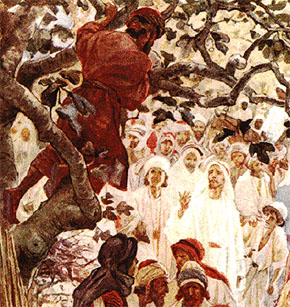
Illustration by Scottish artist William Hole, 1846-1917.
9Jesus said to him, "Today salvation has come to this family, because he too is a son of Abraham, 10for the Son of Man has come to seek and to save that which was lost."The Parable of the Ten Silver Coins (Matt. 25:14-30)
[Zacchaeus, and many with him in Jericho, worked with money. Now Jesus gives a parable about money, which illustrates stewardship. As in previous parables in Luke, the reason and explanation come at the beginning, see , . People thought he would go up to Jerusalem and revolt against Roman rule, but Jesus wants to explain that he will go away and then come back as king. There are similarities with the parable of the talents in , but they are two different parables. Jesus told similar but different parables on different occasions.] 11When they listened to this, Jesus told another parable. Since he was near Jerusalem and they believed that the kingdom of God would become visible (take shape) immediately, 12he said: "A man of noble birth (born noble with high status) traveled to a distant country to receive a kingdom (become king and gain authority to rule) and then return. [The parable probably alludes to real events. Herod the Great traveled to Rom in 40 BC to have his royal title confirmed by the emperor. His son Archelaus did the same after his father's death in 4 BC. The Jews opposed Archelaus receiving the title, which is also mentioned in the parable, see . For Luke's readers, the parallel is that the Jewish leaders opposed Jesus' claim to be their king. Jesus' resurrection is his journey to heaven. One day he will also return to establish the millennial kingdom.] 13He called ten of his servants and gave them ten silver coins. [They received one coin each: the second highest Greek coin, the "mina," which is worth a hundred denarii and corresponded to four months' wages for a worker – a relatively small sum to see if they were faithful in small things, see . He said to them, 'Manage these (buy and sell, invest them) until I come back.] 14But his countrymen hated him and sent a delegation after him to say, 'We do not want this man to be our king. 15When he returned, after receiving the kingdom, he summoned the servants to whom he had given the money. He wanted to know how much each had earned [by managing the four months' wages each had received]. 16The first one came forward and said, 'Sir, your silver coin (mine) has generated (earned) ten silver coins (mine).' [1,000% return] 17The king replied, 'Well done, good servant! Since you have been faithful (loyal) in a very small matter, you shall have responsibility for ten cities.' [An unusual Greek word is used for 'generated' here and is not the same as 'yielded' in . Literally, it can be translated as 'has worked alongside' the original sum.] 18Then the second one came and said, 'Sir, your silver coin has yielded five silver coins.' [500% return] 19The king replied, 'You shall be in charge of five cities.' [The king is not primarily interested in the return on investment; rather, it is loyalty and faithfulness that are important and decisive.] 20Another servant came forward and said, 'Master, here is your coin. I have put it away (stored it) in a sweat towel (linen cloth). 21I was always afraid of you, because you are a strict (hard) man. You take out what you did not put in [the bank], and reap what you did not sow.' [The servant had a completely wrong image of his master, who gave generously and disproportionately, see verses 17 and 19. The word 'sweatcloth' comes from the Latin word for sweat. It was a towel or handkerchief used to wipe sweat from the face. The idle servant had no use for his sweat towel and instead put the coin in it. The word is also used for the linen cloth in which the dead were wrapped at burial, see ; .] 22The king [the noble man who had now become king, see ] said to him, 'I will judge you by your own words, you wicked servant. If you knew that I was a strict man who takes out what I did not put in and reaps what I did not sow. 23Why then did you not put my silver coin in the bank? Then I would have received it back with interest when I came home.' [Interest rates in the Middle East at that time were high, up to 50%. In Jesus' time, there was an upper limit of 12% in the Roman Empire.] 24To those standing nearby, he said, 'Take the silver coin from him and give it to the one who has ten silver coins. 25They said to him, 'But he already has ten silver coins. 26He replied, 'I tell you that everyone who has will be given more, but from the one who has nothing, even what he has will be taken away. 27But bring here those enemies of mine who did not want me to be king over them, and slay them here before me.'" [The last week of Jesus' life occupies a large part of all the Gospels. It falls in the spring, in the Jewish month of Nisan, when three of the spring festivals are celebrated. The days can be divided in different ways, but the headings in the Core Bible are based on the Jewish days for the festivals in the year 30 CE. This year, the third day of the Feast of Unleavened Bread coincides with the Feast of Firstfruits, bikkurim, see . For an overview of the days, see .]10th of Nisan (Saturday evening – Sunday afternoon)
28
The farm in Starby outside Ängelholm is home to Northern Europe's largest model of Jerusalem. The villages of Bethphage and Bethany are located east of Jerusalem on the Mount of Olives.
"Blessed is he who comes, the king,
in the name of the Lord! []
Peace (complete harmony) in heaven
and glory (honor) in the highest [in the highest heavens]!" [During the Passover feast, they sang from . Luke adds "the King" to the quotation to clarify who it refers to.]
39
During the excavations of the southern part of the Western Wall, the stones that the Roman soldiers tore down when the temple was destroyed in 70 AD are still there today.
11th of Nisan (Sunday evening – Monday afternoon)
45Jesus entered the temple area and began to drive out those who were selling there. 46He said to them, "It is written:
'My house shall be a house of prayer.' []
But you have made it
'a den of thieves.'" [] [The religious leaders had robbed the people in several ways. They had taken advantage of them financially by charging high fees for exchanging money and buying sacrificial animals, but they had also robbed them spiritually by not leading them into a personal relationship with God.]
47He continued to teach (day after day) in the temple courtyard. The chief priests, the scribes, and the leaders of the people sought an opportunity to kill him, 48but they could not find a way to do so, because all the people stayed close to him and listened intently to him (literally "hung on his every word").12th of Nisan (Monday evening – Tuesday afternoon)
201One day, when Jesus was teaching the people in the temple and proclaiming the good news (the gospel), the chief priests and the scribes came forward with the elders 2and asked him, "Tell us, what authority (power) do you have to do these things? Who gave you this authority?" [They are probably referring to Jesus' actions the day before when he drove out those who were buying and selling, but also to earlier events such as his entry into the temple and the children's praise of him. The answer is, of course, simple – he does his Father's will, but such an answer would lead to him being accused of blasphemy. The religious leaders' question is not an innocent inquiry. It is a trap that Jesus easily sees through.] 3Jesus answered them, "I also have a question for you. Tell me: 4Was John's baptism from heaven or from men?" 5They conferred among themselves (discussed among themselves) and said, "If we say, 'From heaven,' he will say, 'Why then did you not believe him? 6But if we say, 'From men,' all the people will stone us, for they all hold that John was a prophet." 7So they answered that they did not know where it came from. 8Then Jesus said to them, "Neither will I tell you by what authority I do these things." 9Then he began to tell the people this parable: "A man planted a vineyard [which is a picture of Israel, see ]. The man leased it to vineyard workers and went to another country for a long time. 10When the time came [for harvest], he sent (Gk. apostello) a servant [with authority for a mission] to the vine-growers to collect his share of the harvest. [This happened five years after the vineyard was planted, see . The vineyard workers who leased the land were expected to send a certain portion of the harvest to the owner as rent.] But the vineyard workers mistreated (beat) him severely and sent him away empty-handed. [The vineyard had probably not yielded any harvest – just as Israel was without fruit.] 11Then he sent (Gk. pempo) another servant to them. They also beat and humiliated him and sent him away empty-handed. 12Then he sent (Gk. pempo) a third servant. But they beat him bloody and threw him out. 13Then the owner of the vineyard said, 'What shall I do? I will send my son, my beloved. [The same phrase that the Father uses about the Son, see ]. Surely they will respect him. 14But when the vineyard workers saw him, they discussed it among themselves (weighing the pros and cons) and said, 'Here is the heir; let us kill him, and the inheritance will be ours. 15So they drove him out of the vineyard and killed him." [Jesus explains the parable:] "What will the owner of the vineyard do to them? 16He will come and depose (judge, destroy) them and lease the vineyard to others."
When they [the people in the temple area who were listening to Jesus] heard this, they said, "Never let this happen!" 17But he looked at them and asked, "What then does this mean that is written [in ]:
'The stone that the builders rejected has become the cornerstone?' [The first stone in the building and the one that all other stones are aligned with.]
18Whoever falls on that stone will be broken to pieces,
but whoever the stone falls on will be crushed." [Jesus refers to the imagery of the Old Testament, where the Messiah is likened to a stone. The image of a stumbling block is found in , and the stone that crushes is found in , .] 19The scribes and chief priests would have gladly arrested him at that moment (right then and there), but they feared the people. They understood that it was them he had been talking about in the parable. 20They [the scribes and chief priests, see ] watched Jesus [to find an opportunity to trap him]. They sent out spies [from two groups, the Pharisees and the Herodians, see ]. They would pretend to be honest (righteous) in order to catch him in something he said, so that they could hand him over to the power and authority of the governor. [They wanted to get him to say something against the Roman state so that they could have him convicted in a civil trial. The Jews did not have the right to sentence anyone to death; only the Roman government could do that.] 21They asked him, "Teacher, we know that you speak and teach correctly and do not take sides, but teach the truth about God's way. 22
A denarius depicting Emperor Tiberius (reigned 14-37 AD).
They replied, "Caesar's." [Caesar was both the name and title of the Roman emperor.] 25Then he said to them, "Give to Caesar what belongs to Caesar, and to God what belongs to God." [Man is created in the image of God, see . Just as the coin was stamped with the image of the emperor and belonged to him, so man bears the image of God in his heart and belongs to him.
A denarius was the most common Roman coin, its value corresponding to a day's wage for a laborer. On one side was an image of the head of the then-emperor Tiberius, and along the edge was an inscription in Latin: Tiberius Caesar Augustus – the divine son of Augustus. Roman coins were considered blasphemous among the Jews and were not allowed to be used in the temple. The text and image violated both the first and second commandments – to have no other gods and to make no graven images.] 26They could not catch him in any of his words before the people. Completely amazed (surprised) by his answer, they fell silent. 27Then some Sadducees came forward, they [are the most liberal religious group] who deny that there is a resurrection. [They also did not believe in anything supernatural such as angels or life after death, see .] 28They said: "Teacher, Moses gave us a command that
if a man dies without children, his [younger unmarried] brother should marry the widow
and raise up children for his brother.
[A correct summary of , which guarantees a childless widow's livelihood in a society where she would otherwise be forced into begging. The custom also preserves the name of the deceased husband. These marriages are called levirate marriages, from the Hebrew word levir, meaning brother-in-law. The custom already existed before Moses received God's commandments and instructions on Mount Sinai, see ; .]
29Now there were seven brothers. The first took a wife but died childless. 30The second [younger brother] 31and the third married her, and so did all seven, but they died without having any children. 32Finally, the woman also died. 33At the resurrection, whose wife will she be? They have all been married to her." [The Sadducees wanted to show the absurdity of a resurrection using this example, which they had probably used as an argument in earlier discussions with the Pharisees. The example may come from a story from the Apocrypha, Tobit 3:7-15, where a woman married seven men without having children. They assumed that the resurrected body would be like the current human body, see also Paul's reasoning on the same subject in .] 34Jesus answered them: "The people of this world (sons of this age) marry and are given in marriage. 35But those who [God] considers worthy of sharing in the new age [the kingdom of God to come, see ] and the resurrection from the dead, they neither marry nor are given in marriage. 36They can no longer die, for they are [immortal] like the angels and are children of God, since they are children of the resurrection. [The function of marriage for fellowship and for populating the earth is then over, see .] 37Moses has clearly shown (he has revealed something that is hidden) that the dead are resurrected in the story of the burning bush []. Here Moses calls the Lord the God of Abraham, the God of Isaac, and the God of Jacob [even though they were not living here on earth when Moses said this]. 38God is not a God of the dead but of the living, for to him all are alive."
[The Sadducees had used the teaching in the books of Moses () as an argument that there was no resurrection, but now Jesus uses Moses' own words in the story of the burning bush to prove the opposite.] 39Then some of the scribes answered, "Teacher, well said." [Another question about which is the greatest commandment comes from a scribe. The question and Jesus' answer are found in both and . The reason Luke does not include it may be that he already has a similar story in .] 40After this, they did not dare to ask him any more questions. 41Jesus asked them, "How can you say that the Anointed One (Messiah) is David's son? 42David himself says [inspired by the Holy Spirit] in the Psalms (book of psalms): 'The Lord [Yahweh – God the Father] said to my Lord [Adonai – God's Son, Messiah]:
Sit at my right hand,
43until I make your enemies your footstool.' [Quote from , which is a coronation psalm, composed to be used when a new king ascends the throne. It is messianic and describes how God the Father crowns Jesus. Hebrew uses two different words for Lord, first Yahweh and then Adonai.] 44David calls him Lord, so how can he be David's son?" 45While all the people were listening, he said to his disciples: 46"Beware (be constantly on guard) of the scribes. [Most scribes were Pharisees.] The love to walk around in long robes and be greeted with respect in the marketplace and sit in the best seats in the synagogue [where they could look out over the congregation; these seats were reserved for teachers] and have the places of honor [the seats of honor closest to the host] at banquets [where people reclined at the table]. 47They devour (rob, destroy) the property (houses) of widows [mislead and exploit widows, who were the most vulnerable in society] and then pray long prayers for show (to cover up and hide their ugly intentions). They will receive a harsher judgment. 211Jesus looked up and saw how the rich put their gifts into the temple treasury [in the women's section of the temple, where there were thirteen trumpet-shaped containers, all for different charitable purposes]. 2He also saw a poor widow put in two small copper coins. [The Jewish copper coin "lepta" was the smallest denomination used in the eastern part of the Roman Empire. Its value was 1/128 of a denarius, which was a worker's daily wage. Two "lepta" were equivalent to one "quadrans," which was the lowest coin denomination in the western part of the Roman Empire.] 3Then he said, "I tell you the truth, this poor widow gave more than all the others. 4They all gave of their abundance into the treasury, but she, in her poverty, gave all she had to live on."JESUS SPEAKS ABOUT THE FUTURE
5
During excavations in the summer of 2023 in Ofel (just south of the Temple Mount), this ornate stone from the time of Herod was found. It had been set in a doorpost or in a small room in the southern part of the temple area. The craftsmanship and size of the stone show how lavish and magnificent the buildings were.
Then Jesus said: 6"The days will come when all that you see here will be torn down, not one stone left upon another." [Jesus predicts the destruction of the temple in 70 AD]The disciples' questions
[Jesus goes to the Mount of Olives, which is one and a half kilometers east of Jerusalem. From there, they could see the whole of Jerusalem and the temple they had just left, see .] 7Then they [Peter, James, John, and Andrew, see ] asked him: - "Teacher, when will all this [plural] happen?
- What will be the sign (Gk. semeion – something visible and obvious) for all this [plural]?"
[The plural form indicates that they are not only asking about the signs of the destruction of Jerusalem.]
8
View of Jerusalem from the Mount of Olives.
so that no one deceives you. [False messiahs:]
Many will come in my name, saying,
'I am [the Messiah]', and 'The time is near.
Do not follow them! [Wars and political unrest:]
9When you hear of wars and unrest (political revolutions, riots, chaos),
do not be terrified (do not cower in fear).
These things must happen first,
but the end will not come immediately after that." 10Then he said to them:
"Nation (ethnic group) will rise against nation,
and kingdom against kingdom. [Signs in nature:]
11There will be great earthquakes in various places, and famines (food crises; crop failures) [plural] and epidemics (plagues, pestilences). [The phrase 'various places' probably describes that all three types of natural disasters are worldwide. The same word epidemics is translated as plagues in .] [Great signs:]
There will be terrible events [frightening visions, terror – the only time the Gk. word phobetron is used in the New Testament] and great signs from heaven. [Persecution:]
12But before all this happens, you will be arrested and persecuted. You will be handed over to synagogues and prisons and brought before kings and governors for my name's sake. 13This will be your opportunity to testify. 14Decide in advance (have it clear in your hearts) not to prepare your defense. 15I will give you many wise prov (the ability to speak wisely) so that none of your enemies will be able to resist or contradict you. 16You will be betrayed even by parents, siblings, relatives, and friends, and some of you will be killed. 17You will be hated (despised) by all [people from all categories and social classes; even from close relationships] for my name's sake. [The Greek word for all pas describes 'all kinds and different types'.] 18But not a hair on your heads will be lost. 19By your endurance (steadfastness) [a character that stands firm in trials], you will save your lives (win your souls)." 20"When you see Jerusalem surrounded by armies (encamped), then know that its desolation is near. 21Then those in Judea must flee to the mountains, and those inside the city must leave it, and those in the countryside must not enter the city. 22This is the time of punishment, when everything that is written will be fulfilled. 23Woe to those who are pregnant or nursing babies in those days, for there will be great distress and wrath upon this people. 24They will fall by the sword and be taken captive to all the nations, and Jerusalem will be trampled by the Gentiles (non-Jews) until the times of the Gentiles are fulfilled." [Paul also writes that the punishment of the Jude people is limited in . The destruction of Jerusalem in 70 AD is in itself a sign. This is followed by a period when the Gentiles will have Jerusalem in their possession. But there will come a time when the Jewish people will be back in their land and play a central role in God's prophetic plan.] [Jesus continues to answer the disciples' question about what signs will appear before his second coming, see .] 25"Then there will be strange signs in the sun, moon, and stars. On earth, the nations will be in anguish (despair, hopelessness, completely controlled by fear) and perplexed (confused) by the roaring of the sea and the waves. 26People will lose their breath with fear (anxiety) over what will befall the world, for the powers of heaven will be shaken []. 27Then they will see the Son of Man coming in a cloud [], with great power and glory. 28When this begins to happen, stand up and lift up your heads [from your bowed, oppressed position], for your deliverance (redemption) is near. 29Jesus then told them [the disciples] a parable: "Look at the fig tree and all the other trees. 30When the leaves begin to bud, you see it and understand that summer is near. 31In the same way, you can know (clearly see) that God's kingdom is near when you see this begin to happen. [When signs appear in the sky and the sea roars, when anxiety, confusion, and fear increase among people, see verses 25-26.] 32Truly (Amen), I say to you: This generation (race) will not pass away (change form, change) before all this happens. 33Heaven and earth will pass away, but my words will never pass away (change form, be altered)." [This generation may refer to this evil human race, or the generation that will see the events described in verses 25-27 and see the Son of Man coming. The destruction of the temple in 70 AD (about 40 years after Jesus spoke these words, see ) was part of this fulfillment; the generation of people who heard Jesus say these words also got to see the temple destroyed. It is also possible to interpret the text as referring to the Jewish people, that they will not pass away.] 34"Be on your guard (be vigilant, stay awake, examine yourselves again and again) so that your hearts are not weighed down by:
excess (overconsumption leading to drowsiness) [a medical term for headache and nausea caused by excessive food or alcohol intake],
and drunkenness (intoxication, drug abuse),
and the worries of everyday life (anxiety, being divided and pulled in different directions),
otherwise that day [when Jesus returns] will surprise you, 35for it will come upon all who live on the earth as a snare. 36Stay awake and be alert at all times. Pray constantly (in all situations) so that you will have the strength to escape all that must happen and be able to stand before the Son of Man. 37During the day, Jesus taught in the temple area, but in the evenings he went to the mountain called the Mount of Olives and stayed there overnight. 38Early in the morning, all the people came to him in the temple to listen to him. 221The Feast of Unleavened Bread, which [had also come to be] called Passover (Pesach), was now near. 2The chief priests and the scribes were looking for a way to get rid of Jesus, but they were afraid of the people. [During Passover, there were many Jews visiting Jerusalem. An open arrest of Jesus could cause riots and Roman military intervention, see . If it turned out that the Jewish leaders were the cause, their position and privileges would be jeopardized.
The word Passover is a corruption of the Hebrew word pesach which means "hover over", see . Pesach begins on the afternoon of the 14th of Nisan. A few hours later, after sunset, it is the 15th of Nisan and the Feast of Unleavened Bread (Hebrew: chag ha-masot) begins, see ; . In Jesus' time, these two feasts had merged and were seen as one.]13th of Nisan (Tuesday evening – Wednesday afternoon)
3Then [after the meal in Bethany, see ], Satan entered Judas, who was called Iskariot and was one of the twelve. [The devil had been putting thoughts into Jude's mind for a long time, see . Instead of resisting the temptation, Jude succumbs to it, see .] 4He went away and talked with the chief priests and the captains of the temple guard about how he could betray Jesus (betray and hand him over to them). 5They were pleased and agreed to give him money. [Thirty pieces of silver, see .] 6Jude agreed to this and began looking for a suitable opportunity to betray him without the people being present [to prevent riots and unrest]. 7Then came the day of the Feast of Unleavened Bread, when the Passover lambs were to be slaughtered. [Four days earlier, each Jewish family had counted how many lambs they needed. They had chosen a flawless lamb to take home. During these four days, the whole family became attached to this innocent lamb that would soon die. On the 14th of Nisan, the lamb was brought to the temple courtyard in the afternoon, where it was slaughtered by the priests. That same evening, the Passover meal was eaten, which, in addition to the lamb, consisted of unleavened bread and bitter herbs to remind them of their slavery in Egypt.
The symbolism of Jesus becoming this sacrificial lamb is clear. At the same time that thousands of lambs are brought into Jerusalem, Jesus also goes up to Jerusalem. While every family had a lamb at home for four days, Jesus was openly among the people in the temple and no one could accuse him of anything he had said, see . The priests who sacrificed the lambs were the ones who pushed for and caused Jesus' death.] 8Jesus sent Peter and John away, saying, "Go and prepare so that we may eat the Passover meal." 9They asked him, "Where do you want us to prepare it?" 10He replied, "When you enter the city, a man carrying a jar of water will meet you. Follow him to the house he enters. [This must have been a clear sign, since it was the women's job to carry water jars; men carried wine skins.] 11Tell the owner of the house, 'The Teacher asks you, "Where is the guest room where I may eat the Passover meal with my disciples?"' 12He will then show you a large room upstairs that is furnished and ready. [The couches at the tables were already made up and ready for the guests to lie down on. Probably the same room where they gathered later, see .] Prepare it for us there." 13They went and found everything Jesus had told them, and they prepared the Passover meal.14th of Nisan (Wednesday evening – Thursday afternoon)
14When the time came [after sunset, when Passover began], Jesus took his place at the table, and the apostles with him. [The meal was eaten reclining along one side of the table with the head closest and the feet furthest away.] 15He said to them, "With intense longing I have waited to eat this Passover lamb before my suffering begins. 16For I tell you, I will not eat it again until it is fulfilled in the kingdom of God." [The heavenly wedding feast, .] 17He took a cup [the first of two mentioned by Luke; Jesus follows the Jewish Passover meal order with several cups] and gave thanks. [Presumably the Jewish blessing Kiddush, which begins all holidays. is Hebrew for sanctification. In the prayer, one thanks God and prays, among other things: "Blessed are you, Lord, King of the universe, who has created the fruit of the vine."]
Then he said, "Take this cup and share it among yourselves. 18For I tell you that from now on I will not drink of the fruit of the vine until the kingdom of God comes." 19Then he took bread and gave thanks to God. [Jesus probably recited the Jewish blessing Hamotzi: "Blessed are you, Lord, King of the universe, who brings forth bread from the earth."] Then he broke it and gave it to them, saying, "This is my body, which is given for you. Do this in remembrance of me." 20In the same way, he took the cup after the meal and said, "This cup is the new (renewed) covenant in my blood, which is poured out for you." [Jesus expands the meaning of the Passover meal as a renewed covenant, see also .]Farewell
21"But behold, the one who betrays me (is currently in the process of betraying and handing me over) has his hand here with me on the table. 22For the Son of Man goes [forward on the path] that is determined [by God], but woe (expression of intense despair and sorrow) to the man who betrays him." 23Then they began to discuss among themselves which of them would do this. 24An emotional (eager) discussion arose among them about which [of the twelve disciples] was considered (based on other people's opinions) to be the greatest. 25Then Jesus said to them, "The kings of the nations lord it over their subjects (exercise their power) and those who have authority call themselves 'benefactors of the people'. 26But with you it is different. The greatest among you shall be like the youngest, and the leader shall be like the servant [the one who leads shall have the heart of a servant]. 27Who is greater, the one who is at the table or the one who serves him? Is it not the one who is at the table? Yet I am among you as your servant." [Earlier, the mother of James and John had asked that her sons sit next to Jesus in his kingdom, see . John was the youngest of the disciples, and perhaps his name was being discussed. It is likely that Simon Peter, the oldest disciple, was one of those who raised his voice in the quarrel, since Jesus addresses him personally immediately after speaking to all the disciples, see .]
28[Jesus now encourages the disciples.] "You are the ones who have remained with me through my trials. [Many had grown weary, see , but the disciples' faithfulness brings a reward.] 29Just as my Father has handed over (made a covenant with me and given me) a kingdom, I hand it over to you (I make a covenant with you and give you power). [The verb "hand over" is the same Greek word used for "covenant" in .] 30You will eat and drink at my table in my kingdom, and you will sit on thrones and judge the twelve tribes of Israel." [Jesus now turns to Simon Peter and calls him by his old name, not just once but twice. Peter would soon no longer be firm as a rock, as the name Peter means.] 31"Simon, Simon! Behold, Satan has demanded to sift you [all my disciples] like wheat. [Just as wheat was sifted from the chaff by being shaken vigorously in a sieve, the devil wanted to shake the disciples' faith. This is an allusion to the story of Job, see ; .] 32But I have already prayed for you, that your faith may not fail (be extinguished). And when you have turned back, strengthen (give inner stability to) your brothers [in faith]." [The word "fail" is the Greek word ekleipo. Our word eclipse comes from this word. Luke used it earlier to describe how money can run out, see . The word is also used about the solar eclipse that occurs when Jesus dies, see . When Peter's faith was eclipsed, it was not the end. Jesus' prayer and Peter's repentance open up the light again.] 33Then he [Simon Peter] said to him, "Lord, I am ready to go with you, both to prison and to death." 34Jesus replied, "I tell you, Peter, before the rooster crows today [at dawn], you will deny three times that you [even] know me." 35He said to them, "When I sent you out without a purse [with money], leather bag [with provisions and luggage], and [an extra pair of] sandals, did you lack anything then?" [Jesus reflects back on when he sent the disciples out to prepare his way, see ; .]
They answered, "No, nothing." 36[Circumstances had changed; now the disciples would face more opposition and needed to be prepared.] Then he said to them, "But now [times have changed], whoever has a purse should take it and also a leather bag [with provisions]. Anyone who does not have a sword (a short sword used in close combat) should sell his cloak and buy one. 37For I tell you that what is written [in ] must be fulfilled in me: 'He was counted among the transgressors. What is said about me is now being fulfilled." 38Then they said, "Lord, here are two small swords."
He replied, "That is enough." [Can also be translated: "Enough talk about it."] 39Gethsemane, which literally means olive press, was a walled olive grove at the foot of the Mount of Olives. The place, with one or more olive presses, was well known to Jesus and his disciples. Perhaps they even knew the owner. It is no coincidence that it is precisely in this place – where olives are pressed and crushed – that Jesus is tested and pressed to the utmost. He [Jesus] went out and proceeded to the Mount of Olives, as was his custom, and his disciples followed him. 40When he arrived at the place, he said to them, "Pray that you will not fall into [give in to] temptation." [Jesus does not encourage them to pray that they will not be tempted. They are tempted. Temptation is an inevitable part of human life. Instead, he urges his disciples not to "enter into" or "give in to" temptation.] 41He withdrew ("stretched himself away") from them, about a stone's throw, and fell on his knees and prayed: 42"Father! If you are willing (intend), take this cup away from me. But let your will (desire) be done, not mine." [Jesus' suffering is likened here to a cup that he must empty. A shepherd never went more than a stone's throw away from his sheep so that he could defend them from predators. The Greek expresses strong emotions. Jesus "breaks away," "prays repeatedly," "says in prayer," etc.] 43Then an angel from heaven appeared to him and gave him strength. [He regained his strength to be able to go through what awaited him.] 44And when he was in great distress (anguish, struggle), he prayed more and more fervently [he stretched himself to the utmost in prayer]. His sweat became like drops of blood falling to the ground (the earth). [The physician Luke () uses the Greek words hirdos (sweat) and haima (blood). This accurately describes the unusual medical condition hematidrosis (Latin for "sweating blood"), which can occur during extreme physical or emotional stress when capillary blood vessels burst and the body sweats blood. The word for "to stretch to the utmost" (Gk. ektenes) is used only once more in reference to prayer in the New Testament. When Peter is imprisoned and faces beheading the next day, the church gathers and prays intensely, see . Some manuscripts omit verses 43-44.] 45When he got up from prayer and came to the disciples, he found them asleep – [exhausted] with grief. 46Then he said to them, "Why are you sleeping? When you get up [rise], pray that you will not fall into (enter into) temptation." [This happens several times, see .] 47While he was still speaking, a crowd [Roman soldiers, see , and temple guards, see ] came. It was led by Judas, one of the twelve. He went up to Jesus to kiss him. 48Jesus said to him, "Judas, are you betraying the Son of Man with a kiss?" [The customary greeting at that time with a kiss, which expressed respect and reverence, became here a sign of betrayal.] 49When those around Jesus saw what was happening, they asked, "Lord, shall we strike with the sword?" 50One of them lunged at the high priest's servant [before Jesus could answer] and cut off his right ear. [It was Peter who struck the servant named Malchus, see . Peter probably aimed for the throat, but Malchus ducked so that only his ear was hit. The fact that only John mentions the names may be because he wrote his gospel after Peter's death. The other gospel writers are more cautious and do not mention his name because it could have legal consequences for Peter.] 51Then Jesus said, "Let them go as far as they want [to capture me]." [In there are more details. Jesus tells Peter to put his sword back and that all who draw the sword will be killed by the sword. He also mentions that he could call on more than twelve legions (which was more than 72,000) of angels, but that he must allow himself to be captured so that the prophecies would be fulfilled.]
Then he touched the servant's ear and healed him. [The contrast is unmistakable – Peter draws his sword and wounds, Jesus touches with his hand and heals.] 52Then Jesus said to those who had come out against him, the chief priests and the commanders of the temple guard and the elders, "Do you think I am a robber (violent man, revolutionary)? Is that why you have come out with swords and clubs?" 53I have been with you every day in the temple courts, and you did not arrest me. But this is your hour [the night], and the power of darkness is upon us." 54Then they seized Jesus and took him to the high priest's house. [He was taken to Annas, the father-in-law of Caiaphas, who was high priest that year, see .] Peter followed at a distance. [John also went with them. Since his family was acquainted with the high priest, he spoke to the servant girl at the gate, who then also let Peter in, see .]Peter denies Jesus
[The nights in Israel can be cold in the spring, especially in Jerusalem, which is high above sea level.] 55In the middle of the courtyard, they lit a fire and sat down together, and Peter sat among them. 56But a servant girl [Greek: a certain servant girl/young female slave] who saw him sitting [there] by the light of the fire [facing the light] looked closely at him and said, "This man (this one) was also with him." 57But he denied it and said, "Woman [not a harsh address, but filled with respect], I don't know him!" 58Shortly thereafter, another [another is in the masculine form] saw him and said, "You are also one of them." But Peter replied, "No, I am not." 59About an hour later, another came forward and asserted, "Surely that man was also with him. He is from Galilee!" [Peter's dialect gave him away; in Rev Galilee, they spoke a broader, more rural dialect that was impossible to hide.] 60But Peter answered [in his distinct dialect], "I don't know what you're talking about!" Just as he was speaking, the rooster crowed. 61Then the Lord turned and looked at Peter. He remembered the Lord's words, how he had said to him, "Before the rooster crows tonight, you will deny me three times." 62He went out and wept bitterly. 63The men who were guarding Jesus mocked him and beat him. 64They blindfolded him and asked him, "Prophesy to us! Who was it that struck you?" 65They also said many other things to him to mock him. 66When day came (early at dawn), the elders of the people [the Sanhedrin – the Great Council], both chief priests and scribes, gathered together. They brought him before their council 67and said, "Are you the Anointed One (Messiah)? Tell us." But he answered, "If I tell you, you will not believe me, 68and if I ask, you will not answer. 69But from now on, the Son of Man will be seated at the right hand of God Almighty." 70Then they all said, "So you are the Son of God?" He replied, "You yourselves say that 'I am.'" 71Then they said, "Do we need any more testimony? We have heard it ourselves from his own mouth." 231The whole group [that had gathered, the members of the Great Council, the Sanhedrin] rose and took Jesus to Pilate. Pontius Pilate was responsible to the Roman emperor for the regions of Judea and Samaria and lived in Caesarea on the Mediterranean coast. Since Jerusalem was part of his territory, he was stationed there during the Jewish holidays so that he could quickly quell any unrest and uprisings among the Jews. He and his wife probably lived in Antonia Fortress, which is adjacent to the temple area in the northwest corner. 2There [before Pontius Pilate] they began to accuse him, saying, "We have found this man misleading our people. He forbids us to pay taxes to Caesar, and he says that he is the Anointed One (Messiah), a king!" 3Pilate asked him, "So you are the king of the Jews?" He replied, "You say so." 4Pilate then said to the chief priests and the people, "I find no crime in this man." 5They insisted strongly (became even more argumentative) and said, "He stirs up the people throughout Judea [the Roman name for the entire Jewish province consisting of Idumea, Judea, Samaria, and Galilee], from Galilee [in the north] to here [to Jerusalem in Judea in the south]." 6When Pilate heard this, he asked if the man was from Galilee. 7As soon as he found out that he was from Herod's territory, he sent him to Herod, who was also in Jerusalem during those days. [Herod Antipas ruled over Galilee and Perea, the areas where Jesus ministered. He lived in Tiberias in Galilee. Both he and Pontius Pilate were in Jerusalem during Passover (and also Pentecost and the Feast of Tabernacles) when many people made pilgrimages to Jerusalem.]Jesus before Herod
8When Herod saw Jesus, he was very happy. He had long wanted to meet him, for he had heard much about him and now hoped to see him perform a sign. [Some spectacular miracle that proved he was sent by God. Herod had previously wanted to meet Jesus, see .] 9So Herod questioned him repeatedly and at length, but Jesus gave him no answer. 10The chief priests and the scribes stood there and accused him vehemently. 11Even Herod and his guards [his personal soldiers] despised him and mocked him by putting a magnificent robe on him before sending him back to Pilate. 12That day Herod and Pilate became friends with each other; previously there had been enmity between them. [The reason for the enmity is not entirely known, but it may have had something to do with the massacre of Galileans mentioned in .] 13Then Pilate summoned the chief priests and the leaders [of the Sanhedrin, the highest decision-making body among the Jews] and the people. 14He said to them, "You brought this man to me and said that he was misleading the people. I have now examined him in your presence and have found him guilty of none of the charges you bring against him. 15Neither did Herod, for he sent him back to us. See, he has done nothing deserving of death. 16Therefore, I will have him flogged and then release him." 17The earliest manuscripts do not include : "For it was customary to release a prisoner at the feast." It is probably a marginal note about the tradition of releasing a prisoner, which happened to be included when the text was copied into later manuscripts. 18Then the whole crowd shouted, "Away with him! Release Barabbas!" 19This was a man who had been thrown into prison for leading a riot in the city [Jerusalem], and also for murder. 20Pilate spoke to them again, because he wanted to release Jesus. 21But they shouted, "Crucify him! Crucify him!" 22So he spoke to them a third time and asked, "What has he done wrong? I have found him guilty of nothing that deserves death. I will have him flogged and then release him." 23But they kept pressing him hard with loud cries, demanding that he be crucified. Their cries became overwhelming to him (growing stronger and stronger, achieving the desired effect). 24Pilate gave the verdict that their will should be done. 25He released the man who had been imprisoned for insurrection and murder, the one they wanted, but handed Jesus over to their will. 26
Golgotha, outside the city walls. The Antonia Fortress and the temple are visible in the background.
©Tony Larsson

The Hebrew initial letters form the tetragrammaton JHVH, see [John 19:20-22].
"This is [Jesus of Nazareth]
the King of the Jews." [The four Gospel writers all mention that the sign said "King of the Jews." However, they choose to include different parts of the introductory words. This is not a contradiction; rather, together they give the full picture. The sign probably had the following text: "This is Jesus of Nazareth, King of the Jews," which is the sum of , and . The Hebrew initial letters form the tetragrammaton JHVH. Perhaps the reason why the Jewish leaders wanted to change the text, see .] 39One of the criminals hanging there [joined in the cynicism and] reviled him, saying repeatedly, "Are you not the Anointed One (Messiah)? Then help (save) yourself and us." 40But the other [criminal] rebuked him: "Don't you even fear God, you who are under the same sentence? 41We are getting what we deserve because we have committed crimes, but this man has done nothing wrong." 42Then he said to Jesus, "Lord, remember me when you come into your kingdom." [Other manuscripts have "come with your kingdom."] 43Jesus replied, "Truly (Amen), I say to you [I promise you with certainty], today you will be with me in paradise." [Gk. is of Persian origin and describes a landscaped garden or park. It is a peaceful and joyful place and is used in the Greek translation of the Old Testament to refer to the Garden of Eden, see . The word is used three times in the New Testament. In it describes the "third heaven," and in it refers to the restored Garden of Eden. The criminal's repentance in the last moments of his life allows him to look forward to eternity with Jesus.] 44It was now about the sixth hour (midday). Then darkness came over the whole land, lasting until the ninth hour (three o'clock). 45and the sun was darkened. [This was prophesied in Amos 8:9.] The curtain in the temple was torn (split) in two. The veil separated the most holy part of the temple, see Heb. 9:3. Matthew notes that it was torn from top to bottom (), emphasizing that it was God who opened the way for man to have fellowship with him. The veil was woven in one piece and embroidered with blue and purple colors, see . The Jewish historian Josephus describes the fabric as magnificent and how the pattern and colors became like an image of the universe. The exact dimensions of the veil are not known, but it should have had the same dimensions as Solomon's temple, whose outer width was 10 meters, see . Herod the Great increased the height, so the curtain may have been about 9 x 15 meters in size. According to early Jewish tradition, it was one decimeter thick. Although that measurement is probably an exaggeration, the curtain was enormous and could not possibly have been torn apart by human hands. The tearing of the veil must have made a deep impression on the priests in the temple. It is interesting to note that the Jewish scripture Talmud mentions several inexplicable events in the temple 40 years before its destruction in 70 AD. 46And when Jesus had cried out with a loud voice, he said, "Father, into your hands I commit my spirit." [Here Jesus quotes the opening verse of from a confident psalm by David.] When he had said this, he gave up his spirit (literally: he breathed out) [in a final powerful exhalation, see also ; ]. 47When the officer (centurion) [who was in command at Golgotha] saw what had happened, he praised God and said, "This man was truly innocent (righteous)!" 48The crowd that had gathered as spectators to watch this spectacle returned home when it was over and beat their breasts [which is a sign of grief and remorse]. 49And all of Jesus' friends (those who knew him personally), including the women who had followed him from the beginning in Galilee, stood at a distance and watched all this. 50Now there was a member of the Sanhedrin named Joseph. He was a good and righteous man. 51who had not agreed with what they had decided and done. He was from the town of Arimathea in Judea and was waiting for the kingdom of God. 52Joseph went to Pilate and asked if he could take care of Jesus' body. [He wanted to give him a proper burial.] 53Then he took the body down, wrapped it in a linen cloth, and laid it in a rock-hewn tomb where no one had yet been laid. 54It was Preparation Day, and the Sabbath was about to begin. [The sun was setting; at this time of year, that happens around 6 p.m. The Sabbath was about to begin.] 55The women who had followed Jesus from Galilee followed closely behind [Joseph of Arimathea and Nicodemus, who took Jesus' dead body to a rock tomb near Golgotha] and saw the tomb and how his body was laid in it. 56Then they returned home and prepared aromatic (fragrant) spices and balms. [They also buy more spices on Saturday evening after the weekly Sabbath, see . They wanted to complete what Joseph and Nicodemus had begun and give Jesus a full Jewish burial, see . The spices were used to mask the smell of the dead body.] 15th–16th Nisan (Thursday evening–Saturday afternoon) [Jesus rests in the tomb. In the year 30 CE, there are two Sabbaths in succession. The first day of the Feast of Unleavened Bread, the 15th of Nisan, is a holy Sabbath. It is followed by the weekly Sabbath, the 16th of Nisan, which lasts from Friday evening to Saturday afternoon, see .]
On the Sabbath, they remained silent according to the law.
17th of Nisan (Saturday evening – Sunday afternoon)
241On the first day of the week, early at dawn [on Sunday at about six o'clock], they [the women, see ] came with the aromatic spices they had prepared. 2When they arrived, the stone had been rolled away from the tomb, 3and when they entered, they could not find the body of the Lord Jesus anywhere. 4As they stood there wondering what to make of this, suddenly two men in bright shining clothes stood near them. 5They were terrified and bowed their faces to the ground.
Then the men said to them, "Why do you seek the living among the dead? 6
He is not here, he is risen! In the Garden Tomb in Jerusalem, there is this rock tomb dating from the 7th century BC. Since Jesus was laid in a newly carved tomb, see Matt. 27:57-60, it was not this one.
The travelers to Emmaus
13
During archaeological excavations in Kiryat Ye'arim (right next to Abu Gush), where the Ark stood for 20 years before it was brought to Jerusalem by David, finds were made in 2018 that show that the city was also inhabited during Roman times. This makes this town, 13 km west of Jerusalem, a more likely location than the traditional site of Emmaus Nicopolis, which is 26 km west of Jerusalem.
Show in atlas
14They talked with each other (sharing their experiences, feelings, and thoughts) about everything that had happened. 15While they were talking and having a lively discussion with each other, Jesus had come near them and was walking with them, 16but something prevented their eyes from recognizing him. 17Jesus said to them, "What are you discussing with each other as you walk along (what are you arguing for and against)?" Then they stopped and looked sad (sad). 18One of them, named Cleopas, replied, "You must be the only one who has been in Jerusalem and does not know what has happened there in recent days." 19He asked them what had happened, and they replied, "What has happened to Jesus of Nazareth. He was a prophet and proved it by the mighty things he did and said before God and all the people. 20How our chief priests and leaders [in the Sanhedrin, the highest decision-making body among the Jews] handed him over [to the Roman authorities] to be sentenced to death, and then crucified him. 21We hoped (looked forward to) that he was the one who would liberate (redeem) Israel [from Roman oppression]. Besides this, it is now the third day since this happened. 22Moreover, some women in our group have astonished us. They were at the tomb early this morning, 23and when they did not find his body, they came back and said that they had seen angels (messengers) in a vision, who said that he was alive! 24Some of those who were with us went to the tomb, and what the women had said was true [the tomb was empty], but they did not see Jesus. 25Then he said to them, "Don't you understand (why are you ignorant of this)? Why are you so slow of heart to believe what the prophets have said? 26Must not the Anointed One (Messiah) suffer [all] this before he enters into his glory (his majesty)?" [The negative particle in Greek expects an implied answer – "yes, it was absolutely necessary that he suffer on the cross before he was glorified."] 27Then he began with the books of Moses and went on through all the prophets, explaining to them what was said about him in the Scriptures. [Some of the references Jesus brought up may have been:
– The story known In Jewish tradition as Akedah – "the binding" of Isaac (Hebr. ). There are many prophetic parallels between Isaac and Jesus. Abraham took his only son Isaac to Mount Moriah, which is the same place as the Temple Mount in present-day Jerusalem, where the Father took his only Son Jesus. Isaac carried the wood himself, Jesus carried the cross; both were in their thirties; a ram got its head caught in a thicket of thorns and became a substitute sacrifice, Jesus was crowned with a crown of thorns and died a substitute death for all mankind.
– The Passover feast is instituted. At three o'clock in the afternoon, the flawless one-year-old lamb was sacrificed, the same hour that the Lamb of God died on the cross.
– which speaks of the scapegoat that took Israel's guilt upon itself and was sent out into the wilderness.
– The bronze serpent in the desert, see .
– Where it is said that anyone hung on a tree is accursed, see .
– He was despised, familiar with suffering, pierced, bore our transgressions, laid in a rich man's tomb, etc.] 28As they approached the village [Emmaus] where they were going, he acted as if he were going on. [Jesus is polite and never forces himself on anyone; he lets us choose whether we want to invite him in.] 29But they urged him, saying, "Stay with us, for it is nearly evening and the day is almost over." So he went in to stay with them. 30When he was at table with them, he took bread, gave thanks (blessed) God, broke it, and gave it to them. [The invited guest, Jesus, now takes on the role of host and leads the meal.] 31Now their eyes were opened, and they recognized him. [The same phrase is used only once before, after the Fall, when Adam and Eve's eyes are opened, see .] Then he disappeared from their sight. 32They said to each other, "Were not our hearts burning within us while he was talking to us on the road and explaining the Scriptures to us?" 33They immediately broke up [from the meal] and returned to Jerusalem [that same evening, see ]. [Jewish feasts are always celebrated in the middle of the month, when there is a full moon. In the moonlight, they walked back for two hours, see .] They came to the eleven and the others gathered together, 34who said, "The Lord has truly risen, and he has appeared to Simon [Peter]!" 35Then they [the travelers to Emmaus] told them in detail what had happened on the road, and how they had recognized him when he broke the bread. 36While they were talking about this [the various reports the disciples had received that Jesus might be risen], Jesus himself stood among them and said, "Peace be with you." [The usual Jewish greeting, a wish for peace, prosperity, and all good things in all areas. One might think that the disciples would be happy to see Jesus.] 37But they were frightened and terrified and believed (were completely convinced, thought over and over again) that they were seeing a spirit. 38Then he said, "Why are you so frightened (worried), why do doubts (inner thoughts and questioning reasoning) arise in your hearts? 39Look at my hands and my feet; it is really me. Touch me and see, for a spirit does not have flesh and bones as you see that I have." [Jesus does not say "flesh and blood," because blood belongs to the perishable body, see . Flesh and blood cannot inherit the kingdom of God, see . Jesus' blood is carried into the most holy place in heaven, see . The expression "flesh and bones" shows that Jesus is the same person as before, but with a resurrected body.] 40When he had said this, he showed them his hands (wrists) and his feet. 41But when they, filled with joy and amazement, still could not believe, he asked, "Do you have anything here to eat?" 42They handed him a piece of broiled fish [some manuscripts say they also handed him a honey cake], 43and he took it and ate it in front of them. 44Then he said to them, "This is what I told you while I was still with you, that everything written about me in the teachingsof Moses [Torah – Gk. nomos], the prophets, and the psalms must be fulfilled." 45Then he opened their minds to understand the Scriptures, 46and said to them, "It is written that the Anointed One (Messiah, Christ) would suffer and on the third day rise from the dead, 47and that repentance for the forgiveness of sins should be proclaimed in his name to all nations, beginning in Jerusalem. 48You will be witnesses of this []. 49And behold, I send you what my Father has promised (literally: the promise of my Father upon you) [the Holy Spirit, see , ]. But stay here in the city [Jerusalem] until you are clothed (until you are equipped with) power from on high." 50
The Mount of Olives is on the left, with the slope to the right down towards the Kidron Valley and Jerusalem on the right. On the far left, you can see the tower of the Russian Orthodox Ascension Monastery.