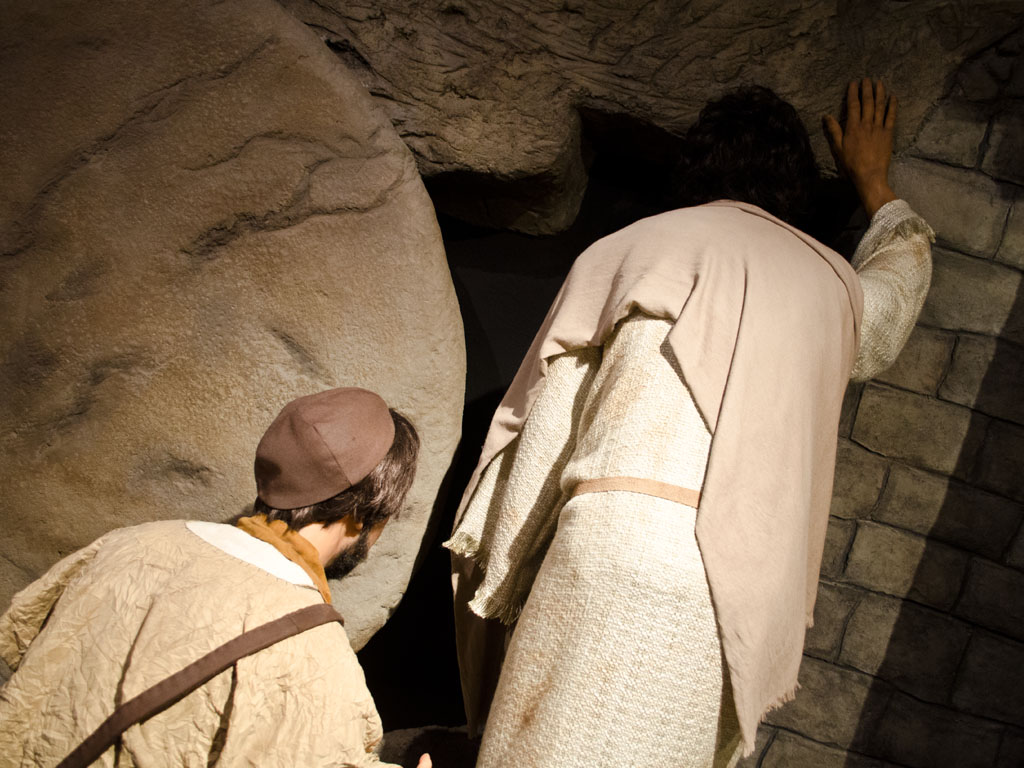
John
INTRODUCTION (1:1-1:18)
Jesus is with God
[The first eighteen verses differ from the rest of the Gospel of John and consist of well-constructed poetic styles with chiastic patterns and parallel structures. It is difficult to illustrate all this in a translation. However, the headings follow the chiastic pattern where the first and last parts thematically deal with Jesus in heaven ( and 16-18), the second and penultimate parts with John the Baptist's testimony ( and 14), and where form the structural center that reinforces the main theme: Jesus became human so that those who receive him may be saved.] 11In the beginning (before all time) was the Word [Gk. Logos, i.e., Jesus, see ],
and the Word was with (associated with; had a close relationship with) God,
and the Word was God. 2He (This, This One) was in the beginning with (with) God. [God (Gk: Theos) is mentioned here three times – first and last with the definite article, but in "the Word was God" in the indefinite form, i.e. without the article. The meaning then becomes that the Word possesses the attributes of God (). At the same time, the Word, i.e. Jesus, fully represents God (; ; ; ; ). Since no human being can understand God in his fullness, he limits himself and meets humanity in the Word to Moses on Mount Sinai and later in the Word incarnate in the Son. are framed by an inclusio with the word beginning, cf. . The Greek word order in forms a chiasm with God at the center: "and the Word was with God – and God was the Word."] 3Everything came into being [came into existence, was created]
through him,
and without him [by himself]
nothing (not even anything) came into being of what has come into being. 4In him was life [God's abundant and true life – i.e., the very essence and meaning of life]
and the Life [Jesus] was the light of men. 5And the light shines [now and forever] in the darkness,
and the darkness did not overcome it [could not extinguish, control, or even understand the light]. [After using the past tense (was, became, etc.) in , John now shifts to the present tense to describe that the light always shines. He thus emphasizes that it is a timeless truth that God's light never ceases to shine, see ; ; . The Greek word for to overcome, katalambano, is composed of kata (down from the higher to the lower) and lambano (to receive). The meaning is that even though darkness tried to take down the light and make it its own, it could not grasp or even understand it. Since the verb is in the active indicative aorist form, it describes an active action that could not be carried out. The grammatical construction assures us that darkness will never overcome light! In , lambano reappears in the same verb form as here.]The testimony of John the Baptist
6There came a man,
sent from God (as a representative, ambassador),
whose name was John.
7He came as a witness,
to testify (openly present the facts, tell) about the Light [Jesus],
so that all might believe through him.
8He himself was not the Light,
but he came to testify about the Light.Jesus came into the world
9The true Light,
which [with a steady, firm glow] shines into every human being (enlightens spiritually, gives clarity),
came into the world.
10He was in the world,
and the world was created through him,
but the world did not recognize (had no personal experience of, did not want to know about) him.
11He came to those who belonged to him [his domain, creation, world],
but those who were his own did not receive (welcome) him.Through faith, one becomes a child of God
[ are the center of the chiasm and the core of John's message:] 12But to all who (literally: "but as many as") received him
he gave the power (right) to become children of God,
to those who [continuously] believe (trust; rely on) in his name [the authority in Jesus' name].
13Those who were born,
not of blood [plural; based on blood ties – faith is not inherited from parents, see ],
nor of the will of the flesh [based on physical desire; good deeds, etc.],
nor of the will of man [no other human being can save anyone],
but of God.Jesus came into the world
14And the Word (Gk. logos) became flesh [human; took on an earthly body]
and dwelt (camped, "tabernacled") among us
and we beheld (gazed upon; studied attentively) his glory (honor, majesty) – a glory as of an only begotten (unique; only begotten son) [close] to his Father [i.e., as the only begotten Son has from the Father], full of grace (favor) and truth. [The concepts of "grace and truth" always go together and are found in God's own testimony, see . Grace without truth becomes ineffective, while truth without grace becomes merciless. Both grace and truth are needed, and grace always comes first. Gk. patros is here in the indefinite form and is translated as father, but from (where the definite form is used) it is clear that it refers to the Father, God Himself.]The testimony of John the Baptist
15John [the Baptist] testifies (openly presents the facts, tells) about him,
and cries out with a loud voice, saying, "It was of him that I said, 'He who comes after me is above me (has higher rank),
because he existed before me.
Jesus is with God
16Through his fullness (abundance) [; ; ] we have all received
grace upon grace (gift upon gift, blessing upon blessing),
17for the teaching (Torah – Gk. nomos) was given through Moses [],
grace and truth came through Jesus the Anointed One (Messiah, Christ) [God's chosen one, see ]. [There is no contradiction between Moses and Jesus or between the teaching in the Old Testament and "grace and truth." God conveys his grace through both of them. They are both gifts and become "gift upon gift." There is a nice connection to where the phrase "abundant in mercy and truth" is used. On this occasion, God showed his mercy to Moses and the Israelites in a concrete way by renewing his covenant with a new set of stone tablets – even when the books of Moses were given, it was in mercy! John now shows how Jesus fulfills the promise given there of "mercy to thousands." Jesus fulfills Scripture, see . Those who love Jesus also follow the commandments, see .] 18No one has ever seen God,
but the only begotten, who is himself God, and (literally: only begotten God, the one who is) in the bosom of the Father ["directed toward" the Father's breast], he explained him [presented him completely]. [The Greek word order begins with God for emphasis, literally "God no one has ever seen," see ; ; . Revelations in the Old Testament were never complete, see . Jesus has made the Father visible. He has taught and opened our understanding of God, see .] PART 1 – SIGNS FOR THE WORLD (1:19-12:50)
The first week (1:19-2:11)

©FreeBibleImages.org
The headings in this passage follow the days that form a "first week." It culminates with the wedding at Cana, which in this case could correspond to the wedding of Adam and Eve! According to rabbinic tradition, Adam's sleep, when God creates Eve, marks the passing of a night, see . The rabbis further reason that it is therefore only on the seventh day that he meets his bride, and she becomes his wife! In there is a clear reference to marriage and wedding.] 19Here is what John replied when the Jews sent priests and Levites from Jerusalem to ask him, "Who are you?" 20He confessed (told the truth) and did not try to avoid the truth, but said openly, "I am not the Anointed One (Messiah)." 21They asked him, "Then who are you? Are you Elijah?" [Elijah is associated with the coming of the Messianic age, see .]
He said, "No, I am not."
"Are you the Prophet?"
"No," he replied. 22Then they said to him, "Who are you? Answer us so that we can give an answer to those who sent us. What do you say about yourself?" 23He confirmed (enlightened – Gk. phemi) with the words of the prophet Isa: "I am the voice of one crying out in the wilderness: 'Prepare (make straight) the way' [Isaiah 40:3]." 24
The Jordan Valley near Bethany. The Judean Mountains can be seen in the background.
26John answered their question and said, "I baptize [only] in water, but among you stands one whom you do not know. 27He is the one who comes after me, I am not even worthy to untie the strap of his sandal [the lowest task performed by a slave]." 28All this happened in Bethany, on the other [eastern] side of the Jordan, where John was baptizing. [Bethany means "house of bondage," "house of sorrow," and "house of oppression." John mentions two places called Bethany in his Gospel. Six days before the last Passover, Jesus comes to Bethany, just east of Jerusalem, which was the home village of Martha, Mary, and Lazarus, see . Both the beginning and the end of "Holy Week" mention a Bethany. Jesus begins his ministry in Bethany, at the lowest point on earth, from below as the Lamb of God. He ends his ministry in the second Bethany just outside Jerusalem, where he fulfills the Jewish hope of leaving the house of bondage, see .] 29
John uses the time reference "the next day," see John 1:29, 35, 43. Together with the "third day" in John 2:1 and the two days it takes to walk to Cana, a "first week" is formed.
Day 3 – the first disciples
35The next day John [the Baptist] was there again with two of his disciples (followers, apprentices). [Andrew, Simon Peter's brother, see , and John, the author of the Gospel.] 36When he saw Jesus walking by [in the distance], he said, "Look, there is the Lamb of God." 37The two disciples [Andrew and John, the author of the Gospel] heard him [John the Baptist] speak, and they followed Jesus. 38Jesus turned around, and when he saw them following him, he asked them, "What are you looking for (desiring)?" They said, "Rabbi, where are you staying?" [The Aramaic word] Rabbi means teacher (master). [John explains Jewish terms and expressions to his Greek readers, see , ; ; . The geography is also explained, see .] 39He said to them, "Come and see." So they went with him and saw where he lived, and stayed with him that day. It was about the tenth hour (late afternoon, around four o'clock). [Jewish time was counted from six o'clock in the morning when the sun rose, while Roman time was counted from midnight – the same way we do today. The tenth hour is therefore four o'clock in the afternoon Jewish time, or ten o'clock in the morning Roman time. The other Gospels definitely use Jewish time, and it is likely that John does too. Roman time was only used in official and legal documents, otherwise time was counted from sunrise. The middle of the day is marked on Roman sundials with VI, not XII. The four times mentioned in the Gospel of John are: about the tenth hour (mentioned in this verse), about the sixth hour (), exactly the seventh hour (), and about the sixth hour ().] 40One of the two who had heard what John [the Baptist] said and followed Jesus was Andrew, Simon Peter's brother. 41He first sought out and found his own brother Simon and said to him, "We have found (discovered after searching, begun to experience) the Messiah."
The [Hebrew] word [Messiah is a title that] means "the Anointed One" (Christ). [The Hebrew Mashiach and the Greek Christos, transliterated as Christ, have the same meaning. John has a habit of explaining words, names, and Jewish concepts. In the next verse, it is the meaning of Peter's name, see also ; ; ; ; .] 42Andrew then took Simon [Peter] to Jesus.
As Jesus looked at him (into his eyes, directly at him), he said, "You are Simon, son of John, you shall be called Cephas" – the [Aramaic] name means Peter [a small stone].Day 4 – more disciples are called
43The next day Jesus decided to go to Galilee. [Probably to attend the wedding mentioned in .] He met Philip [who later became one of the twelve disciples] and Jesus said to him, "Follow me." 44Philip was from (born in) Bethsaida, the same town as Andrew and Peter. 45Philip sought out Nathanael and said to him, "We have found the one Moses wrote about in the Law (Torah – Gk. nomos) and the prophets wrote about – Jesus of Nazareth, the son of Joseph [adopted]." 46Nathanael said to him, "Can anything good come out of Nazareth?"
Philip answered, "Come and see." [Jesus was born in Bethlehem but grew up in Nazareth in Galilee, which was a city of ill repute. Jesus fulfilled the prophecy of being called a Nazarene, see . The prophets speak of the root shoot (Hebr. netzer), which is similar to Nazareth, see ; ; . The derogatory term Nazarene is also fulfilled in how Jesus was despised, see ; . Philip's response is not an argument but an invitation to meet Jesus himself.] 47Jesus saw Nathanael coming toward him and said of him, "Behold, here is a true (real, genuine) Israelite, in whom there is no deceit (falsehood)." [Nathanael is a Hebrew name meaning "God gives" or "gift from God." He came from the town of Cana in Galilee, see . Jesus makes a comparison with Nathanael's ancestor Jacob. The name Jacob means "deceiver, one who lies in wait and attacks." The literal meaning is "he who holds the heel," see . The name described Jacob's character before God gave him a new name – Israel, see . The name Israel has several meanings: "to struggle with God" or "God struggles for us," "God reigns" or "to reign with God." Jacob saw a ladder reaching to heaven in a dream, see . Jesus is that ladder, .
Nathanael is probably the same person as the disciple Bartholomew. It was not unusual to have several names. He is always mentioned together with Philip, see ; ; .] 48Nathanael asked him, "How do you know me?" [How do you know these things about me?]
Jesus answered him, "Before Philip called you, when you were still sitting under the fig tree, I saw you." [The fig tree is a symbol of the nation of Israel, see ; ; . Sitting under the fig tree was a rabbinical image for praying and studying Scripture. One's own fig tree also refers to one's own home, see ; . The fig tree, with its broad, thick leaves, provided good protection from the sun. Something in Jesus' answer must have caused Nathanael to go from being a skeptic to becoming a believer, see . Nathanael, who had traveled down to the Jordan Valley to listen to John the Baptist's teaching, was probably familiar with the rabbinical teaching on prayer, which said, "He who prays and does not pray for the coming of the Messiah has not yet prayed."] 49Nathanael said, "Rabbi (teacher), you are the Son of God, you are the King of Israel!" 50Jesus answered, "You believe (trust, have confidence) in me because I told you that I saw you under the fig tree? You will see greater things than this." 51Then he said to him, "Truly (amen, amen), I say to you, after this you will all see heaven opened, and the angels of God ascending and descending upon the Son of Man." [Jesus is Jacob's ladder, see . He is the one who connects heaven with earth, the supernatural with the natural! It is also interesting that the direction is that angels "ascend" and then descend, see .]Days 5 and 6 – the walk to Cana
[Jesus and the disciples walk for two days from the Jordan Valley to Galilee. Cana was an insignificant small town just north of Nazareth.]Day 7 – the wedding in Cana where the first sign takes place
21On the third day, there was a wedding in Cana in Galilee, and Jesus' mother was [already] there. 2Jesus and his disciples were also invited to the wedding. [The expression "the third day" refers to different things depending on the point of reference. In , a total of four days are described. These four days, together with three more, make the third day complete the "first week" with a wedding. For Jewish readers, the expression "the third day" is also synonymous with Tuesday, since the Jewish week begins on Sunday. Tuesday was the usual day for weddings then and still is today in Israel. The reason is that it is the only day in creation that God says "it was good" twice, see . According to rabbinical tradition, it is an especially blessed day to embark on something new.
A Jewish wedding feast in Jesus' time had many guests and lasted up to a week. The bride or groom was probably related to Mary, as it is implied that she was already there helping with the preparations. Jesus arrives with his disciples, six of them so far. The latest is Nathanael, who was from the town of Cana, see .
The Gospel of John has several different parallel themes. Here begins a section of two chapters that also ends in Cana with the second sign, where the king's servant's son is healed, see .] 3When the wine ran out, Jesus' mother said to Jesus, "They have no wine." [If the wine ran out, it would be a great shame for the bride's family. It could even have legal consequences. The binding contract signed at the betrothal specified all the obligations at the wedding feast and the consequences if they were not fulfilled. Several important moments during the wedding ceremony involved raising a cup of wine and saying blessings, and if the wine ran out, the wedding ceremony could not be completed.] 4Jesus said to her, "Woman [not a harsh address, but filled with respect and tenderness], what does this have to do with you and me? My time (to act) has not yet come." 5His mother said to the servants, "Whatever he says, do it." 6There were six stone jars for the water used in the purification ceremonies of the Jews. Each jar held two to three bat measures (Gk. metretes). [One bat-measure corresponds to 10 gallons (36–40 liters). Each vessel held 20–30 gallon (70-120 liters), and in total, all six vessels held 100–180 gallons (400-700 liters)!] 7Jesus said to the servants, "Fill the jars with water," and they filled them to the brim. [A total of about 100-180 gallons (400-700 liters) of wine.] 8Then he told them, "Now draw some out and take it to the master of the banquet," and they did so. 9The wedding host tasted the water that had now turned into wine. He did not know where it came from, but the servants who had drawn the water knew. Then he called the groom 10and said to him, "Everyone else serves the best wine first, and when the guests begin to get drunk, they serve the inferior wine, but you have saved the best wine until now!" [In Jewish culture, wine was an important part of celebrations, but since drunkenness was considered shameful, wine was often mixed with water to reduce the alcohol content.] 11This was the first of the signs [miracles confirming God's character] that Jesus performed in Cana in Galilee, and he revealed his glory (greatness, power), and his disciples believed in him. [The Greek word for sign, semeion, focuses more on the symbolism behind the miracle than on the miracle itself: - Wine is a symbol of joy and celebration – the gospel is the good news!
- The first sign Moses performs is turning water into blood, see . Jesus' first sign is to turn water into wine.
- It is also no coincidence that six stone jars were used, as these were used for ritual purification according to the law. The number six represents something that is imperfect and incomplete. Jesus perfects and fulfills the law, see
- Six hundred liters is a lot even for a large party, which reflects God's abundant character.
- The wedding host, who may symbolize the scribes and Pharisees, neglected his duty. He should have known that the wine was running out.
- None of the main characters at the party saw the miracle. Those who saw it and grew in faith were only the servants, the disciples, and Jesus' mother – those who were insignificant in the eyes of the world.
In practical terms, Jesus' character also becomes clear. He rescues the family from a difficult situation. He also involves the servants in the miracle, but they do not have to do anything difficult, just pour out water.] 12After this [the wedding], he went down to Capernaum with his mother, his brothers, and his disciples, and stayed there only a few days. 13[It was spring, and] the Jewish Passover (Pesach) was approaching. Jesus went up to Jerusalem. 14In the temple [temple courtyard], he saw (discovered, found) those who were sitting and selling oxen, sheep, and doves, and others who were exchanging currencies. [Most Roman coins had an image of the emperor stamped on them. These coins were not considered pure, and for a high fee they were exchanged for approved Jewish or Phoenician coins without images of idols.] 15Then he made a whip out of ropes [probably from the oxen's reins and bridles] and drove them all out of the temple with their sheep and oxen. He scattered the money changers' coins and overturned their tables. 16To those who were selling doves, he said, "Take these things away! Do not make my Father's house a marketplace." 17His disciples remembered that it was written []: "I am consumed with zeal (fervor, zealotry, jealousy) for your house." 18Then the Jews [the religious leaders in Jerusalem] spoke up and said, "What sign (miracle) can you perform to prove that you have the right to do all this?" 19Jesus replied, "Destroy (tear down) this temple (the most holy place, God's dwelling place), and I will raise it up again in three days." 20Then the Jews said, "It took 46 years to build (renovate) this temple [and the renovation was not yet complete], and you will raise it up in three days?" 21But the temple (the place where God dwells) he was talking about was his body. [The first temple was built in 953 BC by Solomon. It was destroyed by the Babylonians in 586 BC when the Jews were taken into captivity. Seventy years later, the second temple was built. Herod the Great began an extensive renovation and expansion in 19 BC. When Jesus visited the temple, the work had been going on for 46 years, but it was not completed until 63 AD, just seven years before it was destroyed in 70 AD.
These three verses use the Greek word naos for temple. It refers to the place where God dwells. In the temple, it was the innermost courtyard and the Holy of Holies, but Jesus also uses the word about himself – Jesus is the Son of God.] 22When he was raised from the dead, his disciples remembered that he had said this, and they believed (relied on) the Scriptures and the words Jesus had spoken. 23During the Passover feast [which lasted eight days] in Jerusalem [when large crowds were in the city], many began to believe in [and follow] him when they saw the signs (miracles, wonders) he performed. 24But Jesus himself did not entrust himself to them [in the same way he did with his disciples from Galilee], because he knew them all. [Jesus saw through this short-lived superficial faith that was based only on the signs he performed. It is when faith is tested that it can prove to be genuine, see , .] 25He did not need anyone's testimony to prove [deceptive] human nature, for he himself knew what was in man. [He knows all thoughts and the hearts of men, see .]Jesus talks with Nicodemus
31Among the Pharisees [in Jerusalem where Jesus and his disciples were] was a man named Nicodemus, a leader among the Jews. [His name literally means "one who conquers." He was one of the 71 members of the Great Council, the Sanhedrin, which was the highest judicial decision-making body among the Jews.] 2At night he came to Jesus. [Perhaps he came at night so as not to be seen with Jesus, or perhaps it was to have more time with Jesus. It could also be a metaphor for his being troubled, i.e., "in a dark hour." In Jewish tradition, night is also associated with reflection and knowledge, see . We know that this conversation must have affected Nicodemus. He later helps take care of Jesus' body, see . A disciple spent all his time with his teacher, so Jesus' disciples were probably also present. The conversation must have stuck in the young John's memory because he includes it in his gospel.] Are you more than a good teacher?Nicodemus [begins the dialogue with Jesus and] said, "Rabbi (my teacher), we know (have understood because we have seen everything you have done) that you are sent from God as a teacher, for no one can do these signs (miracles) that you do unless God is with him."
[Nicodemus used the phrase "we," but] Jesus answered him [and became personal]: 3"Most assuredly (amen, amen), I say to you:
Unless a man is born again (from above)
he cannot see (have a clear understanding of) the kingdom of God." How is one born again?
4Nicodemus replied, "How can anyone (literally: 'a person') be born when he is old (gray-haired)? He cannot enter his mother's womb and be born again, can he [it is impossible]?" 5Jesus answered: "Truly, truly, I say to you, unless one is born of water and (that is) Spirit (wind), he cannot enter the kingdom of God. [Sometimes 'water' has been interpreted as a reference to water baptism or natural birth, but that is unlikely. In the conversation with Nicodemus, the Scripture's own definitions of 'water and Spirit' carry weight. Jesus rebukes Nicodemus precisely because he does not see these connections, see . Water and Spirit are used synonymously in . The same parallel is also found in , where water also symbolizes spiritual renewal – God will wash the people of Israel clean and give them a new heart and fill them with His Spirit. In the next chapter, there is a connection between the Spirit and the wind, see . This is consistent with the parallels in , , and 8. In the next chapter, water is also used as an image of spiritual life, see .] 6That which is born of the flesh (human nature) is flesh, and that which is born of the Spirit is spirit. 7Do not be surprised (do not begin to speculate in an immature way) that I [literally] said, 'You all [you Nicodemus, you Pharisees andJews, yes, all people] must be born again (from above).' 8The wind (spirit) blows wherever it pleases, and you hear its sound (voice, tone), but you do not know where it comes from or where it is going. So it is with everyone who is born of the Spirit." [The Greek word pneuma means both wind and spirit. Jesus uses the double meaning of the word in a parable where a natural phenomenon illustrates a spiritual reality. Just as we cannot see or control the wind, we can still see its effects and hear it. Nicodemus seemed to have interpreted what Jesus said on a purely physical level.] How can this happen?
9Nicodemus responded by asking, "How can all this happen?" 10Jesus answered and said: "You are a [highly regarded] teacher of Israel and do not understand (have no personal experience of) this? [Nicodemus, who was one of the foremost teachers of Scripture, should have known and understood the prophecies, see ; ; ; .]
11Truly, truly, I say to you [Nicodemus]: We speak of what we know (have a clear understanding of)
and we testify to what we have seen (and tested),
yet you [Jewish leaders] do not accept our evidence (testimony). [In this response, the answer shifts from 'I' to 'we' and then back to 'me' in the next verse. Based on the context, 'we' could refer to 'me and the prophets', 'me and the Holy Spirit', 'me and the disciples here', or perhaps it refers to 'we teachers' (see and 10). Regardless of the meaning, it is Jesus who knows, sees, and testifies!]
God gave his Son to the world
[ form a chiasm. The word 'believe' recurs several times and frames the entire passage, see and 18. The phrase 'everyone who believes' is used as an inner frame in and 16b around the main message in . In the second level, the Son of Man and 'his son' are mentioned, see and 17. There is much to suggest that Jesus' conversation with Nicodemus ends in and that from onwards, these are John's summarizing comments.] 12If you do not believe (trust) when I have spoken (told) about earthly things [i.e., the things that have happened here and now],
how will (can) you believe when I speak (tell) about heavenly things [the things that happen in heaven]? 13No one has [ever] ascended to (into) heaven,
except he who descended from (out of) heaven – the Son of Man.
[Some manuscripts add: 'who is in heaven', i.e., who has his home in heaven.]

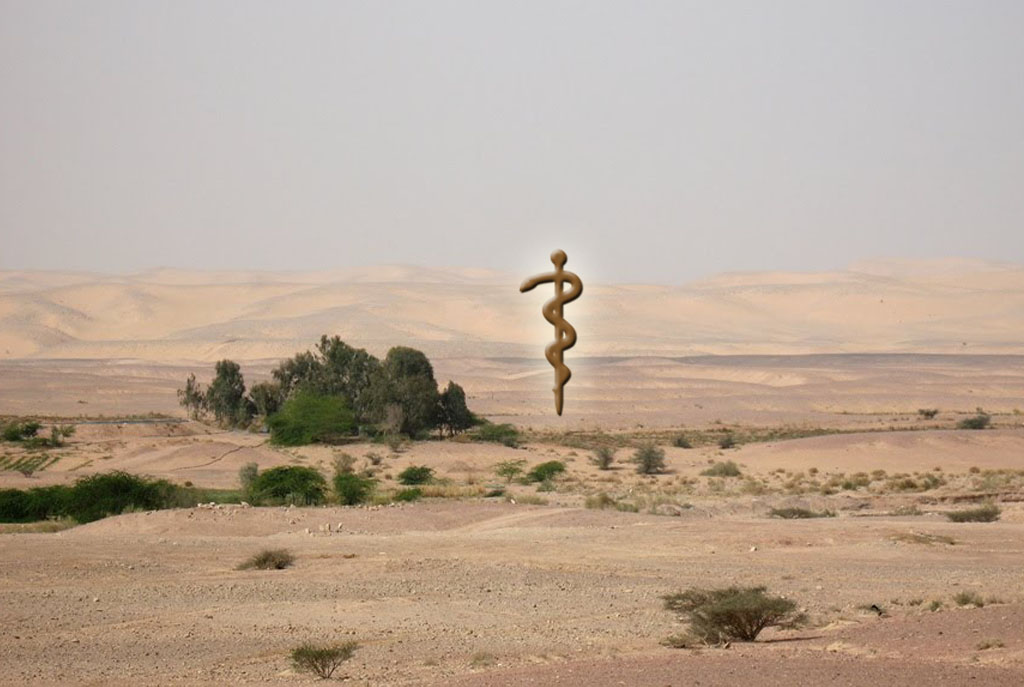
During the Israelites' journey through the desert, snakes came into the camp. Moses erected a pole with a snake made of copper, and everyone who looked up at it was healed from the snakes' bites, see Num. 21:8-9.
14And just as Moses lifted up the serpent in the wilderness [on a pole, see ],
so (in the same way) it is necessary that the Son of Man be lifted up [on a cross; to heaven], 15so that everyone who believes (trusts, has faith) in him
may have (would have) eternal life." [The atonement on the cross is illustrated by an event well known to Nicodemus at the end of the Israelites' journey through the desert – the bronze serpent. Previous generations had complained, but here a stronger word is used to complain when the people say they are tired of "this worthless food" that God has given them. They rebel and question why God and Moses have brought them out of Egypt to die in the desert. The Israelites' protection disappears and poisonous snakes appear in the camp, see . When Jesus teaches about prayer in , he uses a parable about how even an evil father would not give his son a snake if he asked for a fish. The Israelites no longer wanted anything to do with God, and he answered their prayer. The connection to the ancient serpent, Satan himself, becomes clear in the snakes that find their way into the tent camp and kill the people. Those who reject God will instead have Satan as their master. However, the Israelites acknowledge their sin. Moses raises up the bronze serpent, and everyone who looks at it is healed, see . In the conversation with Nicodemus, sin is likened to these poisonous snakes. Sin is not only around us, it has also bitten us all. Just as the bronze serpent was lifted up in the desert, Jesus was made sin when he hung on the cross. Those who look up to him in faith are saved, see .] 16For God so loved [so highly valued] the world
that he gave his only Son (literally: that he gave the Son – the Only Begotten), so that everyone who believes (trusts, has faith) in him
should not perish (be lost), but have (possess) eternal life. 17For God did not send his Son into the world to [him] judge (separate) the world,
but that the world might be saved (rescued, liberated, healed, preserved, secured) through him. 18Whoever believes (trusts, has confidence in) him is not condemned (separated, rejected),
but whoever does not believe has already been condemned,
because he has not believed in the name of God's only (begotten) Son. [, often called "the little Bible," does not say that all people will receive eternal life "because God is so good." Instead, it says that God is so good that he made an unimaginable sacrifice to save us from a hopeless situation in which we would otherwise perish. judgment already rests upon the fallen world. God did not send his Son to judge the world, but to save it. Those who believe in him will never come under judgment But those who do not believe remain under the judgment that rests upon the world. When Jesus comes, an inevitable division will take place. That is the judgment. Greek has the same word (Gk. krino) for "judgment" and "distinction." Here the paths diverge. Some come to the light, others flee into darkness. Jesus will return one day to reign and judge the world, see .]The light has come
[In the following passage, , three similar phrases with "the light" and the verb "come" recur, framing and reinforcing the message. The light has come, and man has been given a choice: to come to the light or not to come to it.] 19This is the basis (reason) for the judgment:
The light has come into the world,
but people loved darkness more than light
because their deeds were evil (poisoned, destructive). 20For everyone who does evil deeds (habitually lives in evil) hates (detests) the light,
they do not come to the light
because there their deeds (activities, way of life) will be exposed. 21But whoever acts according to the truth (has chosen to live constantly in the truth),
comes to the light,
so that it may be revealed that his deeds are done in God (divine, done with God's help).John the Baptist exalts Jesus

Jesus and his disciples are walking in Judea after celebrating Passover in Jerusalem. John the Baptist continues to baptize in the area around Ainon.
Show in atlas
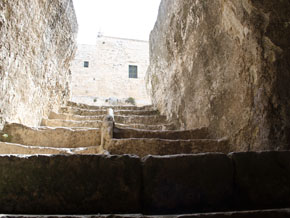
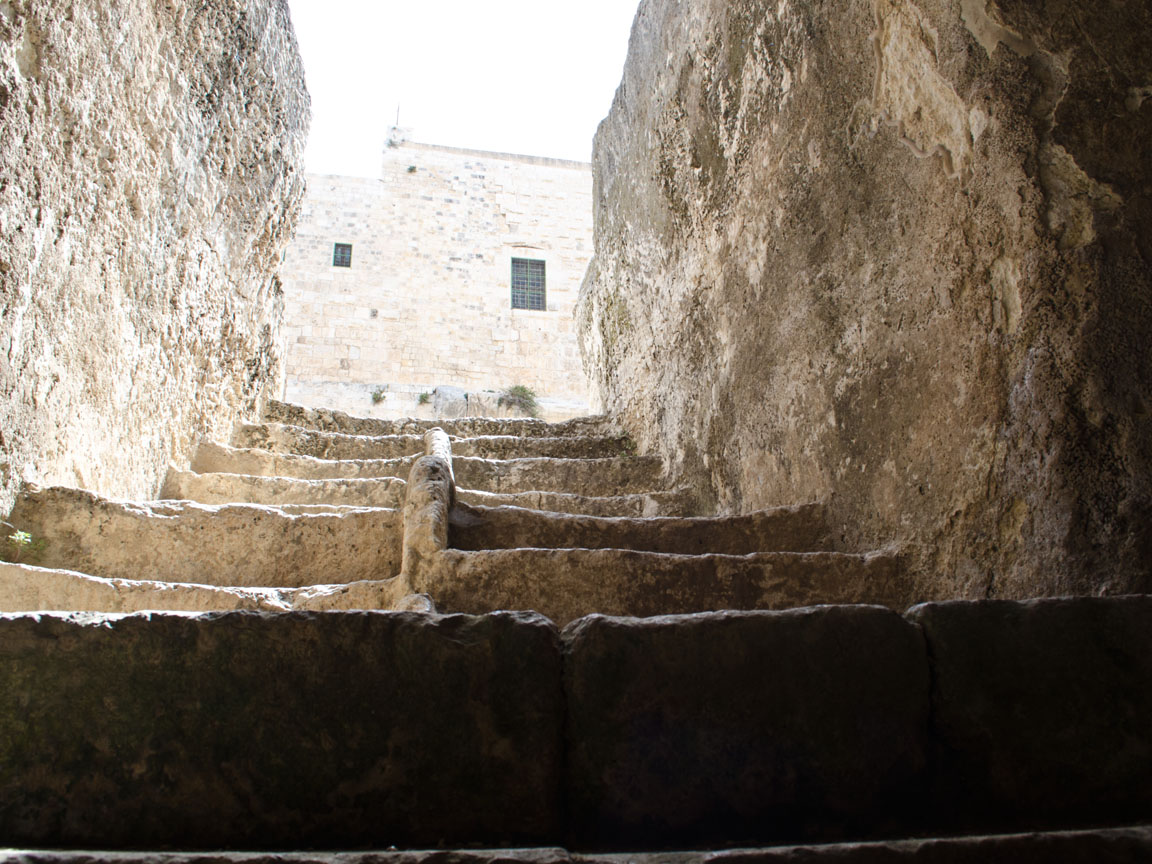
A mikveh bath from Jesus' time near the southern entrance to the temple site. Visitors walked down one side, immersed themselves completely, and then walked up the other side. In the background, you can see the southernmost part of the Western Wall.
Jesus leaves Judea
41
The Roman road network was well developed during Jesus' time. Jude often chose to take the longer route via the Jordan Valley to avoid passing through Samaria when traveling between Jerusalem and Galilee.
Show in atlas
The woman at the well of Sychar
Jesus talks with a Samaritan woman
[Most Jews chose to take a detour around Samaria because of the conflict between Jews and Samaritans that had existed for centuries. The reason for this was that in the 700s BC, the Assyrians occupied this area and took away most of the Israelites (the ten northern tribes) who lived there. Five pagan peoples were then forcibly relocated there (), and the mixed population that arose between the remaining Israelites and these peoples was called Samaritans. When the temple in Jerusalem was rebuilt in 538 BC, they were not allowed to participate because they had intermingled with other peoples, see . They then built their own temple in Shechem on Mount Gerizim around 425 BC. A separate Samaritan movement developed that rejected everything to do with Jerusalem. It is not a pagan belief, but is based on the Torah, written in ancient Hebr., but instead of Jerusalem, the place of worship is Gerizim. The name comes from the Hebr. shamar (to preserve, to keep) – they were preservers of Moses' teachings. John's way of describing the woman "from Samaria" () and then Gk. samaritis () shows the importance of her being from Samaria, but also a practitioner of the Samaritan religion. She was not only a Samaritan woman but also a Samaritan woman. Various actions on both sides caused hatred between them to grow. One hundred and fifty years before Jesus came to the city of Sychar (128 BC), the Jewish king (Hyrcanus II) razed the Samaritan temple on Gerizim to the ground and made that day a holiday. Just over twenty years before Jesus arrived there, the Samaritans had scattered dead bones in the temple in Jerusalem during the Passover celebrations, thereby defiling the temple so that the Jewish priests could not serve there.] 4It was necessary [to fulfill God's plan] for Jesus to pass through Samaria. 5Therefore, he came to a town in Samaria called Sychar, near the field that Jacob gave to his son Joseph. [Joseph was buried near Shechem, see .]. 6
There are many wells in the area around Sychar, but one of them is deep and is most likely Jacob's well. Down a staircase in the Greek Orthodox church that has been built there is the well, which still has fresh spring water today!
©Jeremiah K Garrett

The Greek Orthodox church where the well is located.

View from Mount Gerizim over the modern city of Balata. This is where the ancient city of Shechem was located. At the time of the New Testament, it was abandoned, but right next to it was the small village of Sychar.
Jesus said to her, "You are right when you say, 'I have no husband. 18You have had five husbands, and the one you now have [is living with] is not your husband. What you said was true." [The text does not explain why she had five husbands/men. This phrase does not necessarily mean five immoral marriages. It may have been due to divorce, but divorce could only be requested by a man and did not have to be caused by infidelity on her part (some rabbis, such as Hillel, believed that a man could divorce his wife for something as trivial as burnt food), see . Another explanation is that she suffered repeated grief when her previous husbands died (), a Levirate marriage () or repeated divorce due to barrenness or a current man unwilling to formalize marriage. The man she now lives with may be a relative who took pity on her and gave her a roof over her head.
She seems to be a respected woman, as the people listened to her words (, ). Her deep faith in the Scriptures ( and 25) suggests that she lived a righteous life and was more likely a woman struck by unfortunate circumstances than the consequences of a deliberately immoral life – an image often painted by later interpretations from the 16th century. Until the Reformation, she was highly respected and in sermons she is called an apostle and evangelist. She was seen as a role model in terms of bearing witness to Jesus. Her priorities shift from fetching water to bearing witness to Jesus when she leaves the jar behind, see . The mention of Joseph () also ties in with how Joseph's suffering led to the salvation of all Israel (; ), which has a parallel to the events here, see . Compare also with , where adultery is explicitly mentioned, which is not the case here.] 19The woman said to him, "Sir, I see (understand after careful examination) that you are a prophet. 20Our ancestors worshipped (bowed down in humility, fell on their knees) on this mountain [Gerizim], but you [jews] say that the right place to worship is in Jerusalem." [In the valley between Mount Gerizim and nearby Ebal lay the Samaritan cities of Sykar and Shechem. Even though the temple on the mountain had been destroyed by the Jews, the Samaritans believed that it was the place of worship. The central book of the Samaritan religion was the Samaritan version of the Torah. The Samaritan Books of Moses have approximately 6,000 differences compared to the Masoretic text, the most significant of which is that the place of worship is Mount Gerizim. In the Samaritan version, the tenth commandment is to build an altar on Mount Gerizim.] 21Jesus said to her, "Dear woman, believe (lean on, trust) me, for a time is coming when you will all worship the Father (bow down in humility, fall on your knees; figuratively kiss his hand in reverence) not [only] on this mountain or [only] in Jerusalem. [Jesus elevates the discussion from the religious conflict about how and where to worship to one about the attitude of the heart and a personal faith in him.] 22
Even today, the annual Samaritan Passover lamb is sacrificed on Mount Gerizim, a tradition that has been going on for over 2,000 years.
©Emanuel Gillberg
The disciples return
27Just then his disciples arrived. They were shocked (surprised, completely taken aback) that he was talking to a woman. [Most rabbis avoided contact with women; one did not even speak to one's own wife in public.] Despite this, no one [not even Peter] asked him, "What are you looking for (asking for)?" [This may be a reference to Jesus' earlier statement that the Father seeks worshipers, see .] or "Why are you talking to her?" 28The woman left her water jar and went into the city. [Telling people about Jesus was now more important than fetching water.] She said to the people: 29"Come and see a man who told me everything I have done! Could he be the Anointed One (Messiah, Christ)?" 30Then they began to come out to him. 31Meanwhile, the disciples tried to persuade him (they urged Jesus insistently): "Rabbi (teacher, master), eat something." [They were hungry, and it was customary for the teacher to begin the meal before the others could start eating.] 32But he replied, "I have food (nourishment) that you do not know about (do not see with the eyes of your hearts)." 33Then the disciples began to ask each other, "Could someone have brought him food?" 34Jesus said to them, "My food (nourishment) is to do the will (please) of him who sent me and to finish his work. 35Do you not say [to one another], 'Four months more, then it will be harvest time [the usual time between sowing and harvesting]'? But I tell you, lift up your eyes and look at the fields! They are already ripe (have turned white in color) for harvest. [Many Samaritans ready to be saved poured out of the city to listen to Jesus.] 36The reaper receives his wages now, he gathers the crop (collects the fruit) for eternal life. This is so that both the sower and the reaper may rejoice together. 37Here the saying applies [which was common at that time]: one sows and another reaps. 38I have sent you to reap where you have not labored. Others have done the hard work, and you may enter into their labor [and share in the harvest of their work]."Many Samaritans saved
39Many Samaritans (Gk. samarites) from that city [many followers of the Samaritan faith] believed in him [came to believe in Jesus] because of what the woman said when she testified, "He told me everything I have done." 40When the Samaritans (Samaritans) came to Jesus, they urged him to stay with them. So he stayed there for two days. 41Many more came to believe because of his own words. [Even more than the already many in came to believe when they personally met Jesus. Even those who had already begun to believe because of the woman's words grew deeper in their faith.] 42They said to the woman, "Now we don't believe [only] because of what you said. We have heard him ourselves and we know (have understood) that he really (truly) is the Savior of the world."Onward to Galilee
43Now, after the two days [in the Samaritan city], he left there [and went further north] to Galilee. 44For Jesus himself had testified that a prophet is not honored (respected) in his own country [i.e., his hometown of Nazareth, which is located in Galilee]. 45When he came to Galilee, the Galileans welcomed him, because they had seen all that he had done in Jerusalem during the feast, for they too had been there. [They received him only because of the miracles, but did not honor him.]The healing of the king's servant's son – the second sign
46So Jesus returned to Cana in Galilee, where he had turned water into wine []. In Capernaum there was a royal official (Gk. ). [He served under Herod Antipas.] His son was sick (weak, without strength). 47When he heard that Jesus had returned from Judea to Galilee, he set out [on the two-day journey to Cana] and begged (urged, pleaded) him to come down and heal his son, for his son was dying. 48Then Jesus said to him, "Unless you people see signs (Gk: ) and miracles (wonders – Gk: ), you will not believe (trust in God) at all." 49The official [who served the king] said to him, "Sir, come down before my child dies." 50Jesus answered him, "Go in peace, your son will live."
The man believed (relied on, trusted) Jesus' words and went. 51As he was going down, his slaves (servants) met him and said, "Your son is alive!" [To go from Cana to Capernaum, one went east over the mountains and then down to the Sea of Galilee. The journey, which was nearly 25 miles long, could not be made in a day, so it was on the way down the mountains on the second day that he met his servants.] 52
One of the roads between Capernaum and Cana.
JESUS AND THE FEASTS (chapters 5-11)
[The previous chapter concluded the events framed by the first and second signs in the city of Cana, see . Now a new section of John begins, in which the Jewish feasts play a central role. It begins with an unnamed feast in chapter 5, continues with the Passover feast in chapter 6, followed by the Feast of Tabernacles in chapters 7-10, the temple dedication feast in the middle of chapter 10, and ends with the next Passover approaching in .] 51After that, one of the Jewish feasts came, and Jesus went up to Jerusalem. [Why does John not name the first feast? In , where all the feasts are listed, everything begins with the Sabbath, which is to be observed every week. The events in chapter 5 take place on a Sabbath, see . It can be said that the Sabbath is the first feast, and provides a natural introduction to this section on feasts.
The reason Bible scholars try to identify the feast is that it helps to determine the length of Jesus' public ministry. John mentions three different Passover feasts, see ; ; . This means that Jesus' ministry must have lasted at least two years from Passover to Passover. If the unnamed feast is also a Passover, Jesus' ministry lasted at least three years. Since it can get quite cold in Jerusalem during the winter months, this suggests that the events at the pool took place during the warmer part of the year. The most common suggestions are one of the spring feasts, Passover or Pentecost. Other suggestions are Purim, which falls in March, one month before Passover.]The lame man at Bethesda is healed – the third sign
2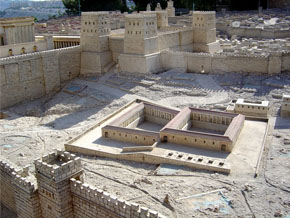
North of the temple was the Pool of Bethesda. It consisted of a northern and a southern pool, with a total of five colonnades.
©Tony Larsdal
It was the Sabbath that day, 10Therefore, the Jewish leaders repeatedly said to the man who had been completely healed, "It is the Sabbath; it is against the law to carry your bed." 11He replied, "The man who healed me said, 'Take up your bed and walk. 12Then they asked him, "Who is the man who told you to take up your bed and walk?" 13But the man who had been healed did not know who it was, for Jesus had disappeared into the crowd that was there. 14Later, when Jesus found him in the temple [temple area], he said to him, "See, you are healed (whole, healthy). Stop sinning so that nothing worse happens to you." 15The man then went away and reported to the Jews that it was Jesus who had healed him.Jesus' response to the Jewish leaders
[Jesus had a habit of healing people from illnesses, regardless of what day of the week it was. Most recently, he healed a sick man at the Pool of Bethesda, see . According to the Pharisees' strict additions to Moses' commandments, it was forbidden to do this on the Sabbath because it was considered "work."] 16Because he had done these things on the Sabbath, the Jews began to persecute (harass, chase) Jesus and planned to kill him. 17But Jesus answered them, "My Father is working (laboring) even now, and I am working (laboring) too." 18This answer made the Jewish leaders even more determined to kill Jesus, because he not only repeatedly broke the Sabbath, but also called God his Father, which equated himself with God. 19Then Jesus answered them: "Most assuredly (amen, amen), I say to you, the Son can do nothing (of his own accord) unless he sees the Father doing it. Whatever the Father chooses to do, the Son also does. 20The Father loves the Son and shows him everything he does, and greater works [than the healing of the man at the Pool of Bethesda who had been sick for 38 years] the Father will let the Son see, so that you may be filled with wonder (admiration). 21Just as the Father raises the dead and gives life, so the Son gives life to whomever he wants. 22The Father does not judge anyone [he does not exercise that right], but has entrusted all judgment to the Son. 23This is so that all [all creation] may honor (revere, show reverence for) the Son, just as they honor the Father. Whoever does not honor the Son does not honor the Father who sent him. 24Very truly (amen, amen) I tell you, whoever hears [continually listens to] my word (Gk. logos) and believes in (trusts in) him who sent (Gk. pempo) me has (has) [already] eternal life and will not come under (into) judgment, but has passed from death to life [has gone out of death into life, see ]. 25Truly, truly, I say to you, the hour is coming, and is now here, when the dead will hear the voice of the Son of God, and those who hear will live (have eternal life). 26For just as the Father has life in himself, so he has granted the Son to have life in himself, 27and given him authority to execute judgment, because he is the Son of Man. [Jesus was truly human.] 28Do not be amazed at this, for the time is coming when all who are in the graves will hear his voice 29and come out. Those who have done good will come to life, while those who have practiced (habitually done) evil (lived without accountability, without morality) will come to judgment (separation). 30I can do nothing on my own. I judge only as I hear, and my judgment is just (fair, righteous), because I do not seek my own will but the will of him who sent me. [The testimony of John the Baptist:]
31If I [alone] testify about myself [my true identity as the Messiah], my testimony is not valid. [] 32There is another who testifies about me, and I know that his testimony about me is true (genuine). 33You sent people [with questions] to John [the Baptist], and he testified to (about) the truth. 34But I do not seek the testimony of men; I mention these things only so that you may be saved. 35John was the burning and shining lamp, and for a time you were willing to rejoice in his light. 36[The works testify:] But I have received a greater (stronger, better) testimony than John, for the works that the Father has given me to complete, the ones I am now doing, are a testimony (proof) that the Father has sent me. [The Father testifies:]
37The Father who sent me has himself testified about me. None of you has ever heard his voice or seen his form (shape, face, what he looks like). 38His word does not dwell (has not remained) with you because you do not believe in the one he has sent. [The Scriptures testify:]
39You always search (look for, investigate) the Scriptures, because you believe that you have eternal life through them. It is [in fact] they that testify (tell the truth) about me, 40yet you refuse to come to me so that you may have life [God's abundant and true life – that is, the very essence and meaning of life]. 41I do not accept honor from people (I do not seek human fame), 42but I know you and know that you do not have God's selfless, giving love in you. 43I have come in my Father's name, and you have not received me, but if someone else comes in his own name, you will receive him. 44How can you believe (trust, rely on) [in God] when you constantly receive honor from one another instead of seeking (wanting) the honor that comes from the one God? 45Do not think that I will accuse you before the Father. The one who accuses you is Moses, the one you rely on (have put your hope in). 46For if you believed Moses, you would believe me, because he wrote about me. 47But since you do not believe what he wrote, how can you believe my words?" [Gk. rhema, specific word brought to life by the Holy Spirit.]
To the other side
[The events in the previous chapter, when a lame man was healed at Bethesda, took place in Jerusalem on a Sabbath around an unnamed feast, see . Jesus is now back in Galilee, and it may have been a few months to a year. Luke is the one who describes the time between these events in most detail, see .] 61
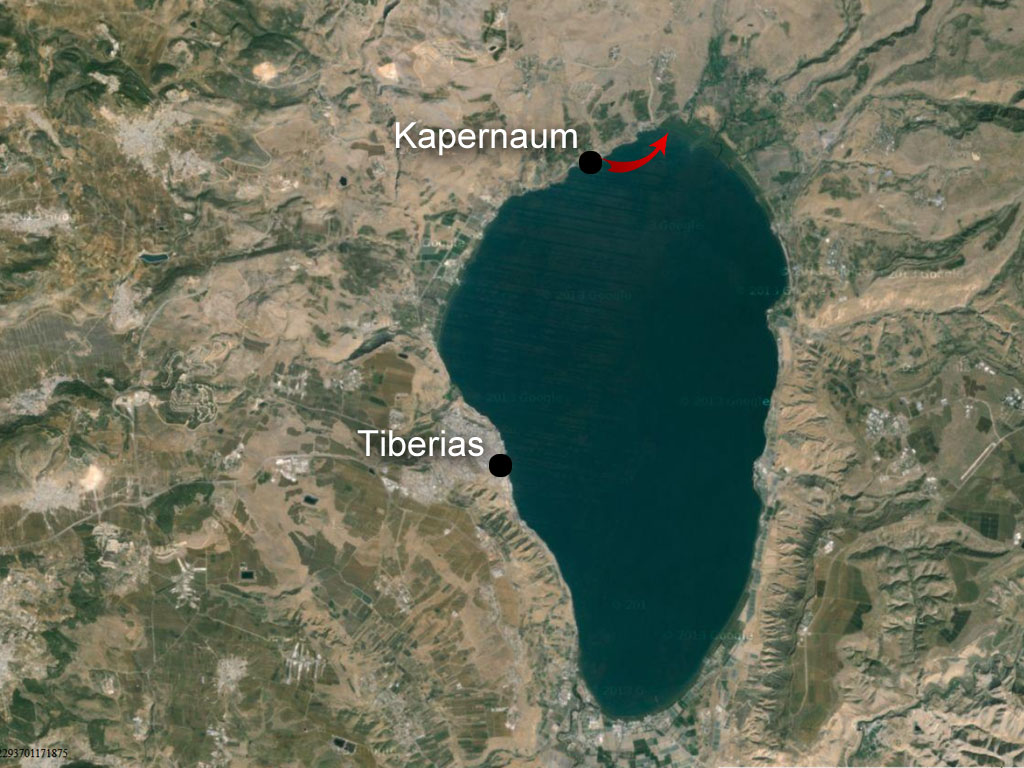
Satellite image of the Sea of Galilee. Its shape resembles a harp, which is why it is called "Yam Kinneret" in Hebrew – the harp lake!
John has just mentioned Moses, see . The events in the following chapter until the next Passover allude to events in the Exodus and the journey through the desert. The other side, the miracle of the loaves, the storm, and the mountain are clear points of recognition.] 5When Jesus looked up and saw a large crowd [thousands of people] approaching him, he said to Philip, "Where shall we buy bread for these people to eat?" 6He said this to test him, for he knew what he was going to do. 7Philip answered him, "Two hundred denarii worth of bread is enough for each of them to have a little." [A denarius was the wage for a day's work. It seems that they had two hundred days’ wages in the treasury, which is equivalent to some thousands US dollars, but even that would not be enough to feed everyone there.] 8One of Jesus' disciples, Andrew, Simon Peter's brother, said to him: 9"Here is a boy (about seven years old) who has five small barley loaves and two small fish, but how can that be enough for so many?" [Here, the usual Greek word ichthys for fish is not used, but opsarion. This refers to a salted and dried fish, probably from Magdala, which the boy had been given by his parents as a snack. The Greek word for boy, paidarion, often describes children between the ages of 5 and 8.] 10Jesus said, "Let the people recline [at the table] here." In that place, the ground was covered with thick grass [in the otherwise mountainous area, Jesus chose this comfortable place to sit down]. The men [and their families] sat down, and their number was 5,000. [There were 5,000 men, not counting women and children, see . In total, there were at least 10,000, perhaps as many as 50,000 people gathered there. Only the youngest disciple, John, mentions the detail about the boy's lunch. He was not even counted among the 5,000, yet his gift fed everyone present!] 11Jesus took the loaves, gave thanks to God, and gave them to the disciples. They then distributed them to those who had sat down there. Jesus then did the same with the fish, and everyone got as much as they wanted. 12When everyone was full, he said to his disciples, "Gather up the leftover pieces so that nothing is wasted." 13So they gathered them up and filled twelve woven baskets with the leftovers from the five small barley loaves after they had eaten. [This was a small basket tied to the waist for packing and provisions during a journey. It was probably the disciples' baskets that were used during the distribution of food. They now also had food for their continued journey!] 14When the people saw the sign (miracle) that Jesus had done, they said, "This is truly (indeed, without a doubt) the prophet who was to come into the world." [Jesus is the prophet that Moses speaks of who will come after him, see . The word "sign" focuses more on the symbolism and message behind the miracle than on the miracle itself and the people's fascination with it. In , Jesus explains that the Son of Man gives eternal life, and that this is the food they should seek.] 15Jesus, knowing that they were about to take him by force and make him king, withdrew again to the mountain, this time alone. 16
Jesus walks on water. Painting by Russian artist Ivan Aivazovsky.
The bread from heaven
22The next day, all the people who were still on the other side of the lake realized that there had been only one small boat there, and that Jesus had not gone with his disciples, but that they had left on their own. 23Other small boats had come from Tiberias and moored near the place where they had eaten the bread after the Lord had given thanks. 24When the people realized that neither Jesus nor his disciples were there, they got into boats and went to Capernaum to look for Jesus. 25When they found him there on the other side of the lake [on the west side of the city of Capernaum], they asked him, "Rabbi, when did you get here?" 26Jesus answered them, "Truly, truly, I say to you, you are seeking me, not because you saw signs (miracles), but because you ate [freely] of the loaves until you were filled. 27Stop striving for (producing, working for) food that perishes [that which is temporary], but work instead for the food that endures forever and gives eternal life, which the Son of Man will give you. God the Father has set his seal (authority, approval) upon him." 28They asked him, "What shall we do (how shall we live) to perform the works of God (works, serve him)?" [Man asks himself what he "shall do"; he wants to try to earn his righteousness.] 29Jesus answered and said to them, "This is the work of God [that God requires, or the work he does], that you believe in (trust, lean on) the one he has sent." 30Then they said to him, "What sign (miracle) will you show us so that we may understand (see) and believe (trust in, lean on you)? What [spectacular supernatural] work can you do? 31Our ancestors ate manna in the desert, as the Scriptures say: He gave them bread from heaven to eat. [The day before, they had hailed him as the Messiah and wanted to make him king by force because of the miracle of the bread, see . Now that Jesus was not what they had imagined, that miracle, or any of the other signs he had performed, was not enough as proof.] 32
The miracle of the loaves illustrates in a practical way that Jesus is the bread of life.
[The same promise to rise on the last day recurs in . This suggests that the phrase "eat and drink Jesus' blood" there has a parallel in "see and believe" here in .] 41Now the Jews [the Jews who were against him] began to murmur (whisper, complain in a low voice) because he said, "I am the bread that came down from heaven." 42They said, "Isn't this Jesus, the son of Joseph? We know both his father and mother. How can he say that he has come down from heaven?" 43Jesus answered and said, "Stop whispering (complaining, murmuring) [about me] among yourselves. 44No one can come to me unless the Father who sent me draws (attracts, leads) him. I will [then] raise him up on the last day. [It is the Father who gives people the desire to seek Jesus!] 45For it is written in the prophets []: 'All will be taught by God.' Everyone who has listened and learned from the Father comes to me. 46This means that no one has seen the Father except the one who comes from God. He has seen the Father. 47Very truly (amen, amen) I tell you, whoever believes in me (trusts in, leans on me) has now (possesses now) eternal life [God's abundant and authentic life – that is, the very essence and meaning of life]. 48I am the bread of life. 49Your ancestors ate manna in the desert, and they died, 50but this is the bread that comes down from heaven. Whoever eats it will never die. 51I am the living bread that came down from heaven. If anyone eats of this bread, he will live forever. The bread that I will give is my own flesh, and I give it so that the world may live." 52Then the Jude who were against Jesus began to argue openly with each other [they had been murmuring before, see ], saying, "How can this man give us his flesh to eat?" 53Jesus said to them, "I tell you the truth (amen, amen), unless you eat (gr. ) the flesh of the Son of Man and drink his blood, you have no life in you. 54Whoever eats (chewing – Gk. ) my flesh [here a more graphic word for eating is used than in the previous verse; the verb form also describes an ongoing process] and drinks my blood has eternal life, and I will raise him up on the last day. [See .] 55My flesh is real (true, genuine) food, and my blood is real (true, genuine) drink. 56Whoever eats (chews repeatedly) my flesh and drinks my blood remains (is left; lives) in me, and I in him. 57Just as the living Father sent me and I live through the Father, so everyone who eats (chews; constantly has his food in) me will live through me. 58This is the bread that came down from heaven. It is not like the bread your ancestors ate, and then died. Whoever eats (chews continuously) this bread will live forever." 59He said this while teaching in the synagogue in Capernaum.Many take offense and leave Jesus
60Many of his disciples [not referring to the twelve, but to a larger group who initially followed Jesus, see ] who heard this said, "This is a demanding teaching (offensive, difficult to understand). Who can listen to it?" [Who is expected to listen to someone who says, "Eat my flesh and drink my blood," see , and obey it?] 61Jesus understood (knew within himself) that the disciples were whispering (complaining) about this, and said to them, "Does this offend you (is this a stumbling block, does this upset your feelings)? 62What then would your reaction be if you saw (clearly saw) the Son of Man ascending where he was before [in heaven]? 63It is the Spirit that gives life (renews life, gives renewed strength), human nature (the flesh) is of no help (does no good, accomplishes nothing). The words I speak to you are spirit and life (give spirit and give life). 64But there are [still] some of you who do not believe." Jesus knew from the beginning (the start) who would not believe and who would betray him. 65Jesus continued: "No one can come to me unless it is given to him (allowed and made possible) by the Father." 66As a result, many of his disciples went back [to their former occupations] and no longer walked (lived, followed) with him. 67Then Jesus said to the twelve, "Do you also want to leave?" 68Simon Peter answered him, "Lord, to whom shall we go? You have the words of eternal life [Gk. rhema – plural; specific words brought to life by the Holy Spirit]. 69We have believed and have come to know (understood) [both put our trust in and had personal knowledge of] that you are the Holy One of God." 70Jesus answered them, "Did I not [myself] choose you twelve? And one of you is a devil!" 71He said this about Judas, the son of Simon Iscariot. Judas was one of the twelve, but later he would betray Jesus. [The name Iscariot may come from the Hebrew Ish Kerioth, which means "a man from Kerioth". Kerioth was a town in southern Judea. Kirjat is Hebrew for village (as opposed to a town, which had a protective city wall), so a direct translation could be "man of the villages." Another possible connection to the name Iscariot is that he was a Sicarii. This radical branch of the Zealots used knives (Latin: sicari) in the armed struggle against their political opponents.]Jesus stays in Galilee
71Then Jesus wandered [from place to place] in Galilee, because he did not want to stay in Judea since the Jews were trying (constantly searching for him to) kill him.The Feast of Tabernacles in Jerusalem (7:1-10:21)
2
Temporary booths (Hebrew: sukkah) are built on balconies and roofs in Jerusalem during the festival of Sukkot.
Jesus teaches in the temple
14When about half of the festival had passed [after 3-4 days], Jesus went up to the temple and taught. 15The Jewish leaders became more and more amazed and said, "How can this man know so much without having studied?" [Jesus was taught in a local synagogue during his school days, but he did not pursue higher studies in theology under a rabbi.] 16Then Jesus answered them and said, "My teaching (doctrine, instruction) is not mine, but comes from the one who sent me. [The Greek emphasizes the word "mine" both times.] 17If anyone wants (would like; longs to) do his [God's] will, he will understand (know) [he will have personal experience] – in regard to the teaching – whether it is from [has its origin in] God or whether I speak of [speak such things that come from] myself. 18He who speaks of himself [his own thoughts and ideas] seeks his own glory [exaltation, to be recognized and affirmed]. But he who seeks (strives for) the glory of him who sent him is true [has integrity] and there is no unrighteousness (falsehood) in him. 19Has not Moses given you the teaching (the law – Gk. nomos) [the Books of Moses]? Yet none of you fulfills (keeps) the teaching. Why do you seek to kill me [and go against the commandment not to kill, in ]?" 20The people (the crowd) answered him, "You are possessed by a demon; who is trying to kill you?" 21Jesus answered them, "I did one work [the healing of the lame man on the Sabbath, see ], and you were all amazed. 22Moses gave you the custom of circumcision [of boys on the eighth day after birth, see ] actually, it was not Moses who introduced the custom, but the fathers [Abraham, see ] – and you circumcise boys even on the Sabbath. 23If a boy is circumcised on the Sabbath so that Moses' law is not broken, how can you be furious (enraged) with me for making a man completely well (restoring him) on the Sabbath? 24Stop judging by appearances (superficially), but judge rightly (justly, according to the truth)." 25Then some of the inhabitants of Jerusalem said, "Isn't this the one they are trying to kill? 26But here he is speaking freely, and they say nothing to him. Could it be that [the Jewish] leaders have understood (gained knowledge based on personal experience) that he really is the Anointed One (Messiah)? 27No, that is definitely not the case, for we know where this man comes from, but when the [true, God-given] Anointed One comes, no one will know where he comes from." 28Then Jesus cried out in a loud voice as he taught in the temple: "Do you [really] know who I am and where I come from? I have not come on my own (by my own authority), but the one who sent me is true (real, faithful), and you do not know him. 29But I know him, for I come from him (his presence, fellowship), and he has [personally] sent me." 30When Jesus said this, they wanted to arrest him, but no one laid a hand on him, for his time had not yet come. 31Still, many in the crowd believed (trusted, leaned on) him, and they said, "When the Anointed One (Messiah) comes, will he [be expected to] do more miracles (signs, wonders) than this man has done?" 32The Pharisees heard the people whispering this about him, so the chief priests and Pharisees sent temple guards to arrest him. [The temple guards were under the command of the chief priests.] 33Then Jesus said, "I will be with you only a little while longer [six months – the time between the Feast of Tabernacles and the Feast of Passover], and then I will return to him who sent me. 34You will look for me, but you will not find me. Where I am [in glory and honor with my Father, in eternal existence, see ; in heaven, see ], you cannot come."
[Jesus has spoken about where he comes from, see . Now he speaks about where he is going. Just as the Jews misunderstood his arrival, they do not understand his departure. Jesus soon takes up the same subject again, see .] 35Then the Jews said to one another, "Where is this man going to go, since we won't be able to find him?
Is he going to go to those [Jude] who are scattered (living in the diaspora) among the Greeks? [Ever since the Babylonian captivity, many Jews lived outside Israel in colonies. The three largest were in Egypt, Syria, and Greece. Would Jesus go to some distant Jewish colony?] Should he teach the Greeks [non-Jews, Gentiles]? [Unknowingly, they prophesied that the gospel would be spread to all nations after Jesus' resurrection. The next time the word "Greeks" appears is in , when some Greeks seek Jesus. John takes up the same thread again at the crucifixion. He is the only Gospel writer who includes the detail that the sign on Jesus' cross was written in Greek, see .] 36What does [Jesus' statement in ] mean:
'You will look for me, but you will not find me.
Where I am, you cannot come'? " The last day of the Feast of Tabernacles

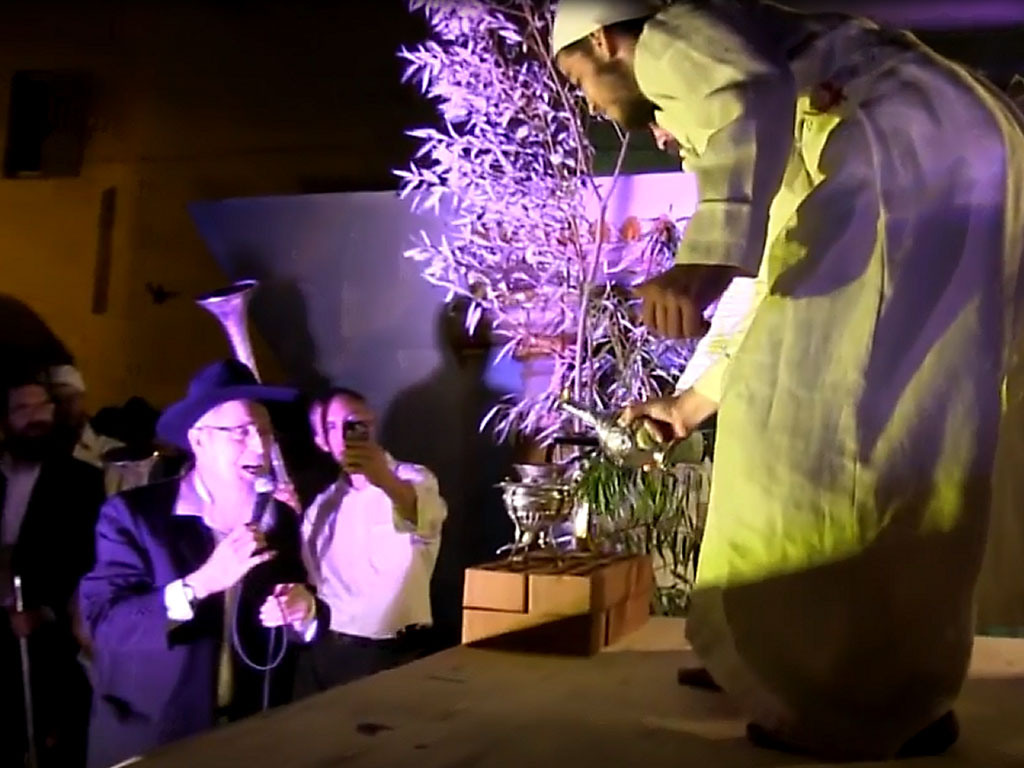
In the fall of 2014, for the first time since the destruction of the temple (in 70 CE), water was poured during Sukkot in Jerusalem. Amidst joy and jubilation, water was drawn from the Siloam Pool (discovered by archaeologists in 2004) and poured onto a temporary altar near the Western Wall. During the Feast of Tabernacles in autumn 2014, for the first time since the destruction of the Temple (in 70 CE), water was once again drawn from the Siloam Pool and poured out so that it overflowed. Since there is no temple today, a temporary altar near the Western Wall was used. It was during such a festival in the temple in the fall that Jesus used this water ceremony as an image of how the Holy Spirit would be poured out on the day of Pentecost, see John 7:37-39.
©Templeinstitute
"If anyone is thirsty,
let him come (again and again) to me and drink!
38Whoever believes [continually trusts and relies] in me
– just as Scripture says (has said) –
from his innermost being (inner self; stomach) streams of living water
will flow (rush) forth." [Jesus is not referring to a single verse in the Old Testament, but to several, such as ; ; ; ; and . In contrast to the small amount of water poured out during the feast in the temple, living water will flow from the believers who are his living temple, see ; .] 39He said this about the Spirit, which those who believed in him would receive. For the [Holy] Spirit was not yet [given/poured out in full measure], because Jesus had not yet been glorified. [A few manuscripts have Gk. dedomenon (poured out). This is probably an addition to clarify that John is writing here from a human perspective, that the Spirit had not been given as promised in . The Holy Spirit has been in the world since creation, see , but from the day of Pentecost onwards, the Spirit would be poured out in full measure upon the believing church, see ; . Jesus had not yet been glorified, which happened in connection with his death, resurrection, and ascension.]Different opinions about Jesus
40When the crowd heard these words, many said, "This is truly (indeed) the Prophet (God's spokesman)." 41Others said, "This is the Anointed One (Messiah)," while others said, "No, surely the Anointed One cannot come from Galilee? 42Does not Scripture say that the Anointed One [the Lord's chosen one] will come from the line (seed) of David, and from Bethlehem, the town (village) where David lived?" 43Because of him, there was disagreement among the people. 44Some wanted to arrest him, but no one laid a hand on him.The Pharisees' unbelief
45Meanwhile, the temple guards had returned to the chief priests and Pharisees, who then asked them, "Why didn't you bring him here?" 46The temple guards replied, "Never has a man spoken like this man." 47Then the Pharisees answered, "Have you also been deceived (misled)?" 48Has any of the Jewish leaders or Pharisees believed (trusted, leaned on) him? 49But this uneducated people who do not understand the law are under God's judgment. 50Then Nicodemus, who had come to Jesus at night [] and was one of them, said to them 51"Our law does not judge anyone before hearing him and finding out what he has done, does it?" 52They answered him, "Are you also from Galilee? Study (examine, explore) [the Scriptures], and you will see that no prophet comes from Galilee." [The Jewish leaders' heated statement was unfounded and incorrect. The prophets Jonah, Hosea, and Nahum, and possibly also Elijah, Elisha, and Amos, were from Galilee, see . They may have been referring to the coming Messiah, but even there they were wrong. Jesus was indeed raised in Galilee, but he was born in Bethlehem, just as Scripture foretold, see .] 53[The following passage, , is not included in the earliest manuscripts. Some have it in the Gospel of Luke (between chapters 21 and 22), others have it at the end of the Gospel of John. However, this does not rule out the authenticity of the event. One of the Church Fathers, Papias, mentions as early as the 130s AD a story about a sinner who was accused before Jesus. And each went home to his own place.] 81But Jesus went to the Mount of Olives [which was three kilometers east of Jerusalem, where he spent the night, see Luke 21:37].Cast the first stone
2
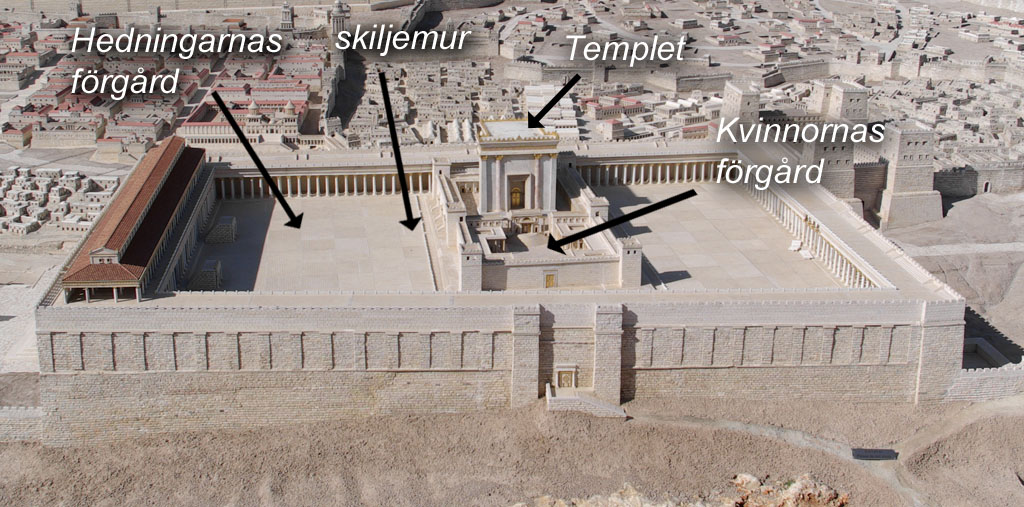
The temple in Jerusalem consisted of several different sections. A dividing wall separated the inner section, which only Jude were allowed to enter. The first section of the temple building was called the "women's courtyard," where both Jewish women and Jewish men could make offerings in the offering boxes, see Mark 12:42. Inside, via the Nicanor Gate, was the men's courtyard and the inner parts of the temple, where only priests were allowed to enter.

The temple site was paved with stone. The picture is from the excavations in the southern part of the temple.
Jesus is the light of the world
12
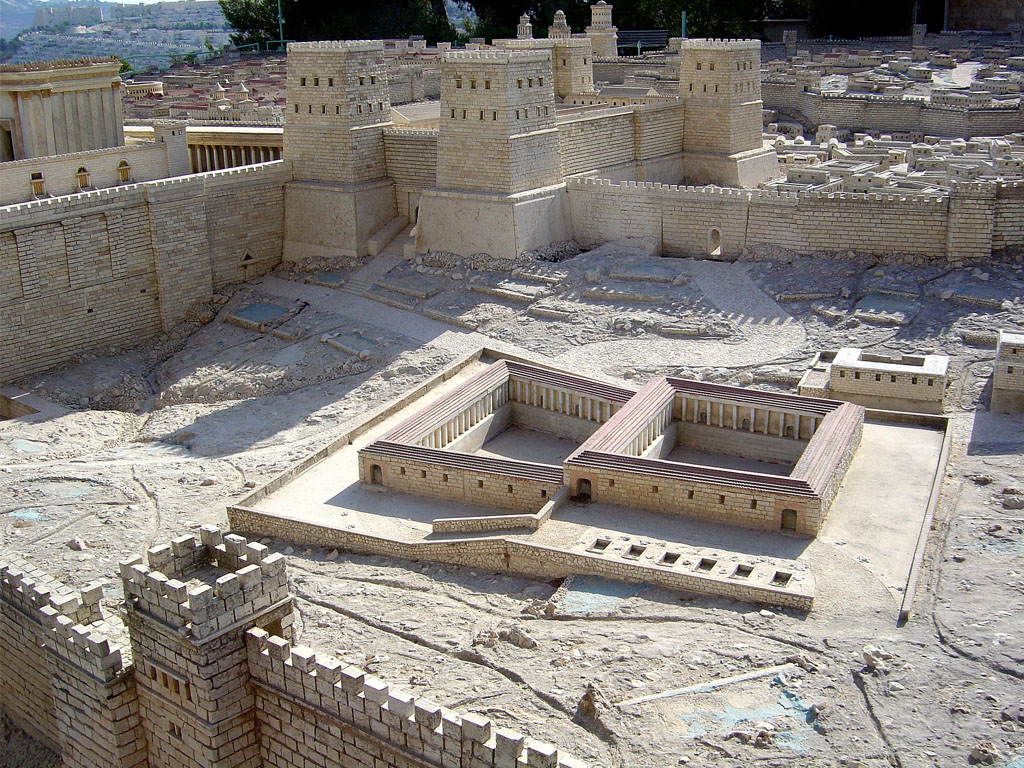
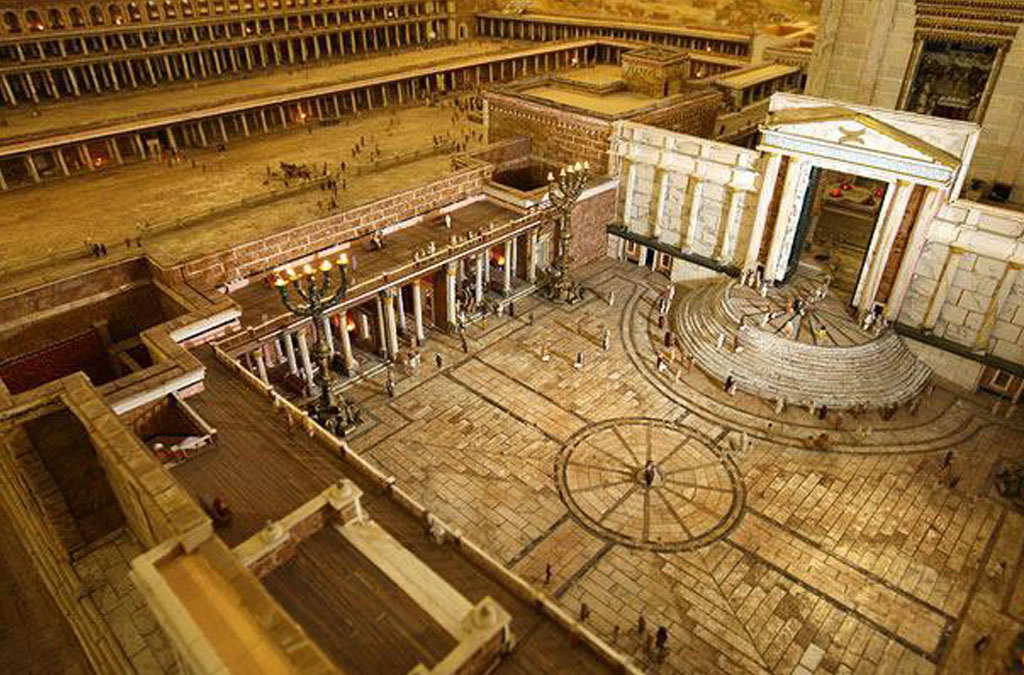
Detailed model of Herod's temple, created by English farmer Alec Garrard. The picture shows two of the four large candelabra that stood in the women's courtyard.
©Geoff Robinson
Who are you?
21Again he said to them, "I am going away, and you will look for me, but you will die in your sin. [Sin in the singular, primarily their unbelief, see .] Where I am going, it is impossible for you to come." 22Then the Jewish leaders began to say, "He is not going to commit suicide, is he? "Is that why he says, 'Where I am going, you cannot come'?" 23But he answered, "You are from below, I am from above. You are from this world (of this world's social system with changing ethics and morals), I do not belong to this world. 24That is why I told you that you will die in your sins. Yes, you will die in your sins because you do not believe that I Am." [The expression "I Am" alludes to how God chooses to present himself, see . The expression also recurs in and 58.] 25Then they asked him, "Who are you?"
Jesus answered, "Just what I said I was from the beginning. 26There is much I could say to you and judge you for, but he who sent me is true. I speak [only] what I have heard from (beside, next to) him to the world." 27They did not understand (had no knowledge based on personal experience) that he was speaking of the Father. 28Then Jesus said, "When you have chosen to lift up the Son of Man [on a cross], you will understand that it is I (I Am), and that I do nothing of myself, but I speak [only] what my Father has taught me. 29He who sent me is always with me. He has not left me alone, for I always do what pleases him." 30While he was saying these words, many came to believe in him.Remain in my word
31Then Jesus said to the Jews [inhabitants of Jude] who had come to believe in him [see ]: "If you remain in my word (Gk. logos) [if you would remain in the word, my word, by actively living according to it], you are truly (indeed) my disciples. 32Then you will understand [personally know] the truth, and the truth will set you free (liberate you)." [Jesus is the way, the truth, and the life, see .] 33They answered him, "We are Abraham's children (seed, descendants) and have never been slaves to anyone. What do you mean by saying, 'you will be free'?" 34Jesus answered them, "Very truly (amen, amen) I tell you, everyone who habitually practices sin (breaks God's commandments, misses the mark) is a slave to sin. 35The slave does not remain in the family [literally the house, which includes children, grandchildren, servants, and slaves] forever (always), but the son remains forever (always). 36If the Son sets you free, then you are truly free. 37I know that you are Abraham's children (seed, descendants), yet you plan to kill me because my word (my teaching) has no place in you. 38I speak the things I have seen (learned) at my Father's side, and you do [your actions reflect] what you have seen (learned) from your father. 39They answered him, "Our father is Abraham." Jesus answered, "If you were truly Abraham's children, you would do the works of Abraham [follow his example]. 40But now you are trying to kill me, a man who has told you the truth that I heard from God. Abraham did not do this. 41You are doing the works of your father."
They said to him, "We were not born out of wedlock (in fornication – Gk. porneia) [as you are]. We have one Father, God." 42Jesus answered them, "If God were truly your Father, you would love (welcome with joy, respect) me, for I have come from God. I have not come here on my own (on my own initiative), but he has sent me. 43Why do you not understand what I say (my language, my dialect)? [Special word for pronunciation and dialect, used about Peter's speech in .] Yes, because you cannot listen to (you cannot stand, cannot accept) my word (my teaching). 44You are from your father, the devil, and you want to carry out your father's evil desires (desires, what satisfies him). He has been a murderer (one who deliberately extinguishes human life) from the beginning (from the beginning of time, the one who did it for the first time) [; ]. He does not stand in the truth, for there is no truth in him. When he speaks lies, he speaks what comes naturally to him [his mother tongue, see ], for he is a liar and the father of lies (the originator of falsehood). 45But because I tell the truth, you do not believe (trust) me. 46Which one of you can point to any sin (transgression) in me? If I speak the truth, why do you not believe (trust) me? 47He who belongs to (is of) God listens to God's words [Gk. rhema, plural – directed and enlivened words – proclaimed in the Holy Spirit]. The reason you do not listen [to these words and to me] is that you do not belong to (are not of) God. 48The Jews answered him, "Are we not right in saying that you are a Samaritan (Gk: samarites) and have (are under the influence of) an evil spirit?" [The reference may be to a Samaritan (from Samaria), but it is also likely that he was a practitioner of the disreputable Samaritan faith, see .] 49Jesus answered, "I do not have an evil spirit, I honor my Father, and yet you despise (dishonor, mock) me. 50I do not seek my own glory (exaltation), but there is one who seeks (demands) it, and he is the one who judges. 51Truly, truly, I say to you, whoever keeps (protects, preserves, lives by, follows) my word (my teaching) will never see death. 52The Jews said to him, "Now we understand (we have knowledge based on personal experience) that you have an evil spirit. Both Abraham and the prophets have died, yet you say that anyone who chooses to keep your word will never see death. 53Our father Abraham died; you are not greater than him, are you? The prophets have also died. Who do you think you are (are you pretending to be)?" 54Jesus answered, "If I honor (exalt, glorify) myself, my honor is worthless. It is my Father who honors (exalts, glorifies) me, the one you say is your God. 55You have not known him (had a personal experience of God), but I know (have a clear understanding of) him. If I said I did not know (understand) him, I would be a liar like you. But I know him and keep (protect, preserve, live by, follow) his word (teaching). 56Your father (ancestor) Abraham rejoiced to see my day. He saw (with the eyes of his heart, had a clear understanding of) it and was glad. 57Then the Jews said to him, "You are not even 50 years old, and you have seen (stood before, met) Abraham?" 58Jesus answered them, "I tell you the truth (amen, amen): I Am – even before Abraham was (born)." [Jesus has always existed, see , ; . The fact that Jesus not only "was" before Abraham but "is" before Abraham also shows how Jesus' present extends back into the past. His existence transcends time. Jesus equates himself with God, see ; . Something that the listeners see as terrible blasphemy deserving of death, see .] 59Then they picked up stones to throw at him [they considered calling himself by God's name to be blasphemy], but Jesus hid himself (disappeared, was hidden from them) and left the temple area.A blind man is healed – the sixth sign
91
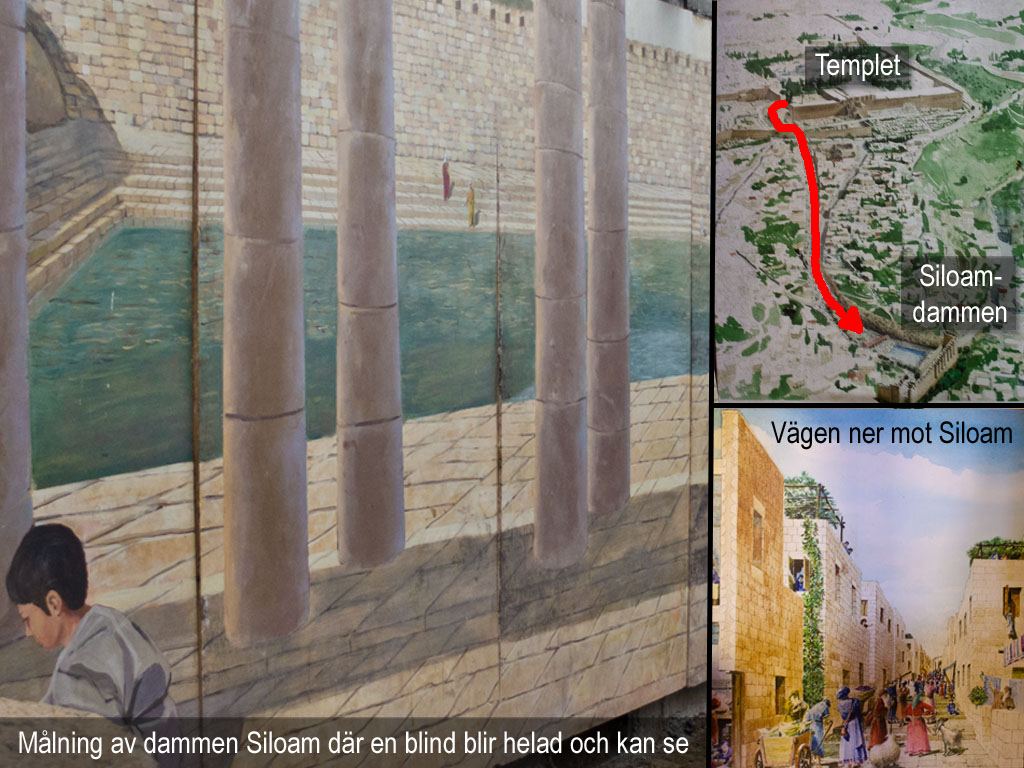
At the excavations at the Siloam Pool, there are paintings of what the site might have looked like in Jesus' time.
He replied, "I don't know."The Pharisees' reaction to the healing
[In Jesus' time, there were three major religious groups – the Sadducees, the Pharisees, and the Essenes. The first two are often mentioned in the other Gospels, while John only mentions the Pharisees in his Gospel. This is noteworthy because the Sadducees were in the majority in the highest Jewish authority, the Sanhedrin. The difference between these groups was that the Sadducees only accepted the Books of Moses as their authority, while the Pharisees accepted the entire Scriptures, see . The reason the Essenes are not mentioned at all in the New Testament is that they were a closed group who lived apart from society, often in seclusion and isolation. One of these places was Qumran, where the discovery of the Dead Sea Scrolls in 1947 has shed more light on how this group lived. When the temple was destroyed in 70 CE, the Sadducees disbanded because the sacrificial service in Jerusalem was no longer functioning. The Pharisees, who were more open to the tradition of interpretation, were able to adapt their teachings to the new circumstances and continue to exist. When John wrote his gospel at the end of the first century, he chose to mention only the Pharisees, who were well known at the time.] 13They [neighbors and acquaintances] brought (forced) the man who had been blind to the Pharisees. 14It was the Sabbath when Jesus had made the mud and opened his eyes. 15Now the Pharisees also asked him how he had received his sight. He replied, "He put mud on my eyes, and I washed, and now I can see!" 16Then some of the Pharisees said, "That man [Jesus] is not from God, because he does not keep the Sabbath." Others said, "How can a sinful man perform such signs (miracles)?" There was constant division (schism, enmity due to differences of opinion) among them. 17Therefore, they asked the [formerly] blind man, "What do you say about him, since it was your eyes that he opened?" He replied, "He is a prophet." 18But the Jews did not believe that he had [really] been blind and had received his sight until they had sent for (called in) his parents. 19They asked them, "Is this your son, whom you say was born blind? How can he now see?" 20His parents answered, "We know for certain that he is our son and that he was born blind. 21But how he can see it, we do not know, nor do we know who opened his eyes. Ask him; he is old enough and can speak for himself." 22His parents said this because they were afraid of the Jews [the Jewish leaders], for they had already agreed that anyone who confessed that Jesus was the Anointed One (Messiah) would be expelled from the synagogue. 23That is why his parents replied, "He is old enough, ask him yourself." [There were two types of expulsion from the synagogue, one temporary and one permanent. In both cases, it was significant: one was not allowed to receive instruction, one was excluded from doing business, and everything one owned was confiscated.] 24Then they called the man who had been blind a second time and said to him, "Swear by God that you are telling the truth (give glory to God). We know (without a doubt, have a clear understanding of) that that man [Jesus] is a sinner." 25He replied, "Whether he is a sinner or not, I do not know, but one thing I do know: I was blind before, but now I can see!" 26Then they asked him again, "What did he do to you, how did he open your eyes?" 27He answered, "I have already told you, but you do not listen to me. Why do you want to hear it again, is it because you also want to become his disciples?" 28Then they hurled insults (abuse, harsh taunts) at him and said, "You are that man's disciple, but we are Moses' disciples. 29We know for certain that God spoke to Moses, but we don't know where that one [Jesus] comes from." 30The man replied, "It is strange (remarkable) that here is a man who has opened my eyes, and you do not know where he comes from! 31We know that God does not listen to sinners, but if anyone chooses to fear God (in reverent worship) and chooses to do his will, then God hears him. 32Never before (since the beginning of time) has anyone heard of anyone opening the eyes of someone born blind. [There is no example in the Old Testament of a blind person being healed.] 33If this man were not close to God (constantly at his side, from), he would not be able to do anything [like this]." 34They replied, "You were born completely in sin (from head to toe), and you are going to teach us?" They cast him out [from the place where they had gathered, and later also from the synagogue, see ].The man's reaction to the healing
35Jesus heard that they had cast him out, and when he found him, he said, "Do you believe in the Son of Man?" [The Son of Man is a messianic concept that identifies Jesus with God himself, see . In Jesus' time, the Son of Man was a title for God himself.] 36He answered, "Who is he, sir, that I may believe in him?" 37Jesus said to him, "You have seen him, and it is he who is speaking to you right now." 38Then he affirmed (confessed, enlightened – Gk. phemi): "I believe, Lord." And he worshipped him (bowed in humility, fell on his knees; figuratively kissed Jesus' hand in reverence). 39Jesus said, "I have come into the world for judgment [to preach God's truth, to be a judge between those who believe in me and those who do not], so that those who do not see may see, and those who see may become blind." 40Some of the Pharisees who were with him heard this and said, "We are not blind, are we?" 41Jesus answered them, "If you were blind, you would have no sin, but since you say you see, your sin remains."The good shepherd
101
A sheep pen at the open-air museum in Nazareth Village.
Jesus explains the parable
7Then Jesus said again, "Truly (amen, amen), I say to you: I am the gate (door, entrance) for the sheep. 8All who came before me [the false shepherds] are thieves and robbers,
but the sheep did not listen to them.
9I am the gate (door, entrance),
if anyone enters (would enter) through me, he will be saved (rescued, freed, healed, safe, preserved),
he will enter and leave and find pasture (food; green meadows). 10The thief would not come, if it were not to
steal (kleptomaniacally take for himself)
and slaughter (kill for sacrifice)
and [completely] destroy (ruin, corrupt) [by driving the sheep out of the flock and throwing it off balance so that it can then be easily killed].
I came so that they might have (possess) life [God's rich life, with power, meaning, and purpose, see ]
and have (possess) it in abundance (to the fullest extent; to the brim so that it overflows all around). [From using the image of a "gate" in , Jesus now calls himself the "good shepherd." The word for good, Gk. kalos, also means wonderful, lovable, and fully capable. The Jewish listeners were familiar with the prophetic promise of a shepherd who would lead the people, see Ezekiel 34:23. Psalm 23 presents how the good shepherd leads his sheep to green pastures and still waters – how he feeds, guards, and protects them, see Psalm 23. Jesus is also called "the great" and "the supreme" shepherd, see ; .] 11I am the good (genuine, ideal) shepherd [the model of a true shepherd].
The good shepherd lays down his life for the sheep. 12But the hired hand [for money] who is not the shepherd and does not own the sheep –
when he sees the wolf coming, he leaves (abandons, forsakes) the sheep and flees,
and the wolf attacks (snatches, tears) them and scatters them [the flock],
13precisely because he is hired and does not care about (is not interested in) the sheep. 14I am the good (genuine, ideal) shepherd [the model of a true shepherd]
and I know (recognize; have a personal relationship with) my sheep
and they know (recognize; have a personal relationship with) me,
15just as the Father knows (has a personal relationship with) me,
I also know (have a personal relationship with) the Father
– and I lay down my life for the sheep.
16I also have other sheep [Gentiles, non-Jews]
that are not from this fold [Israel].
I must also lead them (drive them; bring them with me),
and they will listen to my voice. So there will be one flock and one shepherd. 17That is why the Father loves me,
because I lay down my life in order to take it up again.
18No one takes it from me,
but I lay it down of my own accord.
I have authority to lay it down
and authority to take it up again.
This is the command (instruction) I have received from my Father." 19Again, the Jews were divided because of these words. 20Many of them said, "He has a demon and is insane (confused, out of his mind), why are you listening to him?" 21Others said, "These are not the words (speech, thoughts) of someone who is demonized (under the influence of a demon). A demon (evil spirit) cannot open the eyes of the blind!"Hanukkah – the temple dedication festival
22
A Hanukkah menorah has eight candles, one for each day of the festival. Most menorahs also have a ninth auxiliary candle for lighting the other candles. The candles are lit from right to left. In the picture, the middle auxiliary candle and the first day's candle have been lit.
In modern Judaism, an eight-branched candlestick with a ninth auxiliary light is used. The Hebrew word for this ninth light is shamash, which means servant/helper. It is lit first, and from this the other lights are lit. On the first day one, on the second two, and so on. On the eighth day, all the lights are lit.] It was winter, 23and Jesus was walking in Solomon's colonnade in the temple area. 24The Jewish leaders surrounded him and asked, "How long will you keep us in suspense? If you are the Anointed One (Christ), tell us plainly (openly)!" 25Jesus answered them, "I have already told you, but you do not believe (trust, rely on) me. The works that I constantly do in my Father's name testify about me. 26
The second light has been lit on the large electric Hanukkah menorah in Zion Square in Jerusalem.
©Göran Larsson
Jesus goes to the eastern side of the Jordan River
40
The Jordan Valley and the road to Qasr el Yahud, the baptismal site where, according to tradition, Jesus was baptized by John. The modern site opened in 2011 after being closed to the public since 1967.
Jesus raises Lazarus from the dead – the seventh sign

Bethany at the end of the 19th century.
Jesus speaks with Martha and Mary
17
Even today, you can visit the place that, according to tradition, is the tomb of Lazarus.
Lazarus is raised from the dead
[There may be several reasons for Jesus' anger. Perhaps he felt indignant at all the hypocritical ceremonies with hired mourners and flute playing that were common at funerals at that time. Another reason may have been the unbelief he encountered or the accusations that it was his fault that Lazarus had died – he who is life itself! But perhaps his anger was directed first and foremost at death and the devil, whom he had come to defeat.] 38Jesus was again deeply moved to anger and went to the tomb. It was a rock-hewn tomb with a stone for a door. 39He said, "Take away the stone!" Then Martha, the sister of the dead man, said, "Lord, by now he smells, for he has been dead four days." 40Jesus said to her, "Did I not tell you that if you believed (trusted, leaned on) me, you would see the glory of God?" 41So they took away the stone where the dead man lay, and Jesus lifted up his eyes and said, "Father, I thank you for hearing me. 42I know that you always hear me, but I said this for the sake of the people standing here, so that they may believe that you sent me. 43When he had said this, he cried out in a loud voice, "Lazarus, come out!" 44The man who had been dead came out, his hands and feet wrapped with strips of linen, and his face covered with a cloth. Jesus said to them, "Unbind him and let him go." 45Many of the Jews who had come to Mary and seen what Jesus did believed in him. 46But some of them went back to the Pharisees and told them what Jesus had done. [How Jesus had raised Lazarus from the dead.] 47Therefore, the chief priests and the Pharisees convened a council. [The Great Council, the Sanhedrin, was the highest decision-making body among the Jews. It consisted of 71 members from the Pharisees and Sadducees. They held daily meetings. This is the only time the word Sanhedrin is used in an indefinite form (a council), which may indicate that this was an informal meeting. Normally, the high priest Caiaphas, see , would have been the one to convene the meeting.]They said, "What shall we do? For this man performs many signs (proofs, miracles). 48If we let him go on like this, everyone will believe in him, and the Romans will take away both our place [the temple in Jerusalem] and our nation." 49But one of them, Caiaphas, who was high priest that year, said to them, "You know nothing at all, 50nor do you think logically. It is better for us that one man die for the people than that a whole nation perish." 51He did not say this on his own, but prophetically, since he was high priest that year. He prophesied that Jesus would die for the [Jewish] nation, 52and not only for the nation, but also for God's scattered children who would be gathered together and become one. 53From that day on, they began to plan together to kill (eliminate) him. 54For this reason, Jesus no longer walked openly among the Jewish inhabitants, but went to a town called Ephraim, in a region bordering the desert. There he stayed with his disciples. [Since the territory of the tribe of Ephraim lies north of Jerusalem, the city was probably located a few miles northeast of Jerusalem, on the border with the desert to the east. Many identify it with the ancient city of Ofra mentioned in , 13 miles (20 km) northeast of Jerusalem.] 55The Jewish Passover was near, and many from the countryside went up to Jerusalem to purify themselves [to make themselves ceremonially clean and ready to participate in the feast]. 56They were looking for Jesus, and as they stood in [the courtyard of] the temple, they said to one another, "What do you think, will he come to the feast?" 57The chief priests and Pharisees had now also given orders that anyone who knew where Jesus was should report it, so that they could arrest him.The last Passover is approaching
121John begins and ends his Gospel with a holy week, see , ; . Six days is the Jewish expression for "a week." Luke uses the Greco-Roman expression "about eight days" for the same period of time, compare and . It is probably on Friday afternoon, the 8th of Nisan, before the Sabbath begins, that Jesus arrives from Jericho to Bethany, a distance of 25 miles. Bethany means "house of bondage," "house of sorrow," and "house of oppression." It was here that Jesus began his ministry, see . Now he ends it and fulfills the Jewish hope of leaving the house of bondage, see .
Six days [one week] before the Passover feast [which began on the 14th of Nisan], Jesus came to Bethany, where Lazarus lived, the man whom Jesus had raised from the dead. [John's focus is on Jesus the King. He does not begin the last week as the other Gospels do, with the entry into Jerusalem, but with Jesus being anointed. Note that John does not specify in which house or on which day the supper is held. Since the news of his arrival had spread to Jerusalem, see , it is likely that it is not the same evening. It may be the next day or even two days before Easter, in which case it is the same event described in and . In addition to being anointed here in Jerusalem before his death, he was also anointed a few years earlier in Galilee, see .] 2There they prepared a dinner (evening meal) for Jesus. Martha served them, and Lazarus was one of those who were always at the table. 3Then Mary took a whole bottle of expensive genuine (pure, unadulterated) nard balm. [This exclusive perfume was imported from northern India and was worth a year's salary, see . A bottle weighed one Roman "litra," which is 325 grams and corresponds to half a liter.] She anointed Jesus' feet and then wiped them with her hair, and the house was filled with the fragrance of this balm. [The fragrance lingered throughout the week after this event. Jesus became a fragrant sacrifice, see .] 4But Judas Iscariot, one of his disciples who was about to betray him, said: 5"Why wasn't the oil sold for 300 denarii [equivalent to a year's salary] and given to the poor (those unable to work)?" 6He said this not because he cared about the poor, but because he had always been a thief (kleptomaniac, one who steals secretly). He was in charge of the cash box [the box with the money for Jesus and the twelve disciples] and used to take from it [for his own use]. 7Jesus said, "Leave her alone (leave her be). She has kept (preserved, saved) it for my burial day (for my embalming). [What she has done will be remembered, see .] 8The poor you will always have with you, but you will not always have me. 9A large number of Jews (many of the Jewish inhabitants of Jude) found out that Jesus was there and they came, not only because of Jesus, but also to see Lazarus, whom he had raised from the dead. 10Then the chief priests planned to kill Lazarus too, 11because many of the inhabitants of Jerusalem were leaving them [departing from the Jewish leaders] and believing in Jesus. [John seems to imply that Jesus rode into Jerusalem on the 10th of Nisan, the day when the head of the household chose and publicly displayed the lamb that would be this year's Passover lamb, see . The heavenly Father shows the world the Lamb of God – the lamb that will take away the sin of the world, see .] 12The next day [after the Sabbath], when the large crowd that had come for the feast heard that Jesus was on his way to (into) Jerusalem, 13they took palm branches and went out to meet him, and they shouted [sang from ]: "Hosanna (save, deliver, liberate now)!
Blessed is he who comes in the name of the Lord – the King of Israel." [Waving palm branches signified a warm welcome. Hosanna is originally a Hebrew and Aramaic prayer cry – here a cry of praise in joy and expectation. The word has the same root as Jesus' name in Hebrew – Yeshua.]
14Jesus found a colt and sat on it, [just] as it is written [in ]: 15"Do not be afraid, daughter Zion!
Behold, your King is coming,
riding on a donkey's colt." 16His disciples did not understand this at the time, but later, when Jesus was glorified (exalted) [and returned to the Father in heaven], they remembered that this was written about him, and that this had been done to him. 17Everyone who was there when he called Lazarus out of the tomb and raised him from the dead continued to tell about it. 18For this reason, the crowds came out to meet him, because they had heard that he had done this sign (miracle). 19Therefore, the Pharisees said to one another, "See how we are getting nowhere (how our efforts are futile). The whole world is following (running after) him."Jesus predicts his death on the cross
20
Between the outer courtyard and the inner temple courts was a dividing wall with signs warning gentiles not to approach the temple.
"The hour has come for the Son of Man to be glorified (exalted). [Now there is a turning point. Jesus begins to speak of his death and resurrection. Now follows a short parable in which Jesus compares himself to a grain of wheat that must die in order to bear fruit. The Son of Man is a title for the Messiah, see .] 24
Unless the grain of wheat is put into the ground and dies, there will be no new harvest.
Then a voice came from heaven: "I have already glorified it, and I will glorify it again." 29The people who were standing there and heard this said it was thunder. Others said, "It was an angel speaking to him." 30Jesus replied, "This voice did not come for my sake, but for yours. 31Now judgment is coming upon this world (the ways of the world, organized social systems with changing ethics and morals), now the prince of this world's dominion [Satan] will be cast out. 32When I am lifted up from the earth [on the cross], I will draw all [Jews and gentiles] to myself. 33He said this to indicate (give a clear sign, predict) how he would die. 34The people answered him, "We have heard (understood) from the teaching [the teaching in the Old Testament] that the Anointed One (Messiah) will remain forever. [; ; ; ] How can you say that the Son of Man must be lifted up [on a cross]? Who is this Son of Man?" 35Jesus said to them, "The light is among you for only a short time. Walk while you have the light, so that darkness (evil, sin) may not overcome you. Whoever walks in darkness (has a habit and lifestyle of living in sin) does not know where he is going (where he is headed). 36As long as you have the light, believe in (trust, reach out to) the light [which is Jesus, see ], so that you may become children of light (a people filled with and characterized by light)." When Jesus had said this, he withdrew and hid himself from them.The people do not dare to believe
37Despite all the signs (miracles) he [Jesus] had done before them, they did not believe in him. 38because the words of the prophet Isa would be fulfilled: "Lord, who believed our message (report, sermon),
and to whom has the arm of the Lord (God's great power) been revealed?" []
39The reason they could not believe was, as Isaiah also said: 40"He has blinded their eyes
and hardened their hearts (made them insensitive, hard) [God hardened their hearts after they themselves had already chosen to leave God],
so that they cannot see with their eyes
and understand (think, reflect) with their hearts,
and turn back (return) and be healed by me." []
41Isaiah was able to speak (send out – Gk. epo) because he saw his [the Anointed One's] glory [in his vision, see ] and spoke (Gk. laleo) about him. [John explains how the prophets spoke about Jesus, see , and again he equates Jesus with God, see ; .] 42Despite all this, there were many among the leaders [in the Sanhedrin, the highest decision-making body among the Jews] who believed (trusted, leaned on) him. But because of the Pharisees, they did not confess (announce) it, lest they be expelled from the synagogue. 43They valued human honor more (loved human admiration and acceptance more) than the honor from God.Jesus' last words to the people
[During the last week, Jesus teaches in the temple area in Jerusalem. This is the last speech to the people.] 44But Jesus cried out in a loud voice: "Whoever believes in (has the habit of trusting, leaning on) me,
believes not only in me but in him who sent me.
45Whoever sees (repeatedly and consciously fixes his gaze on) me
sees him who sent me. 46I have come as a light into the world, so that no one who believes in me should remain in darkness. 47If anyone chooses to hear my words and chooses not to believe them, I do not judge him. For I have not come to judge the world [to execute the judgment on the world], but to save (heal, liberate, preserve) the world. [Jesus will one day judge the world, but the first time he came was to save the world, see .] 48Whoever rejects (continuously disregards) me and does not receive my words (does not accept them, does not make them his own) already has a judge over him. The words I have spoken (the message I have preached) will judge (convince) him on the last day. 49For I have not spoken on my own (from my own authority), but the Father who sent me has himself given orders about what (and how) I should speak. 50I know for certain that his command is eternal life. So what I choose to speak is exactly (in accordance with) what my Father has said to me." PART 2 – JESUS SHOWS HIS GLORY TO HIS DISCIPLES (13:1-20:31)
The Last Supper (13:1-17:26)
[In the Gospel of John, the Greek verbs are often in the present and perfect tenses, a style of writing that invites the reader to participate and be present in the story, see e.g. , , , etc.] 131Now [shortly] before the Passover feast [probably the evening of the 13th of Nisan], Jesus knew (Jesus had seen/understood) that his hour had come [he had been aware that his hour was at hand] – that he would leave this world and go to the Father. He loved his own [here] in the world (with a selfless, giving love), to the end [right up to the completion – the ultimate, see ] he loved them. 2And already during the evening meal [when Jesus and the disciples were reclining at the table and eating], the devil [the devil had repeatedly put the thought into] the heart of Judas, Simon Iscariot's son, that he should betray him [Jesus]. 3Jesus knew (had seen) [had a clear understanding of] that the Father had given everything into his hands [gave him power over everything], and that he had come from God and [now] would go (withdraw) to God.Jesus washes the disciples' feet

Jesus washes the disciples' feet.
[After a day on dusty roads, it was necessary to wash one's feet, and often the host of the house had a slave who performed this task. However, the roads in Jerusalem were paved with stone and comparatively clean. The plural form of clothing in shows that Jesus probably took off all his outer garments and was wearing only a tunic, i.e., the clothes worn by a slave.]
6Then he came to Simon Peter, who said to him, "Lord, are you going to wash my feet?" 7Jesus answered and said to him, "What I am doing you do not understand (see, know) now, but you will understand (know) [gain personal knowledge] after [all] this [with these events]." 8Peter said to him, "Never, sir, will you wash my feet!" Jesus answered him, "Unless I wash you, you will have no part with me." 9Peter says [then] to him, "Lord, [wash] not only my feet, but also my hands and my head." 10Jesus said to him, "He who has bathed [cleansed his whole body] needs only to wash his feet, for his body is [literally] completely clean (literally: except for washing his feet, he has no need, but is completely clean). And you [my disciples] are clean, but not all of you." 11For he knew who would betray him (literally: he had seen the one who would betray him), and because of this he said, "You are not all clean." 12Now when he had washed their feet and taken (received) his clothes [see ] and reclined at the table again [resumed his reclining position at the table], he said to them, "Do you realize (do you understand from this personal experience) what I have done for you? 13You call me Teacher [Rabbi, see ] and Lord, and rightly so (what you say is right), for that is what I am. 14If I, the Lord and Teacher, have washed your feet, you also ought to wash one another's feet. 15I gave you an example [I show something to be imitated], so that you may (would) do just as I did to you. 16Truly, truly, I say to you, the slave (the servant) is not greater than his master, nor is the messenger greater than the one who sent him []. 17If you know (have been aware of; have seen) [all] this – Blessed (happy, enviable) are you if you also do it [would practice these things]." 18"I am not speaking of all of you; I know those I have chosen, but [someone will betray and hand me over] so that the Scriptures may be fulfilled: The one who eats my bread
has lifted his heel against me (has turned against me, will betray me). []
19I am telling you this now, before it happens, so that when it does happen, you may believe (trust) that I am [who I say I am, 'I Am']. 20Truly, truly, I say to you, whoever receives (accepts, welcomes) the one I send receives me, and whoever receives me receives him [the Father] who sent me." 21When Jesus had said this, he was troubled (distressed) in his spirit and testified, "Truly, truly, I say to you, one of you will betray me." 22The disciples looked at one another, completely astonished (perplexed), wondering who it was. 23One of his disciples, the one whom Jesus loved, was reclining next to Jesus at the table. [This probably refers to John, the author of this Gospel. He was probably a teenager and the youngest of the disciples. His position suggests that Jesus took special care of him.] 24So Simon Peter signaled (gestured, nodded) to him to ask Jesus who he was talking about. 25He [John] leaned against Jesus' chest and asked him, "Lord, who is it?" 26Jesus answered, "It is the one to whom I give the piece of bread I dip [in the sauce bowl]." So he dipped the piece of bread and gave it to Judas, the son of Simon Iscariot. 27When Jude had taken the piece of bread, Satan (the adversary) entered into him. Jesus said to him, "What you are going to do, do quickly." 28None of those at the table understood why he had said this to him. 29Since Judas was in charge of the money box [the box with the money for Jesus and the twelve disciples], some thought that Jesus had told him, "Buy what we need for the feast," or that he should give something to the poor. 30When Jude had received the bread, he immediately went out. It was night.A new commandment—love one another
31When Jude had gone out, Jesus said, "Now the Son of Man is glorified (given God's majesty, honor, glory, power), and God is glorified in him. 32If God is glorified in him, God will also glorify him in himself, and he will glorify him at once. [When Jesus rises, he will immediately sit at the right hand of the Father.] 33Dear children [beloved young members of the family of faith – Gk. teknion (diminutive form of teknon), see ], I will be with you only a little while longer. You will look for me, but what I said to the Jewish leaders, I now say to you: Where I am going, you cannot come. 34A new commandment (a different kind of commandment) I give to you: that you [always actively] should (would) love one another [selflessly and generously] – just as I [actively] have loved (loved) you, so that you also should (so that you too would) love one another. [, ; ; ] 35By this everyone will know [know from personal experience] that you are my disciples, if you have love for one another (would have mutual love)." [In there is the basis for this commandment: "love your neighbor as yourself." What is new here is "just as I loved you" (see ) instead of "as yourself." Humanly speaking, this is impossible, but Jesus gives a new spirit in the renewed covenant, see ; ; . See also ; ; ; ; .]Jesus predicts Peter's denial
36Simon Peter asked him, "Lord, where are you going?"
Jesus replied, "Where I am going, you cannot follow me now, but you will follow me later." [Jesus predicts that Peter will also die a martyr's death.] 37Peter said to him, "Lord, why can't I follow you now? I will lay down (will give) my life for you." 38Jesus answered, "Do you [really] want to lay down your life for me? Truly (amen, amen) I say to you, before the rooster crows, you will deny (renounce all connection with) me three times." [Peter, who is usually the first to speak and ask questions, now becomes completely silent. During the rest of the meal, Thomas, Philip, and James ask questions, which Jesus answers.]Do not be troubled
[Jesus has just told Peter that he will deny him, and the disciples become worried about what will happen. Jesus speaks again and says:] 141"Do not let your hearts be troubled (frightened). [The singular form of "heart" emphasizes each person's heart individually, but also points to the unity of the eleven. Jesus urges them not to be frightened by the situation.] Believe (trust, have confidence) in God; believe (trust, have confidence) also in me. [Can also be translated as: "You believe in God; believe also in me."] 2In my Father's house [heavenly dwelling, see ] there are many rooms (dwellings). [The Greek word for room mone is used only twice in the New Testament, here and in , and means 'dwelling' and permanent residence.] If it were not so, I would have told you, for I am going away to prepare (arrange) a place for you. 3Now if I go away [which I am doing] and prepare a place for you, I will come back (again) and take you to myself (receive you to myself), so that you also may be where I am. 4And where I am going, you know the way [there]." [By repeatedly using the pronouns "me," "mine," and "I" in , Jesus emphasizes the close personal relationship between himself and his disciples – they belong to him. Jesus will return to be with them, even though he is leaving for a time. There may be a deliberate ambiguity here, with Jesus speaking about several things. A believer can look forward to eternity with Jesus, see ; , and Jesus will one day return to earth, see ; .
The disciples, to whom Jesus is specifically addressing here, will see Jesus already on the evening of the day of resurrection. He also appears on several occasions until his ascension, see , ; ; . The answer Peter receives to his question about where Jesus is going, in , and Jesus' statement that they will soon see him, see , indicate that Jesus is speaking of the resurrection. This chapter also mentions the Holy Spirit who will dwell in the hearts of believers, see , , . On the day of his resurrection, Jesus says to his disciples, "Receive the Holy Spirit," see . On the day of Pentecost, 50 days later, the Holy Spirit is poured out on all believers, see .]Thomas asks about the way
5Thomas asks (says to) him [and repeats Peter's question, see ]: "Lord, we don't know (haven't seen) where you are going, so how can we [then] know (have known; understood, seen) the way?" 6Jesus answers him: "I am the way and the truth [reality itself] and the life [God's abundant and authentic life – i.e., the very essence and meaning of life]. No one comes to the Father except through me. [The Greek preposition pros, translated as "to," indicates a direction of movement toward a goal in mutual cooperation.] 7If you had known (had knowledge based on close personal experience of) me, you would have known (seen; had an inner understanding of) my Father. From now on, you know (have knowledge based on close personal experience of) him and have seen him (distinguished him clearly)." [Jesus is "the way" to God. There is also a connection here to one of the Hebrew words for way, derech. The first time it is used is in , where God "closes" the way to the tree of life. Jesus is the one who opens the way back to God. The first Christians were also called "the way," see .].Philip wishes to see the Father
8Philip said, "Lord, let us see the Father, then we will be satisfied (that is all we ask)." 9Jesus answered him, "I have been with you so long, and you have not known me (had a personal experience of me), Philip? He who has seen (observed, considered) me has seen the Father. How can you say, 'Show us the Father'? 10Do you not believe that I am in the Father and the Father is in me? The words [Gk. rhema – plural; specific words brought to life by the Holy Spirit] I speak to you, I do not speak of myself (on my own initiative), it is the Father who dwells in me who performs his works [mighty miracles]. 11Believe me when I say that I am in the Father and the Father is in me, but if you do not believe me, believe because of the works [miracles]. 12Most assuredly (amen, amen), I say to you: He who believes in (trusts in, leans on) me, he himself will do the works [mighty miracles] that I do, and even greater (more, stronger) than these, because I am going to the Father. 13Whatever you ask (would ask and request) in my name, I will (shall) do, so that the Father may be glorified (may be praised, honored) in the Son. 14If you ask me anything in my name, I will (shall) do it. 15If you love me [selflessly giving], you will keep my commandments. 16I will ask (request; earnestly and eagerly desire) [based on the position of] the Father, and he will give you another (similar) Helper (Advocate, Counselor – Gk. parakletos), so that he [can refer to both the Father and the Spirit] may be with you forever (in the age) – 17the Spirit of truth, whom the world cannot receive (welcome), because it [the world] neither sees nor knows (has knowledge based on personal experience of) him [the Helper]. But you know (have close personal experience of) him, because he remains with (beside) you and will be in you. 18I will not leave you fatherless (unprotected, without teaching, helpless), I will come to you. 19A little while longer [probably referring to the remaining hours until his death on the cross], and the world will no longer see me [after that], but you will see (understand and perceive) me. [On the very day that Jesus rises, he will appear to his disciples, see .] Because I live, you also will live. [] 20On that day [probably the resurrection, see ] you will understand (have knowledge based on personal experience) that I am in my Father, and you are in me, and I am in you. 21Whoever has my commandments and keeps them [whoever carries them in their heart and therefore makes sure to follow them], that person is the one who [truly] loves me [selflessly and generously]. And whoever loves me will be loved by my Father, and I will love him and reveal myself [personally manifest myself] to him. [The two Gk. verbs echon (have, possess; hold fast to; carry) and teron (keep, preserve, consider; guards, watches over) show that it is not just a matter of being able to recite the commandments, but reinforce that it is a matter of obedience and a life wholly surrendered to God's will, see also .]Jude wonders how they, but not the world, will see Jesus
[Jesus' response to Philip that the world would not see him, but that they would, see , puzzled the disciples. Now comes the fourth question since Peter began the discussion in . This entire chapter shows how there was open fellowship around Jesus, where the disciples were not afraid to ask questions.] 22Judas, not Iscariot [who had left them (), but probably Judas Thaddeus, see ], said to him, "Lord, what has happened that you will show yourself to us but not to the world?" 23Jesus answered him, "If anyone loves me, he will keep my word (my teaching), and my Father will love him, and we will come to him and make our home (take up residence, let our home be) in him. 24Whoever does not love me does not keep my words. The word you hear is not mine, it comes from my Father who sent me. 25I have told you this while I am still with you. 26But the Helper (Advocate, Counselor), the Holy Spirit, whom the Father will send in my name, will teach you everything and remind you of all that I have said to you. [The Greek word for "all," pas, is used twice in its plural form in this verse, panta, focusing on all the details and aspects of both the teaching and what we need to be reminded of. The Holy Spirit is called to assist God's children with encouragement, admonition, and comfort. He is at our side here on earth and speaks for us – he prays and intercedes for us according to the Father's will, see . John explains that Jesus now performs this service for us in heaven before the Father, see .] 27Peace (stillness, rest – complete harmony) I leave (send, entrust) to you. My peace I give to you. I do not give to you as the world gives. [Jesus spoke Aramaic with his disciples. The Aramaic and Hebrew word for peace, shalom, is rich in meaning, such as harmony, health, fullness, security, and prosperity. It is a wish for peace that jews still use as a greeting and farewell. The world cannot offer this peace; God's peace takes away all fear and dread of death and the future.] Do not let your hearts be troubled (upset, anxious) or afraid (lose courage, shrink back) []. 28You have heard me say to you, 'I am going away, but I will come back to you.' If you [truly] loved me, you would already rejoice that I am going to the Father, for the Father is greater than I. 29I have told you this before it happens, so that when it happens, you will believe (trust, lean on me). 30I cannot talk with you much longer, for the prince of this world is coming. There is nothing in me that belongs to him (he has no power over me), 31but so that the world may understand (personally experience) that I selflessly love the Father, I will do what my Father in heaven has commanded me. Let us get up and leave here."Remain in me, and you will bear fruit

Jesus compares himself to a vine.
©godasagardener.com
Above the gate to the temple was a gold decoration depicting a vine with several large bunches of grapes. The Jewish historian Josephus describes this in his writings. The vine was also a symbol of the people of Israel, and in particular their special status as God's chosen people (; ; ). Usually, the gates to the temple area were closed in the evening, but on Passover night, the temple area was open because there were so many pilgrims in the city. It is therefore possible that Jesus and his disciples took the most direct route to Gethsemane across the temple area. If so, the following three chapters take place there. Passover (like the other major holidays) always falls in the middle of the Jewish month (the 14th and 15th days, see , , ). Since the months begin at the new moon, it is always a full moon during the holidays (a practical detail that makes it easier to move around outdoors). In clear weather (which is usually the case at this time of year), the gilded vines above the gate glisten in the moonlight. Jesus says that he is the true vine, unlike the artificial vines. Jesus may also have pronounced the priestly blessing in chapter 17 at the very place where the people received the high priest's blessing.] 151"I am the true (genuine) vine [the trunk with its sap]
and my Father is the vine-dresser (the vineyard worker, the farmer). 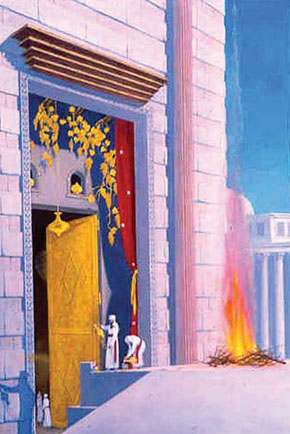
Above the entrance to the temple hung golden grape clusters. It was here that the priests pronounced the priestly blessing. Illustration from the Temple Institute in Jerusalem.
2Every branch in me that does not bear fruit,
he takes away (lifts up – Gk. airo)
and every branch that [continuously] bears fruit
he prunes (trims, prunes),
so that it may bear more (better, richer) fruit. [The Greek word can mean to take away, to pick up, to raise up or to lift up. In it is used about the stone that was removed, while in it is translated as lift up about the lame man's bed. It is the context that determines the meaning. Here it can either mean that the branch that does not bear fruit is taken away, or that it is lifted up from the ground and supported so that it has a new chance to bear fruit.] 3You [the eleven disciples] are already pruned (cut, trained, purified) by the word (Gk. logos) that I have spoken to you [the teaching I have given you]. 4Remain (stay) [live] in me, and I will remain [also] in you. Just as the branch cannot bear fruit by itself unless it remains (were to remain) in the vine, neither can you [bear fruit] unless you remain [were to remain and live continuously] in me. 5I am the vine [see ], you are the branches. Whoever remains (stays) [continually lives] in me – and whom I [also] remain in – bears much fruit, for without (apart from; separated from) me you can do nothing.
6If anyone does not remain (would remain) [continually wants to live] in me, he is thrown away (out) like a [broken] branch and withers, and they gather them up and throw them [such branches are gathered up and thrown] into the fire, and that [this particular individual branch – like the other withered branches] is burned up. 7If you remain (would remain) [want to live] in me, and my words (Gk. rhemata) remain (would remain) in you, ask for (request; desire, wish for) whatever you want, and it will be done for you [and you will receive it]. [When Jesus speaks of "my words," rhema is used in the plural, in contrast to , where logos is used in the singular.] 8My Father is glorified (exalted, praised) when you bear much fruit and [in this way show that you] become my disciples. 9Just as the Father loved me, I also loved you [selflessly giving]. Remain (stay) [live] in my love! 10If you keep my commandments [want to follow my instructions], you will remain (stay) [live] in my love, just as I have kept my Father's commandments and remain (stay) [always live] in his love [Gk. agape – which is a selfless, giving, and righteous love]. 11This [all this] I have spoken to (said) you so that my joy may be in you and [so that] your joy may be complete (overflowing). [Jesus often taught in a very practical way, using images that were familiar to his disciples. Jesus is the vine, the Father is the gardener, and his disciples are the branches. Those who gather the branches and throw them into the fire are probably angels, see , . Jesus is the one who stands between the Father and the branches; it is in him that life flows. The goal is to bear fruit, see , , , , . John uses the same word for fruit that he previously used for crops in . Bearing fruit is about people's eternal salvation.]Love one another
[ form a chiastic pattern. It is framed by the exhortation to "love one another," see and 17b. In and 17a, the word "command" is used. In and 16b, the theme is the relationship with the Father, and is central.] 12This is my commandment: that you [always actively] love one another [selflessly and generously],
just as I [actively] have loved (loved) you. []
13No one has greater love than this [this example of self-sacrificing love]: to lay down (for someone to give/sacrifice) one's life for one's friends. [; ; ] 14You are my friends if you do what I command you (follow my instructions). 15I no longer call you servants (slaves),
for a servant does not know (has no clear understanding of) what his master is doing.
I call you friends,
for everything I have heard from the Father I have made known (made visible, made clear) to you.
16You did not choose me,
but I chose you.
I have appointed you [planted you] to go out [into the world]
and to bear fruit continually, and your fruit shall remain [people who are saved and become disciples of Jesus themselves],
then [the result of your being chosen and living in my will, being branches of the vine, see ]
the Father will give you whatever you ask in my name. 17This is what I command (exhort) you, that you [always actively] love one another [selflessly and generously]." []The world's attitude
18"If the world [with its orderly social system, where changing ethics and morals prevail] hates you, know (have knowledge based on personal experience) that it has already hated me [and still hates me] before it hated you. 19If you belonged to the world, the world would be friendly toward you as toward its own. But now you do not belong to the world, for I have chosen you and called you out of the world. That is why the world hates you. 20Remember what I told you: a slave (servant) is not greater (superior; does not have a higher position) than his master. If they have persecuted (hunted) me,
they will persecute you too.
If they have kept (held fast to) my word,
they will also keep your word.
21But they will do all these things to you [persecute and hunt you] for my name's sake, because they do not know (do not see with the eyes of their hearts, have no clear understanding of) him who sent me. 22If I had not come and spoken to them, they would not be guilty of sin, but now they have no excuse for their sin [sin literally means 'to miss the mark']. 23Whoever hates me also hates my Father. 24If I had not done the works that no one else has ever done, they would not be guilty of sin. But now they have seen (experienced) them, and [even though they have seen all these miracles and signs with their own eyes, they have] hated both me and my Father. 25This happened so that the word written in their teaching [Gk. nomos often refers to the first part of the Old Testament (Torah), but here it refers to the whole and specifically the third part, the Scriptures, which includes the Psalms] would be fulfilled:
They hated me without cause [quote from ; ]."The promise of the Holy Spirit
26"But when the Helper (Advocate, Counselor) comes (is to come), whom I will send to you from the Father – the Spirit of truth who proceeds from (beside) my Father – he will [always] testify about (give good testimony concerning) me. 27But you also testify, because you have been with me from the beginning.
161I have told you this [that the world will hate you, but also the promise of the Holy Spirit, see ] so that you will not be hurt (feel offended, surprised by what will happen, be offended, and lose faith). 2They will exclude you (expel you) from the synagogues; indeed, the time is coming when anyone who kills you will think he is offering a service to God (doing God a favor, carrying out God's mission). 3They will do this to you because they have not come to know (do not have a personal relationship with) the Father or me. 4But I have told you this now, so that when the time comes, you will remember that I told you. I did not tell you this from the beginning, because I was with you.The Spirit of Truth
5"Now I am going to the one who sent me,
and none of you asks me where I am going. 6Instead, because I have said this,
your hearts are filled with sorrow (you feel pain and are depressed).
7But I tell you the truth: It is better for you that I go away,
for if I do not go away, the Helper (the trusted friend, Counselor, Advocate) cannot come to you.
If I go away, I will send him to you. 8When he comes, he will convince the world (the human race) of sin, righteousness, and judgment [The word "convince" means to bring everything to light, as in a trial when obvious evidence is presented. This is one of the tasks of the Holy Spirit.] 9Concerning sin (missing the mark), because they do not believe in (trust, lean on) me. [All sin originates in unbelief, so the greatest sin is to distance oneself from Jesus. Not receiving forgiveness for sins is missing the mark, which is fellowship with God.] 10About righteousness, because I am going to the Father, and you will no longer see me (with your physical eyes). [The Father received Jesus, who was completely without sin. Believing in Jesus is the only way for a person to become righteous.] 11About Judg., because the prince of this world [Satan] has been judged (is now under judgment). [All people will one day stand before God. Satan, also called the accuser, has already been judged. He no longer has any power and can no longer condemn those who are in Jesus.] 12I still have much to say to you,
but you cannot understand (grasp, bear, accept) it now. 13But when he comes, the Spirit of truth, he will guide (teach, show) you into all truth (all truth).
For he will not speak on his own (his own message),
but only what he hears [from the Father], and tell you what is to come in the future.
14He will glorify (exalt) me, because he will take (take from, draw) from what is mine
and convey (explain, proclaim) it to you. 15Everything the Father has is mine. That is why I said that the Spirit will take what is mine
and convey (explain, proclaim) it to you."A little while
[Jesus continues to speak and mentions "a little while." The disciples ask what he means. Most naturally, the statement refers to the time between Jesus' death and resurrection. Jesus would soon die, but also soon rise again. At the same time, there is also a deeper meaning that applies to the waiting period until his return. For an individual Christian, the words also give hope in times of oppression that sorrow will be turned into joy.] 16"Soon (a little while) you will no longer see me,
and then you will soon see me again (I will become visible, revealed) [for I am going to the Father]." 17Then some of his disciples said to one another: "What does he mean when he says to us:
'Soon you will not see me, and then you will see me again (I will become visible, revealed)',
and when he says:
'I am going to the Father?'
18What does he mean by 'soon (a short time)'?
We don't understand what he is talking about." 19Jesus knew that they wanted to ask him, so he said to them, "You are asking each other about what I said:
'Soon (a short time) you will no longer see me,
and then you will soon see me (I will become visible, revealed) again.From sorrow to joy
20Truly, truly, I say to you:
You will weep and mourn (cry like a child and show your grief loudly),
but the world will rejoice.
You will feel pain (heaviness, sorrow),
but your sorrow will turn into joy. 21When a woman is about to give birth (bring forth – Gk. tikto), she feels pain because her time has come,
but when she has given birth (Gk. gennao) to her child, she no longer remembers her suffering
in the joy that a human being has been born into the world.
22Now you have pain (heaviness, sorrow),
but I will see you again, and then you will rejoice in your hearts,
and no one will take your joy away from you []. 23When that day comes [after the resurrection, when the Spirit is poured out, see ], you will not [need to] ask me anything. [The main meaning is to ask a question, as the word is used in , but it can also mean to ask for something in prayer. When Jesus is no longer physically with the disciples, they do not need to ask or pray to him for anything, for the Holy Spirit will guide them into all truth, see , and Jesus is the mediator between God the Father and man and the one who prays for us, see .] Truly, truly, I say to you:
Whatever you ask (pray for, ask) the Father in my name, he will give you.
24Until now you have not asked for anything in my name.
Ask (keep praying and asking again and again) and you will receive,
so that your joy may be complete (continuously filled to the brim, overflowing, you remain in joy).From doubt to faith
25I have used parables (illustrations, images) to speak these things. [The last one was the vine and the branches in .] But now the time is coming when I will no longer speak to you in parables, but will tell you plainly (openly, directly) about the Father. 26When that day comes [after the resurrection], you will ask (request) in my name, and I do not say that I will ask the Father for you [it is not necessary], 27for the Father himself loves (has a strong bond of friendship with) you because you have loved me and believed (trusted) that I came from God. 28I came from the Father and entered the world. Now I am leaving the world and going to the Father."Victory over the world
29His disciples said to him, "Finally, you are speaking plainly (openly) and not in parables. 30Now we know that you know everything and do not need anyone to question you. That is why we believe that you came from God." 31Jesus answered them, "Yes, now you believe [but it will not be long before your faith falters again]. 32Behold, the hour is coming, indeed it has come, when you will be scattered (flee in fear), each to his own [home], and leave me alone. But I am not alone, because the Father is with me. 33I have told you [all this] so that you may have peace (complete harmony) in me. In the world you will have trouble (literally: you will be oppressed), but take heart, I have overcome (triumphed over) the world." []Jesus asks the Father to glorify him
[Jesus is in Jerusalem, they have stopped on the way to Gethsemane where he will soon be captured, see . He bursts into prayer for his own mission, the disciples, and all believers. There are similarities with the priestly blessing, see :
• Blessing and preserving, see , , .
• Shining his face and being gracious, see , . • Turns his face and gives peace, see , .] 171When Jesus had said this, he lifted up his eyes to heaven and said [in prayer]:
"Father, the hour has come (the time has come). Glorify (honor, exalt) your Son, so that your Son may glorify (honor, exalt) you. 2You have given him authority (power) over all mankind (all flesh), [now glorify the Son] so that he may give eternal life to all whom you have given him. 3This is eternal life: to know (have a personal relationship with) you,
the only true (real) God,
and the one you have sent, Jesus the Anointed One (Messiah, Christ).
4I glorified (exalted, honored) you on earth by completing the mission (work, task) you gave me. 5And now, Father, glorify me beside you with the glory I had with you before the universe (world) existed. [Jesus prays for his disciples:] 6I have revealed (manifested) your name (your character, yourself) to the people you have given me. They were yours, and you gave them to me, and they have kept (obeyed) your word. 7Now they have understood (gained knowledge based on personal experience) that everything you have given me comes from you, 8because I have given them the words you gave me. [Gk. rhema – specific words brought to life by the Holy Spirit.] They have received the words and truly understood that I came from you, and they have believed that you sent me. 9I pray for them; I do not pray for the world, but for those whom you [my Father] have given me, for they are yours. 10All that I have is yours, and all that you have is mine, and I have been glorified in (through) them. 11I am no longer in the world, but they are still in the world. When I come to you, Holy Father, protect (preserve) them in your name, those whom you have given me, so that they may be one, just as we are one. 12While I was with them in the world, I kept (protected) them in your name [in knowledge and worship of you]. I kept (protected) those whom you gave me, and none of them was lost except the son of destruction [Judas Iscariot], so that the Scripture might be fulfilled []. 13Now I am coming to you. But I say these things [offer this prayer] while I am still in the world, so that they may have my perfect (a state of ever-abundant) joy in themselves. 14I have given them your word, and the world has hated them, because they are not of the world, just as I am not of the world. 15I do not ask that you take them out of (lift them up from) the world, but that you choose to protect (preserve) them from the evil one [the devil and evil]. 16They are not of the world, just as I am not of the world. 17Set them apart (purify, sanctify, make them holy) through your truth; your word is truth. 18Just as you have sent me (on a mission) into the world, I have also sent them (on a mission) into the world. 19For their sake I separate (purify, sanctify) myself, so that they may choose to be separated (purified, sanctified) in truth. [Jesus prays for all who believe in him:] 20But I pray not only for them, but also for all who will believe in me through their word (teaching), 21that they may all choose to be one, just as you, Father, are in me and I am in you. I pray that they too may choose to be one in us, so that the world may choose to believe (trust) that you have sent me. 22And the glory (honor) that you have given me, I have given to them, so that they may be one just as we are one: 23I in them and you in me,
so that they may be one and choose to be completely united,
so that the world may choose to understand (gain knowledge based on personal experience) that you have sent me, and that you have loved them,
in the same selfless, giving way that you have loved me. 24Father, I want those you have given me to be where I am, so that they may choose to see my glory (honor, splendor) that you have given me, for you have loved me [selflessly and generously] before the world's downfall [Gk. pro kosmos katabole – i.e., before the Fall when God's orderly world system was destroyed]. 25Righteous Father, even though the world has not come to know you (gained knowledge based on personal experience of you), I know you, and they [all who believe] have understood that you have sent me (on a mission). 26I have declared (revealed) your name (your character, yourself) to them, and will continue to make you known, so that they may choose to have the love with which you loved me within themselves, and I myself may be in them 181
Jerusalem in Jesus' time, with the Mount of Olives visible on the right of the picture. Model by Ingemar Eklöv.
©Anna Carlsson

Peter draws his sword.
©FreeBibleImages.org
They answered, "Jesus of Nazareth." 8Jesus answered, "I have told you that I am he. If you are looking for me, let these [my disciples] go." 9He said this so that the word might be fulfilled: "I have not lost a single one of those you have given me." [; ] 10Then Simon Peter drew the short sword he had and struck the high priest's servant, cutting off his right ear. The servant's name was Malchus. [The physician Luke describes how Jesus healed him in .] 11Then Jesus said to Peter, "Put your sword back into its sheath. Am I not to drink the cup that my Father has given me?" 12The Roman battalion (cohort) with its captain and the Jewish temple servants now seized Jesus and bound him. 13They took him first to Annas, the father-in-law of Caiaphas, who was high priest that year. 14It was Caiaphas who had advised the Jews that it was better for one man to die for the people []. 15Simon Peter and another disciple [John's humble way of including himself] followed Jesus. That disciple was known to the high priest and went with Jesus into the high priest's courtyard [an open courtyard surrounded by walls]. 16But Peter stood outside by the gate. The other disciple, who was known to the high priest, went out and spoke to the servant girl who was guarding the gate, and let Peter in. 17The servant girl [13-20 years old] who was guarding the gate said to Peter, "Surely you are one of that man's disciples, aren't you?" He replied, "No, I am not." 18The servants [who worked in the house] and the guards (temple guards) were standing around warming themselves by the charcoal fire they had made, because it was cold. Peter was also with them, warming himself.Jesus is interrogated by the high priest
19
Jesus before the high priest Annas.
©FreeBibleImages.org
Peter denies Jesus a second and third time
25Meanwhile, Simon Peter was standing there warming himself. They said to him, "Aren't you also one of his disciples?" He denied it and said, "I am not." 26One of the high priest's servants, a relative of the man whose ear Peter had cut off, said, "Didn't I see you with him in the garden?" 27Peter denied it again, and at that moment a rooster crowed. 28
Jesus is brought before Pilate, who asks what they accuse him of.
©FreeBibleimages.org

"What is truth?" Painting by Nikolai Ge, 1890.
When he had said this, he went out again to the Jews and said to them, "I find no crime in him. 39Now it is a tradition at Passover that I release a prisoner. Do you want me to release the King of the Jews to you?" 40Then they all shouted back again, "Not him, but Barabbas!" Barabbas was a robber (violent man, revolutionary). [Based on how this word is used in other contemporary literature, it is likely that Barabbas was not just a simple robber. Rather, he was a revolutionary leader and violent man who, with mixed motives of nationalism and personal desire, had committed robbery and terrorized Judea.] 191
Ziziphus spina-christi, according to tradition the tree from which the crown of thorns was made and placed on Jesus.
The Judgment
13When Pilate heard this speech, he brought Jesus out and sat down on the judge's seat, in a place called "the paved platform," in Hebrew Gabbata. 14Now it was the preparation for the Passover [when the Passover lamb, the one-year-old ram, was examined to make sure it was without blemish and then slaughtered, see ], about the sixth hour. He said to the Jewish leaders, "Behold, here is your king!" [The other Gospels give more times and write how Jesus was crucified at the third hour of Jewish time, at nine o'clock in the morning. Three hours later, darkness fell and lasted for three hours until three o'clock in the afternoon. Jesus thus hangs on the cross for a total of six hours and dies at the ninth hour, see , . John's statement that Pilate's judgment is given at about the sixth hour, around midday according to Jewish time, raises a chronological problem. The trial must have been held before Jesus was crucified.
One explanation is that John refers to Roman time, which began at midnight. In that case, the trial took place around six o'clock in the morning. However, other time references appear to be Jewish time, see ; ; . The time reference could also refer to "after six hours of interrogation" in the various Jewish and Roman courts that began during the night, which would be around eight o'clock in the morning.
However, there is a simpler explanation. This is the only time John gives in chapters 5-22. The purpose is not to measure time, since he writes about the sixth hour, in comparison with the healing in , which takes place exactly at the seventh hour. Based on the context, the reason for the time reference "sixth hour" seems to have more to do with the connection to when the Passover lambs began to be slaughtered in the temple. At midday, the sixth hour, all work ceased and the whole of Jerusalem began to prepare for the Passover meal when the Passover lamb would be eaten. John focuses his entire Gospel on signs, and the connection between "Behold, here is your king" and "Behold, the Lamb of God" in is striking.] 15But they shouted loudly, "Away with him, away with him! Crucify him!" Pilate said to them, "Shall I crucify your King?" The chief priests answered, "We have no king but Caesar (the emperor)." 16
Pilate had a sign written: "This is Jesus of Nazareth, King of the Jews" in Hebrew, Latin, and Greek.
[This is] Jesus of Nazareth,
King of the Jews. [The four Gospel writers all mention that the sign read "King of the Jews." However, they choose to include different parts of the opening words. This is not a contradiction; rather, together they give the full picture. The sign probably read as follows: "This is Jesus of Nazareth, King of the Jews," which is the sum of , and . The sign thus mentions Jesus' name and also his crime – King of the Jews.] 20
Golgotha, outside the city walls. The Antonia Fortress and the temple are visible in the background.
©Tony Larsson

Jesus was crucified outside the city, see [Heb 13:12]. Golgotha was probably located on a hill near one of the main roads, clearly visible to everyone passing to and from the city.
The soldiers divide Jesus' clothes
23When the soldiers had crucified Jesus, they took his clothes [outer and inner garments] and divided them into four parts, one part for each soldier. They also took his tunic (a long shirt-like undergarment). It had no seams but was woven in one piece from top to bottom. [Two different Greek words for clothing are used here. The first word is himation and is the common general word for clothing. The second is chiton and describes the tunic, which was an undergarment. The plural form of himation includes both the tunic and the cloak, which was the outer garment, and in this case also sandals, a belt, and perhaps a shawl for the head. The tunic caught the soldiers' attention because it was woven in one piece. Normally it was sewn, but this was the more exclusive type that was woven in one piece.] 24So they said to one another, "Let us not tear it, but cast lots for it to see whose it shall be." This was to fulfill the Scripture: "They divided my garments among them, and for my clothing they cast lots." [A prophecy from .] So the soldiers did this.Jesus' care until the end
25Standing by Jesus' cross were [the following women]: his mother [Mary], his mother's sister [probably Salome, the wife of Zebedee, the mother of James and John], Mary the wife of Clopas, and Mary from Magdala. 26When Jesus saw his mother and the disciple whom he loved [John] standing beside her, he said to his mother, "Woman, behold [here is] your son." 27Then he said to the disciple, "Behold, [here is] your mother." From that hour the disciple took her into his home. [John took care of and provided for Jesus' mother.] 28After this, Jesus knew that everything was now (already) accomplished. To fulfill the Scriptures, he said, "I am thirsty." [; ] 29A vessel full of sour wine stood there [a cheap vinegar wine that probably belonged to the soldiers who crucified Jesus], and they fastened a sponge soaked in the sour wine around a hyssop stalk [about 0.5 m long] and brought it to his mouth. [A bunch of hyssop was used when the blood of the Passover lamb was smeared on the doorposts, see . Earlier, Jesus had refused to accept wine mixed with gall/myrrh to ease the pain, see ; .] 30Now when Jesus [therefore, see ] had received the sour wine, he said, "It is finished [the price is fully paid, never to be paid again]!" Then he bowed his head and gave up his spirit [surrendered his spirit]. [The cause of death in crucifixion is suffocation. The body is positioned in such a way that the victim must constantly push himself up to breathe, leading to exhaustion and suffocation.] 31Since it was Preparation Day, and to prevent the bodies from hanging on the crosses on the Sabbath, for it was a high Sabbath (the high Sabbath) [which is the first day of the Feast of Unleavened Bread, see ], the Jewish leaders ordered Pilate to have their legs broken [to hasten their death] so that they could remove the bodies. 32The soldiers came and broke the legs of the first man and then of the other who was crucified with him. 33When they came to Jesus and saw that he was already dead, they did not break his legs, 34but one of the soldiers pierced his side with a spear, and immediately blood and water came out. [The torture Jesus suffered with flogging and then crucifixion must have led to great blood loss. Medically speaking, the low blood volume causes the victim to suffer hypovolemic shock. This means that the heart races to pump blood that is not there. Since the body needs fluid to replace the blood loss, thirst is also one of the symptoms, as John notes in . The pleural cavity also fills with water. Otherwise, there is hardly any water in free form in the body. When the soldier pierced Jesus' side with his spear, it is likely that a little water came out first, followed by a larger amount of blood. The word order in Greek does not necessarily indicate sequence. The fact that blood is mentioned first may indicate that there was more blood, which is medically accurate.] 35Those who have seen (experienced, been eyewitnesses) give their evidence (testimony) so that you too may choose to believe. [John himself was present and saw the crucifixion.] His testimony is true, and he knows that he is telling the truth. 36This happened so that the Scriptures would be fulfilled: "None of his bones shall be broken." []
37In another passage it is also written: "They will look on him whom they have pierced." []
38After this, Joseph of Arimathea asked Pilate for permission to take down Jesus' body. Joseph was a disciple of Jesus, but secretly for fear of the Jewish leaders. Pilate allowed it. So he went and took down Jesus' body. 39Nicodemus, who had come to Jesus at night, also went with him, bringing a mixture of myrrh and aloes, about thirty pounds. [Literally one hundred Roman "litra," where one "litra" was equal to 12 ounces (325 grams). A huge amount, enough for a royal burial, see . John makes it clear that Jesus was indeed a king.] 40Then they took Jesus' body and wrapped it in linen cloths with the fragrant spices, as is the Jewish custom for preparing a body for burial. 41Now there was a garden next to the place where he had been crucified, and in the garden there was a new tomb (a larger tomb built as a monument, a memorial), where no one had yet been laid. 42They laid Jesus there, because it was the Jewish day of preparation and the tomb was nearby. [The Sabbath began at six o'clock in the evening, and no work was to be done, so they did not have much time to prepare the body and bury it.]The Resurrection
201
John and Peter at the tomb. Model of Jesus' tomb at the Creation Museum in Cincinnati, USA.

Mary weeps at the tomb.
©FreeBibleimages.org
Thinking he was the gardener, she replied, "Sir, if you have carried him away, tell me where you have put him, so I can go and get him." 16
Mary meets the risen Jesus!
©FreeBibleImages.org
She turned and said to him in Hebrew (Aramaic), "Rabbouni!" That means teacher. [John captures the brief but profound conversation in two words. Jesus calls her by name. To Jesus, she was Miryam, which is the original Hebrew name whose Greek and Latin forms are Mary. For Mary, he was "Rabbouni." John translates the word as teacher, which is correct, but at the same time, the Aramaic word carries a deeper reverence and means "my beloved Master" and is an intensification of the more common title "Rabbi."] 17Jesus said to her, "Do not hold on to me [concretely physically, or figuratively "to old patterns"], I have not yet ascended to my Father. Go to my brothers and tell them that I am ascending to my Father and your Father, to my God and your God." [An alternative translation is "Do not touch me," but that would contradict his other statement to actually touch him, see ; ; . The statement is more likely to do with a new way of relating to Jesus, no longer physically but spiritually, see .] 18Mary of Magdala then went and told the disciples that she had seen (experienced, seen with her own eyes) the Lord, and that he had said this to her. [The news of Jesus' resurrection had already reached the Jewish leaders in Jerusalem, see . It is evening and the disciples are probably gathered in the same upper room where they celebrated the Last Supper. The travelers to Emmaus have just arrived and told how they met Jesus, see .] 19On the evening of the same day, the first day of the week [the Sunday when Jesus rose], the disciples were together behind closed doors for fear of the Jews. Then Jesus came and stood among them and said, "Peace be with you!" [The usual Jewish greeting. Now that Jesus has just risen, this phrase takes on a deeper meaning, namely, to receive the blessings of reconciliation.] 20When he had said this, he showed them his hands (wrists) and his side. When the disciples saw (gained a clear understanding of) the Lord, they rejoiced (were glad, elated with joy). 21Jesus therefore said to them again, "Peace be with you! [] Just as the Father has sent (Gk. apostello) me, so I also send (Gk. pempo) you." [Two different verbs are used here for sending. The words are used synonymously throughout the Gospel about thirty times each. Apostello is a little richer in nuance and means to be sent out with authority, while pempo has more the meaning of sending away. This is the first of Jesus' three mission commands. The second and most famous takes place on the mountain in Galilee, see ; , and the third on the Mount of Olives, see ; .] 22When he had said this, he breathed on them and said, "Receive the Holy Spirit. [Just as God breathed his spirit into his creation, see , he does so again with his new creation.] 23If you choose to forgive someone his sins [release him from his sin, carry out God's commission, tell him that Jesus can forgive], they are already forgiven.
[The verb form indicates that the sins are forgiven in the past with the present result that they are now forgiven.] If you bind (hold fast) someone [by not forgiving his sins], he is bound." [The verb form indicates that the sins have been bound in the past with a present result that they are binding.]
Jesus appears to Thomas
24
In 1968, the skeleton of a crucified person from the time of Jesus was found in a Jewish cave tomb in northeast Jerusalem. The name Jehonhanan (John) was engraved on the coffin. The picture shows the heel bone, the ankle, and the 18 cm long nail that seems to have been so firmly embedded that the foot was amputated when the Roman soldiers took the body down from the cross.
He replied, "Unless I see the nail marks in his hands (wrists), and put my finger into the nail marks, and put my hand into his side, I will never believe." [The Greek word cheir is used for both hand and wrist, see where the chains fell from Peter's wrists. In Aramaic, Thomas is Tauma and the word for twin is taama, which becomes a play on words: "Tauma was called taama." Thomas has undeservedly been given the title "Thomas the Doubter," a phrase never used in the Bible. Thomas just wants to see what the other disciples saw, see . Thomas is a realist who asks questions, see ; .] 26Eight days later [Hebrew expression for a week, i.e., the following Sunday], his disciples were gathered there again [in the upper room in Jerusalem, see ], and Thomas was with them. Although the doors were locked, Jesus suddenly stood among them and said, "Peace be with you." 27Then he said to Thomas, "Put your finger here, see (examine, get a clear understanding of) my [pierced] hands (wrists), and reach out your hand and put it into my side. Stop your unbelief and start believing (become full of faith)!" 28Thomas answered and said to him, "My Lord and my God!" 29Jesus said to him, "You believe because you have seen (experienced, witnessed) me. Blessed (happy, enviable) are those who do not see [have not seen me with their physical eyes] yet believe [have believed and believe in me]."The purpose of the gospel and conclusion
30Jesus did many more signs [miracles that confirm God's character] in the presence of his disciples, which are not written in this book. 31But these [seven signs in this book] have been written down so that you may choose to believe that Jesus is the Anointed One (Messiah, Christ), the Son of God, and by believing (trusting, leaning on him), you choose to have life in his name. [Jesus did many signs and wonders. The world would not contain all the books that would need to be written if John were to write down everything, see . The Greek word for sign semeion focuses more on the symbolism behind the miracle than the miracle itself. The seven "signs" found in this gospel are carefully chosen to show that Jesus is truly God.
• The miracle of the wine, see .
• The healing of the king's servant's son, see .
• The healing of the lame man at the Pool of Bethesda, see .
• The feeding of the 5,000, see .
• Jesus walking on water, see .
• The healing of the man born blind, see .
• The raising of Lazarus, see .]EPILOGUE
Jesus appears to the disciples at the Sea of Galilee
211
An empty net along the shore.
2The following [seven] people were gathered:
Simon Peter,
Thomas, called the Twin (Gk. Didymus),
Nathanael, from Cana in Galilee,
the sons of Zebedee [James and John]
and two other disciples of Jesus. [The two other disciples who are not named may have been Andrew and Philip. They are mentioned together in and .] 3Simon Peter said to them, "I am going out to fish."
They replied, "We will go with you." So they went out and got into a boat (Gk. ploion), but that night they caught nothing. 4Early in the morning, Jesus stood on the shore, but the disciples did not realize it was Jesus. 5So Jesus said to them, "Boys (young children, still under their parents' supervision and in need of training), haven't you caught any fish?" They answered, "No." 6He said to them, "Cast the net on the right side of the boat, and you will find some." [In Jewish interpretive tradition, the right side represents mercy and the left side represents Judg., see , .] They cast the net and caught such a large number of fish that they could not (were not strong enough to) pull the net up themselves. 7The disciple whom Jesus loved [referring to John] said to Peter, "It is the Lord!" When Peter heard this, he tied his outer garment (his outer clothing, a fisherman's coat) around himself, for he had nothing on underneath it [he probably tied the coat around his waist to make it easier to move in the water] and threw himself into the lake [and waded toward land]. 8The other disciples came with the small boat (a smaller rowboat – Gk. ploiarion) with the catch in tow. They were not far from land, only about 200 cubits [about 90 meters]. [Two different words for boat are used in and 8. This may refer to the same boat, but it may also mean that they switched from the larger boat to a smaller rowboat to get ashore.] 9
The mood was sombre during breakfast that morning when Peter was to be restored, and it was only after the meal that Jesus broke the silence.
[Two different words for fish are used in and 11. Large fish is the Greek ichthys with the intensifier mega to describe that they are extra large. Small fish is the Greek opsarion, which describes a smaller fish, see also and . Previously, the same word was also used for the two small fish in the miracle of the feeding of the 5,000, see . The disciples are instructed to bring some of these newly caught small fish to the charcoal fire. Throughout history, many different symbolic interpretations have been made of the number 153. Jerome (one of the Church Fathers in the 4th century AD) assumed that it was the number of languages in the world. Other suggestions are that it refers to the number of peoples in the world or the species of fish that existed in the Sea of Galilee at that time. The Bible text gives no explanation, but the point seems to be to show that it was an unusually large catch and that the net had not broken despite this. John, who was present, was perhaps the one who counted the fish, and he includes the number in his eyewitness account of the event. He also mentions the number of stone jars in Cana, see , which has a certain symbolic interpretation. It can be noted that the numerical value 153 is found in the name Bezalel, the first person mentioned as being filled with the Spirit of God (). The Hebrew word haPesach (Passover) () and the phrase "I am God" in Hebr. Ani Elohim also have this numerical value.] 12Jesus said to them, "Come and have breakfast." None of the disciples dared ask him who he was, because they realized it was the Lord. 13Jesus came to them and gave them some of the bread and fish (Gk. opsarion). 14This was now the third time that Jesus appeared to the disciples after he rose from the dead. [Peter is back at the same lake where, about three years earlier, he received the call to leave everything and follow Jesus. According to tradition, it also takes place in the same place, on the shore outside the fishing village of Tagba just south of Capernaum. Then, as now, he had fished all night without catching anything, but at Jesus' word he cast his nets and miraculously caught a large haul, see . It seems that after Jesus' death, Peter gave up his calling and returned to his former occupation as a fisherman. Jesus' goodness is evident when he nevertheless blesses them with a large catch of fish, see . There seems to be a quiet and tense atmosphere during the meal. No one dared to ask him who he was, see . It is also only after they have eaten that Jesus initiates the conversation, see .]Peter's vindication
First question – Simon, do you love me?
15Jesus wants to establish Peter as the leader and shepherd of the church that he was called to be. Two different Greek words for love are used in the dialogue between Jesus and Peter in , , and 17. Jesus begins by using the word agape – which stands for the highest form of selfless, giving love – while Peter responds with fileo – which more describes a friendship relationship. These words can be used synonymously in Greek. Can the choice of words in a Greek text have any significance in a conversation that probably took place in Aramaic? What suggests that the nuances do matter is that John, who was there by the fire, also includes another difference. Peter's reply "you know everything" is changed to the more personal "you know everything" in his third answer. The Greek ginosko is used instead of oidas. The main point, however, is that Peter is allowed to confess Jesus three times, whom he had denied three times, see ; .] When they had finished eating, Jesus said to Simon Peter,
"Simon, son of John, do you love me
[with the highest form of self-sacrificing, giving love] more than these?"
[It must have hurt Peter that Jesus now addressed him as "Simon," the name he had before he became a disciple. Even the addition of "son of John" points to his life before his calling. It was Jesus who had given him the name Peter, see ; .
"These" may refer to the fishermen and the fishing profession that Peter had returned to, or to the other disciples. Peter had previously compared himself to them and said that he would not betray Jesus even if the others did, see . Regardless of what "these" refers to, Simon is faced with a choice to choose Jesus over everything else. He answered him, "Yes, Lord, you know that I care for (have a strong bond of friendship with) you." Jesus said to him, "Feed my lambs!" Second question – Simon, do you love me?
16Jesus asked him a second time:
"Simon, son of John, do you love me [with the highest form of self-sacrificing, giving love]?" [Jesus uses "love" once again, perhaps to give Simon another chance to say "Yes, I love you"?] He answered him:
"Yes, Lord, you know that I care for (have a strong bond of friendship with) you."
Jesus said to him,
"Continue to be a shepherd for (take care of, watch over) my sheep!" [Peter responds in the same way again that he cares for Jesus. In , Jesus responded that Peter would "feed lambs," now Peter is promoted to be a shepherd and take care of adult sheep.]Third question – Simon, do you love me?
17Jesus asked him a third time:
"Simon, son of John, do you love (have a strong bond of friendship with) me?" [The third time, Jesus chooses the weaker expression "do you love me". Jesus comes down to Peter's level and meets him there. The question Jesus seems to be asking is: "Do you at least love me?"] Peter was saddened (sad and hurt) because he asked him a third time, "Do you love me?"
He answered him:
"Lord, you know everything; you know that I love you (have a strong bond of friendship with you)."
Jesus said to him,
"Feed my sheep!" [Peter has completely surrendered and says that Jesus knows everything, his failures but also his desire to be restored. Once again, Peter is urged to feed adult sheep. When Jesus predicted Peter's denial, see , Jesus promised to pray for Peter that he would keep the faith. He also said that after Peter's restoration, he would strengthen the believers. In this chapter, Jesus compares the Christian mission to both fishing and sheep farming. The disciples were called to go out into the whole world and be fishers of men, see ; . The catch of fish became a reminder of the catch that awaits. The conversation with Peter concerns the second part of the Great Commission: to "teach" the believers to keep the commandments, see . In God's church, there are both lambs and sheep that need shepherds to protect them and give them spiritual food. In these three questions from Jesus, it also becomes clear that the motive for Christian leadership must be love for him, Jesus.]Jesus speaks of Peter's death
18[Jesus continues to speak to Peter:] "Very truly (amen, amen) I tell you: When you were young, you used to dress yoursel and go wherever you wanted. But when you grow old, you will stretch out your hands, and someone else will dress you and take you where you do not want to go." 19He said this to indicate the kind of death through which Peter would glorify (exalt, honor) God. [According to tradition, Peter died a martyr’s death in Rom. during Emperor Nero’s persecution in the 60s AD. The earliest mention is found in a letter from Bishop Clement of Rome to the church in Corinth around the year 95. The Roman historian Tacitus writes how Christians during Nero’s persecution were dressed in “clothes of fire” and burned as torches. The choice of words—that someone else should clothe him—may suggest that Peter was killed in this manner, perhaps on a cross. The apocryphal text “The Acts of Peter” (180–190 CE) describes Peter being crucified upside down. The reason may have been that he did not consider himself worthy to die in the same way as his Lord.] Then he said to him, “Follow me!” [Jesus begins to walk along the shore, and Peter goes with him.]Peter and John
20Peter turned and saw that the disciple whom Jesus loved (had a strong bond of friendship with) [John] was following. It was the same disciple who had leaned against Jesus' chest and asked, "Lord, who is it that will betray you?" 21When Peter saw him, he said to Jesus, "Lord, what will happen to him?" 22Jesus answered him, "If I want him to remain until I come, what is that to you? You follow me!" 23Therefore, a rumor spread among the brothers that this disciple would not die. But Jesus had not told Peter that the disciple would not die, but rather, "If I want him to remain until I come, what is that to you?"Concluding remarks
24
If everything Jesus did were to be written down, not even the whole world could contain all the books that would then need to be written!