Hebrews
God has spoken through his Son
11Long ago, God spoke many times [in various revelations, each fragment containing a part of the truth] and in many ways to the fathers through the prophets. 2but now in these last (literally: "eschatological") days he spoke to us through his Son, whom he appointed heir of all things (to whom he gave ownership of all things). Through him he also created the ages (the universe, the world, the epochs). 3He who is the radiance of glory (the afterglow) [he who radiates God's glory] and [is] the image of his being (exact copy/expression) [has God's nature engraved] and who carries all things by his mighty (with the power of his) word (Gk. rhema) – after he himself purified us from our sins (performed the purification of sins) – [he] sat down at the right hand of the Majesty on high. 4He became much more powerful than the angels, as he inherited a much higher name than theirs.Jesus is more powerful than the angels (1:5-2:18)
Seven quotes confirming that Jesus is higher than the angels
[Angels were an important part of Judaism. The reason was that thousands of angels were present when Moses received the teaching (Torah) on Mount Sinai, see ; ; ; . Since a large part of the letter is used to show that Jesus is higher than the angels, it must have been an important topic. The discovery of the Dead Sea Scrolls has provided insight into the teachings of the Jewish sect that had moved to Qumran on the Dead Sea. They practiced the worship of angels. The angel Michael even had a higher status than the coming Messiah. It is not impossible that similar thoughts crept into the minds of the recipients of the Epistle to the Hebrews. The author begins by laying the foundation from Scripture that Jesus is also God.] 5For to which of the angels has God ever said: "You are my Son,
today I have begotten you? []
or in another place [from the prophets]: I will be his Father,
and he will be my Son? []
6When he once again brings his firstborn Son into the world (the inhabited part of the earth), he says: All God's angels shall worship (honor, fall on their knees before) him. []
7Of the angels he says: He makes his angels winds
and his servants flames of fire. []
8But of the Son he says: God, your throne is forever and ever,
and the scepter of your kingdom is a scepter of justice.
9You love righteousness
and hate wickedness.
Therefore, God, your God has anointed you with the oil of gladness (oil of rejoicing)
more than your brothers. []
10And In the beginning, Lord, you laid the foundations of the earth,
and the heavens are the work of your hands. 11They [the heavens] will perish,
but you will remain.
They will all wear out
like a cloak (the usual outer garment – Gk. himation),
12like a draped cloth [head covering or cloak]
you will roll them up (fold them) [the heavens]
and they will be replaced
like a cloak (Gk. himation).
But you are the same,
and your years have no end. []
13And to which of the angels has he ever said: Sit on (outside – Gk. ek) my right hand
until I have made your enemies a footstool for your feet? []
14Are not angels spirits in the service of God, sent to help [protect] those who will inherit salvation?Warning—do not drift away from the faith
[Now follows the first of five warnings in this letter. For the others, see ; ; ; . The recipients of the letter were slow to hear and immature, see . There was a risk that they would fall away from the faith. The word "drive away" is an unusual word and is only used here in the New Testament. The author may have had in mind. In the Greek translation of that verse, this word is used in the exhortation to preserve sound judgment and good sense. The author includes himself in the warning; the word "we" appears a total of five times in and 3. In is the answer to how not to drift away; faith and hope in Jesus are likened there to an anchor.] 21Therefore [because Jesus, who mediates the renewed covenant, is high above all angels, see ], we must pay much more attention to what we have heard, so that we do not drift away [with the prevailing opinion of those around us]. 2For if the word given through angels [Moses' instructions, see ] was binding, and every transgression and disobedience received its just punishment, 3how is it possible that we will escape [God's Judg.] if we neglect such salvation? It was first proclaimed by the Lord and then confirmed to us by those who had heard him. 4God also gave his testimony through signs and wonders and various miracles and by distributing (a portion of) the Holy Spirit according to his will.Jesus' human side does not make him any less powerful
5For it is not to angels that he has subjected the world to come (the inhabited part of the earth) of which we speak. [When the Son of Man will reign in the millennial kingdom.] 6In one place, someone [probably referring to David, see ] has testified: What is man
that you are mindful of him,
or the Son of Man
that you care for him?
7For a little while you made him
lower than the angels,
with glory and honor
you crowned him.
8You put everything under his feet. [. This psalm deals generally with the role of man in creation. Here it is used in a messianic and eschatological perspective.] 9But we see Jesus, who for a short time was lower than the angels, but is now crowned with glory and honor because of his suffering and death, so that by God's grace he tasted (experienced) death for everyone. 10It was fitting for him (the only appropriate and entirely fitting thing) that he, who is the cause of all things and through whom all things exist, when he wanted to bring many sons and daughters to glory, became the originator (the first) who leads them to salvation (rescue, deliverance, healing) perfected through suffering. 11Jesus who sanctifies and those who are sanctified all have one and the same Father. Therefore, he is not ashamed to call them siblings (brothers and sisters), 12when he says: I will proclaim your name to my brothers and sisters,
in the midst of the congregation I will praise you. []
[In , , and 12, the Greek masculine inclusive plural form is used. In Greek, a group consisting only of women is addressed with the feminine plural form. Similarly, a group of men is addressed with the masculine plural form. The same masculine form is also used for a mixed group of both women and men. Thus, it is the context that determines whether the Greek word sons/brothers also includes daughters and sisters. Since the context here is salvation, it is clear that it applies to both men and women.] 13He also says: My hope is in him. []
and further [in the next verse]: Behold, here I am and the children whom God has given me. []
14Since the children [God's children] are flesh and blood, he [Jesus] likewise shared in this [human nature], so that through his death he might destroy (depose) the devil who had the power of death, 15and completely free those who, through fear of death, had been slaves (bound) all their lives. 16For as we all know, it is not angels he establishes, but it is Abraham's children (seed) that he establishes (helps, takes care of). 17Therefore, it was necessary that he became like his siblings (brothers and sisters) in every way (in all respects), in order to become a merciful (gracious) and faithful (true) high priest in his service before God, to atone for the sins of the people. 18Since he himself was tempted when he suffered, he can help (hear the cry for help and rush to the rescue) those who are tempted. [Jesus was tempted in all areas, see . In Gethsemane he prayed "not as I will, but as you will," see . God knows our trials, not only as God, but also as a human being. The word for help is boetheo, which is used only eight times in the New Testament. It consists of two words: boe, which means "to call," and theo, which means "to run." Originally, the word meant "to run to someone in need to help" and "to rush to the aid of someone who is distressed," and then took on the more general meaning of "to help."]Jesus is more powerful than Moses (3:1-4:13)
31Therefore, holy brothers and sisters (brothers and sisters in faith), who share in the heavenly calling, consider the apostle (messenger) and high priest whom we confess, Jesus. 2See how he is always faithful to God who appointed him [as apostle and high priest], just as Moses was faithful in all God's house (God's spiritual family) []. 3
The architect deserves more credit than the house he builds.
Warning—do not harden your hearts and lose faith (3:7-4:13)
[Now follows the second of five warnings in this letter. Unlike the first warning, which was about carelessly drifting away from the faith, see , this one is about not deliberately hardening one's heart. The author uses the Israelites' exodus from Egypt and their journey through the desert as a warning example.
The Israelites were trapped in Egyptian slavery, which is a picture of sin. Just as they were freed by the blood of a lamb, Jesus – the Lamb of God – frees us from the slavery of sin, see . It was not God's will that they remain in the desert, but when they reached the border of the land of Canaan, they began to doubt the promise, see . A journey that could have taken 11 days took 40 years, and an entire generation died in the desert without entering the land and coming to rest. Crossing the Jordan River and entering into the rest of faith represents for a Christian receiving a share in the spiritual inheritance of Jesus, see , , . In the same way, the desert journey describes a Christian who doubts God's promises.] 7Therefore, the Holy Spirit [who inspired the author of the psalm to write] says: Today, if you hear his voice, 8do not harden your hearts as in the rebellion (bitterness, provocation) [at Rephidim, when there was no water, see ],
during the day of testing in the desert, 9when your fathers tempted me
and tested me, even though they had seen my works for 40 years. 10Therefore I was angry (wrathful – Gk. prosochthizo) with that generation,
and I said, 'They are always going astray in their hearts,
they do not know my ways. 11So I swore in my wrath:
They shall never enter my rest. [Quote from . Just as Paul writes that all Scripture is breathed out and inspired by God, see , the Epistle to the Hebrews confirms that the Holy Spirit inspired the author of this psalm, see also .] 12See to it (be constantly on your guard), brothers and sisters (brothers and sisters in faith), that none of you has a wicked heart of unbelief (that you are not driven by deliberate unbelief in your heart) and falls away from the living God. [There is a difference between doubting sometimes and "having unbelief in your heart"; that is not what the author of the letter has in mind here. The word for evil is not abstract evil (Gk. kakos) but deliberate, active evil (Gk. poneros). Unbelief (Gk. apistia) is in the genitive case, which describes a heart controlled by unbelief. The combined meaning is "a wicked, unbelieving heart."] 13Instead, encourage one another every day, as long as it is called "today" [when it is possible to be saved, see ], so that none of you may be hardened by the deceitfulness of sin. 14We have part (are friends with) the Anointed One (Messiah, Christ), if we steadfastly hold on to our first confidence until the end. 15It is said: Today, if you hear his voice,
do not harden your hearts as in the rebellion (bitterness, provocation).
[, first part of the psalm quoted in .]
[Now come three questions that follow the key words from Ps. 95 (rebellion, anger, and rest, see , , , ). The questions are answered with a new question. See also .] 16Who were those who heard but still rebelled (were angry, provoked) [verses 8 and 15]?
Were they not all those whom Moses led out of Egypt?
17Who was he angry (Gk. prosochthizo) [] with for 40 years?
Was it not those who sinned and lay dead in the desert? 18To whom did his oath apply, "that they should never enter into his rest" [],
except those who [had listened to God's word but] refused to obey? 19We see, then, that they could not enter because of unbelief (Gk. ). [The word "unbelief" is placed last in the verse and gives emphasis. Cf. , which speaks of a heart ruled by unbelief.] 41[The last part of , which was quoted in , is about God's rest.] Since there remains a promise of entering his rest, let us be careful that none of you be found to have fallen short of it. 2For the good news has been preached to us as well, just as it was to them [the Israelites in the desert]. But the message they heard did not benefit them, because they did not combine (unite, mix) it with faith. 3It is we who believe who enter into rest. The Lord says: So I swore in my wrath:
They shall never enter into my rest. []
Nevertheless, his works have been finished since the world was cast down [Gk. apo kosmos katabole – i.e., from the Fall when God's ordered world system was destroyed], 4for in one place he says of the seventh day: And God rested on the seventh day from all his works. [] 5[Back to the text I quoted earlier from the Psalms.] Here he says: "They shall never enter into my rest." [Psalm 95:11] 6So it is clear that some enter into rest, and that those who first heard the gospel did not enter because of disobedience [which is the visible result of unbelief]. 7Once again, he sets a special day, [a new] "today" [when it is possible to enter into rest, see ] when he speaks through David much later [about five hundred years after Joshua and the entry into the Promised Land] in the words already quoted: Today, if you hear his voice,
do not harden your hearts. []
8[This rest did not refer to how the Israelites entered the land of Canaan.] For if Joshua had brought them into rest (as in resting from work), God would not have later spoken of another day. 9So there remains a Sabbath rest for the people of God. [This is the only time the word Sabbath rest, Gk. sabbatismos, is used. It describes a perfect rest, see .] 10For whoever has entered (gone) into his [God's] rest has also rested [himself] from his works (deeds), just (in the same way) as God [rested] from his (literally: "his own"). 11Let us therefore strive to enter that rest, so that no one falls like them and becomes an example of disobedience. 12For the word of God (Gk. logos) is living and active (effective, powerful – Gk. energes) and sharper [more penetrating and helpful] than any double-edged sword. It even penetrates so far that it divides (separates, distinguishes) [causes a separation of] soul and spirit,
both joints and marrow [in plural: "marrow masses"],
and discerns (critically examines; discerning can judge between) the heart's thoughts (emotional considerations; reflections)
and intentions (intentions; moral insights) [where ideas and perceptions are born]. [The literal meaning of the Greek word for a double-edged sword is “a sword with two mouths/edges” (‘mouth’ as in the word “river mouth” from the Greek distomos; dis meaning double and stoma meaning mouth/mouth – used, among other things, to refer to the edge of something). The word that comes from God's mouth constitutes one side of the sword, and when we speak God's word with our mouths, it constitutes the other side. The verse has three pairs of words: soul/spirit, joints/marrow, and the thoughts/intentions of the heart. At the center is what has to do with the skeleton of the body – it is invisible to the eye, but still affects the whole body. The order of each pair shows that the joints illustrate the soul and thoughts, and the marrow in the inner breath and intentions. Just as the joints are mobile, the soul is changeable and emotional thoughts are changeable. And just as the marrow produces blood cells inside the solid skeleton and is the source of life, see , so the spirit of man constitutes his inner life. A person's innermost attitude and deep conviction give birth to the intentions of the heart.]
13Before God, nothing created is hidden; everything is naked and exposed (open) to his eyes. Before him, we must all give account (openly give an account of our lives). [The word "exposed" is used only here in the New Testament and literally means "the neck bent backward, open and exposed." It describes a wrestler who takes a decisive hold on his opponent and bends his head back, confidently showing his face to the spectators. It can also describe how the neck of an animal to be sacrificed is bent backward and exposed to the knife. The priest who is to sacrifice opens up the animal and looks into all its parts. The last meaning in particular fits in with the context of the double-edged sword.]Jesus is more powerful than Aaron
[Moses did not lead the Israelites into the Promised Land, as he himself was forbidden to enter. Joshua led them into the land, but not into spiritual rest, see . What then of the first high priest Aaron? Can his ministry with all its sacrifices and ceremonies lead to rest?] 14Now that we have a great (superior) high priest who [has already] [risen and] passed through the heavens – Jesus, the Son of God – we should [of course] hold fast to (be faithful to) the confession [think, act, and say the same thing as God]. 15For we do not have a high priest who is unable to sympathize (feel, empathize) with our weaknesses (frailties) [both spiritual and physical – susceptibility to temptation and the effects of illness], but one who has been tempted in every way [as we are, but] without sin. 16Therefore, let us (we should) approach the throne of grace with boldness [without fear – openly and frankly in confidence], so that we may receive mercy and find grace (favor) to help us in [just] the right time. [Grace is the power that helps us precisely when we need it most.] 51Every high priest is appointed from among men [not angels, see , ] and is appointed for men, to serve before God, to offer gifts and sacrifices for their sins. 2He can have compassion (being neither too tolerant nor too harsh) on those who are ignorant (unaware of their sins) and misguided, because he himself is weak [subject to human weakness] 3and therefore must bring sin offerings both for the people and for himself. [In , the high priest's sacrifice on the Day of Atonement – Yom Kippur – is described. The word for "compassion" is used only here in the entire Bible and describes someone who is not harsh toward sinners but also does not turn a blind eye to sin.] 4No one takes this dignity upon themselves, but one is called by God, as Aaron was. [Aaron was Moses' brother and the first high priest of the Israelites, see .] 5So it was with the Anointed One (Messiah, Christ). He did not take the dignity of high priest upon himself, but received it from the one who said: You are my Son,
today I have begotten you. []
6He also says in another place: You are a priest forever,
in the order of Melchizedek. [. See also . Melchizedek was a priest and king, a contemporary of Abraham, see .]
7While he [Jesus] lived here in the flesh [on earth as a human being], he cried out in tears as he prayed (prayers for special needs) and called upon (asked for protection from) the one who could save (rescue) him from death [to rise to eternal life after the cross], and he was heard because of his godliness [willingness to worship God and submit to God's will]. [Refers primarily to Jesus' prayer in Gethsemane, see ; ; , .] 8Although he was a son [the Son of God, with privileges and rights], he had to learn obedience through suffering. 9When he had accomplished everything (become perfect), he became the source (origin) of eternal salvation (rescue, deliverance, healing) for all who obey him, 10and he was set apart (appointed) as high priest, a priest like Melchizedek (of the same rank).Warning—do not be spiritually immature (5:11-6:20)
[Now follows the third warning of five in this letter. The warning concerning spiritual immaturity is framed by teaching about Melchizedek.] 11We have much to say about this, but it is difficult to explain, since you have become so sluggish (unwilling) to hear (lazy to take in spiritual insight). [The subject of Melchizedek is dealt with thoroughly later in .] 12You should have become teachers long ago, but now you need someone to teach you the first principles of God's word again. You need milk, not solid food! 13For anyone who lives on milk alone is not mature enough for teaching about righteousness, since he is still a child [spiritually immature]. 14Solid food is for adults [spiritually mature], for those who through practice have their senses sharpened to distinguish between good and evil. [Determine whether what is taught comes from God's word, see .] 61Let us leave the first principles (Gk. arche logos) [in teaching and doctrine] about the Anointed One (Messiah, Christ) [Heb. 5:12] and advance steadily toward adult perfection (spiritual maturity; full knowledge).
Let us not again lay the foundation [which is]: Repentance from dead works
and faith toward God,
2baptism [plural – the Jewish purification baptisms; baptism in water, in the Holy Spirit, and in suffering],
the laying on of hands [plural – multiple hands, multiple people, or multiple occasions],
the resurrection of the dead
and eternal judgment.
[These six areas, divided into three topics that follow Christian life (repentance and faith, an active life, resurrection and judgment judgment) are the areas that the recipients of the letter should have been fully knowledgeable and aware of long ago.]
3If God permits, we will [now] move on [to deeper teaching]. 4It is impossible for those who
once have been enlightened,
tasted the heavenly gift,
shared in the Holy Spirit, 5tasted the good word of God [Gk. rhema – specific word brought to life by the Holy Spirit],
and the powers of the age to come,
6but then turned away (broke the contract), to be brought back to repentance, since they themselves crucify the Son of God again and publicly mock him. 7A field that drinks the rain that often falls on it and produces a good harvest for those for whom it is cultivated, that field receives God's blessing. 8But if it bears thorns and thistles, it is worthless and dangerously close to being cursed. The end result will be that it is burned. [Just as the earlier warning not to harden your heart and lose faith ended with encouragement, see , this warning not to be spiritually immature ends with encouragement. This is the only time "beloved" (Gk. agapetos) is used in this letter. The expression is otherwise common in the letters, see e.g. ; ; ; ; .] 9But as for you, our beloved, we are convinced of the best [that your spiritual field does not bear thorns and thistles and needs to be burned], that which leads to deliverance (salvation), even though we speak in this manner. 10For God is not unjust (unrighteous) so as to forget [not care about] your work (what you have done) and the love [what selfless and generous love] you have shown for his name in serving the saints – and as you [still] serve. 11But we wish that each of you would show the same zeal to preserve the full certainty of hope until the end. 12Do not become (cease to be) [spiritually] neutral (passive, sluggish, weakened, apathetic), but imitate (become followers, imitators of) those who through faith and patience [now] fulfill the promises. 13For when God made promises to Abraham, he swore by himself, since he had nothing greater to swear by. 14He said, I will bless you abundantly,
and multiply you greatly. []
15So Abraham, after patiently waiting, received what God had promised. 16People swear by someone greater than themselves, and the oath becomes a confirmation that puts an end to all objections. 17When God wanted to show the heirs of the promise even more clearly how unshakeable his decision is, he confirmed it with an oath. 18Thus, through two unshakeable facts [his promise and oath], where God cannot possibly lie, we who have taken refuge (have fled to safety) in the hope that lies before us receive powerful encouragement. 19We have this hope as a safe and secure anchor for our souls, reaching beyond the curtain. 20Jesus entered there and opened the way for us: when he became high priest forever,
in the same way as Melchizedek. [; , ; ]
[The passage ends with the same quote from the Psalms that began this passage in . The main point is that a Christian must grow in faith and not remain immature. The warnings in the Epistle to the Hebrews follow an escalating pattern. If a believer begins to drift away from God's word, see , it leads to a hardened heart, see . This in turn leads to an unwillingness to listen, see . The solution is to hold fast to God and the hope that is likened to a firm anchor. The next paragraph goes on to explain how Melchizedek is a prototype of Jesus.]Melchizedek's priesthood
[Melchizedek has been introduced in previous chapters. Now there is a more thorough review showing that he is a model for Jesus. Melchizedek is mentioned only twice in the Old Testament. He suddenly appears in the story of Abraham, see , and is quoted in , which is messianic. The first three verses of this chapter are a single verse in Greek.] 71For this Melchizedek,
king of Salem [shortened form of Jerusalem, see ],
priest of God Most High,
who met Abraham on his way back after his victory over the kings and blessed him, 2to whom Abraham gave a tenth of everything [spoils of war],
first and foremost, as his name means
he is "king of righteousness,"
he is also king of Salem,
that is, "king of peace," 3without father,
without mother,
without genealogy,
his days have no beginning,
his life has no end:
he is like the Son of God,
and remains a priest forever. 4See how great he is, if even our forefather Abraham
gave him a tenth of his best spoils. 5Those of Levi's sons (descendants) who become priests have a commandment according to the law [Gk. nomos – Torah, the Books of Moses] to receive tithes from the people [],
that is, from their brothers [Jewish compatriots],
even though they are also descended from Abraham. 6But Melchizedek, who was not of their lineage,
received tithes from Abraham
and blessed him who had received the promises. [In the same way, Jesus does not need to be from the tribe of Levi.] 7No one can deny that it is the lesser [Abraham]
who is blessed by the greater [Melchizedek, who in turn is a model for Jesus]. 8In one case, it is mortal men [Levitical priests, ] who receive tithes,
in the other, it is one who has received the testimony that he lives. 9It can be said that even Levi, who receives tithes,
has himself given tithes through Abraham,
10because he existed as unborn in his ancestor's body
when Melchizedek met him.An eternal priesthood
11If perfection could have been attained through the Levitical priesthood – and on that basis the [Jewish] people received the law [the teachings of the Books of Moses] – why did another priest have to arise, one like Melchizedek, one who is not said to be like Aaron? 12For if the priesthood changes (gets a new order), the law [the instructions regarding the priesthood] must also be changed. 13The one who is spoken of belongs to another tribe, and from that tribe no one has ever served at the altar. 14It is clear that our Lord came from the tribe of Judah, and Moses said nothing about priests from that tribe. [Jesus comes from the tribe of Judah, see ; . When Jacob blesses and prophesies over his sons in , more details are given as to why Jude is considered the firstborn. The birthright was taken from Reuben because he slept with his father's concubine. It passed over Simeon and Levi because of their cruelty in murdering an entire village after Dina was raped. Therefore, Jude was counted as the firstborn. A verse in the blessing from clearly points to Jesus: "The scepter shall not depart from Judah, nor the ruler's staff from between his feet, until he to whom it belongs shall come, and the peoples shall obey him."] 15It becomes even clearer when another priest like Melchizedek appears, 16one who did not become a priest through the law of descent, but through the power of an indestructible life. 17He receives the testimony: You are a priest forever,
in the same way as Melchizedek.
[, this is the third time the same passage is quoted, see ; .]
18Thus, a previous commandment is set aside because it was weak and powerless – 19for the law [Torah] never brought anything to perfection – and a better hope has come, through which we can draw near to God. 20Moreover, it did not come without an oath. The others became priests without an oath, 21but Jesus has become one through an oath by the one who said to him: The Lord has sworn
and will not change his mind:
You are a priest forever.
[]
22So much better is the covenant for which Jesus is the guarantor. 23The other priests have become more and more numerous, because death prevented them from remaining in their ministry. 24But because he [our high priest Jesus] lives forever, he has a permanent (unchanging) priesthood. 25Therefore, he can completely (fully, now and forever) save (heal, preserve, restore, provide for) those who come to God through him, because he lives forever and can intercede for them (intervene and mediate, pray on our behalf). 26It was necessary for us to have such a high priest: holy, innocent, undefiled by sin, separated from sinners, and exalted above the heavens. 27He does not need to make daily sacrifices, like the other high priests, first for his own sins and then for those of the people. He did this once and for all when he sacrificed himself. 28The law appoints weak men as high priests, but the word that was confirmed with an oath and came after the law appoints the Son, who is perfect forever.Jesus is our high priest
81Here is the main point (the most important thing) in what we say: We have such a high priest who sits
at the right hand of the throne of Majesty in heaven,
2and serves in the sanctuaries,
the true tabernacle that the Lord himself and no man has erected. [This is the main point of the letter; it is also the chiastic center. There are two main ideas here: Jesus is seated and he serves.
1. The expression "Jesus is seated" comes from . This has been described in and . There were no chairs in the tabernacle because the priest never finished his tasks. Each repeated sacrifice was a reminder that no sacrifice brought complete salvation. The blood of sacrificed animals did not take away guilt, it only covered it. Jesus is the one who takes away the sin of the world, see . The fact that Jesus, as high priest, sits down describes that his work is complete, in contrast to Aaron, who stands and serves, see .
2. His service in the heavenly tabernacle is described in the next section, see .] 3A high priest is appointed to offer gifts and sacrifices, and therefore the Anointed One (Messiah, Christ) must also have something to offer. 4Had he been on earth, he would not even be a priest, since there are already others who bring the sacrificial gifts prescribed by the law [Torah]. 5They serve in a sanctuary that is only a copy (prototype, model) and a shadow of the [real and true] heavenly sanctuary. For even when Moses was building the tabernacle, he was warned by God: See that you make everything according to the pattern (the model, the design)
that you saw on the mountain. []
6But now the Anointed One (Messiah, Christ) has a higher priesthood, just as he is also the mediator of a better covenant [than the old one], which is based on better promises. [All of God's promises are good, but these have even greater blessings.]The promise of a renewed covenant
7For if the first covenant [the contract given to Israel through Moses on Mount Sinai] had been without flaw, there would have been no need for a second one. 8But God rebukes them when he says [through the prophet Jeremiah]: Behold, the days are coming, says the Lord,
when I will make a new (better) covenant (contract)
with the house of Israel [the ten northern tribes] and with the house of Jude [in the south]. [Jeremiah lived at a time when the Israelites were divided into the northern kingdom, Israel, and the southern kingdom, Jude. The promise of a renewed covenant is also about healing the wounds between God's people; in Jesus there is reconciliation, see .] 9It shall not be like the covenant I made with their fathers
on the day I took them by the hand and brought them out of the land of Egypt,
for they did not remain in the covenant with me,
so I did not care for them, says the Lord. 10No, this is the covenant that I will make with the house of Israel after that time, says the Lord:
I will put my laws [my teaching, Torah – Gk. nomos] in their minds
and write them [the laws, the teaching] on their hearts.
I will be their God,
and they shall be my people.
11Then no one will have to teach his countryman or his brother, saying,
"Know the Lord!"
Everyone will know me,
from the least of them to the greatest,
12for I will forgive their iniquity (unrighteousness, all wrongdoing)
and remember their sins no more. [. This is the longest Old Testament quotation in the New Testament.] 13When he speaks of something new (better) [the renewed covenant], he has thereby declared the first [covenant] obsolete (worn out, old). That which becomes old and obsolete is about to (close to) disappear. [The temple in Jerusalem was destroyed by the Romans in 70 AD. The Jewish historian Josephus writes that the daily sacrifices ceased on August 5 of that year. The statement that the old "is about to disappear," and the present tense in , that the priest "now serves" in the temple, may indicate that the temple was still standing in Jerusalem when the Epistle to the Hebrews was written.]A new worship
91The first covenant had its rules for worship and its earthly sanctuary.The design of the earthly tabernacle

Sketch of the tabernacle with the two rooms separated by a curtain, the veil. The entrance to the tabernacle was always from the east and was covered by a curtain.
2A tabernacle [God's dwelling place – a tent where God reveals himself and meets with man] was furnished with a first room called the Holy Place. There stood: the lampstand [the menorah – the seven-branched candlestick, see ]
and the table []
with the showbread [; ].
3But behind the second curtain (the veil) [also called the mercy seat] was a room called the Holy of Holies []. 4It contained [included]: the gilded altar of incense [. The altar of incense, which was completely covered in gold, stood by the curtain in the first room, but is associated with the innermost holy of holies, since it was used on the Day of Atonement when the high priest entered the holy of holies, see .]
and [there stood] the ark of the covenant,
which was covered with gold on all sides [].
In the ark were:
a golden pot containing manna [],
Aaron's rod that had budded []
and the tablets of the covenant [; ].
5
In Timna Park, just north of Eilat in southern Israel, there is a full-scale model of the tabernacle.
[This is where the high priest sprinkled blood to atone for sin once a year on the Day of Atonement – Yom Kippur, see ; .]
But we cannot go into all the details about this now. 6That is how it was arranged. In the first room, the priests constantly enter and perform their duties. [Olive oil was to be poured into the candlestick, which was lit every evening and burned until morning, see . The twelve showbread loaves were replaced every Sabbath, see . Two lambs were sacrificed daily, see ; .] 7Only the high priest enters the second room, once a year [on the Day of Atonement – Yom Kippur, see ], and then never without blood, which he brings for his own and the people's unintentional sins. 8In this way, the Holy Spirit shows that the way into the Holy of Holies is not yet revealed as long as the first room exists. [The very existence of an outer room that protected the Holy of Holies shows that the ceremonies and rules of the Old Testament limited access to God's presence. When Jesus died on the cross, the veil was torn from top to bottom, see .] 9This [the outer part of the tabernacle, the holy place] is a picture (parable, illustration, parallel) of the present time [the first covenant], when gifts and sacrifices are offered that cannot purify the conscience of the one performing the service. 10These [outer ceremonies and rituals] concern only food and drink and various purifications [ceremonial cleansing baths and washes]. They were external rules (for the body) to be followed until the time of a better order [a better covenant].the heavenly tabernacle
[The real temple, the most holy place, where God himself dwells, is in heaven. That is where Jesus has entered, not as the earthly high priest "with the blood of goats and calves," but with his own blood. On the Day of Atonement (Yom Kippur), the high priest sacrificed a goat and a bull.] 11But now the Anointed One (Messiah, Christ) has come as high priest of the good things to come. Through the greater and more perfect tabernacle, which is not made by human hands and therefore does not belong to this creation, 12he entered the Holy of Holies once and for all, not with the blood of goats and calves, but with his own blood, and won eternal redemption. 13If the blood of goats and bulls [] and the ashes of a [red] heifer [, ] can be sprinkled on the unclean and sanctify them for outward purity, 14how much more will the blood of the Anointed One (Messiah, Christ) purify our consciences from dead works so that we may serve the living God? He has offered himself through the eternal Spirit [the Holy Spirit or the Spirit of Jesus] as a flawless sacrifice to God. [The expression "the eternal Spirit" can be interpreted as a reference to "the Holy Spirit" or "the Spirit of Jesus." Based on and the context, where the contrast is between the temporary earthly sacrifices and the eternal heavenly sacrifice, it probably refers to the Spirit of Jesus. See also ; ; .]Was it necessary for Jesus to die?
15Therefore, the Anointed One (Messiah, Christ) is the mediator of a renewed covenant, so that those who are called [regardless of nationality, see ] may receive the promised eternal inheritance, now that he has redeemed us from the transgressions under the first [old] covenant by his death. 16Where there is a will [the same word translated "covenant" in the previous verse], it must be shown that the one who made it is dead. 17Only at his death does the will become valid, for it does not take effect while he is still alive. [How Moses purifies the earthly is related to how Jesus purifies the heavenly, see .] 18It was the same with the first testament (covenant). It had to be instituted (opened) with blood [from sacrificial animals in order to take effect]. 19When Moses had proclaimed all the commandments of the law to the whole people, he took the blood of calves and goats, together with water, scarlet wool, and hyssop, and sprinkled it both on the scroll itself and on all the people. 20He said,
This is the blood of the covenant that God has commanded you to keep. []
21In the same way, he sprinkled blood on the tabernacle and all the articles of worship. 22According to the law [Torah], almost everything is purified with blood, and without the shedding of blood there is no forgiveness. [This is the center of the passage and answers the question of why it was necessary for Jesus to die.] 23Therefore, the [earthly] images (examples, copies) of the [real] things in heaven must be purified by these means, but the heavenly things themselves must be purified by better sacrifices than these. 24For the Anointed One (Messiah, Christ) did not enter a sanctuary made by human hands, which is only a copy (model, replica) of the real sanctuary. He entered heaven itself to appear now before God on our behalf. 25Nor would he sacrifice himself many times, as the high priest enters the Holy of Holies every year with blood that is not his own. 26In that case, he would have had to suffer many times since the world was cast down [Gk. apo kosmos katabole – i.e., from the Fall when God's orderly world system was destroyed]. But now he has appeared once and for all at the end of the ages to wipe out sin through his sacrifice. 27In the same way that it is determined that all people will die (it awaits everyone) [Rom. 6:23] and then be judged, 28so the Anointed One (Messiah, Christ) was sacrificed once to bear the sins of many []. He will appear (come forth) a second time, not to bear sin but to save (deliver) those who wait for (long for with eager expectation) him.Jesus' sacrifice
101The law [the teachings in the Books of Moses] gives a shadow image [a foreshadowing, the rough outlines] of the good that is to come [in Jesus as high priest, see ], but not of things in their true form. Therefore, the law, through the sacrifices that are offered year after year in the same manner [on the Day of Atonement – Yom Kippur, ], can never perfect those who come forward [to the altar]. 2In that case, one would have stopped offering [these annual sacrifices], since those who served would have already been purified once and for all and would no longer have had any sins on their conscience? 3But now the sacrifices serve as an annual reminder of sins, 4for the blood of bulls and goats cannot possibly (has no power to) take away sins. 5Therefore, the Anointed One (Messiah, Christ) says when he enters the world [becomes a human being]: You did not want sacrifices [with animals] and gifts [food and drink offerings],
but you have prepared a body [to be sacrificed] for me. 6Burnt offerings and sin offerings did not please you. 7Then I said, 'Here I am, I have come to do your will, God.
In the scroll it is written about me.
[] 8First he says, "Sacrifices and gifts, burnt offerings and sin offerings you did not want, they did not please you." This is despite the fact that they are offered according to the law. 9Then he says, "Behold, I have come to do your will." He sets aside the first to establish the second. 10And by virtue of that will, we are sanctified (set apart for God's service) through the body of Jesus the Anointed One (Messiah, Christ) sacrificed once and for all. [In , the annual sacrifice "year after year" was described; here, the daily sacrifice is described, see .] 11All other priests stand and perform their service day after day, offering the same sacrifices over and over again, which can never take away sins. 12But when this [priest, Jesus] offered one sacrifice for sins for all time, "he sat down at the right hand of God" [], 13where he now waits for "his enemies to be made his footstool" []. 14For by one sacrifice he has perfected (completed his work of maturity in) those who are sanctified (set apart for holy service). 15The Holy Spirit testifies to this for us, for he has said: 16This is the covenant that I will make with them
after those days.
I will put my laws [my teaching] in their hearts,
and I will write them [the laws, the teaching] on their minds (understanding, thoughts).
[. The same quote as in , but with heart and mind in reverse order. The renewed covenant is not written on stone tablets but in the heart and transforms from the inside out, see .] 17Then he says [in the next verse]: Their sins (walking away from God) and their lawlessness (transgressions against the commandments)
I will no longer remember.
[In the first covenant, it was remembered every year, see .]
[]
18Now that there is forgiveness for these [sins], there is no longer any [need for] sacrifice for sin.Encouragement and warning – hold fast to the faith
19Therefore, brothers and sisters (brothers and sisters in faith), we have boldness to enter [we can enter with confident assurance, see ] into the Most Holy Place – into [and through; by virtue of] the blood of Jesus [the sacred place where Jesus sits at the right hand of the Father is likened to the innermost room of the tabernacle where the most holy objects were kept], 20this when he opened (consecrated, sanctified) a new (freshly slaughtered) and living way for us through the veil (the curtain) – that is, his body (his flesh). [The curtain that separated the Holy of Holies was torn in two from top to bottom when Jesus died on the cross for us. Only here does the reinforcement "newly slaughtered" appear in the description of a new way – Jesus was the sacrificial victim.] 21Now that we have such a great [wonderful] high priest over the house of God: 22Let us [then] go forward [then we should step forward and approach God, see ] with a sincere (genuine, true) heart in full assurance of faith (conviction)
– our hearts have [after all] been purified (sprinkled) from an evil (tormented, heavy) conscience, and our bodies [the outer man] have [after all] been washed with pure water. 23Let us [then] steadfastly [then we should, without changing our position or stance, constantly] hold fast to (seize; take hold of; anchor, retain; fully possess) the confession of hope [so that we do not lose the confident expectation () that enables us to speak in accordance with God's will]
– for he who gave (announced) [the well-founded] promise is faithful (true, reliable). 24And [yes, since we now have such a high priest, see ] let us [then] pay attention [then we should constantly and attentively think] to one another,
so that we motivate (encourage, spur) one another to love and good (honorable) deeds 25and not forsake (abandon, neglect) the fellowship of the church (our own gatherings),
as some are in the habit of doing (which is a custom for some),
but instead encourage (admonish, comfort) [one another],
and all the more so as you see the day approaching [when Jesus will return to judge the world]. [In , the Greek noun paroxusmos (provocation, incitement, strife, motivation) comes from a verb meaning to raise up, awaken, and sharpen. It is used in to refer to a sharp conflict, but here it has the meaning of stimulating, inciting, and provoking love and good deeds. The church community, Gk. episynagoge, is in the singular and describes a group that gathers for (literally: gathers on/over, i.e., builds on) a specific purpose. The word comes from the verb episynago (epi – on; synago – to gather together). In we encounter faith, hope, and love – "these three" which constitute that which is lasting and unchanging, see also . The three main verbs in the same passage are found in this summary: "let us approach the throne in faith," "let us hold fast to the confession of hope," and "let us think of one another with love." Because of Jesus' work of reconciliation, we can boldly approach God. It is also important to see that this is not disconnected from human relationships. Love for God must be reflected in love for our fellow brothers and sisters, otherwise it is not genuine.] 26For if we willingly (voluntarily; with reason and will) sin [again and again] after having received [after willingly and actively accepting] the knowledge of the truth, [then] there is no longer any sacrifice for [Gk. peri – concerning everything about] sins, 27but [only] a certain, terrible expectation (Gk. ekdoche) of judgment and a raging fire (the zeal/jealousy of fire) [a punishment] that is about to consume the opponents [Gk. hupenantios – those who set themselves above and who resist]. 28Anyone who rejects the law of Moses [and the teachings of the Torah] dies without mercy (compassion) on the basis of two or three witnesses (after two or three testimonies/pieces of evidence) [according to ]. 29How much more severe a punishment do you think is deserved by those who have trampled on (despised) the Son of God, profaned the covenant blood that sanctified him, and insulted (reviled, slandered, offended, despised, wounded – Gk. enubrizo) the Spirit of grace? 30We know him who has said, "Vengeance is mine, I will repay," and again, "The Lord will judge his people." [] 31It is a fearful thing to fall into the hands of the living God. [This passage uses several more unusual Greek words – including ekdoche (), hupenantios (), and enubrizo ().] 32Remember [remind yourselves again and again] the early days, after you had been [spiritually] enlightened [come to faith in Jesus] and stood firm despite many great and painful sufferings. 33At times you were publicly exposed (put on the world stage) and subjected to ridicule (mockery, contempt) and abuse (put under severe pressure), at other times you shared this with others who were going through the same thing. 34You felt sympathy for those who were in prison, and you gladly accepted the confiscation of your property, knowing that you possessed something better and more lasting. [According to Roman law, the penalty for certain crimes could be confiscation of the convicted person's assets. The readers of Hebrews have thus been prosecuted and punished for their faith in Jesus.] 35Do not throw away (reject) your boldness (conviction, trust, confidence), for it brings a great reward. 36For you need endurance (steadfastness) [character that remains firm even under trials] to do God's will and receive what is promised. [It is as the prophets have said:] 37"For yet a little while (Gk. mikros),
the one who is to come [the Messiah] will come,
and he will not delay.
38But my righteous one will live by faith (based on trust and confidence),
and if he shrinks back (were to shy away) [out of fear and shame and unwillingness to stand up for his convictions],
my soul has no pleasure (delight) in him [any longer]."
[Freely quoted from and .]
39But we are not among those who shrink back and are lost, but rather among those who believe and save their souls.What is faith?

©Anders Wester
Abel died in faith
[In the chiasm, this passage is balanced against the examples of people who suffered and died in faith, see .] 4By faith, Abel brought a better sacrifice to God than Cain, and was justified by God himself attesting to (accepting) his offerings []. Although he [Abel] is now dead, his faith still speaks. [Abel's example of faith and sacrifice that did not come from his own achievements and deeds still speaks to us today, see .]Enoch was allowed to live in faith
[This passage is balanced with the example of those who triumphed in faith, see . Enoch (Hebr. Chanoch) was the seventh generation in the line of Seth. He walked with God, see .] 5By faith [that pleased God], Enoch was transferred (Gk. ) [from earth to heaven] without seeing death. He was not found, because God had transferred him. [Quote from .]
Even before the transfer (Gk ), he received the testimony that he had found favor with God. [Enoch and Elijah are the two people who were taken to heaven in this way, see . The word transfer/transfer describes a change of position. In , the remains of Jacob and his sons are transferred to Shechem. In , the word is used to describe how the Galatians quickly change their position.] 6Without faith, it is impossible (powerless, fruitless – Gk.adunatos) to please [him], for whoever approaches God must (needs to) believe that he exists (is, is there) and that he rewards (literally: becomes a rewarder to) those who devotedly seek (persistently and earnestly ask for) him. [] [If faith is lacking, i.e., if we are not faithful to God and do not trust in him, problems arise – the Greek word for impossible can also be translated as powerless or incapable. It is therefore impossible to please or delight him. God wants us to seek him with eager anticipation of his goodness, see .]Noah's family is saved by faith
7[The following example is about water and how Noah's family is saved from judgment. The passage is balanced with the story of how the Israelites cross the Red Sea and are saved, see .]By faith Noah, being warned by God about things not yet seen, built an ark to save his family, and by this he condemned the world and became heir of the righteousness that comes by faith. Through this faith, he condemned the world [for its unbelief] and himself partook of (inherited) the righteousness that comes from faith (being faithful).Abraham went out in faith
[Abraham left the city of Ur in Mesopotamia. This passage is balanced by the Exodus of his descendants from Egypt, see .] 8By faith Abraham obeyed when he was called to go out to a land that he was to receive as an inheritance, and he went out, not knowing where he was going []. 9By faith he settled in the promised land as in a foreign country. He lived in tents with Isaac and Jacob, who were co-heirs to the same promise, 10for he was waiting for the city with the firm foundations, whose builder and creator is God. Sarah's faith – Isaac's birth
[Sarah's faith enabled her to become the mother of Isaac despite her advanced age. Both Abram and Sarai receive new names from God, see , . In both names, the letter h (Hebr. He) is added, which is pronounced as an exhalation. God breathes life into the names Abraham and Sarah. The theme of the passage is Isaac, the son of promise, who is a prototype of Jesus, balanced with the passage about how Abraham was willing to sacrifice his son in faith, see .] 11In faith, Sarah, who was barren, also received the power to become a mother [Gk. katabole sperma lambano – literally: "to receive a discarded seed"] to a lineage even though she was past childbearing age. She believed that the one who had made the promise was faithful (Gk. pistos). 12Therefore, even a man who was as good as dead had children as numerous as the stars in the sky and as countless as the grains of sand on the seashore. Strangers journeying to God's city
[ are the center of the chiasm. Here it becomes clear that faith looks forward to something that is not yet fully visible to the physical eye, see . Here, too, the pattern "in faith" is broken to emphasize "through faith" (Gk. kata pistis), the same expression as in .]
13Through faith, all these [Abraham, Sarah, Isaac, and Jacob, see , but may also include those mentioned in ] died without receiving the promises fulfilled. [During their earthly lives, they did not see all that God had promised them.]
Nevertheless, they saw the fulfillment, but from a distance, and welcomed it [by faith] and confessed that they were guests and strangers (who have a temporary dwelling here) on earth. 14Those who speak in this way clearly show that they are seeking a homeland (fatherland). 15If they had constantly longed for the land they had left, they would have had countless opportunities to return there. [Abraham and Sarah left the city of Ur in Mesopotamia.] 16But now they longed for (sought, reached out for) a better country, the heavenly one. Therefore, God [who is called "the God of Abraham, Isaac, and Jacob"] is not ashamed to be called their God, for he has prepared a city for them. Abraham's faith – Isaac is offered as a sacrifice
17In faith, Abraham offered Isaac as a sacrifice when he was tested []. He offered his only son, even though he had received the promises 18and God had said to him, "It is through Isaac that your descendants will be counted." 19Abraham counted on God's power to even raise him from the dead, and from there he also regained him, figuratively speaking. [When Abraham died, he was 175 years old. At that time, his family consisted of a son, 75 years old, and two grandchildren who were 15 years old.]
The faith of Abraham's children
20In faith, Isaac gave his blessing to Jacob and Esau for the times to come []. 21In faith, the dying Jacob blessed Joseph's two sons []. Then he worshiped, bowing toward the end of his staff []. 22In faith, Joseph, when he was about to die, mentioned (remembered) the Exodus of the sons of Israel [about God's promises to his people concerning the land of Canaan, see ; ; , and that they would return after captivity, see ] and gave instructions about what should happen to his bones (remains) [; ]. 23In faith, Moses – who had just been born – was hidden for three months by his parents, because they saw that he was a beautiful [little] child [he had inner and outer beauty; literally: "he was from/belonged to a city," i.e., he carried himself elegantly (not uneducated), but also in the sense that he came from a heavenly city], and they were not afraid of the king's [Pharaoh's] decree [to kill all Hebrew newborn boys because they posed a future threat to the Egyptians, see , , ; ; ]. 24In faith, Moses as an adult refused to be called the son of Pharaoh's daughter. 25He chose to share in the suffering (participate in the oppression) of God's people, rather than enjoy the temporary pleasures of sin. 26He considered (after carefully weighing all the facts) that the reproach (insults, mockery) he had to endure for the Anointed One (Messiah, Christ) [who was to come] was a greater treasure than all the treasures of Egypt, for he had his eyes fixed on the reward. 27In faith, he left Egypt behind without fearing the wrath of the king [Pharaoh], holding fast as one who sees the Invisible One. 28By faith he celebrated the Passover and marked the doorposts with blood so that the destroyer would not touch their firstborn [].The Israelites crossed the Red Sea in faith
29In faith, they [Moses and the Israelites] crossed the Red Sea as if it were dry land, but when the Egyptians tried to do the same, they were drowned.Examples of people who triumphed in faith
30By faith, the walls of Jericho fell after they [the Israelites] had marched around (surrounded) them for seven days. 31By faith, the prostitute Rahab (Gk. Raav) escaped being killed along with those who refused to believe (obey), because she had welcomed the spies (been hospitable, not hostile toward them). 32What more shall I say?
I would not have time to tell about
Gideon [who won victory with a small army of 300 men, see ],
Barak [who obeyed the prophetic words of the judge Deborah. Together they defeated the enemy, see ],
Samson [who finally understood that his strength did not come from himself, see ],
Jephthah (Jiftach) [born out of wedlock, driven away by his brothers, but allowed to join in defeating the Ammonites and became a judge, see ],
David [Israel's most famous king, see ; ],
Samuel [Israel's great prophet, see ]
and the prophets,
33who in faith defeated kingdoms,
practiced righteousness (ruled the country in a righteous manner),
saw [God's] promises fulfilled,
shut the mouths of lions [],
34quenched raging fires,
escaped the edge of the sword,
were weak but gained strength,
became strong in battle,
put foreign armies to flight. 35Women received their dead back [in faith]
through resurrection,
others were tortured and did not accept deliverance [which was offered if they denied their faith],
because they wanted to attain a better resurrection. [The Old Testament has two examples of women getting their dead sons back. Elijah raised a widow's son in Zarephath, see , and Elisha raised a woman's son in Shunem, see . The Greek word for torture is tumpanizo, which originally describes how to beat a drum. The word can specifically describe how the victim is beaten or has their body tied up and stretched on a wheel, but was generally used for various forms of torture.]Examples of people who died for their faith
[Just as Abel was killed by his brother because of his faith, here are a number of examples of nameless women and men who suffered and died for their faith. Sometimes it takes more faith to stand firm in one's convictions than to be freed from troublesome circumstances, just as the three young Hebrews refused to renounce their faith even if God did not deliver them from the furnace, see .
The word for "others" in the previous verse is allos, while this verse begins with hetros.] 36Others (another category of people) suffered
scorn and flogging,
yes, even chains and imprisonment. 37They were stoned,
sawn in two [according to Jewish tradition, Isaiah was killed in this way],
killed with the sword.
They went about in sheepskins and goatskins,
distressed,
tormented
and mistreated.
38The world was not worthy of them.
They wandered about in
deserts and mountains,
in caves and holes.All of these testify to faith
[Now the argument that began in chapter 11 is summarized. The word testimony used in recurs here and frames the entire passage.] 39Although all these [examples of people from the Old Testament mentioned] had received testimony for their faith, they did not receive what was promised. [They did not see the Messiah, his kingdom, and the final restoration and salvation that will take place when Jesus returns, see .] 40For God has prepared something better for us []: first, together with us, they will reach the goal. [One day, those who have lost family members prematurely will see them again, see . All the righteous will rise on the last day, see , .]Perseverance
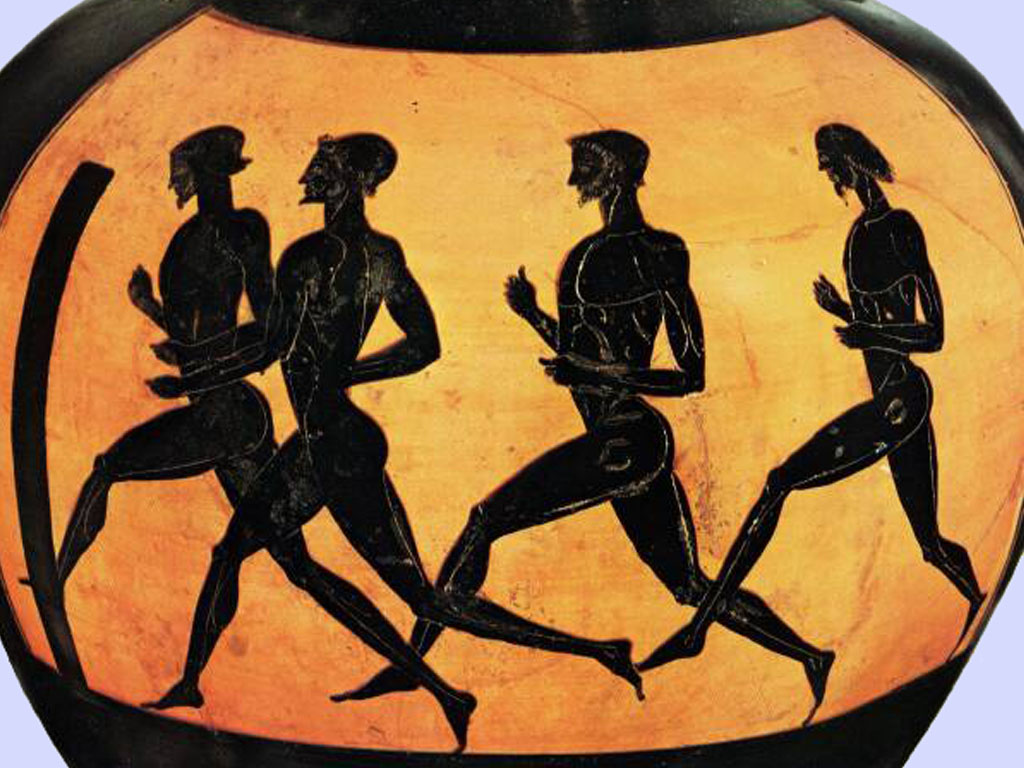
Run the race

Competitive runners depicted on an ancient clay pot. Amphorae filled with oil (often with a depiction of the respective sport on the outside) were the prize for victory at the Panathenaic Games in Athens.
God's discipline

Ancient school in the Middle East where young boys write on clay tablets. Painting by American artist Tom Lovell.
My son, do not despise (take lightly) the Lord's discipline (chastisement, correction),
nor lose heart (give in) when he rebukes you,
6for the Lord disciplines (punishes, chastises) those he loves,
he chastises (punishes, strikes) every son he receives [welcomes close to his heart and loves].
[Quote from , see also ; ; ; ; .] 7When [other manuscripts: if – in Greek, only one letter differs] you endure [until the end goal] during discipline (training, chastisement) – [remember that] God treats you as sons. For what son is not disciplined by his father? 8If you do not receive discipline (training, correction) – something that all the others have received [their] share of – then you are illegitimate children and not real sons. 9Moreover, we had our earthly (carnal) fathers as disciplinarians, and we respected (revered) them. Should we not much more submit to the Father of spirits so that we may live? 10For it was indeed the case that they [our fathers here on earth] disciplined us for a short time (literally: a few short days) as they saw fit (according to what seemed good to them). [Human upbringing is based on incomplete judgments and temporary temperament. Sometimes unfair, sometimes too harsh, other times too lax.] He [God], on the other hand [as our heavenly Father who knows everyone's hearts, see ; ; ], does it for our best [in a combined way that benefits us in all areas], so that we may share in his holiness. 11For the moment (Gk. paron), no discipline (training, chastisement) seems to be a joy, but [rather] a sorrow (grief, pain), but afterwards it yields – for those who have been trained (Gk. gymnazo) by it – [a return in the form of] the peaceful (calm, beneficial) fruit of righteousness. [Fruit is in the singular, as in and .] 12Therefore, strengthen your powerless hands and weak knees []. 13Make straight paths for your feet [], so that what is lame does not go (would go) out of joint, but instead (even better) becomes (would become) healed (cured). [In many descriptions of ancient competitions, especially in pankration, which was a combination of wrestling and boxing, it is described how feet are twisted out of joint.]Seek peace with all and holiness
14Strive (seek eagerly; pursue devotedly) for peace with all and [for] sanctification
– without it, no one (without which no one at all will) see the Lord. 15See to it (Gk. episkopeo, cf. ) [watch over your heart () so]
that no one misses out on God's grace,
that no bitter root grows up
and harms and infects many, 16that no one is sexually immoral [breaking trust and covenant] or unspiritual like Esau [Jacob's brother, see ], who sold his birthright for a single meal. 17You know that when he later wanted to inherit the blessing, he was rejected. He found no way to change his mind, even though he sought the blessing with tears.A kingdom that cannot be shaken
[Now follows a comparison between the original and the renewed covenant. The two mountains Sinai and Zion are used in the parable. On Mount Sinai, the Israelites received the law in fear, see . In contrast, there is now a heavenly Jerusalem on Mount Zion through the blood of Jesus.] 18You have not come to (approached) anything [a physical Sinai mountain] that can be touched [], a mountain covered with fire [],
clouds,
darkness,
storm (weather, thunder),
19to the sound of a trumpet
and a voice that spoke such words that those who heard it begged to be spared from hearing any more. [The people feared God, see , and asked Moses to act as mediator, see .] 20They could not bear what was commanded: "Even if it is an animal that touches the mountain, it shall be stoned." [] 21So terrifying was the sight that Moses said, "I am terrified and trembling." []
22No, instead you have come to the mountain of Zion, the city of the living God,
the heavenly Jerusalem [in contrast to Mount Sinai which the Israelites came to after their exodus from Egypt, see ],
to myriads (literally "tens of thousands," also describing an innumerable number)
of angels gathered for a feast (festival, Gk. panegyris – the word was used for the Olympic Games) [in contrast to the terror when God appeared on Sinai],
23to a gathering of all the firstborn [a first fruit, see ]
who have their name in heaven, to God
who is the judge of all,
to the spirits of the righteous
who have been made perfect [believers throughout the ages who have fallen asleep, and who are waiting to rise together with Jesus and be clothed with a glorified resurrection body, see ],
24to Jesus, the mediator of a renewed covenant [the mediator of the first covenant was Moses],
and the purifying blood that speaks more powerfully than the blood of Abel. [The blood of the first covenant was the sacrificial blood that Moses sprinkled on the people of Israel at Sinai. The covenant with the recurring sin offerings could never cleanse from sin in the way that Jesus' blood does, see . Abel's blood cries out from the ground for vengeance, in contrast to Jesus' blood, which cries out for mercy and forgiveness for our sins, see . Abel's sacrifice of an animal, unlike Cain's sacrifice of crops, is also a first faint shadow of Jesus' blood sacrifice, where Jesus' blood speaks much more powerfully, see .] Warning—do not turn your back on Jesus
[This is the fifth and final warning in this letter. For the others, see ; ; ; .] 25See to it (be constantly vigilant) that you do not reject him who speaks. For if they [the Israelites during the desert journey] did not escape when they rejected him who warned them here on earth, how shall we escape if we turn our backs on him who warns us from heaven?A kingdom that cannot be shaken
26At that time his voice shook the earth [when God spoke to Moses on Mount Sinai, see ], but now he has promised and said: Once more I will shake not only the earth but also the heavens. [The quote is from and refers to when the Lord will return and fill his house with his glory. The passage ends in with the coming glory being greater than the previous one. God is preparing new heavens and a new earth, see ; ; ; .]
27The phrase "once more" shows that what is shaken will disappear (change, be replaced), because it is created, so that what cannot be shaken will remain. 28Now that we have received a kingdom that cannot be shaken, let us have grace [God's favor and power]. In this way, we will serve and please God with reverence and fear, 29for "our God is a consuming fire." [; ]Let your faith be visible in your lives
Remember the believers
131Remain in brotherly love (keep mutual love and care for one another alive). [Showing care for fellow believers makes love visible. Here are two examples that address hospitality and commitment to those deprived of their liberty. Jesus also speaks about this in and lets us understand that what we do, we actually do for the Lord himself.] 2Do not forget to be hospitable (show love by being generous and welcoming to strangers), for through this some have entertained angels without knowing it. [Several people in the Old Testament met angels: Abraham, see ; Lot, see ; Gideon, see ; Samson's father Manoah, see .] 3Remember the prisoners [brothers and sisters in faith who are bound in prison], as though you were their [bound] fellow prisoners, those who are mistreated (tormented, tortured) as though you yourselves were in the body (feeling their suffering).Do not be selfish
[Selfishness is the opposite of love and care. Here the author brings up two areas where selfishness causes problems: sexual morality () and the view of money (). The first part of lacks a verb and forms a chiasm where the adjectives "honorable" and "undefiled" frame the context. Then come two nouns: "marriage" and "bed," which are expressions of sexual intimacy, see ; . The word "all" is central, reinforcing that both unmarried and married people should hold marriage in high esteem as an institution established by God, something that is precious, fine, and beautiful – a sacred covenant.] 4Honorable (glorious, precious)
marriage should be
among all
and the bed
kept undefiled (sexual relations within marriage are a fine and pure gift from God),
for sexually immoral (Gk. pornos) and adulterers [who violate and distort marriage]
will be judged by God. 5Do not be greedy (not money-loving – the Greek adjective afilarguros is composed of three words and means "not-loving-silver") in your ways (character), be content with what you have (your current situation). For he [God] himself has said: No – never [ever] will I leave you (let go of you, give up on you, let you sink),
nor [will] I – no, never [ever] abandon you (leave you helpless in the midst of difficult circumstances). [, ] [Two different negations precede the verb "leave" and are repeated together with a third negation before the verb "abandon" in Greek. This really emphasizes that God will not leave or abandon us. The quote is taken from , where Moses encourages Joshua before entering the Promised Land.]
6Therefore, we can boldly say: The Lord is my helper (the one who rushes to rescue and serve) [],
I will not be afraid (have anxiety, be terrified).
What can man do to me?
[]
7Remember your leaders who gave you (spoke, explained) God's word. Study carefully (reflect on) the outcome of their lives (the end result; how they ended their lives), and imitate (copy; take as an example) their faith (faithfulness). [Many of the early church leaders were now dead – several had died as martyrs, e.g., Stephen and James, see ; . The word "imitate" is also used in , where Paul takes himself, Silvanus, and Timothy as examples of how they had worked voluntarily in Thessalonica so as not to burden the believers there financially. John also uses the same word in about following good examples. He mentions Gaius, who was faithful and known for his selfless love, see , and also Demetrius, whom everyone spoke well of, see .] 8Jesus the Anointed One (Messiah, Christ),
[is always] the same – yesterday [when Jesus walked on earth and the first leaders saw him, see , but also since the beginning of time, see ],
today [in our time],
and forever [in all ages and with the full meaning of eternity].
[Jesus has no beginning and no end and is always the same. Extra emphasis is given here when both his name (Jesus) and his title (Christ) are used. The Greek word Christos means "the anointed one" or "the Anointed One." The Hebrew equivalent with the same meaning is Mashiach (Messiah). Israel's priests and kings were anointed with oil, so the word is generally used to refer to an anointed priest or king who has been set apart for service, see ; , but more specifically, "the Anointed One" refers to the Savior of the world who will reign as king from Jerusalem. Although Hebrew does not distinguish between upper- and lower case letters, Bible translations do so to clarify what is meant. The New Testament authors show that Jesus is the Messiah prophesied in the Scriptures (Old Testament) by unanimously testifying about him as "Jesus the Anointed One" – our anointed King and High Priest. Both the man Jesus – who through his earthly father Joseph was descended from King David (from the tribe of Judah) and through his mother Mary (from the priestly tribe of Levi) – and Jesus, the Son of God, are represented in "the Anointed One." The Father in heaven has appointed and anointed his Son to one day ascend David's throne here on earth, see .] 9Do not be carried away (swept away, deceived) by all kinds of strange teachings. For it is good to be strengthened in your heart [the inner man] through grace and not through [external ceremonial] rules about food, which have not helped those who have engaged in such things. 10We have an altar from which the servants of the tabernacle have no right to eat. 11The blood of the sacrificial animals is carried into the Holy of Holies by the high priest as a sin offering, but the bodies themselves are burned outside the camp. 12Therefore, in order to sanctify the people through his own blood, Jesus also suffered (was tortured and killed) outside the city gate. [The remains of the animals sacrificed in the temple were thrown outside the camp (), in the same way that Jesus was killed on the cross at Golgotha, which was outside the city walls of Jerusalem at that time.] 13Let us go out to him outside the camp and bear [literally: carrying – i.e., while we carry] his reproach (insult, dishonor) [the insult, rebuke, reproach, accusation, and defamation he had to endure]. [Let us leave the emphasis on the external and instead seek Jesus, where inner surrender leads to real change.] 14For here we have no permanent city, but we look forward to (seek, long for) the one to come. 15Through him, we can therefore continually [regardless of circumstances] offer the sacrifice of praise to God [honor and exalt him with song] – that is (that is to say) a fruit from lips that [with gratitude and in full agreement openly] confess [themselves to] (affirm, praise) his name. 16But do not forget to do good and share (do not neglect charity – Gk. eupoiia and fellowship – Gk. koinonia) [both materially and emotionally], for such sacrifices are pleasing (are well-pleasing) to God. 17Listen to your spiritual leaders and let them persuade you [based on the word of God that they speak], for they are constantly watching over your souls and will give an account [for their faithfulness to their calling, see ]. Let them be able to do this [watch over you] with joy and not with a heavy heart (sighing, complaining), for that would not benefit you. [The word "benefit" is literally an economic term: "not to pay." Spiritual leadership that must constantly worry about a congregation is a poor investment.] 18Continue to pray for (around – Gk. peri) us [the author of the letter and those who are with him]! We know that we have a clear conscience, because we want to do what is right (live honestly and righteously in everything). 19I really want to urge you to do this [pray for me], so that I can come back to you soon. [This is the first time the author mentions himself in the letter. He asks for prayer. It is unclear what is preventing the author from coming; suggests that he is free to travel.] 20Now the God of peace, who by the blood of an eternal covenant brought back from the dead our great Shepherd, our Lord Jesus, 21equip you (for service) with everything good so that you may (have the ability to) do his will. He is always at work in us through Jesus the Anointed One (Messiah, Christ) so that we may do what pleases him. His is the glory forever and ever, amen.Closing greetings
[In conclusion, the author defines what he has written. It is both an encouragement and a letter. The word for written is Greek epistello. The English word epistle, which describes a letter, comes from this. The absence of an introduction with sender, recipient, and greeting distinguishes this letter from other New Testament and contemporary letters. The genre appears to be an encouraging sermon with a concluding greeting. It may be that the author, out of humility, chose not to include his own name in the introduction.] 22I urge you, brothers and sisters in faith, to listen patiently to my words of encouragement (edification), for I have written to you briefly. [The letter takes about an hour to read. It is brief in comparison to everything the author had on his heart and wanted to share. In several places, he apologizes for not having time to go into all the details, see ; .] 23I can tell you that our brother Timothy has been released. If he comes here soon, we will visit you together. 24Greet all your leaders and all the saints. The believers (brothers and sisters) who are from Italy greet you [as well]. [It is natural that those who were originally from Rome and Italy greeted their friends in return, which means that the letter was probably written to Rome. The heading of a letter often indicates who the letter is intended for. The Epistle to the Romans, for example, was written to Christians in Rom. In this case, however, the title probably refers to the sender of the letter. They are Jude from some province of the Roman Empire. Ephesus is a possible location. Timothy often traveled there and could have been imprisoned and released.] 25Grace be with you all.