Introduction"Thus says the first and the last,
he who was [literally became] dead but is alive (who rose again):
[Jesus, who himself knows what suffering is, now offers special encouragement to those who suffer for their faith.Encouragement
9I [Jesus] see (know with certainty) your persecution (the pressure, the harsh treatment you endure) and your poverty, but you are rich [spiritually, see ]! [The opposite of Laodicea, where they were financially well-off but spiritually poor, see .] I also know how you are reviled (blasphemed, slandered) by those who call themselves Jews but are not, but are a synagogue of Satan. [Even to the penultimate church, Philadelphia, the synagogue of Satan is mentioned, see .]Criticism
[none] Exhortation10Do not be afraid of what you are about to suffer. Behold, the devil is about to cast some of you into prison, that you may be tested, and you will have tribulation ten days. Be faithful until death [even if you must die a martyr's death for your faith], and I will give you the crown of life. [The image of a crown of victory is taken from the Greek games, where the victor was rewarded with a laurel wreath, see .]
Promise
11He who has an [spiritual] ear, let him hear what the Spirit says to the churches.
He who overcomes shall not be hurt at all
by the second death [the lake of fire, see ]."Letter 3 (of 7) Pergamon – the liberal church

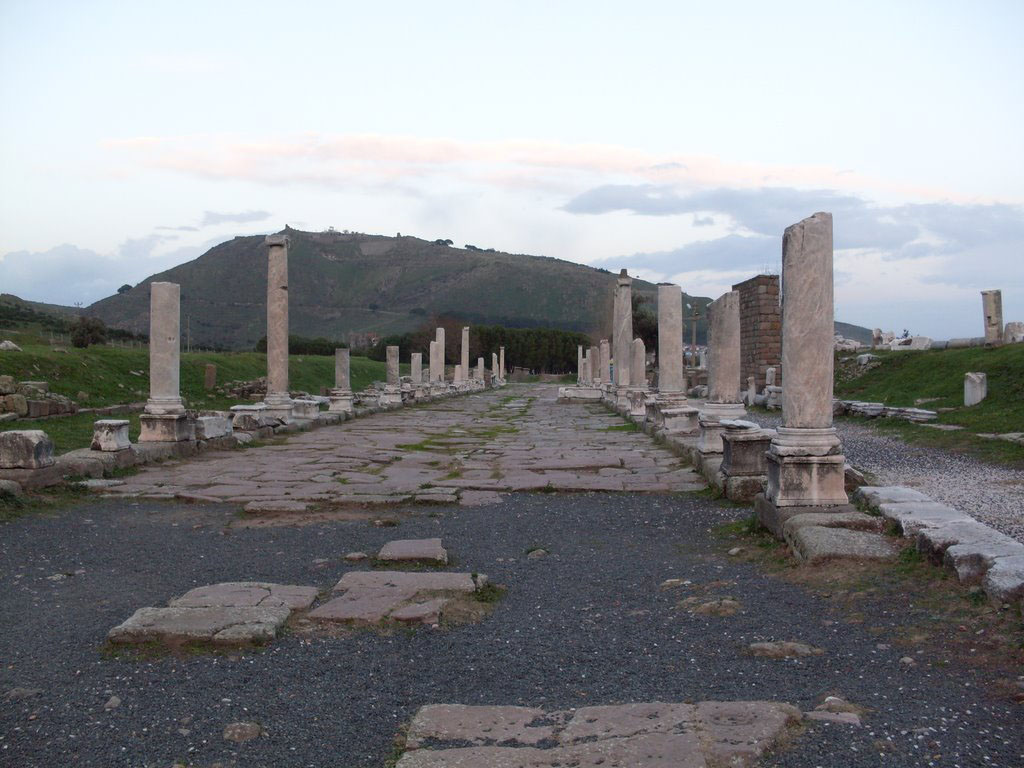
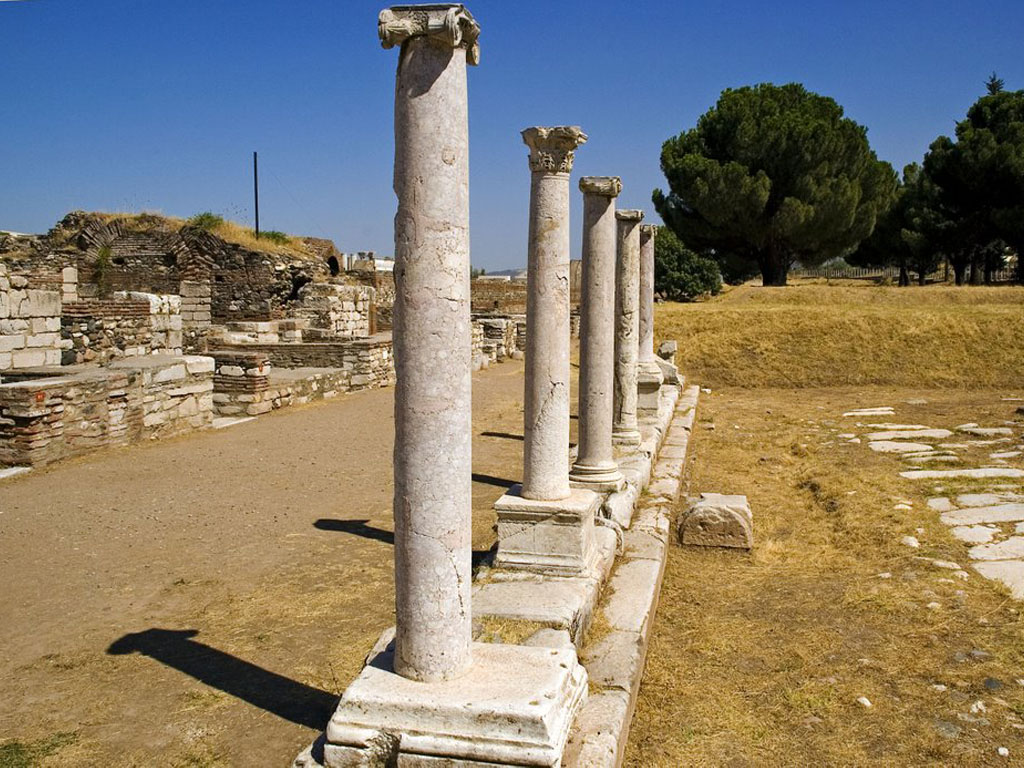
In the background is the Acropolis, where the altar of Zeus was located. In the foreground are the ruins of the healing center of Asclepius.
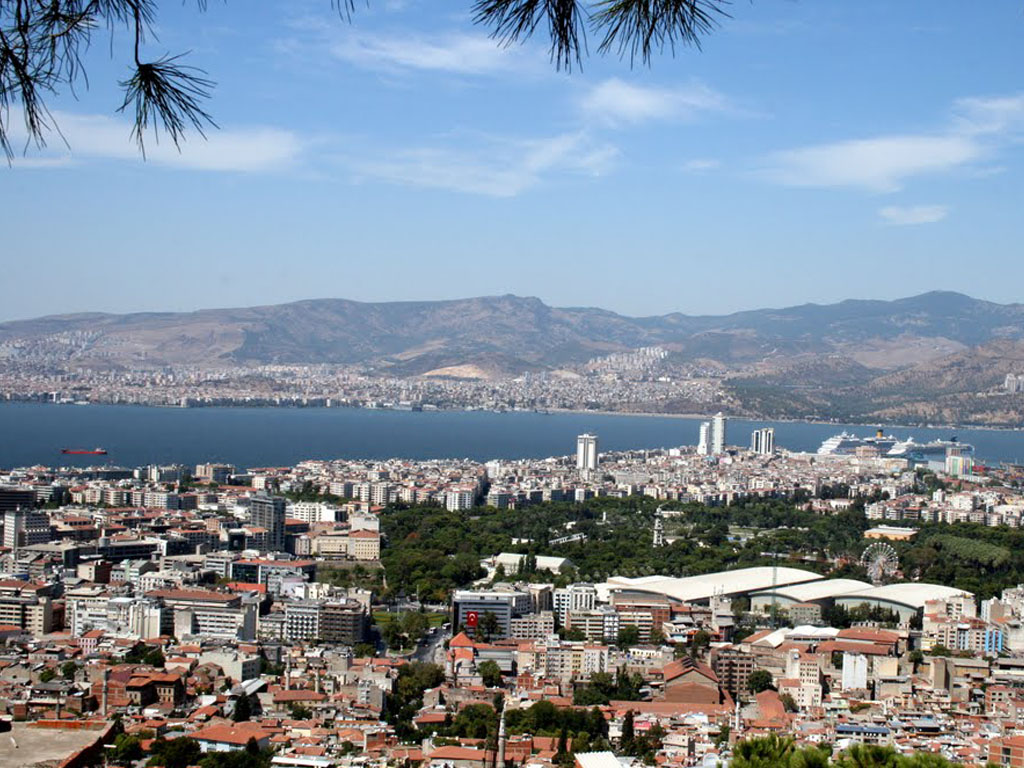
Today: Pergamon, seven miles north of Smyrna.
When John writes this letter, Pergamon has been the capital of Asia Minor for 300 years. It is known for the invention of parchment, which is named after the city. The material was prepared from animal skins and became the competing writing material to the papyrus previously used in Egypt. The city was influential with the world's second largest library at the time. The Greek historian Plutarch writes that it contained 200,000 titles. In Pergamon, many gods were worshipped, including the greatest Greek god Zeus and the god of medicine Asclepius, whose symbol was the snake. Many made pilgrimages here to spend the night in the temple of Asclepius, where they slept among snakes that were believed to speak in dreams, which the occult priests then interpreted.] 12Write the following to the messenger (angel) of the church of Pergamon: Introduction"Thus says he who has
the sharp, double-edged sword: [Literally: "the sword, the one with two edges, the sharp one." The word of God from his mouth is one side, and when we speak the word of God with our mouths, it is the other side of the sword, see also ; .]
Encouragement
13
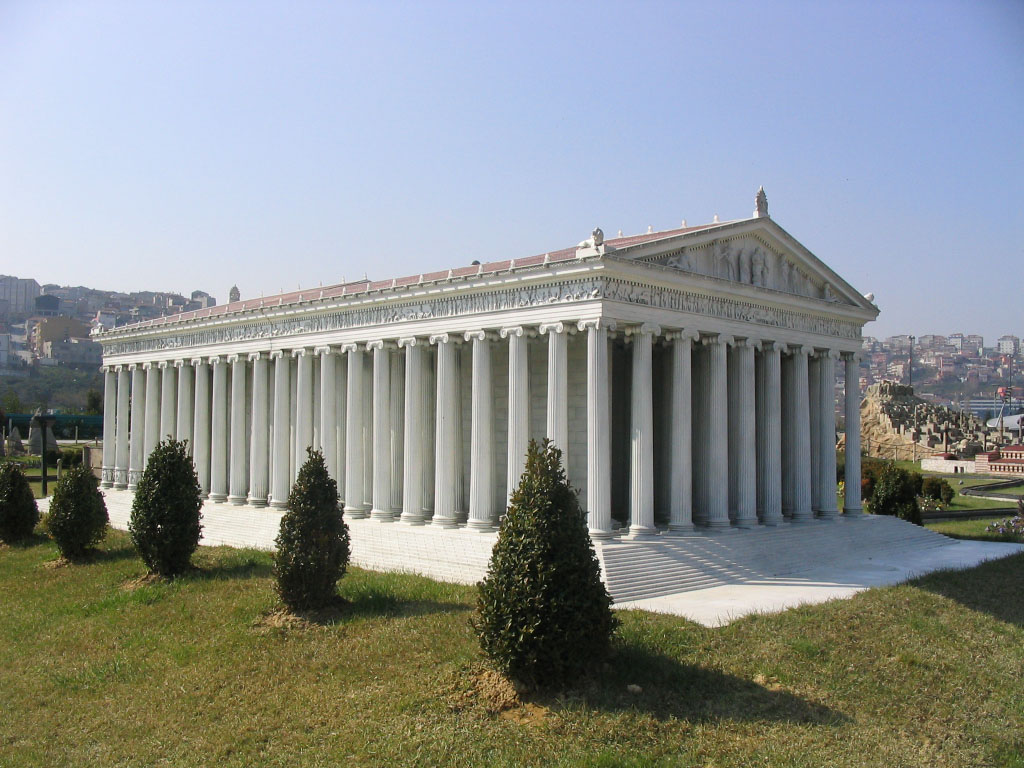
The Pergamon Museum in Berlin houses the altar of Zeus.
It was here that the pastor of the congregation, Antipas, had been martyred for refusing to worship the emperor. According to legend, he had been tied inside a copper ox and burned to death during occult worship around 92 AD, a few years before John wrote this letter. This altar was found in the late 19th century by German archaeologists. It was taken to Berlin, where it was restored and rebuilt at the Pergamon Museum.Criticism
14But I have something against you: you have some among you who hold to the teaching (doctrine) of Balaam, who taught Balak to entice the sons of Israel to eat sacrificial meat and practice sexual immorality. 15You also have those who hold to the teaching of the Nicolaitans.Exhortation
16Repent (change your way of thinking and acting), or I will soon come to you and fight against them [who were like Balaam and followed the teaching of the Nicolaitans] with the sword of my mouth. Promise
17He who has an [spiritual] ear, let him hear what the Spirit says to the churches.
To him who overcomes, I will give some of the hidden manna,
and I will give him a white stone,
and on the stone a new name written, which no one knows except him who receives it." A white stone was used in Roman courts and meant: not guilty. Even in sports, a white stone was used as a prize for victory. The winner received a white stone with his name on it. It could be God's name or the recipient's. Regardless, the meaning is that the believer owns something that only he has received.Letter 4 (of 7) Thyatira – the pagan church
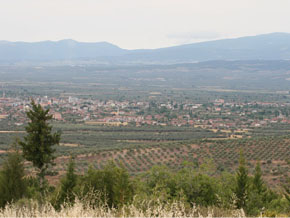
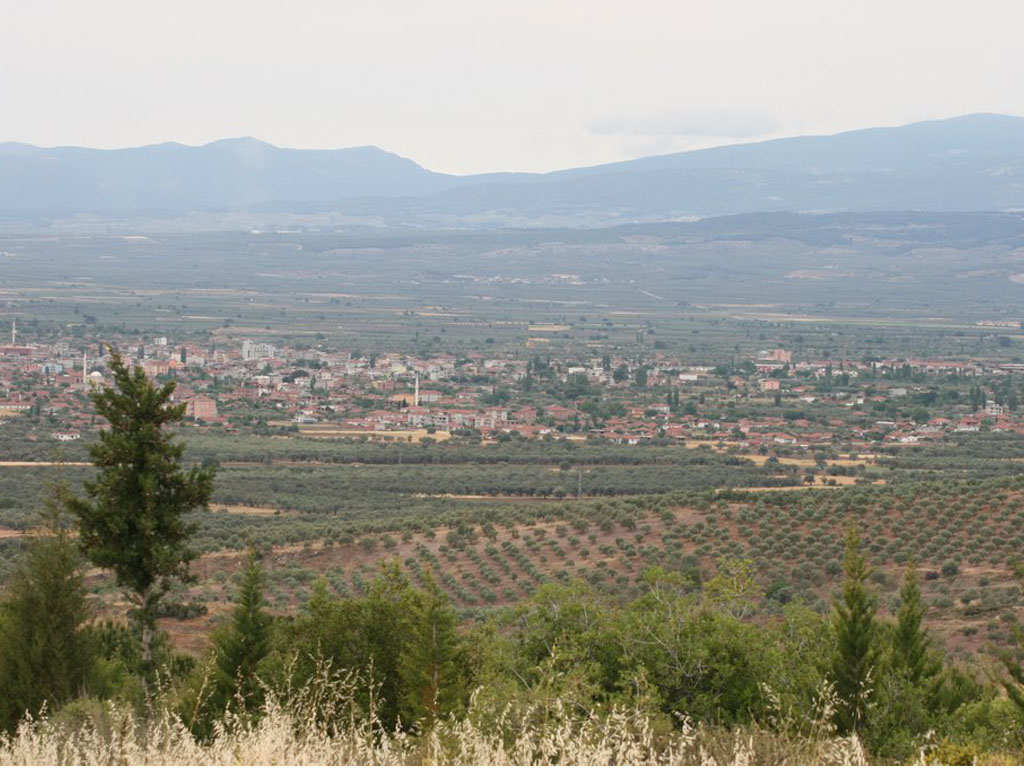
In the fertile valley lay Thyatira, known for its wool and production of fabrics in various colors. There was also a large military camp here.
©Panoramio
Today: Akhisar, ten miles east of Pergamon along the road to Sardis. The smallest of the seven cities, but the longest greeting with forty Greek words. It was a rich city known for its production of pottery and bronze armor, but perhaps most of all for its textile industry with weaving mills and purple dye works. From this city came Lydia, a businesswoman who traded in fabrics. She was converted in Philippi, see . She probably had relatives and friends who were members of the church and probably visited her hometown from time to time.] 18Write the following to the messenger (angel) of the church in Thyatira: Introduction "Thus says the Son of God,
he whose eyes are like a flame of fire [] [who sees into hearts and searches and judges, see ],
whose feet are like burnished bronze [] [which crushes the Gentiles like clay pots, see ]: [The imagery is the same as in .]
Encouragement
19I [Jesus] see (know with certainty) your deeds,
and your love [which is selfless and generous],
and your faith (faithfulness, perseverance),
and your service (practical service – Gk. diakonia),
and your endurance (steadfastness) [that you stand firm even under trials],
and that your last deeds
are more than your first.Criticism
20But I have this against you [singular – the congregation/leadership as a whole, or the pastor]: You tolerate (do nothing about) the woman Jezebel, who calls herself a prophet and teaches and seduces my servants to commit sexual immorality (illicit sex – Gk. porneia) and eat sacrificial meat.
[This woman, who probably had a different name, refers to Ahab's infamous wife Jezebel, who cunningly and actively led the Israelites away from God and introduced the worship of Baal, see ; ; . Here in Thyatira there was a woman (the wife of an influential man) who was allowed to run rampant in the church and led them to believe that it was not wrong to visit temple prostitutes and eat sacrificial meat, which was contrary to what was taught, see .]
21I gave her time to repent, but she does not want to repent of her immorality. 22Behold, I will put her on a bed of suffering, and those who commit [spiritual] adultery with her I will afflict with severe suffering unless they repent of her deeds. 23I will kill her children [followers] with pestilence. And all the churches shall know that I am he who searches the minds and hearts [an Old Testament image of "the inner man"], and I will give to each of you [reward] according to his deeds.Exhortation
24But to the rest of you in Thyatira who do not hold to this [Jezebel's] teaching, all of you who do not know the depths of Satan, as it is called, I say: I will not impose any new burdens on you. 25Hold fast what you have until I come. Promise
26To the one who conquers and keeps my works [keeps my commandments and does what pleases me] until the end, I will give authority over the nations, 27and he shall rule them with a rod of iron, as one breaks pottery [] – 28[the same power] that I also received from [actively and willingly accepted from] my Father. And I will give him the morning star [which is Jesus himself, see ].
29You who have an [spiritual] ear, listen to what the Spirit says to the churches."Letter 5 (of 7) Sardis – the dead church
31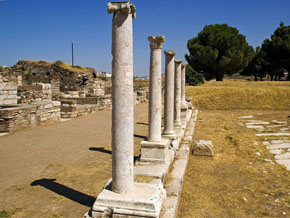
Pelargata from ancient Sardis.
©Panoramio
Today: In ruins, next to the small village of Sart, 60 km south of Thyatira.
Sardis was the ancient capital of the province of Lydia in Asia Minor. It was located on a plain through which flowed the river Pactolus, which had large gold deposits. It was a hub between several trade routes and a rich city famous for its gold. The world's first gold and silver coins were minted in the Lydian Empire in the 6th century BC. The last king of the Lydian Empire was Croesus, who reigned from 560 to 547 BC. He was immensely rich and arrogant, giving rise to the saying "rich as Croesus." The city was located on a 450-meter-high mountain plateau with three steep sides and was considered impregnable, which meant that these sides were not guarded very closely. Both Cyrus and Epiphanes surprised the city with soldiers who climbed a steep path among the cliffs and captured their fortifications during the night. The expressions "awake" in and "like a thief in the night" in resonated with the Sardinians. The city was also known for its dye works and wool weaving. It prided itself on being the first in the world to dye wool. Their black woolen fabrics were a sought-after commodity throughout the Roman Empire. Write the following to the messenger of the church in Sardis: Messenger is Gk. for aggelos. It can refer to an angel, but more likely it refers to the leadership of the church who are to read the letter and convey the message to the church.] Introduction "Thus says he who has the seven spirits of God [the Holy Spirit who is fully revealed, see ]
and the seven stars [the messengers of the seven churches, see , ]: Encouragement [none] Criticism I [Jesus] see (know with certainty) your deeds; you have a reputation of being alive, but you are dead. [Jesus' words about them being alive but dead were apt. The people of Sardis were widely known for their licentiousness and love of luxury and pleasure. Herodotus wrote in the 400s BC about the inhabitants of the city: "The light-footed Lydians only want to play the zither and harp and engage in retail trade."]
Exhortation
2
Gold coins from the time of Croesus.
Promise
4But you have a few people in Sardis who have not soiled their clothes. [Dirty clothes are a picture of a life of sin, influenced by the ways of the world.] They will walk [in fellowship] with me in white clothes [in purity] because they are worthy (deserve) it.
5Therefore, whoever overcomes [wins over sin] will be clothed in white garments. And I will not blot out his name from the book of life. I will confess his name before my Father and before his angels. [The books and the book of life will be opened when all who have died will be judged before the great white throne, see . The mention of white garments was highly relevant in the weaving town of Sardis, known for its black woolen cloth. Having one's name in the book of life is a biblical image of salvation and eternal life, see . But it was also a meaningful image for the non-Jewish Christians in Sardis. Cities in the Greek world kept a register of their citizens. Criminals were removed from this list and lost their citizenship. Those who have given their lives to Jesus, who took all sin upon himself, can be sure of their salvation.] 6You who have an [spiritual] ear, listen to what the Spirit says to the churches."Letter 6 (of 7) Philadelphia – the living church

View of the modern city of Alasehir, built on the site of the ancient city of Philadelphia.
Today: Present-day Alasehir, 25 miles east of Sardis at the end of the valley.
The area is prone to earthquakes, and the city was completely destroyed in 17 AD. Just as the city was known for its loyalty, the church there was faithful to Jesus, see verses 8 and 10.] 7Write the following to the messenger (angel) of the church in Philadelphia: Introduction "Thus says he who is Amen (the true one), he [the Holy One, the True One] who has the key of David,
he who opens
so that no one can shut
and shuts
so that no one can open:
Encouragement
8I [Jesus] see (know with certainty) your deeds. Behold, I have set before you an open door that no one can shut. [This expression is often used as a picture of successful evangelism. The next verse gives a promise that the most hateful opponents in the city will be saved!] I know that your [own] strength is small, and that you have kept my word and have not denied my name. 9Behold, I will make those of the synagogue of Satan, who say they are Jews and are not, but lie – behold, I will make them come and bow down at your feet, and they will know that I have loved you. 10Because you [the church in Philadelphia, and primarily addressed to the church leader] have kept (protected, been faithful to, and followed) the word, which requires endurance (steadfastness), I will [Jesus] also keep (protect) you from the hour of trial that is coming upon the whole world to test those who dwell on the earth. [The expression "keep you from" can mean "keep you from trial" or "keep you even during trial."]Criticism
[none] Exhortation11I am coming soon (suddenly, as soon as possible). Continue to hold fast to what you have so that no one [the devil] takes away your crown of victory.
Promise
12To the one who conquers, I will make him a pillar (be firm and be important) in the temple of my God, and he will never leave it. On him I will write:
the name of my God,
and the name of the city of God,
the new (better) Jerusalem that comes down out of heaven,
from my God,
and my new name. 13You who have an [spiritual] ear, listen to what the Spirit says to the churches."Letter 7 (of 7) Laodicea – the lukewarm church

The remains of ancient Laodicea.
Today: Present-day Eski Hissar, the easternmost city of the seven, located in the province of Phrygia.
Laodicea was a rich city, famous for its black shiny wool and a medical research center that produced an eye ointment. The city's water came through long pipe systems from nearby sources in the mountains. The city was destroyed in 60 AD by an earthquake. The emperor of Rom offered help, but the city was so rich that it declined the offer and rebuilt itself with its own resources, something Jesus alludes to in .
In the two churches that receive criticism and no encouragement (Sardis and Laodicea), there is no mention of external opponents or internal strife. While the church in Laodicea receives Jesus' sharpest rebuke, it is also here that the greatest promises are given, that those who overcome apathy and indifference will reign with Jesus.
14Write the following to the messenger (angel) of the church in Laodicea:] Introduction "Thus says he who is Amen (the true one) [],
the faithful and true (genuine) witness,
the beginning of God's creation:
Encouragement
[none] Criticism15I [Jesus] see (know with certainty) your deeds; you are neither cold nor hot (burning, boiling; having great enthusiasm – Gk. zestos) []; I wish you were either cold or hot.
The problem was that by the time the water reached Laodicea, it was neither cold nor hot, but lukewarm. The metaphor is that the church had no impact on its surroundings. It provided neither refreshing coolness nor healing warmth. Instead, the surroundings had influenced the church so that it was lukewarm.
16But because you are lukewarm, and neither cold nor hot, I must (I can do nothing else but) spit you out of my mouth. 17Because you say, 'I am rich [materially, but also spiritually] and have abundance and need nothing more,' but you do not understand that you [in my eyes] are: miserable (pathetic)
and pitiful (sad)
and poor (completely unable to work, forced to beg)
and blind
and naked.
Exhortation
18I advise you: Buy from me gold refined in fire,
so that you may become rich [with true real wealth]. [Laodicea was a rich trading city, but instead of trading in goods, the advice is to "buy" God's gold. Righteousness comes through faith in Jesus, and faith tested by fire glorifies Jesus, see ; .] Buy white clothes from me,
so that you may be clothed, and your shameful nakedness not exposed. [Laodicea was known for its textile industry. They made luxurious shiny clothes from black wool from their sheep. Instead of these dark clothes, Jesus advises them to clothe themselves in his white garments!]
Buy eye salve to anoint your eyes,
so that you may see. [In Laodicea, there was also a medical research center that produced eye salve. The salve was called Phrygian powder. Now Jesus advises that instead, they should let him anoint them so that they can see!] 19I rebuke (convince, refine) and discipline (educate, guide, correct, train) [continuously] all those whom I love (care for; as many as I would be friends with and associate with – Gk. phileo) [freely quoted from ]. So be [constantly] eager (warm, devoted; literally: 'boil over'), and repent (change your way of thinking)! [; ] 20Behold, I stand [still] at the door [outside the congregation] and knock. If anyone hears my voice and opens the door, [then] I will come in to him and dine (have a meal) with him, and he with me. [The Greek here literally says, "has stood at the door." This, together with "knocking," describes a repeated ongoing event; see also ; ; ; . Jesus both knocks and speaks to his congregation and individual believers. The knocking can be external circumstances, trials, and sufferings when a person is reminded of the fragility of life. Jesus is then close by and speaks through the Holy Spirit, see . A meal describes a close fellowship – we "break bread" together with him himself, see ; ; ; .]Promise
21Whoever wins the victory [over lukewarmness and indifference, the problem in Laodicea, see ], I will let sit with me on my throne, just as I won the victory [over all the powers of evil] and sat down with my Father on his throne. [Where he sits today, see Col. 3:1. God's grace is so great that those whom Jesus had just threatened to spew out of his mouth, see , are now invited to share his throne if they heed his warning and repent!]
22He who has an [spiritual] ear, let him hear what the Spirit says to the churches." [The last phrase, "He who has an ear, let him hear what the Spirit says to the churches," recurs in all seven letters and gives an individual exhortation to every Christian to take to heart the warnings and promises in all seven letters. In the first three, the phrase comes before Jesus' promise, and in the last four, it comes after the promise. Jesus often used the expression "he who has ears" in his teaching when he really wanted to capture his listeners' attention in the face of great truths or promises, see ; . One detail that distinguishes its use here in Revelation from its use in the Gospels is that the word "ear" is in the singular. This may be a way of further clarifying that it is the spiritual ear and the ability to listen to the voice of the Spirit that is emphasized.]THE SECOND VISION – The Heaven of Faith and the Seven Seals (chapters 4-7)
An open door to heaven

In his vision, John now sees a door to heaven that is open.
The perspective now shifts from earth to heaven. Chapters 4-19 mainly describe God's judgment of the world before Jesus reigns in the millennial kingdom. The judgment is described through: - Seven seals that are opened – chapters 6-8.
- Seven trumpets that sound – chapters 8-11.
- Seven bowls of plagues that are poured out on the earth – chapter 16.
The number seven is often divided into two groups, with first four and then three judgments that belong together.] 41After [all] this, I saw – and behold [the double verbs "saw" and the exhortation "behold, notice; observe" express a contrast, a new dimension and panoramic view in the vision, see also ], there was a door standing open in heaven. The same voice that I had first heard speaking to me like a trumpet (military trumpet, with a clear signal) said, "Come up here, and I will show you what must happen after this." [The risen Jesus continues to speak to John, see , .]The throne in heaven
2
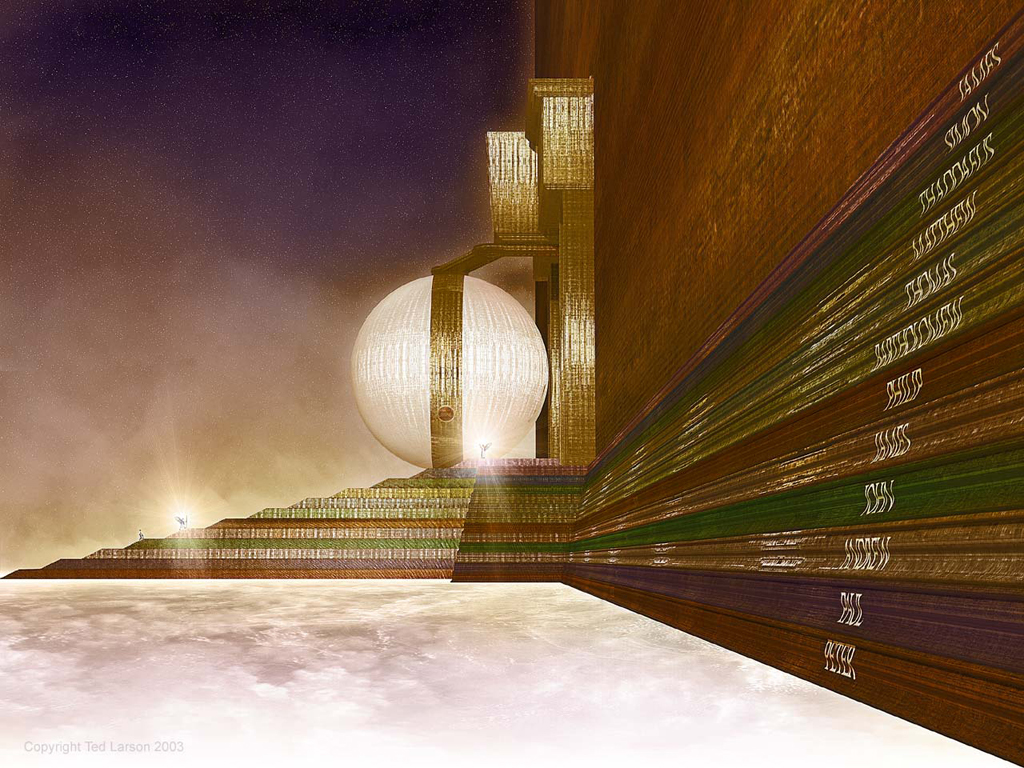
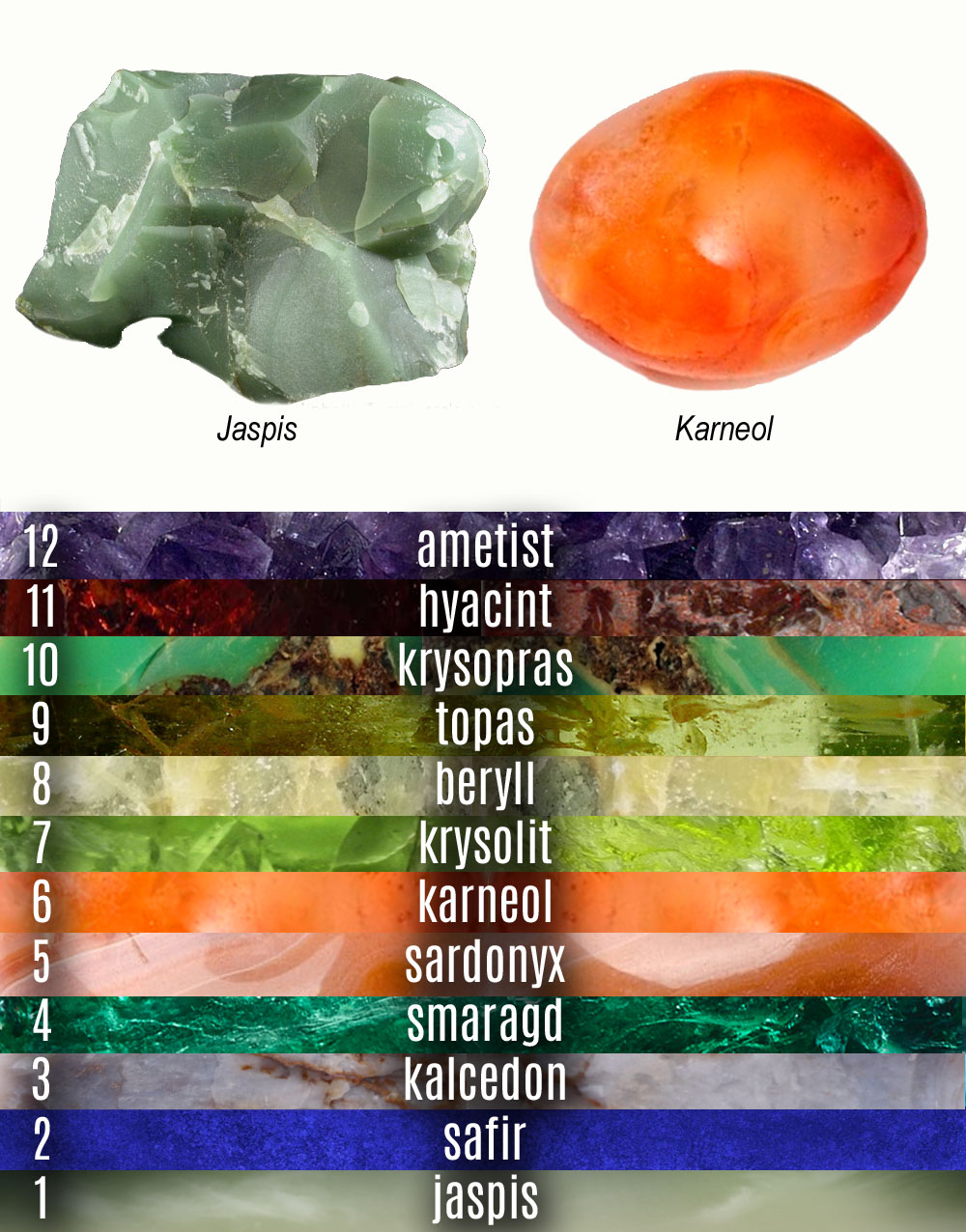
In John's vision, he sees the last and first gemstones in the high priest's breastplate. Hebrew is written and read from right to left, so the first gemstone was placed at the top right and the last at the bottom left of the breastplate.
The twenty-four elders
4
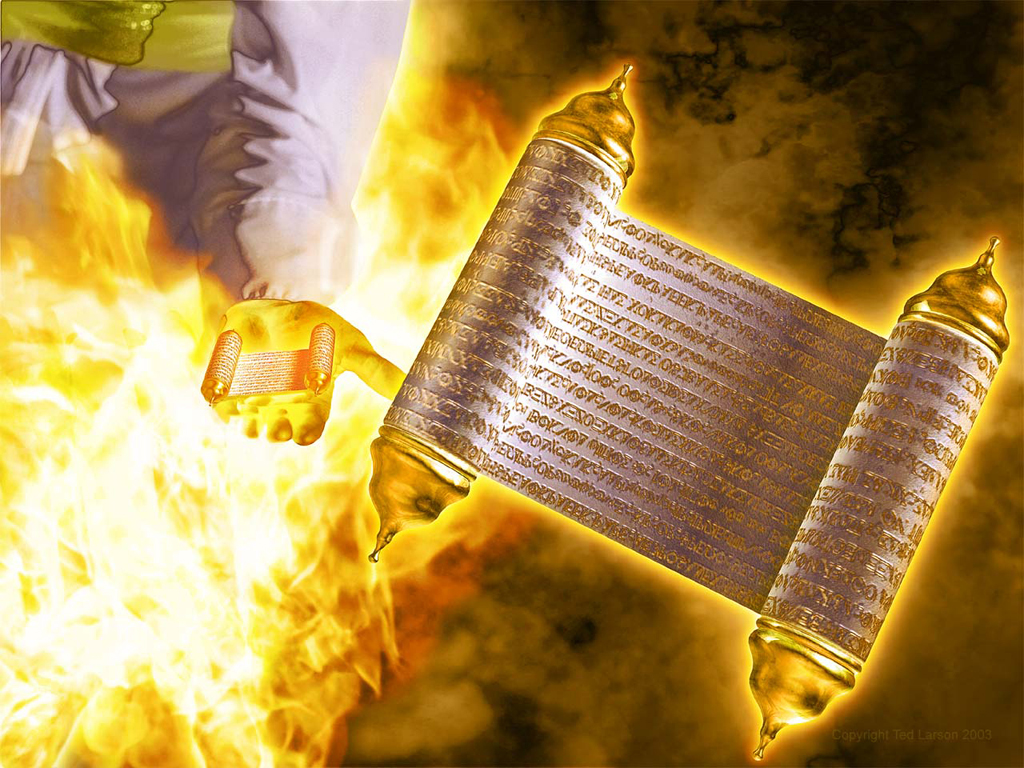
God's throne is what catches John's attention. John tries to describe what he sees using parables. Illustration by Ted Larson.
Before the throne burned seven torches, which are the seven spirits of God. [The seven spirits probably do not refer to seven different spirits, but to the Holy Spirit, who is perfect and complete, see . A similar example can be found in , where the prophet mentions seven aspects of the coming Messiah.] 6In front of the throne was something like a sea of glass, like crystal. [Once again, words are not enough. John sees something that resembles a sea. In the tabernacle, there was a small round bronze basin where the priests washed their hands and feet before performing their duties, see . It was made of bronze that had been used as mirrors, see . The water must have sparkled and reflected in the material so that it looked like a sea. When Solomon built the temple, the basin was enlarged to become a larger circular pool. Its diameter was 4.5 meters and its depth was just over two meters, and it is called "the sea," see . The next time John sees the sea of glass, it is mixed with fire, see .] The four creaturesIn the center of the throne and around it stood four creatures (living beings, animals) that had eyes all around and within themselves. [The many eyes symbolize intelligence and that they watch over the throne.]
7The first creature was like a lion.
The second creature was like a young bull.
The third creature had a face like a man.
The fourth creature was like a flying eagle. [It is not entirely clear what these four creatures are or symbolize. Since they worship at God's throne, they are created beings. They seem to be a combination of the cherubim in and the seraphim in , who also sang "holy, holy, holy." These four creatures are also present when the first seals of the scroll are opened, and they say "come," see chapter 6. The four creatures also represent the four major groups that God created on earth – birds, wild animals, livestock, and humans, see . The eagle is the foremost of the birds, the lion is the king of the wild animals, etc. One interpretation is that everything created on earth is meant to worship God.
There is also a connection to the four Gospels and how Jesus is presented, an interpretation that was common among the Church Fathers. Matthew presents Jesus as king – the lion from the tribe of Judah. Mark presents Jesus as the Lord's servant – the ox that pulls. Luke focuses on Jesus' humanity, which may then represent the third creature that had the human face. Finally, John points to Jesus' divinity, which is represented by the eagle. There is also a connection to four of the twelve tribes (Jude, Reuben, Ephraim, and Dan) that were located closest to the tabernacle, see .] 8The four creatures (living beings, animals) each had six wings. Each wing was covered with eyes all around (on all sides), both inside and outside. Day and night they said [sang] without ceasing: "Holy, holy, holy
is the Lord God Almighty (the Sovereign Lord),
who was and is and is to come."
9When (every time) these beings praise, honor, and thank him who sits on the throne and who lives forever and ever, 10the twenty-four elders fall down before him who sits on the throne and worship him who lives forever and ever. They lay their crowns before the throne [in respect and reverence] and say: 11"You are worthy, our Lord and God, to receive
the glory (praise, honor)
and honor (praise, respect)
and power (strength, might, ability),
for you created all these (them all; all these),
by your will (desire) they came into being
and were created." The scroll and the Lamb
51
©Ted Larson
The scroll, seals, and temple also bring to mind the law of redemption described in . There is an example of this entire process in . In the midst of the siege of Jerusalem by Babylon's king Nebuchadnezzar, Jeremiah receives a word from the Lord to buy back a piece of land from his cousin. This concrete prophetic act shows hope for the future. There will be peace. The land will be bought back and return to its rightful owner. In the presence of witnesses, the exact same purchase contract was recorded on two papyrus sheets. Both were rolled up, one sealed with a seal while the other remained open so that it could be read. In the event of a dispute over a piece of land, a priest could break the seal, open the original document, and settle the dispute.
Jesus is the judge who can redeem the earth, which is currently "under siege." Paul describes how all of creation is subject to decay, but one day it will be redeemed, see .] 2
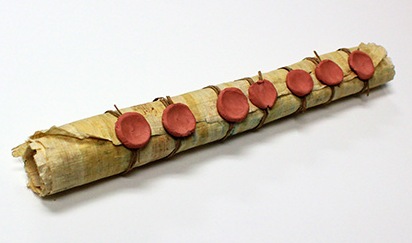
Scroll with seven seals.
The Lamb that was slain
6Then I saw (and I saw) a Lamb [a yearling ram] standing in the center, between the throne and the four creatures and the [twenty-four] elders. [In the previous verse, John "hears" about a lion that has triumphed, see . When he looks again, it is instead a lamb that appears. The following three descriptions make it perfectly clear that it is the risen Jesus whom John sees manifested centrally in the middle of the throne room.] It looked as if it had been slaughtered,
had seven horns [a symbol of perfect strength and power]
and seven eyes [all-seeing], which are the seven spirits of God sent out over the whole earth. [The seven spirits are probably a symbol of the Holy Spirit who is perfect, see . Earlier in , John saw the seven spirits as seven burning torches near God the Father on the throne. The same Holy Spirit is now seen near the slaughtered lamb – the Son of God.] 7The Lamb came and took the scroll out of the right hand of him who sat on the throne. 8When he took the scroll, the four living creatures and the twenty-four elders fell down before the Lamb. Each one had a harp and golden bowls full of incense, which are the prayers of the saints. [An angel then lifts these up on the altar, see .] 9And they sang a new song: "You are worthy to take the scroll and break its seals,
for you were slain,
and with your blood you purchased for God
people from every tribe
and language
and people (ethnic groups)
and peoples (ethnic groups).
[The same four words appear again in – in reverse order, except for "tribes".]
10You have made them a kingdom
and priests to our God,
and they shall reign on earth." An endless multitude
[John sees another dimension in his vision, and his perspective broadens even more.] 11Then I looked (and I saw), and I heard the voice of many angels standing around (as in an outer circle on all sides of) the throne and the creatures and the [twenty-four] elders [who stood closest to the throne]. Their number was myriads of myriads, and thousands upon thousands. [A myriad denotes the highest numerical value in Greek, which is 10,000, but is also used figuratively to describe an innumerable quantity.] 12They said with a loud (strong) voice: "The Lamb that was slain is worthy to receive:
power [Gk. dynamis – the power and capacity to perform God's works]
and riches
and wisdom
and strength [Gk. ischys – ability, power to perform God's deeds]
and honor (praise, esteem, respect)
and glory (honor, praise)
and blessing (praise, adoration)." [Three of these nouns were expressed by the twenty-four elders in their praise – however, in this order: glory, honor, and power, see . Here follows a crescendo in the praise:]
13Every creature (every created being that exists) in heaven and on earth and under the earth and in the sea, yes, everything (all of them) that is in them, I heard saying: "To him who sits on the throne [the Father]
and to the Lamb [Jesus]
belongs
the praise (the word of praise, the worship),
and the honor (the price, the esteem, the respect)
and the glory (the honor, the worship)
and the power (sovereignty; kratos – the power to rule, the power to govern)
for ever and ever."
14The four living creatures [] said, "Amen" (it is true, let it be done).
The elders [] fell down and worshiped. [In this crescendo of praise, all creation praises the Father and the Son. In a chiastic pattern, chapters 4-5 are framed by a description of how the four living creatures and the twenty-four elders worship.]The seven seals are opened (chapters 6-8)

Seven seals are opened, the last of which contains seven trumpets. The last trumpet, in turn, consists of seven bowls.
There are similarities between the seven seals and Jesus' discourse on the end times in Matt. 24-25. They follow the same order: - False messiahs – ;
- War – ; ;
- Death – ;
- Martyrdom – , ; , , ;
- God's judgment – ;
The seals can be divided into a first group of four and a final group of three seals. The first four follow a similar pattern where the four creatures around the throne speak, and for each seal that is opened, a horse appears.
The seals could be placed on the outside or inside of the document. If they were on the inside, they sealed one section at a time, and for each seal, another section could be read. Since John sees all seven seals, the scroll was sealed with seven external seals, see . This means that it was only when the last seal was broken that the scroll could be opened, see .] First seal – a white horse 61Then I saw (and I saw) when the Lamb broke (opened) one [the first] of the seven seals (seals).
Then I heard one of the four creatures [the one that resembled a lion, see ] say with a voice like thunder [mighty and powerful]: "Come!" [Earlier, John had heard Jesus' voice like a trumpet and the roar of mighty waters, see , . This voice, however, comes from one of the four creatures in front of the throne, see . This is the first description of their voices and, in this case, the creature that "looked like a lion," see .].
2Then I saw (and I saw), and behold (an exhortation to pay attention to what follows): a white horse, and he who sat on it had a bow [either a bow and arrow or a symbol of promise]. He was given a victory wreath, and he went forth as a victor to conquer. [The double verbs "saw" and the exhortation "behold" express a contrast and a new dimension in the vision; the same phrase recurs in verses 5 and 8. The bow, together with the crown of victory and the description that "he goes forth to conquer," seems to speak of war. This is the only time the bow, Gk. , is used in the New Testament. The word comes from tikto, which means to bring forth, a seed that bears fruit, or metaphorically, to create a new beginning. The bow can also symbolize that the rider comes with a promise of peace, cf. . The four horses belong together, see . There are similarities with Jesus coming on a white horse, see , but it is more likely that this is a false messiah. The white horse and rider may symbolize the initial peaceful promises a conqueror first makes. If one sees a parallel to , , the first warning applies precisely to false messiah figures who will deceive many.]The second seal – a red horse
3
The four horses and riders. Illustration from revelationillustrated.com.
©Pat Marvenko Smith
Third seal – a black horse
5When the Lamb broke the third seal, I heard the third creature [which had a face like a human being, see ] say: "Come!"
Then I looked (and I saw), and behold (an exhortation to pay attention to what follows): a black horse, and the one who sat on it had a pair of scales in his hand. 6And I heard a voice among the four living creatures saying, "A measure of wheat [Gk. choinix – a day's ration, about a liter] for a denarius [the usual daily wage for a laborer] and three measures [about three liters] of barley for a denarius. [More than ten times the price of food.] But do not damage the olive oil and wine." [After the sword, which speaks of war, famine often follows. It can also be related to severe inflation and economic imbalance.]Fourth seal – a green horse
7When the Lamb broke the fourth seal, I heard the fourth creature [which resembled an eagle, see ] say, "Come!" 8Then I saw (and I saw), and behold (an exhortation to pay attention to what follows): a green horse, and the one who sat on it was named Death, and Hades (the realm of the dead) followed him. They were given power over a quarter of the earth, to kill with sword and with famine and with pestilence and by the beasts of the earth. [In the judgment of Jerusalem, famine, wild beasts, sword, and pestilence are mentioned, see .] [The Greek word for the color of the fourth horse is Gk. chloros. The word is used throughout the Bible for greenery and green grass, see ; ; . The word was also used among the Greeks to describe the yellow-green color of a sick person's skin. The readers of the letter probably associated it with Zech. 6, where he sees red, black, white, and speckled horses, see . If we compare Zech. 6's and John's visions, the white and black colors correspond exactly, while Zech. 6's red color has been intensified to fiery red. The speckled color corresponds to the last greenish chloros-colored horse. Another clue to the color of the last horse is found in , where the word for vine is used to describe the speckled horse's color. The vine is first light green when it sprouts, then darkens and finally turns brownish. It seems that the last horse is green, with several yellow-green or brown shades. If these colors refer to kingdoms, there may be a connection to Nebuchadnezzar's vision of a statue with four parts. The fourth, the foot consisting of both clay and iron mixed together, symbolized that it would be a divided kingdom, see .]Fifth seal – Christian martyrs in heaven

Only God can give a just judgement.
©Tori Rector, flickr CC
Sixth seal—heaven, sea, and land shaken
12And I saw when the Lamb broke the sixth seal. Then there was a great earthquake. The sun turned black like mourning clothes, and the whole moon became like blood. [] 13The stars of heaven fell to the earth, as when a fig tree drops its unripe fruit when shaken by a strong wind. 14And the sky disappeared as when a scroll is rolled up, and all the mountains and islands were moved from their places. [Isa describes the same event using the same language, see . Here there is a change in the three spatial dimensions and perhaps also in time and in several of the total of 10 dimensions that modern quantum physics speaks of, see ; ; ; .] 15The kings of the earth and their nobles [the highest political leaders of the countries] and commanders [military leaders], the rich and powerful [with economic influence] and all slaves and free men hid themselves in caves and among the rocks of the mountains [], 16and they said to the mountains and rocks, "Fall on us and hide us from the one who sits on the throne and from the wrath of the Lamb! 17The great day (time) of their wrath has come, and who can stand?" [Luke 23:30] [The seventh seal is opened in chapter 8. Before that, John sees another vision in chapter 7 that has to do with believers.] [There is now an interruption between the sixth and seventh seals. The same structure with a parallel plot can also be found between the sixth and seventh trumpets, see chapters 10-11. The question asked in the previous chapter about who can stand is now answered. Two groups are described, the 144,000 and an innumerable multitude. The first group is Jews from the twelve tribes, the second is Gentiles from all nations. The first group is counted, the second is an innumerable multitude. The first group is marked here with God's seal, the second group stands in heaven before God's throne. If one reads Jesus' discourse on the last days from Matt. in parallel with this chapter, the 144,000 may be God's special witnesses during the tribulation, see .] the 144,000 71After this, I saw four angels standing at the four corners of the earth [the four cardinal points] holding back the four winds of the earth so that no wind would blow over the earth or the sea or any tree. [Wind is often used symbolically for God's Judg., see ; ; .]
2I saw another angel coming up from the east (where the sun rises) with the seal of the living God. He called out in a loud voice to the four angels who had been given power to harm the earth and the sea: 3"Do not harm the earth or the sea or the trees until we have sealed the foreheads of the servants of our God!" [Once again, an image is borrowed from Ezekiel's vision, where a man dressed in linen is given the task of going through the city and drawing a mark on the foreheads of all those who weep and sigh over the sin they see around them, see . Later in Rev, God's opponents are forced to receive a mark on their right hand or forehead, see .] 4I heard the number of those who had received the seal, 144,000 from all the tribes of the sons of Israel: 5from the tribe of Judah 12,000 [the family of Jesus, see ; ] who had received the seal,
from the tribe of Reuben 12,000 [],
from the tribe of Gad 12,000 [],
6from the tribe of Asher 12,000 [],
from the tribe of Naphtali 12,000 [],
from the tribe of Manasseh 12,000 [one son of Joseph, see ; ],
7from the tribe of Simeon 12,000 [],
from the tribe of Levi 12,000 [the priests, who were not normally counted, see ],
from the tribe of Issachar 12,000 [],
8from the tribe of Zebulun 12,000 [],
from the tribe of Joseph 12,000 []
and of the tribe of Benjamin 12,000 [the youngest, see ] who received the seal. [The twelve tribes originate from Jacob's twelve sons. This is the only list of the tribes in the New Testament and is unusual in several respects. This is the only time Jude is mentioned first, perhaps because Jesus was of that tribe, see ; ; . Jacob's eldest son, Reuben, comes second, and last comes the youngest, Benjamin, but the others do not appear in order of birth.
The tribes of Dan and Ephraim are completely missing and are replaced by the tribes of Levi and Joseph. In this way, the number twelve is retained. Levi served in the temple and had no land, only a few cities. The reason why Dan and Ephraim are not mentioned may be that these were the tribes that led the Israelites into idolatry, see ; . Another explanation may be found in Jacob's final blessings over his sons, where he prophesies that Dan will be involved in judging, see . In other lists, it is not uncommon for Joseph's name to be replaced by his two sons, Manasseh and Ephraim. What is special here, however, is that only Manasseh's name is included, see . In the Old Testament, the twelve sons are mentioned 28 times. The list is sometimes based on birth order, see ; location in relation to the tabernacle, see ; assigned land area, see ; the twelve gates, see .
Another way to interpret this enumeration is to see it as an image of a military muster, see . A few chapters earlier, John heard about the Lion of Jude, which is a clear reference to a victorious king, but saw a slaughtered lamb, see . Similarly, the point here may be that John "hears" about a military muster, see , but then sees a huge crowd that no one could count, from every nation, tribe, people, and language, see .
There may also be symbolism in the numbers and names mentioned: - The number 12 represents God's people. The Israelites were divided into twelve tribes, Jesus called twelve disciples.
- The number 144 is the product of 12 multiplied by 12. It describes steadfastness and something that is complete.
- Both the numbers 12 and 144 are multiplied by 1,000. The number thousand often represents the earthly being permeated by the heavenly. The reason is that 1,000 is 10 raised to the power of 3. The number 10 represents worldly rule and 3 is the number of God.
In Jewish scriptural interpretation, there is a concept called remez, which means to hint. In addition to the first literal meaning, there may be a deeper meaning in names and in the meaning of words. In biblical times, children's names often described the circumstances surrounding their birth. The name Judah means "to thank and praise." When Leah gave birth to her fourth son, she thanked the Lord and named him Judah, see . When Rachel gave birth to a son during a difficult delivery, she named him Ben-Oni, which means "son of my sorrow." She dies, but the child survives. Jacob then gives the child the similar name Benjamin, which means "son of my right hand" – someone to whom he gives power and influence, see . Taking the meanings of the twelve names here in verses 5-8, the following sentences are formed:
Praise the Lord, he has seen my suffering and fights for me – my luck is changing.
I am happy, I have fought and won and forgotten my sorrow. The Lord has heard my prayer, come to me and rewards me.
God will dwell with me, will give anew, my right-hand son!
In context, this fits well with God's protection over his people and leads to the worship of Jesus sitting at the right hand of the Father, as presented in the next paragraph, see .
It is important to emphasize that neither numerical nor verbal symbolism is an exact science. It should not be used to create new doctrines, but can sometimes reinforce a message that is already clear in the text. See also the introduction to Revelation for more on numerical symbolism.]A huge crowd before the throne
9After [all] this, I looked, and behold (yes, take note): a great (mighty, enormous) multitude that no one could count, from every nation (people, ethnicities) and tribe and country (peoples, ethnic groups) and language, standing before the throne and before the Lamb [in diminutive form, which makes the meaning more "the beloved Lamb"], clothed in white robes (white floor-length robes) [purity and dignity] and with palm branches in their hands [ready to celebrate the victory]. 10With a loud (strong, mighty) voice they cried out [again and again] and said: "Salvation (deliverance, liberation) [belongs] to [comes from; is found in]
our God – he who sits on the throne –
and [the beloved] Lamb."
11All the angels stood in a circle around the throne and around the elders and the four living creatures, and they fell on their faces before the throne and worshiped God 12and said: "Amen (this is true, let it be done):
The praise (praise) and
glory and
wisdom and
thanksgiving and
honor and
power and
strength
belong to our God forever and ever.
Amen (yes, it is true, let it be done)." [This doxology (praise of God) is sevenfold (seven nouns), which points to perfection and wholeness. This is also reinforced by the framing with the Hebrew word amen both at the beginning and at the end!]
13One of the [twenty-four] elders then addressed me, asking, "Who are these people dressed in white robes, and where do they come from?" 14I answered him, "My Lord, you know." [This is the second and last time that one of the twenty-four elders speaks directly to John. The first time was to comfort him when there was no one worthy to open the scroll, see . The elder gives both an explanation of where they have come from and what awaits them.]Then he said to me, "These are the ones who come out of the great tribulation. They have washed their robes and made them white in the blood of the Lamb. 15Therefore, they stand before God's throne and serve him day and night in his temple [the innermost holy place, where God's presence dwells], and he who sits on the throne will spread his tent (dwelling, tabernacle) over them. 16They shall hunger no more, nor thirst any more; neither shall the sun nor any heat strike them []. 17for the Lamb who stands before the throne will be their shepherd [; ]. He will lead them to springs of living water [living water, ]. God will wipe away every tear from their eyes. [] [It is important to remember that John does not always see exactly what the future glory will look like. Here he reproduces the answer he "hears." Earlier in , he "heard" who the twelve tribes were. John writes more about what he has seen in his visions than Paul does, see . Nevertheless, it is clear that he follows the biblical principle that "we live here by faith, not by sight," see . John also writes in one of his letters that it is not yet clear what we as God's children will become, but we know with certainty that when he reveals himself, we will become like him, for then we will see him as he truly is, see .]Seventh seal – begins with silence
Seven seals are opened, the last of which contains seven trumpets. The last trumpet, in turn, consists of seven bowls.
THE SEVEN TRUMPETS (chapters 8-11)
Preparation for the seven trumpets
2I saw the seven angels who stand before God, and they were given seven trumpets (military trumpets). [The trumpet used for military purposes brings to mind how God enters history with both judgment and victory. When the Israelites captured Jericho, seven priests carried seven trumpets and marched around the city seven times, see . The trumpet was also used to warn of impending danger. God's judgment is imminent. The goal is repentance, see .
Now seven angels who stand before God are introduced. One of them may be Gabriel. When he is sent to earth to convey the message that Zechariah will become the father of John the Baptist, he says, "I am Gabriel. I stand before God," see . The apocryphal books of Tobit and Enoch mention seven archangels: Uriel, Raphael, Raguel, Michael, Sarakael, Gabriel, and Remiel. Since the number seven often appears as a symbol of perfection and completeness, the seven angels may symbolize all of God's angels.] 3Another angel [] came and stood at the altar with a golden censer. He was given much incense to offer with the prayers of all the saints on the golden altar before the throne. [Same description as in . Prayers are described as incense, see .] 4And the smoke of the incense rose from the angel's hand together with the prayers of the saints before God [in his presence]. 5The angel took the censer, filled it with fire from the altar, and threw it down on the earth, and there was thunder, rumbling, and lightning, and the earth shook. 6The seven angels with the seven trumpets prepared themselves to sound them. [After the sixth seal, the winds of the earth were held back, see . Now that God's people have been marked with God's seal on their foreheads, the series of trumpet blasts continues. The first four are "natural" in that they affect the earth, the seas, the fresh waters, and the heavenly bodies. The last three affect humanity more directly.
There is a parallel to the creation in Genesis. Then the heavens, the seas, and the earth were created. Now creation is being dissolved. Interestingly, this happens in reverse order. First, one third of the earth's vegetation is affected, then the seas and fresh waters, and finally the heavens:
Trumpet 1 – 1/3 of the vegetation burns up, see ; .
Trumpet 2 & 3 – 1/3 of the seas and rivers are affected, see ; .
Trumpet 4 – 1/3 of the heavenly bodies are darkened, see ; .
The same opposite pattern to creation is also found in the seven bowls of wrath:
Bowl of wrath 1 – boils on people, see ; .
Bowls of wrath 2 & 3 – seas and fresh water turned to blood, see ; .
Bowl of wrath 4 – the sun scorches, see ; .]The first four trumpet blasts
The first trumpet – one third of the earth is affected
7The first angel [of the seven] blew [his trumpet].
Then hail and fire, mixed with blood, were thrown down on the earth. A third of the earth was burned up,
a third of the trees (fruit trees) were burned up,
and all the green grass was burned up.
[Hail and fire correspond to the seventh plague against Egypt, see . The prophet Joel speaks of "blood and fire" in the last days, see . The first judgment affects vegetation and upsets the balance of nature, which in turn affects the food supply.]The second trumpet – one third of the seas are affected
8The second angel blew [his trumpet].
Then it was as if a large burning mountain was thrown into the sea. [It is something resembling a mountain, perhaps referring to a volcanic eruption or a meteor trailing toxic gases. Other suggestions are that it is a symbolic expression of environmental destruction in the sea or an atomic bomb. The world's oceans cover two-thirds of the earth's surface. Babylon is likened to a mountain, see ; .] A third of the sea turned to blood,
9one third of all life in the sea died,
and one third of all ships sank. The third trumpet—one-third of the fresh water becomes undrinkable
10The third angel blew [his trumpet].
Then a great star fell from heaven, burning like a torch, and it fell on a third of the rivers and springs of water. 11The name of the star is Wormwood (Gk. apsinthos). [Wormwood is a plant with a greenish bitter oil. It is often a symbol of sorrow, see ; .] A third of the waters were turned into wormwood, and many people died from the water that had become bitter. [As with the second trumpet, there are similarities with the first plague in Egypt that destroyed the drinking water. There are also similarities with the desert journey where the water became bitter in Mara, see .]The fourth trumpet – a third of the heavenly bodies are darkened
12The fourth angel blew [his trumpet].
Then a third of the sun
and a third of the moon
and a third of the stars were struck,
so that a third of them were darkened
and the day lost a third of its light,
and the night likewise.
[The darkening of the sun resembles the ninth plague when Egypt is struck by three days of darkness, see .]Interlude – the three remaining judgment are introduced
[A warning is now given that the last three trumpet blasts will have even greater consequences for the inhabitants of the earth than the first four.] 13And I saw, and heard an eagle flying high in the sky, crying out in a loud voice: "Woe [expression of intense despair],
woe [expression of intense despair],
woe [expression of intense despair]
for the inhabitants of the earth [the wicked, see ]
because of the trumpet blasts that are yet to come,
when the other three angels sound [their trumpets]!"
[The three woes describe the three final trumpet blasts:
First woe – 5th trumpet,
Second woe – 6th trumpet,
Third verse – 7th trumpet, .
This is the second of three eagles mentioned in Revelation. One of the four creatures around the throne resembled an eagle, see . The creatures' threefold "holy, holy, holy" contrasts with the threefold verses here. The third and final reference to an eagle is in where it provides protection.]The abyss opens – hell breaks loose on earth
The fifth trumpet – the first woe

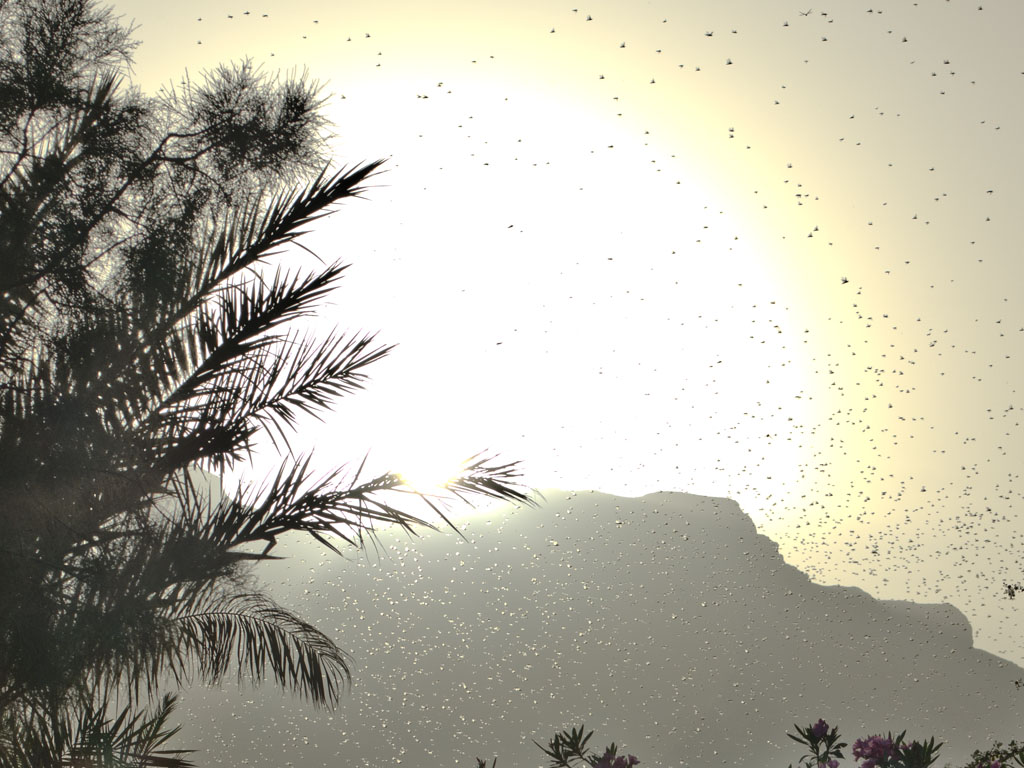
Israel is sometimes hit by locust invasions. The picture is from Ein Gedi by the Dead Sea in 2013, when a large swarm arrived from North Africa.
[Gk. abyssos is the place of the dead, see . It is also a prison for demons, see ; . It is where Satan will be bound for 1,000 years, when Jesus reigns on earth, see . It is from the abyss that the beast rises, see ; . The abyss is not the same as the "lake of fire," the final place for Satan and all who follow him, see . The abyss is a spiritual, hidden world that is under God's authority, see . John does not see the actual fall of the star. It is already on earth and may refer to the star Wormwood in the previous chapter, see , the angel with the key, see , or Satan, see ; .]
2He opened the bottomless pit, and smoke rose from the pit like the smoke from a huge furnace, and the sun and the air were darkened by the smoke from the pit. 3Out of the smoke came locusts upon the earth, and they were given power like that of scorpions on the earth. 4They were told not to harm the grass of the earth or any other green thing or any tree, but only those people who did not have the seal of God on their foreheads. 5They were not allowed [by God] to kill them, but they were allowed to torment them for five months [a limited time, corresponding to the natural lifespan of a grasshopper], and the pain from them was like the pain when a scorpion stings a person. 6In those days, people will seek death but will not find it; they will long to die, but death will flee from them. 7
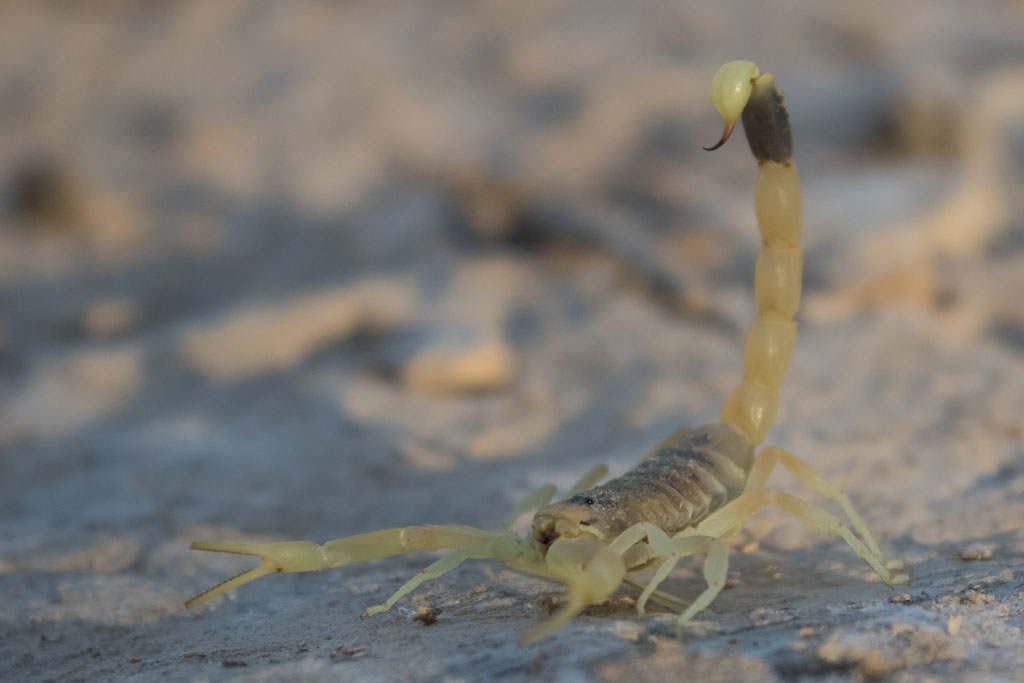
Leiurus quinquestriatus in the Negev Desert in Israel. The scorpion is called the deathstalker because it is one of the most poisonous species.
The sixth trumpet—the second woe
13The sixth angel sounded [his trumpet]. [The sixth trumpet also corresponds to the second woe, see ; .]
Then I heard a voice from the four horns of the golden altar before God, 14and it said to the sixth angel who had the trumpet, "Release the four angels who are bound at the great river Euphrates." 15The four angels who had been kept ready for that hour, day, month, and year were released to kill a third of mankind. 16The number of riders in these cavalry armies was twenty thousand times ten thousand (200 million). I heard their number. [When John wrote this, the entire population of the earth was around 200 million and the Roman army 300,000. An army of 200 million horsemen must have been an unimaginable number which, if interpreted literally, could only become relevant when the earth's population increased to billions in the 20th century.] 17In my vision, the horses and their riders looked like this: the riders had fiery red, dark blue, and sulfur yellow breastplates. The horses had heads like lions, and fire, smoke, and sulfur came out of their mouths. 18Of these three plagues – the fire, smoke, and sulfur that came out of their mouths – a third of humanity was killed. 19The power of the horses lies in their mouths and their tails, for their tails are like serpents and have heads, and with these they do harm. [The sixth trumpet has sounded, and the second series of woes is coming to an end. One might think that five months of plagues, see , followed by death from fire and brimstone, would have brought people to repentance. Instead, it describes how they continue with the same contempt for God and His commandments. Perhaps the most frightening thing about Rev 9 is not the trumpet blasts, but the sin that people continue to commit.] 20The rest of mankind [two-thirds, see ], those who were not killed by these plagues, still did not repent of the works of their hands.
They did not stop worshiping evil spirits (demons)
and idols (images) of gold, silver, bronze, stone, and wood
that cannot see or hear or walk. [] [Behind the created idols that are worshipped there is an evil power, see . The word image refers back to the prohibition of images in . An image is a copy of the real thing. This also includes false ideas and thoughts about God.] 21They did not turn away from (change their thinking about): murder,
drugs (black magic, occult activities), [The Greek word pharmakos, our word pharmacist, comes from this word. Drugs and magic were often combined, which is why the word is sometimes translated as black magic, see ; ; ]sexual immorality [The Greek word porneia is used here, and the root word means "to sell oneself into slavery." Our word "pornography" is a compound word made up of this very word porneia and grafo, which means "something written or drawn," i.e., a description in either text or graphics of someone selling themselves sexually.] and theft.
[Human sin can be divided into two categories – sin against God and sin against people, see . deals with idolatry – not loving God and putting Him first, the first part of the Ten Commandments, see . concerns sins against other people – not loving one's neighbor, the second part of the Ten Commandments, see . Here we recognize the commandments not to murder, not to commit adultery, and not to steal. John also adds a point concerning occult activities involving drugs. Witchcraft and drug abuse belong in this category because they negatively affect other people. These points describe the development of a society that has turned away from God. As it goes with religion, so it goes with morality.]Interlude – before the seventh trumpet (10:1-11:14)
A mighty angel with a little scroll
[So far, John has seen everything in the second vision, which began in chapter 4, from heaven. The perspective now seems to shift from heaven to earth. John also becomes personally involved in the vision when he is given the scroll to eat.] 101Then I saw another mighty (powerful, strong) angel (messenger) coming down from heaven. [This is a different angel than the one who asked who could open the scroll with the seven seals, see .]
The angel (messenger) was clothed (wrapped) in a cloud [which often describes God's presence, see ; ],
with the rainbow [which is a sign of God's covenant and his faithfulness, see ] over his head. His face was like the sun [similar to the description of Jesus in ]
and his legs like pillars of fire. [During the Exodus from Egypt, God led the Israelites with a pillar of fire, see .]
2In his [left] hand he held a small scroll that was open. [John constructs a new Greek word biblaridion, "small scroll." The word is used only here and in verses 9-10. Perhaps to distinguish this scroll from the sealed scroll, Gk. biblion, which the Lamb took from God's right hand, see . The sealed scroll in chapters 4-5 depicted the entire future history. Here it may be a scroll symbolizing the final phase, as indicated by its placement between the sixth and seventh trumpets. The angel holds the scroll in his left hand because he later lifts his right hand toward heaven, see . The scroll seems to contain the written order for the mission the angel is about to complete on earth. The fact that it is opened describes that the time for God's final judgment has come, see . The book is small in relation to the mighty angel's hand, but even for John it was not so large that he could not later "eat" it.] The angel set his right foot on the sea
and his left foot on the earth [describing the enormous size of the angel, but also his authority over the whole earth] 3and cried out with a loud voice
like a roaring lion. [; ] [All angels are powerful and strong, see . Some have greater power and authority than others. This angel, and the one John had previously seen in , is described as mighty and strong and bears striking similarities to the descriptions of the risen Jesus in the introduction, see , , . It may be Jesus who reveals himself as an angel and messenger, as has happened many times in the Old Testament. In that case, the small scroll is identical to the previously sealed scroll, see . The angel's position on both sea and land indicates complete ownership of the whole earth. The message concerns the whole earth. Soon the Antichrist will reign for a short time, but before that happens, the Son of God will claim the earth, see . Satan roars like a lion to frighten, see . The Lion of Jude roars to proclaim his victory, see ; .] When he had cried out, the seven thunders spoke with their voices. 4When the seven thunders had spoken, I was about to write [down what they had said, at Jesus' request ], but I heard a voice from heaven saying, "Seal up what the seven thunders have said and do not write it down." [The main purpose of the Book of Revelation is not to hide God's purposes, but to reveal them, see . What "the seven thunders" said is the only part of this book that is hidden. God's voice is often likened to thunder, see ; ; , and seven often represents something complete and perfect. In it says that "thunder came from the throne," which also indicates that it was God's voice that John heard. Thunder is often associated with judgment, see ; ; ; . This voice probably speaks of God's complete and final judgment of the earth. However, it is pointless to speculate about what was said, see .] 5The angel whom I saw standing on the sea and on the earth raised his right hand to heaven 6and swore by him
who lives forever and ever [],
who created heaven and what is in it
and the earth and what is in it
and the sea and what is in it: "No more delay (the wait is over, the deadline has passed).
[Now there is no turning back, the last part of God's plan is being put into action, see . Here the word chronos is used for time. Literally, it says "no more time." However, this cannot mean that time would cease to exist and enter into a "timeless eternity." The Book of Revelation speaks of measurable time both on earth and in the heavenly world, see ; ; .]
7But in those days when the voice of the seventh angel is heard and he is about to sound his trumpet [see ], then God's mystery (secret) will be fulfilled, as he has proclaimed in the gospel he has given to his servants, the prophets." [The phrase "the mystery of God" is used by Paul about the anointed King, see . What the prophets of the Old Testament have said – that the Messiah will one day return and reign – is about to be fulfilled. When the seventh trumpet sounds in the next chapter, the events leading to Satan's final defeat will begin. See also ; .] 8The voice I had heard from heaven spoke to me again and said, "Go and take the opened scroll from the hand of the angel standing on the sea and on the earth." 9So I went to the [great] angel and asked him to give me the little scroll. He replied, "Take it and eat it! It will be bitter in your stomach [cause heartburn, because the message is about God's judgment, see ] but sweet as honey in your mouth [because it is God's word and also deals with grace and salvation]." [To "eat the scroll" illustrates how John must become one with the prophetic message in the same way that the food we eat becomes part of us and gives life to the body. The Bible is often described as bread, see ; milk, see ; meat, see ; honey, see ; . Ezekiel had a similar experience, . The fact that the scroll both stings the stomach and tastes sweet means that it speaks of both judgement and salvation, see ; ; .] 10I took the scroll from the angel's hand and ate it, and in my mouth it was sweet as honey. But when I had eaten it, it burned in my stomach. 11Then he said to me, "You must prophesy again about many peoples and nations (ethnic groups) and languages and kings."The temple and the two witnesses in Jerusalem

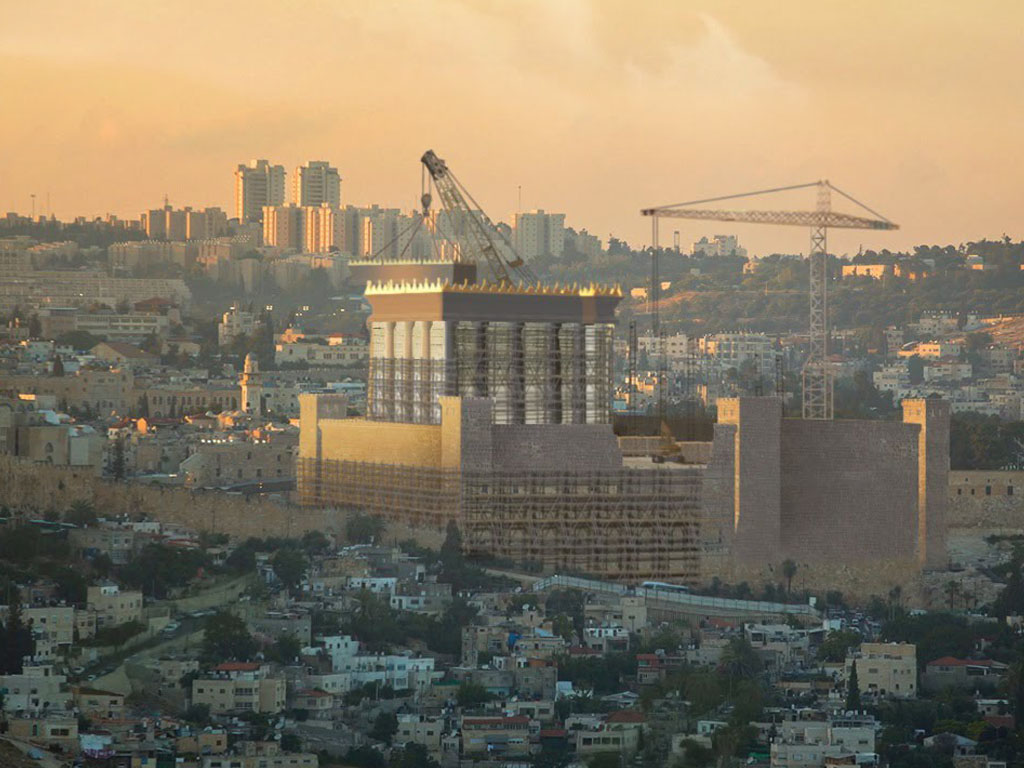
Today, there is no temple in Jerusalem. This computer-generated image from the Temple Institute visualizes what the construction of the third temple might look like.
"Stand up and measure the temple of God and the altar and those who worship there. 2But leave out the outer court of the temple and do not measure it, for it has been given to the Gentiles, and they will trample (occupy) the holy city [Jerusalem] under their feet for forty-two months [which corresponds to 3.5 years, see also ; ; ]. [Both Ezekiel and Zechariah have similar visions of a man with a measuring rod, see ; . On these occasions, the measuring seemed to symbolize divine protection, see .] 3I will let my two witnesses prophesy for 1,260 days [also equivalent to 3.5 years – 42 months with 30 days in each month], clothed in sackcloth." [Since these two witnesses are hated by all the peoples of the earth and people want to harm them, see , their prophetic speech probably concerns sin and God's judgment.] 4These [witnesses] are the two olive trees and the two lampstands [light bearers] that stand before the Lord of the earth. [For a testimony to be true, two witnesses are required, see . The image of a lampstand and two olive trees is found in , . There, the two olive trees symbolize the governor Zerubbabel and the high priest Joshua, whom God used to rebuild the temple after the liberation from captivity in Babylon in 500 BC, see . It is therefore likely that the two witnesses here are also two real people. It is possible that they also played a role in the rebuilding of the temple. Some suggestions for who they might be are: - Two people who are now unknown, as they are not mentioned by name.
- Enoch and Elijah, as they did not die a natural death, see ; .
- Moses and Elijah, because the signs they perform are of the same nature and they conversed with Jesus on the Mount of Transfiguration. Elijah is prophesied to return before the day of the Lord and bring the Jews back to the faith of their fathers, see .
Other suggestions are that the two olive trees represent the two covenants, the Old Testament and the New Testament. Since the seven lampstands previously referred to churches, see , it has been suggested that these two lampstands refer to the two churches without criticism, Smyrna and Philadelphia.] 5If anyone wants to harm them, fire comes out of their mouth and consumes their enemies. [Prophetic words of judgment are likened to fire, see . When Elijah spoke, fire came down from heaven, see .] Yes, if anyone wants to harm them, he must be killed in that way. 6They have power to shut up the sky so that no rain falls during the days they prophesy [as Elijah did, see ], and they have power to turn the waters into blood [as Moses did, see ] and to strike the earth with all kinds of plagues as often as they want. 7When they have finished their testimony, the beast [the Antichrist, described in more detail in chapter 13, see ; ; ] coming up out of the abyss [the bottomless pit, see ] will fight against them, defeat them, and kill them. [In Daniel's prophecy, the same thing is said about the new eleventh horn that later sprang up among the ten horns of the fourth and last terrible beast, see .] 8Their corpses will lie in the street of the great city, which spiritually (figuratively, symbolically) is called Sodom and Egypt, and where their Lord was also crucified. [Jesus was crucified just outside Jerusalem, see . It is likely that "the great city" refers to the real city of Jerusalem. It is the city where the temple stands. The symbolic names refer to places that God has judged earlier in history. The city of Sodom was known for its sin, especially sexual perversions, see . Egypt was a country that oppressed God's people into slavery, see .] 9For three and a half days, people from all peoples, tribes, languages, and nations (ethnicities) will see them lying there, and they will not allow their dead bodies to be placed in any grave. [Due to the hot climate in the Middle East, bodies were buried on the same day that death occurred. Not burying someone was a sign of disrespect and contempt. These two prophets were so deeply hated that they were denied a burial. How people from all over the world could see this event must have been difficult to understand in John's time. Today, with round-the-clock news coverage and modern technology, it is not difficult to understand how the whole world could follow the events in Jerusalem.] 10The inhabitants of the earth rejoice over them and celebrate and send gifts to one another, because both prophets had tormented those who live on earth. 11But after the three and a half days, the breath of life from God entered them, and they stood up on their feet, and those who saw them were terrified. [; ] 12Then they [the two witnesses] heard a loud voice from heaven saying to them, "Come up here!" And they ascended to heaven in a cloud, and their enemies saw them. [Elijah was taken up to heaven in a similar manner, see .] 13At that moment (hour), there was a great earthquake, and a tenth of the city collapsed. Seven thousand people were killed in the earthquake. Those who survived were terrified and gave glory to the God of heaven. 14The second woe is over. Behold, the third [and last woe, see ] is coming soon (quickly).The seventh trumpet – third wail
15The seventh angel sounded [his trumpet]. Then loud voices were heard in heaven: "The kingdom (power) of the world now belongs to our Lord
and his Anointed One (Christ, Messiah).
He will reign (exercise royal authority) for ever and ever."
16The twenty-four elders who sat on their thrones before God fell on their faces and worshiped God. 17They said: "We give thanks to you, Lord God Almighty,
who is and who was. [The phrase "and who is to come," see ; , is missing here and in . Jesus is now, as the next verse indicates, in the process of completing everything and returning.] You have taken power,
your great power, and begun to reign (as king). 18The nations were angry,
but your wrath has come.
The time has come for the dead to be judged
and for you to reward your servants the prophets
and the saints.
Reward both small and great, those who revere your name,
and destroy those who destroy (morally corrupt) the earth." 19The temple of God in heaven was opened, and his ark of the covenant was seen in his temple, and there were flashes of lightning, rumblings, peals of thunder, an earthquake, and heavy hail. [Verses 15-17 describe what happens in heaven when the seventh trumpet sounds. What happens on earth is described when the story resumes in chapter 16. John hears a "loud voice from the temple" saying what will happen on earth, see . In chapters 12-17, the main actors in the final resolution are presented and described from a different perspective.]THE GREAT DRAMA THROUGH THE AGES (12:1-15:8)
[A new parenthesis is inserted into the narrative. In the previous paragraph, the seventh trumpet sounded, see . Its effects on earth are first discussed in chapter 16. The following paragraph now describes a number of different actors in the conclusion of history. They are described as signs, Greek semeion. Since this word is used, it indicates that what follows are symbols that need to be interpreted. What is described is the struggle between God and Satan that has been going on since the beginning of the world. The seven main actors in this chapter are:
• The woman – the Jewish people, see .
• The dragon – Satan, the devil who opposes God's purposes and deceives, see , .
• The Son – Jesus, who now sits at God's throne, see . • Michael – the archangel who fights against the dragon, see . • The woman's children – persecuted believers, see . • The beast from the sea – a future world leader, see . • The beast from the earth – the false prophet, see .] The woman 121A great sign [a strong and clear symbol describing spiritual reality] appeared in heaven:
a woman clothed with the sun
and with the moon under her feet
and on her head a crown (victory wreath) of twelve stars. [In Joseph's dream, the sun is likened to his father Jacob, the moon to his mother Rachel, and his eleven brothers to eleven stars, see . At this time, before the captivity in Egypt, this family constituted the entire nascent nation of Israel. God often compares his people to a woman, see . The woman symbolizes God's people, primarily the Jewish people throughout the ages.]
2She was pregnant and cried out in labor pains. [This may refer to Jesus, who was Judean and was born in Bethlehem in Israel, but the labor pains more likely refer to the birth of the Jewish people, which characterizes the Old Testament narrative. Everything from Abraham's struggle, the captivity in Egypt, the entry into the land, etc.]The dragon
[The next sign is a fiery red dragon. Words and images convey a feeling. When the Holy Spirit is likened to a dove, it reflects peace, see . A dragon or a roaring lion, on the other hand, gives a feeling of discomfort.] 3Another sign [a symbol] appeared in heaven, and behold, a great fiery red dragon with seven heads and ten horns and seven crowns (royal diadems) on his heads. [Daniel's prophecy describes how the fourth and final beast has ten horns. It strikes down three kings, leaving only seven, which is probably what the seven crowns refer to, see ; .] 4His tail swept away a third of the stars of heaven, and he threw them down to the earth. [Since this passage clearly speaks in imagery, "tail" stands for consequences. A similar expression is "in the wake of." Stars can refer to angels or people, often leaders. If this is the same event described in more detail in verses 7-9, the stars refer to angels, see also .]
The dragon stood in front of the woman who was about to give birth, so that he might devour her child as soon as it was born. [The red dragon is identified as Satan, see . Throughout history, the battle has continued. Immediately after the Fall, there is mention of this battle between the serpent and the woman's seed, see . Eve's firstborn, Cain, murdered his brother. Cain's descendants became increasingly wicked until the days of Noah, and God was forced to intervene. When Jesus was born, Herod the Great killed all boys two years old and younger in Bethlehem, see .]The Son
5She gave birth to a child, a Son who will rule all nations with an iron scepter. [A clear reference to Jesus, see ; ] Her child [the Son] was taken up to God and his throne. [Jesus rose from the dead and now sits at the right hand of the Father.] 6The woman then fled into the desert, where she has a place prepared for her by God, so that she could be sustained there for 1,260 days [equivalent to 3.5 years – 42 months with 30 days in each month]. [The flight is described in more detail in verses 13-14.]Satan is cast out of heaven
[The Book of Job describes how Satan, the Accuser, appears together with God's sons before God in heaven, see ; . also describes how he accuses the high priest Joshua. See also ; ; .] 7A war broke out in heaven. [The archangel] Michael [who is specially appointed to watch over Israel, see ; ] and his angels fought against the dragon, and the dragon and his angels fought against them. 8But the dragon was not strong enough, and there was no longer any place for them in heaven. 9So the great dragon – the ancient serpent [who deceived Adam and Eve in the Garden of Eden, see , ; Leviathan, see ], he who is called the devil (one who divides and separates – Gk. diabolos) and Satan (Hebrew word meaning "adversary" or "accuser"), he who deceives the whole world – was cast down to earth, and his angels with him. 10Then I heard a loud voice in heaven saying, "Now it is done:
salvation
and power
and the kingdom of our God
and the authority of his Anointed One (Messiah, Christ) have come.
[Jesus has been anointed as king and given all power.]
For the accuser of our brothers,
the one who accused them day and night before our God,
has been thrown down.
11They defeated him
because of the blood of the Lamb and
because of the message of their testimony.
They did not love their lives so much
that they shunned death.
12Therefore rejoice, heavens,
and you who dwell in them.
But woe to the earth and the sea,
for the devil has come down to you.
He is furious,
knowing that his time is short." 13When the dragon saw that he had been thrown down to the earth, he pursued the woman who had given birth to the Son. 14But the woman was given the two wings of the great eagle to fly to her place in the desert, where she is protected from the serpent and receives her sustenance for a time, times, and half a time [3.5 years]. [The flight to the desert, mentioned in , is now described in more detail. The image of the eagle and the desert is familiar. When God speaks to Moses after the Exodus from Egypt, he uses the image of "eagle wings" to describe how he carried them safely through the desert to Mount Sinai, see . Since the eagle is described as "the great eagle," it may refer to the eagle described in . If one reads Jesus' discourse on the end times in Matt. 24-25 in parallel with the Book of Revelation, it may be now that Jesus' exhortation in to flee to the mountains is being fulfilled.
This is the only time the expression "a time, times, and half a time" is used in the Book of Revelation. The expression is found in the Book of Daniel, see ; . Based on the parallel passage, the time corresponds to 1,260 days, see . The period of 3.5 years is described in three different ways in a chiastic pattern:
42 months – .
1,260 days – .
1,260 days – .
A time, times, and half a time – .
42 months – .] 15Then the dragon spewed water out of his mouth like a river after the woman, to sweep her away with the flood. 16But the earth helped the woman, opening its mouth and swallowing the river that the dragon spewed out of its mouth. [In a similar way to Egypt here, which pursued Israel when they left Egypt and was destroyed by a miracle of nature, now the earth also comes to Israel's aid through a miracle of God in nature.] 17In his rage against the woman, the dragon went off to fight against the rest of her offspring (Gk. sperma), against those who obey God's commandments and hold fast to the testimony of Jesus. [The dragon has been defeated time and time again. - First, he was cast out of heaven, see verses 4, 7-9.
- Then he fails to destroy the woman's son, see verses 4-5.
- When he tries to destroy the woman herself in her place of refuge, he fails again, see verses 6, 13-16.
His last attempt is to fight against her other children. These "other children" are the Christians. Depending on interpretation, this includes the recipients of the letter in the seven churches, and Christians throughout the ages, or only those who come to faith during the last tribulation.
This and the next chapter fulfill the ancient prophecy from against the serpent: "I will put enmity between you and the woman, and between your offspring and hers." The prophecy has two parts. Here in chapter 12, the vision dealt with the first part – the battle between the woman and the dragon. Chapter 13 describes the second part – the battle between the woman's other children, who have just been introduced, and the dragon's offspring, who are about to emerge.] 18He [the fiery red dragon] stood on the sand (the sandy beach) by the sea. [The dragon stands on the unstable sand along the shore next to the moving waves of the sea, see . This is in stark contrast to the Lamb, who stands on the solid rock, the mountain Zion, see . The dragon is prepared to welcome "the beast from the sea," which is described in the next chapter.]An unholy trinity
The beast from the sea
[John now sees a beast coming up out of the sea. Chapter 13 continues to describe signs as symbols. The sea is defined in as "peoples, multitudes, nations, and languages." The dragon, the devil, is waiting for a world leader to rise among the pagan peoples. It is implied that this beast rides a wave of popularity among the people.] 131I saw a beast coming up out of the sea. It had ten horns and seven heads, and on its horns were ten crowns (royal diadems), and on its heads were blasphemous names. [This monster is a reflection of its master, the dragon. The beast now has ten crowns, compared to the dragon, which had seven, see .] 2The beast that I saw
was like a leopard,
had feet like a bear
and a mouth like a lion.
The dragon gave it its power, its throne and great authority. [Daniel saw the same animals in his dream, see . He saw: - A lion – corresponding to the Babylonian Empire.
- A bear – corresponding to the Medo-Persian Empire.
- A leopard – corresponding to the Greek-Macedonian Empire.
- A terrible beast – represents the Roman Empire.
John saw these three beasts in reverse order, because he was looking back on past historical events, while Daniel was looking ahead. The last world empire will have its roots in all the previous great world empires.] 3One of its heads appeared to have been slaughtered and killed, but its mortal wound had been healed. [An evil imitation of the Lamb of God who was slaughtered but rose again, see . The healed wound on the head suggests that there was a previous battle between the beast and the Lamb. Once again, there is a connection to the ancient prophecy against the serpent from "he will attack your head." This probably happened when Jesus rose from the dead.] The whole earth marveled at the beast and followed it. 4They worshiped the dragon because he had given his power to the beast, and they worshiped the beast, saying, "Who is like the beast? Who can fight against it?" 5The beast [from the sea] was given a mouth that spoke great and blasphemous words, and it was given authority to continue for forty-two months (3.5 years). 6It opened its mouth to blaspheme God, to blaspheme his name and his dwelling place, those who dwell in heaven. 7It was given authority to wage war against the saints and to conquer them, and it was given authority over every tribe, people, language, and nation. [The beast gains political and military power over the whole earth.] 8All the inhabitants of the earth will worship it, everyone whose name has not been written in the book of life of the Lamb that was slain since the foundation of the world [Gk. apo kosmos katabole – i.e., from the Fall when God's orderly world system was destroyed]. [At the end of each of the seven letters, the risen Jesus had warned the church, see , , , ; , , . Now comes a final warning, similar to , indicating that it is inevitable that this monstrous power will cause suffering.] 9You who have a [spiritual] ear, listen: 10If anyone is led into captivity,
then he will go into captivity.
If anyone is to be killed with the sword,
then he will be killed with the sword. Here the endurance (steadfastness) and faith of the saints are revealed.
[The first beast should not be met with armed rebellion, but with endurance and faith, see ; ; ; ; . The second beast must be fought with wisdom, see .
The Antichrist is not mentioned in the Book of Revelation. However, John mentions the Antichrist/antichrists five times in his letters, see , ; ; . The Greek word anti means "against," "opponent," or "instead of." All teachings that go against who Jesus is and what he said go against Christ and are "anti-Christ." Consequently, those who advocate and teach these false teachings are called "anti-Christs" and are enemies of Christ. Since John writes in that there are already many antichrists in the world, but also mentions an Antichrist who is to come, many have identified the beast with this coming Antichrist. The beast from the sea is often associated with the Antichrist. However, both the beast from the sea and the beast from the earth seem to have the characteristics of the Antichrist. In , the beast is mentioned as a single entity. Both are judged together, see .].The beast from the earth – the false prophet
[The unholy trinity is now complete. In , the following are explicitly mentioned: - The dragon, who is Satan, see .
- The beast from the sea – a political system and its leaders.
- The beast from the earth – the false prophet.
The dragon probably remains by the sea and summons another beast, but this time from the earth, see . This may be an allusion to the Jewish legends about a sea monster (Leviathan) and a land monster (Behemoth), see ; . In the false trinity, Satan acts as the father, the first beast as the son, and the false prophet as the spirit.
The first beast symbolizes kingdoms and rulers who reign with military power, see verses 4 and 7. The second beast has to do with economic influence, see . Both of these beasts derive their power from the dragon. Throughout history, believers have been tempted to compromise and abandon their faith in God by placing their trust in worldly kingdoms, kings, and systems for protection and economic prosperity.] 11I saw another beast coming up out of the earth. It had two horns like a lamb, but it spoke like a dragon. [Outwardly, this creature resembled a lamb, but its speech revealed its true master – the dragon, who is Satan. In the Sermon on the Mount, Jesus had just warned against false prophets who come dressed as lambs, with pious outward expressions, but inside they are ravenous wolves hungry to plunder and destroy, see . This beast speaks for the dragon and is his prophet. John becomes so eager that he begins to recount in the present tense everything that the new land monster does.] 12It exercises all the power of the first beast before it [in the presence of the first sea beast] and causes the earth and its inhabitants to worship the first beast, whose deadly wound had been healed. 13It performs great signs and even causes fire to fall from heaven to earth in the sight of men. 14Through the signs it has been given power to perform before the beast, it deceives the inhabitants of the earth. It tells the inhabitants of the earth to make an image for the beast that has a wound from a sword but is alive again. 15And it was given power to give life to the image of the beast, so that the image of the beast could even speak and cause those who did not worship the image of the beast to be killed. 16It [the false prophet] causes all – [both] small and great, rich and poor, free and slave [these six groups describe all of humanity] – to receive a mark (imprint, something stamped) on their right hand or forehead, 17so that no one can buy or sell except the one who has the mark, the name of the beast or the number of its name. 18
Hebrew and Greek letters also have numerical values. By adding up the letters in words and names, one can calculate their numerical values.
Many have speculated on what the number 666 stands for. The numerical value of "Emperor Nero," which in Hebrew is Neron Kesar, is 666. That this was an early interpretation is confirmed by the fact that when translated into Latin, the numerical value becomes 616, a combination of digits that is also found as a text variant in an early manuscript.
The number 6 symbolically represents the number of man, since man was created on the sixth day, see . One can also see God's Holy Trinity as 777 in comparison to this unholy trinity with the dragon and the two beasts, symbolized by the number 666.
Some have drawn the connection that www would correspond to 666 (since the numerical value of the Hebrew letter Vav is 6), but this does not follow the normal gematric method of summing the letters, since the numerical value of www is 18. The phrase "hand and forehead" is also clearly recognizable from , where Moses urges the people to bind the words he has just spoken on their hands and foreheads. The prayer that Moses prays begins in with the words "Hear, O Israel." In Hebrew, the word for "hear" is shema, and therefore the prayer is called Shema. Every morning and evening, Jews throughout the ages have recited this prayer. The Shema is the Jewish creed:
"Hear, O Israel: The Lord our God, the Lord is one. You shall love the Lord your God with all your heart, with all your soul, and with all your strength. These words that I command you today shall be upon your heart. You shall teach them diligently to your children and shall talk of them when you sit in your house and when you walk by the way, when you lie down and when you rise up. You shall bind them as a sign on your hand, and they shall be as frontlets between your eyes. You shall write them on the doorposts of your house and on your gates.
Orthodox Jude interpret Moses' commandment literally and therefore have two small black leather capsules, called "tefillin," which contain parchment scrolls with verses from the Torah. The two capsules are called shel rosh and shel jad. Every weekday before morning prayers, one is attached to the arm with a leather strap and the other above the forehead. Regardless of whether is interpreted literally or metaphorically, it is about who or what controls one's consciousness and actions, who or what is one's authority, who or what one serves and follows.
Here in Revelation, the beast forces people to give their loyalty to him in a creed that can be said to be an "anti-shema."]The Lamb and the 144,000
141And I saw, and behold (an exhortation to pay attention to what follows) [the double verbs "saw" and the exhortation "behold" express a contrast and a new dimension in the vision; the phrase recurs in ]:
The Lamb stood on the mountain of Zion, and with him the 144,000 who had his name and his Father's name written on their foreheads. [In contrast to those who have taken the mark of the beast on their foreheads or hands, see .] [Unlike the false prophet, who looked like a lamb, see , Jesus is the true Lamb. The mountain of Zion can refer either to earthly Jerusalem or to the city of the living God, heavenly Jerusalem, see . The 144,000 are probably the same group that was introduced in . At that time, they were on earth under God's protection. Since they now stand before the throne, it is likely that the heavenly Jerusalem is meant, see . The message is clear. God's people, who are now fighting against evil, will be victorious in the future.] 2I heard a voice from heaven, like the sound of many (mighty, roaring) waters and the sound of powerful thunder. The voice I heard was like harpists playing their harps. 3They sang a new song before the throne and before the four living creatures and the elders, and no one could learn that song except the 144,000 who have been redeemed from the earth. [They have their citizenship in heaven.] 4These are the ones who have not defiled themselves with women, for they are virgins, and these are the ones who follow the Lamb wherever he goes. [Symbolically speaking, they have been faithful to Jesus, see .] They have been redeemed from among men as firstfruits to God and to the Lamb. 5No lie has been found in their mouths. They are spotless.Three flying angels – proclaiming that judgment is coming
[The scene now moves to the sky between heaven and earth. As when the seven trumpets sounded in chapters 8-11, several angels are involved. Two groups of three angels in each group are described. The first three are called the first, the second, and the third. They proclaim that the harvest is coming. Then a voice is heard from heaven, and John sees the Son of Man, who, together with three other angels, reaps the harvest with a sickle.] 6I saw another angel [whom John had not seen before; the last one was the angel with the little scroll in chapter 10] flying in the middle of heaven. [The angel flew between heaven and earth, just like the eagle with the scroll, see .] The angel had an eternal gospel to proclaim to the inhabitants of the earth, to all nations, tribes, languages, and countries. 7He said in a loud voice, "Worship God and give him glory! The hour (time) for his judgment has come. Worship him who made heaven and earth, the sea and the springs of water." 8Another angel, the second, followed [the first angel], saying, "Fallen, fallen (destroyed, crushed, completely ruined) is the great Babylon, which made all nations drink the wine of her adulterous passion (lustful, intoxicating wine)." [The Greek word thymos describes strong emotions and can be translated as both "desire" and "anger". It is also used in . The fall of Babylon is described in detail in chapters 17-18. Babylon was the capital of the empire that destroyed Jerusalem in 586 BC. Babylon is often used as a symbol of the worldly power that opposes God, see ; ; ; , .] 9A third angel followed them, saying in a loud voice, "If anyone worships the beast and its image and receives the mark on their forehead or hand, 10he himself will drink the wine of God's wrath (lust) poured undiluted into the cup of God's wrath. He will be tormented with fire and sulfur in the presence of the holy angels and in the presence of the Lamb. [Punishment with "brimstone and fire" brings to mind Sodom and Gomorrah, see .] 11The smoke of their torment rises forever and ever. They have no rest day or night, those who worship the beast and its image and receive the mark of its name. 12Here is the perseverance (steadfastness) of the saints – those who keep the commandments of God and their faith in (are faithful to) Jesus."A voice from heaven
13Then I heard a voice from heaven saying, "Write: Blessed (happy, enviable) are the dead who die in the Lord from now on. Yes, says the Spirit, they will rest from their labors, for their deeds follow them."The coming of the Son of Man – the harvest
14And I saw, and behold (an exhortation to pay attention to what follows): a white cloud, and on the cloud sat one like a son of man. On his head he had a crown (victory wreath – Gk. stephanon) of gold, and in his hand a sharp sickle [for harvesting]. [Now Jesus is coming back. The cloud, the Son of Man, and the crown are clear images that point to Jesus, see ; ; ; ; . Jesus himself has used the image of the sickle and the harvest, see ; . Three more angels are involved and take part in the harvest. These come out of the temple and are sent by God.]The dry harvest of grain
[Two harvests are described, first a dry one and then a wet one, in the same way that grain is harvested in the spring and grapes in the autumn in Israel. Both of these harvests are also mentioned in connection with the judgment in . It is unlikely that this is meant to imply that there would first be one harvest and then another a few months later. Rather, it is an image of everything that the earth has produced being harvested, both the spring and autumn harvests. All people will be brought before God's judgment seat.] 15Another angel [the fourth in this chapter] came out of the temple and called out in a loud voice to the one sitting on the cloud, "Put out your sickle and reap, for the time to reap has come, and the harvest of the earth is ripe." 16Then the one sitting on the cloud swung his sickle over the earth, and the earth was harvested.The wet grape harvest
17Another angel [the fifth] came out of the temple in heaven, also with a sharp sickle. 18Another angel [the sixth] came out from the altar, he who had power over the fire. He cried out with a loud voice to [the fifth] angel with the sharp sickle, "Stretch out your sharp sickle and reap the clusters of grapes from the vine of the earth, for its grapes are ripe." 19The angel swung his sickle across the earth and harvested the grapes from the vine of the earth and threw them into the great winepress of God's wrath. 20The winepress was trodden outside the city, and blood flowed from the press and reached up to the bridles of the horses [1.5 meters], for a distance of 1,600 stadia [30 miles]. [A Greek stadium is equivalent to 185 meters, which was the length of the running track in the ancient stadium at Olympia. The measurement of 1,600 stadia corresponded approximately to the length of the Jordan River, from its source in Mount Hermon in the north down to the Dead Sea in the south. The length may refer to the universal nature of the judgment and that it affects "the whole land." Another interpretation is that the number consists of multiples of 4 or 40. Multiplying 40 x 40 or 4 x 4 x 100 gives the result 1,600. The number 4 represents the whole world, and the number 40 has to do with testing. Regardless of the exact interpretation, it is clear that the number represents a very large global judgment.]SEVEN ANGELS – the seven last plagues (chapters 15-16)
[Earlier, John saw two great signs, the woman and the dragon, see , . Now he sees another great sign – seven angels ready to go out from God's temple with seven bowls of wrath. Time and again, God has sought repentance, see ; , . Soon the world will drink "the wine of God's wrath," see , but before this happens, there will be an introduction with praise.] 151And I saw another great and marvelous sign in heaven: seven angels with seven plagues, the last ones, for with them God's wrath reaches its completion.a song of victory
2And I saw what looked like a sea of glass [described in ] mixed with fire [which John had not mentioned before; the fire may refer to the coming Judg.], and on the sea of glass stood those who had conquered the beast and its image and the number of its name [which was 666, see ]. [This group was described in .] They have God's harps in their hands 3and sing the song of God's servant Moses and the song of the Lamb: Great and marvelous are your deeds,
Lord God Almighty.
Just and true are your ways,
you King of the nations.
4Who would not fear you, Lord,
and praise your name?
You alone are holy,
and all nations shall come and worship before you [],
for your righteous judgment have been revealed. The seven bowls are prepared
5After this, I saw the temple in heaven, the tabernacle of testimony, opened. [For the second time, the temple in heaven is opened. The first time was in connection with the seventh trumpet, see . The series of the seven bowls of wrath thus begins when the seventh trumpet sounds, see .] 6The seven angels with the seven plagues came out of the temple, dressed in shining white linen [some manuscripts have "clear shining stones," see also ] and with gold belts around their chests. 7One of the four living creatures gave the seven angels seven golden bowls filled with the wrath of God, who lives forever and ever. 8The temple was filled with smoke from the glory and power of God. [Smoke often symbolizes God's presence, see .] No one could enter the temple until the seven plagues of the seven angels had come to an end [fulfilled their purpose].The seven bowls of wrath
161Then I heard a loud voice [the voice of God] from the temple saying to the seven angels, "Go out and pour out the seven bowls of God's wrath on the earth." [There are similarities between the seven trumpets in chapters 8-9 and the bowls of wrath in this chapter. The trumpets are a warning of the judgment that will come in the bowls. Both series cover the same areas and follow the same order, but the bowls have a greater scope. The trumpets affect one-third of the earth, the sea, and the rivers, while the bowls affect the whole earth. Another difference is that now the judgments are also directed specifically against the beast and those who worship him, see verses 2, 10, 13. When the trumpets sounded, the beast did not yet seem to have been revealed.
Both series have an interruption. In the trumpet judgments, it occurs between the first four and the last three. An eagle flew and proclaimed three more woes, see . In the series of bowls of wrath, however, the break occurs between the first three and the last four. An angel and the altar engage in a dialogue, see verses 5-7. If one looks for chiastic patterns, this provides a nice framework for these two series: 4-3 and 3-4. In both the trumpet and wrath judgments, there is a clear recognition of the plagues against Egypt, see .]First bowl – boils
2The first angel went and poured out his bowl on the earth. Wicked (nasty) and painful boils broke out on the people who had the mark of the beast and who worshiped its image.
[The first trumpet also affects the earth, see . The boils correspond to the sixth plague against Egypt, see .]Second bowl – the seas turn to blood
3The second [angel] poured out his bowl on the sea, and it turned to blood like that of a dead man, and every living thing in the sea died. [The second trumpet also affected the seas, see . The second and third bowls correspond to the first plague against Egypt, see .]Third bowl – fresh water turned to blood
4The third [angel] poured out his bowl on the rivers and springs of water, and they turned to blood. [The third trumpet also affected the fresh water, see .] 5I also heard the angel of the water say: "You are righteous (in all your decisions and judgments),
you who are and who were, you who are holy! [The phrase "and who is to come," see ; , is missing here and in because Jesus is in the process of completing everything and returning.]
6They have shed the blood of the saints (your people) and the blood of the prophets [since Abel],
and therefore you have given them blood to drink.
They deserve it (they get what they deserve)." 7I heard the altar say, "Yes, Lord God Almighty,
true and just are your judgments." [Earlier, John had seen the souls of the martyrs under the altar, see . It may be their voices that are heard. In a voice is also heard from the four horns of the altar.]Fourth bowl – the sun scorches
8The fourth [angel] poured out his bowl on the sun, and it was given power to scorch people with fire. 9People were scorched by intense heat and blasphemed the name of God, who has power over these plagues. But they did not repent and give him glory. [The fourth trumpet also affected the sun, see . Then a third of the sky was darkened, but now the sun burns hotter. It is clear that there will be dramatic changes in the climate. This corresponds to the ninth Egyptian plague, see .]Fifth bowl – darkness
10The fifth [angel] poured out his bowl on the throne of the beast, and its kingdom was plunged into darkness. People gnawed their tongues in agony (torment, anguish). 11and blasphemed the God of heaven for their pains (plagues) and their sores. But they did not repent of their deeds. [The fifth trumpet touched on demonic powers that are released from the bottomless pit. The sun and the sky are darkened, see . Pain/torment is the same word as in .]Sixth bowl – the war from the Euphrates
12
Megiddo (Armageddon) is located at the entrance to the only mountain pass between the coast and the interior.
Show in atlas
the mouth of the dragon [Satan],
the mouth of the beast [Antichrist, see ] and
the mouth of the false prophet [].
14They are evil spirits that perform signs [affect and influence public opinion]. They go out to the kings of the whole world to gather them for battle on the great day of God Almighty. [The second Egyptian plague was frogs, see . The satanic trinity, with the help of demonic power, will influence world leaders to gather their armies.] 15
View from Megiddo towards the northeast. In the mountains to the left lie Nazareth and the Jezreel Valley.
[The sixth trumpet touches the river Euphrates, see .]Seventh bowl—it is finished
17The seventh [angel] poured out his bowl into the air. A loud voice came from the throne in the temple: "It is done." 18There were flashes of lightning, rumblings, peals of thunder, and an earthquake so great that nothing like it has ever been since mankind has been on earth, so great was that earthquake. 19The great city [referred to in as Jerusalem, later as Babylon, see ; , – may also refer to Rom] was split into three parts, and the cities of the nations collapsed. [There have been earthquakes before, one in which a tenth of Jerusalem collapsed, see .] God remembered the great Babylon and gave it the cup of the wine of his fierce wrath. 20All the islands fled, and the mountains were no more. 21Great hailstones, heavy as talents [about 30 kg], fell from the sky on the people, and they blasphemed God because of the plague of hail, since it was very severe. [The seventh and last trumpet indicates that the end has come, see . Earthquakes and hail change the earth, Jerusalem is the only city that seems to remain. Corresponds to the last plague and the night of deliverance in Egypt, see .]Babylon (chapters 17-19)
[Throughout the Bible, the city of Babylon stands in stark contrast to the heavenly city that Abraham was waiting for, see . The rest of Revelation is dominated by the contrast between this evil kingdom and the kingdom of God. Babylon represents all human striving and ambition. In Genesis, after the Flood, Babel is introduced, see . It is here that people build a city with a tower to reach heaven. Instead of honoring God, the purpose is to make their name known, see . It is to Babylon that the Jews are taken captive from Jerusalem, and Babylon has always been associated with idolatry and that which opposes God. Some of the contrasts: - The prostitute woman Babylon is the beast and its city, see ,
while the heavenly woman Jerusalem is the city of God, see . - Babylon comes from the desert, the home of evil spirits, see ,
while the woman who gave birth to the son comes from heaven, see . - Babylon is clothed in earthly luxury, see ,
while the heavenly woman is clothed in heavenly splendor, the moon, the sun, and the stars, see . - Babylon is a prostitute, see ,
while heavenly Jerusalem is the faithful wife, see .
Babylon's collapse has already been mentioned in connection with the seventh and last bowl of wrath, see . Now more than two chapters are devoted to describing the fall.] 171One of the seven angels with the seven bowls came and spoke with me, saying, "Come, I will show you the judgment of the great harlot who sits on many waters. 2The kings of the earth have committed fornication with her [idolatry], and the inhabitants of the earth have been made drunk with the wine of her fornication." 3
The Greek two-euro coin from 2002 is inspired by Greek mythology. The image depicts a scene in which Zeus has taken the form of a bull and abducted the maiden Europa. This is a legend that John and his readers were familiar with.
"The great Babylon,
mother of all prostitutes [the source of all idolatry and false religions]
and every abomination on earth (all abominations and all evil, everything that God detests, an attitude of pride in which one consciously goes against God's will without the slightest shame)." 6I also saw that the woman was drunk with the blood of the saints, with the blood of the witnesses of Jesus. When I saw her, I was greatly astonished.
7The angel said to me, "Why are you so amazed? I will tell you the mystery (secret) of the woman and the beast that carries her, which has seven heads and ten horns.The angel explains the vision
The beast
8The beast that you saw was, and is no more [an imitation of the title of the Lamb, see ; , and the title of God, see , ; ], but it is about to come up out of the abyss and go to destruction.
Those of the inhabitants of the earth whose names are not written in the book of life since the foundation of the world [] will marvel when they see the beast, because it was and is not, but is to come. 9Here is where wisdom is needed: the seven heads are seven mountains on which the woman sits. [Rom was built on seven hills, but that is not the only interpretation.] They are also seven kings. 10Five [kings, kingdoms] have fallen [no longer exist], one is, and one has not yet come. When he comes, he will remain only a short time. [When John wrote this, Domitian was emperor, reigning in the Roman Empire from 81 to 96 AD.] 11The beast that was and is not, he himself is the eighth but belongs to the seven, and he goes to destruction. 12The ten horns you saw [, ] are ten kings who have not yet received a kingdom. But together with the beast, they will be given power to reign as kings for one hour [a short time]. 13They have the same mind (common purpose, opinion) and give their power and authority to the beast. 14They will fight against the Lamb, but the Lamb will defeat them together with his called, chosen, and faithful ones, because he is the Lord of lords and King of kings.The prostitute woman – Babylon
15He [the angel] said [further] to me: "The waters you saw where the harlot sits are peoples, multitudes, nations, and languages. [Ancient Babylon is often referred to as "the city by the great waters," see . The river Euphrates flowed through the city, which had a well-developed canal system, see also .] 16The ten horns you saw and the beast will hate the prostitute and make her destitute and naked. They will eat her flesh and burn her with fire, 17for God has put it into their hearts to carry out his plan and to give their royal power to the beast until the word of God is fulfilled. 18The woman you saw is the great city that rules over the kings of the earth."The Fall of Babylon
The fall is announced
[Now the fall of Babylon is proclaimed. The chapter is written as a lament and contrasts with the heavenly song of victory in the next chapter. John's perspective is from earth, and he is still in the desert in this vision, see .] 181After [all] this, I saw another angel coming down from heaven with great power, and the earth was illuminated by his glory. 2He cried out with a loud voice, "Fallen, fallen (destroyed, crushed, completely ruined) is the great Babylon!
[A repetition of the proclamation already made in . The same expression is found in .]
It has become a dwelling place (home) for evil spirits,
a haunt for every unclean spirit,
a haunt for every unclean bird,
and a haunt for every unclean and detestable wild animal. [Jesus also uses the image of birds in his parables, as representatives of Satan and the evil spirit world, see , , .] 3All nations have drunk the wine of her fornication,
and the kings of the earth have committed adultery with her [in idolatry and committed adultery against God],
and the merchants of the earth have grown rich from her excessive luxury." Come out of her
[Another voice is heard. It could be another angel. The phrase "my people" suggests that it could be the voice of Jesus. The voice speaks until .] I heard another voice from heaven: 4Come out of her [separate yourselves, sanctify yourselves], my people,
so that you do not share in her sins
and suffer her plagues. 5Her sins have reached Rev. heaven,
and God has remembered her crimes.
6Repay her as she has repaid,
and double her double for what she has done.
Pour into her cup double the mixture she has mixed.
7Give her as much pain and sorrow
as she has brought honor and luxury upon herself,
for she says in her heart, "I sit as queen,
I am not a widow and will never feel sorrow."
8Therefore, her torments will come on the same day:
death, sorrow, and famine, and she will be burned up in fire.
Mighty is the Lord God who has judged her.The kings of the earth mourn
9The kings of the earth, who have committed adultery with her and lived in luxury, will weep (mourn loudly) and mourn over her when they see the smoke of her burning. 10Terrified by her torment, they stand at a distance and say: "Woe, woe [expression of intense despair], you great city!
Babylon, you mighty city!
In a single hour [a comparatively short time] judgment has come upon you." [The same expression recurs twice more, see verses 16 and 19.] The merchants of the earth mourn
[The Bible does not condemn trade, but warns against becoming ensnared by mammon and the love of money. In this corrupt economic system described, where only those who have the mark of the beast can buy and sell, see , there are those who oppress and exploit the poor and tolerate unfair profit-making. The merchants of the earth who have allied themselves with the beast complain loudly. Their sorrow is a selfish grief () that no one is buying their goods anymore. The twenty-nine items listed below can be divided into seven or eight main categories of goods, most of which are luxury items.] 11The merchants of the earth weep and mourn over her because no one buys their cargoes anymore. 12Ship cargoes containing: [Jewelry:]
Gold and silver [imported from Spain],
precious stones [imported from India] and pearls.
[Precious fabrics and dyes:]
Fine linen [fabric],
purple [precious purple dye produced from shells in the eastern Mediterranean],
silk [fabric]
and scarlet [precious red dye produced from berries].
[Materials for luxury furniture:]
All kinds of tuja wood (cypress, fragrant wood) [precious wood from North Africa, popular material for furniture],
various items made of ivory [elephant tusks, exclusive inlays in furniture]
and [other] precious woods.
[Materials for art objects:]
Bronze, iron, and marble.
[Perfumes and spices:]
13Cinnamon and ointments,
incense, myrrh, and perfumes.
[Foodstuffs:]
Wine and olive oil,
fine flour and grain.
[From the cattle market:]
Cattle and sheep,
horses and carts.
[From the slave market:]
Human bodies
and souls (lives). [The expression "bodies and souls" can be interpreted in two ways. Either as two separate concepts, where the word "bodies" refers to slavery and "souls/lives" indicates how degenerate human life has become. The two words can also be interpreted as one concept. In rhetoric, this is called hendiadys. Earlier in the list, there are several words that are used in pairs and can also be interpreted individually or as one concept. An example from the same verse is "cattle and sheep," which can refer to cattle and sheep specifically, or refer to the cattle market as a whole, which also includes goats and other animals. In that case, "bodies and souls" describes all forms of human trafficking. Regardless of interpretation, it refers to the slave trade that was widespread in the Roman Empire, where half the population were slaves.
In total, the list contains 29 products and reflects the goods from Tyre, see . It is noteworthy that the slave trade is mentioned at the bottom of the list of goods that were sold and bought. Its placement, after food and livestock, shows how degenerate human values had become in the Roman Empire.] 14The fruit that your soul longed for has disappeared from you. You have lost all luxury and splendor, and it will never be found again. 15The merchants who traded in this and became rich through her will stand at a distance, frightened by her torment, and weep and lament: 16"Woe, woe [expression of intense despair], you great city,
clothed in linen, purple, and scarlet,
and adorned with gold, precious stones, and pearls!
17In one hour all this wealth has been destroyed." The transport industry mournsAll the captains, coastal sailors, sailors, and all who work at sea, they all stood at a distance
18and watched the smoke from the fire where she burned, and they cried out: What city was like this great city? 19They threw dust on their heads and wept and wailed loudly: "Woe, woe [expression of intense despair] to the great city
where all who had ships at sea became rich through her wealth!
In a single hour she was destroyed."
[The voice that began speaking in now concludes:]
20Rejoice over her [the fall of Babylon and all that is happening], O heaven, and you saints and apostles and prophets, for God has judged her and vindicated you. The Fall of Babylon
21Then a mighty angel picked up a stone like a large millstone and threw it into the sea, saying: "In the same way, suddenly and with violent force, Babylon, the great city, will be thrown down and never exist again. 22Never again will the sound of harpists, musicians, flute players, and trumpeters be heard in you.
Never again will any craftsman of any kind be found in you.
Never again will the sound of a millstone be heard in you. 23Never again will the light of a lamp shine in you.
Never again will the voices of bride and groom be heard in you.
Your merchants were the great men of the earth, and all nations were deceived (seduced) by your drugs. [The Greek word pharmakeia, our word pharmacist, comes from this word. Drugs and magic were often combined, which is why the word is sometimes translated as 'black magic', see also .] 24In her [Babylon] was found the blood of prophets and saints and of all who had been slaughtered on earth." Three hallelujahs
[The three verses from kings, merchants, and traders are paralleled by three praises. The word hallelujah is a loanword from Hebrew meaning "praise Yahweh," where Yahweh is God's personal name. The word is used only four times in the New Testament. All four occurrences are here in the nineteenth chapter, see verses 1, 3, 4, and 6. Now a shift takes place. The great tribulation that has dominated chapters 4-18 comes to an end. Chapter 19 begins with the phrase "After this." This indicates the next chronological event.] 191After this [the events in chapter 18], I heard what sounded like a loud voice from a great multitude in heaven: "Hallelujah (praise God)!
Salvation and glory and power belong to our God, 2for his judgments are true and just.
He has judged the great prostitute [the great Babylon, see ]
who corrupted the earth with her fornication
and punished her for the blood of her servants." [It is not the fall of Babylon that is the cause of joy. Instead, the song emphasizes God's attributes – he is true and righteous, see also ; . God does not find joy in the death of the wicked, but rather wants to see repentance, see . Händel's Hallelujah Chorus from 1741 was inspired by this passage.] 3Once again they said: "Hallelujah (praise God)!"
The smoke from her [Babylon's destruction] rises for ever and ever. 4The twenty-four elders and the four living creatures fell down and worshiped God who sits on the throne, saying: "Amen (yes, it is true, let it be done).
Hallelujah (praise God)!"
5Then a voice [from an angel] came from the throne, saying: "Praise (exalt, sing praises to) our God,
all you his servants,
you who fear him in reverent worship,
both small and great."
[All shall worship regardless of position, those of low status together with the influential.]
The feast in heaven
6Then I heard something that sounded like a huge crowd, like the roar of many great waters and rumbling thunder, and they shouted: "Hallelujah (praise God)!
For the Lord our God,
the Almighty (who has all power and knows all things),
has now taken his royal position.
[Jesus has always been king, but now he is entering that position.]
7Let us rejoice and be glad and give him glory.
For the wedding of the Lamb has come, and his bride [the believers] has made herself ready. 8She has been given the right to dress in the finest linen, shining white and pure."
The fine linen is the righteous deeds of the saints. [Unlike the prostitute, see , who gives herself to many lovers, the bride gives herself completely and fully to Jesus. A little further on, the bride is called the wife of the Lamb, at which point she is married and the wedding feast is over, see . Paul calls the believers betrothed to Jesus, see . The church is likened to his bride, see . The Song of Songs describes this love between God and his people. In Hosea, Israel is described as an unfaithful wife whom God will restore in the future.
A Jewish wedding at that time had several stages:
1. Betrothal – an official ceremony that was much more binding than today's engagement, see . The groom traveled from his father's house to the bride's home and paid a bride price, see ; .
2. The groom prepares the new home, see .
3. The groom comes to the bride's house to fetch her. No exact date is given, but it takes place about a year after the betrothal. The custom is illustrated in Jesus' parable of the ten bridesmaids, see .
4. The wedding feast – lasted several days, often seven days, see .
There are different interpretations of what these images describe. What is clear is that the bridegroom is Jesus, see . The bride always describes believers in the plural, while guests, the bridegroom's friends, and bridesmaids are used more individually to refer to individual believers, see .] 9Then he [the angel] said to me [John], "Write: Blessed (happy, enviable) are those who are invited to the wedding feast of the Lamb." He also said to me, "These words of God are true (reliable)."
10Then I fell down at his feet to worship him, but he said to me, "Do not do that! I am only a fellow servant with you and your brothers who have the testimony of Jesus. Worship God. The testimony of Jesus is the spirit of prophecy." [Literally "the testimony of Jesus." In Greek, this can mean both "the testimony of Jesus," what he says, but also "the testimony about Jesus" – his life, death, and resurrection. Prophecy is inspired by the Spirit, and the Spirit testifies about Jesus, see .]THE THIRD VISION (19:11-21:8)
The King of Kings on a white horse!
[A new series of eight "and I saw" begins here, see ; ; ; ; ; ; ; . This is the third great vision of Jesus. In the first vision, Jesus walked among the lampstands, a beautiful image of Jesus' presence in the churches, see . In the second vision, John saw him in heaven, at the throne. Jesus was the Lion of Jude who looked like a slaughtered lamb, see . Now, in this third vision, he sees Jesus as a victorious king. The only time Jesus had previously ridden on an animal was when he peacefully entered Jerusalem on a donkey, see .] 11Then I saw (and I saw) the sky open, and behold, a white horse, and he who sat on it is called Faithful and True [the same title as in ], and he judges and makes war in righteousness. [Unlike the false messiah figure in .] 12His eyes were like flames of fire, and on his head he wore many crowns (royal diadems). He had a name written that no one knows except himself, 13and he was clothed in a robe dipped in blood [his own, or that of his enemies, see ], and his name is the Word of God. [Only John uses the title "the Word" for Jesus in the New Testament. The title is found here, in his Gospel, and in his first letter, see , ; . Just as everything was created by Jesus in the beginning, see , the Word is active at the end of the age.] 14The armies of heaven followed him on white horses, and they were dressed in white, clean linen. 15And out of his mouth comes a sharp sword with which he will strike the nations, and he will rule (shepherd) [supervise] them with an iron scepter (a rod of iron) [], and he treads the winepress of the wrath of God Almighty. [The sword is not held in his hand, but comes out of his mouth, see ; . Gk. rhabdos (scepter, staff) is also used in the Greek translation Septuagint for the staff in .] 16On his robe and on his thigh he has a name written: "King of Kings and Lord of Lords." [Jesus is described in verses 11-16 with four names:
1. Faithful and True – he does what he has promised and it will be as he has said.
2. An unknown name – the deepest essence of the Son is a secret that no one but the Father knows, see also .
3. The Word of God – he has existed since the beginning.
4. King of kings and Lord of lords – the crucified and rejected by the world is truly the Lord of all lords.]the victory of the King
[This chapter describes two banquets. The first is the wedding feast with the Lamb, see . In contrast, there is now a terrifying invitation to the birds of the earth. Verses 17-21 form a chiasm where the first and last verses speak of birds and meat. The central theme is the so-called "battle." The whole purpose of the chiasm is to dramatize the inevitable end of evil.] 17Then I saw (and I saw) an angel standing in the sun, and he cried out with a loud voice to all the birds flying in the Rev of heaven, saying, "Come and gather yourselves together for the great supper of God, 18and you shall eat
the flesh of kings,
the flesh of commanders,
the flesh of mighty men,
the flesh of horses and their riders
and the flesh of all people, free and slave, small and great." [The word meat appears five times in this sentence. Although it refers to the body that the vultures eat, there is also a deeper meaning here. Man falls short because of his fallen nature, the flesh, see ; ; ; .] 19Then I saw (and I saw) the beast and the kings of the earth and their armies gathered for battle
against the rider on the horse and against his army. [Between verses 19 and 20, one might have expected a description of the battle, but it does not even seem to be a battle. The sword "from the mouth of the rider" () probably refers to words, see .] 20The beast [from the sea, see ] was captured together with the false prophet [the beast from the earth, see ],
who had performed signs in the presence of the beast
and thereby deceived those who had received the mark of the beast
and worshiped his image.
Both were thrown alive into the lake of fire burning with sulfur. 21The rest were killed with the sword that came out of the mouth of the rider, and all the birds ate their fill of their flesh.Satan is bound for 1,000 years
[There are several parallels between the following three verses and chapter 12: - There the dragon was thrown down to the earth, see , , here he is thrown down from the earth into the abyss.
- There it was for a short time, here it is for a long time.
- Then his fall meant terror for the inhabitants of the earth, see , here it means freedom.
Chapters 12 and 20 frame the dragon's activity as described between these chapters. In chapter 12, his activity is introduced, and in chapter 20, it is concluded. In a broader perspective, the serpent is introduced in the third chapter of the Bible, see . Here, in the third chapter of the Bible from the end, he is destroyed.] 201Then I saw (and I saw) an angel coming down from heaven with the key to the bottomless pit and a great chain in his hand. [When the fifth angel sounded his trumpet, the bottomless pit was opened, see . Now it is closed.] 2He seized the dragon, that ancient serpent [], who is the devil and Satan [same title as in ], and bound him for a thousand years. [] 3Then the angel threw him into the abyss, which was closed and sealed over him. This was so that he would no longer deceive the nations until the thousand years were ended. After those years, he will be released for a short time. [The verse indicates that the dragon will disappear in two stages; the final judgment is described in verses 7-10. It can be difficult to understand why Satan will be released once again. One explanation may be that Satan's judgment follows the same pattern as the judgment of ungodly people. When they die, they end up in the realm of the dead (Gk Hades, Hebr. Sheol),which is a temporary place. From there, they will be released for a short time to stand before the white throne, be judged by Jesus, and then be thrown into the lake of fire, see verses 11-15. Similarly, the wicked serpent is sent to the abyss, released for a short time, and finally judged and thrown into the lake of fire, see verses 9-10.]The resurrection of the martyrs
[The martyrs, whom John saw under the altar when the fifth seal was broken, asked a question: "How long before you judge the inhabitants of the earth and punish them for our blood?" See . That question now receives its answer and fulfillment.] 4Then I saw (and I saw) thrones, and those who sat on them were given authority to judge (can also be translated "a judgment was given to them"). I saw the souls [see ] of those who had been beheaded for their testimony to Jesus [because they testified about Jesus] and [confessed and spoke] the word of God. They had not worshiped the beast and its image or received the mark on their foreheads or their hands. They lived and reigned with the Anointed One [the King] (Messiah, Christ) for a thousand years. [These believers who did not take the mark of the beast and suffered martyrdom have now risen and been vindicated. They now reign with Jesus. In the battle in , the army was destroyed, but there are many other people on earth, see .]. 5But the other dead did not come to life until the thousand years were ended. [The wicked, see verses 11-15.] This is the first resurrection. 6Blessed (happy, fortunate) and holy (set apart for service) is the one who has part in the first resurrection. Over them the second death [being cast into the lake of fire, see ] has no power, but they shall be priests to God and the Anointed One (Messiah, Christ), and shall reign with him a thousand years. [A period of a thousand years is mentioned six times, see verses 2, 3, 4, 5, 6, 7. The word millennium, from the Latin mille annum (a thousand years), is often used for this period of time. Based on prophecies in the Old Testament about a kingdom of peace, and previous verses where Jesus comes on a white horse, see , it seems to be a period when Jesus reigns on earth. It will be a time when creation is restored, see . Lambs and wolves will live together, see . It is a kingdom of peace where swords are beaten into plowshares, see . However, it is not a completely perfect world: - People will still die: "Those who die at the age of a hundred will still be called young," see . Paul makes it clear that "Jesus must be king and reign until he has put all his enemies under his feet, the last enemy to be destroyed being death," see . It is only after the final battle with the devil that the earth will be purified by fire and a new heaven and a new earth will come, see . It is only after the new heaven and the new earth that "death will be no more," see .
- Even though Jesus reigns here on earth together with the believers, judgment are necessary, see . Jesus reigns, but many reluctantly bow to his will because they rebel at the end of the period, see verses 7-9.
This view that Jesus comes before the millennium is called premillennialism and is the most common interpretation. In amillennialism (the Greek prefix a means not), the millennium is interpreted as a symbolic time. During the 19th century, when many believed in humanity's own ability to change the world, postmillennialism emerged, which holds that Jesus will come only after the millennium, with a new heaven and a new earth. Until then, the church will have reigned on earth for a thousand years while Jesus is in heaven.]Satan's final Judg.
[Now the theme from is resumed.] 7When the thousand years have come to an end, Satan will be released from his prison. 8He will go out to deceive the nations at the four corners of the earth, Gog and Magog, and gather them for battle. Their number is like the sand of the sea. [Gog and Magog bring to mind Ezekiel's prophecy of an attack by an enemy from the north. It is led by an evil king, "Gog," whose country is "Magog," see ; . God intervenes and the enemy is completely defeated. After the war, Israel is reestablished and a new temple is built, see . The numerical value of the Hebrew names Gog and Magog is 12 and 52, respectively. The phrase "Gog and Magog" is Gog v´magog in Hebrew, and the numerical value is 70 (12 + 6 + 52). This reinforces the connection to the whole world and the 70 nations in .] 9They spread out over the whole earth and surrounded the camp of the saints and the beloved city [Jerusalem]. But fire came down from heaven and consumed them. [Just as the battle in chapter 19 was not a great battle, the battle is over in an instant. Fire from heaven also has the meaning of confirming the words of prophecy, see ; .] 10The devil who had deceived them was then thrown into the lake of fire and sulfur, where the beast [from the sea, see ] and the false prophet [the beast from the earth, see , already] are []. There they will be tormented day and night for ever and ever. [All the forces of evil that were introduced one by one have now been defeated one by one in reverse order. Yet another chiastic feature of the Book of Revelation.
The dragon is introduced, see .
The two beasts appear, see .
Babylon, the prostitute, is described, see .
Babylon is destroyed, see .
The two beasts are thrown into the lake of fire, see .
The dragon is thrown into the lake of fire, see .
The stage is now set for a new world!]The great white throne
11
An artist's image of the great white throne.
A new heaven and a new earth
[Verses 1-5 are a chiasm framed by new, gone and no longer exists/will no longer exist, see verses 1 and 4-5. Central to this are verses 2-3, where John sees and hears about the perfect communion with God.] 211Then I saw (and I saw) a new (better) heaven (sky) and a new (better; completely new kind of) earth, for the first heaven and the first earth had passed away (disappeared, passed by) – and the sea was no more. [The promise of a new heaven and a new earth is fulfilled, see ; ; . In Jewish tradition, seven heavens are described, but only three are mentioned in the Bible: - The sky and atmosphere closest to the earth (where the birds fly), see .
- Space and the universe with the sun, moon, and stars, see ; ; .
- God's throne and dwelling place, see ; ;
The sea and waters often represent chaos and evil, see ; . The absence of the sea speaks of peace and security. However, there will be water and rivers in the new world, see . Since it does not say "seas" but "sea" in the definite form, it may also refer to a specific sea – "the Red Sea", see ; .] 2And I saw the holy city – the new (a new) Jerusalem – coming down from [out of] heaven from God, prepared as a bride adorned for her husband.
[ describes the next step in the wedding – the bride has become the Lamb's wife.] 3And I heard a loud voice from the throne saying, "Behold, the tabernacle of God is [from now on] among (with) men. He will dwell (tabernacle) among (with) them [], and they shall be His people, and God Himself shall be among (with) them. 4And he will wipe away every tear from their eyes.
And death shall be no more [; ; ],
nor shall there be mourning or crying [for anyone who has died – ; ; ; ],
nor shall [any] pain (torment, despair, anguish, distress, toil) be any more [; ]. For the former things [the first ages and world orders] have passed away (disappeared, gone by)." 5And he who sits on the throne [Jesus] said, "Behold, I make all things new." He also said, "Write, for these words are trustworthy and true." 6Then he said to me: It has happened (it is finished).
I am Alpha (Α – the first Greek letter)
and Omega (Ω – the last Greek letter),
before everything (the beginning, the origin)
and the end of everything (the end).
[In the introduction, the same title is used for God, see .]To the thirsty [who long for and want to belong to God]
I will freely give water from the spring of life. [; ]
7He who overcomes shall inherit these things,
and I will be his God,
and he shall be my son.
8But
the cowardly [],
the unbelievers (who do not want to believe)
and the shameful (unclean, defiled by sin) [those who have drunk from the cup of everything that God detests, see ; ],
the murderers
and the sexually immoral,
the occultists (those who abuse drugs), [the Greek word pharmakos, our word pharmacist comes from this word. In pagan temples, drugs and magic were often combined.]
idolaters
and all liars,
they will have their part in the lake that burns with fire and sulfur. This is the second death. The New Jerusalem
Beautiful as a bride

The new Jerusalem is likened to a bride.
Twelve gates
12The city had a great and high wall with twelve gates, and at the gates were twelve angels. There were also names inscribed: the names of the twelve tribes of the sons (children) of Israel. 13There were three gates on the east, three gates on the north, three gates on the south, and three gates on the west. [It seems that John is allowed to walk around and see all sides. However, his movement pattern is unexpected, first from east to north, then from south to west. Ezekiel had a similar vision in which he saw the gates and which tribe they belonged to, see . However, the names are slightly different from those John heard in an earlier vision, see . If the names of the tribes correspond to Ezekiel's vision, the gates belong to the following tribes:
East: Dan, Benjamin, Joseph.
North: Levi, Jude, Reuben.
South: Zebulun, Issachar, Simeon.
West: Naphtali, Asher, Gad.]Twelve foundation stones
14
The new Jerusalem in John's vision has several dimensions. Illustration by Ted Larson.
©Ted Larson

Jasper is the first stone in the wall and carnelian is the sixth. These two stones are found as the last and first in the high priest's breastplate, and also in the one who sits on the throne in Rev. 4:2-3.
The first foundation stone [either horizontally or vertically] was a jasper (Gk. iaspis – "spotted stone") [translucent green]. [Jasper was the foundation of the wall, see . It was also the last stone in the breastplate and must therefore have had the name Benjamin (Jacob's youngest son) engraved on it, see . The stone describes the one who sits on the throne, but also the heavenly Jerusalem, see ; . In ancient times, jasper mainly described green, partially transparent stones, but today the term is also used for other colors.]
The second is a sapphire [Gk. sappheiros, from Hebr. – "a blue stone"; sky blue]. [In ancient times, all blue gemstones were called sapphires, and it is more likely that the blue rock lapis lazuli is meant here than the blue corundum called sapphire today. The Roman natural philosopher Pliny (23-79 AD) describes how sappheiros also has traces of gold speckles (which lapis may have). This stone was centrally placed in the second row of the breastplate, see . The first time the stone is mentioned in the Bible is in , where it is described as being like the heavens themselves in clarity.]
The third was a chalcedony [literally: "copper-like" – smoky, whitish, or light blue].
The fourth was an emerald [transparent green].
20The fifth is a sardonyx [white with brown or pink streaks].
The sixth is a carnelian [reddish – milky white to orange-brown]. [The first stone in the breastplate; describes God in the throne room, see .]
The seventh is a chrysolite [from Gk. chrysos and lithos – "golden stone"; greenish with a golden hue].
The eighth is a beryl [pale green].
The ninth is a topaz [Gk. topazion – olive green, yellowish]. [The name may derive from the island of Zabargad (in Greek Topazios) in the Red Sea, where the green gemstone peridot was mined. All the stones up to the ninth level of the wall were found on the cherub that was banished from God's holy mountain, see .]
The tenth was a chrysoprase [from Gk. chrysos, meaning gold, and prasinon, meaning green].
The eleventh was a hyacinth [Gk. huakinthos, meaning dark red or purple].
The twelfth was an amethyst [purple and violet]. [All these stones are beautiful and shimmer in different colors. They are anisotropic, which means that light shines through them and creates fantastic patterns in all the colors of the rainbow (which is not the case with isotropic stones such as diamonds, rubies, and garnets). Eight of these twelve stones are found with the same names in the breastplate of the high priest, see . It is likely that the other four – sardonyx, beryl, chrysoprase, and amethyst – were also in the breastplate, but that they are described by other names in Hebrew.
Gemstones have varying degrees of hardness. Moses was instructed to engrave the names of the twelve tribes on the stones, see . The stones used in the breastplate must therefore have been soft enough for the engraving techniques of the time. All minerals mentioned in this list are softer than quartz, and not harder stones such as corundum (ruby and sapphire) or diamond.] 21The twelve gates consisted of twelve pearls, and each gate was made of a single pearl. The main street of the city was pure gold, like transparent glass. 22I saw no temple in the city, for the Lord God Almighty and the Lamb are its temple. [The temple represented God's presence, but it is no longer needed because God's presence is throughout the city, see .] 23The city does not need the sun or the moon to give it light, for the glory of God illuminates it, and its lamp is the Lamb. [] 24The nations will walk by its light, and the kings of the earth will bring their glory into it. 25Its gates will never be shut by day – there will be no night there – 26and the glory and honor of the nations will be brought into it. 27Nothing impure will ever enter it, nor anyone who does what is shameful or deceitful, but only those whose names are written in the Lamb's book of life. 221Then the angel showed me a river of life-giving (living, pure) crystal clear water flowing from the throne of God and of the Lamb 2in the middle of the city's [the new Jerusalem] main street [; ]. On both sides of the river stood the tree of life [singular], which bears fruit twelve times a year and yields its harvest every month. The leaves of the tree are life-giving (for healing – Gk. therapeian) to the nations. [The tree of life is singular and can be interpreted as a uniform group of trees of the same species, or the river flows on both sides of the tree. The tree of life is also mentioned in the Garden of Eden, see . After the Fall, God prevents Adam and Eve from eating its fruit, because it gives eternal life, see . In his greeting to the church in Ephesus, Jesus promised them that they would eat from the tree of life in God's paradise, see . Unlike the sea, which represents chaos, the river is a positive image of something that is in motion and bubbling with life. Eternity in close communion with God never becomes boring. Just as Adam was given the task of naming the animals, see , there will likely be meaningful creative tasks.] 3There will be no more curses. [In the new Jerusalem there will be no sin, the cause of curses, see ; .] The throne of God and of the Lamb will be in the city, and his servants will serve him. 4They will see his face. [Something that was not possible before, see .] His name will be written on their foreheads. [It is completely clear and obvious that they belong to God, see ; .] 5There will be no more night. No one will need a lamp or the light of the sun, for the Lord God will shine on them, and they will reign forever and ever. [The blessing prayer is fully realized here – the Lord causes his face to shine upon you, and he turns his face toward you, see . Note also the use of "the throne of God and of the Lamb" in verses 1 and 3. God and the Lamb share the throne, further evidence that Jesus is God.]Conclusion
6He said to me, "These words are trustworthy and true. The Lord, the God of the spirits of the prophets [], has sent his angel to show his servants what must soon (quickly) take place." [] 7[John now hears Jesus:] "And behold, I am coming soon. Blessed (happy, fortunate) is the one who keeps the words of the prophecy in this book." [The sixth of the seven blessings in Revelation, see .] 8I, John, am the one who heard and saw these things. And when I had heard and seen them, I fell down to worship at the feet of the angel who had shown them to me. 9But he said to me, "Do not do that! I am only a fellow servant with you and your brothers the prophets and with those who keep the words of this book (scroll). Worship God." [This is the second time John mistakes the angel for Jesus and falls down, see .] 10He said to me [the angel continues to speak]: "Do not seal up the words of the prophecy in this book, for the time is near. [Unlike Daniel's prophecy, which was to be sealed until later, see , .] 11The unrighteous may continue to do wrong,
and the unclean may continue to defile themselves.
The righteous may continue to do right,
and the holy may continue to sanctify themselves. [This verse does not encourage remaining in sin; the point is that if someone does not take the words of this prophecy to heart, he will continue in his sin. If he accepts the invitation in and repents, he will continue to do what is right. Unclean and holy are opposites; in both cases, deeds are described first, followed by inner character. There is a similarity with the penultimate verse in the Book of Daniel, where the wicked will continue in their wickedness without understanding it, but also that many will be purified, see .] 12[John hears Jesus again:] "Behold, I am coming soon, and I will bring with me the reward that will be given to each according to his deeds. 13I am the Alpha (Α – the first Greek letter) and the Omega (Ω – the last Greek letter). [; ]
The first and the last. [; ]
Before all things (the beginning, the origin) and the end of all things (the end). [] [Each of these three titles, 'Alpha and Omega', 'the first and the last' and 'before all things and the end of all things', has already appeared. This is the only time that all three appear together. See also where the Hebrew object particle et (alef-tav) appears.] 14Blessed (happy, fortunate, enviable) are those who wash their clothes so that they may have the right to the tree of life and may enter through the gates into the city. [The seventh of the seven blessings in Revelation, see .] 15But outside are the wild dogs [the wicked] and the occultists, the sexually immoral and the murderers, the idolaters and all who love and practice falsehood. 16"I, Jesus, have sent my angel (messenger) to you to testify to these things in the [local] churches. I am the shoot (heir) from the root (family) of David, the bright (shining) morning star [the beginning of a new bright day]." 17The Spirit and the bride say, "Come!" [Depending on who "the bride" refers to, the meaning could be "come Jesus" or "come to Jesus."
If the bride is the church here on earth, then it corresponds to the longing that John later expresses in : "Come, Lord Jesus." It becomes a response to the three "behold, I am coming soon" that Jesus says, see verses 7, 12, 20.
If, on the other hand, the bride refers to "the new Jerusalem from heaven" that John has just seen and described in detail in the previous chapter, it is the perfected heavenly church that calls on the church here on earth to rise to a higher spiritual level.] Anyone who hears [the Spirit and the bride say this, anyone who listens and has this letter read to them or reads this letter themselves],
is urged to say, "Come!"
Anyone who thirsts [longs for more of God],
is urged to come!
Whoever wants to,
is invited to freely (without charge) receive the water of life. [From the river flowing from the throne of God and the Lamb, see verses 1-2. Jesus also spoke in similar terms, see .] 18To all who hear the words of the prophecy in this book, I testify: If anyone adds to these words,
God will add to him the plagues described in this book. 19If anyone takes words away from this book of prophecy,
God will take away his share in the tree of life and in the holy city described in this book. [A similar warning is found in the Books of Moses, see .] 20He who testifies to these things says, "Yes, I am coming soon."
Amen (yes, it is true, let it be done),
come, Lord Jesus! [The Song of Songs ends with a similar prayer and longing for Jesus, see . Paul uses the Aramaic expression "Maranatha," which also means "Our Lord has come," see .]
21The grace (power, God's undeserved favor) of the Lord Jesus be with you all (be with everyone). [The Book of Revelation began with a wish for "grace and peace" to those who had the book read to them, see . The book, and the entire Bible, also ends with the grace of the Lord Jesus, something unusual for an apocalypse but common in the letters, see e.g. . The greeting of grace was addressed to the believers in the churches at that time, see , but also to believers in all ages, see .
In Greek, the verse consists of seven words: e charis toy Kyrio Ieso meta panton. Literally translated, this means: The grace of the Lord Jesus with all/everything. The Lord is central, and Jesus is at his right hand. The first verse of the Bible also has seven words and ends with everything (heavens and earth). In the first verse of the Bible, God (Elohim) is followed by alef–tav (the object particle et) on the right side. The Bible begins with the creation of a perfect earth, a river, the tree of life, and the Fall (). In the last chapter of the Bible, a restoration in reverse order (in a chiastic pattern) follows Jesus' victory over Satan, a life-giving river, and finally the grace found in the Lord Jesus.]