First letter to the Corinthians
INTRODUCTION (1:1-9)
Greetings
11
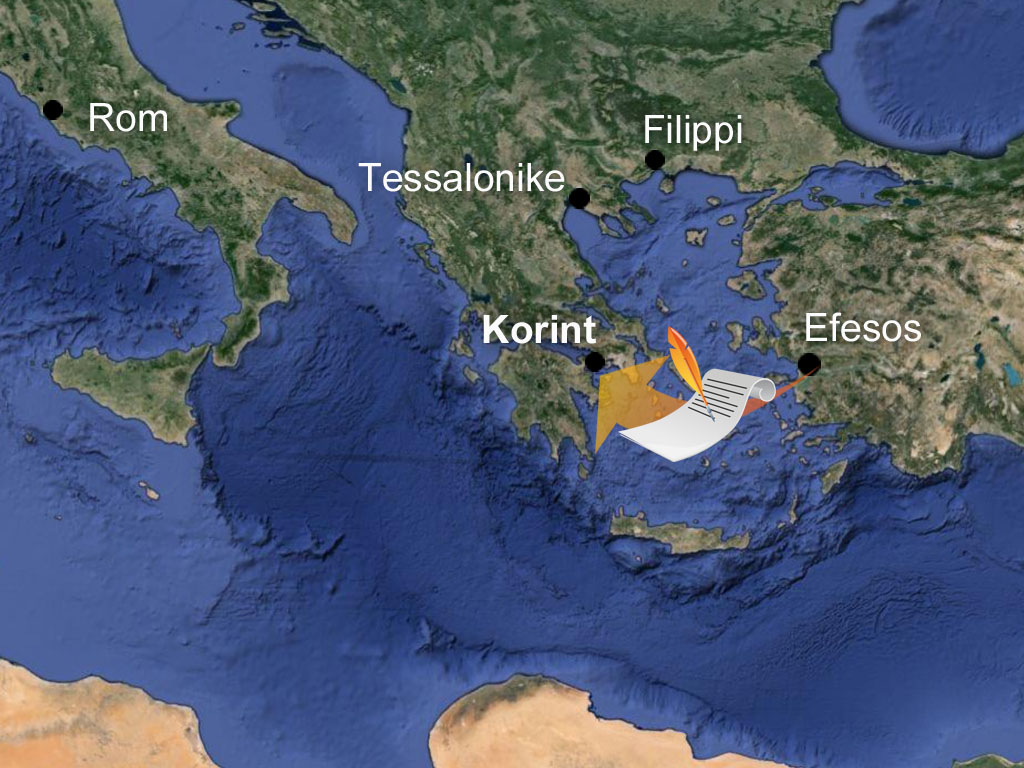
Paul receives disturbing reports from the church in Corinth and writes letters from Ephesus, where he is staying.
Show in atlas
and brother Sosthenes. [The name Sosthenes means “liberator of his people.” He was with Paul in Ephesus when the letter was written and must have been known in the church in Corinth. Perhaps he was Paul's secretary who wrote down what Paul dictated, except for the final greeting, which Paul wrote himself, see . He may be the synagogue leader of the same name who was beaten before the governor Gallio when Paul was in Corinth for the first time, see .] 2To the church of God (Gk. ekklesia) that is in Corinth.
[The only thing that separates the churches in the New Testament is geographical location. The believers in one place, even if they met in different homes, are always referred to as one entity.]
You who have been sanctified (purified; set apart and separated) [from ungodliness and appointed to holy service] in the Anointed One (Messiah, Christ) Jesus [by being united with him], who are called to be holy [God's people] together with all those who call upon (invoke; call on, appeal to) [honor] the name of our Lord Jesus the Anointed One (Messiah, Christ) in every place – [both] theirs and ours.
[The verse ends literally with “theirs and ours,” and can refer either to place or to Lord. Either way, the idea is that the Corinthians are not alone in their faith in Jesus. Throughout history, people have tried to lay claim to the name of Jesus, see . From the beginning, Paul is clear that Jesus is not divided.]
3Grace (undeserved favor – Greek charis) to you,
and peace (harmony, happiness, prosperity – shalom)
from God our Father
and the Lord Jesus the Anointed One (Messiah, Christ). [The usual Jewish greeting was “peace be with you,” Hebrew shalom. The Greek equivalent was “be greeted,” Greek charis. By combining these two phrases, Paul identifies himself with both Greeks and Jews.]Thanksgiving
[Paul begins with thanksgiving for the Corinthians. The first verse and the last verse, , form a framework that summarizes Paul's entire argument – God is the one who holds together the past, present, and future. Paul is diplomatic; he cannot thank them for their "faith," see , or their "common commitment to the gospel," see , or their "faith and love," see , or their "faith, love, and hope," see . Instead, he thanks them for God's grace and undeserved favor upon them!] 4I always thank my God for you because of the grace (power, undeserved favor) of God that you have received in the Anointed One (Messiah, Christ) Jesus. 6because the testimony of the Anointed One (Messiah, Christ) has strengthened (confirmed, fortified) you, 7so that you are not lacking (in need of) any [spiritual] gift (free gift of grace).
[These spiritual gifts are described in more detail in chapters 12 and 14.] While you wait for Jesus the Anointed One (Messiah, Christ) to be revealed [to come back a second time], 8he will strengthen (confirm, fortify) you until the end, so that we may be blameless on the day of our Lord Jesus the Anointed One (Christ). 9God is faithful (reliable, trustworthy, true to his promises, and dependable), through whom you were called into fellowship with his Son, Jesus the Anointed One (Messiah, Christ), our Lord.THE CROSS AND CHRISTIAN UNITY (1:10-4:16)
Problem – division in the church
10
Fishermen repairing their nets.
"I belong to (follow, adhere to) Paul" [who started the church, see ], or
"I belong to Apollos" [a group influenced by Greek Alexandrian philosophy, see ], or
"I belong to Cephas [Peter's Jewish name]" [perhaps a Judaistic group, see ], or
"I belong to the Anointed One (Messiah, Christ)." [This phrase suggests that the others did not belong to Jesus and may have been a religious clique who considered themselves to be "true believers," superior to others and the only genuine believers.] [Based on Paul's comment in , it is possible that he does not mention the actual groups that Chloe told him about. Instead, he takes himself, Paul, Apollos, and Peter as examples. Paul had not heard the different parties' stories, and in an already infected situation, it would easily become even worse if Paul took sides with a particular party.]
13Is the Anointed One (Messiah, Christ) divided (split into different parts)? [No!]
Was Paul crucified for your sake? [No!]
Were you baptized in Paul's name? [No!] 14I thank God that I did not baptize any of you, except Crispus and Gaius, 15otherwise someone might say that I baptized them in my name. 16Yes, I also baptized Stephanas and his household, but I don't remember baptizing anyone else. [Chapter 13 contains the well-known praise of love. Equally noteworthy is the following praise of the cross. The praise of the cross consists of three main parts. The first and last parts deal with how the wisdom of the world cannot describe the cross, see and . The central part describes the power and wisdom of God in the cross, see . The proclamation of Jesus' cross is found at the beginning, middle, and end, framing and reinforcing the theme of the cross, see , ; .]The Praise of the Cross
The wisdom of the world cannot describe the cross
17
This cross stands on the road between Jerusalem and Jericho. Even today, the cross is God's power for salvation!
to those who are perishing [currently heading toward eternal death],
but to us who are being saved [heading toward eternal life]
it is the power of God.
19It is written [in the prophet Isaiah]: "I will destroy
the wisdom of the wise [show that the human thinking of philosophers is useless],
and the intelligence of the intelligent
I will wipe out (show that it leads nowhere)"
[Quote from . As Paul often does to congregations of both Jews and Gentiles, he uses an example from Israel. Isaiah's words condemned them for following human advice and making a covenant with Egypt to defend themselves against Assyria, see .] 20Where are the [Greek] wise men (philosophers, thinkers)?
Where are the [Jewish] scribes?
Where are the debaters of this world?
[They are not there, for God has destroyed them, see .] Has God not shown the foolishness of this world's wisdom? []Jesus crucified – God's wisdom
21This world, with all its wisdom (philosophical thinking),
has failed to recognize God in his wisdom. Therefore God chose to save (redeem, establish, preserve, heal, provide for, liberate) those who believe,
through the "foolishness" that is preached [that one is saved by "just" believing]. 22The Jews demand signs (miracles)
and the Greeks seek wisdom (philosophical human knowledge), 23but we preach the Anointed One (Messiah, Christ) crucified, [This is the center of the chiasm – Jesus, God's Anointed One, crucified. The word cross is also found in and which frame this passage.] a stumbling block (scandal, something embarrassing) to the Jews
and foolishness (philosophically completely wrong, absurd) to the Gentiles. 24But for those who are called, whether Jews or Greeks,
the Anointed One (Messiah, Christ) is the power of God and the wisdom of God. 25God's "foolishness" [that he saves sinful people]
is wiser than human wisdom,
and God's "weakness" [his selfless, giving love]
is stronger than human strength.The wisdom of the world cannot describe the cross
[Paul now moves on from the gospel, where the message of the cross is foolishness, and addresses the people whom God calls. This passage has the same theme as , and has been given the same heading to clarify the chiastic pattern.] 26Brothers and sisters (in faith),
just look back at when you yourselves were called.
In a worldly sense (according to the flesh),
not many of you were wise,
not many were influential (powerful),
not many were of noble birth. [God's calling is not based on human wisdom and external circumstances.] 27But God chose (deliberately chose) what is foolish to the world
so that those [who think they are] wise would be put to shame,
and God chose what the world considers weak
so that those [who think they are] powerful would be put to shame.
28God chose what the world looks down on [those without noble lineage, status]
and what was despised (worthless),
even what was nothing,
to nullify (ignore) what is something [that the world considers important].
29This is so that no human being (no flesh) should boast (brag) before God.
30Because of (but through, from) him, you are in (you live united with) the Anointed One (Messiah, Christ) Jesus, who has become our wisdom from God. He has become our [the wisdom in Jesus becomes visible through our]:
righteousness [has enabled us to meet a holy God without guilt],
sanctification (has purified and set us apart for service), and
redemption (deliverance) [has paid the price to buy us free from eternal judgment for sin].
31Therefore, as it is written [through the prophet Jeremiah]: "Whoever wants to boast,
let him boast in the Lord."
[Paul summarizes , which warns against boasting about one's own wisdom and ability. All praise must be in light of what God has done. The same quote is also given in .]
[Paul also takes himself as an example of how God's wisdom is higher than human wisdom.] 21For my part, when I came to you, brothers and sisters in faith,
my message that I proclaimed about God was not dominated by impressive speech (rhetoric) or wisdom.
2For I decided to know nothing [consciously show my knowledge] among you
except Jesus the Anointed One (Messiah, Christ), and him crucified.God's wisdom is revealed through the Spirit (2:3-16)
God's wisdom both hidden and revealed
3For my part, when I met you, I appeared in weakness and fear (I was nervous and did not like to speak in front of people) and 4neither my speech (presentation) nor my message (my preaching) was based on persuasion (seductive arguments) of "wisdom," but on conviction (a manifestation) in the Spirit and in power. 5This was so that your faith would not be based on human wisdom but on God's power. 6Now there is [a higher] wisdom that we are accustomed to speaking of when we are among adults (fully grown, those who are spiritually mature), but it is not the wisdom of this age (generation, world) or of the world's leaders (princes, kings), which is in the process of being set aside (doomed to perish). 7No, instead we speak (convey) God's wisdom, hidden in a mystery (a riddle) [hidden from human wisdom], which God planned before the beginning of time
for our glory, 8which none of the rulers of this age knew (had a personal experience of), for if they had, they would never have crucified the Lord of glory. 9But as Scripture says: "No eye has seen,
no ear has heard,
no heart has dreamed of (what anyone could have thought),
all that God has prepared (smoothed the way, paid for)
for those who love him forever."
[Paul quotes freely from and .]
10God has revealed this to us through his Spirit. The Spirit reveals God's wisdomThe Spirit [the Holy Spirit] searches (constantly examines, studies carefully again and again) everything, even the depths of God (deep insight).
11For who among men knows (understands, knows) what is in man [the depths – in others or even in himself, see ], except the spirit of man within him (literally: him)? In the same way, no one knows what is in God except the Spirit of God. 12But we have not received the spirit of the world, but the Spirit of God, so that we may know (understand, appreciate) the gifts (of free favor and blessings) that God has given us. 13We put these truths into words, but not with words taught (dictated) by human wisdom, but as the Spirit teaches, by combining (compiling) spiritual truths with spiritual words [to those who have the Holy Spirit]. 14An unspiritual person [who has not been touched by God] does not receive what comes from the Spirit of God. It is foolishness to her, and she cannot understand it because it must be judged spiritually. 15The spiritual person, on the other hand, can judge everything (examine, determine what is right), but she herself cannot be judged (condemned) by anyone [unspiritual person]. [The spiritual person can only be judged by God, see , not by unspiritual people or worldly Christians, see .] 16For who has known the mind (plans, thoughts) of the Lord?
Who can teach him?
[, see also .] But we have the mind of the Anointed One (Christ).Christian unity (3:1-4:16)
[Paul looks back to when, about three years earlier, he was involved in leading the Corinthians to faith in Jesus.] 31Brothers and sisters (in faith), I could not speak to you as spiritual people, but only as unspiritual people (strongly influenced by their fleshly human nature), as infants in the Anointed One (Messiah, Christ). 2I gave you milk to drink [as a mother would feed a small child], because you were not mature (old enough) to take in solid food [deeper spiritual truths]. But [three years later] you are still not ready! 3The reason is that you are still carnal [and allow yourselves to be ruled by emotions and circumstances]. For as long as there is envy [the underlying inner cause] and strife [which is the fruit of envy] among you, are you not carnal and living like everyone else [without the life of the Spirit]? 4If one says, "I follow Paul," and another, "I follow Apollos," are you not like people in general? [Envy and selfishness lead to disorder and all kinds of evil deeds, see . One of the works of the flesh is strife, see .]Misconception about what Christian leadership means
[The Corinthians showed their immaturity by exalting human leaders to the heavens. Paul responds to this by pointing out that true Christian leadership is servant leadership.] 5What is Apollos?
What then is Paul?
We are only servants who have brought you to faith [not leaders of different groups]. The Lord has given us different tasks. [The church can be likened to a plant:]
6I planted, Apollos watered, but God gave the growth. 7Neither the one who plants nor the one who waters is important, but only God who gives the growth. 8The one who plants and the one who waters are equal (are equally important), and each will receive his wages according to his work. 9We are God's co-workers, and you are God's field, God's building. [The church can be likened to a building:]
10Through the grace (the special gift given to me for my task) that God gave me, I laid the foundation like a skilled architect (experienced builder), and another is now building on it. [Apollos and other teachers built on the foundation that Paul had laid in Corinth.] Let each one be careful how he builds on it, 11for no one can lay any foundation other than the one [already] laid, which is Jesus the Anointed One (Messiah, Christ). [There is only one foundation – Jesus, the Anointed One – but there are different ways to build on that knowledge. Here he warns pastors and teachers in particular to be vigilant about what they teach.] 12If anyone builds on the foundation with [lasting materials such as] gold, silver, and precious (noble) stones, [or temporary ones such as] wood, hay, and straw, 13then each one's work will be made visible (openly showing what it is made of). For that day will reveal it, since it will be revealed in fire, and the fire will test the quality (test what is genuine and has real value) of what each person has done. [It is not the quantity of work but the quality that is assessed.] 14If the work (deeds) that someone has built up passes [the test], he will receive his reward, 15but if it is burned up, he will suffer loss [he will lose his reward]. He himself will be saved, but as through fire [like someone who escapes a fire but what he has built is destroyed]. 16[You are not just any building.] Do you not know (have you not realized) that you [the entire congregation in Corinth] are God's temple and that God's Spirit dwells in you? 17If anyone destroys (ruins, damages) God's temple [with false teachings], God will destroy him. God's temple is holy, and that temple is you. [Paul emphasizes that the believers together constitute God's temple. Here, the Gk. word naos is used to describe the sanctuary with its inner rooms (not the Gk. word hieron, which is used for the outer courtyards). Peter uses the same image, where everyone is a "living stone" in a spiritual building, see . A little later, Paul uses the same image of the temple again for the individual believer, see . God takes a serious view of leaders who do not build up but destroy his holy dwelling place.] 18Do not deceive yourselves [be on your guard so that you are not deceived by the wisdom of this world]. If any of you think you are wise in this world, you must first become a fool in order to become wise. 19For the wisdom of this world is foolishness with God. It is written: He catches the wise in their craftiness []
20and further: The Lord knows the thoughts of the [human] wise,
he knows that they are empty. []
21Therefore, no one should boast about people [your human leaders], for [it is indeed as your philosophers say that] "everything is yours": 22Paul, Apollos, and Cephas [Peter],
the world (the universe),
life and death,
the present and the future,
all are yours. [Paul uses a well-judged irony by borrowing the expression "all are yours" from the popular philosophies of his day. Stoics and Cynics claimed that even though they owned nothing, the whole world belonged to them because they were friends with the gods who owned the world. Paul reveals the Corinthians' lack of true wisdom because if the whole world belonged to them, there was no reason to talk about belonging to different teachers.] 23You belong to the Anointed One (Messiah, Christ), and the Anointed One belongs to God.A leader must be faithful
41Let people look at us [me, Paul, Apollos, and other leaders, see , ; ] as servants of the Anointed One (Messiah, Christ), as stewards of God's mysteries (bearers of his hidden plans and purposes). 2What is required of a steward here [in this area] is that he be trustworthy (the quality sought in those who are to have authority and responsibility is faithfulness). [The Corinthians seemed to value only eloquence and human philosophical knowledge.] 
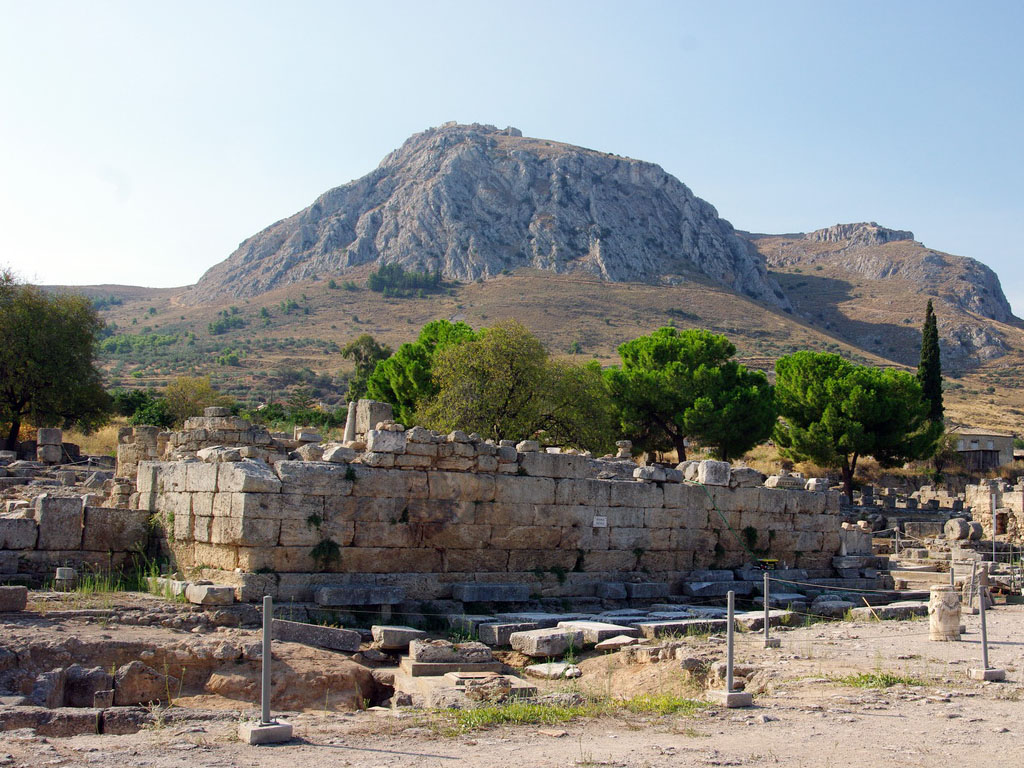
Even today, you can see the remains of the foundation of the raised judge's seat (Gk. bema) in Corinth. It was here that members of the synagogue brought Paul to try to have him convicted by the proconsul Gallio, see .
[Who are you to choose different leaders and groups, see .]
What do you have that you did not receive?
And if you did receive it, why do you boast as though you did not? [The entire argument in is built on contrasts. The Corinthians seemed to overemphasize the future, where the coming age was already here – a so-called over-realized eschatology. They may also have adopted a contemporary Stoic philosophy of life, where a wise person would be free from everyday worries. The reasoning with "kings" is interesting and seems to have existed in these circles. A few years later, Epictetus (50-135 AD) wrote: "When someone looks at me, who does not feel that she is looking at her king or master?"] 8You are already satisfied, you are already rich, you have become kings without us. I wish you had truly become kings, so that we could reign together with you! 9It seems that God has put us apostles last, as if we were condemned to death. We have become a spectacle to the world, to both angels and men. 10We are fools for the Anointed One (Messiah, Christ),
you are wise in the Anointed One.
We are weak,
you are strong.
You are respected,
we are despised. 11Even now we are hungry and thirsty, we are naked, beaten and homeless. 12We toil and labor with our hands. [Paul worked for his own livelihood so as not to be a burden to the church, see .] When we are reviled,
we bless;
when we are persecuted,
we endure;
13when people speak ill of us
we speak well of them. We have become like the refuse of the world, the scum of humanity, and so it is today.A father's admonition
14I am not writing this to shame you, but to guide (admonish, gently warn) you as my beloved children. 15For even if you had a myriad [the highest numerical value in Greek, which is 10,000, but is also used figuratively to describe an innumerable quantity] of teachers in the Anointed One (Messiah, Christ), you still do not have many fathers. It was I who, in the Anointed One Jesus, gave you birth through the gospel. 16Therefore, I urge (encourage, exhort) you: have me as your role model (become "imitators" of me – Gk. mimetes).MEN AND WOMEN – IN FAMILY RELATIONSHIPS (4:17-7:40)
Gross sexual sin in the midst of the church (4:17-5:6)
Introduction
[The following verse may refer back to the divisions in the congregation, or forward to the open sexual sin that Paul soon addresses in chapter 5. Since the word "therefore" is used in and refers back, it is likely that this "therefore" refers forward. The visit Paul speaks of also recurs in . This is also consistent with the chiastic structure.] 17For this reason (for this reason), I have sent you Timothy, my beloved and faithful child in the Lord. He will remind you of my ways in the Anointed One (Messiah, Christ) Jesus, which I teach in all the churches everywhere. [Paul met Timothy during his first missionary journey. On the second journey, Timothy accompanied him as his assistant, see . He was well known in the church in Corinth, see .]The problem
18Some have become arrogant, thinking that I will not come to you. 19But I will come to you soon, if the Lord wills, and then I will find out how things really are, not by the words of those who are puffed up, but by their power. 20For the kingdom of God does not consist in words but in power. 21What do you want? Shall I come to you with a rod,
or with love [which is unselfish and giving] and a gentle (emotionally balanced) spirit? 51Everyone is saying (and it is common knowledge) that there is sexual immorality among you, such sexual immorality that is not even found among the pagans: that a man is living with his father's wife. [The wording indicates that the son is not living with his own mother but with his stepmother, a relationship that was forbidden according to . This type of relationship within forbidden degrees was not socially acceptable in society and could be prosecuted under Roman law. The wording "everyone is talking" indicates Paul's great surprise that the congregation seems to be proud of being so tolerant and open.
We do not know exactly what the situation was, but a likely scenario is that in a family in the congregation, the mother has died. The father had remarried a younger wife. An adult son, who was the same age as his father's new wife, developed a relationship with her. Some in the church claimed that love is the greatest and that they no longer live under the law but under grace. We are tolerant – the freedom in Jesus applies to everything!
In addition to the divisions in the church, Paul had received verbal information about other problems in the church. It is important that Paul addresses the problem of division first – a divided church does not have the authority and power to deal with any other problems.] 2Despite this, you are puffed up!
Shouldn't you instead mourn (weep)? Exhortation – distance yourselves from him [In , , and 5, body followed by spirit recurs as a recurring literary pattern.]
You should have removed the one who did this from your community.
3I, who am
absent in body
but present in spirit,
have already judged (passed the judgment over) the one who did this, as if I were there.
4In the name of our Lord Jesus the Anointed One (Christ).
When you are gathered together [the body of Jesus]
and my spirit is with you,
by the power of our Lord Jesus, 5that man shall be delivered unto Satan for
the destruction of the flesh
that the spirit may be saved
in the day of the Lord. 6Your boasting [about your teachers and how everything is fine in the church] is totally inappropriate. [Paul urges the church to take responsibility. They should not wait for him to come and solve the problem for them, but he gives advice on how he would have acted if he had been there. The man who lived with his father's wife was clearly acting against both God's commandment and Roman law, and the congregation turned a blind eye to it. Paul does not say that they should stone him, which would have been the Jewish solution. Nor does he urge them to take the case to court, which would have been the Roman solution. Instead, he says that the church as a whole should distance themselves from him and hand him over to Satan, in the hope that the shock of seeing who his real master is might lead to repentance. This story has a happy ending; in 2 Cor. 2:5-8, the man has repented and is back in the community. The church must sometimes set boundaries, but the admonition must be done in love, see , and the goal is always restoration, see .] Why is it important that you address this?1)
A little leaven leavens the whole lumpDon't you know that a little leaven
[a picture of sin and false teachings, see ; ; ] leavens the whole lump?
7Purge the old leaven so that you may become a new dough – you are indeed unleavened, for our Passover lamb, the Anointed One (Messiah, Christ), has been slaughtered for us. 8Therefore, let us celebrate the feast, not with old leaven [when we lived according to the ways of the world], nor with the leaven of malice and wickedness (evil and practiced wickedness). Instead, celebrate with the unleavened dough of purity (honor) and truth (honesty).2) There is a difference between the world and the church
9In my [previous] letter to you, I wrote that you should not associate (habitually and have close contact) with sexually immoral people. 10I did not mean all
sexually immoral people here in the world,
or all greedy people (who strive for more and more possessions, but also power and influence) and
exploiters (deceivers, swindlers) [The word is translated "predatory" in .]
or all idolaters.
In that case, you would have had to leave the world! [Paul had written at least one letter before this letter, which we call First Corinthians. In the previous letter, which has not been preserved, the exhortation not to have close association with people who live in obvious sin had been interpreted incorrectly. It had not been applied internally in the church, but was thought to apply only to other people in the world. Paul points out the absurdity of such a view. Paul does not advocate monasticism; a Christian should live in the world but not of it. Jesus does not ask that his disciples be taken out of the world, but that they be kept from the evil one, see .] 11But now I am writing to you that you should not associate with anyone who calls himself a brother [who calls himself a Christian] and is [has a lifestyle of being]
sexually immoral,
greedy,
an idolater,
a slanderer,
a drunkard, or
an extortioner.
You should not even eat with such a person. [This list has similarities with the deadly sins in , which also ends with the instruction not to have anything to do with those who indulge in such things.]3) Secular courts should not solve the problems of the congregation
12Is it my business to judge outsiders? [No!]
Shouldn't you judge those inside [the congregation]? [Yes!] 13God will judge outsiders. Drive out the wicked from among you! [] [It is likely that someone in the congregation had gone to court concerning this case where the son was with his father's wife. Perhaps the humiliated father, one of the wife's relatives, or a group in the congregation.] 61How can any of you who are in dispute with another [brother or sister] go to court before the unrighteous and not before the saints? 2Do you not know that the saints will judge the world?
If the world is to be judged by you,
are you not competent to judge [comparatively] small matters?
3Don't you know that we are going to judge angels?
How much more, then, should you be able to judge matters of this life? 4But when you have everyday disputes, you appoint people as judges whom the congregation does not trust. [Paul is probably thinking back to how he himself was brought to trial in Corinth when he was there for the first time, see . Gallio dismissed the case, and the synagogue in Corinth was publicly humiliated.] 5I say this to shame you. Is there no one among you wise enough to settle a dispute between brothers? 6Instead, brother goes to court against brother, and this before unbelievers. 7The very fact that you are taking each other to court is a defeat for you. Why not rather suffer injustice? Why not rather suffer loss? 8Instead, you yourselves commit injustice and rob one another, and you do this to your brothers and sisters in the faith.The Laws of the Kingdom of God (6:9-17)
Ten sins
9Do you not know that the unrighteous will not inherit the kingdom of God? Stop deceiving yourselves! [Five sexual sins:]
Neither sexually immoral (fornicators – Gk. porneia),
or idolaters [who practiced sexual acts in idol temples],
or adulterers,
or catamites (the passive partner in a male homosexual relationship), [The word malakoi is also used to refer to soft fabric in and , and can be used to describe a feminine man or a homosexual prostitute.]
or men who lie with men, [The Greek word arsenokoites describes the active partner in a male homosexual relationship. The word consists of two words, arsen, meaning man, and koitai, meaning "bed." These two words are used in and it is likely that Paul constructs this new Greek word to give a clear reference to this particular verse. All five of these sexual sins are mentioned centrally in .] [Five other sins:]
10or thieves,
or greedy people,
or drunkards,
or slanderers,
or exploiters will inherit the kingdom of God. [The number ten is often used in the Bible for man's responsibility before God, the Ten Commandments (), tithing (), etc. All of these ten sins relate to the problems Paul addresses in this letter. The first part, concerning sexual sins, is obvious from the context. The second part begins and ends with theft and robbery, exactly what Paul spoke of in , where people "rob" each other by suing one another. In the middle, he mentions the greedy, drunkards, and slanderers. These three words summarize the problems at the Lord's Supper in the church service that will soon be addressed, see . When Paul describes these people, he uses nouns, not verbs, which indicates that these are not isolated sins but an active lifestyle in these sins.] 11Some of you have been like this. But you have been washed clean,
but you have been sanctified,
but you have been declared righteous
in the name of the Lord Jesus the Anointed One (Messiah, Christ)
and in the Spirit
of our God. [These six lines belong together. You have been washed clean in the baptism of Jesus, see . The Holy Spirit is the one who sanctifies, and God is the one who justifies, see .]
[Paul now uses a rhetorical device called diatrib. An imaginary dialogue partner is quoted and then contradicted. Since Greek does not have quotation marks, one cannot be entirely sure when it is a quotation and when it is not. It is not unlikely that these quotations originally came from Paul himself when he argued against Jewish legalism. Taken out of context, some had used them to support unrestrained freedom. The same four lines are found almost verbatim in .] 12[You say:] "Everything is permissible for me,"
but not everything is beneficial (compared to other things). [You say:] "Everything is permissible,"
but I will not let anything control (enslave) me.The body is not for unbridled sexuality
[The Corinthians argued that food and sexuality were comparable. I feel hungry – and I eat. I feel sexual desire – and I indulge in prostitutes. Greek spirituality, and Gnosticism in particular, was characterized by a mindset in which the physical and the spiritual were separate. It did not matter what one did with the body, the spirit was higher.] 13[You say:] "Food is for the stomach
and the stomach for food,"
but [then I want to say that] God will destroy both of them.
The body is not for immorality but for the Lord,
and the Lord for the body. 14God has raised the Lord,
and by his power he will raise us too. [The logic of Paul's reasoning about sexuality has to do with the body, which will one day be resurrected. Therefore, how we treat our bodies matters.] 15Do you not know that your bodies are members of the body of the Anointed One (Messiah, Christ)? [This is thematically related to .] Shall I then take parts of the body that belong to the Anointed One (Messiah, Christ)
and make them one with the body of a prostitute?
[This is thematically related to , where the word "body" is also used twice.] Absolutely not! 16Don't you know that whoever joins themselves to a prostitute
becomes one body with her? It is said: 16The two shall become one flesh. [] [Sexuality is not separate from love and involves the whole person. Sexual intimacy creates both a physical and spiritual union with deep soul bonds.] 17But whoever is united with the Lord
is one spirit with him.
[This is thematically related to , see the words "united" and "is one."] 18Flee sexual immorality!
Every other sin a person commits is outside the body,
but the sexually immoral person sins against his own body. 19Do you not know that your body is a temple of the Holy Spirit within you, which you have from God?
You are not your own, 20you were bought at a high price.
Therefore, honor God with your body! [The body is a temple of the Holy Spirit. There is an interesting connection to the tabernacle. From the outside, one saw only skins (from animals), but inside was the ark of the covenant. We can also read that they gathered three colors of yarn: blue, purple, and scarlet (). Similarly, our blood vessels in the body are blue when they are low in oxygen, dark red when they are full of oxygen, and violet in between.]Sexual relationships in harmony with the gospel
[Paul now answers seven questions about family life and sexuality that the Corinthians wrote to him about. What was not mentioned in the letter was the disagreement, the man who lived with his father's wife, and how some men did not think it was so bad to use prostitutes. It seemed as if the congregation in Corinth was trying to hide these embarrassing problems and instead wrote some questions of a more general nature. Paul found out about the real situation and therefore addresses these serious problems in chapters 5-6 before answering their written questions.]1) Not male dominance
[Paul has previously addressed the problem of liberal groups that advocated free sex, see . Now he turns to the ascetics who believed that all sexuality was sinful and should be avoided, even within marriage.] 71Regarding what you wrote: "It is good for a man not to touch a woman."
2But because of [the risk and temptations of] sexual sins (fornication in the plural – Gk. porneia) [which were widespread and generally accepted in Corinth]
every man should have [sexual relations with] his wife
and every wife [sexual relations with] her husband. 3The husband should give his wife what he owes her,
and likewise the wife her husband. 4The wife does not have authority over her own body,
but the husband does.
Likewise, the husband does not have authority over his own body,
but the wife does. 5Do not deprive each other, except perhaps for a time by mutual consent, so that you may devote yourselves to prayer. Then come together again, so that Satan will not tempt you because you cannot control yourselves.2) Widows and widowers
[The phrase "I say this" refers forward in the same way as in . Unlike the case of incest and the question of whether it is compatible with Christian faith to go to prostitutes, which had a clear answer, there is no clear answer as to whether widows and widowers should remarry. In , it is clear that one of the spiritual gifts is the ability to live unmarried. The prevailing situation in the world also played a role, see .] 6But this I say as a counsel, not as a commandment: 7Ideally, I would like everyone to be like me. But each person has their own gift from God,
one in one way, another in another. [We do not know much about Paul's marital history. We know that he studied under the rabbi Gamaliel, but we do not know if he himself became a rabbi, see . If so, he must have been married earlier, since marriage was a requirement for becoming a rabbi at that time. Rabbinic tradition sets a minimum age for marriage at 18 for boys (Mishnah Abot 5:21). If one is not married by the age of 20, one is cursed by God (T.B. Sanh. 76b). What we know for certain is that he is not married when he writes this letter. Perhaps Paul was a widower, as may be implied in the following verse.]
8To the unmarried and to widows I say:
it is best for them to remain as I am. 9But if they cannot live in abstinence, they should marry,
for it is better to marry than to burn with desire.3) Believers and non-believers – marriage and divorce
[Now Paul addresses some more complicated issues concerning divorce, see also ] 10To the married [where both are believers], I give a command that is not mine but the Lord's:
"A wife must not separate from her husband." [; ]
11But if she does divorce him, she must remain unmarried or be reconciled to her husband. A man must not [either] abandon his wife. 12To the rest I say, not the Lord: If a brother has a wife who is not a believer and she is willing to live with him,
he must not divorce her.
13If a wife has a husband who is not a believer and he is willing to live with her,
she must not leave him. 14For the unbelieving husband is sanctified by his wife,
and the unbelieving wife is sanctified by her believing husband.
Otherwise your children would be unclean, but now they are holy.
[In Jewish tradition, regarding what is holy and unclean, it was assumed that the unclean defiled the holy. Jesus reverses this. In , neither the woman with the bleeding nor Jairus' dead daughter defile Jesus. He touches what is considered unclean without becoming unclean himself; instead, what he touches is healed and cleansed.] 15But if the unbeliever wants to separate, let him separate. In such cases, [the believer] is not morally bound [to the marriage] as a slave. God has called you to live in peace. 16For how do you know, wife,
whether you will save your husband?
Or how do you know, husband,
whether you will save your wife?4) Jewish and Greek, slave and free
[The main message in this section is to remain in the lot that the Lord has given a person; the phrase recurs in , , . The terminology is taken from , which deals with how God assigns different plots of land to the Israelites in the Promised Land. Why does Paul bring up Jude/Greek and slave/free in the middle of a context that talks about family relationships? The answer may be found in , where these two topics are brought up in connection with the fact that in Jesus there is no longer male and female.] 17But each one should live in the position (lot) that the Lord has assigned him, as God has called him. I prescribe this in all the churches. 18Was anyone [a Jewish man] already circumcised when he was called [by God]?
Then he should not change that. [Remove his Jewish identity through surgical intervention, literally "acquire foreskin."]
Was anyone [a non-Jewish man] uncircumcised when he was called [by God]?
Then he should not be circumcised.
19This procedure called circumcision has no significance,
and this physical procedure of becoming uncircumcised again has no significance either,
what matters is that one keeps God's commandments. [Greek culture idealized nudity. In Jerusalem, the first Roman sports facility was built around 175 BC. The Greek word is gymnasium, from the Greek gymnos (naked), because people trained and competed naked. Our words "gym" and "gymnastics" come from this word. Both the First Book of Maccabees 1:17 and Josephus' work Antiquities of the Jews (book 12, 5:1), there is mention of how Greek Jewish men were ashamed of their Jewish identity and underwent surgical procedures to "acquire a foreskin" and become uncircumcised.] 20Each one should remain in the position
he was in when he was called. 21Were you a slave when you were called [by God]?
Do not worry about it,
but if you can become free (gain your freedom), take that opportunity. [The last part is literally "but even if you can become free, use it." It can be translated to mean "even if you can become free, it is better to remain a slave." In light of , where slave traders are compared to murderers, and the content of the next verse, it is most likely that the meaning is that Paul is not opposed to a slave being freed, see also the letter to Philem.]
22He who was a slave when he was called by the Lord is the Lord's freedman, and he who was free when he was called is a slave to the Anointed One (Messiah, Christ).
23You were bought at a high price [Jesus paid with his life on the cross],
so do not become slaves to men. 24Brothers and sisters in the faith, each one should remain before God as he was when he was called.5) Advice to the unmarried
25Now concerning unmarried women (virgins), I have no command from the Lord. But I give my opinion as one who by the Lord's mercy is trustworthy. 26I think that in the difficult situation that now prevails, it is best for people to remain as they are. 27If you are bound to a wife,
do not seek to be free.
If you are not bound,
do not seek a wife.
28But if you marry, you do not sin,
and if an unmarried woman (virgin) marries, she does not sin.
However, those who do so will suffer in this life,
and I would like to spare you that. 29But I say this, brothers and sisters in faith: The time is short, from now on: Let even those who have wives
live as though they did not have them,
30and those who weep [at a funeral]
as though they did not weep,
those who rejoice [at a birth]
as though they did not rejoice,
those who buy something [property]
as though they did not keep it,
31and those who use this world [sell and buy goods]
as if they did not use it. For the order of this world is coming to an end.Marriage means responsibility
32I want you to be free from worry.
The unmarried think about what belongs to the Lord,
how to please the Lord. 33The married man thinks about what belongs to the world,
how he can please his wife, 34and so he is divided. The unmarried woman and the virgin think about what belongs to the Lord,
to be holy in both body and soul. The married woman thinks about what belongs to the world,
how she can please her husband.
35I say this to build you up (for your benefit and your own good), not to restrict you (to bind you), so that you may live rightly and faithfully hold fast to the Lord without distraction.It is not wrong to marry
[Paul now concludes his guidelines by making it clear that marriage is a good thing and that there is nothing wrong with getting married. However, under the current circumstances in the world, starting a family will cause extra worries, which is why Paul advises against it in this situation. He is fully confident that the Lord is able to fulfill the basic longings and needs of the unmarried. is difficult to translate and can refer either to a father who is about to marry off his marriageable daughter or to a young man who is betrothed to a young girl. Regardless, the conclusion is the same – it is not sinful to marry.] 36But if anyone thinks he is doing wrong to his daughter who is of marriageable age and wants to marry, then he should do as she wishes; he is not sinning, let them marry. 37On the other hand, he who is firm in his mind and is not under compulsion but has the freedom to follow his own will and has decided to let his daughter remain unmarried, he is doing something good. 38Therefore:
the one who marries off his daughter
does something good,
the one who does not marry her off
does something even better.It is not wrong to remarry after death
39A wife is bound as long as her husband lives. If her husband dies, she is free to marry whomever she wishes, as long as it is in the Lord. The expression "in the Lord" means that she marries a believing man, see . Later in , he encourages younger widows to remarry. 40But she is happier (more blessed) if she remains as she is. That is my opinion, and I believe that I also have the Spirit of God.LIVING AS A CHRISTIAN IN A FALLEN WORLD (chapters 8-11)
Meat sacrificed to idols – freedom and responsibility
[Here in and 4, Paul quotes what the Corinthians have said to justify their behavior. Paul agrees to some extent, but shows how they have misused their freedom.] 81When it comes to meat from idol sacrifices, we know that "we all have knowledge," but knowledge puffs up, while love builds up. 2If anyone thinks he has knowledge about something, he does not yet have the knowledge he should have, 3but if anyone loves God, he is known by him. 4When it comes to the question of whether it is permissible to eat meat sacrificed to idols (images) [], we know that "there is no idol in the world" and that "there is only one God." 5For even if there were so-called "gods" in heaven or on earth – and there are many "gods" and many "lords," 6we have only one God – the Father –
from whom everything is
and to whom we ourselves belong,
and one Lord – Jesus the Anointed One (Messiah, Christ) –
through whom everything is
and through whom we ourselves are. [There is no Zeus in heaven, no Athena on earth, and no Poseidon in the sea. Here Paul also does something remarkable by including Jesus in the Jewish creed Shema. The phrase "we have only one God" corresponds to "the Lord our God" in the prayer and "one Lord – Jesus the Anointed One" to "the Lord is one," see .] 7However, not everyone has this knowledge. Some are still so accustomed to idols (images) that they eat meat as idol sacrifices, and then their weak conscience is stained. 8But it is not food that brings us closer to God.
If we do not eat, we lose nothing,
and if we eat, we gain nothing. 9But make sure that the freedom you have gained does not become a stumbling block to the weak. 10For if anyone sees you, who have knowledge, sitting at table in an idol temple, will not the one with a weak conscience be encouraged to eat the meat from the idol sacrifices? 11Through your knowledge,
the weak person is lost,
your brother and sister for whom the Anointed One (Messiah, Christ) died.
12When you sin in this way against your brothers and sisters in faith
and wound their weak consciences,
you sin against the Anointed One (Messiah, Christ). 13Therefore, if food causes my brother to stumble, I will never eat meat again, so that I will not cause my brother to stumble.Paul's personal freedom and responsibility
[In the previous paragraph, Paul's conclusion is that we are free to eat meat sacrificed to idols, but we also have a responsibility to other believers who may be hurt. This means that we sometimes have to refrain from doing certain things. Now he shows how he himself has applied these two principles in his own life.] 91Am I not free? Am I not an apostle (messenger, ambassador)? Have I not seen our Lord Jesus? Are you not my work in the Lord? 2If I am not an apostle to others,
I am at least an apostle to you.
You are the seal of my
apostleship in the Lord. 3My defense before those who accuse me is this:
4Do we not have the right to food and drink?
5Don't we have the right to take a believing wife with us,
as do the other apostles and the brothers of the Lord and Cephas [Peter]?
6Or is it just Barnabas and I who are not entitled to be free from work? 7Who serves as a soldier at his own expense?
Who plants a vineyard without eating its fruit?
Who tends a flock without drinking its milk?
[These three examples are related to the two examples from agriculture in .] 8Am I saying this as a purely human opinion?
Doesn't the teaching (Gk. nomos) [Torah] say the same thing? 9It is written in the teaching of Moses: You shall not muzzle an ox
while it is threshing. [; ]
Is it only oxen that God cares about? 10Does he not say it rather (especially) for our sake? Yes, for our sake it was written that the one who plows
and the one who threshes should do so in the hope of receiving their share. 11When we have sown spiritual things among you,
is it too much to ask that we reap material things from you?
12If others have the right to share in what is yours,
do we not have that right even more? Paul chooses not to use his freedom [Paul writes three times "that he does not use his right," which frames this passage, see , , and 18.]
But we have not used that right [to be paid], but we put up with everything so as not to hinder the gospel of the Anointed One (Christ).
13Don't you know that those who serve in the temple
eat from the temple,
and those who serve at the altar
get their share from the altar?
14In the same way, the Lord has commanded that those who preach the gospel should live from the gospel. 15But I have not used any of these privileges, and I am not writing this to start doing so. For I would rather die ...
[The sentence is not finished; this is a so-called "aposiopesis," which shows Paul's deep emotional commitment.]
No one shall take away my glory. 16Preaching the gospel is not something I should be praised for,
it is a must for me.
Woe to me if I do not preach the gospel! 17If I do this willingly [preach the gospel and voluntarily renounce my rights, see , , ]
I have my reward (recompense),
but if I do it because I must
it is a stewardship entrusted to me. [This is the center and main point of the passage. Paul is faithful to his mission, see . It is a stewardship, see .] 18What then is my reward?
Well, as a preacher, to present the gospel without compensation, not to take advantage of the right [to a reward] that the gospel gives me.1) Complete adaptation – becoming all things to all people (9:19-27)
[Paul now comes to the central part of the topic concerning how to live as a Christian in a fallen world. The question every Christian must ask is how much we must identify with and adapt to the prevailing culture in order to make the gospel accessible. When it comes to the question of whether it is right to eat meat sacrificed to idols, which was a topical issue at the time when virtually all meat in the city had been sacrificed in idol temples, the answer is both yes and no. It depends on how much you know, and whether there are other weaker believers who might fall away if you exercise your freedom to eat such meat. Paul's three approaches:
1. Complete adaptation – everything for everyone, see .
2. Partial adaptation, see .
3. No adaptation, see .] 19Even though I am free (independent) from all [because I am unpaid],
I have [of my own free will] made myself a servant (slave, bondman) to all,
in order to win more [for Jesus]. 20To the Jews I have become like a jew (putting myself in their situation),
to win Jews.
To those under the law (teaching, educational system – Gk. nonoms) I have become like one under the law,
even though I myself am not under the law,
to win those under the law.
21To those who are without law [the Gentiles], I have become like one without law,
though I myself am not without God's law but live under the law of the Anointed One (Christ),
in order to win those who are without law.
22To the weak [sensitive, in faith] I have become weak [avoiding things that might cause offense and cause them to lose faith, such as eating meat sacrificed to idols, see chapter 8],
in order to win the weak. I have become all things to all people,
so that I might save (rescue) some.Parables from the world of sports

Image from an ancient clay pot depicting a winner being crowned with an olive wreath.
The participants competed naked in events such as running, boxing, wrestling, and pankration (which was a free-for-all fight where all means were permitted). They did not compete for money, but for honor and a victory wreath. The oldest and most prestigious event was running. The distance run was one stadium. The measurement was not completely standardized and varied between 580 - 630 feet (177 - 192 meters). This corresponds to today's modern 200-meter race. There were also longer races of two and four stadia and relay races with torches.] 23But I do all this for the sake of the gospel (the good news), so that I may share in it with you. 24Do you not know that those who run (race – Gk. trecho) on the track [the approximately 606 feet (185-meter) long sprint track at the stadium in Isthmia] – they all run [they all strive to be the first to cross the finish line], but only one receives the prize?
Run so that you win (can truly claim) it [and make it yours]. 
Wrestling competition in ancient Greece, painting by American artist Tom Lovell.
25But each one [every athlete, runner, boxer, and gladiator]
who competes (fights) [in the Greek games]
practices self-control (practices restraint; subjects himself to hard training) in everything. These [do all this] to win (receive) a victory wreath
that soon withers (a perishable laurel wreath),
but we strive [to win] one
that never withers (an imperishable) [].
[The training required to compete in these games lasted ten months. They trained hard and abstained from unhealthy food, alcohol, and physical intimacy. The winner was crowned with a wreath of olive branches.] 26I [myself] therefore do not run (race) aimlessly (uncertainly; in a hesitant manner; at random – without a clear goal in sight) [],
I do not box like one who beats the air. [It is a real fight and a real opponent.] 27Instead, I [like a boxer who delivers a devastating blow to the face] am hard on my body and force it into obedience (submission; master it by taking it away/making it a slave), so that, after preaching to others, I myself would not [in any way] be disqualified (fall short).2) Jewish traditions – partial identification (10:1-13)
[In the previous paragraph, Paul has exhorted believers "to become all things to all people," see . It is no problem to adapt to other cultures in terms of music style, clothing, food, social patterns, etc. It becomes more complicated when it comes to sacraments, which are acts that have religious significance. In this paragraph, he discusses the Jewish sacraments that were fulfilled in Jesus.] 101Siblings (brothers and sisters in faith), I don't want you to be misinformed (ignorant, lacking knowledge) about what happened to our fathers [and what could happen to us]:
Everyone was under the cloud [God's presence that went before them and protected them],
everyone walked through the sea,
2all were baptized into Moses in the cloud
and in the sea.
3All ate the same spiritual food,
4all drank the same spiritual drink,
for they drank from a spiritual rock that accompanied them,
and that rock was the Anointed One (Messiah, Christ). [Paul says "our fathers" to both Jews and Greeks. The Jewish people who crossed the Red Sea were the ancestors of both the Gentile Christians and the Messianic Jews. Both baptism and the Lord's Supper have their clear roots and models in the Exodus from Egypt. They were in the cloud and walked through the water. That was their baptism. They ate bread from heaven and drank the water of life that flowed from the rock.] 5Despite this, God was not pleased with most of them (no joy in the majority) [because they loved evil more than God]. They fell and lay scattered in the desert. 6These are now warning examples for us, lest we be like those who passionately love (have lust for) evil, as they did. 7Do not become idolaters like some of them, as it is written:
The people sat down to eat and drink
and rose up to play (dance). []
8Nor should we commit sexual sin as some of them did
and 23,000 fell (died) in one day. [] 9We should not tempt the Anointed One (Messiah, Christ) as some of them did,
they were killed by snakes. [] 10Do not grumble (mutter) as some of them did,
which led to their being destroyed by the "Destroyer" [the angel of death]. []
11All that happened to them serves as an example
and was written down to warn us who are living in the end times. 12Therefore, let him who thinks he stands take heed lest he fall. [In , Paul has taken several examples from the Old Testament of how people have strayed from the path – that is why we must be vigilant.] 13No temptation (trial, stress) has overtaken (seized, captured) you except those that are common to man. And God is faithful – he will not allow you to be tempted (tried) beyond your ability (more than you can bear/handle/cope with), but [at the same time] with the temptation (along with the trial) he will also provide the way out [that is given to you] so that you can (so that you are able to) endure. [The Greek word peirasmos means both trial and temptation. The nuance we have in the English language does not exist in Greek, see also ; . During trials, one may be tempted to leave God. Even the flesh, human sinful nature, has a tendency to lure people away from God, something Satan exploits. God tests, but does not tempt, see ; ; ; ; . The Greek word for way out is ekbasis. It only appears here and in , where it is translated as "outcome." The word is used in secular Greek for a river's outlet into the sea. At the same time as the temptation/trial, there is always a specific way out for a good end result, see .]3) Pagan traditions – no adaptation or identification (10:14-22)
[Now Paul comes to the third and final paragraph, which deals with how much a Christian should adapt to his culture. He began by saying, "I have become all things to all people" (see ). Then he reflected on the Jewish sacraments, which have their continuation in baptism and the Lord's Supper. This paragraph deals with pagan traditions that have religious significance. Individually, at someone's home, it may not necessarily be a problem to eat meat sacrificed to idols, but together with other believers, it is different. Have nothing to do with it. Here, it is not "everything for everyone," but "nothing for everyone"!] 14Therefore, my beloved, flee from idolatry! 15I am speaking to sensible people. Judge for yourselves what I say. 16The cup of blessing [with wine during the Lord's Supper] that we bless,
does it not signify [drinking]
communion (participation) with the blood of the Anointed One (Christ)?
The bread that we break,
does it not signify [eating] it
communion (participation) with the body of the Anointed One (Christ)?
17Since there is only one loaf [broken at the meal],
even though we are many, we are one body,
for we all partake of this one loaf.
[When each person takes a part of this one loaf, which represents the body of Jesus, the believers enter into a spiritual communion, united in Jesus and therefore also with one another.] 18Look at earthly (carnal) Israel.
Do not those who eat the sacrifices have fellowship with the altar? 19So what do I mean?
That idol sacrifices mean something or that an idol means something?
20No, but what the Gentiles sacrifice,
they sacrifice to evil spirits and not to God.
I do not want you to have fellowship with evil spirits. 21You cannot drink both the cup of the Lord
and the cup of evil spirits.
You cannot partake both of the Lord's table
and the table of evil spirits. 22Or do we want to challenge the Lord?
Are we stronger than him?Freedom and responsibility – concluding words
23[Contemporary readers sometimes find it difficult to grasp the chiastic patterns in this letter. We are used to reading from top to bottom, with the conclusion at the end. However, if you read "from the outside in," it is easier to follow Paul's train of thought. Headings and insertions attempt to make it easier to see the text in this way:
Verses 23-24: General principles – think of others.
Verses 32-33: General principles – do not cause offense.
Verses 25-26: Eat what is sold in the market, for it belongs to God.
: Eat to honor God.
: Eat what is offered if you are visiting someone who does not believe.
Verses 29b-30: Eat – you are free, give thanks and eat. Verses 28-29a: However, if someone says, "It is sacrificial meat," do not eat it out of respect for that person's conscience.] General principles – consider othersEverything is permissible,
but not everything is beneficial.
Everything is permissible,
but not everything builds up.
24No one should seek their own good,
but that of others.Eat what is offered, but if someone takes offense, do not eat
25Eat everything sold in the marketplace without asking questions for the sake of conscience,
26for the earth is the Lord's, and everything in it. 27If any of those who do not believe invite you to their home and you want to go,
then eat everything that is set before you without asking questions for the sake of conscience. 28But if anyone says to you, "This is sacrificial meat,"
do not eat it out of respect for the one who said it and for the sake of conscience. 29I do not mean your own conscience, but the other person's. Why should my freedom be judged by someone else's conscience?
30If I eat with gratitude,
why am I criticized for something I thank God for? 31Whether you eat or drink, or whatever you do,
do [all the time] everything [plural] for the glory (praise, honor, and glory) of God.General principles – do not cause offense
32Do not cause offense to Jews or Greeks or the church of God. 33I myself try to please everyone in everything I do, not seeking my own good but the good of many, so that they may be saved.
111Follow my example
as I follow the example of the Anointed One (Christ).MEN AND WOMEN IN THE CHURCH (11:2-14:40)
Prophets and Appropriate Clothing
[In the previous couple of chapters, Paul has discussed how much a Christian should adapt to a fallen world. One of the points is that we sometimes have to give up our freedom so as not to cause a weaker brother to stumble. The following four chapters deal with men and women in worship and practical arrangements.
The first thing Paul addresses is dress style, and the point is that both men and women should dress in a way that is not provocative or offensive to their culture. Dress style should not distract from prayer or prophecy. It seems that some women had taken their newfound freedom in Jesus too far and did not follow the customary norm of covering their heads. Paul could have solved the problem by completely forbidding women to pray and prophesy in the assemblies; instead, he gives a simple piece of advice: men should have their heads uncovered, while women should have their heads covered.
The problem is that it is not entirely clear what covering one's head meant then, and how it should be interpreted today. Throughout history, these verses have been misused. However, it helps our understanding to see that Paul is probably using a chiastic pattern, where half of the argument comes before the center and the other half after. The text is inserted in different stages to illustrate this.] 2I commend you for thinking of me in everything and holding fast to the traditions (teachings, ordinances, instruction) that I have passed on to you. 3Now I want you to know:
that every man's head (origin) is the Anointed One (Messiah, Christ),
that the woman's head (origin) is the man,
and that the Anointed One's (Christ's) head (origin) is God. 4If a man prays or prophesies with something on his head,
he dishonors his head. 5And if a woman prays or prophesies with her head covered,
she dishonors her head. It is the same as having her head shaved. 6For if a woman does not cover her head,
she might as well cut her hair off.
But if it is shameful for a woman to cut or shave her hair,
she should cover her head.
[ is related to .] [Paul now turns to creation, see . are related to .] 7A man should not have anything on his head,
because he is the image and glory of God,
and the woman is the glory of the man.
8For man does not come from woman,
but woman from man. 9Man was not created for (because of) woman,
but woman for (because of) man. [Refers back to creation where man was alone and needed a helper, see . The Hebrew word for helper is ezer. The word is often used for God when he rescues Israel (, , ; ; ; ). It does not describe a servant but a powerful figure who rescues someone in need.] 10Therefore, a woman ought to have authority on her head
because of the angels. 11More specifically (what is important in this discussion is that),
in the Lord, the woman is not independent of the man,
nor is the man independent of the woman. [Verses 9 and 11 belong together. In , Paul connects back to creation that women, like Eve, were created because men, like Adam, needed help. Now in comes the summary that in the Lord, men and women are dependent on each other.] 12For just as woman came from man,
so also man is born of (because of) woman.
And everything comes from God. 13Judge for yourselves: is it proper for a woman to pray to God without having anything on her head? 14Doesn't nature itself teach you
that it is a disgrace for a man to have long hair, 15but an honor for a woman, since she has been given hair as a veil. 16But if anyone wants to argue [is inclined to be quarrelsome about this], we have no such custom (custom, habit, practice; mutually agreed tradition – sunetheia), nor do the churches of God. [The word for custom is used here and in as well as in the custom of releasing a prisoner around Passover (). What custom is Paul referring to? The Greek seems to refer primarily to the custom of not arguing or quarreling about things that were considered natural and were already common practice in other churches as well. The fact that Paul uses the word for custom (not doctrine or law) and not the church (singular) but churches in the plural (; ) indicates that this is a matter more related to tradition and cultural custom than to doctrine.]Order in worship – the Lord's Supper
Serious problems

Reconstruction of the dining room, triclinium, where people reclined at the table in a finer Roman house. The picture was taken at the museum in the Spanish city of Zaragoza. Here, Emperor (Caesar) Augustus founded the city of Caesaraugusta around 10 BC.
18First of all, I hear that there is division among you when you meet in the church,
and to some extent I believe that to be true.
19There must be choices (free will; different groups – Gk. hairesis) among you,
in order to clearly and openly show which of you are genuine [and do not contribute to division]. [The word hairesis has come to describe heresies and sects with an emphasis on a different doctrine. The basic meaning of the word is "to take" and "to choose," and in the Greek translation of the Old Testament, the word is used for sacrifices that are "voluntary," see . The emphasis in this verse is that there must be free will and choice for genuine love and true fellowship. God sometimes tests His people through false prophets, see .] 
An artist's depiction of a fine meal in a triclinium, which consisted of three couches arranged in a U-shape. The name comes from "tri," meaning three, and "kline," meaning couch.
20When you gather together,
it is not the Lord's Supper that you are celebrating. 21For when it is time to eat, everyone rushes to eat their food [without waiting for the poor who came later],
some are hungry, others have drunk themselves drunk. 22Don't you have your homes where you can eat and drink?
Or are you trying to desecrate God's assembly by shaming those who have nothing [no homes of their own and no food to bring]? [The rich came early, ate all the food, and got drunk. The poor, who worked, came later and got no food.] What shall I say to you, shall I praise you?
No, for this you deserve no praise.The Lord's Supper is a tradition from the Lord

The Lord's Supper has been a Christian tradition ever since Jesus celebrated the Last Supper with his disciples. Since it took place during the Feast of Unleavened Bread, we know that it was unleavened bread that Jesus broke.
what I have also passed on to you:
On the night when the Lord Jesus was betrayed,
he took bread, 24and when he had given thanks to God [through a prayer or song of thanksgiving],
he broke (distributed) the bread and said: "This is my body for you (which is broken for you).
Do this in remembrance of me."
25In the same way, he took the cup after the meal and said: "This cup is the new (undefiled, better) covenant in (through) my blood.
Whenever you drink it, do so in remembrance of me."
26As often as you eat this bread
and drink this cup
you proclaim the Lord's death until he comes. [The Lord's Supper has four different perspectives. It is a look back at what Jesus did on the cross, see . At the same time, it also looks forward to the day Jesus returns, see . There is also an aspect of looking around and discerning our brothers and sisters in faith, see . In that process, we also look inward and evaluate ourselves, see .]Examine yourselves
27Anyone who eats the bread or drinks the cup of the Lord in an unworthy manner [which you do in Corinth]
sins against the body and blood of the Lord. 28Each one should examine (evaluate) himself
and then eat of the bread and drink of the cup.
29Anyone who eats and drinks without discerning the Lord's body,
he eats and drinks judgment on himself. [In the next chapter, Paul writes that they are the body of Christ, see . Not "discerning the Lord's body" is therefore a matter of selfishness and not seeing one's brothers and sisters. In the chiastic pattern, belong together with . The problem was that some ate and drank before everyone had arrived. That group was full and drunk when those who had worked during the day came to the service, see . Verses 33-34 provide the solution: wait for each other and do not grab food so that someone is left without.] 30That is why there are many weak (frail, powerless) and sick (without strength due to illness) among you,
and quite a few have fallen asleep [in the rest of death]. [In a congregation where God's love does not prevail among believers, God's protection disappears. The prayer for miracles and signs in is answered first in , after the hypocrisy of Ananias and Sapphira had been exposed, see .] 31If we dealt with ourselves properly,
we would not be judged. 32But when we are judged, we are disciplined by the Lord,
so that we will not be condemned with the world. 33Therefore, my brothers and sisters in the faith, when you come together to eat,
wait for one another.
34If anyone is hungry, he should eat at home,
so that your gathering will not be a judgment on you.
I will give instructions about everything else when I come. [Finally, Paul mentions that he will bring up some specific issues with them that do not concern other churches reading this letter. The Corinthians had written about many things, but Paul does not let their questions dictate the structure of the letter. Paul chooses topics that concern "the whole church," see .]Spiritual gifts – different parts of the body of Christ (chapter 12)
Introduction
121As for spiritual matters (manifestations, spiritual gifts), I do not want you to be misinformed (ignorant, lacking knowledge). 2You know that while you were pagans, you were constantly led away (like prisoners) to mute idols. You were led (influenced) as soon as there was an opportunity [for the flesh or the devil to act]. [The ancient expression "it feels right" is not a reliable way to determine whether something is true and right.] 3Therefore, I want to make it clear to you so that you understand that no one who habitually speaks through (influenced and by virtue of) the Spirit of God says, "Cursed is Jesus," and that no one can [truly] say "Jesus is [my] Lord" except through (influenced and by virtue of) the Holy Spirit. 4There are different gifts (freely given gifts, different in character, distributed to different people),
but the Spirit is the same.
5There are different ministries (ways of serving, different in character, distributed to different people),
but the Lord is the same.
6There are different kinds of miracles (ways of working, performing a task, different in character, distributed among different people),
but God is the same who works (inspires, gives the power) in them all. Many gifts
7To each person, the Spirit has been revealed (shown, given as proof) to be useful (continuously unite, gather, be useful to others). 8To one is given through the Spirit [the power to speak] words of wisdom [a guiding word in a special situation].
To another is given [the power to give] words of knowledge [insight into something that God supernaturally reveals] through the same Spirit. [The difference between wisdom and knowledge is that wisdom is about how knowledge should be applied in a particular situation. Words of wisdom often deal with how conflicts should be resolved and unity created, as emphasized in the preceding verses, see . An example of words of wisdom is when Solomon discovered who the child's real mother was in a custody dispute, see . Several examples can be found in the Acts of the Apostles, where words of wisdom help to structure the distribution of food and later how James' words resolve a major conflict, see ; .
An example of words of knowledge is when Jesus asks Peter to go down to the lake where he knows a fish will have a silver coin in its mouth that they will use for the temple tax, see . Other examples are when Jesus speaks to Nathanael and to the woman at the well, see ; .]
9To another faith [for miracles and signs] through the same Spirit.
To another gifts of healing (healing the sick, restoring) through the same Spirit. [The Greek word is plural. It can refer to many healings, but also to the fact that there are different gifts and ways of healing different illnesses, see .] 10To another, to perform miracles (signs, wonders).
To another, prophetic insight [the gift of understanding and communicating God's will and purpose].
To another, to discern (have the ability to distinguish, differentiate) between spirits.
To another, different kinds of languages (speaking in tongues),
To another, interpretation of (the ability to explain) [such] languages (speaking in tongues). 11All these [gifts, mighty works] are inspired by (receive their power from) one and the same Spirit, who distributes them to each person as he wills. [Paul has described nine spiritual gifts. In , these are taken up again, which is typical in a chiastic style of writing. In total, over twenty different spiritual gifts are mentioned in the New Testament; the other three references are ; ; .]The body of Jesus
12For just as the body is one (is a unity)
it still has many parts (limbs). Although there are many different parts,
together they form one body,
so it is with the Anointed One (Messiah, Christ).
13With one and the same Spirit, we have all been baptized into one body,
whether we are Jews or Jude, Greeks or slaves.
We have all been given to drink (had our thirst quenched, been filled) from the same Spirit. 14For the body is not made up of one part (limb)
but of many.A comparison with our physical body

Just as the body consists of different parts, the body of Christ consists of different parts that belong together.
"Because I am not the hand, I do not belong to the body,"
would it not still belong to the body?
16If the ear were to say,
"Because I am not the eye, I do not belong to the body,"
would it not still belong to the body? 17If the whole body were an eye,
how could it hear,
or if it were only an ear,
how could it smell? 18But now God has placed every part of the body in the body, each one of them exactly where he wanted them (where they fit and function best, where he intended them to be). 19If the body consisted of only one part (limb), then it would not be a body. 20But now there are many parts, but only one body. 21The eye cannot say to the hand,
"I don't need you,"
nor can the head say to the feet,
"I don't need you." 22No, on the contrary, the parts of the body that seem weakest (most fragile)
are all the more necessary,
23and the parts of the body that we do not consider valuable (honorable),
we clothe with dignity,
and the less attractive parts
we surround with so much greater care (elegance),
24while the other parts do not need such care.
God has joined together all the parts of the body (united, combined them in the right proportions), and given greater honor to the parts that lack honor [those that have no obvious external significance].The body of Jesus
25This is so that there would be no division (separation, schism – Gk. schisma) in the body, but that the parts (limbs) would have the same care for each other (be genuinely concerned for each other's best interests). 26If one part of the body (limb) suffers,
all parts (limbs) suffer with [it].
If one part of the body is honored (exalted),
all parts (limbs) rejoice with [it]. 27Now you are [together] the body of the Anointed One (Messiah, Christ), and individually [based on a specific portion and limited part – Gk. ek merous] members [of it].
[The Greek expression ek merous recurs several times in , where it means "limited" or "to/from a limited part." Every believer is a unique member of the body of Christ, with an individual place and function.]Many gifts
28God has chosen people (given gifts) in the congregation (church, the people who gather):
First apostles (messengers, ambassadors) [who establish a church],
second prophets (inspired preachers),
third teachers,
then [those who perform] mighty deeds (miracles)
[have power over evil spirits, diseases],
then [those who have] the gift of healing (curing diseases, restoring),
[those who are especially focused on]
helping (loving actions, helpfulness, bearing others' burdens) [the Greek word for "lift up, carry"],
governing (the gift of being skilled in administration, leading) [the Greek word for ship captain],
speaking different tongues (languages).
[Being able to speak languages in a supernatural way that one does not normally speak, e.g. what happened on the day of Pentecost, see .] 29Not everyone is an apostle, right?
Not everyone is a prophet, right?
Not everyone is a teacher, right?
Not everyone performs miracles, right?
30Not everyone has the extraordinary gift of healing, right?
Not everyone speaks in tongues, right?
Not everyone can interpret, right? 31Be eager to obtain (seek, long for, and strive constantly for) the most useful (the best, highest) gifts.
Now, however, I want to draw your attention to (show you) an incomparably higher way. A "higher way" can describe a path through a mountain pass, where effort is required to get across, and ties in nicely with , which urges us to "pursue love." The higher way is selfless, giving love.Love and the Spiritual Gifts
131
The main street in Corinth. In the background is Acrocorinth, rising 500 meters above sea level, where the temple of Aphrodite, goddess of love, stood.
but do not have love [which is unselfish and giving],
I have become like a clanging gong or a clanging cymbal. [My loveless speech sounds just as deafening to the ears of God and men. Corinth was known for its bronze craftsmanship. In workshops along the streets, craftsmen hammered metal as they shaped vessels and handicrafts. Paul had lived in Corinth for 18 months, see , and was well acquainted with this noisy clamor.] 2If I have the gift of prophecy,
understand all of God's hidden plans (mysteries),
have all knowledge,
and if I have all faith so that I could move mountains,
but lack love [which is selfless and giving],
then I am nothing [worth]. 3If I give all my possessions to charity (to feed the poor),
and even sacrifice my body to be burned [which ultimately honors my own name],
but lack love [which is selfless and giving],
I would gain nothing.Poem of Love
[Few passages in the Bible have been taken so out of context as the following four verses, which provide the Bible's definition of love. This passage characterizes the function of the spiritual gifts and describes God's selfless, giving, and righteous love (Gr. ). There are a total of fifteen verbs describing love, but since refers to “two sides of the same coin” and the two verbs are based on the same root (the second verb is – to rejoice together), there are a total of fourteen (7+7) topics covered. Central to the chiasm are seven negations that highlight what love is not or does not do – but Paul both begins and ends by describing the distinctive characteristics of love. The word love appears three times. The first two frame the description patient and kind. The Core Bible translates closely to the Greek word order to show the chiastic pattern.] 4Love [the selfless, giving, and righteous kind] is
patient (“it stretches far”; is long-lived, forbearing, forgiving) and
kind (friendly; shows helpfulness; acts in goodness) – [such is]
love.
Not envious (not resentful; does not have a zeal to compete, compare; does not boil with anger) –
[such is] love. It does not boast (does not exalt itself; does not flatter) [does not embellish or exaggerate].
It is not puffed up (does not show pride; does not act arrogantly).
5It does not behave improperly (tastelessly, provocatively, rudely). It does not seek its own (is not selfish).
[Does not insist on its own way and rights – the center of the chiasmus.]
It does not become angry (does not become irritated and angry; is not touchy and oversensitive).
It does not remember (Gk. ) evil (does not keep a record of the wrongs and injustices it has suffered).
6It does not rejoice in injustice [other people's sins and failures], but rejoices in the truth [is a joyful supporter of what is right and just].
7It bears all things [covers everything, conceals and lovingly accepts it].
It believes everything [it is confident in everything].
It hopes for everything [eagerly awaits everything – regardless of circumstances].
It endures everything (perseveres through everything). [All four of these last verbs are active, which speaks of a lifestyle. The previous negations have their opposite here. The meaning becomes “none of this” () and now “all of this”!
The Greek verb stego (to endure) comes from the word for roof or boat deck. The meaning is to cover and protect on the inside, but also to endure in this. The very meaning “to endure” is also found in the last word, (to endure; literally: to remain under). This means that also forms a kind of chiasm. described how love rejoices in the truth, but without gossiping and maliciously exposing the weaknesses of others. Truth without mercy can be harsh and unforgiving. Love does not cover sin, but carefully covers the sinner, see .]Love and the Spiritual Gifts
8Love [the righteous, selfless, and giving kind] never ceases [fails, falls short; it does not become exhausted or give up – it always has more to give].
However, prophecies
will disappear (pass away; be completely abolished) [the gift of prophecy will be completely taken out of use],
tongues [the gift of speaking in tongues] will cease (fall silent)
and knowledge will disappear (pass away; be completely abolished). 9For we understand (know, feel) [only] in part
and we prophesy [only] in part.
[Our knowledge and our prophetic gift are limited, incomplete, imperfect, and fragmentary.]
10But when the perfect [that which is fully grown, mature, and completely perfect] comes,
that which is in part will disappear (perish; be completely abolished).
[Prophecies, tongues, and knowledge lose their value and are no longer needed when they are replaced by the whole truth.] 11When I was a child (small, immature),
I spoke like a [small] child [unable to form clear words],
thought (felt, believed) like a [small] child [with an understanding based solely on sensory impressions]
and reasoned like a [small] child [with a child's logic].
Since I became a man [became an adult]
I have [completely] put away childish things [done away with all immaturity].
[The Greek adjective describes someone who is immature, childish, and without understanding. It is also used here as a noun for a child between the ages of 1 and 10.] 12
A reconstruction of a Roman mirror found in Pompeii. The surface is polished and provides a mirror image, albeit a hazy one. Located at the National Museum in Naples.
but then [when perfection comes] we shall see face to face [].
Now I understand [here and now I only know] in part [my personal knowledge is limited and incomplete],
but then I shall understand (know, recognize) fully [gain complete personal knowledge],
just as I myself am fully known [by God who knows/recognizes everything about me]. 13But now remains (so it remains now):
faith, hope, love
– these three –
but the greatest (most prominent) among them (literally: of these) is love. [Love is God's righteous, selfless, and giving “agape love.” Together with faith (which is characterized by faithful trust and confidence) and hope (which comes with a joyful and confident expectation of eternal salvation), love remains with God for all eternity.]Spiritual gifts – building up the body of Christ (14:1-25)
The gift of prophecy is more important than speaking in tongues
[Paul now returns to the teaching on spiritual gifts that began in chapter 12.] 141Strive (literally "run after," pursue) for love,
but also be eager for spiritual gifts,
especially the gift of prophecy. 2Anyone who speaks in tongues [a prayer language that is not understood unless there is someone who can interpret it] does not speak to people but to God, since no one understands him. He speaks [divine] mysteries (secrets) in his spirit. 3But the one who prophesies [speaks inspired by God, with or without reference to future events] speaks to people and gives edification, encouragement, and comfort. 4He who speaks in tongues
builds himself up, but he who prophesies (speaks inspired by God)
builds up the church.
5I would like you all to speak in tongues, but even more [I wish] that you [all] prophesy. He who prophesies [speaks inspired by God through preaching and teaching] is greater (more important) than he who speaks in tongues, unless he [who speaks in tongues] interprets his speech so that the church may be edified.The gifts are for building up the church
6Brothers and sisters in faith, imagine that I come to you and speak in tongues [that are incomprehensible]. What good will it do you (what benefit and profit will you gain) if I do not give you any:
revelation
or knowledge
or prophecy
or teaching (doctrine)? [This list goes in pairs. Revelation goes with prophecy, and knowledge with teaching. Revelation comes through the prophet, and knowledge through the teacher. focuses on "edification, encouragement, and comfort," while here in comes the next step, "revelation and knowledge," which leads to a deeper faith.] [Now follow four parables: flute, harp, trumpet, and unknown languages. Corinth was an international city with many nationalities and languages. A Christian who speaks in tongues is compared to a stranger speaking an unknown language. Paul's point is that unknown languages do not unite but divide.] 7If lifeless instruments, such as a flute or harp,
do not produce clear (distinct) tones,
how can one understand what is being played?
8If a military trumpet [with different signals for attack or retreat]
were to give an unclear signal,
who would prepare for battle? 9So it is with you.
If you do not speak intelligible words with your tongues,
how can anyone understand what you are saying?
You are speaking into the air. 10No matter how many languages there are in the world,
none of them are meaningless.
11But if I do not know what the sounds mean,
I am a stranger to the speaker,
and the speaker is a stranger to me. 12So it is with you,
since you are eager to receive the gifts of the Spirit,
seek those that build up the church
so that you may have them in abundance.Speaking in tongues—it must be understandable to outsiders
13Therefore, anyone who speaks in tongues
should ask to be able to interpret it.
14For if I pray in tongues, my spirit prays,
but my mind bears no fruit.
15What does this mean?
I want to pray in the spirit,
but I also want to pray with my mind.
I want to sing praises in the spirit,
but I also want to sing praises with my mind. [After an introduction, there is a chiasm where are connected to . The theme is that what is said in a church service must be understandable.] 16If you give thanks to God in the Spirit,
how can the uninitiated say "Amen" (it is true) to your thanksgiving,
when they do not understand what you are saying?
17You are right to give thanks to God,
but the other person will not be edified [if they do not understand what you are saying]. [Amen is a Hebrew word meaning "firm," "trustworthy," "true." It confirms what has just been said. The congregation was engaged and responded with agreement after a prayer or praise. This practice was common both in the synagogue and in the early Christian church.] 18I thank God that I speak in tongues more than any of you. 19But in the church I would rather speak
five words with my mind to teach others
than ten thousand [myriads of words] in tongues. 20Brothers and sisters (in faith), do not be [immature] children in your thinking.
As for evil, be infants
while you are adults [mature] in your thinking. 21It is written in the teaching (Gk. nomos) [here nomos refers to the entire Old Testament]:
"Through foreign languages
and foreign lips
I will speak to this people,
and even then they will not listen to me,
says the Lord." []
22Thus, tongues are a sign
not for believers but for unbelievers [who are about to begin to believe],
while prophecy [which explains God's word and will] is a sign
not for unbelievers but for believers. 23If the whole church comes together and everyone speaks in [unknown] tongues
and some who do not understand or believe come in,
will they not say that you are insane? 24But if all prophesy [in order, two or three at a time, see ]
and someone who does not believe or understand comes in,
he will be convinced [of his sin and unbelief] by all [prophetic words that give clarity to God's word]
and judged (evaluated) by all [the words of the Bible].
25The secrets of his heart (inner life) are revealed,
and he falls on his face
and worships God and confesses: "God is truly among you!"Order in worship (14:26-36)
Singing, preaching, and prayer—freedom in an orderly manner
[This is the second major section dealing with the order of worship. In the first section, , Paul addressed problems surrounding the celebration of the Lord's Supper, where some were hungry and others were drunk. In this section, he addresses what was said in worship, which seemed to be chaotic. Sermons and prayers must be conducted in an orderly manner.] 26How should it be, then, brothers and sisters in faith?
Well, when you gather together, each one has something to contribute:
a psalm,
a teaching [by teachers],
a [prophetic] revelation,
a tongue and an interpretation.
Let everything be for edification. [These five elements indicate participation in worship. However, it seems that the gatherings have become unnecessarily long and counterproductive. Both men and women prayed and prophesied, see the previous paragraph . Now both men and women are urged not to speak at the same time, to wait their turn, and sometimes to be silent.] 27If anyone [a man or woman in the congregation] speaks in tongues
two or at most three may speak, one at a time, and someone must interpret. 28If there is no one to interpret
the speaker in tongues should be silent in the congregation
and instead speak to himself and to God. 29Two or three prophets [men or women, see ] shall speak,
and the others shall [reflect and] test what is said. [Time should be given to reflect on and test what has been said. It is natural that those who have the gift of "discerning spirits" use their gift here to discern what has been said, see .] 30But if someone else sitting there receives a revelation,
the first one should be silent.
31You can all prophesy, one at a time,
so that everyone may be taught and everyone may be encouraged (strengthened, helped).
32And the spirits of the prophets are subject to the prophets. [The goal is increased knowledge and edification. The last part, "the spirits of the prophets are subject," means that the speaker can control his speech. They cannot say, "God made me do it" as an excuse for speaking uncontrollably in each other's mouths.] [These directives, directed at those who speak in tongues and those who prophesy, are intended to create structure.] 33For God is not a God of disorder (confusion) but of peace. It is the same in all other assemblies of saints. [It is a fine combination of structure and freedom. Sometimes the last part of this verse has been combined with the next verse, but as in , it is a fitting conclusion to the argument about God's order and peace, which was a hallmark of all congregations and should be so in Corinth as well.]No chatting during the service

Fresco depicting the female priest Cerula from the 5th century AD. She is depicted with the four Gospels (which are also named) as open books over her hands. In a letter from Pope Gelasius in 495 AD to this very area south of Rome, he complained that women were serving as priests. Paul was never misogynistic. In his letter to Rom. he mentions nine women by name and gives more women than men the title of co-workers, see Rom. 16:1-16. The catacombs of San Gennaro in Naples, where the painting of Cerula and also Bitalia (who is also depicted in a similar way with the Gospels above her hands) were found in 1971, are located right next to the port city of Puteoli, where Paul goes ashore on his way to Rom, see Acts 28:13-14.
1. Prophets (both men and women) are urged not to speak over one another but to be silent, see .
2. Speakers in tongues, both men and women, are urged to be silent if there is no one who can interpret, see .
3. A group of married women, who probably asked questions and disrupted the service, are urged not to do so. Since they were to ask their husbands at home, the reason was not disinterest, but rather the opposite. Perhaps they did not understand Greek and asked about the meaning of the words. Corinth was a multicultural city where many different languages were spoken.
All three of these groups should be silent and not disturb the service.] 34Women should be silent in your assemblies. They are not to speak [chat and disturb during the service]
but are to be in subjection [to the leader of the meeting],
as the law (the teaching system – Gk. nomos) also says. 35If they want to know something, they should ask their husbands at home,
for it is shameful for a woman to speak in the assembly. 36Did the word of God originate with you,
or did it come only to you? [It is unclear which law/teaching Paul is referring to in . Normally, this Greek word nomos refers to the Torah (the five books of Moses) or the entire Old Testament (see ). However, there is no law that says women should be silent. On the contrary, in it says: "The Lord proclaims his word, and a great company of women come with the good news." also clearly states that both women and men should prophesy.
An alternative explanation is that are a quote from a Jewish-Christian group in the congregation who wanted to silence the women. Paul has answered several questions in letters before, see , ; . Paul's two counter-questions: "Did the word of God originate with you, or did it come only to you?" are then directed at men who distort God's word and try to prevent women from speaking. Jesus also refers in a similar way to the Pharisees' additions and interpretations of Moses' teaching, see .
Paul's instructions were clear and understood by his contemporaries. Unfortunately, we know very little about how the early Christians celebrated worship and the dress code discussed in . It is therefore difficult for us to fully understand these words. It is therefore risky to use these verses unilaterally as a basis for arguing for or against women serving in the church. What is clear, however, is that Paul does not contradict himself and silence the female prophets and intercessors in chapter 11!]General principles for worship – a summary
[Just as the previous large section on how to live as a Christian in a fallen world (chapters 8-10) had a conclusion (), there is a conclusion and summary to this section (chapters 11-14) on worship.] 37If anyone thinks they are a prophet [as developed in chapter 11]
or spiritual [as discussed in chapter 12], they should realize that what I am writing to you
is the Lord's command. [Everything must be done in love, chapter 13.]
38If anyone does not acknowledge this,
he himself is not acknowledged. [Central to this is a reference to the commandment "to love one another," which Jesus gave to his disciples, see .] 39Therefore, my brothers and sisters (brothers and sisters in faith),
be eager to prophesy [as instructed in ]
and do not forbid speaking in tongues [as instructed in ].
40But let everything be done decently
and in order [as developed in ].THE RESURRECTION (chapter 15)
The message
151Brothers and sisters in faith, now I want to remind you of the gospel (the good news of salvation) that I preached to you. You received the gospel and stand on that foundation. 2Through it [faith] you are saved (secure, established, preserved, healed, provided for, freed, free from sin, and have eternal life with God after death), if you still hold fast to what I preached to you, otherwise your faith has been wasted. 3I gave you (conveyed, helped you understand) the most important thing first [the foundations of faith], what I myself had personally received: That the Anointed One (Messiah, Christ) died for our sins,
just as the Scriptures foretold. [Isa wrote about this 700 years before Jesus was born, see .] 4That he was buried.
[Isaiah also writes about this, see .]
That on the third day he would rise again and now lives,
just as the Scriptures foretold. [David wrote about this 1,000 years before Jesus was born, see .] [ form an early creed: Jesus died for our sins – was buried, rose again, and lives today!] 5He appeared (became visible) to: Cephas [Peter, see ],
then to the twelve [on several occasions, see ; ; ].
6After that, he appeared to over 500 brothers and sisters in the faith
at one time, most of whom are still alive, but some have fallen asleep (died).
7Later, he appeared to James [presumably Jesus' half-brother],
then to all the apostles,
8and last of all he appeared to me [Paul],
as to one born prematurely. [Jesus appeared in a flash of light when Paul, then known as Saul, was on his way to Damascus to imprison Christians, see . A premature baby rarely survived birth, i.e., was doomed to certain death, an image of Paul's unexpected salvation and calling as an apostle. When Paul writes this letter, he has had an argument with Peter, see . Here he gives Peter first place and himself last. Paul began by writing about the divisions where "one held to Paul and another to Peter," see . Here he now reverses the order and shows how Peter and Paul stand together as witnesses to the risen Jesus.
There is also a literary parallelism with an anticlimax. Both sections begin with one person. Peter begins the first, followed by the twelve and then 500 people (). The second section begins with James, followed by the apostles, and then one expects a large number in the same way as in the first section. Instead of 500 people, most of whom are still alive, Paul's name comes as an anticlimax, like a premature baby.] 9I am the least (least important) of the apostles (messengers, ambassadors), unworthy of being called an apostle because I have persecuted (hunted, harassed) God's church (the called). 10But by God's grace (undeserved favor, gift, power, and blessing), I am what I am, and his grace toward me was not in vain (fruitless, without effect). I have worked harder than the others [apostles], yet not I myself, but God's grace (God's active power) that has been with me. 11Whether it was me or the other apostles [regardless of who worked most intensely, and from whom you heard the gospel], this is what we preach [that Jesus died, was buried, and is now risen, see ], and this is what you have come to believe.The praise of the resurrection – Jesus is risen

As a Christian, there is life after death.
how is it that some of you say that there is no resurrection (ascension, new life) of the dead? 13If there is no resurrection of the dead,
then the Anointed One has not risen either. 14If the Anointed One has not been raised,
then our preaching is meaningless
and your faith is meaningless. 15Then we would be (revealed as) false witnesses of God,
because we have testified that God raised (Gk. egeiro) the Anointed One (Messiah, Christ),
which he did not do in that case
if it is true that the dead cannot rise. 16If the dead do not rise,
then the Anointed One has not risen.
17If the Anointed One has not been raised,
then your faith is meaningless,
and you are still in your sins [controlled by them and under God's judgement]
18Then those who have died in the Anointed One (Messiah, Christ) have also been lost. 19If we who live in the Anointed One (Christ) have only our hope in this [earthly] life,
and that is all, then we are the most pitiable (sad, miserable, pathetic) of all people.
20But now the Anointed One (Messiah, Christ) has been raised (Gk. egeiro) from the dead [to eternal life],
and he became the first (a foretaste, the firstfruits, the firstborn) of those who have died (fallen asleep in death). [Without the resurrection, faith is meaningless and we remain in our sins. If it weren't for the resurrection, Jesus would have been like any other rabbi who tried to renew Israel but failed. In that case, Peter, James, Andrew, and John would have returned to their boats and lived ordinary lives. The resurrection shows that sin and death did not have the last word.]Adam and Jesus
21For since it was through a man that death came [into the world],
so also the resurrection of the dead came through a man.
22Just as all die through Adam,
so all will be made alive through the Anointed One (Messiah, Christ). [All people are related to Adam and share in the fall. All will also be resurrected to eternal life or eternal judgment. When discussing Paul's view of women, it may be worth noting that Paul blames Adam for the fall, contrary to the accepted Jewish tradition of blaming Eve. Some of the extra-biblical writings that influenced Judaism in Paul's time were the writings of Ben Sira from the 190s BC, which state, "From a woman sin originates, and for her sake we must all die," see Syr 25:24.] 23But in order [Corinth was a colony originally inhabited by retired Roman soldiers, Paul uses the military term for rank]: the Anointed One (Messiah, Christ) is the first (first fruits). [Jesus was the first to rise again, never to die again, and received a new body. He has the highest rank. This happened in 30 AD on Bikkurim, see .]
Then when he comes [back],
those who belong to the Anointed One (Messiah, Christ). [All Christians throughout the ages who have died will receive life and be resurrected and receive new bodies when Jesus returns.]
24Then comes the end. [The final resurrection is when all people will rise and stand before the white throne, and each will hear their Judg., see .] Then he will hand over the kingdom to God, his Father,
after deposing all other rulers (archdukes, leaders from ancient times, military term for general, the highest leader) [probably high-ranking demons],
and every authority (military term for delegated authority)
and power (force). 
Putting one's enemies "under someone's feet" is a powerful expression in the Middle East. In Tutankhamun's tomb, discovered in 1922, his throne and footstool were found with the king's enemies engraved on them. Tutankhamun was pharaoh of Egypt during the eighteenth dynasty and died in 1339 BC.
25For he [Jesus] must reign [in the millennial kingdom]
until he has put all his enemies under his feet. 26The last enemy to be destroyed (eliminated, disarmed)
is death,
27for [it is written in :]
"He [the Father] has put everything under his [Jesus'] feet." When it says that "everything" has been put under him,
it is of course the one who has put everything under the Anointed One (Messiah, Christ) who is excluded. 28When all things have been subjected to him,
the Son himself will be subject to the one [the Father]
who subjected all things to him,
so that God may be all in all.The Resurrection
Three arguments
[Paul now gives three arguments for the resurrection of the dead:] Argument 1
29What else should those who baptize themselves for the dead do?
If the dead do not rise at all,
why do they baptize themselves for them? [This verse is controversial and there are many interpretations. One of the variations is that one can be baptized "on behalf" of people who are already dead, which is practiced today by Mormons. However, there is no other verse that supports the idea that one can be baptized for someone else; on the contrary, all other verses in the Bible show that baptism is about one's own decision to follow Jesus – one comes to faith and allows oneself to be baptized. The most natural interpretation is that the verse refers to relatives of deceased believers who come to faith. An example could be a dying mother who says to her son, who is not yet a Christian, "We will see each other again." When the son later comes to faith and is baptized, there is hope that he will see his beloved mother again. Regardless of what is meant here, this is mentioned in passing by Paul in his argument for the real resurrection of the dead.]Argument 2
30Why do we expose ourselves to danger at every moment? 31Brothers and sisters,
as surely as you are my pride in the Anointed One (Messiah, Christ) Jesus our Lord
– I die every day.
[Center of the passage.] Argument 3
32If I had believed like the people in general when I fought against the wild beasts in Ephesus,
what good would it have done? [It is likely that Paul likens influential evil people in Ephesus to wild beasts. Heraclitus, a Greek philosopher from Ephesus, had called his countrymen "wild beasts" four hundred years earlier. Epimenides also called the Cretans the same thing, see . Paul is in Ephesus and his life is in danger there, see . Although the riot started by the silversmith Demetrius has not yet taken place, see , because Paul is forced to leave the city immediately afterwards, he begins to have "many opponents," see .]If the dead do not rise,
let us eat and drink, for tomorrow we die. [Without resurrection, one might as well give up, see ; . Jesus uses similar reasoning in the parable of the rich fool, see .] 33Do not be deceived: "Bad company corrupts good morals."
[May be a quote from the Greek writer Menander, who lived in the 300s BC. It may also have been a popular contemporary proverb.]
34Wake up from your drunkenness (come to your senses)! Live righteously and stop sinning! Some of you are completely ignorant about God. I say this to your shame.Adam and Jesus
[Some of the believers in Corinth did not believe that the dead would rise, see .] 35But now someone asks: How do the dead rise?
What kind of body will they have when they come?
36You fool (you who completely lack understanding and do not reason logically)! [Paul calls it foolish not to believe in something just because you do not understand exactly how it works, and gives some examples from everyday life. Just as it is obvious that a seed that is planted dies and grows into something new, it is equally obvious that a body that is buried can receive a new body at the Reversion.] Some examplesWhat you sow does not come to life [does not sprout from the ground and begin to grow]
unless it first dies.
37The seed you sow does not have the body [composition and outward appearance] that it will later have,
it is just a naked grain – a grain of corn or some other seed.
38God gives it exactly the body he has planned,
and each seed gets its own body. 39Not all flesh is of the same kind,
humans have theirs,
livestock theirs,
birds theirs
and fish theirs.
[The bodies look different, humans have skin, livestock have fur, birds have feathers and fish have scales.] 40There are also heavenly bodies [the sun, moon, and stars]
and earthly bodies [humans, animals, and plants].
The heavenly bodies have their own splendor (glory, beauty, magnificence)
and the earthly ones have a different kind of splendor. 41The sun has its splendor,
the moon has another splendor,
and the stars yet another splendor,
yes, each star has its own splendor (they surpass each other in beauty and glory).It is no stranger with the resurrection
42So it is also with the resurrection of the dead.
What is sown perishable [the perishable body that is buried is "sown" in the earth]
rises imperishable (immortal, free from decay).
43What is sown in contempt,
rises in glory.
What is sown weak,
rises full of power. 44What is sown as a body with physical life,
rises as a body with spirit.
If there is a body with physical life,
then there is also one with spirit. 45It is written []:
"The first man, Adam,
became a living being."
The last Adam
became a life-giving spirit. 46But spiritual life did not come first,
but physical life, then spiritual life. 47The first man came from the earth and was earthly (made of dust),
the second man came from heaven. 48Those who are earthly (made of dust) are like him who was first earthly (made of dust) [they have an earthly mind].
Those who are from heaven are like him [the last Adam] who is from heaven [they have a spiritual perspective on life]. 49Just as we have borne the image of the earthly man,
we shall also bear the image of the heavenly man [bear the image of Jesus – he who came from heaven].
50But I say this, brothers and sisters in faith:
flesh and blood cannot inherit the kingdom of God,
and what is perishable cannot inherit what is imperishable. [Chapter 13 contains the well-known praise of love (). Worthy of at least as much attention is the hymn of the cross and the resurrection, see ; . Like the other hymns, it consists of three parts. These three all deal with the victory over death.]The Praise of the Resurrection (15:51-58)
We shall be changed
51[Just as the praise of the cross describes how the cross is God's wisdom and a mystery, the resurrection also has its secrets, see . The word used is the Greek mysterion, which describes something that has been hidden but is now revealed. Paul's goal is to reveal and explain these secrets, see . The first part is framed by the word "transformed," and the transformation will happen quickly. See, I tell you a secret (a mystery): We will not all fall asleep, but we will all be transformed.]Behold, I tell you a secret (a mystery):
We shall not all fall asleep,
but we shall all be transformed, 52in a moment,
in the twinkling of an eye,
at the last trumpet.
For the trumpet will sound, and the dead will be raised immortal,
and we will be changed. [Who are "we" in and "us" in ? It is likely that Paul is referring not only to his generation but to all believers throughout history.]Death is defeated
[The second paragraph, , revolves around the words perishable/imperishable and mortal/immortal.] 53For this perishable [our body that decays]
must put on imperishability [divine nature],
and the mortal
must put on immortality (freedom from death).
54When that which is perishable
has put on imperishability,
and that which was mortal
has put on immortality,
then it shall be as it is written:
"Death is swallowed up in victory!" [] 55"Death, where is your victory?
Death [the realm of death], where is your sting (your poison)?"
[; some manuscripts have Hades instead of death; the Hebrew text has Sheol.]
56The sting of death [its poison] is sin,
and the power of sin comes from (is) the law [because Moses' teaching points to and condemns sin, see .]
57But thanks be to God [for his grace] who gives us the victory through our Lord Jesus the Anointed One (Messiah, Christ)! [The Greek word charis, translated here as thanks, has a basic meaning of grace and favor. The word for victory (conquest, triumph – Gk. nikos) frames the last paragraph, and 57.]CONCLUSION (15:58-16:24)
Exhortation
58So be steadfast (securely positioned; steady, firm; "seated" – Gk. hedraios) and unshakeable (immovable, unyielding) [in the belief in the resurrection of the dead], my beloved siblings (brothers and sisters in faith), always overflowing [] in the Lord's work (deeds) [always working/acting devotedly for him], aware that your labor is not in vain in the Lord.
Collection for the church in Jerusalem
161
On Paul's third missionary journey to Ephesus, he visits the congregations in Derbe, Lystra, Iconium, and Antioch in Pisidia, among others. He encourages them to collect funds for the believers in Jerusalem who are in need.
Show in atlas
Support for Paul's travels
5I plan to come to you after I have traveled through Macedonia, for I am going through Macedonia. 6But I will stay with you for a while, if possible, perhaps for the whole winter, so that you can equip me for my onward journey, wherever that may be. 7I do not want to visit you now on my way through, for I hope to stay with you for a while, if the Lord permits. 8I will stay in Ephesus until Pentecost, 9because a door has opened for me to do a great deal of work, and there are many opponents. Collection for Timothy's journey
10When Timothy comes [to you in Corinth], see that he can be with you without worry, for he is doing the Lord's work just as I am. 11Therefore, no one should look down on him. Help him on his way in peace so that he may come to me. I and the brothers are waiting for him. 12As for our brother Apollos, I have strongly urged him to go to you with the brothers. But he did not want to go now, but will go when he has an opportunity. 13Watch (stay awake), stand firm in the faith, act like [mature, courageous] men – be strong! 14Let everything you do be done in [selfless and generous] love.Recommendation
15My brothers and sisters, you know that the family of Stephanas is the firstfruits of [the province] Achaia [present-day southern Greece where the city of Corinth was located] and that they have devoted themselves to the service of the saints. 16Therefore, follow the example of such people and all others who work together and struggle (work hard) with them. [Stephen's family, whom Paul also mentions at the beginning of the letter, see , were among the first to come to faith in Corinth. Paul was the one who baptized them. Stephen was probably one of the wealthier members of the congregation, with his own household, slaves, and servants. He is held up as an example of someone who, instead of exploiting his social position for his own purposes, used his position to help others.] 17I am glad that Stephanas, Fortunatus, and Achaicus [two men with slave names, probably from Stephanas' household] have come, for they have filled the void left by you 18and refreshed both my spirit and yours. You should appreciate people like them.Greetings
19The churches in Asia [including those in the cities of Smyrna, Pergamon, Thyatira, Sardis, Philadelphia, Hierapolis, Laodicea, Colossae, and Miletus] send their greetings to you.
Aquila and [his wife] Prisca, and the church in their house [here in Ephesus], send you greetings in the Lord. [A married couple who worked with Paul as tentmakers. They had fled from Rome to Corinth in connection with Claudius' expulsion of the Jews. From there they had accompanied Paul to Ephesus. In the Acts of the Apostles she is called Priscilla, while Paul always uses her formal name Prisca.]
20All the brothers and sisters in the faith [all Christians here in Ephesus] send their greetings.
Greet one another with a holy kiss. [An expression of love, forgiveness, and unity, Gk. philema. The kiss on the cheek was and is a common form of greeting in the Mediterranean region.] 21I, Paul, write this greeting with my own hand. [It was common for letters to be dictated. A scribe with good handwriting wrote down what was spoken or copied from a draft. As usual, Paul takes up the pen to conclude the letter, see ; .] 22If anyone does not value (love – Gk. phileo) the Lord, he should be under a curse. [Paul wants to be very clear that it is the desire to be friends with Jesus that is important. Peter failed to stand up for Jesus but was restored, David fell into grave sin but rose again. Paul wants to emphasize the seriousness of his message and confront his readers with a conscious choice.]Maranatha! [Several Hebrew/Aramaic words and concepts seem to have been used by the Greek-speaking church. The most common are: amen, abba, mammon, hosanna, and maranatha. The word maranatha is a compound word that can be divided into the words maran-atha or marana-tha. In the first case, the meaning is "Our Lord has come." In the second case, the meaning is "Our Lord is coming" and is used as a prayer, "Our Lord, come." In recent times, it is the latter meaning that has dominated. The only time the word is used in contemporary literature is in Didache 10:6, where maran-atha is found in connection with the Lord's Supper and is translated as "Our Lord has come."] 23The grace (favor) [power] of the Lord Jesus be with you. 24My love [which is selfless and generous] is with you all in the Anointed One (Messiah, Christ) Jesus. [The letter is framed by God's grace, see . Paul is clear about his agape love for the church in Corinth.]