

Lamentations
Jeremiah's Sorrow Over the Destruction of Jerusalem
Reading time approx 30 minutes


 Core Bible
The Lamentations consist of five poems and are a book attributed to the prophet Jeremiah, also known as the weeping prophet. The book was written shortly after the destruction of the First Temple in 586 BC and expresses the deep sorrow that this terrible catastrophe caused the Jewish people. But the book also teaches us about God's grace, mercy, and great love for us. Lamentations describes a collective grief, but it also becomes an individual grief when personal plans and dreams are shattered.
In Hebrew, Lamentations is called Eicha, which roughly means "alas." Chapters 1, 2, and 4 all begin with this word, and the title is an apt description. Lam. is the language of suffering. To lament is not to grumble or whine. Nor is it to complain about something or someone in general. Lam. has nothing to do with complaining. Lam. arises from sorrow. It expresses inner pain. Lam. puts words to our feelings of frustration, anger, spiritual pain, and fear. Lam. is a despair that often lacks relevant words but must still be expressed. Our most basic emotional needs of pain and suffering are expressed in crying and lam. Tears are mentioned several times in the Lam. see Lam. 1:2, 16; 2:11, 18; 3:48, 49, 51. Crying is to the soul what a shower is to the body. Tears release grief, burden, and anxiety. Grief and pain are something that must be allowed to exist and be processed when we are struck by misfortune and death. This is where lam, together with weeping, has its place as part of the process of getting through and processing grief and spiritual pain.
The different stages of grief
Even though thousands of years separate us from the time when the Lamentations were written, grief is the same and it is universal – grief is shared and timeless. The first four chapters of the Lamentations follow an alphabetical pattern. This shows that there is some kind of structure to grief; even though the emotions and the text go in many different directions, there is an order and grief has different stages. It is interesting that when psychology in the 20th century began to formulate models of the different stages of grief, it came up with something that had been in the Bible all along!
There are different models and theories, and all people react differently, but certain patterns can still be seen. Chapter 1 describes the shock phase, when difficult emotions are expressed in different ways, often with denial. Chapter 2 describes the reaction phase, when people begin to take in more and more of what has happened. Anger is not uncommon here. In chapters 3 and 4, grief is processed. Words such as bargaining and depression are sometimes used here. Interestingly, chapter 3 has 66 verses, instead of 22 as in the other chapters—processing takes time, but here is also the climax of the book, which gives hope, see Lam. 3:22–27. The reorientation phase is found in chapter 5, when one accepts what has happened and begins to move on. This chapter is not bound by the alphabetical pattern, but the text becomes prose. A new chapter can be written. The wounds are healed, but the scars remain and bear witness to what has happened.
Some people think that Lamentations is a difficult book to read, but if you dare to tackle it, it can be a great help when you yourself are affected by grief and deep pain. Among the Jews, Lamentations is read every year on the 9th of Av, which falls in July/August in our calendar. This is the date when both the first and second temples were destroyed. Many other disasters have also befallen the Jewish people on this day throughout history (the Bar Kokhba revolt in 133 CE, the expulsion of Jews from England in 1290 CE, and the expulsion of Jews from Spain in 1492). For Jews, this is a day of fasting when they mourn these catastrophes. On this day, they also pray for the temple to be rebuilt.
Structure:
The verse structure in Hebrew poetry often consists of two balanced lines with an equal number of words. An example is Ps. 19:1 and Ps. 19:4, which both have 4 + 4 (four words in each line). An exception to this is lamentation. (Hebr. qinah), which has a qinah pattern. Here, the second line is often shorter than the first and follows a "3 + 2 pattern" in number of words (instead of the more common 3 + 3 or 4 + 4), see Lam. 3:4. In this way, the text is "cut off," ending abruptly and dying out. The structure of the entire book also follows a qinah pattern. The first three chapters have nearly 400 words each, while the two concluding chapters are significantly shorter (chapter 4 has 259 words and chapter 5 has 145 words).
The book is written as four alphabetical songs, chapters 1-4, and a concluding prayer, chapter 5. The first four chapters of Lamentations have an alphabetical pattern. In this so-called acrostic style, one or more lines are based on the twenty-two Hebrew consonants in order. Similar acrostic patterns can also be found in the Psalms, see Ps. 9–10; 25; 34; 37; 111; 112; 119; 145 as well as Prov 31:10–31. The Hebrew letters are more than just letters; they are symbols and also have a numerical value. Often, the symbol reinforces the verse and makes the meaning clearer. Since the theme of the verse often follows the symbol of the letter, this explains why the subject sometimes shifts abruptly. The Core Bible includes the symbol and describes what it symbolizes in square brackets. The word or words that begin with the letter in question are also written in bold to indicate that it is an especially important word in that verse.
There is also a chiastic pattern in which chapter 3 is central. It is three times as long and stands out as the central chapter. In the first and last chapters, Ajin and Pe are found in that order (Lam. 1:16–17; 5:18), while in chapters 2, 3, and 4, the order is reversed (Lam. 2:16–17; 3:46–51; 4:16–17). There is also a chiastic pattern in the subject, where the first two chapters have the perspective of Jerusalem (she sits alone, see Lam. 1:1). Chapter 3 is masculine (I am the man, see Lam. 3:1) and the last two are collective (we/us).
Written: Probably shortly after 586 BC.
If the scroll in Jer. 36:2 refers to the Lamentations, parts of it may have been written 17 years before the fall of Jerusalem. According to Jewish tradition, Jeremiah dictated the first parts of the book to his disciple Baruch ben Neria in stages. The last chapter was then added after the fall.

Click the the gear icon in the menu for more settings. You can for example choose to hide chapter or verse numbers.
Tip! Click on a verse or chapter number in the text and you will see the exact hebrew words in an interlinear versionBETA where every word is linked to the Hebrew lexicon.
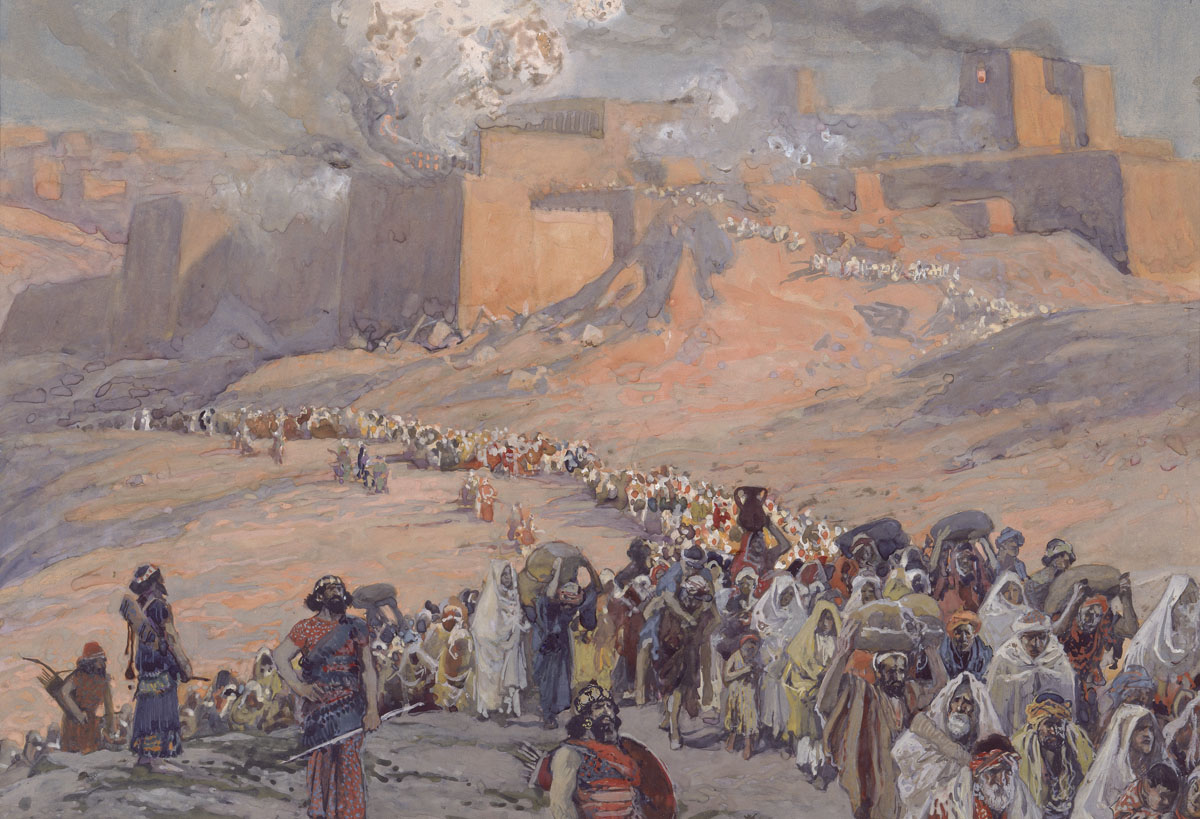
James Tissot's painting of the Israelites being taken away to Babylon and Jerusalem being burned down.

Sunrise over the Sea of Galilee.