About First letter to the Corinthians

Introduction: This letter has sometimes been called “the problem letter” because it addresses several issues in the church at Corinth, but while that is true, it contains much more than that. Here we find teaching on the resurrection of the dead in chapter fifteen. The most beautiful description of true love ever written, not only in the Bible but in all literature, is found in chapter thirteen!

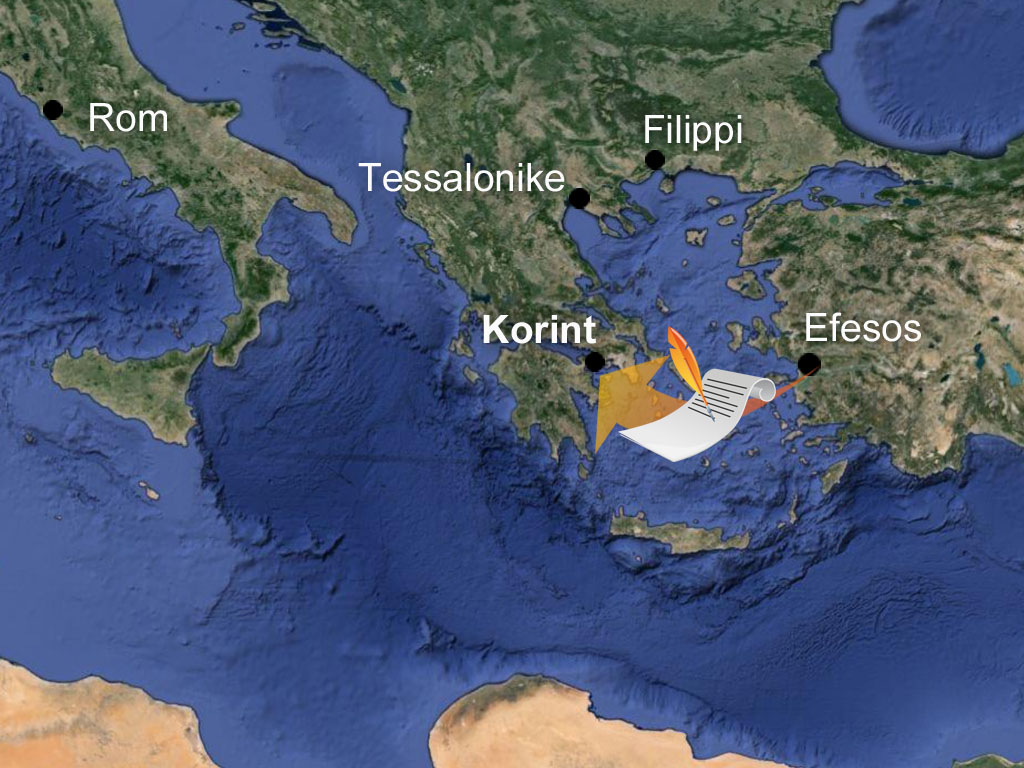
Paul founded the church in Corinth during his second missionary journey around 52 AD. He remained there for a year and a half, see Acts 18:1–11. At the end of his three-year stay in Ephesus, he writes this letter to them, see 1 Cor 16:8. He has heard that there are factions and divisions in the church. This is not the first letter Paul has written. We understand that there was an earlier letter that has been lost, see 1 Corinthians 5:9-10. The Corinthians have also written to Paul, see 1 Corinthians 7:1.

Corinth was a large trading city with about 50,000 inhabitants from many different peoples. It was a religious center with many temples. The goddess of love, Aphrodite, was worshipped here, and according to ancient sources, 1,000 prostitutes served in her temple. The city even had a Greek verb named after it, the word “korintize,” which meant to practice sexual immorality. The cult of Dionysus, whom the Romans called Bacchus, was probably very large in Corinth and may explain many of the problems that existed in this particular church. Dionysus was a wine god, and people drank themselves drunk on wine. There was dancing, ecstasy, speaking in tongues, prophecies, and all sexual relations were permitted.

Structure: It is likely that Paul is not writing in a purely sequential manner; instead, he is using a chiastic construction. This is a common Hebrew writing style, where the subject is repeated in reverse order and the main point is in the middle. The pattern is found on several levels, both in larger sections and within them. It is clear in the teaching on spiritual gifts discussed in chapters 12 and 14, and in the middle of these is a chapter on how the gifts should be used in love. In this division, the letter has five parts that together give three main themes:
1. The cross and the resurrection, chapters 1-4 and 15.
2. Men and women in the family and worship, chapters 4-7 and 11-14.
3. How to live as a Christian in a fallen world, chapters 8-11.

If, on the other hand, one chooses to see a sequential structure in which Paul answers questions, the letter can be divided into three parts:
1. Response to Chloe's report, chapters 1-4.
2. Response to rumors of immorality, chapters 5-6.
3. Response to questions from previous letters, chapters 7-16.

Report a problem

Table of Contents


Persons (17) BETA


Places (7)


Unique words (127)


  Written: Around the year 55 AD

To: Corinth.

From: Ephesus, see 1 Cor 16:8–9.

Author: Paul, see 1 Cor 1:1.

Messenger: Probably Timothy. He was soon to visit Corinth, see 1 Cor 4:17; 16:10–12.

Reading time: ca 1,5 hour.

Total amount of words in this book: 13636

  Reading settings

Click the cog in the menu for more settings. You can for example choose to hide chapter or verse numbers.

Tip! Click on a verse or chapter number in the text and you will see the exact Greek words in an interlinear versionBETA where every word is linked to the Greek lexicon.
Reading view:

 Core Bible translation without expansions () or explanations [].
Text size:

First letter to the Corinthians

INTRODUCTION (1:1-9)

Greeting

11
(1 Kor 1:1) Paul receives disturbing reports from the church in Corinth and writes letters from Ephesus, where he is staying.

Paul receives disturbing reports from the church in Corinth and writes letters from Ephesus, where he is staying.
Show in atlas

From Paul [whose name means “small”], by God's will an apostle (messenger, ambassador) of Jesus the Anointed One (Messiah, Christ),
    and brother Sosthenes. [The name Sosthenes means “liberator of his people.” He was with Paul in Ephesus when the letter was written and must have been known in the church in Corinth. Perhaps he was Paul's secretary who wrote down what Paul dictated, except for the final greeting, which Paul wrote himself, see 1 Cor. 16:21. He may be the synagogue leader of the same name who was beaten before the governor Gallio when Paul was in Corinth for the first time, see Acts 18:17.]
2To the church of God (Gk. ekklesia) that is in Corinth.

[The only thing that separates the churches in the New Testament is geographical location. The believers in one place, even if they met in different homes, are always referred to as one entity.]

You who have been sanctified (purified; set apart and separated) [from ungodliness and appointed to holy service] in the Anointed One (Messiah, Christ) Jesus [by being united with him], who are called to be holy [God's people] together with all those who call upon (invoke; call on, appeal to) [honor] the name of our Lord Jesus the Anointed One (Messiah, Christ) in every place—[both]
theirs and ours.

[The verse ends literally with “theirs and ours,” and can refer either to place or to Lord. Either way, the idea is that the Corinthians are not alone in their faith in Jesus. Throughout history, people have tried to lay claim to the name of Jesus, see verses 12-13. From the beginning, Paul is clear that Jesus is not divided.]

3Grace (undeserved favor – Greek charis) to you,
    and peace (harmony, happiness, prosperity – shalom)
from God our Father
    and the Lord Jesus the Anointed One (Messiah, Christ). [The usual Jewish greeting was “peace be with you,” Hebrew shalom. The Greek equivalent was “be greeted,” Greek charis. By combining these two phrases, Paul identifies himself with both Greeks and Jews.]
4 5MORE TO COME – SAMPLE from 1 Cor 13.

Love and the Spiritual Gifts

131
(1 Kor 13:1) The main street in Corinth. In the background, you can see Acrocorinth, which rises 1640 feet (500 meters) above sea level, where the temple of Aphrodite, the goddess of love, once stood.

The main street in Corinth. In the background, you can see Acrocorinth, which rises 1640 feet (500 meters) above sea level, where the temple of Aphrodite, the goddess of love, once stood.

If I speak in the tongues of men and [yes, even] of angels,
    but do not have love [which is unselfish and giving],
    I have become like a clanging gong or a clanging cymbal. [My loveless speech sounds just as deafening to the ears of God and men. Corinth was known for its bronze craftsmanship. In workshops along the streets, craftsmen hammered metal as they shaped vessels and handicrafts. Paul had lived in Corinth for 18 months, see Acts 18:11, and was well acquainted with this noisy clamor.]
2If I have the gift of prophecy,
    understand all of God's hidden plans (mysteries),
    have all knowledge,
and if I have all faith so that I could move mountains,
    but lack love [which is selfless and giving],
    then I am nothing [worth].
3If I give all my possessions to charity (to feed the poor),
    and even sacrifice my body to be burned [which ultimately honors my own name],
    but lack love [which is selfless and giving],
    I would gain nothing.

Poem of love

[Few passages in the Bible have been taken so out of context as the following four verses, which provide the Bible's definition of love. This passage forms the core of the account of the function of spiritual gifts in worship and describes what God's selfless, giving, and righteous love (Greek: agape) is and does. There are a total of fifteen verbs describing love, but since verse 6 refers to “two sides of the same coin” and the two verbs are based on the same root chario (the second verb is sun chairo – to rejoice together), there are a total of fourteen (7+7) topics covered. Central to the chiasm are seven negations that highlight what love is not or does not do – but Paul both begins and ends by describing the distinctive characteristics of love. The word love appears three times. The first two frame the description patient and kind. The Core Bible translates closely to the Greek word order to show the chiastic pattern.] 4Love [the selfless, giving, and righteous kind] is
    patient (“it stretches far”; is long-lived, forbearing, forgiving) and
    kind (friendly; shows helpfulness; acts in goodness) [such is]
love.

Not envious (not resentful; does not have a zeal to compete, compare; does not boil with anger)
[such is] love.
It does not boast (does not exalt itself; does not flatter) [does not embellish or exaggerate].
It is not puffed up (does not show pride; does not act arrogantly).
5It does not behave improperly (tastelessly, provocatively, rudely).
It does not seek its own (is not selfish).
[Does not insist on its own way and rights – the center of the chiasmus.]
It does not become angry (does not become irritated and angry; is not touchy and oversensitive).
It does not remember (Gk. logizomai) evil (does not keep a record of the wrongs and injustices it has suffered).
6It does not rejoice in injustice [other people's sins and failures],
but rejoices in the truth [is a joyful supporter of what is right and just].

7It bears all things [everything covers it, conceals it, and it lovingly accepts it].
    It believes everything [it is confident in everything].
    It hopes for everything [it eagerly awaits everything – regardless of circumstances].
It endures everything (it perseveres through everything). [All four of these last verbs are active, which speaks of a lifestyle. The previous negations have their opposite here. The meaning becomes “none of this” (verses 4b-6a) and now “all of this”!
    The Greek verb stego (to endure) comes from the word for roof or boat deck. The meaning is to cover and protect on the inside, but also to endure in this. The very meaning “to endure” is also found in the last word, hypomeno (to endure; literally: to remain under). This means that verse 7 also forms a kind of chiasm. Verse 6 described how love rejoices in the truth, but without gossiping and maliciously exposing the weaknesses of others. Truth without mercy can be harsh and unforgiving. Love does not cover sin, but carefully covers the sinner, see Proverbs 16:6.]

Love and the Spiritual Gifts

8Love [the righteous, selfless, and giving kind] never ceases (fails, falls short; it does not become exhausted or give up—it always has more to give].
However, prophecies
    will disappear (pass away; be completely abolished) [the gift of prophecy will be completely taken out of use],
    tongues [the gift of speaking in tongues] will cease (fall silent)
    and knowledge will disappear (pass away; be completely abolished).
9For we understand (know, feel) [only] in part
    and we prophesy [only] in part.
    [Our knowledge and our prophetic gift are limited, incomplete, imperfect, and fragmentary.]
10But when the perfect [that which is fully grown, mature, and completely perfect] comes,
    that which is in part will disappear (perish; be completely abolished).
    [Prophecies, tongues, and knowledge lose their value and are no longer needed when they are replaced by the whole truth.]
11When I was a child (small, immature),
    I spoke like a [small] child [unable to form clear words],
    thought (felt, believed) like a [small] child [with an understanding based solely on sensory impressions]
    and reasoned like a [small] child [with a child's logic].
Since I became a man [became an adult]
    I have [completely] put away childish things [done away with all immaturity].
[The Greek adjective nepios describes someone who is immature, childish, and without understanding. It is also used here as a noun for a child between the ages of 1 and 10.]
12For [here and] now we see [only] in a dim mirror (enigmatic reflection) [of polished metal, i.e., indirectly—what we see is only a blurred reflection of true reality, see 2 Cor. 5:7],
    but then [when perfection comes] we shall see face to face [Num. 12:8].
Now I understand [here and now I only know] in part [my personal knowledge is limited and incomplete],
    but then I shall understand (know, recognize) fully [gain complete personal knowledge],
just as I myself am fully known [by God who knows/recognizes everything about me].
13But now remains (so it remains now):
    faith, hope, love
    – these three –
but the greatest (most prominent) among them (literally: of these) is love. [Love is God's righteous, selfless, and giving “agape love.” Together with faith (which is characterized by faithful trust and confidence) and hope (which comes with a joyful and confident expectation of eternal salvation), love remains with God for all eternity.]


ta bort markör