Matthew 20:29

As they were leaving [the old city of] Jericho, a large crowd followed him.
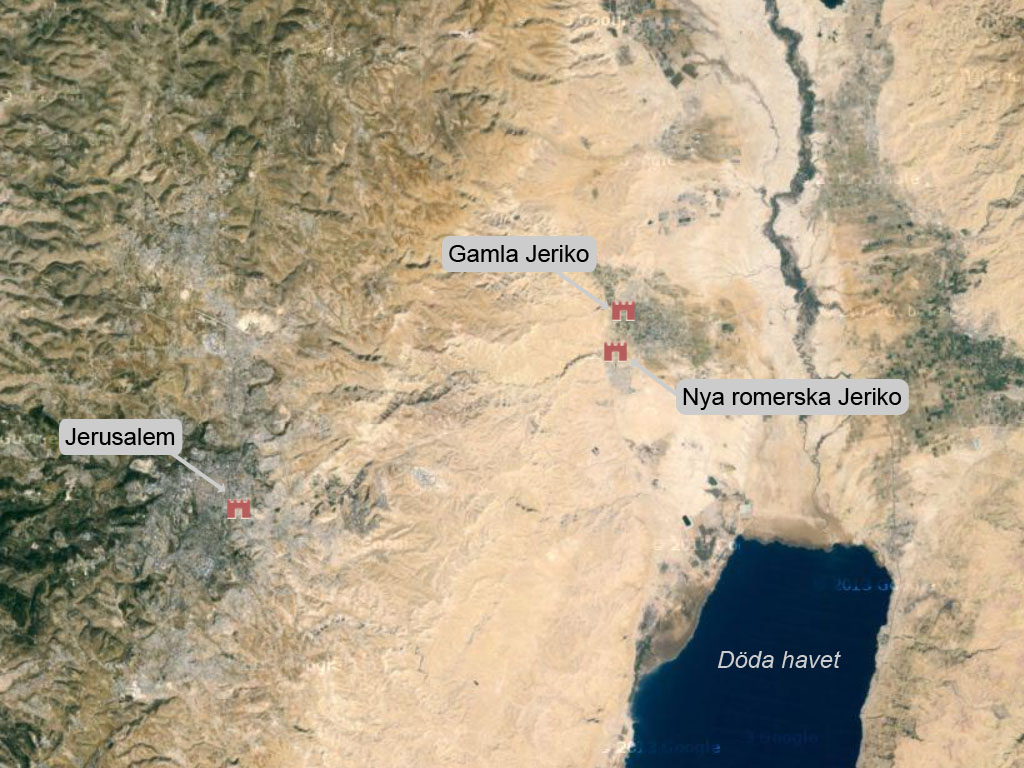
[Matthew and Mark describe Jesus as "leaving Jericho," see Mark 10:46. Luke, on the other hand, writes that he was "approaching Jericho" when this event occurred, see Luke 18:35. This may at first appear to be a contradiction, but excavations have shown that there were two Jerichos in Jesus' time. The old city of Jericho mentioned in Joshua 6:24-26 is the most famous, but just south of it, Herod the Great built a new city called Roman Jericho. Here in Roman Jericho there were palaces, amphitheaters, pools, etc., and Herod spent his winters here.
Another difference, which is not a contradiction, is that Matthew writes that there were two blind men, while Mark and Luke write that there was only one. Of the two men who received their sight, they choose to focus on the one blind man named Bartimaeus, see Mark 10:46; Luke 10:35.]

The greek text BETA

Nestle-Aland and Textus Receptus

Καὶ   ἐκπορευομένων   αὐτῶν   ἀπὸ   Ἰεριχὼ   ἠκολούθησεν   αὐτῷ   ὄχλος   πολύς.  

Manuscript comments

The greek text has 9 words. There is no difference between NA and TR in this verse.


Interlinear — horizontal

Below is an interlinear translation which follows the original scripture word for word. We are still working on the lexicon. Please contact us if you want to help.


Interlinear — table

Below is an interlinear version in table form that follows the word order of the original text. Clicking on the Strongs number will show the words in their basic form (note that sometimes the grammar causes not only the endings to change, but also the initial letters of the word).


Strongs nr Greek English Grammar Code
G2532
Καὶ (Kai)
And
Conj. Conjunktion
CONJ
G1607
ἐκπορευομένων (ekporeyomenon)
when were going out
VERB Verb
pres. middle dep. part. present middle or passive deponent Participle
genitive pl. ♂ genitive plural masculine
V-PNP-GPM
G0846
αὐτῶν (ayton)
they
Personal Pron. Personal Pronoun
gen. pl. ♂ genitive plural masculine
P-GPM
G0575
ἀπὸ (apo)
from
Preposition Preposition
PREP
G2410
Ἰεριχὼ (Iericho)
Jericho,
Noun Noun
gen. sing. ♀ genitive singular feminine
Location (location)
N-GSF-L
G0190
ἠκολούθησεν (ekoloythesen)
followed
VERB Verb
aorist active ind. aorist active indicative
sing. third person singular
V-AAI-3S
G0846
αὐτῷ (ayto)
Him
Personal Pron. Personal Pronoun
dative sing. ♂ dative singular masculine
P-DSM
G3793
ὄχλος (ochlos)
a crowd
Noun Noun
nom. sing. ♂ Nominative singular masculine
N-NSM
G4183
πολύς. (polys.)
great.
Adjective Adjective
nom. sing. ♂ Nominative singular masculine
A-NSM

The color of the words tell you how rare the word is, the more red, the fewer uses.

Colorscale:  
1-5
|6-10
|11-50
|51-100
|101-500
|501-1000
|1000+
Related images

More translations


English:
 Biblegateway – Multiple English translations side by side
 Expanded Bible – Expanded translations with comments and references
 Amplified – The first expanded translation
 New International Version – One of the most popular English translations
 Complete Jewish Bible – Translation with many translitterated Jewish phrases
 American standard version
 New King James Version – One of the most common English translations, uses Textus Receptus
 Tree of Life Version – Messianic translation
 NET Bible – Has a lot of commentary, generous copyright policy
 The Voice – Reads like a script from a play
 The Passion Translation – Paraphrase
 Youngs Literal Translation – Word for word translation
 Bible Hub – Website with many English translations

Bible Hub:
 Luther's German Bible (1545)
 Multiple Spanish translations

Other Interlinear translations:
 Blueletterbible – Blueletterbible's interlinear version
 Bible Hub – Bible Hub's interlinear version

commentaries:
 Bible Hub – Commentaries on Biblehub
 Enduring Word – Commentaries on Enduring word (whole chapter)