First letter to the Thessalonians
Introductory greeting
11
Picture of the modern city of Thessaloniki. The Olympus Mountains can be seen in the south.
©wiki
Silvanus [also called Silas] and
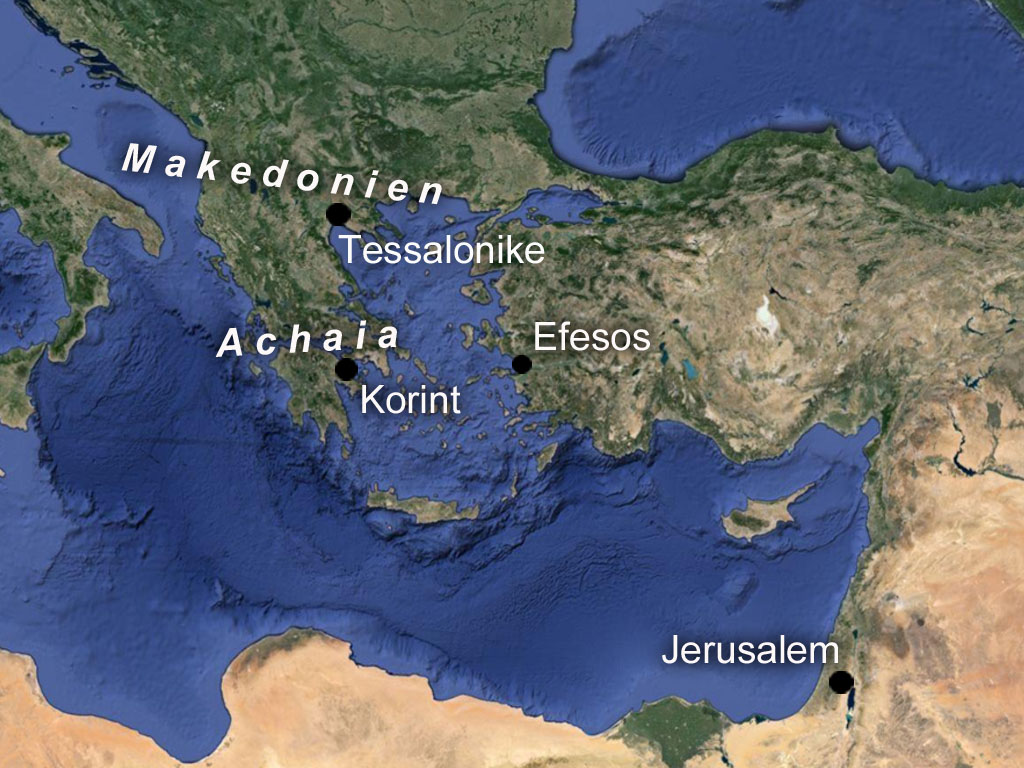
Timothy [Paul's closest colleague]. [The letter contains many triplets and begins with three personal names. Silvanus is the same person whom Luke refers to as Silas in the Acts of the Apostles. Here Paul uses the Latin form of his name. He was a recognized leader in the church in Jerusalem and, like Paul, was a Roman citizen, see , . Silas and Timothy traveled with Paul on his second missionary journey, see . They had remained in Thessalonica after Paul was forced to flee the city. Now all three have been reunited in Corinth, see . The letter is written at the beginning of the 1.5 years that Paul is there, see .]
To:
Thessalonica congregation (the called out ones – Gk. ekklesia),
who live in God the Father and the Lord Jesus the Anointed One (Messiah, Christ). [The Greek word for congregation is ekklesia. In classical Greek, the word could describe all kinds of gatherings of people, such as the legal assembly of the people or a mob, see , . The literal meaning is "the called out ones." Paul is careful to emphasize that the church in Thessalonica is not just any group of people, they are God's church. In the Bible, the word can describe the local assembly in a town. That is how it is used here, but it can also refer to the universal assembly of all believers throughout the ages, see .]
Grace (power, undeserved favor) and peace (harmony, freedom from fear, well-being) be with you. [The introduction to this letter is the shortest of all Paul's letters. He does not use the title of apostle, which shows his close relationship with the church. Silas and Timothy are also with him in Corinth, see ; .]GRATITUDE AND HOPE (chapters 1-3)
Thanksgiving and prayer
2We always thank God for all of you
when we mention you in our prayers. 3We constantly remember
your work in [which has its source in] faith and
your labor (your hard work) in [motivated by] love [which is selfless and generous] and
your endurance (steadfastness) [character that remains firm even during trials] in [based on] the hope
of our Lord Jesus the Anointed One (Messiah, Christ) [his coming, ]
before our God and Father.
[ are a single sentence in Greek, the main verb being "we thank." Faith, love, and hope produce works, see . These three words also recur at the end and frame the letter, see . The same order of works, labor, and endurance is found in . The believers in Thessalonica had experienced persecution. During Paul's first visit to the city, Jason had been dragged out of his house because he had welcomed the missionaries, see .] 4We know, dear brothers and sisters in faith,
that you are loved by God and that he has chosen you [you have responded yes to the call, we know that your faith is genuine], 5for our gospel [the good news we preached] came to you not only in words but also with
power [miracles and signs] and
the Holy Spirit [who convinced you of sin, gave you comfort and joy] and
full certainty [of your conversion],
just as
you know how we lived among you (what kind of men we were) for your sake. [Unlike Greek philosophies, which were based only on teachings in words, the Thessalonians had received the gospel that changed their lives. They had also seen for themselves how Paul, Silas, and Timothy lived their lives among them.]You are examples
6
Word of the believers in Thessalonica had spread far beyond their own city.
Show in atlas
These two verses also serve as a summary of the topics Paul addresses in the letter. In the next paragraph, he describes in more detail how he came to them, see . The believers in Thessalonica expected Jesus to return while they were still alive. This topic of Jesus' coming and the judgment is also addressed later in the letter in chapters 4-5.]Remember how you came to faith
21Paul reminds the believers in Thessalonica how they had received him, Silas, and Timothy. Luke writes in detail about the events in Acts 17:1-10. When the Thessalonians think back on Paul's ministry and how they themselves have been transformed by the gospel, they understand that their visit was not in vain.
For you yourselves know, dear brothers and sisters in the faith, that our coming to you was not in vain (fruitless, meaningless, but fulfilled a purpose and still does). 2As you already know, we had previously suffered and been treated shamefully in Philippi, but in God [who gave us strength], we became bold and preached the gospel of God to you [in Thessalonica] despite fierce opposition (a hard struggle). [Paul and Silas were arrested in Philippi, and without any charges, they were beaten and imprisoned. Despite this, they praise God and sing hymns of praise, see . Paul and Silas' backs still ached from the whipping when they arrived in Thessalonica after 3-4 days of walking, see .] 3Behind our encouragement (exhortation, teaching) [to accept the gospel] there is no
lie (delusion, false teachings),
impurity [wrong, impure motives such as personal gain and power] or
deception (questionable methods, tricks, flattering words to deceive you).
4On the contrary, we speak because God has tested (examined) us [and found us worthy, accepted us] to deliver the gospel, not to please people but God, who tests (examines) our hearts.
5We never used flattering words (did not adapt the truth to public opinion),
as you know.
We did not act out of hidden greed (did not exploit you for our own financial gain),
as God is our witness.
6We did not seek human honor from you or from others, 7even though as apostles of the Anointed One (Messiah, Christ) we could have made demands (used our authority).
Instead, we behaved gently, like a caring mother tenderly caring for her children, 8so much did we long for you.
We were happy to share not only the gospel of God,
but also our lives with you.
So dear have you become to us.
[Paul now shifts the image from a mother, see , to a father. He used similar language to the believers in Corinth, where he was now, see . In the same way, he was a spiritual father to the believers in Thessalonica. He worked to provide for them, see ; lived a righteous life, see ; and encouraged them, see .] 9Brothers and sisters in faith, you remember our toil and hardship. Night and day we worked so that we would not be a burden to any of you while we preached the gospel of God to you. [Paul worked with leather and made tent cloths, among other things, see Acts 18:3.] 10You are witnesses, yes, God himself is witness to how
holy and
righteous and
pure
we behaved among you believers.
11You also know how we treated each one of you, as a father does his own children [when he gives encouragement and guidance], 12how we:
encouraged (comforted, helped, walked alongside you, admonished) and
motivated (spoke encouragingly and supportively) and
appealed to (urged) you
to walk (live your lives habitually) in a manner worthy of God, who constantly calls you to his kingdom and glory. Gratitude for endurance
[Paul picks up the thread of thanksgiving from and gives further reasons to thank God for the church in Thessalonica.]13Therefore, we always thank God that you received the word of God that you heard [when we preached] and welcomed it [into your hearts], not as the word of men, but as it truly is: the word of God, which is at work in you who believe.
[; ; ]
14You, brothers and sisters in faith, have become imitators of the churches of God in Judea, who live in the Anointed One (Messiah, Christ) Jesus. You have endured the same sufferings [persecution] from your countrymen [both Greeks and Jews living in Thessalonica, see ] as they have from the Jews, 15who killed both the Lord Jesus and the prophets, and who have now driven us away (forced us away with violence and persecution). They do not please God, and they oppose all people. 16when they continually try to prevent us from preaching to the Gentiles so that they may be saved. [This also happened in Corinth where Paul wrote this, see .] So they are constantly filling up the measure of their sins. But the wrath of God has finally come upon them.
[Paul himself was a jew, and he wrote to a congregation of both Jews and Greeks. Not all Jews had killed Jesus; the term refers to those who were hostile toward Jesus. The same evil disposition was found among those in Thessalonica and Berea who stirred up the riots that drove Paul from these cities, see , . The same image of "filling up the measure of sin" is used in . Jesus also used it when he spoke to the Pharisees, see .]Paul's longing to see them again
Paul's plans
17Brothers and sisters in faith, we [Paul, Silas, and Timothy] have been torn away from you [strong words describing how a parent has been deprived of their child] for a time. However, this is only outwardly, not in our hearts, for we have become increasingly desperate to see your faces. 18We have really wanted to come to you. Both once and twice, I, Paul, have tried, but Satan has prevented us. 19Who is
our hope,
our joy,
our crown of victory (wreath)
before our Lord Jesus when he comes
if not you?
20Yes, you are our glory and our joy. Timothy's visit

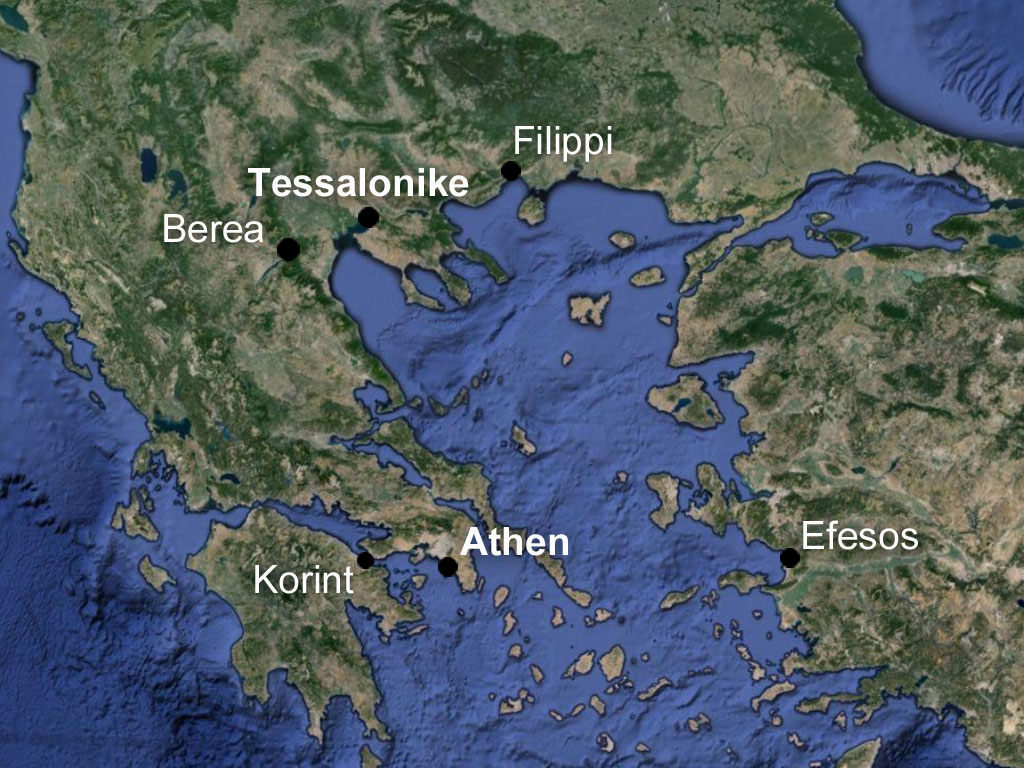
From Athens, Timothy is sent back to Thessalonica to encourage and strengthen the believers there.
Show in atlas
Timothy's return
6But right now, Timothy has returned from [his visit to] you with good news about your faith [which is steadfast] and your love [which is selfless and generous]. [Paul is overwhelmed by the good reports Timothy brings and writes this letter immediately, see .] Timothy has told us how you constantly think of us with joy and long to see us, just as we long to see you. 7So we have been encouraged by your faith, brothers and sisters, in the midst of all our difficulties and sufferings. 8Now we live [again], if you stand firm in the Lord. 9For how can we thank God enough for you, for all the joy you bring us before our God? 10Night and day we pray intensely (to the utmost, more than usual) to see your faces and help you with (complete, bind together) what is lacking in your faith [so that it continues to deepen]. [Timothy mentions faith and love in , but not hope. The hope that Jesus will return may be one of the things Paul wants to continue teaching the believers in Thessalonica about. It is also a topic he brings up later in this letter.]Paul's prayer and desire
11Paul's prayer in is a single sentence in Greek. It describes in more detail and with more words the prayer in . May our God and Father himself and our Lord Jesus guide our journey to you. 12May the Lord make you grow and overflow in love [which is selfless and generous] for one another and for all,
just as we do in our love for you,
13so that he may strengthen your hearts and make them blameless in holiness before our God and Father
when our Lord Jesus comes with all his holy ones [may refer to angels or believers]. [Paul did not pray that they would be sinless – that is impossible. He prayed that they would be blameless. It is the same word used in to describe how Paul had behaved among them. This means that, after dealing with their mistakes, they became free.]PRACTICAL EXHORTATIONS (chapters 4-5)
[Now there is a shift in the letter. The word "finally" does not mean any difference in what is important, but the text, which until now has mostly contained statements, now shifts to exhortations. It is common for Paul in his letters to begin with the position of believers in Jesus, and then conclude with exhortations to live the new Christian life based on that position. The first three chapters have dealt with the past and the present. The last two chapters also deal with the present, but also with future events.] 41Finally (by the way), brothers and sisters (brothers and sisters in faith), we ask and encourage (we stand by your side and pray, admonish) you in the Lord Jesus to remember what we have taught you: live a life that pleases God, as you already do. Yes, we urge you to continue doing this more and more. 2You know what instructions we have given you from the Lord.Sexual purity
[The following passage deals with sanctification, and the Greek word hagiasmos is used three times. It frames the passage in and 7, and is also found centrally in .] 3This is God's will – your sanctification (that you be set apart, living pure and holy lives): That you abstain from sexual immorality. [The Greek word porneia is used here, and the root word means "to sell oneself into slavery." Pornography is a compound word made up of this very word porneia and grafo, which means "something written or drawn." Pornography is a description, either in text or graphically, of someone selling themselves sexually.]
4That each one of you know how to control (own, win) your own vessel (your own body, tool, wife)
in a holy and honorable way.
5It must not be done in passions and desires as among the Gentiles who do not know God. [The word "vessel" is probably used figuratively for the body, as Paul uses it in . Anyone who sins in the sexual realm sins against his own body, see . In rabbinical language, vessel can also refer to one's wife. Peter uses the word in this way, see . It can also be a euphemism, i.e., a circumlocution for the sexual organs.]
6That no one goes too far [crosses the line between what is mine and what is yours] and violates (takes advantage of) his brother in this area. The Lord punishes all such things, as we have already said and testified to you. [The third exhortation may have to do with adultery, see . The words used here can also apply to finances and then refer to deceiving one's brother. However, based on the context, it seems to refer to sexual purity.]
7God has not called us to impurity
but to a life of holiness. 8Anyone who rejects this therefore rejects (precisely because of this – Gk. toigaroun) not a human being but God, who gives you his Holy Spirit.The love you have for one another
9As for brotherly love, we do not need to write to you. You yourselves have learned from God to love one another (selflessly and generously), 10and you show that love to all the brothers and sisters in the whole of Macedonia. But we urge you, brothers and sisters, to do even more. 11Make it your ambition to lead a quiet life, to mind your own business, and to work with your hands, as we instructed you, 12so that you may win the respect of outsiders and not be in need of anything.The Lord's Coming
[Jewish belief and the Old Testament teach that at the end of time there will be a resurrection and a final judgment. Martha believed this when she said, "I know that Lazarus will rise again in the resurrection on the last day," see . A Christian who dies leaves earthly life to be with Jesus, see ; . The resurrection will also take place in stages. Jesus was the first, then all believers who have lived will be resurrected, and finally all people, see .
Paul lived with the conviction that Jesus could return during his lifetime, see . So did Peter, see . It seems that some questions have arisen in this area. It is likely that some of the believers in Thessalonica had died, and people wondered what would happen to them. Would their bodies remain in the grave until the final resurrection? What will happen when Jesus returns? Will they be there?] 13Brothers and sisters (in faith), we want you to know what will happen to those who have fallen asleep, so that you will not grieve in the same way as others who have no hope. [All people feel sorrow and loss when someone close to them dies. The difference is that without the Christian faith, there is no hope.] 14For if we believe that Jesus died and rose again [which we do], then God will bring with him those who have fallen asleep [those who have died] through Jesus. 15We tell you this according to a word from the Lord: We who are alive and remain until the coming of the Lord will not precede those who have fallen asleep.
16For the Lord [Jesus] himself will descend from heaven
with a command,
the voice of an archangel [being heard]
and the trumpet of God [sounding].
Then the dead who belong to the Anointed One (Messiah, Christ) will rise first. [This resurrection applies to "those who have died in the Anointed One." It applies to all those who believed in Jesus as the Messiah and may also apply to believers from the Old Testament. What is clear is that it is not a general resurrection where everyone who has ever lived will rise. The Book of Revelation mentions seven trumpets, the last of which has to do with the judgment in the tribulation, see . See also .] 17After that, we who are alive and remain shall be caught up together with them in the clouds to meet the Lord in the air (the lowest atmosphere). And so we shall always be with the Lord. [This event is usually called "the rapture."] 18Therefore [because we will then always be with Jesus], comfort (encourage) one another with these words. [The talk of Jesus' return is not meant to frighten. It will be a day when we will be with Jesus and see again those who have gone before us.]The Day of the Lord
51
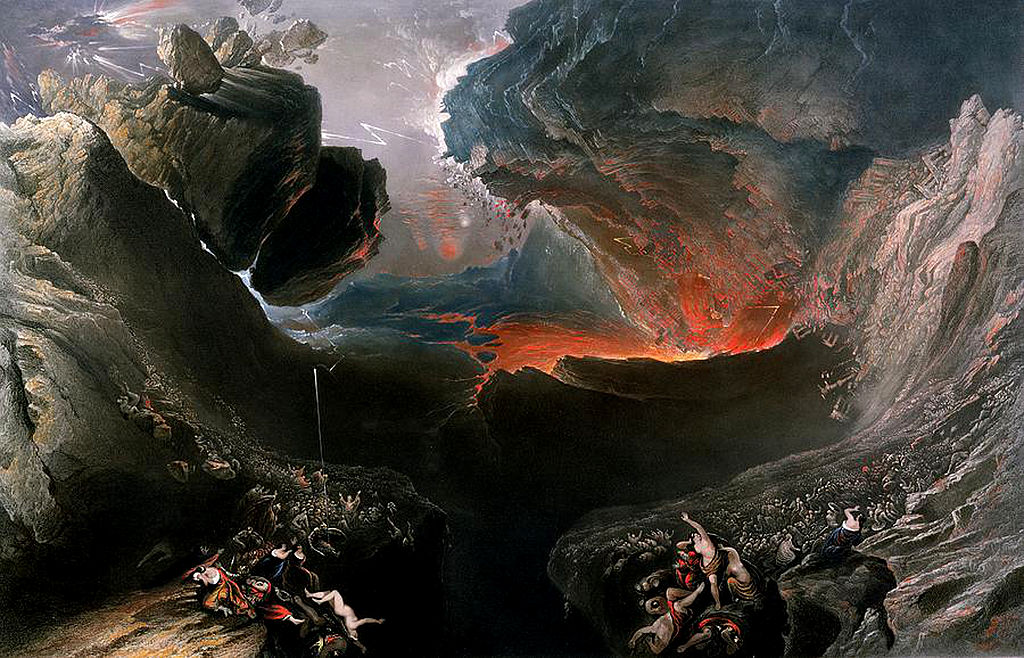
Oil painting by John Martin on the theme of the Day of the Lord from 1853.
Paul had taught about the end of time and the Day of the Lord when he was in Thessalonica a few years earlier. Jesus also taught on this subject and used similar expressions such as "a thief in the night" to urge vigilance, see , ; .] 3When they [people who do not know God] say, "Peace and safety," then destruction (catastrophe) will come upon them as suddenly as labor pains come upon a woman in childbirth, and there will be no way to escape (flee) it.
[Two images are used here, a thief in the night and a woman in labor, see . This statement about peace and security may refer to the false peace predicted in . Cf. also . For a believer, however, the day will not come as a surprise, see .]How should a Christian live while waiting for Jesus?
4But you, brothers and sisters in faith, do not live in darkness so that that day may surprise you like a thief. 5You are all children of light and children of the day. We do not belong to the night or to darkness. 6Therefore, let us not sleep as others do, but let us stay awake and be sober. 7Those who sleep, sleep at night, and those who get drunk are drunk at night. 8But we who belong to the day should be sober, clothed with faith and love as armor, and the hope of salvation as a helmet. [Faith, love, and hope are also found in the introduction, see . In the middle of these three words, as the central one, is love.]
9For God has not destined us to suffer (be exposed to) the wrath [that will come upon the earth on the day of the Lord, see ], but to gain (experience) salvation through our Lord Jesus the Anointed One (Messiah, Christ). 10He died for us so that we might live together with him, whether we are awake (alive) or asleep (dead) [when Jesus returns]. 11Therefore, encourage (comfort, help, invite) one another and build each other up (strengthen each other), as you are already doing. Final exhortations
Value your leaders
[The first group of exhortations (), of a total of four grouped together in , concerns the congregation's attitude toward its leaders.] 12We urge (ask) you, dear brothers and sisters (in faith): To appreciate (respect, honor) those who work so hard for you,
those who have been given the responsibility (are set before you) to guide (convey understanding, gently warn, admonish) you in the Lord. 13That you hold them in high esteem in love [which is selfless and generous] for their work.
Live in harmony (and work for peace) with one another at all times.Help the weak
[The second group () also applies to everyone in the congregation who has a responsibility to guide, encourage, and help one another. All this must be done with patience.] 14We urge you, dear brothers and sisters in the faith:
Guide (convey understanding, gently warn, admonish)
the undisciplined (rebellious, who refuse to obey authority and do not want to submit).
Encourage
the discouraged (who have lost hope; have broken hearts). Help (support)
the weak (frail).
Be patient
with everyone [do not lose hope even if circumstances are against you or you are treated unfairly by others].
15Make sure [at all times] that no one repays evil with evil [would have retaliated in kind, see ],
but always strive (pursue) to do [what is] good, both toward one another and toward all [people].Rejoice always
[The third group of exhortations (), like the very last group (), deals with personal inner life. There is always reason for optimism and gratitude.] 16Always be joyful (rejoice always) [in grace; lean on God at all times, see ; ]. 17Pray without ceasing (without interruption) [regularly without tiring]. [The most common word for prayer in the New Testament (Gk. proseuchomai) is used here. It describes an intimate conversation in which desires are exchanged, i.e., one presents one's own desires to God, but also listens to what God wants by working His will/desire in the believer, see ; .]
18Give thanks [to God at all times] in everything [in every situation and circumstance].
For this is the will of God [what he desires most of all] for you in the Anointed One (Messiah, Christ) Jesus.Take personal responsibility in spiritual matters
[The last group has five exhortations. First, two negative ones that warn against cynicism, followed by three positive ones. is literally "but test everything."] 19Stop quenching (suppressing) the Spirit.
20Stop despising (looking down on) prophecies [prophetic revelations, exhortations, and warnings]. 21Instead, test (evaluate) everything.
Hold on to what is good (right, true).
22Keep away from every form of evil [no matter how pious and fine it may seem on the surface]. [While one should not stifle and extinguish the Spirit by despising prophecies, one should not simply accept everything that claims to be spiritual. All spiritual manifestations and prophetic utterances must be tested against the word of God, see . The gift of discerning spirits must also be active, see ; . In this context, "everything" refers primarily to prophetic utterances, see , but also includes other things that happen in the church.]Conclusion
23May the God of peace himself sanctify you (set apart every part of each one of you for holy service), and [we pray that] your
spirit and
soul and
body
may be kept whole so that you are without blemish at the coming of our Lord Jesus the Anointed One (Messiah, Christ). 24He who calls you to this is faithful. He will also do it [sanctify and preserve you, see ].Three personal exhortations
25Brothers and sisters in faith, pray for us too. 26Greet all the brothers and sisters in the faith
with a holy kiss. [An expression of love, forgiveness, and unity, Gk. philema. The kiss on the cheek was and is a common form of greeting in the Mediterranean region.]
27Promise me before the Lord that the letter will be read aloud
to all [holy] brothers and sisters (brothers and sisters in faith).Blessing
28Grace (favor) [power] from our Lord Jesus the Anointed One (Messiah, Christ) to you.