Second Samuel 5:9

And David lived in the stronghold [referring to the well-fortified city, which was entirely a fortress] and called it the City of David. And David built around [outside the existing city] starting from Millo (the rampart; literally "filling"), as well as its houses.
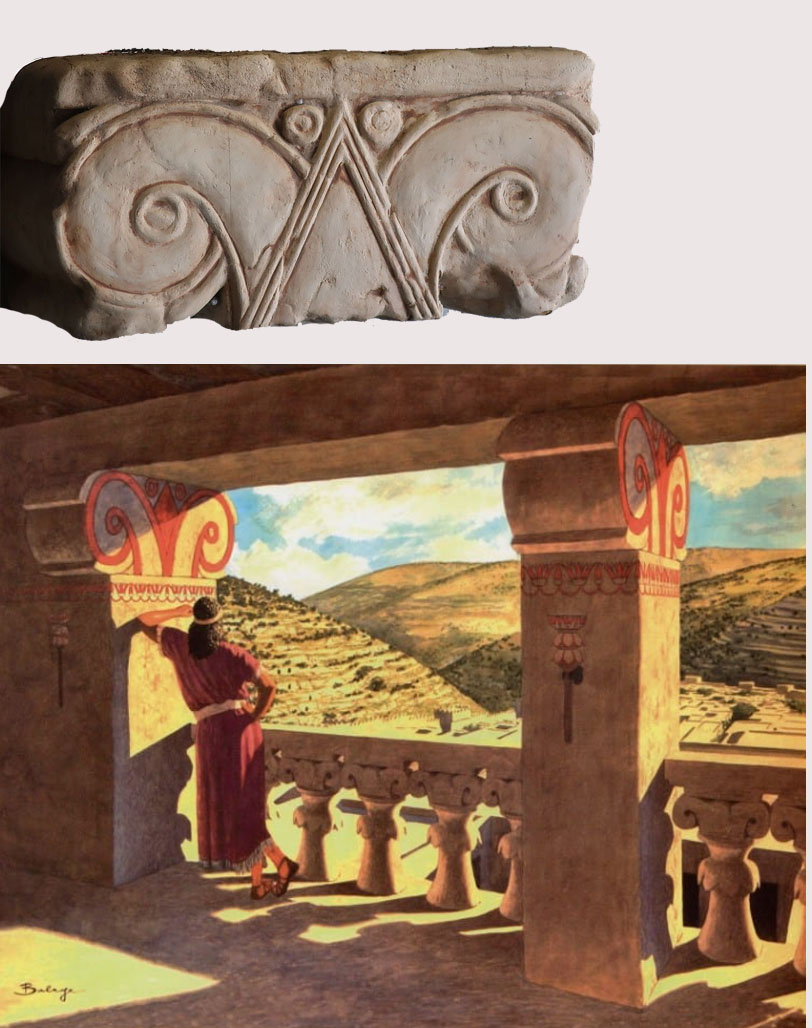
[Millo is always used in the definite form (Hebr. ha-millo). This probably refers to the stepped construction just north of the original city. Several excavations since the 1920s have revealed parts of the impressive construction that was built to widen the ridge at its narrowest point just north of the original Jebusite city that David captured. Integrated into and partly built on this artificial structure, archaeologist Eilat Mazar (1956-2021) has excavated the foundations of what she believed to be David's palace. The building is larger than the palaces found in Megiddo, for example. During excavations at Millo in 1963, an Aeolic capital was found. Such capitals were used as decoration at entrances or windows in palaces, for example at the palace in Megiddo. Such capitals were used as decoration at entrances or windows in palaces, for example, at the palace in Megiddo. This is the most skillfully executed of all capitals found to date in the entire Middle East. The eastern outer wall at Millo is 7 meters wide, so the building also constituted an improved part of the city's defenses. If this refers to David's palace, David began construction, and later (verse 11) it is reported that he enlisted the help of Hiram's skilled craftsmen to complete the building and decorate it.
The impressive building also served as an administrative center. Dozens of seals have been found at Millo, which is a sign that there were official archives in the building. A seal, also called a bulla, is a flattened lump of clay with a name or image, about 1 cm in diameter, which was used to seal important documents. The building remained in use until the destruction of Jerusalem. This is known from the names found on three of the seals. These are the names of scribes mentioned in Jeremiah, namely Gemarjahu (Shaphan's son, see Jer. 36:10), Jehuchal (Shelemja's son, see Jer. 37:3) and Gedaljahu (Pashur's son, see Jer. 38:1). In the latter verse, Jehuchal and Gedaljahu are even mentioned together! Other well-known names such as King Hezekiah and the prophet Isaiah were also found here in 2015 and 2018.]

The hebrew text BETA

Hebrew Masoretic text (MA), Read from right to left

וַיֵּשֶׁב   דָּוִד   בַּמְּצֻדָה   וַיִּקְרָא   לָהּ   עִיר   דָּוִד   וַיִּבֶן   דָּוִד   סָבִיב   מִן   הַמִּלּוֹא   וָבָיְתָה  

Greek Septuagint (LXX), Read from left to right

καὶ ἐκάθισεν Δαυιδ ἐν τῇ περιοχῇ καὶ ἐκλήθη αὕτη ἡ πόλις Δαυιδ καὶ ᾠκοδόμησεν τὴν πόλιν κύκλῳ ἀπὸ τῆς ἄκρας καὶ τὸν οἶκον αὐτοῦ


Interlinear — horizontal

Below is an interlinear translation which follows the original scripture word for word. We are still working on the lexicon. Please contact us if you want to help.


Read from right to left


Interlinear — table

Below is an interlinear version in table form that follows the word order of the original text. Clicking on the Strongs number will show the words in their basic form (note that sometimes the grammar causes not only the endings to change, but also the initial letters of the word).


Strongs nr Hebrew English Grammar Code
H9001
H3427
וַ (va)
יֵּ֤שֶׁב (jeshev)
seq
to dwell
Conj. Conjunktion

Verb Verb
qal wayyiqtol 3p sing. qal wayyiqtol (sequential imperfect) third person masculine singular

c
Vqw3ms
H1732
דָּוִד֙ (david)
David
Noun Noun
masculine
Name/Place name/place

Npm
H9003
H4686b
בַּ (ba)
מְּצֻדָ֔ה (metzudah)
in
fortress
Prep. Preposition

Noun Noun
sing. feminine singular Absolute state

Rd
Ncfsa
H9001
H7121
H9014
וַ (va)
יִּקְרָא (jiqera-)
־
seq
to call
link
Conj. Conjunktion

Verb Verb
qal wayyiqtol 3p sing. qal wayyiqtol (sequential imperfect) third person masculine singular

c
Vqw3ms
H9005
H9034
לָ֖ (la)
הּ (h)
to
her
Prep. Preposition

Suffix Suffix
pron. 3p sing. Pronominal third person feminine singular

Rd
Sp3fs
H5892b
עִ֣יר (ir)
city
Noun Noun
♂/♀ sing. gen. masculine och feminine singular Construct state

Ncbsc
H1732
דָּוִ֑ד (david)
David
Noun Noun
masculine
Name/Place name/place

Npm
H9001
H1129
וַ (va)
יִּ֤בֶן (jiven)
seq
to build
Conj. Conjunktion

Verb Verb
qal wayyiqtol 3p sing. qal wayyiqtol (sequential imperfect) third person masculine singular

c
Vqw3ms
H1732
דָּוִד֙ (david)
David
Noun Noun
masculine
Name/Place name/place

Npm
H5439
סָבִ֔יב (saviv)
around
Noun Noun
♂/♀ sing. masculine och feminine singular Absolute state

Ncbsa
H4480a
H9014
מִן (min-)
־
from
link
Prep. Preposition

R
H9009
H4407
הַ (ha)
מִּלּ֖וֹא (milvó)
the
Millo
Particle Particle (Definite Article)

Noun Noun
♂/♀ sing. masculine och feminine singular Absolute state

Td
Ncbsa
H9002
H1004b
H9011
H9016
וָ (va)
בָֽיְתָ (vajeta)
ה (h)
׃
and
house
to
verseEnd
Conj. Conjunktion

Noun Noun
♂/♀ sing. masculine och feminine singular Absolute state

Suffix Suffix

C
Ncbsa
Sd

The color of the words tell you how rare the word is, the more red, the fewer uses.

Colorscale:  
1-5
|6-10
|11-50
|51-100
|101-500
|501-1000
|1000+
Related images

More translations


English:
 Biblegateway – Multiple English translations side by side
 Expanded Bible – Expanded translations with comments and references
 Amplified – The first expanded translation
 New International Version – One of the most popular English translations
 Complete Jewish Bible – Translation with many translitterated Jewish phrases
 American standard version
 New King James Version – One of the most common English translations, uses Textus Receptus
 Tree of Life Version – Messianic translation
 NET Bible – Has a lot of commentary, generous copyright policy
 The Voice – Reads like a script from a play
 Youngs Literal Translation – Word for word translation
 Bible Hub – Website with many English translations

Bible Hub:
 Luther's German Bible (1545)
 Multiple Spanish translations

Other Interlinear translations:
 Blueletterbible – Blueletterbible's interlinear version
 Bible Hub – Bible Hub's interlinear version

commentaries:
 Bible Hub – Commentaries on Biblehub
 Enduring Word – Commentaries on Enduring word (whole chapter)
 Rashi's Commentary – Jewish Commentary (whole chapter)