-
Reading view
- Text size:
Bible text
Atlas


-
- Core Bible
-

Choose book Choose another book
Here you can look up and read:
Genesis – chapter 1 (Hebrew/English interlinear)This is the first resource to have a verbatim direct translation that follows both the Hebrew and Greek texts in English. For the NT, there is the five-volume Study Bible published in 1983 by Normans Förlag, but it is not widely available and can only be obtained in antique bookshops for thousands of kronor.
Let's take the first verse of the Bible as an example. This is how Gen. 1:1 looks in the Hebrew text (read from right to left):
בְּרֵאשִׁ֖ית בָּרָ֣א אֱלֹהִ֑ים אֵ֥ת הַשָּׁמַ֖יִם וְאֵ֥ת בהָאָֽרֶץ
An interlinear version follows the Hebrew word order word by word. Each word is also translated exactly in the form in which it appears. It is not always good English, but you get an understanding of which words are used and in what order they appear. A literal translation of the first verse of the Bible from Hebrew could be :
In the beginning God created the heavens and the earth.
In the interlinear version, the words are printed one below the other. There is also a transliteration of the Hebrew characters to make it easier to see how it is pronounced. The first word is bereshit, which in English is "i begynnelsen":
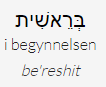
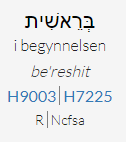
In addition to the English translation, we also show links to the words in the core Bible dictionary. This allows you to read more about the words and see how they are used elsewhere in the Bible, etc. The grammatical code is also included. The word is made up of first a prefix translated "in" and then the main word itself, the noun reshit, meaning "beginning". The whole of this word in Hebrew becomes the phrase "in the beginning" in English. The preposition has Strong's numbers. The preposition has Strongs numbers H9003 (H stands for Hebrew) and the beginning has the number H7225.
Here is the entire first verse, read from right to left:
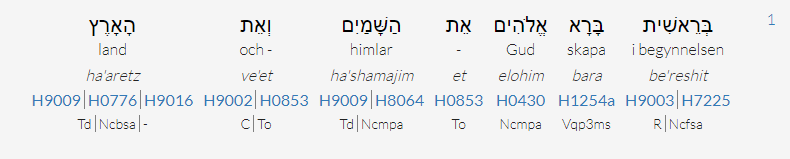
The second word (from the right) is the verb bara which is written in the basic form "create". The last word (leftmost) is erets which can mean land, area or earth. The word is in distinct form (hebr. ha) so it translates to "the land" or rather "the earth". In this version we show the main word which is "land". The word is used 2504 times in the OT and in this case "earth" would be better suited.
Eventually the interlinear version will be developed to be better. Preparations have been made for this, and we hope to find some volunteers to help with this work. It will take thousands of hours, but the goal is to have a complete English interlinear translation.
If you click on the Strongs number, you get more info about the word itself and can see that e.g. reshit is used 51 times in the OT. If you click look up you will look up the word in the lexicon and recieve more details.
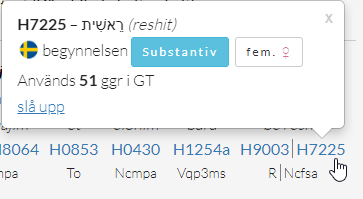
The exact grammatical code is also given. Currently we are using the english standard where N is used for Noun, V for verb etc.
We have added a first version of translation to easier see the translation. in the example below you can see that the word "create" (hebr. bara) has the grammatical code Vqp3ms, which means that it is a verb in the hebrew form qal gatal third person masculine singular.
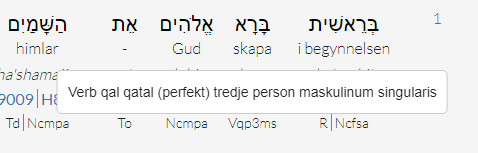
You can adjust the amount of information to be shown. These checkboxes can be checked ur unchecked to adjust how you want to see the scripture.

If you click Text color based on number of uses the color of the text will show how rare a word is, the more red a word is, the fewer uses that word has in the text. This is a visal way to study the Bible and quickly discover if the author is using a rare word.
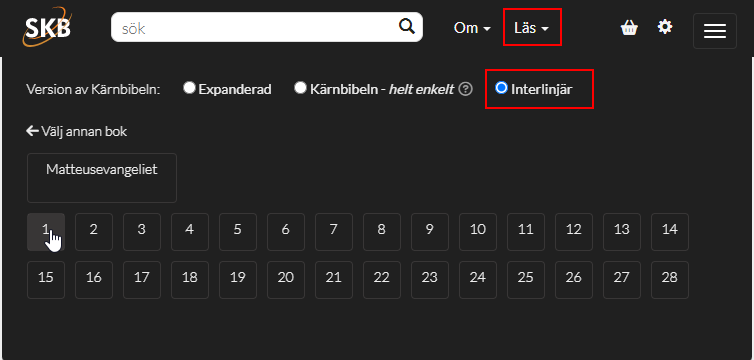
You can access the interlinear translation by clicking on a chapter or versenumber.

You can also write for example "Matt 1:1" or "Matt 1" in the searchbar at the top of the page and then select " Matt 1 – Matthews chapter 1 interlinear".

A third way is to select "interlinear" in the top menu.