Second letter to Timothy
Greetings
[From:] 11Paul, by the will of God an apostle (messenger, ambassador) of Jesus the Anointed One (Messiah/Christ Jesus) according to a promise of life – that [which is God's rich life] in Jesus the Anointed One (Messiah, Christ).
2To Timothy,
[my] beloved child [beloved with God's selfless and generous love]. [The Greek word for child used here is not huios – an adult son. Instead, Paul writes teknon, which literally means "to be born of someone" and emphasizes the relationship between parent and child – a beloved family member. Timothy came from Derbe (located in present-day central Turkey) where Paul met him during his first missionary journey. Timothy's mother was Jewish and his father was Greek, see . He accompanied Paul on several of his journeys and became his closest co-worker. Paul was his spiritual father.] Grace (undeserved favor) [power],
mercy (compassion expressed in action)
and peace
from God the Father and the Anointed One (Messiah, Christ) Jesus, our Lord. [The expression grace and peace is common in Paul's writings, but the addition of "mercy" is found only here in the pastoral epistles. Jesus spoke in the Sermon on the Mount that those who are merciful will themselves receive mercy, see .]Thanksgiving for Timothy
[ are symmetrically structured in a form called chiasmus. This means that the theme in the first line is related to the theme in the last line, the theme in the second line to the penultimate line, and so on. In a chiasmus, words and phrases often recur. Paul writes about his ancestors in , which is related to Timothy's mother and grandmother in , the word "remember" in is related to "reminded" in , etc. Central to is the climax and the main point: the longing to see Timothy! To visualize the chiasm, the text is indented in different steps.] 3I [Paul] feel such gratitude to God, whom I, like my ancestors, serve (worship, do holy service before) with a clear conscience, when I remember (constantly think of) you [Timothy] in my prayers,
both night and day. 4When I remember your tears,
I long to see you again,
so that I may be filled with joy. 5I have been reminded of your sincere (genuine, unfeigned) faith, which was first in your grandmother Lois, your mother Eunice, and which I am sure is also in you. [Timothy's mother was a Jewish woman who became a Christian, but his father was Greek and apparently not a believer, see .]The gospel
[ form a chiasm. The outer frame deals with God's gift, the Holy Spirit, and the word love, see and 13-14. Verses 8a and 12b deal with "not being ashamed." Verses 8b and 12 deal with "suffering." uses the word "saved" and in "Savior" reappears. Central to is the core of the gospel: salvation not by works but by grace!] 6That is why I remind you to rekindle (awaken, breathe life into, and keep burning) the gift of grace from God [the inner glow and fire] that is within you, which you received through my laying on of hands. 7For God did not (has not given us) the spirit of discouragement (cowardice, timidity, uncertainty, shyness, fearfulness, fright),
but of power (ability, possibility)
and love
and a sound (well-balanced) mind [Spirit].
[Instead of discouragement, God's Spirit gives strength, love, and a clear mind. God's selfless, giving, and righteous love (Gk. agape) is at the center of the last three nouns in the genitive case. The first is the Greek dynamis, which describes how the gift of grace has "explosive power." The last, sophronismos (which only appears here in the New Testament), derives from sozo (to save, liberate, heal, and preserve) and phren (insight and discernment). It refers to a careful and controlled mind equipped with rational thinking and good judgment. A mind that in every situation has the ability to see the whole picture – the bigger picture – from God's perspective, and thus also His will to save, deliver, and heal (Gk. sozo). Self-control and discernment are also needed in order to teach and rebuke in a bold and appropriate manner, see .] 8Therefore, do not be ashamed of the testimony of our Lord (be ashamed of the Lord's testimony) [i.e., what He has done and proven in His love], nor of me, His prisoner, 8but suffer (share in the suffering) together [with me] for the gospel in (according to) God's power (according to the strength and ability God gives). 9He is the one who saved (delivered, rescued, healed, preserved, restored) us with a holy calling [leading to holiness, a life set apart for His service]. [center of the chiasmus:]
Not because of our deeds,
but according to his decision and grace,
which was given to us in the Anointed One (Messiah, Christ) Jesus before the beginning of time,
10but which has now been revealed when our Savior, the Anointed One (Messiah, Christ) Jesus, has appeared (revealed Himself). He has broken the power of death and brought life and immortality (immunity from eternal death) to light through the gospel. 11This is what I am appointed to serve as a preacher, apostle, and teacher.
12That is why I suffer all these things. I am not ashamed, for I know whom I have believed, and I am convinced that he is able to guard what has been entrusted to me, which I have handed over [to him] until this day. 13As a model of sound teaching, you should have the words you have heard from me, in faith and love in the Anointed One (Messiah, Christ) Jesus.
14Guard the good thing that has been entrusted to you
through the Holy Spirit who dwells in us.Onesiphorus sought me out and found me
[Verses 15-18 are formed as a chiasm framed by the expression "you know," see and 18. The second paragraph mentions the region of "Asia," and the second paragraph from the end mentions the city of "Ephesus," which was the capital of Asia. uses the word "mercy," which is also found in . Central to this is , where Onesiphorus sought and found Paul in Rom.] 15As you know everybody in [the province] Asia [present-day western Turkey, where Ephesus – where Timothy was located – was the capital]
turned away from me,
among them Phygelus and Hermogenes. [Timothy knew Phygelus and Hermogenes, perhaps they were Christian leaders in Ephesus. It is likely that they deviated both in terms of their ties to Paul and in terms of true doctrine. Paul also mentions Hymenaeus and Philetus a little later, see .] 16[In contrast to these painful examples for Paul, he chooses to highlight one man as a role model for all believers.] May the Lord show mercy
to the family of Onesiphorus.
He often refreshed me (literally "was like fresh air")
and was not ashamed of my chains. 17On the contrary, when he came to Rom
he eagerly searched for me and found me too. [This central verse in this passage corresponds to the center above in , which reinforces Paul's desire to see Timothy one last time.] 18May the Lord grant him mercy
from the Lord on that day [when Jesus will judge all people, see ]. How much he helped me in Ephesus, you know very well. [Onesiphorus was probably dead. His family is mentioned again in the closing greetings, see .]Practical exhortations—be persistent
Train the next generation
[Each generation is responsible for passing on the Christian faith to the next generation. Paul was Timothy's spiritual father, and now he urges Timothy to train younger leaders.] 21As for you [Timothy], my child [follow Onesiphorus' example, see ], draw strength (gain strength continually, time after time) from the grace (undeserved favor) [power] that is in the Anointed One (Messiah, Christ) Jesus. 2What you have heard from me in the presence of many witnesses, entrust (pass on) to reliable (faithful) people who will be able to teach others. [Later in the letter, Paul will ask Timothy to leave Ephesus and come to him in Rom, see , . It is important that there are trustworthy people who can pass on the fundamentals of the faith. The word entrust means to place something next to a person; it is used in the sense of setting food on the table in . The word was also used for a deposit into a bank account.]Three parables
[Those who want to follow Jesus will encounter resistance. Paul illustrates this by highlighting the characteristics of three professions: a soldier in battle does not lose concentration, an athlete must follow the rules to win, and a farmer must work hard and be patient to get a harvest. These were familiar images to Timothy and the congregation in Ephesus, as Roman soldiers were present in every city, the Olympic Games in southern Greece were well known, and many people worked in agriculture. These three examples also recur in the letter to Corinth, which was written from Ephesus, see , .] 3Share suffering with others as a good (noble) soldier for the Anointed One (Messiah, Christ) Jesus. [Some of Paul's hardships are listed in 2 Cor. 11:23-29.] 4No soldier in active service allows himself to become involved (engaged, entangled) in civilian affairs [becomes completely absorbed only with work, family, or leisure], for he wants to serve the [commander] who recruited him to be a soldier. 5If someone competes [as an athlete], he does not win the prize (is not crowned) unless he follows the prescribed rules [does not follow or handle God's word correctly, see ]. 6It is the hard-working farmer [who plows and sows] who should be the first to receive his share of the harvest. 7Consider (think about this again and again, understand) what I say, for the Lord will give you full understanding in everything.Jesus as an example
[ form a chiasm framed by Paul first looking back on Jesus, and then looking forward to eternity with him. Central to this is the theme that the gospel cannot be hindered – it is not bound!] 8Remember (think constantly of) Jesus the Anointed One (Messiah, Christ) [his human side], who was raised from the dead (resurrected and now alive), of the line of David (seed). [] [In this letter, the title "the Anointed One," Gk. Christos, is mentioned thirteen times. Twelve of these are in the designation "the Anointed One Jesus," which emphasizes Jesus' divinity as God's chosen one. Here in this verse, the word order is reversed. The designation "Jesus the Anointed One" highlights Jesus' human side. During trials, suffering, and hard work, it helps to remember that Jesus was human, see . The fact that Jesus was from the line of David shows that he was a human being like us, but also that he fulfilled the criteria of messianic expectations.
The verb form perfect participle, used for "risen," emphasizes that an event that took place in the past still has an effect in the present. Jesus has risen and is still alive, which affects us today!]
This is my gospel, 9for which I suffer,
even to the point of being bound (imprisoned, wearing chains and shackles) like a criminal,
but the word of God is not bound (imprisoned, does not have chains and shackles).
10Therefore (because of this) I endure everything [I stand firm in everything and do not waver] for the sake of the elect, so that they too may have [a share in] (win) salvation (deliverance) in the Anointed One (Messiah, Christ) Jesus
and thus [obtain] eternal glory (honor, splendor).A word to trust
11This is a trustworthy (reliable) saying: If we have died with him (which we have),
we shall also live with him. 12If we stand firm (hold our ground, remain in the faith, which we do),
we shall reign with him as kings.
If we deny him (actively distance ourselves from him, make a lifestyle of denying him),
he will deny us. []
13If we are unfaithful (do not believe),
he is faithful [to his word, see ],
for he cannot deny himself. [ are probably an early Christian hymn or poem. The first part is an encouragement to believers, see . The second part is a warning to those who have actively distanced themselves from Jesus, see . Similar contrasts are described in . The expression "this is a trustworthy saying" is used a total of five times in the pastoral letters. The other four are: ; ; ; . These are fundamental truths of the Christian faith.]A faithful servant
14Continue (again and again) to remind them [the congregation] of this [to stand firm, to teach with a focus on the core of the gospel, see , , ]. Warn them before God to avoid quarrels over words, for such things are
meaningless (completely without profit)
and destructive (upsetting, devastating – Gk. katastrophe)
to those who listen. 15Do everything you can (be eager; hurry) to pass the test [to prove yourself ready for service] before God, like a worker who has no reason to be ashamed, and who rightly (correctly and accurately) handles (shares, applies, interprets) the word of truth. [The word "rightly handles," Gk. orthotomeo, is found only here in the NT. However, it is used twice in the Greek translation of the OT and is translated "make the way straight," see ; . The basic meaning refers to building a straight road, but also to "cutting straight," meaning to plow straight or cut a block of stone. False teachers tried to lead people astray, but Timothy is urged to build a straight road. The use here also alludes to walking the right path, doing what is right by following and applying the truth.
When a Roman road was built, a string was stretched between two points to get a straight line. In this context, it refers to the resurrection of the dead, see . The two points of reference to which sound Christian teaching should be attached are Jesus' first and second coming. A one-sided focus on his first coming can lead to worldliness, just as a one-sided focus on his second coming can lead to over-spirituality.] 16But you should always beware of unspiritual, empty talk. Those who engage in such things will go further and further into ungodliness [away from God, from the right path], 17and their words will spread like gangrene (gangraena – Gk. gaggraina). [Gangrene is a disease in which the body's tissue dies due to poor blood supply or serious bacterial infection. It often occurs in poorly treated wounds and spreads to nearby tissue. The cure is always to remove the dead tissue and, nowadays, also to treat with antibiotics if there is an infection.] Among them are Hymenaeus [a less common name, probably the same man who ignored Paul's earlier warning, see , and was probably expelled from the community] and Philetus, 18who have strayed from the truth. They turn the faith upside down for some when they say that the resurrection has already taken place. [The Bible is clear that there will be a future, physical resurrection, see . It is likely that these false teachers in Ephesus had embraced early Gnostic teachings and spoke of a kind of spiritual resurrection where they were already in heaven in spirit.] 19But God's firm foundation [the church, which is the pillar and foundation of truth, see ] remains and has this seal: "The Lord knows those who are his." [Quote from , which deals with Korah, Dathan, and Abiram's rebellion against Moses and the church. Just as God then distinguished between those who were false teachers and those who were loyal, Timothy is encouraged to trust in God who distinguishes between true and false teachers.] "Everyone who calls on (confesses) the name of the Lord
shall keep himself from iniquity." [Not a literal quote, but the same ideas found in and .]
Be a pure vessel that God can use
20But in a large house [in a large congregation], there are not only vessels of gold and silver,
but also of wood and clay,
some for honorable use,
others for dishonorable use.
21Whoever cleanses himself from these
[false teachings, turning away from unrighteousness, ]
becomes a vessel for honorable use,
sanctified,
useful to his master (master – Gk. despotes)
and ready for every good work.
[The word "this," sometimes translated "these," is neuter in form and does not refer to people. Paul will soon exhort Timothy to be kind to all and to rebuke opponents with humility, see .]Steps to correct false teaching
22Flee the evil desires of youth. [This probably refers to youthful immaturity, impatience, strife, and personal ambitions, see . It also includes sexual temptations, although that is not the main theme here. The words flee and follow are the same as in . In ancient times, the concept of adolescence did not exist, and the word young did not mean the same thing as it does today. Life was divided into two phases: one was either young or old, and the dividing line was at the age of 40. Timothy is probably in his 30s when Paul writes this letter to him, see .] Instead, pursue (strive for):
righteousness (living right, in complete harmony with God's will),
faith,
love [which is unselfish and generous]
and peace
together with those who call upon (ask for, cry out to, and appeal to) the Lord with a pure heart. 23On the other hand, you should reject (avoid, refuse to engage in) foolish and meaningless (undisciplined, childish) disputes, knowing that they only breed strife (disputes, conflicts). 24A servant (slave, bondman) of the Lord should
not quarrel (create conflicts, fights)
but be
kind to all,
skilled in teaching,
prepared to be mistreated without becoming bitter (not be easily offended), 25in gentleness (kindness, emotional stability without getting angry) be able to rebuke (discipline) those who oppose [the true doctrine]. Perhaps God will let them repent, so that they may come to a full understanding of the truth 26and come to their senses from the snare of the devil, where they are held captive, so that they do his will. [False teachings and all the negative consequences that come with them originate with Satan, but through God's grace, Jesus' servants can help bring these people back.
The phrase "perhaps God will let them repent" emphasizes that true repentance must be God's work in a person's heart. Jesus said that no one can come to him unless the Father draws him, see . God desires salvation, see ; .]The Last Days
31You should know (must understand) that in the last days there will be difficult times. [The expression "the last days" is used in the New Testament for the entire period from Jesus' death and resurrection until his return, see Peter's speech in and .] 2People will be: self-centered (selfish, loving themselves, everything revolves around their own ego),
money-loving (loving money, living for materialism, literally "friends with silver coins"),
boastful (arrogant),
proud,
mocking, [Now follow five alliterations – a rhetorical figure of speech where several words begin with the same sound. It can be compared to rhymes, where words end with the same sound. The following five words all begin with the Greek letter alpha, which reverses the meaning of the word. The English equivalent is "u". This group all seem to have to do with family relationships.]
disobedient (rebellious – Gk. apeithes)
towards their parents,
ungrateful (Gk. acharistos),
unholy (ungodly – Gk. anosios),
3insensitive (emotionless, loveless towards their loved ones, without family ties – Gk. astorgos),
unforgiving (does not enter into covenants, covenant breaker, refuses to overcome differences of opinion – Gk. aspondos), diabolical (gossips, slanderers – Gk. diabolos, the name of the devil – someone who divides and splits and acts devilishly), [This is the center of the list – the source of all this is the devil.]
[Now follow three more alliterations where all the words begin with alpha, see .]
unrestrained (without self-control – Gk.) akrates),
unruly
(untamed, rough, brutal, animalistic – Gk. anemeros),
hostile
towards goodness
(completely uninterested in goodness – Gk. aphilagathos),
4false (those who betray),
reckless (hasty, rushing headlong into their own ruin)
arrogant (blinded). They will love pleasure (literally, be "friends with hedonism")
more than they love God (literally, be "friends with God") 5and have a form (an outward appearance) of godliness
but deny its power. [This list of eighteen points begins and ends with the theme of selfishness. Love for oneself, instead of love for God, frames this entire passage.] Stay away from (avoid) them! [Paul had previously urged Timothy to be kind to everyone, see . This also applied to these people who seemed to be part of the church community. When Paul was a prisoner in Caesarea, the Roman governor Felix often came to listen to him, and Paul had an opportunity to share the gospel, see . See also .] 6Among them [who are driven by selfishness, see , and also among the false teachers in Ephesus] are those who sneak (slither) into homes and ensnare (gain control over, capture) weak women who are burdened by [unknown, past] sins [which now weigh them down] and driven by many kinds of desires, they are 7constantly taught, but never able to come to an understanding (practical knowledge) of the truth. 8Like [the Egyptian sorcerers] Jannes and Jambres defied Moses, these men defy the truth. They [these false teachers] are people with corrupt minds, their faith is not genuine. 9But they will have no further success. [They go further and further in their wickedness, see .] Their folly will be obvious to everyone, just as it was with the two [Jannes and Jambres]. [Jannes and Jambres were, according to Jewish tradition, the names of Pharaoh's two magicians who performed false signs, see ; .]Exhortation to Timothy
Be faithful despite persecution
[Unlike false teachers who sneak in, Paul shows openness. Timothy has followed and observed Paul for a long time; his life is open and transparent.] 10But you have followed (been present, watched closely) my teaching (doctrine),
lifestyle (my life),
goals,
faith,
patience (balanced temperament, forgiving others when they make mistakes),
love [which is selfless and generous], and
perseverance (steadfastness) [character that remains firm even during trials],
11my persecutions and sufferings, such as those in Antioch [, where Paul and Barnabas were driven out of the city], Iconium [, where they were nearly stoned, but managed to flee the city]
and Lystra [, where Paul was stoned and dragged out of the city, seemingly dead].
What persecutions I have not endured,
but the Lord has rescued me from them all.
[Refers to .] 12So all who want to live godly lives in the Anointed One (Messiah, Christ) Jesus will be persecuted. 13But evil people and deceivers [charlatans, illusionists, those who give the appearance of being good] will go further and further in their wickedness, they deceive (wander away from the truth) and are themselves deceived. [All sin originates from being deceived. Knowing the truth sets people free, see .]Be faithful to God's word
14But you must hold fast to what you have learned (intellectually understood) and what you are convinced of (assured of, faithful to). You know personally those who have taught you. [Paul was referring to Timothy's mother Eunice and his grandmother Lois, see , and also to himself, see ; . Perhaps Paul was also thinking of several other reliable teachers whom he has mentioned, see .] 15From childhood you have known the Holy Scriptures, which are able to make you wise for salvation (healed, restored, delivered) through faith in the Anointed One (Messiah, Christ) Jesus. 16All Scripture (every writing; every part of Scripture) [the entire Bible] is breathed out by God ("breathed out by God" – Gk. theopneustos) [inspired by the Spirit of God] and useful (useful, helpful)
for teaching [instruction in doctrine and its application, see ],
for reproof (conviction) [of sin, see ],
for correction (restoration, correction), [and]
for training in righteousness [disciplined training in living in accordance with God's will],
17so that the man of God [the one who belongs to God] may be [fully] equipped [qualified and ready to function here and now],
well equipped [since she has been fully adapted and equipped] for every good work. [By Scripture, Paul refers to the Jewish writings (which constitute what we today call the Old Testament), but also to the Gospels, the Acts of the Apostles, and the letters written in the middle of the first century (which, together with the Gospel of John, later letters, and the Book of Revelation, are called the New Testament). The Greek preposition pros ("to" in and "for" in ) means "working together toward the goal" and emphasizes the role of Scripture in sanctification.]
41I [Paul] solemnly charge you [Timothy] before God and Christ Jesus, who will judge the living and the dead, and by his appearing [second coming] and his kingdom: 2Preach the word (make the message widely known),
be ready in season and out of season (regardless of circumstances).
Admonish (convince of sin and urge repentance),
rebuke sharply (give clear warning) and
encourage (comfort, help, invite) with
tireless patience (balanced temperament that is forgiving when someone does wrong) and
teaching (doctrine, clear instructions on how to do what is right). [Encouragement includes patiently explaining and instructing about what the Bible says on various issues. When someone is admonished or rebuked, they must be told the reason for it and be encouraged and taught how to change their behavior. The three verbs admonish, correct, and encourage do not have ampersands between them in the original text. This writing style emphasizes that the conclusion and reason come in .] 3For the time will come when people will no longer tolerate (accept, put up with) hearing sound doctrine. Instead, they will accumulate for themselves teachers to suit their own desires (itching to hear what they want to hear), who will say what they want to hear. 4They will turn away from listening to the truth and instead turn to myths (humanly invented stories). [In contrast to the spiritual indifference to the truths of God's Word described in , Paul gives four exhortations:] 5But be [constantly] sober (alert in mind; collected, level-headed, vigilant, clear-thinking, unaffected) in all things.
Endure (persevere) in difficulties (bear your suffering; be prepared to "suffer harm").
Do the work of an evangelist.
[Let your work have the characteristics of an evangelist – be eager to lead others to Jesus!]
Carry out (fulfill; do your utmost to fully "bear") your ministry (Gk. diakonia).Paul's example
6
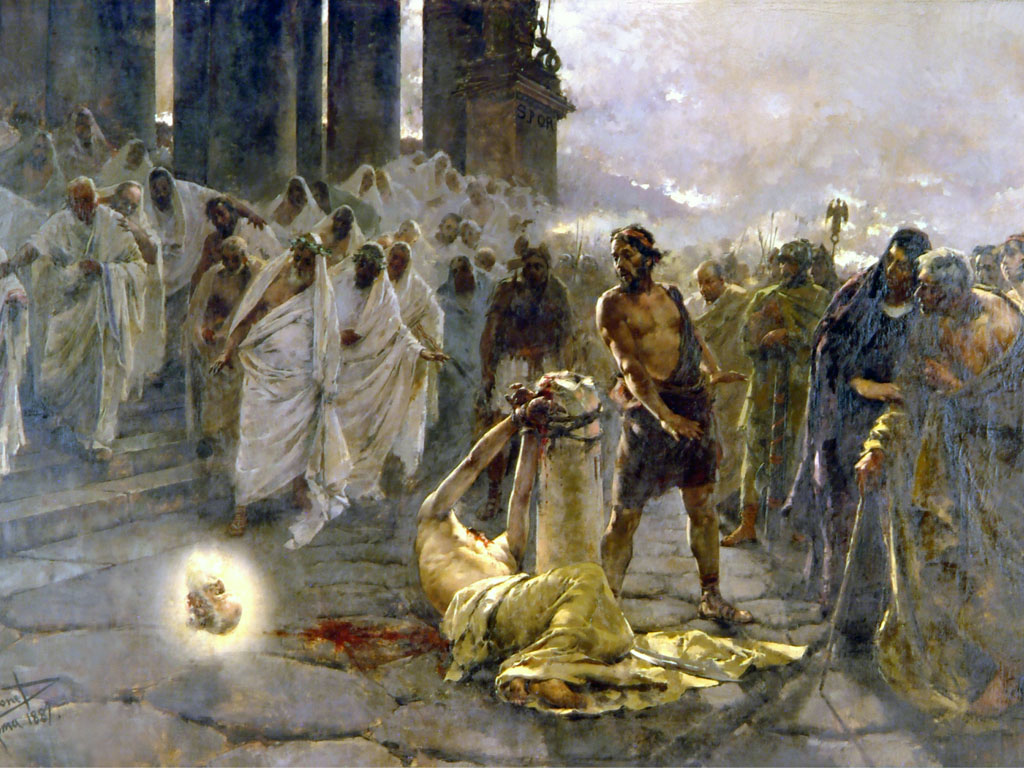
The beheading of Paul. Painting by Spanish artist Simonet, 1887.
and the time of my departure has come. [The Bible does not say when Paul died, but most evidence points to it being a few years after the fire in Rom in 64 AD, when persecution of Christians increased. According to tradition, Paul was imprisoned in the underground Mamertine Prison and then beheaded during Nero's reign as emperor around 67 AD.] 7I have fought the good (honorable) fight.
[Like an athlete in the Greek games, I have won, and now rest in that victory.]
I have finished my race.
[Like a runner in a sprint, and now rest in that victory.]
I have kept (held fast to) the faith.
[Like a soldier, I have defended and protected the faith, and now I rest in that victory.] 8Now the crown of righteousness awaits me, which the Lord, the righteous judge, will give me on that day [when I meet him], and not only me but all who have loved (and still love and long for) his revelation (return). [; ]Personal greetings
[The following passage is framed by Paul's desire for Timothy to come to him in Rom, see and 21. Paul knew that he would soon die, but expected some delays in the Roman legal process. It takes less than a month to travel by sea between Ephesus and Rom. So it would be a few months from the time the letter was sent until Timothy arrived. Considering Timothy's safety, Paul wanted him to arrive before winter, see , when it became dangerous to travel on the Mediterranean Sea. Both Paul's spiritual and human needs are evident in this letter. He needed the scrolls with God's word, but also company and his cloak to keep warm in the cold prison cell in Rom.] 9Hurry (do everything you can) to come to me soon. Update on people in Rom.
10Demas has deserted me,
he fell in love with this world (this present age) and traveled to Thessalonica.
Crescens
has traveled to Galatia [in Asia Minor, central Turkey].
Titus
has gone to Dalmatia [region north of Macedonia, present-day southwestern Croatia]. [Demas, which is a shortened form of the name Demetrius, had previously been a close associate of Paul, see . He was not a jew, see , . He had abandoned Paul in Rom and moved to Thessalonica, which was probably his hometown. Crescens and Titus were sent on new missions. Earlier, Paul had written to Titus in Crete and asked him to spend the winter in Nicopolis, see .] 11Luke is the only one who remains with me. [Luke was with Paul even during his first imprisonment in Rom, see ; .] Bring Mark here with you,
he is very useful to me in my ministry. [John Mark traveled with Paul and Barnabas, but he broke off the journey in Perga, see . There has been a reconciliation, and Paul speaks well of him here. He was with Paul even during his first imprisonment, see .] 12I have sent Tychicus to Ephesus. [Tychicus was one of Paul's faithful traveling companions, see . Timothy could feel secure in leaving Ephesus when he knew that Tychicus was on his way to Ephesus and the church.] 13When you [Timothy] arrive, bring the cloak I left with Carpus in Troas [on the way from Ephesus to Rom]. [Winter is coming soon, and Paul needs his cloak to keep warm.] Bring the books too, especially the parchment scrolls.The Lord gives strength despite opposition
14Alexander the coppersmith [in Ephesus] has done me a lot of harm. The Lord will repay him according to his deeds. 15You yourself must also be on your guard against him, for he has strongly opposed our message. [Alexander was a common name. It may be the same man mentioned in , or more likely the person in .] 16When I defended myself the first time, no one came to my aid, but everyone abandoned me. May it not be held against them. 17But the Lord helped me and gave me strength, so that the message might be fully proclaimed and all the people might hear it. And I was rescued from the lion's mouth. [Paul updates Timothy with details of what has happened since they last saw each other. Paul's expression "when I defended myself the first time" probably refers to the prima action, which were the preliminary hearings that had now been held during his second imprisonment in Rom. Luke had not yet had time to come to him.] 18The Lord will also rescue me from every evil attack and save me for his heavenly kingdom. To him be the glory forever and ever.
Amen (let it be so, it is true).Update on people in the vicinity of Ephesus
19Greet Prisca and [her husband] Aquila
and the family of Onesiphorus. [All these people were in Ephesus. In the Acts of the Apostles, the more informal name Priscilla is used instead of Prisca.] 20Erastus
remained in Corinth [west of Ephesus, on the other side of the Aegean Sea],
but I left Trophimus
in Miletus [just south of Ephesus], because he was sick. 21Hurry here [to Rom] before winter. [The passage is framed by the exhortation "hurry here," see .] Further greetings from Rom.The following [people, three men and one woman] also send their greetings to you:
Eubulus,
Pudens,
Linus,
Claudia
and all the brothers and sisters (brothers and sisters in faith).
Blessing
[The letter ends with a double blessing. Paul first blesses Timothy personally and then the entire congregation. This is probably Paul's last letter. If so, these lines are Paul's final greeting.] 22The Lord
be with your spirit [Timothy].
Grace [God's favor and power]
be with you [the entire church in Ephesus].