Nehemiah
Nehemiah returns
News
11
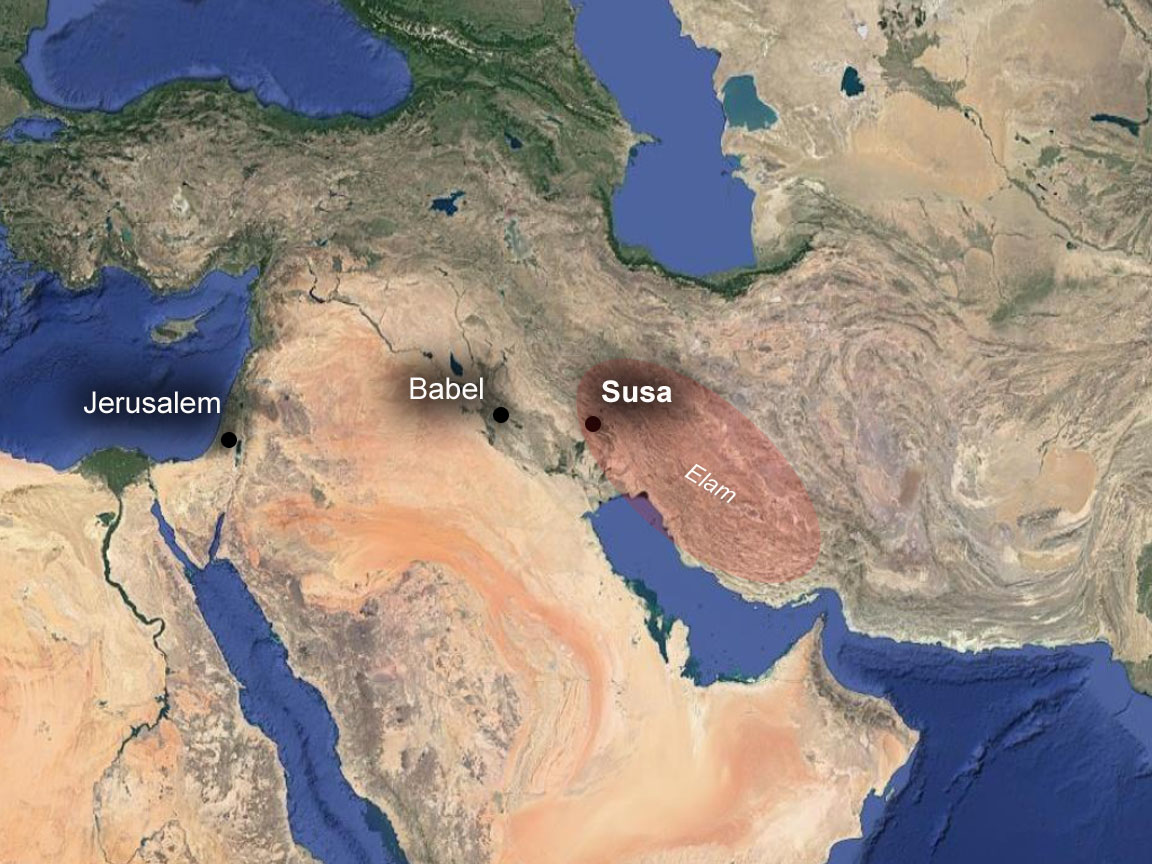
The city of Susa is located nearly 400 km east of Babylon.
Show in atlas
And it came to pass in the month of Kislev [the 9th month, corresponding to Nov/Dec in our calendar], in the twentieth year [446-445 BC], when I was in the capital city of Shushan (Shushan) [in Persia, present-day Iran], 2that Chanani, one of my brothers [compatriot or biological brother; both interpretations are possible, but based on the mention in , it is more likely that he was Nehemiah's biological brother], came from Judah, he and some men. And I asked them about the Jews who had remained (the remnant) who had survived the captivity and about Jerusalem. 3And they said to me, "The remnant of the captivity there in the province are in great distress and disgrace. The walls of Jerusalem are broken down, and its gates are burned with fire."Nehemiah sits down
[This passage is related to how Nehemiah "rises up" in .]
4And when I heard these words, I sat down and wept and mourned for several days, and I fasted and prayed before the God of heaven (Elohim). 5I said [prayed]: I implore you, Lord (Yahweh), God of heaven (Elohim), you who are great and awesome (worthy of reverence), God (El), who keeps covenant and mercy (loving care) with those who love you and keep your commandments (follow the principles of the Torah, the teaching—the five books of Moses). 6Let your ears be attentive and your eyes open, so that you may hear the prayer of your servant, which I pray before you this day, both day and night, on behalf of your servants, the children of Israel. I confess the sins of the children of Israel, which we have committed (sinned) against you. I and my father's house have sinned. 7We have acted very deceitfully toward you [God] and have not kept your commandments (the clear commandments – Hebr. mitzvot) and ordinances (Hebr. chuqim), and have not followed your decrees (binding legal decisions – Hebr. mishpatim), which you commanded (Hebr. tsavah) Moses, your servant. 8I beg you, remember the words you commanded Moses, your servant, when you said: If you are treacherous and unfaithful,
I will scatter you among the nations. 9But if you return to me and keep my statutes and do them (live them out in your lives),
then even if you are scattered to the ends of the heavens,
I will gather you from there and bring you back to the place I have chosen as a dwelling place for my name.
[; ] [Nehemiah intercedes in a similar way to Daniel almost 100 years earlier, see . Both begin their prayers by confessing sin, not only for themselves but for the whole people, see .]
10They are your servants and your people, whom you have redeemed with your great power and with your strong hand. 11I implore you, Lord (Adonai), let your ear be attentive to the prayer of your servant and to the prayers of your servants who delight in revering your name. Give your servant success today and grant him endless mercy (compassion) before this man. [The word for grace (Hebr. rachamim) only appears in the plural and is used to refer to God's infinite grace, see . The word also has the meaning of mercy, compassion, and pity. The word rachamim also shares its root with the word for womb, rechem. This gives the mercy in this expression an additional dimension of being protective and nurturing, in the same way that the womb is the protection of the small, helpless, and defenseless child.] At that time, I was the king's cupbearer. [A cupbearer was close to the king and acted as a bodyguard. Among other things, his duties included checking deliveries of food and wine, visiting suppliers, and even tasting food and drink before the king ate.]Nehemiah's request
21And it happened in the month of Nisan [the first month, corresponding to March/April in our calendar] in the 20th year of the reign of King Artaxerxes (Hebr. Artachshasta) [the first], [445 BC], when the wine was before him, that I took up the wine and gave it to the king. I had not previously shown myself sad in his presence. [It has now been four months since Nehemiah received the report about the distress in Jerusalem, see Neh 1:1.] 2The king asked me, "Why is your face so sad when you are not sick? This must be due to heartbreak." Then I was very frightened 3but I replied to the king, "May my lord the king live forever. Why should my face not be sad when the city where my ancestors are buried lies in ruins and its gates have been destroyed by fire?" 4The king asked me, "What is your request?"
Then I prayed to the God of heaven (Elohim), 5and I answered the king, "If it seems good to the king and if your servant has found favor in your sight, send me to the city in Judah where my ancestors are buried so that I may rebuild it." [This is the central verse in verse 1-10:]
6Then the king asked me, with the queen [Damaspia] sitting at his side, "How long will your journey take, and when will you return?" Since it pleased the king to send me, I gave him a time. [The text does not give Nehemiah's answer as to how long it would take. In , it is recounted how Nehemiah became governor of Jerusalem for 12 years. Clearly, the time was shorter than that, and it was probably less than a year. See also .] 7I said to the king, "If it pleases the king, let him give me a letter to the officials on the other side of the Euphrates, enabling me to pass through their territory until I arrive in Judah, 8and also a letter to Asaph, the king's forest keeper, so that he may give me timber to make beams for the gates of the fortress by the temple, for the city walls, and for the house where I will live." The king granted my request because the good hand of God (Elohim) was upon him. 9Then I went to the officials on the other side of the river (Euphrates) and gave them the king's letter. The king had also sent with me captains from the army and horsemen from the cavalry. 10When the officials Sanvallat, the Horonite [probably from Beit-Choron, 30 km north of Jerusalem, governor of Samaria], and Tobiah (Hebr. Tovijaho), the Ammonite [probably governor of Ammon, see Ezra 2:60], heard this, they became very angry that a man had come seeking the welfare of the children of Israel.Nehemiah got up and went to Jerusalem
11
The northern wall of Jerusalem, watercolor by 19th-century artist Carl Haag.
Nehemiah gives his own report
17But now I said to them, "You see what a difficult situation we are in, how Jerusalem lies in ruins and its gates are burned down. Come! Let us rebuild the wall of Jerusalem and put an end to our disgrace!" 18Then I told them how my God had kept his protective hand over me and what the king had promised me.
Then they said, "Get up, let's start building!" They got ready (took courage) for this good work. 19But when Sanballat the Horonite, Tobiah the Ammonite (Hebr. Tovijaho), the officials, and Geshem the Arab heard this, they laughed and despised us and said, "What are you doing? Are you going to rebel against the king?" 20I answered them by saying, "The God of heaven will make us prosper (he will help us succeed). We, his servants, are getting up and starting the rebuilding. You have no legal right or historical connection to Jerusalem."The wall is built despite opposition
Work on the walls begins
[This chapter describes four towers and eleven gates. Of these gates, six were repaired, see , , , . Nehemiah's account begins at the Sheep Gate in the northeastern part of the wall and continues counterclockwise to the west. The Sheep Gate is the gate near the Pool of Bethesda, see . The phrase "beside them" (Hebr. v´al jado), literally "at their hand," is used 16 times in this chapter and indicates the joint effort in the rebuilding.] The workers on the north wall
31Then Eliashiv, the high priest, and his brothers the priests went up and built the Sheep Gate. They consecrated it and set its doors in place. They also [built the wall] to the "Tower of the Hundred" (Hebr. migdal ha-meah) and consecrated it to Chananel's Tower ("Tower of God's Favor" – Hebr. migdal chananel). [; ; ] 2Next to them, the men of Jericho built, and next to them, Zackor, the son of Imri, built. 3The sons of Hasen built the Fish Gate [in the north, where fish from Tyre, among other places, was imported; see ; ; ]. They set in its beams, its doors, its doorposts, and its bars. 4Next to them, Meremoth, son of Uriah, son of Hakoz, repaired, and next to them, Meshullam, son of Berechiah, son of Meshezabel, repaired, and next to them, Zadok, son of Baana, repaired. 5And next to them the Tekoites repaired, but their nobles did not put their shoulders to the work of their masters (they did not want to stoop to physical labor). The workers on the west wall
6And the Old Gate [near the modern Damascus Gate] was repaired by Joiada, son of Paseah, and Meshullam, son of Besodja. They set in its beams, its doors, its doorposts, and its bars. 7And beside them, Melatia the Gibeonite and Jadon the Meronothite, men from Gibeon and Mizpah who were under the authority of the officials on the other side of the river (Euphrates), repaired the wall. 8And next to them, Ussiel, son of Charhaja, repaired [he belonged] to the goldsmiths (refineers) [who worked with metals—they worked together in their neighborhood]. And next to them, Chananja, one of the perfumers [who made spices, perfumes, and oils], repaired (Hebr. chazaq) and restored (Hebr. azav) Jerusalem [the city wall of Jerusalem] all the way to the broad wall.
[Hebr. azav is unusual. Most likely, this part of the wall was not in such bad shape that they needed to repair (Hebr. chazaq) it. It was enough to restore it. In this way, they made it even stronger. Some interpret the word as meaning that they "omitted/left out" (as the word can also mean, see, for example, ) it, in which case it could mean that they did not do any work here at all. The broad wall stretched westward between the Gate of Ephraim and the Tower of the Ovens ().] 9And next to them, Rephaiah, son of Hur (Hebr. Chor), prince of half the district of Jerusalem, repaired. [Jerusalem was divided into two districts, each ruled by a leader (Rephaiah and Shallom), see .] 10Next to them, Jedaias, son of Harumaph, repaired opposite his own house. Next to them, Hattus, son of Hashabneiah, repaired. 11Malkijah, son of Charim, and Chashov, son of Pachat-Moab, repaired another section (of the wall) and the Oven Tower. [These towers were probably located near the district and streets with the bakers' houses, see Jer 37:21.] 12And next to them, Shallom, son of Hallochesh, prince of half the district of Jerusalem, repaired it, he and his daughters. [Even women, who did not usually participate in construction work, were here and contributed to the rebuilding of the wall.]The workers on the south wall
13The residents of Chanons and Zanoachs repaired the Dal Gate [in the southwest]. They built it and installed its doors, its door frames, and its bars. They also repaired 1,000 cubits [450 meters] of the wall up to the Dung Gate [in the southern part of the City of David]. [The modern Dung Gate is located near the southwest corner of the Temple Mount and dates from the Ottoman Empire in the 16th century CE.] 14Malkijah, son of Rechav, prince of the district of Beit-Karem, repaired the Dung Gate and installed its doors, door frames, and bars.The workers on the southeast wall
15Shallon, son of Kolhoze, prince of the district of Mitspah, repaired the Fountain Gate. He built it, covered it, and installed its doors, door frames, and bars. He also repaired the wall of the Shelah Pool (Siloam Pool) and the king's garden, as far as the stairs go down from the City of David. [Hebr. shalach means sent out.] 16Next to him, Nehemiah, son of Azbuk, prince of half the district of Beth Zur, repaired as far as the tomb of David and the house of the warriors. [] 17After (next to) him, the Levites made repairs – [under the leadership of] Rechum, son of Bani. And next to them, Hashabiah, prince of half the district of Keilah, repaired his section of the wall [the section of the wall protecting Keilah]. [Keila is located between Zanoah () and Beit-Tsur (), 30 km southwest of Jerusalem.] 18Next to him, repairs were made by their brothers—[under the leadership of] Bavvai, son of Chenadad, prince of half the district of Keila.
19And next to them, Ezer, son of Jeshua, prince of Mitspah, repaired another section opposite the entrance to the armory at the corner of the pillar. 20After him, Baroch, son of Zakkai, eagerly repaired another section from the corner of the pillar to the door of the house of the high priest Elishiv. 21After him, Meremoth, son of Uriah, son of Hakkoz, repaired another section of the wall from the door of the house of Eliashib the high priest to the end of Eliashib's house. 22After him, the priests, the men of the plain (Hebr. ha-kikar), repaired. [The plain may refer to areas around Jericho in the Jordan Valley (see ) or near Jerusalem, see Neh. 12:28.] 23After them, Benjamin and Chashov repaired opposite their houses. After them, Azariah (Hebr. Azarjah), son of Maaseiah, repaired his own house. [These people are not mentioned elsewhere; they only repaired the wall near their own houses.] 24After him, Binnui, son of Henadad, repaired another section from Azariah's house up to the inner corner (the corner of the wall, the reinforcement) and the corner. 25Palal, son of Uzai, made repairs opposite the corner (the corner of the wall, the reinforcement) and the tower that comes out of the upper palace [in David's city, just south of the Temple Mount, see also ] at the guardhouse. After (next to) him, Pedaja, son of Parosh, made repairs. 26Now the temple servants [Hebr. netinim; meaning "given to" or "set apart for," they had been assigned to help the Levites with simple tasks such as fetching water and chopping wood, see ] in Ophel, and they repaired the area opposite the Water Gate [near the Gihon Spring] to the east, and the projecting tower ("the tower that sticks out" – Hebr. migdal ha-jatsa). 27After him [Palal, see ], the Tekoites repaired another section, opposite the large protruding tower, and on to the wall of Ophel.The workers on the northeast wall
28Above the Horse Gate, the priests repaired, each opposite his own house. 29After them, Zadok, son of Immer, repaired opposite his own house. And after him, Shemaiah, son of Shecaniah, the gatekeeper of the east gate, repaired. 30After him, Hananiah, son of Shelemiah, and Hanun, the sixth son of Tsalaph, repaired another section. After him, Meshullam, son of Berechiah, repaired opposite his chamber. 31After him, Malkijah, one of the goldsmiths, repaired up to the house of the temple servants and the merchants opposite the Gate of the Counting (Hebr. Shaar ha-mifqad) as far as the rooms above the corner. [Little is known about this gate; it may have been a gate into the temple area.] 32Between the rooms above the corner and the Sheep Gate, the goldsmiths and merchants worked.Verbal resistance
41But when Sanvallat heard that we were building the wall, he became angry and took great offense, and he mocked the Jews. 2He spoke to his brothers and the army of Samaria, saying, "What are these feeble Jews doing? Are they going to restore at their leisure? Are they going to sacrifice? Are they going to finish everything in one day? Can they resurrect the stones from the ruins that are burned?" 3Now Tobiah the Ammonite (Hebr. Tovijaho) was with him, and he said, "What they are building, a fox will break down if it jumps on their stone wall." 4Hear (listen), our God (Elohim), for we are despised; turn their reproaches upon their own heads, and deliver them up to destruction in a land of captivity. 5Do not cover their transgressions, and do not let their sin be blotted out before you, for they have challenged you [God] before the builders. [Note that this prayer is about God's glory and honor, not that they themselves are afflicted by contempt.] 6We built (on) the wall, and the entire wall was joined together to half its height, for the people had set their minds to the work. [They were devoted to the work.]Conspiracy to kill the workers
7But when Sanballat and Tobiah and the Arabs and the Ammonites and the Ashdodites heard that the repair of the walls of Jerusalem was progressing and that the damage was beginning to be repaired, they became very angry. 8They conspired, all together, and came and fought against Jerusalem to create confusion there (in the city). 9But we prayed to our God (Elohim) and set guards against them both day and night. 10And Hos said, "The strength of the workers is failing, there is so much debris (stone fragments to remove) that we cannot repair the wall." 11Our opponents said, "They shall know nothing and see nothing, until we stand among them and kill them, so that the work will cease." 12But it happened that the Jews who lived near them came and told us ten times (on ten occasions), "From all the places where you live, you must stand up." 13Then I stationed people in the lowest places inside the wall, in the open (visible) places. I placed the people in families with their swords, spears, and bows. 14When I had reviewed the situation, I stood up and said to the noble men, the leaders, and the rest of the people, "Do not be afraid of them. Remember our great and awesome Lord (Adonai) and fight for your brothers, for your sons, your daughters, your wives, and your homes." 15When our enemies heard that their plans had been revealed to us and that God (Elohim) had thwarted their counsel, we returned to the wall, each to his work. 16From that time on, half of my servants worked on the wall, while the other half held spears, shields, bows, and breastplates (armor), and the leaders stood behind the whole house of Judah. 17Those who built the wall and those who carried burdens (moved building materials) kept one hand on the work and with the other hand they held their weapons. 18The builders also had their swords in their belts (hanging at their sides) while they built. The one who blew the shofar (ram's horn) [the one responsible for sounding the alarm] was at my side. 19I said to the noble men, the leaders, and the rest of the people, "The work is great and extensive, and we are scattered (separated) on the wall, one far from the other. 20Wherever you are when you hear the sound of the shofar [alarm signal], come closer (take refuge) to us. Our God (Elohim) will fight for us." 21We devoted ourselves to the work, and half of them held the spears, from the dawn until the stars came out (in the evening). [They worked all the daylight hours from the first dawn until dusk was over.] 22At that time, I also said to the people, "Let every person with his servant spend the night inside Jerusalem so that they can be our guards at night and do work during the day." 23Neither I nor my brothers, nor my servants, nor the guards who accompanied me, none of us took off our clothes; all who went to the water [to fetch drinking water from the Gihon Spring, which was Jerusalem's source of drinking water] carried their weapons with them.Nehemiah helps the poor
[Chapter 5 is the central chapter in ] 51Then there arose a great cry (a lamentation, an angry protest, "a murmur") among the people and their wives against their brothers, the Jews. [The word for cry is the same as that used for the lament of the Israelites under Egyptian slavery, see .] 2Some said, "We, our sons, and our daughters are many; let us go and get grain for them, so that we may eat and live." 3Others said, "We have mortgaged our fields, our vineyards, and our houses; let us get grain, for there is a famine." 4Still others said, "We have borrowed money to pay the king's tax on our fields and vineyards. 5Now our bodies (literally, flesh) are like the bodies of our brothers, our children like their children, and we are bringing our sons and daughters in chains to become servants, and some of our daughters are already in chains, and it is not in our power (Hebr. el) to help them, for other people have our fields and our vineyards." 6I became very angry when I heard their cries and these words. 7Then I consulted with myself (thought carefully and considered various options) and challenged the princes and leaders and said to them, "Usury! You lend at interest, each one to his brother." I held a large assembly against them. 8I said to them, "We have, to the best of our ability, freed our brothers, the Jews, who have sold themselves to the Gentiles. Will you still sell your brothers? And will they sell themselves to us?" Then they were silent and could not find words [could not answer]. 9I continued, "What you have done is not good. Should you not walk in the fear of God, considering the reproaches of our pagan enemies? 10I, my brothers, and my servants have also lent them money and grain. I implore you, let us put an end to this extortion. 11I implore you, I beg you, return to them today their fields, their vineyards, their olive groves, and their houses, as well as the 100 pieces of silver, and the grain, wine, and oil that you have taken from them." 12Then they replied, "We will return it to them and will not demand anything from them; we will do as you have said."
Then I called the priests and made them swear an oath that they would do as they had promised. 13I shook my cloak and said, "So shall God shake away every man from his house and from his work who does not fulfill his promise; in this way shall he be shaken away." And the whole assembly said, "Amen," and praised the Lord (Yahweh). And the people did according to this promise. 14Furthermore, from the time I was appointed governor of the land of Judah, from the 20th year [445 BC] to the 32nd year [433 BC] of King Artaxerxes (Hebr. Artachshasta), which is 12 years, my brothers and I have not eaten the bread (food) of the governors. [These 12 years refer to a mission as governor that Nehemiah receives from the king. It is not the time he spends in Jerusalem; based on the dialogue with King Artachshasta, it is implied that it is a shorter period of about a year, see , .] 15But the former governors who were before me laid burdens on the people. They took bread (food) and wine from them, equivalent to more than 40 shekels of silver [460 grams]. Their servants also acted as lords over the people. But I did not do so because I fear (revere) God (Elohim). [] 16I also put my hand to the work on the wall, nor did we buy land, and all my servants gathered around the work (were close to the work, focused, devoted themselves to it). 17In addition, there were 150 of the Jews and the leaders, besides those who came to us from other countries, who sat at my table (ate, received their food at my expense). 18What was prepared every day was one ox and six selected lambs, and birds were also prepared for me. [The daily requirement was not insignificant, but it can hardly be compared to the 30 oxen and 100 sheep that were needed daily in Solomon's time, see .] Every tenth day, all kinds of wine were also served. For all this, I did not ask for any of the governors' bread (food) because the work was hard for the people. 19Remember, my God (Elohim), and give me credit for all that I have done for this people. [This is the first of the prayers in which he asks God to remember, see ; , , , .]Conspiracy to kill Nehemiah
61It happened that when it was reported to Sanballat and Tobiah (Hebr. Tovijaho) and to Geshem the Arab, and to the rest of our enemies, that I had rebuilt the wall and that there were no more breaches in it, even though at that time I had not yet set the doors in the gates, 2Sanballat and Geshem sent me a message, saying, "Come, let us meet in one of the villages in the plain of Ono." [Ono was a city in the territory of Benjamin (; ; ; ), probably present-day Kafr Juna, a few hundred meters north of Ben Gurion Airport.]
But they thought they would harm me there. 3So I sent a messenger to them and replied, "I am engaged in a great work, so I cannot come down. Why should the work stop while I leave it and come down to you?" 4Four times they sent for me in this way, and I replied to them in the same way (each time). 5Then Sanvallat sent his servant to me a fifth time in the same manner, with an open letter in his hand, 6in which it was written: "It is reported among the nations, and Geshem says it, that you and the Jews are planning to revolt. Therefore, you are building the wall, and you will become their king, according to these words. 7You have also appointed prophets to proclaim this in Jerusalem, and they shall say, 'There is a king in Judah.' Now it shall be reported to the king [of Babylon] according to their words. Come now, therefore, and let us consult together." 8Then I sent to him and replied, "None of what you claim exists, but you are inventing this in your own heart." 9They wanted to make us afraid by saying, 'Your hand will become weak so that the work will not be done.' But now, strengthen my hands, [God].Verbal resistance
10Then I went to the house of [the hired false prophet] Shemaiah, son of Delaja, son of Mehetavel [perhaps his grandmother], where he was staying (locked up). [Shemaiah is not mentioned anywhere else, but his genealogy indicates that he was probably an important person in society. He was hired by Tobiah and Sanballat to prophesy against Nehemiah, see . The name Shemaiah means "heard by Yahweh." His father's name, Delaja, means "Yahweh has drawn/lifted." Mehetabel means "favor/joy from El," and she may be his grandmother. The name appears only in two other places in the Bible, referring to Mehetabel, the wife of Hadad, king of Edom, see ; . The last word in the sentence is Hebr. atsar, which means "locked up" or without strength and restrained. The reason why Shemaiah stays at home is not given.] He [Shemaiah] said: "Let us meet in the house of God (Elohim), in the temple, and let us close the doors of the temple, for they will come here to kill you (literally: strike with deadly force). Yes, at night they will come and kill you." 11I replied, "Should a man like me [in my position] flee? How could someone like me enter the temple and live? [As a place of refuge, ; ; ; ; .] I will not go in there." [If anyone who is not a priest enters the temple itself, he dies, because only priests who have purified themselves were allowed to enter.] 12I understood (discerned) [with the gift of spiritual discernment] that God (Elohim) had not sent him, because he uttered this prophecy against me, since Tobiah and Sanballat had hired him. 13For this reason, he was hired, so that I would be frightened into doing [what they wanted] and sinning, and they would have a reason to give me a bad name (reputation), to discredit and mock me. 14[I prayed:] Remember, my God (Elohim), Tobiah and Sanballat according to their deeds, and also the prophetess Noadiah and the other prophets who have put me in danger. [Noadiah is one of the four female prophetesses mentioned in the Bible, The others are Miriam, Deborah, and Huldah, see ; ; ; compare ; . In , a Levite and "son" named Noadiah is mentioned. The name means "meeting with Yahweh" and seems to function as both a male and female name. This prayer shows that the incident with Shemaiah was only one of several attempts to discredit Nehemiah as a leader, but he remained faithful in his service despite this opposition.]The wall is completed (6:15-7:3)
15The wall was completed on the 25th day of the month of Elul [in the fall – Aug/Sept], in [only] 52 days [the wall was completed]! 16And it came to pass, when all our enemies heard thereof, that all the nations round about us feared, and they were greatly discomfited in their own eyes, because they understood that this work was done by our God (Elohim). 17Moreover, the princes of Judah sent many letters to Tobiah, and Tobiah's letters came to them. 18For there were many in Judah who had sworn allegiance to him, because he was the son-in-law of Shecaniah, the son of Arah, and his son Jehohanan had taken the daughter of Meshullam, the son of Berechiah, as his wife. 19They also spoke to me about his good deeds and reported my words to him. So Tobiah sent letters to put me in danger. [The priests and Levites made up almost half of the population of Jerusalem, see compared to . Guarding the gates of the temple has always been one of the duties of the Levites, see ; . Now this task is extended to include the gates of Jerusalem.] 71Now that the wall was built and I had installed the doors, and the gatekeepers, singers, and Levites were appointed (the positions were filled), 2I put my brother Hanani in charge of Jerusalem, along with Hananiah, the governor of the fortress (castle, palace), for he was a trustworthy man and feared (revered) God (Elohim) more than many others. [The term "brother" can be used to refer to both a biological brother and a fellow countryman. Since Chanani is referred to as "brother" both here and in and Chananja does not have that title (even though he is also a countryman), it is likely that Chanani is Nehemiah's biological brother.] 3I said to them, "Do not open the gates of Jerusalem until the sun is hot (has risen properly above the horizon). While they are still on guard (before they finish their service for the day), they shall close and bolt the doors. Also appoint residents of Jerusalem as guards, each for his own watch and each opposite his own house." [The day was divided into different watches, as they relieved each other.]The finale
List of those who returned under Zerubbabel
4The city was large (in area) but there were few inhabitants inside and the houses were not renovated. 5Therefore, my God (Elohim) put it into my heart to gather together the princes, the leaders, and the people, so that they could be counted according to their families. I found a book with the families that came up in the first (return), and in it I found written: 6These are the people of the province who returned from captivity in exile, whom Nebuchadnezzar, king of Babylon, had carried away and who returned to Jerusalem and Judah, each to his own hometown. 7Those who came with Zerubbabel (Hebr. Zerobavel) were Jeshoa, Nehemiah, Azariah, Raamiah, Nahamani, Mordecai, Bilshan, Mispperet, Bigvai, Nechom, Baana.
The number of people of the people of Israel was: 8The sons of Parosh: 2,172
9The sons of Shephatiah: 372
10The sons of Arach: 652
11The sons of Pahath-Moab, from Jeshua and Joab: 2,818
12The sons of Elam: 1,254
13The sons of Zattu: 845
14The sons of Zacchaeus: 760
15The sons of Binnui: 648
16The sons of Bevai: 628
17The sons of Azegad: 2,328
18The sons of Adonikam: 667
19The sons of Bigvai: 2,067
20The sons of Adin: 655
21The sons of Ater from Hezekiah: 98
22The sons of Hashum: 328
23The sons of Bezai: 324
24The sons of Charif: 112
25The sons of Givon: 95 [In , the word bnei is used for sons, while in , the word anashei is used, which is translated as "people" or "nation." From , bnei is used again until ] 26The people of Bethlehem and Netophah: 188
27The people of Anatoth: 128
28The people of Betazmavet: 42
29The people of Kirjat Jearim, Kefira, and Beerot: 743
30The people of Ramah and Geva: 621
31The people of Michmas: 122
32The people of Bethel and Ai: 123
33The rest of the people of Neve: 52
34The rest of the sons of Elam: 1,254
35The sons of Charim: 320
36The sons of Jericho: 345
37The sons of Lod, Hadid, and Ono: 721
38The sons of Zenaah: 3,930 39The priests: The sons of Jedaiah of the house of Jeshoah: 973
40The sons of Immer: 1,052
41The sons of Pashhur: 1,247
42The sons of Charim: 1,017 43The Levites: The sons of Jeshua from Kadmiel from the sons of Hodevah: 74
44The singers: The sons of Asaph: 148
45The gatekeepers: The sons of Shallum, the sons of Ater, the sons of Talmon, the sons of Akkub, the sons of Hatita, and the sons of Shobai: 138
46These are the temple servants [the netinim, meaning "given to" or "set apart for," i.e., assigned to assist the Levites with simple tasks such as fetching water and chopping wood, see ]: The sons of Zichri, the sons of Hazupha, the sons of Tabbaoth, 47the sons of Keros, the sons of Sias, the sons of Padon, 48the sons of Levana, the sons of Chagava, the sons of Shalmay, 49the sons of Hanan, the sons of Giddel, the sons of Gahar, 50the sons of Reaiah, the sons of Rezin, the sons of Nekoda, 51the sons of Gazzam, the sons of Uzza, the sons of Paseah, 52the sons of Besai, the sons of Meonim, the sons of Nefeshim, 53the sons of Bakbuk, the sons of Chakof, the sons of Charchor, 54the sons of Batsel, the sons of Mechida, the sons of Charsha, 55the sons of Barkos, the sons of Siseras, the sons of Temach, 56the sons of Netsiach, the sons of Chatipha. 57The sons of Solomon's servants: The sons of Sotai, the sons of Soferet, the sons of Perida, 58the sons of Jala, the sons of Darkon, the sons of Giddel, 59the sons of Shephatiah, the sons of Hattil, the sons of Pochereth-Hatsvajim, the sons of Amos. 60All the temple servants [the Nethinim] and the sons of Solomon's servants: 392. 61These were the ones who went up from Tel-Melach, Cherov-Addon (Cherov, the strong one) and Immer, but they could not tell (account for) the houses of their fathers, not for their seed (genealogy), whether they were Israelites. 62The sons of Delaja, the sons of Tobias (Hebr. Tovijahos), the sons of Nekoda 642. 63Of the priests: the sons of Chavaja, the sons of Hakkot, the sons of Barzillai, who took a wife from the daughters of Barzillai, the Gileadite, and then took their family name. 64These searched for their records, their kinship (the names of their ancestors), but could not find them. Therefore, they were considered unclean and separated from the priesthood. 65And Tirshata told them not to eat of the holy things (the parts of the sacrificial animals that belonged to the priest) until a priest (high priest) came with the Urim and Thummim [which could determine whether they were true priests or not].
[Urim and Thummim were the names of the two objects (probably two small stones or rods) that the priest carried in his breastplate and which were probably used for casting lots, see ; .] 66The entire group (congregation) numbered 42,360, 67in addition to their 7,337 male and female servants, and they also had 245 male and female singers. 68[ is missing in some Hebrew manuscripts, but some translations have added material from which states: "They had 736 horses, 245 mules."] 69They [also] had 435 camels and 6,720 donkeys. 70Some of the heads of families contributed to the work. The governor gave to the tax collection: 1,000 gold drachmas [The drachma was a gold coin introduced by Darius I, equivalent to 1/60 mina or 8.5 grams. The total weight of gold was therefore 8.5 kg.]
50 bowls
500 priestly vestments
71Some of the heads of families contributed to the tax collection for the work: 20,000 gold drachmas [170 kg of gold]
2,200 silver minas [1,200 kg of silver]
72The rest of the people gave: 20,000 gold drachmas [170 kg of gold]
2,000 silver minas [1,000 kg of silver]
67 priestly garments
73The priests and Levites, the gatekeepers and singers, some of the people, the temple servants [the Nethinim], and all Israel lived in their towns. When the seventh month [Tishri – Sept/Oct] came, the whole house of Israel was in their cities. [It had probably been six months since Nehemiah came to Jerusalem in the spring of 445 BC, see , .]Ezra reads from the books of Moses
81All the people gathered as one man in the open space in front of the Water Gate. They spoke to Ezra, the scribe, that he should bring out the book (scroll) with Moses' teaching, which the Lord (Yahweh) had established for Israel. 2Then Ezra the priest brought the teaching [the five books of Moses – Hebr. Torah] to the assembly, to the men and women and all who could understand what they heard. [Even children, see .] It was the first day of the seventh month [Tishri; October 8, 445 BC]. 3He read from it in front of the large open space in front of the Water Gate from early morning until midday in the presence of men and women and those who could understand. The ears of all the people were attentive to the teaching in the book (the scroll). 4Ezra, the scribe, stood on a raised wooden platform [] that they had made for that purpose. [This platform (literally: tower of wood) must have been large enough for Ezra and his 13 assistants to stand there.] Beside him stood [six people:] Mattithiah, Shema, Ananiah, Oriyah, Hilkiah (Hebr. Chilqijaho), and Maaseiah on his right hand, and [seven people:] Pedaiah, Mishael, Malkijah, Hashum, Hashbaddana, Zechariah, and Meshullam on his left hand. 5Ezra opened the book (the scroll – Hebr. sefer) in the sight of all the people, for he was standing above the people, and when he opened it, all the people stood up. [Standing was a way of showing respect, see .] 6Ezra blessed the Lord (Yahweh), the great God (Elohim), and all the people responded, "Amen, amen," while they lifted up their hands and bowed their heads and fell down before the Lord (Yahweh) with their faces to the ground. 7Jeshua [], Bani [], Sherebja [], Jamin, Ackub, Shabbetai, Hodia [], Maaseiah [], Kelita [Neh. 10:10], Azariah [perhaps the same as in Neh. 10:2], Josabad [Neh. 11:16], Hanan [Neh. 10:10], Pelaja [] and the Levites taught the people the Torah [the five books of Moses] while the people stood there, each in his place. [Of these 13 Levites, 7 return and sign Nehemiah's letters, see .] 8They read clearly from the scroll, from God's teaching, and explained [translated] the meaning so that it could be understood. [Most likely, the Hebrew text was translated into Aramaic, see .] 9Governor Nehemiah, the scribe Ezra, and the Levites who taught the people said to all the people, "This day is holy to the Lord your God. Do not mourn or weep." For all the people wept when they heard the words of the teaching (Torah). 10And he said to them, "Go and eat your best food and drink your sweetest wine. And send gifts of food to those who have nothing ready, for this day is holy to our God. Do not be sad, for joy in the Lord is your strength." 11The Levites also calmed all the people and said, "Be still, for the day is holy. Do not be sad." 12Then all the people went away and ate and drank, sent gifts, and celebrated with great joy, for they had understood the words that had been proclaimed to them. 13On the second day [October 9, 445 BC], the heads of the families of the whole people, together with the priests and Levites, gathered at Ezra the scribe to study (gain insight and understanding) the words of the teaching (Hebr. Torah). [] 14They found it written in the teaching (Hebr. Torah) that the Lord had commanded through Moses that the children of Israel should dwell in booths during the feast in the 7th month [15th-22nd of Tishri, falls in Sept/Oct, see Num. 29:12-38], 15and that they should proclaim and proclaim in all their cities and in Jerusalem: "Go out to the mountains and bring leaves from olive trees, planted or wild, and leaves from myrtle, palm trees, and other leafy trees, and make booths as it is written." 16So the people went out and gathered branches and made booths, each on his roof and in his courtyards, as well as in the courtyards of the house of God and in the square at the Water Gate and in the square at the Ephraim Gate [in the northern part of the western wall]. 17The whole assembly of those who had returned from captivity made booths and lived in them. From the days of Joshua, son of Nun, until that day, the children of Israel had not done so. And there was very great joy. 18Ezra read from the teaching of God (Hebr. Torah) every day, from the first day to the last. They celebrated the feast for seven days, and on the eighth day there was a solemn assembly [holy day without work, see Lev. 23:36] as prescribed. The Israelites confess their sins
91On the twenty-fourth day of the same month [October 31, 445 BC – two days after the Feast of Tabernacles ended, see Lev. 23:34-37], the children of Israel gathered for fasting, dressed in mourning clothes and with ashes on their heads [to show their sorrow and repentance]. 2Those who were of the tribe of Israel separated themselves from all strangers [who lived among them] and came forward and confessed their sins and the iniquities of their fathers. 3They rose from their places, and the Torah scroll [the Books of Moses] of the Lord (Yahweh) their God (Elohim) was read for a quarter of the day [three hours, see ]. The next quarter [for three hours] they confessed their sins and worshipped the Lord (Yahweh) their God (Elohim). 4Jeshua and Bani, Kadmiel, Shebanja, Bunni, Sherebja, Bani, and Kenani went up to the platform of the Levites [the steps above them] and cried out with a loud voice to the Lord (Yahweh) their God (Elohim). 5And the Levites Jeshua and [seven other Levites] Kadmiel, Bani, Hashabneja, Sherebja, Hodia [], Shebanja, and Petachja [] said:
"Arise and praise the Lord (Yahweh) your God (Elohim),
from everlasting to everlasting!
Blessed be your glorious name,
which is exalted above all praise and honor.
6You are the Lord (Yahweh), you alone!
You have made the heavens,
the heavens of the heavens with all their host [all the stars or angels],
the earth,
and everything on it,
the seas,
and everything in them.
It is you who sustain all life,
and the heavenly host bows down [in worship] before you.
7You are the Lord God who chose Abram (Avram)
and brought him out of Ur of the Chaldeans
and gave him the name Abraham (Avraham).
8You found his heart faithful before you,
and you made a covenant with him:
to give his descendants the land of the Canaanites, the Hittites,
the Amorites, the Perizzites, the Jebusites, and the Girgashites. [The Hivites are not mentioned in this list, which usually has seven ethnic groups, perhaps because their descendants, the Nethinim, served in the temple, see ; ; ] You fulfilled your words,
for you are righteous. 9You saw the affliction of our fathers in Egypt
and heard their cry at the Reed Sea (Hebr. jam sof) [Red Sea].
10You performed signs and wonders against Pharaoh,
against all his servants and against all the people of his land,
because you knew how arrogantly the Egyptians treated them.
You made a name for yourself that is still remembered today.
11You divided the sea before them,
and they walked through the sea on dry ground.
But you sank their pursuers into the depths,
like a stone in mighty (raging, strong) waters. 12You led them with a pillar of cloud by day
and a pillar of fire by night,
to light their way
on the path they should take. 13On Mount Sinai you went down
and spoke to them from heaven,
you gave them righteous precepts (Hebr. mishpatim)
and true teaching (plural – Hebr. torot),
good statutes (Hebr. chuqim)
and commandments (Hebr. mitzvot).
14You gave them knowledge of your holy Sabbath [; ]
and gave them commandments (the clear commandments – Hebr. mitzvot),
ordinances (Hebr. chuqim)
and the teaching (Torah – the five books of Moses),
which you commanded (Hebr. tsavah) them,
through the hand of your servant Moses. 15You gave them bread [manna] from heaven when they were hungry []
and brought water out of the rock when they were thirsty [; ].
You commanded them to go and take possession of the land
which you had promised (sworn an oath) to give them with your hand raised high.
16But our fathers acted arrogantly
and became stubborn and did not listen to your commands.
17They refused to listen
and did not consider the wonders you had done among them.
They were stubborn and in their rebellion
they chose a leader to return to their slavery.
But you are a forgiving God,
gracious (full of loving care) and merciful,
slow to anger and abounding in steadfast love (caring love).
You did not abandon them. 18Even though they made a cast calf and said,
"Here is your god who brought you up out of Egypt." []
And they committed great blasphemies (great profane words).
[Unusual word, used only here, in , and in .] 19Because of your infinite mercy (compassion, tender love), you did not abandon them in the desert. The pillar of cloud did not disappear during the day, but guided them on their way. The pillar of fire did not cease to light up the path they were to take at night. [The cloud and the fire are an image of the Holy Spirit and his guidance.] 20You gave them your good Spirit to teach them. You did not withhold your manna from their mouths, and you gave them water to quench their thirst. 21For 40 years you gave them food (you provided for them). Even in the desert, they lacked nothing. Their clothes did not wear out, and their feet did not swell. 22And you gave them kingdoms and peoples, and divided different areas among them. They took the land of Sihon, king of the land of Heshbon, and King Og of the land of Bashan. 23You made their children as numerous
as the stars in the heavens.
You brought them into the land
that you promised their fathers
to come to and take possession of. 24And their children came and took possession of the land.
You subdued the inhabitants of the land
the Canaanites for them
and gave them into their hands,
both the kings and the people of the land,
and they did as they pleased with them. 25They took fortified cities and fertile land
and took over houses filled with all good things,
dug wells, vineyards, olive groves
and fruit trees in abundance.
They ate and were satisfied and fat
and enjoyed your great goodness.
26But they rebelled and defied you,
they cast your teaching (Hebr. Torah) behind their backs.
They killed your prophets who warned them
and wanted them to turn back to you.
They were guilty of gross blasphemy (great blasphemous words).
27Then you gave them into the hands of their enemies
who oppressed them.
But in their distress they cried out to you,
and you heard them from heaven.
In your great mercy (infinite, compassionate grace) [plural]
you gave them deliverers
who saved them
from the hand of their enemies.
28But when they were at rest,
they did evil again in your sight.
Then you left them
in the hands of their enemies, who ruled over them.
But they cried out to you again,
and you heard them from heaven,
and you saved them many times
in your mercy (infinite, compassionate grace) [plural].
29You admonished them to bring them back
to your teaching (Hebr. Torah).
But they were arrogant
and did not listen to your commandments (Hebr. mitzvot)
but sinned against your precepts,
even though the person
who keeps them
will live by them.
They were stubborn and obstinate
and refused to listen.
30You were patient with them for many years
and admonished them with your Spirit through your prophets,
but they did not listen.
Then you gave them
into the hands of foreign peoples. 31But you, who are rich in mercy (infinite, compassionate grace—Hebr. rachamim) [plural],
did not destroy them
and did not abandon them,
for you are a gracious (Hebr. chanon)
and gracious (Hebr. rachom) God (El).
32And now, our God (Elohim) – the great, the mighty (the hero, the powerful warrior) and feared God (El),
you who keep the covenant and mercy (faithful love):
Let it not be small in your eyes,
the affliction that has befallen us,
our kings, our princes,
our priests, our prophets,
our fathers, and all your people –
from the days of the Assyrian kings
until today.
33You are righteous
in all that has befallen us,
for you have shown yourself faithful
while we have been unfaithful. 34Our kings, our princes, our priests, and our fathers
did not keep your teaching (Hebr. Torah)
and did not listen to your commandments
and the warnings you gave them.
35Even though they lived in their own kingdom
with all the good things you gave them
in the spacious and fertile land
you gave them,
they still did not serve you
or turn from their evil deeds.
36Behold, we are slaves [to this day we are slaves to the Persian Empire]
in the land you gave our fathers
to eat its fruit and its goodness,
behold, there we are slaves.
37Its rich harvest goes to the kings
you set over us because of our sins.
They rule over our bodies
and our livestock as they please,
and we are in great distress."The covenant with the people
38Because of all this [], we made a firm covenant and put it in writing. The letter, which was sealed with a seal, bore the names of our princes, our Levites, and our priests. Signatures
101The following names [nearly 90 people, see ] were on the documents bearing the seals:
Governor Nehemiah, son of Hachaliah, and Zedekiah (Hebr. Tsidqijaho) [secretary, probably the same person as Tsadoq in ].
[The following 22 priests, most of whom are also found in the list in :]
2Seraja, Azariah, Jeremiah,
3Pashur, Amariah, Malkijah, 4Hattush, Shebaniah, Malluch,
5Harim, Meremoth, Obadiah [not the prophet; Obadiah was a common name, over 10 people have that name in the Old Testament], 6Daniel [son of Ithamar, see ], Ginneton, Baroch,
7Meshullam, Avijah, Mijamin, 8Maaseiah, Bilgai, Shemaiah—these were the priests. 9The Levites [17 people and unnamed brothers] were: Jeshua, son of Azaniah,
Binnui, of the sons of Henadad,
Kadmiel, 10and their brothers:
Shebaniah, Hodiah, Kelita, Pelaiah, Hanan, 11Mic., Rehob,
Hashabiah, 12Zaccur, Sherebiah, Shebaniah, 13Hodiah, Bani, and Beninu. 14The leaders of the people [44 names] were: Parosh, Pahath-Moab, Elam, Sattu, Bani,
15Bunni, Asgad, Bebai,
16Adonijah (Hebr. Adonijah), Bigvai, Adin,
17Ater-Hiskia [; ], Azzur,
18Hodia, Hashum, Besai, 19Harif,
Anatot,
Nebaj [from Nebo, see ], 20Magpiash [from Magbish, see ],
Meshullam, Hesir, 21Meshesabel, Tsadoq, Jaddua,
22Pelatiah, Hanan, Ananiah, 23Hosea, Hananja, Hashub,
24Hallohesh, Pilha, Shobek, 25Rehum, Hashabna, Maaseiah,
26Ahijah, Hanan, Anan, 27Malluk, Harim, and Baana. 28The rest of the people—the priests, the Levites, the gatekeepers, the singers, the temple servants, and all who had separated themselves from the foreign peoples and turned to the teaching of God (Hebr. Torah), together with their wives, sons, and daughters, and all who could understand— 29join their leading brothers and solemnly promise to live according to God's teaching (Hebr. Torah), which was given through God's servant Moses, and to keep and follow all the commandments (Hebr. mitzvot), decrees (Hebr. mishpatim) and statutes (ordinances; literally "things engraved" – Hebr. ). The Agreement
30Not to give our daughters to the foreign peoples, nor to take their daughters as wives for our sons. 31If any of the foreign peoples bring goods or grain for sale on the Sabbath day, we shall not buy them from them on the Sabbath or on a holy day. [This rule originates from . Pretty soon the people broke this rule, see .]
We shall let every seventh year be a year of release and refrain from all kinds of demands. [; ; ] 32We commit ourselves to give one-third of a shekel [temple tax for Israelites over 20 years of age, see ] each year to the service of our God's house, 33for the showbread and the daily grain offering, for the daily burnt offering and the sacrifices on the Sabbaths, at the new moons and at the appointed feasts, for the thank offerings and the sin offerings for the atonement of Israel, and for all the work of the house of our God. 34We, the priests, the Levites, and the people, cast lots for the wood offering, how it shall be brought to the house of our God at appointed times each year, according to our families, and burned on the altar of the Lord (Yahweh), our God (Elohim), as it is written in the teaching (Hebr. Torah) []. [The Gibeonites were previously responsible for the wood, see .] 35Every year we shall bring the first fruits of the land and the first fruits of all the fruit of every tree to the house of the Lord (Yahweh). 36As it is written in the teaching (Hebr. Torah), we shall also bring to the house of God, to the priests who serve in the house of our God, the firstborn of our sons [Pidjon haben (the redemption), see ] and of our livestock, the firstborn of our cows and sheep []. 37And the firstfruits of our flour and our sacrifices and of all kinds of tree fruit, of wine and oil, we shall bring to the priests, into the storehouses of the house of our God, and the tithe of our land to the Levites, the Levites who receive the tithe in all the cities where we cultivate the land. 38A priest, one of the sons of Aaron, shall be with the Levites when they receive the tithe. And the Levites shall bring the tithe of their tithe up to the house of our God, into the chambers of the storehouse. 39For both the children of Israel and the children of Levi shall bring their offerings of grain, wine, and oil into these chambers, where the vessels of the sanctuary and the priests who minister, the gatekeepers, and the singers are.
We shall not neglect the house of our God.Name
[This chapter provides the solution to the problem in where there were not enough people living in Jerusalem to protect the city. The people had previously () promised to give a tenth of their income to the service of the Lord, now they also give a tenth of themselves.] 111The princes of the people lived in Jerusalem. The rest of the people cast lots so that one man in ten would be chosen to live in Jerusalem, the holy city, while nine-tenths would live in the other cities. 2The people blessed all who voluntarily settled in Jerusalem. 3These are the leaders of the province who lived in Jerusalem. But in the cities of Judah, each man lived in the city where he had his ancestral property: ordinary Israelites, priests, Levites, and temple servants, as well as the descendants of Solomon's servants. 4Some of the children of Judah and some of the children of Benjamin lived in Jerusalem. [It is estimated that 4,800–8,000 people lived in Jerusalem at this time. The list here is similar to that in .]
Of the children of Judah: Ataiah, son of Uzziah, son of Zechariah, son of Amariah, son of Shephatiah, son of Mahalalel, of the children of Perez, 5Maaseiah, son of Baruch, son of Col-Hose, son of Hasaja, son of Adaja, son of Jojarib, son of Zechariah, son of Shilonite. 6The descendants of Perez who lived in Jerusalem numbered 468 men capable of bearing arms. 7These were the children of Benjamin: Sallu, son of Meshullam, son of Joed, son of Pedaja, son of Kolaja, son of Maaseja, son of Itiel, son of Jeshajah [not the prophet Isaiah], 8and next to him Gabbai and Shallai, 928. 9Joel, the son of Zichri, was their leader, and Judah, the son of Hassenuah, was the second in command of the city. 10Of the priests: Jedaias, son of Jojarib, Jachin, 11Seraja, son of Hilkia (Hebr. Chilqijaho), son of Meshullam, son of Tsadoq, son of Merajot, son of Ahitub, prince of the house of God, 12and their brothers, who did the work in the house, 822. Furthermore, Adaiah, son of Jeroham, son of Pelatiah, son of Amsi, son of Zechariah, son of Pashur, son of Malkijah, 13and his brothers, heads of families, 242. Also Amasai, son of Azarel, son of Asa, son of Meshillemot, son of Immer, 14and their brothers, brave and strong men, 128. Their leader was Zabad, son of Haggadol. 15Of the Levites: Shemaiah, son of Hashub, son of Asrikam, son of Hashabiah, son of Bunni, 16and Shabbethai and Josabad, who were in charge of the outside work at the house of God and were among the leaders of the Levites, 17Next, Mattaniah, son of Micah son of Sabdi, son of Asaph, the choir director who led the singing during prayer, Bakbukja, the one of his brothers who was next in line after him, and Abda, son of Shammua, son of Galal, son of Jedutun. 18The Levites in the holy city numbered 284. 19The gatekeepers, Akkub, Talmon, and their brothers, who guarded the gates, numbered 172. 20The rest of the Israelites, the priests, and the Levites lived in all the other towns of Judah, each in his own inheritance. 21But the temple servants lived on the Ophel [at the beginning of the slope of the mountain where the temple was located], and Siha and Gishpa were in charge of the temple servants. 22The leaders among the Levites in Jerusalem in the work of the house of God were Ussi, son of Bani, son of Hashabja, son of Mattaniah, son of Mic, of the sons of Asaph, the singers. 23A royal decree [probably by Artaxerxes, see Neh. 2:1] was issued concerning them, and a fixed order was established for the singers for each day. 24Pethahiah, son of Meshezabel, of the sons of Zerah, son of Judah, was the king's right hand in all matters concerning the people.The villages around Jerusalem
25Some of the children of Judah also lived in the villages [without a wall] with their fields: in Kiriath-Arba with its [associated] daughter cities [literally: daughters, see also , , , and 31], in Dibon with its [associated] daughter cities, in Jekabseel with its villages, 26further in Jeshua, Molada, Beit-Pelet 27and Hazer-Shual, and in Beer-Sheva with [its] daughter towns, 28Tsiklag and in Mekona with [associated] daughter towns, 29En-Rimmon, Tsorah, Jarmot, 30Sanoa, Adullam with its villages, in Lachish with its fields, in Azeka with its [associated] daughter towns. They settled from Beer-Sheva all the way to the Valley of Hinnom. [Archaeological finds in Azeka confirm that the city was rebuilt after its destruction by the Assyrians in 701 BC.] 31The children of Benjamin had their settlements from Geva: in Mikmash and Aja, as well as in Bethel with [its] daughter towns, 32in Anathoth, Nov [probably just northeast of Jerusalem on Mount Scopus], Ananiah, 33Hazor, Ramah, Gittaim, 34Chadid, Tsevoim, Nevallat, 35Lod, Ono, and the Valley of the Carpenters. 36Some divisions of the Levites from Judah were counted as belonging to Benjamin. Priests and Levites
Priests and Levites in the time of Zerubbabel
121These were the priests and Levites who went up with Zerubbabel, the son of Shealtiel, and Jeshua. [The priests were:] Seraja, Jeremiah, Ezra,
2Amarai, Malluch, Hattush,
3Shekaniah, Rehum, Meremoth,
4Iddo, Ginnetoj, Avijah,
5Mijamin, Maadja, Bilgah,
6Shemaiah, Joiarib, Jedaiah,
7Sallu, Amok, Hilkiah (Hebr. Chilqijaho), and Jedai. These were the leaders of the priests and their brothers in the time of Jeshua. 8The Levites were: Jeshua [also mentioned in ], Binnoh, Kadmiel [also mentioned in ], Sherebiah, Judah, and Mattaniah, who with their brothers led the thanksgiving (praise), 9and Bakbukiah and Unni, their brothers, who had their places opposite them during the service. [In there are more details about how the singing and music in the temple were organized. There were probably as many women as men in the choir, see .]High Priests
10[The high priest] Jeshua became the father of Jojakim,
Jojakim became the father of Eljashib,
Eljashib became the father of Jojada, 11Joiada became the father of Jonathan
and Jonathan became the father of Jaddua.
Priests in the days of Jehoiakim
12In the days of Jehoiakim, the heads of the priestly families were as follows: for Seraja: Meraja,
for Jeremiah: Hananiah,
13for Ezra: Meshullam,
for Amariah: Johanan,
14for Meliku: Jonathan,
for Shebanja: Joseph,
15for Harim: Adna,
for Meraioth: Helkai,
16for Iddo: [the prophet] Zechariah [],
for Ginneton: Meshullam,
17for Abijah [; ]: Zikri,
for Minjamin and for Moadja: Piltaj,
18for Bilgah: Shammua,
for Shemaiah: Jonathan,
19for Jojarib: Mattaniah,
for Jedaiah: Uzziel,
20for Sallai: Kallai,
for Amok: Eveb,
21for Hilkiah (Hebr. Chilqijaho): Hashabiah,
for Jedayah: Nethanel. 22In the days of Eliashib, Joiada, Jochanan, and Jaddua, the heads of the families of the Levites were recorded, as were the priests, during the reign of Darius the Persian. [This probably refers to Darius the Great, 522-486 BC, or Darius II, who reigned from 424 to 404 BC.] 23The heads of the families of Levi's children are recorded in the Book of Chronicles [] up to the time of Johanan, the son of Eljasib. [He was high priest in Jerusalem and is mentioned in a letter from Elephantine in Egypt dated 408 BC, see also .] 24The leaders of the Levites were Hashabiah, Sherebiah, and Jeshua, the son of Kadmiel, and their brothers, who stood opposite them to praise and give thanks, as the man of God David had commanded. [This form, in which a leader first sings a phrase and then the congregation/choir responds, is called antiphonal, see, for example, . The title "man of God" is used only here and in about David, and then always in connection with how the praise is organized.] 25Mattaniah, Bakbukiah, Obadiah, Meshullam, Talmon, and Akkub were gatekeepers and guarded the storehouses at the gates. 26These lived in the time of Jehoiakim, the son of Jeshua, the son of Jozadak, and in the time of Governor Nehemiah and Ezra the priest, the scribe.Nehemiah gathers the people—the wall is dedicated
27When the wall of Jerusalem was to be dedicated, the Levites were sought out from all the places where they lived and brought to Jerusalem to celebrate the dedication and joyous feast with thanksgiving and singing, with cymbals, lyres, and harps. 28Then the sons of the singers gathered from the surrounding area of Jerusalem and from the villages of the Netophathites, 29from Beit-Haggilgal, and from the Mark areas around Geva and Asmavet, for the singers had built villages around Jerusalem. 30The priests and Levites purified themselves and then purified the people, the gates, and the wall. 31I had the princes of Judah ascend the wall. Then I arranged two large choirs of praise. One went to the right on top of the wall to the Dung Gate. 32Behind them followed Hoshaiah and half of the princes of Judah, 33as well as Azariah, Ezra, and Meshullam, 34Judah, Benjamin, Shemaiah, and Jeremiah 35and some of the sons of the priests with trumpets, followed by Zechariah, son of Jonathan, son of Shemaiah, son of Mattaniah, son of Micaiah, son of Zaccur, son of Asaph, 36and his brothers Shemaiah, Azarel, Milalai, Gilalai, Maai, Nethanel, and Judah, and Hanani with the musical instruments of David the man of God. Ezra the scribe went before them. 37They crossed the Fountain Gate and went straight up the steps to the City of David, on the steps in the wall above David's house, to the Water Gate on the east. 38After the second choir, which went in the opposite direction, I accompanied the other half of the people, on top of the wall, up through the Tower of the Ovens (Hebr. migdal ha-tanurim) to the Broad Wall, 39then over the Ephraim Gate, the Old Gate, and the Fish Gate [in the north, where fish from places such as Tyre were imported, see ; ; ] and through Chananel's Tower ("Tower of God's Favor" – Hebr. migdal chananel) and "The Tower of the Hundred" (Meah Tower – Hebr. migdal ha-meat) [], all the way to the Sheep Gate; and they stopped at the Prison Gate. 40Then both choirs stopped at the house of God, and I and half of the officials with me, 41and the priests Eljakim, Maaseja, Minjamin, Mikaja, Eljoenaj, Sakarja, and Hananja, with the trumpets, 42and Maaseiah, Shemaiah, Elazar, Uzziel, Johanan, Malkijah, Elam, and Ezer. The singers sang under the direction of Jesrah. 43On that day they brought great sacrifices and rejoiced, for God had given them great joy. The women and children also rejoiced, and the joy of Jerusalem was heard far and wide. 44At that time, men were appointed to be in charge of the storehouses where the offerings, first fruits, and tithes were deposited. From the fields of the city, they were to collect what, according to the teaching (Hebr. Torah), belonged to the priests and Levites. There was joy in Judah over the priests and Levites who served. 45They observed what was to be observed in the worship service and in the purifications, and even the singers and gatekeepers performed their duties as David and his son Solomon had commanded. 46Long ago, in the days of David and Asaph [who wrote many of the psalms, see ; ], there were leaders of the singers, and they sang songs of praise and thanksgiving to God (Elohim). 47In the days of Zerubbabel and Nehemiah, all Israel gave the singers and gatekeepers their daily allowance. They gave the Levites their sacred portion, and the Levites gave the sons of Aaron their sacred portion. Reforms
131On that day, they read from the Book of Moses to the people. There it was written [] that no Ammonite or Moabite should ever be allowed to enter the assembly of God. 2for they had not met the children of Israel with food and drink, but had hired Balaam against them to curse them []. But our God turned the curse into a blessing. 3When they had heard the teaching (Hebr. Torah), they separated all the mixed peoples (non-Jews) from Israel. [No special holiday is specified, so this was probably the usual weekly reading of the Books of Moses. Over the course of a year, all five books of Moses are read, and now they had reached the end of the Fifth Book of Moses.] 4Some time before, the priest Eljashib, who was close (a friend, relative, or well-wisher) to Tobiah (Hebr. Tovijaho), had been appointed to oversee the chambers of our God's house. [Tobia was an Ammonite who was married to a Jewish woman, see . He is introduced in and opposed Nehemiah.] 5He had furnished a large room for Tobiah, where they used to put the food offerings, the incense, the vessels, and the tithes of grain, wine, and oil that were designated for the Levites, the singers, and the gatekeepers, as well as the offerings for the priests. 6While all this was happening, I was not in Jerusalem, for in the 32nd year of the reign of Artaxerxes (Hebr. Artachshasta), king of Babylon [around 433 BC], I had returned to the king. But after some time, I asked the king for permission 7and returned to Jerusalem. There I learned of all the evil that Eliashib had done for Tobiah, for he had prepared a room for him in the courts of the house of God. 8I was very upset and had all of Tobiah's belongings thrown out of the room. 9Then I ordered the rooms to be cleaned, and I put the vessels back in the house of God, along with the grain offering and the incense. 10I also learned that the Levites had not been given their share. The Levites and singers had therefore returned to their fields instead of performing their duties. 11I rebuked the officials and said, "Why has the house of God been neglected?" I brought them back and had them return to their places. 12All Judah brought their tithes of grain, wine, and oil to the storehouses. 13I appointed Shelemiah the priest, Zadok the scribe, and Pedahiah, one of the Levites, as overseers of the storehouses, and I gave them Hanan, the son of Zaccur, the son of Mattaniah, to help them. These men were considered trustworthy, and they were to distribute the portions to their brothers. 14Therefore, remember me, my God, and do not blot out what I have done out of love for the house of my God and for its service. 15At that time I saw in Judah people treading winepresses on the Sabbath and bringing in grain and loading it on donkeys, as well as wine, grapes, figs, and all kinds of goods, which they carried to Jerusalem on the Sabbath day. I warned them when they sold their goods. 16The Tyrians who lived there brought in fish and all kinds of goods and sold them on the Sabbath to the Jews and in Jerusalem. 17Then I rebuked the nobles of Judah and said to them, "How can you do such evil and profane the Sabbath day? 18Was it not because your fathers did such things that our God brought all these calamities upon us and upon this city? And now you are bringing even more wrath upon Israel by desecrating the Sabbath!" 19As soon as it began to get dark at the gates of Jerusalem before the Sabbath, I commanded that the gates be closed and not opened until after the Sabbath. I posted some of my servants at the gates so that no goods could be brought in on the Sabbath day. 20Then merchants and sellers of all kinds of goods stayed outside Jerusalem overnight, both once and twice. 21But I warned them and said to them, "Why are you spending the night in front of the wall? If you do this again, I will lay my hand on you." From that day on, they no longer came on the Sabbath. 22I commanded the Levites to purify themselves and come and guard the gates, so that the Sabbath might be kept holy.
Therefore, remember me, my God, and have mercy on me according to your great kindness. 23At that time I also saw Jewish men who had taken Ashdodite, Ammonite, and Moabite women. 24Half of their children spoke the languages of the other peoples [Aramaic and Canaanite], and they could not speak the language of the Jews [Hebrew]. 25Then I rebuked them and cursed them, and some I struck and pulled by the hair. I made them swear by God and said, "You shall not give your daughters to their sons, nor take their daughters as wives for your sons or for yourselves. 26Was it not just like this that Solomon, king of Israel, sinned? Among the many pagan peoples there was no king like him, and he was loved by his God, and God made him king over all Israel. But even he was seduced into sin by foreign women. 27And now we hear that you have done this great evil and have been unfaithful to our God by marrying foreign women!" 28A son of Jehoiada, the son of Eliashib the high priest, was the son-in-law of Sanballat the Horonite. I drove him away from me. 29Remember them, my God, because they have defiled the priesthood and the covenant of the priests and Levites! 30So I purified the people from everything foreign and established what the priests [] and Levites should observe, each in his duty, 31how the wood offerings and the first fruits were to be brought at appointed times, and concerning the first fruits.
Remember this, my God, for my sake!