Judges
Prologue (1:1-3:6)
Gathering at Gilgal
11And it came to pass after the death of Joshua [] that the sons of Israel asked the Lord (Yahweh) and said, "Who shall go up for us (who shall lead us) against the Canaanites to fight against them?" 2The Lord (Yahweh) answered, "Judah [tribe] shall go up; behold, I have given the land into his hand." [The people are in Gilgal near Jericho, see ; .]The conquest of the land fails
[Seven sections now describe how the Israelites fail to conquer the land. The first describes two tribes (Judah and Simeon) that have some success, followed by five tribes (Benjamin, Joseph, Zebulun, Asher, and Naphtali) that fail, ending with Dan's catastrophic defeat, see . The number seven is included in the deliberate structure. The five tribes that are not listed separately are Reuben, Levi, Gad, and Issachar. Simeon, who is within the territory of Judah, is mentioned briefly in the introduction together with Judah, but already in the next verse the focus is not on them but on Judah, see .] Judah
3Judah [the people of the tribe of Judah] said to his brother Simeon (Shimon) [the people of the tribe of Simeon]: "Come up with me to my inheritance, that we may fight against the Canaanites, and I likewise will go up with you to your inheritance." And Simeon went with him. [Simeon's territory is located near the city of Beer-Sheva and the territory of the tribe of Judah surrounding it, mostly to the east towards the mountains, see . It is therefore natural that these two tribes help each other. Simeon is known for his zeal for justice and vengeance when they rescue and avenge their sister Dinah, who has been raped, see , . Now follow seven episodes, from north to south in the territory of the tribe of Judah, where they have some success in conquering the land.] 4Judah [together with the people of the tribe of Simeon] now went up, and the Lord (Yahweh) delivered the Canaanites and Perizzites into their hands, and they struck them down at Bezek—10,000 men. [Bezek means "lightning" and is probably today's Ibziq, located in the territory of the tribe of Manasseh, about 100 km north of Jerusalem. Soon the Lord's messenger/angel will condemn the Israelites for not driving out these peoples, see . See also ; ; ; ; .] 5And they found Adoni-Bezek [probably a title for the king of the city; literally "lord of lightning"] in Bezek ["city of lightning"] and they fought against him and defeated the Canaanites and the Perizzites. 6But Adoni-Bezek fled, and they pursued him and captured him and cut off his thumbs and big toes. [This form of mutilation was common among pagan peoples, rendering the person incapable of wielding weapons or performing religious rites (). In the next verse (in his own words), the king describes how he himself is now suffering the punishment he himself inflicted on 70 other people. He interprets it as God's punishment, see also ; .] 7Adoni-Bezek then said, "Seventy kings who gather food under my table [beg] have their thumbs and big toes cut off. As I have done, so God (Elohim) has repaid me." [The phrase "gather food under my table" refers to begging. These 70 captured kings who had been mutilated could do nothing but beg at the table of their captors. They had been humiliated and were kept alive by Adoni-Bezek only to demonstrate his power and instill fear.] They took him to Jerusalem, and he died there. [It is not entirely clear who "they" are, but it is likely that the Simonians are behind this revenge and bring Adoni-Bezek to the Jebusites in Jerusalem, although God does not seem to allow him to be kept in Jerusalem in the same way to instill fear in the surrounding area, see also , ; .] 8And the sons of Judah fought against Jerusalem [also called Jebus, see ] and took it and struck it with the edge of the sword and set the city on fire. [This was a temporary victory (; ; ). David later captured the city, see .] 9After that, the sons of Judah went down and fought against the Canaanites who lived in the hill country, in the Negev (south), and in the Lowlands [Hebr. Shefelah – the lowlands between the Mediterranean coast and the hill country of Judah]. 10And Judah went against the Canaanites who lived in Hebron, the present Hebron was formerly called Kiriath-Arba [; ; ], and they struck Sheshai, Ahiman, and Talmai [who were descendants of the giant Anakim, ; ; , ]. 11And from there he went against the inhabitants of Debir [in the southern Judean hill country]. The present Debir was formerly called Kiriath-sepher [literally, "city of the scroll"; perhaps there was a library or registry there, or perhaps a school for notaries/scribes; see also ]. 12And Caleb said, "Whoever strikes Kirjat-Seph and takes it, to him I will give my daughter Achsa as a wife." 13And Othniel, the son of Kenaz, Caleb's younger brother, took it, and he gave him his daughter Achsah as his wife. 14And it came to pass, when she came to him, that she persuaded him to ask her father for a field, and she got down from her donkey, and Caleb said to her, "What do you want?" [] 15And she answered, "Give me a blessing [extra favor], since you have given me the South Country, therefore give me springs of water." And Caleb gave her the Upper Spring and the Lower Spring []. 16And the Kenites, the sons of Moses' father-in-law [], went up from the City of Palms [usually Jericho (), but may refer to another city here] with the sons of Judah to the wilderness of Judah, which is south [literally: "Negev"] of Arad, and they went and lived with the people. 17And Judah went with Simeon his brother, and they smote the Canaanites that dwelt in Zephath [12 km east of Beersheba in the Negev desert] and utterly destroyed them [; ]. And they called the city Hormah [which sounds like the word for "total destruction" in Hebrew, see ]. 18Judah also took Gaza with its borders, Ashkelon with its borders, and Ekron with its borders. 19[Summary:] And the Lord (Yahweh) was with Judah, and he drove out the inhabitants of the hill country, but he could not drive out the inhabitants of the valley because they had iron chariots. [The horse-drawn chariots were made of wood, but with iron fittings and reinforcements.] 20And they gave Hebron to Caleb, as Moses had said, and they drove out from there the three sons of Anak [; ; ].Benjamin
21And the Jebusites who lived in Jerusalem were not driven out by the sons of Benjamin, but the Jebusites live with the sons of Benjamin in Jerusalem to this day. Joseph
[The account of Joseph's tribes is divided into seven sections, the first (verses 22-26) and last () of which deal with the territory of Ephraim. In between, it describes how Manasseh did not drive out the enemies from five cities (verses 27-28).] 22The house of Joseph went up to Bethel, and the Lord (Yahweh) was with them. 23And the house of Joseph sent spies to explore Bethel, and the name of the city was formerly Luz. 24And the watchmen saw a man coming out of the city, and they said to him, "Show us, we pray, the entrance to the city, and we will show you mercy (caring love – Hebr. chesed)." 25And he showed them the entrance to the city, and they struck the city with the edge of the sword, but they let the man and his family go. 26And the man went to the land of the Hittites and built a city and named it Loz, as it is called to this day. 27And Manasseh did not drive out the inhabitants of: Beit-Shean and its villages (daughters),
Taanach and its villages (daughters)
the inhabitants of Dor and its villages (daughters),
Jibleam and its villages (daughters),
the inhabitants of Megiddo and its villages (daughters)
but the Canaanites were determined to live in that land. 28And it came to pass, when Israel was strong, that they put the Canaanites to forced labor (they became liable to pay taxes), but they did not drive them out at all. 29And Ephraim did not drive out the Canaanites who lived in Gezer [a city halfway between Joppa and Jerusalem], but the Canaanites lived in Gezer among them.Zebulun
30Zebulun (Hebr. Zevolun) did not drive out the inhabitants of Kitron or the inhabitants of Nahalol, but the Canaanites lived among them and became forced laborers (taxpayers).Asher
[Here, too, there is a list of seven cities that were not captured.] 31Asher did not drive out the inhabitants of Akko,
and the inhabitants of Sidon [descendants of Canaan from Tsidon, see ],
nor the inhabitants of Achlav,
nor the inhabitants of Achziv,
nor the inhabitants of Helbah,
nor the inhabitants of Aphek,
nor the inhabitants of Rehob, 32except Asher lived among the Canaanites, the inhabitants of the land, for they did not drive them out.Naftali
33Naphtali did not drive out the inhabitants of Beit-Shemesh and the inhabitants of Beit-Anat, but lived among the Canaanites, the inhabitants of the land. However, the inhabitants of Beit-Shemesh and Beit-Anat became forced laborers (taxpayers).Dan.
34And the Amorites forced the sons of Dan into the hill country, for they would not let them come down into the valley [; ]. 35And the Amorites were determined to live in Harcheres in Ajalon [literally: "field of deer"] and in Shaalvim [literally: "place of foxes"], but the house of Joseph prevailed so that they became forced laborers (taxpayers). 36And the border of the Amorites went from the corner of Akrabim [Hebrew for "scorpion"] from Sela [south of the Dead Sea; the capital of Edom, probably present-day Petra] and upward.Gathering at Bochim
[The gathering at Gilgal () was enthusiastic, and the enumeration of the seven tribes went from victories to ever greater defeats. As a parallel, a sad gathering now follows at Bochim. The messenger here is sometimes identified with God himself, see ; ; . The Hebrew phrase malach JHVH can be translated as "the messenger of the Lord" or "the angel of the Lord." It appears 19 times in this book, and the variant malach ha-elohim (God's messenger/angel) appears three times (; , ). Prophets are often called the Lord's messengers (; ; ; ; ). The fact that he is said to come from Gilgal (and not heaven) may also support this. At the same time, the prophet () is distinguished from the messenger/angel of the Lord () in chapter 6. It is therefore most likely that it is a heavenly angel, perhaps the same one who was sent out in Moses' time, see ; ; .] 21And the messenger (angel) of the Lord (Yahweh) came up from Gilgal to Bochim. And he said, "I brought you up out of Egypt and have brought you to the land that I promised (swore an oath) to your fathers, and I said, 'I will never break my covenant with you' [; ], 2and you shall not make a covenant with the inhabitants of this land [], you shall break down their altars [], but you have not listened to my voice. What have you done?" 3And I also say, "I will not drive them out before you, but they shall be thorns in your sides [be around you; shall crowd you and become a snare; irritate you like a thorn in your side] and their gods shall be a snare to you." [; ] 4And it came to pass, when the messenger of the Lord (Yahweh) had spoken these words to all the sons of Israel, that the people lifted up their voices and wept (Hebr. ). 5And they called the name of that place Bochim [meaning: "the weeping ones"] and they sacrificed there to the Lord (Yahweh). [Bochim is not identified, but should be located near Jericho but at a higher elevation, see .]Israel's repeated pattern of decline (2:6-3:6)
A good start
6Now when Joshua had sent the people away, the sons of Israel each went to his inheritance to possess the land. 7And the people served the Lord (Yahweh) as long as Joshua lived (all the days of Joshua) and all the days that the elders outlived Joshua, who had seen all the great works of the Lord (Yahweh) that he had done for Israel. 8And Joshua, the son of Nun, the servant of the Lord (Yahweh), died at the age of 110. [Joshua was in his 60s when he entered the land of Canaan, see ; ; . The phrase "servant of the Lord" was first used of Moses, see .] 9And they buried him at the border of his inheritance in Timnath-heres [also called Timnath Serah, see ; ] in the hill country of Ephraim, on the north side of Mount Gaash.The sin of the next generation
10And that whole generation was gathered to their fathers [had died], and a new generation arose after them who did not know (were not intimately acquainted with) the Lord (Yahweh) or the deeds he had done for Israel. 11And the sons of Israel did what was evil in the sight of the Lord (Yahweh) and served the Baals. [Baal was the chief god of the Canaanites, but also had many local variants.] 12And they forsook the Lord (Yahweh), the God of their fathers (Elohim), who brought them out of the land of Egypt, and followed other gods, the gods of the peoples who were around them, and worshiped them, and provoked (angered) the Lord (Yahweh). 13And they forsook the Lord (Yahweh) and served Baal and Asherah. 14And the anger of the Lord (Yahweh) was kindled against Israel, and he delivered them into the hands of destroyers who destroyed them, and he delivered them into the hands of their enemies around them, so that they could no longer withstand their enemies. [The phrase "did what was evil in the sight of the Lord" in recurs six more times, see , ; ; ; ; .]Judges
15Wherever they went, the hand of the Lord (Yahweh) was against them for evil, as the Lord (Yahweh) had said and as the Lord (Yahweh) had promised (sworn) to them, and they were greatly distressed (in great distress, anguish).God's gracious intervention
[This is the central verse in this passage:]
16The Lord (Yahweh) then raised up judges who saved them from the hand of those who destroyed them.The next generation – even worse sin
[This passage is related to verses 10-13. Future generations go deeper into the destructive downward spiral of sin, see also .] 17Yet they did not listen to their judges, but instead went after other gods and worshipped them. They were quick to stray from the path their fathers had walked. They [their fathers] listened to the Lord's (Yahweh's) commandments (clear commands – Hebr. mitsvah), but they did not. 18And when the Lord (Yahweh) raised up judges for them, then the Lord (Yahweh) was with the judges and delivered them from the hand of their enemies all the days of the judges, for it was the Lord (Yahweh) who had compassion on them when they cried out because of those who afflicted and oppressed them. 19But it happened that when a judge died, they [the next generation] turned back and acted more corruptly than their fathers. They followed other gods and served them and worshipped them. They did not give up their ways or their stubborn (hard, obstinate, stiff-necked) ways.Judgment—even worse punishment
20So the anger of the Lord (Yahweh) was kindled against Israel, and he said, "Because this people has forsaken my covenant which I commanded their fathers and has not listened to my voice, 21I will not drive out any of the peoples (nations) that Joshua left when he died, 22so that I may test Israel through them, whether they will keep (guard, protect, preserve) the ways of the Lord (Yahweh) and walk in them as their fathers kept (guarded, protected, preserved) them, or not." 23So the Lord (Yahweh) left these peoples (nations) without driving them out hastily, and he did not give them into Joshua's hand. 31These are the peoples (nations) that the Lord (Yahweh) left [allowed to remain undefeated] to test Israel through them—all those who did not know all the wars of Canaan, 2so that [all new] generations of the sons of Israel might know and learn to fight, at least those who previously knew nothing about it: 3The five Philistine princes [of the cities of Gaza, Ashkelon, Ashdod on the Mediterranean coast, and Ekron and Gath a little further inland, see ],
and all the Canaanites [general term for the peoples of the land]
and the Sidonians [people from Phoenicia, with the cities of Tyre and Sidon, see ; ]
and the Hivites [] who lived in the mountains of Lebanon
from Mount Baal-Hermon [] to Lebo Chamat [Hebr. lebo means "entrance" and can also refer to the mountain pass of Chamat; probably the city of Labweh in northern Lebanon at the sources of the Orontes River]. [The Philistines are a designation for the seafaring people who came from the Greek islands (mainly Crete, see ; ; ; ). These five cities/kingdoms (sometimes called the Philistine pentapolis, from the Greek words for five and city, cf. 'the ten cities' called the decapolis in the New Testament, see ) had a common city league and were enemies of Israel, see .] 4They were there to test Israel through them to see if they would listen to the Lord's (Yahweh's) commands (the clear commandments – Hebr. mitzvot) that he had commanded (Hebrew tsavah) their fathers through Moses.Summary
5And the sons of Israel lived among the Canaanites—the Hittites, the Amorites, the Perizzites, the Hivites, and the Jebusites. 6and they took their daughters as wives and gave their own daughters to their sons and served their gods. [Compared to the list in , the Girgashites are not mentioned. Moses had clearly warned against making alliances with these peoples, see .]Main content (3:7-16:31)
The Book of Judges goes through the twelve judges who served during this period in chronological order. Here in the Book of Judges, seven sections are created. Seven leaders (the most prominent) are described in detail, while the other five are only mentioned in passing. Gideon is the fourth (of the seven described in detail), which means that in the chiastic pattern he is the central judge. His son is also described here, who was not a judge but a king, see . Each Hebrew name also has a meaning. Gideon, for example, means breakthrough.
1. Othniel – Lion of God ()
2. Ehud – unity ()
3. Shamgar – sword ()
4. Deborah – bee and torch/light ()
5. Gideon – breakthrough ()
– Gideon's son Avimelech – king's father ()
6. Tola – worm/crimson ()
7. Jair – he gives light ()
8. Jephthah – he opens ()
9. Ivtsan – their whiteness ()
10. Elon – oak/mighty ()
11. Abdon – slavery/oppression ()
12. Samson – like the sun ()
Each section follows a similar pattern with initial oppression, the Lord's intervention, and then the end of oppression.
Othniel – the first judge Initial oppression
7And the sons of Israel did evil in the sight of the Lord (Yahweh) and forgot the Lord their God (Yahweh Elohim) and served the Baals and the Asherahs.
8Therefore, the anger of the Lord (Yahweh) was kindled against Israel, and he delivered them into the hand of Koshan-Rishataim, king of Aram-Naharaim, and the sons of Israel served Koshan-Rishataim for eight years.The Lord's intervention
9And when the sons of Israel cried out to the Lord (Yahweh), the Lord (Yahweh) raised up a savior (rescuer) for the sons of Israel who saved them—Othniel [the lion of God], the son of Kenaz, Caleb's younger brother.End of oppression
10And the Spirit of the Lord (Yahweh) came upon him, and he judged Israel, and he went out to battle, and the Lord (Yahweh) delivered the king of Aram, Koshan-Rishataim, into his hand, and his hand prevailed against Koshan-Rishataim. 11And the land had rest for 40 years. Then Othniel, son of Kenaz, died. [The phrase "the Spirit of the Lord came upon him" in recurs four more times in the book, see ; ; ; . In the Old Testament, the Spirit comes upon people to give them the power to carry out God's mission. The expression also recurs in reference to kings, see ; ]Ehud – the second judge
Initial oppression
12And the sons of Israel again did evil in the sight of the Lord (Yahweh), and the Lord (Yahweh) strengthened Eglon [meaning: "like a calf" and also similar to the word for round/rounded], king of Moab, against Israel, because they had done evil in the sight of the Lord (Yahweh).
[The Moabites are not mentioned among the peoples whom the Lord had left to test the Israelites, see verses 3-6. The Moabites are descended from Lot's eldest daughter, who had an incestuous relationship with her father after he "ate and drank," see . The name Eglon means "like a calf" in Hebrew, and is similar to the word agol, which means round or rounded. No Israelite could fail to notice the caricatured description of Eglon, who becomes a clown-like figure. In , the Hebrew word bari is used, which describes fat cattle, and here with an intensifier that describes him as "enormously fat." Every time his name appears in verses 12-17, he is described as "the king of Moab," but after , the author avoids that title. This man was "someone" during the 18 years he reigned, but is then reduced to a nameless "he" who dies a humiliating death.] 13He [Eglon] gathered the sons of Ammon and Amalek, and he went and defeated Israel, and they occupied the City of Palms [Jericho, see ]. 14And the sons of Israel served Eglon, king of Moab, for 18 years.The Lord's intervention
15But when the sons of Israel cried out to the Lord (Yahweh), the Lord (Yahweh) raised up a savior (deliverer), Ehud, the son of Gera, the son of Benjamin, a left-handed man, and the sons of Israel sent a gift with him to Eglon, king of Moab. [The name Benjamin literally means "son of the right hand." The author notes that Ehud was left-handed, a trait that would prove decisive for the outcome of this story, see verses 16 and 21. The Benjaminites were known for their skill in using slings with their left hand ().] 16And Ehud made a double-edged sword for him [himself or for Eglon], a cubit long [45 cm], and he fastened it under his clothes on his right side. [Since most people were right-handed, it looked as if Ehud was unarmed because he did not have the weapon on his left side. The weapon needed to be long enough to kill Eglon, who was a large man, and small enough to be hidden under his clothes.] 17And he offered the gift to Eglon, king of Moab. Eglon was a very well-fed (literally "fat/large abundance/more/much" – Hebr. bari meód) man. [The same expression is used about the seven fat cows in Joseph's dream, see .]Ehud leaves the palace – after giving Eglon the gift
18When he had finished presenting the gift, he sent away the people who had carried it. 19But he himself turned back from the stone images (the engraved images) [stone pillars or engraved text on a stone; perhaps marking the border between Ephraim/Benjamin, or referring to the twelve stones that Joshua set up, see ] that were in Gilgal and said: "I have a secret message for you, O king."
And he said, "Be quiet!" And all who stood by him went out from him.The Lord gives victory
20Ehud then came to him, and he was sitting by himself, alone in his cool upper room. And Ehud said, "I have a word (message; a matter, something—Hebr. davar) from God (Elohim) for you." And he rose from his seat. 21And Ehud drew out his left hand and took the sword from his right hip and thrust it into his belly. 22Even the hilt followed the blade into his belly, and the fat closed over the blade, for he did not draw the sword out of his belly, and his bowels came out. Ehud leaves the palace – after killing Eglon
23Then Ehud went out through the balcony (Hebr. misderon; the word comes from cedar and may imply "the room above the roof beams") and closed the doors of the upper room behind him and locked them. 24When he had gone, his servants came and saw that the doors of the upper room were locked, and they said, "He is surely in the toilet (literally: "covering his feet," i.e., with his cloak) in the inner (private) cool upper room." [The servants probably also smelled the odor and did not want to disturb him. See also where the same expression is used by Saul.] 25And they waited until they were ashamed, but behold, he did not open the doors of the upper room. Therefore, they took the keys and opened, and behold, their master had fallen down dead on the floor (ground). 26And Ehud fled while they lingered and had passed by the stone images [see ] and fled to Seira. [Probably a wooded area in the southeastern hill country of Ephraim, where it was easy to hide.]Ehud's second trip down to Jericho
27And it came to pass, when he came [home], that he blew a shofar in the mountains of Ephraim [to gather them for battle]. Then the sons of Israel came down with him from the hill country, and he was before them [Ehud took the lead]. 28And he said to them, "Follow me, for the Lord (Yahweh) has given your enemies the Moabites into your hand." End of oppression
And they went down after him and took the fords of the Jordan [just north of the Dead Sea] against (opposite) the Moabites, and did not allow anyone to cross. [The fords of the Jordan River were a strategic position to hold, see also . This prevented the Moabite forces west of the Jordan from receiving reinforcements and also prevented their retreat. A similar strategy is used in when Jephthah fights against the Ephraimites and in Ramses II's description of the battle of Kadesh against the Hittites in 1285 BC]. 29And they struck down about 10,000 men in Moab at that time, every able-bodied man and every warrior, not a single man escaped (managed to flee). 30Moab was subdued that day under the hand of Israel, and the land had peace for 40 years.Shamgar
31After him came Shamgar, son of Anath, who struck down 600 Philistine men with an ox goad. He also saved Israel.Deborah – the third judge
Initial oppression
41And the sons of Israel did evil again in the sight of the Lord (Yahweh) after Ehud died. 2And the Lord (Yahweh) delivered them into the hand of Jabin, king of Canaan, who reigned in Chatsor [in Upper Galilee, north of the Sea of Galilee]. The commander of his army was Sisera, who lived in Charoshet-Hagojim ("the forest land of the Gentiles"). [The name Sisera is not found in the Middle East, which means that it may originate from the city of Sassari in Sardinia. He may have been part of the seafaring people who came from the Greek islands (). In terms of meaning, the name is composed of horse (Hebr. sus) and to see (Hebr. raa), which gives the meaning of someone who is fast and sees.
Charoshet means "forest land" and ha-gojim is "the Gentiles." The compound name Charoshet-Hagojim may be a city or the area that was under Sisera's control. No archaeological finds have yet been made that link any place to this name. This may indicate that the name refers to a forest area, probably around the Carmel mountain range in the western Jezreel Valley. The Kishon stream, which flows through the Jezreel Valley and empties into present-day Haifa, is mentioned in connection with the name, see .] 3And the sons of Israel cried out to the Lord (Yahweh), for he [Jabin] had 900 iron chariots [under the command of his commander Sisera] and for 20 years he oppressed the sons of Israel with great force.The Lord's intervention
4
The name Deborah means bee in Hebrew.
a woman [Hebr. isha – a female]
prophetess,
a woman [Hebr. eshet – woman of/with]
torches [Hebr. lappidot – "a fiery woman"].
She judged (she was a judge in) Israel at this time.
[The first five words are all in the feminine form and form a chiasmus where the central word "prophetess" is emphasized by being framed by the word woman on either side. The outer frame, the first and last words, are the name Deborah and Hebr. lappidot, which means torches and light. One interpretation is that Lappidot is Deborah's husband, but unlike, for example, Huldah's husband Shallum (who is mentioned as Tikva's son, i.e. in the masculine form, see ), the ending in lappidot is in the feminine plural. However, there are 10 exceptions, such as in where eshet jafat-toar describes a characteristic of someone's husband. However, there are 10 exceptions, such as in , where eshet jafat-toar describes a characteristic of the woman: "a beautiful woman." This means that the expression eshet lappidot here in the Book of Judges can be interpreted as Deborah being a "lappidot woman" – a woman of torches! This interpretation is neither unusual nor unlikely. According to early Jewish tradition, she made and prepared the lights for the tabernacle in Shiloh. The form of the chiasmus also makes it likely that the expression is a description of Deborah's personality. It is interesting to note that in the story that follows, it is Deborah who sends Barak (which means lightning), see verses 6, 14. She is the torch that ignites the lightning. According to another Jewish tradition, Barak is also her husband. There is also a linguistic connection to Gideon and Samson, who later in the book use torches to defeat the enemy (the word is used a total of five times – four times in the masculine plural form lappidim, see , ; , and the central masculine singular lappid in ). Deborah's dual role as prophetess and judge is evident in how she was like a bee and a torch to the Israelites. Just as bees swarm around the queen who builds the colony (), the people follow the prophetess who leads them. A bee collects pollen and produces sweet honey, but can also sting intruders. Devorah is the feminine form of the Hebrew davar – which means "word." This also connects her name to the word of God, which is a light and a lamp ().] 5She sat under Deborah's palm trees (date palms – Hebr. tomer) between Ramah [meaning: "height"] and Bethel [meaning: "house of God"] in the hill country of Ephraim [1-2 miles north of Jerusalem], and the sons of Israel came up to her for legal decisions. [Deborah's dual role as prophetess and judge is reflected linguistically in the fact that things are described in pairs. The text mentions two heights: Ramah (the birthplace of the prophet, judge, and priest Samuel) and Bethel (where Jacob wrestled with God). Ephraim means "double fruitful," and the word for date palm, tomer, shares its root with Tamar, who bore twins to Judah ().] 6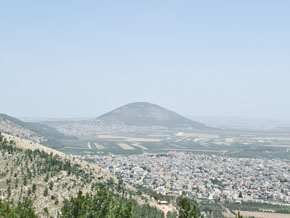
The picture was taken just outside Nazareth, looking east towards Mount Tabor (Tavor) rising alone on the Jezreel Valley.
The troops gather – go up
And Deborah arose and went with Barak to Kedesh. 10And Barak summoned Zebulun and Naphtali to Kedesh, and they went up 10,000 men on foot, and Deborah went up with him. 11Chever, the Kenite, had separated himself from the Kenites, from the sons of Hobab, Moses' father-in-law, and he pitched his tent as far away as Elon-Betsananim, which is near Kedesh. 12And they told Sisera that Barak, the son of Abinoam, had gone up to Mount Tabor. 13And Sisera gathered all his chariots, 900 iron chariots, and all his people who were with him from Harosheth-Hagoyim ("the forest land of the Gentiles") to the brook Kishon [which flows through the plain of Jezreel and empties into present-day Haifa].The Lord gives victory
14And Deborah said to Barak [third speech]: "Rev! This is the day that the Lord (Yahweh) has delivered Sisera into your hand; has not the Lord (Yahweh) gone out before you?"The troops flee
15
During excavations in El Awhat (25 km east of Caesarea on the Mediterranean coast), this bronze detail, which is 2 cm in diameter and 5 mm thick, was found in the late 1990s. It is believed to be part of a pin that was attached to a cart wheel, and the location and date suggest that this decorated pin may have been attached to one of Sisera's carts!
Deborah's prophecy comes true
17However, Sisera fled on foot to the tent of Jael, the wife of Heber the Kenite, for there was peace between Jabin, king of Hazor, and the house of Heber the Kenite. 18And Jael went out to meet Sisera and said to him, "Come in, my lord, come in to me, do not be afraid." And he went in to her in her tent, and she covered him with a blanket. 19And he said to her, "Please give me a little water to drink, for I am thirsty." And she opened a milk jug and gave him a drink and covered him. 20And he said to her, "Stand at the entrance of the tent [and keep watch]. If anyone comes and asks you if there is a man here, say no." 21Then Chever's wife Jael took a tent peg and a hammer in her hand and went quietly to him and drove the tent peg through his temple and pierced him to the ground, for he was in a deep sleep. So he became unconscious and died. 22And behold, while Barak was pursuing Sisera, Jael came out to meet him and said to him, "Come, and I will show you the man you are looking for." And he came to her, and behold, Sisera lay dead, and the tent peg was (still) in his temple.End of oppression
23So God (Elohim) subdued Jabin, king of Canaan, before the sons of Israel on that day. 24And the hand of the sons of Israel prevailed more and more against Jabin, king of Canaan, until they destroyed Jabin, king of Canaan.Deborah's song

A mosaic from a 1600-year-old synagogue in the city of Chokoka (Josh. 19:34) in Galilee is the oldest depiction of Deborah. The find was made during excavations in the summer of 2022.
when the people sacrifice themselves voluntarily
– bless the Lord (Yahweh). [The repetition of the Hebrew word parot reinforces, and can be translated as "when the leaders of Israel take up their leadership," i.e., take their leadership seriously, or refer to those who let their hair grow, which means that they choose to enter a period as Nazirites. The latter is a voluntary sacrifice, which fits well into the context of the rest of the sentence. At the same time, there is a double message here that deals with both responsible leadership and that they become, or behave like, Nazirites. That is, that they truly, both voluntarily and seriously, enter into what God wants.] 3Listen, you kings [Israel did not yet have a king, so this is addressed to pagan nations, see ],
give ear, you princes,
I – to the Lord (Yahweh);
I will sing (Hebr. ),
I will play (strike the strings – Hebr. )
to the Lord (Yahweh), the God of Israel (Elohim). [The last part of the verse forms a chiasm framed by the Lord, with the verbs sing and play at its center. Hebrew is often used in connection with stringed instruments, see ; . Miriam used a tambourine, see .] 4Lord (Yahweh), when you go forth from Seir,
when you march forth from the fields of Edom, the earth trembles,
the heavens drip,
even the clouds drip water.
5The mountains tremble at the presence of the Lord (Yahweh),
as does Sinai at the presence of the Lord (Yahweh), the God of Israel (Yahweh Elohim).
[Here the battle is compared to how the Lord met Moses on Sinai after the exodus from Egypt.] 6In the days of Shamgar, son of Anath,
in the days of Jael, the paths are silent [the caravans are gone]
and those who wander must take winding detours. 7The princes are silent in Israel,
they are silent until you arise, Deborah,
when you arise, a mother in Israel. 8They chose new gods,
then there was war in the gates [the enemy came all the way to our cities].
Was there a shield or a spear
to be seen among 40,000 in Israel? 9My heart is turned to the leaders of Israel,
who willingly sacrifice themselves among the people.
Bless the Lord (Yahweh).
10You who ride on white donkeys,
you who sit in expensive clothes
and you who walk on the roads, tell about it. 11Higher than the voice of the archer, [it is heard] between the water troughs,
there they shall practice the righteous deeds of the Lord (Yahweh),
the righteous deeds with his leaders in Israel.
Then the people of the Lord (Yahweh) go down to the gates. [Chiasmus with Deborah's name central to the first stanza and Barak framing the second:] 12Wake up (triumph),
wake up (triumph)
Deborah,
wake up,
wake up – speak (sing) a song!
Arise, Barak
and lead your captives into captivity,
you son of Avinoam [which is Barak, see ].
13Then he let the remnant rule
over the nobles [Israel],
the Lord (Yahweh) let me rule
over the warriors (men in their prime – full of their own strength and power).
14Out of Ephraim came those whose roots are in Amalek,
after you Benjamin among your people,
out of Machir came princes, and out of Zebulun
those who wielded the scepter. [There are no biological roots between Amalek and Ephraim; this refers to Joshua's defeat of Amalek. Joshua is an Ephraimite, and Amalek was the first enemy to fight against Israel in Rephidim after the exodus.] 15And the princes of Issachar were with Deborah,
as was Issachar, so was Barak,
into the valley he rushed on his feet.
Among the multitudes of Reuben
there was great determination in their hearts.
16Why do you sit among the sheepfolds
to listen to the flute playing for the flocks?
Among the multitudes of Reuben
the heart is greatly searched (examined).
17Gilead had its home on the other side of the Jordan,
and Dan, why does he stay with the ships?
Asher lives by the sea
and has his home by its bay.
[Asher has its territory around the Gulf of Haifa and northward along the coast toward Lebanon.]
18Zebulun is a people who risk their lives even unto death,
and Naphtali on the high heights of the field. 19The kings come, they fight,
then the kings of Canaan fight,
in Taanach by the waters of Megiddo,
they have no gain from silver.
20They fight from the heavens, the stars
from their courses fight against Sisera.
21The brook Kishon sweeps them away,
the ancient brook, the brook Kishon.
My soul, trample them down with strength. 22Then the horses' hooves stamp deliberately in dance,
they dance for the mighty. 23"Curse Meroz," says the angel (messenger) of the Lord (Yahweh),
"yes, curse its inhabitants
because they did not come to the aid of the Lord (Yahweh),
the Lord (Yahweh) to the aid of the mighty." [Meroz may be an expression of an evil spirit, or the name of a star. "Curse those who are against us" is the spirit of this expression.] 24Blessed above (more than) women shall Jael be,
the wife of Chever, the Kenite,
above (more than) the women in the tent
she shall be blessed.
25He asked for water—she gave him milk;
she brought butter (cheese) in the feast bowl. [The feast bowl here is a victory cup that the commander or king used to use when celebrating victory after a battle.]
26She put her hand on the tent peg
and her right hand on the craftsman's hammer,
and with the hammer she struck Sisera, she struck through his head,
yes, she pierced and struck through his temple.
27Between her feet he sank,
he fell,
he lay,
between her feet
he sank,
he fell,
where he sank,
there he fell down dead. [The verse forms a double chiasmus with parallelism!] 28Through the window she looked out and peered, Sisera's mother,
through the lattice:
"Why is his chariot so late in coming?
Why are the steps [the sound of the horses' hooves] from his chariot delayed?"
29Her wisest ladies-in-waiting answer her,
she repeats the answer (the word) to herself:
30"They have surely found prey, and now they are dividing the spoils.
One womb (mother's womb), two wombs for each warrior,
to Sisera a spoil of colored clothes, a spoil of colored, embroidered clothes,
two colored embroidered garments for the neck of each plunderer."
[Sexual assault was not uncommon in war, but Sisera's mother's objectifying, almost vulgar expression stands out and shocks the reader.] 31May all your enemies perish, Lord (Yahweh),
but those who love him shall be like the sun when it rises in its might. And the land had peace for 40 years.Gideon – the fourth judge
Apostasy
61And the sons of Israel did evil in the sight of the Lord (Yahweh), and the Lord (Yahweh) delivered them into the hands of the Midianites for seven years. 2And the hand of the Midianites prevailed against Israel, and because of the Midianites, the sons of Israel made caves for themselves in the mountains and caves and strongholds [natural mountain strongholds and cliffs – Hebr. masad; the same word as the famous ancient fortress Masada in the Negev desert]. 3Every time the Israelites had sown [their seed in the fall], [year after year for seven years] the Midianites and the Amalekites and the sons of the east came up against them, 4and they camped opposite them and destroyed (ruined) the crops of the land, as far as Gaza [in the west], and left nothing edible in Israel, neither sheep, oxen, nor donkeys. 5For they came in with their livestock and their tents, and they came like locusts in great swarms—both they and their camels were impossible to count—and they came into the land to destroy it. 6And Israel became very small (impoverished, poor; literally: 'brought down very low') [completely discouraged] because of Midian, and the sons of Israel cried out to the Lord (Yahweh). [The Midianites, together with the Amalekites and other peoples from the east (), did not primarily engage in warfare, like previous enemies, but instead stole and ravaged the land. The first attack on Israel came from the Amalekites. At that time, they had not even entered the land but were still wandering. The Amalekites used camels and specialized in surprise attacks where they came and plundered and robbed, see ; .] 7And it happened when the sons of Israel cried out to the Lord (Yahweh) because of the Midianites [who took their grain] 8the Lord (Yahweh) sent a man (Hebr. ish), a prophet (Hebr. navi), to them. [He is not mentioned by name, but is the first male prophet after Moses, followed by Samuel. The wording follows the same pattern as Deborah, who is presented as isha neviah (a woman, a prophetess), see . According to Jewish tradition, this refers to the priest Phinehas (grandson of Aaron and son of Eleazar), see .]He said, "Thus says the Lord, the God of Israel [reminding them who God is, how they have forsaken him and begun to worship idols instead]: It was I who brought you out of Egypt,
brought you out of the house of bondage (slavery).
9I rescued you from the hand of Egypt,
and from the hand of all other oppressors.
I drove them away for you,
and gave you their land.
10I said to you: I am the Lord (Yahweh) your God (Elohim),
you shall not worship (revere, fear) the gods of the Amorites in whose land you dwell,
but you did not listen to me."[The Israelites had begun to worship the fertility god Baal and his mistress Asherah. By sacrificing their firstborn sons in fire and through sexual rites, they believed they could awaken Baal so that he would give them good harvests.] Gideon receives a visit
[The theme of fear/dread permeates the entire story of Gideon. The fear reflected in this story is a normal human fear that can arise in the face of the unknown or when faced with a challenge. But it must be overcome.] 11The angel of the Lord came to Ophrah [on the plain of Jezreel] and sat under the terebinth tree belonging to Joash of the Abiezrites. Gideon, his son, was threshing wheat in the winepress to hide it from the Midianites (so that they would not see or get to it). [A generally accepted view is that the angel of the Lord is Jesus pre-incarnate, i.e., Jesus appearing as a messenger of the Lord before taking human form. The city of Ophrah is mentioned in connection with the Jezreel Valley and Mount Tabor. It seems to have been exposed to attack in the middle of the plain and is often identified with today's Afula. Gideon means "one who cuts down," which is an appropriate name considering his first mission to tear down the altar of Baal and the Asherah pole, see .] 12The angel of the Lord appeared to him and said, "The Lord is with you, mighty warrior!" 13Gideon replied, "But, Lord (Adonai), if the Lord (Yahweh) is with us, why has all this happened to us? Where are all the miracles our fathers told us about when they said how the Lord (Yahweh) brought us out of Egypt? Now the Lord (Yahweh) has forsaken us and given us into the hands of the Midianites." 14The Lord (Yahweh) turned to Gideon and said, "Go, and use the strength (Hebr. koach) you have, and you shall save Israel from the hands of the Midianites. Am I not sending you?" 15Gideon replied, "But, Lord (Adonai), how can I save Israel? My clan is the least in Manasseh, and I am the youngest in my family." 16The Lord (Yahweh) said to him, "I will be with you. You will strike down the Midianites [their entire army] as if they were one man." 17And he [Gideon] said to him, "If I have found favor (undeserved love – Hebr. chen) in your eyes, then show me a sign that it is you who is speaking to me. 18Please do not leave this place until I come to you and bring my gift (food offering – Hebr. minchah) and place it before you." [It could be a gift or a food offering, see ; .]
And he said, "I will stay here until you return." 19And Gideon went in and prepared a kid and unleavened cakes from an ephah [standard measure for measuring dry goods – 22-36 liters] of flour, and he put the meat in a basket and the broth in a bowl, and brought it out to him under the terebinth tree and set it before him. 20And the angel of God (Elohim) said to him, "Take the meat and the unleavened bread and place them on the rock, and pour out the broth." And he did so. 21And the angel of the Lord (Yahweh) stretched out the tip of his staff that he had in his hand and touched the meat and the unleavened bread, and fire came out from the rock and consumed the meat and the unleavened bread. And the angel of the Lord (Yahweh) disappeared from his sight. 22And Gideon saw that he was the angel of the Lord (Yahweh), and Gideon said, "Alas (oh no), Lord of lords (Adonai Yahweh), for I have seen the angel of the Lord (Yahweh) face to face." 23And the Lord (Yahweh) said to him, "Peace (shalom) be with you, do not be afraid, you shall not die." 24And Gideon built an altar there to the Lord (Yahweh) and named it Yahweh-Shalom (the Lord is peace, health, prosperity, and all good things). To this day it still stands in Ophrah, the land of the Ezri. 25And it came to pass that night that the Lord (Yahweh) said to him, "Take your father's bull and the other bull that is seven years old, and break down the altar of Baal that your father has, and cut down the Asherah beside it, 26and build an altar to the Lord your God (Yahweh Elohim) on top of this stronghold (the idol altar), on the battlefield, and take the other bull and offer it as a burnt offering with the Asherah, which you shall cut down, as wood." [Gideon is to build the altar of the Lord on the site where the altar of Baal stood. The site is a battlefield. These principles recur throughout the Bible. Jesus takes his disciples to one of the darkest places and teaches them about the church that is to be built "on this rock," see . In spiritual warfare, the occult must be replaced with God's alternative, see .] 27And Gideon took ten men of his servants and did as the Lord (Yahweh) had spoken to him, and it came to pass that because of fear of his father's house and the men of the city, he could not do it by day, but did it by night. 28And when the men of the city rose early in the morning, behold, the altar of Baal was broken down, and the Asherah that stood beside it was cut down, and the second bull was sacrificed on the altar that had been built. 29And they said to one another, "Who has done this?" And when they investigated and inquired, they said, "Gideon, the son of Joash, has done this." 30And the men of the city said to Joash, "Bring out your son so that he may die, because he has broken down the altar of Baal and cut down the Asherah that was beside it." 31And Joash said to all who stood over him (gathered around him, pressed in on him), "Will you fight for (defend with words) Baal? Or will you save him? Whoever wants to fight for him shall be killed before morning; if he is a god, let him fight for (defend) himself, since his altar has been broken down." 32And on that day he was called Jerubbaal, and he said, "Let Baal fight (defend himself) against him, since he has broken down his altar." 33And all the Midianites and the Amalekites and the sons of the east gathered together, and they crossed over and encamped in the valley of Jezreel. 34But the Spirit of the Lord (Yahweh) clothed Gideon, and he blew a shofar, and the Aviezers gathered after (behind) him. 35And he sent messengers throughout Manasseh, and they also gathered after him, and he sent messengers to Asher and to Zebulun and to Naphtali, and they came up and met him. 36And Gideon said to God (Elohim), "If you will save Israel by my hand as you have said [promised], 37behold, I will put a fleece of wool on the threshing floor; if there is dew only on the fleece and it is dry on all the ground, then I will know that you will save Israel by my hand, as you have said [promised]." 38And it came to pass, that he rose up early in the morning, and squeezed the fleece, and there came out of the fleece a bowl full of water. 39And Gideon said to God (Elohim), "Do not let your anger be kindled against me, and I will speak only once more. Let me test it, I beg you, but this time with the fleece. Let it be dry on the fleece and full of dew on the ground." 40And God (Elohim) did so that night, for it was dry only on the fleece and there was dew on the ground.Gideon's army – from 32,000 to 300
71
On the northern slope of Mount Gilboa towards the Jezreel Valley is the cave known as "Gideon's Cave," which supplies Ein-Charad with water.
may turn back and leave (go home early; unusual word can also mean chirp – Hebr. )
from the hill country of Gilead.'" And 22,000 of the people [who were initially 32,000] returned, and 10,000 remained. [Of the 32,000 Israelite men, only 30% remain. One reason why the fearful would go home is that fear spreads easily, see . The source Ein-Charod is located by Mount Gilboa, while Gilead is located to the east on the other side of the Jordan River, which is clearly defined just a few chapters earlier in Deborah's song, see . The first time the place is mentioned in the Bible is during Jacob's flight from Laban, see , which associates the name with fear and flight. Some interpret this as a typo, but it is better to see that those who were afraid, who were from the region of eastern Manasseh (, which is in the mountainous region of Gilead), would return home. If we see the expression as a chiasm, it is framed by who is to return and, centrally, how they are to do so. This is not the only linguistic subtlety in the text. The word shake (Hebr. charad) has the same root as the name of the source, Charod. Central to the chiasm are two unusual words. First, Hebr. shov to return, followed by tsafar, which is difficult to translate and can mean "early," but also a bird's chirping. The meaning becomes that those who are from Gilead and are afraid can return and "flutter home" like frightened birds.] 4
Below the spring, the water collects in a pool. It is now a national park called Maajan Charod (Maayan Harod).
The camp of the Midianites was [at a lower elevation] below him in the valley. 9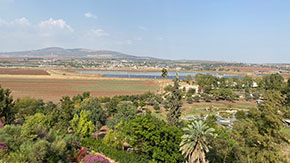
View above the spring on Mount Gilboa. The Midianites' camp was in the valley at the foot of Mount Givat-More, which can be seen in the background.
And they replied, "As you are, so were they, each one looking like a king's son." 19And he said, "They were my brothers, my mother's sons, as the Lord (Yahweh) lives, if you had saved them alive, I would not strike you." 20Then he said to Jether, his firstborn, "Rev them." But the young man did not draw his sword, for he was afraid because he was a young man. 21And Zebah and Zalmunna said [to Gideon], "Get up and fall upon us—for as the man is, so is his strength." And Gideon got up and struck [killed] Zebah and Zalmunna and took the moon pendants from the necks of their camels. [The Hebrew word saharon means "small moons" and is the name of a neck ornament worn by men and women, but also by decorated camels (; ). Presumably, there was gold in the adornments worn by their camels. Verses 25-26 mention that the camels' necklaces were made of gold.]Gideon's Ephod
22And the men of Israel said to Gideon, "Rule over us, you and your son and your sons' sons, for you have saved us from the hand of the Midianites." 23And Gideon said to them, "I will not rule over you, nor shall my sons rule over you; the Lord (Yahweh) shall rule over you." 24And Gideon said to them, "I have a request to make of you, that each of you give me an earring from his spoil." For they had earrings of gold, because they were Ishmaelites [a people related to the Midianites, see ]. 25And they [the Israelites] answered, "We will gladly give them." And they spread out a cloak, and each one threw the earrings from his spoil. 26And the weight of the gold earrings he asked for was 1,700 shekels [20 kg] of gold. Besides the moon jewelry (Hebr. saharon) and the pendants (earrings) and the purple garments that were on the kings of Midian, and besides the chains that had been around the necks of their camels. 27And Gideon made an ephod [perhaps an image of a high priest; to determine God's will, see ] out of it and placed it in his city, in Ophrah, and all Israel went after it (literally: prostituted themselves with it), and it became a snare to Gideon and to his house.Gideon's death
28So Midian was subdued (they were forced to bow their knees—Hebr. kana) before the sons of Israel, and they no longer lifted up their heads. And the land had rest for 40 years in the days of Gideon. 29And Jerubbaal [another name for Gideon; ], the son of Joash, went and lived in his own house. 30And Gideon had 70 sons who had gone out (been born) from his lands, for he had many wives. 31And his concubine who was in Shechem [present-day Nablus in Samaria, see ] also bore him a son, and she named him Abimelech. [Abimelech means "my father is king." This must have been his mother's wish and how she viewed Gideon. Gideon himself refused to be a king, see , so the name is in that sense a lie, but may be an expression of his mother's utopia or desire.] 32And Gideon, the son of Joash, died at a good old age and was buried in the tomb of Joash, his father, in Ophrah of the Abiezrites.Avimelech – the fifth leader
Apostasy
33And it came to pass, as soon as Gideon was dead, that the children of Israel turned again, and served Baalim, and made Baal-berith their god (elohim). [Baal-berith means 'Baal of the covenant', cf. El-berith 'God of the covenant' in .] 34But the sons of Israel did not remember the Lord (Yahweh) their God (Elohim), who had delivered all their enemies on every side into their hands. 35And they showed no mercy (loving kindness – Hebr. chesed) to the house of Jerubbaal, Gideon, after all the good he had done for Israel. 91And Avimelech, the son of Jerubbaal, went to Shechem to his mother's brothers and spoke with them and with all the family of his grandfather's house. He said: 2"Please speak in the ears of all the men of Shechem: What is better for you, that all the sons of Jerubbaal, who are seventy men, rule over you, or that one man rule over you? Remember that I am your bone and your flesh." 3And his mother's brothers spoke in his ear to all the men of Shechem [so that they would really hear], all these words, and their hearts were inclined to follow Avimelech, for they said, "He is our brother." 4And they gave him seventy pieces of silver from the house of Baal-berith [], with which Avimelech hired worthless (Hebr. reiq) and light (Hebr. pachaz) men [two expressions for various loose people] who followed him. 5And he went to his father's house in Ophrah and struck his brothers, the sons of Jerubbaal, 70 men, on a stone, but Jotham, Jerubbaal's youngest son, was gone because he had hidden himself. 6And all the men of Shechem gathered together, and all the men of Beth Millo, and went and made Abimelech king by the terebinth tree that is by the pillar that is in Shechem. 7And when they told Jotham, he went and stood on top of Mount Gerizim and lifted up his voice and cried out and said to them: "Hear me, men of Shechem, that God (Elohim) may hear you. 8The trees went out once to anoint a king over them, and they said to the olive tree, 'Reign over us. 9But the olive tree said to them, 'Should I leave (abandon) my fatness (Hebr. deshen) [stop producing olive oil] that honors God (Elohim) and men and go and sway over the trees?' [To stand and sway is a sarcastic expression for doing something useless and insignificant.] 10And the trees said to the fig tree, 'Come and rule over us.' 11But the fig tree said to them, 'Should I leave (abandon) my sweetness and my good fruit and go and sway over the trees? 12And the trees said to the vine, 'Come and reign over us.' 13But the vine said to them, 'Should I leave (abandon) my wine that gladdens God (Elohim) and people and go and sway over the trees? 14Then all the trees said to the thornbush (Hebr. atad): 'Come and reign over us.' 15And the thorn bush said to the trees, 'If you truly anoint me king over you, then come and take refuge in my shade, and if not, let fire come out from the thorn bush and devour the cedars of Lebanon.'"[Ironically, it is ultimately the thorn bush, which contributes nothing positive to mankind, that accepts the proposal to rule. Compared to the cedars of Lebanon, the olive tree, the fig tree, and the vine are not as tall, and they also bear fruit. These three trees are three of the seven species that specifically represent Israel. They can be interpreted as the true Israelites who do not want to see Avimelech as king.] 16And know that if you have acted in truth and sincerity in making Avimelech king, and if you have done good to Jerubbaal [Gideon] and his house, and have done to him according to what his hands deserve, 17for my father fought for you and risked his life and delivered you from the hand of Midian, 18and you rise up against my father's house today and have struck down his sons, 70 men on one stone, and have made Avimelech, the son of his maidservant, king over the men of Shechem because he is your brother, 19if you have acted in truth and sincerity toward Jerubbaal and toward his house today, then rejoice in Avimelech, and let him also rejoice in you. 20But if not, let fire come out from Avimelech and consume the men of Shechem and Beit-Millos, and let fire come from the men of Shechem and from Beit-Millo and consume Avimelech. 21And Jotham ran away and fled and went to Beer [the spring] and lived there for fear of his brother Avimelech. [There are many cities that have "spring" in their name (e.g., Beer-Sheva), but perhaps it is the city of el-Bireh north of Shechem in the Jezreel Valley near Gideon's hometown of Ophrah, see .] 22And Avimelech was prince over Israel three years. 23And God (Elohim) sent an evil spirit between Avimelech and the men of Shechem [cf. ], and the men of Shechem acted treacherously toward Avimelech, 24so that the violence done to the seventy sons of Jerubbaal came upon them, and their blood was laid on Avimelech, their brother who killed them, and on the men of Shechem who strengthened his hands to kill his brothers. 25And the men of Shechem set men in ambush on the tops of the mountains, and they robbed all who passed by them on the way, and it was told to Avimelech. 26And Gaal, the son of Ebed, came with his brothers and went to Shechem, and the men of Shechem trusted him. 27And they went out into the field and gathered their wine and trod the grapes and held a feast and went into the house of their gods and ate and drank and cursed (spoke ill of, literally "took lightly") Avimelech. 28And Gaal, the son of Ebed, said, "Who is Avimelech, and who is Shechem, that we should serve him? Is he not the son of Jerubbaal? And Zebul his commander? You may serve the men of Hamor, the father of Shechem, but why should we serve him? 29If this people were given into my hand, I would destroy Avimelech." And he said to Avimelech, "Enlarge your army and come out!" 30When Zebul, the prince of the city, heard the word of Gaal, the son of Ebed, his anger was aroused. 31And he sent messengers to Abimelech at Timnah, saying, "Behold, Gaal, the son of Ebed, and his brothers have come to Shechem, and behold, they are stirring up the city against you. 32Now therefore, arise by night, you and the people who are with you, and lie in wait in the field. 33And it shall be done in the morning, as soon as the sun is up, that ye shall rise up early, and scatter yourselves abroad in the city; and, behold, when he and the people that are with him come out against you, then ye shall do to them as the occasion shall require. 34So Avimelech got up at night, along with all the people who were with him, and they lay in ambush against Shechem in four groups. 35And Gaal, the son of Ebed, went out and stood at the entrance of the city gate, and Avimelech and the people who were with him rose up from the ambush. 36And when Gaal saw the people, he said to Zebul, "Look, people are coming down from the tops of the mountains." And Zebul said to him, "You see the shadows of the mountains as if they were men." 37And Gaal spoke again and said, "Look, people are coming down from the center of the land (raised plateau; central parts, middle), and a group is coming by way of Elon-Meonenin." [Elon-Meonenin literally means "oak of revelation." The same oak at Shechem is mentioned earlier in verses 5-6. Abraham had a revelation at the same place, see . See also .] 38And Zebul said to him, "Where is your mouth when you say, 'Who is Avimelech that we should serve him? Is this not the people you have despised? Go, I beg you, and fight against them." 39And Gaal went out before the men of Shechem and fought against Avimelech. 40And Avimelech pursued him, and he fled before him, and many were wounded, even to the entrance of the gate. 41And Avimelech lived in Aroma, and Zebul drove out Gaal and his brothers so that they would not live in Shechem. 42And it came to pass in the morning, when the people went out into the field, that it was told Avimelech. 43And he took the people and divided them into three groups and lay in ambush in the field. And he looked, and behold, the people came out of the city, and he rose up against them and struck them. 44And Avimelech and the groups that were with him rushed forward and stood at the entrance to the city gate, and the two groups rushed over all who were in the field and struck them down. 45And Avimelech fought against the city all day, and he took the city and struck down the people who were in it, and he broke down the city and scattered it with salt. 46And when all the men of Shechem heard of it, they went into the stronghold of the house of El-Beri [El-Beri means 'god of the covenant', see ; ]. 47And it was told Avimelech that all the men of Shechem's tower were gathered together. 48And Avimelech went up to Mount Tsalmon, he and all the people who were with him. And Avimelech took an axe in his hand and cut down a branch from the trees and picked it up and laid it on his shoulder, and he said to the people who were with him, "What you have seen me do, hurry and do as I have done." 49And all the people cut down their branches, each one his own, and followed Avimelech and laid them against the citadel and set them on fire, so that all the men of Shechem's tower died, about 1,000 men and women. 50And Avimelech went to Tevet and camped opposite Tevet and took it. [Probably today's Tubas, 15 km northeast of Shechem. No archaeological excavations have yet been made at the site.] 51But there was a strong tower in the city, and all the men and women, everyone in the city, fled there and shut themselves in and went up to the roof of the tower. 52And Avimelech came to the tower and fought against it and came near the door of the tower and burned it with fire. 53But a woman threw an upper millstone on Avimelech's head and crushed his skull. 54And he quickly called to a young man, his armor bearer, and said to him, "Draw your sword and kill me, lest they say of me, 'A woman struck him down. '" And his young man pierced him, and he died. 55And when the men of Israel saw that Avimelech was dead, they all went to their homes. 56And God (Elohim) repaid Avimelech for the evil he had done to his father when he slew his seventy brothers, 57and all the evil of the men of Shechem, God (Elohim) repaid upon their heads, and brought upon them the curse of Jotham, the son of Jerubbaal.Tola
101And after Avimelech, Tola [meaning worm or scarlet], the son of Puah, arose to save Israel, the son of Dodo, a man of Issachar, and he lived in Shamir in the hill country of Ephraim. 2And he judged Israel twenty-three years, and died, and was buried in Shamir. [The hill country of Ephraim stretched from Bethel, north of Jerusalem, up to the plain of Jezreel. Shamir may refer to the region of Samaria's capital, which is also called Samaria.]Jair
3And after him, Jair the Gileadite arose and judged Israel for 22 years. 4And he had
30 sons [cf. ]
who rode on 30 donkeys [a king riding a donkey for peaceful purposes, see ; ]
and they had 30 cities
called Havoth-Jair [Jair's tent cities] to this day, which are in the land of Gilead [east of the Sea of Galilee]. 5And Jair died and was buried in Qamon. [Location in Gilead not yet identified; the name means "upright."]
[The main content of the Book of Judges revolves around seven stories that follow the pattern of apostasy, oppression, prayer, and finally deliverance. However, the pattern is interrupted three times by a brief description of six other men who were leaders in Israel. The first was Shamgar, who was described in one verse (). The remaining five (Tola, Jair, Ibzan, Elon, and Abdon) are mentioned in two groups that frame the story of the sixth judge, Jephthah (). The first two (Tola and Jair) are mentioned in verses 1-5 and the last three (Ish-bosheth, Elon, and Abdon) in Judges 12:8-15. This literary construction, with the framing of five "minor judges," reinforces the story of Jephthah. The name Tola means scarlet (he was probably very reddish when he was born and was given that name), but the word can also mean insignificant, like a worm, see . Together with the brief description in one line, his insignificance is reinforced. Jephthah is then framed by Jair and Ivtsan, who both had 30 sons (; ). This is in stark contrast to Jephthah, who had only one daughter, see .]Jephthah – the sixth judge
Apostasy
6And the sons of Israel again did evil in the sight of the Lord (Yahweh) and served [now seven idols are listed:]
the Baals
and the Ashtaroth (stars) and
the gods of Aram [which were Chehadad, Mot, Anat, and Rimmon]
and the gods of Sidon
and the gods of Moab [Chemosh, see ]
and the gods of the sons of Ammon [Moloch, see ]
and the gods of the Philistines [Dagon, see ]
and they forsook the Lord (Yahweh) and did not serve him. 7And the anger of the Lord (Yahweh) was kindled against Israel, and he delivered them into the hand of the Philistines and into the hand of the sons of Ammon. 8And they oppressed [unusual word, used only here and in ] and crushed the sons of Israel thatyear – [for a total of] 18 years [they oppressed] all the sons of Israel who were beyond the Jordan in the land of the Amorites, which is in Gilead. 9And the sons of Ammon crossed the Jordan to fight against Judah and against Benjamin and against the house of Ephraim, so that Israel was in great distress. 10And the sons of Israel cried out to the Lord (Yahweh) and said, "We have sinned against you in that we have forsaken our God (Elohim) and have served the Baals." [This is the first and only time in the book that the Israelites' prayer for help is described in detail. In the answer that follows, a verb is missing; it is implied that they were saved or delivered. In the list that follows, seven enemies are counted, as in .] 11And the Lord (Yahweh) said to the sons of Israel: "Have I not [rescued/saved you from these seven countries/peoples:]
from Egypt (Hebr. Mitsrajim; literally meaning siege, confinement) []
and from the Amorites []
and from the sons of Ammon [through Shamgar, see ]
and from the Philistines 12and the Sidonians
and the Amalekites []
and the Moabites [here the Midianites are expected]
when they oppressed you, and you cried out to me, and I saved you from their hand. [; ; ] 13But you have forsaken me and served other gods. Therefore, I will no longer save you. 14Go and cry out to the gods you have chosen; let them save you in your time of trouble." 15And the sons of Israel said to the Lord (Yahweh), "We have sinned; do to us whatever seems good in your eyes, but please save us this day." 16And they removed the foreign gods from among them and served the Lord (Yahweh), and his soul was grieved for the trouble of Israel.Threat from the Ammonites
17And the sons of Ammon gathered themselves together and encamped in Gilead. And the sons of Israel gathered themselves together and encamped in Mizpah. [There are several places called Mizpah in the Bible, this is probably the same place in Gilead (not yet identified) where Jacob and Laban made their agreement, see .] 18And the people said to one another, the princes of Gilead, "The man who begins the battle with the sons of Ammon shall be head (leader) over all the inhabitants of Gilead." 111And Jephthah (Hebr. Yiftach), the Gileadite, was a mighty warrior, but he was the son of a prostitute, and Gilead gave birth to Jephthah. [The name Jephthah (Hebr. Yiftach) means "he has opened." The name seems to express his mother's joy at having given birth to a son. However, it is not entirely clear who "he" refers to, but it probably refers to some deity who has opened her womb. The word is used for a place called Jiftach-el (, ) where the general name for God (Hebr. El) is used. One possibility is that Jiftach's name is "Jiftach-El" or "Jiftach-Yahweh," i.e., that it refers to the God of Israel, but based on the story, this is unfortunately unlikely. His name was perhaps rather "Jephthah-Baal." His mother's occupation, his father's actions, his half-brothers' character, and Jephthah's own actions point to a strong influence of Canaanite culture and religion.] 2And Gilead's wife bore him sons, and when his wife's sons grew up, they drove Jephthah away and said to him, "You shall not inherit our father's house, for you are the son of another woman." Jephthah's mother may have been an Israelite, but more likely a Canaanite, perhaps a temple prostitute. When Jephthah's father dies and it is time to divide the inheritance, his half-brothers drive him away because they do not want to share the inheritance with him. 3Jephthah fled from his brothers and lived in the land of Tob [a city/region northeast of Gilead], where various vagabonds gathered around Jephthah and went out with him. 4And it came to pass after a while that the sons of Ammon went to war against Israel. 5And it came to pass, when the children of Ammon made war against Israel, that the elders of Gilead went and took Jephthah from the land of Tob. 6And they said to Jephthah, "Come and be our commander (Hebr. qatsin) so that we may fight against the sons of Ammon." 7And Jephthah said to the elders of Gilead, "Did you not hate me and drive me out of my father's house? Why do you come to me now, when you are in trouble?" 8And the elders of Gilead said to Jephthah, "That is why we have come to you now, that you may go with us and fight against the sons of Ammon, and you shall be our head (our leader – Hebr. rosh) over all the inhabitants of Gilead."
[The same word (Hebr. rosh) is used in . There is a significant difference between being qatsin () and rosh (). A leader, qatsin, is a leader/chief with limited responsibility, and this may also apply to a limited period of time. For example, a captain in the army who has been given a mission for a specific part of the army and perhaps only for a specific battle/task. A leader, rosh, is a permanent leader/chief, such as a tribal chief or king, who has full responsibility in all areas for all the people in his group for as long as he lives.] 9And Jephthah said to the elders of Gilead, "If you bring me back home to fight against the sons of Ammon and the Lord (Yahweh) gives them before me, I will be your head (leader – Hebr. rosh)." 10And the elders of Gilead said to Jephthah, "The Lord (Yahweh) is (shall be) witness between us, if we do not do according to your word." 11And Jephthah went with the elders of Gilead, and the people made him head (Hebr. rosh) and commander (Hebr. qatsin) over them. And Jephthah spoke all his words [repeated the words from ] before the Lord (Yahweh) at Mizpah. 12And Jephthah sent messengers to the king of the Ammonites, saying, "What have you against me? [What are you doing in the land of Israel?] Why have you come to fight against my land [the area around Gilead east of the Jordan River]?" [Jephthah tries to resolve the conflict diplomatically and through negotiations first. The fighting has already begun, see , so the question may also be about gaining time and providing moral arguments for fighting.] 13And the king of the Ammonites said to Jephthah's messengers, "Since Israel took my land when you came up from Egypt, from the Arnon to the Jabbok and to the Jordan, now return it [the land and the cities] peacefully (in shalom)." 14And Jephthah sent messengers back to the king of the sons of Ammon 15and said to him, "Thus says Jephthah: Israel did not take the land from Moab, nor did they take the land of the sons of Ammon. [Now follows a long explanation in which Jephthah shows that he is well acquainted with the history of Israel. He makes it clear that the sons of Ammon have never been taken by Israel. On the contrary, there are three countries that God says Israel should not fight against because they are their brothers. These are Ammon and Moab, who are descendants of Lot (Abraham's nephew), and Edom, who are descendants of Esau (Jacob's brother). What Jephthah now recounts from verses 16 to 26 is how Israel wandered in the desert and did not touch these three countries, but how, on the other hand, the Amorites long ago took the area that Ammon now claims and how Israel took it from the Amorites and thus has a legal right to this area. see .] 16But when they came out of Egypt, Israel wandered through the wilderness to the Reed Sea (Hebr. jam sof) [Red Sea] and came to Kadesh, 17and Israel sent messengers to Edom, saying, 'Let me pass through your land, I beg you,' [] but the king of Edom would not listen. And in the same way he sent to the king of Moab, but he would not, and Israel remained in Kadesh. 18And they journeyed through the wilderness and went around (took a detour around) the land of Edom and the land of Moab and came to the east side of Moab, and they camped on the other side of the Arnon. But they did not come within the borders of Moab, for the Arnon was the border of Moab. [The Arnon River flows through Wadi el-Mojib and empties into the southeastern part of the Dead Sea.] 19And Israel sent messengers to Sihon, king of the Amorites, king of Heshbon, and Israel said to him, "Let us pass through your land to my place, we pray." 20But Sihon did not trust Israel to pass through his borders, and Sihon gathered all his people together and encamped at Jahaz and fought against Israel. 21And the Lord (Yahweh), the God (Elohim) of Israel, delivered Sihon and all his people into the hand of Israel, and they defeated them. So Israel took possession of the whole land of the Amorites, the inhabitants of the land. 22And they took possession of all the borders of the Amorites from the Arnon to the Jabbok and from the wilderness to the Jordan. 23And now the Lord (Yahweh), the God of Israel (Elohim), has driven out the Amorites before his people Israel. Will you now take possession of it? 24Will you now take possession of what Chemosh, your god, has given you to possess? Whomever the Lord our God (Yahweh Elohim) has driven out before us, we will possess. 25And are you now better than Balak, son of Zippor, king of Moab? Did he ever quarrel with Israel or fight against them? 26While Israel lived in Heshbon and its towns, in Aroer and its towns, and in all the towns along the side of the Arnon for 300 years, why did you not take them back during that time? 27Therefore, I have not sinned against you, but you have done wrong to me by fighting against me. May the Lord (Yahweh), the Judge, judge today between the sons of Israel and the sons of Ammon." 28But the king of the sons of Ammon did not listen to the words that Jephthah sent to him [via the messengers].The Promise
29Then the Spirit of the Lord (Yahweh) came upon Jephthah, and he went over Gilead and Manasseh and passed over Mizpeh of Gilead and from Mizpeh of Gilead over to the sons of Ammon. 30And Jephthah made a vow to the Lord (Yahweh) and said, "If you will indeed deliver the sons of Ammon into my hand, 31then whatever comes through the door of my house to meet me when I return in shalom (peace) from the Ammonites shall be the Lord's (Yahweh's), and I will offer it up as a burnt offering." [The word whatever (Hebr. vehaja) can describe an object, an animal, or a person. Hebrew makes no distinction between an object and a living thing. However, a dead thing cannot meet him at the door, so Jephthah must be referring to either an animal or a person. There are also restrictions on what can be sacrificed; for example, an unclean animal such as a dog cannot be sacrificed to the Lord (Yahweh). The idea of human sacrifice was not uncommon among the religions of neighboring peoples () and was something Abraham was tested with ().The word burnt offering is used hundreds of times in the Old Testament and always refers to a sacrifice offered on an altar. However, if one interprets the sacrifice figuratively, it could be about consecrating the first person who met him to serve in the tabernacle, similar to how Hannah consecrates Samuel, see , and if it was an animal, it would be sacrificed. Jephthah was a man of faith and is mentioned among other men and women who showed strong faith (), which indicates that what he did was right.]The Lord gives victory over the Ammonites
32And Jephthah went over to the sons of Ammon to fight against them, and the Lord (Yahweh) delivered them into his hand. 33And he smote them from Aroer, even unto Minnith, twenty cities, and unto Abel-keramim, with a very great slaughter. So the children of Ammon were subdued before the children of Israel.The promise is fulfilled with sorrow
34And Jephthah came to Mizpah to his house, and behold, his daughter came out to meet him with tambourines and with dancing, and she was his only child; besides her he had no son or daughter. 35And it came to pass, when he saw her, that he rent his clothes, and said, "Alas (oh no), my daughter! You have brought me to utter despair (you have brought me down to the lowest depths, completely to my knees – Hebr. kara kara) and brought misfortune upon me (have afflicted me). I opened my mouth to the Lord (Yahweh) and cannot go back (take back what I have said)." [] 36And she said to him, "My father, you have opened your mouth to the Lord (Yahweh), do to me according to what has come out of your mouth, since the Lord (Yahweh) has avenged you on your enemies, the sons of Ammon." 37And she said to her father, "Let this be done to me. Leave me alone for two months, that I may go and mourn my virginity, I and my friends." 38And he said, "Go." And he sent her away for two months, and she went, she and her friends, and mourned her virginity on the mountains. 39And it came to pass, when the two months were ended, that she returned to her father [Jephthah], who did with her according to the vow which he had vowed. And she had known no man.
And it became a custom in Israel 40for the daughters of Israel to go out yearly to mourn the daughter of Jephthah the Gileadite four days in the year.Internal strife
121And the men of Ephraim gathered together and went to Zaphon, and they said to Jephthah, "Why did you go over and fight against the Ammonites without calling us to go with you? We will burn your house down over you." 2And Jephthah said to them, "I and my people were in great conflict with the sons of Ammon, and when I called to you, you did not save me from their hand. 3And when I saw that you did not come to my rescue, I put my soul (my life) in my (own) hand and went over against the sons of Ammon, and the Lord (Yahweh) delivered them into my hand. Why have you come up against me to fight me today?" [The battle with the sons of Ammon had been going on for a long time before Jephthah first took it upon himself to fight them. Therefore, one may rightly wonder why the men of Ephraim are coming now, when they did not come earlier.] 4And Jephthah gathered all the men of Gilead and fought against Ephraim, and the men of Gilead defeated Ephraim because they said, "You Gileadites are fugitives from Ephraim in the midst of Ephraim and in the midst of Manasseh." 5And the men of Gilead took the fords of the Jordan [] against Ephraim, and it came to pass that when any of the fugitives of Ephraim said, "Let us go over," the men of Gilead said to him, "Are you an Ephraimite?" If he said, "No," 6then they said to him, "Say, I beg you, Shibboleth" [meaning: river/stream], and he said, "Sibboleth," because he could not pronounce it correctly [cf. ], then they seized him and struck him down at the fords of the Jordan. And at that time, 42,000 fell from Ephraim. [This is a terrible civil war.]Summary
7And Jephthah judged Israel for six years. Then Jephthah the Gileadite died and was buried in one of the cities of Gilead. [The Hebrew does not say "in one of" but only "in" the cities of Gilead; the reason for the plural form is probably that the author does not know exactly which city it is; see also .]Ivtsan
8And after him, Ivtsan [meaning: "shining/white"] from Bethlehem judged Israel. 9And he had 30 sons. And he sent 30 daughters abroad and brought 30 daughters from abroad to his sons. And he judged Israel for 7 years. 10And Ivtsan died and was buried in Bethlehem. [There are two Bethlehems. The larger Bethlehem in Galilee, just east of present-day Haifa on the plain north of Mount Carmel (), and the more famous southern one just south of Jerusalem. According to the Talmud, Ivtsan is identified with Boaz in the Book of Ruth and came from southern Bethlehem.]Elon
11And after him, Elon the Zebulunite judged Israel. And he judged Israel for 10 years. 12And Elon the Zebulunite died and was buried in Ajalon in the land of Zebulun.Abdon
13And after him, Avdon, the son of Hallel, the Pirathonite, judged Israel. 14And he had forty sons and thirty grandsons, who rode on seventy donkeys [cf. ]. And he judged Israel for eight years. 15And Avdon, the son of Hallel, the Pirathonite, died and was buried in Pirathon in the land of Ephraim, in the hill country of the Amalekites. Samson – the seventh judge
The birth of Samson

Samson came from the city of Tsorah, just south of Beit Shemech. View from the top where mosaic floors have been found, among other things.
"Behold, I pray thee, thou art barren, and bearest no child; but thou shalt conceive and bear a son. 4And during this time, you shall keep (guard, protect, preserve), I beg you, and not drink wine or strong (alcoholic) drinks, and you shall not eat anything (ritually) unclean, 5for behold, you will conceive and bear a son. No razor shall come upon his head, for the young man shall be a Nazirite of God (Elohim) from his mother's womb, and he shall begin to save Israel from the hand of the Philistines." [The Nazirite vows are described in . It was customary for these to be voluntary, but here the Nazirite vow is given even before conception. This means that the mother must also abstain from wine during pregnancy. Not eating anything unclean is an addition that is unique to Samson's Nazirite vow. The exact meaning of this is unclear, since no Jew should eat unclean food according to the provisions of the Torah. But this shows that purity is very important to Samson] 6And the woman came and said to her husband, to her husband she said: "A man from God (Elohim) came to me [the phrase suggests that she believes him to be a prophet] and his appearance was like the appearance of an angel of God (Elohim), very impressive, and I did not ask him who he was, and he did not tell me his name, 7but he said to me:
'Behold, you shall bear a son, and now you shall not drink wine or strong drink, nor eat anything unclean, for the young man shall be a Nazirite of God (Elohim) from the womb until the day of his death.' " [In a comparison between her report and the first message in verses 3b-5, there are some differences. She omits the last part that his mission has to do with beginning to save Israel from the hand of the Philistines. Nor does she include the phrase "no knife shall come upon his head." This, together with her addition of "until he dies," is ominous and ultimately leads to his death, see ] 8And Manoah pleaded (asked – Hebr. atar) with the Lord (Yahweh) and said, "O Lord (Adonai), please let the man of God (Elohim) whom you sent come again to us and teach us what we should do with the child who is to be born." [Here, a less common word for prayer is used, which often also involved a sacrifice. The repetition of "us" suggests that he was jealous that the messenger had come to his wife and not to him.] 9And God (Elohim) listened to Manoah's voice, and the angel of God (Elohim) came again to the woman as she sat in the field, but Manoah her husband was not with her. 10And the woman hurried and ran and told her husband, saying to him, "Look [he is here]! The man who appeared to me the other day has just appeared to me again." 11Manoah then got up and followed his wife and came to the man and asked him, "Are you the man who spoke to the woman (my wife)?"
He replied, "I am." [It is I.] 12Manoah said, "Now that your word has come to pass (what you have said has happened), what is the commandment (binding legal decision – Hebr. mishpat) for the young man and what we should do [with him]?" 13And the angel of the Lord (Yahweh) said to Manoah, "Of all that I have said to the woman, let her keep (guard, protect, preserve) it. 14She shall not eat anything that grows from the vine, nor shall she drink wine or strong drink, nor shall she eat anything unclean; she shall keep (guard, protect, preserve) everything that I commanded her." 15And Manoah said to the angel of the Lord (Yahweh), "Please stay, so that we may prepare a kid before you." 16And the angel of the Lord (Yahweh) said to Manoah, "Even if you keep me, I will not eat your bread, and if you prepare a burnt offering, you must offer it to the Lord (Yahweh)." For Manoah did not know that he was the angel of the Lord (Yahweh). 17And Manoah said to the angel of the Lord (Yahweh), "What is your name? For when your words come true (what you have said will be fulfilled), we will honor you (literally "and we will give you glory" from the word kavod)." 18
At the foot of Tel Tsora is an altar called "Manoah's Altar."
Samson betrays his secret to his Philistine wife
141
Timnah (Tel Batash) in Judea.
©Miguel Nicolaevsky
But Samson said to his father, "Get her for me, for she is the right one in my eyes." [The Hebrew word order has "her" first, which emphasizes Samson's decision, based solely on feelings, that there are no alternatives—she is the one he wants. Also interesting is the parents' argument and the reasons they give. They seem to see it mostly as a cultural problem. They make no mention of the prohibition in or the Nazirite vow and the call for him to save Israel from the Philistines ().] 4But his father and mother did not know that it was from the Lord (Yahweh), because he [the Lord] was seeking an occasion (reason – Hebr. toanah) against the Philistines. At that time, the Philistines ruled over Israel. [This comment from the author is a key verse for understanding the entire episode with Samson. The noun toanah is only used here, but the verb anah is used to describe an appropriate time for something to happen. The Israelites had become increasingly comfortable with being drawn into the customs and morals of the surrounding peoples. Now God will allow even human weakness to work for his purposes; if the Israelites do not take up the fight against the Philistines, he will allow the Philistines to rise up against Israel.] 5
Scene from the 2018 film Samson.
They replied, "Tell us the riddle and let us hear it." [Investments at that time included clothing, see . From the men's protests in , we also understand that the value of the reward was great.] 14He said to them, "Out of the eater comes forth food
and out of the strong comes forth sweetness."
But none of them could tell the riddle in three days. 15And on the seventh day they said to Samson's wife, "Entice your husband to tell us the riddle, or we will burn you and your father's house with fire. Have you called us here to make us poor?" 16And Samson's wife wept over him [clung to him] and said, "You only hate me, you do not love me, you have presented a riddle to the sons of my people and will not tell me, and you say to her [your wife], 'Behold, I will not tell my father and my mother, and shall I tell you? [See verses 6 and 9] 17And she wept over him on the seventh day, while the feast was going on, and it came to pass on the seventh day that he told her, because she pressed him hard. And she told the riddle to the sons of her people. 18And the men of the city said to him on the seventh day before the sun went down, "What is sweeter than honey, and what is stronger than a lion?" And he said to them, "If you had not plowed with my heifer [milked my wife for information], you would not have solved my riddle." 19And the Spirit of the Lord (Yahweh) came upon him, and he went down to [the Philistine city] Ashkelon [a distance of 37 miles] and struck down 30 men of them and took their clothes and gave them to those who had answered the riddle correctly. And his anger was kindled, and he went up to his father's house. 20But Samson's wife was given to [married off to] one of his wedding companions (marshals – Hebr. merea), the one he had chosen as his marshal. [She was married to his best man, probably one of the 30 Philistine wedding friends (). See also .]Samson visits his wife in Timnah
151And it came to pass after a while, when it was time for the wheat harvest [in May-June], that Samson visited his wife [in Timnah] with a kid, and he said, "I want to go in to (have sexual relations with) my wife in the chamber." But her father would not let him in. 2And her father said, "I really thought you hated her, so I gave her to your best man (Hebr. merea) [who was responsible for the wedding festivities]. Isn't her younger sister more beautiful than she is? Take her [the younger one], I beg you, instead of her [your wife]." 3But Samson said to them, "This time I will be free of guilt toward the Philistines if I do them harm." 4And Samson went and caught 300 foxes and took torches and tied tail to tail and put a torch in the middle between two tails. 5And when he had lit the torches, he let them go into the standing grain [corn and wheat fields] of the Philistines and burned both the sheaves [piles of grain that had already been harvested] and the standing grain [uncut grain] and also the olive groves [and thus also destroyed the autumn harvest]. 6And the Philistines said, "Who has done this?" And they said, "Samson, the son-in-law of the Timnite, because he took his wife and gave her to his best man (Hebr. merea) [who was responsible for the wedding]."
So the Philistines came up and burned her and her father in the fire. [What the 30 Philistine wedding guests threatened to do to Samson's wife if she did not give them the answer to the riddle now happens anyway because her father did not respect that she was Samson's wife, see .] 7And Samson said to them, "If you do this, I will avenge them and then cease." 8And he struck them—thigh upon thigh, a great slaughter (he completely destroyed them). [The expression "thigh upon thigh" is probably a proverbial expression, similar to the English "to beat someone to a pulp."] Then he went down and lived in the cleft of the rock at Etam.
[There is a town near Bethlehem called Etam (), but it is too far east, and Samson is not in a town. The most common suggestion is Arak Ismain (an area with many caves) just outside Samson's hometown of Tsorah in Judah.]Samson kills 1,000 Philistines
9
Just north of Beit Shemesh lies Arak Ismain, where there are several caves that may have been the place where Samson stayed.
The exact location of Lehi is not certain. In , the place is called "the jawbone hill." This could refer to a cave opening, a mountain formation, or something else that resembles a donkey's jaw, or the hill may have gotten its name because of the events described in verses 9-20. The spring Ein-Haqore is also located in the same place (). The cleft in Etam (verses 8 and 11) should also not be too far from Lechi. Most identify Lechi somewhere in the area around Beit-Shemesh. In verses 9-10, however, it is clear that the Philistines go "up" to one of the capitals of Judah, which was Bethlehem (; ) or Hebron (; ), from where one goes "down" to Etam. Another connection to the tribe of Dan () is that the area looks like a jawbone from above. It is not uncommon for places to be named after their shape, cf. Lake Haver (Hebr. Jam Kinneret).] 10The men of Judah asked, "Why have you come up against us?"
They replied, "We have come up to bind Samson, to do to him as he has done to us." 11And 3,000 men of Judah went down to the cleft of the rock at Etam and said to Samson, "Do you not know that the Philistines rule over us? What have you done to us?"
He answered them, "As they did to me, so I have done to them." 12And they said to him, "We have come down to bind you and deliver you into the hands of the Philistines." And Samson said to them, "Swear to me that you yourselves will not fall upon me." 13They answered him, "No, but we will bind you and deliver you into their hands, but we will not kill you." So they bound him with two new ropes and brought him up from the rock. 14When he came to Lehi, the Philistines shouted loudly (raised a battle cry) and rushed toward him. Then the Spirit of the Lord (Yahweh) came upon him, and the ropes around his arms became like flax that had caught fire, and they melted, and his ropes [ran away from him] from his hands. 15And he found a fresh jawbone [here the same word for jawbone is used as in the name of the place Lehi] and stretched out his hand and took it and struck 1,000 men [with it]. 16And Samson said, "With the jawbone (Hebr. lechi) of a donkey (Hebr. chamor),
one heap, two heaps (Hebr. chamor chamoratajim);
with the jawbone of an ass,
I have slain 1,000 men." [This verse is a poetic victory song. It is also a play on words, where the words for donkey and mound have the same root chamar and are written with the same three Hebrew letters (chet, mem and resh). The two phrases are parallel and there is an escalation. Mound is singular and then mounds is repeated in the dual form, i.e. two mounds. Exactly what "heap" means is not entirely clear, but the song suggests that Samson's victory took place in several stages, one heap, then two heaps, etc. The number 1,000 is not exact, but a typical poetic way of writing to indicate that there are many. Cf. also David's victory song, see .]
17And it came to pass, when he had finished speaking, that he threw the jawbone from his hand, and that place [was named] Ramat-Lechi [literally: "Jawbone Hill"]. 18And he was very thirsty and cried out to the Lord (Yahweh) and said, "You have given this great deliverance into the hand of your servant, and now you let me die of thirst and fall into the hand of the uncircumcised." 19And God (Elohim) split the hollow in Lechi and let water come out of it, and he drank and his spirit returned and he was revived. Therefore, he called (gave) [the spring] the name Ein-Haqore, which is in Lechi to this day. [The name of the spring comes from the Hebrew words ein and qara and literally means "Crying Spring." There is a parallel here to .] 20He [Samson] judged Israel for 20 years, during the days of the Philistines [when they ruled over Israel, see , ]. [The wording leads the reader to believe that the cycle with Samson is complete, but it is not. The next verse describes a new episode where the common denominator is Samson's fascination with women and the place, in this case as far down in Philistia as he could get – Gaza.]Samson visits a prostitute in Gaza
161
The Erez border crossing between Israel and Gaza.
[Here Samson goes from the coast six miles up into the mountains of Judah to Hebron, a considerable distance with two doors and doorposts with crossbars on his shoulders. The reader's attention is drawn to the word night (Hebr. lajla), which is used twice in and twice (half the night) in . Structurally, the woman in Gaza is the second woman Samson is with, of the three mentioned in the story. From a chiastic perspective, the story turns here when it has reached the "halfway point" of the night; the rest of this chapter follows the second half of Samson's night. We also see several similarities in the story in with the first woman and what soon follows with the third woman in verses 4-21. Samson has now reached the middle of the night, and the scene is set for the next lajla...]Samson betrays his secret to Delilah
4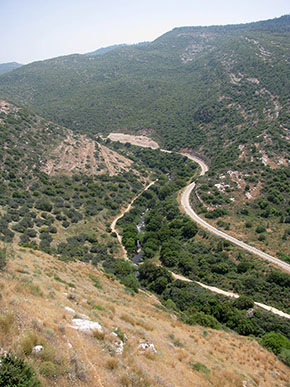
The Soreq River, which flows from the area around Jerusalem down to the Mediterranean Sea, served at this time as the border between the Israelites (the tribe of Dan) and the Philistines.
6Then Delilah said to Samson, "Tell me, I beg you, where does your great strength come from and how can you be bound to humiliate (torment) you?" 7Samson replied [with a lie]: "If they bind me with seven fresh ropes (tent ropes; ropes made of sinews; Hebr. jeter) that have not yet dried, I will become as weak as a [normal] man." [Tent ropes and bowstrings were often made from the entrails of livestock. Tendons from sheep bones were also used. Compare with Hebr. avot in .] 8Then the princes of the Philistines came up to her with seven fresh ropes that had never been dried, and she bound him with them. 9Those who were lying in wait for him were in the inner chamber. She then said to him, "The Philistines are upon you, Hos!" He tore the [thick, strong] ropes as if they were flax when it is scorched by fire [which becomes hot and begins to smell burnt, then it breaks easily], but he did not reveal [the secret behind] his strength. [See about flax.] 10Then Delilah said to Samson, "Look, you have humiliated (deceived – Hebr. talal) and spoken untruthfully (illusion) to me. Now tell me, I beg you, how to bind you." 11He said to her [and lied again]: "If they bind me with new ropes (Hebr. avot; twisted rope) that have not been used for anything (literally: that no work has been done with), I will be as weak as a [normal] man." 12Then Delilah took new ropes and bound him with them and said to him, "The Philistines are upon you, Samson!" Those who were lying in wait were in the inner chamber [as before, see ]. But he tore them [the new ropes] from his arms as if they were [thin] threads. 13And Delilah said to Samson, "Behold, thus far you have mocked (deceived – Hebr. talal) me and told me lies [every time]. Tell me how you can be bound."
And he said to her, "If you weave the seven locks of my head into the fabric." [Now Samson begins to play with fire, involving his hair, which is the key.] 14[She made him fall asleep] And she drove in a tent peg and said to him, "The Philistines are upon you, Samson!" And he awoke from his sleep and pulled the tent peg out of the loom and the web. 15Then she said to him, "How can you say you love me when your heart is not with me? These three times you have humiliated (deceived – Hebr. talal) me and have not told me where your great strength comes from." 16And it came to pass, because she pressed him daily with her words and tormented (Hebr. alats) him with her words, that his soul (his whole being – Hebr. nefesh) became impatient (literally: became too short) unto death. 17And he told her his whole heart and said to her, "No razor has come upon my head since I am a Nazirite of God (Elohim) from my mother's womb. If I am shaved, my strength will depart from me, and I will become weak and be like all [ordinary] men." 18When Delilah realized that he had told her his whole heart, she sent for the princes of the Philistines and said, "Come up this time, for he has told me his whole heart." And the princes of the Philistines came up to her and brought the silver in their hands. 19She let him sleep on her lap, and she called a man and had the seven locks of his head shaved off. And she began to humiliate (torment – Hebr. anah) [see verses 5-6] him, and his strength left him (was no longer with him). 20And she said, "The Philistines are upon you, Samson!" And he awoke from his sleep and said (alternatively: thought), "I will go as before and shake myself free." But he did not know that the Lord (Yahweh) had departed from him. 21And the Philistines seized him and gouged out (literally: dug out) his eyes, and they went down with him to Gaza and imprisoned him in bronze shackles and made him grind in the house where he was imprisoned. [Samson's great weakness was women. Seeing beautiful women and letting his eyes control him led him to fall away from God. See ; . Therefore, it is logical that it was his eyes that were taken from him.] 22But the hair on his head began to grow where he had been shaved.Samson's death
23And the princes of the Philistines [probably the five Philistine princes from Gaza, Ashkelon, Ashdod on the Mediterranean coast, and Ekron and Gath a little further inland, see ] gathered to offer a great sacrifice to their god (elohim) Dagon [who was worshipped in the Philistine cities, see ] and to rejoice, saying, "Our god has delivered our enemy Samson into our hands." 24When the people saw him, they praised their gods, saying, "Our god has delivered our enemy
into our hands,
and the one who has ruined our land,
who has killed many of us."
25And it came to pass, when their hearts were merry [the celebration was in full swing], that they said, "Call for Samson, that he may make us merry (entertain us – Hebr. sochaq)." [Perhaps they placed objects that he could not see so that he would trip over them. This is just one of several ways to mock a blind person in an unfamiliar place.]
And they called for Samson from the prison house, and he was mocked (laughed at – Hebr. tsachaq) before them. Then they placed him between the pillars. 26Then Samson said to the young man who was holding him with a strong (firm, secure – Hebr. chazaq) grip on his hand, "Let me go so that I can feel the pillars on which the house rests and lean against them." 27The house [the temple] was filled with men and women, and all the princes of the Philistines were there. And on the roof were 3,000 men and women watching as Samson was mocked. 28And Samson cried out to the Lord (Yahweh) and said, "Lord, Lord (Adonai, Yahweh), remember me, I beg you, and make me strong (firm, secure, brave – Hebr. chazaq), I beg you. Just this once, God (Elohim), so that I may take revenge on the Philistines for my two eyes." [In the story of Samson, the Hebrew word koach is used seven times to refer to his own strength and ability (see verses 5, 6, 9, 15, 17, 19, and 30). This is the only time he uses the address Adonai Yahweh (cf. ). There is a certain humility in Samson's prayer, but at the same time, several details indicate the opposite. The prayer centers on himself; of the 18 words in the prayer, 5 are personal pronouns (I, my, mine), and nothing is mentioned about his mission to save the Israelite people. The expression "just this once" shows the same impulsive short-sightedness that has characterized his entire life. He has been driven by his vision, and even though he no longer has his eyes, they still become the very reason why God should avenge his two eyes.] 29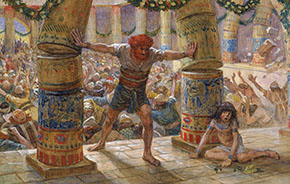
James Tissot's painting of Samson tearing down the pillars of the Philistine temple (1896-1902).
Samson's way of being a Nazirite differs from what is written in . He does not seem to have had any restrictions about not coming near anything dead. In addition, he killed many people, which is not part of a normal Nazirite vow. But he still had God's calling to be a kind of Nazirite, where hair is a symbol of this.]Epilogue – religious apostasy
The Book of Judges ends with two separate stories ( and ). Both begin in the same way: "And it came to pass" (Hebr. vajehi), see . Each story contains a statement: "In those days there was no king in Israel. Everyone did what he thought was right" ( and ). The first part is also repeated in and and frames this entire morally dark period in Israel's history. Here we understand that it is not an earthly king who is referred to; the people had rejected the Lord as their king, see . No chronological order is given, but some observations can be made:
In the first story in chapters 17-18, there are details that connect to the seventh judge, Samson (1,100 pieces of silver, see ; and his hometown of Zorah, see ; ). Samson is the crescendo of the betrayal that the Danites began earlier when they abandoned Joshua's mission and moved north. The event probably takes place before Samson is a judge.
In the second story in chapters 19-21, the only person named is the priest Phinehas, whose father is Eleazar, who was a contemporary of Joshua (; ). This links the story to the time just after the entry into the land.
Even in a chiastic pattern, which is often found in this book, it would be natural for the story to go back in time in this way, with first a story that provides the background to Samson, and then the time just at the entry into Joshua's time.
Idolatry in Dan. An idol in a home
171[The first story recounts how Moses' own grandchildren and descendants set up an entire system of idolatry in Dan. The story has seven episodes, the last three of which are related and become increasingly worse. The first household god is set up by an individual, while the second is set up by an entire tribe!] And it came to pass that there was a man in the hill country of Ephraim whose name was Micah (Hebr. Michajho) [meaning: 'Who is like Yahweh?']. [The hill country of Ephraim stretched from Bethel, north of Jerusalem, up to the plain of Jezreel. Here lay Shiloh, where the tabernacle stood. The name Micah is spelled Michajho in verses 1 and 4, later in and the rest of the chapter the shorter Hebrew form Micha is used. Both names mean "Who is like Yahweh?" The story mentions 1,100 pieces of silver, the same amount that each of the Philistine kings offered Delilah to betray Samson, see .]
2And he said to his mother, "The 100 pieces of silver that were taken from you, and you swore an oath [against the thief; the unusual Hebr. ala is used here], and also said in my ears (he heard her oath). Behold, the silver is with me; I took [stole] it."
His mother replied, "Blessed be my son to the Lord (Yahweh)." [It is strange that she blesses her son who has just confessed to stealing.] 3He returned the 110 silver coins to his mother.
And his mother said, "Separate, I separate [the word qodesh is repeated twice] the silver to the Lord (Yahweh) from my hand to my son, to make a graven image [stone or wood, which was covered with a layer of silver] and a molten image, and now I give it back to you." 4And he gave the silver back to his mother. And his mother took 200 pieces of silver and gave them to the smith, and he made an idol and a cast image, and it was in the house of Micah (Hebr. Michajhos). [The woman does not seem to see any problem with breaking God's commandment in ; ; . There is a similarity here with Ananias and Sapphira, see .] 5And the man Micah (Hebr. Michah; meaning: "who is like God") had a house of God, and he made an ephod [priestly garment, see ] and [some] household gods (figurines – Hebr. teraphim), and he ordained (had his hand filled) one of his own sons, who became his priest. [Filling a hand is part of the ritual performed to set someone apart as a priest. See also ; ; ; . Mic.'s mother does not reappear in the story, and many questions remain. Where is Micha's father? What did the woman do with the remaining 900 silver coins?] 6At that time there was no king in Israel.
Everyone did what he thought was right.The Levites are drawn in
7And there was a young man from Bethlehem in Judah, from the family of Judah, and he was a Levite, and he was staying there. [How could a Levite (a person from the tribe of Levi) come from the tribe of Judah? The reason may be that Levites were adopted into families in order to have their "own" priest. Some examples of this are given here in the Book of Judges, see and .] 8And the man left the city, from Bethlehem in Judah, to stay wherever he could find. [The phrase is ambiguous; was he looking for food, a place to settle, a job, or a place that God would show him?] And he came to the hill country of Ephraim, to Mic.'s house, to shape his path. [The last phrase is also unusual.] 9Mic. asked him, "Where are you from?"
He replied, "I am a Levite from Bethlehem in Judah, and I am going to stay wherever I can find (a place to stay)." 10And Micah (Hebr. Micha) said to him, "Stay with me and be a father and a priest to me, and I will give you ten pieces of silver for each month, and fine clothing, and your sustenance (your survival – Hebr. michja)." And the Levite went (in to him). 11And the Levite was pleased to dwell with the man, and the young man became to him like one of his sons. 12And Micah ordained the Levite (filled his hand), and the young man became a priest to him, and he was in Mic.'s house. 13And Micah said, "Now I know that the Lord (Yahweh) will do good to me, since I have a Levite as a priest."Scouts from Dan on a peaceful mission
181[The following phrase recurs four times in the conclusion of the Book of Judges, see ; ; .] In those days there was no king in Israel. And in those days the Danites [still] sought an inheritance [their own territory] to dwell in, for nothing had been given them to this day as an inheritance among the tribes of Israel.
[Moses had previously blessed Dan and assigned their tribe the area of Bashan, located in the Golan north of the tribe of Naphtali, see . Under Joshua's leadership, the tribe of Dan had been given the area west of Jerusalem towards the Mediterranean Sea between Ephraim and Benjamin, see . However, the Danites do not seem satisfied with their allocation (the area is too "cramped," see ) and want the northern area Moses mentions in his blessing, rather than the lot they received from Josh. This chapter describes how the Danites conquered the northern city of Laish, which was then named Dan.] 2And the sons of Dan sent from their families five men from among them, men who were soldiers, from Zorah [Samson's birthplace and the place where he was also buried, see ; ] and from Eshtaol [it was in the area between these cities in the Lowlands that the Spirit of the Lord began to move upon Samson, see ] to search (scout, spy on) the land and to explore it, and they said to them, "Go and explore the land."
And they came to the hill country of Ephraim, to the house of Mic., and lodged there. 3They were in Mic.'s house and they recognized the voice of the young man, the Levite [], and they went aside there and said to him, "Who brought you here? And what are you doing here? And what do you have here?" [The fact that they recognized the Levite's voice may have had something to do with the fact that he came from their area on the border between Dan and Judah. Perhaps they knew him personally, or perhaps they heard him speaking their own dialect.] 4And he said to them, "Such and such has Micah done for me, and he has hired me, and I am a priest to him." 5And they said to him, "Ask, we pray you, by God (Elohim), and let us know whether our way that we go is good." 6And the priest said to them, "Go in peace (shalom), before the Lord (Yahweh) is your way that you walk in (on).Turning point – the Danites return
7And the five men went on and came to Laish [in the north]. [Hebr. lajish means "full-grown lion." The city is also called Leshem, see . It is located at the foot of Mount Hermon in the northernmost part of Israel. The area is fertile and there is plenty of water from the headwaters of the Jordan River. The city is later named Dan, see . In Moses' blessing over Dan, the wording is that Dan shall be a lion cub leaping forth in Bashan (which is another name for the same area), see .] The [five spies] saw the people who were there, [they] lived securely under the Sidonians' decree (binding legal decision – Hebr. mishpat) [were under their military protection], had peace and security, and no one dishonored them in the land [through any attack, see ; ; ; ; ] and no controlling government (Hebr. etser, found only here) and they were far from the Sidonians, and they had no contact with other people [literally: "no one spoke to them with a man"]. 8And they came to their brothers in Zorah and Eshtaol [in the Lowlands], and their brothers asked them, "What have you ...?" [Here the Hebrew has the concise ma attem. Both the verb and possibly more words are missing. Common phrases could have been "What do you have to tell us?" (cf. ; ) or "What do you recommend we do" (cf. ). The wording shows that either they are so eager to hear what the spies have to say that they ask the shortest possible question, or the spies are so eager to tell that they interrupt before the question has even been asked. Based on the answer in the next verse, the latter is most likely.] 9They answered [immediately], "Get up and let us go up against them, for we have seen the land, and behold, it is very good. And they are quiet, we do not hesitate (Hebr. atsal) to go, to come and inherit the land. 10When we come, we will come to a secure people, and the land is wide open on both the right and the left (literally: 'spacious on both hands'), because God (Elohim) has given it into our hands, a place that no one there needs, all things that [are] in the world (on earth).Dan's spies visit with hostile intent
11And from there they set out from the families of the Danites, from Tsorah and from Eshtaol, 600 men girded with weapons of war. 12And they went up and encamped in Qirjat-Jearim in Judah. Therefore, that place is called Machane-Dan [Dan's encampment] to this day. See, after Qirjat-Jearim. 13And they passed from there through the hill country of Ephraim and came to the house of Mic. 14And the five men who had gone to spy out the land of Laish answered and said to their brethren, "Do you know that in this house there is an ephod [priestly garment, see ] and [some] household gods (figurines – Hebr. teraphim) [] and a carved image and a cast image []? And now, know (consider) what you should do." 15And they went aside there and came to the house of the young man, the Levite, Mic.'s house, and asked him about his shalom (how he was, if all was well). 16And the 600 men girded with their weapons of war stood at the entrance of the gate, those who were from the sons of Dan. 17And the five men who had gone to search (spy on) the land went up and came there and took the carved image and the ephod [the priest's garment] and the household gods (Hebr. teraphim) and the cast image. And the priest stood in the doorway with the 600 men girded with their weapons of war.Mic. loses his Levite
18And they entered Mic.'s house and took the image, the ephod, and the household gods (Hebr. teraphim) and the cast image. And the priest said to them, "What are you doing?" 19And they said to him, "Be quiet! Don't say a word (put your hand over your mouth). Come with us and be our father [advisor, see Judges 17:10; Gen. 45:8] and priest. Is it better for you to be a priest to one man's house or to be a priest to a tribe and to a family in Israel?" 20This made the priest happy (the priest's heart was glad), and he took the ephod and the household gods (Hebr. teraphim) and the graven image and came into the midst of the people. 21And they turned and went and placed the little ones [children] and the livestock and the wealth (Hebr. kevoda) before them [as protection in case they were attacked, see ]. 22They were far from Mic.'s house, and the men who were in the houses that were near Mic.'s house cried out and caught up with the sons of Dan. 23And they called out to the sons of Dan, and they turned (their faces) toward them and said to Micah "What [is missing] to you, that you are crying out?" 24And he said, "You have taken away my god that I made and the priest, and have gone away; what more do I have? And how can you say to me, 'What [is wrong] with you?'" 25But the sons of Dan answered him, "Do not raise your voice among us, or bitter men will come upon your soul (your life), and you will gather your soul and the souls of your house (you and your household will lose your lives)." 26Then the children of Dan continued on their way. And when Micah saw that they were stronger than he, he returned to his house.Idolatry among a tribe
27And they [the Danites] took what Micah had made and the priest he had, and came to Laish, to a people [who] were at ease and secure, and struck them with the edge of the sword and burned the city with fire. 28And there was no rescue because they were far from Sidon and they did not speak to any man, and it was in the valley that is by Beit-Rachov.
And they built the city and lived in it. 29And they named the city Dan, [after] the name of their father Dan, who was born to Israel. But nevertheless (a sharp emphasis and contrast between something that was and something that is – Hebr. olam), Lajish was the name of the city at first. 30And the sons of Dan set up a pillar for themselves, and Jonathan, the son of Gershon, the son of Moses [some manuscripts have "the son of Manasseh"], he and his brothers were priests to the tribe of Dan until the day they went into captivity from the land. [This is the first occurrence of a person named Jonathan, a name that later becomes a common name. It means "Yahweh has given."] 31And they set up the carved image that Micah had made, [during] the entire time that the house of God (Elohim) was in Shiloh. [The Levite introduced in is now named. It comes as a shock to the reader that this idolatrous Levite is the grandson of Moses through his eldest son Gershon, see . The rabbinical writers considered it so degrading that Moses' name should be mentioned in connection with such despicable behavior that they added the letter nun after the first letter mem, so that the Hebr. mosheh became manasheh. Many Hebrew manuscripts have nun written above the name between the first two letters. The Greek translation Septuagint and also the Latin Vulgate have Moses. The problem of syncretism (religious mixing) had affected the entire people, including Moses' family. The earlier comment that already in the first generation after entering the land, people abandoned their faith in the Lord () is now confirmed.]Moral decay
The concubine leaves her home in Ephraim
[The second story in the conclusion of the Book of Judges now begins. The only person named is Phinehas (). The fact that he is the son of Eleazar, who was a contemporary of Joshua (), means that this story takes place early in the period of the judges, one generation after Joshua. The phrase that recurs four times, "In those days there was no king in Israel" (; ; ), is found here, but with a slightly changed word order, where "king" comes before "was" here.] 191And it came to pass in those days, when there was no king in Israel, that a man, a Levite, was staying on the other (far) side of the mountains of Ephraim. He took a woman, a concubine from Bethlehem in Judah. [No person is named, which makes the story more general and applicable. The main character is a Levite—the tribe that had a mission of spiritual leadership. It is not the same person as in the previous story. There are both similarities and contrasts: - The Levite was traveling in the hill country, the same area where another Levite in the previous story had found a home ().
- The direction is reversed – in chapter , a Levite traveled from Bethlehem to the hill country of Ephraim, while here another Levite travels in the opposite direction down to Bethlehem.
- Both stories are about hospitality – in , Micah gives the Levite the title "father" but treats him as his own son. Here, the Levite is a father's son-in-law.
The woman is introduced as a concubine, which immediately makes the reader suspect something sinister based on previous events in , which ended tragically in .] 2And his concubine committed adultery [was angry] against him. She left him and went to her father's house, [south] to Bethlehem in Judah. There she stayed for four months. [The Hebrew wording is unusual with "against him"; the Greek translation Septuagint translates it as "she became angry with him." In the Aramaic interpretation Targum, from the Second Temple period, it is mentioned that she "rejected him." Since the Books of Moses do not mention a woman divorcing her husband, the unusual wording here may be a way of describing how she leaves him, which would then fall under the category of infidelity (even though she has not been unfaithful with another man). What is clear is that something causes a marital crisis and she leaves him and returns to her family. After four months, the man takes the initiative to try to get her back, and he is welcomed by both the woman and her father.]Positive negotiations
3And her husband got up and went after her to speak to her heart [in the hope of winning her back]. He took his young servant (a young servant – Hebr. naar) and a pair of donkeys with him. And she brought him into her father's house, and the young woman's (Hebr. naarah) [here the feminine form of naar is used] father saw him and was glad to meet him. 4And his father-in-law, the young woman's father, strengthened him, and he stayed with him three days, and they ate and drank and lodged there.Hospitality in Bethlehem
5And it came to pass on the fourth day that they rose early in the morning, and he arose to depart, but the young woman's father said to his son-in-law, "Fortify your heart [with] a piece of bread, and then [you may] go." 6And they sat down and ate together, and they drank. And the young woman's father said to the man, "Please be satisfied, I beg you, and stay overnight and let your heart be well." 7But the man got up [later on the fourth day] to leave, but his father-in-law pressed him, and he stayed and spent the night there. 8And he rose in the morning on the fifth day and got up to leave, but the young woman's father said, "Strengthen your heart, I beg you, and stay until the day wanes (it becomes afternoon)." And they both ate. 9And the man got up to leave, he and his concubine and his young man, and his father-in-law, the young woman's father, said to him, "Look, I beg you, the day is drawing to a close, stay, I beg you, look, make camp today, stay here and let your heart be well, and get up tomorrow and go on your way to your tent."Turning point – the Levite turns back
10But the man was not willing to spend the night [another night, but prepared himself in the afternoon of the sixth day], so he got up and went up to Jebos (Jebus), that is [the former name of the city] Jerusalem. He had a pair of saddled donkeys with him, and his concubine was with him. [His male servants were also with him on the return journey, see verses 3 and 11.] 11They were at Jebus and it was late in the day [literally: "the day had gone down a lot," may refer to the sun being almost down].
The young man said to his master, "Come, I beg you, let us stop at the city of the Jebusites and spend the night there!" 12His master replied, "No, we will not stop in a foreign city where there are no Israelites. We will continue [north] toward Gibeah." 13And he said to his young man, "Let us approach one of the places and let us spend the night in Gibeah or in Ramah." [These two cities are a few kilometers apart, barely a mile north of Jerusalem.]Unfriendliness in Gibeah
14So they passed [Jerusalem] and went on. The sun went down when they were at Gibeah, which belongs to Benjamin. 15And they turned aside from the road and went into Gibeah to spend the night there. And he went in and sat down in the open square of the city [visible to all]. But no man took them into his house to spend the night. [; ] [In contrast to the friendly reception in Bethlehem, no one in Gibeah shows hospitality. It was traditional to offer lodging to passersby, especially fellow countrymen.] 16And behold, in the evening, an old man came in from his work in the field. The man was from the hill country of Ephraim, and he was staying in Gibeah, but the men of the place were the sons of Benjamin. 17And he lifted up his eyes and saw the traveler in the open place (the square) of the city, and the old man said, "Where are you going, and where do you come from?" 18And he said to him, "We are passing from Bethlehem in Judah to the other side of the mountains of Ephraim, from whence I am, and I went to Bethlehem in Judah, and now I am going to the house of the Lord (Yahweh), but no man takes (invites) me into his house. 19And also hay and also fodder for our donkeys and also bread and wine are available for me and for your servant woman and for the young man who is with your servant. [There is] no need, all things [are available]." 20And the old man said, "Shalom to you, let all your needs rest on me, just don't stay in the open place (the square)." 21And he brought him into his house and gave the donkeys fodder, and they washed their feet and ate and drank.Terrible negotiations for the woman
22They had a good time and felt well (literally: 'made their hearts glad'), but behold, the men of the city, the men of Belial [literally: the worthless, but also a Jewish name for Satan], surrounded the house and pounded on the door, and they said to the man, the master of the house, to the old man they said: "Bring out the man who came to your house, and let us know him (have sexual intercourse with him)." 23But the man, the master of the house, went out to them and said to them, "No, my brothers, do not do this evil thing, I beg you. After this man came to my house, you must not do this folly. [There are similarities here with how Lot acted, see .] 24Behold, my daughter, the virgin, and his concubine, I will bring out to you, I beg you, and with them you may do what is good in your eyes, but to this man you shall not do such evil." 25But the men did not listen to him, and the man took his concubine and brought her out to them, and they knew (had sexual intercourse with) her and violated (abused) her all night until morning, and when the day dawned, they sent her away. 26And the woman came at dawn and fell down at the door of the man's house where her master was (and lay there) until it was light.The concubine is brought back to Ephraim dead
27And her master rose in the morning and opened the door of the house and went on his way, and behold, the woman, his concubine, had fallen down at the door of the house with her hands on the threshold. 28And he said to her, "Get up, and let us go," but she did not answer. And he lifted her onto the donkey, and the man got up and went to his place. 29And he came to his house and took the knife and took a strong (firm) hold of his concubine and cut her into twelve pieces and sent her throughout the territory of Israel. 30And it came to pass, that all who saw it said, "Such a thing has not been done or seen from the day the sons of Israel came out of the land of Egypt to this day." [The purpose of the man's action was to mobilize the military by shocking and creating fear. There is a striking parallel between and verses 29-30.] Think of her (put yourself in her situation)!
Consider!
Speak! [The Hebrew is strange here and changes pronouns. Some put the last words in the mouths of those who received the macabre shipment, but it is more likely that the author is doing something very unusual here and speaking directly to the reader. This event is horrific, and the author asks the reader to carefully read what follows. There are several details that must be pointed out. It never says that the woman is dead before the man dismembers her; there is some uncertainty here. When the man then recounts the event, the focus is on the fact that they were after him; he omits the detail that it was he who handed her over to save his own life, cf. ; .]The war against the Benjaminites
201And all the sons of Israel went out, and the congregation gathered as one man from Dan and Beer-Sheva and the land of Gilead to the Lord (Yahweh) at Mizpah. 2And the leaders (literally "corners," cf. "cornerstone" – Hebr. pinot) of all the people, all the tribes of Israel, stood assembled [as] the people of God (Elohim), 400,000 men on foot who draw the sword. 3And the sons of Benjamin heard that the sons of Israel had gone up to Mizpah, and the sons of Israel said, "Tell us how this evil could happen (take place)?" 4And the Levite, the husband of the woman who was murdered, answered and said, "I came to Gibeah, which belongs to Benjamin, with my concubine to spend the night. 5And the men of Gibeah rose up against me and surrounded the house around me at night, intending to kill me, and they defiled my concubine, and she is dead. 6And I took my concubine and cut her into pieces and sent her throughout the land of Israel's inheritance, because this disgrace and folly has been done in Israel. 7See, all you sons of Israel, give them a word and advice here." 8And all the people rose up as one man and said, "No man will go to his tent, and no man will turn aside to his house. 9But now this is what we will do to Gibeah: [draw lots] over him. 10And we will take 10 out of 100 men from all the tribes of Israel, and 100 out of 1,000, and 1,000 out of 10,000, to bring provisions for the people, to do (act, deal), when they come to Gibeah in Benjamin, after all the folly that has been done in Israel." 11And all the men of Israel gathered against the city, united as one man. 12And the tribes of Israel sent men to the whole tribe of Benjamin, saying, "What evil is this that has been done among you? 13Now therefore, deliver up the men, the sons of Belial [literally: the worthless, but also a Jewish name for Satan], who are in Gibeah, that we may put them to death and remove the evil from Israel." [Belial is also mentioned in .]
But the sons of Benjamin did not listen to the voice of their brothers, the sons of Israel. 14And the sons of Benjamin gathered from their cities to Gibeah, to go out to battle against the sons of Israel. 15And the sons of Benjamin mustered that day from the cities 26,000 men who drew swords, besides the inhabitants of Gibeah, who mustered 700 chosen men. 16Of all these people, 700 were left-handed men, [with] their right hand able to sling a stone and hit a hair [with hair-fine precision] and not miss (Hebr. chata). [The word for miss is the same word that is otherwise translated as sin, see .] 17And the men of Israel mustered [together], except Benjamin, 400,000 men who draw swords. All these were warriors. 18And they arose and went up to Bethel, and they inquired of God (Elohim), and the sons of Israel said, "Who among us shall go up first to fight against the sons of Benjamin?" The Lord (Yahweh) answered, "Judah first." [This is one of several examples in the Bible where Judah is to go first.] 19The next morning, the sons of Israel rose up and encamped at Gibeah. 20And the men of Israel went out to battle against Benjamin, and the men of Israel drew up in battle array at Gibeah. 21And the sons of Benjamin went out from Gibeah and struck down 22,000 men of Israel that day. 22And the men of Israel gathered their strength (became brave) and prepared for battle again in the place where they had arrayed themselves on the first day. 23And the sons of Israel went up and wept before the Lord (Yahweh) until evening, and they asked the Lord (Yahweh), saying, "Shall we again go out and fight against the sons of our brother Benjamin?"
The Lord (Yahweh) answered, "Go up against him." 24And the sons of Israel came near to the sons of Benjamin on the second day. 25And Benjamin went out to meet them from Gibeah on the second day. They struck down the sons of Israel, 18,000 men, all of them with drawn swords. 26And all the sons of Israel and all the people went up and came to Bethel and wept, and they sat there before the Lord (Yahweh) and fasted until evening. And they offered burnt offerings and peace offerings before the Lord (Yahweh). 27And the sons of Israel asked the Lord (Yahweh), and there was the ark of the covenant of God (Elohim) in those days. 28And Phinehas, the son of Eleazar, the son of Aaron, stood before it in those days and said, "Shall I go out again to battle against the sons of Benjamin, my brother, or shall I cease?" The Lord answered, "Go up, for tomorrow I will give him into your hand." 29And Israel set an ambush around Gibeah. 30And the sons of Israel went up against the sons of Benjamin on the third day and drew up in battle array against Gibeah as on the other days. 31And the sons of Benjamin went out to meet the people, and they were drawn away from the city, and they began to strike down the people and kill them as before, by the main road that goes up to Bethel and another to Givata through the field, about 30 men of Israel. 32And the sons of Benjamin said, "They are being struck down before us as before." But the sons of Israel said, "Let us flee and draw them away from the city to the main roads." 33And all the men of Israel rose up from their places and stood in battle array at Baal-Tamar [the name means Lord of the Dates]. And the ambush of Israel came out from their places, from Maare-Geva. 34And they came from the south to Gibeah, 10,000 men chosen from all Israel, and they fought intensely (literally: "the battle was heavy"), but they did not know that evil was about to come upon them. 35And the Lord (Yahweh) smote Benjamin before the face of Israel, and the sons of Israel destroyed in Benjamin that day 25,100 men, all of them drew the sword. 36And the sons of Benjamin saw that they were defeated.
And the men of Israel gave Benjamin room, because they trusted in those who lay in ambush whom they had placed at Gibeah. 37And those who were lying in ambush hurried to rush to Gibeah, and they came out and struck the whole city with the edge of the sword. 38And there was an agreed sign between the men of Israel and those who were lying in ambush, that they should make a great torch of smoke rising above the city. 39And the men of Israel turned in the battle, and Benjamin began to smite and kill the men of Israel, about thirty men, for they said, "They will surely be beaten down before us as in the first battle." 40But when the torch began to rise like a pillar of smoke from the city, the Benjaminites looked behind them and saw that the whole city was rising in smoke to the heavens. 41And the men of Israel turned back, and the men of Benjamin were terrified, for they saw that disaster was coming upon them. 42And they turned before the men of Israel toward the desert road, and the battle overtook them, and those from the city were destroyed in its midst. 43They surrounded Benjamin, pursued them, and set foot on their resting place as far as Gibeah to the east (from the sunrise). 44And from Benjamin fell 18,000 men, all of them warriors. 45And they turned and fled toward the wilderness to the rock of Rimmon, and their after-harvest (Hebr. alal) in the main roads [was] 5,000 men [the word is normally used for harvest, see ; here meaning "to cut down the last ones"] and they caught up with them as far as Gidom and struck down 2,000 men there. 46And all the fallen of Benjamin were 25,000 men who drew the sword that day, all of them warriors. 47But they turned and fled toward the wilderness to the rock of Rimmon, 600 men, and they stayed at the rock of Rimmon for four months. 48And the men of Israel returned to the sons of Benjamin and struck them with the edge of the sword—all (everything in—Hebr. metom) the cities [all the people, men, women, and children] as far as [all] the livestock, everything they found. They also set fire to all the cities they found. [It became a "holy war" with complete destruction (Hebr. charam) of both people and animals, see ; ; . This terrible revenge against their own brother people, which extended from Gibeah to the entire territory of Benjamin, was an impulsive act carried out in the heat of the moment.]The tribe of Benjamin is preserved
[A total of 25,000 men from the tribe of Benjamin had been killed, along with all the women and children; only 600 men had fled and were still alive. All this had happened based on an emotional decision when the Levite from Ephraim sent out the twelve mutilated parts of his wife, who had been raped by the Benjaminites in Gibeah. Out of hatred, all eleven tribes now felt compassion for the Benjaminites, who were about to be exterminated. Jacob's fear several hundred years earlier had come true, see .] 211And the men of Israel had made a [hasty] oath at Mizpah, saying, "None of us shall give his daughter to Benjamin as a wife." [In connection with the meeting at Mizpah () when it was decided to take revenge on the Benjaminites in Gibeah, an oath had also been taken. See also where Jephthah took a rash oath, see .] 2And the people came to Bethel [or "God's house," which was Shiloh] and sat there before God (Elohim) until evening, and they lifted up their voices and wept bitterly. 3And they said, "Why, Lord (Yahweh), God of Israel (Elohim), has this happened in Israel? That today there is a tribe missing (lacking) in Israel?" [The reader would have wished that the sorrow was over Israel's sin. Previously, they had wept over wounded pride (), but now it is a sentimental sorrow over a lost tribe, see verses 6 and 15. The question "why" here is more of an accusation against God than an honest question.] 4And it came to pass on the morrow, that the people rose up early, and built an altar there, and offered burnt offerings [] and peace offerings []. 5And the sons of Israel said, "Who is there that did not come up in the assembly of all the tribes of Israel to the Lord (Yahweh)?" for they had made a great oath concerning him who did not come up to the Lord (Yahweh) at Mizpah, saying, "He shall surely be put to death." 6And the sons of Israel repented (literally comforted) over Benjamin, their brother, and said, "There is a tribe that has been cut off from Israel today. 7What shall we do for them to give them [who remain] wives, since we have sworn by the Lord (Yahweh) that we will not give them our daughters as wives?" 8And they said, "Is there anyone from the tribes of Israel who has not come to the Lord (Yahweh) at Mizpah?" And behold, not a man from the camp of Jabesh-Gilead came to the assembly. 9And the people were mustered (counted), and behold, there was not a man from the inhabitants of Jabesh-Gilead. 10And the assembly sent 12,000 men from among the soldiers and commanded them, saying, "Go and strike them, the inhabitants of Jabesh-Gilead, with the edge of the sword, and the women and the little ones. 11And this thing that you shall do, every man and every woman who has shared a bed [had sexual intercourse] with a man shall be destroyed." 12And they found among the inhabitants of Jabesh-Gilead 400 young virgins who had not known a man by lying in his bed. And they brought them to the camp at Shiloh, which is in the land of Canaan. 13And the whole assembly sent and spoke to the sons of Benjamin who were at the rock of Rimmon and proclaimed peace (shalom) to them. 14And Benjamin returned at that time, and they gave them the women whom they had saved from Jabesh-Gilead, but they were not enough for them (there were too few). [There were a total of 600 Benjaminites (), so 200 remained who had not received a wife.] 15And the people felt sorry for Benjamin because the Lord (Yahweh) had made a breach (a gap, a hole) in the tribes of Israel. 16And the elders of the congregation said, "What shall we do to provide (literally, to remain) women, since the women are missing (are destroyed, exterminated) from Benjamin?" 17And they said, "Those who have fled must become an inheritance to Benjamin. So that a tribe is not exterminated from Israel. 18But we cannot give them wives from our daughters." For the sons of Israel had sworn an oath, saying, "Cursed be he who gives a wife to Benjamin." [Of the 600 Benjaminites who had fled, there were still 200 who had not received wives. The elders discussed how they could keep their rash promise and help the Benjaminites to continue to exist. This leads to yet another ungodly plan involving the kidnapping of young women. The festival in Shiloh is described vaguely; the only festival with dancing is Sukkot, but it is more likely a Canaanite fertility festival to celebrate the autumn grape harvest. The vague description of the festival also indicates the godlessness that prevailed at this time.] 19And they said, "Behold, there is an annual (day of days) feast of the Lord (Yahweh) in Shiloh—which is north of Bethel, east (sunrise) of the main road that goes up from Bethel (to) Shechem, and south of Levona." 20And they commanded the sons of Benjamin [the 200 who lacked wives], saying, "Go and lie in wait in the vineyards, 21and keep watch. When you see the daughters of Shiloh come out to dance in the festival (in the dances), then come out of the vineyards. Each one of you shall seize (capture) a wife from among the daughters of Shiloh, and then go home to the land of Benjamin. 22And it shall come to pass, because their fathers or their brothers come to contend with us, that we will say to them, 'Be gracious (give them undeserved love—Hebr. chanan) to them, because we did not take to them [the Benjaminites] every man a wife in the battle. Nor did you give to them, so that you would now be guilty [and break the oath, see ].'" 23And the sons of Benjamin did so and took wives according to their number from among those who danced whom they had taken with them. [In total, 200 young women were abducted, see ; .] And they went and returned to their inheritance and built cities and lived in them. 24And the sons of Israel returned from there at that time, every man to his tribe and to his family. And they went from there, every man to his inheritance. 25At that time there was no king in Israel.
Everyone did what he thought was right.


