First Kings
Solomon's path to power
David's declining health
11King David was now old and advanced in years (had reached old age), and they covered him with blankets, but he could not get warm. [David was in his 70s, see ] 2Therefore his servants said to him, "Let a young virgin be sought for my lord the king, and let her be before the king and be a nurse to him, and let her lie in your arms so that my lord the king may be warm." 3So they searched throughout Israel for a young woman (Hebr. naarah) and found Abishag the Shunammite, and brought her to the king. [Avishag was from the city of Shunem in the valley of Jezreel near Mount Gilboa; the woman in the Song of Songs is also from Shunem, see Song of Songs 6:13.] 4And the young woman was very beautiful, and she became a companion to the king and served him, but the king had no intimate relationship with her.Adonijah's attempt to become king
5And Adonijah (Hebr. adónijah), the son of Haggith, exalted himself and said, "I will be king." And he prepared chariots (several horse-drawn carriages – Hebr. rechev) and horsemen and 50 men to run [as bodyguards/soldiers] before him. [He prepared a royal procession through the city for his coronation as king. His older brother Avshalom had done similarly when he took power, see . At that time, there was one chariot; Adonijah had several horse-drawn chariots. Adonijah broke with the tradition of allowing God to choose the king of Israel and then confirming this choice through the prophetic ministry. Neither Saul nor David had sought the throne themselves, see ; . Now follow three reasons for his arrogance:] 6His father [David] had never rebuked him [by reprimanding him] in all his days, asking, "Why are you doing this?"
He was also handsome
and was born after Absalom [, ]. [David had been an absent father, see ; ; . Adonijah was more focused on outward appearance than on character, see . Adonijah was the oldest son alive, so he assumed he would be entitled to the throne.] 7So he consulted with [David's army commander] Joab, the son of Zeruiah, and with the priest Abiathar, and they supported Adonijah [took his side]. 8But Zadok the priest [David's second high priest, see ; ] and [the commander of David's bodyguard] Benaiah, the son of Jehoiada, and the prophet Nathan, and Shimei, and Rei, and the mighty men (Hebr. gever) who belonged to David, did not side with Adonijah. 9And Adonijah slaughtered sheep and oxen and fattened cattle at the stone of Zoheleth, which is beside Ein-Rogel [a spring just south of the Gihon Spring in the Kidron Valley, on the border between Benjamin and Judah], and he called all his brothers, the king's sons, and all the men of Judah, the king's servants. [Adonijah follows the same pattern as his brother Absalom did in his coup, see .] 10But he did not call the prophet Nathan, Benaiah, the mighty men ["David's veterans" who had supported him before his time as king], or his [younger] brother Solomon.Solomon becomes king
11Then [the prophet] Nathan spoke to [David's wife] Bathsheba, Solomon's mother, and said, "Have you not heard that Adonijah, the son of Haggith, is reigning (has made himself king), and David, our lord (Hebr. adón), does not know it? 12And now, let me give you advice, I beg you (appeal), so that you may save your own life and the life of your son Solomon. 13Go in to King David and say to him, 'Did you not, my lord the king, swear (take an oath) to your servant and say, "Surely your son Solomon shall reign after me, and he shall sit on my throne"? Why then is Adonijah reigning? 14Behold, while you are still speaking there with the king, I will also come in after you and confirm your words." 15So Bathsheba went to the king into the chamber [where David was lying]. Now the king was very old, and Avishag, the Shunammite, was attending the king. 16Bathsheba bowed before the king. The king [David] asked, "What do you want?" 17She said to him, "My lord, you swore (gave your oath) by the Lord your God (Yahweh Elohim) to your servant, 'Surely your son Solomon shall reign after me, and he shall sit on my throne. 18And now, behold, Adonijah reigns, and you, my lord the king, do not know it. 19And he has slaughtered oxen and fattened cattle and sheep in abundance, and has invited all the king's sons and the priest Abiathar and Joab, the commander of the army, but Solomon, your servant, he has not invited. 20And you, my lord the king, all Israel is looking to you to tell them who will sit on my lord's throne, the king after him. 21Otherwise, when my lord sleeps with his fathers, I and my son will be counted as lawbreakers." 22And while she was still speaking to the king, the prophet Nathan arrived. 23And they told the king, saying, "Behold, Nathan the prophet." And when he came before the king, he bowed down before the king with his face to the ground. 24And Nathan said, "My lord the king, have you said, 'Adonijah shall reign after me, and he shall sit on my throne'? 25For he has gone down today and has slaughtered oxen and fattened cattle and sheep in abundance, and has called all the king's sons and the commanders of the army and Abiathar the priest, and behold, they are eating and drinking before him and saying, 'Long live King Adonijah. 26But me, your servant, and Zadok the priest, and Benaiah the son of Jehoiada, and your servant Solomon, he has not called. 27Has my lord the king done this thing without telling your servant who shall sit on the throne of my lord the king after you?" 28And King David answered and said, "Call Bathsheba to me." And she came into the king's presence and stood before the king. 29And the king swore and said, "As the Lord (Yahweh) lives, who has delivered my soul out of all adversity, 30I have truly (indeed) sworn to you by the Lord (Yahweh), the God (Elohim) of Israel, saying, 'Surely your son Solomon shall reign after me, and he shall sit on my throne in my place,' I will do this today." 31And Bathsheba bowed with her face to the ground and humbled herself before the king and said, "May my lord King David live forever." 32And King David said [in a series of clear instructions, the elderly David regains the energy to make the necessary preparations so that Solomon can be anointed king]: "Call to me Zadok the priest [who can anoint a new king], and Nathan the prophet, and Benaiah the son of Jehoiada." And they came before the king. 33And the king said to them, "Take your lord's servants and let my son Solomon ride on my own mule and bring him down to Gihon [the spring on the east side of Jerusalem]. 34And let Zadok the priest and Nathan the prophet anoint him there as king over Israel, and blow the trumpet and say, 'Long live King Solomon. 35Then you shall come up after him, and he shall come and sit on my throne, for he shall be king in my place, and I have appointed him to be prince over Israel and over Judah. 36And Benaiah, the son of Jehoiada, answered the king and said, "Amen, so says the Lord (Yahweh) God (Elohim), my lord the king (Adonai). 37As the Lord (Yahweh) has been with my lord the king, so may he be with Solomon and make his throne greater than the throne of my lord King David." 38Then Zadok the priest, Nathan the prophet, Benaiah the son of Jehoiada, the Kerethites, and the Pelethites went down and had Solomon ride on King David's mule and brought him to Gihon [the spring on the east side of Jerusalem]. 39And Zadok the priest took the horn of oil from the tent and anointed Solomon. And they blew the shofar, and all the people said, "Long live King Solomon." 40And all the people went up after him, and the people blew trumpets and rejoiced greatly, so that the earth cracked (broke apart, split) with the sound of them. 41And Adonijah and all his guests who were with him heard it when they had finished eating. And when Joab heard the sound of the trumpet, he said, "Why does it sound like the city is in an uproar?" 42While he was still speaking, behold, Jonathan, the son of Abiathar the priest, came, and Adonijah said, "Come, for you are an honest man, and give us good news." 43And Jonathan answered and said, "Truly, our lord King David has made Solomon king. 44And the king has sent with him Zadok the priest, and Nathan the prophet, and Benaiah the son of Jehoiada, and the Cherethites and the Pelethites, and they have made him ride on the king's mule. 45And Zadok the priest and Nathan the prophet have anointed him king at Gihon [the spring on the east side of Jerusalem], and they are coming up from there with such great joy that the city is in an uproar. This is the noise you hear. 46And Solomon also sits on the throne of the kingdom. 47And besides, the king's servants came and blessed our lord King David, saying, 'God (Elohim) will make Solomon's name even greater (better) than your name and make his throne mightier than your throne,' and the king bowed down on his bed. 48And the king [David] also said, 'Blessed be the Lord (Yahweh), the God (Elohim) of Israel, who has given someone to sit on my throne today, and my eyes get to see it.'" [Jonathan's report here in verses 43-48 is written from the perspective of someone who was there and saw and heard what happened.] 49And all Adonijah's guests were afraid (panicked) and rose and went each his way. 50And Adonijah feared Solomon and rose up and went and took hold of the horns of the altar. 51And it was told to Solomon, saying, "Behold, Adonijah fears King Solomon, for he has taken hold of the horns of the altar, saying, 'Let King Solomon swear to me that he will not slay his servant with the sword. 52And Solomon said, "If he proves to be a righteous man, not a hair of his head shall fall to the ground, but if wickedness is found in him, he shall die." 53And King Solomon sent [soldiers], and they brought him [Adonijah] down from the altar, and he came and humbled himself before King Solomon. And Solomon said to him, "Go to your house."David's advice to Solomon
21When the days of David's death drew near, he gave Solomon the following instructions and said: 2"I am walking (now taking the next step) on the path that all [of us here] in the world must walk. [Poetic expression to describe how everything here on earth dies, see also .] Therefore, be strong (firm, confident, brave) and show yourself to be a man [], 3and be careful to keep (guard, protect, preserve) the ways of the Lord (Yahweh) your God (Elohim) so that you walk in them to keep (guard, protect, preserve) his statutes (literally "things engraved"), his commandments (clear commands), his statutes (binding legal decisions), and his ordinances (testimonies, God's fundamental rules) in accordance with everything written in the teaching of Moses, so that you may prosper in all that you do and wherever you turn, 4so that the Lord (Yahweh) may confirm (ratify) his word that he has spoken about me, saying, "If your sons watch over their ways [live as I teach them] and walk before me in truth with all their heart and with all their soul, he promises that there will be no successor [from your line] on the throne of Israel. [, ] 5And you [Solomon] also know what Joab, the son of Zeruiah, did to me—how he struck down (killed) two of Israel's commanders, Abner, the son of Ner [], and Amasa, the son of Jether []. In times of peace, he struck them down as if in battle; when he shed their blood as in battle, he stained his belt around his hips and his sandals on his feet. [The words used for belt and sandals in this verse are never used in war (), which reinforces that the killing did not take place in a battle context.] 6Therefore, act according to your wisdom and do not let his gray hair go down to Sheol (the grave, the underworld, the place of the dead) in peace (shalom). 7But show mercy (loving kindness – Hebr. chesed) to the sons of Barzillai the Gileadite, and let them be among those who eat at your table, for they came to me when I fled from your brother Absalom. 8And behold, there is with you Shimei, the son of Gera, the Benjaminite from Bahurim, who cursed me with a grievous curse on the day I went to Mahanaim [], but he came down and met me at the Jordan, and I swore to him by the Lord (Yahweh), saying, 'I will surely kill you with the sword.' [] 9And now, do not let him be innocent, for you are a wise man and you know what to do to him, and you shall bring down his gray hair to Sheol (the grave, the underworld, the place of the dead) with blood."David's death
10So David rested with his fathers and was buried in the City of David. [Where his tomb remained even in Jesus' time, see Acts 2:29.] 11And the days that David reigned over Israel were 40 years:
7 years he reigned in Hebron (Hebr. Chevrón) [when he reigned over Judah]
and 33 years he reigned in Jerusalem.
12And Solomon sat on the throne of his father David, and his kingdom was made very stable (fully established). [Literally: "made his kingdom very stable," there were no internal or external conflicts, so the kingdom could take shape and be established. The same phrase without the word "very" recurs in .]Solomon's early years of reign
13And Adonijah, the son of Haggith, came to Bathsheba, Solomon's mother, and she said, "Do you come in peace?"
And he said, "Peace." [Here Bathsheba uses the word shalom in the definite form, and Adonijah responds with shalom in the indefinite form.] 14He said, "I have something to say to you."
And she said, "Speak." 15And he said, "You know that the kingdom was mine and that all Israel lifted up their faces to me to reign. But the kingdom has been changed and has become my brother's, for from the Lord (Yahweh) it is his. [] 16And now I have a request to make of you—do not turn away my face."
She replied, "Speak." 17And he said, "Speak, I pray thee, to Solomon the king—for he will not turn away his face from thee—that he give me Abishag the Shunammite to be my wife." [] 18And Bathsheba said, "Good, I will speak on your behalf to the king." 19And Bathsheba went to King Solomon to speak to him on behalf of Adonijah. And the king rose and bowed down to her, and sat on his throne, and had a throne set for the king's mother, and she sat on his right hand. 20Then she said, "I have one small request to make of you; do not refuse me." The king replied, "Ask me, and I will not refuse you." 21And she said, "Let Abishag the Shunammite be given to Adonijah your brother as his wife." 22And King Solomon answered his mother and said, "Why do you ask for Abishag the Shunammite for Adonijah? Ask for the kingdom for him also, for he is my older brother, and for him and for Abiathar the priest and for Joab the son of Zeruiah." 23And King Solomon swore by the Lord (Yahweh), saying, "May God (Elohim) do so to me and more, if Adonijah has not spoken these words against his own soul. 24And now, as the Lord (Yahweh) lives, who has established me and set me on the throne of my father David, and who has made me a house as he promised, Adonijah shall be put to death today." [] 25And King Solomon sent by the hand of Benaiah the son of Jehoiada, and he came upon him so that he died. 26And to Abiathar the priest the king said, "Go to Anathoth, to your own fields, for you deserve to die, but I will not put you to death this time, because you carried the ark of the Lord (Yahweh) God (Elohim) before my father David and because you were afflicted with all that afflicted my father David." 27And Solomon dismissed (expelled) Abiathar from being a priest of the Lord (Yahweh), so that the word of the Lord (Yahweh) might be fulfilled, as he had spoken concerning the house of Eli in Shiloh. [] 28And the report came to Joab, for Joab had followed Adonijah, but had not followed Absalom. And Joab fled to the tent of the Lord (Yahweh) and took hold of the horns of the altar. 29And it was told Solomon, "Joab has fled to the tent of the Lord (Yahweh), and behold, he is by the altar." And Solomon sent Benaiah, the son of Jehoiada, saying, "Fall upon him (kill him)." 30And Benaiah came to the tent of the Lord (Yahweh) and said to him, "Thus says the king: Come out." But he replied, "No, I will die here." And Benaiah reported this to the king, saying, "Thus spoke Joab, and thus he answered me." 31And the king said to him, "Do as he has spoken, and fall upon him and kill him, and bury him, that you may take away the blood that Joab shed without cause from me and from my father's house. 32And the Lord (Yahweh) will return his blood upon his own head, because he struck down two men who were more righteous and better than he, and he killed them with the sword, and my father David did not know it. Abner, the son of Ner, commander of Israel [], and Amasa, the son of Jether, commander of Judah []. 33So their blood shall return upon Joab's head and upon the head of his seed forever. But to David and to his seed and to his house and to his throne, there shall be peace (shalom) forever from the Lord (Yahweh)." 34And Benaiah, the son of Jehoiada, went up and came upon him (met him, to kill him – Hebr. parag) and struck him, and he was buried in his own house in the wilderness. 35And the king appointed Benaiah, the son of Jehoiada, in his place over the army, and Zadok the priest in the place of Abiathar. 36And the king sent and called for Shimei, and said to him, "Build yourself a house in Jerusalem and live there, and do not go anywhere else. 37For on the day you go out and cross the Kidron Valley, you shall surely die; your blood shall be on your own head." 38And Shimei said to the king, "Your prov is good, as my lord the king has spoken, so shall your servant do." And Shimei lived in Jerusalem many days. 39And it came to pass, when three years had passed, that two of Shimei's servants ran away to Achish, the son of Maacah, king of Gath. And they told Shimei, saying, "Behold, your servants are in Gath." 40And Shimi arose and saddled his donkey and went to Gath, to Achish, to seek his servants, and Shimi went and brought back his servants from Gath. 41And it was told Solomon that Shimei had gone from Jerusalem to Gath and had returned. 42And the king sent and called for Shimei and said to him, "Did I not make you swear by the Lord (Yahweh) and warn you, saying, 'Know for certain that the day you go out and wander away, you shall surely die'? And you said to me, 'Your words are good; I have heard them. 43Why then have you not kept the oath of the Lord (Yahweh) and the commandment (Hebr. mitzvot) that I commanded (Hebr. tsavah) you?" 44And the king said to Shimei, "You know well all the evil that your heart has acknowledged, which you did to my father David; therefore the Lord (Yahweh) will bring back evil upon your own head. 45But King Solomon shall be blessed, and David's throne shall be established before the Lord (Yahweh) forever." 46And the king commanded Benaiah, the son of Jehoiada, and he went out and fell upon him (killed him) so that he died. And the kingdom was established (formed) in Solomon's hand.Solomon's reign
Marriage to an Egyptian princess
31And Solomon made an alliance with Pharaoh, king of Egypt, through marriage, and took Pharaoh's daughter and brought her to the city of David, until he had finished building his house and the house of the Lord (Yahweh) and the wall around Jerusalem. 2But the people sacrificed [to God] on the high places, because no house had been built for the name of the Lord (Yahweh) until those days. 3And Solomon loved the Lord (Yahweh) and walked in the statutes (literally "things engraved") of his father David, except that he sacrificed in the high places.Solomon asks for wisdom – receives prosperity and wisdom
4And the king went to Gibeon and offered there, for that was the great high place. Solomon offered a thousand burnt offerings on the altar. 5At Gibeon [ten miles northwest of Jerusalem, where the largest sacrificial mound in the land was located before the temple was completed], the Lord appeared to Solomon in a dream at night [the same day he sacrificed there, see ].
God said, "Ask for whatever you want, and I will give it to you." 6Solomon replied, "You have already shown great kindness (caring love, faithfulness—Hebr. chesed) to your servant, my father David, because he walked before you in truth, in righteousness, and with an honest heart [all the days of his life]. You have continued to show him this great kindness (loving-kindness, faithfulness) by giving him a son who now reigns on his throne. 7Lord (Yahweh) my God (Elohim), you have now made your servant king after my father David. I am only a child [Solomon is about 20 years old, but the expression refers to being inexperienced and under training], I do not know how to go out (begin) or come in (end) [lead as king]. 8Your servant is here among your people whom you have chosen, a great people, so numerous and countless that they cannot be counted. 9So give your servant a heart that hears (understands, listens) [a responsive mind], to judge your people, so that I may distinguish between good and evil. For who else could judge [be a judge and rule over] this great people of yours?" 10That Solomon asked for this (had asked about this matter) was pleasing to the Lord (was good in the eyes of Adonai), 11and God (Elohim) said to him, "Because you have asked for this and not for a long life or for riches or for the lives of your enemies, but for understanding what is right, 12I will do as you wish. I will give you a wise and understanding heart, so that there has never been and never will be anyone like you. 13I will also give you what you have not asked for—wealth and honor (good reputation). There will be no other king like you during your lifetime. 14If you walk in my ways and keep my statutes (literally, "things engraved") and commandments (clear commands), as your father David did, then I will also add days to your life." 15And Solomon awoke, and behold, it was a dream, and he came to Jerusalem and stood before the ark of the covenant of the Lord (Yahweh) and offered burnt offerings and peace offerings and made a feast for all his servants.Two women—Solomon's wisdom to judge
16At that time, two prostitutes came to the king and stood before him. 17The first woman said, "Hear me, my lord. I and this woman live in the same house, and I bore a child in her house. 18Three days after I gave birth to my child, this woman also gave birth to a child. We were alone; no one else was with us in the house, just the two of us. [So there are no witnesses.] 19One night, this woman's son died because she lay on (rolled over) him. 20Then she got up in the middle of the night and took my son from my side, while your servant was asleep, and laid him in her arms. But she laid her dead son in my arms. 21I got up in the morning to breastfeed my son—and he was dead! When I looked more closely [later] in the morning [when it had gotten lighter], I discovered that it was not my son, the one I had given birth to." 22Then the other woman said, "No! My son is alive, and your son is dead." But the first woman replied, "No, your son is dead, and my son is alive." So they quarreled before (literally: spoke in the face of) the king. 23The king said, "One says, 'This is my son who is alive, and your son is dead.' The other says, 'No, your son is dead, and my son is alive.'" 24Then the king said, "Bring me a sword." They brought the sword to the king 25and he said, "Cut the living child in two and give one half to one woman and the other half to the other." 26The woman who was the mother of the living child said to the king, for her heart burned with love for her son: "My lord, give her the living child; do not kill it!" But the other said: "It shall be neither mine nor yours. Cut it in two!" 27Then the king spoke and said, "Give her [the woman who does not want the child killed] the living child. Do not kill it. She is the child's mother." 28When all Israel heard of the judgment that the king had rendered, they marveled at the king, for they saw that the wisdom of God (Elohim) was in him to execute justice.Organization
41And King Solomon was king over all Israel. [All later kings ruled only over parts of the country.] 2These were his princes (high-ranking men): Azariah (Hebr. Azarijaho) – son of the priest Zadok,
3Elichoref and Ahijah, sons of Shisha – scribes (secretaries),
Jehoshaphat, son of Ahilud – bookkeeper,
4and Benaiah, son of Jehoiada – commander-in-chief (he was in charge of the army) [],
and Zadok and Abiathar – priests,
5and Azariah, son of Nathan, was over the captains (leader of the governors of the various districts)
and Zavod, son of Nathan – priest and friend of the king,
6and Ahishar – over the household
and Adoniram, the son of Abda – over the tax collectors. [Probably the same person as Adoram, see .] 7And Solomon had 12 chiefs over all Israel, who provided food for the king's household, each man providing for one month each year. 8And these are their names: Hurs son – in the hill country of Ephraim;
9the son of Dekar – in Makaz and in Shalavim, and Beit-Shemesh and Elon-Beit-Chanan;
10the son of Chesed, in Arubot; to him belonged Socho and all the land of Chefer;
11the son of Avinadav – all the territory of Dor, he had Solomon's daughter Tafat as his wife;
12Baana, son of Achilod – in Taanach and Megiddo and all of Beit-Shean, which is next to Tsaretan, between Jezreel from Beit-Shean to Avel-Mechola as far as beyond Jokmeam;
13Gever's son – in Ramoth-Gilead, which had the villages of Jair, Manasseh's son, in Gilead; he also had the territory of Argob in Bashan, 60 large cities with walls and bronze bars;
14Achinadav, son of Iddo – in Mahanaim;
15Achimat – in Naphtali, he took Solomon's daughter Basmat as his wife;
16Baana, son of Hoshai, in Asher and Bealoth;
17Jehoshaphat, son of Paroah – in Issachar;
18Shimi, son of Ela – in Benjamin;
19Gever, son of Or – in the land of Gilead, the land that belonged to Sihon, king of the Amorites, and Og, king of Bashan, and a leader in the land (probably meaning that he was the head of the other leaders in the same area). Daily maintenance
20Judah and Israel were as impossible to count as the sand by the sea [; ], they ate and drank and were merry. [Here in begins chapter 5 in the Hebrew text:] 21And Solomon reigned over all the kingdom from the river to the land of the Philistines and to the border of Egypt; they brought tribute and served Solomon all the days of his life. 22And Solomon's daily provisions [to feed all the thousands of people who were in his service] were 30 kor [30 barrels; equivalent to 12 cubic meters (8 tons)] of fine flour
and 60 kor [60 barrels; equivalent to 24 cubic meters (16 tons)] of coarse flour,
2310 fat (fattened) oxen [from the stable]
and 20 oxen from the fields [that had been grazing]
and 100 sheep, in addition to deer, gazelles, roe deer, and fattened birds. [The number of people who served administratively and were supported by Solomon is estimated to be between 14,000 and 32,000 people.] 24For he ruled over the whole region on this [western] side of the river [Euphrates] from Tiphsah [a city along the Euphrates (Lake Assad in Syria) that marked the northeastern border of Solomon's kingdom] as far as Gaza [in the southwest], over all the kings on this [western] side of the river, and he had peace (shalom) on all sides around him. 25And Judah and Israel lived in safety, every man under his vine and under his fig tree, from Dan to Beersheba, all the days of Solomon. 26And Solomon had 40,000 stalls for his chariots and 12,000 horsemen. 27And these leaders [of the twelve regions] provided King Solomon and all who came to the king's table with provisions, each man his month, they let nothing be lacking. [Over time, the burden becomes too great, and the people ask Solomon's successor to lighten the tax burden, see . The words of Moses serve as a warning.] 28Grain and straw for the horses and swift horses for the places where they should be, each man according to his assignment.Solomon's wisdom
29And God (Elohim) gave Solomon wisdom and very great knowledge and a large (literally expanded, enlarged) heart, like the sand on the seashore. 30And Solomon's wisdom surpassed the wisdom of all the sons of the east and all the wisdom of Egypt, 31for he was wiser than all men, than Ezra the Ezrahite [Ps 89:1], and Heman [Ps 88:1], and Calcol, and Darda, the sons of Mahol, and his fame was in all the surrounding countries. 32And he spoke 3,000 proverbs, and his songs were 1,005. [The word speak – Hebr. davar, means both to speak and to create, which here means that he both formulates/invents and utters 3,000 proverbs in addition to the songs.] 33And he spoke of trees, from the cedar in Lebanon to the hyssop that grows on the wall; he also spoke of animals and birds, of creeping things and fish. 34And all kinds of people came to hear Solomon's wisdom, from all the kings of the earth who had heard of his wisdom.Hiram of Tyre
51And Hiram, king of Tyre, sent his servant to Solomon, for he had heard that they had anointed him king after his father David, for he had loved David all his days. 2And Solomon sent messengers to Hiram, saying [writing the following text in a letter]: 3"You know how David, my father, could not build a house for the name of the Lord (Yahweh), his God (Yahweh Elohim) [to honor the Lord], because of the wars [he had to wage] on all sides around him, until the Lord (Yahweh) put them under his feet (literally: 'under the soles of his feet/legs'). 4But now the Lord my God (Yahweh Elohim) has given me rest (silence) on every side, no Satan (accuser) and no presence of evil. 5And behold, I intend to build a house for the name of the Lord (Yahweh), my God (Elohim), as the Lord (Yahweh) my God (Eloha) spoke to my father David, saying, 'Your son, whom I will set on your throne in your place, he shall build the house for my name. 6Now therefore command that they cut cedar trees for me from Lebanon, and my servants shall be with your servants, and I will pay you for your servants according to all that you say, for you know that there is no one among us who has the skill to cut timber like the Sidonians." 7And it came to pass, when Hiram heard the words of Solomon, that he was very glad, and said, "Blessed be the Lord (Yahweh) today, who has given David a wise son over this great people." 8And Hiram sent [messengers] to Solomon, saying: "I have heard what you have sent to me. I will do (fulfill) all your wishes concerning cedar timber and cypress timber. 9My servants shall bring it down from Lebanon to the sea, and I will have them make (tie together) rafts for it to be transported by sea to the place you shall appoint for me, and I will see to it that it is carried there, and you shall receive it, and you shall fulfill my requests by giving bread (food) to my house." 10And Hiram gave Solomon cedar timber and cypress timber according to all his desires. 11And Solomon gave Hiram 20,000 kor [barrels; equivalent to 7,800 cubic meters (5,000 tons)] of wheat as food for his house, and 20 kor [barrels] of pressed olive oil; this Solomon gave to Hiram year by year. 12And the Lord (Yahweh) gave Solomon wisdom as he had promised, and there was peace (shalom) between Hiram and Solomon, and they made a covenant together. 13And King Solomon levied a service tax on all Israel, and those who were conscripted were 30,000 men. 14And he sent them to Lebanon, 10,000 a month in groups, one month they were in Lebanon and two months they were at home, and Adoniram was leader over the conscripts. 15And Solomon had 70,000 who carried burdens and 80,000 who were stonecutters in the mountains, 16besides Solomon's overseers of the work, 3,300, who ruled (coordinated) over the people who participated in the work. 17And the king commanded, and they cut large stones, precious stones, to lay the foundation of the house with hewn stones. 18And Solomon's builders and Hiram's builders and the Gileadites shaped them and prepared the timber and stones for the building of the house.The temple is built (2 Chron. 3)
61And it came to pass in the 480th year after the sons of Israel came out of the land of Egypt, in the fourth year of Solomon's reign over Israel, in the month of Ziv [corresponding to April/May], which is the second month, that he began to build the house of the Lord (Yahweh). [This verse, together with the 300 years in , indicates that the exodus took place in the 14th century BC. It is common to date the dedication of the temple to 966 BC, which then gives the year of the exodus as 1446 BC. Those who argue for a later date for the exodus (around 1260 BC) see the number 480 as symbolic of 12 generations of the twelve judges (40 x 12 = 480). The Greek translation Septuagint writes the number 440.
Here and in , the unusual name Ziv is used for the second month. The word comes from the word for light (Hebr. ohr) and alludes to the fact that it is becoming spring and lighter. The expression "second month" is otherwise used, see ; ; ; . In the modern Jewish calendar, the name Iyar is used.]Exterior
2The house that Solomon built for the Lord (Yahweh) was
60 cubits [27 meters] long,
20 cubits [9 meters] wide, and
30 cubits [13.5 meters] high. [The measurements are according to the royal cubit, which is about 52 cm long, see ]
3And the porch in front of the temple was 20 cubits [9 meters] long, the same as the width of the house, and 10 cubits [4.5 meters] wide in front of the house. 4And he made the house with windows that were wide on the inside but narrow on the outside. [This window construction keeps out much of the sun's heat while allowing a large amount of sunlight to be captured.] 5And against the wall of the house he built small chambers all around, against the wall of the house all around, both the temple and the most holy place, and he made the side chambers all around. 6The lowest floor of the chambers was 5 cubits [2.3 meters] wide, the middle floor was 6 cubits [2.7 meters] wide, and the third floor was 7 cubits [3.2 meters] wide, for on the outside he made a ledge in the wall of the house all around, so that the beams would not be attached to the wall of the house. 7And the house, when it was built, was built of stones that had been prepared in the quarry, and neither hammer nor axe nor any other iron tool was heard in the house when it was built. 8The door to the lowest row of chambers was on the right side of the house, and they went up by spiral staircases to the middle row and from the middle to the third. 9So he built the house and finished it, and he covered the house with cedar planks over the beams. 10And he built storehouses in the side chambers against the whole house, each 5 cubits [2.3 meters] high, and they rested on the house with cedar beams.The word of the Lord
11And the word of the Lord (Yahweh) came to Solomon, saying: 12"This is what you must do with the house you are building:
If you walk in (live according to)
my statutes (literally "things engraved")
and do my decrees (binding legal decisions)
and keep (guard, protect, preserve) all my commandments (clear commands)
and walk in them (live by all of this),
then I will establish (set up) my word with you, which I spoke to David, your father,
13and I will dwell in it among the sons of Israel,
and I will not forsake my people Israel." 14And Solomon built the house and finished it.Interior
15And he built the walls of the house inside with cedar boards, from the floor of the house to the ceiling beams he covered them with wood, and he covered the floor of the house with cypress boards. 16And he built twenty cubits [9 meters] in the rear part of the house with cedar from the floor to the ceiling, and he built for himself from the house to the sanctuary, to the most holy place. 17And the house is 40 cubits [18 meters] long, it is the temple in front. 18All the cedar wood inside the house was carved with knobs and open flowers, all in cedar wood, no stone was visible. 19And he prepared the sanctuary in the middle of the interior of the house to place the ark of the covenant of the Lord (Yahweh) there. 20And in front of the most holy place, which was 20 cubits [9 meters] long and 20 cubits [9 meters] wide and 20 cubits [9 meters] high, covered with pure gold, he placed the altar covered with cedar wood. 21And Solomon overlaid the house inside with pure gold, and he drew gold chains across the wall in front of the Holy of Holies, and he overlaid it with gold. 22And he overlaid the whole house with gold until the house was finished (completed), and he overlaid the whole altar that belonged to the Holy of Holies with gold. [In the following passage, the number 10 recurs several times. It is the sum of 5 plus 5, the number of grace. This refers to double grace. The number often also stands for rule and power, see also ; .] 23And in the holy of holies he made two cherubim of olive wood, 10 cubits [4.5 meters] high. 24And 5 cubits [2.25 meters] was the length of one wing of the cherub, and 5 cubits [2.25 meters] was the length of the other wing of the cherub; from the tip of one wing to the tip of the other wing was 10 cubits [4.5 meters]. 25And the other cherub was 10 cubits [4.5 meters] high; both cherubim had the same dimensions and the same design. 26The height of one cherub was 10 cubits [4.5 meters], and the same was true of the other cherub. 27And he placed the cherubim in the innermost part of the house, and the wing of one cherub was stretched out so that it touched one wall, and the wing of the other cherub touched the other wall, and their wings touched each other in the middle of the house. 28And he overlaid the cherubim with gold. [Olive trees grew in Israel and did not need to be imported via Hiram from Lebanon, . It is naturally oily, which meant that it did not need to be treated and oiled like other types of wood, which was suitable for the interior of the temple where the high priest entered once a year.] 29And he carved all the walls of the house around with carved motifs of cherubim and palm trees and open flowers inside and outside. 30And he overlaid the floor of the house with gold inside and outside. 31And for the entrance to the Holy of Holies, he made doors of olive wood, and the doorposts inside the frame had five hinges. 32And on the two doors of olive wood he carved cherubim and palm trees and open flowers, and overlaid them with gold, and he placed the gold on the cherubim and on the palm trees. 33And for the opening of the temple, he made doorposts of olive wood in a square frame, 34and two doors of cypress wood. The two door leaves of one door were hinged, and the two door leaves of the other door were hinged. 35And he carved cherubim and palm trees and open flowers on them, and he overlaid them with gold fitted to the carved work. 36And he built the inner court with three rows of hewn stones and one row of cedar beams. 37In the 4th year, the foundation of the house of the Lord (Yahweh) was laid in the month of Ziv [the 2nd month – falls in April/May]. 38And in the 11th year, in the month (Hebr. jerach) bol [in the Phoenician calendar; meaning "rainy"], which is the 8th month (Hebr. chodesh) [cheshvan – Oct/Nov], the house [the temple] was completed in all its parts according to all its plans. And the house was built in 7 years.
[The temple was completed in Oct/Nov 959 BC. Here, both the older jerach (from jerah moon) and the more common chodesh are used for month, but also new moon, see also .]Solomon's palace
71And Solomon built [then, after seven years] his own house [the royal palace] in 13 years, and he completed his entire house. [A total of 20 years of construction, see .] 2And he built the house of the forest of Lebanon; the length thereof was a hundred cubits [45 meters], and the breadth thereof fifty cubits [22.5 meters], and the height thereof thirty cubits [13.5 meters], upon four rows of cedar pillars, with cedar beams upon the pillars. 3And it was covered with cedar wood on top, on the side chambers that rested on 45 pillars, 15 in a row. 4And there were beams in three rows and windows to windows in three rows. 5And all the openings and doorposts were square, and windows were opposite windows in three rows. 6And he made a hall of pillars, its length was 50 cubits [22.5 meters] and its width 30 cubits [13.5 meters] and a hall "above their faces" and pillars (plural) and a beam "above their faces." 7And he made a throne room where he would judge, a courtroom. And he covered it with cedar wood from floor to floor. 8And his house where he lived, by the second court behind the throne room, was made in the same way. He also built a house for Pharaoh's daughter, whom Solomon had taken as his wife, in the same way as the throne room. 9All these were precious stones, cut to size, sawed with saws, inside and outside, from the foundation to the top of the wall, and from the outside to the great courtyard. 10And the foundation was of costly stones, according to the size of hewn stones, large stones, stones of 10 cubits [4.5 meters] and stones of 8 cubits [3.6 meters]. 11And on top were precious stones, cut to size, and cedar wood. 12And the large courtyard around it had three rows of hewn stone and one row of cedar beams, in the same way as the inner courtyard of the house of the Lord (Yahweh) and the courtyard of the throne room.The Temple
13And King Solomon sent and brought Hiram out of Tyre. 14He was the son of a widow from the tribe of Naphtali, and his father was a man from Tyre, a coppersmith (literally, "one who plows/engraves in bronze"). And he [Hiram] was full of wisdom and knowledge and skill to do all kinds of work in bronze. And he came to King Solomon and did all his work.The bronze pillars
15He made the two bronze pillars, each 18 cubits [8 meters] high, and a cord (measuring line) that was 12 cubits [5.4 meters] measured the circumference of the other pillar. [The pillars were hollow and the thickness was a handbreadth (8-9 cm). In the total height of the pillars is given.] 16And he made the two capitals to put on top of the pillars. The height of one capital was 5 cubits [2.25 meters], and the height of the other capital was 5 cubits [2.25 meters]. 17He made nets of squares and wreaths of chains for the capitals that were on top of the pillars, seven for one capital and seven for the other capital. 18And he made the pillars, and there were two rows around one net to cover the capitals that were on top of the pomegranates, and he did the same for the other capital. 19And the capitals that were on top of the pillars in the hall were lily work (made, shaped like lilies), 4 cubits [1.8 meters]. 20And the capitals on the two pillars, even above the waist of the network, and the pomegranates, which were 200 in rows around each capital. 21And he set up the pillars in the porch of the temple, and he set up the right pillar and gave it the name Jachin, and he set up the left pillar and gave it the name Boaz. 22And on top of the pillars were lilies, and so the work on the pillars was finished. 23And he made the cast sea, 10 cubits [4.5 meters] from edge to edge (diameter), round in shape, and its height was 5 cubits [2.25 meters], and its circumference was 30 cubits [13.5 meters] around. 24And gourds (like elongated buds) were under the rim all around it, all around it, 10 cubits [4.5 meters] surrounded the sea around the sea, the gourds were in two rows cast in one piece (with the sea). 25It stood on twelve oxen, three facing north, three facing west, three facing south, and three facing east, and the sea was placed on them, on top, and all their hindquarters were inside (facing each other under the sea). 26And it was a handbreadth [8-9 cm] thick, and its rim was like the rim of a cup, like a lily. It held 2,000 bat [a total of 60 cubic meters]. [Hiram's third project was to make ten movable stands for the vessels needed for various rituals in the temple. Each vessel held about 900 liters of water, which weighs close to a ton. When filled with water, the total weight was over 2 tons!] 27He also made ten stands (foundations) of bronze [for the water vessels]. Each one was
4 cubits [1.8 meters] long,
4 cubits [1.8 meters] wide, and
3 cubits [1.4 meters] high.
28And they were designed as follows: They had sides (edges, moldings), and sides (edges, moldings) between the corners. 29And on the sides, between the corners, there were [decorations of] lions, oxen, and cherubim, and at the corners, both above and below the lions and oxen, there were decorated hanging wreaths (literally: "wreaths designed to hang").
[The commandment not to make any graven image () has influenced Jewish art throughout the ages. It is easy to distinguish Jewish mosaics, decorations, and patterns because they never depict people or animals. Instead, they feature ornaments, flowers, and plants. In the instructions for the tabernacle and its furnishings given by Moses in , there is no mention of lions and oxen for these stands (see also ). It is possible that this was Hiram's idea. Solomon and his advisors must have known the commandments, but perhaps reasoned that these foundations were not objects of worship in themselves and gave their approval. In , five requirements for a king are given. Later in his life, Solomon did the opposite on several of these points, see .] 30And each stand had four bronze wheels and bronze axles, and its four corners had a side piece under the basin, where the side piece was cast with a wreath on the side of each. 31And its mouth (opening) inside the capital and above was 1 cubit [45 cm] high, and its mouth was round like the stand, 1.5 cubits [68 cm], and on the mouth it was carved, and its edge was square, not round. 32And the four wheels were under the side pieces, and the wheel axles were attached to the stand, and each wheel was 1.5 cubits [68 cm]. 33And the workmanship of the wheel was like the workmanship of a cartwheel, its axles and its rims and its spokes and its hub were all cast. 34There were four carrying arms at the four corners of each stand, and its carrying arms were made in one piece with the stand. 35And at the top of the stand there was a round enclosure (edge), 0.5 cubits [23 cm] high. At the top of each stand were holders and side moldings, made in one piece with it. 36And on the sides of the holders and on the corners he carved cherubim, lions, and palm trees, as many as could fit on the surface, and wreaths around them. 37In this way he made 10 holders, all of them having one (the same, identical) casting, one (the same, identical) measure, and one (the same, identical) form. 38And he made ten bronze bowls, one bowl holding 40 baths [1.2 cubic meters], and each bowl was 4 cubits [1.8 meters]. And on each of the 10 stands, one bowl. 39And he placed the stands, 5 on the right side of the house and 5 on the left side of the house, and he placed the sea on the right side of the house, facing south. 40And Hiram made the vessels and the shovels and the basins.
So Hiram finished all the work that he did for Solomon on the house of the Lord (Yahweh): 41Two pillars
and two capitals that are on top of the pillars,
and the two nets that cover the two capitals on top of the pillars,
42and the 400 pomegranates for the network, two rows of pomegranates for each network,
to cover the two capitals on top of the pillars,
43and the ten stands and the ten bowls on the stands,
44and the sea,
and the twelve oxen under the sea,
45and the vessels and the shovels and the bowls. All the utensils that Hiram made for King Solomon in the house of the Lord (Yahweh) were of polished bronze. 46The king cast them in the plain of Jordan, in the clay ground between Sukkot and Tsaretan. 47And Solomon left all the utensils unweighed, for they were too many; the weight of the bronze could not be calculated. 48And Solomon made all the utensils that were in the house of the Lord (Yahweh): the golden altar
and the table of showbread were of gold,
49and the menorahs of pure gold—five on the right side and five on the left side in front of the Most Holy Place,
and the flowers and the lamps and the tongs of gold,
50and the cups and the basins
and the bowls and the pots and the censers, of pure gold,
and the hinges for the doors of the inner house, the Holy of Holies,
and for the doors of the house, which is the temple, of gold. 51And all the work was completed as King Solomon had done in the house of the Lord (Yahweh). And Solomon brought in the objects that David, his father, had set apart (consecrated), the silver and the gold and the utensils, and placed them in the treasury of the house of the Lord (Yahweh).The temple is dedicated
Introduction
[This is the central chapter of chapters 3-11, which is a chiasm. Chapter 8 is also formed in a chiasm with seven sections, with Solomon's prayer as the central part:
A Introduction (verses 1-2)
B Dedication (verses 3-13)
C Solomon blesses the people (verses 14-21)
D Solomon's prayer (verses 22-54)
C´ Solomon blesses the people (verses 55-61)
B´ Dedication (verses 62-64)
A´ Conclusion (verses 65-66)
The completion of the temple is Solomon's greatest achievement. This building both embodies and symbolizes Israel's bond with God. In the midst of all this, it is also quite obvious that the God of heaven cannot dwell in a house built by humans, something that Solomon also mentions in his prayer, see and .] 81At that time (since), Solomon gathered the elders of Israel and all the heads (leaders) of the tribes, the princes of the houses of the fathers of Israel, to King Solomon in Jerusalem to bring up the ark of the covenant of the Lord (Yahweh) from the city of David, which is Zion. 2And all the men of Israel gathered to King Solomon at the feast [Feast of Tabernacles] in the month (Hebr. jerach) of Ethanim [in the Canaanite calendar], which is [equivalent to] the 7th month (Hebr. chodesh) [Tishri – Sept/Oct]. [The dedication takes place 11 months after the temple was completed. This occurs during the Feast of Tabernacles (Sukkot), which is the most joyful feast of all, see .] 3And all the elders of Israel came, and the priests took up (lifted) the ark. 4And they brought up the ark of the Lord (Yahweh) and the tent of meeting and all the holy vessels that were in the tent, and they carried them up, the priests and the Levites. [David's city is just south of the Temple Mount, and there is a fairly large difference in elevation up to the Temple Mount in the north.] 5And King Solomon and all the assembly of Israel that was gathered with him were with him before the ark, sacrificing sheep and oxen that could not be counted for they were so many. 6And the priests brought the ark of the covenant of the Lord (Yahweh) to its place, into the sanctuary of the house, into the most holy place, under the wings of the cherubim. 7for the cherubim spread their wings over the place of the ark, and the cherubim covered the ark and its poles above it. 8And the poles were so long that the ends of them could be seen from the holy place before the Holy of Holies, but they could not be seen from outside, and there they are to this day. 9There was nothing left in the ark except the two stone tablets that Moses put there at Horeb (Hebr. Chorev) [Mount Sinai], when the Lord (Yahweh) made a covenant with the sons of Israel, when they came out of the land of Egypt. [The Hebrew word for Horeb shares its root with cherev, which means sword.] 10And it came to pass, when the priests came out of the holy place, that the cloud filled the house of the Lord (Yahweh), 11so that the priests could not stand to minister because of the cloud, for the glory of the Lord (Yahweh) filled the house of the Lord (Yahweh). 12Then Solomon said, "The Lord (Yahweh) has said that he will dwell in the thick (dark) cloud. [The word arafel means a thick, powerful thundercloud and can therefore also be translated as darkness.] 13I have truly built you a house to dwell in, a place where you can live forever." [Here the word forever is in the plural, which means that it can also be translated as for ever and ever. Some Greek translations also include an additional line: "Is this not written in the Book of Jashar?", the same phrase found in ; .] 14And the king turned his face and blessed the whole assembly of Israel, and the whole assembly of Israel stood. 15And he said, "Blessed be the Lord (Yahweh), the God (Elohim) of Israel, who spoke with his mouth to David my father and has fulfilled it with his hand. He said 16From the day I brought my people Israel out of Egypt, I chose no city from all the tribes of Israel to build a house, that my name might be there, but I chose David to be over my people Israel. 17And it was in the heart of David my father to build a house for the name of the Lord (Yahweh), the God of Israel (Elohim). 18But the Lord (Yahweh) said to David my father, 'Because it was in your heart to build a house for my name, you did well that it was in your heart, 19but nevertheless, you shall not build the house, but your son who will come from your loins, he shall build the house to my name. 20And the Lord (Yahweh) has confirmed his word that he spoke, and I have risen up in the place of my father David and sit on the throne of Israel, as the Lord (Yahweh) spoke (promised), and have built the house for the name of the Lord (Yahweh), the God of Israel (Elohim). 21And there I have made a place for the ark in which is the covenant of the Lord (Yahweh), which he made with our fathers when he brought them out of the land of Egypt." [The account in also tells us that Solomon stood on a pulpit.] 22And Solomon stood before the altar of the Lord (Yahweh) in front of the whole assembly of Israel and spread out his hands toward heaven 23and said: "Lord (Yahweh) God (Elohim) of Israel, there is no God (Elohim) like you in heaven above or on earth below, who keeps (guards, protects, preserves) covenant and mercy (loving kindness – Hebr. chesed) with your servants who walk before you with all their heart 24which you have kept (guarded, protected, preserved) with your servant David, my father, as you spoke to him, and you spoke with your mouth and with your hand you have fulfilled it, as it is to this day. 25And now, Lord (Yahweh), God of Israel (Elohim), keep (guard, protect, preserve) for your servant David, my father, what you have spoken to him, saying: 'There shall not fail thee a man (literally: cut off from thee a man) before me, sitting on the throne of Israel, if only thy sons take heed (guard, protect, preserve) to their ways to walk before me, as thou hast walked before me. 26And now, God of Israel (Elohim), let your words, I pray, be confirmed as you have spoken to your servant David, my father. 27Can God really dwell on earth? [No, of course not] Behold, the heavens and the heavens of heavens [the entire universe to its uttermost limits], they cannot contain you, how much less this house that I have built! 28Nevertheless, turn your face toward this place (respond with your favor and closeness), hear the prayer and supplication of your servant, O Lord my God. Answer the cry and prayer that your servant now prays before you today. 29Let your eyes be open toward this house—toward the place where you have said, 'My name shall be there'—so that you may hear the prayer that your servant prays when he turns toward this place. 30Answer the prayer of your servant and your people Israel when they turn toward this place in prayer. Hear (listen to) them from heaven, where you dwell. Hear (listen to) them and forgive them [their sin]. 31When a man sins against his neighbor and a pledge is demanded of him to make him take an oath, and he comes and takes an oath before your altar in this house, 32then hear (listen) in heaven and act, and judge your servant, declaring the wicked one guilty and bringing his own ways upon his head, and vindicating the righteous one, giving him according to his righteousness. 33When your people Israel are defeated before their enemies, when they sin against you, if they turn back to you and confess your name and pray and plead with you in this house, 34and you hear (listen) in heaven and forgive the sin of your people Israel, and bring them back to the land you gave their fathers. 35When the heavens are shut up and there is no rain, when they sin against you, if they pray toward this place and confess your name and turn from their sin when you afflict them, 36and you hear (listen) in heaven and forgive the sin of your servants and your people Israel, when you teach them the good way in which they should walk, and send rain upon the land which you have given to your people as an inheritance. 37If there is famine in the land, if there is pestilence, if there is blight or mildew, locusts or caterpillars, if the enemy besieges them in the land of their cities, whatever plague, whatever disease afflicts them, 38all the prayers, all the earnest prayers offered by all the people of your people Israel, each man knowing (being well acquainted with) the sickness (wound, affliction) of his own heart and stretching out his hands toward this house, 39then you shall hear (listen) in heaven, your dwelling place, and forgive and do and give to each man according to all his ways, whose heart you know, for you alone are intimately acquainted with the heart of all the sons of men (each person individually), 40that they may revere you all the days that they live in the land that you have given to their fathers. 41Strangers who do not belong to your people Israel shall come from distant lands because of your name (your reputation) [your presence]. 42When they hear of your great name and your mighty hand (your ability to perform mighty deeds) and your outstretched arm, they shall come and pray toward this temple. 43[Lord] Hear (listen) from heaven, your dwelling place, and answer all the prayers of the foreigners. Then all the peoples of the earth will know (become intimately acquainted with) your name and, in reverent worship, fear you as your people Israel do, and understand that this temple I have built is consecrated to your name (belongs to you). [This is a prophetic prayer showing that the gospel will be preached to the whole world, as it was when the disciples fulfilled the Great Commission.] 44When your people go out to battle against their enemies, wherever you send them, and they pray to the Lord (Yahweh) toward the city you have chosen and the house I have built for your name, 45and you hear (listen) in heaven their prayers and their urgent pleas and do what is right for them. 46When they sin against you—for there is no one who does not sin—and you become angry with them and deliver them to the enemy, who carries them away captive to a land far away or near, 47if they come to their senses in the land where they were taken captive, and turn back and plead with you in the land where they were taken captive, saying, 'We are guilty and we have sinned, we have done evil. 48If they return to you with all their heart and with all their soul in the land of their enemies who took them captive, and pray to you toward the land you gave their fathers, the city you have chosen [Jerusalem] and the house [the temple] I have built for your name, 49then hear (listen to) their prayer and their plea (their earnest prayer) in heaven, your dwelling place, and uphold their cause (give them justice). 50Forgive your people who have sinned against you, and all their transgressions with which they have transgressed against you, and grant them mercy (mercy, infinite mercy – Hebr. rachamim) before those who carried them away captive, so that they may grant them mercy (rachamim). 51For they are your people and your inheritance, whom you brought out of Egypt, the hot furnace (literally: 'from the midst of the iron furnace'). 52Let your eyes be open to the prayers of your servants and the earnest prayers of your people Israel, to hear (listen) to them whenever they cry out to you. 53For you have set them apart from all the peoples of the earth to be your inheritance, as you promised through your servant Moses when you brought our ancestors out of Egypt, Lord of Lords (Adonai Yahweh)." 54And it came to pass, when Solomon had finished praying to the Lord (Yahweh) all these prayers and supplications, that he arose from before the altar of the Lord (Yahweh), from kneeling on his knees with his hands spread out toward heaven.Solomon blesses the people
55And he stood and blessed all the assembly of Israel with a loud voice, saying: 56"Blessed is the Lord (Yahweh) who has given rest (also meaning peace and comfort – Hebr. menocha) to his people Israel according to all his words (promises), not one word that he has spoken has failed (no promise has been unfulfilled, all words have come to pass), as he spoke through the hand of his servant Moses. 57The Lord our God (Yahweh Elohim) is with us, as he was with our fathers, let him not leave us and not forsake us, 58so that he inclines (bends, stretches) our hearts toward him, to walk in his ways, and keep (guard, protect, preserve) his commandments (the clear commandments – Hebr. mitzvot) and his statutes (literally 'things engraved') and his ordinances (binding legal decisions) which he commanded (Hebr. tsavah) our fathers. 59And let these my words, which I have prayed before the Lord (Yahweh), be near the Lord our God (Yahweh Elohim) day and night, so that he may perform (uphold) the cause of his servant and may perform (uphold) the cause of his people Israel, as needed each day, 60so that all the peoples of the earth may know that the Lord (Yahweh) is God (Elohim), there is no other. 61And let your hearts be perfect (complete, whole) with the Lord your God (Yahweh Elohim) to walk in his statutes (literally, 'things engraved') and keep (guard, protect, preserve) his commandments (clear commands) as it is today."Dedication
62And the king and all Israel with him offered sacrifices before the Lord (Yahweh). 63And Solomon offered peace offerings (communion offerings) which he offered to the Lord (Yahweh), 22,000 oxen and 120,000 sheep. So the king and all the sons of Israel consecrated (dedicated) the house of the Lord (Yahweh). 64On that same day, the king consecrated the middle court that was before the house of the Lord (Yahweh)'s house, for there he offered the burnt offering and the food offering and the fat of the peace offering, because the bronze altar that was before the Lord (Yahweh)'s face was too small to receive the burnt offering and the food offering and the fat of the peace offering.Conclusion
65And Solomon held a feast at that time, and all Israel with him, a great assembly from the entrance of Hamath to the stream of Egypt, before the Lord our God (Yahweh Elohim), seven days and seven days, fourteen days. 66On the eighth day he sent the people away, and they blessed the king and went to their tents joyful and with glad hearts, for all the goodness that the Lord (Yahweh) had shown to David his servant and to Israel his people.the Lord approves the temple
[This episode concludes the book's account of Solomon's first 20 years as ruler, see . He had previously received a word from the Lord to build the temple in Gibeon, see . This word from the Lord probably occurred the night after the dedication of the temple described in the previous chapter, see .] 91And it came to pass, when Solomon had finished building the house of the Lord (Yahweh) and the king's house, and all that Solomon desired (willingly committed himself to do, Hebr. chesheq), what pleased him (he himself took pleasure in – Hebr. chafets) to do, 2that the Lord (Yahweh) appeared to Solomon a second time, as he had appeared to him at Gibeon. [] 3And the Lord (Yahweh) said to him: "I have heard your supplications and your earnest prayers that you have prayed before me. I have consecrated (set apart) this house that you have built to place my name there forever, and my eyes and my heart shall be there all the days (uninterruptedly as long as time lasts, until the end of days). 4And you, if you walk before me as David your father walked, in the integrity (wholeness, sincerity – Hebr. tam) of your heart [shares a root with tamim, which is ritual purity and describes the flawless and perfect sacrifice] and in sincerity, and do all that I have commanded you and keep (guard, protect, preserve) my statutes (literally 'things engraved') and my ordinances (binding legal decisions), 5then I will establish your kingdom over Israel forever, as I spoke (promised) to David, your father, saying, 'There shall not fail you a man (literally: cut off from you a man) before me, sitting on the throne of Israel.' [] 6But if you or your sons turn away from following me and do not keep (guard, protect, preserve) my commandments (clear commands) and my statutes (literally 'things engraved') that I have given you, but go and serve other gods and worship them, 7then I will cut off Israel from the land I have given them, and this house that I have consecrated (set apart) for my name, I will cast out of my sight, and Israel will become a proverb and a byword among all peoples. 8And this house, which is so exalted, everyone who passes by it will be astonished and will hiss, and when they say, 'Why has the Lord (Yahweh) done thus to this land and to this house? 9then they shall answer, 'Because they forsook the Lord (Yahweh) their God (Elohim) who brought their fathers out of the land of Egypt, and took hold of (with a firm, sure grasp) other gods and served them, therefore the Lord (Yahweh) has brought all this evil upon them.' " Hiram of Tyre
10And it came to pass at the end of the twentieth year, when Solomon had built the two houses: the house of the Lord (Yahweh) [the temple, which took 7.5 years] and the king's house [his palace, which took 13 years, see ], 11that Hiram, king of Tyre, had supplied Solomon with cedar and cypress wood and with gold, according to all his desires, then (at that time) King Solomon gave Hiram 20 cities in the land of Galilee. [Probably in the northwestern part, near Tyre.] 12And Hiram came from Tyre to see the cities that Solomon had given him, but they did not please his eyes. 13And he said, "What cities are these that you have given me, my brother?" And they were named Kavol, (as they are called) to this day. [Kavol means bound, fettered. The name appears once before in , where it is a city in the territory of Asher on the border with Tyre (a few miles east of Haifa and Akko). Hiram seems to have picked up the name of that city and applied it to the entire area. The word sounds a bit like the Hebrew words for something worthless or fleeting. The Jewish historian Josephus writes that it sounds "unpleasant" in Phoenician. These cities were probably in poor condition. Hiram does not accept these cities, so Solomon later rebuilt them and had Hebrews move there, see ] 14And Hiram sent 120 talents [4 tons] of gold to the king. [Equivalent to 330 gold bars weighing 12.5 kg each, see also .]Organization
15
The gates of the three cities that Solomon is said to have built walls around are strikingly similar in construction, with dimensions that match to the centimeter. The entrance is from above, and then there are three rooms. The function of these rooms is not entirely clear, but may have had to do with defense or the ability to attach wagons to horses.
the house of the Lord (Yahweh)
and his own house
and Millo [the defensive wall and fortification for the palace]
and the wall of Jerusalem
and [the cities] Hazor [north of the Sea of Galilee]
and Megiddo [in the Jezreel Valley]
and Gezer [the trading city halfway between Joppa and Jerusalem]. [Archaeological finds from these cities show how the construction of these gates is special and distinct from other cities. This speaks to a master builder who left his mark with measurements, proportions, and design.] 16Pharaoh, king of Egypt, had gone up and taken Gezer [a trading city halfway between Joppa and Jerusalem] and burned it with fire and smitten the Canaanites who dwelt in the city and given it as a portion to his daughter, Solomon's wife. [He married her early, see . The fact that she was given her own house shows her special position among Solomon's 700 wives, see ; .] 17And Solomon built Gezer and Beit-Choron, the lower one, 18and Baalat and Tadmor [Palmyra; between Damascus and the Euphrates] in the desert, in the land, 19and all the store cities that Solomon had, and the cities for his chariots, and the cities for his horsemen, and whatever Solomon desired (willingly committed himself to do – Hebr. chesheq) to build for his satisfaction (Hebr. chashaq) in Jerusalem and in Lebanon and throughout the land over which he ruled. [30,000 were recruited for these projects, see ; .] 20All the people who remained of the Amorites, Hittites, Perizzites, Hivites, and Jebusites, who were not of the sons of Israel, 21the sons who remained after them in the land, whom the sons of Israel could not utterly destroy, from them Solomon took tribute until this day. 22But Solomon did not make any of the sons of Israel slaves; they were his warriors, his servants, his princes, his commanders, and the commanders of his chariots and horsemen. 23These are the chief officers over Solomon's work, 550 who were overseers of the people who did the work. 24But Pharaoh's daughter [in Egypt] came out of the city of David [Jerusalem] to her house that was built for her, and he built Millo [the defensive wall and rampart for the palace, see ]. 25And three times a year Solomon offered burnt offerings and peace offerings on the altar he had built for the Lord (Yahweh) and sacrificed there on the altar [] before the Lord (Yahweh) []. Thus he completed the house. [Three times a year is at the three pilgrimage festivals of Passover, Shavuot, and Sukkot, see ; .] 26And King Solomon made (had made) a fleet at Ezion-geber, which is near Eloth [present-day Eilat] on the shore of the Sea of Reeds (Hebr. yam sof) [Aqaba Gulf – the eastern arm of the Red Sea] in the land of Edom. 27And Hiram sent his servants to the fleet, sailors who had knowledge of the sea, together with Solomon's servants. 28And they came to Ophir [a region known for its gold, see Job 28:16; Isaiah 13:12; probably south of the Red Sea] and bought gold from there, 420 talents [16 tons – equivalent to 1,152 gold bars weighing 12.5 kg each], and brought it to King Solomon.The Queen of Sheba visits Solomon
[This chapter is thematically linked in chiastic parallelism with , where two women come to Solomon and he judges with wisdom.] 101When the queen of Sheba (Hebr. Sheva) heard the rumors about Solomon and the name of the Lord [the connection between his glory and his relationship with God, his moral and spiritual wisdom], she came to test him with difficult questions (proverbs, problems). [Sheba was probably located in southern Arabia and was a large kingdom that may have stretched across the Red Sea all the way to Ethiopia. The distance to Israel through desert and mountainous terrain is over 2,000 kilometers.] 2
The Queen of Sheba visits Solomon, painting by Salomon de Bray (1597-1664).
Solomon's great wisdom and prosperity
Annual income
14The weight of gold that came to Solomon in one year was 666 talents of gold [23 tons – 1,827 gold bars weighing 12.5 kg each], 15in addition to what came with the merchants and from the trading voyages and all the king's Arabs and the governors of the land.
The annual income of 23 tons of gold was during Israel's heyday, which is a lot, but not unreasonable figures. In Egypt, there is an inscription in which Shishak (Pharaoh of Egypt 945-922 BC) donates 200 tons of gold to the gods, some of which must have come from Jerusalem, see , . A few centuries later, at Alexander the Great's victory at Persepolis, the gold and silver there was valued at 120,000 talents (4,500 tons).
• It is estimated that 190,000 tons of gold have been mined throughout history (which would fit into a cube measuring 28 meters on each side).
• The International Monetary Fund has 2,814 tons of gold (2021).
• Sweden's central bank has 126 tons of gold (2024).
Gold shields
16And King Solomon made 200 long shields (Hebr. tsinah) of hammered gold. 600 weight units [shekels – 6.9 kg] of gold were used for one shield. [The shield was made of wood and covered with gold.] 17And he made 300 shields (Hebr. magen) of hammered gold; three minas (Hebr. mane) of gold were used for one shield. [These shields had half as much gold, see ] And the king placed them in the forest house of Lebanon.
[These 500 shields were probably placed on the 13.5-meter-high walls. The house was 46 meters long and 23 meters wide, see . See also .]The throne
18And the king [Solomon] made (had made) a great throne of ivory and overlaid it with the finest (best) gold. 19There were six steps to the throne, and the head of the throne (the top part) was round at the back (literally "behind it"), and there were armrests on both sides of the seat, and two lions stood beside the armrests. 20And twelve lions stood there, one on one side and one on the other side of the six steps. There was nothing like it made in any other kingdom.Everything was made of gold!
21And all King Solomon's drinking vessels were of gold, and all the utensils in the forest house of Lebanon were of pure gold; nothing was of silver, for it was not considered valuable in the days of Solomon. 22For the king had his own fleet of ships of Tarshish at sea, along with Hiram's fleet. Every three years the fleet of Tarshish came [home] with gold and silver, ivory and monkeys and peacocks. 23And King Solomon surpassed all the kings of the earth in riches and wisdom. 24And all the earth sought Solomon's face to hear his wisdom, which God (Elohim) had put in his heart. 25And they brought every man his gift, vessels of silver and vessels of gold, garments and armor, spices, horses, and mules, year after year. 26And Solomon gathered together chariots and horsemen, and he had 1,400 chariots and 12,000 horsemen, whom he placed in the chariot cities and with the king in Jerusalem. 27And the king made silver as common in Jerusalem as stones, and cedar [its value] he made as common [there was such a large quantity of it] as sycamore trees in the Lowlands [Hebr. Shefelah – the lowlands between the Mediterranean coast and the Judean mountains]. 28And Solomon's horses were brought from Egypt [in the south] and from Qove [corresponding to Cilicia in present-day southeastern Turkey, the horses here were known for their strength and endurance]. The king's merchants bought them from Qove at a fixed price. 29And a chariot came up and went out from Egypt for 600 shekels [the price of 6.9 kg] of silver, and a horse for 150 [shekels of silver – equivalent to 1.7 kg]. And likewise to the kings of the Hittites and to the kings of Aram, they brought them out for a fixed price.Solomon's marriages to foreign women

A figurine depicting a naked woman holding two newborn babies was found in a Canaanite temple in Tell Burna in 2015.
Opponent
14And the Lord (Yahweh) raised up an adversary against Solomon, Hadad the Edomite, who was of the royal family of Edom (a descendant of the king of Edom). 15For it came to pass, when David was in Edom, that Joab, the commander of the army, went up to bury the slain, and he struck down all the men of Edom. 16for Joab and all Israel stayed there six months until he had destroyed (cut down) every man (all males) in Edom, 17and Hadad fled, he and some Edomites from his father's servants with him, and they went to Egypt, when Hadad was a young boy (probably 5-10 years old). 18And they went up from Midian and came to Paran, and they took men with them from Paran and came to Egypt, to Pharaoh, king of Egypt, who gave him a house and assigned him maintenance and gave him land. 19And Hadad found favor (undeserved love – Hebr. chen) in Pharaoh's eyes, so that he gave him his own wife's sister, the queen mother's sister – tachpeneis – as his wife. [The word tachpeneis is probably not a name but a transcription of the Egyptian phrase t-h-p-nsw, which corresponds to queen/queen mother, cf. ; .] 20And the sister of tachpeneis [the queen mother] bore him a son, Genuvat, whom tachpeneis [the queen mother] weaned in Pharaoh's house, and Genuvat was in Pharaoh's house among Pharaoh's sons. 21And when Hadad in Egypt heard that David was asleep with his fathers and that Joab, the commander of the army, was dead, Hadad said to Pharaoh, "Let me leave so that I may go to my own country." 22And Pharaoh said to him, "But what have you lacked with me, that you ask to go to your own country?" And he replied, "Nothing, but let me go anyway." 23And God (Elohim) raised up another adversary against him, Rezon, the son of Eliada, who had fled from his master Hadadezer, king of Zobah. 24And he gathered men around him and became commander of a troop when David defeated them, and they went to Damascus and lived there and ruled in Damascus. 25And he was an adversary to Israel all the days of Solomon, besides the troubles that Hadad caused, and he hated Israel and reigned over Aram.Jeroboam rebels
26And Jeroboam (Hebr. Jarovam), the son of Nebat, an Ephraimite from Zeredah, a servant of Solomon whose mother was Zeruah, a widow, also raised his hand against the king. 27And this was the reason why he lifted up his hand against the king: Solomon built Millo and repaired the breaches in the city of his father David. 28And the man Jeroboam was a mighty man of valor, and Solomon saw that the young man was diligent, and he gave him charge over all the laborers of the house of Joseph. 29And it came to pass at that time, when Jeroboam went out of Jerusalem, that the prophet Ahijah the Shilonite found him on the way. And he had clothed himself with a new coat, and the two of them were alone in the field. 30And Ahijah took the new cloak that he was wearing and tore it into twelve pieces. 31And he said to Jeroboam, "Take ten pieces, for thus says the Lord (Yahweh), the God (Elohim) of Israel: 'Behold, I will tear the kingdom out of the hand of Solomon and will give ten tribes to you, 32but he shall have one tribe for the sake of my servant David and for the sake of Jerusalem, the city which I have chosen out of all the tribes of Israel, 33because they have forsaken me and have worshipped
Ashtoreth [Ishtar – goddess of love and war; queen of heaven and wife of Baal], goddess of the Sidonians,
Chemosh, the god of Moab, and Milcom [also called Molech], the god of the Amorites, and have not walked in my ways to do what is right in my sight and to keep (guard, protect, preserve) my statutes (literally "things engraved") and my ordinances (binding legal decisions) as his father David did. 34But I will not take the whole kingdom out of his hand, but I will let him be prince all the days of his life [his whole life], for the sake of my servant David, whom I chose, because he kept (guarded, protected, preserved) my commandments (clear commands) and my statutes (literally "things engraved"). 35But I will take the kingdom out of the hands of his sons and give it to you, 10 tribes. 36And to his son I will give one tribe, so that David my servant may always have a lamp before me in Jerusalem, the city which I have chosen for myself to place my name there. 37And I will take you, and you shall reign over all that your soul desires, and shall be king over Israel. 38And this shall be if you listen to everything I command (Hebr. tsavah) you and walk in my ways and do what is right in my eyes to keep (guard, protect, preserve) my statutes (literally "things engraved") and my commandments (the clear commandments – Hebr. mitzvot), as David, my servant, did, I will be with you and will build you a stable house, as I built for David, and will give Israel to you. 39And for this I will punish the descendants of David, but not forever. 40Solomon therefore sought to kill Jeroboam, but Jeroboam arose and fled to Egypt, to Shishak, king of Egypt, and remained in Egypt until Solomon's death.The Death of Solomon
41The rest of the acts of Solomon, all that he did, and his wisdom, are they not written in the book of the acts of Solomon? 42And the time that Solomon reigned in Jerusalem over all Israel was forty years. 43And Solomon slept with his fathers and was buried in the city of his father David, and Rehoboam (Hebr. Rechavam), his son, reigned in his place.The Northern Kingdom – the first seven kings (chapters 12-16)
The first king of the Northern Kingdom – Jeroboam
121[This passage describes the first seven kings of the Northern Kingdom. Jeroboam is the first king of the Northern Kingdom. He reigned for 22 years () 931-910 BC]. And Rehoboam (Hebr. Rechavam) went to Shechem [present-day Nablus in Samaria, see ], for all Israel had gone to Shechem to make him king. 2And it came to pass, when Jeroboam the son of Nebat heard of it (for he was still in Egypt, whither he had fled from the presence of King Solomon), that Jeroboam dwelt in Egypt, 3they sent and called him, so that Jeroboam and all the assembly of Israel came and spoke to Rehoboam, saying, 4"Your father made our yoke heavy, so lighten the hard service of your father and his heavy yoke that he put on us, and we will serve you." 5And he said, "Leave me for three days, and then come back to me." So the people left. 6And Rehoboam took counsel from the elders who had stood before Solomon his father while he was still alive, and said, "What counsel do you give me to answer this people?" 7And they spoke to him, saying, "If you will be a servant to this people today, and will serve them, and speak good words to them, then they will be your servants forever." 8But he abandoned the advice of the elders that they had given him and took the advice of young men who had grown up with him and stood before him. 9And he said to them, "What advice do you give me to answer this people who have spoken to me and said, 'Make the yoke your father put on us lighter'?" 10And the young men who had grown up with him spoke to him and said, "This is what you should do to the people who have spoken to you and said, 'Your father made our yoke heavy, but you should lighten it for us,' you should say to them, 'My little finger is thicker than my father's hips. 11And if my father burdened you with a heavy yoke, I will burden your yoke even more. My father disciplined you with whips, but I will discipline you with scorpions." 12And Jeroboam and all the people came to Rehoboam on the third day, as the king had told them, saying, "Come to me on the third day." 13And the king answered the people harshly and abandoned the advice that the elders had given him, 14and spoke to them according to the counsel of the younger men, saying, "My father made your yoke heavy, but I will make your yoke even heavier; my father chastised you with whips, but I will chastise you with scorpions." 15And the king did not listen to the people, for it was something that the Lord (Yahweh) had allowed to happen so that he might confirm his word that the Lord (Yahweh) had spoken through the hand of Ahijah the Shilonite to Jeroboam, the son of Nebat. [Jeroboam I, first king of the Northern Kingdom.] 16And when all Israel saw that the king did not listen to them, the people answered the king and said, "What share do we have in David?
We have no inheritance in the son of Jesse.
To your tents, Israel,
see to your own house, David."
And Israel went to their tents. 17But as for the sons of Israel who lived in the cities of Judah, Rehoboam [still] reigned over them. 18When King Rehoboam sent Adoram, who was in charge of forced labor, all Israel stoned him to death. And King Rehoboam hurried to get into his chariot to flee to Jerusalem. 19And Israel rebelled against the house of David to this day. 20And it came to pass, when all Israel heard that Jeroboam was returned, that they sent and called him to the assembly, and made him king over Israel. There was none that followed the house of David, save the tribe of Judah. 21And when Rehoboam came to Jerusalem, all the house of Judah and the tribe of Benjamin, 180,000 chosen men who were warriors, gathered together to fight against the house of Israel, to bring the kingdom back to Rehoboam, the son of Solomon. 22But the word of God (Elohim) came to Shemaiah, a man of God [, , ]. He said: 23"Speak to Rehoboam, son of Solomon, king of Judah, and to all the house of Judah and Benjamin, and to the rest of the people, saying, 24Thus says the Lord (Yahweh): You shall not go up, nor fight against your brothers, the sons of Israel. Return, every man to his house, for this is from me." And they listened to the word of the Lord (Yahweh) and returned and went their way according to the word of the Lord (Yahweh).Golden calf in Bethel and Dan.
25And Jeroboam built Shechem in the hill country of Ephraim and lived there, and he went from there and built Penuel. [Shechem was a strategic junction where several roads met between Mount Gerizim and Mount Ebal. Peniel was the place by the river Jabbok, on the east side of the Jordan River, where Jacob wrestled with God. The city existed in the time of Gideon (, ), but now Jehoram is rebuilding it. The city is identified with Tell ed-Dhahab.] 26And Jeroboam said (thought) in his heart, "Now the kingdom will return to the house of David. 27If the people go up and offer sacrifices in the house of the Lord (Yahweh) in Jerusalem, then the hearts of the people will return to their lord, to Rehoboam, king of Judah, and they will kill me and return to Rehoboam, king of Judah." 28And the king took counsel and made two calves of gold, and he said to them, "You have gone up long enough to Jerusalem; behold your gods, O Israel, who brought you up out of the land of Egypt." 29And he set one in Bethel and the other he set in Dan. 30And this became a sin, for the people went and worshiped before it as far as Dan. 31And he made houses on high places and made priests from among all the people who were not sons of Levi. 32And Jeroboam commanded a feast in the eighth month [Cheshvan – Oct/Nov] on the fifteenth day of the month, like the feasts of Judah, and he went up to the altar. He did this in Bethel and sacrificed to the calf he had made, and he placed the priest in Bethel on the high place he had made. [The biblical autumn feasts occur a month earlier in the 7th month (Tishri), see , , .] 33And he went up to the altar that he had made in Bethel on the 15th day of the 8th month [Chesvan – Oct/Nov], the month that he had determined in his own heart, and he commanded a feast for the sons of Israel and went up to the altar and sacrificed. [The biblical autumn feasts fall in the 7th month (Tishri), see , , .]The man of God from Judah
131And behold, a man of God came from Judah with the word of the Lord (Yahweh) to Bethel, and Jeroboam was standing by the altar to offer sacrifice. 2And he cried out the word of the Lord (Yahweh) against the altar, saying, "Altar, altar, thus says the Lord (Yahweh): Behold, a son shall be born to the house of David, Josiah (Hebr. Joshijaho) [meaning: 'the one whom the Lord heals'] is his name, and upon you he shall sacrifice the priests of the high places who sacrifice upon you, and the bones of men shall be burned upon you. 3And he gave a sign on that day, saying, "This is the sign that the Lord (Yahweh) has spoken: Behold, the altar shall be split (broken, shattered) and the ashes on it shall be scattered. 4And it came to pass, when the king heard the word of the man of God, which he cried against the altar in Bethel, that Jeroboam put forth his hand toward the altar, and said, "Take him!" And his hand, which he had stretched out toward him, withered, so that he could not draw it back. 5And the altar was broken, and the ashes ran out of the altar, according to the sign that the man of God had given by the word of the Lord (Yahweh). 6And the king answered and said to the man of God, "I beg you, pray to the Lord (Yahweh) your God (Elohim) and pray for me that my hand may be restored." And the man of God prayed to the Lord (Yahweh), and the king's hand was restored and became as it was before. 7And the king said to the man of God, "Come with me to my house and refresh yourself, and I will give you a gift." 8But the man of God said to the king, "Even if you give me half your house, I will not go with you, nor will I eat bread or drink water in this place." 9For this is what has been decreed for me by the word of the Lord (Yahweh), who said, "You shall not eat bread, nor drink water, nor return by the way you came." 10And he went another way and did not return by the way he had come to Bethel. 11And an old prophet lived in Bethel, and his sons came and told him all that the man of God had done that day in Bethel, and the words that he had spoken to the king, and they told this to their father. 12And their father said to them, "Which way did he go?" For his sons had seen which way the man of God had gone, who came from Judah. 13And he said to his sons, "Saddle the donkey for me." And they saddled the donkey for him, and he rode on it. 14And he went after the man of God and found him sitting under an oak tree, and he asked him, "Are you the man of God who came from Judah?"
He replied, "I am." 15Then he said to him, "Come with me to my house and eat bread." 16But he replied, "I will not return with you or go in with you, and I will not eat bread or drink water with you in this place, 17for it was said to me by the word of the Lord (Yahweh), 'You shall not eat bread, nor drink water, nor return by the way you came. 18And he said to him, "I am also a prophet like you, and an angel spoke the word of the Lord (Yahweh) to me, saying, 'Bring him back to your house so that he may eat bread and drink water. '" But he lied to him. 19So he went back with him and ate bread and drank water. 20And it came to pass, as they sat at the table, that the word of the Lord (Yahweh) came to the prophet who had brought him back. 21And he cried out to the man of God who had come from Judah, saying, "Thus says the Lord (Yahweh): As much as you have rebelled against the mouth of the Lord (Yahweh) and have not obeyed his command (commandment – Hebr. mitsvah) that the Lord (Yahweh) your God (Elohim) commanded (Hebrew tsavah) you, 22but returned and ate bread and drank water in the place of which [the Lord] had said, 'You shall not eat bread or drink water,' so your body shall not come to the tomb of your fathers." 23And it came to pass, after he had eaten bread and drunk, that he saddled the donkey for him, for the prophet whom he had brought back. 24And as he [the prophet from Judah] went, a lion met him on the road and struck him, and his body was thrown on the road, and the donkey stood by it, and the lion also stood by the body. [Lions were not very common in Israel, but not unknown; see Judges 14:5.] 25And behold, men passed by and saw the body cast upon the ground and the lion standing by the body, and they told it in the city where the old prophet lived. 26And when the prophet who brought him back from the road heard about it, he said, "It is the man of God who rebelled against the word of the Lord (Yahweh), therefore the Lord (Yahweh) has given him to the lion, which tore him and struck him according to the word of the Lord (Yahweh) which he spoke to him." 27And he spoke to his sons and said, "Saddle the donkey for me." And they saddled it. 28And he went and found his body cast upon the road, and the donkey and the lion standing by the body. And the lion had not eaten the body, nor torn the donkey. 29Then the prophet took the body of the man of God and laid it on his donkey and brought it back, and he came to the city of the old prophet, and he mourned and buried him. 30And he laid his body in his own grave and mourned over him: Woe, my brother. 31And it came to pass, after he had buried him, that he spoke to his sons, saying, "When I am dead, bury me in the grave where the man of God is buried; lay my bones beside his bones. 32For the word that he cried out by the word of the Lord (Yahweh) against the altar in Bethel and against all the houses of the high places that are in the cities of Samaria shall surely come to pass (be fulfilled)." 33After these things, Jeroboam did not turn from his evil ways, but again made priests for the high places from among all the people; whoever desired [to be a priest], he appointed him, so that he became one of the priests of the high places. 34And through this, it became a sin to the house of Jeroboam (family, clan), so that it was wiped out and destroyed, so that it was no longer on the face of the earth.Ahijah's prophecy against Jeroboam
141At that time, Abijah, Jeroboam's son, became ill. 2And Jeroboam said to his wife, "Please get up and disguise yourself so that you will not be recognized as Jeroboam's wife, and go to Shiloh. Behold, there is Ahijah the prophet who told me that I would become king over this people. 3Take ten loaves of bread, ten cakes, and a jar of honey, and go to him. He will tell you what will happen to this young man." 4And Jeroboam's wife did so, and arose and went to Shiloh, and came to the house of Ahijah. Now Ahijah could not see, for his eyes were dim because of his age. 5And the Lord (Yahweh) said to Ahijah, "Behold, Jeroboam's wife is coming to ask you about her son, for he is sick. Thus and thus shall you speak to her, for it shall come to pass when she comes in that she will pretend to be another woman." 6And it came to pass, when Ahijah heard the sound of her feet as she came in at the door, that he said,
"Come in, Jeroboam's wife, why do you pretend to be someone else? I am sent to you to give you a heavy message. 7Go and tell Jeroboam: 'This is what the Lord (Yahweh), the God (Elohim) of Israel, says: Just as I have exalted you from among the people and made you prince over my people Israel, 8and torn the kingdom from the house of David and given it to you, yet you have not been like my servant David, who kept (guarded, protected, preserved) my commandments (clear commands) and walked after me with all his heart, doing only what was right in my eyes, 9but you have done evil (Hebr. raa) in all that was before you, and you have gone and made other gods and cast images to provoke me, and you have cast me behind your back. 10Therefore, behold, I will bring evil (Hebr. raa) upon the house of Jeroboam, and I will cut off (cut off) from Jeroboam every male who urinates against the wall [a derogatory expression for a man; in the expression he is also likened to an unclean dog, see ]— [both] imprisoned and released – in Israel. I will burn the house of Jeroboam as one burns dung until it is completely gone (consumed). 11Those of Jeroboam's house who die in the city shall be eaten by dogs, and those who die in the field shall be eaten by the birds of the sky, for the Lord (Yahweh) has spoken. 12Get up and go to your house, and when your feet enter the city, the child will die. 13And all Israel shall mourn for him and bury him, for he is the only one of Jeroboam who shall have a burial, because there was something good in him toward the Lord (Yahweh), the God (Elohim) of Israel. 14And the Lord (Yahweh) will raise up a king over Israel who will cut off the house of Jeroboam that day. And what is it this time? 15And the Lord (Yahweh) will strike Israel as a reed is shaken in the water, and he will rev Israel from the good land that he gave to their fathers, and scatter them beyond the river [east of the Euphrates], because they have made their Asherahs [poles for idol worship] to provoke the Lord (Yahweh). 16And he shall forsake [lift his hand from] Israel because of the transgressions of Jeroboam, which he has committed, with which he has made Israel to transgress.'" 17And Jeroboam's wife arose and departed and came to Tirtsah [northeast of Shechem; present-day Tell el-Farah], and when she came to the threshold of the house, the young man died. 18And all Israel buried him and mourned (literally tore their hair and beat their breasts, which is an expression of grief) for him, according to the word of the Lord (Yahweh) which he spoke by the hand of his servant Ahijah the prophet. 19The rest of the acts of Jeroboam, how he waged war and how he reigned, are written in the chronicles (books) of the kings of Israel. [This does not refer to the Books of Kings in the Bible, but to public records from which information was taken by the prophets and written down in the canonical books.] 20And the days that Jeroboam reigned were 22 years, and he slept with his fathers, and Nadab his son reigned in his place. [Nadab's reign is recounted in . The narrative now returns to Rehoboam, Solomon's son and successor, the first king of the Southern Kingdom.] Royal Chronicles
Important events were recorded year by year in official chronicles, see ; . Some of the ancient world's well-known chronicles (e.g., those of the Assyrian kings) are useful for reconstructing chronology and geographical locations, but often contain propaganda. Others (e.g., those from the Neo-Babylonian period) have more neutral information. The reference to the annals of the kings of Israel shows that the biblical authors drew their narrative from larger and more detailed sources. The chronicle of the kings of Israel is referenced here: ; , , , ; ; ; ; , ; , ; , , , , ; . The chronicle of the kings of Judah here: ; , ; ; ; ; ; , ; ; ; , ; ; .
First ruler of the Southern Kingdom – Rehoboam
[Rehoboam was the first ruler of the Southern Kingdom (reigned 930-913 BC).] 21And Rehoboam, Solomon's son, reigned in Judah. Rehoboam was 41 years old when he began to reign, and he reigned 17 years in Jerusalem, the city which the Lord (Yahweh) had chosen out of all the tribes of Israel to put his name there, and his mother [queen mother] was Naamah the Ammonite. 22Judah did what was evil in the sight of the Lord (Yahweh), and they provoked him to anger with all the transgressions they committed, more than all the transgressions of their fathers. 23For they also built high places and Asherah poles [poles for idol worship] on every high hill and under every green tree. 24Yes, there were even male temple prostitutes (Hebr. qadesh) in the land, doing all the abominations that the nations had done, which the Lord (Yahweh) had driven out before the sons of Israel. 25But in the fifth year of Rehoboam, Shishak, king of Egypt, went up against Jerusalem. [Shishak was from the 22nd dynasty of Egypt. He hid Jeroboam after Solomon tried to kill him, see .] 26And he took away the treasures (riches) from the house of the Lord (Yahweh) and the treasures from the king's house. He took away everything, and he took away all the shields of gold that Solomon had made. 27And King Rehoboam made (manufactured) bronze shields in their place and entrusted them to the hands of the captain of the guard who guarded the door of the king's house. 28And it came to pass, when the king went into the house of the Lord (Yahweh), that the guard carried them and brought them back to the guard's chamber. 29The rest of the acts of Rehoboam, and all that he did, are written in the chronicles of the kings of Judah. 30And there was war between Rehoboam and Jeroboam continually. 31And Rehoboam slept with his fathers and was buried in the city of his father David. And his mother's [the queen mother's] name was Naamah, the Ammonite. And Abijam, his son, reigned in his place.The second ruler of the Southern Kingdom – Abijah
[Abijah was the second ruler of the Southern Kingdom. He reigned in Jerusalem from 913 to 910 BC. He fought against the Northern Kingdom and defeated Jeroboam in Ephraim (ca. 912 BC), see .] 151And in the 18th year of King Jeroboam's son Nebat, Abijah began to reign over Judah. 2He reigned three years in Jerusalem, and his mother's [queen mother's] name was Maacah, the daughter of Avishalom. [In her name is spelled Mikaja.] 3And he walked in all the transgressions of his father, which he had done before him, and his heart was not wholly with the Lord (Yahweh), his God (Elohim), as the heart of David his father. 4But for David's sake, the Lord (Yahweh), his God (Elohim), gave him a lamp in Jerusalem, and set his son after him to preserve Jerusalem, 5because David did what was right in the eyes of the Lord (Yahweh) and did not turn aside from anything that he commanded him all the days of his life, except in the incident with Uriah the Hittite. 6And there was war between Rehoboam and Jeroboam all the days of his life. 7The rest of the acts of Abijah, and all that he did, are written in the chronicles of the kings of Judah. And there was war between Abijah and Jeroboam. 8And Abijam slept with his fathers, and they buried him in the city of David his father. And Asa his son reigned in his place.Third ruler of the Southern Kingdom – Asa
[Asa was the third ruler of the Southern Kingdom (reigned 905-874 BC).] 9And in the twentieth year of Jeroboam, king of Israel, Asa began to reign over Judah. 10He reigned in Jerusalem forty-one years, and the name of his grandmother (mother/grandmother – Hebr. im) [name of the queen mother; Abijah's mother, see ] was Maacah, the daughter of Abishalom. 11Asa did what was right (upright, sincere) in the eyes of the Lord (Yahweh) like his ancestor (father – Hebr. av) David. 12And he removed the male temple prostitutes (Hebr. qadesh) from the land and removed all their idols that his fathers had made (manufactured). 13Yes, he even deposed his grandmother [mother/grandmother] Maacha from her position as queen mother, because she had done an abomination, an Asherah [pole for idol worship]. And Asa cut down her idol and burned it in the Kidron Valley. 14But the high places were not removed, nevertheless Asa's heart was wholly with the Lord (Yahweh) all his days. 15And he brought into the house of the Lord (Yahweh) the things that his father had dedicated and the things that he himself had dedicated, silver and gold and utensils. 16And there was war between Asa and Baasha, king of Israel, all their days. 17And Baasha, king of Israel, went up against Judah and built Ramah to prevent anyone from coming to Asa, king of Judah. 18And Asa took all the silver and gold that was left in the treasury of the house of the Lord (Yahweh) and the treasures of the king's house, and gave them into the hands of his servants, and King Asa sent them to Ben-Hadad, the son of Tabrimmon, the son of Hezion, king of Aram, who dwelt in Damascus, saying 19"There is a covenant between me and you, and between my father and your father. See, I have sent you gifts of silver and gold. Go and break your covenant with Baasha, king of Israel, so that he will leave me alone." 20And Ben-Hadad listened to King Asa and sent the commanders of his armies against the cities of Israel and struck Ijon and Dan and Abel-Beth-Maacah and all Kinnereth [Galilee] with all the land of Naphtali. 21And it came to pass, when Baasha heard of it, that he left the building of Ramah and dwelt in Tirtsah [northeast of Shechem; present-day Tell el-Farah]. [Tirtsah soon becomes the capital of the Northern Kingdom, see .] 22And King Asa made a proclamation throughout all Judah, no one was exempt, and they carried away the stones of Ramah and the timber with which Baasha had built, and King Asa built Geva in Benjamin with it and Mizpah. 23The rest of the acts of Asa, and all his might, and what he did, and all the cities that he built, are written in the chronicles of the kings of Judah. But in his old age he became diseased in his feet. 24And Asa slept with his fathers and was buried with his fathers in the city of his father David. And Jehoshaphat his son reigned in his place. [Jehoshaphat becomes the fourth king of the Southern Kingdom. He is described in . He reigns from 872 to 848 BC.]Second king of the Northern Kingdom – Nadab
[Second king of Israel (the Northern Kingdom) – Nadab (903-902 BC)] 25And Nadab, the son of Jeroboam, began to reign in Israel [the Northern Kingdom] in the second year of Asa king of Judah [Asa was the fourth king of the Southern Kingdom], and he reigned over Israel two years. 26And he did what was evil in the sight of the Lord (Yahweh) and walked in the ways of his father and in his transgressions, causing Israel to transgress. 27And Baasha, the son of Ahijah, of the house of Issachar, conspired against him, and Baasha struck him down at Gibbethon, which belongs to the Philistines, for Nadab and all Israel were besieging Gibbethon. 28And in the third year of Asa, king of Judah, Baasha slew him (Nadab) and reigned in his stead. 29And it came to pass, as soon as he was king, that he smote all the house of Jeroboam. He left none that breathed to Jeroboam, until he had destroyed him, according to the word of the Lord (Yahweh) which he spake by the hand of his servant Ahijah the Shilonite, 30for the transgressions of Jeroboam, which he committed and with which he made Israel transgress, provoking the Lord (Yahweh), the God (Elohim) of Israel, with them. 31The rest of the acts of Nadab, and all that he did, are written in the chronicles of the kings of Israel. 32And there was war between Asa and Baasha, king of Israel, all their days.The third king of the Northern Kingdom – Baasha
[The third king of Israel (the northern kingdom) – Baasha (909-886 BC). His story is found in .] 33In the third year of Asa's reign in Judah, Baasha, the son of Ahijah, began to reign over all Israel in Tirtsah [northeast of Shechem; present-day Tell el-Farah] and reigned for 24 years. 34And he did evil in the sight of the Lord (Yahweh), walking in the ways of Jeroboam and in his transgressions, with which he made Israel to transgress. 161And the word of the Lord (Yahweh) came to Jehu, the son of Hanani, concerning Baasha, saying 2"As much as I lifted you up from the dust and made you prince over my people Israel, and you have walked in the ways of Jeroboam and have caused my people Israel to sin and provoke me with their sins, 3behold, I will utterly sweep away Baasha and his house, and I will make your house like the house of Jeroboam, the son of Nebat. 4Whoever of Baasha's dies in the city, the dogs shall eat, and whoever of him dies in the field, the birds of the air shall eat." 5The rest of the acts of Baasha, what he did, and his might, are written in the book of the chronicles of the kings of Israel. [In the same way that the chronicles of previous kings are written down, see .] 6And Baasha slept with his fathers, and he was buried in Tirtsah [the capital of the Northern Kingdom, northeast of Shechem], and Elah his son reigned in his place. 7And also by the hand of the prophet Jehu, the son of Hanani, the word of the Lord (Yahweh) came against Baasha and against his house, for all the evil that he did in the sight of the Lord (Yahweh), to provoke him to anger with the work of his hands, in following the ways of the house of Jeroboam, and because he struck him down.The fourth king of the Northern Kingdom – Elah
[Fourth king of Israel (the Northern Kingdom) – Elah (886-885 BC)] 8In the 26th year of Asa's reign over Judah, Elah, son of Baasha, began to reign over Israel in Tirzah [capital of the Northern Kingdom, northeast of Shechem], and he reigned for two years. 9But his servant Zimri, commander of half his chariots, conspired against him. Once when he [King Elah] was in Tirzah, drinking himself drunk in the house of Argath, who was in charge of the palace (literally: 'was over the house') in Tirzah, 10Zimri went there and struck him down and killed him—this happened in the 27th year of Asa's reign over Judah—and reigned in his [Elah's] place.The 5th king of the Northern Kingdom – Zimri
[Zimri was the fifth king of the Northern Kingdom (reigned 885 BC)] 11And it came to pass, when he began to reign, as soon as he sat on his throne, that he smote all the house of Baasha. He left not one who urinates against the wall [a derogatory expression for a man; in the expression he is also likened to an unclean dog], none of his relatives (someone who could become a redeemer – Hebr. goel) and none of his friends. 12And Zimri destroyed the entire house of Baasha, in accordance with the word of the Lord (Yahweh) which he had spoken against Baasha through the prophet Jehu, 13for all the sins of Baasha and the sins of his son Elah, which he sinned and caused Israel to sin and provoke the Lord (Yahweh), the God (Elohim) of Israel, with their vanity (emptiness – Hebr. hevel) [idolatry]. 14The rest of the acts of Elah, and all that he did, are written in the chronicles of the kings of Israel. 15In the 27th year of Asa king of Judah, Zimri reigned [only] seven days in Tirtsah [northeast of Shechem; present-day Tell el-Farah]. And the people were encamped against Giveton, which belongs to the Philistines. 16And the people who were encamped heard it said, "Zimri has conspired and has also struck down the king." Therefore, all Israel made Omri, the commander of the army, king over Israel that day in the camp. 17 And Omri went up from Giveton, and all Israel with him, and they besieged Tirtsah. 18And it came to pass, when Zimri saw that the city was taken, that he went into the stronghold of the king's house, and burned the king's house upon himself with fire, and died. 19This was because of his sins which he sinned, when he did that which was evil in the sight of the Lord (Yahweh), in that he walked in the ways of Jeroboam and in his sins which he made Israel to sin. 20The rest of Zimri's deeds and his treachery are written in the chronicles of the kings of Israel.The sixth king of the Northern Kingdom – Omri

On the Mesha Stele (dated to 840 BC), the Moabites describe their rebellion against Israel. The stone was found in 1868 in Dibon, Jordan, and mentions "Omri, king of Israel" in lines 4-5. The 31st line is damaged, but new analyses in 2022 using 3D technology mean that more and more researchers are confirming that it says "House of David."
The name Omri means "sheaf of grain."] 21At that time, the people of Israel were divided into two parts, half of the people followed Tivni, the son of Ginath, and made him king, and the other half followed Omri. 22And the people who followed Omri were stronger (more steadfast, braver) than the people who followed Tivni, the son of Ginat, and Tivni died and Omri reigned. 23In the 31st year of Asa, king of Judah [4th king of the Southern Kingdom], Omri began to reign over Israel and reigned for 12 years, 6 years of which he reigned in Tirtsah [northeast of Shechem; present-day Tell el-Farah]. 24And he bought the hill of Samaria from Shemer (Hebr. shemer) for two talents of silver [a total of 70 kg], and he built on the hill and named the city he had built Samaria (Hebr. Shomron) after the owner of the hill, whose name was Shemer. [Both names are spelled with the same consonants smr in Hebrew Shin-Mem-Resh.] 25And Omri did what was evil in the eyes of the Lord (Yahweh) and did more evil than all who were before him. 26And he walked in all the ways of Jeroboam, the son of Nebat, and in his sins, whereby he made Israel to sin and provoke the Lord (Yahweh), the God (Elohim) of Israel, with their vanity (idolatry). 27The rest of the acts of Omri, and what he did, and his might, are they not written in the book of the chronicles of the kings of Israel? 28And Omri slept with his fathers and was buried in Samaria, and Ahab (Hebr. Achav; meaning "father's brother"), his son, reigned in his place.The seventh king of the Northern Kingdom – Ahab
[The seventh king of Israel (the northern kingdom) – Ahab (874-853 BC)
His name Achav means "father's brother".] 29Ahab (Hebr. Achav), son of Omri, became king of Israel [the eighth king of the northern kingdom]. This happened during the 38th year of Asa, king of Judah [the southern kingdom]. Ahab, son of Omri, reigned over Israel in Samaria for 22 years [874-853 BC]. 30And Ahab, son of Omri, did evil in the sight of the Lord (Yahweh), more than all who were before him. 31And it came to pass, as if it were a light thing for him to walk in the sins of Jeroboam, the son of Nebat, that he took as his wife Jezebel (Hebr. Izevel), the daughter of Ethbaal, king of the Sidonians, and went and served Baal and worshipped him. 32And he erected an altar for Baal in the temple of Baal (Baal's house) which he had built in Samaria. 33And Ahab did much more to provoke the Lord (Yahweh), the God of Israel (Elohim), than all the kings of Israel who were before him. 34In his days, the Bethelite Hiel built Jericho, with Abiram, his firstborn, laying its foundation, and with his youngest son Segub setting up its gates, according to the word of the Lord (Yahweh) [] which he had spoken through the hand of Joshua, the son of Nun.The prophet Elijah
Elijah and Ahab
171Elijah the Tishbite [Hebr. Eliahu; meaning "Yahweh is my God"], from Tishbe in Gilead [east of the Jordan River], said to Ahab (Hebr. Achav): "As surely as the Lord (Yahweh), the God of Israel, whom I serve, lives, there shall be neither dew nor rain in the coming years until I say so." [Ahab had introduced the worship of Baal. Baal was a god of fertility and lord of the rain clouds. By saying that it would not rain, Elijah challenged the very core of this false religion.] 2The Lord (Yahweh) said to Elijah: 3"Leave this place [the city of Samaria where Elijah visited King Ahab and gave this message, see ] and go east. Hide by the brook Cherith east of the Jordan [a distance of about 30 miles]. 4Drink from the water in the ravine [the stream that flows there during the rainy season], for I have already told (commanded) the ravens to provide you with food there." 5So he did as the Lord (Yahweh) had told him, he went to the brook Cherith near the Jordan and lived there. 6The ravens brought him bread and meat every morning and evening, and he drank from the stream. 7And it came to pass after a while that the brook dried up, because there was no rain in the land. 8Then the word of the Lord came to Elijah: 9"Get up, go to Zarephath, which is near Sidon, and settle there. I have already commanded a widow who lives there to provide you with food." 10So Elijah set out for Zarephath. [A distance of 160 km from Kerith, where he had been hiding from Jezebel until now. Zarephath means "to melt, to test, to try," and becomes a place where Elijah is tested. The city was located between Tyre and Sidon on the Mediterranean coast in the area ruled by Jezebel's father Ethbaal, see . Here, in the heart of Baal worship, God promises to provide for Elijah through a poor widow!] When he came to the city gate, he saw a widow gathering sticks for firewood. He called out to her, "Please bring me a cup of water to drink." 11As she went to get the water, he called out, "Can you also bring a small piece of bread in your hand?" 12She said, "As the Lord (Yahweh), your God (Elohim), lives, I don't have a loaf of bread, only a handful of flour in the jar and a little oil in the jug. I am now gathering a few sticks of wood, then I will go home and prepare a last meal for myself and my son. When we have eaten it, we will die of starvation." 13Elijah said to her, "Do not be afraid. Go and do as you have said, but first make a small thin cake and bring it to me [honor God by giving away the first part, see ; ], then prepare something for yourself and your son, 14for thus says the Lord (Yahweh), the God (Elohim) of Israel: 'The flour in the jar shall not be used up, and the oil in the jug shall not be used up, until the day that the Lord sends rain upon the earth again. 15She went and did as Elijah had said, and there was always enough food for her, Elijah, and her family. 16The flour in the jar did not run out, and the oil in the jug did not run dry, just as the Lord (Yahweh) had spoken through Elijah. [The Lord provided them with bread and oil every day.] 17But after this [after the widow and her son in the city of Zarephath were saved from starvation and now received flour and oil every day in a supernatural way], the son of the woman who owned the house became ill. His illness was so severe that he stopped breathing. 18She said to Elijah, "What do you have to do with me, man of God? Have you come to remind me of my sin and kill my son?" 19But he said to her, "Give me your son." He took him from her arms and carried him up to the upper room (the guest room) where he was staying and laid him on his bed. 20Elijah cried out to the Lord (Yahweh) and said, "Lord (Yahweh), my God (Elohim), would you do such a terrible thing to this widow with whom I am staying, that her son should die?" 21Then he stretched himself out over the boy three times and cried out to the Lord (Yahweh), saying, "Lord (Yahweh), my God (Elohim), let this boy's soul (life, spirit) come back into him." 22The Lord (Yahweh) heard Elijah's voice (heard his prayer), and the boy's soul returned to him, and he came back to life. [This is the first time in the Bible that someone is raised from the dead.] 23Elijah took the boy and went down from his room and gave him to his mother, and Elijah said, "See, your son is alive." 24Then the woman said to Elijah, "Now I know that you are a prophet and that the word of the Lord (Yahweh) in your mouth is truth."Elijah and Obadiah
181And it came to pass after many days that the word of the Lord (Yahweh) came to Elijah in the third year, saying, "Go and show yourself to Ahab, and I will send rain upon the land." 2And Elijah went to show himself to Ahab.
And there was a great famine in Samaria 3and Ahab called Obadiah [Hebr. Ovadjaho – meaning: "servant of the Lord"], who was in charge of the palace (literally: "was over the house") [in the city of Samaria]. And Obadiah greatly revered the Lord (Yahweh), 4for when [Ahab's wife] Jezebel (Hebr. Izevel) exterminated (cut off) the prophets of the Lord (Yahweh), Obadiah had taken 100 prophets and hidden them, 50 in each cave, and given them bread and water. 5And Ahab said to Obadiah, "Go through the land to all the water sources and to all the streams, in case you find grass and save the lives of the horses and donkeys, so that we do not lose all the animals." 6So they divided the land between them and went through it. Ahab went one way by himself, and Obadiah went another way by himself. 7And while he was going, behold, he met Elijah, and he recognized him and fell on his face and said, "Is it you, my lord Elijah?" 8And he answered him, "It is I. Go and tell your master, 'Behold, Elijah is here. 9And he said, "In what have I sinned, that you send your servant into the hand of Ahab to slay me? 10As the Lord your God (Yahweh Elohim) lives, there is no nation (heathen people) or kingdom where my lord has not sent to seek you, and when they say, 'He is not here,' he takes an oath from that kingdom and people that they have not found you. 11And now you say, 'Go and tell your master, "Behold, Elijah is here." 12And it shall come to pass, as soon as I am gone from thee, that the Spirit of the Lord (Yahweh) shall carry thee whither I know not; and when I come and tell Ahab, and he cannot find thee, he shall slay me: but I, thy servant, have feared the Lord (Yahweh) from my youth. 13Has it not been told my lord what I did when Jezebel slew the prophets of the Lord (Yahweh), how I hid 100 men of the prophets of the Lord (Yahweh), 50 in every cave, and gave them bread and water? 14And now you say, 'Go and tell your master, Elijah is here, and he will kill me. 15And Elijah said, "As the Lord of hosts (Yahweh Sebaot) lives, before whom I stand, I will surely show myself to him (Ahab) today."Elijah and the prophets of Baal
16So Obadiah went and met Ahab and told him, and Ahab went and met Elijah. 17And it came to pass, when Ahab saw Elijah, that Ahab said to him, "Is it you, O troubler of Israel (who causes disorder, brings disaster upon the land – Hebr. achar)? 18And he [Elijah] answered, "It is not I who bring disaster (create chaos) in Israel, but you and your father's house, in that you have forsaken the commandments (clear commands – Hebr. mitsvot) of the Lord (Yahweh) and you have followed the Baals. 19Now send and gather all Israel to me at Mount Carmel, and the 450 prophets of Baal and the 400 prophets of Asherah [1 Kings 14:15] who eat at Jezebel's table."Elijah on Carmel
20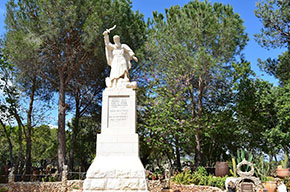
Mount Carmel is a 40-kilometer-long mountain range that stretches southeast from Haifa. At one of the higher points is Muchraka, a Carmelite monastery, with a statue of Elijah.
And all the people answered and said, "That is well spoken." 25And Elijah said to the prophets of Baal, "Choose a bull for yourselves and prepare it first, for you are many, and call on the name of your gods, but do not put fire under it." 26
Sunset over the Carmel mountain range seen from the north.

Kishon is one of the larger rivers in Israel and flows into the Sea of Galilee.
The rain is coming
41And Elijah said to Ahab, "Get up, eat and drink, for there is the sound of a heavy rain." 42So Ahab got up and ate and drank. But Elijah went up to the top of Carmel and bent down over the ground with his head between his knees.[The usual position for prayer was standing or kneeling. Here Elijah knelt and then lowered his head to the ground, between his knees, until his forehead touched the ground. He assumes a posture reminiscent of that of a woman giving birth.] 43And he [Elijah] said to his servant, "Go up, I pray you, and look toward the sea (toward the sea) [westward]." And he went up and looked and said, "There is nothing." And he said, "Go again," seven times. 44And it came to pass on the seventh time that he [Elijah's unnamed servant] said, "Behold, a cloud rises out of the sea, small as a man's hand."
And he said, "Go up, tell Ahab: Prepare your chariot and go down, lest the rain stop you." 45And it came to pass after a little while that the heavens were black with clouds and wind, and there was a great rain. And Ahab rode and came to [his hometown] Jezreel. 46And the hand of the Lord (Yahweh) was upon Elijah, and he girded up his clothes and ran before Ahab to the entrance of Jezreel.The Lord encourages Elijah in Sinai
191Ahab (Hebr. Achav) told [his wife] Jezebel (Hebr. Izevel) in detail about everything Elijah had done. [How the prophets of Baal had failed to light the sacrificial fire, while Elijah had called down fire from heaven; how Elijah had prayed and it had begun to rain after three and a half years of drought.] Ahab also recounted the details of how Elijah had killed all the prophets with the sword [given the command that the 450 prophets of Baal should be executed]. 2Then Jezebel sent a messenger with the following warning to Elijah: "May the gods [Baal and the Astarte goddesses whom Jezebel served] punish me severely if by this time tomorrow I have not taken your life in the same way that you took theirs." [Ahab was the most wicked king of Israel throughout history, because he allowed himself to be controlled by others, see . After the triumph over the prophets of Baal, the people cried out, "The Lord is God," see . What Elijah had longed for and prayed for was now beginning to happen. The people repented, and it looked as if Ahab would finally deal with Jezebel. Elijah accompanied Ahab to the city of Jezreel and waited at the gate while Ahab told Jezebel what had happened. She became furious and threatened to kill Elijah within 24 hours. Jezebel is a master at manipulating people. Since the people have seen God's power, she cannot openly kill Elijah, so she sends the message secretly in an attempt to control and intimidate the prophet into silence.] 3Elijah saw (became afraid), got up, and ran for his life. [The three verbs indicate a quick action without thought. What Elijah saw was the message, but also how his hope that the country's leadership would repent would not be fulfilled.] He came to Beer-Sheva in Judah [the southernmost city in Judah, 150 km from Jezreel]. There he left his servant, 4
Broom bush.
A strong wind went before the Lord and split the mountains and broke the rocks,
but the Lord was not in the wind.
After the wind came an earthquake,
but the Lord was not in the earthquake. 12After the earthquake came a fire,
but the Lord was not in the fire.
After the fire came the sound of a gentle whisper. 13When Elijah heard this, he covered his face with his cloak, went out, and stood at the entrance of the cave. Then a voice came to him and said, "What are you doing here, Elijah?" 14He replied [again], "I have been completely devoted (zealous with great zeal, enthralled) to the Lord (Yahweh), the God of hosts (Elohim Sebaot), even though the Israelites have abandoned your covenant, torn down your altars, and killed your prophets with the sword. Now I alone am left, and they are seeking my life." 15The Lord said to him, "Go back the way you came [through Israel east of the Dead Sea and Jordan] and continue to the desert around Damascus. When you arrive, anoint Hazael king over Aram (Syria). 16Jehu, the descendant (son, grandson) of Nimshi [], you shall anoint as king over Israel. Also anoint Elisha [which means "my God is salvation"], the son of Shaphath, from Abel Meholah [a city in the Jordan Valley], to be prophet and your successor. 17And it shall come to pass, that he who escapes the sword of Chazalel shall be slain by Jehu, and he who escapes the sword of Jehu shall be slain by Elisha. 18And I will leave 7,000 in Israel, all whose knees have not bowed to Baal and every mouth that has not kissed him." 19Elijah went from there to Elisha, son of Shaphat. [From Mount Horeb in the Sinai desert, where Elijah was, to the city of Abel Mecholai in the Jordan Valley is 250 km.] He found Elisha in the field plowing with twelve pairs of oxen. Elisha was with the last pair. [Elisha came from a wealthy family that owned land and oxen. Like many others, he was not idle when he was called to service. David tended his father's sheep, the sons of Zebedee mended their nets, etc.] Elijah went up and threw his cloak over him. 20Elisha left the oxen and ran after Elijah, saying, "Let me kiss my father and mother goodbye, and then I will follow you." Elijah replied, "Go back. Do you understand what I have done to you?" 21He [Elisha] went back. Then he took the two oxen and slaughtered them. He used the yoke as fuel to cook the meat and gave it to the people to eat. Then he set out and followed Elijah as his servant. [By sacrificing the oxen, he shows that he understands the seriousness of the calling and does not intend to return to his old life. Elisha now follows Elijah for ten years and is trained in the prophetic ministry before the mantle is handed over to him.]War – Israel and Aram
201And Ben-Hadad, king of Aram, gathered his entire army, and there were 32 kings with him, with horses and chariots, and he went up and besieged Samaria and fought against it. 2And he sent messengers to Ahab (Hebr. Achav), king of Israel, into the city 3and said to him, "Thus says Ben-Hadad: Your silver and your gold are mine, and your wives and your sons, and the best of them are mine." 4The king of Israel answered him, "As you say, my lord the king, I am yours, and all that I have." 5And the messenger came back and said, "Thus says Ben-Hadad: I have indeed sent to you, saying, 'You shall give me your silver and your gold, your wives and your sons,' 6but tomorrow at this time I will send my servants to you, and they shall search your house and the houses of your servants, and whatever their eyes desire, they shall take in their hands and carry away." 7Then the king of Israel [Ahab] called all the elders of the land and said, "Know (take note), I beg you, and see how this [Ben-Hadad] wants to harm us. When he sent messengers to me and demanded my wives and my sons and my silver and my gold, I did not refuse him." 8And all the elders and all the people said to him, "Do not listen or agree." 9So he [Ahab] said to Ben-Hadad's messengers, "Tell my lord the king, 'Everything you first sent your messengers for, I will do, but this I will not do. '" And the messengers departed and took these words back to him [Ben-Hadad]. 10And Ben-Hadad sent word to him [Ahab replied], saying, "May the gods do so to me and more, if the dust of Samaria is not enough for a handful for all the people who follow me." 11And the king of Israel [Ahab] answered and said, "Tell him, 'Let not him who girdeth on his armor boast as he who putteth it off (literally, as he who opens his armor).'" 12And it came to pass, when he heard the message while he was drinking, he and the kings in the tents, that he said to his servants, "Make yourselves ready for battle." And they made themselves ready for battle against the city.Ahab defeats Ben-Hadad
13And behold, a prophet came near to Ahab king of Israel and said, "Thus says the Lord (Yahweh): Have you seen all this great multitude? Behold, I will give it into your hand today, and you shall know that I am the Lord (Yahweh)." 14Then Ahab asked, "By whom?"
And he [the prophet] answered, "Thus says the Lord (Yahweh): By the young men of the princes."
And he asked, "Who shall begin the battle?"
And he [the prophet] answered, "You." 15And he counted the young men of the princes, and there were 232. And after them he counted all the people, all the sons of Israel, who were 7,000. 16And they went out at noon. But Ben-Hadad was drinking himself drunk in the tents, he and the kings, 32 kings who helped him. 17And the young men of the princes went out first, and Ben-Hadad sent out and they told him, saying, "Men are coming out of Samaria." 18And he said, "If they come in peace (shalom), take them alive; and if they come to fight, take them alive." 19And these went out of the city, the young men of the princes, and the army followed them. 20And they each struck their man, and the Arameans fled, and Israel pursued them, and Ben-Hadad, king of Aram, fled on a horse with horsemen. 21And the king of Israel went out and struck the horses and the chariots and slaughtered the Arameans with a great blow. 22And the prophet came near to the king of Israel and said to him, "Go and strengthen yourself (make yourself firm, secure, brave) and know and see what you have done, for when the year returns (the same time next year), the king of Aram will come up against you." 23And the servants of the king of Aram said to him, "Their God is a god of the mountains, therefore they were stronger (more secure, braver) than us. But let us fight against them in the field, then we will surely be stronger (more secure, braver) than them. 24And do this: Remove the kings, each from his place, and appoint governors in their place. 25And count for yourself an army like the one you have lost, horse for horse and chariot for chariot, and we will fight them in the field, and we will surely be stronger (firmer, more secure, braver) than they." And he listened to their voice and did so. 26And it came to pass, when the year was come round again (a year had passed), that Ben-Hadad mustered the Arameans and went up to Aphek to fight against Israel. 27And the sons of Israel were mustered and provisioned and went against them, and the sons of Israel camped before them like two small flocks of lambs, but the Arameans filled the land. 28And a man of God came near to the king of Israel and said, "Thus says the Lord (Yahweh): Because the Arameans have said, 'The Lord (Yahweh) is a god of the mountains but he is not a god of the valleys,' therefore I will give all this great multitude into your hand, and you shall know that I am the Lord (Yahweh)." 29And they camped opposite each other for seven days. And it came to pass on the seventh day that the battle began, and the sons of Israel slew of the Arameans 100,000 footmen in one day. 30But the rest fled to Aphek into the city, and the wall fell on 27,000 men who were left. And Ben-Hadad fled and entered the city into an inner room. 31And his servants said to him, "Behold, we have heard that the kings of the house of Israel show mercy (loving kindness—Hebr. chesed), let us, we pray thee, put sackcloth on our loins and ropes on our heads, and go to the king of Israel; perhaps he will save thy life." 32And they put sackcloth on their hips and ropes on their heads and came to the king of Israel and said, "Your servant Ben-Hadad says, 'I beg you, let me live.'" And he said, "Is he alive? He is my brother." 33And the men took it as a sign and hurried to take it from him, and they said, "Your brother Ben-Hadad." And he said, "Go and bring him." And Ben-Hadad came to him, and he made him get into his chariot. 34And he said to him, "The cities that your father took from my father, I will restore, and you shall make streets for yourself in Damascus, as my father did in Samaria." And he made a covenant with him and let him go.A prophet condemns Ahab
35And a man from among the sons of the prophets said to his colleague by the word of the Lord (Yahweh), "Strike me, I beg you." But the man refused to strike him. 36And he said to him, "Because you have not obeyed the word of the Lord (Yahweh), behold, as soon as you have left me, a lion will kill you." And as soon as he had left him, he was found by a lion, which killed him. 37And he found another man and said, "Strike me, I beg you." And the man struck him, striking and wounding him. 38And the prophet went from there and waited for the king by the road, and disguised himself with his head covering (also meaning ashes) over his eyes. 39And when the king passed by, he called out to the king and said, "Your servant went out into the midst of the battle, and behold, a man turned aside and brought a man to me and said, 'Keep (guard, protect, preserve) this man. If he is missing (disappears) in any way, then your life shall be demanded for his life, or you shall pay a talent [34 kg] of silver. 40And while your servant was busy with one thing and another, he disappeared."
And the king of Israel said to him, "So shall your judgment be; you yourself have decided it." 41And he hurried and took off the covering from his eyes, and the king of Israel recognized that he was one of the prophets. 42And he said to him, "Thus says the Lord (Yahweh): Because you have let go of the man whom I have set apart for destruction, therefore your life shall be taken for his life and your people for his people." 43And the king of Israel went to his house angry (bitter, sullen) and furious (stormy; breathing heavily—Hebr. ) and came to Samaria. [The phrase angry and furious recurs in .]The center – Naboth's vineyard

A carved wine press on the northern slope down from the city. This several thousand-year-old wine press is believed to have belonged to Naboth. It was found during excavations in 2013 in Jezreel and is one of the largest wine presses in Israel.
"Proclaim a fast and set Naboth at the head of the people (in the place of honor), 10and set two men, trustworthy citizens, before him, and let them testify against him, saying, 'You bless (Hebr. barach) [dismiss/curse] God (Elohim) and the king.' Then take him out and stone him to death." [Here the word bless is used, but with the opposite meaning of dismiss and curse, see also and ; , ] 11And the men of the city, the elders and nobles who lived in the city, did as Jezebel (Hebr. Izevel) had sent them, according to what was written in the letter she had sent them. 12They proclaimed a fast and set Naboth at the head of the people (in the place of honor). 13And two men, trustworthy citizens, came and sat before him, and the two trustworthy citizens testified against him, against Naboth, before the people, saying, "Naboth has blessed (Hebr. barach) [rejected/cursed] God (Elohim) and the king." Then they carried him out of the city and stoned him to death. 14Then they sent word to Jezebel (Hebr. Izevel) and said, "Naboth has been stoned and is dead." 15And it came to pass, when Jezebel heard that Naboth was stoned and was dead, that Jezebel said to Ahab, "Arise, take possession of the vineyard of Naboth the Jezreelite, which he refused to give you for silver, for Naboth is not alive, but dead." 16And it came to pass, when Ahab heard that Naboth was dead, that Ahab arose and went down to the vineyard of Naboth the Jezreelite, and took possession of it. 17And the word of the Lord (Yahweh) came to Elijah the Tishbite, saying 18Go up, go down and meet Ahab king of Israel, who is in Samaria; behold, he is in the vineyard of Naboth, where he has gone down to take possession of it. 19And you shall speak to him and say, 'Have you killed and taken possession? And you shall speak to him and say, 'Thus says the Lord (Yahweh): In the place where the dogs licked the blood of Naboth, the dogs shall lick your blood, even yours. 20And Ahab said to Elijah, "Have you found me, my enemy?" [The greeting is similar to that in , but now it is no longer "troublemaker" but "enemy".]
And Elijah answered, "I have found you because you have set your heart to do evil in the sight of the Lord (Yahweh). 21Behold, I will bring evil upon you and will utterly sweep away you and Ahab [his descendants], and I will cut off from Ahab [his descendants] every male in Israel, both bond and free [a derogatory term for a man; an unclean dog, ]. [] 22And I will make your house like the house of Jeroboam, son of Nebat, and like the house of Baasha, son of Ahijah, for the evil you have done in provoking me and causing Israel to sin. 23And even though Jezebel (Hebr. Izevel) has spoken, the Lord (Yahweh) has said: The dogs shall eat Jezebel (Hebr. Izevel) in the moats of Jezreel. 24He who dies with Ahab in the city shall be eaten by dogs, and he who dies in the field shall be eaten by the birds of the air." 25There was no one like Ahab, who sold himself to do evil in the eyes of the Lord (Yahweh), as his wife Jezebel (Hebr. Izevel) encouraged him. 26And he did many abominations in following idols, in all that the Amorites did, which the Lord (Yahweh) cast out before the children of Israel. 27And it came to pass, when Ahab heard these words, that he rent his clothes, and put sackcloth upon his body, and fasted, and lay in sackcloth, and went softly (crept, moved silently). 28And the word of the Lord (Yahweh) came to Elijah the Tishbite, saying 29"Do you see how Ahab humbles himself before me? Because he humbles himself before me, I will not bring the evil in his days, but in the days of his sons I will bring the evil upon his house."War – Israel and Aram
[Chapter 21 was an interruption, the chiastic center, and now comes a passage that is thematically related to and the war with Aram.] 221And there was no war between Aram and Israel for three years. 2And it came to pass in the third year [after the peace, see ] that Jehoshaphat, king of Judah [the 4th ruler of the Southern Kingdom], came down [from Jerusalem, which is high] to the king of Israel [in the north; Ahab was the 7th king of the Northern Kingdom]. 3And the king of Israel said to his servants, "Do you know that Ramoth-Gilead is ours, and we are passive and do not take it from the hand of the king of Aram?" 4And he said to Jehoshaphat, "Will you go with me to Ramoth-Gilead and fight?" And Jehoshaphat said to the king of Israel [Ahab], "I am as you are, my people as your people, my horses as your horses." 5And Jehoshaphat said to the king of Israel [Ahab], "Ask first (today), I pray you, for the word of the Lord (Yahweh)." 6And the king of Israel [Ahab] gathered the prophets, about 400 men, and said to them, "Shall I go up against Ramoth-Gilead to battle, or shall I refrain?" And they said, "Go up, for the Lord (Yahweh) will give it into the king's hand." 7But Jehoshaphat said, "Is there no prophet of the Lord (Yahweh) here, that we may ask him?" 8And the king of Israel [Ahab] said to Jehoshaphat, "There is a man through whom we can inquire of the Lord (Yahweh), but I hate him because he does not prophesy good about me, but evil, Micah (Hebr. Michajho), the son of Imlah." And Jehoshaphat said, "Let not the king say so." 9And the king of Israel [Ahab] called for a chamberlain and said, "Bring Micah the son of Imlah, quickly." 10And the king of Israel [Ahab] and Jehoshaphat, king of Judah, each sat on his throne, dressed in his robes, at the threshing floor at the entrance to the gate of Samaria, and all the prophets prophesied to them. 11And Zedekiah (Hebr. Tsidqijaho), the son of Kenaan, made himself horns of iron and said, "Thus says the Lord (Yahweh): With these you shall gore the Arameans until they are consumed." 12And all the prophets prophesied, saying, "Go up to Ramoth-Gilead and be victorious, for the Lord (Yahweh) will give it into the king's hand." 13And the messenger who went and called Micah spoke to him, saying, "Behold, the words of the prophets proclaim good to the king with one voice; let your words, I pray you, be like the word of one of them, and speak good." 14And Micah said, "As the Lord (Yahweh) lives, whatever the Lord (Yahweh) says to me, that I will speak." 15And when he came to the king, the king said to him, "Mic., shall we go up to Ramah-Gilead and fight, or shall we refrain?" And he answered him, "Go up and be victorious, and the Lord (Yahweh) will give it into the king's hand." 16And the king said to him, "How many times shall I ask you to speak to me nothing but the truth in the name of the Lord (Yahweh)?" 17And he said, "I saw all Israel scattered on the mountains, like sheep that have no shepherd, and the Lord (Yahweh) said, 'These have no master; let them return, each to his house, in peace (shalom).'" 18And the king of Israel [Ahab] said to Jehoshaphat, "Did I not tell you that he would not prophesy good about me, but evil?" 19And he said, "Therefore, hear the word of the Lord (Yahweh). I saw the Lord (Yahweh) sitting on his throne, and all the host of heaven standing by him on his right hand and on his left. 20And the Lord (Yahweh) said, 'Who shall entice Ahab, that he may go up and fall at Ramoth-Gilead? And one said, 'In this way,' and another said, 'In that way. 21Then a spirit came forward and stood before the Lord (Yahweh) and said, 'I will entice him. 22And the Lord (Yahweh) said to him, "With what?" And he said, "I will go forth and become a lying spirit in the mouth of all his prophets." And he said, "You shall entice him and succeed; go forth and do so." 23And now, behold, the Lord (Yahweh) has put a spirit of lies in the mouths of all these prophets, and the Lord (Yahweh) has spoken evil concerning you." 24And Zedekiah (Hebr. Tsidqijaho), the son of Canaan, came near and struck Micah on the cheek and said, "Which way did the Spirit of the Lord (Yahweh) go from me to speak to you?" 25And Micah said, "Behold, you shall see it on the day when you go into the inner room to hide yourself." 26And the king of Israel [Ahab] said, "Take Micah and carry him back to Amon, the mayor of the city, and to Joash, the king's son, 27and say, 'Thus says the king: Put this man in prison and give him bread of oppression and water of oppression until I return in peace. 28And Micah (Hebr. Michayahu) said, "If you return in peace, the Lord (Yahweh) has not spoken through me." And he said, "Hear, all you people."Ahab is killed at Ramah-Gilead
29And the king of Israel [Ahab] and Jehoshaphat, king of Judah, went up to Ramoth-Gilead. 30And the king of Israel said to Jehoshaphat, "I will disguise myself and go out to battle, but put on your (royal) robes." And the king of Israel disguised himself and went out to battle. 31And the king of Aram had commanded the 32 leaders of his chariots, saying, "Do not fight (duel) with anyone small or great except the king of Israel." 32And it came to pass, when the chariot captains saw Jehoshaphat, that they said, "Surely it is the king of Israel," and they turned and fought against him, and Jehoshaphat cried out. 33And it came to pass, when the charioteers saw that it was not the king of Israel, that they turned back from pursuing him. 34And a man drew his bow at random and struck the king of Israel between the joints of his armor and his breastplate. Therefore, he said to the driver of his chariot, "Turn your hand and carry me out of the army, for I am badly wounded." 35And the battle grew fierce that day, and the king stood in his chariot against the Arameans and died in the evening, and the blood flowed from his wound into the bottom of the chariot. 36And a cry went through the army as the sun went down, saying, "Every man to his city, and every man to his country." 37So the king died and was brought to Samaria, and they buried him in Samaria. 38And they washed the chariot at the water cistern of Samaria, and the dogs licked up his blood, and the harlots washed themselves there, according to the word of the Lord (Yahweh) that he had spoken. 39And the rest of the acts of Ahab, and all that he did, and the house of ivory that he built, and all the cities that he built, are they not written in the book of the chronicles of the kings of Israel? 40And Ahab slept with his fathers, and Ahaziah (Hebr. Achazijaho), his son, reigned in his place.King Jehoshaphat
41And Jehoshaphat, the son of Asa, began to reign over Judah in the fourth year of Ahab, king of Israel. 42Jehoshaphat was thirty-five years old when he began to reign, and he reigned twenty-five years in Jerusalem. And his mother's name was Azubah, the daughter of Shilhi. 43And he walked in all the ways of his father Asa; he did not turn aside from them, doing what was right in the eyes of the Lord (Yahweh). 44However, the high places were not removed, and the people still sacrificed at the high places. 45And Jehoshaphat had peace (shalom) with the king of Israel. 46And the rest of the acts of Jehoshaphat, and his might that he showed, and how he warred, are they not written in the book of the chronicles of the kings of Judah? 47And the remnant of the male temple prostitutes (Hebr. qadesh) who remained from the days of his father Asa, he drove out of the land. 48And there was no king in Edom; a deputy was king. 49Jehoshaphat built ships of Tarshish to go to Ophir [south of the Gulf of Aqaba – eastern Africa or perhaps India] for gold, but they did not go, for the ships were wrecked at Ezion-geber [port city around Eilat/Aqaba, perhaps Coral Island 13 km south of Eilat]. 50At that time, Ahaziah (Hebr. Achazijaho), son of Ahab, said to Jehoshaphat, "Let my servants go with your servants on the ships." But Jehoshaphat would not.Elijah and Ahaziah
51And Jehoshaphat slept with his fathers and was buried with his fathers in the city of his father David, and Jehoram his son reigned in his place. 52Ahaziah, son of Ahab, began to reign over Israel in Samaria in the 70th year of Jehoshaphat, king of Judah, and he reigned two years over Israel. 53And he did what was evil in the sight of the Lord (Yahweh), and walked in the ways of his father and in the ways of his mother, and in the ways of Jeroboam the son of Nebat. Thus he caused Israel to sin. 54And he served Baal and worshipped him, and provoked the Lord (Yahweh), the God of Israel (Elohim), to anger, just as his father [Ahab] had done.


