First Samuel
Samuel's birth and reign
Introduction
11There was a man from Ramathaim-Zophim, from the hill country of Ephraim, whose name was Elkanah [meaning: "God has created"],
the son of Jeroham,
the son of Eliho [Eliel, see ],
the son of Tohu [Toah, see ],
the son of Zoph,
an Ephraimite. [Ramatajim means "two hills" and Ramatajim-Tsofim is believed to be Arimathea, 25 km west of Shiloh. Later it is mentioned that Samuel's hometown is Rama, see .] 2And he had two wives, one named Hannah [Hebr. Channah, from Hebr. chanan, meaning "grace"] and the other named Penina [meaning "jewel"], and Penina had children but Hannah had no children. [The first polygamist mentioned in the Bible is Lamech (in the sixth generation from Adam and a descendant of Cain, the brother murderer) who boasted about killing a man, see . God's original plan was for one man and one woman to be married, see ; ; ; ; . A king should not take many wives, see ; . Although the Bible does not say "it was wrong" on every occasion, each example shows the jealousy and all the problems that polygamy brings, see ; .] 3And this man [Elkanah] went up from his city year after year (literally: "from day to day") [i.e., every appointed day of the Lord (Yahweh) – the three annual feasts of the Lord (Yahweh)], to worship and sacrifice to the Lord of Hosts (Yahweh Sebaot) in Shiloh [15 km north of Bethel, see ]. Eli's two sons, Hophni and Phinehas, were priests of the Lord (Yahweh) there. [This is the first time God's name, Lord of Hosts, is used. Yahweh is God's personal name. Sebaoth is the feminine form of the Hebrew word , which means army, battle, or war. The combination of these two names describes an almighty and all-powerful God.] 4And it came to pass on a certain day, when Elkanah sacrificed, that he gave to his wife Peninnah, and to all her sons and her daughters, portions (portions of the sacrifice), 5but to Hannah (Hebr. Channah) he gave a double (single) portion, for he loved Hannah, even though the Lord (Yahweh) had closed her womb. [The Hebrew literally says, "a portion of the two faces (nostrils)," which can be interpreted as food for two people, or that she only received one portion, and this upset Elkanah. The Greek translation has "only one." It depends on how one interprets "face," which here is in the dual form. Either two people, or anger and wrath.] 6And her [Hannah's] rival (Hebr. ; from the word for enemy) teased her painfully to make her lose her temper (literally: thunder/thunderstorm), because the Lord (Yahweh) had closed her womb. 7And he did so [Elkanah went up to Shiloh with his family] year after year [here it says years, unlike , which says days]. Every time she [Hannah] went up to the house of the Lord (Yahweh), the other woman [Peninnah] provoked her, so she wept and could not eat. 8And Elkanah said to her, "Hannah, why are you crying? And why are you not eating? And why is your heart grieving? Am I not better to you than ten sons?" 9Hannah rose after they had eaten in Shiloh and after they had drunk. Now the priest Eli was sitting on his chair [seat; a sign of his office] by the doorpost of the Lord's (Yahweh's) building (palace, temple – Hebr. hechal). 10And her soul was bitter (mourning, in deep distress), and she prayed to the Lord (Yahweh) and wept with pain. 11And Hos made a vow [which her husband Elkanah also agreed to, see ] and said: "Lord of hosts (Yahweh Sebaot), if you will indeed look upon the affliction of your servant and remember me and not forget your servant, but will give your servant a son, then I will give him to the Lord (Yahweh) for his entire life, and no razor shall come upon his head." [He shall be a Nazirite of God, see .] 12And it came to pass, when she had made her prayer unto the Lord (Yahweh) long, that Eli observed (literally watched) her mouth. 13But Hannah spoke in her heart, her lips moved, but her voice was not heard, so Eli thought she was drunk, 14and he said to her, "How long will you be (acting like a) drunk? Get rid of your wine." 15But Hannah answered and said, "No, my lord, I am a woman with a deeply troubled spirit; I have not drunk wine or strong drink, but I have poured out my soul before the Lord (Yahweh). 16Do not consider your servant a worthless woman (daughter of Balial – "daughter of Satan"), for I have been speaking out of my great anguish and distress." [Balial literally means "the worthless one," but is also a Jewish name for Satan.] 17Then Eli answered and said, "Go in peace (shalom). The God of Israel (Elohim) will give you what you have asked (prayed) of him." 18And she said, "Let your servant find favor (undeserved love – Hebr. chen) in your eyes." So the woman went her way and ate, and her face was no longer sad. 19And they rose early in the morning and worshiped before the Lord (Yahweh) and returned and came to their home in Ramah, and Elkanah knew (had intercourse with) his wife Hannah, and the Lord (Yahweh) remembered her. 20And it came to pass, when the time was come, that Hannah conceived and bore a son, and she called his name Samuel [meaning "God hears prayer" – Hebr. Shmoel] – "because I have asked him of the Lord (Yahweh)."Samuel is entrusted to the Lord
21Then Elkanah and all his family went up to offer their yearly sacrifice and their vow offering to the Lord (Yahweh), 22Hannah (Hebr. Channah) did not go with them, but said to her husband, "I will wait until the boy is weaned. Then I will take him with me and bring him before the Lord (Yahweh), and he shall remain there forever." [Hebrew children were normally breastfed until they were two or three years old.] 23Her husband Elkanah said to her, "Do what you think is best, wait until he is weaned. Let the Lord (Yahweh) fulfill his promise." So the wife stayed at home and nursed her son until he was weaned. 24Now that he was weaned, she took him up there, along with three bulls, an ephah of flour [35 liters], and a skin of wine. [Manuscripts from the Dead Sea Scrolls and the Greek translation say that it was a three-year-old bull, but according to , a much smaller amount of flour would have been sufficient in that case.] She brought him into the house of the Lord (Yahweh) in Shiloh, and the young man was just a young man (he was just a child). [Some manuscripts have "a three-year-old bull" instead of three bulls. The use of the word youth (Hebr. naar) repeated (antanaclasis, a rhetorical form where the same word has different meanings) reinforces that Samuel was very young when he came to the temple. He was probably only three years old.] 25They slaughtered the bull [which could also refer to several bulls if there were three] and then brought the boy to Eli. 26She said, "Listen to me, my lord [Eli], as surely as you live, my lord, I am the woman who stood here beside you and prayed to the Lord (Yahweh). 27I prayed for this boy, and the Lord (Yahweh) has given me what I asked him for. 28Therefore, I now want to give him back (hand him over/lend him) to the Lord (Yahweh). As long as he lives, he shall belong (be handed over/lent) to him."
Then they (literally: he) worshipped the Lord (Yahweh) there. [The basic meaning of the Hebrew word —used here in connection with giving back and belonging, and which appears twice here—is to ask, request, pray, and seek.]Hannah praises God
21So Hannah prayed [she praises God in the following prayer and song of praise]: "My heart rejoices (triumphs victoriously with jubilation) in the Lord (Yahweh),
my horn is exalted (I have my strength) in the Lord (Yahweh).
I can open my mouth (dare to speak boldly) against my enemies,
because I rejoice in your salvation. 2No one is holy (set apart) like the Lord (Yahweh),
for there is no one besides you (no one exists except you).
And no rock (firm foundation; strength) is like our God (Elohim). [; ] 3Do not speak so proudly [my enemies],
do not let arrogant words flow from your mouths.
For the Lord (Yahweh) is a God (El) who knows everything,
he weighs every action (evaluates everything that people do).
4The bows of the heroes (the strong) are broken,
but those who stagger (are weak) are clothed (equipped) with new strength. 5Those who were full must work [literally: 'hire themselves out' and work as day laborers] for their bread,
but those who were hungry are no longer hungry.
The barren woman bears seven children [metaphor for many],
but the one with many sons wastes away [sits alone in sorrow]. 6The Lord takes life and gives life,
leads down to Sheol (the underworld—the place of the dead) and up from there. 7The Lord makes poor, and he makes rich,
he humbles (causes people to bow down) and he exalts. 8He raises the weak from the dust,
he lifts the poor from the ash heap.
He seats them among princes,
and gives them a place of honor.
For the pillars of the earth belong to the Lord (Yahweh),
on them he has set the world (the surface of the earth).
9He guards (preserves) the steps of his faithful ones,
but the wicked perish (are silenced) in darkness,
no one succeeds by his own strength. 10The enemies of the Lord (Yahweh) are crushed to pieces,
he thunders against them [from his throne] in heaven,
the Lord (Yahweh) judges [all peoples] to the ends of the earth.
He gives strength to his king [an earthly king or the King – Jesus],
lifts high the scepter of his anointed." 11And Elkanah went to his house at Ramah. And the child served the Lord (Yahweh) under the priest Hos.Eli's wicked sons
12But Eli's sons were sons of wickedness (sons of Balial), they did not know (lacked an intimate relationship with) the Lord (Yahweh). 13And the custom of the priests with the people was that when any man offered his sacrifice, the priest's servant came with a three-pronged meat hook in his hand, while the meat was being prepared, 14and he would stick it into the pan or pot or cauldron or vessel. Whatever the meat hook pulled up, the priest would take from there. They did this to all the Israelites who came to Shiloh. 15Before the fat was burned, the priest's servant would come and say to the man who was offering the sacrifice, "Give the priest some meat to roast, for he does not want raw meat from you, but cooked." 16And if the man said to him, "Let the fat be burned first, then you can take as much as you want," he would say, "No, you must give it to me now, or I will take it by force." 17And the sin of the young men was very great before the Lord (Yahweh), because they treated the Lord's (Yahweh's) sacrifices with contempt. 18But Samuel ministered before the Lord (Yahweh) as a young man, wearing a linen ephod. 19And his mother made him a little robe (official garment) [which priests and kings wore, see ] for him, which she brought with her every year when she came up with her husband to offer the annual sacrifice. 20And Eli blessed Elkanah and his wife, saying, "The Lord (Yahweh) will give you children by this woman for the loan that was lent to the Lord (Yahweh)." And they went to their own home. 21Then the Lord (Yahweh) remembered Hannah, and she conceived and bore three sons and two daughters. And the young Samuel grew up (grew up) with the Lord (Yahweh). 22Eli was very old, and he heard everything his sons did to all Israel and how they had sexual relations with the women who served at the entrance to the tent of meeting. 23And he said to them, "Why do you do these things? I hear evil reports about you from all these people. 24No, my sons, it is not good reports that I hear the people of the Lord (Yahweh) spreading. 25If a man sins against another man, God (Elohim) will judge him, but if a man sins against the Lord (Yahweh), who will intercede for him?" But they did not listen to their father's voice, because the Lord (Yahweh) would slay them. 26And the young Samuel grew up (literally walked) and became great and good, both with the Lord (Yahweh) and with people.Prophecy against Eli's house
27And there came a man of God [unnamed; the term "man of God" is common, see ; ] to Eli and said to him,
"Thus says the Lord (Yahweh): Did I reveal myself to your father's house when they were in Egypt, slaves in Pharaoh's house? 28And did I choose him from all the tribes of Israel to be my priest, to go up to my altar and burn incense, and to wear an ephod before me? And did I give to the house of your fathers all the burnt offerings of the sons of Israel? 29Why do you trample on my sacrifices and my grain offerings, which I commanded you in my dwelling place, and honor your sons above me, to make yourself fat with the best pieces of all the sacrifices of the people of Israel? 30Therefore, the Lord (Yahweh), the God of Israel (Elohim), declares (says, proclaims): I have indeed said that your house and the house of your fathers shall walk before me forever (always), but now the Lord (Yahweh) declares (says, proclaims): Far be it from me, for those who honor me I will honor, and those who despise me shall be held in low esteem. 31Behold, the days are coming when I will cut off your arm [take away your strength/power] and the arm of your fathers' house [], so that there will be no old man in your house. 32You will see the affliction of my dwelling in all the good that is done for Israel, and there will be no one who becomes an old man in my house in all the days to come. 33The man whom I do not cut off from my altar will make your eyes weep and your soul mourn, and all that your house produces will die young. 34And this shall be the sign to them, that shall come upon your two sons, Hophni and Phinehas, in one day they shall both die. 35And I will raise up for myself a faithful priest, who will do what is in my heart and in my soul, and I will build his house firmly (stably), and he shall walk before my anointed one all the days. [This is a prophecy that also refers to the Anointed One—the Messiah!] 36And it shall come to pass that all who are left in your house shall come and bow down to him for a piece of silver and a cake of bread, and shall say, "Please appoint me to one of the priest's duties, that I may eat a piece of bread."Samuel's calling
31And the young man (Hebr. naar) Samuel ministered before the Lord (Yahweh) under Eli. [Samuel is now about twelve years old. His name literally means "God hears prayer" or "the one heard by God."]
And the word of the Lord (Yahweh) were rare at that time; prophetic visions (revelations) were not common. 2Eli's eyes had grown dim and he could no longer see. He was lying asleep in his usual place, 3and God's (Elohim's) lamp had not yet gone out. Samuel was sleeping in the temple of the Lord (Yahweh), where God's ark was also located. [Both the lamp and the ark are symbols of God's presence. In , instructions are given that the lamp should burn every night until dawn. What happens now takes place just before dawn because the lamp is still burning.] 4The Lord (Yahweh, I Am, God's personal name, signifying his presence among his people) called Samuel, and he answered, "Here I am." [Here I am (Hebr. hineni) is an expression that does not primarily refer to one's physical or geographical location. Instead, it is a word that means "I am at your disposal" or "I am ready to take responsibility." Everyone who gives this answer is an example of a person who takes on some form of leadership role when they say hineni – here I am. Abraham says it in , Isaac in , Jacob in , Moses in , the prophet Isaiah in , and others.] 5And he ran to [the blind] Eli and said, "Here I am, you called me." But Eli said, "I did not call you. Go back and lie down." Samuel went back and lay down. 6The Lord (Yahweh) called Samuel again [for the second time]. He got up and went to Eli and said, "Here I am, you called me." But Eli replied, "I did not call, my son. Go back to bed." 7Samuel had not yet learned to recognize the Lord (Yahweh) or received any [prophetic] word [revelation] from the Lord (Yahweh). 8The Lord (Yahweh) called Samuel a third time. He got up and went to Eli and said, "Here I am, you called me." Then Eli understood that it was the Lord who was calling the boy. 9Eli therefore said to Samuel, "Go back and lie down. When he calls you, say, 'Speak, Lord (Yahweh), your servant is listening. Samuel went back and lay down in his place. 10Then the Lord (Yahweh) came and stood near (positioned himself next to) and called as he had done before [this is the fourth time the Lord calls]: "Samuel, Samuel." Samuel answered, "Speak, your servant is listening." 11And the Lord (Yahweh) said to Samuel, "Behold, I am going to do a thing (Hebr. davar) in Israel, so that everyone who hears it will lose both ears. [Literally, it says that God will utter a word so that it materializes in the same way as when God spoke and it came into being in creation.] 12On that day I will fulfill against Eli all that I have spoken concerning his house from beginning to end. 13For I have told him that I will judge his house forever for sin, because he knows that his sons are bringing a curse upon themselves, yet he does not rebuke them. 14And therefore I have sworn (made my vow) to Eli's house that the sins of Eli's house shall not be atoned for by sacrifice, not by any sacrifice forever." 15And Samuel lay down until morning and opened the doors of the house of the Lord (Yahweh). And Samuel was afraid to tell Eli the vision. 16Then Eli called Samuel and said, "Samuel, my son," and he answered, "Here I am." [Hebr. hineni, see .] 17And he said, "What words did he speak to you? I beg you, do not hide it from me. May God (Elohim) do so to you and more, if you hide anything from me of all the words that he spoke to you." 18And Samuel told him [Eli] all the words and hid nothing from him.
And he [Eli] said, "It is the Lord (Yahweh), let him do what is good in his eyes." [Eli knew that his sons Hophni and Phinehas were not doing what was right, so this message must have been hard for him to hear.] 19And Samuel grew up, and the Lord (Yahweh) was with him and did not let any of his words fall to the ground. [The prophetic words he spoke were fulfilled.] 20And all Israel, from Dan [in the north] to Beersheba [in the south], knew that Samuel was becoming a prophet of the Lord (Yahweh). 21And the Lord (Yahweh) appeared again at Shiloh, for the Lord (Yahweh) revealed himself to Samuel at Shiloh through the word of the Lord (Yahweh).The prophecy concerning Eli's sons Hophni and Phinehas comes true
[At this time, neither Egypt nor Assyria was a world power. Israel fought with its neighbors, the Philistines in the west and Moab and Ammon in the east. The Philistines, who were a seafaring people, had imported knowledge of ironworking and were militarily superior in this area. This, combined with increasing immigration from the west, led them to take over more territory. They were organized in five cities on the Mediterranean coast. The following passage describes how Eli's family is destroyed, the words that the Lord spoke to Samuel are fulfilled, see , . As earlier in history, disobedience has consequences, see ; . On this occasion, God uses a pagan people, the Philistines, see , , and in this way God shows his omnipotence over all peoples, even those outside the covenant.] 41And Samuel's word came to all Israel. Now Israel went out to war against the Philistines and camped beside Even-Ezer [meaning "stone of help," perhaps Izbet Sartah], and the Philistines camped in Aphek [in the valley of Elah]. 2And the Philistines drew up in battle array against Israel, and as the battle raged, they defeated Israel before the Philistines, and they struck down their army in the field, about 4,000 men. 3And when the people came to the camp, the elders of Israel said, "Why has the Lord (Yahweh) defeated us today before the Philistines? Let us bring the ark of the covenant of the Lord (Yahweh) from Shiloh to us, so that he may be among us and save (deliver) us from the hand of our enemies." 4So the people sent [messengers] to Shiloh, and they brought the ark of the covenant of the Lord (Yahweh) of hosts, who sits above the cherubim, from there. And Eli's two sons, Hophni and Phinehas, accompanied the ark of God (Elohim). [] 5And when the ark of the Lord (Yahweh) came into the camp, all Israel shouted with a loud voice, so that the ground shook (vibrated with the sound). 6And when the Philistines heard the sound of the shouting, they said, "What does the sound of this great shouting in the camp of the Hebrews mean?"
When they found out that the ark of the Lord (Yahweh) had entered the camp, 7the Philistines were afraid and said, "God (Elohim) has come into the camp!" And they said, "Woe to us! There was nothing like this yesterday or the day before. 8Woe to us! Who will deliver us from the hand of these mighty gods? These are the gods who struck the Egyptians with all kinds of plagues and in the desert. [In this verse, the Philistines speak from their own polytheistic understanding of many gods and do not understand that Israel has only one God.] 9Be strong and act like men, you Philistines, so that you do not become slaves to the Hebrews as they have been to you. Gather yourselves together as men and fight!" 10And the Philistines fought, and Israel was defeated, and they fled, every man to his tent. And there was a great slaughter, for 30,000 of Israel's foot soldiers fell. 11And the ark of God (Elohim) was taken, and Eli's two sons, Hophni and Phinehas, were killed.The death of Eli
12
The gate on the northern slope of Shiloh, excavated in 2023. This is where Eli was sitting when he received the message.
And the man hurried and came to Eli and told him. 15Now Eli was 98 years old, and his eyes were dim, so that he could not see. 16And the man said to Eli, "I am the one who has come from the army, and I fled from the army today."
Then he said, "How did it go, my son?" 17And the one who brought the message answered and said, "Israel has fled before the Philistines, and there has also been a great slaughter among the people, and they have even struck down your two sons. Hophni and Phinehas are dead, and the ark of God (Elohim) has been taken." 18And it came to pass, when he mentioned the ark of God (Elohim), that he fell backward from his chair beside the gate, and his neck was broken, and he died, for he was an old man and heavy (Hebr. kaved). And he had judged Israel for 40 years. 19And his daughter-in-law, the wife of Phinehas, was pregnant and about to give birth. When she heard the news that the ark of God (Elohim) had been taken and that her father-in-law and her husband were dead, she bent down and gave birth, for her pains came upon her suddenly. 20And as she was dying, the women who were with her said, "Do not be afraid, for you have given birth to a son." But she did not answer and did not take it to heart. 21And she named the child Ichabod [meaning: "no glory," "where is glory," or "woe—glory"] and said, "The glory [God's presence] has departed from Israel," because the ark of God (Elohim) had been taken [carried away] and because of her father-in-law and her husband. [] 22And she said, "The glory has departed from Israel, for the ark of God (Elohim) has been taken."The ark's journey back
The Ark in Ashdod, Gath, and Ekron
[According to the Talmud (a summary and interpretation of the Old Testament), the ark was in Shiloh for 369 years before it was taken into battle, see .] 51Now that the Philistines had taken the ark of God (Elohim), they brought it from Even-Ezer [in the valley of Elah, see ] to [their city] Ashdod [on the Mediterranean Sea]. 2And the Philistines took the ark of God (Elohim) and brought it into the house of Dagon and placed it beside Dagon. [Hebr. means "a fish." This was a Philistine idol who was considered to be the father of Baal. The Philistine temples from this period that have been found by archaeologists had a sacred place at the front where the idol stood on a platform. See also where Samson tears down the temple of Dagon in the neighboring city of Gaza. There was also a temple of Dagon in Beit-Shean where Saul's head was hung up by the Philistines, see .] 3And when the inhabitants of Ashdod rose early the next morning, behold, Dagon had fallen on his face on the ground before the ark of the Lord (Yahweh). And they took Dagon and set him in his place again. 4And when they rose early the next morning, behold, Dagon had fallen on his face on the ground before the ark of the Lord (Yahweh) (again), and Dagon's head and both his palms were cut off on the threshold, only Dagon's body remained of him. 5Therefore, no one who enters the house of Dagon, neither priest nor anyone else, treads on the threshold to this day. 6But the hand of the Lord (Yahweh) was heavy upon them in Ashdod, and he destroyed them and struck them with hemorrhoids (boils, tumors – Hebr. ófel), Ashdod and its surroundings. 7And when the men of Ashdod saw that this was so, they said, "The ark of the God of Israel (Elohim) shall not remain with us, for his hand is heavy upon us and upon our god Dagon." 8So they sent and gathered all the leaders of the Philistines to them and said, "What shall we do with the ark of the God (Elohim) of Israel?" They replied, "Let the ark of the God (Elohim) of Israel be carried to Gath." So they carried the ark of the God (Elohim) of Israel there. 9And it came to pass, when they had brought it there, that the hand of the Lord (Yahweh) was against the city with great destruction, and he smote the men of the city, both small and great, and hemorrhoids came upon them. 10So they sent the ark of God (Elohim) to Ekron. And it came to pass, when the ark of God (Elohim) came to Ekron, that the inhabitants cried out, saying, "They have brought the ark of the God (Elohim) of Israel to us to slay us and our people." 11So they sent for and gathered together the leaders of the Philistines, and they said, "Send away the ark of the God (Elohim) of Israel, and let it return to its place, so that it does not slaughter us and our people," for a deadly plague was rampant throughout the city, and the hand of God (Elohim) was very heavy there. 12And the men who did not die were struck with hemorrhoids, and the cry of the city went up to heaven.The Ark Returns to Israel
61When the ark of the Lord (Yahweh) had been in the land of the Philistines for seven months, 2the Philistines called the priests and diviners and said, "What shall we do with the ark of the Lord (Yahweh)? Tell us how we can send it back to its place." 3And they replied, "If you send away the ark of the God (Elohim) of Israel, do not send it empty, but send him a guilt offering in some way, and then you will be healed, and it will be known to you why his hand has not been removed from you." 4Then they said, "What shall be the guilt offering that we shall give him?" They replied, "Five golden boils (hemorrhoids, tumors) and five golden mice [cast entirely in gold], according to the number of the leaders of the Philistines [Ashdod, Gaza, Ashkelon, Gath, and Ekron, see ], for one plague was upon you all and upon your leaders. 5Therefore, make images of your hemorrhoids and images of your mice that have afflicted the land, and give glory to the God of Israel (Elohim). Perhaps he will then lighten his hand from you and from your possessions and from your land. 6Why have you hardened your hearts like the Egyptians and Pharaoh hardened their hearts? When he was angry among them, they did not let the people go, but they went? 7Now take a new cart and two cows that have recently calved and are nursing, and that have never been yoked. Hitch the cows to the cart and take their calves away from them. [If a cow and calf are separated, they will bellow to try to find each other; if the cows do not follow their instinct and instead deliver the ark to Israel, God's intervention will be confirmed.] 8And take the ark of the Lord (Yahweh) and place it on the cart, and put the objects of gold, which you give him as a guilt offering, in a box beside it, and send it on its way. 9And behold, if it goes up the road toward its own border to Beit-Shemesh, then he is the one who has done this great evil, but if not, then we shall know that it was not his hand that struck us, it was a coincidence that befell us." 10And the men did so, and took two cows that were suckling, and tied them to the cart, and shut up their calves at home. 11And they set the ark of the Lord (Yahweh) on the cart and the box with the mice of gold and the images of their boils (Hebr. techór) [another word, more general than ófel in verses 4 and 5, see also , , ]. 12And the cows went straight along the road to Beth-Shemesh, they went along the main road, and mooed as they went, and did not turn to the right or to the left, and the leaders of the Philistines followed them to the border of Beth-Shemesh. 13And the inhabitants of Beit-Shemesh were reaping their wheat in the valley, and they lifted up their eyes and saw the ark and were glad to see it. 14And the cart came to the field of Joshua the Beth-shemeshite, and stood there, where there was a large stone, and they cut up the wood of the cart and offered the cows as a burnt offering to the Lord (Yahweh). 15And the Levites took down the ark of the Lord (Yahweh) and the box that was with it, where the gold things were, and set them on the great stone. And the men of Beit-Shemesh offered burnt offerings and sacrificed sacrifices to the Lord (Yahweh) that same day. 16And when the five Philistine leaders saw this, they returned to Ekron that same day. 17And these are the golden tumors (Hebr. techór) that the Philistines gave as a guilt offering to the Lord (Yahweh):
For Ashdod – one,
for Gaza – one,
for Ashkelon – one,
for Gat – one,
for Ekron – one,
18and the golden mice according to the number of the cities of the Philistines belonged to the five leaders, both the fortified cities and the villages, as far as Avel at the great stone, where they set down the ark of the Lord (Yahweh). This stone remains in the field of Joshua the Bethshemeshite to this day. 19And he struck some of the men of Beit-Shemesh, because they had looked into the ark of the Lord (Yahweh),
and he struck some of the people
70 men,
50,000 men, and the people mourned because the Lord (Yahweh) had struck the people with a great blow (a great slaughter). [According to , no one but the Levitical priests were allowed to see even the exterior of the ark, let alone its contents. This verse has caused difficulties for translators. Normally, numbers are written with the largest digits first, followed by the smaller ones. The normal way would have been to write 50,000 and 70, which would have given the number 50,070. The Hebrew here does not include the word "and" and repeats the word "men," first 70 men and then 50,000 men. Beit-Shemesh is also a small town with a population of no more than a thousand, which has led to questions about the high number. The Jewish historian Josephus only mentions that there were 70 men in Beit-Shemesh (Antiquities of the Jews, book 6, 1:4), and some medieval manuscripts have chosen to solve the problem by simply removing the number 50,000. However, the understanding and answer can be found in the context and structure of the text. Earlier in , the same closing phrase "a great slaughter" is mentioned when 30,000 men died, which suggests that the large number of just over 50,000 is also meant here. Only 70 men is not a great slaughter. When the ark was in Ashdod, both the city and the surrounding area were affected (). The Hebrew sentence structure here in has a nice parallelism with "the men of Beit-Shemesh" and 70 men and "part of the people" and 50,000 men throughout Israel. Even in a larger perspective throughout the Books of Samuel (which is a single book in the Hebrew Bible), this is confirmed when this event with 70 in Beit-Shemesh (+ 50,000 around) is connected with when 70,000 die of the plague.] 20And the men of Beit-Shemesh said, "Who can stand before the Lord (Yahweh), this holy God (Elohim)? And how shall it go up from us?" 21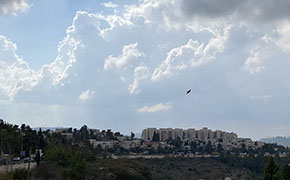
Kirjat-Jearim is located 13 km west of Jerusalem. Excavations in 2017 confirm that it was a large city at that time.
Samuel as judge
2And it came to pass from that day that the ark remained in Kiriath Jearim for a long time, twenty years, and all the house of Israel longed for the Lord (Yahweh). 3And Samuel spoke to all the house of Israel, saying, "If you return to the Lord (Yahweh) with all your heart, and remove the foreign gods and Asherahs [poles for idol worship] from among you, and turn your hearts to the Lord (Yahweh) and serve him only, then he will deliver you from the hand of the Philistines." 4Then the sons of Israel removed the Baals and the Asherah poles [poles for idol worship] and served the Lord (Yahweh) alone. 5And Samuel said, "Gather all Israel to Mitspah [just over 10 km north of Jerusalem], and I will pray for you to the Lord (Yahweh)." [Several cities share this name, which means "watchtower" and is used for various places that served as military posts. This mitspah has been identified with Tell en-Nasbeh, an 8-hectare city that guarded the main road from north to south between the Judean mountains and the mountains of Ephraim.] 6And they gathered together at Mitspah and drew water and poured it out before the Lord (Yahweh) and fasted that day and said there, "We have sinned against the Lord (Yahweh)." And Samuel judged the sons of Israel at Mitspah. 7And when the Philistines heard that the sons of Israel had gathered at Mizpah, the leaders of the Philistines went up against Israel. And when the sons of Israel heard it, they were afraid of the Philistines. 8And the sons of Israel said to Samuel, "Do not cease to cry out to the Lord our God (Yahweh Elohim) for us, that he may save us from the hand of the Philistines." 9And Samuel took a lamb and offered it as a whole burnt offering to the Lord (Yahweh). And Samuel cried out to the Lord (Yahweh) for Israel, and the Lord (Yahweh) answered him. 10While Samuel was offering the burnt offering, the Philistines drew near to battle against Israel, but the Lord (Yahweh) thundered with a great thunder over the Philistines that day and confused them (caused panic) that day, and they were struck down before Israel. 11And the men of Israel went out from Mitspah and pursued the Philistines and struck them until they came to Beit-Kar. 12Then Samuel took a stone and set it up between Mitspah and Shen, and named it Even-Ezer [Stone of Help], saying, "Thus far the Lord (Yahweh) has helped us." [Hebr. even means stone and ezer means help.] 13So the Philistines were subdued and did not come again within the border of Israel, and the hand of the Lord (Yahweh) was against the Philistines all the days of Samuel. 14And the cities that the Philistines had taken from Israel were restored to Israel, from Ekron to Gath, and its border [about 10 km in a north-south direction from Ekron down toGath] was taken back by Israel from the hand of the Philistines. And there was peace between Israel and the Amorites. 15And Samuel judged Israel all the days of his life (as long as he lived). 16And he went from year to year around to Bethel and Gilgal [just east of Jericho] and Mizpah, and he judged Israel in all these places. 17And he returned to Ramah, for there was his house, and there he judged Israel. And there he built an altar to the Lord (Yahweh).Saul's reign and missteps (chapters 8-15)
Israel asks for a king
81And it came to pass, when Samuel was old, that he made his sons judges over Israel. 2The name of his firstborn was Joel, and the name of his second was Abijah; they were judges in Beersheba. 3But his sons did not walk in his ways, but turned aside after gain, took bribes, and perverted justice. 4Then all the elders of Israel gathered together and came to Samuel at Ramah. 5And they said to him, "Behold, you are old, and your sons do not walk in your ways; now appoint a king to judge us like the other nations." 6But Samuel was displeased when they said, "Give us a king to judge us." And Samuel prayed to the Lord (Yahweh). 7And the Lord (Yahweh) said to Samuel, "Listen to the voice of the people in all that they say to you, for they have not rejected you, but they have rejected me, that I should not reign over them. 8In accordance with everything they have done since the day I brought them up out of Egypt to this day, they have rejected me and served other gods, so they are doing the same to you. 9Now therefore, listen to their voice, but you shall solemnly warn them (carefully let them know), and shall tell them the statutes (the binding legal decisions) of the king who shall reign over them." 10And Samuel spoke all the word of the Lord (Yahweh) to the people who asked him for a king. 11And he said, "These shall be the statutes (binding legal decisions) of the king who will reign over you: he shall take your sons and appoint them for himself to his chariots and to be his horsemen, and they shall run before his chariots. 12And he shall appoint them captains of 1,000 and captains of 50. And to plow his fields and reap his harvest, and to make weapons of war and weapons for his chariots. 13And he shall take your daughters to be perfumers and to be cooks and to be bakers. 14And he shall take your fields and your vineyards and your olive groves, the best of them, and give them to his servants. 15And he shall take the tenth of your grain and of your wine and give it to his officers and to his servants. 16And he shall take your servants and your maidservants and your best young men and your donkeys and put them to work. 17He will take a tenth of your flocks, and you will be his servants. 18And you shall cry out in that day because of the king whom you have chosen for yourselves, and the Lord (Yahweh) will not answer you in that day." 19But the people refused to listen to Samuel's voice, and they said, "No, but let us have a king over us, 20so that we may be like the other nations, and our king will judge us and go out before us and fight our battles." 21When Samuel heard all the words of the people [demanding a king], he repeated them in the ears of the Lord (Yahweh). [He did not answer the people, but repeated what they had said privately before God.] 22So the Lord (Yahweh) said to Samuel, "Listen to their voice and give them a king." And Samuel said to the men of Israel, "Go, every man to his city."Samuel anoints Saul as king
91Now there was a man in Benjamin whose name was Kish, the son of Abiel, the son of Zeror, the son of Bechorath, the son of Aphiah, a Benjamite, a valiant (honorable, strong) man. 2He had a son named Saul (Hebr. Shaol) — young (chosen — Hebr. bachor) and handsome (handsome — Hebr. tóv), among the sons of Israel there was no one more handsome (more beautiful — Hebr. tóv) than he — from the shoulder upward he was taller than anyone in the whole people. [He was a head taller than anyone else.] [The name Shaol means "desired"; he was a long-awaited and prayed-for son to Kish and his wife. The word "young" is often used for an unmarried young man (). The noun comes from the verb root to examine and to choose, so the phrase bachor v´tov can also mean "chosen and good/handsome." Saul is in his mid-thirties and married when he becomes king. His son, Jonathan, is commander in the first war (and must be around 17-20 years old at the time, see ). The Old Testament does not specify how long Saul reigns, but Paul writes 40 years (). This may be a symbolic time, but his successors David and Solomon each reigned for 40 years (; ). In that case, Saul is about 75 years old when he fights the Philistines at Gilboa (). See also .] 3Now Kish, Saul's father, had lost his donkeys, and Kish said to Saul, his son, "Take one of your servants with you and go and look for the donkeys." 4And he went [northwest] through the hill country of Ephraim and passed through the territory of Shalisha [Baal-Shalisha], but did not find them. Then he passed through the territory of Shaalim [the territory of the foxes], but they were not there, and he passed through the territory of Benjamin, but did not find them. 5When they came to the land of Zophah [near Ramah], Saul said to his servant who was with him, "Come, let us return, lest my father stop caring about the donkeys and worry about us instead." [Saul lived in Gibeah, just over a mile north of Jerusalem (). The mountainous region of Ephraim was just over 12 miles northwest of his home. Although Shalisha and Shaalim are unclear, most identify them with Baal-Shalisha and Shaalbim, respectively, which are located at the northwestern and southwestern ends of the Ephraimite mountain country. Just walking around this area would involve a 100-mile trek, a large area to cover during this three-day search (see ). The region of Tsof is generally assumed (based on 1 Sam. 1:1) to be the region of Samuel's hometown in the hill country of Ephraim.] 6But he said to him, "Look now (I beg you), there is a man of God in that city [probably Ramah], and he is a man who is held in honor; whatever he says comes to pass. Let us go there now, and perhaps he can tell us about our journey, where we should go." 7Then Saul said to his servant, "Look, if we go, what shall we take with us to the man? The bread in our bags is dry, and it is not a gift to give to a man of God. What do we have?" 8And the servant answered Saul and said, "Behold, I have a quarter of a shekel of silver [2.9 grams] [a week's wages for a laborer] in my hand, which I will give to the man of God to tell us our way." 9In the past in Israel, when a man went to ask God (Elohim), he would say, "Come, let us go to the seer." For the one who is now called a prophet was formerly called a seer. 10Then Saul said to his servant, "Well said (good suggestion). Come, let us go." So they went to the city where the man of God was. [Probably Ramah, a little over a mile north of Jerusalem, where Samuel used to be, see .] 11When they went up to the city [Ramah], they found young virgins coming out to draw water, and they said to them, "Is the seer here?" 12And they answered them and said, "He is, see, he is before you, hurry now, for he came to the city today, because the people have sacrificed today on a high place. 13As soon as you enter the city, you will find him straight ahead, before he goes up to the high place to eat, for the people will not eat until he comes, because he usually blesses the sacrifice, and afterward those who are invited eat. Therefore, go up now, for you can find him at this moment." 14And they went up to the city, and when they entered the city [Ramah], behold, Samuel came out to meet them to go up to the high place. 15And the Lord (Yahweh) had shown Samuel a day before he came and said: 16"Tomorrow at this time I will send you a man from the land of Benjamin, and you shall anoint him to be prince over my people Israel, and he shall save the people from the hand of the Philistines, for I have looked upon my people, because their cry has come to me." 17And when Samuel saw Saul, the Lord (Yahweh) said to him, "Behold, the man of whom I spoke to you. This one shall have authority over my people." 18Then Saul approached Samuel at the gate and said, "Tell me, I beg you, where is the seer's house?" 19And Samuel answered Saul and said, "I am the seer; go up before me to the high place, for you shall eat with me today, and tomorrow I will let you go, and I will tell you all that is in your heart. 20As for your donkeys that went missing three days ago, do not worry about them, for they have been found. And to whom does the desire of all Israel belong? Is it not to you and to all your father's house?" 21And Saul answered and said, "Am I not a Benjaminite, from the smallest of the tribes of Israel? And my family is the smallest of the families of the tribe of Benjamin. Why then do you speak to me in this way?" 22And Samuel took Saul and his servants and brought them into the hall and had them sit in the place of honor among those who were invited, which was about 30 people. 23And Samuel said to the cook, "Bring the portion that I gave you, which I told you to set aside." 24And the cook took the thigh and what was on it and set it before Saul. And [Samuel] said, "See what has been saved, set it before you and eat, for it has been saved for you for the appointed time, and I say, I have invited the people." So Saul ate with Samuel that day. 25And when they came down from the high place to the city, he spoke with Saul on the roof. [At that time, houses were built with flat roofs and used the space as an extra room.] 26And they rose early, and it came to pass at dawn that Samuel called Saul on the roof and said, "Get up, so that I may send you away." And Saul rose, and they both, he and Samuel, went outside. 27As they went down toward the edge of the city [ancient cities were always located on high ground, so the edge of the city probably refers to the gate in the wall], Samuel said to Saul, "Tell your servant to go on ahead of us." And he went on [out of the city]. "But stay here a while so that I may let you hear the word of God (Elohim)." [Samuel had a message from the Lord for Saul that he wanted to share with him privately.] 101Then Samuel took the horn of oil and poured it on his head and kissed him and said [verses 1b-8 are Samuel's longest recorded speech to a person, 147 Hebrew words]:
"Is it not the Lord (Yahweh) who has anointed you to be prince over his inheritance? 2When you leave me today, you will find two men at Rachel's tomb on the border of Benjamin at Tzelzach, and they will say to you, 'The donkeys you went to look for have been found, and your father has stopped worrying about the donkeys and is worried about you, saying, "What shall I do for my son?" 3Then you shall go on from there, and you shall come to the terebinth of Tabor, and there three men shall meet you who are going up to God (Elohim) in Bethel. One has three kids with him, another carries three loaves of bread, and another carries a jar of wine. 4And they shall greet you and give you two loaves of bread, which you shall receive from their hands. 5Then you shall come to God's (Elohim)'s Gibeah ("God's hill" – Hebr. Gibeah haElohim) where the Philistines' army is [], and when you arrive there in the city, you shall meet a group of prophets coming down from the high place with a psaltery, a tambourine, a flute, and a kithara (Hebr. kinnor) before them, and they will prophesy. 6And the Spirit of the Lord (Yahweh) shall come upon you mightily, and you shall prophesy with them, and you shall be turned into another man. 7And when these signs come to you, do whatever you find in your hand, for God (Elohim) is with you. 8And you shall go down before me to Gilgal, and behold, I will come down to you to offer burnt offerings and sacrifice sacrifices and peace offerings (communion offerings), and you shall wait seven days until I come to you and tell you what you shall do."Saul becomes king
9And it came to pass, when he [Saul] turned his shoulder (Hebr. shechem) to depart from Samuel, that God (Elohim) transformed (overturned) him and gave him another heart, and all these signs occurred on the same day. [The word shoulder (Hebr. shechem) is used here and in ; . Saul is transformed inwardly, but it is not permanent, see .] 10And when they came to Gibeah, behold, a group of prophets met him, and the Spirit of God (Elohim) came upon him, and he prophesied among them. 11And it came to pass, when all who knew him before saw it, behold, he prophesied with the prophets, and the people said to one another, "What is this that is happening to the son of Kish? Is Saul among the prophets?" 12And a man in the same place answered and said, "And who is their father?" Therefore it became a proverb, "Is Saul also among the prophets?" 13And when he had finished prophesying, he came to the high place. 14And Saul's uncle said to him and to his servants, "Where did you go?" And he said, "To look for the donkeys, and when we saw that they were not found, we came to Samuel." 15 And Saul's uncle said, "Tell me, I beg you, what Samuel said to you." 16And Saul said to his uncle, "He told me plainly that the donkeys had been found." But he did not tell him what Samuel had said about the kingdom. 17And Samuel called the people together at Mizpah [just north of Jerusalem, where Samuel had previously gathered the people; see ]. [Several cities share this name, which means "watchtower" and is used for various places that served as military posts. This mitspah has been identified with Tell en-Nasbeh, an 8-hectare city that guarded the main road from north to south between the Judean mountains and the mountains of Ephraim.]
18And he said to the sons of Israel, "Thus says the Lord (Yahweh), the God (Elohim) of Israel: I brought Israel up out of Egypt, and I delivered you out of the hand of the Egyptians and out of the hand of all the kingdoms that oppressed you. 19But today you have rejected your God (Elohim), who himself saved you from all your troubles and your distress, and you have said to him, 'Set a king over us. Now therefore, present yourselves before the Lord (Yahweh) according to your tribes and your thousands.'" 20So Samuel brought all the tribes of Israel near, and the tribe of Benjamin was chosen [the lot fell on that tribe]. [Probably by casting lots, see ; .] 21And he brought the tribe of Benjamin near by their families, and the family of Matri was chosen [the lot fell on that family], and Saul, the son of Kish, was chosen [the lot fell on him], but when they searched for him, they could not find him. 22Therefore, they asked the Lord (Yahweh) further, "Has the man yet come here?" And the Lord (Yahweh) answered, "Behold, he has hidden himself among the utensils (baggage)." 23And they ran and found him there. And when he stood among the people, he was taller than any of the people, from his shoulders and upward. 24And Samuel said to all the people, "Do you see the one whom the Lord (Yahweh) has chosen, that there is no one like him among all the people?" And all the people shouted and said, "Long live the king." 25Then Samuel spoke the commandments (the binding legal decisions) about the king to the people, and wrote them in a book and laid it before the Lord (Yahweh). And Samuel sent all the people away, each to his house. 26And Saul also went to his house in [his hometown] Gibeah, and with him went the brave men (warriors—men in their prime—full of their own strength and power), whose hearts God (Elohim) had touched. 27But some men said, "How can this man save (deliver) us?" And they despised him and gave him no gift. But he remained calm (ignored them).Saul saves the city of Jabesh
111Then the Ammonite Nahash came up and encamped against Javesh-Gilead [probably Tell Maqlub along the Javis River]. Then all the men of Javesh said to Nahash, "Make a covenant with us, and we will serve you." [The Ammonites had been fighting the Israelites over the area east of the Jordan River for a long time, see .] 2And the Ammonite Nahash said to them, "On this condition I will make a covenant with you, that everyone's right eye be put out, and I will put it as a reproach on all Israel." [Mutilating enemies was common among pagan peoples, see ; . The people would be able to see enough to function as laborers, but would be unable to become skilled warriors and revolt.] 3And the elders of Jabesh said to him, "Give us seven days to consider, so that we may send messengers throughout the territory of Israel, and if no one comes to help us, we will come out to you." 4Then the messengers came to Saul's [city] Gibeah and spoke these words in the ears of the people, and all the people lifted up their voices and wept. 5And behold, Saul came from the field behind his oxen, and Saul said, "Why are the people weeping?" And they told him what the man from Javesh had said. 6And the Spirit of God (Elohim) came upon Saul when he heard these words, and his anger was greatly kindled. 7And he took a yoke of oxen and broke it in pieces and sent them throughout Israel by messengers, saying, "Whoever does not follow Saul and Samuel, so shall it be done to his oxen." And the fear of the Lord (Yahweh) fell upon the people, and they went out as one man. 8And he counted them in Bezek, and the sons of Israel were 300,000, and the men of Judah 30,000. 9And they said to the messengers who came, "Thus shall you say to the men of Jabesh-Gilead: Tomorrow, by the time the sun is hot [in the afternoon around three o'clock], you shall have help." And the messengers came and told the men of Jabesh, and they were glad. [The distance between Bezek and Javesh-Gilead is 21 km.] 10The men of Javesh said, "Tomorrow we will come out to you, and you shall do to us whatever seems good to you." 11The next day, Saul divided the people into three groups, and they invaded the camp at the morning watch [the last of the three night watches – from 2:00 to 6:00 a.m.] and struck the Ammonites until the heat of the day [afternoon]. Those who escaped were so scattered that not two of them escaped together. [The Amorites must have put up some resistance at first, as the battle lasted about 12 hours.] 12And the people said to Samuel, "Who is this who said, 'Shall Saul reign over us? Bring forth the men, that we may put them to death. 13But Saul said, "No man shall be put to death today, for today the Lord (Yahweh) has given deliverance in Israel." 14Then Samuel said to the people, "Come, let us go up to Gilgal and renew the kingdom there." 15And all the people went to Gilgal, and there they made Saul king before the Lord (Yahweh) in Gilgal.Samuel's farewell speech
121And Samuel said to all Israel, "Behold, I have listened to your voice in all that you have said to me, and I have set a king over you. 2And now, behold, the king goes before you, and I am old and gray-haired, and behold, my sons are with you, and I have walked before you from my youth until today. 3Here I am, testify against me before the Lord (Yahweh) and before his anointed [King Saul, see ]. Whose ox have I taken? Or whom have I defrauded? Or whom have I oppressed? Or from whose hand have I taken a bribe to blind my eyes with it? Then I will make restitution to you." 4They replied, "You have not deceived us, nor oppressed us, nor taken anything from anyone's hand." 5Then he [Samuel] said to them, "The Lord (Yahweh) is witness against you, and his anointed is witness this day, that you have found nothing in my hand."
They replied, "He is witness." 6Samuel then said to the people: "It is the Lord (Yahweh) who chose (literally, made) Moses and Aaron, and who brought your fathers up out of the land of Egypt. 7Now therefore, be still, that I may plead your cause before the Lord (Yahweh) concerning all the righteous deeds of the Lord (Yahweh) which he has done for you and your fathers. 8When Jacob came to Egypt [, ], your fathers cried out to the Lord (Yahweh), and the Lord (Yahweh) sent Moses and Aaron, who brought your fathers out of Egypt and let you dwell in this place. 9But they forgot the Lord (Yahweh), their God (Elohim), and he gave them into the hand of Sisera, the commander of Hazor [in northern Galilee, see ], and into the hand of the Philistines [], and into the hand of the king of Moab [east of the Dead Sea, see ], and they fought against them. 10And they cried out to the Lord (Yahweh) and said, 'We have sinned because we have forsaken the Lord (Yahweh) and have served the Baals and the Asherahs [poles for idol worship]. But now deliver us from the hand of our enemies, and we will serve you.' 11Then the Lord (Yahweh) sent Jerubbaal [Gideon, see ] and Bedan [probably another name for Barak, see ] and Jephthah [] and Samuel [he mentions himself as the last judge; some Greek manuscripts of the Septuagint and the Syriac translation write Samson, see ] and delivered you from the hand of your enemies on every side, and you lived in safety. 12And when you saw that Nahash, king of the Ammonites, was coming against you [], you said to me, 'A king shall reign over us,' even though the Lord your God (Yahweh Elohim) is your king. 13And now, behold the king whom you have chosen [Saul] and whom you have asked for; and behold, the Lord (Yahweh) has set a king over you. 14If you revere (fear – Hebr. jare) the Lord (Yahweh)
and serve (work for – Hebr. avad) him
and listen (obey – Hebr. shama) to his voice
and do not rebel against the Lord's (Yahweh's) commands (mouth), and if both you and the king who rules over you become followers of the Lord your God (Yahweh Elohim) ... [The sentence is not finished; here there is a pause for the reader to think about what happens if one chooses to follow God.]
15But if you do not listen to the voice of the Lord (Yahweh) and rebel against the commands of the Lord (Yahweh), then the hand of the Lord (Yahweh) will be against you and against your fathers. 16Therefore, be still now and see this great thing that the Lord (Yahweh) will do before your eyes. 17Is it not wheat harvest today [May/June – the time to harvest barley and wheat]? I will call upon the Lord (Yahweh) to send thunder and rain, and you shall know (personally experience) and see that your wickedness is great, which you have done in the eyes of the Lord (Yahweh), by asking for a king [and not wanting me as king]." 18Then Samuel cried out to the Lord (Yahweh), and that same day the Lord (Yahweh) sent thunder and rain, and all the people were very afraid (seized with great fear; trembled greatly) before the Lord (Yahweh) and Samuel. [Normally, there is never any rainfall in Israel during the harvest season, so this is something very remarkable. The downpour probably also destroyed the grain harvest for that year, see .] 19And all the people said to Samuel, "Pray for your servants to the Lord your God (Yahweh Elohim) that we may not die, for we have added this evil to our sins, asking for a king." [Here the people do not say "our God" but "your God," thus distinguishing themselves from Samuel.] 20And Samuel said to the people, "Do not be afraid, for you have indeed done all this evil, but do not turn away from following the Lord (Yahweh) and serving the Lord (Yahweh) with all your heart, 21and do not turn away, for then you will follow emptiness (vain things – Hebr. ha-toho) [idols, see ; ] that cannot profit or deliver, for they are emptiness (nothingness – Hebr. tóho). 22For the sake of his great name, the Lord (Yahweh) will not abandon his people, because it has pleased the Lord (Yahweh) to make you a people for himself. 23Even for me, far be it from me to sin against the Lord (Yahweh) by ceasing to pray for you, but I will teach you the good and the right way. 24Only fear the Lord (Yahweh) and serve him in truth with all your heart, and consider how great things he has done for you. 25But if you continue to do evil, you and your king will be swept away. Saul begins his reign as leader or king in several stages. Samuel first anoints Saul as prince of Israel in , the whole people choose him as king in , but some protest and everyone, including Saul, goes home. Some time later, during a war, they find Saul working with the oxen in the field (). He has already been chosen as king, but he has not yet acted as such. He then gathers Israel and leads them to victory. After that, the kingdom is renewed and everyone finally recognizes him as king in , and only then does he begin to reign in earnest.
Samuel rebukes Saul 131Saul had reigned [in practice] for one year, even though he had been [formally] king of Israel for two years. [The first half of the verse has caused some confusion. The reason is that it does not follow the "usual formula" of stating the king's age when he became king and how long he reigned (cf. , ; ; ; ; ). Many translations have attempted to "correct" the text so that it fits the age and reign formula. The verse is not included in the Septuagint, but some Greek manuscripts state that Saul was 30 years old, probably based on the ages of other kings, see . The Jewish historian Josephus states that Saul reigned for 20 years, see his work Antiquities of the Jews (book 6), but also suggests 40 years in other places, something that Paul mentions, see . It is incredible that any writer could have managed to corrupt both the age at which Saul became king and the length of his reign without anyone noticing that it said that Saul was one year old when he began to reign and then was king for two years. The most natural interpretation is that the verse describes how a year had passed since Saul was recognized by the people as king, but he had formally been king for two years.]
2And Saul chose for himself 3,000 men from Israel, of whom 2,000 were with Saul in Michmash [meaning: "hidden place"; probably present-day Mukmas, 11 km northeast of Jerusalem] and in the hill country of Bethel, while 1,000 were with [his son] Jonathan in Gibeah of Benjamin [the city of Gibeah in the territory of the tribe of Benjamin, see also ]. He sent the rest of the people each to his tent. 3And Jonathan struck the Philistine garrison that was in Geva [masculine form of "hill"] and the Philistines heard about it. And Saul blew the shofar throughout the land and said, "Let the Hebrews hear." [On four occasions in the Books of Samuel, the Hebrew spelling Geva (masculine form of the word "hill") is used instead of Giva (the more common feminine form of "hill" used twelve times in the Books of Samuel). It probably refers to the same place, but the author may have wanted to give a different emphasis. Geva is used in , ; ; and Giva in ; ; , ; , ; ; ; ; ; ; . The phrase Giva-Benjamin is used in verses 2, 15, and , and the reason may be to recall the tragic event in .]
4And all Israel heard say that Saul had smitten the Philistines, and that Israel had also made themselves odious to the Philistines. And the people gathered themselves together after Saul to Gilgal. 5And the Philistines gathered [their forces] to fight against Israel, 30,000 chariots and 6,000 horsemen and people—as numerous as the sand on the seashore—in great numbers [; ], and they came up and encamped in Michmash east of Beit-Aven [near Bethel, see ]. 6And Israel saw that they were trapped (literally: "in a narrow or confined place") for the people were in distress, then the people hid in caves and in thickets and in rocks and in cavities and in pits (wells). 7Some of the Hebrews had crossed the Jordan to the land of Gad and Gilead [east of the Jordan River].
But Saul was still in Gilgal, and all the people followed him trembling with fear. 8He waited seven days, the time Samuel had set []. But Samuel did not come to Gilgal, and the people [Saul's army] scattered from him (began to abandon him). 9Then Saul said, "Bring me the burnt offering and the peace offering." And he offered the burnt offering. 10Just as he had finished offering the burnt offering, Samuel arrived, and Saul went to meet him to greet him. 11But Samuel said, "What have you done?"
Saul replied, "Because I saw that the people were scattering from me and that you did not come at the appointed time, and that the Philistines were gathering at Michmash, 12I said, 'Now the Philistines will come down on me at Gilgal, and I have not sought the Lord's (Yahweh's) face,' so I hurried to offer the burnt offering." 13Samuel said to Saul, "You have acted foolishly [only priests were allowed to sacrifice], you have not kept (guarded, protected, preserved) the Lord (Yahweh), the commands (the clear commandments – Hebr. mitzvot) of your God (Elohim) that he commanded (Hebr. tsavah) you [], for now the Lord (Yahweh) would have established your kingdom over Israel forever. 14But now your kingdom will not endure, for the Lord (Yahweh) has sought out a man after his own heart [David, see ], and the Lord (Yahweh) has appointed him prince over his people, because you have not kept (guarded, protected, preserved) what the Lord (Yahweh) commanded you." 15Then Samuel got up and went from Gilgal to Gibeah of Benjamin [the city of Gibeah in the territory of the tribe of Benjamin]. And Saul counted the people who were with him, about 600 men.Israel without weapons
16And Saul and Jonathan his son and the people who were with them stayed in Geva-Benjamin [here the masculine form Geva is used instead of the usual feminine Giva], but the Philistines were encamped in Michmash. 17And the destroyers came out of the camp of the Philistines in three groups: one group took the road that leads to Ophrah, to the land of Shoal,
18and one group took the road to Beth-Horon,
and one group took the border road that overlooks the valley of Zeboim toward the desert. 19There was no blacksmith in all the land of Israel, for the Philistines said, "Otherwise, the Hebrews will make swords and spears." 20So all the Israelites went down to the Philistines to sharpen their plowshares, their plow irons, their axes, and their pickaxes.
21And the price for sharpening was a fim [2/3 shekel – 8 grams; probably a silver coin] for the plowshare and for the plow iron and for the three-pronged forks and for the axes and for setting the spurs. [Previous translations stated that the Hebr. word fim was a misspelling of the letter Pe (the word for mouth). Now the word fim has been found in inscriptions on several weights. This also describes the beginning of the Iron Age in Israel (around 1200 BC). Iron was known before that, but the process of cooling it in water was mastered by the Philistines, and produced stronger swords than those made of bronze by the Israelites.] 22And when the days of war came, there was no sword or spear to be found in the hands of any of the people who were with Saul and Jonathan, but they were found with Saul and Jonathan (only Saul and Jonathan had personal weapons).Jonathan attacks the Philistines
23And the Philistine army went out to the pass at Michmash. [The word for pass is used for mountain passes and fords where one crosses over. This mountain pass is also called "Geba's Pass" in . This area in the central mountainous region is characterized by deep ravines (wadis) that cut through the landscape in an east-west direction. This limits the number of roads from the area around Jerusalem to the north. Michmas (now the Arab village of Mukhmas, which has retained the name) was an important city that protected Wadi es-Swenit, a deep ravine that runs from the central mountain passes down to the Jordan Valley. There is a section that is easy to pass, which is this pass. According to , the road passed between two mountain formations called Botsets and Sene. Some identify this with Wadi es-Swenit, others believe it is 1 km southeast of the village of Mukhmas. The only way to get to Michmash was through this mountain pass, which connected it to the city of Gibeah, see .] 141And it came to pass one day that Jonathan, Saul's son, said to the young man who carried his armor [his armor bearer], "Come, let us go over to the Philistine camp on the other side." But he did not tell his father. 2And Saul lingered at the edge of Gibeah under the pomegranate trees that are in Migron [meaning: "high rock"; located near Gibeah], and the people who were with him were about 600 men, 3and Ahijah, the son of Ahitub, the brother of Ichabod, the son of Phinehas, the son of Eli, the priest of the Lord (Yahweh) in Shiloh [where the tabernacle was], who wore an ephod [the sacred priestly vest, see ]. And the people did not know that Jonathan had gone. 4And in the pass, where Jonathan had intended to cross over to the Philistine camp, there was a steep rocky cliff on one side and a steep rocky cliff on the other side, and the name of one was Botsets and the name of the other was Sene. [Botsets means sparkling or "surpasses white" and Sene means "thorny."] 5One rose to the north toward Michmash, and the other rose to the south toward Geva [here the masculine form of Giva is used, see ]. 6And Jonathan said to the young man who carried his armor, "Come, let us go over to the camp of these uncircumcised men [], for perhaps the Lord (Yahweh) will do it for us, since there is no hindrance to the Lord (Yahweh) in saving by many or by few." 7And the armor bearer said to him, "Do whatever is in your heart; turn (wherever you want), I am with you according to your heart." 8And Jonathan said, "Behold, we will go over to the men and show ourselves to them. 9If they say this to us: 'Wait until we come to you [and kill you], then we will stand still in one place and not go up to them. 10But if they say, 'Come up to us [so we can fight], then we will go up, for the Lord (Yahweh) has given them into our hands, and this shall be the sign for us. 11And both of them showed themselves to the Philistine camp, and the Philistines said, "Look, the Hebrews are coming out of the caves where they have hidden themselves." 12And the men in the camp spoke to Jonathan and his armour-bearer, saying, "Come up to us, and we will show you something." Then Jonathan said to his armour-bearer, "Come up after me, for the Lord (Yahweh) has given them into the hand of Israel." 13And Jonathan climbed up on his hands and feet, and his armour-bearer after him, and they fell before Jonathan, and his armour-bearer slew them after him. 14And the first slaughter that Jonathan and his armour-bearer made was about twenty men, within half a plough furrow on a ploughed field (acre). [The exact size of a ploughed field is unknown, but it is probably the area that a pair of oxen could plough in a day. The word used is Hebr. tsemed, which means span/yoke, see also ; ; . The area is estimated to be about 0.5 hectares, which corresponds to the old Nordic unit of area, the acre (equivalent to the area of land that could be sown with one barrel of seed). The distance here is half the length of a plow furrow, which is about 35 meters if it is a square field measuring 70x70 meters.] 15And there was a trembling in the camp in the field and among the people, the encampment and the outposts also trembled, and the earth shook, so it grew into a fear of God (Elohim). 16And Saul's watchmen in Givat-Benjamin looked, and behold, the crowds were melting (in disarray) and they were going here and there. [The word for "in disarray" is literally the word for melting and describes a change that cannot be resisted. The people are shaking with fear and cannot do anything about the situation. ] 17And Saul said to the people [the army] who were with him, "Count and see who has left us." And when they had counted, it appeared that Jonathan and his armor bearer were not there. 18And Saul said to Ahijah, "Bring the ark of God (Elohim)." For the ark of God (Elohim) was with the sons of Israel at that time. 19And it came to pass, while Saul was speaking to the priest, that the turmoil in the camp of the Philistines continued and worsened, and Saul said to the priest, "Withdraw your hand." 20And Saul and the people who were with him gathered together and came to the battle, and behold, every man's sword was against his neighbor, and there was a very great defeat. 21And the Hebrews who had previously been with the Philistines and had gone up with them to the camp around, they also turned (changed sides) and were with the Israelites who were with Saul and Jonathan. 22And all the men of Israel who had hidden themselves in the hill country of Ephraim, when they heard that the Philistines were fleeing, they also pursued them in the battle. 23And the Lord (Yahweh) saved Israel that day, and the battle continued as far as Beit-Aven.Saul makes another mistake
24And the men of Israel were weary [exhausted, hard pressed] that day, but Saul implored the people, saying, "Cursed (utterly destroyed—Hebr. arar) be the man who eats any food before evening, and I have avenged myself on my enemies." So none of the people tasted any food. 25And all the people came to the forest, and there was honey on the ground. 26And when the people [the army] came to the forest, they saw a river of honey, but no man put his hand to his mouth, for the people were afraid of the oath (the curse). 27But Jonathan did not hear when his father bound the people with the oath, and he stretched out the staff that was in his hand and dipped it in the honeycomb and brought it to his mouth, and his eyes became clear. 28And a man from among the people answered and said, "Your father has bound the people with an oath, saying, 'Cursed be the man who eats food today,' and the people are weak." 29And Jonathan said, "My father has brought disaster (created great problems) upon the land; I beg you, my eyes have been opened when I tasted a little of this honey. 30How much more if the people had been able to eat freely today from the spoils of their enemies that they find? Would there not have been a much greater slaughter among the Philistines?" 31And they struck the Philistines that day from Michmash to Ajalon, and the people were very weary. 32And the people clothed themselves with the spoils and took sheep and oxen and calves and slaughtered them on the ground, and the people ate them with the blood. [Eating a slaughtered animal with its blood was strictly forbidden (; ; , ), but here hunger causes the people not to care about letting the blood drain from the animal before eating it.] 33And they told Saul and said, "Behold, the people are sinning against the Lord (Yahweh) by eating [the meat] with the blood." [; ; ] And he said, "You have acted treacherously. Roll a large stone to me at once (literally: today)." [So that the animals could be slaughtered and the blood flow down to the ground.] 34Then Saul said, "Go out among the people and tell them, 'Each one, bring your ox and your sheep and slaughter them here and eat. But do not sin against the Lord (Yahweh) by eating blood.'" So all the people brought their oxen that night and slaughtered them there. [The prohibition against eating meat with blood is also linked to the prohibition against blood sacrifices to bring forth spirits, a custom described in several Hittite texts, see ; .] 35Then Saul built an altar to the Lord (Yahweh). This was the first altar he built to the Lord (Yahweh). 36And Saul said, "Let us go down after the Philistines tonight [when it is dark] and destroy them until the morning light (until dawn), and let us not leave a man of them alive."
And they said, "Do what is good in your eyes."
And the priest said, "Let us draw near here to God (Elohim)." [It is likely that the priest used the Urim and Thummim to determine God's will, see ; .] 37So Saul asked God (Elohim) for advice: "Should I go down against the Philistines? Will you deliver them into the hand of Israel?" But he did not answer him that day. 38Then Saul said, "Come here, all you leaders of the people, and know and see how this sin has been committed today. 39For as the Lord (Yahweh) lives, who saves Israel, if it is through Jonathan my son, he shall surely die." But there was not a man among the people who answered him. 40So he said to all Israel, "You stand on one side, and I and my son Jonathan will stand on the other side." And the people said to Saul, "Do what is good in your eyes." 41And Saul said to the Lord (Yahweh), the God of Israel (Elohim), "Declare what is right." And the lot fell on Saul and Jonathan, but the people escaped. 42And Saul said, "Cast lots between me and Jonathan my son." And the lot fell on Jonathan. 43And Saul said to Jonathan, "Tell me what you have done." So Jonathan told him and said, "I did taste a little honey with the tip of my staff that was in my hand. Here I am (I take responsibility – Hebr. hineni). I shall die." 44Saul replied, "God (Elohim) will do so and more besides; you shall surely die, Jonathan." 45But the people said to Saul, "Shall Jonathan die? Who has given this great victory to Israel? Away with it, the Lord (Yahweh) lives, not a hair of his head shall fall to the ground, for he has fought with God (Elohim) today." 46Then Saul gave up pursuing the Philistines, and the Philistines went to their own place. 47After Saul had taken the kingship over Israel, he fought against all his enemies on every side, against Moab and against the sons of Ammon and against Edom and against the kings of Zobah and against the Philistines. And wherever he turned himself, he struck them down. 48He [Saul] acted bravely and defeated the Amalekites and delivered Israel from the hand of those who had oppressed them.Saul's family
49And these are the sons of Saul: Jonathan, Ishvi, and Malki-Shua; and his two daughters were these: the name of the firstborn was Merab, and the name of the younger was Michal. 50And the name of Saul's wife was Ahinoam, the daughter of Ahimath, and the name of the commander of the army was Abner, the son of Ner, Saul's uncle. 51And Kish was Saul's father, and Ner, the father of Abner, was the son of Abiel. 52And there were hard battles against the Philistines all the days of Saul. And all the mighty men (warriors – men in their prime – full of strength and power – Hebr.) gever) and all the brave men
(strong, mighty warriors, soldiers – Hebr. chajil) that Saul saw, he took into his army
[see ].
God rejects Saul
151And Samuel said to Saul, "The Lord (Yahweh) has sent me to anoint you king over his people, over Israel; therefore, listen now to the voice of the word of the Lord (Yahweh). 2Thus says the Lord of hosts (Yahweh Sebaot): I remember what Amalek did to Israel, how he stood in their way on the way when they came up out of Egypt. [; ] 3Now go and strike Amalek and utterly destroy all that they have; do not spare them, but kill both man and woman, infant and nursing child, ox and sheep, camel and donkey." [] [The Amalekites were a nomadic people who lived in southern Judah and the Negev desert. Like the Edomites, they were descended from Esau. They were Israel's arch enemies. It started as early as , when they wanted to prevent the Israelites from passing from Egypt to the west. Later, Moses urges them not to forget to destroy the Amalekites but to remember this well, see . In the Book of Esther, the evil Haman is a descendant of an Amalekite, see . He wants to exterminate all Jews but fails. Amalek is also the spiritual force that throughout history has stood for/represented all kinds of anti-Semitism, i.e., a desire to exterminate the Jews. It has taken many forms throughout history, and even replacement theology (which teaches that the role of the Jews has been completely replaced by Christianity) is a variant of anti-Semitism.] 4And Saul gathered the people and counted them in [the city] Telaim [south of Hebron in the Negev desert, probably the same as Telem along Judah's southern border with Edom, see , ], 200,000 foot soldiers and 10,000 men from Judah. [A total of 210,000 men, the second largest army in Saul's career. The largest was earlier, see .] 5And Saul came to the city of Amalek [their capital] and lay in wait for him in the valley. [Probably in the brook of Egypt which the main road crossed, present-day Wadi el-Arish.] 6And Saul said to the Kenites [; ; ; ]: "Go, depart, go down from the Amalekites, lest we destroy you with them, for you showed kindness (loving care) to all the house of Israel when they came up out of Egypt." So the Kenites departed from the Amalekites. 7And Saul smote the Amalekites from Havilah as one goes to Shur, which is before Egypt. 8And he took Agag, king of the Amalekites, alive, and utterly destroyed all the people with the edge of the sword. 9But Saul and the people spared Agag and the best of the sheep and oxen and the two-year-olds and the lambs of the males and all that was good, and did not utterly destroy them, but everything worthless and weak they utterly destroyed. 10And then the word of the Lord (Yahweh) came to Samuel. He said: 11"I regret (mourn-comfort – Hebr. nacham) that I have made Saul king, for he has turned away (turned away) from following me and my word, he has not fulfilled the commands." And Samuel was grieved, and he cried out to the Lord (Yahweh) all night. [Hebr. nacham in verses 11, 29, and 35 is sometimes translated as "regret," but the word means both to feel sorrow and to comfort, as well as the actual "change" in the process of moving from sorrow to giving comfort. The name of the prophet Nahum, which means comfort, has the same Hebrew root (nhm), see also ; ; . God feels sorrow that Saul fell into sin, but now begins the process of comforting and giving a new king. In , it is precisely the "human aspect" of changing one's mind that is emphasized—no, that is not how God is!] 12And Samuel rose early to meet Saul in the morning. And they told Samuel and said, "Saul came to Carmel, and behold, he has set up a monument for himself and has gone on and gone down to Gilgal." 13And Samuel came to Saul, and Saul said to him, "Blessed are you by the Lord (Yahweh)! I have done the commands that the Lord (Yahweh) has spoken." 14And Samuel said, "What then is this bleating of sheep in my ears and the lowing of oxen that I hear?" 15And Saul said, "They have taken them from the Amalekites, for the people spared the best of the sheep and of the oxen, to sacrifice them to the Lord (Yahweh) your God (Elohim), and the rest we have utterly destroyed." 16And Samuel said to Saul, "Stop! And I will tell you what the Lord (Yahweh) said to me last night." And he said to him, "Speak." 17And Samuel said, "Even though you are small in your own eyes, you are the head of the tribes of Israel. And the Lord (Yahweh) has anointed you king over Israel, 18and the Lord (Yahweh) sent you on a journey and said, 'Go and utterly destroy the sinners, the Amalekites, and fight against them until they are completely consumed. 19Why then have you not obeyed the voice of the Lord (Yahweh), but have struck down the spoil and done what is evil in the eyes of the Lord (Yahweh)?" 20And Saul said to Samuel, "I have obeyed the voice of the Lord (Yahweh) and have gone the way the Lord (Yahweh) sent me, and have captured Agag, king of the Amalekites, and have utterly destroyed the Amalekites. 21But the people took some of the sheep and oxen that were spared, the best of the things set apart, to sacrifice to the Lord (Yahweh) your God (Elohim) at Gilgal." 22But Samuel replied: "Does the Lord (Yahweh) take as much pleasure in burnt offerings and sacrifices
as in obeying the voice of the Lord (Yahweh)?
Behold, obedience is better than sacrifice
and listening (and doing) than the fat of rams. 23For rebellion (bitterness – Hebr. meri) is a sin of witchcraft (literally, to sin with witchcraft – Hebr. chatat qesem)
and stubbornness is idolatry (literally nothing, vanity, but also an idol – Hebr. aven) and household idol worship (Hebr. teraphim).
Because you have rejected the word of the Lord (Yahweh),
he will also reject you from being king." [Interestingly, Saul and a member of his family would be associated with both divination () and a household god ().] 24Then Saul said to Samuel, "I have sinned, for I have transgressed the word of the Lord (Yahweh) and your words, because I feared the people and listened to their voice. 25Now, I beg you, forgive my sin and return with me, so that I may worship the Lord (Yahweh)." 26But Samuel replied to Saul, "I will not return with you, for you have rejected the word of the Lord (Yahweh), and the Lord (Yahweh) has rejected you from being king over Israel." 27And Samuel turned to go his way, and he (Saul) took a firm grip (here the word chazaq is used, which means strong, firm, and brave) on the corner of his cloak, and it tore (cracked, broke). 28And Samuel said to him, "The Lord (Yahweh) has torn the kingdom of Israel from you today and has given it to someone else who is better than you. 29And even Israel's Eternal One shall not lie or repent (Hebr. nacham), for he is not a man to repent (Hebr. nacham). 30And he said, "I have sinned; now honor me, I beg you, before the elders of my people and before Israel, and return with me so that I may worship the Lord (Yahweh) your God (Elohim). 31And Samuel returned after Saul, and Saul worshiped the Lord (Yahweh). 32And Samuel said, "Bring Agag, king of the Amalekites, to me." And Agag came to him in chains. And Agag said, "Surely the bitterness of death is relentless." 33But Samuel said, "As your sword has made women childless,
so shall your mother be childless among women."
And Samuel cut Agag into pieces before the Lord (Yahweh) in Gilgal. 34Then Samuel went to Ramah, and Saul went up to his house at Givath-Shalom. 35And Samuel never saw Saul again until the day he died, for Samuel mourned (Hebr. ) for Saul. And the Lord (Yahweh) regretted (mourned-comforted – Hebr. nacham) that he had made Saul king over Israel. [See comment in .]The young David – a man after God's own heart (chapters 16-20)
Samuel anoints David in Bethlehem
[The third unit in the Books of Samuel deals with how the young David comes to the throne. It consists of seven units that go from positive events to negative ones. The first four describe his anointing, his service as a harpist, his victory over Goliath, and his popularity and friendship with Jonathan. At the center, the narrative turns, and in a chiastic pattern, three stories follow that describe his struggles and how Saul becomes increasingly harsh toward David.] 161The Lord (Yahweh) said to Samuel, "How long will you mourn for Saul? See, I have rejected him as king over Israel. Fill your horn with oil and go. I will send you to Jesse the Bethlehemite, for I have chosen a king for myself from among his sons." 2And Samuel said, "How can I go? If Saul hears of it, he will kill me." The Lord (Yahweh) replied, "Take a heifer with you and say, 'I have come to sacrifice to the Lord (Yahweh). 3And invite Jesse to the sacrifice, and I will tell you what to do, and you shall anoint for me the one I tell you." 4And Samuel did as the Lord (Yahweh) had said and came to Bethlehem. And the elders of the city came trembling to meet him and said, "Do you come in peace (shalom)?" 5He [Samuel] answered, "Peace (shalom), I have come to sacrifice to the Lord (Yahweh). Sanctify yourselves and come with me to the sacrifice." And he sanctified Jesse and his sons and invited them to the sacrifice. 6And it came to pass, when they were come, that he saw Eliab [Jishai's eldest son, see ] and said, "Surely the Lord's (Yahweh's) anointed is before him." 7But the Lord (Yahweh) said to Samuel, "Do not look at his appearance or at his height, for I have rejected him, for it is not as man sees, for man looks at what is before his eyes, but the Lord (Yahweh) looks at the heart." 8And Jesse called Abinadab [Jesse's second eldest son, see ] and had him pass before Samuel. And he said, "The Lord (Yahweh) has not chosen this one either." 9And Jesse had Shamma [Jesse's third son, also called Shimea, see ] come forward. And he said, "The Lord (Yahweh) has not chosen this one either." 10And Jesse had seven of his sons come before Samuel. And Samuel said to Jesse, "The Lord (Yahweh) has not chosen any of these." 11And Samuel said to Jesse, "Are these all your young men (Hebr. naar)?" And he [Jishai] said, "The youngest (insignificant) remains, but behold, he is tending the sheep."
And Samuel said to Jishai, "Send and bring him, for we will not sit down until he comes here." 12So he sent for him and brought him in. He was ruddy, with beautiful eyes and a handsome appearance. And the Lord (Yahweh) said, "Rise and anoint him, for this is the one." 13And Samuel took the horn of oil and anointed him in the midst of his brothers. And the Spirit of the Lord (Yahweh) came mightily upon David from that day forward. And Samuel arose and went to Ramah.David plays the harp for Saul – positive story
14And the Spirit of the Lord (Yahweh) had departed from Saul, and he was tormented (terrified – Hebr. baat) by an evil spirit (tormentor – Hebr. ra-ruach) from the Lord (Yahweh).
An evil spirit from the Lord
Five times it is mentioned how Saul was tormented by an evil spirit from the Lord/God (, ; ; ). Another reference to something similar can be found in . Previously, Saul had been anointed king by Samuel (), something that is often associated with receiving the Spirit of God. Now two things are described as happening. First, the Spirit of the Lord leaves him, which happens in the verse after the Spirit of the Lord came upon David () and as a consequence of being rejected as king (, ; ). However, Saul does not end up in a normal state; instead, something else comes upon him that also torments him. The English word "tormentor" describes someone who torments others. It is not a spirit, but a person. The same breadth of meaning is found in Hebr. in the words used here. The word evil (Hebr. ra) can also mean misery, misfortune, or something morally twisted. The first time it is used is in about the tree of the knowledge of good and evil. The verb torment (Hebr. baat) means both to torment and to terrify.
There is a scale of interpretation where Saul is only affected spiritually and psychologically to the point that he becomes possessed by an evil spirit. It is possible to see how the combination of the Hebrew words ra-roach (evil spirit) is an expression of "an unhappy mind" and a bad mood, i.e. that Saul is tormented purely spiritually by anxious thoughts. The other extreme is to interpret it as Saul being under the influence of a demonic power sent by the Lord, but that would make the Lord (Yahweh) the prince of demons, which is unlikely. A third interpretation is that the Lord sent a "tormenting angel." The Lord had previously sent the destroyer to Egypt () and an angel of death would later be sent against the Assyrian camp (). In that case, from God's perspective, it is a good angel who serves the Lord. However, from Saul's perspective, it becomes an "evil/tormenting angel" who constantly demonstrates the Lord's righteousness. This frightens and torments Saul, causing him at times to become so mad that he wants to kill David.
Regardless of the interpretation (in terms of the spiritual and the soul, which in Hebrew thought are not separate) that torments him, this is something that the Lord (Yahweh) allows to happen after Saul has left God's protection.
15Then Saul's servants said to him, "Behold, now (we beg you – Hebr. na) [listen to us], since an evil spirit from God (Elohim) is tormenting you, 16let our lord (Hebr. adon) tell his servants who are before him (before your face) to seek out a man who is skilled in playing the lyre. When the evil spirit from God comes upon you, he can play with his hand, and you will feel better (it is good for you)." 17Saul replied to his servants, "Find me a man who can play well and bring him to me." 18Then one of the young men answered and said, "Behold, I have seen one of the young sons of Jesse the Bethlehemite, who is skilled in playing and a mighty man (warrior, a man in his prime – Hebr. gever), a strong man (Hebr. chajil), a man of war (Hebr. milchama), and a man of good speech, and the Lord (Yahweh) is with him." [The three Hebrew words , chajil and milchama have slightly different connotations, but all three words also mean warrior or fighter.] 19Therefore, Saul sent messengers to Jesse and said, "Send me your son David, who is with the sheep." 20And Jesse took a donkey and loaded it with bread and a jug of wine and a kid, and sent it with his son David to Saul. 21And David came to Saul and stood before him, and he loved him greatly, and he became his armor bearer. 22And Saul sent messengers to Jesse, saying, "Let David, I pray thee, remain before me, for he hath found favor (undeserved love – Hebr. chen) in my sight." 23And it came to pass, when the spirit from God (Elohim) was upon Saul, that David took the harp and played with his hand, and Saul was refreshed and was well, and the evil spirit departed from him.David's victory over Goliath
171
View from the top of Tel Azeka overlooking the Elah Valley.
[Why did David carry Goliath's head to Jerusalem? At that time, there was a place called the Skull Place on the Mount of Olives, where the peoples who lived in the land before Israel used to gather the heads of those they had defeated in battle. It is possible that David knew about this and therefore took the head there. If so, it was a way for David to show the Jebusites, who still lived in Jerusalem, what he had done. It is also an image of Jesus defeating Satan at the Skull Place.] [Now follows a flashback in verses 55-66 with more details about what happened before the battle. Here we are given background information on , where Saul asks for the name of David's father so that he can find out more about the man who could potentially become his son-in-law. The image given here in verses 55-58 is also that of a king who is now unable to remember simple details, which also shows that God's Spirit had left Saul. David had previously played for Saul, see .] 55And when Saul saw David going toward the Philistine, he said to Abner, the commander of the army, "Abner, whose son is this young man?" And Abner replied, "As your soul lives, O king, I cannot tell you." 56And the king said, "Ask whose son the lad is." 57When David returned from killing the Philistine, Abner took him and brought him to Saul with the Philistine's head in his hand. 58Then Saul said to him, "Whose son are you, young man?" David replied, "I am your servant, the son of Jesse the Bethlehemite."Center – David in the throne room
181And it came to pass, when he [David] had finished speaking with Saul, that Jonathan's soul was knit to David's soul (person), and Jonathan loved him as his own soul (as himself). 2And Saul took him that day and would not let him go back to his father's house. 3Then Jonathan made a covenant with David because he loved him as his own soul. 4And Jonathan took off the robe that was on him and gave it to David, and his armor, his sword, his bow, and his belt. [Exchanging robes and weapons with each other is part of all the ceremonies associated with entering into a blood covenant. Although only a few details are mentioned here, we understand that David and Jonathan entered into a complete blood covenant. Otherwise, this would not have been mentioned, since it is something that is never done in any other situation. At that time, it was sufficient to mention one of the associated rituals, without giving a complete account, because everyone knew what it meant.] 5And David went out where Saul sent him. He was very successful (wise, intelligent – Hebr. sachal), and Saul put him in charge of the warriors, and it was good in the eyes of the people and also in the eyes of Saul's servants.
[Most Greek translations do not include , but it is included in the Hebrew texts.] 6And it came to pass, when they came, when David returned from the slaughter of the Philistines, that the women came out of the cities of Israel, singing and dancing to meet King Saul with tambourines, with joy and with shalishim instruments. [The Hebrew word shalishim is used only here and has to do with the word "three," which some interpret as a three-stringed instrument. It may also be an onomatopoeic word describing an instrument that sounds "shal-shal-shal," and is some kind of rhythm instrument like a rattle.]Saul jealous of David's victory song
7And the women sang to each other as they played, saying: "Saul has slain his thousands
and David his ten thousands."
8And Saul became very angry, and these words were evil in his eyes, and he said, "They have credited David with ten thousand, and to me they have credited only a thousand, and the only thing he lacks is the kingdom." 9And Saul watched David from that day on. 10And it came to pass in the morning that an evil spirit from the Lord (Yahweh) came upon Saul [again, see ], and he prophesied [raged, roared, behaved violently] in the midst of the house, but David played with his hand as he used to do every day, and Saul had his spear in his hand. 11And Saul hurled (swinged, threw – Hebr. tol) the spear. He said (thought): "I will pin David to the wall." [He wanted to pierce David with the spear in the wall, see .] But David dodged him (literally: from his face) twice. [Here, the usual word for throwing (Hebr. shalach) is not used, but rather the more intense verb for hurling (Hebr. tol). The word is used to describe the wind that is "hurled down" and creates a mighty storm in . The choice of words describes Saul's uncontrolled behavior as he hurls the spear with all his might at David in his anger. These are Saul's first two attempts to kill David. Not just once, but twice, he hurls his spear. David's willingness to remain in the room long enough for Saul to retrieve the spear after the first failed assassination attempt indicates courage and a willingness to help Saul overcome his torment. In total, Saul tries to kill David 14 times, see also , ; , , , , , , ; ; . Fourteen is also the Hebrew numerical value of David's name.] 12And Saul was afraid of David because the Lord (Yahweh) was with him, but had left (departed from) Saul. 13Therefore Saul removed him from his presence and made him a commander of a thousand, and he went out and came in before the people. 14And David was successful in all his ways, and the Lord (Yahweh) was with him. 15And when Saul saw that he had great success, he was afraid of him. 16But all Israel and Judah loved David because he went out and came in before them. 17And Saul said to David, "Behold, my eldest daughter Merav [meaning: "increase"] I will give to you as a wife, only you are a brave son and fight the battles of the Lord (Yahweh)." For Saul said (thought): "Let not my hand be upon him, but let the hand of the Philistines be upon him." [Saul expresses his hope that David will be killed. This is Saul's third attempt to kill David.] 18But David said to Saul, "Who am I, and what is my life, or my father's family in Israel [we are not a well-known family], that I should become the king's son-in-law?" 19But when the time came for Merab, Saul's daughter, to be given to David as his wife, she was given to Adriel the Mecholite as his wife. 20But Michal [meaning: "Who is like God"], Saul's daughter [the youngest, see ], loved David, and they told Saul, and these words pleased Saul's eyes. 21And Saul said (thought), "I will give her to him, that she may be a snare to him, and that the hand of the Philistines may be against him." Therefore Saul said to David, "You shall be my son-in-law today by one of these two." [This is Saul's fourth attempt to kill David.] 22And Saul commanded his servants, "Speak to David secretly and say, 'Behold, the king has found favor in your eyes, and all his servants love you; therefore now become the king's son-in-law. 23And Saul's servants spoke these words in David's ears. And David said, "Is it a small thing for you to become the king's son-in-law? Consider that I am a poor man and of little account." 24And Saul's servants told him, saying, "This is what David said." 25And Saul said, "Thus shall you say to David: The king's desire is not a dowry, but 100 Philistine foreskins, as vengeance on the king's enemies." For Saul thought that David would fall by the hand of the Philistines. 26And when his servants told these words to David, it pleased David's eyes to become the king's son-in-law. And the days were not limited. 27And David arose and went, he and his men, and slew two hundred men of the Philistines, and David took their foreskins and gave the whole number to the king, to become the king's son-in-law. And Saul gave him his daughter Michal as his wife. [David fulfills the king's wish twice over and gives a double dowry. This shows his devotion and eagerness to become part of the royal family. Saul has no choice but to let Michal marry David.] 28And Saul saw and knew (understood very well) that the Lord (Yahweh) was with David. And Michal, Saul's daughter, loved him. 29And Saul was now even more afraid of David, and Saul was constantly David's enemy. 30Then the princes of the Philistines came forward, and it happened that as often as they came forward, David was more successful than all of Saul's servants, so that his name became very influential (respected).David plays the harp for Saul – Saul wants to kill him
191Saul spoke to Jonathan, his son, and to all his servants, that they should [find a way to] kill David. [This is Saul's fifth attempt to kill David.] But Saul's son Jonathan was very fond of (really admired, was very attached to) David. 2So Jonathan told David this [warned him] and said, "Saul, my father, is seeking to kill you, therefore I beg you, be on your guard (protect yourself) tomorrow. Stay in a secluded place and hide. 3And I will go out and stand beside my father in the field where you are, and I will speak to my father about you, and if I see anything, I will tell you." [Jonathan remains loyal to his friend David (), but betrays his father. Saul refers to this event later, see . Jonathan and David have a covenant of friendship, which leads to one of Jonathan's sons later being honored, see .] 4And Jonathan spoke well of David to his father Saul and said to him, "Let not the king sin against his servant, against David, for he has not sinned against you, and his work has been very good for you [and for the whole kingdom]. 5He has put his life in your hand and struck down the Philistine [Goliath, see ], and the Lord (Yahweh) gave a great victory to all Israel; you saw it and rejoiced. Why then do you want to sin against innocent blood and kill David without cause?" 6And Saul listened to Jonathan's voice (took his words to heart) and Saul promised (swore an oath): "As the Lord (Yahweh) lives, he shall not be put to death." 7Jonathan called David and told him everything that had been said. And Jonathan brought David to Saul, and he was in his presence as before [and served both militarily and with music, see verses 8-9]. 8And there was war again, and David went out and fought against the Philistines, and smote them with a great slaughter, and they fled before him. 9And an evil spirit from the Lord (Yahweh) was upon Saul [again, see ] as he sat in his house with his spear in his hand, and David was playing [the lyre] with his hand. [Sitting with "his spear in his hand," fully prepared for war inside his own palace, shows Saul's fear and mental imbalance. David was well aware of Saul's previous outbursts, see , and was prepared.] 10And Saul tried to pin David to the wall with his spear, but David slipped away from Saul's sight (face), and he struck the spear into the wall, and David fled [to his house] and escaped that night. [Saul's sixth attempt to kill David.] 11Saul sent messengers to David's house to watch it and then kill him in the morning. [Saul's seventh attempt to kill David.] But Michal, David's wife, told him [as her brother Jonathan had done] and said, "If you do not save your life tonight, tomorrow you will be killed." 12Then Michal let David down through the window, and he went away, fled, and escaped. 13Michal took the household god (the figurine – Hebr. terafim) and put it in the bed, placed a goat hair blanket on its head, and wrapped it in cloth. [The household gods/figurines found in excavations are often smaller, but here it seems to be one that is human-sized. The fact that there was a household god available so close to Michal may suggest that she mixed the worship of surrounding religions, but the text does not state whether she did or did not do so. However, it is clear in 2 Sam. 6:16-23 that she did not have a full understanding of true worship.] 14And when Saul sent messengers to take David [to the king], she said, "He is sick." 15[When Saul heard this, he gave a new order.] Saul sent the messengers back to see David and said, "Bring him here in his bed so that I may kill him." [This is Saul's eighth attempt to kill David. Saul was still in the same manic state as the night before. If David was too sick to walk on his own to be killed, then he had to be brought "in his bed" to be killed.] 16And when the messengers came in [to David and Michal's bedroom and lifted the cover], behold, [instead of David] the household god was in the bed with a goat hair blanket on its head. [Either then, or after another visit to Saul, the soldiers took Michal to the king.] 17Saul said to Michal, "Why have you [my own daughter] deceived me and let my enemy [David] go, so that he could escape?"
Michal replied to Saul, "He [David] said to me, 'Let me go, why should I kill you? [The expression is interpreted as a threat from David to kill Michal.]" [Saul calls David "his enemy." Michal pretends that David threatened her and lies about what happened. No one could question her, and this gave Saul even more reason to kill David, since he had threatened a member of the royal family.]David flees to Samuel in Ramah
18Now David had fled and escaped. He went to Samuel in Ramah [3 km east of Gibeah] and told him everything Saul had done to him. He and Samuel went [together, which describes their fellowship] and stayed in Naioth [the tent camps at the school of the prophets in Ramah]. [Naioth is only used in this chapter and is probably not a city, but describes a campsite in Ramah. Hebrew nave is used for shepherd's tents and navah is dwelling and also field. It is probably the name of the area where Samuel's school of prophets was located. Probably the same place mentioned in with a dining room that could seat 30 people.] 19And they told Saul, saying, "Behold, David is in Naioth [the tent camps, in Samuel's dwelling] in Ramah." 20Then Saul sent messengers to take David. But when they saw the company of prophets prophesying and Samuel standing as head (leader) over them, the Spirit of God (Elohim) came upon Saul's messengers, and they also prophesied. 21When this was reported to Saul, he sent other messengers, and they also prophesied. And Saul sent messengers a third time, and they also prophesied. [The Hebrew word for prophesying, nava, refers to speaking inspired by God, proclaiming His word, praising and glorifying His name, not just predicting the future.] 22
The cistern in Tell Chatzor with steps along the wall for fetching water.
He [Saul] asked [those who were there], "Where are Samuel and David?"
And one said, "Behold, they are in Naioth in Ramah." 23And he [Saul] went there to Naioth [the school of prophets] in Ramah, and the Spirit of God (Elohim) came upon him also, and he went on prophesying until he came to Naioth in Ramah. 24And he [Saul] also took off his [royal] clothes, and he too prophesied before Samuel, and he lay down naked [without his royal clothes] all day and all night. Therefore, people say, "Is Saul also among the prophets?" [Three times the Spirit of God had come upon the messengers. But Saul did not understand that God was with David, so he went to Ramah himself to personally kill David. This is the twelfth attempt to kill David. It is unlikely that Saul stripped naked; instead, he took off his royal clothes, see . God humbled Saul. The story shows that it is possible to have spiritual experiences, but it requires repentance and a true surrender to transform one's life. The phrase "Is Saul also among the prophets?" is also found in .]David and Jonathan
201And David fled from Naioth in Ramah [because Saul was there, see ] and came and said to Jonathan [in Gibeah], "What have I done? What is my offense? What is my sin before your father [Saul], that he seeks my life (my soul)?" 2And he said to him, "Far be it from you (be it far from you), you shall not die. Behold, my father does nothing, great or small, without revealing it to me, and why should my father hide these things from me? It is not so." 3But David swore again and said, "Your father knows very well that I have found favor (undeserved love – Hebr. chen) in your eyes. He says, 'Do not let Jonathan know this, lest he be saddened,' and as surely as the Lord (Yahweh) lives and as you yourself (your soul) live, there is only one step between me and death." 4And Jonathan said to David, "What does your soul desire, that I may do it for you?" 5And David said to Jonathan, "Behold, tomorrow is the new moon, when I should sit with the king to eat; let me go, that I may hide myself in the field until the third day at evening. 6If your father misses me at all, say, 'David asked me if he could leave so that he could run to his city of Bethlehem, for there is an annual sacrifice there for their family. 7If he says, 'It is good,' then your servant will be at peace, but if he becomes angry, then you will know that evil has been determined by him. 8Therefore, deal kindly with your servant, for you have a covenant with your servant from the Lord (Yahweh), but if there is any transgression in me, kill me yourself, for why should you take me to your father?"[Each new moon was celebrated with special sacrifices, followed by a dinner. David was expected to be there. Since it was common knowledge that he had returned from Ramah, his presence was expected at the king's table. This occasion now becomes a test of whether Saul had truly changed after his experiences in Ramah. Jonathan seems to be living in an illusion; despite several obvious attempts by Saul to murder David, he does not believe that Saul will kill David.] 9And Jonathan said, "Far be it from me, if I knew that evil was determined upon you by my father, would I not tell you?" 10And David said to Jonathan, "Who will tell me if your father's answer is harsh (heavy, binding like a yoke)?" 11And Jonathan said to David, "Come, let us go out into the field."
So they both went out into the field. [] 12There Jonathan said to David, "The Lord (Yahweh) is the God (Elohim) of Israel [he is my witness]—when I hear from my father at this time tomorrow or the day after [the third day], behold, if it is good toward David, shall I not send to you and reveal it to you? 13– The Lord (Yahweh) do so to Jonathan. And more than that: If it pleases my father to harm you, I will tell you and send you away so that you may go in peace (shalom); and the Lord (Yahweh) be with you, as he has been with my father. 14While I am still alive, show me the Lord's (Yahweh's) mercy (caring love, faithfulness – Hebr. chesed), if I am still alive ... [The Hebrew text is not entirely clear, but it is likely that Jonathan realizes that he is risking his own life by helping David.] 15But do not cease (cut off – Hebr. karat) your mercy (Hebr. chesed) from my house, even if the Lord (Yahweh) has cut off (cut off – Hebr. karat) every one of David's enemies from the face of the earth." [David keeps this promise and honors Jonathan's son Mephibosheth, see .] 16And Jonathan made a covenant with the house of David: "And the Lord (Yahweh) will require it from the hand of David's enemies." 17And Jonathan made David swear again, because of the love he had for him, for he loved him as he loved his own life (his own soul). 18And Jonathan said to him, "Tomorrow is the new moon, and you will be missed, your seat will be empty. 19But the day after tomorrow (on the third day), you shall hide yourself well and come to the place where you usually hide yourself on the days you work, and you shall stay (remain) by the Ezel stone. [Hebr. ezel means "the stone on the road"; probably a milestone for travelers.] 20And I will shoot three arrows to the side as if I were shooting at a target (mark). 21And behold, I will send the boy: 'Go and look for the arrow.' If I say to the boy, 'Behold, the arrow is on this side of you,' take them and come, for there is peace (shalom) for you and no (evil) prov, the Lord (Yahweh) lives. 22But if I say this to the boy, 'Look, the arrows are farther away,' go your way, for the Lord (Yahweh) has sent you away. 23And concerning what you and I have spoken of, behold, the Lord (Yahweh) is between me and you forever." 24And David hid himself in the field, and when the new moon came, the king [Saul] sat down to eat. 25And the king sat on his chair as at other times, on his chair by the wall, and Jonathan stood up, and Abner sat by Saul's side, but David's place was empty. 26But Saul said nothing that day, for he thought, "Something has happened to him, so that he is unclean; he is surely unclean." 27And it came to pass on the morning after the new moon, which was the second day, that David's place was empty, and Saul said to Jonathan, "Why has the son of Jesse [David] not come to the meal, either yesterday or today?" 28And Jonathan answered Saul, "David asked me for permission to leave to go to Bethlehem, 29and he said, 'Let me go, I beg you, for our family has a sacrifice in the city, and my brother has commanded me, and if I have found favor in your eyes, let me go, I beg you, and see my brothers.' Therefore he has not come to the king's table." 30And Saul's anger was kindled against Jonathan, and he said to him, "You son of a rebellious rebel, did I not know that you have chosen the son of Jesse to your own shame and to the shame of your mother's nakedness? 31For as long as the son of Jesse lives on the earth, you will not be established, nor your kingdom. Now send and bring him, for he deserves to die." [Saul understands that Jonathan has been more loyal to David than to him, see .] 32And Jonathan answered Saul his father and said, "Why should he be put to death? What has he done?" 33And Saul hurled his spear at him to strike him down. Therefore Jonathan knew that his father had determined to kill David. 34And Jonathan rose from the table in burning anger and ate no food on the second day of the month, for he mourned for David and because his father had put shame upon him. 35And it came to pass in the morning that Jonathan went out into the field at the time which he and David had appointed, and a little lad was with him. 36And he said to his boy, "Run and look for the arrows I shoot." And when the boy ran, he shot an arrow behind him. 37And when the boy had come to the place where Jonathan's arrow had fallen, Jonathan called to the boy and said, "Is not the arrow before you?" 38And Jonathan called after the boy, "Hurry, hurry, don't stop." And Jonathan's boy picked up the arrow and came to his master. 39But the boy knew nothing, only Jonathan and David knew the matter. 40And Jonathan gave his weapons to his boy and said to him, "Go and carry them into the city." 41And as soon as the boy had gone, David rose from his place to the south and fell on his face to the ground and bowed down three times. And they kissed each other and wept together until David could weep no more. 42And Jonathan said to David, "Go in peace (shalom), since we have both sworn in the name of the Lord (Yahweh) and said, 'The Lord (Yahweh) shall be [witness] between me and you and between our descendants (between my seed and your seed) forever. 43And he [David] arose and departed, and Jonathan went into the city.David as a political refugee
211Then David came to Nov [a Levitical city in the territory of Benjamin, probably just northeast of Jerusalem on Mount Scopus, only 3 km south of David's hiding place in Anathoth], to the priest Ahimelech, and Ahimelech came trembling to meet David and said to him, "Why are you alone and have no man with you?" 2David answered the priest Ahimelech, "The king has commanded me to do a task and has said to me, 'Let no one know anything about the task I am sending you on, and what I have commanded you, and I have appointed the young men to such and such a place. 3Now, what do you have on hand? Five loaves of bread? Give them to me, or whatever you have on hand." [David does not mention the name of the king who sent him. It is not Saul, but the God of heaven who is his king, see ; ; ; ; ; ; ; .] 4And the priest answered David and said, "There is no ordinary bread under my hand, but there is holy bread [the showbread, see ], only if the young men have kept themselves away (guarded, preserved themselves) from women." [] 5And David answered the priest and said to him, "Since we have abstained from women these three days, when I came out, the vessels of the young men were holy, even though it was an ordinary journey, how much more so today when there will be holy bread in the vessels?" 6So the priest gave him holy bread, because there was no other bread there except the showbread, which had been removed from the presence of the Lord (Yahweh), but replaced with warm [freshly baked] bread on the same day it was removed. 7Now one of Saul's servants was there that day, confined (prevented, confined) before the Lord (Yahweh), and his name was Doeg, the Edomite, the leader of Saul's shepherds. [Doeg may have taken a Nazirite vow, or it may be the Sabbath, which prevented him from doing anything that day. Eventually, he will tell Saul that David was here and killed all the priests, see , , ; .] 8David asked Ahimelech, "Don't you have a sword or spear here in your hand? I have neither my sword nor my weapons with me, because the king's business was urgent." 9The priest replied, "The sword of Goliath the Philistine, whom you struck down in the Valley of Elah (the Valley of Terebinth) [see ]; behold, it is wrapped in a cloth and placed behind the ephod [see ]. If you want it, take it, for there is nothing else here." And David said, "There is nothing like it; give it to me."David in Gath
10And David arose and fled that day from Saul and came to Achish, king of Gath. [He flees to his arch-enemy Achish, and with him he takes the sword that belonged to Achish's dead hero Goliath.] 11And Achish's servants said to him, "Is this not David, the king of the land? Do they not sing of him in their dances, saying, Saul has slain his 1,000,
and (but) David his 10,000?" []
12And David took these words to heart (put these words in his heart) and became very afraid of Achish, king of Gath. 13So he changed his behavior before them and pretended to be insane in their hands, and he scraped at their doors in the gate and let his saliva run down his beard. [Getting saliva on one's face and beard was something shameful and humiliating, see ; ; .] 14Then Achish said to his servants, "When you see a man who is a fool, why do you bring him to me? 15[He continues sarcastically:] Am I lacking fools, that you have brought this madman before me to show off his folly? Should such a one enter my house?" [Once free, David reflects on these events and realizes that he acted out of fear of man rather than fear of God, see . He humbles himself before God and writes Psalm 56. Perhaps in connection with this, or later, Psalm 34 is written. Here David praises God for how he has delivered him, despite his fear and sin, and wants to show how a right and healthy fear of God means that we need not be afraid of anything. See and .]The cave of Adullam
221Then David left there and fled to the cave of Adullam [in the Lowlands (Shefela) – halfway between Gath and Bethlehem], and when his brothers and his father's whole household heard about it, they went down to him there. 2And all the men who were in distress and all the men who were in debt and all the discontented souls gathered around him, and he became their leader, and Hos had about 400 men with him.Mitspe
3And David went from there to Mitspeh [meaning: "watchtower"] in Moab [east of the Jordan River], and he said to the king of Moab, "Let my father and my mother, I beg you, come here and stay with you until I know what God (Elohim) will do for me." 4And he brought them before the king of Moab, and they stayed with him all the time that David was in the stronghold (Hebr. matsodah). [The exact location of Mizpah is not entirely certain; it is a general name for a military outpost, but it may also be a city, perhaps Kerak or Rujm el-Meshrefeh in present-day Jordan.] 5And the prophet Gad said to David, "Do not stay in the stronghold; leave and go into the land of Judah." So David left and came to the forest of Hereth.Saul kills the priests in Nov
6And Saul heard that David had been found and that the men were with him. Saul was now sitting in [his hometown, see ] Gibeah under the tamarisk tree on the hill (Hebr. ramah) with his spear in his hand [as a scepter], and all his servants were standing around him.
[Saul performed his royal duties outdoors, which was not unusual, see ; . The tamarisk tree grew in desert landscapes and was an unusual sight in the mountainous region around Gibeah. Perhaps this was a place of worship. Saul had previously ordered David to be killed, see . When he now hears where David is, he gets excited and bursts out to all his men around him. He calls them "sons of Benjamin," which indicates that he had placed people from his own tribe in leading positions. He now alludes to their loyalty to his tribe and their greed.] 7And Saul said to his servants who stood around him, "Listen, I beg you, sons of Benjamin, should the son of Jesse [from the tribe of Judah] give fields and vineyards to all of you, should he make you leaders over 1,000 and leaders over 100, 8so that you all conspire against me, and there was no one who revealed to me when my son made a covenant with the son of Jesse, and there is no one among you who feels sorry for me or reveals to me that my son has incited my servants against me to lie in ambush as he does this day?" 9Then Doeg the Edomite, who was set over Saul's servants, answered and said, "I saw the son of Jesse [David] come to Nov [a Levitical city just northeast of Jerusalem on Mount Scopus, see ], to Ahimelech, the son of Ahitub. [; ] 10And he inquired of the Lord (Yahweh) for him, and gave him provisions, and gave him the sword of the Philistine Goliath." 11And the king sent for Ahimelech, the son of Ahitub, and all his father's house, the priests who were in [the city] Nov, and they came to the king. 12And Saul said, "Listen, I beg you, son of Ahitub."
He replied, "Here I am, my lord." [Here I am – Hebr. hineni, meaning "I am at your disposal" or "I am ready to take responsibility," see .] 13And Saul said to him, "Why have you conspired against me, you and the son of Jesse, when you gave him bread and a sword and asked God (Elohim) for him, so that he might rise up against me and lie in ambush as he does today?" 14And Achimelech answered the king and said, "Who among all your servants is as trustworthy as David, who is the king's son-in-law, and keeps the king's commands and is honored in your house? 15Have I begun today to inquire of God (Elohim) for him? Far be it from me. Let the king not impute anything to his servants, nor to all my father's house, for your servant knew nothing of all this, small or great." 16And the king said, "You shall surely die, Ahimelech, you and all your father's house." [Saul uses language similar to that used by God, see ; .] 17And the king [Saul] said to the running guards [the bodyguards who ran in front of the chariot, see ] who stood beside him, "Turn back and kill the priests of the Lord (Yahweh), for their hands are also with David [they have taken his side]. They knew he was fleeing, but they did not reveal it to me."
But the king's servants did not want to lay their hands on the priests of the Lord (Yahweh) to kill them. [This is the second time it is mentioned that those under Saul's leadership refused to obey his orders, see . This reinforces how the Israelites believed that an earthly king had limited power and that it was important to obey God more than men, see .] 18And the king said to Doeg, "Turn and kill the priest." So the Edomite Doeg turned and killed the priest, and he killed 85 people that day who wore a linen ephod. [The linen vest worn by the priests was easily recognizable, see .] 19And Nov, the inhabitants of the city of the priests (Levites), he killed with the edge of the sword,
from men to women,
from children [all the way down] to infants
and oxen
and donkeys
and sheep,
with the edge of the sword.
[Ironically, this describes exactly what Saul failed to do to the Amalekites, see , which was the reason he lost his kingdom. Instead of destroying an ungodly people, he now destroys God's anointed holy priests.]
20One of Ahimelech's sons, Ahitub's son, named Abiathar, escaped and fled to David. [The beginning of the fulfillment of , see .] 21And Ebiathar told David that Saul had struck down the priests of the Lord (Yahweh). 22Then David said to Abiathar, "I knew that day, when the Edomite Doeg was there, that he would surely tell Saul []. I have brought death upon all the souls of your father's house. 23Stay with me. Do not be afraid, for he who seeks my life seeks your life. With me you are safe."David saves the city of Qila
231And they told David, saying, "Behold, the Philistines are fighting against Qila (Keilah) and are robbing their threshing floors." [Qila is one of the cities in the Lowlands (Hebr. Shefelah – between the Mediterranean coast and the Judean Mountains). The modern Arab village of Al-Qilla has preserved the city's name. The city is located 11 km northwest of Hebron.] 2And David asked the Lord (Yahweh) and said, "Shall I go and smite these Philistines?"
The Lord (Yahweh) answered David, "Go and smite the Philistines and save Qila." 3And David's men said to him, "Behold, we are afraid here in Judah; how much more then if we go to Qila against the army of the Philistines?" 4And David asked the Lord (Yahweh) again. And the Lord (Yahweh) answered him and said, "Rev, go down to Qila, for I will deliver the Philistines into your hand." 5So David and his men went to Gath and fought the Philistines and carried off their livestock and struck them with a great blow (a great slaughter). Thus David saved the inhabitants of Gath. 6And it came to pass, when Abiathar the son of Ahimelech fled to David to Gath, that he brought down an ephod [the priest's sacred vest] in his hand. [The ephod was the high priest's garment, a vest that covered the chest and back, see . It is likely that the ephod also included the Urim and Thummim, which were used to determine God's will, see .]Saul pursues David
7And it was told Saul that David had come to Qila, and Saul said, "God (Elohim) has delivered him into my hand, for he is trapped when he has entered a city that has gates and bars." 8And Saul called all the people to battle, to go down to Keilah and besiege David and his men. 9But David knew that Saul was plotting evil against him, and he said to the priest Ahimelech, "Bring the ephod [the priest's sacred vest]." 10And David said, "Lord (Yahweh), God of Israel (Elohim), your servant has heard for certain that Saul is seeking to come to Qila to destroy the city for my sake. 11Will the men of Qila deliver me into his hand? Will Saul come down as your servant has heard? Lord (Yahweh), God of Israel (Elohim), I beg you (appeal) to tell your servant."
Then the Lord (Yahweh) said, "He will come down." 12David asked again, "Will the men of Qila deliver me into Saul's hand?" And the Lord (Yahweh) answered, "They will deliver you into his hand (hand you over)." 13Then David and his men, who were about 600, got up and left Qila and went wherever they could go. And it was reported to Saul that David had fled from Qila, and he did not continue on his way. 14And David stayed in the wilderness in the strongholds [natural strongholds, caves, and cliffs that provided shelter—Hebr. masad; the same word as the famous ancient fortress Masada in the Negev desert] and remained in the mountains in the wilderness of Ziph. [Tel Sif is located just south of Hebron, a barren area with few inhabitants, where it is easy to hide.] And Saul sought him every day, but God (Elohim) did not deliver him into his hand. 15And David saw that Saul came out to seek his life, and David was in the wilderness of Ziph in the forest. 16And Jonathan, Saul's son, arose and went to David in the forest and strengthened (Hebr. chazaq) his hand in God (Elohim). [Jonathan urged David to be confident and courageous in the certainty that God is with him. The Lord uses the same word (Hebr. chazaq) when he encourages Joshua, see , , .] 17And he said to him, "Do not be afraid, for the hand of my father Saul will not find you, and you will be king over Israel, and I will be next to you. And my father Saul knows this too."The Ziphites betray David
18And the two of them made a covenant before the Lord (Yahweh). And David stayed in the forest, and Jonathan went to his house. 19But some Ziphites [a clan from the town of Ziph, just southeast of Hebron] went up to Saul in [his hometown] Gibeah and said, "Is not David hiding among us in the strongholds (mountain strongholds – Hebr. masad) in the forest, on the hills of Chachila, which are in the south of Jeshimon? 20And know that all your soul desires to come down, come down, and our part will be to give him into the king's hand." 21And Saul said, "Blessed are you by the Lord (Yahweh) for you have compassion on me. 22Go, I beg you, and make sure that you know and see his place where he is staying and who has seen him there, for it has been said to me that he acts very subtly. 23Therefore, look and find out all the hidden places where he may be hiding, and come back to me with reliable information, and I will go with you, and it shall come to pass, if he is in the land, that I will find him among all the thousands of Judah." 24So they got up and went to Ziph before Saul. But David and his men were in the wilderness of Maon in the Arabah south of Jeshimon. 25And Saul and his men went to search for him. And they told David, so he went down to the rock and stayed in the wilderness of Maon. And when Saul heard it, he pursued David in the wilderness of Maon. 26And Saul went on one side of the mountain, and David and his men on the other side of the mountain, and David hurried to get away from Saul, for Saul and his men surrounded David and his men on all sides to capture them. 27But a messenger came to Saul and said, "Hurry and come, for the Philistines have made a raid on the land." 28And Saul returned from pursuing David and went against the Philistines. Therefore they called the place Sela-Machelqot. [Sela means steep rock, and Machelqot means divided. The place is in the wilderness of Maon, southeast of Hebron.]David spares Saul
241And David went up from there and stayed in the strongholds (mountain strongholds – Hebr. masad) in Ein-Gedi [in the area near the Dead Sea]. 2And it came to pass, when Saul had returned from pursuing the Philistines, that they told him, saying, "Behold, David is in the wilderness of En-Gedi." 3And Saul took 3,000 chosen men from all Israel and went to seek David and his men on the rocks of the wild goats. 4And he came to the sheepfolds by the road, where there was a cave, and Saul went in to relieve himself [literally: "cover his feet"; the same expression is used in about Eglon]. And David and his men were sitting in the innermost part of the cave. 5And David's men said [whispered] to him, "Behold, the day when the Lord (Yahweh) said to you, 'Behold, I will deliver your enemies into your hand, and you shall do to him as it seems good to you,'" and David arose and cut off the corner of Saul's robe secretly (without him noticing). 6But afterward, David's heart smote him because he had cut off Saul's corner [the corner or tassel of his robe]. 7And he said to his men, "The Lord (Yahweh) forbade me to do this to my lord, to the Lord's (Yahweh's) anointed, to stretch out my hand against him, because he is the Lord's (Yahweh's) anointed." 8And David persuaded his men with these words and did not let them rise up against Saul. And Saul rose up from the cave and went on his way. 9And David rose up after him and went out of the cave and called after Saul, saying, "My lord the king." And when Saul looked behind him, David bowed with his face to the ground and humbled himself. 10And David said to Saul, "Why do you listen to the word of men who say, 'Behold, David seeks your harm'? 11Behold, this day your eyes have seen how the Lord (Yahweh) has delivered you into my hand in the cave, and some urged me to kill you, but my eyes spared you, and I said, 'I will not stretch out my hand against my lord, for he is the Lord's (Yahweh's) anointed. 12Moreover, my father, behold, behold the corner of your mantle in my hand, for when I cut off the corner of your mantle, I did not kill you, you know and see that there is no evil or transgression in my hand, and I have not sinned against you, though you lie in wait for my soul to take it. 13The Lord (Yahweh) will judge between you and me, and the Lord (Yahweh) will avenge me on you, but my hand shall not touch you. 14As the old saying goes, "From the wicked comes wickedness, but my hand shall not strike him. 15After whom has the king of Israel come out? After whom are you chasing? After a dead dog, after a flea! 16Let the Lord (Yahweh) therefore be judge and judge between me and you, and see and speak for my cause, and deliver me out of your hand." 17And it came to pass, when David had made an end of speaking these words unto Saul, that Saul said, Is this thy voice, my son David? And Saul lifted up his voice and wept. 18And he said to David, "You are more righteous than I, for you have dealt well with me, while I have dealt badly with you. 19And you have shown today how you have dealt with me, for when the Lord (Yahweh) delivered me into your hand, you did not kill me. 20For if a man finds his enemy, shall he let him go unharmed? Therefore, the Lord (Yahweh) shall reward you with good for what you have done to me today. 21And now, I know that you will surely be king, and that the kingdom of Israel will be firmly established in your hand. 22Therefore, swear to me by the Lord (Yahweh) that you will not cut off my descendants after me and that you will not destroy the name of my father's house." 23David swore to Saul, and Saul went home. But David and his men went up to the stronghold (Hebr. matsodah) [in Ein-Gedi, see ].David, Nabal, and Abigail
[This is the central passage in chapters 21-31.] 251And [the prophet] Samuel died, and all Israel gathered together and mourned for him and buried him in his house in Ramah [in the hill country of Ephraim].
Then David arose and went down to the wilderness of Paran. 2And there was a man in Maon whose property was in Carmel [not Mount Carmel, but the village of Carmel 13 km south of Hebron], and the man was very rich and had 3,000 sheep and 1,000 goats, and he sheared his sheep in Carmel. 3The man's name was Naval, and his wife's name was Abigail [meaning "my father's joy"], and the woman was wise (Hebr. tóv sechel) and beautiful, but the man was cruel and evil in his deeds. He was of the house of Caleb. [The Calebites were a respected tribe in Judah who, among other things, built Bethlehem, David's hometown, see . Naval means fool or wicked. Abigail is described with the word understanding, whose verb form is used in 1 Sam 18:5 about David. This gives a subtle hint that there is a connection between them. This is reinforced by the phrase "brutal and wicked" driving a wedge between Naval and his wife, who is "good in understanding."] 4While David was in the wilderness, he heard that Nabal was shearing his sheep. 5So David sent ten young men and said to the young men, "Go up to [the village of] Carmel and go to Nabal and greet him in my name. 6And say this to him: 'To life! [Probably a greeting expressing a wish for prosperity/success and a long life!] And peace (all good things – Hebr. shalom) to you, and peace (Hebr. shalom) to this house, and peace (Hebr. shalom) to all that is yours (your entire household)! 7I have heard that you are shearing, and your shepherds are now with us, and we will not harm them, but we will make sure that they lack nothing (we will guard their belongings while they are not here) during the time they are in Carmel. 8Ask the young men, and they will tell you. Therefore, let the young men find favor (undeserved love—Hebr. chen) in your eyes, for we have come on a good day (a feast day). Please give what is in your hand to your servants and to your son David. 9When David's young men arrived, they repeated all the words to Naval in David's name. Then they waited (were silent). 10But Naval answered David's servants and said, "Who is David? And who is the son of Jesse? There are many servants these days who have forsaken their masters, 11shall I take my bread and my water and my meat that I have slaughtered for my shearers and give it to men whom I do not know?" 12And David's young men turned and went back and came and told him according to all these words. 13And David said to his men, "Gird yourselves, every man with his sword." And they girded themselves, every man with his sword, and David girded himself with his sword, and they went up after David, about 400 men. And 200 men stayed with their belongings. 14But one of the young men [in Nabal's house] told Abigail, Nabal's wife, and said, "Behold, David sent messengers from the wilderness to greet our lord, and he snorted at them (snorted, insulted them). 15But the men were very good to us, and we were not harmed, nor did we lose anything as long as we walked with them when we were in the fields. 16They were a wall to us both by night and by day, all the time we were among them and guarded the sheep. 17Now know and consider what you should do, for evil is determined against our lord and against his whole house, since he is such a person that one cannot speak to him." [Naval does not listen to anyone but lives up to his name in every way.] 18And Abigail hurried and took 200 loaves of bread and two skins of wine and five sheep that had been sheared and five measures of dried grain and 100 raisin cakes and 200 fig cakes and put them on donkeys. 19And she said to her young husband, "Go on ahead of me, and I will follow you." But she did not tell her husband Naval anything. 20And it came to pass, when she was riding on her donkey and came down to the hiding place of the mountain, that behold, David and his men came down toward her, and she met them. 21And David had said, "I have guarded all that belongs to this man in the wilderness, so that nothing was lacking to him, all that belongs to him, and he has rewarded me with evil for good. 22God (Elohim) will do so to David's enemies and more besides, if I let as much as one who urinates on the wall ["wall-uriner"; a derogatory term for a man; in the expression he is also likened to an unclean dog, see ] of all that belongs to him remain until dawn." 23And when Abigail saw David, she hurried to get off her donkey and fell on her face before David and bowed herself to the ground. 24And she fell at his feet and said [the longest speech by a woman in the Old Testament, 153 Hebrew words]: "It is my fault, my lord; let the blame fall on me. Please let your servant speak to you (into your ears), and listen to what your servant has to say. 25Please, my lord, do not pay attention to this man, to Habanel, for he is like his name, that is what he is like. Habanel is his name, and he is harsh, greedy, and buffoonish, but I, your servant, did not see the young men of my lord whom you sent. 26And now, my lord, the Lord (Yahweh) lives, and your soul lives, see, the Lord (Yahweh) has kept you from bloodguilt and from avenging yourself with your own hand, therefore let your enemies and those who seek evil against my lord be like Naval. 27And this gift that your servant has brought to my lord, let it be given to the young men who follow my lord. 28Forgive, I pray thee, the trespass of thy handmaid, for the Lord (Yahweh) will surely make the house of my lord a house of steadfastness, because my lord fights the battles of the Lord (Yahweh), and evil has never been found in thee all thy days. 29And even though men rise up and pursue you and seek your life (want to kill you), nevertheless the life of my lord shall be bound in the bundle of life with the Lord your God (Yahweh Elohim), and the lives of your enemies he shall hurl away as one hurls (a stone) with a sling (sling). 30Now that the Lord (Yahweh) has done all the good things he has spoken concerning you and has appointed you prince over Israel, 31let this not be a stumbling block for you, nor a transgression in the heart of my lord, nor that you have shed blood without cause, nor that my lord has taken vengeance for himself (taken the law into his own hands). Remember your servant when the Lord (Yahweh) has done good to my lord." 32Then David said to Abigail (Hebr. Avigal) [here spelled Abigail (Hebr. Avigajil) without the ending jil, meaning "joy"]: "Blessed be the Lord (Yahweh), the God of Israel (Elohim), who has sent you this day to meet me, 33and blessed is your prudence, and blessed are you, who this day have kept me from bloodguilt and from avenging myself with my own hand. 34But nevertheless (a sharp emphasis and contrast between something that was and something that is – Hebr. olam) as the Lord (Yahweh), the God of Israel (Elohim), lives, he who has restrained my hand from harming you. Had you not come so quickly to meet me, by the light of dawn not one male would have been left of all the men of Nabal." [The same derogatory expression as in is used again.] 35And David received from her hand what she had brought him, and he said to her, "Go in peace (shalom) to your house, see, I have listened to your voice and accepted your face." 36When Abigail returned to Nabal, he had prepared a feast in his house, like a king's feast. Nabal's heart was merry [in good spirits], and he was very drunk, so she told him nothing, little or great, until the morning light. 37And it came to pass in the morning, when the wine had left (gone out of) Naval, that his wife told him these things. Then his heart died within him, and he became like a stone. [This may describe a heart attack, stroke, or that he fell into a coma.] 38And it came to pass about ten days after that the Lord (Yahweh) smote Naval, and he died. [David interprets this as God's judgment on Naval.] 39When David heard that Naval was dead, he said, "Blessed be the Lord (Yahweh) who has executed my cause from Naval's hand and has restrained his servant from evil, and the evil Naval, the Lord (Yahweh) has repaid upon his own head." David then sent (an envoy) and spoke to Abigail about taking her as his wife. 40And when David's servants came to Abigail at Carmel, they spoke to her, saying, "David has sent us to you to take you to him as his wife." 41And she arose and bowed herself with her face to the ground and said, "Behold, your servant is a servant to wash the feet of my lord's servants." 42And Abigail hurried and arose and rode on a donkey with five of her maidens following her, and she went after David's messengers and became his wife. 43David also took Ahinoam of Jezreel, and both became his wives. 44But Saul had given his daughter Michal, David's wife, to Palti, the son of Laish, who was from Gallim.David spares Saul's life once again
261The Ziphites [a clan from the town of Ziph, just southeast of Hebron] came to Saul at Gibeah and said, "Is David not hiding among the hills of Hachilah, which is before Jeshimon?" 2And Saul arose and went down to the wilderness of Ziph, and took with him 3,000 chosen men of Israel to seek David in the wilderness of Ziph. 3And Saul encamped among the hills of Hachilah, which are before Jeshimon, by the way. But David remained in the wilderness, and he saw that Saul came after him into the wilderness. 4So David sent out spies and learned that Saul had come with a specific purpose. 5Then David got up and went to the place where Saul had camped. And David saw the place where Saul lay, and [also] Abner, the son of Ner, the commander of the army. Saul lay inside the barricade, and the people camped around him. 6So David said to Ahimelech the Hittite and to Abishai the son of Zeruiah, Joab's brother, "Who will go down with me to Saul at the camp?" And Abishai said, "I will go down with you." 7So David and Avishai came to the people by night, and behold, Saul was lying asleep inside the camp with his spear stuck in the ground at his head, and Avner and the people were lying around him. 8And Avishai said to David, "God (Elohim) has delivered your enemies into your hand today, so let me strike him, I beg you, with the spear to the ground in one blow, and I will not strike him a second time." 9But David said to Avishai, "Do not destroy him, for who can stretch out his hand against the Lord's (Yahweh's) anointed and be without guilt?" 10And David said, "As the Lord (Yahweh) lives, the Lord (Yahweh) shall smite him, or his day shall come to die, or he shall go out to battle and be swept away. 11The Lord (Yahweh) forbid that I should stretch out my hand against the Lord's (Yahweh's) anointed, but now, I beg you, take the spear that is at his head and the water jug, and let us go." 12And David took the spear and the water jug from Saul's head, and they carried them away, and no one saw it, no one knew it, nor did anyone wake up, for they were all asleep, because a deep sleep from the Lord (Yahweh) had fallen upon them. 13And David went over to the other side and stood on the top of the mountain, far away, so that there was a great distance between them. 14And David called to the people and to Abner, the son of Ner, and said, "Will you not answer, Abner?" And Abner answered and said, "Who are you who calls to the king?" 15And David said to Abner, "Are you not a brave man? And who is like you in Israel? Why then have you not kept watch over your lord the king? For one of the people came to destroy the king, your lord." 16This is not a good thing that you have done. As the Lord (Yahweh) lives, you deserve to die because you did not guard your lord, the Lord's (Yahweh's) anointed. And now, see where the king's spear is, and the water jug that was at his head." 17And Saul recognized David's voice and said, "Is this your voice, my son David?" David replied, "It is my voice, my lord the king." 18And he said, "Why has my lord pursued his servant? For what have I done? Or what evil is in my hand? 19Therefore, I pray you, let my lord the king hear the words of his servant. If it is the Lord (Yahweh) who has stirred you up against me, let him accept an offering, but if it is the sons of men, may they be cursed (utterly destroyed—Hebr. aror) before the Lord (Yahweh), for they have driven me out this day from clinging to (cling to) the inheritance of the Lord (Yahweh) and have said, "Go and serve other gods." 20And now, let not my blood fall to the ground far from the face of the Lord (Yahweh), for the king of Israel has come out to seek a single flea, like one who hunts partridges in the mountains." 21And Saul said, "I have sinned; return, my son David, for I will no longer harm you, since my life is precious in your eyes today. See, I have been a fool and have greatly erred." 22And David answered and said, "Behold the king's spear! Let a young man come over and get it. 23And the Lord (Yahweh) will reward every man for his righteousness and his faithfulness, which the Lord (Yahweh) has given you into my hand today, and I did not stretch out my hand against the Lord's (Yahweh's) anointed. 24And behold, as your life was great in my eyes today, so let my life be great in the eyes of the Lord (Yahweh), and let him deliver me from all trials (afflictions, sufferings)." 25And Saul said to David, "Blessed are you, my son David, (you shall) be mighty and victorious." David went on his way, and Saul returned to his place.David with the Philistines
271But David [was tired of constantly having to flee from Saul and] said in his heart (thought to himself): "One day I will be swept away (removed) by Saul's hand. There is nothing better for me than to flee to the land of the Philistines. Then Saul will give up (grow weary of) searching for me throughout the borders of Israel, and I will escape his hand." 2And David arose and went down, he and the 600 men who were with him, to Achish, the son of Maoch, king of Gath. [The first time David came to Gath, he was alone, or had only a few soldiers with him. Now he has his army with him and does not fear Achish, see , ; .] 3And David stayed with Achish in Gath, he and his men, each man with his household, even David with his two wives, the Jezreelite Ahinoam [] and Abigail [short form of Abigail], the Carmelite wife of Naval []. 4And it was told Saul that David had fled to Gath, and he sought no more for him. 5And David said to Achish, "If I have found favor (undeserved love – Hebr. chen) in your eyes, let them give me a place in one of your towns in the country, so that I may live there, for why should your servant live in the royal city with you?" 6And Achish gave him Ziklag that day. Therefore, Ziklag belongs to the kings of Judah to this day. 7And the number of days that David lived in the land of the Philistines was a full year and four months. 8And David and his men went up and made a raid on the Geshurites, the Gizrites, and the Amalekites, for these were the inhabitants of the land from ancient times, when one goes up to Shora and to the land of Egypt. 9And David smote the land, and left neither man nor woman alive, and took away the sheep, and the oxen, and the asses, and the camels, and the raiment. And he returned, and came to Achish. 10Achish asked, "Where did you make a raid today?" And David replied, "Against southern Judah, against southern Jerachmel, and against southern Qeni." 11And David left neither man nor woman alive to bring them to Gath, saying, "Otherwise they will tell us and say, 'This is what David did, and this has been his way all the time he has been in the land of the Philistines. 12And Achish believed David and said, "He has made his people Israel utterly detest him, therefore he shall be my servant forever."Saul's death (chapters 28-31)
Introduction
281And it came to pass in those days [some time later] that the Philistines gathered their army for battle, to fight against Israel. Then Achish said to David, "You shall know for certain that you shall go out with me in the army, you and your men." 2David replied to Achish, "Therefore, know that your servant will do as you say." Achish said to David, "Therefore, I will make you my bodyguard (literally: the guardian of my head) forever." 3Samuel was now dead, and all Israel had mourned for him and buried him in Ramah, in his own city. Saul had removed (forbidden, eradicated) all the diviners who consulted spirits (demons) or family spirits (spiritists) from the land. [; ] 4And the Philistines gathered themselves together and came and encamped at Shunem, and Saul gathered all Israel together and they encamped at [Mount] Gilboa.The fortune teller in Ein-Dor
5And when Saul saw the army of the Philistines, he was afraid, and his heart trembled. 6And when Saul asked God (El), the Lord (Yahweh) did not answer him. Not in dreams, not with the Urim [used by the high priest to receive answers from God, see ], not through prophets. 7Then Saul said to his servant, "Find me a woman who can consult a spirit, so that I may go to her and ask her."
And his servant answered him, "Behold, there is a woman who consults a spirit in Ein-Dor." [The servant knew immediately about this woman who used black magic, necromancy, and spirit conjuring to speak with spirits. Ein-Dor is probably Tell Tsaftaafot, just a few kilometers south of Mount Tabor in the Jezreel Valley.] 8And Saul disguised himself (made himself unrecognizable) and put on other clothes and went, he and two men with him, and they came to the woman at night, and he said, "Look for me, I beg you, through a spirit and conjure up for me whoever I name to you." 9And the woman said to him, "Behold, you know what Saul has done, how he has cut off (exterminated) those who practice divination (seer) through a spirit (demon) or a familiar spirit from the land. Why are you laying a snare for my life that will bring about my death?" 10And Saul promised (swore an oath) to her by the Lord (Yahweh) and said, "As the Lord (Yahweh) lives, no punishment shall come upon you for this." 11And the woman said, "Whom shall I bring up for you?" And he said, "Bring up Samuel." 12And when the woman saw Samuel, she cried out with a loud voice, and the woman spoke to Saul and said, "Why have you deceived me? For you are Saul." 13And the king said to her, "Do not be afraid. What do you see?" And the woman said to Saul, "I see a godly being coming up out of the earth." 14He asked her, "What does he look like?"
She replied, "An old man is coming up, and he is wrapped in a cloak." And Saul understood that it was Samuel, and he bowed his face to the ground and humbled himself. 15Samuel said to Saul, "Why have you disturbed me and brought me up?" Saul replied, "I am very distressed, for the Philistines are fighting against me, and God (Elohim) has forsaken me and no longer answers me, neither by prophets nor by dreams. Therefore, I have called upon you so that I may know what to do. 16And Samuel said, "Why do you ask me? See, the Lord (Yahweh) has forsaken you and is your enemy. 17And the Lord (Yahweh) is angry when he speaks through me, and the Lord (Yahweh) has torn the kingdom out of your hand [] and given it to another, to David []. 18Because you did not obey the voice of the Lord (Yahweh) and did not carry out his fierce wrath against Amalek [], therefore the Lord (Yahweh) has done this to you today. 19Moreover, the Lord (Yahweh) will deliver Israel with you into the hand of the Philistines, and tomorrow you and your sons will be with me. The Lord (Yahweh) will deliver the army of Israel into the hand of the Philistines." 20And Saul fell full length on the ground and was very afraid because of Samuel's words. And there was no strength in him, for he had eaten no bread all day or all night. [Saul had apparently fasted in preparation for this visit. Ironically, he practiced religious devotion in order to break God's commandment.] 21And the woman came to Saul and saw that he was very frightened, and said to him, "Behold, your servant has listened to your voice, and I have put my life in your hand and have listened to the words that you have spoken to me. 22And now, I pray you, listen to the words of your servant, and let me set a little bread before you, and eat, that you may have strength when you go on your way." 23But he refused and said, "I will not eat." But his servants and the woman urged him, and he listened to their voice. So he rose from the ground and sat on the bed. 24And the woman had a fattened calf (a calf from the stable) at home (in the house), and she hurried and slaughtered it, and she took flour and kneaded it and baked unleavened bread from it, 25and she set it before Saul and his servants, and they ate. Then they rose and went on their way that night.David returns to Ziklag
291
The spring in Jezreel is located 250 meters northeast of the city of Jezreel.

Sunset over the plain between Beer-Sheva and Gaza. Here lies Tel Shera, a likely candidate for the biblical city of Ziklag.
[The Amalekites surely remembered what David had done to them a few years earlier, see . Another aspect is also Saul's failure to destroy Amalek, see , , .] 2They had taken the women and all who were there as captives, both small and great; they killed no one but carried them away and went on their way. 3So when David and his men came to the city, behold, it was burned with fire, and their wives and their sons and their daughters were taken captive. 4Then David and the people who were with him lifted up their voices and wept until they had no more strength to weep. 5David's two wives were also taken captive—Ahinoam of Jezreel [] and Abigail, the wife of Nabal of Carmel. [, ] [The grief and bitterness of the people soon turned to anger and found a focus in David. After all, it was his fault that this had happened. In , wives, sons, and daughters are all written in the plural. In , son is in the singular and daughters in the plural. Perhaps this emphasizes the thoughts and fears of how the youngest son of the men and their daughters who had remained at home were now being treated by the Amalekites. David, who was grieving himself, but now also facing death threats, did as he usually did and sought strength from the Lord, see .] 6And David was hard pressed (in distress), for the people thought (began to talk about) stoning him, because they were all grieving bitterly, each for his son and for his daughters. But David strengthened himself in the Lord his God (Yahweh Elohim). [Another parallel between Saul and David is given by the author. During a time of great distress, both men sought supernatural guidance before battle. Chronologically, they probably sought guidance on the same day. One defied the Torah. Saul sought help from a medium and received the promise of death (, ); David sought help from an Aaronic priest who used the ephod and received the promise—which was later fulfilled—of life and blessing.]David's victory over the Amalekites
7And David said to the priest Ahimelech, the son of Abiathar, "I beg you, bring the ephod here." [] And Ahimelech brought the ephod to David. [] 8And David inquired of the Lord (Yahweh), saying, "Shall I pursue this troop? Shall I overtake them?" And he answered him, "Pursue, for you shall surely overtake them and recover everything without loss." 9And David went, he and his 600 men who were with him, and came to the ravine (wadi – Hebr. nachal) Besor [2 miles south of Ziklag], where those who were last remained. 10But David pursued [further south], he and 400 men, but 200 men who were so exhausted that they could not cross the ravine Besor remained [there]. [Besor is one of the largest and deepest ravines in southern Judah. The name comes from Hebr. basar, which means "to bring good news" and is the word translated as euaggelizo in Gk. – to evangelize!] 11Then they met an Egyptian in the field and brought him to David and gave him bread, and he ate, and they gave him water to drink, 12and they gave him a piece of fig cake and two raisin cakes. And when he had eaten, his spirit returned to him, for he had eaten no bread and drunk no water for three days and three nights. 13And David said to him, "Whose are you? Where do you come from?" And he said, "I am a young Egyptian, servant to an Amalekite, and my master left me because I fell ill three days ago. 14We raided the Kerethites in the south and the territory of Judah and the territory of Caleb in the south, and we burned Ziklag with fire." 15And David said to him, "Can you take me down to this army?"
He replied, "Swear by God (Elohim) that you will not kill me or hand me over to my master, and I will take you down to this army." 16And when he had brought him down, behold, they were spread abroad throughout the whole region, eating and drinking and feasting, for the spoil they had taken from the Philistines and from Judah was great. 17And David struck them from dusk until the evening of the next day, and not a single man of them escaped, except for 400 young men who rode on camels and fled. 18And David recovered all that the Amalekites had taken, and David saved his two wives. 19And there was nothing missing, neither small nor great, neither sons nor daughters, neither spoil nor anything that they had taken. David brought back everything. 20And David took all the flocks and herds that they drove before the other animals and said, "This is David's spoil." 21And David came to the 200 men who were exhausted and could not follow David and remained at the brook Besor, and they went out to meet David and the people who were with him. And when David came near the people, he greeted them with peace (shalom). 22And all the wicked and worthless (useless – Hebr. belijaal) men among those who had gone with David said, "Since they did not go with us, we will not give them any part of the spoils we have recovered, except for each man's wife and his sons (children), so that they may go away with them and leave." 23But David said, "No, you shall not do so, my brothers. See what the Lord (Yahweh) has given us. He has preserved us and given us the army that came against us into our hand. 24And who will listen to you in this matter? For those who went out to battle shall have the same share as those who stayed with the baggage. They shall share equally." 25And so it was from that day on. He made it a statute (literally "things engraved") and a rule (binding legal decision) for Israel to this day.David returns to Ziklag
26And when David came to Ziklag, he sent some of the spoils to the elders of Judah, to his friends, saying, "Here is a gift for you from the spoils of the enemies of the Lord (Yahweh)." 27To those who were in Bethel [Betol () in the Negev – not the more famous Bethel north of Jerusalem]
and to those who were in Ramoth in the Negev (south) [perhaps Baalot-Beer, see ]
and to those who were in Jattir [Levitical city southwest of Hebron, see ]
28and to those who were in Aroer [southwest of Beer-Sheva ()]
and to those who were in Sifmot
and to those who were in Eshtemoa,
29and to those who were in Rachal
and to those who were in the towns of Jerachmelis
and to those who were in the towns of the Kenites
30and to those who were in Horma
and to those who were in Bor-Ashan
and to those who were in Attah
31and to those who were in Hebron
and to all the places where David himself and his men used to hunt. [Fourteen places in southern Judah are mentioned. The numerical value of David is fourteen, see also ; .]The fortune teller's prediction comes true
311And the Philistines fought against Israel, and the men of Israel fled before the Philistines and fell slain on Mount Gilboa. 2And the Philistines pressed hard after Saul and his sons, and the Philistines slew Jonathan, and Abinadab, and Malchi-shua, Saul's sons. 3And the battle was fierce against Saul, and the archers overtook him, and he was in great distress because of the archers. 4And Saul said to his armor-bearer, "Draw your sword and pierce me with it, lest these uncircumcised men come and pierce me and mock me." But the armor-bearer would not, for he was very afraid. Therefore Saul took his sword and fell upon it. 5And when his armor-bearer saw that Saul was dead, he did the same and fell on his sword and died with him. 6So Saul and his three sons and his armor-bearer and all his men died together that same day. 7And when the men of Israel who were on the other side of the valley and those who were beyond the Jordan saw that the men of Israel had fled and that Saul and his sons were dead, they abandoned the cities and fled, and the Philistines came and lived in them.The End
8And it came to pass in the morning, when the Philistines came to strip the slain, that they found Saul and his three sons fallen on Mount Gilboa. 9And they cut off his head and took off his armor and sent it around the land of the Philistines, to bring the message to their idol houses and to the people. 10And they put his armor in the house of Ashtaroth, and they fastened his body to the wall of Beth-Shean. 11And when the inhabitants of Jabesh-Gilead heard what the Philistines had done to Saul, 12all the mighty men arose and went all night and took the body of Saul and the bodies of his sons from the wall of Beth-Shean, and they came to Jabesh and burned them there. 13And they took their bones and buried them under the tamarisk tree in Javesh, and fasted for seven days.


