Second Samuel
David becomes king
Over Judah (chapters 1-4)
David avenges Saul's killer

Sunset over the plain between Beer-Sheva and Gaza. Here lies Tel Shera, a likely candidate for the biblical city of Ziklag.
He answered him, "I have fled from the camp of Israel [in the Valley of Jezreel]." 4David asked him, "How are things [in the war against the Philistines in the north]? Please tell me!"
He replied, "The people have fled from the battle, and many of the people have also fallen and died, and Saul and Jonathan, his son, are also dead." 5David asked the young man who told him this, "How do you know that Saul and Jonathan, his son, are dead?" 6The young man who told him this replied, "When I happened to be on Mount Gilboa, I saw Saul leaning on his spear, and the chariots and horsemen were closing in on him. 7When he turned and saw me, he called out to me, and I answered, 'Here I am. 8Then he asked me, 'Who are you?' And I answered him, 'I am an Amalekite. 9Then he said to me, 'Come over and kill me, for the pains of death are upon me, because my soul (my life) is flowing out of me.' [Here an unusual word is used that seems to describe how Saul is losing consciousness.] 10So I stood over him and killed him, because I knew he would not live after he fell, and I took the crown that was on his head and the bracelet that was on his arm and have brought them here to my lord." [The young man's story does not match the account in the previous chapter in several details. In , it was Saul himself who threw himself on his sword and took his own life. It seems that the young Amalekite is slanting his story to try to look good and get a reward for taking credit for killing Saul.] 11[When the man who had been after David's life and tried to kill him on several occasions dies, he does not rejoice. Then David took hold of his clothes and tore them [in mourning], and all the men who were with him did the same.] 12And they lamented and wept and fasted until evening for Saul and for Jonathan his son and for the people of the Lord (Yahweh) and for the house of Israel, because they had fallen by the sword. 13And David said to the young man who had told him, "Who are you?" He replied, "I am the son of a foreign Amalekite." 14David asked him, "How is it that you were not afraid to lift your hand and strike the Lord's (Yahweh's) anointed?" [The Amalekites are the first people to attack the Israelites. It is a vicious attack in which the weakest at the rear of the line are slaughtered, see . Later, Moses urges them not to forget to destroy the Amalekites but to remember this well, see . Saul does not obey this command, see , while David has just fought against the Amalekites, see . Here stands a young Amalekite who wants a reward for claiming to have killed Saul!] 15And David called one of the young men and said, "Go near and attack him." And he struck him so that he died. 16David said to him, "Your blood is on your own head, for your own mouth has testified against you, saying, 'I have killed the Lord's (Yahweh's) anointed one.David's sorrow over Saul and Jonathan
17And David lamented (mourned; sang monotonously and drawn out – Hebr. qinen) this lament (Hebr. qina) over Saul and over Jonathan, his son, 18and said, to teach the sons of Judah [this lament, which was named] "The Bow." [The reason for the name may be that Saul was wounded by arrows, see , or the mention of "Jonathan's bow," see . See also . Some interpret this as David teaching the Judeans to become skilled in archery.] Behold, it is written in the book of Jashar: 19Your beauty, Israel [referring to Saul and Jonathan], lies slain on your high places.
How the mighty have fallen!
20Do not tell it in [the Philistine city] Gath,
do not proclaim it in the streets of Ashkelon,
lest the daughters of the Philistines rejoice,
lest the uncircumcised triumph. 21Mountains of Gilboa,
let there be no dew,
no rain upon you,
no fields of choice fruit,
for there the shield of the mighty was cast away,
the shield of Saul, without being anointed with oil. 22From the blood of the slain,
from the fat (human flesh) of the mighty,
Jonathan's bow does not return,
and Saul's sword did not return empty. 23Saul and Jonathan,
beloved and beautiful in their lives,
even in their death they were not separated,
they were swifter than eagles,
they were stronger than lions. 24Daughters of Israel,
weep for Saul
who clothed you in scarlet [the most precious color; luxurious clothing] and splendor (jewels, jewelry; joy – Hebr. eden)
and put gold ornaments on your clothes.
25How the mighty have fallen in the midst of battle.
Jonathan is slain on his high places.
26I am distressed for you, my brother Jonathan,
you have been very pleasant to me,
wonderful was your love to me,
more than the love of women.
27How the mighty have fallen,
and the weapons of war perished. David becomes king of Judah
21And it came to pass after this, that David inquired of the Lord (Yahweh), saying, "Shall I go up to any of the cities of Judah?"
And the Lord (Yahweh) answered him, "Go up."
Then David asked, "Where shall I go up?"
And he said, "To Hebron (Hebr. Chevrón)." 2So David went up there, and his two wives, Ahinoam of Jezreel and Abigail, the widow of Nabal of Carmel, went with him. [] 3And David also took up his men who were with him, each man with his household, and they dwelt in the cities of Hebron. 4The men of Judah came and there they anointed David king over the house of Judah.
And they told David, saying, "The men of Jabesh-Gilead were the ones who buried Saul." 5And David sent messengers to the men of Jabesh-Gilead, saying to them, "Blessed are you by the Lord (Yahweh) for showing kindness (caring love—Hebr. chesed) to your lord, to Saul, and for burying him. 6And now the Lord (Yahweh) shows mercy and truth to you! I will also reward you with this kindness, because you have done this thing. [Mercy and truth (Hebr. chesed ve emet) are inseparable. They are always presented in the same order and are found in God's own testimony, see . Grace without truth becomes meaningless, while truth without grace becomes merciless.] 7Now let your hands be strong (take courage and act decisively) and be sons of valor, for your lord Saul is dead, but the house of Judah has anointed me king over them."Rivalry between north and south
8But Abner, the son of Ner, commander of Saul's army, had taken Ish-Bosheth, Saul's [youngest] son, and brought him over to Mahanaim, 9and made him king over Gilead, over the Ashurites, over Jezreel, over Ephraim, over Benjamin, and over all Israel. 10Ish-Bosheth, Saul's son, was 40 years old when he began to reign over Israel, and he reigned for two years. But the house of Judah followed David. [The name Ish-Bosheth means "man of shame"; in the Books of Chronicles he is called Eshbaal, which means "Baal is there" (). He is not an anointed king, but someone appointed as king over all eleven tribes, except Judah, where David reigns. For two years, there is a temporary division into a Northern and Southern Kingdom before David unites the nation again.] 11And the time that David was king in Hebron over the house of Judah was seven years and six months. 12And [Saul's commander] Abner, the son of Ner, together with the servants of Saul's [youngest] son Ish-Bosheth, went out from Mahanaim to Gibeon. 13And [David's general] Joab, the son of Zeruiah, and David's servants went out. And they met at the pool of Gibeon (water reservoir – where rainwater was collected) and sat down, one on one side of the pool and the other on the other side of the pool. 14And Abner said to Joab, "Let the young men, I beg you, stand up and compete (duel) before us." And Joab said, "Let them stand up." 15And they stood up and crossed over in equal numbers:
Twelve for Benjamin and for Ish-Bosheth, Saul's son,
and twelve of David's servants.
16And they each took a firm hold of their opponent's head and thrust their sword into their opponent's side so that they fell together. And that place was given (called) the name Chelqat-Hatsurim [meaning: "The smooth rocks"], which is in Givon. [Chelqat comes from a root meaning smooth, even, and slippery. Hatsurim is the definite plural form of a root meaning rock.] 17The battle was very fierce that day, and Avner was struck down, and the men of Israel before David's servants. 18And the three sons of Zeruiah were there, Joab, Avishai, and Asahel. And Asahel was as light (agile, swift) on his feet as a gazelle in the field. 19And Asahel pursued Avner, and he did not turn to the right or to the left, but followed Avner. 20Then Avner turned around and asked, "Is that you, Asahel?" And he replied, "It is I." 21And Avner said to him, "Turn to the right or to the left and stay behind one of the young men and take his armor." But Asahel did not stop (turn away from) following him. 22And once again Avner said to Asahel, "Turn away from following me, why should I strike you to the ground? How then shall I show my face to your brother Joab?" 23But he refused to turn aside, and Avner struck him in the belly (at the fifth rib) with the tip of his spear, so that the spear came out behind him, and he fell there and died on the spot. And it came to pass that those who came to the place where Asahel fell and died stood still. 24But Joab and Avishai pursued Avner, and the sun was setting when they came to the hill of Amma, which is before Gihon, on the way to the wilderness of Gibeon. 25And the sons of Benjamin gathered behind Abner and formed a troop and stood on the top of the hill. 26And Avner called out to Joab and said, "Will the sword devour forever? Do you not know that it ends in bitterness? How long will it be before you ask the people to return from following their brothers?" 27Joab replied, "As surely as God (Elohim) lives, if you had not spoken [and proposed a one-on-one duel, see ], the people would have returned in the morning, each one away from his brother." [Joab blames the battle on Avner.] 28So Joab blew the shofar, and the people stopped. They did not pursue Israel any further and ceased fighting. 29And Avner and his men went all night through the Arava, and they crossed the Jordan and went through all of Bitron and came to Mahanaim. 30When Joab returned from pursuing Abner and gathered all the people, 19 men of David's servants were missing, besides Asahel. 31But David's servants had struck down Benjamin, Avner's men—a total of 360 men had died. [In the duel (), 348 of Avner's men had died, compared to 7 of Joab's men.] 32They took up Asahel and buried him in his father's tomb in Bethlehem. Joab and his men walked all night, and dawn met them in Hebron. 31And there was a long war between the house of Saul and the house of David, and the house of David grew stronger and stronger, but the house of Saul grew weaker and weaker. 2And David had sons born to him in Hebron (Hebr. Chevrón) [six sons, all by different mothers]: His firstborn [son] was Amnon, [born] to Ahinoam the Jezreelite; 3and his second [son] was Chilab [meaning "his father's image," also called Daniel, see ] – [born] of Abigail [short form of the name Abigail], the wife of Naval the Carmelite [widow whom David later married];
and the third, Avshalom (Absalom) – the son of Maacah,
daughter of Talmai, king of Geshur [region in Syria],
4and the fourth Adonijah – son of Haggith;
and the fifth Shephatiah – son of Avital,
5and the sixth, Itream – [born] of David's wife Egla [may refer to Michal, see ]. These [six sons] were born to David in Hebron. [In Jerusalem, Solomon was born to Bathsheba, see .]Abner goes over to David's side
6And it came to pass, when there was war between the house of Saul and the house of David, that Abner proved himself strong (firm, secure, brave) in the house of Saul. 7And Saul had a concubine named Rizpah, the daughter of Aiah, and he [Ish-Bosheth] said to Abner, "Why did you go in to my father's concubine?" 8And Abner was very angry at Ish-Bosheth's words and said, "Am I a dog's head belonging to Judah? Today I have shown kindness (caring love – Hebr. chesed) to your father Saul's house, to your brothers and to his friends, and have not given you into David's hand, and you accuse me today of a sin with this woman! 9May God (Elohim) do so to Avner and even more, if, as the Lord (Yahweh) has sworn to David, I do not do this to him, 10to remove the kingdom from the house of Saul and set up David's throne over Israel and over Judah from Dan to Beersheba." 11But he [Ish-Bosheth] could not answer Avner a word, for he was afraid of him. [His behavior is reminiscent of his father's fear, see .] 12Then Abner sent messengers to David, saying, "Whose is the land?" And he said, "Make a covenant with me, and behold, my hand shall be with you to bring all Israel to you." 13So he [David] replied, "Good, I will make a covenant with you, but I ask one thing of you, that you do not come before me until you have first brought Michal, Saul's daughter, and then you may come and see my face." [Michal loved David () and first became David's wife as a reward for him defeating Goliath, but then he had to win her with 100 foreskins (). After that, Saul changed his mind and gave her to another man (Palti, see ). Now David wants his wife back.] 14Then David sent messengers to Ish-Bosheth, Saul's son, saying, "Give me my wife Michal, whom I betrothed to myself for 100 Philistine foreskins." [David and Michal had not divorced, and the bride price (equivalent) had not been returned, so she was still his wife, see .] 15Then Ish-Bosheth sent [messengers] and took her from her husband, from Paltiel, the son of Laish. [In the name is the shorter Palti.] 16Her husband [Paltiel] went with her, weeping as he followed her to Bahurim. [He followed them along the road from Jerusalem to Jericho. Bahurim is a village east of the Mount of Olives, see also ; . The village is identified with Almon, 6 km northeast of Jerusalem.] Finally, Abner said to him, "Go, turn back." So he turned back. 17And Avner spoke to the elders of Israel and said, "Even before, even three days ago, you sought to make David king over you, 18and now you are doing so. For the Lord (Yahweh) has spoken to David, saying, 'By the hand of my servant David, I will save my people Israel from the hand of the Philistines and from the hand of all their enemies. 19And Avner also spoke in Benjamin's ears [privately with the Benjaminites, out of earshot of the others], and Avner also went and spoke in David's ears in Hebron all that seemed good to Israel and to the whole house of Benjamin. 20And Avner came to David at Hebron, and 20 men with him. And David prepared a feast for Avner and the men who were with him. 21And Avner said to David, "I will arise and go, and I will gather all Israel to my lord the king, that they may make a covenant with you, and that you may reign over all that your soul desires." And David sent Avner away, and he went in peace (shalom).Joab murders Avner
22And behold, David's servants and Joab came from a raid, and they had brought with them a great spoil. But Avner was not with David in Hebron, for he had sent him away, and he had gone in peace. 23When Joab and all his army that was with him had come, they told Joab and said, "Avner, the son of Ner, came to the king, and he sent him away, and he went in peace." 24And Joab came to the king and said, "What have you done? Behold, Avner came to you, why did you send him away in peace? And he has already gone? 25You know Avner, the son of Ner; he came to deceive you, to learn how you come and go and to know all that you do." 26And when Joab came out from David, he sent messengers after Abner, and they brought him back from the well of Sirah [a cistern with water, according to tradition 3 km north of Hebron], but David did not know about it. 27And when Abner returned to Hebron, Joab took him aside to the middle of the gate to speak with him in secret, and there he struck him in the groin so that he died, for the blood of Asahel, his brother. 28And afterward, when David heard it, he said, "I and my kingdom are without guilt before the Lord (Yahweh) forever for the blood of Avner, the son of Ner. 29Let it fall on the head of Joab and on his father's house, and let there be no one missing in Joab's house who has a concern or who has a skin disease (Hebr. ) [] or who leans on a staff or who falls by the sword or who lacks bread." 30And Joab and Avishai, his brother, struck Abner because he had killed their brother Asahel at Gibeon in the battle. 31And David said to Joab and to all the people who were with him, "Tear your clothes and put on sackcloth and mourn for Abner." And King David followed the bier. 32And they buried Abner in Hebron, and the king lifted up his voice and wept at the grave of Abner, and all the people wept. 33And the king chanted (mourned; sang monotonously and drawn out – Hebr. qinen) over Abner and said [sang the following lament]: "Should Abner die as a fool dies?
34Your hands were not bound,
your feet were not fettered in bronze [Hebr. nechoshetim (bronze/copper) is in the dual form, i.e., both feet were not chained],
like a man falls before sinful sons,
so you have fallen." And all the people wept over him. 35And all the people came to David and wanted him to eat bread while it was still day. But David swore an oath and said, "May God (Elohim) do so to me and more, if I taste bread or anything else before the sun goes down." 36And all the people took note of it, and it pleased them. Everything David did pleased the people. 37And all the people and all Israel understood that day that it was not the king who was behind the killing of Avner, the son of Ner. 38And the king said to his servants, "Do you not know that a prince and a great man has fallen in Israel today? 39And I am weak today, and I have just been anointed king. And these men, the sons of Zeruiah, are too heavy for me. May the Lord (Yahweh) reward those who do evil according to their wickedness."Saul's son Ish-Bosheth is murdered
41And when Saul's son [Ish-Bosheth, who ruled the 11 tribes (except Judah) from the city of Machanajim on the east side of the Jordan River, see ] heard that Abner [his commander] was dead in Hebron, his hands became weak (he lost both strength and courage) and all the Israelites were dismayed. [Abner had been murdered by Joab, see . The opposite expression, "strengthened hands," is found in .] 2But Saul's son [Ish-Bosheth] had two men who were leaders of (separate) bands of robbers. [They had positions and duties similar to those of Joab in David's army, see .]
The name of one was Baana [meaning: "to torment"]
and the name of the other was Rechav [meaning: "one who rides"],
they were sons of Rimmon, the Beerothite of the tribe of Benjamin. For Beeroth was also counted among Benjamin, 3but the Beerothites fled to Gittaim and have remained there to this day. [The city of Beeroth was located 7 km north of Jerusalem in the territory of the tribe of Benjamin. The city/village of Gittaim (meaning "two winepresses") has not been identified, but it should be located in a place where grapes were harvested in abundance and was known for its two winepresses. It is only mentioned here and in , where one of the cities of the Benjaminites near Rama and Chadid () north of Jerusalem is also mentioned.] [In this verse, which is a parenthesis, Jonathan's son Mephibosheth is introduced.] 4Jonathan, Saul's son, had a son who was lame in both feet. He was 5 years old when the report from Jezreel came about Saul and Jonathan. [Both Mephibosheth's father and grandfather had died in the battle of Gilboa in the valley of Jezreel, see . Mephibosheth's (Israel's heir to the throne) life was now at stake, as all potential successors were usually eliminated by new rulers.] His nurse [who was responsible for Mephibosheth when Jonathan went into battle] picked him up and fled, but during the chaotic escape he fell and became lame. His name was Mephibosheth.
[Although the details are not given here, it is likely that the Philistines took control of the entire region and were heading south to plunder Saul's capital, Gibeah (; , just north of Jerusalem), where Mephibosheth was located. The text gives no details about how he fell; perhaps they jumped from a wall and he broke his legs, or suffered nerve damage to his neck that left him lame. Regardless, this must have created deep feelings of guilt in the nurse, who in a difficult situation tried to protect him, but an accident occurred and the child became disabled. The name Mephibosheth means "crushes shame"; outside the Books of Samuel, he is also called Merib-Baal, see ; . The mention of Mephibosheth here also has a literary point; in the next verse, it is mentioned how Saul's son Ish-Bosheth, which means "man of shame," dies. The author wants to give hope; the shame will be crushed. Mephibosheth will play a decisive role in future events, see ; ; .] 5
The area in Jordan where the city of Machanajim was located next to the Jabbok stream.
[As military leaders, Rechav and Baana could fetch rations of wheat for their subordinates; they had surely done this before. Now they used this reason as a pretext to enter the central parts of the palace. The Greek translation Septuagint states that "the female gatekeeper was threshing wheat, but had fallen asleep," which allowed them to enter unnoticed. Ish-Bosheth is killed in a similar manner to Asahel and Avner, see ; . Hebrew chomesh means five, and may refer to the fifth "rib," i.e., in the heart of the chest. In , the result is that the entrails spilled out, which indicates that it is the lower part of the chest toward the abdomen that is meant.]
7For when they entered the house where he [King Ish-Bosheth] was lying on his bed in the inner chamber, they struck him and killed him, and cut off his head, and took his head and went all night by the way of the Arabah [desert road]. [This verse provides more details. Taking the head was a way of proving that King Ish-Bosheth was dead. They carry this gruesome trophy in their hands and set off on the more desolate road south of Machanajim along the Jordan Valley north of the Dead Sea during the afternoon and evening. The time of day and the heat make the road quite deserted, and they are not discovered by any ally of Saul's house on their way down to David in Hebron.] 8And they brought Ish-Bosheth's head to David in Hebron and said to the king, "Behold, the head of Ish-Bosheth, Saul's son, your enemy who sought your life, and the Lord (Yahweh) has avenged my lord the king on Saul this day and on his seed (descendants)."
[The last time anyone brought a head before the king was when David brought Goliath's head before Saul, see . David was rewarded with a position with the king and in the royal family, and was also exempted from taxes, see . Rechab and Baanah probably expected a similar reward.] 9But David answered Rechab and his brother Baanah, the sons of Rimmon the Beerothite, and said to them, "As the Lord (Yahweh) lives, who has delivered my soul from every adversity []. 10When someone told me and said, See, Saul is dead,' and he thought he was bringing good news, I seized him and killed him in Ziklag [in the southern part of Judah in the Negev desert], instead of rewarding him for his news []. 11How much more—when evil men [like you] have killed a righteous man in his own house on his bed—shall I not require his blood [] from your hand and wipe you out (burn you) from the earth!" 12And David commanded his young men, and they struck them and cut off their hands and their feet and hung them up beside the pool in Hebron. But they took Ish-Bosheth's head and buried it in Abner's tomb in Hebron. [Ish-Bosheth was 42 years old.]David becomes king of Israel
51
Khirbet Qeiyafa is a city in the Elah Valley that was built during David's reign. The picture shows the city and the wall with two gates. The bottom picture shows the special casemate wall (with hollow sections) that characterizes cities in Jude from this period.
Khirbet Qeiyafa – A city that shows David's growing kingdom
Until the discovery in Tell Dan in northern Israel in 1993, which mentions "the house of David," there was no archaeological evidence that David had existed. Excavations in 2007–2013 at Khirbet Qeiyafa, located in the Elah Valley (near Azeka, where David defeated Goliath), show how the united kingdom of Israel during David's time (c. 1010–970 BC) expanded and strengthened its position by building new fortified cities as a defense against the Philistines. The city was inhabited for only a short period of 20-30 years during the latter part of David's reign. The city was destroyed in 980-970 BC. Dating has often been done solely on the basis of ceramic finds, but in Khirbet Qeiyafa, about 20 olive pits were found that could be analyzed using the carbon-14 method, which enabled such an accurate dating. Another decisive factor in the dating was the fact that the city was inhabited for only a short period of time before being abandoned for a long time.
The city shows all the signs (type of wall, city planning, absence of pig bones, type of pottery, etc.) of being a Jewish city and not a Philistine or Canaanite one. The site is strategically important, located a day's march from both Jerusalem and Hebron. It is a border town with the Philistines (12 km to Gat to the west). The findings have enabled archaeologists to better identify cities from the same period at other excavations. Some of them are: Beit-Shemesh (layer 4), Tell en-Nasbeh, Chirvet ed-Davara, Chirvet al-Raj (2019) and Lachish (layer 5, 2023).
The wall is a so-called casemate wall (double wall). This technique was used in Israeli cities, but not in Philistine or Canaanite cities. Specific to Judah is that the wall was integrated into the dwellings where it could be used as a storage room. A thicker wall is certainly stronger, but the advantage of this hollow construction (in this case, the width of the outer wall was 1.5 meters and the inner wall 1 meter) is that it is quicker to build. Finds show that four groups built the wall, starting from each side of the two gates. Everything points to a central administration that planned the construction of the city.
Between 2007 and 2013, a quarter of the city has been excavated (which is a lot in archaeological terms). Over 400,000 clay shards and 693 handles from large clay vessels have been found. Such vessels were used by a central administration, where empty vessels were sent out to be filled, and served as a kind of taxation. Here in the Elah Valley, much of the grain needed to feed the growing empire was grown. Among the more spectacular finds is an inscription with the name Esh-Baal, the same name as Saul's fourth son (). Of the thousands of names found on other inscriptions from places in Israel, this is the first time this name has been discovered. It also fits in chronologically with the people in the Bible who have that name. Personal names containing Baal, which means "lord" but was also used for the Canaanite god, no longer appear in the Bible after the 9th century BC.
Twelve very small weights have also been found, all with a rounded top and a flat base. They were used to weigh precious materials such as metals, jewels, or spices. They are all different fractions of the (11.5 grams). Before this discovery, it was commonly believed that this precise system of measurement was first used in the 600s in Judah. Other signs that the city had an active and well-developed commerce include beautiful vessels from Cyprus and scarabs from Egypt. In addition, many metal objects have been found, including 15 daggers, 10 arrowheads, 3 swords, and a bronze axe.
6
Many archaeologists identify the high staircase-like reinforcement with the structure known as the Millo.

The Gihon Spring was well fortified and supplied Jerusalem with water. Illustration based on findings from archaeological excavations.
The word tsinor can mean pipe, tunnel, or canal. It fits the partially underground tunnel that ran from the well-fortified Gihon Spring into the city. The Gihon Spring was surrounded by a defensive tower with walls 4-7 meters wide. Next to the spring was a fortified large pool/basin where the water from the Gihon Spring was collected, and water could be drawn while standing on a platform above the pool. From the Spring Tower and the pool, two parallel walls ran up to the outer entrance to what is usually called Warren's shaft system. The walls are still preserved today up to a height of 8 meters and are 3 meters wide. From there, it was possible to enter the city via a tunnel dug through the rock. The tunnel is 1-2 meters wide and in places over 3 meters high. It is perhaps through this tunnel (Hebr. tsinor) that Joab managed to get in, see .] 9
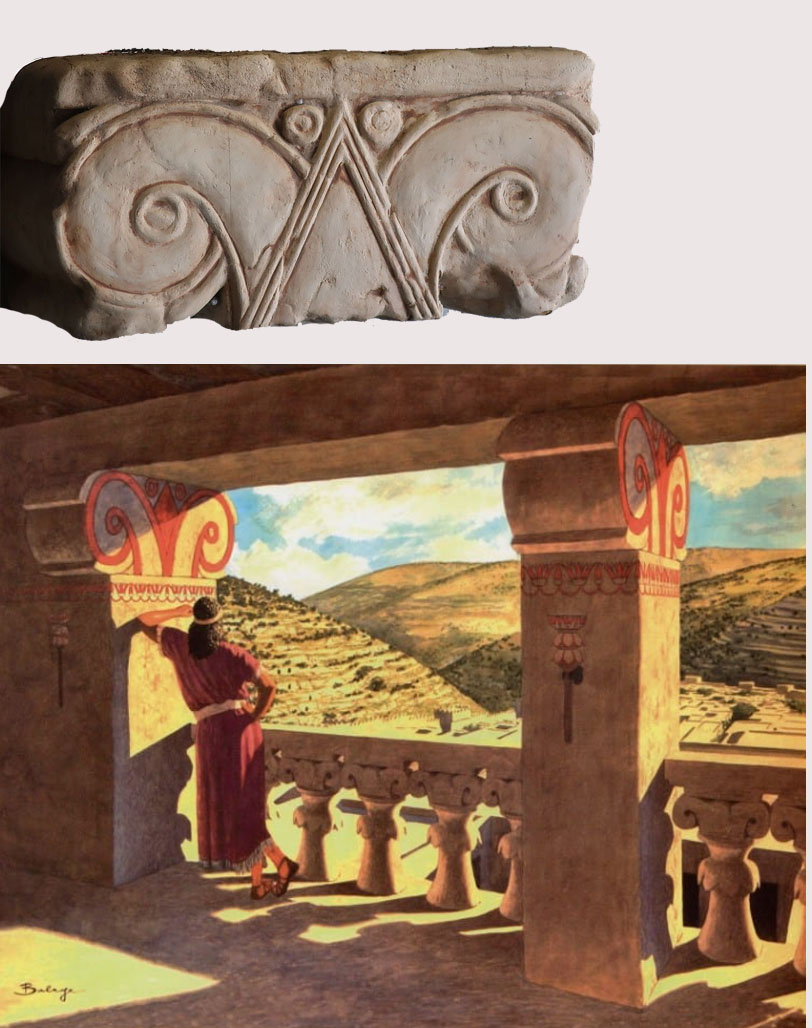
Top: The Aeolic capital found in 1963. Bottom: An artist's illustration of David leaning against a pillar in his palace, looking south over the City of David with the Mount of Olives to his left.
The impressive building also served as an administrative center. Dozens of seals have been found at Millo, which is a sign that there were official archives in the building. A seal, also called a bulla, is a flattened lump of clay with a name or image, about 1 cm in diameter, which was used to seal important documents. The building remained in use until the destruction of Jerusalem. This is known from the names found on three of the seals. These are the names of scribes mentioned in Jeremiah, namely Gemarjahu (Shaphan's son, see ), Jehuchal (Shelemja's son, see ) and Gedaljahu (Pashur's son, see ). In the latter verse, Jehuchal and Gedaljahu are even mentioned together! Other well-known names such as King Hezekiah and the prophet Isaiah were also found here in 2015 and 2018.] 10And David grew more and more powerful, for the Lord (Yahweh), the God of hosts (Elohim Sebaot), was with him. [David gained more authority, the kingdom grew, and his reputation spread.] 11And Hiram, king of Tyre, sent messengers to David, and cedar wood, and carpenters, and stonecutters. And they built [completed] David's house [the palace or administrative building at Millo]. [A trace of their skilled craftsmanship is probably the Aeolic capital found at Millo.] 12
On the Mesha Stele (dated to 840 BC), the Moabites describe their rebellion against Israel. The stone was found in 1868 in Dibon, Jordan, and mentions "Omri, king of Israel" in lines 4-5. The 31st line is damaged, but new analyses in 2022 using 3D technology mean that more and more researchers are confirming that it says "House of David."
Shamoa
and Shovav
and Nathan
and Solomon [these four were the sons of Bathsheba, see ] 15and Jibhar
and Elishoa
and Nefeg
and Jafia
16and Elishama
and Eliada
and Eliphalet. [This is the shortest of the three lists of children born to David in Jerusalem, see ; . While the author shows how David's kingdom was strengthened and how he was blessed with many children, with five more children born in Jerusalem than in Hebron, it is also hinted that this could cause problems in the future, see .]David defeats the Philistines
17When the Philistines heard that David had been anointed king over Israel, all the Philistines went up to seek David, and David heard of it and went down to the stronghold (Hebr. matsodah). [The Philistines came from the cities of Gaza, Ashkelon, Ashdod on the Mediterranean coast, and Ekron and Gath a little further inland from the coast, and moved uphill towards Jerusalem. Some believe that this stronghold refers to the one in Adullam near Bethlehem, which is at a lower altitude (), but based on the geographical position near Refaim and Givon (verses 18, 22, and 25), it is more likely that David moved his headquarters from the palace, which was now built at a higher elevation, down to the stronghold inside the walls of Jerusalem.] 18The Philistines came and spread out in the Valley of Rephaim [the border between Judah and Benjamin southwest of Jerusalem]. 19Then David inquired of the Lord (Yahweh) and said, "Shall I go out against the Philistines? Will you deliver them into my hand?"
And the Lord (Yahweh) said to David, "Go out, for I will surely deliver the Philistines into your hand." 20So David came to Baal-Perazim ["lord of breaking through"; just outside Jerusalem] and David defeated them there, and he said, "The Lord (Yahweh) has broken through my enemies before me, like water breaking through." That is why the place is called Baal-Perazim. [Hebr. Peratsim is the plural of Hebr. perets – to break, crack, make a breach in.] 21There they left their idols, and David and his men took them away. 22But the Philistines came up again and spread out in the Valley of Rephaim. 23When David asked the Lord (Yahweh), he replied: "You shall not go out against them, but circle around behind them and come upon them opposite the weeping trees (Hebr. bachaim). [David should block their retreat westward through the Valley of Rephaim. The tree is probably a balsam tree (Mecca balsam, Gilead balsam) that drips sap when its branches and leaves are broken off. The name comes from the verb for crying (Hebr. bacha), see also ; .] 24And it shall come to pass, when thou hearest the sound of the marching army in the tops of the bacha trees, that thou shalt make ready, for then the Lord (Yahweh) is gone out before thee, and hath smitten the army of the Philistines." 25And David did as the Lord (Yahweh) commanded him, and he defeated the Philistines from Geva [meaning "height"; just west of Jerusalem] until they reached Gezer [along the Ajion Valley to the west, halfway to the Mediterranean coast].The ark of God is brought to Jerusalem (1 Chron. 13:9-12)
61[The Israelites had taken the ark with them into battle because they believed that God's power and presence would be with them, but instead it was taken as spoils of war by the Philistines (, ). For seven months it remained in Ashdod, Gath, and Ekron (), but when their god Dagon fell down and the inhabitants became ill with boils, they sent the ark to Beit-Shemesh. There, the people handle the ark in an unworthy manner, so it is sent on to Kirjat-Jearim (13 km west of Jerusalem, near Abu Gush), where it remains for 20 years in the house of Avinadav (). It remains there during Saul's reign (40 years) and for about 10 years into David's reign. In total, 70 years have passed since the ark left the tabernacle in Shiloh. Now David wants to bring the ark to Jerusalem. His speech to the assembled people is recorded in 1 Chron. 13:2-3. Once again, David gathered all the chosen men of Israel, 30,000 men.] 2And David arose and went with all the people who were with him from Baalah in Judah [also called Kiriath-Jearim, 13 km west of Jerusalem] to bring up from there the ark of God (Elohim), over which the Name is called, the name of the Lord of hosts (Yahweh Sebaot) who sits on the cherubim. [On the lid of the ark were two cherubim, see .] 3And they put the ark of God (Elohim) on a new cart and brought it out of the house of Abinadab on the hill (Hebr. givah), and Uzzah and Ahio, the sons (descendants) [grandsons] of Abinadab, drew the new cart. [According to Moses' instructions, Levites were to carry the ark, see . David's method of bringing up the ark is more similar to that of the Philistines, see , . Instead of examining the Scriptures, David does the same as a pagan people did.] 4And they brought it out of the house of Abinadab, which was on the hill, with the ark of God (Elohim), and Ahio went before the ark. [And Uzzah probably walked behind.] 5And David and all the house of Israel played before the Lord (Yahweh) with all manner of instruments made of cypress wood, and with kithara harps (Hebr. kinnor) and psalteries and tambourines and rattles and cymbals. 6And when they came to the threshing floor of Nacon, Uzzah reached out his hand to the ark of God (Elohim) and took hold of it, for the oxen stumbled. 7Then the anger of the Lord (Yahweh) was kindled against Uzzah, and God (Elohim) struck him there for his mistake, and he died there by the ark of God (Elohim). 8But David was upset because the Lord (Yahweh) had broken down (Hebr. perets) Uzzah, so he called that place Peres-Uzza, as it is still called today. [Perets means to break apart and Uzza means strong. The place is located only 1 km west of Jerusalem. The ark symbolizes God's presence, person, and his promises. In the gold-plated wooden box (1.2 m long and 0.6 m wide and high) were the stone tablets with the commandments, see . Only the high priest was allowed to enter the ark once a year under strict restrictions, and violating this was punishable by death, see ; . The Levites, who were descendants of Kohath, the Kohathites, were the ones who were to perform the tasks related to the ark (, , ). The ark was to be carried (not driven on a cart) and covered with a veil (). When the ark was carried across the Jordan, it was the Levites who carried it, and the people were to keep a distance of 900 meters, see .
The house of Avinadav was in Judah, so he and his sons were probably not Levites, let alone Kohathites. Even if they were, the ark was transported completely incorrectly. The brothers Uzzah and Ahio had grown up with the ark in their house, so there is a risk that, in their familiarity, they did not have sufficient reverence for God's holiness.] 9And David was afraid of the Lord (Yahweh) that day, and he said, "How can the ark of the Lord (Yahweh) come to me?" 10So David did not move the ark of the Lord (Yahweh) to his city, but carried it aside into the house of Obed-Edom the Gittite. 11And the ark of the Lord (Yahweh) remained in the house of Obed-Edom the Gittite for three months, and the Lord (Yahweh) blessed Obed-Edom and all his household. 12
David dances as the Ark is brought into Jerusalem, painting by James Tissot (1896–1902), on display at the Jewish Museum in New York.
God's promise to David
[This passage introduces the court prophet Nathan. He is present during both David's and Solomon's reigns and is the probable author of this book, see . His name means "he gave," "given," or "placed." A key word in this chapter is the Hebr. bait, which means both house and family. Its use can be compared to the English word "royal house," which can refer to both the palace and the royal family. The promise Moses had made to take the land was now fulfilled, see .] 71When the king [David] was sitting in his house [palace in Jerusalem] and the Lord (Yahweh) had given him rest (peace) from all his enemies around him, 2he said to the prophet Nathan, "Behold, I dwell in a house of [beautiful imported] cedar [from Tyre, see ], while the ark of God dwells in a tent." 3Nathan said to the king, "Go and do whatever is in your heart, for the Lord (Yahweh) is with you." A promise of an eternal house
[David's intentions are good. He sees his own beautiful house and has just brought the ark to Jerusalem, see . The prophet Nathan responds immediately, without consulting the Lord, and gives an initial answer based on what seems good. However, it turns out that God has other plans. David had "shed much blood and fought many wars," see . The temple would be built, but now was not God's time.
The following passage is one of the strongest prophetic words in the entire Old Testament. The passage consists of 197 words and is the longest word from the Lord since the days of Moses when he spoke on Mount Sinai.] 4That night, a word came from the Lord (Yahweh) to Nathan, saying: 5"Go and tell my servant David: Thus says the Lord:
Would you build me a house to live in?
6I have not lived in a house since the day I brought the children of Israel out of Egypt until today, but I have moved around in a tent, in a tabernacle. 7Have I ever spoken to any of the tribes of Israel, whom I have led as shepherd of my people Israel, saying, 'Why have you not built me a house of cedar? 8Now you shall say this to my servant David, says the Lord of hosts (Yahweh Sebaot):
It was I who took you from the pasture where you tended sheep,
to be prince over my people Israel. 9I have been with you wherever you have gone
and have cut off all your enemies from you,
and I will make your name great,
like the names of the greatest men on earth.
10I will prepare a place for my people Israel
and plant them so that they may dwell there and no longer be disturbed.
Evil people will no longer oppress them as before, 11since the time I appointed judges over my people Israel.
I will give you rest from all your enemies.
And now the Lord (Yahweh) tells you that the Lord (Yahweh) will build a house (family, dynasty) for you. 12When your time is up and you rest with your fathers, I will raise up your descendant [Solomon (), but also the Messiah – the Son of David, see ; ] who will come from your life, and I will establish his kingdom. 13He shall build a house for my name, and I will establish his royal throne forever. 14I will be his father, and he shall be my son. [Quoted about the Messiah in ]
If he does anything wrong, I will punish him with the rod of men and with the plagues that afflict the children of men. 15But my mercy (loving kindness) will not depart from him, as I took it away from Saul, whom I removed from before you. [] 16Your house [David] and your kingdom shall be established before me forever. Your throne shall be established forever." 17Nathan told David all these words from his vision. [Everything God had said.]David's prayer
[David is deeply moved when he hears Nathan recount the vision from the Lord that a descendant of his will build the Lord's temple. He goes to the meeting tent where the ark is and sits down in God's presence.] 18Then King David went in and sat down before the Lord (Yahweh). [Probably in the tabernacle.] He said [asked God imploringly]:
"Who am I, Lord (Adonai), Lord (Yahweh),
and what is my house (my family, my clan),
that you have brought me this far [from a simple shepherd boy to become king of Israel]?
19You have spoken of this as if it were something small in your eyes (as if this were not enough), Lord (Adonai), Lord (Yahweh). Even though the future of your servant's house [you have spoken], this is teaching (Hebr. torah) for man, Lord (Adonai), Lord (Yahweh). [Man is literally Hebr. Adam and may refer to the promise of a Savior in .] 20What else can David say to you? [This is the third rhetorical question. David now refers to himself in the third person, which is a way of emphasizing his submission to God, and the perspective now shifts to also be God's perspective. The word "know" can also be translated as "you have treated me in a special way."] You know your servant, Lord (Adonai), Lord (Yahweh). [; ] 21According to your promise (for the sake of your word) and according to your heart, you have done all this great thing and let your servant know (understand) it. 22Therefore [because of the promise of an eternal house], you are [have always been] great, Lord (Adonai), Lord (Yahweh)—for there is no one like you, and there is no [other] God (Elohim) besides (apart from; apart from) you, according to all that we have heard with our [own] ears. 23Is there any other people on earth like your people Israel,
whom God (Elohim) himself came and redeemed as his own [],
to make his name known? [The first three questions in verses 18 and 20 focused on David's personal relationship with God; here, in the fourth rhetorical question, the focus shifts to God's special relationship with the Israelites:] You have done great things for them and wonderful things for your land and before the eyes of your people whom you redeemed from Egypt, from the nations and their gods. 24You have made your people Israel your people forever, and you, Lord (Yahweh), have become their God (Elohim). [The following passage, verses 25-29, is a chiasm with the central verse being that God will build David's house, see .] 25And now, Lord (Yahweh), confirm forever the word that you have spoken concerning your servant and his house, and do as you have said. 26And let your name be glorified forever, so that it will be said, 'The Lord of hosts (Yahweh Sebaot) is God (Elohim) over Israel.' And the house of your servant David (David's dynasty) shall be established before you. 27For you, Lord of hosts (Yahweh Sebaot), God (Elohim) of Israel, have revealed (revealed) to your servant and said: 'I will build you a house,'
therefore your servant has taken it upon himself to pray this prayer to you. 28And now, Lord of hosts (Adonai Yahweh), you alone are God (Elohim) and your words are true, and you have spoken (promised) these good things (words – Hebr. davar; can mean both words and things, objects) to your servant. 29Now please bless the house of your servant, that it may continue forever before you, for you, Lord of lords (Adonai Yahweh), have spoken it, and by your blessing you have blessed the house of your servant forever."David's victories
81And after this, David defeated the Philistines and subdued them, and David took (liberated) Meteg-Amma from the hand of the Philistines. 2And he defeated Moab and measured them with a measuring line, making them lie down on the ground, and he measured two rows, which he killed, and one whole row was allowed to live. And the Moabites became David's servants (slaves) and brought gifts. 3David also defeated Hadadezer, son of Rehob, king of Zobah, when he went to establish his supremacy at the Euphrates River. 4And David took from him 1,700 horsemen and 20,000 foot soldiers, and David cut the hamstrings of all the chariot horses, but spared 100 chariots. [A damaged horse could no longer be used in the cavalry, see also ; ; ; .] 5And when the Arameans of Damascus came to help Hadadezer, king of Zobah, David killed 22,000 of the Arameans. 6Then David placed garrisons in Damascus. Aram and the Arameans became servants (slaves) to David and brought gifts. And the Lord (Yahweh) gave David victory wherever he went. 7And David took the gold shields that Hadadezer's servants had and brought them to Jerusalem. 8And from Betach and from Berotai, the cities of Hadadezer, David took a great amount of bronze. 9And when Toi, king of Hamath, heard that David had defeated the entire army of Hadadezer, 10Toi sent his son Joram to King David to congratulate him, and he blessed him because he had fought against Hadadezer and defeated him. For Hadadezer had fought against Toi and had taken with him silver vessels, gold vessels, and bronze vessels. 11David also dedicated this to the Lord (Yahweh) with the silver and gold he had dedicated from all the nations he had subjugated, 12from Aram, from Moab, from the sons of Ammon, from the Philistines, from Amalek, and from the spoils of Hadadezer, son of Rehob, king of Zobah. 13And David made a name for himself when he returned from defeating the Arameans in the Valley of Salt, 18,000 men. 14And he placed garrisons in Edom, throughout Edom he placed his troops, and all the Edomites became servants (slaves) to David. And the Lord (Yahweh) gave David victory wherever he went. [Archaeological finds in Ein Hatzevah in the Negev show defensive towers dating back to the 10th century BC.]David's officials
15And David ruled over all Israel, and David administered justice and righteousness to all his people. 16And Joab, the son of Zeruiah, was over the army (general), and Jehoshaphat, the son of Ahilud, was recorder (chancellor, finance minister), 17and Zadok, the son of Ahitub, and Ahimelech, the son of Abiathar, were priests, and Seraiah was the scribe, 18and Benaiah the son of Jehoiada was over the Cherethites and the Pelethites, and David's sons were chief officers.David's sin (chapters 9-12)
David and Mephibosheth
91And David said, "Is there anyone left of the house of Saul, that I may show him kindness (loving care – Hebr. chesed) for Jonathan's sake?" 2Now there was a servant of Saul's house named Ziba, and they called him to David, and the king said to him, "Are you Ziba?" He said, "Your servant is he." 3The king asked, "Is there anyone left of Saul's house (family) so that I may show God's (Elohim's) kindness (Hebr. chesed) to him?" Ziba answered the king, "Jonathan still has a son who is crippled in both feet." 4And the king said to him, "Where is he?"
Tsiva answered the king, "Behold, he is in the house of Machir, the son of Ammiel, in Lo-Debar." 5Then King David sent and brought him from the house of Machir, the son of Ammiel, in Lo-Debar. 6And Mephibosheth, the son of Jonathan, the son of Saul, came to David and fell on his face and prostrated himself on the ground. But David said, "Mephibosheth!" And he answered, "Here is your servant." 7And David said to him, "Do not be afraid, for I will surely show you kindness (Hebr. chesed) for the sake of Jonathan your father. I will restore all the land of your father Saul, and you shall always eat bread at my table." 8And he bowed down and said, "What is your servant, that you should look upon me, who am like a dead dog?" 9Then the king called for Ziba, Saul's servant, and said to him, "I have given all that belonged to Saul and his whole house to your master's son. 10And you shall work the land for him, you and your sons and your servants, and you shall bring in the fruit, so that your master's son may have bread to eat, but Mephibosheth, your master's son, shall always (continually) eat bread at my table." Ziba had 15 sons and 20 servants. 11And Ziba said to the king, "According to all that my lord the king has commanded his servant, so shall your servant do; but Mephibosheth shall eat at my table as one of the king's sons." [The Hebrew has "my table," referring to King David's table.] 12Mephibosheth had a young son named Micha. And all who lived in Ziba's house were servants to Mephibosheth. 13But Mephibosheth lived in Jerusalem, for he always ate (continuously) at the king's table, and he was lame (crippled) in both his feet. 101And it came to pass after this, that the king of the children of Ammon died, and Hanun his son reigned in his stead. [The name Hanun means unconditional mercy, which is ironic considering how he later treats David's servants, see .] 2And David said, "I will show mercy (caring love – Hebr. chesed) [keep my covenant] to Nahash the son of Chanon in the same way that he showed mercy (Hebr. chesed) [was loyal] to me." So David sent gifts by the hands of his servants to comfort him after the death of his father. And David's servants came to the land of the Ammonites. 3But the princes of the sons of Ammon said to Chanon their lord, "Do you really think that David wants to honor your father by sending comforters to you? Hasn't David sent his servants to you to explore the city and spy on it and overthrow it?" 4So Chanon took David's servants and shaved off half their beards [; ] and cut their clothes in half at the buttocks [so that their genitals were exposed] and sent them away. 5When they told David, he sent [messengers] to meet them, for the men were greatly humiliated (shamed). And the king [David] said, "Stay in Jericho until your beards have grown back, and then return." 6And when the sons of Ammon saw that they had become detestable to David [they understood that they had humiliated David], they sent for
20,000 foot soldiers from Beit-Rachov and Tsova's Arameans,
1,000 men from the king of Maacah, and
12,000 men from Tob.
[An army totaling 33,000 men.] 7And when David heard it, he sent Joab and all the army of mighty men. 8And the sons of Ammon came out and drew up in battle array at the entrance of the gate, and the Arameans of Zobah and Beth-Rechov, and the men of Tov and Maacah were with them in the field. 9Now when Joab saw that the enemy was arrayed against him both in front and behind [when he realized that it would be a two-front war], he chose some of Israel's best men [select warriors] and arrayed them against the Arameans, 10and he entrusted the rest of the people to his brother Avishai, and he placed them in battle formation against the Ammonites. 11And he said, "If the Arameans become too strong for me, then you shall help me, but if the sons of Ammon become too strong for you, then I will help you. 12Be strong (firm, confident, courageous), and let us show ourselves strong for our people and for the cities of our God (Elohim), and the Lord (Yahweh) will do what is best in his eyes." 13So Joab and the people [the army] who were with him drew near to fight against the Arameans, and they fled before him. 14And when the sons of Ammon saw that the Arameans had fled, they likewise fled before Avishai and entered the city [the Ammonite capital of Rabbah, present-day Amman]. Then Joab returned from the sons of Ammon and came to Jerusalem. 15And when the Arameans saw that things were going badly for Israel, they gathered themselves together. 16And Hadadezer [king of Zobah in northern Syria, see ] sent and brought the Arameans who were beyond the River [Euphrates], and they came to Helam, with Shobach, commander of the army of Hadadezer, at their head.[Chejlam means "stronghold"; a place east of the Jordan River, but west of the Euphrates River. It is mentioned only here and in the next verse (and perhaps in ). Chejlam is also mentioned in an Egyptian execution text (to curse their enemies) that is almost a thousand years older; future archaeological finds may help to identify the exact location of the site.] 17And it was told David, and he gathered all Israel together and crossed the Jordan and came to Chejlam. And the Arameans lined up in battle formation against David and fought him. 18And the Arameans fled before Israel, and David slew of the Arameans seven hundred charioteers and forty thousand horsemen, and smote Shovach, the captain of their army, that he died there. 19When all the kings who were servants of Hadadezer [other cities in the northern region of Syria and on the other side of the Euphrates River] saw that they had been defeated by Israel, they made peace with Israel and served them [they became subject to Israel]. And the Arameans never again dared to rescue (help) the sons of Ammon.David's sin with Bathsheba
111[A year has now passed.] And it came to pass at the turn of the year (when the year returned, repeated itself) [the turn of the month of Adar/Nisan] at the time when kings go out [to battle, which usually happens in early spring, after the winter rains in March and before the harvest is gathered in May and all the labor is needed in the fields] that David sent Joab [as his general] and his servants (his army) with him. They destroyed the sons of Ammon and besieged Rabbah [present-day Amman, the capital of Jordan]. But David remained in Jerusalem. 2And it came to pass in the evening [around sunset on a spring evening] that David arose from his bed [after his afternoon rest] and went up to the roof of the king's house, and from the roof he saw a woman bathing, and the woman was very beautiful (good) to look at. 3And David sent and inquired about the woman. And they said, "Is this not Bathsheba (Batseba), the daughter of Eliam, the wife of Uriah the Hittite?" [He was one of David's officers who had gone out to battle with David's army. The name Bathsheba means "daughter of the promise."] 4[David could not get Bathsheba out of his mind.] So David sent messengers and took her, and she came to him, and he lay with her, for she had purified herself from her uncleanness (menstruation), and she returned to her house.
[David was well aware of the commandments in ; and the fact that his action was punishable by death, see ; .] 5And the woman conceived, so she sent word to David, saying, "I am pregnant." [Something had to be done. Both she and David could be punished with death, see .]
[Considering the time of day, evening, and the fact that she had purified herself after her menstruation, it is highly likely that she visited a mikvah for a ritual bath when David saw her from the roof of the house. The week after the purification bath is also the time in a woman's menstrual cycle when the likelihood of becoming pregnant is greatest.]David tries to hide his sin
6[Since it would be obvious that Uriah could not be the father of the child, David devised a plan.] David then sent word to [his general] Joab: "Send me the Hittite Uriah." And Joab sent Uriah to David. 7And when Uriah came to him [an 8-mile walk from Rabbah to Jerusalem], David asked him how Joab was doing, how the people were doing, and how the war was going. 8And David said to Uriah, "Go down to your house and wash your feet."
And Uriah left the king's house, and after him a gift [food and wine] was sent to his house from the king. 9But Uriah slept at the door of the king's house with all his master's servants and did not go down to his house. 10And they told David, saying, "Orija did not go down to his house." David said to Orija, "Have you not come from a journey? Why do you not go down to your house?" 11And Orija said to David, "The ark and Israel and Judah are staying in tents, and my lord Joab and my lord's servants are camping in the open field. Should I go into my house to eat and drink and lie with my wife? As you live and as your soul lives, I will not do such a thing." 12And David said to Orija, "Stay here today also, and tomorrow I will let you go." So Orija stayed in Jerusalem that day and the next day. 13And David called him, and he ate before him and drank, and he became drunk. In the evening he went out and lay on his bed with his lord's servants, but he did not go down to his own house. 14
In central Amman, there are remains from ancient Rabba. Most of the archaeological finds (including those in the picture) are from the later Roman city of Philadelphia, which was part of the ten-city pact in the area, known as the Decapolis.
The prophet Nathan confronts David
121The Lord (Yahweh) sent Nathan to David. And he came to him and said to him: "There were two men who lived in a city, one rich and the other poor. 2The rich man had an abundance of sheep and cattle. 3But the poor man had nothing except a little lamb that he had bought. He raised it, and it grew up with him and his sons. It ate his food, drank from his cup, and slept in his arms. It was like a daughter to him. 4When the rich man had a visitor, he did not want to use any of his own lambs or cattle to feed his guest. Instead, he took the poor man's lamb and prepared it for the man. [The visitor in this parable may allude to the temptation that came over David. At first, he was just a visitor who was then invited in and allowed to take over.] 5David exploded in anger at how the rich man had behaved. He said to Nathan, "As surely as the Lord (Yahweh) lives, the man who did this deserves to die. 6He shall repay the lamb fourfold for what he has done and his lack of compassion." [According to , a lamb must be repaid fourfold, but David himself adds that he also deserves to die. Some translations have "seven times" instead of "four times".] 7Nathan said to David, "You are that man. Thus says the Lord (Yahweh), the God of Israel (Elohim): I anointed you king over Israel, and I rescued you from the hand of Saul, 8and I gave you your master's house and your master's wife [Michal, Saul's daughter] into your arms, and I gave you the house of Israel and Judah, and if that were too little, I would give you much more. 9Why have you despised the word of the Lord (Yahweh) to do what is evil in my sight? You have struck down Uriah the Hittite with the sword and taken his wife to be your wife, and you have struck him down with the sword of the sons of Ammon. 10And now the sword shall never depart from your house [conflicts and strife in the family] because you have despised me and have taken the wife of the Hittite Uriah to be your wife. 11Thus says the Lord (Yahweh): Behold, I will raise up evil against you from your own house, and I will take your wives before your eyes and give them to another man (to your neighbor; someone who lives near you – Hebr. rea), and he shall lie with your wives in broad daylight (in the sunshine) [which Avshalom does, see ], 12for you did this in secret, but I will do these things before all Israel in broad daylight (before the sun)."David acknowledges his sin
13David said to Nathan, "I have sinned against the Lord (Yahweh)." [The confession is short and without excuses, see also . God's response and forgiveness are immediate. Later, David writes a psalm about this event, see , .]
And Nathan said to David, "The Lord (Yahweh) has also taken away your sin; you shall not die. [The punishment was death (; ), but God is merciful, see .] 14Nevertheless (as a consequence), because you have caused the Lord (Yahweh) to be blasphemed [or "truly shown contempt for the Lord"], the son (Hebr. ben) born to you shall die." [The Hebrew in the first line can be interpreted to mean that David has despised the Lord through this sin. The enemies of the Lord may refer to pagans or Israelites who despise how God acts if he lets David get away with murder without punishment. The death of the son shows that God both forgives and is righteous, and that sin has consequences. There is a difference between being forgiven for one's sin and the judgment of sin. God forgave David's sin, but he did not remove all the consequences of the sin. The first was that the child died, see also . This event will affect his family relationships.] 15And Nathan went to his house. Bathsheba's child dies And the Lord (Yahweh) struck the child (Hebr. jeled) that Uriah's wife had borne to David, and it became very ill.
16And David pleaded with God (Elohim) for the young man (Hebr. naar), and David fasted and lay all night on the ground. [Even though Uriah is dead and David is now married to Bathsheba, the reader is reminded that the child was conceived while Uriah was alive. Three different words for the child are used in verses 14-16: son, child, and young man. Hebr. jeled is the usual word for a small child, see verses 15, 18, 19, 21, 22. The use of the word naar here (the only time in this chapter) probably reinforces David's desire for the child to grow up to be a healthy young man. A similar opposite indication of age is found in .] 17And the elders of his house arose and stood beside him to lift him up from the ground, but he would not, nor did he eat bread with them. 18And it came to pass on the seventh day that the child died. But David's servants were afraid to tell him that the child was dead, for they said, "Behold, while the child was still alive, we spoke to him, but he did not listen to our voice; how then can we tell him that the child is dead, lest he harm himself?" 19But when David saw that the servants were whispering among themselves, David understood that the child was dead, and David said to his servants, "Is the child dead?" They replied, "He is dead." 20And David arose from the ground and washed and anointed himself and changed his clothes, and he came into the house of the Lord (Yahweh) and worshipped. Then he came to his own house, and he asked, and they set bread before him, and he ate. 21And his servants said to him, "What is this thing that you have done? You fasted and wept for the child while it was alive, but when the child died, you got up and ate bread." 22And he said, "While the child was still alive, I fasted and wept, for I said (thought), 'Who knows whether the Lord (Yahweh) will show mercy (undeserved love, favor—Hebr. chanan) and let the child live? 23But now he is dead. Why should I fast? Can I bring him back [to life]? I will go to him [will die one day], but he will not return to me [will not come back to life]." 24And David comforted Bathsheba, his wife, and went in to her and lay with her, and she bore a son and named him Solomon. And the Lord loved him 25and he sent [a greeting] by the hand of the prophet Nathan, and he named him Jedidiah, for the Lord's sake. [Solomon means "his shalom," i.e., his peace, prosperity, success, health, and all heavenly blessings. Jedidiah means "beloved of the Lord."]Victory over the Ammonites
[Based on the events in preceding this, Rabbah had been besieged for at least 9 months, perhaps as long as 2 years.] 26Joab fought against Rabbah [meaning "great"; present-day Amman in Jordan] and captured the royal [part of] the city. 27And Joab sent messengers to David, saying, "I have fought against Rabbah and taken the water supply ["water city"] of the city. [Once the city's water reservoir had been captured, it was only a matter of time before the city's inhabitants would surrender.] 28Now gather the rest of the people and encamp opposite the city and take it, or I will take the city and it will be named after me." 29And David gathered all the people together and went to Rabbah and fought against it and captured it. 30And he took the crown of Malkam from his head, and its weight was a talent of gold [34 kg], and there were very precious stones on it, and it was placed on David's head. And he carried away the spoils from the city, very much. 31And he brought out the people who were there and put them under saws and under iron harrows and under iron axes and made them pass through the brick kiln (Hebr. ), and so he did to all the cities of the sons of Ammon. And David and all the people returned to Jerusalem. [The expression "set under" can either refer to him putting them to hard labor, i.e., "subjugating them" (the word is used that way in , ). It can also be interpreted literally to mean that he placed them under saws and other instruments of torture and death, see . The Ammonites were known for their cruelty, see ; . The idol of the Ammonites was Milcom (also called Molech), see , , . The choice of words "pass through" and "brick/brick kiln" may also be a reference to the child sacrifices by fire that these peoples practiced, see ; ; ; . Now they themselves had to go through the same fire in which they had killed their children.]Continued consequences of David's sin
Absalom's revolt
Amnon and Tamar
131And it came to pass after this, that Absalom, David's son, had a beautiful sister whose name was Tamar. [She was the daughter of Maacah, see .] Amnon, David's [eldest] son [], loved her. 2And Amnon was so unhappy that he felt sick because of his sister Tamar, for she was a virgin and it seemed impossible for Amnon to do anything with her. [They were half-siblings and incest was forbidden, see .] 3But Amnon had a friend named Jonadab, a son of David's brother Shimeah. [David's son Amnon and Jonadab were cousins. Shimeah means "fame"; in he is called Shammah.] And Jonadab was a very cunning man. 4And he said to him, "Why, son of the king, have you become so thin (skinny) from day to day? Won't you tell me?"
And Amnon said to him, "I love Tamar, my brother Avshalom's sister." 5And Jonadav said to him, "Lie down on your bed and pretend to be sick, and when your father comes to see you, say to him, 'Let my sister Tamar come, I beg you, and give me bread to eat, and prepare the food before my eyes so that I may see it and eat it from her hand. 6So Amnon lay down and pretended to be sick. When the king came and saw him, Amnon said to the king, "Please let my sister Tamar come and make some cakes in my presence, so that I may eat from her hand." 7And David sent word to Tamar's house, saying, "Go, I beg you, to your brother Amnon's house and prepare food for him." 8And Tamar went to her brother Amnon's house, and he was lying down. And she took dough and kneaded it and made cakes in his sight, and she baked the cakes. 9And she took the pan and set it before him, but he refused to eat. And Amnon said, "Send all the men out from me." And all the men went out from him. 10And Amnon said to Tamar, "Bring the food into the bedroom so that I may eat from your hand." Then Tamar took the cakes she had made and brought them into the bedroom to Amnon, her brother. 11And when she had brought them near him to eat, he took hold of her and said to her, "Come, lie with me, my sister." 12And she said to him, "No, my brother, do not force me, for such a thing should not be done in Israel. [; , ; ; ] Do not do this reckless thing. 13And I, how can I bear my shame? And you, you will be like one of the shameful fools in Israel. And now, speak, I beg you, to the king, for he will not refuse me from you." 14Nevertheless, he would not listen to her voice, but was stronger than she, and he forced her and lay with her. 15And Amnon hated her with a very great hatred, for the hatred with which he hated her was greater than the love with which he had loved her. And Amnon said to her, "Get up and go away." 16And she said to him, "No, because this great wrong of driving me out is worse than the other thing you have done to me." But he did not listen to her. 17And he called his servant who served him and said, "Send this woman away from me and lock the door behind her." 18And she had a garment of many colors on her, for such garments were worn by the king's daughters when they were virgins. And his servant sent her out and shut the door behind her. 19And Tamar put ashes on her head and tore the garment of many colors that she was wearing, and she put her hand on her head and went away, weeping aloud as she went. 20And her brother Avshalom said to her, "Has Aminon [diminutive form of Amnon] your brother been with you? Now, calm down, my sister, he is your brother, do not take this to heart." [The diminutive form is probably used to emphasize how the meaning of Amnon's name, "faithful," did not match his actions. So Tamar remained abandoned (devastated, alone) in her brother Avshalom's house. ] 21But when King David heard about all these things, he became very angry. 22And Avshalom spoke neither good nor bad to Amnon, for Avshalom hated Amnon because he had raped his sister Tamar.Absalom kills Amnon
23And it came to pass, after two years (two years of days), that Absalom had sheep shearing in Baal-Hazor, which is beside Ephraim [two miles north of Jerusalem]. So Absalom invited all the king's sons. [Absalom has a cunning plan to take revenge on Amnon, the goal being to find an opportunity to kill him. Now he had waited two years. Sheep shearing was celebrated as a festive occasion, often with wine, see ; , , .] 24So Avshalom came to the king [David] and said, "Behold, your servants have sheep shearing. O king, I beg you, take your servants and go with us (literally: your servants)." 25But the king [David] said to Avshalom, "No, my son, let us not all go, it will be too burdensome for you." Even though he [Absalom] pressed him [King David], he did not go, but he [David] gave him his blessing. [Even though Absalom has been refused, he has managed to get David's blessing. He has also managed to manipulate his father into a social position that forces him to say yes to the next request. It comes without delay and gives the appearance of innocence: if the king himself cannot come, then let him send "my brother Amnon," the king's heir to the throne, in his place.] 26Then Avshalom said [to his father David], "If you don't want to, I beg you, let my brother Amnon go with us."
And the king said to him, "Why should he go with you?" 27But Avshalom pressed him [David], and he let Amnon and all the king's [David's] sons go with him. 
Absalom's Feast, painting by Niccolo de Simone, 1650.
Absalom returns to Jerusalem
141And Joab, the son of Zeruiah, understood that the king's [David's] heart was over (his thoughts were focused on) Absalom. [Joab is David's nephew and general, see .] 2And Joab sent to Tekoa [south of Jerusalem, between Bethlehem and Hebron] and brought from there a wise woman, and said to her, "I beg you, disguise yourself as someone who is mourning and put on mourning clothes, I beg you, and do not anoint yourself with oil, but be like a woman who has mourned for a long time over a dead person, 3and go in to the king and speak to him in this manner." And Joab put the words in her mouth. 4And when the woman from Tekoa spoke to the king, she fell on her face to the ground and humbled herself and said, "Save (help) the king!" 5And the king said to her, "What is the matter with you?" She replied, "Truly, I am a widow; my husband is dead. 6And your servant has two sons, and they quarreled with each other in the field, and there was no one to separate them, but one struck the other and killed him. 7And now the whole family has risen up against your servant, saying, 'Give us the one who struck his brother, that we may kill him for the life of his brother whom he struck, and destroy the heir as well. In this way they want to extinguish my spark of life (my coal) that remains [my only hope and light], and leave my husband without a name or memory on the face of the earth." 8And the king said to the woman, "Go to your house, and I will give orders concerning you." 9And the woman from Tekoa said to the king, "My lord the king, the guilt shall be on me over the house of my fathers, and the king and his throne shall be blameless." 10And the king said, "Whoever speaks to you, bring him to me, and he shall not touch you again." 11And she said, "I beg you, let the king remember the Lord your God (Yahweh Elohim) so that the avenger of blood does not destroy any more, otherwise they will destroy my son." And he said, "As the Lord (Yahweh) lives, not a hair of your son shall fall to the ground." 12And the woman said, "Let your servant, I pray you, speak a word to my lord the king."
And he said, "Speak." 13And the woman said, "And why then have you devised such a thing against the people of God (Elohim)? By speaking these words, the king is like one who is guilty, in that the king does not take back his exiled one. 14For we must die and are like water spilled on the ground that cannot be gathered up again, but God (Elohim) does not take away a soul (extinguish life) without having plans so that the exiled will not be cast out from him forever. 15And now that I have come to speak these words to my lord the king, it is because the people have made me afraid, and your servant said (thought): 'I will speak to the king, perhaps the king will grant his servant's request. 16For the king will listen to save his servant from the hand of the man who would destroy me and my son together from the inheritance of God (Elohim).'" 17And she said, "Let the word of my lord the king be comfort to me, for my lord the king is like an angel of the Lord (Yahweh) in discerning good and evil, and the Lord your God (Yahweh Elohim) is with you." 18And the king answered and said to the woman, "Hide nothing from me, I pray thee, whatever I shall ask thee." And the woman said, "Speak, I pray thee, my lord the king." 19And the king said, "Is Joab's hand with you in all this?" And the woman answered and said, "As my soul lives, my lord the king, no one can turn (deviate) to the right or to the left from all that my lord the king speaks, for your servant Joab, he commanded me, and he put all these words in the mouth of your servant, 20to change the circumstances (literally, to turn the tables) in this matter, your servant Joab has done this, and my lord is wise, like the wisdom of the angels of God (Elohim), to know (be aware of) everything that is on earth." 21And the king said to Joab, "Behold, I have granted this matter; go and bring back the young man Absalom." 22And Joab fell on his face to the ground and humbled himself and blessed the king, saying, "Today your servant knows that I have found favor (undeserved love) in your eyes, my lord the king, in that the king has granted the request of his servant." 23And Joab arose and went to Geshora and brought Avshalom to Jerusalem. 24And the king said, "Let him return to his own house, but let him not see my face." And Avshalom returned to his own house and did not see the king's face. 25In all Israel there was no one as handsome as Absalom; from the soles of his feet to the crown of his head there was no blemish (no fault) in him. 26And when he cut his hair, at the end of each year he cut it, because his hair was heavy on him, so he cut it, and he weighed the hair on his head, and it weighed 200 shekels [2.3 kg] according to the king's weight. 27And to Avshalom were born three sons and one daughter whose name was Tamar, she was a woman of beautiful appearance. 28And Avshalom lived two full years in Jerusalem, and he did not see the king's face. 29And Avshalom sent for Joab to send him to the king, but he did not come to him, and he sent for him a second time, but he did not come. 30Therefore, he said to his servants, "Behold, Joab's field is near mine, and he has barley there; go and set it on fire." And Absalom's servants set the field on fire. 31And Joab arose and came to Absalom to his house and said to him, "Why have your servants set my field on fire?" 32And Absalom said to Joab, "Come here, that I may send you to the king to say, 'Why have I come here from Geshur? It would be better for me to remain there. Let me see the king's face, and if there is any guilt in me, let him kill me. 33And Joab came to the king and told him. And when he had called for Absalom, he bowed himself with his face to the ground before the king, and the king kissed Absalom.Absalom's rebellion
151
Assyrian soldiers on horseback capturing the city of Astaru in Jordan. Relief from the palace of Tiglath-Pileser III in Nimrod (720-737 BC).
David's flight from Jerusalem
17And the king went, and all the people followed him, and they stayed in Beit-Merchaq. 18And all his servants passed over his hand (by him), and all the Kerethites, and all the Pelethites, and all the Gittites, 600 men who came on foot from Gath passed over the king's face (went by him). 19And the king said to Ittai the Gittite, "Why are you also going with us? Return and stay with the king, for you are a foreigner and are in exile from your own place. 20Yesterday you came, and today I would let you go up and down with us and see where I go? Return, and take your brothers with you in mercy and truth." [Mercy and truth (Hebr. chesed ve emet) are inseparable. They are always presented in the same order and are found in God's own testimony, see . Grace without truth becomes useless, while truth without grace becomes merciless.] 21And Ittai answered the king and said, "As the Lord (Yahweh) lives, and as my lord the king lives, surely in the place where my lord the king is, whether for death or for life, there shall your servant be." 22And David said to Ittai, "Go and pass over." And Ittai the Gittite passed over, and all his men, and all the little ones that were with him. 23And all the land wept aloud as all the people passed over, and when the king passed over the brook Kidron, all the people passed over and took the way toward the wilderness. 24And behold, Zadok and all the Levites with him came and carried the ark of the covenant of the Lord (Yahweh), and they set down the ark of God (Elohim), but Abiathar went up until all the people had passed out of the city. 25And the king said to Zadok, "Carry back the ark of God (Elohim) to the city. If I find favor (undeserved love – Hebr. chen) in the eyes of the Lord (Yahweh), he will bring me back and show me both it and his dwelling place, 26but if he says, 'I have no pleasure in you,' behold, here I am (I take responsibility), let him do to me what seems good in his eyes." ["Here I am" Hebr. hineni means to be available and to take responsibility, see .] 27And the king said to the priest Zadok, "See? Return to the city in peace (shalom) and Achimaats, your son, and Jehonatan, the son of Evjatar, your two sons with you. 28I will remain in the plain of the wilderness until word comes from you to tell me." 29Zadok and Abiathar carried the ark of God (Elohim) back to Jerusalem, and they stayed there. 30And David went up the slope of the Mount of Olives and wept as he went up, and he had his head covered and walked barefoot. And all the people who were with him covered their heads, and they went up and wept as they went up. 31And they told David, saying, "Ahithophel is among those who conspire with Absalom." And David said, "Lord (Yahweh), I pray you, turn Ahithophel's counsel into folly." 32And it came to pass, when David was come to the top of the hill, where God (Elohim) is usually worshipped, that Hoshai the Archite came to meet him with his cloak torn and earth on his head. 33And David said to him, "If you go on with me, you will be a burden to me, 34but if you return to the city and say to Avshalom, 'I will be your servant, O king, as I have been your father's servant before, so now I will be your servant. And you shall thwart Ahithophel's counsel for me. 35And with you there are Zadok and Abiathar, the priests. Therefore, whatever you hear from the king's house, you shall tell Zadok and Abiathar, the priests. 36Behold, they have their two sons with them, Hos, the son of Zadok, and Jonathan, the son of Abiathar, and through them they shall send everything to me so that I may hear it." 37And Hushai, David's friend, came into the city at the same time that Absalom was entering Jerusalem. 161And when David had passed the top [of the Mount of Olives], behold, Ziba, the servant of Mephibosheth, met him with a pair of donkeys, and on them 200 loaves of bread and 100 cakes of raisins and 100 summer fruits and a jar of wine. 2Then the king said to Ziba, "What do you mean by this?" Ziba said, "The donkeys are for the king's household to ride on, and the bread and summer fruit are for the young men to eat, and the wine is for those who are faint in the wilderness to drink." 3The king asked, "Where is your master's son?"
Tsiva answered the king, "Behold, he is staying in Jerusalem, for he said, 'Today the house of Israel will restore to me the kingdom of my father. [This was probably a lie from Tsiva, if Mephibosheth's account later on is correct, see .] 4And the king said to Ziba, "Behold, all that belongs to Mephibosheth is yours." And Ziba said, "I humbly beg you, let me find favor (undeserved love – Hebr. chen) in your eyes, my lord the king."Shimi curses David
5
Illustration by Scottish artist William Hole, 1846-1917.
Advice from Ahithophel
15And Absalom and all the people, the men of Israel, came to Jerusalem, and Ahithophel with him. 16And it came to pass, when Choshai the Arkite, David's friend, had come to Absalom, that Choshai said to Absalom, "Long live the king, long live the king." 17And Absalom said to Hushai, "Is this your kindness (loving care – Hebr. chesed) toward your friend? Why did you not go with your friend?" 18And Choshai said to Avshalom, "No, but the one whom the Lord (Yahweh) and this people and all the men of Israel have chosen, he shall be king, and with him I will be. 19And secondly, whom should I serve? Should I not serve before his son? As I served before your father, so shall I be before your face." 20And Avshalom said to Ahithophel, "Give your advice, what should I do?" 21And Ahithophel said to Absalom, "Go in to your father's concubines, whom he has left to keep the house, and all Israel will hear that you have made yourself odious to your father, and the hands of all who are with you will be strengthened." 22So they pitched a tent for Absalom on the roof of the house, and Absalom went in to his father's concubines in the sight of all Israel. 23And Ahithophel's counsel in those days was as if a man had inquired of the word of God (Elohim). Such was all Ahithophel's counsel to David, and also to Absalom. 171And Ahithophel said to Absalom, "Now let me choose 12,000 men, and I will arise and pursue David tonight, 2and I will overtake him while he is weary and weak-handed, and I will frighten him, and all the people who are with him will flee, and I will strike down only the king, 3and I will bring back all the people to you, when everyone has returned, except the man you are seeking, and all the people will have peace (shalom)." 4And his word pleased Avshalom and all the elders of Israel. 5And Avshalom said, "Call, I pray thee, also Choshai the Arkite, and let us hear what he has to say." 6When Choshai came to Avshalom, Avshalom spoke to him and said, "Here is what Achitofel has said [the advice he has given us]. Should we do according to his word or not? Speak." 7So Choshai said to Absalom, "The advice that Ahithophel has given this time is not good." 8And Choshaj said, "You know your father and his men, that they are mighty warriors (men in their prime, full of their own strength and power) and they are embittered in their souls (minds) like a bear robbed of her cubs in the field, and your father is a warrior and does not spend the night with the people. 9Behold, he is now hiding in some hole or some place, and it shall come to pass when they first attack them that whoever hears it shall say, 'There is slaughter among the people who follow Avshalom, 10and even the son of the warrior, whose heart is like the heart of a lion, will melt completely, for all Israel knows (is well acquainted with) that your father is a mighty warrior and those who are with him are able warriors. 11But I advise that all Israel gather to you from Dan to Beersheba, as numerous as the sand by the sea (impossible to count), and that you yourself (personally) go out to battle. 12Then we will overtake him wherever he is found, and we will fall upon him as dew falls on the ground, and none of his men will be left, not a single one. 13And if he withdraws to a city, all Israel shall bring ropes to that city, and we shall pull it down to the valley until not a single small stone is found there." 14And Absalom and all the men of Israel said, "The advice of Ahithophel the Arkite is better than the advice of Ahithophel." For the Lord (Yahweh) had determined to thwart the advice of Ahithophel, so that the Lord (Yahweh) might bring evil upon Absalom. 15And Hushai said to Zadok and to Abiathar, the priests, "This and this is Ahithophel's counsel to Absalom and to the elders of Israel, and this is my counsel to them. 16Therefore, send quickly and tell David, saying, 'Do not spend the night in the plain of the wilderness, but go to one of the passes of the wilderness, lest the king be swallowed up, and all the people who are with him. 17Now Jonathan and Ahimaaz were at En-Rogel, and a servant girl went and told them, and they went and told David, for they did not want to be seen in the city. 18But a young man saw them and told Absalom, and they both went quickly and came to a man's house in Bahurim who had a well in his courtyard, and they went down there. 19And the woman spread a blanket over the opening of the well and scattered gravel on top of it, and no one knew anything. 20And Absalom's servants came to the woman of the house and said, "Where are Ahimaaz and Jonathan?" The woman answered them, "They have gone over the watering place (Hebr. michal)." [An unusual word for a stream, may be its name.] And when they had searched and could not find them, they returned to Jerusalem. 21And it came to pass, after they had gone, that they came up from the well and went and told King David. And they said to David, "Arise and cross the water [the Jordan River] immediately, for Ahithophel is advising you." 22And David arose, and all the people that were with him, and crossed over the Jordan. By the light of dawn, there was not one of them who had not crossed over the Jordan. 23And when Ahithophel saw that his counsel was not followed, he saddled his donkey and went up and went to his city and set his house in order and hanged himself and died. And he was buried in his father's tomb. 24And David came to Mahanaim, and Absalom crossed the Jordan, he and all the men of Israel with him. 25And Absalom had appointed Amasa over the army instead of Joab. Amasa was the son of a man named Itra, an Israelite who had gone in to Abigail (Hebr. Avigal) [short form of Abigail], the daughter of Nahash, the sister of Zeruiah, the mother of Joab. 26And Israel and Absalom encamped in the land of Gilead. 27And it came to pass, when David came to Mahanaim, that Shobi, the son of Nahash, from Rabbah of the land of the Ammonites, and Machir, the son of Ammiel, from Lo-Debar, and Barzillai, the Gileadite, from Rogelim, 28brought beds and basins and carved (sculpted) clay vessels and wheat and barley and flour and roasted grain and beans and lentils and roasted legumes 29and honey and butter (cheese) and sheep and milk for David and for the people who were with him to eat, for they said, "The people are hungry and tired and thirsty in the wilderness."Absalom is defeated
[The passage is framed by David waiting at the gate, see and .] 181And David counted the people who were with him and appointed commanders over 1,000 and commanders over 100. 2And David sent out the people, a third under the command of Joab, a third under the command of Abishai, the son of Zeruiah, Joab's brother, and a third under the command of Ittai the Gittite. And the king said to the people, "I myself will surely go with you." 3But the people said, "You shall not go with us, for if we flee, no one will care about a single soul; and if half of us die, no one will care about a single soul; but you are like 10,000, and now it is better that you deliver us out of the city." 4And the king said to them, "What is best for me to do in your eyes?"
And the king stood by the gate, and all the people went out (in groups) of 100 and of 1,000. 5But the king commanded Joab and Avishai and Ittai, saying, "For my sake, treat the young man Avshalom gently." And all the people heard when the king gave orders to all the leaders concerning Avshalom. 6And the people went out into the field against Israel, and the battle took place in the forest of Ephraim. 7And the people of Israel were defeated there before David's servants, and there was a great slaughter that day, 20,000 men. 8And the battle spread throughout the whole land, and the forest devoured more people than the sword devoured that day. 9
Absalom's Death, wood engraving from 1877 by Julius Schnorr Carolsfeld.
David mourns
19And Ahimaaz, the son of Zadok, said, "Let me run and bring the king the news of how the Lord (Yahweh) has avenged him of his enemies." 20But Joab said to him, "You shall not carry any news today, but you shall carry news another day; but today you shall carry no news, because the king's son is dead." 21And Joab said to the Cushite, "Go and tell the king what you have seen." And the Cushite bowed down before Joab and ran away. 22And once again Ahimaaz, the son of Zadok, said to Joab, "Why won't you let me, I beg you, let me also run after the Cushite." And Joab said, "Why do you want to run, my son, you will not receive any reward for this news?" 23"What prevents me from running?" But he [Joab] answered him, "Run." And Ahimaaz ran the way of the plain and outran the Cushite. 24Meanwhile, David was sitting between the two gates, and the watchman went up to the roof of the gate on the wall and lifted up his eyes and saw, and behold, a man running alone. 25The watchman called out and told the king.
The king said, "If he is alone, he has news in his mouth." And he came quickly closer. 26And the watchman said, "Look, another man is running alone." And the king said, "He also has news." 27And the watchman said, "The running style of the one in front looks like that of Achimaats, the son of Tsadoq." And the king [David] said, "He is a good man and brings good news." 28And Achimaats cried out and said, "Shalom (all is well)!" Then he bowed down before the king with his face to the ground and said, "Blessed be the Lord your God (Yahweh Elohim), who has delivered the men who rose up (raised their hands) against my lord the king." 29And the king said, "Is the young man Absalom safe?" And Ahimaaz answered, "When Joab sent the king's servants and me, your servant, I saw a great commotion, but I do not know what it was." 30And the king said, "Stand aside and stand there." And he stood aside and stood still. 31And behold, the Cushite came and the Cushite said, "News to my lord the king, for the Lord (Yahweh) has avenged you today on all those who rose up against you." 32And the king said to the Cushite, "Is the young man Absalom safe?" And the Cushite answered, "My lord the king's enemies and all who rose up against you to harm you are like that young man." 33And the king was very upset and went up to the chamber above the gate and wept, and as he went, he said, "My son Absalom, my son, my son Absalom! If only I had died in your place, Absalom, my son, my son!" 191And they told Joab, "Behold, the king weeps and mourns for Absalom." 2And the victory that day was turned into mourning for all the people, for the people heard it said that day, "The king mourns his son." 3And the people crept into the city that day, as people who are ashamed when they retreat and flee in battle. 4And the king covered his face, and the king cried aloud, "My son Absalom, Absalom, my son, my son!" 5And Joab came into the house to the king and said, "Today you have brought shame on the faces of all your servants, who today have saved your life and the lives of your sons and your daughters and the lives of your wives and the lives of your concubines, 6by loving those who hate you and hating those who love you. For you have shown today that princes and servants are nothing to you. For I know today that if Absalom had lived and we had all died today, it would have pleased you well. 7Now rise up, go out and speak to the hearts of your servants, for I swear by the Lord (Yahweh), if you do not go out, not a man will remain with you overnight, and it will be worse for you than all the evil that has befallen you from your youth until now."David returns
8And the king arose and sat in the gate. And they told the people, saying, "Behold, the king is sitting in the gate," and all the people came before the king. But Israel had fled, every man to his tent. 9But all the people were quarreling (arguing) in all the tribes of Israel, saying, "The king saved us from the hand of our enemies, and he saved us from the hand of the Philistines, but now he has fled from the land because of Absalom. 10And Absalom, whom we anointed king over us, died in battle. And now, why is there no word about bringing the king back?" 11And King David sent messengers to Zadok and to Abiathar, the priests, saying, "Speak to the elders of Judah and say, 'Why are you the last to bring the king back to his house? For the word of Israel had come to the king, to bring him back to his house. 12"You are my brothers, you are my bones and my flesh, so why should you be the last to bring the king back?" 13And say to Amasa, 'Are you not my bone and my flesh? May God (Elohim) do so to me and more also, if you do not become commander of the army before me in place of Joab forever. 14And he turned the hearts of all the men of Judah, as if they were one man, so that they sent word to the king, "Come back, you and all your servants!" 15And the king returned and came to the Jordan. And Judah came to Gilgal to go and meet the king and bring the king across the Jordan. 16And Shimei the Benjamite, the son of Gera, who was from Bahurim, hurried to come down with the men of Judah to meet King David. 17And there were 1,000 men of Benjamin with him, and Ziba, the servant of the house, and his 15 sons and his 12 servants with him. And they hurried down to the Jordan [and crossed it] before the king. 18And they went back and forth at the ford to bring over the king's household and to do what was good in his eyes. When Shimei, the son of Gera, was about to cross the Jordan, he fell down before the king's face. 19He said to the king, "Do not let my lord hold me guilty, nor remember the wrong that your servant did on the day that my lord the king went out of Jerusalem, so that the king would take it to heart. 20For your servant did not know that he was sinning. Therefore, I have come first of all today from the whole house of Joseph [the northern tribes] to go down and meet the king." 21But Avishai, the son of Zerah, answered and said, "Should not Shimei be put to death for this, because he cursed the Lord's (Yahweh's) anointed?" 22And David said, "What have I to do with you, Zerah's son, that you should be my advocate today? Shall any man be put to death in Israel today? Do I not know that I am king of Israel today?" 23And the king said to Shimei, "You shall not die." And the king swore to him. 24And Mephibosheth, Saul's grandson (son), came down to meet the king [David], and he had not put shoes on his feet, nor trimmed his beard, nor washed his clothes from the day the king left until the day he came home in peace (shalom). 25And it came to pass, when he came to Jerusalem to meet the king, that the king said to him, "Why did you not go with me, Mephibosheth?" 26And he [Mephibosheth] said, "My lord the king, my servant [Tsiva] deceived me [], for your servant said, 'I will saddle a donkey for myself so that I may ride on it and go with the king, since your servant is lame. 27And he has slandered your servant to my lord the king, but my lord the king is an angel (messenger) of God (Elohim), so do what is good in your eyes. 28Although my father's whole house deserved death at the hand of my lord the king, you have set your servant among those who eat at the king's own table. What right do I have to this? And to complain to the king?" 29And the king [David] said to him [Mephibosheth], "Why do you keep talking about this? I say, you and Ziba shall divide the land." [David fulfills his promise to Ziba (), but his actions toward Mephibosheth are not right. The Talmud considers this a huge failure on the part of King David. For this misjudgment, God later punished David by dividing his land in two during the days of his grandson Rehoboam. Intellectually, David knew that Ziba had misled him with his malicious slander of Mephibosheth. But the emotional impact of the anger he had originally felt when he heard that Jonathan's son had betrayed him lingered within him.] 30And Mephibosheth said to the king, "Let him take everything, since my lord the king has come home in peace (shalom) to his own house." 31And Barzillai the Gileadite came down from Rogelim and went to the Jordan with the king to escort him on his way across the Jordan. 32And Barzillai was a very old man, 80 years old, and he had provided for the king while he was staying in Mahanaim, for he was a very great man. 33And the king said to Barzillai, "Come over with me, and I will provide for you in Jerusalem." 34And Barzillai said to the king, "How many days are the years of my life, that I should go up with the king to Jerusalem? 35I am now 80 years old; can I distinguish between good and evil? Can your servant taste what I eat or what I drink? Can I still hear the voice of a man singing or a woman singing? Why then should your servant be a burden to my lord the king? 36Your servant will only cross the Jordan with the king, and why should the king repay me with such a reward? 37Let your servant, I beg you, return so that I may die in my own city, at the grave of my father and mother. But see your servant Kimham, let him cross over with my lord the king and do to him what is good in your eyes." 38And the king answered, "Kimham shall cross over with me, and I will do for him whatever seems good to you, and whatever you ask of me, I will do for you." 39And all the people crossed the Jordan, and the king crossed over, and he kissed Barzillai and blessed him, and he returned to his own place. 40And the king went over to Gilgal, and Kimham went over with him. And all the people of Judah brought the king over, and half the people of Israel. 41And behold, all the men of Israel came to the king and said to the king, "Why have our brothers, the men of Judah, stolen you away and brought the king and his household across the Jordan, and all the men of David with him?" 42And all the men of Judah answered the men of Israel, "Since the king is a close relative of ours, why are you angry about this matter? Have we eaten at the king's expense, or has any gift been given to us?" 43And the men of Israel answered the men of Judah and said, "We have ten parts (literally, ten hands are ours) of the king, and also in David more than you. Why do you despise us (make us light) and not let this matter be first to us to bring the king home?"
But the word of the men of Judah were harder than those of the men of Israel.Sheba's revolt
201And there met them a worthless (useless – Hebr. belijaal) man whose name was Sheba, the son of Bichri, a man of Benjamin. [Sheba was from the same tribe as Saul, perhaps even a relative, see .] And he blew the shofar and said, "We have no part in David, nor do we have any inheritance in the son of Jesse. Every man to his tent, Israel!" 2Then all the men of Israel (literally: went up from following) David and followed [instead] Sheba, the son of Bichri. But the men of Judah remained loyal to their king [David], from the Jordan to Jerusalem. 3And David came to his house in Jerusalem, and the king took the ten women, his concubines, whom he had left to take care of the house, and put them in a separate section and provided for them, but he did not go in to them. They lived confined in widowhood until the day they died. 4And the king said to Amasa, "Summon the men of Judah within three days, and be here yourself." 5And Amasa went and gathered the men of Judah, but he delayed beyond the time that was appointed for him. 6And David said to Avishai, "Now Sheba, the son of Bichri, will do us more harm than Absalom did. Take your lord's servants and pursue him, lest he take fortified cities and escape from our sight." 7So Joab's men went out after him, along with the Kerethites, the Pelethites, and all the mighty men (men in their prime, full of strength and power), and they went out from Jerusalem to pursue Sheba, the son of Bichri. 8When they were at the great stone which is in Gibeon, Amasa came out to meet them. And Joab was girded with his armor which he had put on, and there was a belt with a sword fastened to his hip in its sheath, and as he went forward it fell out. 9And Joab said to Amasa, "Shalom (are you well), my brother." And Joab took Amasa by the beard with his right hand to kiss him. 10But Amasa did not think about the sword in Joab's hand, and he struck him in the groin with it, and his entrails came out, and he did not strike him again, and he died. And Joab and his brother Avishai pursued Sheba, the son of Bichri. 11And a man stood by him from among Joab's young men and said, "Whoever is for Joab and whoever is for David, let him follow Joab!" 12And Amasa lay writhing in his blood in the middle of the highway. And when the man saw that all the people stood still, he [the man who spoke in ] carried Amasa away from the highway into the field and threw a cloak over him, because he saw that all who came upon him stood still. 13When he was removed from the highway, all the people followed Joab to pursue Sheba, the son of Bichri. 14And he went through all the tribes of Israel to Abel and Beth-Maachah and all the Berites, and they gathered themselves together and went after him. 15And they came and besieged him in Abel of Beth-Maacah, and they cast up a mound against the city, and they stood in the siege, and all the people who were with Joab beat the wall to tear it down. 16And a wise woman cried out from the city, "Listen, listen, I beg you, I say to you, to Joab, come here so that I may speak with you." 17And he came near her, and the woman said, "Are you Joab?"
He replied, "I am."
She said to him, "Hear the words of your servant."
He said, "I am listening." 18And she spoke and said, "The speakers who spoke from the beginning (in times past) said, 'Those who ask, ask for advice in Avel, so it was decided (a dispute or question). 19We are the most peaceful and faithful in Israel, and you are trying to destroy a mother city (important central city) in Israel. Why do you want to destroy the Lord's inheritance? 20And Joab answered and said, "Far be it from me that I should devour and that I should destroy. 21The matter is not so. But a man from the hill country of Ephraim, Sheba, the son of Bichri, has lifted his hand against the king, against David. Give him to us, and we will leave the city." The woman said to Joab, "Behold, his head shall be thrown to you over the wall." 22And the woman went to all the people in her wisdom. And they cut off the head of Sheba, the son of Bichri, and threw it to Joab. And he blew the trumpet, and they left the city, each to his tent. And Joab returned to Jerusalem to the king.David's closest leaders
[This is the second enumeration of David's closest leaders in the Book of Samuel, see .] 23And Joab commanded (was over) the whole army of Israel []
and Benaiah, the son of Jehoiada, commanded the Cherethites
and commanded the Pelethites,
24and Adoram commanded (was over) the Levites
and Jehoshaphat, the son of Ahilud, was the secretary,
25and Sheba was the scribe
and Zadok and Abiathar were priests,
26and Ira the Jairite was also a priest to David. [The name Ira means "guardian of the city"; he was a priest (Hebr. kohen) in the royal household. Ira's sons are mentioned in the list in .]The end of David's reign
Famine because of Saul's wars
211And there was a famine in the days of David, three years, year after year, and David sought the face of the Lord (Yahweh). And the Lord (Yahweh) said, "It is because of Saul and the blood of his house, because he killed the Gibeonites." 2And the king called the Gibeonites and said to them, "The Gibeonites were not of the sons of Israel, but were a remnant of the Amorites, and the sons of Israel had sworn to them, but Saul sought to kill them in his zeal for the sons of Israel and Judah. 3And David said to the Gibeonites, "What shall I do for you? And how shall I make atonement, that you may bless the inheritance of the Lord (Yahweh)?" 4And the Gibeonites said to him, "It is not a matter of silver or gold between us and Saul or his house. Nor is it our business to kill any man in Israel." And he said, "What do you say I should do for you?" 5And they said to the king, "The man who destroyed us and conspired against us, so that we have ceased to be within any of the borders of Israel, 6let seven men of his sons be given to us, and we will hang them up to the Lord (Yahweh) in Saul's Gibeah, the Lord's (Yahweh's) chosen one." So the king said, "I will give them to you." 7But the king saved Mephibosheth, Jonathan's son, Saul's son, because of the oath of the Lord (Yahweh) between them, between David and Jonathan, Saul's son. 8And the king took the two sons of Rizpah, the daughter of Aiah, whom she bore to Saul, Armoni and Mephibosheth, and the five sons of Saul's daughter Michal, whom she bore to Adriel, the son of Barzillai the Meholathite, 9and he gave them into the hands of the Gibeonites, and they hanged them on the mountain before the Lord (Yahweh), and they all seven fell together. And they were killed in the days of harvest [April/May], on the first day at the beginning of the barley harvest. [This takes place on the day of the first fruits, yom ha-bikkurim.] 10And Rizpah, the daughter of Aiah, took sackcloth and spread it out for herself on the rock from the beginning of the harvest until water was poured on it from the heavens, and she did not allow the birds of the heavens to rest on it by day or the beasts of the field by night. [Normally, it does not rain in Israel from the beginning of the barley harvest in the spring until the entire harvest is completed in the fall after the feasts. From the end of March to the end of October in our calendar.] 11And they told David what Rizpah, the daughter of Aiah, Saul's concubine, had done. 12And David went and took the bones of Saul and his son Jonathan from the men of Jabesh-Gilead, who had stolen them from the open place at Beth-Shan, where the Philistines had hung them, on the day the Philistines struck Saul at Gilboa. 13And he brought them up from there, the bones of Saul and the bones of Jonathan his son, and gathered the bones of those who were hanged. 14And they buried the bones of Saul and Jonathan his son in the land of Benjamin in Zela, in the tomb of his father Kish. And they did all that the king commanded. And afterward, God (Elohim) was propitiated toward the land. 15And the Philistines were again at war with Israel, and David went down and his servants [soldiers] with him and fought against the Philistines. But David grew weary. 16Then Ishbi-Benov, who was a child of the Rephaim (the giant – Hebr. ha-rapha), whose spear weighed 300 shekels of bronze [3.4 kg], had girded himself with a new suit of armor – he intended to kill David. [] 17But Avishai, the son of Zeruiah, helped him [David] and struck down the Philistine and killed him. And David's men swore to him, saying, "You shall not go out with us to battle again, lest you quench the lamp of Israel." 18And it came to pass after this, that there was a battle with the Philistines in Gow [meaning: cistern; may be Gezer – a trading city halfway between Joppa and Jerusalem, see ]. At that time Sibbecai the Hushathite struck down Saph [Sippai, see ], who was one of the children of the Rephaim (a giant). 19And there was again a battle with the Philistines at Gov. And Elhanan, the son of Jaare-Oregim, the Bethlehemite, struck down Goliath, whose spear had a shaft like a weaver's beam. [In it is clarified that this was a brother of the Goliath whom David had previously struck down, see .] 20Then there was another battle at Gath. There was a hero there who had six fingers on each hand and six toes on each foot—a total of 24 [fingers and toes], and he too was born to the Rephaim (a giant). 21And when he taunted Israel [the army of Israel, in a similar way to Goliath earlier, see ], Jonathan, a son of David's brother Shimeah, struck him down. [; Shimeah was David's father Jesse's third son, see .] 22These four [Jishbi-Benov, Sibbechai, Goliath's brother, and the man with six fingers and six toes] were born to the Rephaim (giants) in Gath, and they fell by the hand of David and by the hand of his servants. []David's song – thanks for the victory
221David spoke to the Lord (Yahweh), the words of this song, on the day when the Lord saved him from the hand of all his enemies and from the hand of Saul.
This song is also found as a psalm, see .
Some differences:
hand – Hebr. kaf , jad in .
cry – Hebr. qara , sawa in
rock besides – mibbalade" , zulati in .
Structure: The song is structured as a chiasm on several levels.
A Introductory praise, verses 2-7
B God's intervention, verses 8-20
C God's faithfulness, verses 21-30
B´ God gives strength, verses 31-46
A´ Concluding praise, verses 47-51
Introductory praise
2He [David] said: The Lord (Yahweh) is
my rock (impregnable mountain ridge, protected place)
and my fortress (my stronghold)
and my savior (liberator).
3My God (Elohim)
my rock (my solid point; my massive mountain) – to whom I take refuge [],
my shield,
my horn of salvation [the horn of a wild ox is a metaphor for military strength and victory] and
my tower of defense (my fortress, my stronghold, my safe height)
my refuge (my refuge, elevated place, high on a mountain)
my savior (rescuer)!
You saved me from violence (evil). 4Hallelujah (worthy of praise, all praise to you)!
I cried out (raised my voice in prayer) to the Lord (Yahweh) and was saved from my enemies. 5The ropes of death surrounded me,
the rivers of Belial (the evil chaotic, satanic) streams (the rushing waters) terrified (attacked) me [wanted to drown me].
6The ropes of Sheol (the underworld) were wrapped (entangled) around me,
the snares of death confronted me (snares were thrown at me). [Verses 5-6 form a well-structured chiasm with four expressions of death and four verbs for how it enveloped, terrified, wrapped, and confronted David, see .] 7In my distress (anguish, despair) I cried out (raised my voice in prayer) to the Lord (Yahweh),
I cried out (called for help) to my God (Elohim).
He heard my voice from his temple [ suggests that it is God's heavenly temple that is meant],
my anguished cry to him (cry for help in deep distress) reached his ears.God's intervention (Ps 18)
8Then the earth swayed (up and down) and shook,
the foundations of the mountains trembled and shook, because he was angry (inflamed with rage).
9Smoke rose from his nostrils,
and consuming fire from his mouth,
glowing coals were hurled out (ignited).
10He bent the heavens (curved the universe) and came down,
and he descended with dark clouds under his feet. [The Hebrew word for "bent" is nata, which means to expand and stretch out. The Bible describes how the heavens and the universe are bent/curved. This suggests that there may be more than the three spatial dimensions. In the early 1900s, Einstein formulated the theory of relativity, with time as a fourth dimension, resulting in "curved space." Here we glimpse how God can stand outside of time and know the end from the beginning (), while at the same time existing in time. Today, scientists often talk about ten dimensions, including light, supergravity, electromagnetism, superstring theory, etc.] 11He mounted a cherub [winged heavenly being, see ; ; ; ] and flew.
He hovered on the wings of the wind.
12He wrapped himself (hid himself) in darkness (the dark storm was like a veil),
like a tent (hut, temporary shelter – Hebr. sukka) around himself,
dark pools of water, thick clouds in the sky.
13From the radiance (the dazzling light) before him, glowing coals (balls of fire, lightning) blazed.
14The Lord (Yahweh) thundered in (from) the heavens,
and the Most High (Elion) made his voice heard.
15He shot his arrows and scattered them [the enemies],
flaming lightning confused them (panic and turmoil broke out).
16The depths of the sea were exposed (the currents of the sea),
the inner parts of the earth were laid bare at your shout (rebuke, when you roared with a loud voice), Lord (Yahweh),
by the powerful blast from your nostrils. [The effects of a major earthquake with cracks, sinkholes, and abyssal depths are depicted.]
17He reached down from on high [with his hand], took hold of me,
pulled me up (Hebr. masha, the same word as Moses, whose name means saved from the water, see )
from many (great) waters.
[The great seas are often a symbol of peoples and nations, see .]
18He saved me from my strong enemy [in David's case Saul, see ],
and from those who hated me, for they were too powerful for me.
19They confronted me when I was at my weakest (when I was like a besieged city),
but the Lord became my support.
[The word "support" is used in about aid shipments with supplies and water to besieged Jerusalem.]
20He brought me out into freedom (a spacious place, wide open spaces) [a long-awaited contrast after being confined in a besieged city],
he saved me, for he loves (finds joy in) me.God's faithfulness
21The Lord (Yahweh) has treated me (allowed me to grow and mature, given me my reward) according to my righteousness,
because of my clean hands (because my actions are innocent) he has vindicated (restored, rewarded) me.
22For I have followed (kept watch over) the ways of the Lord (Yahweh) (protected, obeyed his commandments)
and have not acted wickedly or fallen away from my God (Elohim);
23For I have kept his judgments before me [remembered them, kept them in mind],
and I have not departed from (rejected) his statutes ("engraved commandments").
24I have been sincere (wholehearted, living with integrity) before him,
and kept myself away (guarded my way, protected myself) from sin (guilt, punishment). [The word for sincere is "tamim". The main meaning is to be whole, complete, without any deficiency. When the word is used about God, it describes his wholeness and flawlessness. When used about people, it does not describe someone who is completely without sin, but someone who is honest and has integrity where words and actions are consistent. Someone who is a whole person with all that that entails, there are no hidden rooms, ulterior motives, or anything concealed. The word for sin is a broad word that literally means to deviate from the path. The meaning is rich and includes both sin, shame, and punishment.] 25Therefore, the Lord (Yahweh) has treated me (allowed me to grow and mature, given me my reward) according to my righteousness,
because of my clean hands (because my actions are innocent)
before his eyes, he has established (brought back, rewarded) me.
26Towards the faithful (holy, merciful, loving) [The word has the same root as chesed, which means grace and caring love]
you show yourself faithful (holy, merciful, loving).
Towards the sincere (wholehearted, honest, true) [The word for sincere is tamim, see ]
you show yourself sincere (wholehearted, honest, true).
27Towards those who have purified themselves (like metal that has been heated and impurities removed),
you show yourself to be pure,
but towards those who are morally corrupt (corrupt, twisted, who consciously choose the wrong path),
you show yourself to be subtle (opposite, antagonistic, in conflict with).
28You liberate (save) an oppressed (humble) people,
but you fix your eyes on the proud and bring them down (force them to humility).
29For you are my lamp [that keeps me alive, physically and spiritually], Lord (Yahweh).
My God (Yahweh) illuminates my darkness.
30For with (in) you I can attack (run toward) an army (an enemy barricade),
with my God (Elohim) I can storm (jump over) a wall. []God gives strength
31As for God (El) [the one true God]—his way (course of action) is without fault (has integrity),
the Lord's promises (Hebr. imrah) have proven to be true (has been tested) [],
he is a shield for all who take refuge in him.
32For who is God (El) besides the Lord (Yahweh),
and who is a rock (mountain, a secure and stable foundation) except our God (Elohim)?
33God (El) who is my stronghold
and made my way without fault (helped me to walk with integrity, made me wholehearted, honest).
34Who made my feet [swift and agile] like those of a deer [which climbs easily along steep mountain slopes],
and set me on my high places (the heights). [The prophet Habakkuk uses similar language, see , the word is also used for sacrificial sites, which were often located on high places.]
35He taught my hands to fight (trained me for war),
so that my arms could bend the bronze bow. [This may refer to an actual bow decorated with bronze/copper at the ends, or it may be a poetic description of supernatural strength that can bend a metal bow. The bow was a well-known symbol of royal power in both Assyria and Egypt at this time. The Assyrian sun god Ashur is depicted with a bow. A relief found in Assyria, sculpted around the same time as David, describes how Ashur gives a magnificent bow to the king.] 36You gave me your shield of salvation,
your willingness to bow down (your humility) has made me great (has strengthened me).
37You have made room for my steps (expanded the area beneath me),
my ankles have not gone out of joint (my feet did not stumble, did not lose their footing).
[Refers to the image of a deer on narrow mountain paths.]
38I pursued my enemies and defeated them,
I did not turn back until I had destroyed them.
39I consumed them and crushed them, so that they could not rise,
they fell under my feet. 40You equipped (gave, clothed) me with power (strength, courage) for battle (war),
you made those who rose up against me bow down to me.
41You put my enemies to flight (you gave me their backs and necks),
I completely silenced those who hated me (I cut them down like one cuts down a branch).
42They cried out (shouted, sought help), but none [of their idols] helped them,
[they cried out for help or shouted in disgust] to the Lord, but he did not answer. [In there are examples of how pagans cry out to the God of Israel. In , people turn to God, not in repentance, but to blaspheme him.] 43I crushed (ground) them [so completely that they became] like the dust of the earth,
I trampled them like dirt (mud) on the road [threw them out like trash on the street], and trampled them down. 44You saved me from the wars of my people (Hebr. am)
you made me head over the nations (Hebr. goj).
Nations I did not know now serve me.
45The sons of strangers cower (become powerless) before me,
as soon as they heard about me [the rumor of what God does], they obeyed me.
46The sons of strangers lost heart (withered, shrank),
and came limping (trembling) out of their hiding places (closed places, strongholds).
Concluding praise
47The Lord (Yahweh) lives!
Praised (worthy of praise, to bow down in reverence) is my Rock (mountain that stands firm),
exalted is God, my rock of salvation!
48God (El) [the true God],
the one who gives me complete vengeance [plural],
the one who subjugates the nations under me,
49who delivers me from my enemies,
who lifts me up (exalts me) above those who rise up against me,
who saves me from the man of violence (the man who plunders and terrorizes – Hebr. ish chamas).
50Therefore, I will give thanks [with open hands – praise, honor, and acknowledge] you before the nations, Lord (Yahweh),
and sing praises to your name. [The verse is quoted in .]
51He is a tower of salvation to his King [but also to the earthly king],
he shows mercy (caring love) toward his anointed one (chosen one, king) [Messiah],
toward David and his seed [descendants, singular, see ; ] forever. David's last prov
231These were David's last words: Thus says (declares, proclaims) David, the son of Jesse,
thus says (declares, proclaims) the man who was highly exalted,
the anointed of the God of Jacob,
the psalmist (leader of praise, song accompanied by instrumental music) of Israel.
2The Spirit of the Lord (Yahweh) spoke through me
and his words (Hebr. milah) were on (came upon) my tongue. 3The God of Israel (Elohim) said,
the Rock of Israel spoke to me:
"He who rules over men shall be righteous,
he who rules in the fear of God,
4and like the morning light when the sun rises, a morning without clouds, like when clear light shines after rain, like the delicate grass sprouting from the earth." [Verses 3 and 4 can be written in both the present and future tenses.] 5For is not my house founded upon the Lord (Yahweh)
as an everlasting covenant that he has with me,
good order in all things and secure (surrounded)
for all my salvation and all my desires,
shall he not let it grow?
6But the wicked (empty, completely evil; "minions of evil" – Hebr. belijaal) are like thorns [in a field] – all are removed (discarded, cleared away),
one cannot touch them with one's hand,
7but the man who touches them must be armed
with iron and a spear shaft,
and they shall be completely burned
with fire in their place (where they lie). [This list describes the closest men around David. First, the three closest are mentioned, followed by a group of 30 men. The last list contains a few more, but that is because fallen heroes are also counted, see .] These are the names of David's heroes (mighty warriors). The first – Joshev-Bashevet
8Joshev-Bashevet [meaning "rests in peace"], a Tachmonite, the foremost of the warriors. The same was Adino, the Eznite, who swung his spear over 800 slain at once. [] [He reported directly to David.]The second—Elazar
9And after him [number two] was Elazar, the son of Dodo, the son of an Ahohite, one of the three mighty men with David, when they risked their lives against the Philistines who had gathered for battle, and the men of Israel had withdrawn. 10he stood firm and struck down the Philistines until his hand was tired and stuck to the sword, and the Lord (Yahweh) gave a great victory that day, and the people returned after him to plunder the slain.The third—Shamma
11And after him [as the third man] was Shamma, the son of Agas, the Hararite. And the Philistines were gathered at Lechi [or "as a troop"] and there was a field full of lentils, and the people fled from the Philistines. 12But he stood in the middle of the field and defended it and struck the Philistines, and the Lord (Yahweh) gave a great victory.Three other leaders – brave exploits
13Once during the harvest season [in early summer when it is hot and dry], three of the thirty leaders went down [from the mountains of Judah] and came to David at the cave of Adullam [26 km southwest of Jerusalem, see ], and the Philistine army had camped in the valley of Rephaim. [The exact location is not known, but it is just southwest of Adullam.] 14And David was in the stronghold (fortress – Hebr. matsodah) [near Adullam], and the Philistine army was then in Bethlehem. 15And David longed and said, "Who can give me water to drink from the well of Bethlehem, which is by the gate?" 16And three mighty men broke through the Philistine army and drew water from the well of Bethlehem, which was by the gate, and brought it to David. But he would not drink it, but poured it out to the Lord (Yahweh) [as a drink offering, see ]. 17And he said, "Far be it from me, Lord (Yahweh), that I should do this, that I should drink the blood of these men who risked their lives as they went!" Therefore, he did not drink it. Such things did the three mighty men (warriors, men in their prime – Hebr. gever).
[Blood is likened to life in and drinking/eating blood is forbidden in . David equated the water from the spring with the blood of these three men, because they risked their lives to fetch it. But their feat was not in vain, David fulfilled by pouring the water on the ground.]Avishai
18And Avishai, Joab's brother, the son of Zeruiah, was the leader of the other three []. And he lifted up his spear against 300 and struck them down, and had a name (was highly regarded) among the three. 19He was the most honorable of the three, therefore he was their leader, but he did not belong to the first three.Benaiah
20And Benaiah, the son of Jehoiada, the son of a warrior from Kabzeel, who had done mighty deeds, he struck down the two lions of Moab (famous heroes) and he went down and struck down a lion in the pit (cistern) during the snowy season (winter). 21And he struck down an Egyptian, a man of stature, and the Egyptian had a spear in his hand, but he went down to him with a staff and struck the spear out of the Egyptian's hand and struck him with his own spear. 22These things did Benayahu, the son of Jehojada, and had a name among the three mighty men (warriors, men in their prime – Hebr. gever). 23He was more honorable than the 30 but did not belong to the first three. And David put him in charge of his guard.The 30
[This list enumerates at least 30 people, depending on how the individuals in verses 32-33 are to be presented. The enumeration begins and ends with individuals who died on the battlefield. The inclusion of these fallen heroes indicates that the number of "the 30" varied during different periods of David's reign.] 24Asahel, Joab's brother,
was one of the 30.
Elchanan, the son of Dodo, from Bethlehem,
25Shamma, the Hordite,
Eliqa, the Hordite,
26Chelets, Paltiten,
Ira, son of Iqesh, Tekoiten,
27Aviezer, Anatotite,
Mevunaj, Chushatite,
28Tsalmon, the Ahohite,
Maharaj, the Netophathite,
29Chelev, son of Baanah, the Netophathite,
Itaj, son of Ribi from Gibeah [Saul's hometown], of the sons of Benjamin.
30Benayahu, a Pirathonite,
Hidai from Nahal-Gaash,
31Avialvon, the Arvatite,
Azmavet, the Barchumite
32Eljachba, the Shaalvonite, of the sons of Jashan,
Jonathan, 33Shamma, the Hararite,
Achiam, the sonof Sharar , the Ararite,
34Elifelet, the Maachatite, the son of Achasbai,
Eliam, the son of Achitofel, the Gilonite,
35Chetsraj, the Carmelite,
Paaraj, the Arbite,
36Jigal, son of Nathan, from Tsova,
Bani, the Gadite,
37Tseleq, the Ammonite,
Nacharaj, the Berothite, armour-bearer to Joab, the son of Zeruiah,
38Ira, the Jetherite,
Gareb, the Jetherite,
39Orija, the Hittite.
All 37 [including those who died].The plague – caused by David's census (2 Sam. 21:1-14)
[This passage is thematically related to the famine caused by Saul's war against the Gibeonites.] 241And again the anger of the Lord (Yahweh) was kindled against Israel, and he [the Lord (Yahweh) allowed Satan] provoked (seduced, incited, stirred up) David against them, saying, "Go and count Israel and Judah." [In the parallel reference (), it is an accuser (Hebr. Satan) who urged David to count the people, but it is also clear that the Lord (Yahweh) allows Satan to test David. It was permissible according to the Torah to conduct a census, but there is a warning of pestilence if it was not done properly (). Since it was permitted and sometimes even encouraged (; , ; ), this suggests that David's sin was not about counting the people. The problem was either David's motive for the census or the way in which it was carried out. Perhaps the purpose was to exalt himself and rely more on his own strength than on the Lord's. Alternatively, David did not fulfill the requirement that all registered men pay half a shekel as the ransom required (). What speaks in favor of the second alternative is that David had previously failed to follow all the regulations for an otherwise permissible act—the transport of the ark of the covenant—which had disastrous consequences ().] 2And the king said to Joab, the commander of the army [commander in the singular], who was with him, "Go now and walk through all the tribes of Israel, from Dan [in the north] to Beersheba [in the south], and count the people, so that I may know the number of the people." 3And Joab said to the king, "And the Lord your God (Yahweh Elohim) will increase the people (the army) a hundredfold before the eyes of my lord the king. But why does my lord the king desire to do this?" 4But the king's word stood firm (strong, sure) against Joab [David's general] and against the army commanders. And Joab and the army commanders went out from the king's presence (face) and counted the people of Israel. 5And they crossed the Jordan and camped at Aroer on the right side of the city that is in the middle of the valley of Gad, and at Jazer. 6And they came to Gilead and to the land of Tahtim-Haddash, and they came to Dan-Jaan and around to Sidon, 7and came to the fortress of Tyre and to all the cities of the Hivites and the Canaanites, and they went out to the south of Judah at Beersheba. 8And when they had gone through the whole land, they came to Jerusalem after nine months and twenty-one days. 9And Joab gave the number of the people counted to the king, and there were in Israel 800,000 valiant men who could draw the sword, and the men of Judah were 500,000. 10And David's heart smote him after he had numbered the people. And David said unto the Lord (Yahweh), "I have sinned greatly in what I have done, but now, Lord (Yahweh), take away, I pray thee, the sin of thy servant, for I have done very foolishly." 11And when David arose in the morning, the word of the Lord (Yahweh) came to the prophet Gad, David's seer (prophet – Hebr. chozeh) [the usual word nevi is not used here], saying 12"Go and speak to David: Thus says the Lord (Yahweh): I will bring three things upon you; choose one of them, and I will do it to you." 13And Gad came to David and told him, saying, "Shall seven years of famine come upon you in the land? Or will you flee three months before your enemies when they pursue you? Or shall there be three days of pestilence in the land? Now consider and think about what answer I should give to the one who sent me." 14And David said to Gad, "I am in great distress; let us fall into the hand of the Lord (Yahweh), for his mercy (eternal mercy, compassion – Hebr. rachamim) is great, and let me not fall into the hand of man." 15And the Lord (Yahweh) sent a plague on Israel from the morning until the appointed time, and the people died from Dan to Beersheba, 70,000 men. 16And when the angel (messenger) stretched out his hand toward Jerusalem to destroy it, the Lord (Yahweh) regretted (repented, mourned-comforted) the evil and said to the angel who was destroying the people, "It is enough, stay your hand." And the angel (messenger) of the Lord (Yahweh) was at the threshing floor of Araunah the Jebusite. 17And David said to the Lord (Yahweh) when he saw the angel who was striking the people and said, "Behold, I have sinned and I have acted unjustly, but these sheep, what have they done? Let your hand, I beg you, be against me and against my father's house." [When David took Jerusalem, he did not drive out the Jebusites who lived there. Aravnah, who owned the land, has sometimes been identified as a governor of the Jebusites. They are counted among the Hurrians, whose word for governor is similar to araona, which means that it may be a title rather than a name. It is also significant that the word Jebos means threshing floor, so there is a clear connection here.]David builds an altar
18
Illustration by Scottish artist William Hole, 1846-1917.