Second Kings
Elijah's ministry
Elijah and Ahaziah

On the Mesha Stele, also known as the Moabite Stone, the Moabites describe their rebellion against Israel. The description is in complete harmony with the Bible's version.
Elijah meets the messengers
3But an angel of the Lord (Yahweh) spoke to Elijah the Tishbite: "Get up and go to meet the messengers of the king of Samaria and say to them, 'Is it because there is no God (Elohim) in Israel that you are going to consult Baal-Zebub, the god of Ekron? 4Know now that thus says the Lord (Yahweh): You shall not come down from the bed on which you have gone up, but you shall surely die." And Elijah went from there. 5And the messengers returned to him, and he said to them, "Why have you come back?" 6And they said to him, "A man came out to meet us and said to us, 'Go back to the king who sent you and say to him, "Thus says the Lord (Yahweh): Is it because there is no God (Elohim) in Israel that you go to inquire of Baal-Zebub, the god of Ekron? Therefore, you shall not come down from the bed on which you have gone up, but you shall surely die." 7And he said to them, "What kind of man was it who came to meet you and spoke these words to you?" 8And they answered him, "It was a hairy man with a leather belt around his waist." And he said, "It is Elijah the Tishbite."First troop of 50 soldiers
9Then the king [Ahaziah] sent a captain of fifty with his fifty [soldiers]. And he went up to him, and behold, he was sitting on top of the hill. And he spoke to him, saying, "Man of God, the king has spoken: Come down." 10But Elijah answered and spoke to the captain of the fifty: "If I am a man of God, let fire come down from heaven and consume you and your fifty." And fire came down from heaven and consumed him and his fifty. [It is this story that forms the basis for the proposal by the brothers James and John to send fire upon a village in Samaria that had not welcomed Jesus, see .]The second group of 50 soldiers
11And again he [Ahaziah] sent another captain of fifty to him. And he answered and said to him, "Man of God, thus says the king: Come down quickly." 12But Elijah answered and said to them, "If I am a man of God, let fire come down from heaven and consume you and your fifty." And the fire of God (Elohim) came down from heaven and consumed him and his fifty.Third troop of 50 soldiers
13And again he [Ahaziah] sent to him a third captain of fifty and his fifty. And the third captain of fifty came and fell down (crouched) on his knees before Elijah and showed mercy to him and spoke to him, saying, "Man of God, I pray you, let my life (my soul) and the lives (souls) of these fifty servants of yours be precious (something valuable) in your sight. 14Behold, fire has come down from heaven and consumed the two previous commanders over 50 and their 50, but now let my life be precious in your eyes." [In the story of Elijah's condemnation of King Ahaziah, repetition is used as a literary device. The tension increases each time Ahaziah sends a military unit to Elijah, until the pattern of destruction by fire finally ceases.]Elijah to King Ahaziah
15And the angel of the Lord (Yahweh) spoke to Elijah: "Go down with him, do not be afraid of him." And he rose and went down with him to the king [of the Northern Kingdom]. 16And he spoke to him [Ahaziah]: "Thus says the Lord (Yahweh): Because you have sent messengers to inquire of Baal-Zebub, the god of Ekron, is there no God (Elohim) in Israel? Therefore, you shall not come down from the bed on which you have gone up, but you shall surely die." 17So he died according to the word of the Lord (Yahweh) that Elijah had spoken. And Jehoram began to reign in his place, in the second year of Jehoram, the son of Jehoshaphat, because he had no son. 18The rest of the acts of Ahaziah that he did, are they not written in the chronicles of the kings of Israel?Elisha and his deeds
[Central to the Book of Kings (when viewed as a whole) are 14 stories from Elisha's prophetic ministry, divided into two sections of seven each. Compared to Elijah, these are less grandiose and more mundane. Most of the stories are not about kings but concern the poor and helpless. Elisha literally received a double blessing (), compared to the seven miracles described in ; ; ; ; and .] First group of miracles Power over death – Elijah's ascension to heaven
21And it came to pass, when the Lord (Yahweh) was about to take Elijah up to heaven in a whirlwind (storm wind – Hebr. searah), that Elijah walked with Elisha from Gilgal.
2And Elijah said to Elisha, "Stay here, I beg you, for the Lord (Yahweh) has sent me to Bethel."
But Elisha said, "As the Lord (Yahweh) lives, andas your soul lives, I will not leave you." So they went down to Bethel. 3And the sons of the prophets who were in Bethel came out to Elisha and said to him, "Do you know that the Lord (Yahweh) will take your master away from you today?" He replied, "Yes, I know it; be silent (do nothing, stay calm)." 4And Elijah said to him, "Elisha, stay here, I beg you, for the Lord (Yahweh) has sent me to Jericho."
But he replied, "As the Lord (Yahweh) lives andas your soul lives, I will not leave you." So they walked [together] down to Jericho. 5And the sons of the prophets who were in Jericho came to Elisha and said to him, "Do you know that the Lord (Yahweh) will take your master away from you today?"
He replied, "Yes, I know it, be quiet (do nothing, stay calm)." 6And Elijah said to him, "Stay here, I beg you, for the Lord (Yahweh) has sent me to the Jordan."
But he said, "As the Lord (Yahweh) lives, and as your soul lives, I will not leave you." So the two of them walked on. 7And 50 men of the sons of the prophets went and stood opposite them at a distance, and the two stood by the Jordan. [These witnessed what happened, see also verses 13-15.] 8And Elijah took his cloak and folded it up and struck the water, and it divided to one side and to the other, so that the two could cross over on dry ground. 9And it came to pass, when they had crossed over, that Elijah said to Elisha, "Ask what I shall do for you before I am taken from you."
Then Elisha answered, "I pray you, let a double portion of your spirit be upon me." [In , the firstborn has the right to a double inheritance. The meaning is that he will be Elijah's successor. At the same time, there is also a literal fulfillment. Elijah raises one person from the dead (), while Elisha raises two (; ), even though the last miracle occurs after his death!] 10And he said, "You have asked a difficult thing, but if you see me when I am taken from you, it shall be so for you, but if not, it shall not be so." 11As they continued walking and talking, suddenly a chariot of fire appeared, drawn by horses of fire, which came between the two [and separated them], and Elijah was taken up (ascended) in a whirlwind (Hebr. searah) into heaven. [Many artists have depicted this scene as Elijah riding up in the chariot of fire. What the text says is that the chariot of fire rushes between the two prophets and separates them. The text then suggests that Elijah deliberately enters the whirlwind or tornado because he knows that God wants to take him to heaven with it. This word for storm wind (Hebr. searah) is often used when God manifests his power, see ; ; ; ; . See also ; ; .] 12While Elisha was watching this, he cried out, "My father, my father! You who are Israel's chariots and horsemen!" [Probably referring to Elijah, whose prophetic ministry was like an army protecting Israel.] Then he could no longer see him. He grabbed his clothes and tore them in two.Elisha and the sons of the prophets
[Elisha moves back the same way he came with Elijah. In verses 2-8, they went from Bethel to Jericho and finally to the Jordan. Now Elisha moves back alone from the Jordan to Jericho toward Bethel verses 13-23.] 13He picked up Elijah's cloak, which had fallen from him, and went back to the bank of the Jordan River. 14He picked up the cloak that had fallen from Elijah, struck the water with it, and said, "Where is the Lord (Yahweh), the God of Elijah?" When he struck the water, it parted, and Elisha crossed over. 15And when the sons of the prophets who were at Jericho saw him from afar, they said, "The spirit of Elijah rests on Elisha." And they came to meet him and bowed down to the ground before him. 16And they said to him, "Behold, we pray you, there are with your servants fifty men, men of valor; let them go, we pray you, and seek your master, if by any chance the Spirit of the Lord (Yahweh) has taken him up and cast him upon some mountain or into some valley."
Then he answered, "You shall not go." 17But when they urged him until he was ashamed, he said, "Go." So they sent the fifty men, and they searched for three days, but they did not find him. 18And they returned to him while he remained in Jericho, and he said to them, "Did I not tell you, 'Do not go'?"The water at Jericho becomes sweet—no more death
19And the men of the city said to Elisha, "Behold, we pray you, the situation of the city is good, as my lord sees, but the water is bad and the ground yields no produce." 20And he said, "Give me a new jar and put salt in it." And they gave it to him. 21And he went on to the water source and threw the salt into it and said, "Thus says the Lord (Yahweh): I have healed this water; from now on there shall be no more death or miscarriage." [Here, the same miracle that Moses performed with a piece of wood at Mara is repeated, where the Lord revealed himself as the Lord the Healer (Hebr. JHVH rafa), see . Both times, the Lord heals the sick water, but he does so in different ways.] 22The water was healed from that day on, according to the word that Elisha spoke.The mob in Bethel – death
23From there [Jericho], Elisha went up to Bethel [just north of Jerusalem, a day's march from Jericho, and continued to walk back the same way he had come with Elijah]. On the way there, a group of young men [perhaps a hundred or so, aged 12-30] came out of the city [and met him], and they mocked him (called him useless). They shouted at him, "Go up, baldhead! Go up, baldhead!" [Elisha is in his mid-twenties. It may be that the insult of "baldhead" has to do with Elisha having taken a Nazirite vow and shaved his hair, and therefore being bald. In that case, the mockery was directed at the Lord whom he represented. The expression "get up" refers to him disappearing in the same way that his predecessor Elijah "ascended" to heaven. It is a death threat. When the northern kingdom became independent in 930 BC, King Jeroboam established idol worship in two cities, Dan in the north and Bethel in the south, see . When this event occurs, the eighth king after him is reigning, and these two cities have developed into major centers for all kinds of idols. The young men may well have been prophets of Baal.] 24Elisha turned around, looked at them, and cursed them in the name of the Lord (Yahweh). Then two female bears came out of the forest and mauled 42 of the young men.[The text does not say whether they were only injured or torn to pieces, but in the same word (Hebr. baqa) is used for tearing apart and killing. Considering that a specific number is mentioned, it is most likely that these 42 young men from the mob were seriously injured or killed.] 25From there Elisha went to Mount Carmel [near present-day Haifa, on the Mediterranean coast], and from there he returned to Samaria.Water – under Moab's oppression
31And Jehoram, son of Ahab (Hebr. Achav), began to reign in Israel in Samaria, in the 18th year of King Jehoshaphat of Judah, and reigned for 12 years. [Jehoram is the 9th king of the Northern Kingdom.] 2And he [Jehoram, also called Joram] did evil in the sight of the Lord (Yahweh), but not like his father and mother [Ahab and Jezebel, see ], for he removed the Baal pillars that his father had made. 3Nevertheless, he clung to the sins of Jeroboam, the son of Nebat, with which he caused Israel to sin (miss the mark – Hebr. chata), and he did not forsake them. [Jehu was the first king of the Northern Kingdom, see .] 4And Mesha, king of Moab, was a sheep breeder, and he gave the king of Israel the wool of 100,000 lambs and 100,000 rams. 5But it came to pass, when Ahab was dead, that the king of Moab rebelled against the king of Israel. 6And King Jehoram went out from Samaria at that time and mustered all Israel. 7Then he went and sent messengers to Jehoshaphat, king of Judah, saying, "The king of Moab has rebelled against me. Will you go with me to fight against Moab?"
He replied, "I will go. I am as you are, and my people as your people, my horses as your horses." 8And he said, "Which way shall we go up?" And he answered, "The way through the wilderness of Edom." 9So they set out—the king of Israel [Joram], the king of Judah [Jehoshaphat], and the king of Edom [a vassal king appointed by Joram, see ]—and they made a detour that took seven days, until finally there was no water for the army or for the animals that followed them. [They had hoped to find water in Wadi el Ahsy on the border of Moab.] 10Then the king of Israel said, "Alas (oh no), it is the Lord (Yahweh) who has gathered these three kings to deliver them into the hand of Moab." 11But Jehoshaphat said, "Is there no prophet of the Lord (Yahweh) here, that we may inquire of the Lord (Yahweh) through him?"
And one of the servants of the king of Israel answered and said, "Elisha, the son of Shaphath, is here, who poured water on the hands of Elijah." 12And Jehoshaphat said, "The word of the Lord (Yahweh) is with him." So the king of Israel, Jehoshaphat, and the king of Edom went down to him. 13And Elisha said to the king of Israel, "What have I to do with you? Go to the prophets of your father and to the prophets of your mother." And the king of Israel said to him, "No, for the Lord (Yahweh) has called these three kings together to deliver them into the hand of Moab." 14And Elisha said, "As the Lord of hosts (Yahweh Sebaot) lives, before whose face I stand, if it were not for the respect of the presence of Jehoshaphat, king of Judah, I would not look at you or see you. 15But give me a musician." And it came to pass, when the musician played, that the hand of the Lord (Yahweh) came upon him. 16And he said, "Thus says the Lord (Yahweh): Make this valley full of ditches. 17For thus says the Lord (Yahweh): You shall not see wind, and you shall not see rain, but the valley shall be filled with water, and you shall drink, both you and your cattle and your animals. 18And this is an easy thing in the eyes of the Lord (Yahweh), and he will deliver Moab into your hand. 19And you shall strike all the fortified cities and all the chosen cities, and you shall fell all the good trees, and you shall fill all the springs with earth, and you shall ruin every good piece of land (arable land) with stones." 20And it came to pass in the morning, at the time of the offering of the sacrifice, that behold, water came [flowing] along the way of Edom, and the land was filled with water. 21And all the kings of Moab heard that the kings were coming up to fight against them, and they gathered together, all who could bear armor (were old enough) and upward, and they stood at the border. 22And they rose early in the morning, and the sun shone on the water, and the Moabites saw the water a distance away, and it was red like blood, 23and they said, "This is blood; surely the kings have fought against each other and each has killed his man; therefore, Moab, to the spoil!" 24And when they came to the camp of Israel, the Israelites rose up and struck the Moabites, so that they fled before them. And they struck the land of Moab mightily (powerfully, thoroughly, severely). 25And they smote the cities, and every man cast his stone upon every good piece of land [arable land] and filled it [the field], and they closed up (covered, hid) all the springs of water and cut down all the good trees until only Qir-Cheres [may refer to Kir-Moab, a major city in southern Moab] remained with its stone wall, and the slingers surrounded it and broke it down. 26And when the king of Moab saw that the battle was too strong for him, he took with him 700 men who drew swords to break into the king of Edom, but they could not. 27Then he took his eldest son, who was to reign in his place, and sacrificed him as a burnt offering on the wall. And a great wrath came upon Israel, and they left him and returned to their own land.Elisha and the sons of the prophets
41And a woman who was the wife of one of the sons of the prophets cried out to Elisha and said, "Your servant, my husband, is dead, and you know that your servant revered the Lord (Yahweh). And the creditor has come to take my two children as slaves for himself." 2And Elisha said to her, "What shall I do for you? Tell me, what do you have in your house?" And she said, "Your servant has nothing in the house except a jar of oil." 3And he said, "Go and borrow vessels from all your neighbors, empty vessels; do not borrow too few. 4Then go in and shut the door behind you and your sons, and pour into all these jars, and set aside the full ones." 5And she left him and shut the door behind her and her sons, and they brought her the jars, and she poured. 6And it came to pass, when all the vessels were full, that she said to her son, "Bring me another vessel." And he said to her, "There is no more." And the oil stopped. 7Then she came and told the man of God [Elisha], and he said, "Go and sell the oil and pay the debt, and you and your sons shall live on what is left."Power over death
8And it came to pass one day that Elisha passed through Shunem [a city in the eastern Jezreel Valley] where a powerful (influential, rich; "great" – Hebr. gadol) woman lived. She persuaded (coerced) him to eat bread [stay for a meal]. And so it was that whenever he passed by, he would come in and eat bread. 9And she said to her husband, "Look, I beg you, I know that this is a holy man of God who passes by regularly. 10Let us make, I beg you, a small room on the roof and let us set a bed for him there and a table and a chair and a candlestick. And it shall be that when he has the roads past us, he shall come here." 11And it came to pass one day that he came there and went into the upper room and lay [spent the night] there. 12And he said to Gehazi, his servant (Hebr. naar): "Call this Shunammite woman." [The wording emphasizes this specific woman who had given Elisha a room.] And when he called her, she stood before him. [Gehazi was an assistant, cf. Abraham, who had several young men to help him, see .] 13And he said to him, "Now tell her, 'Look, you have been helpful to us with all this care. What can we do for you? Do you want us to speak to the king or to the commander of the army on your behalf?'"
And she replied, "I live among my own people." [A way of expressing that she has no urgent needs.] 14And he said, "What shall we do for her?" And Gehazi answered, "She has no son, and her husband is old." 15And he said, "Call her." And when he called her, she stood at the door. 16And he said, "At this time next year, you will have a son." And she said, "No, my lord, you man of God, do not lie to your servant." 17But the woman conceived and bore a son at the time when the year had come around, as Elisha had spoken to her. 18And when the child had grown up, it happened one day that he went out to his father among the harvesters. 19And he said to his father, "My head, my head!"
And he said to his servant, "Carry him to his mother." 20And when he took him and brought him to his mother, he sat in her lap until noon, and then he died. 21And she went up and laid him on the bed of the man of God, and shut the door upon him, and went out. 22And she called her husband and said, "Send me, I beg you, one of the young men and one of the donkeys, so that I may run to the man of God and return." 23And he said, "Why do you want to go to him today? It is neither the new moon nor the Sabbath." And she said, "Shalom!" [A wish that all will be well.] 24And she saddled a donkey and said to her servant, "Drive on and go forward, do not slow down unless I ask you [to slow down]." 25So she went and came to the man of God [Elisha] on Mount Carmel. [Where the confrontation with the prophets of Baal had taken place, see .] When the man of God saw her in the distance, he said to his servant (Hebr. naar) Gehazi, "Look, there is the Shunammite woman. 26Now run, I beg you, and meet her and ask her, 'Is all well (shalom) with you? Is all well (shalom) with your husband? Is all well (shalom) with the child?'"
She replied, "Peace (Shalom)." 27But when she came to the man of God at the mountain, she took hold of his feet. Then Gehazi went forward to push her away, but the man of God said, "Leave her alone, for her soul is bitter within her, and the Lord (Yahweh) has hidden it from me and has not told me." 28And she said, "Did I ask my lord for a son? Did I not say, 'Do not deceive me'?" 29And he said to Gehazi, "Tie up your clothes (literally, your loins/hips) and take my staff in your hand and go. If you meet any man on the way, do not greet him, and if anyone greets you, do not answer him, and lay my staff on the face of the young man." [The instruction not to greet anyone may be because greeting someone was a rather long and time-consuming procedure. At that time, one could not simply say hello as we do and move on. The matter is urgent, and therefore Gehazi should not delay himself with this.] 30And the young man's mother said, "As the Lord (Yahweh) lives andas your soul lives, I will not leave you." And he got up and went with her. 31And Gehazi went on ahead of them and laid the staff on the face of the young man, but there was no sound (no voice; i.e., no response) and no movement (no physical response). Therefore, he returned to meet them and told him, saying, "The young man is not waking up." 32And when Elisha came into the house, behold, the young man was dead and lying on his bed. 33And he went in and shut the door upon the two of them, and prayed to the Lord (Yahweh). 34And he got up and lay on top of the child and put his mouth over his mouth and his eyes over his eyes and his hands over his hands, and he stretched himself over him, and warmth came into the child's flesh (body). 35And he returned and went into the house back and forth, and went up and stretched himself upon him, and the young man sneezed seven times, and the young man opened his eyes. 36And he [Elisha] called Gehazi and said, " Call the Shunammite woman, this one." [Almost the same phrase as , but here the definite form "the Shunammite woman" together with the emphasis "this one," she who had given a room and now also regained her son.] And he called her. And when she came in to him, he said, "Take up your son." 37And she went in and fell at his feet and bowed down to the ground, and she took up her son and went out.Second group of miracles
Poisonous food becomes edible
38And Elisha came to Gilgal, and there was a famine in the land, and the sons of the prophets were sitting before him, and he said to his servant, "Put on a large pot and cook soup for the sons of the prophets." 39And one went out into the field to gather herbs and found a wild vine and gathered an armful of the wild gourds and came and cut them into the soup, for he did not know [what it was]. 40And they poured it out for the men to eat. And it came to pass, as they ate the soup, that they cried out and said, "Man of God, there is death in the pot!" [It is poisoned] And they could not eat it. 41And he said, "Bring me some flour." And he threw it into the pot and said, "Distribute it to the people so that they may eat." And there was no harm in the pot.Food for a hundred people in a miraculous way
42A man from Baal Shalisha came to the man of God with twenty loaves of barley bread, baked from the first of the new harvest, and with fresh ears of his crop. [The city of Baal Shalisha was originally called Shalisha, see , but under Jezebel's influence it had been given the addition of Baal. From this pagan place now comes a godly man with his tithe. The word Baal itself means lord, and Shalisha literally means three, but also refers to diversity and growth. The word can be translated as "the Lord who multiplies."] He [the prophet Elisha] said, "Give it to the people so they can eat." 43But his servant [Gehazi] said, "Shall I set this before a hundred men?"
Elisha said, "Set it before the people, for the Lord (Yahweh) says, 'They shall eat and have food left over. 44So he set it before them, and they ate and had some left over, as the Lord (Yahweh) had said. [; ; ; ; ]Elisha heals the Aramean commander Naaman
51Naaman was commander of the army of the king of Aram. [The king of Aram is Ben-Hadad II, who reigned from 860 to 841 BC in the area around Damascus in Syria.] Naaman had great influence with his master, for through him the Lord (Yahweh) had given the Arameans military victories. But this great warrior suffered from a severe skin disease (Hebr. ). [The Hebr. word is a general term for various types of skin diseases that spread. It is a type of mold. Most Bible scholars believe that it is not the leprosy that exists today, also known as Hansen's disease, see also .] 2Smaller military units of the Arameans had gone out on raids, and among the captives they took in Israel was a young girl (teenager – Hebr. naarah) who became a slave to Naaman's wife. 3She said to her mistress, "Oh, if only (alas, if only – Hebr. achalaj) my master could go to the prophet in Samaria. Then he would cure him of his skin disease." [Samaria (Hebr. Shimron) can refer to both the city and the region of the same name. The prophet Elisha lived and worked in many places, but is often found in the region's capital, Samaria. The last place he is mentioned as being is Gilgal, located in the southern part of the region of Samaria, see .] 4He [Naaman] went to his master and told him what the young girl from Israel had said. 5The king of Aram replied, "Go now, and I will send a letter to the king of Israel." So he went, taking with him 10 talents [equivalent to 340 kg] of silver, 6,000 shekels [equivalent to 70 kg] of gold, and 10 changes of clothing. 6And he gave the letter to the king of Israel and said, "Now that this letter has come to you, behold, I have sent Naaman, my servant, to you, that you may heal him of his skin disease." 7And it came to pass, when the king of Israel had read the letter, that he tore his clothes and said, "Am I God (Elohim), to kill and to make alive, that this man sends to me to heal a man of his skin disease? But consider, I pray you, and see how he seeks a pretext against me." 8And it came to pass, when the man of God, Elisha, heard that the king of Israel had torn his clothes, that he sent [a messenger] to the king, saying, "Why have you torn your clothes? Now let him come to me, and he shall know [personally experience] that there is a prophet in Israel." 9So Naaman came with his horses and chariots and stopped at the gate of Elisha's house. 10Then Elisha sent a man with a message (a messenger) to him, saying, "Go and wash yourself seven times in the Jordan River, and your skin will be restored, and you will be clean." [From Samaria to the Jordan River is about 25 miles; Naaman had crossed the Jordan River on his way to Samaria from Damascus.] 11Naaman became angry and went away, saying, "I thought he would come out to me personally, call on the name of the Lord his God, and wave his hand over the place and thus remove the skin disease. [It was a common belief that a king could heal by waving his hand over a wound.] 12Are not the rivers of Damascus, the Abana and the Pharpar, better than all the waters of Israel? Could I not have washed in them and been clean?" So he turned and went away in a rage (upset). 13His servants approached him and said, "My father, if the prophet had spoken harsh words to you (told you to do something difficult, a heroic deed), would you not have done it [surely you would have been willing to do it]? But now he says to you, 'Wash yourself and you will be clean. 14So he went down and dipped himself seven times in the Jordan, just as the prophet had said. His skin became as soft as a little child's, and he was cleansed (healed). 15He and his entire entourage returned to the man of God [a 25-mile journey back, delaying his return home by at least a day]. Naaman came and stood before him [unlike the first time when he did not get out of his chariot but arrogantly assumed that the prophet would serve him, see ]. He said, "Now I know for sure that there is no God (Elohim) in all the world except in Israel! Please accept a gift of gratitude from your servant." 16But he said, "As the Lord (Yahweh) lives, before whom I stand, I will not accept anything." And he urged him to accept it, but he refused. 17And Naaman said, "If not, I beg you to let your servant receive two mule loads of earth (the amount of earth that two mules can carry), for your servant shall henceforth offer neither burnt offerings nor any other sacrifices to other gods, but only to the Lord (Yahweh). 18May the Lord (Yahweh) forgive your servant in this Zech, when my master goes into the house of Rimmon to worship there, and he leans on my hand, and I bow myself in the house of Rimmon. When I bow myself in the house of Rimmon, may the Lord (Yahweh) forgive your servant in this Zech." 19And he said to him, "Go in peace (shalom)."
And he left him by the same way [he had come]. 20But Gehazi, the servant (Hebr. naar) of Elisha, the man of God, said, "Look, my master has refused to accept anything from the hand of Naaman, the Aramean. As the Lord (Yahweh) lives, I will run after him and take something from him." 21And Gehazi followed after Naaman. And when Naaman saw someone running after him, he got down from his chariot to meet him and said, "Is everything all right?" 22And he said, "Everything is fine. My master has sent me and said, 'Look, now two young men of the sons of the prophets have come to me from the hill country of Ephraim. Please give them a talent [34 kg] of silver and two changes of clothing. 23And Naaman said, "Please take two talents." And he persuaded him and tied up two talents of silver in two bags with two changes of clothing and put them on two of his servants, and they carried them before him. 24And when he came to the hill, he took them from their hands and stored them in the house and sent the men away, and they departed. 25But he went in and stood before his master.
Then Elisha asked him, "Where did you come from, Gehazi?"
He replied, "Your servant (servant – Hebr. eved) went nowhere." 26But he [Elisha] said to him, "Did not my heart go with you when the man turned back from his chariot to meet you? Is this a time to receive money and to receive garments and olive groves and vineyards and sheep and oxen and male and female servants? 27Therefore, Naaman's disease shall cling to you and your seed forever." And he went out from his presence, white as snow from the disease.Lost axe head found
[This is the central story of the second part of Elisha's miracles.] 61And the sons of the prophets said to Elisha, "Behold, the place where we dwell before you is too narrow (small) for us. 2Let us go, we pray, to the Jordan, and from there let each man take a log, and let us make a place there, so that we may dwell.
He replied, "Go." 3One of them said, "Please, I beg you, go with your servants."
He [Elisha] replied, "I will go." 4So he went with them.
They went to the Jordan and began to cut down trees. 5But when one felled a log, the axe fell into the water, and he cried out and said, "Alas (oh no), my lord!" For it was borrowed. 6The man of God [Elisha] asked, "Where did it fall?" And he showed him the place. And he cut off a branch and threw it in there, and made the iron float. 7And he said, "Pick it up." And he stretched out his hand and took it.Syrian soldiers blinded
8Now the king of Aram was at war with Israel. When he consulted with his servants and said, "In such and such a place I will encamp [with my army]." [When he gave the positions in order to attack.] 9Then the man of God sent word to the king of Israel, saying, "Beware (protect, preserve) yourself, lest you pass by such a place, for the Arameans are coming down there." 10And the king of Israel sent this warning to the place that the man of God had told him about, and he guarded (protected, preserved) himself there. This did not happen just once or twice. 11And the heart of the king of Aram was greatly troubled because of this, and he called his servants and said to them, "Can you not tell me which of us is keeping with the king of Israel?" 12And one of his servants answered, "No, my lord the king, but Elisha, the prophet in Israel, tells the king of Israel the words that you speak in your bedroom." 13And he said, "Go and see where he is, so that I may send and bring him." And it was told him, "Behold, he is in Dothan." [Dothan means "two springs" and was a city about 15 miles north of the capital Samaria. Dothan is located along the Via Maris trade route (which ran between Egypt in the south, via Damascus (in Syria) to Mesopotamia in the east). Dothan is the same place where Joseph's brothers took the sheep and Joseph was thrown into a well, see .] 14So he sent horses and chariots and a large army, and they came at night and surrounded the city. 15Now when the servant of the man of God [Elisha] rose early and went out, behold, an army with horses and chariots had surrounded the city. So his [the man of God's] young man said to him, "Alas (oh no), my master! What shall we do?" [The servant is probably not Gehazi, who is otherwise named (, ; ; ). Here, a different word for servant is used (one who waits – Hebr. sharat). It may have been one of the prophet's servants who accompanied Elisha to Dothan.] 16He [the man of God, Elisha] said, "Do not be afraid, for those who are with us are more than those who are with them." [; ; ] 17And Elisha prayed and said, "Lord (Yahweh), I pray you, open his eyes that he may see." And the Lord (Yahweh) opened the eyes of the young man, and he saw, and behold, the mountain was full of horses and chariots of fire around Elisha. 18And when they came down to him, Elisha prayed to the Lord (Yahweh) and said, "Strike this people, I pray thee, with blindness." And he struck them with blindness according to the word of Elisha. 19And Elisha said to them, "This is not the way, nor is this the city; follow me, and I will bring you to the man you seek." And he led them to Samaria. 20And it came to pass, when they came to Samaria, that Elisha said, "Lord (Yahweh), open the eyes of these men, that they may see." And the Lord (Yahweh) opened their eyes, and they saw, and behold, they were in the midst of Samaria. 21And the king of Israel said to Elisha when he saw them, "Shall I really strike them, my father?" 22And he answered, "You shall not strike them. Have you captured with your sword and with your bow those whom you have struck down? Set out water and bread for them, so that they may eat and drink and go to their master." 23And he prepared a great feast for them, and when they had eaten and drunk, he sent them away, and they went to their master. And the army of Aram did not come into the land of Israel again.Miraculous supply of food during the siege
24After this, Ben-Hadad, king of Aram, gathered his entire army and went up to besiege Samaria. 25And there was a great famine in Samaria [and the food supplies ran out]. They besieged the city for so long that a donkey's head [one of the least desirable parts] was sold for 80 [shekels – 920 grams] of silver [equivalent to nearly 7 years' wages for a worker] and a quarter of a kav of pigeon droppings [for food or fuel] for 5 silver [5 shekels (58 grams) – 5 months' wages]. [The text does not specify the unit, but it is most likely the silver coin, the shekel. A worker's monthly wage was one shekel, so these prices are exorbitant. In texts from Mesopotamia from 2200 BC (Naram-Sin), there are examples where a week's consumption of bread for one person (about 6 liters) cost 50 silver coins during a siege.] 26And when the king of Israel was walking on the wall, a woman cried out to him and said, "Help, my lord the king!" 27He replied, "If the Lord (Yahweh) does not help you, how can I help you, from the threshing floor or from the winepress?" 28And the king asked her, "What do you want?" She replied, "This woman said to me, 'Give your son so that we may eat him today, and we will eat my son tomorrow. 29And we boiled my son and ate him, and I said to her the next day, 'Give your son so that we may eat him,' but she had hidden her son." 30And it came to pass, when the king heard the words of the woman, that he rent his clothes; and he walked upon the wall, and the people looked, and, behold, he had sackcloth within upon his body. 31Then he said, "Do this to me, God (Elohim), if the head of Elisha, the son of Shaphath, remains on him today." 32But Elisha was sitting in his house, and the elders were with him, and the king sent a man ahead of him, but before the messenger came to him, he said to the elders, "Do you see how this son of a murderer has been sent to take away my head? Behold, when the messenger comes, you shall shut the door and hold the door against him. Is it not the sound of his master's feet behind him?" 33And while he was still speaking with them, behold, the messenger came down to him and said, "Behold, this evil is from the Lord (Yahweh), why should I continue to wait for the Lord (Yahweh)?" 71And Elisha said, "Hear the word of the Lord (Yahweh): Thus says the Lord (Yahweh): Tomorrow at this time, a seah [7-12 liters] of fine wheat [an adult's weekly bread requirement] will be sold for a shekel [a month's wages], and two seahs [a total of 15-20 liters] of barley for a shekel [a month's wages] in the streets of Samaria." [Elisha prophesies that in a day the situation will be reversed, from a severe famine when there is no food and people are eating their children, to a situation where food will be available, even if it is somewhat more expensive than in a normal year. Based on information from Babylonian literature about what the standard prices for food were at this time, food prices will be 600-700% above the normal price in peacetime, but compared to the exorbitant prices during a siege, this was still unthinkable, see .] 2The commander, whose hand the king leaned on (whom the king trusted), then answered the man of God: "Look, even if the Lord (Yahweh) were to make windows (openings) in the heavens, how could this happen?" And he said, "Look, you will see it with your own eyes, but you will not eat of it."The siege is lifted
3Now there were four men with a skin disease at the entrance of the gate, and they said to each other, "Why are we sitting here until we die?" 4If we say, 'Let us go into the city,' the famine is in the city, and we shall die there; and if we sit still here, we shall also die. Come, and let us fall into the hands of the Aramean army; if they spare us alive, we shall live; but if they kill us, we shall have died anyway." 5And they rose at twilight and went to the camp of the Arameans, and when they came to the outer part of the camp of the Arameans, behold, there was no man there. 6For the Lord (Adonai) had caused the Aramean army to hear the sound of chariots and the sound of horses and of a great army, and they said to one another, "Behold, the king of Israel has hired (for a fee, hired against us) the kings of the Hittites and the kings of Egypt to come against us." 7Therefore, they rose up and fled at twilight, leaving their tents, their horses, and their donkeys, the entire camp as it was, and fled for their lives. 8And when those who were sick came to the edge of the camp, they went into a tent and ate and drank there, and took silver and gold and clothing from there and went and hid it. And they came back and went into another tent and carried away from there also and hid it. 9Then they said to each other, "We are not doing right. This is a good day, and we are keeping silent. If we wait until dawn, punishment will come upon us. Come now, let us go and tell the king's house." 10So they came and called out to the gatekeeper of the city. And they told him, saying, "We came to the camp of the Arameans, and behold, there was no man there, nor the voice of any man, but the horses were tied up and the donkeys were tied up, and the tents were as they were." 11And the gatekeeper cried out, and they told the king's house within. 12And the king arose in the night and said to his servants, "I will tell you what the Arameans have done to us. They know that we are hungry, so they have gone out of the camp and hidden themselves in the field, saying, 'When they come out of the city, we will take them alive and go into their city. [The king does not believe the words of the lepers; he thinks it is a trap to lure the people out of the city. His ancestors used a similar tactic in Ai, see .] 13But one of his servants answered and said, "Take [select some men], I beg you, and let them take five of the horses that remain in the city. Even if they are killed, their fate will be no different from that of the rest of the people of Israel (Literally: 'See, they are like the whole congregation of Israel that remains in it; see, they are like the whole congregation of Israel that is consumed'). So let us send them and see." 14So they took two chariots with horses, and the king sent them after the Aramean army, saying, "Go and see." 15They went after them [eastward] to the Jordan. [Probably via Beth-shan, which lies along the road between Samaria and Damascus.] And behold, the whole road was full of clothing and weapons that the Arameans had thrown away in their haste. [During their flight, the Syrians had thrown away their cloaks, shields, and even swords—everything that hindered a hasty retreat.] So the messengers returned and told [all this] to the king. 16Then the people went out and plundered the Aramean camp. So a sea measure [7-12 liters] of fine wheat was sold for a shekel [a month's wages], and two measures of barley for a shekel, according to the word of the Lord (Yahweh) [see ]. 17And the king appointed the captain of the guard, whose hand the king leaned on (whom the king trusted), and put him in charge of the gate. But the people trampled him down in the gate, and he died, as the man of God had said, who spoke when the king came down to him. 18And it came to pass, as the man of God had spoken to the king, saying, "Two seahs [a total of 15-20 liters] of barley for a shekel [a month's wages] and a measure of fine wheat for a shekel shall be in the gate of Samaria tomorrow at this time." 19And the captain who answered the man of God and said, "Behold, even if the Lord (Yahweh) were to make windows in heaven, how could this be?" [] And he said, "Behold, you shall see it with your own eyes, but you shall not eat of it." 20And it happened to him, for the people trampled him in the gate, and he died. [The captain who doubted Elisha's words in is trampled to death by the hungry mob rushing out of the gate when they hear that the enemy is gone and there is food.]Shunammite woman helped
81And Elisha spoke to the woman whose son he had brought back to life and said, "Get up, you and your household, and stay wherever you can find shelter, for the Lord (Yahweh) has called for a famine, and it will come upon the land for seven years." 2And the woman arose and did according to the word of the man of God, and she went with her household and dwelt in the land of the Philistines for seven years. 3And it came to pass, when the seven years were expired, that the woman returned from the land of the Philistines, and went to plead with the king for her house and her land. 4Now the king spoke with Gehazi, the servant of the man of God, and said, "Please recount to me all the great things that Elisha has done." 5And it came to pass, while he was recounting how he had raised the dead, that behold, the woman whose son he had raised came to plead with the king for her house and her land.
Then Gehazi said, "My lord the king, this is the woman, and this is her son whom Elisha raised." 6And when the king asked the woman, she told him.
And the king appointed an official for her and said, "Restore everything that was hers and all the fruit of the field from the day she left the land until now."Seven kings – The Northern Kingdom is established (8:7-13:25)
Hazael – from Syria
[Elijah had been commissioned to anoint Hazael as king, see . He reigned at the same time as Elijah's successor, Elisha. Hazael reigned from 842 to 805 BC.] 7And Elisha came to Damascus, and Ben-Hadad, king of Aram [Syria], was sick, and they told him, saying, "The man of God has come here." 8And the king said to Hazael, "Take a gift in your hand and go and meet the man of God, and inquire of the Lord (Yahweh) through him, saying, 'Shall I recover from this sickness? 9So Hazael went and met him, and took a gift in his hand of all the good things of Damascus—40 loaded camels—and came and stood before him and said, "Your son Ben-Hadad, king of Aram, has sent me to you, saying, 'Shall I recover from this sickness? 10And Elisha said to him, "Go and tell him, 'You will certainly recover,' but the Lord (Yahweh) has shown me that he will surely die." 11And he looked steadily at him until he began to be ashamed, and the man of God wept. 12And Hazael said, "Why does my lord weep?" And he [Elisha] answered, "Because I know the evil that you will do to the sons of Israel; you will set fire to their strongholds, and you will slaughter their young men with the sword, and you will dash their little ones to pieces, and rip open their pregnant women." 13And Hazael said, "Who is your servant, who is like a dog, that should do these great things?" And Elisha said, "The Lord (Yahweh) has shown me that you shall be king over Aram." 14And he departed from Elisha and came to his master, and he said to him, "What did Elisha say to you?" And he said, "He told me that you would surely recover." 15And it came to pass in the morning that he took the blanket and dipped it in water and spread it over his face, and he died. And Hazael reigned in his place.The fifth king of the southern kingdom – Jehoram
[Jehoram reigned over Judah for eight years (848-841 BC). He sins by marrying Ahab's daughter Athaliah, .] 16In the fifth year of Jehoram, son of Ahab, king of Israel [in the north], while Jehoshaphat was king of Judah [in the south], Jehoram, son of Jehoshaphat, became king of Judah. 17He was 32 years old when he began to reign, and he reigned for 8 years in Jerusalem. 18And he walked in the ways of the kings of Israel, as the house of Ahab had done, for he had Ahab's daughter [Athaliah] as his wife, and he did what was evil in the sight of the Lord (Yahweh). [Athaliah was Jezebel's daughter; she would eventually seize power and seek to rule, just like her mother; see .] 19But the Lord (Yahweh) did not want to destroy Judah for the sake of his servant David. He had promised that he and his sons would have a lamp (Hebr. nir) forever. [See also and the word for torch, Hebr. lappid.] 20In his days, Edom rebelled against Judah's control (literally: "from under Judah's hand") and set up its own king. [Edom had been under Judah for 150 years since the time of David, see ; . This was a great loss, Isaac's prophetic words being fulfilled, see .] 21And Joram went over to Zair, and all his chariots with him, and he rose up by night and smote the Edomites who surrounded him and the chariot drivers, and the people fled to their tents. 22And Edom rebelled against Judah's control (literally: "from under Judah's hand") to this day. And Libnah rebelled at the same time. 23Now the rest of the acts of Joram, and all that he did, are they not written in the book of the chronicles of the kings of Judah? 24And Joram slept with his fathers and was buried in the city of his father David. And Ahaziah his son reigned in his place.The sixth king of the Southern Kingdom – Ahaziah
[Ahaziah began to reign in 841 BC.] 25And in the twelfth year of Joram, son of Ahab, king of Israel, Ahaziah, son of Jehoram, king of Judah, began to reign. [In the first year, Joram reigned with his father Ahab, see also .] 26Ahaziah was 22 years old when he began to reign, and he reigned one year in Jerusalem. His mother's [queen mother's] name was Athaliah (Hebr. Ataljaho), daughter of Omri, king of Israel. 27He walked in the ways of the house of Ahab and did evil in the sight of the Lord (Yahweh), as the house of Ahab did, for he was the son-in-law of the house of Ahab. 28And he went with Joram, the son of Ahab, to fight against Hazael, king of Aram, at Ramoth-Gilead, and the Arameans wounded Joram. 29And King Joram returned to be healed in Jezreel of the wounds which the Syrians had inflicted on him at Ramah, when he fought against Hazael, king of Aram. And Ahaziah, son of Jehoram, king of Judah, went down to see Joram, son of Ahab, in Jezreel, because he was sick.The 10th king of the Northern Kingdom – Jehu
91And the prophet Elisha called one of the sons of the prophets and said to him, "Gird up your loins [tie up your clothes, get ready], and take this flask of oil in your hand, and go to Ramoth-Gilead. 2And when you arrive there, look for Jehu, son of Jehoshaphat, son of Nimshi, and go in and make him rise from among his brothers and bring him into an inner chamber. 3And take the bottle of oil and pour it on his head and say, 'Thus says the Lord (Yahweh): I have anointed you king over Israel. Then open the door and flee, and do not delay. 4And the young man, the young prophet, went to Ramoth-Gilead. 5And he came and saw the commander of the army sitting there, and he said, "I have a message for you, commander." And Jehu said, "For which one of us?" And he said, "For you, commander." 6And he arose and went into the house, and he poured the oil on his head and said to him, "Thus says the Lord (Yahweh), the God (Elohim) of Israel: I have anointed you king over the people of the Lord (Yahweh), over Israel. 7And you shall strike down the house of your master Ahab (Hebr. Achav), that I may avenge the blood of my servants the prophets, and the blood of all the servants of the Lord (Yahweh) from the hand of Jezebel. 8And all the house of Ahab shall perish, and I will cut off from Ahab [his descendants] every male in Israel, both bond and free [a derogatory term for a man; an unclean dog, ]. [] 9And I will make the house of Ahab like the house of Jeroboam, the son of Nebat, and like the house of Baasha, the son of Ahijah. 10And the dogs shall eat Jezebel in the portion of Jezreel [the area that had previously been Naboth's vineyard], and no one shall bury her." And he opened the door and fled. 11And Jehu came to his master's servants, and one of them said to him, "Shalom (is all well)? Why did this madman come to you?" And he said to them, "You know the man and what he babbles." 12And they said, "You are lying! Tell us, we beg you." And he said, "This is what he said to me: 'Thus says the Lord (Yahweh): I have anointed you king over Israel. 13And they hurried and took each man his cloak and laid it under him at the top of the stairs, and they blew the trumpet and said, "Jehu is king!"Jehu kills Joram and Ahaziah
14And Jehu, the son of Jehoshaphat, the son of Nimshi, conspired against Joram. And Joram guarded (protected, preserved) Ramoth-Gilead from Hazael, king of Aram. 15But King Joram had returned to be healed in Jezreel of the wounds that the Arameans had inflicted on him when he fought against Hazael, king of Aram. And Jehu said, "If this is your mind, let no one escape from the city and go and tell it in Jezreel." 16And Jehu rode in a chariot and went to Jezreel, for Joram was lying there. And Ahaziah (Hebr. Achazjaho), king of Judah, had come down to see Joram. 17And the watchman stood on the tower of Jezreel, and he saw Jehu's company as he came, and said, "I see a company." And Joram said, "Take a horseman, and send, and meet him, and let him say, 'Is it peace? 18And one rode on horseback and went to meet him and said, "Thus says the king, 'Shalom (is all well)?'"
And Jehu said, "What have you to do with shalom? Turn back behind me." And the watchman told him, saying, "The messenger came to them, but he is not coming back." 19And he sent out a second horseman, who came to them and said, "Thus says the king: 'Shalom (is all well)?'" And Jehu said, "What have you to do with shalom? Turn back behind me." 20And the watchman told him, saying, "The messenger came to them, but he is not coming back. His driving is like the driving of Jehu, the son of Nimshi, for he drives violently ("like a madman" – Hebr. shigaon)." [The word "violently" comes from the same root as that translated "mad" in . This is the meaning given by the Greek and Latin versions, but the Jewish historian Josephus explained the word as meaning: "Jehu traveled calmly and in good order." Jehu drove in a manner that was easily recognizable. The similar word shiggaion is used for psalms that have "sudden changes," see ; .] 21And Joram said, "Get ready," and they prepared his chariot. And Joram, king of Israel, and Ahaziah, king of Judah, went out and got into their chariots, and they went out to meet Jehu. They found him in the territory of Jezreel, in the land of Naboth. 22And it came to pass, when Joram saw Jehu, that he said, "Shalom (all is well), Jehu?" And he said, "What shalom (how can all be well), as long as the prostitution of your mother Jezebel and her witchcraft are so many?" 23And Joram turned his hands and fled, and said to Ahaziah, "It is treachery, Ahaziah." 24And Jehu drew his bow with all his strength and struck Joram between his arms, and the arrow went into his heart, and he sank down in his chariot. 25And he said to Bidkar, his commander, "Pick him up and throw him on the field of Naboth the Jezreelite, for remember how you and I rode together after Ahab his father, and the Lord (Yahweh) proclaimed this message (prophecy, this burden—Hebr. masa) against him; 26Yes, truly (in truth), I have seen the blood of Naboth and the blood of his sons yesterday [], declares (says, proclaims) the Lord (Yahweh), and I will reward you in this place, declares (says, proclaims) the Lord (Yahweh). And now take and cast him down in this place upon the ground according to the word of the Lord (Yahweh). [This event, in which Ahab's wife, Jezebel, killed Naboth to get his vineyard, had taken place 14-15 years earlier, see . There is no mention of Naboth's sons also being killed, but it was not unusual for the sons to be killed as well, see also .] 27And Ahaziah, king of Judah, saw this and fled [south] along the road by the garden house (Hebr. Bet Haggan) [may be modern Jenin south of Jezreel]. But Jehu followed him and said, "Strike him down [while he is] in the chariot." On the hill up to Gor, which is near Ivleam [he was struck], but he fled [on] to Megiddo and died there. 28And his servants carried him in a chariot to Jerusalem and buried him in his tomb with his fathers in the city of David. 29Ahaziah had begun to reign over Judah [the Southern Kingdom] in the 11th year of [the 9th king of the Northern Kingdom] Joram, son of Ahab. [In the first year, Joram probably reigned together with his father. The year of accession was usually counted in the Southern Kingdom, while the year of accession was not counted in the Northern Kingdom. Hence the indication of 12 years in .]Jezebel is killed
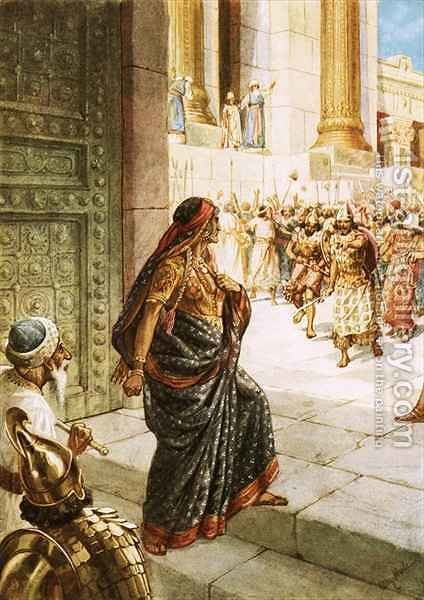
30
Illustration by Scottish artist William Hole, 1846-1917.
Jehu kills Ahab's family
101But Ahab (Hebr. Achav) had 70 sons in Samaria. [All of these had a greater right than Jehu to succeed Joram.] So Jehu wrote several letters and sent them to Samaria, to the leaders of Jezreel, to the elders and guardians [who were responsible for the upbringing and education] of Ahab's sons, saying: 2"And now, as soon as this letter comes to you—since your masters' sons are with you, and you also have chariots and horses, fortified cities, and armor— 3choose the best and most suitable of your masters' sons, and set him on his father's throne, and fight for your master's house." 4But they were very afraid and said, "Behold, the two kings did not stand before him; how then shall we stand?" 5And the one in charge of the palace (literally: 'over the house') [the royal palace in Samaria] and the governor of (literally: 'those who were over') the city and the elders and guardians [who raised and educated the king's sons, see ] sent word to Jehu, saying "We are your servants and will do whatever you ask us to do; we will not make any man king. Do whatever is good in your eyes." 6And he [Jehu] wrote a second letter to them, saying, "If you are on my side and if you listen to my voice, take the heads of the men of your lord's sons and come to me tomorrow at this time."
And the king's sons, who were 70 in number, were with the great men of the city, who brought them up. 7And it came to pass, when the letter came to them, that they took the king's sons and slew them, all seventy men, and put their heads in baskets, and sent them to him to Jezreel. 8And a messenger came and told him, saying, "They have brought the heads of the king's sons." And he said, "Put them in two heaps at the entrance of the gate until morning." 9And it came to pass in the morning that he went out and stood and said to all the people, "You are righteous. Behold, I conspired against my master and struck him down, but how did you strike down all these? 10Now know that none of the provisions of the Lord (Yahweh) shall fall to the ground that the Lord (Yahweh) has spoken concerning Ahab. For the Lord (Yahweh) has done what he spoke through his servant Elijah." 11And Jehu struck down all who remained of the house of Ahab in Jezreel, and all his great men and his close friends and his priests, until there was no one left. 12And he arose and departed and went to Samaria. And when he was at the sheep shearing houses of the shepherds by the way, 13Jehu met the brothers of Ahaziah, king of Judah, and said, "Who are you?" They replied, "We are the brothers of Ahaziah, and we are going down to greet the sons of the king and the sons of the queen mother." 14And he said, "Take them alive." And they took them alive and killed them at the well of the sheep shearing house, 42 men, and left none of them. 15Then, as he was leaving the place, he met Jehonadab, the son of Rechab, who came to meet him. And he [Jehu] greeted him and asked him, "Is your heart right [are you with me], as my heart is with your heart?"
And Jehonadab answered, "Yes, it is."
"Then give me your hand." [Either Jehonadav's or Jehu's words to take his hand on this, see .] And he gave him his hand, and he took him up to him in the chariot. 16And he said, "Come with me and see my zeal for the Lord (Yahweh)." And they let him ride in his chariot. 17And they came to Samaria, and he struck down all who remained of Ahab in Samaria until he had destroyed him, according to the word of the Lord (Yahweh) which he spoke to Elijah.Jehu eradicates Baal worship
18And Jehu gathered all the people together and said to them, "Ahab served Baal a little, but Jehu will serve him much. 19Therefore, call to me all the prophets of Baal, all his worshippers, and all his priests; let no one be missing, for I have a great sacrifice to make to Baal. Whoever is missing shall not live." [This gathering is similar to Elijah's gathering of the prophets of Baal on Mount Carmel in ] But Jehu was bluffing (acting cunningly – Hebr. oqvah) because his intention was to destroy all the worshippers of Baal. 20And Jehu said, "Consecrate a solemn assembly to Baal." And they proclaimed it. 21And Jehu sent throughout all Israel, and all the worshippers of Baal came, and there was not one left. They entered the temple of Baal (the house of Baal), and the temple of Baal was filled from one end to the other. 22And he said to the keeper of the wardrobe, "Bring out garments for all the worshippers of Baal." And he brought out garments for them. 23And Jehu and Jehonadab, the son of Rechab, went into the house of Baal, and he said to the worshippers of Baal, "Search and see that there is no servant of the Lord (Yahweh) among you, but only worshippers of Baal." 24And they went in to offer sacrifices and burnt offerings. And Jehu had appointed 80 men outside, and he said, "If any of the men whom I bring into your hands escape, his life shall be for his head." 25And it came to pass, as soon as he had finished offering the burnt offering, that Jehu said to the guard and the commander, "Go in and strike them down; let no one come out." And they struck them down with the edge of the sword, and the guard and the commander cast them out and went to the city of the house of Baal. 26And they took the pillars that were in the house of Baal and burned them. 27And they broke down the pillars in the house of Baal and broke down the house of Baal and made it a latrine to this day. 28And Jehu destroyed Baal from Israel. 29But he did not turn away from the sins that [the first king of the Northern Kingdom] Jeroboam, the son of Nebat, had caused Israel to sin, not from the golden calves that were in Bethel and were in Dan. [] 30And the Lord (Yahweh) said to Jehu, "Because you have done well (Hebr. tóv) and done what is right (straight – Hebr. jashar) in my eyes, and have done to the house of Ahab according to all that was in my heart, your sons shall sit on the throne of Israel for four generations." [Jehu both did what was good and what was right. So it is possible to do what is right, but not everyone is in harmony with God's heart and also does what is good. In the list of kings that follows, this combination with good is not used, but only with the word right six times, see ; ; , ; ; and once what is not right ().] 31But Jehu was not careful (did not keep, guard, preserve – Hebr. lo shamar) to walk in the teaching (Hebr. torah) of the Lord (Yahweh), the God of Israel (Elohim), with all his heart. He did not turn away from (did not turn away from) the sins Jeroboam had caused Israel to commit. [Idolatry and syncretism, see 4.] 32In those days the Lord (Yahweh) began to cut Israel short, and Hazael defeated them on all the borders of Israel, 33from the Jordan eastward, all the land of Gilead, the Gadites, the Reubenites, and the Manassites, from Aroer, which is by the valley of Arnon, Gilead, and Bashan. 34The rest of the acts of Jehu, and all that he did, and all his might, are they not written in the book of the chronicles of the kings of Israel? 35And Jehu slept with his fathers, and they buried him in Samaria. And Jehoahaz his son reigned in his place. 36And the time that Jehu reigned over Israel in Samaria was twenty-eight years.The 7th ruler of the Southern Kingdom – Queen Athaliah
Athaliah's rebellion
111When Athaliah (Hebr. Ataljaho), the mother of Ahaziah, saw that her son was dead, she arose and destroyed (killed) the whole royal family (all the royal seed). 2But Jehosheba, the daughter of King Joram [another name for Jehoram, see ], the sister of Ahaziah, took Joash [also called Jehoash], Ahaziah's son, and took him away from the king's sons who were slain, him and his nurse, and hid them in the bedchamber, and they were hidden from Athaliah, so that he was not slain. 3And he was hidden with her in the house of the Lord (Yahweh) for six years. And Athaliah reigned over the land.Athaliah is overthrown
4And in the seventh year [of Athaliah's reign], Jehoiada sent for the officers (the leaders of hundreds), the Carites, and the guards, and brought them to the house of the Lord (Yahweh). And he made a covenant with them and took an oath from them in the house of the Lord (Yahweh) and showed them the king's son [Joash/Jehoash]. 5And he commanded them, saying, "This is what you shall do: one third of you shall come on the Sabbath and guard the king's house, 6a third of you shall guard the Gate of the Lot [one of the gates into the palace, which is unknown], and a third at the gate behind the guard shall guard the house [on the east side] and be a barrier. 7But your other two divisions, all those who go out [are not on duty] on the Sabbath, shall guard the house of the Lord (Yahweh) at Hos. 8[When the time comes.] Then surround the king [the young Joash/Jehoash] on every side, each man with his weapon in his hand. And if anyone comes within reach, let him be struck down. And be with the king when you go out and when you come in." 9And the officers (the leaders of hundreds) did all that the priest Jehoiada commanded, and each man took his men, those who were to come in on the Sabbath and those who went out on the Sabbath, and came to the priest Jehoiada. 10And the priest gave to the officers (the leaders of hundreds) the spears and shields that had belonged to King David, which were in the house of the Lord (Yahweh). 11And the guard stood, each man with his weapon in his hand, from the right side of the house to the left side of the house, along the altar and the house around the king. 12Then he brought out the king's [Ahaziah's] son [Joash] and put the crown and the regalia on him, and they made him king and anointed him, and they clapped their hands and said, "The king lives (long live the king)!" 13
Illustration by Scottish artist William Hole, 1846-1917.
And the priest [Jehoiada] appointed leaders over the house of the Lord (Yahweh). 19And he took the officers (leaders of hundreds), the Carites, and the guards, and all the people of the land, and they brought down the king [the young Joash/Jehoash] from the house of the Lord (Yahweh) and came by way of the guard gate to the king's house. And he sat on the throne of the kings. 20And all the people of the land rejoiced, and the city was quiet, and they struck Athaliah with the sword at the king's house. 21Jehoash [also called Joash, see ] was seven years old when he began to reign.The 8th king of the Southern Kingdom – Jehoash
121[Joash reigned over Judah (the Southern Kingdom) for 40 years (835-796 BC). He was only 7 years old when he came to the throne (). His mother, Zibiah, was from Beer-Sheba in southern Judah (). He could have reigned longer, but his own servants killed him and put his son Amaziah on the throne (). He came to the throne through a coup and died during a coup. In the seventh year of Jehu [of the Northern Kingdom], Jehoash began to reign, and he reigned 40 years in Jerusalem, and his mother's [queen mother's] name was Zibiah of Beer-Sheba.] 2Jehoash did what was right (straight) in the eyes of the Lord (Yahweh) all his days, as the priest Jehoiada taught him. 3Only the high places were not removed, and the people still sacrificed at the high places. 4And Jehoash [the young king] said to the priest, "All the silver that is brought into the house of the Lord (Yahweh), the silver that is given in exchange for every man's soul (the ransom) [; ], all the silver from voluntary offerings (which has risen up in a man's heart that he should bring it) to the house of the Lord (Yahweh), 5let the priests take it to themselves, each from his appraiser (Hebr. makar). Thus they shall strengthen (restore) the house, wherever a crack (damage) is found." 6But it was so that in the 23rd year of King Jehoash [he was then 30 years old], the priests had not strengthened (restored) the cracks (damage) in the house. 7And King Jehoash called Jehoiada, the priest, and the other priests, and said to them, "Why are you not strengthening (repairing) the house [the temple in Jerusalem]? Now you shall no longer take the silver from your appraisers (Hebr. makar). You shall give it to the cracks (damage) in the house." [Jehoash urges that the collection that had been ordered be ended, see , and instead a new way of collecting funds via collection boxes is introduced, see .] 8And the priests agreed that they would no longer take silver from the people without strengthening (repairing) the house. 9Then the priest Jehoiada took a chest and drilled a hole in the lid of it and placed it beside the altar, on the right side when one enters the house of the Lord (Yahweh). And the priests who guarded (protected, preserved) the threshold put all the silver that was brought into the house of the Lord (Yahweh) into it. 10And it came to pass, when they saw that there was much silver in the chest, that the king's scribe and the high priest came up, and they put it in sacks and counted the silver that was in the house of the Lord (Yahweh). 11And they gave the silver that was weighed into the hands of those who did the work, who had oversight of the house of the Lord (Yahweh), and they paid it to the carpenters and to the builders who did the work on the house of the Lord (Yahweh), 12and to the masons and to the stonecutters, and to buy timber and hewn stone to strengthen (repair) the house of the Lord (Yahweh), and for everything that was spent to strengthen (repair) it. 13But they did not make for the house of the Lord (Yahweh) silver cups, snuffers, bowls, trumpets, all the gold utensils, or the silver utensils from the money that was brought into the house of the Lord (Yahweh), 14for they gave it to those who did the work and strengthened (repaired) the house of the Lord (Yahweh). 15But no account was taken of the silver that was left in their hands, for they handled it as a trust (faithful – Hebr. emonah). 16The silver and silverware that had been confiscated were not brought into the house of the Lord (Yahweh), for they belonged to the priests.Attacks from Syria
17At that time, Hazael, king of Aram [Syria], went up and fought against [the Philistine city] Gath and took it. [The plan was probably to control the southern trade routes; he had also taken areas on the eastern side, see .] And Hazael turned his face toward Jerusalem. 18And Jehoash, king of Judah, took all the sacred things that Jehoshaphat, Jehoram, and Ahaziah, his fathers, kings of Judah, had set apart (consecrated), and his own sacred objects, and all the gold that was in the treasury of the house of the Lord (Yahweh) and in the king's house, and sent it to Hazael, king of Aram, who had withdrawn from Jerusalem. 19The rest of the acts of Jehoash, and all that he did, are written in the Book of the Chronicles of the Kings of Judah. 20And his servants rose up and conspired against him and struck him down at Beit-Millo on the road that goes down to Silla. 21And Jehoaz, the son of Shimeath, and Jehozabad, the son of Shomer, his servants, struck him down, and he died. And they buried him with his fathers in the city of David. And Amaziah (Hebr. Amatsjaho), his [Jehoash's] son, reigned in his place. [Amaziah becomes the 9th ruler of the Southern Kingdom, and his reign is described in .]The 11th king of the Northern Kingdom – Jehoahaz
[Jehoahaz reigned in the Northern Kingdom from 814 to 798 BC. He did what was evil in the eyes of the Lord (), and God allowed the king of Aram to defeat Israel time and time again, drastically reducing Jehoahaz's army (). Jehoahaz prays to God, and God sends an anonymous deliverer (perhaps Elisha and Jehoash, see ). This is the only time it is mentioned that a king in the north receives an answer to prayer, see .] 131In the 23rd year of Joash, son of Ahaziah, king of Judah, Jehoahaz, son of Jehu, began to reign over Israel in Samaria and reigned for 17 years. 2And he did what was evil in the sight of the Lord (Yahweh) and followed the sins of Jeroboam, son of Nebat, with which he made Israel sin. He did not turn away from them. 3And the anger of the Lord (Yahweh) was kindled against Israel, and he delivered them into the hand of Hazael, king of Aram, and into the hand of Ben-Hadad, son of Hazael, all their days. 4And Jehoahaz prayed to the Lord (Yahweh), and the Lord (Yahweh) listened to him, for he saw the affliction of Israel, how the king of Aram oppressed them. 5And the Lord (Yahweh) gave Israel a savior, so that they could leave (literally: "go out from under") the hand of the Arameans, and the sons of Israel lived in their tents as before. [The savior is not identified but may be Elisha, who is mentioned in . Another suggestion is Jehoash, see .] 6Nevertheless, they did not turn away from the sins of the house of Jeroboam, with which he had caused Israel to sin, but walked in them. And even the Asherah [idol worship] in Samaria remained. 7And there remained to Jehoahaz nothing but fifty horsemen, ten chariots, and ten thousand foot soldiers, for the king of Aram destroyed them and made them like the chaff when threshing. 8The rest of the acts of Jehoahaz, and all that he did, and his might, are written in the chronicles of the kings of Israel. 9And Jehoahaz slept with his fathers, and was buried in Samaria; and Joash his son reigned in his stead. The 12th king of the Northern Kingdom – Jehoash
[Jehoash reigned over the Northern Kingdom from 798 to 782 BC.] 10In the 37th year of Joash, king of Judah, Jehoash, the son of Jehoahaz, began to reign over Israel in Samaria, and he reigned 16 years. 11And he did evil in the sight of the Lord (Yahweh). He did not forsake all the sins of Jeroboam, son of Nebat, with which he made Israel sin, but walked in them. 12The rest of the acts of Joash, and what he did, and his might, how he fought against Amaziah king of Judah, are they not written in the book of the chronicles of the kings of Israel? 13And Joash slept with his fathers, and Jeroboam sat on his throne. And Joash was buried in Samaria with the kings of Israel.The Death of Hazael
The Death of Elisha
14And Elisha was sick with the sickness whereof he died, and Joash the king of Israel came down to him, and wept over him, and said, "My father, my father, the chariot of Israel, and the horsemen thereof!" 15And Elisha said to him, "Take a bow and arrows." And he took a bow and arrows. 16And he said to the king of Israel, "Put your hand on the bow." And he put his hand on it, and Elisha put his hand on the king's hand. 17And he said, "Open the window toward the east." And he opened it. And Elisha said, "Shoot!" And he shot. And he said, "The Lord's (Yahweh's) arrow of victory, the arrow of victory against Aram, for you shall strike the Arameans at Aphek until you have devoured them." 18And he said, "Take the arrows." And he took them. And he said to the king of Israel, "Strike the ground." And he struck three times and stopped. 19And the man of God became angry with him and said, "You should have struck five or six times, then you would have struck Aram until it was consumed, but now you will only strike Aram three times." 20And Elisha died, and they buried him. Elisha's last miracle!
And Moabite raiders came into the land at the beginning of the year [in the spring, after the winter rains in March and before the harvest was gathered in May, when all the laborers were needed in the fields, see ; , ]. 21And it came to pass, as they were burying a man, that they saw a band of robbers, and they threw the man into Elisha's grave. And as soon as the man touched Elisha's bones, he revived and stood on his feet. [Elisha had asked Elijah for a double portion of his spirit, see . Elijah had raised a widow's son , and until now Elisha had also raised a dead man, see . Now his promise to receive a double portion was fulfilled, Elisha raised two people, even though the last miracle happened when he himself was already dead and buried!] 22And Hazael, king of Aram, oppressed Israel all the days of Jehoahaz. 23But the Lord (Yahweh) showed them mercy (undeserved mercy – Hebr. chanan) and was gracious to them and turned his face toward them, because of his covenant with Abraham, Isaac, and Jacob, and did not want to destroy them, nor had he cast them away from his presence until now.Hazael dies
24And Hazael, king of Aram, died, and Ben-Hadad, his son, reigned in his place. 25And Jehoash, the son of Jehoahaz, took back from Ben-Hadad, the son of Hazael, the cities that he had taken from Jehoahaz, his father, by war. Three times he struck him and restored the cities of Israel.The last years of the Northern Kingdom (chapters 14-17)
The 9th ruler of the Southern Kingdom – Amaziah (2 Chron. 25)
[Amasja reigned for a total of 29 years. First alone for 4 years (796-792 BC) and then sharing his throne with his son Azarja (also known as Ussia) for the last 25 years, 792-767 BC.] 141In the second year of Joash, the son of Jehoahaz, king of Israel, Amaziah (Hebr. amatsjaho), the son of Joash, king of Judah, began to reign. 2He was 25 years old when he began to reign, and he reigned 29 years in Jerusalem. [The first 4 years alone and the last 25 together with his son Azariah.] And his mother's [queen mother's] name was Jehoadan of Jerusalem. 3He did what was right (upright) in the eyes of the Lord (Yahweh), but not like his ancestor David [who was an ideal king, see ; ; ]. He did everything that Joash, his father, had done. 4Only the high places were not removed, and the people still sacrificed at the high places. 5And as soon as the kingdom was established in his hand, he struck down the servants who had struck down his father. 6But he did not kill the sons of the murderers, according to what is written in the book of the law of Moses, which the Lord commanded, saying, "Fathers shall not be put to death for their sons, nor shall sons be put to death for their fathers. But each one shall be put to death for his own transgression." [] 7He defeated Edom in the Valley of Salt, 10,000 men, and took Sela in battle and gave it the name Joqteel, as it is called today. 8Then Amaziah [king of the Southern Kingdom] sent messengers to Jehoash [12th ruler of the Northern Kingdom, see ], son of Jehoahaz, son of Jehu, king of Israel, saying, "Come (come here), let us meet face to face (literally: see each other's faces)." 9And Jehoash, king of Israel, sent messengers to Amaziah, king of Judah, saying, "The thistle that was in Lebanon sent to the cedar that was in Lebanon, saying, 'Give your daughter to my son as wife,' and the wild beasts that were in Lebanon trampled the thistle. 10You have indeed defeated Edom, and now your heart is lifted up. Be satisfied (enjoy this honor, literally: 'let yourself be weighed down' – Hebr. hikavod) and stay in your house, for why should you meddle in evil, so that you and Judah with you fall?" [In the parable, Amaziah, king of the Southern Kingdom, is compared to a wild, insignificant thistle, which can easily be trampled down by wild animals. It is a warning not to be proud.] 11But Amaziah did not listen. And Jehoash, king of Israel, went up, and he and Amaziah, king of Judah, looked each other in the face [met eye to eye] at Beit-Shemesh, which belongs to Judah. 12And Judah was defeated before Israel, and they fled, every man to his tent. 13And Jehoash, king of Israel, took Amaziah, king of Judah, Jehoash's son, Ahaziah's son, at Beit-Shemesh, and came to Jerusalem, and broke down the wall of Jerusalem from the Ephraim Gate [on the north side of Jerusalem] to the Corner Gate [on the west side], 400 cubits [180 meters]. 14And he took all the gold and silver and all the utensils that were in the house of the Lord (Yahweh) and the treasures of the king's house and the sons of the hostages, and returned to Samaria [the capital of the Northern Kingdom]. 15The rest of the acts of Jehoash, and what he did, and his might, and how he fought with Amaziah king of Judah, are they not written in the book of the chronicles of the kings of Israel? 16And Jehoash slept with his fathers and was buried in Samaria with the kings of Israel. And Jeroboam (Hebr. Jarovam), his son, reigned in his place. 17And Amaziah, the son of Joash, king of Judah, lived fifteen years after the death of Jehoash, the son of Jehoahaz, king of Israel. 18The rest of the acts of Amaziah are written in the chronicles of the kings of Judah. 19And they conspired against him in Jerusalem, and he fled to Lachish, but they sent after him and killed him there. 20And they brought him on horses, and he was buried in Jerusalem with his fathers in the city of David. 21And all the people of Judah took Azariah (Hebr. Azarjah) [also called Uzziah], who was 16 years old, and made him king in place of his father Amaziah. 22He built Eilat and restored it to Judah after the king slept with his fathers.The 13th king of the Northern Kingdom – Jeroboam II
[Jeroboam II was the grandson of Jehu and the son of Joash. He reigned 41 years (786-746 BC).] 23In the 15th year of Amaziah, son of Joash, king of Judah, Jeroboam (Hebr. Jarovam), son of Joash, king of Israel, began to reign in Samaria, and he reigned 41 years. 24And he [Jeroboam II, son of Joash] did what was evil in the sight of the Lord (Yahweh). He did not depart from any of the sins of [his ancestor] Jeroboam, son of Nebat, which caused [encouraged] Israel to sin (miss the mark – Hebr. chata). [Jeroboam I was the first king of the Northern Kingdom and the one who introduced idolatry, see , .] 25He restored the borders of Israel from the entrance of Hamath to the Sea of the Arabah, according to the word of the Lord (Yahweh), the God (Elohim) of Israel, which he spoke through his servant Jonah, the son of Amittai, the prophet from Gath-hepher. [See Jonah 1:1] 26For the Lord (Yahweh) saw the affliction of Israel, which was very bitter, and there was no end to their oppression, and there was no helper for Israel. 27And the Lord (Yahweh) did not say that he would destroy Israel from under heaven (literally: "from under the heavens"), and (therefore) he saved them through the hand of Jeroboam, the son of Joash. [The destruction on earth is described from God's perspective – I will destroy from under the heavens.] 28What else is there about Jeroboam's deeds, and all that he did, and his strength, how he fought, and how he recovered Damascus and Hamath for Judah in Israel, it is written in the chronicles of the kings of Israel. 29And Jeroboam slept with his fathers with the kings of Israel. And Zechariah his son reigned in his place.The 10th ruler of the Southern Kingdom – Azariah/Uzziah
[Azariah is the same person as Uzziah, see ; ; . He is the eighth king of Judah after the division and the tenth king after David. In this chapter, there are two spellings of his name in Hebr. Azarjah (verses 1, 7, 17, 23, 27) and Azarajaho (verses 6 and 8).] 151In the 27th year of Jeroboam, king of Israel, Azariah (Hebr. Azarjah) [Uzziah], son of Amaziah, king of Judah, began to reign. 2He was 16 years old when he began to reign, and he reigned 52 years in Jerusalem, and his mother's [queen mother's] name was Jecholiah from Jerusalem. 3He did what was right (upright) in the eyes of the Lord (Yahweh) according to all that his father Amaziah had done. 4Only the high places were not removed, and the people continued to sacrifice, they sacrificed on the high places. 5And the Lord (Yahweh) struck the king with a skin disease (Hebr. ) [] until his death, and he lived in a separate house. And Jotham, the king's son, was over his house and judged the people of the land. 6The rest of the acts of Azariah (Hebr. Azarjaho) [Uzziah], and all that he did, are written in the chronicles of the kings of Judah. 7And Azariah (Hebr. Azarjah) [Uzziah] slept with his fathers, and they buried him in the city of David. And Jotham his son reigned in his place.The 14th king of the Northern Kingdom – Zechariah
[Zechariah (Hebr. Zecharjaho) was the 14th king of Israel. He reigned for six months before being killed by his successor. The shorter form of his name, Zechariah, is used in ; .] 8In the 38th year of Azariah (Hebr. Azarjaho) [Uzziah], king of Judah, Zechariah (Hebr. Zecharjaho), son of Jeroboam, reigned over Israel in Samaria for six months. 9He did what was evil in the sight of the Lord (Yahweh), as his father had done. He did not depart from the sins of Jeroboam, son of Nebat, with which he made Israel sin. 10And Shallum, son of Javesh, conspired against him and struck him down before the people and killed him, and reigned in his place. 11The rest of the acts of Zechariah are written in the chronicles of the kings of Israel. 12This is the word of the Lord (Yahweh) that he spoke to Jehu, saying, "Your sons to the fourth generation shall sit on the throne of Israel." [] And so it came to pass.The 15th king of the Northern Kingdom – Shallum
13[Shallum was the 15th king of Israel (the Northern Kingdom). He led a conspiracy against his predecessor, see . He reigned for only one month.
Shallum, son of Javesh, began to reign in the 39th year of Uzziah (Hebr. Uzzijaho), king of Judah [also called Azariah], and he reigned one month in the territory of Samaria.] 14And Menachem, son of Gad, went up from Tirtsah [northeast of Shechem; present-day Tell el-Farah] and came to [the city of] Samaria and struck Shallum, son of Javesh, in Samaria and killed him. And he reigned in his place. 15The rest of the acts of Shallum, and his conspiracy which he made, are written in the chronicles of the kings of Israel. 16Then Menahem struck Tiphsah and all who were there, and its borders, from Tirtsah, because they did not open to him, so he struck it, and all the pregnant women therein he cut open.The 16th king of the Northern Kingdom – Menachem
[Menachem was the 16th king of the northern kingdom. His name means "comforter," which is ironic considering his violent rise to power. He reigned for 10 years (752-742 BC).] 17In the 39th year of Azariah (Hebr. Azarjah) [Uzziah], king of Judah, Menachem, son of Gad, began to reign over Israel, and he reigned for ten years in Samaria. 18And he [Menachem] did what was evil in the sight of the Lord (Yahweh). He did not depart from any of the sins of [his ancestor] Jeroboam, son of Nebat, which caused [encouraged] Israel to sin (miss the mark – Hebr. chata). [Jehu was the first king of the Northern Kingdom, see .] 19Pol, king of Assyria, came over the land, and Menachem gave Pol 1,000 talents [34 tons] of silver so that his hand would be strong (firm, secure, brave) with him to fortify the kingdom in his hand. 20And Menachem taxed the silver over Israel, over all the mighty, warlike men, of every man 50 shekels [0.6 kg] of silver to give to the king of Assyria. And the king of Assyria returned and did not stay there in the land. 21The rest of the acts of Menachem, and all that he did, are written in the chronicles of the kings of Israel. 22And Menachem slept with his fathers, and his son Peqachjah reigned in his place.The 17th king of the northern kingdom – Pekahiah
23[Pecahiah (sometimes simplified in English to Pekahiah) means "Yahweh sees" or "Yahweh has opened." He is the 17th king of the northern kingdom and reigned for two years (742-740 BC). He is not mentioned in the Books of Chronicles. In the 50th year of Azariah (Hebr. Azarjah) [Uzziah], king of Judah, Pekahiah, son of Menahem, began to reign over Israel in Samaria and reigned for two years.] 24And he [Pecahiah] did what was evil in the sight of the Lord (Yahweh). He did not depart (turn away) from any of the sins of [his ancestor] Jeroboam, son of Nebat, which caused [encouraged] Israel to sin (miss the mark – Hebr. chata). [Jehu was the first king of the Northern Kingdom, see .] 25One of his commanders, Pekah, son of Remaliah, conspired against him. He and 50 men of Gilead struck Pekahiah, along with Argob and Arieh, in Samaria, in the fortress of the king's house. He [the commander Pekah] killed him and reigned in his place. 26The rest of the acts of Pekahiah, and what he did, behold, they are written in the chronicles of the kings of Israel.The 18th king of the Northern Kingdom – Pekah
27In the 52nd year of Azariah (Hebr. Azarjah) [Uzziah], king of Judah, Pekah, son of Remaliah, began to reign over Israel in Samaria and reigned 20 years. 28And he [Pecah] did what was evil in the sight of the Lord (Yahweh). He did not depart (turn away) from any of the sins of [his ancestor] Jeroboam, son of Nebat, which caused [encouraged] Israel to sin (miss the mark – Hebr. chata). [Jehu was the first king of the Northern Kingdom, see .] 29In the days of Pekah, king of Israel, Tiglath-Pileser, king of Assyria, came and took Ijon, Abel-Beth-Maacha, Janoah, Kedesh, Hazor, Gilead, and Galilee, all the land of Naphtali, and he carried them away captive to Assyria. 30And Hoshea, the son of Elah, conspired against Pekah, the son of Remaliah, and struck him down and killed him, and reigned in his place in the twentieth year of Jotham, the son of Uzziah (Hebr. Uzzijahos). 31The rest of the acts of Pekah, and what he did, behold, they are written in the chronicles of the kings of Israel.The 11th ruler of the Southern Kingdom – Jotham
[Jotham was 25 years old when he became king and reigned over Judah (the Southern Kingdom) for 18 years (759-743 BC). He was co-regent with his leprous father until 742 BC, see .] 32In the second year of Pekah, son of Remaliah, king of Israel [in the north], Jotham, son of Uzziah, king of Judah, began to reign [in the Southern Kingdom]. 33He was 25 years old when he began to reign, and he reigned 16 years in Jerusalem. And his mother's [queen mother's] name was Jerosha, the daughter of Zadok. 34He did what was right in the eyes of the Lord (Yahweh), doing everything his father Uzziah (Hebr. Uzzijaho) had done. 35Nevertheless, the high places were not removed. The people still sacrificed at the high places. He built the upper gate of the house of the Lord (Yahweh). 36The rest of the acts of Jotham, and all that he did, are written in the book of the chronicles of the kings of Judah. 37In those days the Lord (Yahweh) began to send Rezin, king of Aram, and Pekah, son of Remaliah, against Judah. 38And Jotham slept with his fathers and was buried with his fathers in the city of David. And Ahaz his son reigned in his place.The 12th ruler of the Southern Kingdom – Ahaz
161[Ahaz was 23 years old when he became king and first reigned with Jotham from 735 to 732 BC, then alone for 16 years from 732 to 715 BC. In the 17th year of Pekahiah, son of Remaliah, Ahaz, son of Jotham, king of Judah, began to reign.] 2Ahaz was 23 years old when he began to reign, and he reigned 16 years in Jerusalem, and he did not do what was right (upright) in the eyes of the Lord (Yahweh), his God (Elohim), as his father (ancestor) David had done. [Here, strong language is used to say that he did not do what was right, cf. . Only Manasseh () and Amon () who follow him receive harsher words among the kings of the Southern Kingdom.] 3Instead, he walked in the ways of the kings of Israel and made his son pass through the fire according to the abominations of the nations, whom the Lord (Yahweh) had driven out before the sons of Israel. 4And he sacrificed and burned incense on the high places and on the hills and under every green tree. 5Then King Rezin of Aram (Syria) [740-733 BC] and King Pekah, son of Remaliah, of Israel [Northern Kingdom, 752-732 BC] came up to Jerusalem to wage war, and they besieged Ahaz but could not overcome him. [] 6At that time, Rezin, king of Aram, recaptured Eilat for Aram and drove the Jews out of Eilat, and the Edomites came to Eilat and lived there to this day. 7And Ahaz sent messengers to Tiglath-Pileser, king of Assyria [Tiglath-Pileser III], saying, "I am your servant and your son; come and save me from the hand of the king of Aram and from the hand of the king of Israel, who are rising up against me." 8And Ahaz took the silver and gold that was in the house of the Lord (Yahweh) and in the treasury of the king's house and sent it as a gift to the king of Assyria. 9And the king of Assyria listened to him, and the king of Assyria went up against Damascus and took it and carried the people away captive to Kir and killed Rezin [the king of Syria, see verses 5-6].Ahaz's altar
10Then King Ahaz went to Damascus to meet Tiglath-Pileser, king of Assyria [and thank him]. When King Ahaz saw the altar that was in Damascus [he was impressed and] sent a sketch of it to Orija, the priest, with a detailed drawing (dimensions), in accordance with its entire craftsmanship. 11And Orija, the priest, built the altar [in Jerusalem in the temple of God] according to all that King Ahaz had sent from Damascus, so Orija, the priest, did, and made it before King Ahaz came from Damascus. 12And when the king came from Damascus, the king saw the altar, and the king came near the altar and sacrificed on it. 13And he offered his burnt offering and his meal offering, and poured out his drink offering, and sprinkled the blood of his peace offering against the altar. 14And the bronze altar that was before the Lord (Yahweh), he moved from the front of the house, from between his altar and the house of the Lord (Yahweh), and placed it on the north side of his altar. 15And King Ahaz commanded Uzziah the priest, saying "On the great altar shall be offered the morning burnt offering and the evening grain offering, the king's burnt offering and his grain offering, with the burnt offering of all the people of the land and their grain offerings and their drink offerings, and sprinkle all the blood of the burnt offerings and all the blood of the sacrifices, but the bronze altar shall be for me to look upon." 16And Orija, the priest, did all that King Ahaz commanded. 17And King Ahaz cut off (broke into pieces) the edge of the foundation and removed the basin from it, and he removed the sea from the copper oxen that were under it and placed it on a foundation (floor) of stones. 18And he covered (closed) the Sabbath gate that they had built in the house, and he turned the king's outer entrance toward the house of the Lord (Yahweh) from the face of the king of Assyria.The death of Ahaz
19The rest of the acts of Ahaz, and what he did, are written in the chronicles of the kings of Judah. 20And Ahaz slept with his fathers and was buried with his fathers in the city of David. And Hezekiah his son reigned in his place.The 19th king of the Northern Kingdom – Hosea
[Hosea (Hebr. Hoshea) becomes the last king of Israel.] 171In the twelfth year of Ahaz, king of Judah, Hosea, son of Elah, began to reign in Samaria and reigned over Israel nine years. 2And he did what was evil in the sight of the Lord (Yahweh), but not like the kings of Israel who were before him. 3Shalmaneser, king of Assyria, came up against him, and Hosea became his servant and brought him gifts. 4And the king of Assyria found (discovered) a conspiracy in Hos, for he had sent messengers to So, king of Egypt, and did not offer gifts to the king of Assyria as he had done year after year. Therefore, the king of Assyria silenced him and bound him in prison. 5And the king of Assyria came up through the whole land and went up to Samaria and besieged it for three years. 6In the ninth year of Hosea, the king of Assyria took Samaria and carried Israel away to Assyria, and put them in Halah and in Habor, by the river of Gozan, and in the cities of the Medes.Israel is taken into captivity
7And this happened because the sons of Israel had sinned against the Lord (Yahweh), their God (Elohim), who had brought them up out of the land of Egypt from under (literally "from beneath") the hand of Pharaoh, king of Egypt, and had followed other gods, 8and walked after the statutes of the nations whom the Lord (Yahweh) had cast out before the children of Israel and before the kings of Israel, which they had done 9And the sons of Israel had secret things that were not right before the Lord (Yahweh), their God (Elohim), and they built high places in all their cities, from the watchtowers to the fortified cities. 10And they set up pillars and Asherah poles [poles for idol worship] for themselves on every high hill and under every green tree, 11and there they sacrificed on all the high places, in the same way as the peoples whom the Lord (Yahweh) had driven out before them, and did evil things [plural] to provoke the Lord (Yahweh). 12And they served idols, about which the Lord (Yahweh) had said to them, "You shall not do such things." 13And the Lord (Yahweh) repeated in Israel and in Judah through the hand of all his prophets and all the seers (prophets – Hebr. chozeh) and said, "Turn away from your evil ways and keep (guard, protect, preserve) my commandments (clear commands) and my ordinances (literally: 'things engraved') in accordance with all the teaching (Hebr. Torah) that I commanded your fathers and that I sent to you through the hand of my servants the prophets." 14But they did not listen, but stiffened their necks (stubborn), like the necks of their fathers, who did not believe (trust) in the Lord their God (Yahweh Elohim). 15And they rejected his statutes (literally "things engraved") and his covenant which he had made with their fathers, and his testimonies (testimonies) with which he had testified against them. And they went after empty things and became nothing, and after the nations that were around them, about whom the Lord (Yahweh) had determined that they should not do as (be like) them. 16And they abandoned all the commandments (clear commands) of the Lord (Yahweh), their God (Elohim), and made molten idols, two calves, and made an Asherah [pole for idol worship], and worshipped all the host of heaven (the stars), and served Baal. 17And they made their sons and their daughters pass through the fire, and used divination and sorcery, and sold themselves to do all that was evil in the sight of the Lord (Yahweh), to provoke him to anger. 18And the Lord (Yahweh) was very angry with Israel and removed them from his presence, and there was no one left except the tribe of Judah. 19And Judah did not keep (guard, protect, preserve) the commandments (clear commands) of the Lord (Yahweh), their God (Elohim), but walked in the statutes of Israel as they did (practiced). 20And the Lord (Yahweh) rejected all the seed of Israel and afflicted (plagued) them and delivered them into the hand of destroyers until he had cast them out of his sight. 21For he tore Israel from the house of David, and they made Jeroboam, the son of Nebat, king, and Jeroboam led Israel away from following the Lord (Yahweh) and caused them to sin greatly. 22And Israel walked in all the sins of Jeroboam that he did, and they did not forsake them 23until the Lord (Yahweh) removed Israel from his presence, as he had spoken through the hand of all his servants the prophets. And Israel was carried away from their land to Assyria to this day.Samaria repopulated
24And the king of Assyria brought men
from Babylon
and from Kota [city in Babylon]
and from Avah [unknown city]
and from Hamath [city in central Syria]
and Sepharvaim [Sefarvim (meaning: "the two scribes") – city in northern Syria on the eastern side of the Euphrates that Assyria had captured]
and placed them in the cities of Samaria instead of the sons of Israel, and they took Samaria and lived in its cities. 25And it came to pass in the beginning of their habitation there, that they did not reverence the Lord (Yahweh). Therefore the Lord (Yahweh) sent lions among them, which killed some of them. 26Therefore, they spoke to the king of Assyria and said, "The peoples whom you have carried away and placed in the cities of Samaria do not know the ways (how to act) of the God (Elohim) of the land. Therefore, he has sent lions among them, and behold, they are killing them, because they do not know the ways (how to act) of the God of the land (Elohim)." 27And the king of Assyria commanded and said, "Bring one of the priests who were taken from there and let him go and live there, and let him teach the people the ways (how to do) of the God of the land (Elohim)." 28And one of the priests whom they had carried away from Samaria came and lived in Bethel and taught them how to worship the Lord (Yahweh). 29But each people made their own gods and put them in the houses on the high places, as the Samaritans had done, and each people in the cities where they lived. 30And the men of Babylon made Sukkot-benoth, and the men of Cuth made Nergal, and the men of Hamath made Ashima 31and the Avites made Nivchaz and Tartak, and the Serfavites burned their sons in the fire of Adramelech and Anamelech, the gods of the Serfavites. 32And they feared the Lord (Yahweh), but they made for themselves priests from among themselves to the high places, who sacrificed for them in the houses of the high places. 33They feared the Lord (Yahweh) and served their own gods according to the ways of the peoples from whom they had been carried away. 34To this day they do so (follow their old customs). Nor do they fear the Lord (Yahweh), or do according to (follow) the statutes (literally "things engraved"), the ordinances (binding legal decisions), the teaching (Hebr. Torah) or the commandments (the clear commandments – Hebr. mitzvot) that the Lord (Yahweh) commanded (Hebr. tsavah) the sons of Jacob, whom he named Israel, 35with whom the Lord (Yahweh) made a covenant and charged them, saying, "You shall not fear other gods, nor bow down to them, nor serve them, nor sacrifice to them, 36but the Lord (Yahweh) who brought you up out of the land of Egypt with great power and with an outstretched arm, him you shall fear, and him you shall worship, and to him you shall offer sacrifices. 37And the statutes (literally "things engraved") and the ordinances (binding legal decisions) and the teachings and the commandments (clear commands) that I have written for you, you shall keep (guard, protect, preserve) to do all the days, and you shall not fear other gods. [; ] 38And the covenant that I have made with you, you shall not forget. You shall not fear other gods, 39but the Lord (Yahweh) your God (Elohim), you shall fear, and he shall deliver you out of the hand of all your enemies." 40But they did not listen, but did as they had done before. 41And these peoples feared the Lord (Yahweh) but served their cast idols, and their sons' sons did as their fathers had done. They continue to do so to this day.The last years of the Southern Kingdom
[Hezekiah reigned over Judah (the Southern Kingdom) for 29 years (726-697 BC).] 181In the third year of the reign of Hoshea, son of Elah, in Israel, Hezekiah, son of Ahaz, king of Judah, began to reign. 2He was 25 years old when he began to reign, and he reigned 29 years in Jerusalem. And his mother's [the queen mother's] name was Abi, the daughter of Zechariah. 3He did what was right in the eyes of the Lord (Yahweh), following all the ways of his ancestor David. 4He removed the high places and broke down the pillars and cut down the Asherah poles [poles for idol worship], and he broke in pieces the bronze serpent that Moses had made [], for to this day the sons of Israel had been sacrificing to it, and it was called Nechushtan. 5He trusted (relied on) the Lord (Yahweh), the God of Israel (Elohim), so that after him there was no one among the kings of Judah who was like him, nor among those who were before him. 6For he clung to the Lord (Yahweh) and did not turn away from following him, and kept (guarded, protected, preserved) his commandments (the clear commandments – Hebr. mitzvot) that the Lord (Yahweh) had commanded (Hebrew tsavah) Moses. 7And the Lord (Yahweh) was with him wherever he went, and he prospered, and he rebelled against the king of Assyria and did not serve him. 8He defeated the Philistines as far as Gaza and its borders, from the watchtower to the fortified city. 9And it came to pass in the fourth year of King Hezekiah, which was the seventh year of Hoshea, son of Elah, king of Israel, that Shalmaneser, king of Assyria, came up against Samaria and besieged it. 10At the end of the third year [of the siege of the city], in the sixth year of Hezekiah's reign and the ninth year of Hoshea's reign as king of Israel, Samaria was captured. 11And the king of Assyria carried Israel away to Assyria and placed them in Halah and in Habor by the river of Gozan and in the cities of Media, 12because they did not listen to the voice of the Lord (Yahweh), their God (Elohim), [and obey him], but transgressed his covenant, all that Moses, the servant of the Lord (Yahweh), commanded. They would not listen, and they would not do. 13And it came to pass in the fourteenth year of King Hezekiah [701 BC] of [Judah, the southern kingdom] that Sennacherib (Hebr. Sancheriv), king of Assyria, came up against the fortified cities of Judah and captured them. [The siege of Lachish is illustrated on the walls of Sennacherib's palace in Nineveh.] 14Then Hezekiah, king of Judah, sent messengers to the king of Assyria at Lachish, saying, "I have done wrong (sinned). Turn away from me, and I will bear whatever you impose on me." And the king of Assyria imposed on Hezekiah, king of Judah, 300 talents [25 tons] of silver and 30 talents [1 ton] of gold. [The Assyrian texts recount how Hezekiah was also forced to send his daughters, concubines, male and female musicians, ivory, and other valuable objects.] 15And Hezekiah gave him all the silver that was in the house of the Lord (Yahweh) and in the treasury of the king's house. 16At that time, Hezekiah scraped off the gold from the doors of the sanctuary of the Lord (Yahweh) and from the doorposts that [he himself] Hezekiah, king of Judah, had [had] overlaid, and gave it to the king of Assyria. [Hezekiah also repaired the wall and replenished the water supplies and prepared for a siege, see , .]Threat to Jerusalem
17And the king of Assyria sent the commander (Hebr. tartan), the commander-in-chief (Hebr. rav-saris), and the court marshal (Hebr. rav-shaqeh) from Lachish to King Hezekiah with a large army to Jerusalem. And they went up and came to Jerusalem. And when they came up, they came and stood by the cistern at the upper pool, which is on the highway to the Field of the Foolishman [place where textiles were washed and dried], 18and they called for the king. Then [the following three men from Hezekiah's palace] came:
Eljakim, son of Hilkiah (Hebr. Chilqijaho) [], who was in charge of the palace (literally: 'was over the house') [the royal palace in Jerusalem],
and the scribe Shebna []
and Joah, the son of Asaph, the recorder, to them. 19And the commander (Hebr. ravshake) said to them: "Now tell [your king] Hezekiah: Thus says the great king, the king of Assyria [Sennacherib]: On what security do you rely? 20I say: It is only empty prov (mouth wind), for counsel and strength are for battle. Whom do you trust, since you have rebelled against me? 21Behold, you rely on this splintered reed, Egypt, which, if you lean on it, will go into your hand and pierce it. Such is Pharaoh, king of Egypt, to all who rely on him. 22But you may say to me, 'We trust in the Lord our God (Yahweh Elohim).' Is it not he whose high places [sacrificial sites, often on high ground, see ; ; ] and altars [your king] Hezekiah has removed, and has said to Judah and Jerusalem, 'You shall worship before this altar'? [The Assyrian commander mistakenly assumes that the other places of sacrifice were places where the Lord (Yahweh) was worshipped and that limiting sacrifices to Jerusalem alone would offend him. These high places and altars were not the way the God of Israel was to be worshipped, see .] 23Now therefore, I pray, make a wager with my lord, the king of Assyria, and I will give you 2,000 horses if you can do your part to put riders on them. 24How can you turn away from a leader, and the least of my lord's servants, so that you put your trust in Egypt for horses and riders? 25Have I come up against this land to destroy it without the Lord (Yahweh)? The Lord (Yahweh) has said to me, 'Go up against this land and destroy it. 26
The Assyrian commander speaks to the people in Hebrew. Illustration by Scottish artist William Hole, 1846-1917.
"Listen to the word of the great king—the king of Assyria! 29Thus says the king [the ruler of the world at that time]:
Do not let [your king] Hezekiah deceive you, for he will not be able to deliver you. 30Do not let Hezekiah make you trust in the Lord (Yahweh) and say that the Lord (Yahweh) will surely save us, this city will not be given into the hand of the Assyrian king. 31Do not listen to Hezekiah, for thus says the king of Assyria: Make peace with me and come out to me, and each of you shall eat of his own vine and each of his own fig tree, and each of you shall drink the water of his own well, 32until I come and take you away to a land like your own, a land of grain and wine, a land of bread and vineyards, a land of olive trees and honey, so that you may live and not die. Be careful that Hezekiah does not persuade you, saying, 'The Lord (Yahweh) will deliver us. 33Has the god of any other nation delivered his land from the hand of the Assyrian king?
34Where are the gods of Hamath and Arpad?
[Two cities in central Syria that the Assyrians defeated during their campaigns, see ]
Where are the gods of Sepharvaim, Hena, and Avva?
[Sepharvaim (meaning "the two scribes"), a city in northern Syria on the eastern side of the Euphrates that Assyria had captured.]
Have they delivered Samaria out of my hand? [The Assyrian king Shalmaneser V (727-722 BC) began the siege against Hoshea because he made a covenant with Egypt (). Sargon ended the siege, mentioning the number of Israelites taken captive as 27,280.] 35Which of all the gods of the nations have delivered these nations out of my hand, that the Lord (Yahweh) should deliver Jerusalem out of my hand?" [The words in verses 18-35 correspond almost verbatim to . It is likely that an official transcription of the speech was made and was available in the archives.] 36But they remained silent and did not answer him a word, for the king's command was, "Do not answer him." 37Then [the three men]
Eljakim, son of Hilkiah (Hebr. Chilqijaho), who was in charge of the palace (literally: 'was over the house') [in Jerusalem],
and the scribe Shebna
and Joah, the son of Asaph, the recorder,
to Hezekiah with their clothes torn [as an outward sign of mourning] and told him the words of the commander (Hebr. ravshakes). 191And it came to pass, when King Hezekiah heard it, that he rent his clothes and covered himself with sackcloth and went into the house of the Lord (Yahweh). 2And he sent Eljakim, who was in charge of the palace (literally: 'was over the house') [had the highest position in the royal house in Jerusalem], and the scribe Shebna and the elders among the priests, clothed in sackcloth, to the prophet Isaiah, son of Amoz [Hebr. – not the same person as the prophet Amos from Tekoa ()]. 3And they said to him, "Thus says Hezekiah: Today is a day of distress, rebuke, and blasphemy, for the children are ready to be born (the pregnancy is full-term), but there is no strength to give birth. 4Unless the Lord (Yahweh), your God (Elohim), hears all the words of the commander whom the king of Assyria, his master, has sent to mock the living God (Elohim), and punishes the words that the Lord (Yahweh), your God (Elohim), has heard. Therefore, pray for the remnant that remains." 5And the servants of King Hezekiah came to Isaiah. 6And Isaiah said to them, "Thus shall you say to your master: Thus says the Lord (Yahweh): Do not be afraid of the word you have heard, with which the servants of the king of Assyria have blasphemed me. 7Behold, I will put a spirit in him, and he shall hear a rumor and return to his own land, and I will cause him to fall by the sword in his own land." 8And the commander returned and found the king of Assyria fighting against Libnah, for he had heard that they had departed from Lachish. 9But when Sennacherib heard that King Tirhakah of Cush [Nubia; present-day Ethiopia/Sudan] had gone out to fight against him, he sent messengers again to Hezekiah with this message: 10"Thus shall you speak to Hezekiah, king of Judah, saying, 'Do not let your God (Elohim), in whom you trust, deceive you, saying, "Jerusalem shall not be given into the hand of the king of Assyria. 11Behold, you have heard what the king of Assyria has done to all lands, utterly destroying them, and shall you be delivered? 12Have the gods of the lands saved those whom my father has destroyed, Gozan and Haran (Hebr. Charan) and Retseph and the sons of Eden who were in Telassar? 13Where is the king of Hamath, and the king of Arpad, and the king of the city of Sepharvaim, Hena, and Ivah?"Hezekiah prays—deliverance from Assyria
14And Hezekiah received the letter from the messengers' hand and read it. And Hezekiah went up to the house of the Lord (Yahweh) and spread it out before the Lord (Yahweh). 15And Hezekiah prayed before the Lord (Yahweh) and said, "Lord (Yahweh), God (Elohim) of Israel, who sits on the cherubim, you are God (Elohim), you alone to the kings of the lands, you have made the heavens and the earth. 16Incline your ear, Lord (Yahweh), and hear; open your eyes, Lord (Yahweh), and see; and hear the words of Sennacherib, which he has sent to mock the living God (Elohim). 17It is true, Lord (Yahweh), that the kings of Assyria have destroyed the peoples and their lands, 18and have cast their gods into the fire, for they were not gods but made by human hands, wood and stone, therefore they have destroyed them. 19And now, Lord (Yahweh), our God (Elohim), save us, I pray thee, from his hand, that all the kingdoms of the earth may know that thou, Lord (Yahweh), art God (Elohim), thou alone."Isaiah prophesies the fall of Sennacherib
20Then Isaiah, the son of Amoz, sent word to Hezekiah, saying, "Thus says the Lord (Yahweh), the God (Elohim) of Israel: As you have prayed to me concerning Sennacherib, king of Assyria, I have heard you. 21This is the word that the Lord (Yahweh) has spoken concerning him: The virgin daughter of Zion
has despised you and laughed at you,
the daughter of Jerusalem
has shaken her head at you. 22Whom have you mocked and blasphemed,
and against whom have you raised your voice?
You have raised your eyes high,
against the Holy One of Israel!
23Through the messengers
you have mocked the Lord (Adonai)
With my many chariots
I have come up to the heights of the mountains,
to the innermost part of Lebanon,
and I have cut down its tall cedars
and its choice cypress trees,
and I have gone into the depths of its forest
and its fruitful fields.
24I have dug and drunk foreign waters
and with the soles of my feet I have dried up the river of Egypt (Hebr. ). [Singular is used instead of the usual dual form . Perhaps referring primarily to Lower Egypt and the Nile Delta.] 25Have you not heard?
Long ago I did it,
in ancient times I formed (sculpted, designed – Hebr. jatsar) it,
now I have brought it to pass, it is done,
the fortified cities shall be laid waste
in heaps of ruins.
26And their inhabitants, weak and powerless (having little strength),
they are terrified and confused,
they are like the grass of the field
and the green herbs,
like the grass on the rooftops
and like ruined grain before it grows up.
27But I know (am well aware of) where you sit,
where you go out and when you come in
and your rage against me. 28Because you rage against me
and your tumult has come up to my ears,
therefore I will put a hook in your nose
and my bridle in your lips,
and I will turn you back
on the way you came. 29And this shall be the sign for you [Hezekiah]: This year you shall eat what grows of itself,
and in the second year what springs up in the same way,
and in the third year you shall sow and reap,
and plant vineyards and eat their fruit. 30And the remnant that has escaped from the house of Judah
shall again take root downward and bear fruit upward.
31For out of Jerusalem shall come a remnant,
and out of Mount Zion [the Temple Mount in Jerusalem] those who have escaped, The zeal of the Lord of hosts (Yahweh Sebaots) shall accomplish this. 32Therefore, thus says the Lord (Yahweh) concerning the king of Assyria: He shall not come into this city,
nor shoot an arrow there,
he shall not come before it with a shield
nor cast a siege wall against it. 33The way he came, he shall return,
and he shall not come to this city, declares (says, proclaims) the Lord (Yahweh). 34I will defend the city and save it for my own sake and for the sake of my servant David." [This passage is the central part of the passage dealing with the reign of Hezekiah.] 35And it came to pass that night that an angel (messenger) of the Lord (Yahweh) went forth and smote in the camp of Assyria 185,000, and when the men arose in the morning, behold, all the bodies were dead. 36And Sennacherib, king of Assyria, departed and went and returned and dwelt at Nineveh. 37And it came to pass, when he worshipped in the house of Nisroch his god, that Adrammelech and Sharezer his sons smote him with the sword, and they escaped into the land of Ararat. And Esarhaddon his son reigned in his stead.Hezekiah prays – illness
201In those days Hezekiah was sick unto death. And Isaiah the son of Amoz came to him and said, "Thus says the Lord (Yahweh): Set your house in order, for you shall die and not live." 2And he turned his face toward the wall and prayed to the Lord (Yahweh), saying 3"Now, Lord (Yahweh), remember, I pray you, how I have walked before you in truth and with a whole heart, and have done that which is good in your sight." And Hezekiah wept bitterly. 4And it came to pass, before Isaiah had gone out of the inner court of the city, that the word of the Lord (Yahweh) came to him, saying 5"Return and tell Hezekiah, the prince of my people: Thus says the Lord (Yahweh), the God (Elohim) of your father David: I have heard your prayer, I have seen your tears; on the third day you shall go up to the house of the Lord (Yahweh). 6And I will add fifteen years to your life, and I will deliver you and this city from the hand of the king of Assyria, and I will defend this city for my own sake and for the sake of my servant David." [Hezekiah is granted 15 extra years of life. Sadly, the parallel passage describes how he became arrogant. Hezekiah's sins during the last 15 years begin with him openly displaying the riches of the land to the enemy, see verses 13-17.] 7And Isaiah said, "Take a fig cake." And they took it and put it on the boil, and he recovered. 8And Hezekiah said to Isaiah, "What shall be the sign that the Lord (Yahweh) will heal me and that I shall go up to the house of the Lord (Yahweh) on the third day?" 9And Isaiah said, "This shall be the sign to you from the Lord (Yahweh) that the Lord (Yahweh) will do what he has spoken: shall the shadow go forward ten steps or backward ten steps?" 10And Hezekiah answered, "It is an easy thing for the shadow to go forward ten steps; let the shadow go back ten steps." 11And Isaiah the prophet cried out to the Lord (Yahweh), and he brought back the shadow ten steps that it had already gone on Ahaz's sundial.Arrival of friendly messengers with gifts
12At that time, Berodach-Baladan, the son of Baladan, king of Babylon, sent a letter and a gift to Hezekiah, for he had heard that Hezekiah had been sick. 13And Hezekiah listened to them and showed them all his treasure house, the silver and gold, the spices and the precious oil, the armory, and everything that was in his treasure house. There was nothing in his house that was his possession that Hezekiah did not show them. 14And Isaiah the prophet came to Hezekiah and said to him, "What did these men say? And from where did they come to you?" And Hezekiah said, "They came from a distant land, from Babylon." 15And he said, "What have they seen in your house?"
And Hezekiah answered, "They have seen everything in my house; there is nothing among my treasures that I have not shown them." 16And Isaiah said to Hezekiah, "Hear the word of the Lord (Yahweh). 17Behold, the days are coming when everything in your house, and all that your fathers have stored up to this day, will be carried away to Babylon; nothing will be left, says the Lord (Yahweh). 18And your sons who will come from you, whom you will bear, will be taken away and will become eunuchs (chamberlains) in the palace of the king of Babylon." 19And Hezekiah said to Isaiah, "The word of the Lord (Yahweh) that you have spoken is good." And he said, "Is it not so that peace (shalom) and truth shall prevail in my days?" 20What else is written about the deeds of Hezekiah and his strength, and how he made the dam and the canal (Hezekiah's tunnel) and brought water into the city, is written in the chronicles of the kings of Judah. 21And Hezekiah slept with his fathers, and his son Manasseh (Hebr. Menasheh) reigned in his place.Seven kings – The collapse of the Southern Kingdom
The 14th ruler of the Southern Kingdom – Manasseh
[Manasseh reigned from 687 to 642 BC. His name means "cause to forget." He is described as one of the worst kings, see ] 211Manasseh (Hebr. Menasheh) was 12 years old when he began to reign, and he reigned 55 years in Jerusalem, and his mother's [queen mother's] name was Cheftsiva. 2He did what was evil in the sight of the Lord (Yahweh), the abominations of the nations that the Lord (Yahweh) had cast out before the sons of Israel. 3And he rebuilt the high places that his father Hezekiah had torn down [], and he erected an altar to Baal and made an Asherah [a pole for idol worship, see ] as Ahab king of Israel had done, and he worshiped all the hosts of heaven (demonic powers) and served them. 4And he built altars in the house of the Lord (Yahweh), about which the Lord (Yahweh) had said, "In Jerusalem I will place my name forever." 5But he built altars to all the hosts of heaven (demonic powers) in the two courts of the house of the Lord (Yahweh). 6And he made his son pass through fire [] and practiced divination and used sorcery and consulted mediums and spiritists. He did much evil in the sight of the Lord (Yahweh), provoking him. 7And he placed the carved Asherah [pole for idol worship] that he had made in the house about which the Lord (Yahweh) had said to David and to Solomon his son, "In this house and in Jerusalem, which I have chosen out of all the tribes of Israel, I will place my name forever, 8I will no longer let the feet of Israel wander [as refugees] out of the land I gave their fathers, if only they hold fast to (guard, protect, preserve) and do all that I have commanded them and all the teaching (Hebr. Torah) that my servant Moses commanded them." 9But they did not listen, and Manasseh led them astray to do what is more evil than what the nations did whom the Lord (Yahweh) destroyed before the sons of Israel. 10And the Lord (Yahweh) spoke through his servants the prophets, saying: 11"Because Manasseh, king of Judah, has done these abominations and has done evil above (more than) all that the Ammonites did before him, and has also made Judah sin with his idols, 12therefore, says the Lord (Yahweh), the God (Elohim) of Israel: Behold, I will bring such evil upon Jerusalem and Judah that whoever hears of it, both his ears shall tingle. 13And I will stretch out over Jerusalem the measuring line [to measure length] that I used over Samaria and the plumb line [to measure depth] that I used on the house of Ahab (lineage). I will wash Jerusalem clean as one washes a dish and then turns it upside down. [The Lord is likened to a skilled builder who plans and builds according to a blueprint. God uses the same yardstick for his judgment against Jerusalem as he did against Samaria.] 14And I will cast away the remnant of my inheritance and give them into the hands of their enemies, and they shall become a prey and a spoil to all their enemies, 15because they have done what is evil in my sight and have provoked me since the day their fathers came out of Egypt until this day." 16And Manasseh has also shed innocent blood very much, until he has filled Jerusalem from one end to the other, besides his sins with which he has made Judah sin by doing what is evil in the sight of the Lord (Yahweh). 17The rest of the acts of Manasseh, and all that he did, and his sins that he committed, are written in the chronicles of the kings of Judah. 18And Manasseh slept with his fathers and was buried in the garden of his own house, in the garden of Uzza, and Amon his son reigned in his place.The 15th ruler of the Southern Kingdom – Amon
[Amos reigned in Judah from 642 to 640 BC.] 19Amos was 22 years old when he began to reign, and he reigned two years in Jerusalem. His mother's [queen mother's] name was Meshullemet, the daughter of Charot from Jotva. 20He did what was evil in the sight of the Lord (Yahweh), as his father Manasseh had done. 21He walked in all the ways of his father and served the idols as his father had served them and worshipped them. 22And he forsook the Lord (Yahweh), the God of his fathers (Elohim), and did not walk in the ways of the Lord (Yahweh). 23And Amos' servants conspired against him and killed Amos in his own house. 24But the people of the land struck down all those who had conspired against King Amon, and the people of the land made Josiah (Hebr. Joshijaho), his son, king in his place. 25The rest of the acts of Amos, and what he did, are written in the Book of the Chronicles of the Kings of Judah. 26And he was buried in his tomb in the garden of Uzza, and Josiah (Hebr. Joshijaho), his son, reigned in his place.The 16th ruler of the Southern Kingdom – Josiah
[Josiah reigned over Judah (the Southern Kingdom) for 31 years (640-609 BC).] 221Josiah (Hebr. Yoshiya) was 8 years old when he began to reign, and he reigned 31 years in Jerusalem, and his mother's [queen mother's] name was Jedidah, the daughter of Adaya, from Botskat. 2And he did what was right (upright) in the eyes of the Lord (Yahweh) and walked in all the ways of his father David and did not turn aside to the right or to the left. [The wicked Amon (13th king of the Southern Kingdom, see ) was his father, but David was his spiritual father.] 3And it came to pass in the eighteenth year of King Josiah (Hebr. Joshijahos) that the king sent Shaphán, the son of Azaliah, the son of Meshullam, the scribe, to the house of the Lord (Yahweh), saying: 4"Go up to Hilkiah (Hebr. Chilqijah), the high priest, and have him count the silver that has been brought into the house of the Lord (Yahweh), which the doorkeepers have collected from the people, 5and let them give it into the hands of the workers who are in charge of the house of the Lord (Yahweh), and let them give it into the hands of the craftsmen who are in the house of the Lord (Yahweh) to repair the damage to the house, 6to the carpenters and to the builders and to the stonecutters and to buy timber and hewn stone to repair the house." 7But no accounting had been made with them of the silver that had been left in their hands, for they handled it as a trust (faithful – Hebr. emonah). 8And Hilkiah, the high priest, said to Shaphan, the scribe, "I have found the Torah scroll in the house of the Lord (Yahweh)." And Hilkiah gave the scroll to Shaphan, and he read it. 9And Shaphan the scribe came to the king and brought back prov to the king, saying, "Your servants have poured out the silver that was found in the house and have given it into the hands of the workers who are in charge of the house of the Lord (Yahweh)." 10And Shafan the scribe told the king, saying, "Hilkiah (Hebr. Chilqijaho), the priest, has given me a scroll." And Shafan read it before the king. 11And it came to pass, when the king heard the words of the Torah scroll [the Books of Moses], that he tore his clothes. 12And the king commanded Hilkiah the priest, and Ahikam the son of Shaphan, and Achbor the son of Micaiah, and Shaphan the scribe, and Asaiah the king's servant, saying, 13"Go and inquire of the Lord (Yahweh) for me and for the people and for all Judah concerning the provisions of this book that has been found, for the wrath of the Lord (Yahweh) is great, which is kindled against us, because our fathers have not listened to the provisions of this book, to do all that is written in it concerning us." 14And Hilkiah the priest, and Ahikam, and Achbor, and Shaphan, and Asaiah, went to the prophetess Huldah (Hebr. Choldah), the wife of Shallum, the son of Tikvah, the son of Harhas, keeper of the wardrobe, who lived in Jerusalem in the Second Quarter, and they spoke with her. [The name Hulda is the feminine form of Hebr. choled, which is the word for weasel, the basic meaning of which has to do with being quick and nimble. Hulda is also mentioned in .] 15And she said to them, "Thus says the Lord (Yahweh), the God of Israel (Elohim): Tell the man who sent you to me, 16Thus says the Lord (Yahweh): Behold, I will bring evil upon this place and upon its inhabitants, all the words of the scroll that the king of Judah has read, 17because you have forsaken me and have sacrificed to other gods, provoking me to anger with all the works of your hands, therefore my wrath shall be kindled against this place, and it shall not be quenched. 18But to the king of Judah who sent you to inquire of the Lord (Yahweh), you shall say to him: Thus says the Lord (Yahweh), the God of Israel (Elohim): The word that you have heard, 19because they softened your heart and you humbled yourself before the Lord (Yahweh) when you heard what I spoke against this place and its inhabitants, that they should be destroyed and cursed (disgraced – Hebr. qlala) and you tore your clothes and wept before my face, therefore I have also heard you, declares (says, proclaims) the Lord (Yahweh). 20Therefore, behold, I will gather you to your fathers, and you shall be gathered to your grave in peace (shalom), and your eyes shall not see all the evil that I will bring upon this place." And they brought back word to the king.Renewed covenant
231And the king sent and gathered together all the elders of Judah and Jerusalem. 2And the king went up to the house of the Lord (Yahweh), and all the men of Judah and all the inhabitants of Jerusalem with him, and the priests and the prophets and all the people, both small and great, and he read in their ears all the words of the book of the covenant that had been found in the house of the Lord (Yahweh). 3And the king stood on a platform and made a covenant before the Lord (Yahweh) to walk after the Lord (Yahweh) and to keep (guard, protect, preserve) his commandments (clear commands) and his statutes (testimonies) and his ordinances (literally "things engraved") with all his heart and all his soul, to uphold (confirm, preserve, and affirm) the words of the covenant written in this book. And all the people affirmed (upheld) the covenant. 4And the king commanded Hilkiah (Hebr. Chilqijaho), the high priest, and the other priests and gatekeepers to bring out and carry away from the house of the Lord (Yahweh) all the vessels that were made for Baal and for Asherah [idol worship] and for the hosts of heaven (the demonic powers). And he burned them outside Jerusalem in the field of Kidron and carried the ashes to Bethel. 5And he removed the priests of the idols whom the kings of Judah had appointed to offer sacrifices on the high places in the cities of Judah and in the places around Jerusalem, those who sacrificed to Baal and to the sun and to the moon and to the constellations and to all the hosts of heaven (the demonic powers). 6And he brought out the Asherah [pole for idol worship] from the house of the Lord (Yahweh) outside Jerusalem to the brook Kidron and burned it at the brook Kidron and made it into fine (thin) dust and threw the dust on the graves of the sons of the people. 7And he broke down the houses of the male temple prostitutes (Hebr. qadesh) that were in the house of the Lord (Yahweh), where the women wove coverings for the Asherah [pole for idol worship]. 8And he brought out all the priests from the cities of Judah and defiled the high places where the priests had sacrificed, from Geba to Beersheba, and he broke down the high places at the gates that were at the entrance to the gate of Joshua, the mayor of the city, which was on a man's left [hand, side] when he enters the city gate. 9And the priests of the high places did not come up to the altar of the Lord (Yahweh) in Jerusalem, but they ate unleavened bread with their brothers. 10And he defiled Topheth (the place of burning) [the installation of the cremation site where children were sacrificed] which is in the valley of the son of Hinnom, so that no man would let his son or daughter pass through the fire to [the idol] Molech. 11And he removed the horses that the king of Judah had dedicated to the sun at the entrance to the house of the Lord (Yahweh), at the chamber of Nethan-melech, the commander, which was in the courtyard of the guard, and he burned the chariots of the sun with fire. 12And the altar that was on the roof of Ahaz's upper chamber, which the king of Judah had made, and the altars that Manasseh had made in the two courts of the house of the Lord (Yahweh), he broke in pieces and knocked them down from there and threw their dust into the Kidron Valley. 13And the high places that were in front of (east of) Jerusalem, to the right [the southern hill] of the Mount of Destruction [a play on words for "Mount of Anointing," i.e., the Mount of Olives], which Solomon, king of Israel, had built for
Ashtoret [Ishtar – goddess of love and war; queen of heaven and wife of Baal], the abomination of the Sidonians, King of Israel, had built for Ashtoreth [Ishtar – goddess of love and war; queen of heaven and wife of Baal], the abomination of the Sidonians, and for Chemosh, the abomination of Moab, and for Milcom [also called Molech], the abomination of the sons of Ammon,
the king defiled himself. 14And he broke the pillars in pieces and cut down the Asherah poles [poles for idol worship] and filled their place with human bones. 15And also the altar that was in Bethel and the high places that Jeroboam, the son of Nebat, who made Israel sin, had made, even that altar and the high places he broke down, and he burned the high places and made them fine dust, and he burned the Asherah [pole for idol worship]. 16And when Josiah (Hebr. Joshiyahu) turned around, he saw the graves that were there on the mountain, and he sent and took the bones from the graves and burned them on the altar and defiled it according to the word of the Lord (Yahweh) that the man of God had proclaimed, who proclaimed these things. 17And he said, "What are these monuments that I see?"
And the men of the city told him, "It is the tomb of the man of God who came from Judah and proclaimed these things that you have done to the altar of Bethel." 18And he said, "Leave him alone; let no one move his bones." And they left his bones with the bones of the prophet who came from Samaria. 19And all the houses of the high places that were in the cities of Samaria, which the kings of Israel had made to provoke, Josiah (Hebr. Joshijaho) took away and did to them as he had done in Bethel. 20And he smote upon the altars all the priests of the high places that were there, and burned the men's bones upon them. And he returned to Jerusalem. 21And the king commanded all the people, saying, "Celebrate the Passover to the Lord (Yahweh) your God (Elohim), as it is written in this book of the covenant." 22For such a Passover had not been celebrated since the days when the judges ruled Israel, nor at any time during the reign of the kings of Israel and Judah. 23But in the eighteenth year of King Josiah (Hebr. Joshijahos), this Passover was celebrated to the Lord (Yahweh) in Jerusalem. 24And even those who practiced divination through mediums and spiritists and household gods (figurines – Hebr. teraphim) and household gods and all the abominable things that were seen in the land of Judah and in Jerusalem, Josiah (Hebr. Joshijahos) removed them, to confirm the words of instruction that were written in the scroll that Hilkiah (Hebr. Chilqijaho), the priest, found in the house of the Lord (Yahweh). 25And there was no king like him before him, who turned to the Lord (Yahweh) with all his heart and with all his soul and with all his might, according to the teaching of Moses, and none after him who arose like him. 26But the Lord (Yahweh) did not turn away from his fierce anger, with which his wrath was kindled against Judah because of all their provocations with which Manasseh had provoked him. 27And the Lord (Yahweh) said, "I will remove Judah from my sight as I have removed Israel, and I will cast away this city which I have chosen, Jerusalem, and the house of which I said, 'My name shall be there. 28The rest of the acts of Josiah (Hebr. Joshijahos), and what he did, are written in the chronicles of the kings of Judah. 29In his [Josiah's] days, Pharaoh Necho, king of Egypt, went up against the king of Assyria to the Euphrates River. Then King Josiah went out against him [Necho], but was killed by him at Megiddo as soon as he saw him. [In 2 Chron. 35:20-27, it is recounted how Josiah disguised himself in battle and was struck by an arrow from an archer in the Pass of Megiddo.] 30And his servants carried him dead in a chariot from Megiddo and brought him to Jerusalem and buried him in his own tomb. And the people of the land took Jehoahaz, Josiah's son, and anointed him and made him king in his father's place. [Only three kings are mentioned as being anointed in the Books of Kings: Solomon (), Joash (), and here Jehoahaz.]The 17th ruler of the Southern Kingdom – Jehoahaz
31Jehoahaz was 23 years old when he began to reign, and he reigned three months in Jerusalem, and his mother's [queen mother's] name was Chamoth, the daughter of Jeremiah, of Libnah. [Jehoahaz's maternal grandfather Jeremiah is not the well-known prophet Jeremiah, since he was never married, see ] 32He [Jehoahaz] did evil in the sight of the Lord (Yahweh) after all that his fathers had done. 33And Pharaoh Necho put him in chains at Riblah in the land of Hamath, so that he could not reign in Jerusalem, and imposed a fine (penalty) on the land of 100 talents [3.4 tons] of silver and 1 talent [34 kg] of gold. 34And Pharaoh Necho made Eliakim, the son of Josiah, king in place of Josiah his father, and changed his name to Jehoiakim (Hebr. Jehojaqim). And he took Jehoahaz away and brought him to Egypt, where he died. [Eljakim means "God (El) rises up" and Jehoiakim means "The Lord (Yahweh) rises up". There is no significant difference in the meaning of the names. It was not unusual for the power that conquered another country to also give people new names, see ; ; ; ; . Apparently, Necho does the same thing here.] 35And Jehoiakim (Hebr. Jehojaqim) gave silver and gold to Pharaoh. But he taxed the land to give silver according to Pharaoh's command. He demanded the silver and gold from the people of the land, from every man according to his ability to pay, to give it to Pharaoh Necho.The 18th ruler of the Southern Kingdom – Jehoiakim
36Jehoiakim (Hebr. Jehojaqim) was 25 years old when he began to reign, and he reigned eleven years in Jerusalem. And his mother's [queen mother's] name was Zevoda, the daughter of Pedaja, from Rom. 37And he did what was evil in the sight of the Lord (Yahweh), following all that his fathers had done. 241In his days, Nebuchadnezzar, king of Babylon, came up, and Jehoiakim (Hebr. Jehojaqim) became his servant for three years, then he turned and rebelled against him. 2And the Lord (Yahweh) sent against him the armies of the Chaldeans, the armies of the Arameans, the armies of the Moabites, and the armies of the sons of Ammon, and sent them against Judah to destroy them, according to the word of the Lord (Yahweh) which he had spoken by the hand of his servants the prophets. 3By the word of the Lord (Yahweh), this will happen in Judah to remove them from his presence, because of the sins of Manasseh for all that he has done, 4and also for the innocent blood that he shed, for he has filled Jerusalem with innocent blood, and the Lord (Yahweh) will not breathe (agree) to forgive. 5What else is there about the deeds of Jehoiakim, and all that he did, it is written in the chronicles of the kings of Judah. 6And Jehoiakim slept with his fathers, and Jehoiachin his son reigned in his place. 7And the king of Egypt did not come out of his land anymore, for the king of Babylon had taken from the stream of Egypt to the river Euphrates everything that belonged to the king of Egypt.The 19th ruler of the Southern Kingdom – Jehoiachin
8Jehoiachin (Hebr. Jehojachin) was 18 years old when he began to reign, and he reigned three months in Jerusalem. His mother's [queen mother's] name was Nechushta, the daughter of Elnathan, of Jerusalem. 9And he did what was evil in the sight of the Lord (Yahweh), following all that his fathers had done. 10At that time, the servants of Nebuchadnezzar, king of Babylon, came up to Jerusalem, and the city was besieged. 11And Nebuchadnezzar, king of Babylon, came to the city while his servants were besieging it. 12And Jehoiachin, king of Judah, went out to the king of Babylon, he and his mother [the queen mother; i.e., his gevirah] and his servants and his princes and his leaders, and the king of Babylon took him in his eighth year of reign. 13And he carried away all the treasures of the house of the Lord (Yahweh), and the treasures of the king's house, and broke in pieces all the vessels of gold that Solomon, king of Israel, had made in the temple of the Lord (Yahweh), which the Lord (Yahweh) had spoken (according to the Lord's instruction). 14And he carried away all Jerusalem, and all the princes, and all the mighty men of valor, 10,000 captives, and all the craftsmen and smiths; none remained, except the poorest people of the land. 15And he carried away Jehoiachin to Babylon, and the king's mother and the king's wives and his captains and the chief men of the land he carried away captive from Jerusalem to Babylon. 16And all the warriors, 7,000, and the craftsmen and smiths, 1,000, all of them strong and fit for battle, the king of Babylon took captive to Babylon. 17And the king of Babylon made Mattaniah, his [Jehoiachin's] father's brother, king in his place, and changed his name to Zedekiah (Hebr. Tsidqijaho). []The 20th and last ruler of the Southern Kingdom – Zedekiah/Mattaniah
18Zedekiah (Hebr. Tsidqijaho) was 21 years old when he began to reign, and he reigned eleven years in Jerusalem, and his mother's [queen mother's] name was Chamoth, the daughter of Jeremiah, from Libnah. [Zedekiah's brother Jehoahaz () was the 15th king and reigned for only three months. After a few more rulers, Zedekiah (formerly Mattaniah, see ) comes to power in a turbulent time.] 19And he did what was evil in the sight of the Lord (Yahweh), following all that Jehoiakim (Hebr. Jehojaqim) had done. 20Because of the Lord's (Yahweh's) anger, this happened in Jerusalem and Judah until he cast them out from his presence. And Zedekiah (Hebr. Tsidqijaho) rebelled against the king of Babylon.The Fall of Jerusalem
251And it came to pass in the ninth year of his reign, in the tenth month [Tevet – Jan/Dec], on the tenth day of the month, that Nebuchadnezzar, king of Babylon, came, he and all his army, against Jerusalem, and encamped against it, and built siege works against it all around. 2And the city was besieged until the 11th year of King Zedekiah (Hebr. Tsidqijahos). 3On the 9th day of the month [July 18, 586 BC], the famine was so severe (strong) in the city. There was no bread for the people of the land. 4And a breach was made in the city, and all the warriors fled by night through the gate between the two walls, which was by the king's garden. And the Chaldeans were against the city all around, and the king went along the Arabah road. 5But the army of the Chaldeans pursued the king and overtook him in the plain of Jericho, and his whole army was scattered from him. 6And they took the king and carried him to the king of Babylon, to Rivla, and they spoke justice with (pronounced binding legal decisions against – Hebr. mishpat) him. 7And they smote the sons of Zedekiah (Hebr. Tsidqijahos) before his eyes, and put out the eyes of Zedekiah, and bound him in fetters, and carried him to Babylon. 8And in the fifth month, on the seventh day of the month, which was the nineteenth year of Nebuchadnezzar, king of Babylon [August 14, 586 BC], Nebuzaradan, captain of the guard, one of the servants of the king of Babylon, came to Jerusalem. 9And he burned the house of the Lord (Yahweh) and the king's house and all the houses of Jerusalem; every great house he burned with fire. 10And the whole army of the Chaldeans that was with the captain of the guard broke down the walls of Jerusalem all around. 11Some of the weakest (poorest) of the people, the part of the people who remained in the city together with the deserters who had gone over to the Babylonian king, these Nebuzaradan, the captain of the guard, took away into captivity. 12But the weakest (poorest) of the land, the leader of the guard left behind to work in the vineyards and fields (to do slave labor). 13And the bronze pillars that were in the house of the Lord (Yahweh) and the bases and the bronze sea that were in the house of the Lord (Yahweh), the Chaldeans broke into pieces and carried the bronze to Babylon. 14And the vessels, the shovels, the wick trimmers, the pans, and all the bronze utensils used in the service, they took away. 15And the four basins and the basins that were of gold—gold [the repetition may indicate that it is pure gold], and that which was of silver—silver, the captain of the guard took away. 16The two pillars, the single sea, and the bases that Solomon had made for the house of the Lord (Yahweh), the copper from all the utensils had no (missing) [measured] weight. 17The height of one pillar was 18 cubits [8 meters], and a bronze capital was on top of it, and the height of the capital was 3 cubits [1.35 meters], with a network and pomegranates above the capital all around, all of bronze. And likewise was the other pillar with a network. 18And the captain of the guard took Seraiah, the chief of the priests, and Zephaniah, the second priest, and the three doorkeepers, 19and from the city he took a leader who was set over the warriors and five men of those who saw the king's face, whom they found in the city, and the scribe of the army commander, who mustered the people of the land, and 60 men from the people of the land who were found in the city. 20And Nevuzaradan, the captain of the guard, took them and brought them to the king of Babylon at Riblah. 21And the king of Babylon struck them down and killed them in Riblah in the land of Hamath. And Judah was carried away captive out of its land. 22And the people who remained in the land of Judah, whom Nebuchadnezzar, king of Babylon, had left, over them he made Gedaliah, the son of Ahikam, the son of Shaphan, governor. 23And all the captains of the forces, they and their men, heard that the king of Babylon had made Gedaliah governor, and they came to Mizpah. And Ishmael, the son of Nethaniah, and Johanan, the son of Kareah, and Seraiah, the son of Tanhumeth, the Netophathite, and Jaazaniah, the son of the Maacathite, they and their men. 24And Gedaliah swore to them and their men, saying, "Do not be afraid because the servants of the Chaldeans are dwelling in the land; serve the king of Babylon, and it shall go well with you." 25But it came to pass in the seventh month [Tishri – Sept/Oct] that Ishmael, the son of Nethaniah, the son of Elishama, of royal descent, came and ten men with him, and struck Gedaliah, so that he died, and the Jews and the Chaldeans who were with him in Mizpah. 26And all the people, both small and great, and the captains of the forces arose and went to Egypt, for they were afraid of the Chaldeans.Jehoiachin is released
27And it came to pass in the 37th year of the captivity of Jehoiachin, king of Judah, in the 12th month, on the 27th day of the month, that Evil-Merodach, king of Babylon, in the year that he began to reign, lifted up the head of Jehoiachin, king of Judah, out of prison. 28And he spoke kindly to him and set his throne above the thrones of the kings who were with him in Babylon. 29And he changed his prison clothes, and he ate bread before him continually all the days of his life (as long as he lived). 30And his allowance (apanage) was a constant allowance given to him by the king, every day a fixed portion (ration), all the days of his life (as long as he lived).