Psalms
FIRST BOOK (Psalms 1-41)
The first book of the Psalter consists of 41 psalms.
Psalm 1 – Two paths
The theme of the psalm emphasizes two paths: the path of the righteous and that of the wicked. The Hebr. verb root for wicked (Hebr. rasha) describes someone who actively chooses to reject God. The adjective originates from the word for doing evil, see verses 1, 4, 5, and 6. The description begins with what the righteous do not do in , and then in it ends up where the righteous find their joy. This requires an active stance. Living righteously and saying yes to God means saying no to things that lead away from him.
In Hebrew, the first three words are: ashrei haish asher. Rabbis have pointed out how prominent the sch sound is in the words "a-sh-rei hai-sh a-sh-er"! Throughout history, regardless of language and culture, it seems that the sch sound has had the same meaning: "Be attentive and listen!" When a child is upset and crying, parents around the world say "Sh ...sh!" to calm and comfort them. The expression cannot be traced back to a specific word but seems to originate from the sch sound itself. When a liquid rushes forward, a similar hissing sound is formed. We can hear the water "hissing" in a water pipe when we open a tap. The blood pulsing in our blood vessels also generates a rushing sound. This is the sound a child hears when lying in its mother's womb. This is where linguists make a connection. When parents say "sh" to their child, it reminds them of the security of their mother's womb and has a calming effect. It is interesting that, purely in terms of sound, the Psalms begin with three sch sounds. It is like a greeting in another linguistic dimension to God's children: "Be calm, God is in control, everything will be alright!"
Author: Unknown, perhaps David.
Structure: The psalm is framed by an introductory and concluding verse that describe the two paths.
1. The two paths,
2. The righteous are described, verses 2-3
3. The wicked are described, verses 4-5
4. The two paths,
11Blessed (happy, fortunate) is the one
who does not walk with the wicked (ungodly, evil) to get advice (follows, takes their advice),
who does not stand [has not entered] on the path of the sinner [is involved in wickedness],
who does not sit among mocking despisers (sits in the seat of the mocker). [] [The plural form of blessed (Hebr. ashrei) describes fullness of blessings. The three verbs: walk, stand, and sit, illustrate a gradual increase in involvement in evil. The description of the wicked also follows the same ascending pattern: wicked, sinners, and despisers. It begins with ungodly influences and advice, continues with participation in sin, and ends with a consensus and contempt for God and what is right. The word "seat" often means to teach others, see . Even in English, the word "seat of learning" (an idiom referring to a university or college) is used in that sense. So, sitting on "the seat of the scornful" is not only about scornfully rejecting God and what is right, but also about encouraging and teaching others to do so.]
2
The Psalms often use images from the warm climate of the Middle East. Those who want to follow God are likened to a green, fruit-bearing tree, well rooted with roots that have found water sources. Those who do not want to know God, on the other hand, are like dry chaff that is carried away by the wind.
planted (transplanted) by streams of water [lush, full of life], which bears its fruit in season
and whose leaves do not wither. And whatever he does prospers. [In a dry climate, a reliable water supply is vital. It is likely that a date palm tree is meant here, see . These were (and still are) common in Jericho and the Jordan Valley. There are two words for planting in Hebrew. One means to sow a seed, the other is to move a plant and replant it. The latter word is used here! In the following verse, the psalm shifts from describing a righteous man to describing the wicked. There is a literary point in describing the righteous in the singular, while the wicked are many and are described in the plural. Jesus said that the path that leads to destruction is wide and many walk on it; it takes an active choice to live righteously, see . Jesus says that he is the way, see . Regardless of circumstances, the righteous can flourish. The fruit does not need to be forced, but comes in due season when it is time to harvest.] 4This is not the case with the ungodly (wicked, evil) [who do not have a relationship with the Lord],
they are like chaff [the useless husk around the wheat] that is blown away by the wind [when the grain is threshed]. [The fleeting chaff contrasts with the well-rooted tree that bears fruit in due season, see .]
5Therefore, the wicked will not stand (rise, be able to stand upright – Hebr. qom) at the judgment,
nor will sinners [sit] in the assembly of the righteous. [There are several parallels between verses 1-2 and verses 4-5. Two synonyms for stand are used. In , it is Hebr. amad (to stand upright), while in , qom is used, which describes the actual movement of rising up, standing upright, and rising. The latter word is also found in about how the dead will one day rise to eternal life. Jesus uses the similar Aramaic word when he spoke to Jairus' daughter, see . Just as the righteous are described in what they do not do in , verses 4-5 now describe what the wicked do not do. The righteous did not go to the wicked for advice, did not stand in the way of sinners, and did not sit among mockers (). The same flow of movement—walking, standing, and sitting—now recurs in verses 4-5: The wicked followed the advice of the wicked and are carried away like chaff by the wind. The wicked who stood in the way of sinners will not stand in judgment. They sat among scoffers and will not sit in the assembly of the righteous.] 6
The psalm ends the same way it begins—with choices. The Lord knows, is aware of, and is actively involved in the path of the righteous.
the way of the righteous,
but the way of the wicked (ungodly, evil)
perishes (Hebr. avad) [leads to destruction].
[This verse summarizes the entire first psalm, and the entire Book of Psalms: there are two paths—two ways to live one's life. Psalm 112 also begins and ends with the same words as Psalm 1, see , .]Psalm 2 – God's Son and his kingdom stand firm!
Psalm 1 begins with "blessed is the man who does not walk" and Psalm 2 ends with "blessed are those who take refuge in him." According to the Talmud (a summary and interpretation of the Old Testament), the first two psalms were counted as one psalm because David began and ended his favorite psalms with the word ashrei – blessed, happy, fortunate. Whether there were one or two psalms, they belong together and nicely summarize the theme of the Book of Psalms. There are two paths in life, and one day the Messiah will come and set everything right.
Author: David, according to Luke, see .
Quoted: The most quoted psalm in the entire New Testament.
Verses 1-2 are quoted in
is quoted in ; ;
Verses 8-9 in ; ;
Structure: The psalm is divided into sections of three verses each.
1. The people have rebelled and speak, verses 1-3
2. God's response, verses 4-6.
3. The king speaks, verses 7-9.
4. Exhortation to follow God's way, verses 10-12.
21Why do the the gentiles (heathen nations) rage (planning rebellion; are in tumult and restless)?
Why are the peoples thinking (utter, muttering – Hebr. ) empty thoughts? [The same word used about the righteous who ponder the Lord's words () is used here to describe how the nations fill themselves with vain thoughts that they repeat to themselves. Their foolish plans are futile. The Gentiles/nations (Hebr. ) refer to peoples united by a land area, while the other word, peoples (Hebr. ), has more to do with ethnicity. There is a transition from the more general "nations/peoples" () to the more specific "kings and rulers" in . The crescendo comes in with their contemptuous statement.]
2The kings of the earth rise up
and the rulers gather together
against the Lord (Yahweh) and against his Anointed One [Messiah, Jesus].
[The kings who rebel against God say:] 3"Let us break their bonds (chains),
and cast off their ropes!" [There is no true freedom outside of God's will. Jesus says that we need to take up his yoke, i.e., lay down our own lives and follow him, in order to experience that freedom. Jesus' yoke is a gentle, good, and pleasant yoke, see . The following three verses describe God's reaction to the defiance and pride expressed in human conspiracies.] [God's response:] 4He who sits (dwells, sits on the throne) in heaven laughs (laugh mockingly),
the Lord (Adonai) mocks them. [He mimics them to show the absurdity of man's attempts to rebel against God.]
5Then he speaks to them in his anger,
and frightens them in his wrath (deep disapproval):
6"I have set my King on Zion [Jerusalem],
my holy mountain." [Zion is used for the city Jerusalem, but also has a broader meaning as God's city, kingdom, and his people, see ; ; . Originally, Zion referred to the mountain where David built his palace (, ). After Solomon built the temple, it was also included in the concept of Zion (). Peter quotes and refers to how Jesus has become "the cornerstone of Zion," see . In the previous verse, believers are likened to living stones in a spiritual temple, see . The place also has a future significance when all the nations will flock there, see ; .] [The king says:] 7I will recount (enumerate – Hebr. safar) what the Lord (Yahweh) has said to me:
"You are my son, today I have begotten you.
8Ask (request – Hebr. ) of me, and I will give you
the nations as your inheritance and the whole earth (the land, the ends of the earth) as your possession.
9You will break them (rule over them) with a rod of iron (a staff of iron) [have all authority, see ; ; ],
shatter them like clay pots." [The Greek translation Septuagint has "shepherd" instead of crush, and likens the peoples to a flock of sheep being led. In Israel and the Middle East, the shepherd was a common metaphor for the king, see ; ; , and there is also a connection between the scepter and the shepherd's staff, see . However, to get the meaning "to shepherd," the consonants in the Hebrew text must be vocalized slightly differently so that it becomes ra-ah, instead of ra-a, which means "to crush." What nevertheless suggests that "crush" is the correct meaning is the parallel to "shatter," Hebr. nafats.]
10Therefore, take heed now, you kings,
be warned (learn and be rebuked), you judges (leaders) of the earth. [The verb "warned" (Hebr. jasar) is in the passive hebrew verb form nifal, a reflexive verb form where the subject both performs and receives the action. The form reinforces the invitation to accept the offer to repent while there is still time.]
11Serve (obey) the Lord (Yahweh) with fear (reverent worship),
and rejoice with trembling.
12Kiss the Son [honor, fall down before him in reverence and worship, let the Son reign],
lest he be angry [lest he judge you now, anger is used metonymically, as a paraphrase for an action]
and you perish in your way (you die because of your way of life),
when his wrath is quickly kindled. [God's judgment is likened here to fire, the most destructive and feared force in Israel at that time.]
Blessed (happy, fortunate) are all who take refuge in him! [The kiss on the cheek was and is a common form of greeting in the Mediterranean region, see ; ; . It is also an expression of respect and homage, see . The expression "in your way" is used as a metaphor for human life. In the Psalms, it is a common recurring image where there are two paths, that of the righteous and that of the wicked, see . The plural form of "blessed" (Hebr. ashrei) describes a fullness of blessings. Since the plural form does not exist in English, the word is translated as "richly blessed" and "very happy." It is the same word that begins the Book of Psalms, see .]Psalm 3 – On the run
This psalm of thanksgiving is the first of a total of fourteen psalms directly related to events in David's life. The other psalms are ; ; ; ; ; ; ; ; ; ; ; ; . This is the first psalm in which the expression selah is used. Its meaning is unknown, but based on how the word is used, it appears to be some kind of musical marking. A common explanation is that it is a pause to allow time to reflect on the text that has just been sung, perhaps an instrumental interlude.
Background: Towards the end of his reign, David is forced to flee Jerusalem when his own son Absalom rebels against him, see . David was a shepherd boy who was anointed for his future mission at a young age (). He was 30 years old when he became king and reigned for 40 years (). David lived to be just over 70 years old and was sick and bedridden in his final days, see ; ; . When this psalm was composed, David was probably in his 60s and on the run.
Author: David
Structure: The psalm consists of four sections, each with two verses. A thematic chiasm is formed, framed by lamentation in verses 1-2 and prayer in verses 7-8. Central to the psalm is trust in God. The psalm also alternates between "I" and "you":
A. Lamentation – many "rise up" against me, verses 1-2
B Trust – You, verses 3-4
B´ Trust – I, verses 5-6
A´ Prayer – Lord "rise up," verses 7-8

Many rise up against me.
2Many say of me (my life, my soul):
"There is no help (salvation, deliverance – Hebr. jeshua) for him in God (Elohim)."
Selah. [Probably a break for instrumental interlude, a pause to reflect on what has just been sung.] [The word "many" is used three times in the introduction to the psalm, which reinforces how hard David is being attacked. The Hebrew word , translated here as "me," describes the whole of a living being, but with an emphasis on inner life and the human soul. When God created Adam, he breathed life into his body and he became a living being, a living soul, see . The last statement: that there is no help from God, is a personal attack on David's relationship with God.]
3But you, Lord (Yahweh), are a shield (a protection) around me;
you are my glory, you lift up my head.
4I, I raise my voice (cry out in prayer) to the Lord (Yahweh),
and he answers me from his holy mountain [Zion, the temple, see ; ].
Selah. [Probably a break for an instrumental interlude, a pause to reflect on what has just been sung.] 5I lay down and fell asleep;
I woke up, for the Lord (Yahweh) supports (upholds, strengthens, protects) me.
6I am not afraid even though large crowds (tens of thousands)
surround me on all sides.
[Absalom had 12,000 men, see . David had 600 faithful men with him, see .] 7Arise, Lord (Yahweh)!
Save (rescue, deliver) me, my God (Elohim)!
For you have struck all my enemies on the jaw (mouth),
you have broken the teeth of the wicked (ungodly, evil). [The raw poetic language likens David's enemies to wild beasts whose strength lies in their powerful jaws and terrifying teeth.]
8To the Lord (Yahweh) is salvation [salvation belongs to him, only with the Lord is there help and deliverance]!
Your blessing is (exists, will be) upon your people. [The opening cry in , "Arise, Lord! Save me, my God!" finds its answer here. The Hebrew word for salvation (used sixty times in the Psalms) is jeshua, the Hebrew name for Jesus. The psalms point to where our salvation is found.] Selah. [Probably a break for instrumental interlude, a pause to reflect on what has just been sung.]Psalm 4 – An evening prayer
This psalm is called “an evening prayer”; see . It is believed to have the same historical background as the previous psalm—namely, Absalom’s rebellion against David. We see the psalmist's focus on God, regardless of the situations he faces. God never forsakes those who trust in him. This is the first psalm in which an instrument is mentioned in the title.
Author: David
Quoted: is quoted by Paul in
Structure: The psalm has a chiastic pattern framed by direct addresses to God, see and :
A Introductory prayer,
B Lamentation over what people have said,
C Words of instruction to the people, verses 3-5
B´ Lamentation over what people say,
A´ Concluding confidence, verses 7-8
To (for) the leader. [Describes someone who stands out – who is brilliant and prominent in their field. Refers partly to the director of temple music but also to the Messiah, the brilliant morning star, see and the introduction to the Psalter.]
For stringed instruments. A psalm [song accompanied by strings] by David. 41Answer me when I call [raise my voice in prayer],
my God (Elohim) of righteousness!
When I was in distress (in trouble/difficulties)
you gave me space (relief; you expanded my territory; you freed me).
Show me mercy (undeserved love; favor) [bend down to me]
and hear my prayer. 2You people (sons of men) [who rise up against me—listen]:
How long will you turn my glory (reputation) into shame?
How long will you love emptiness [false unfounded rumors] and seek falsehood (untruth, lies, an illusion)? [The unusual Hebrew expression bnei ish, literally "sons of men," is used here. If the psalm was written in connection with , the exhortation may be directed at Joab and Avishai, who had gone over to Absalom's side. There are several examples of Joab's betrayal, see ; .]
Selah. [Probably a break for an instrumental interlude, a pause to reflect on what has just been sung.] 3Know this (do not forget) that the Lord (Yahweh) has set apart (set aside – Hebr. pala) the godly (the faithful, those who follow him) for himself [he has distinguished the godly and given them a special mark],
The Lord (Yahweh) hears when I call [raise my voice in prayer] to him.
4Fear (tremble; be angry) but do not sin.
Consider in your hearts when you lie down [in the evening] and be still [purify your hearts in God's grace]. [An exhortation to David's opponents not to rush into emotional decisions, but to calmly consider the situation. The words are directed both to those who have already abandoned David, but also to those who were with him and may have been considering betraying him. Here is wise advice—applicable to every believer, including David—to examine one's heart before God's grace and mercy at the end of each day. Paul quotes this verse in .]
Selah. [Probably a break for an instrumental interlude, a pause to reflect on what has just been sung.] 5Bring righteous sacrifices [; ],
and trust (rely) on the Lord (Yahweh). 6Many say,
"Who can show us what is good?" [Even among those who followed David, despondency and helplessness could creep in. In the previous psalm, there was a similar expression where many questioned David's relationship with God, see . In this dark and difficult trial, David seeks light, counsel, and help from the Lord.]
Lift up the light of your face [let your face shine] upon us [with favor, mercy, and peace], Lord (Yahweh). [David bases his prayer on the Aaronic blessing, see .]
7You give me joy in my heart,
more than when others receive grain and wine in abundance [at harvest time].
8In peace (Hebr. shalom) I will lie down
and [in peace I will] sleep [],
for you, Lord (Yahweh) – you alone (you alone), let me dwell in safety [you are my safe refuge]. [Literally: "In peace both/at the same time I lie down and I sleep." The wording can also be interpreted as meaning that when David lies down, he falls asleep immediately, without any worries. The last phrase is literally: "for you Yahweh bring/in seclusion to/in safety let me dwell." Seclusion/isolation (Hebr. badad) is often used as an adjective or adverb (alone, by oneself, separate, only) and can here refer either to the fact that only the Lord can do this, or that David will be safe and secluded. From a broader perspective, it is a good thing that the people too can be secluded in safety and dwell under God's blessing. David ends as he begins, addressing the Lord directly, see . God has answered his prayer.]Psalm 5 – A morning psalm
The psalm is a cry for help when enemies spread false rumors to slander and destroy. It is often used as a morning prayer because the morning is mentioned in . The word morning is also associated with court decisions. In ancient Israel, legal decisions were made at the city gate early in the morning, see ; ; ; . The morning follows a dark night and can also symbolize renewed hope. The psalm has messianic undertones, Jesus is the root shoot from David's root, the bright morning star, see .
Author: David
Quoted: is quoted in
Structure: There are three clear chiasms in the psalm, two at the beginning and one at the end. Three lines begin with "for," the Hebrew word ki. These three "fors" are preceded by three prayers:
1. Hear my voice, verses 1-3
...for you do not delight in evil, verses 4-6
2. Make my path straight before me, verses 7-8
...for the wicked are unreliable,
3. Judge the guilty and let those who love you rejoice, verses 10-11
...for you bless the righteous, see
To (for) the leader. [Describes someone who stands out – who is brilliant and prominent in their field. Refers partly to the director of temple music but also to the Messiah, the brilliant morning star, see and the introduction to the Psalter.]
For Nechiloth (the one who inherits; wind instrument). A psalm [song accompanied by strings] by David. [The Hebrew word ha-nechiloth is only used here in the entire Bible and its meaning is unknown. The word is in the plural and definite form. It may be related to the word for flute (Hebr. chalil). In that case, it refers to the psalm being performed with some kind of wind instrument. The similar verb nachal describes how someone receives an inheritance. The Father tells the Son in to ask for the Gentile nations as an inheritance. This interpretation is made in the Greek translation Septuagint and the Latin Vulgate, both of which write "for her who inherits." This refers to the bride of Jesus, the church, which through him has a promise of an inheritance—eternal life, see ; ; . The Greek translation Septuagint translates "to the end" instead of "to the glorious leader."]Prayer 1 – Hear my voice
[Both verses 2 and 3 form a chiasm with God at the center. There are a total of four verbs in these two verses. Structurally, begins and ends with nouns, and with verbs. The chiasms reinforce the message that in the midst of suffering, God is present. Only here in and in is the unusual Hebrew word hagig used for sighing. It describes an honest, heartfelt prayer. The word has the same root as the Hebrew hagah used in to mean "to ponder" God's teaching.] 51My words,
listen (turn your ear) to them,
Lord (Yahweh),
understand (consider, discern)
my sigh (whisper, groan).
2Pay attention (listen attentively)
to my cry for help,
my King and my God (Elohim),
for it is to you
I plead (pray, fall on my knees, trust that you will speak on my behalf – Hebr. palal). [The first three verbs in the psalm are in the imperative, where the psalmist desires that God listen, understand, and heed the psalmist's cry for help. The fourth verb, plead (Hebr. palal), breaks the pattern and reinforces the trust that God hears prayer and will intervene. The word is unusual and means to fall down, pray, and appeal to an authority to do justice, see ; .] 3Lord (Yahweh),
in the morning you hear my voice,
in the morning I turn to you (prepare and present my plans – Hebr. arak),
and wait (keep watch, like a sentry actively scanning the horizon) [for the answer to my prayer]! [The last part of the sentence is difficult to translate. The verb prepares (Hebr. arak) has no object. The word is used to describe how the priests lit the altar of sacrifice and prepared the offering, see ; . It is also used to describe setting a table, see , or structuring and arranging in rows, see . The meaning here is probably that in the morning, when the coming day is structured with everything that needs to be done, David asks for God's help, but since the word is so often used in temple worship, there is also the aspect that morning prayer is a worship service and sacrifice being prepared. describes the content of these prayers.] 4For you are not a God (El) who finds pleasure (has joy) in wickedness (ungodliness – Hebr. resha),
wickedness (Hebr. ra) cannot dwell with you [stand under your protection].
5The proud (arrogant, boastful) cannot stand (persist) before your eyes [receive your blessing],
you hate all who do wrong (practice evil, harm and destroy).
6You destroy those who speak falsehood (deception, untruth),
the Lord (Yahweh) detests the bloodthirsty and deceitful (who seduce and mislead others).Prayer 2 – Make your way straight for me
7But as for me, because of your great (abundant) mercy (caring and faithful love)
I may come into (enter) your house. [You welcome me!]
I bow down in awe (reverence, admiration)
before your holy temple.
8Lord (Yahweh), guide me in your righteousness (show me what is right),
for the sake of my enemies (those who lie in wait) [who wait for me to slip up].
Make your path straight (even) for me (show me clearly how you want me to live). 9For there is no reliability (steadfastness) in their [the liar's and the bloodthirsty one's, see ] mouth,
their innermost being is corruption [deepest darkness like the realm of death],
their throat is an open grave,
their tongue is slippery. [A slippery tongue is a euphemism for deceitful and flattering words, see . The innermost being of the enemies is also likened to the realm of death, Sheol. The path to it is described in imagery for those who fall victim to the enemy. They slide down a steep slope—the tongue. They fall into an open grave—the throat—and finally land in the realm of death—the stomach.]Prayer 3 – Bring justice
10Judge (declare) them guilty, O God (Elohim)!
Let their own plans bring them down.
Cast them out for their transgressions (sins, crimes),
because they have turned (rebelled) against you. 11But let all who take refuge (put their hope and trust) in you rejoice;
let them shout for joy (raise loud triumphant shouts) forever! [The verb "rejoice" comes first in Hebrew, indicating certainty about the outcome.] Protect (cover, overshadow, defend) them,
so that those who love your name may rejoice!
12For you
bless
the righteous,
Lord (Yahweh),
who with a great [rectangular] shield
of grace (favor, pleasure, tenderness)
surrounds (protects, encloses) him [on all sides]. [The last verse consists of seven Hebrew words. Just as the psalm began with two chiasms, it ends with a chiasm in which the personal name of the Lord is central.]Psalm 6 – A daily prayer
The psalm is an individual prayer for help. The psalmist feels as if God has abandoned him. Feelings of rejection, sorrow, and weakness are described in strong words. The inner pain and emotional turmoil are also combined with external threats. All of this can be summed up in the question in : "How long?" David has reached the end of himself. No specific background is given, which means that the prayer can be applied to many different situations in a believer's life when God is experienced as distant. The psalm is part of the daily morning and afternoon prayers of Orthodox Jews. Worshipers read this psalm silently with their heads bowed after has been quoted.
Author: David
Quoted:
is quoted in
is quoted in ;
Structure: Three sections can be identified:
1. Introductory prayer to God, verses 1-3
2. Repeated prayer to God, verses 4-7
3. Concluding address to enemies, verses 8-10
To (for) the leader. [Describes someone who stands out – who is brilliant and prominent in their field. Refers partly to the director of temple music but also to the Messiah, the brilliant morning star, see and the introduction to the Psalter.]
With stringed instruments to the eighth. A psalm [song accompanied by strings] by David. [The eighth (Hebr. sheminit) may refer to an eight-stringed lyre or a specific style of music. In , sheminit is used in contrast to alamot. The word alamot comes from Hebr. almah, young woman, and probably describes high soprano voices. In this context, sheminit can then describe dark tones in contrast to light ones.
Numbers also have significance. The number eight often represents something new; the eighth day is the first day of a new week. In music, an octave is when the scale repeats itself eight tones. From the note C to B there are seven notes, the eighth note is the next C and the scale starts again. In one of the Jewish collections of commentaries, Arakhin 13b:11, it is stated that the harps in the temple have seven strings, but in the Messianic age the harps will have eight strings. Symbolically, "the eighth" can reinforce the theme of the psalm and the desire for a new beginning. The word is used here and in Psalm 12, which has a similar theme, see .]Introductory prayer for mercy
61
Seven-stringed harp at the entrance to the City of David in Jerusalem.
in your anger—do not punish (chastise, rebuke) me,
in your wrath—do not discipline me! [The words anger and wrath come first in the Hebrew word order. This arrangement emphasizes these words, making them stand out. The wording makes it clear that David is aware that he has sinned and is asking for mercy.] 2Give me mercy (undeserved love), Lord (Yahweh),
for I am wasting away (am weak) [like a plant that withers].
Heal me, Lord (Yahweh),
for my bones are shaking. [The expression can figuratively describe feelings and how someone is terrified to the core; in , it describes how hands shake with fear. The expression can also physically describe how someone shakes with feverish chills.]
3My soul (my innermost being; my whole being – Hebr. ) is deeply troubled,
but you, Lord (Yahweh) ... how long ... [The verse does not end; it is a so-called aposiopesis that shows the psalmist's deep emotional involvement. David is so moved that there is an interruption.]Repeated prayer
4Turn back, Lord (Yahweh),
save my life (my soul, my innermost being – Hebr. ),
save me because of your mercy (care, faithful love).
5For in death [among the dead] is no remembrance of you [Hebr. – the dead cannot call upon your name, see ; ].
In Sheol (the grave, the underworld – the place of the dead) who can give you thanks (praise)?
6I am utterly exhausted from my lam (my sighing).
My bed floats away (flows) every night,
my tears flood my bed.
7My eye [singular – refers to sight] is swollen from weeping (I cannot see clearly),
it has grown old (become weak) because of all my enemies.Concluding address to the wicked
[Now there is a shift in the psalm and the wicked are addressed directly.] 8Depart, all you who do evil (plan evil and hardship; prepare sorrow),
for the Lord (Yahweh) has heard the sound of my tears (weeping). 9The Lord (Yahweh) has heard
my cry (my call for help),
my prayer has
been received by the Lord (Yahweh). [The verbs heard and received function as an inclusio and frame the nouns cry and prayer.] 10All my enemies will be ashamed (humiliated) and terrified,
they shall turn back and suddenly (in an instant) be put to shame (humiliated). [The last three verses have a new tone and the roles are reversed. In , it was the psalmist's legs that trembled – in , it is the enemies who are terrified. In , the prayer was that the Lord would return – in , it is the enemies who return. The last word is "suddenly" and describes a rapid sequence of events. The question "how long" in is answered here. Prayer changes everything, see .]Psalm 7 – You are my refuge
This psalm expresses David's cry for help in times of distress, but also his trust and hope in God's deliverance. The psalm is recited during the festival of Purim, when the story is read of how Esther helped prevent Haman's plans to exterminate the Jewish people.
Author: David
Structure: The psalm is well structured. The number seven represents perfection and completeness. God's personal name, Yahweh, is used seven times. Six times, the more general word for God (Hebr. Elohim) is used. Together with the last phrase, "the Most High" (Hebr. Elion), this makes seven references to God. Verses 4-6 contain four conditions regarding the author's assumption of guilt and four violent consequences.
1. Prayer for help, verses 1-5
2. Arise, God – bring justice, verses 6-9
3. Trust in God, verses 10-17
A "shiggaion" [a melody – perhaps with several sudden changes] by David, which he sang to the Lord (Yahweh) because of the words of the Benjaminite Kush. [The Hebrew word shiggaion is only used here and in , where the word is in the plural. It may be a musical or literary term describing the content or how the song should be performed. The root of the word is shagah, which means "to stagger and sway like a drunkard" or "to wander astray," see ; . It may mean that the song has abrupt changes. This is true both for this psalm and for Habakkuk's prayer. In that case, the psalm should musically reflect this in irregularity and sudden changes. Another interpretation that is common In Jewish tradition is that it is about David's sin, how he strayed from God's commandments.
Kush may be a person, but he is not mentioned in the Bible. However, David's opposition during his time as king initially came from the tribe of Benjamin, the tribe from which Saul was from, see . Saul's father was named Kish, and the Hebrew word Kush means black. One rabbinical interpretation is that it indirectly refers to Saul, described as a dark and capricious person. The background to the psalm can be found in and , where Saul pursues David. The psalm is a prayer song from a person who has been falsely accused. If it was not written while Saul was alive, it may be one of Saul's relatives who accuses David of wrongfully taking the throne.]Prayer for help
71Lord (Yahweh), my God (Elohim), in you I take refuge.
Help me from all my persecutors, save (deliver) me, 2otherwise he will tear me (my soul, my person – Hebr. ) to pieces like a lion,
carry me away, and no one can rescue me. 3Lord (Yahweh), my God (Elohim), if I have done this;
if my hands bear guilt (if I have acted wrongly), 4if I have done wrong to my friend or plundered (rescued) my enemy without cause. [The last part can be interpreted as having unjustly plundered an enemy or unknowingly helped one's friend's enemy.]
5If so, let my enemy hunt (pursue) me (my soul) and capture me;
let him trample my life into the ground (destroy me),
and lay my honor in the dust [defile me, bring me to the grave in shame, see ]. [A person's memory, honor, or disgrace is important in this culture. Nebuchadnezzar threatens to demolish houses, see . Even today, the houses of convicted criminals are demolished in some parts of the Middle East to erase their memory. In ancient times, there are also examples where temples and houses have been demolished and turned into public toilets to humiliate and dishonor the name of the former owner, see ; .] Selah. [Probably a break for an instrumental interlude, a pause to reflect on what has just been sung.]Arise, God—bring justice
6Arise, Lord (Yahweh), in your anger;
rise up against the fury [plural] of my enemies,
awake for my sake, execute your judgment (render justice). [The preposition before the word fury can also describe God's wrath as raging against the enemy, see .]
7A multitude of peoples (congregation) surrounds you,
return [judge] over her [the multitude] from on high [heaven].
8It is the Lord (Yahweh) who rules over the nations.
Judge me [now], Lord (Yahweh), according to my righteousness, according to my integrity. [David does not claim to be without sin, but he is innocent of the accusations made by his enemies. David is on the run and seeking refuge, see . The psalm also alludes to the principle of the six cities of refuge where one could flee to receive a just judgment, see . God was David's safe refuge from his enemies, and he desires God to render a just judgment.]
9Oh, I beg you [the addition of the Hebr. na, translated as "Oh," adds emphasis—stressing and reinforcing the necessity of intervention],
put an end to the wickedness of the wicked (ungodly, godless),
let the righteous stand firm!
You who test (search) hearts and kidneys
are a righteous God (Elohim).
[The kidneys represent the most sensitive and vital function within the body.]Trust in God
10My shield is with God (Elohim) [],
he saves those who have sincere hearts (honest and pure hearts, the righteous, literally "straightforward").
11God (Elohim) is a righteous judge (judges completely fairly),
God (El) feels anger (abhorrence, condemns, curses) every day [towards evil].
12If anyone does not want to repent,
he sharpens his sword,
he bends his bow,
13prepares his deadly weapons,
and makes his arrows into flaming arrows [used in sieges and shot into fortified cities]. [Verses 12-13 only have "he" as the subject in the Hebrew text. The closest subject is "the one who does not want to repent" in . This then becomes a parallel to , where the person who does not want to repent digs his own pit; in the same way, he sharpens and directs his weapons against himself and his own destruction. Another interpretation is that the second "he" in is God preparing judgment, see . The word for "feels anger" in is Hebr. zaar, which is the only time it is used in the Psalms and describes God's wrath over injustice, but is also used to curse and speak against something, see .]
14Behold, he [the one who does not want to repent, see ] bears (twists, binds in pain) evil within himself [the word describes how something is twisted and causes pain; it is used about labor pains and the pain of childbirth, but also about a binding promise], he is pregnant with evil deeds (wickedness, hard work) and gives birth to falsehood (lies, emptiness). []
15He digs a pit and makes it deep [the double description, both digging and making the pit deep, reinforces how the wicked person spends time and energy to trap another person],
but falls into the well (grave) [trap] he digs [in the midst of his work]. [This was not permitted, see .]
16His evil deeds (wickedness, suffering, harm; the fruit of his labor) will return upon his [own] head,
and upon his [own] crown (upon himself) his violence (cruelty, lawlessness, falsehood – Hebr. chamas) will come down. [Haman is a striking example of these verses. The story of how Haman tries to destroy the Jews is found in the Book of Esther, see chapters 3-7. God often allows people's cruelty and insolent wickedness to befall them, see ; ; .]
17I want to thank [with open hands—praise, honor, and acknowledge] the Lord (Yahweh) for his righteousness (because he does what is right, judges fairly)!
I want to praise the name of the Lord (Yahweh), the Most High (Elion)!Psalm 8 – How majesticis your Name
The previous psalm ended with the phrase: "I will praise the name of the Lord, the Most High," see . This is followed by the first psalm that addresses God directly in praise. The common thread is God's indescribable greatness. The psalm also addresses man's role in creation and God's care for him despite his smallness. This magnificent psalm is and has been a source of inspiration for many psalms and hymns, including the Swedish songwriter Carl Boberg's "How Great Thou Art" from 1885.
Author: David
Quoted:
in
Verses 4-6 in
in and
Structure: David both begins and ends by exclaiming "how majestic" – and this forms the framework of the psalm. Central to is the question: what then is man? Three times the Hebrew word mah is used, which is translated as how or what (verses 1, 4, and 9). The basic Hebrew word for heavens/skies, , is also used three times (verses 1, 3, and 8). The table below illustrates how masterfully inspired this psalm is constructed:
A How majestic is your name throughout the earth,
B God's glory extends upward above the heavens,
C A power against enemies,
D Look at the stars ...,
E What then is man,
D´ ... and understand that you are less than God,
C´ Man's power over the works of God's hands,
B´ Man's glory extends down from the heavens to the sea,
A´ How majestic is your name throughout the earth,
To (for) Gittit (winepress). A psalm [song accompanied by strings] by David. ["To Gittit" is probably a musical instruction, a well-known melody of the time, or the name of an instrument, and is found only here and in ; . The word comes from gatt, which is the Hebrew word for winepress. Some associate this with the autumn celebrations surrounding the grape harvest and the Feast of Tabernacles, Sukkot. Others believe that the psalm is connected to the city of Gat and its special instrument or style of music. It was in this city that David was captured, see ; . As a young man, he had also fought against Goliath, who was from the city of Gath. In , Goliath mocks the young teenager David, saying that he is just a "little child." Could this be the thread that David picks up on in the third verse? Regardless of whether it is the city or the word "Gath," the meaning is "winepress." From a messianic perspective, we can see the symbolism of Jesus being crushed like a grape in a winepress, but also the joy and celebration that the harvest brings.] [The psalm begins and ends with praise, see .] 81Lord (Yahweh), our Lord (Adonai) [God, you who have all power],
how majestic (powerful, great, glorious, wonderful) is your name (reputation) throughout the earth! For your glory (your reputation)
extends above the heavens (the stars, the outer limits of the universe). [God's glory extends upward above the heavens. is related to , where human glory extends downward from the heavens to the sea.] 2From the mouths of [little] children and infants [nursing babies]
you have established (prepared; laid the foundation for) a power (strength; a stronghold)
because of your adversaries (who attack you) –
to silence the enemy and the avenger. [Here, innocent and pure-hearted children are compared to rebellious and defiant enemies. In this context, there is also a contrast between the heavens (verses 2b and 4) and mankind. Compared to the greatness of the universe, even the most powerful of men here on earth is like a little baby. Jesus quotes the Greek translation Septuagint in .] 3When I see your heavens, the work of your fingers,
the moon and the stars that you have set (attached; literally: raised) ... [The sentence does not end; this is a so-called aposiopesis – it is as if the author is overwhelmed and there is a pause. The psalm also shifts here from the third person ("our God" in ) to the first person ("I see") and becomes more personal.] 4What is [then] a [frail] man (Hebr. enósh)
that you think about (remember) it? (What is a human being that you take notice of her?) A son of man ("Adam's son") [born of the earth],
that you care for (watch over) him?
5Yet you made him a little lower than (almost like)
God (a divine being; made him lack a little of God – Hebr. Elohim/elohim) [Man is highlighted in the singular masculine form in verses 5-7, but here the whole of humanity is also referred to (collective noun). Hebr. enosh refers to the entire mortal human race (and is also in the masculine form). The passage is quoted in – then also with a messianic perspective. The Hebrew word Elohim/elohim (plural) has a broad meaning ranging from the one God to divine beings, angels, and human leaders (see also ). The phrase can be understood to mean that man was created with a slight lack of God's own greatness. The Greek translation Septuagint (which is quoted from in the Epistle to the Hebrews) interprets it as meaning that man is almost like the angels.]
And crowned (surrounded) him with glory and majesty – 6put him in charge (to rule; to have authority) over the works of your hands [your creation].
You have put everything under his feet, 7all sheep and oxen, and also the wild animals, 8the birds of the sky and the fish of the sea
and everything that moves in (crosses over) the waves of the sea (ocean currents; literally: on the paths/ways of the seas).
[In contrast to the heavens and the outer limits of the universe (), the smallest animals in the seas, such as plankton, are mentioned.] [The psalm ends and is framed by the same praise with which it began, see .] 9Lord (Yahweh), our Lord (Adonai) [God, you who have all power],
how majestic (powerful, great, glorious, wonderful) is your name (reputation) throughout the earth!Psalm 9-10 – Alef-Bet about God's order

Psalms 9-10 follow a rhythm of two verses for each letter. However, the pattern is broken in a few places, where the passage is half as long and consists of only one verse. In total, seven letters are missing entirely from the acrostic structure.
The psalm has an alphabetical pattern. In this so-called acrostic style, each line is based on the twenty-two Hebrew consonants in order. The following Psalms and passages have alphabetical patterns, see ; ; ; ; ; ; ; ; ; ; ; ; ; ; .
The Hebrew letters are more than just letters; they are symbols and also have a numerical value. Often, the symbol reinforces the verse and makes the meaning clearer. Since the theme of the verse often follows the symbol of the letter, this explains why the subject of the psalm sometimes shifts abruptly. The Core Bible includes the symbol and also writes in square brackets what it symbolizes. The word or words that begin with the letter in question are also written in bold to indicate that it is an especially important word in that verse. There is much to suggest that Psalms 9 and 10 belong together and form a unit. Psalm 9 has an introduction, while Psalm 10 does not. Eight Hebrew manuscripts combine them, as do the Aramaic, Greek, and Latin translations. Psalm 9 begins with the first letter and ends with the eleventh letter Kaf. Psalm 10 continues with the twelfth letter Lamed and ends with the twenty-second and last letter . The fact that these are two halves that belong together is also confirmed by the fact that both psalms are exactly the same length. Both psalms have 162 Hebrew words each, not counting the two occurrences of the word selah, see , .
Author: David
Structure: Alphabetical – two verses for each letter.
There are disruptions in the acrostic pattern. The normal rhythm of two verses for each letter is broken in a few places. Some letters have a shorter text that is only one verse long, see , , ; , , while others have longer sections, see , . In total, seven letters are completely missing from the pattern. Bible critics have used these irregularities as arguments to claim that the manuscripts have been corrupted. However, it is highly unlikely that the careful scribes missed letters in such a clear acrostic psalm. It is more likely that the author deliberately breaks the pattern to reinforce the message. The first "disruption" is found in verses 5-6. This is also the first time that "wickedness" is mentioned. Sin and godlessness disrupt God's order. In Psalm 10, the pattern is completely broken between verses 2 and 11, and six letters are missing. This passage describes how the wicked think and act. This is something that completely deviates from the order of creation, which is then illustrated by total chaos in the pattern, see . See also comments on .
To [the melody of the song] "the death of the son" (Hebr. alamot-labben; the Greek translation translates: "the mysteries of the son"). [The phrase "the death of the son" or "the mysteries of the son" brings to mind the death and resurrection of Jesus.] A psalm [song accompanied by strings] by David. א – Alef
91I will give thanks [with open hands – praise, honor, and acknowledge] to the Lord (Yahweh) with all my heart!
I will recount (accurately report – Hebr. safar) all (every one of) your wonders (the wonderful things you have done)!
2I want to be glad and rejoice in you (jump for joy before you)!
I want to sing praises (play; strike the strings) to your name, you the Most High (Elion)! [The first Hebrew letter (א) represents an ox, symbolizing strength. is the leader—the first and most important. Four verbs in "I want to give thanks," "I want to tell," "I want to be glad," and "I want to sing praises" begin with this letter. From this we understand that the first and most important thing is to give thanks, praise, and rejoice in God and testify to all the good He does, see .]ב – Bet
3When my enemies turn back,
they stumble to their downfall before your face.
4For you have upheld my right and brought my case,
you have sat on your throne as a righteous judge. [The second Hebrew letter is: ב – Bet. The character depicts a house with only one door. The word "return" begins with . It reinforces the confidence that God will one day judge fairly. David does not need to take revenge on his enemies himself, there are no back doors, he trusts in the Lord.]ג – Gimel
5You have rebuked the pagan peoples (you have struck fear into them with your battle cry)!
You have destroyed the wicked (the ungodly, the evil), you have wiped out their names forever! [The third Hebrew letter is: ג – . The character depicts a camel. It often symbolizes endurance; a camel walks through the desert in heat and cold, regardless of circumstances, holding its head high and moving forward. The word "rebuked" begins with that letter. It can reinforce how God is faithful and will judge unrighteousness.] ד – Dalet [missing] [The fourth Hebrew letter is: ד – . Between verses 6 and 7, there should have been a sentence where the first word began with the letter , but there isn't, and the acrostic pattern is broken. The reason is probably that this is the first time in the psalm that "the wicked" are mentioned. Evil creates disorder in the world, and literally, there is disorder in the psalm when wickedness is mentioned, see , , ; , , , , . The fact that the fourth letter is completely missing also reinforces the point here in verses 5-6. The theme of the preceding and following sentences is that the wicked and the enemy will be gone forever, which is then also illustrated literally by the fact that the letter is also missing from the pattern! A similar stylistic maneuver is made in . The sign for the letter depicts an open door seen from above. The letter represents being able to make decisions and choose the right path, and could emphasize the importance of choosing God's way because it has eternal consequences.]
ה – He
6The enemy is gone, eradicated forever,
you have destroyed their cities, the memory of them is wiped out. [The fifth Hebrew letter is: ה – He. The character depicts a person with outstretched hands. The meaning of the letter is to see, look, breathe, and gain revealed insight into something great and important that has been pointed out. It often symbolizes seeing and having perspective. In this verse, it is the word "Enemy" that begins with this letter. This reinforces how important it is to have God's eternal perspective when the enemy seems to have the upper hand. The passage for both and He in verses 5 and 6 is shorter than usual, which also shows how wickedness disrupts God's order and structure.]ו – Vav
7But the Lord (Yahweh) [in contrast, see verses 5-6] sits [on the throne, reigns] forever (eternally),
he has set up his throne to judge [has prepared it];
8and he judges (has judged, and will judge) the world (the people on earth) in righteousness,
he passes judgment (rules, and will judge) over the nations with justice. [Without a just judgment there is no righteousness; the same Hebrew root for "pass judgment" is found in , where it is translated "trial." The use of that word is yet another assurance that God will plead the psalmist's case and judge righteously.]
9And the Lord (Yahweh) is a tower of defense (refuge; a fortress, safe height) for the oppressed,
a tower of defense (refuge; a fortress, safe height) in times of scarcity (drought, distress).
10And those who know your name trust in you,
for you do not forsake those who turn to (seek, have a relationship with) you. [The sixth Hebrew letter is: ו – Vav. The character depicts a tent peg, a hook, or a hanger. In practical terms, it was the tent peg that held up the tent fabric. It binds different things together. In the same way, the letter is used in grammar to bind words together into sentences. In verses 7-10, the words "But" and "and" begin with that letter.
The passage is longer than normal; usually, two verses follow each letter, see verses 1-2, 3-4, 11-12, 13-14, etc. However, this pattern was broken in verses 5-6, when the wicked were mentioned. Then the passages became shorter, only one verse long. Figuratively and structurally, verses 9-10 are now added to compensate for the disorder caused by wickedness earlier. The theme of these "extra" verses also provides comfort to those who have been afflicted by evil and wickedness. The Lord is likened to a strong fortress and an assurance that he will not abandon those who turn to him.]ז – Zajin
11Praise (make music; strike the strings) the Lord (Yahweh) who dwells in (reigns in) Zion,
tell (proclaim, announce openly and clearly) his deeds to the nations.
12For he who demands blood [blood in plural, see ] remembers,
he has not forgotten the cries of the humble. [The seventh Hebrew letter is: ז – zayin. The letter is used in the word "Praise". The character depicts a sword. The letter symbolizes movement and zeal and reinforces how God is the one who demands blood. God takes murder seriously, and the first time the word "demand" is used is in , which clearly connects the meaning here. The word for humble (Hebr. anav) also describes someone who is oppressed because of injustice, see .]ח – Chet
13Show me mercy (undeserved love; favor), Lord (Yahweh). See how I am tormented by those who hate me!
Lift me up from the gates of death;
14so that I may recount (accurately recount) all your praises [all the praiseworthy things you have done]
in the gates of the daughter of Zion [a loving poetic title for the city of Jerusalem] and rejoice in your salvation. [The eighth Hebrew letter is: ח – Chet. The character depicts a fence. The letter symbolizes something that binds together and encloses, physically like a fence or a wall, or socially like friendship and love. In this verse, it is the cry for mercy, "Show me mercy," in that begins with this letter. Its use here highlights God's strong love for humanity. The word for "see" in has a deeper meaning than just seeing; it refers to a commitment that will result in action.]ט – Tet
15The heathen peoples sank down into the grave (deep pit) they dug,
their own feet caught in the net they themselves laid out (hid, the trap they set).
16The Lord (Yahweh) has revealed himself, he has executed judgment,
the godless (ungodly, wicked) are caught (entangled) in their own [evil] deeds. [The ninth Hebrew letter is: ט – Tet. The character depicts a head and a tail and represents either a snake in a basket or a person bowing in humility. Paradoxically, the letter can symbolize both evil and good – either rebellion or goodness. This verse begins with the word "sank down" and reinforces how wickedness and rebellion must bow down when the Lord reveals Himself.] Higajon (speak softly, pray; stringed instrument) – Selah. [The expression selah is probably an interruption for an instrumental interlude, a pause to reflect on what has just been sung. This is the only time the word higajon is used together with selah, reinforcing the call to pause and reflect on what has just been said. The word is used to mean to ponder, to quietly reflect. It is also a musical description, perhaps similar to affettuoso – with warmth, emotionally (Italian, from the Latin affectuosus). See also .]י – Yod
17The wicked (ungodly, evil) will return to (are on their way to) Sheol (the grave, the underworld – the place of the dead),
all pagan peoples who forget (ignore) God (Elohim). [The tenth and smallest Hebrew letter is: י – Yod. The character depicts an arm or a closed hand. The hand symbolizes strength and power. The word "return" begins with this letter and reinforces how God stands against the wicked. The same word is used in where the enemies "return" and stumble toward their doom. The word "return" in Hebrew has many nuances and does not necessarily mean that the wicked have already been in the realm of death, but rather that they are heading in that direction. One day they will rise and face the second death, see ; . In the previous verse and in this one, the word "the wicked" is mentioned again. The last time was in . Once again, there is a disruption in the pattern of the psalm. Instead of being two verses, the passage is only one verse, see also ; .]כ – Kaf
18For the poor will not be forgotten forever,
nor will the hope of the humble [who have fallen victim to injustice and been oppressed] be lost forever.
19Arise, Lord (Yahweh)!
Do not let men have power (the upper hand)!
Let the heathen nations be judged before your face. 20Give them a teacher (reverence, fear), Lord (Yahweh).
Let the heathen nations understand that they are only human. [The Hebrew word morah is only used here in the entire Bible. It has the same consonants as the word for "teacher." The Greek and Syrian translations of the Old Testament translate it that way. Others see morah as a misspelling of the Hebrew mora, which means "reverence, terror, and fear."
The eleventh Hebrew letter that begins the verse is: כ – Kaf. The character depicts a palm. The word "For" begins with this word and ties in with the previous verses that God will judge unrighteousness, see verses 16-17. The symbol of the outstretched hand may reinforce David's desire for God to act and stretch out his hand so that the nations will learn and understand that God wants a relationship with them. Paul takes up the same theme and asks rhetorically in how anyone can call upon and believe in God if they have not heard about Him. In the same way as before, when verses 9 and 10 were added to restore order, this passage has been extended with . In , the ungodly were mentioned, the order was disrupted, and the passage became shorter. Once again, order is restored, and with an outstretched hand!] Selah. [Probably a break for an instrumental interlude, a pause to reflect on what has just been sung.]
Psalm 10 is written as poetry in an alphabetical acrostic form. It is a continuation of Psalm 9, which is based on ten of the first eleven Hebrew consonants in order. In this psalm, the pattern continues, beginning with the twelfth letter, Lamed. However, there are some interruptions to illustrate how wickedness and evil disrupt God's order.
Quoted: in
ל – Lamed
101Why, Lord (Yahweh), do you stand far away
and hide yourself [your eyes, your face] in times of trouble (drought, distress)? [The twelfth Hebrew letter is: ל – Lamed. It is the tallest letter in the Hebrew alphabet. This makes it stand out in a text and be clearly visible, as it is the only letter that is so tall that it rises above the imaginary top line along the upper edge of the letters. The character depicts a shepherd's crook or ox whip. It often describes authority, or something that motivates and causes something to happen. The word "Why" begins with this letter and reinforces the question of why it sometimes seems to take so long for the Lord to intervene. Why does it seem as if God is far away, when He is the greatest? Just as Lamed sticks up and stands out, shouldn't God be visible here on earth? Part of the answer comes in verses 2-11, where wickedness disturbs God's order and obscures Him.]Total disorder without God
[Between verses 2 and 11, the acrostic pattern is completely broken. Between Lamed in and in , the following six letters should have appeared: Mem (מ), (נ), (ס), (ע), (פ), (צ). The theme of this passage is how the wicked think and act. When people do not want to have anything to do with God, total chaos ensues in society. God's perfect order and structure is disrupted, which is also reinforced in literary terms by the acrostic disorder and irregularity in the length of the verses. God's perfect number is 7 and man's number is 6, because man was created on the sixth day. The allusion to man's number may be that it is precisely six letters that are missing. See also , ; for more "disturbances" in the pattern when the wicked are mentioned.] 2In pride (arrogance), the wicked pursue (persecute, burn) the weak (humble),
they are caught by their own cunning plans. [Literally, the phrase is "in/by pride the wicked burns/chases the weak." The Hebrew word dalak is used 9 times in the Old Testament. About half of the times, the meaning is to start a fire and to burn, see ; . The other half of the times, the meaning is to pursue/chase, see . The origin of the word has to do with how a flame burns and pursues the wick. The most common interpretation is that the pride and arrogance of the wicked burn and pursue the weak. It is also possible to see the fire as the torment and cruelty that the weak experience during persecution, see . In the second part, "they" refers either to the weak who are subjected to the evil plans of the wicked or to the godless who are often caught in their own traps, see .]
3For (yes, the reason is that) the godless (wicked, evil)
praises (shouts "hallelujah," boasts about, is proud of) his own appetite (lust, his desires),
and blesses the greedy [the one who robs and steals] and despises the Lord (Yahweh). [The verse begins with the word "because" (Hebr. ki) and connects verses 3-11 with the preceding introductory text in or . This may be an explanation for the wicked man's pride and actions against the weak in , or it may be related to the psalmist's introductory question in about why God seems so distant. The word provides a starting point for a further thought that is now developed in more detail. In the following verses, the reader will gain insight into the words, thoughts, and reasoning of the wicked. The second part of the verse can also be translated as "those who rob others despise the Lord." Regardless of the exact translation, the main meaning is clear. The wicked praise wickedness and despise the Lord.] 4The wicked (ungodly, evil) say in their pride (literally "raise their noses contemptuously in the air"):
"He [God] will not demand (seek, hold me accountable), there is no God (he does not care)."
[Alternative translation: "the godless do not seek God," but makes it more likely that it is God who will hold them accountable.] [The wicked fear neither God nor man:]
5He goes straight ahead on his way [will stop at nothing to achieve his goals],
high are your judgments (decrees) [your instructions, Lord], far from [high above, out of sight of] him,
he sneers at (despises, speaks against, blows away, literally "breathes on") his enemies. [As in verses 2 and 4, it is unclear who the subject is. It could be the godless man who despises and sneers at his enemies, or God who speaks against or blows away the wicked, see also .] [His successes make him confident:]
6He thinks (says in his heart): "I will never falter,
no misfortune will ever (through all generations) befall me."
7His mouth is full of cursing (he invokes evil forces to bring misfortune upon his enemies),
of dishonesty (deception, false promises) and threats (oppression),
under his tongue [initially hidden] are [poisonous words of] evil and misfortune. [Paul quotes from this verse in , based on the Greek translation. There is a connection to the poisonous snake that has its venom in its neck.] 8He lies in wait near the villages (towns without protective walls),
secretly wanting to kill the innocent;
his eyes watch for (lie in wait for) the helpless (weak, the unfortunate victim).
9He lies in ambush, hidden, like a lion in a thicket;
he lies in wait, waiting to catch the weak;
he catches him by pulling in his net.
10He crouches [like a lion preparing to pounce], lies in wait,
throws himself upon (attacks) the helpless (weak, unfortunate victim) with his strength. [The word "strength" is plural here and could refer to the lion's claws or teeth. The plural form could also refer to the wicked man's accomplices, or it could be used to emphasize that his strength is very great.] 11He thinks (says in his heart):
"God (El) has forgotten, he has hidden his face, he will never see it." [Verses 4 and 11 frame the description of the wicked man with his quote that God would not hold anyone accountable and see what happens. also has a similar quote. After six missing letters, the acrostic pattern is now resumed in .]ק – qof
12Arise, Lord (Yahweh)! God (El), lift up your hand,
do not forget the humble (oppressed because of injustice, those who have bowed down before you and seek you).
13Why should the godless (wicked, evil) despise (blaspheme) God (Elohim)? [How can you allow it?]
He thinks (says in his heart): "You will not hold me accountable (demand anything, seek anything, ask anything of me)." [The nineteenth Hebrew letter is: ק – . The character depicts the eye of a needle or the back of a head and is also an image of standing behind someone and helping them. In this verse, it is the word "Arise" that begins with that letter. It reinforces the longing that, after 9 verses describing the wicked, God must intervene! The perspective in the second part of shifts from the third person to the second person, from "he thinks" to "you say." This gives extra emphasis to the arrogance of the statement. Together with the letter , which depicts the back of a head, it is as if the wicked person is making this statement openly, audibly, behind God's back. The psalmist wonders how God can allow this!]ר – Resh
14You see (you have seen and are seeing) [in response to the wicked's claim in ],
yes, you notice wickedness (malice, pain, that which weighs heavily) and provocation (anger, torment, sorrow),
to give (put) it in your hand. [The expression "put it in your hand" must be interpreted. It may describe how God writes it in his hand to remember. Hand also stands for action, and may be the next step, from having "seen" with the eyes, it is now time to act with the "hand" and do something about the situation, retaliate and judge by his hand.]
The helpless (the weak, the unfortunate victim, see verses 8 and 10) entrusts his cause to you;
you are the helper of the fatherless. [The twentieth Hebrew letter is: ר – : The character depicts a head from the side and symbolizes the ability to see. The word "You see" begins with that letter and reinforces how God sees everything that happens. The verse before mentioned the wicked, see . This causes a slight disruption in the number of words in this verse, see also , .]ש – Shin
15Break off (crush) the arm [metaphor for strength, power, and might] of the wicked and the evil.
Seek (search for, hold them accountable for) their wickedness (ungodliness) until you can no longer find it. [The word seek (Hebr. darash) is used in verses 4 and 13 to mean "hold someone accountable." The same meaning is also found here, but in a more poetic phrase that literally means "seek until you no longer find."]
16The Lord (Yahweh) is king forever and ever,
the foreign peoples (heathen peoples) are gone from his land. [The twenty-first Hebrew letter is: ש – . The character depicts two teeth and often symbolizes crushing and destroying something. In this passage, it is the phrase "Break off" that begins with this letter and reinforces that God will crush the wicked.]ת – Tav
17The longing (desire, hunger, thirst, plea) of the humble (oppressed) you have heard [and you will intervene], Lord (Yahweh),
you strengthen their hearts (encourage them), you listen attentively to (turn your ear to) them [when they pray],
18to vindicate (give justice to) the fatherless and the oppressed (crushed),
so that no one on earth can frighten them anymore. [The twenty-second Hebrew letter is: ת – . The sign represents a dot, a signature, or a cross. As the last letter, it is a signature and often symbolizes that which concludes and completes. The word "longing" in begins with this letter. It reinforces how God hears those who choose to humble themselves before Him and pray to Him, see . As the last point, this is also a fitting signature to end this acrostic pattern that began in Ps 9.]Psalm 11 – Do not flee, trust in the Lord
This psalm expresses trust and hope in the midst of persecution and threats. The psalm is structured as a dialogue, with the end of through being an exhortation to flee. It may be David's friends urging him to give up and flee, or it may be an internal dialogue. It begins and ends with complete trust in the Lord (Yahweh).
Background: There are several events in David's life that may have given rise to this psalm. For many years, David had to flee from Saul, who was out to kill him. Neighboring nations attacked him, and even his own son Absalom attacked him. The fact that no specific event is referred to makes the psalm easier to apply and become a personal prayer when we are tempted to give up.
Author: David
Structure: The psalm consists of two sections, both of which begin with a poetic description of the Lord and end with the preposition ki (translated as "for") and the word righteous, see verses 3 and 7.
1. Trust – followed by advice from the wicked, verses 1-3
2. Trust – in response to the advice of the wicked, verses 4-7
By David. Part 1
111In the Lord (Yahweh) I have taken refuge. [The Hebrew verb construction (qal qatal), "have taken refuge," probably describes a completed action with an ongoing result. David has his security and safety in the Lord (Yahweh). He is on the rock, and there is no need to find escape routes.] How then can you say to me:
"Flee like [frightened, helpless] birds [to or from] your mountain. [The expression 'like a bird' is used as an image of someone who is being hunted, see . The plural form includes everyone who is in a similar situation. There is no preposition before mountain, so either the exhortation is for the bird to flee to or from the mountain. Even today in Israel, birds can be seen taking shelter in crevices and caves in the mountains and cliffs around Jerusalem. In his discourse on the future, Jesus says that a time will come when those who live in Judea must flee to the mountains, see . The mountains are thus a place of refuge. The difference, however, is that in this psalm, the mountain is singular. It may then refer to Jerusalem.
In this psalm, David and his allies are compared to small birds. Birds often sing, and this could refer to the psalmist and the singers. They are either frightened from the open field and flee to the safety of the mountain, or they abandon their nests in the mountain and flee from there. Regardless of whether it is to or from the mountain, the contrast is clear between a bird that is easily frightened and a mountain that stands firm.] 2For behold, the wicked (ungodly, evil) [who actively distance themselves from God, hate His commandments, see ] bend their bows,
they have put the arrow on the string and aim,
to shoot at them in the dark (in secret)
with sincere hearts (honest and pure hearts, the righteous, literally "straight-hearted").
3For when the foundations [the foundations of society, values, morals] are torn down [when the wicked prosper and the righteous suffer],
what can the righteous do then?" [An unusual Hebrew word is used for the foundations. A related word in Ugaritic, a Syrian written language from 1400–1200 BC, is used to describe the lower part and base of a mountain or rock. Based on the previous verse and what follows, it is imagery of a society where morality is in decline. Here in , the quotation advising David to flee ends. This contrasts with the next part of the Psalm.]Part 2
4The Lord (Yahweh) is in his holy temple,
the Lord's throne is in heaven,
his eyes see,
his gaze (literally: "eyelids," describing how God focuses his gaze and)
scrutinizes (tests, examines) people (Adam's children). [The word "eyelids" is used only twice in the Psalms. In , it is used in the sense of not allowing oneself any sleep. God sees everything, even what happens in the darkness, see .] 5The Lord tests (examines) [both] the righteous and the wicked,
but he (his whole being – Hebr. ) hates those who love violence (terror, lawlessness, plunder – Hebr. chamas). [The verse can also be translated: "He tests the righteous, but he hates the wicked and those who love violence."]
6May the Lord rain down burning coals and sulfur on the wicked,
a scorching wind is what they deserve (literally "is their cup's portion"). [It is David's wish that the Lord would judge the wicked at once. Fire and brimstone bring to mind the judgment of Sodom and Gomorrah and the judgment against Gog, see ; .] 7For the Lord is righteous and loves righteousness;
the upright (the honest, who walk straight on God's path) shall see his face. [Two closely related words for righteous are used here. The first word is tsedaqah, which is used about the Lord (Yahweh). The second word, translated as "upright," is jashar. Both words are abstract, but the latter is used concretely to describe a straight/even path. The same word is used in combination with heart and is translated as "sincere hearts" in . Seeing the Lord's face is not possible for a sinful person, see , but those who walk in God's way will one day see him, see .]Psalm 12 – The words of men and God

This psalm is about the importance of speaking correctly. Judaism emphasizes that what is special about humans—animate beings—is precisely their ability to communicate and express themselves. In the first verses of the Bible, we read how God creates through the spoken word. In , we are urged to guard our tongue from evil, deceit, and lies. He who is blameless in his speech is perfect, says James in his sharp letter to "the twelve tribes in the dispersion," see . He then goes on to describe the power of the tongue and that the result of thoughtless words can be likened to how a forest fire spreads.
The psalm is about God's truth and people's lies. Literally, the word for truth in the original text stands firmly on two feet, while the word for lie wobbles on one leg.
Truth
The Hebrew word for truth is emet and consists of three letters: , , and . also begins the Hebrew alphabet, is found in the middle, and is the 22nd and last letter. All three letters have two points of contact with the imaginary baseline and stand firmly. Typographically, and also have a "foot" on their left edge. The word emet comes from aman, which means steady and stable.
Lie
The word for a lie in Hebrew is sheqer and also consists of three letters: , and . Each of these has only one point of contact with the imaginary baseline, and goes below it. is the 21st letter, the 19th, and the 20th. Rabbis often joke that the 22nd letter, , is already taken by the truth, but that lies try to get close and take the letter next to it. Christian author C.S. Lewis writes: "By mixing a little truth with it they had made their lie far stronger." The three letters of the word "lie" are out of order and balance on the outer edge of the alphabet, unlike the word "truth," which rests on the entire alphabet.
The Hebrew language reinforces how the truth takes in the whole picture and is well balanced. The lie, on the other hand, is one-sided and waver in every part. The sum of God's Word is truth, see . Jesus says: I am the Alpha and the Omega. The first and the last. Before all things and the end of all things, see . and correspond to the Greek Alpha and Omega. The sign for Mem represents water and symbolizes life. When Jesus says that he is the way, the truth, and the life, , this is fully represented in the word emet. The Hebrew word for truth is thus formed by and protecting and enclosing Mem on the path of life!
If we remove Alef from the word emet, we are left with the word met – the Hebrew word for death! The letter Alef often represents God. Truth without God leaves only death behind!
Background: Not specified, but the occasion when Saul kills 85 priests and their families could be an event that gave rise to this psalm, see .
Author: David
Structure:
The psalm has a chiastic pattern framed by the Hebrew ben adam, translated as "children of men", mankind or humanity, see verses 1 and 8.
A God is addressed in prayer, the good are gone, verses 1-2
B God is spoken of, the wicked are quoted, verses 3-4
C Central is God's response, he is quoted,
B´ God is spoken of, his promises,
A´ God is addressed in prayer, evil increases, verses 7-8
On the eighth. A psalm [song accompanied by strings] of David. [The eighth (Hebr. sheminit) may refer to an eight-stringed lyre or a specific style of music. Symbolically, "the eighth" may also reinforce the theme of the psalm and the desire for a new beginning. The word is used in two psalms, here and in Psalm 6, which has a similar theme; see for further comments.] [The psalm begins with a desperate cry for help. The Hebrew word for salvation used sixty times in the Psalms is jeshua, the Hebrew name for Jesus. The psalms point to where our salvation lies.] 121Help, Lord (Yahweh) ...
for [it seems that] faithfulness is gone (there are no more pious people),
the loyal (faithful) [people] are no longer among the human race (children of men, literally "children of Adam").
2Everyone lies to each other,
with flattering ("slippery") speech (lips),
and with a double heart they speak (inconsistent, changeable, unreliable). [Literally "with one heart and one heart," which is the opposite of "one heart," see ; . James uses a similar word "double-minded" for someone who is tossed back and forth between faith and unbelief, in his letter, see . A letter that also addresses lies and the power of the tongue, see ; ; .] 3Let the Lord silence (destroy) all flattering ("slippery") lips,
the tongue that speaks big (grand, boastful) words.
4They say, "Our tongue gives us power (victory),
our lips belong to us (we can say whatever we want),
who is lord over us?" 5Because of the oppression (plunder, violence) against the weak (oppressed),
because of the cries (lamentation or moans of pain) of the helpless,
[therefore, in response to this] the Lord (Yahweh) now rises up and says:
"I will give them the salvation (deliverance) they long for."
[Central to the chiastic pattern is the main point that God hears prayer and will intervene!] 6The Lord's (Yahweh's) promises are pure (flawless) promises,
like silver refined in a furnace on the ground,
seven times [; ].
[The first line has no verb and is literally: "Promise JHVH promise pure" (Hebr. imrot JHVH imrot tesorot). The word for promise (Hebr. imrah) is repeated twice and surrounds the Lord (Yahweh). God's name is paralleled with the word pure (Hebr. tahor), which is used to describe pure gold (). The wording communicates that God's promise is pure because God himself is pure. The number seven stands for perfection. Silver was purified several times until most of the dross was gone; God's word is perfectly (sevenfold) pure. The Greek translation Septuagint writes "burned and tested on earth." In the larger chiastic pattern, God's pure promise stands in contrast to flattering words in verses 3-4.] 7You, Lord (Yahweh), will preserve them [the weak and helpless in ],
you will always protect each one of them from this [evil] race.
8The wicked (ungodly, evil) walk (wander, roam, parade) on all sides [everywhere, like wild beasts ready to destroy],
when the vile (immoral, foolish) are exalted by the human race (children of men). [This verse is difficult to translate. The word "vile" (Hebr. zullut) is only used here, but based on related languages, it can mean something like "morally foolish behavior." Isaiah writes how people will call evil good and good evil, see .]Psalm 13 – How long?
The psalm begins with four repetitions of the question "How long?" Throughout history, this psalm has been a comfort to the Jewish people when they were taken into exile and asked the question: "how long will we have to suffer?" The psalm can also be seen as an inner dialogue in which David asks himself what the purpose is of the trial he is going through. Instead of blaming others, a believer examines his own heart. Herein lies the great difference between Saul and David. Saul blamed others, while David was quick to repent.
Author: David
Structure:
1. Lamentation in the midst of a crisis, verses 1-2
2. Prayer for deliverance, verses 3-4
3. Trust and gratitude in the midst of trial, verses 5-6
To (for) the leader. [Describes someone who stands out – who is brilliant and prominent in their field. Refers partly to the director of temple music but also to the Messiah, the brilliant morning star, see and the introduction to the Psalter.]
A psalm [song accompanied by strings] of David. 131How long, Lord (Yahweh);
will you forget (ignore, not care about) me forever?
How long
will you hide (conceal) your face (presence) from me?
2How long must I ponder (plan, deliberate) within myself,
and daily (day after day) have sorrow (grief) in my heart?
How long
will my enemy dominate (be exalted) over me? 3Look at me (consider, think of me),
answer me, Lord (Yahweh), my God (Elohim),
give light to my eyes,
or I will sleep in [the sleep of] death.
4Then my enemy would say,
"I have defeated (overpowered) him!"
Then my adversaries would rejoice
over my downfall (when I stumble and fall). 5But I trust in (rely on) your mercy (loving care; faithfulness),
my heart rejoices in your salvation (deliverance, success, victory).
6I want to sing to the Lord (Yahweh),
for he has treated me well (is so good to me; will compensate me).Psalm 14 – The folly of godlessness
Psalm 14 and Psalm 53 are very similar. What distinguishes them are a few word choices, the instructions in the first title verse, and verses 5-6. Psalm 14 uses the name of God JHVH in verses 2, 6, and 7, while Psalm 53 uses the more general word Elohim for God.
In biblical times, it was self-evident that existence had a spiritual dimension. The phrase "there is no God" in refers more to practical atheism than to the theoretical atheism of our time. The message of the psalm is therefore also directed at those who claim to believe, but live their lives as if God does not exist. The Hebrew word for fool is naval, which comes from navel, describing something that withers away, falls down, and dies. This word does not describe someone who is stupid or unintelligent. Instead, it refers to moral foolishness. Those who repeatedly go against their conscience eventually die inside and stifle their spiritual life. The image that is painted is one of morality that shrinks and withers away. See also the introduction to Proverbs for the different words for fool in Hebrew. The First Book of Samuel tells the story of a man named Naval. During a period when David was fleeing from Saul, Naval did not want to acknowledge David even though David had been good to him, see . When David now sings the Hebrew word naval in this psalm, there is certainly an association in David's mind with this man of the same name who personifies foolishness.
Quoted: Verses 1-3 are quoted in summary in
Author: David
Structure:
1. The deeds of fools, verses 1-4
2. God's judgment, verses 5-6
3. Prayer for salvation,
By David. 141The fool (the morally corrupt, the one who is about to wither away) says in his heart (to himself):
"There is no God (he does not care)." []
They [people who do not want to know God] are corrupt (destroyed, like ruined cities),
they have committed abominable deeds, no one does good. [The word "corrupt" is used for the first time to describe the state of the earth before the Flood, see .]
2The Lord (Yahweh) looks down from heaven
upon the children of men (Adam's children),
to see if there are any who are wise (live wisely),
any who seek (ask for, take refuge in, often appear before) God. [Like the previous verse, this one also brings to mind that event in the Book of Genesis where God came down to see what people were doing when they built the Tower of Babel, see .] 3All (every single one) have turned aside [from the right path, do not seek God],
together—all have become morally corrupt (have they rotted and stink);
no one does what is right,
not a single one. [Paul quotes from this verse, see . It leads to the conclusion that "all have sinned and fall short of the glory of God." The word for "have become morally corrupt" (Hebr. alach) is unusual. It is found only in the parallel Ps. and in . It is used of milk that has turned sour and meat that is rotting, but also of moral decay. Man was good from the beginning, but has become morally corrupt. The contrast is also reinforced by the fact that the first word is "all" and the last is the smallest number, one, and not even "a single one." See also ; ; .] 4Do they not understand (do they never learn),
those who do evil?
They eat (devour) my people as they eat (devour) bread,
they do not call upon (cry out to) the Lord (Yahweh). [As natural and commonplace as eating bread, these evil ones devour and destroy God's people. They do not seek the Lord; they reject God's existence and His truths.] 5There they stand, utterly terrified (literally "terrified, they are terrified"),
because God (Elohim) is with the righteous (stands on their side).
6You mock (deride, nullify) the plans of the oppressed (the weak) [try to take away their hope, try to confuse them],
but the Lord (Yahweh) is his refuge.
7O, that Israel's salvation
would come from Zion [poetic image of Jerusalem, the place of God's presence].
When the Lord (Yahweh) turns the fate of his people (restores his people, brings them back from captivity),
then Jacob shall rejoice and Israel be glad!Psalm 15 – Who may dwell on your holy mountain?
This psalm asks what is required to draw near to the Lord (Yahweh). God is holy, and whoever comes near Him must be pure and set apart. In light of the Bible’s overall message, the need for Jesus’ work on the cross becomes clear. Jesus opens the way to fellowship with God, see ; .
Background: No specific event is mentioned, but it could very well be when the ark was brought back to Jerusalem and Uzzah died. It was a time when David surely asked these questions, see .
Author: David
Structure: There are 10-12 points that can be associated with the Ten Commandments. There is also a chiastic structure:
A Who may dwell with the Lord,
B He who walks blamelessly, righteously, and speaks truth,
C He who does not ... three points,
D despise – verb,
E the rejected – object,
E´ those who fear God – object,
D´ honor – verb,
E´ those who fear God – object, e
D´ honor – verb, f
nbsp; E´ those who fear God – object,
D´ honor – verb,
C´ He who does not ... three dots, verses 4e-5a
B´ He who does so – lives righteously,
A´ Stands firm and dwells with the Lord,
Who may dwell (have their permanent abode) on your holy mountain? [In response to these questions follow the requirements that must be met in order to approach the Lord. They are expressed alternately in terms of what should be done and what should not be done. God is holy and demands perfection in word and deed. The psalm has several points of contact with the Ten Commandments, see . The psalm has sometimes been called "David's Sermon on the Mount," see . Jesus concludes six points in the Sermon on the Mount with the words "Be perfect, therefore, as your heavenly Father is perfect," see , . Jesus does not raise the bar to weed out those who are not good enough. He does so to make us realize that we cannot do it without his grace.] [Three requirements:]
2Those who live pure lives (who are wholehearted, sincere, and have integrity),
and act righteously (do what is right, judge fairly),
and speak the truth from the heart (those who are honest). [Three requirements, expressed in negatives:]
3Those who do not slander (wanders around; spies – Hebr. ragal) with their tongue [spreads rumors],
who does not hurt (harm) their neighbor (friend, neighbor, fellow human being),
who does not try to insult (offend) their loved ones (those who are close to them). [These three phrases all begin with the word "not," which reinforces that this is something that really should not be done. The theme is what is said about others, see also . The word for "neighbor" (Hebr. reah) is a common word that is translated as "neighbor" or "fellow man." The word comes from a verb that means "to have intercourse with" and "to belong to" and includes all people. The last word, "neighbor," describes someone who is close. It is a deliberate evil to harm someone who is close.] 4Those who despise
the rejected [do not honor and admire those who have consciously chosen to leave God].
Those who fear (revere, respect) the Lord (Yahweh),
he honors them. [This is the center and main point of the psalm. The Hebrew word order reinforces this by forming another chiasm here, where the verbs frame the sentence.]
[Three requirements, expressed in negations:]
He who does not abandon a promise even if it harms (is disadvantageous to) himself, 5who does not lend money at interest,
who refuses to be bribed (take bribes) to condemn an innocent person. [The prefix in the Hebrew word for usury, be-neshech ("through" interest), indicates that the motive for giving the loan is precisely the interest. It is through the interest that one wants to increase one's wealth. The word comes from the verb "to bite" and describes how the lender gets a share of the sum. Taking advantage of someone in a position of dependence in this way is abhorrent, see Ezekiel 18:13. The Torah (Moses' teachings) urges lending money without interest to one's fellow countrymen, but it is permissible to charge reasonable interest to a foreigner, see Lev. 25:35-37; Ex. 22:25; Deut. 23:19-20.]
[Now follows a summary requirement that is thematically related to .]
Anyone who does so (has a habit of living that way) will never fall (waver, be overturned). [Whoever does so will be shown and dwell with God. Here comes the answer to the introductory questions in .]Psalm 16 – Trust in the Lord
The psalm expresses trust in the Lord (Yahweh). Two threats challenge this trust. The first is people who worship other gods; the second is the fear of death. The psalm can also be seen in a prophetic, messianic light. It then speaks of Jesus and his human emotions, how he suffers and wins victory over the grave, rises and is seated at the right hand of the Father. Both Peter and Paul, who quote from this psalm, apply the words to Jesus' resurrection.
Quoted:
Verses 8-11 are quoted by Peter in
is quoted by Paul in
Author: David
Structure:
1. Introductory trust in the Lord, verses 1-2
2. Description of the saints vs. idolaters, verses 3-4
3. The Lord is my blessing, verses 5-6
4. Praise, verses 7-8
5. Concluding trust, verses 9-11
A Michtam [an engraved, gold-plated inscription worthy of preservation]. By David. [The meaning of the Hebrew word michtam is uncertain. In , the similar word michtav is used to refer to the song that King Hezekiah of Judah wrote when he had been sick and recovered. In , the word is also used to refer to "writing an inscription in gold". There are other similar Hebrew words that mean "something hidden" and "gold". The Greek translation Septuagint from around 200 BC translates it as "inscription in stone", which suggests that this was one of the main interpretations at the time. The psalm thus describes something that is worth engraving in gold for all eternity and may contain hidden elements. The word is only used here and in the titles of five other Psalms, see Ps 56:0; 57:0; 58:0; 59:0; 60:0. All of these Psalms, which begin with the word michtam, are personal prayers by David. This is noteworthy. Jewish culture is based on community, and most psalms were used for unison singing. In these six psalms, a personal God appears who touches the psalmist's innermost being and engraves his word in his heart, see ; .]
I seek refuge (trust, confidence, hope) in you. 2I say to the Lord (Yahweh): "You are my Lord (Adonai),
I have no good (no happiness, joy, wealth) apart from you." [The psalmist expresses his complete dependence on God. There is no room here for compromise or syncretism. The word “good” encompasses everything from moral goodness to material prosperity. With God there is goodness, joy, happiness, contentment, and everything that is lovely and beautiful.] 3The holy ones (God's chosen ones) [the congregation] who are in the land (the world),
they are the majestic (noble, glorious) ones who have all my pleasure (my joy).
[Literally, "to the majestic ones belongs all my desire."]
4Those who run after (choose) other gods multiply (increase) their problems (sorrows, grief, pains).
I will not offer drink offerings of blood to them,
or take their names on my lips [swear an oath by their names]. [Verses 3-4 are difficult to translate. The holy ones could refer to God's angels, see , but since they "are in the land," it is more likely that they refer to God's people or the religious leadership, see ; . is even more difficult to translate. The verse may describe the Israelites who worship other gods besides the Lord, known as syncretism, or pure idolatry. Regardless, the point is that these people multiply their sorrows because these tyrannical idols demand abominable rites and sacrifices. It is ironic that this verse about idolatry is difficult to interpret. In fact, it reinforces the literary point that idolatry is something incomprehensible in God's eyes and something we should not engage in!] 5The Lord is my inheritance, my cup [my lot, I want to be filled with you Lord, see ].
You are the one who continually sustains (preserves, supports, assures) my future (lot, my inheritance).
6Wonderful fertile lands have been measured out for me [literally "the ropes/boundaries have fallen/been measured out sweetly for me"],
I have a good inheritance (I am satisfied and content with my inheritance). 7I want to bless the Lord (proclaim Yahweh worthy of praise), he who has guided me (been my advisor),
yes, who corrects (teaches, instructs) my innermost being (conscience, literally "my kidneys," the seat of emotions and hidden motives) at night.
[Nights can be figurative for nights of prayer, but also dark moments, illness, loneliness, etc., see .]
8I constantly have the Lord (Yahweh) before me (I have put him first, I trust him in everything),
because he is at my right hand, I shall not fall (waver, be overturned). 9Therefore my heart rejoices and my inner being (literally "my glory," honor) exults.
Yes, my body may (can) rest in safety.
10For you will not leave me (my soul, my person – Hebr. ) to (in) Sheol (the grave, the underworld – the place of the dead),
you will not let those who follow you (your faithful, holy ones) see the abyss.
[David speaks prophetically about Jesus, who even on the cross could be sure that God would raise him from the dead.] 11You show me (explain, announce, proclaim) the path of life (my personally marked path).
Great (total, exuberant) joy abounds in your presence (before your face),
delight (joy, sweetness, pleasure, glory) forever (constantly, always) at your right hand. [Life and joy, presence and delight are in the plural in the original text, emphasizing God's countless assets and blessings. There is also a connection to how God gives revelation and help to choose the right path when we seek His face. His right hand is full of lovely, good gifts that He is ready to give!]Psalm 17 – Protect me as the apple of your eye
The psalm is a prayer for help. It has similarities with the previous psalm. Compare the phrases "Your right hand" (; ), "I put my trust in you" (; ), and "Preserve me" (; ).
Author: David.
Structure: The psalm has three parts. Each part begins with an appeal followed by an explanation.
1a. A first appeal, verses 1-2
1b. ... for I am innocent, verses 3-5
2a. A second plea, verses 6-9
2b. ... for enemies surround us, verses 10-12
3a. A final plea, verses 13-14
3b. ... for I trust in you,
A prayer (appeal, intercession – Hebr. tefillah). By David. [This is the first psalm to use the Hebr. tefillah in the introduction, see also ; ; ; . Of the at least 12 different words used for prayer, this is among the more common ones. It may have to do with the verb root palal to fall down.] Part 1
171Hear, O Lord (Yahweh), righteousness! [The short opening phrase is difficult to translate. The word "righteousness," which in Hebrew is a noun, can be interpreted as meaning that the prayer concerns a righteous cause or that the author considers himself righteous and innocent. One way to translate it could be: "Hear the righteousness that speaks through me." The word "righteousness" can also function as an adjective that illuminates God's character. It then becomes a desire for God, in his righteousness, to hear David's prayer and intervene and bring justice. The tentative introduction may be deliberately formulated to be open to multiple interpretations. The texts of the psalms are also written to music that reinforces the words, the feeling, and the mood. After a musical intro on the harp, the first phrase may be whispered with a pause between each word: "Hear, Lord, righteousness." After another instrumental section, a new attempt is made to form a complete sentence:] Pay attention (listen carefully) to my cry!
Listen to (turn your ear to) my prayer,
it does not come from false lips (these are honest, true words).
2Let the judgment (your decision in my case) come from your presence (your face),
your eyes see (observe, determine) what is right and just (your perspective is fair). 3You have tested my heart (my inner motives),
you have visited me at night [when we are not busy with everyday matters and have time to think and reflect on life],
you have carefully examined (as a crucible purifies silver and gold) me [even during the day when we interact with other people, see ] but find nothing.
I have decided not to transgress (say anything evil, sin) with my mouth. 4As for people's actions [what evil people do, how they live their lives],
with the help of the word of your lips (your instructions, your guidance)
I have observed [and thus avoided] the paths of the violent (ways of living, well-known beaten paths).
5My steps are steady on your paths (tracks, well-known trails—I have followed your instructions; lived my life according to your Word),
my feet have not stumbled (I have not wavered, strayed from your path). [Two paths are described in these two verses: God's path and the path of the violent. The righteous can learn even from the wicked by observing their life choices and consequences.]Part 2
6I call [raise my voice in prayer] to you,
for you answer me, God (El)!
turn your ear (listen carefully) to me,
hear my words of promise (Hebr. imrah).
7Show me special (extra) mercy (caring love – Hebr. chesed) [in the dire situation I am in right now, I need a miraculous intervention],
you who with your right hand (your power) save those who take refuge (have their refuge) in you,
from those who rise up [against me].
8
In the left image, the photographer's reflection can be seen in the pupil.
as the apple of your eye (pupil/boy – a beloved daughter). [The first phrase is loaded with several powerful images. Literally, it says preserve me as "the pupil/the little man daughter eye". The Hebrew word ishon means both "a little man" and "pupil". The reason for the double meaning is that you can see your own miniature reflection in the pupil when you look someone in the eye. The next word consists of the usual word for eye (Hebr. Ajin). The combination of ishon followed by Ajin occurs five times in the Bible. The others are ; , ; . However, something unique is done here. Another word is inserted and a new word is created: bat-ajin. The meaning is "daughter of the eye." The Hebrew word bat means daughter, and is used, for example, in the phrase bat mitsvah when a girl at the age of twelve becomes a "daughter of the commandment." Boys celebrate bar mitsvah at the age of thirteen.
Here in Psalm 17, a whole is now formed with the masculine form "the little man – the pupil" together with the feminine "daughter of the eye". It paints a picture of a beloved son, daughter, God's precious apple of his eye. Just as the eye and pupil are protected by the eyelid, eyebrow, eye socket, and hand, which reflexively lifts up if something comes toward the eye, David wants God to reflexively protect him.
As a parallel to the first line, there is an image from the animal world where a bird spreads its wings over its young. Jesus uses the same image in . Both of these images, the eye and the wings, are used in , and are probably the inspiration for this verse. There is also an association with the wings of the cherubim overshadowing the mercy seat in the tabernacle, see .]Hide me under the shadow of your wings, 9[protect/hide me] from the wicked (ungodly, evil) who want to destroy me,
my mortal enemies (literally "my soul's enemies," those who are after my life) who surround me. [The word "destroy" is also used to describe an army that plunders, burns, and destroys a city they have besieged and captured. David feels surrounded by enemies who are about to storm against him.]
10Completely enveloped in their fatness (hardened, unfeeling),
they speak proudly with their mouths (big words, arrogant). [The expression "enveloped in their fatness" is difficult to translate. Fatness is often used as a metaphor for wealth, abundance, and the good life. It is used to describe how the wicked have become proud in their success, see ; ; . Figuratively, fat also envelops the human organs and hinders their function. Psalm 73:7 literally says "eyes peering out from the fat," an image of how "fat," or success, has blinded them. Another organ that can be enveloped by fat is the heart, which gives an image of someone who has become emotionally cold and can no longer empathize with another person's situation. Hebrew poetry often has parallels. Since the second part mentions the mouth, the first phrase may implicitly refer to the heart and how it has become completely hardened. Thus, it is an image of how wealth has made them emotionally numb.]
11They have followed our steps, they surround us,
they stare at me, ready to knock me to the ground.
12He can be likened to a lion eager to tear [its prey],
like young lions lying in ambush.Part 3
13Arise, Lord (Yahweh)!
Confront him (stand against his face)!
Bring him down to his knees!
Save my life (soul – Hebr. ) from the godless (wicked, evil), your sword. [The first two verbs give a nice rhythm to the language. Stand up is kumah and go confront is kadmah. The word "sword" in this verse can be interpreted in two ways. The sword can be a parallel to "God's hand" in the next verse. The sword then becomes a weapon in God's hand when he intervenes and defends the righteous. It is also possible to see it as the wicked being God's sword in his service. The latter interpretation means that the wicked are sometimes God's instruments for carrying out his judgment. This idea is not foreign to the Bible, see ; .]
14Save me from men by your hand (mighty power),
from the men of this world,
whose inheritance (only goal) is this [temporary] life,
you fill their bellies with your treasures,
they have many sons and leave their abundance to their children. [God is the source of all good things, see . He causes the sun to rise on both the evil and the good, and causes rain to fall on both the righteous and the unrighteous, see . Even though these actively wicked people do not know it, all good things come from God. Without God, life revolves only around earthly things, and their highest goal is to leave an inheritance for their children. That is not wrong in itself, but it is not the highest purpose of life.]
15For my part, in righteousness [unlike the unjustly rich]
I will see (with prophetic insight) your face (be in your presence; have your full attention) [],
when I awake I shall be satisfied with your likeness (image). [Waking up can be interpreted as waking up from physical sleep, see , figuratively from night and darkness to a new bright day, or waking up after death to an eternity with God.]Psalm 18 – Victory Song
In this song of thanksgiving, David confirms that God is his faithful protector. The psalm is long, the third longest in the entire Psalter and the longest in the first book (Psalms 1-41). A similar version is also found in . The Holy Spirit seems to want to convey an important message, as the song appears twice. There are some slight differences in wording between the two versions, but it is likely that this variant in the Psalter was used in temple music. Paul quotes this psalm and connects it to the life of Jesus, see . It is also possible to see how the psalm describes his death, resurrection, ascension, second coming, and coming kingdom. Nowhere else in the Bible is the battle and victory that Jesus won when he rose from the dead described in such detail!
Author: David
Quoted: is quoted in
Structure:
The psalm is structured as a chiasm on several levels.
A Introductory praise, verses 1-6
B God's intervention, verses 7-19
C God's faithfulness, verses 20-29
B´ God gives strength, verses 30-45
A´ Concluding praise, verses 46-50
By David, servant of the Lord (Yahweh), who spoke [sang] the words of this song on the day when the Lord (Yahweh) rescued (removed) him from the grasp (hand, i.e., power) of all his enemies and from the hand of Saul. [David was king when he wrote this psalm, yet he chooses to describe himself as "the servant of the Lord," which shows his humble attitude.] Introductory praise
181He [David] said [begins this song of freedom with the following words]:
I want to love you deeply (embrace me as your child, I need to feel your closeness)! [David does not use the usual Hebrew word for love, ahav, but racham, which is otherwise always used to describe how God loves man by showing compassion and mercy. The first time racham is used is in , where Moses sees God's glory and God has mercy on him. How can David have mercy on God? We gain a deeper understanding when the word is also used to describe the heartfelt love and care a mother has for her child, see , i.e. through the closeness and bonds that develop when a parent gives their child physical closeness. With this word, David describes his inner longing and his deep need to be close to his heavenly Father.] Lord (Yahweh),
my strength (source of power).
2Lord (Yahweh),
my rock (impregnable mountain ridge; protected place)
and my fortress (my stronghold)
and my savior (the one who frees me) [so that I may escape unharmed].
My God (Eli),
my Rock (fixed point; my massive mountain) – to whom I take refuge [],
my shield [my personal defense]
and my horn of salvation [like the horn of a wild ox – a metaphor for military strength and victory]
and my tower of defense (fortress; my stronghold, safe height)! [In verses 1-2, the psalmist addresses the Lord directly and uses eight terms: my strength, my rock, my fortress, my savior (verb – a personal protector), my rock, my shield, my horn of salvation, and my stronghold. This is the longest list in the Psalter and shows God as our Helper and Protector! Verses 3-6 summarize the entire psalm. Here there is a chiastic pattern on several levels that frames David's cry and appeal to the Lord.] 3I cried out to (raised my voice in prayer, called upon) the Lord (Yahweh)
– who is worthy of praise –
and was saved from my enemies. 4The ropes of death surrounded me,
the [satanic] torrents of destruction (rushing waters) terrified me [wanted to drown me].
5The ropes of Sheol (the underworld) wrapped (twisted) around me,
the snares of death confronted me (the death traps threw themselves at me). [Verses 4-5 describe the background and form a well-structured chiasm with four expressions of death and four verbs for how it affected David. Death is personified in a roaring sea with stormy waves and dangerous currents. Ropes and snares entangle their victim and drag it down into the depths. The sea is often a symbol of peoples and nations in chaos and rebellion, see ; ; . The destruction in is the Hebrew word belial, which also describes ruin. In the Qumran writings, Belial is portrayed as a person who is God's enemy and who entices people to apostasy. Paul uses the word in this sense when he rhetorically asks what fellowship Jesus can have with Belial, see . The Aramaic translation interprets the word as "without a yoke," meaning that one has abandoned God's teaching and lives in lawlessness.] 6In my distress (anguish, despair) [when I was in trouble], I cried out (raised my voice; called out) to the Lord (Yahweh),
to my God (Elohim) I cried out (shouted loudly) [for help and deliverance].
He heard my voice from his temple [ suggests that it is God's heavenly temple that is meant]
and my anguished cry to him (cry for help in deep distress) reached his ears. God's intervention
[God's approach is described in terms similar to the encounter on Mount Sinai, see . Compare also with the destruction of Sodom and Gomorrah, see . In the following passage up to , God's intervention is described in terms of an earthquake, storm, thunder, and perhaps a volcanic eruption.] 7Then the earth swayed (up and down) and shook,
the foundations of the mountains trembled and shook, because he was angry (inflamed with rage).
8Smoke rose from his nostrils,
and consuming fire from his mouth,
glowing coals were hurled out (ignited).
9He bent the heavens (curved the universe) and came down,
and he descended with dark clouds under his feet. [The Hebrew word for "bent" is , which means to expand and stretch out. The Bible describes how the heavens and the universe are bent/curved. This suggests that there may be more than the three spatial dimensions. In the early 1900s, Einstein formulated the theory of relativity, with time as a fourth dimension, resulting in "curved space." Here we glimpse how God can stand outside of time and know the end from the beginning (), while at the same time existing in time. Today, scientists often talk about ten dimensions, including light, supergravity, electromagnetism, superstring theory, etc.]
10He mounted a cherub and flew,
he soared on the wings of the wind. [A cherub is a winged heavenly being, see ; ; ; .]
11He wrapped himself (hid himself) in darkness (the dark storm was like a veil),
like a tent (hut, temporary shelter – Hebr. sukka) around himself, dark waters, thick clouds.
12From the radiance (the dazzling light) before him, the clouds parted,
with hail and balls of fire (lightning). [This may be a reference to Jesus' return, see .]
13The Lord (Yahweh) thundered from [ has "from"] the heavens,
and the Most High (Elion) made his voice heard, hail and balls of fire (lightning) [continued to accompany him].
14He shot his arrows and scattered them [the enemies],
flaming lightning in abundance confused them (panic and turmoil broke out).
15The depths of the sea were exposed (the currents of the sea),
the inner parts of the earth were laid bare at your command (rebuke, when you roared with a loud voice), Lord (Yahweh),
by your mighty blast from your nostrils.
[The effects of a major earthquake with cracks, sinkholes, and abysmal depths are depicted.] 16He reached down from on high [with his hand], took hold of me,
pulled me up [Hebr. masha, the same word as Moses, whose name means saved from the water, see ]
from many (great) waters. [The great seas are often a symbol of peoples and nations, see .]
17He saved (rescued) me from my strong enemy [in David's case Saul, see ],
and from those who hated me, for they were too powerful for me.
18They confronted me when I was at my weakest (when I was like a besieged city),
but the Lord (Yahweh) became my support.
[The word "support" is used in about aid shipments with supplies and water to besieged Jerusalem.]
19He brought me out into freedom (a spacious place, wide open spaces),
he saved me, because he loves me.
[A long-awaited contrast after being trapped in a besieged city.]God's faithfulness
[Central to the psalm, verses 20-29, is a passage about God's faithfulness. It begins with a section where verses 20 and 24 mirror each other and frame the introductory section. In verses 21 and 23, the word "follow/watch" recurs. Central to this is God's order and his judgments.] 20The Lord (Yahweh) rewarded me (treated me well; allowed me to grow and mature, compensated me) according to my righteousness
according to the purity of my hands (innocent actions), he has repaid me (returned to me, brought me back). 21For I have followed (kept watch over) the ways of the Lord (Yahweh) [protected and obeyed his commandments]
and have not fallen away from (acted maliciously against) my God; 22For I have kept his judgments before me [remembered them, kept them in mind],
and I have not departed from (rejected) his statutes ("engraved commandments"). 23I have been sincere (wholehearted, spotless, intact, perfect, lived with integrity) before him,
and kept myself away (watched my path, protected myself) from sin (guilt, punishment).
[Literally: "from my sin," i.e., from what could have been my sin if I had not lived pure.] [The word for sincere is tamim. The main meaning is to be whole, complete, perfect, without any flaw. When the word is used about God, it describes his wholeness and flawlessness. When used about people, it does not describe someone who is completely without sin, but someone who is honest and has integrity where words and actions are consistent. Someone who is a whole person with all that that entails—where there are no hidden rooms, ulterior motives, or anything concealed. The word for sin is a broad word that literally means to deviate from the path. The meaning is rich and includes both sin, shame, and punishment.] 24Therefore, the Lord (Yahweh) has rewarded me (returned to me, brought me back) according to my righteousness,
according to the purity of my hands (because my actions are innocent) before his eyes. [The following passage, verses 25-26, describes how God is just, that he acts in accordance with human morality and reflects human actions. In the previous passage, which forms a chiasm, the verses literally mirror each other, see verses 20-24. This is something that those familiar with the original language may also notice. The righteous, who want to live according to God's morality, will themselves encounter and experience God's faithfulness, sincerity, and purity. Those who are morally corrupt, on the other hand, will encounter resistance and experience God's ways as incomprehensible.] 25To the faithful (holy, merciful, loving)
you show yourself faithful (holy, merciful, loving).
To the sincere (wholehearted, honest, true)
you show yourself sincere (wholehearted, honest, true).
26Towards the purified (like a metal that has been heated and impurities removed),
you show yourself to be pure,
but towards the [morally] corrupt (twisted, devious; those who consciously choose the wrong path),
you show yourself to be the opposite (antagonistic, in conflict with; you are sharp-witted in opposition). [In the first three stanzas—which describe positive qualities—God addresses the righteous in a corresponding manner. In the Sermon on the Mount, there is a similar statement that the merciful themselves will receive mercy, see . In the fourth stanza, which describes the wicked who are morally corrupt, God does not return wickedness – he is holy and pure. If anyone opposes God, he will use his sharp mind and wisdom to oppose Him—not in a twisted way, but with justice and righteousness. This is clear in Hebrew, where the first three verses have the same root, while the fourth pat-tal differs:
faithful/faithful – cha-sid / chas-sad
sincere/sincere – ta-mim / tam-mam
pure/clean – na-bar / ba-rar
twisted/opposite – iq-qes / pat-tal
The word patal appears only four times in the Old Testament. In , it is used more neutrally in the description of a conflict and struggle, while in and , it has a negative connotation and refers to deceitful words. Here, however, it describes how the wicked perceive God as hostile and difficult to understand, cf. also Jacob's wrestling match, see .] 27For you deliver a humble (oppressed) people,
but you bring down (humiliate) proud eyes (haughty looks).
28For you light my lamp [give me life], Lord (Yahweh)
– my God (Elohim) illuminates my darkness. [A lamp often signifies physical and spiritual life, see ; ; ; ; . David is also called "the light of Israel," see . In the temple, the light of the seven-branched candlestick burned all night, see . True humility is about willingly bowing down before God, see . Here in , the Hebrew word sapal is used, which means to be forced down low.] 29For with (in) you I can attack (run toward) an army (an enemy barricade),
with my God (Elohim) I can storm (jump over) a wall. []God gives strength
[Now come five verses describing the Lord:]
30As for God (El) [the one true God]
– his way (course of action) is without fault (has integrity),
the Lord's (Yahweh's) promise (word) is pure (tested, refined like metal without dross) [],
he is a shield for all who take refuge in him.
31For who is God (Eloha) [Elohim in singular – the only God] besides the Lord (Yahweh),
and who is a rock (mountain, a secure and stable foundation) except our God (Elohim)? [No, no one is like you!]
32God (El) is the one who equipped (gave, clothed) me with strength (power, courage, influence, wealth),
and made my way without fault (helped me to walk with integrity, made me wholehearted, honest).
33Who made my feet [swift and agile] like those of a deer [which climbs easily along steep mountain slopes],
and set me on my high places (heights). [The prophet Habakkuk uses similar language, see , the word is also used for sacrificial sites, which were often located on high places.]
34Who taught my hands to war (trained me for war),
so that my arms could bend the copper bow. [May refer to an actual bow decorated with copper at the ends, or it may be a poetic description of supernatural strength that can bend a metal bow. The bow was a well-known symbol of royal power in both Assyria and Egypt at this time. The Assyrian sun god Ashur is depicted with a bow. A relief found in Assyria, sculpted around the same time as David, describes Ashur giving a magnificent bow to the king.] [Verses 35-45 continue to describe the Lord's deeds, but return to addressing him as "You." As in , this passage begins with an extra-long sentence. The word for battle/war in verses 34 and 39 frames verses 35-38.] 35You gave me the shield of your salvation,
your right hand upholds me;
your willingness to bow down (your humility) has made me great (has strengthened me).
36You have made room for my steps (expanded the area beneath me),
my ankles have not slipped.
[Refers to the image of a deer on narrow mountain paths.]
37I pursued my enemies and overtook them,
I did not turn back until I had destroyed them.
38I crushed them so they could not rise,
they fell beneath my feet. 39You equipped (gave, clothed) me with power (strength, courage) for battle (war),
you made those who rose up against me bow down to me.
40You put my enemies to flight (you gave me their backs and necks),
I completely silenced those who hated me.
41They cried out (called for help), but none [of their idols] helped them,
[they cried out for help or screamed in disgust] to the Lord (Yahweh), but he did not answer. [In there are examples of how pagans cry out to the God of Israel. In , people turn to God, not in repentance, but to blaspheme him.] 42I crushed (ground) them [so completely that they became] like dust [dirt] in the wind,
I trampled (stomped) on them like dirt (mud) on the road. 43You saved me from the strife of the people [probably an attacking army],
you made me the head of the heathen nations.
Nations I did not know now serve me.
44as soon as they heard [the rumor of what God does], they obeyed me.
Strangers became powerless before me,
45strangers lost heart (withered, shrank),
and came trembling out of their strongholds.Concluding praise
[The psalm ends with a passage that ties in nicely with the introduction, see verses 1-6.] 46The Lord (Yahweh) lives!
Praised (worthy of praise, of bowing down in reverence) is my Rock (mountain that stands firm),
exalted is my God of salvation! [The two verbs complement each other, the first having a downward movement of bowing, while the second has an upward movement. The following two verses summarize the Lord's deeds:]
47God (El) [the true God],
he who gives me complete vengeance [plural],
and speaks to [subdues] the peoples under me [those who are defeated], 48the one who frees me from my enemies,
the one who lifts me up (exalts me) above those who rise up against me,
the one who rescues (snatches away) me from the man of violence (the man who plunders and terrorizes – Hebr. ish chamas).
49Therefore, I will give thanks [with open hands – praise, honor, and acknowledge] you before the peoples, Lord (Yahweh),
and sing praises to your name. [The verse is quoted in .]
50The Lord (Yahweh) gives great victories to his king,
he acts faithfully (graciously, with loving care) toward his anointed one (chosen one, king) [also refers to the Messiah],
toward David and his offspring [seed, singular, see ; ] forever.Psalm 19 – God's existence is evident
The psalm has three sections, all of which have to do with words and someone speaking. Several different Hebrew words for speak, proclaim, etc. are used. The psalm begins with words about God, continues with words from God, and ends with words to God. Creation begins and speaks of the existence of a higher power (verses 1-6). The second section (verses 7-11) shows that it is God's word that gives full revelation and joy to the inner man. Finally (verses 12-14), David responds and invites everyone to join him in expressing their desire to let every word and thought please God. There is also an increased degree of revelation. When creation speaks, the general word for God, the Hebrew El (), is used. When God reveals himself in the Word, he does so under his personal name, Yahweh (verses 8-10). All three sections address both our external and internal lives—our speech and communication with others, as well as our hearts and thoughts. Just as God speaks and it comes to be (), it is important that the thoughts of the heart are pleasing to God because they affect speech, see .
Author: David
Quoted: is quoted by Paul in
Structure:
1. Creation speaks, verses 1-6
2. God's word speaks, verses 7-11
3. Man speaks, verses 12-14
A psalm [song accompanied by strings] of David.Creation speaks
191
The Milky Way
the glory (honor, weight, dignity) of God (El),
the sky (the expanse – Hebr. raqia) [the breadth of the heavens] tells of (proclaims, shows)
the work of his hands [stands visibly and boldly for his craftsmanship]. [Creation testifies to the Creator and his work, see . The Hebrew word , translated here as declare, is often used for mathematical calculations and numbers, e.g. in where Abraham is asked to count the stars.] Dizzying distances
Our galaxy, the Milky Way, has about 200 billion stars. Of these, about 5,000 are visible to the naked eye. The closest stars are 4 light-years from Earth, and the more distant ones are several thousand light-years away. One star that often is visible from the earh is Vega. It is 25 light-years away from Earth. This means that the light we see when we look at the star was emitted from it 25 years ago and traveled at the speed of light for 25 years before reaching Earth. The distance is a staggering 240 trillion kilometers. One way to make that number more tangible is to scale down the distance. If the distance to Vega were equivalent to the distance between Stockholm and Rom, which is 2,500 kilometers, we would have passed the moon after just a few millimeters on our journey to Rome!
2Day after day
they [the heavens and the firmament] overflow with speech (words – Hebr. omer),
night after night
they reveal knowledge (wisdom). [There is a connection between day and words in contrast to night and knowledge. During the light hours of the day, words are used to communicate with other people, while in the evening and at night there is often an opportunity to process the impressions of the day, which provides knowledge. When darkness falls, colors fade away, and when the stars appear, it is difficult not to reflect on the eternal questions. The connection between words and knowledge—how we interact and reflect—recurrs in all three sections of the psalm, see verses 10 and 14.] 3Without speech (words), without words [human language] –
their voice is not heard.
4Their voice [tent ropes] goes [nevertheless] out [as proof of God's greatness] throughout the earth,
their speech (Hebr. milah) to the ends of the world.
He has set up a tent for the sun in them [in the heavens – where it rests during the night], 5it [the sun] is like a bridegroom coming out from his wedding canopy (shelter, chamber, bed canopy) [],
and rejoices to run its course like a strong athlete [brave hero].
6It rises from one side of the heavens,
follows its orbit to the other side,
and nothing escapes (is hidden from) its heat.God's Word speaks
[In verses 7-9, David uses God's personal name JHVH (Yahweh) six times. Five words for God's word are used, see also .] 7The Lord's (Yahweh's) teaching (Torah) is perfect (complete, absolute, whole)
– it gives new life to the soul (brings repentance to the whole person).
The Lord's (Yahweh's) testimony (Hebr. ) is reliable (true; stands firm)
– it makes simple (ignorant, open, willing) people wise. 8The Lord's (Yahweh's) precepts (commandments, assignments – Hebr. ) are right (just; lead straight ahead)
– they give joy to the heart (the inner man cause for rejoicing).
The commandments of the Lord (Yahweh) (commandments – Hebr. mitsvah) are clear (pure, radiant)
– they give light to (enlighten) the eyes. 9The fear (reverence) of the Lord (Yahweh) is pure
– it endures forever. [It is the first step and foundation of knowledge, see .]
The Lord's (Yahweh's) precepts (righteous judgments, legal decisions – Hebr. mishpatim) are true (without error; reliable)
– they are thoroughly righteous,
10more desirable (precious) than gold,
yes, than quantities of pure gold.
They are sweeter than honey,
flowing from the honeycomb [the sweetest honey is that which drips naturally and is not pressed out].
11They also warn your servant (remind, enlighten, instruct),
keeping them (preserving, protecting them) brings great reward. [The word of the Lord is more valuable than the finest gold and the sweetest honey. In addition to this obvious image, there is also a connection to the recurring pattern in the psalm that speaks of man's outer and inner life, see verses 2 and 14. Gold has to do with our relationships with our fellow human beings, while honey has to do with our inner life. Gold only has value if it is in demand among people. On a desert island, finding gold would not change the situation, but honey would be a valuable, life-changing discovery. God's word influences our speech, which bears good fruit for everyone around us and gives strength and energy to our inner being. Really fresh honey has good health-promoting properties. Drawing new strength and nourishment from His word every day promotes life and gives knowledge and insight into His good will.]Human response
[Now comes the last section of the psalm. First, nature has spoken and testified that there is a Creator, see verses 1-6. Then the Bible reveals more details about who God is, see verses 7-11. Finally, there is man's response, which becomes a prayer that his whole life may harmonize with the order and rhythm of the universe.] 12Who can understand (notice, perceive, see, discern) all their missteps (shortcomings)?
Acquit (purify) me from all my hidden (secret) shortcomings [things I have done wrong that I may not even be aware of], 13also keep your servant [help your servant to refrain] from obvious sin (pride, arrogance, insolence).
Do not let such things [both hidden and obvious sin, and especially pride] have control (power) over me,
then I will be pure and innocent from great (obvious, gross) sin (transgression). [The word "such" refers to sin such as missteps, shortcomings, and transgressions, and perhaps primarily to pride, see . The same Hebrew word for "hidden" is deliberately used in both verses 6 and 12b. Nothing is hidden from the heat of the sun; the heat penetrates deep into the ground. In the same way, God's word penetrates into the innermost being of man and touches our conscience. The word for "control" is the same as in where God appeals to Cain to "control" and rule over his anger.] 14Let the words of my mouth (speech – plural)
and the thoughts of my heart (contemplation, reflection; quiet musings – singular) [what I often reflect on]
be pleasing (delightful; find favor with) you [as a pleasing sacrifice, see ],
Lord (Yahweh), my Rock (strength)
and my Redeemer (Savior) [the one who is always there, ready to pay the price to save and deliver me]. [The concluding prayer in this verse touches on both our outer and inner lives—the words we speak to other people and the words that are formed within us; see also how words are conveyed and described in verses 3 and 11. David's concluding words, "my Rock and my Redeemer," tie together the three parts of the psalm. Rock is something concrete associated with creation, and redeemer is an abstract word that summarises the main message of Scripture: that God wants to restore his relationship with humanity through his Son.]Psalm 20 – Prayer before a battle
The psalm is a prayer for help in times of need. In Jewish tradition, it is prayed daily to commemorate the loss of the Second Temple. It is also used as a prayer when a woman is about to give birth. The psalm begins with seven prayers, all beginning with "May," and culminates in a prayer for victory and intercession for the king ready to go to war.
Psalms 20 and 21 belong together. Psalm 20 is the prayer before the battle, and is the thanksgiving for the victory that has been won. The expression "day of trouble" in often refers in prophetic contexts to the last days and the return of Jesus (; ). There is also a connection here to being born again, see . Prophetically, the psalm describes how Jesus defeats Satan and frees his people from the power of darkness, see ; . This could be the prayer that Jesus urged his disciples to pray in Gethsemane when he was in deep anguish on his way to the cross, see .
Author: David
Structure: The psalm is well structured with a total of 70 Hebrew words, which has led it to be often associated with the 70 years of exile (). The psalm revolves around the word "answer" (verses 1, 6, and 9). It begins with the people praying for their king before the impending battle (verses 1-5). The king answers in . Finally, the people respond in chorus in verses 7-9. David alternates between the pronouns "we" and "I," see verses 5, 6, 7-9.
1. The people's prayer, verses 2-6
2. The king's response, verses 6-8
3. Closing prayer,
A psalm [song accompanied by strings] of David. 201May the Lord (Yahweh) answer you in the day of trouble [the final battle, the day of the Lord],
may the name of Jacob's God (Elohim) protect you [high up in an unreachable place].
2May he send you help (a helper – Hebr. ezer) from the sanctuary [holy place],
and support (uphold, help) you from Zion [poetic image of Jerusalem, the place of God's presence].
3May he remember (take note of) all your sacrifices,
and accept your burnt offering [blood sacrifice] with pleasure.
Selah. [Probably a break for an instrumental interlude, a pause to reflect on what has just been sung.] 4May he give you according to your heart [the deepest desires of your heart],
and accomplish (fulfill) all your plans (your counsel) [let everything succeed].
5May we rejoice (shout in triumphant joy) over your salvation [sing loudly about your victory],
and raise victory banners (triumph; march in victory) in the name of our God (Elohim).
May the Lord (Yahweh) fulfill (complete) all your desires (prayers, plans – Hebr. mishalah). [This is an unusual word for desires, it comes from the verb to ask, pray, and desire (Hebr. shaal), see also .] [Now the pronoun changes from "we" to "I," then returns to "we" and "us" in verses 7-9.] 6Now I know that the Lord (Yahweh) saves his anointed (chosen one, king) [Messiah].
He will answer him from his holy heaven [the sanctuary of the heavens – his heavenly throne room],
through the mighty acts of salvation (great strength/power) of his right hand [great deeds and victories].
7Some [put their trust] in chariots and others in horses [those who do not know God],
but we [God's people have put our hope] in the name of the Lord (Yahweh), our God (Elohim)
– we invoke (we remember; we boast of; we praise). [The Hebrew construction is unusual in that the only verb in the sentence, "to invoke" (Hebr. zachar), is placed last. The word has a rich meaning of invoking, remembering, paying attention to, thinking about, mentioning, referring to, and boasting of something. The absence of a verb at the beginning of the verse also reinforces the emptiness and futility of praising one's own military prowess compared to remembering God's mighty interventions and rescue operations among those who put their hope in him.] 8They [the enemy] sink down (collapse) and fall (have bent down and fallen),
but we [God's people], we rise (have risen) and remain standing (stand straight/upright) [and can bear witness].
9Lord (Yahweh), save [give victory to] the king!
May he answer us on the day we call (when we raise our voices in prayer).
[With the certainty that the Lord will prevail.] [Some see the first part as standing alone: "Lord, save." The next line then becomes a prayer that the king will answer the prayer. However, based on the context, this verse ties in with both verses 6 and 1. The king here is associated with "his anointed" in . The word day (Hebr. jom) is used twice in the psalm, here in the last verse and in the introduction, see . The day of distress becomes here in the conclusion the day of the answer to prayer.]Psalm 21 – Thanks for the victory
Psalms 20 and 21 are related and are both about trusting in God. The previous psalm was a prayer for God’s protection before battle and is followed by this psalm, which expresses thanksgiving for the victory. The psalm has messianic elements, and the word "life" in can be interpreted as referring to the resurrection.
Author: David
Structure: There are two sections framed by the first and last lines, both of which contain the words "Lord" and "in your strength," see verses 2 and 13. The first section is framed by the word "joy," see verses 2 and 8. Central to this is , which deals with God's faithful love.
1. The king's past victories – the resurrection from the cross, verses 1-7
2. The king's future victories – Jesus' return and the day of judgment, verses 8-13
To (for) the leader. [Describes someone who stands out – who is brilliant and prominent in their field. Refers partly to the director of temple music but also to the Messiah, the brilliant morning star, see and the introduction to the Psalter.]
A psalm [song accompanied by strings] of David.Previous victories
211Lord (Yahweh),
in your strength (power) the king rejoices;
and in your salvation (rescue), how loudly he exults (dances)! [The Hebrew word for rejoicing means "to circle around," i.e., to dance in joy and gladness.] 2You gave him the desire of his heart [],
you did not deny him the request of his lips.
Selah. [Probably a break for instrumental interlude, a pause to reflect on what has just been sung.]
3For you meet him [the king, see ] with rich blessings,
you set a crown of pure gold on his head.
4When he asked you for [resurrection] life,
you gave him long life (length of days) forever and ever.
5Great is his honor because of your salvation,
you have given (bestowed, placed) majesty and glory upon him.
6You make him an everlasting blessing (bless and make him a blessing) [in a similar way that Abraham was blessed to be able to bless others, see ],
you delight him with joy before your face (in your presence). []
7For the king trusts in the Lord (Yahweh),
through the grace (care, faithful love) of the Most High (Elion) he stands secure and safe.Future victories
8Your hand reaches (seeks out and finds) all your enemies,
your right hand reaches (seeks out and finds) all who are against you.
9You put them as in a burning furnace [they become like material that is burned],
when you show yourself (show your face).
The Lord (Yahweh) will devour them in his wrath;
fire will consume them.
10You destroy their offspring (fruit of life) from the earth,
their descendants (seed) from the human race (Adam's children). [Complete deliverance requires not only the elimination of those who attack, but also the next generation.]
11When they direct evil against you [literally "stretch out evil"; set snares and nets],
devise evil plans, they will not succeed. [It is not the Lord who initiates attacks on people; he responds to their attacks.]
12You put them to flight (literally "they show their shoulders," i.e., turn around),
with your bow you aim at them. [In , the enemies "stretched out" evil against the Lord; now the Lord stretches out his bow and aims back at them.] 13Be exalted, Lord (Yahweh), in your strength (power),
we want to sing and praise your greatness (victory, heroic power). [The psalm ends in the same way it begins and is framed by praise, see .]Psalm 22 – The Suffering and Victory of the Messiah
The psalm describes Jesus' suffering, death, and resurrection. Jesus quotes from the first line when he hangs on the cross: "My God, my God, why have you forsaken me?" He probably continued and prayed the entire psalm, which after two-thirds changes tone and ends in resurrection and victory! It is more than a coincidence that this psalm, written by David about 1 000 years before these events, contains so many prophecies that Jesus fulfills in every detail. The introduction "to the glorious leader" indicates that it is messianic. The psalm describes crucifixion as a method of execution, 600 years before it was invented by the Persians. In Jewish tradition, which does not see the psalm as predicting Jesus' suffering, it is nevertheless acknowledged that the psalm is about future events and cannot only be about David's life. The medieval French rabbi Rashi, who wrote the most influential commentary, notes this. The psalm has a broad spectrum and can be applied to several situations. It was written by David when he felt abandoned by God. The words have also comforted believers in times when it felt as if God was far away. In addition, there is a prophetic dimension, woven into the whole of the psalm.
Author: David
Quoted:
, quoted by Jesus in ;
, see
, see
Fulfilled prophecies:
1. Jesus' words on the cross, – ;
2. Crying out in prayer, –
3. Jesus was mocked, – ; ;
4. The soldiers cast lots for his clothes, – ; ; ;
5. Hands and feet pierced, – ;
6. The soldiers crowned (surrounded) him with a crown of thorns, –
7. Jesus was thirsty, –
8. Surrounded by hostile pagans, –
9. Compared to the insect used to produce a red dye, – .
10. His legs are not broken, which was otherwise common in crucifixions, –
11. The stone was rolled away, –
12. Among the disciples again –
13. Gentiles are converted – ;
Structure:
The psalm is well structured in twelve smaller units that belong together in pairs. These six pairs in turn form three larger sections. The first two larger sections deal with abandonment and lamentation. There is a recurring pattern of lamentation followed by prayer. In the third and final large section, the prayer turns from lamentation to victory.
Part 1 – Prayer from an abandoned person, verses 1-10
1. Lamentation verses 1-2, followed by prayer, verses 3-5
2. Lamentation verses 6-8, followed by prayer, verses 9-10
Part 2 – Prayer of a king, verses 11-21
3. Lamentation, verses 11-13, followed by prayer, verses 14-15
4. Lamentation, verses 16-18, followed by prayer, verses 19-21
Part 3 – Answer to prayer, verses 22-31
5. Prayer, , followed by exhortation, verses 23-24
6. Prayer, , followed by exhortation, verses 26-31
To the "Dawn Bringer." A psalm [song accompanied by strings] by David. ["The dawn doe" was probably an already known melody with that name. There are more examples of similar descriptions, e.g. "the dumb dove in the distance" in . A less likely interpretation is that "the dawn doe" refers to a musical instrument, cf. , which mentions "the eighth." A rabbinical explanation is that the dawn doe is a poetic expression for the first rays of the sun rising like the two horns of a deer. However, the word used here is not male deer (Hebr. ajal) but the word for a female deer (Hebr. ajalah), which does not have horns. Perhaps it could be a literary paraphrase using the feminine form. Jesus quotes the first verse of this psalm when he hangs on the cross, see and . It is not unlikely that he recited the entire psalm from beginning to end. A new day dawns after a dark night; there is hope in Jesus' death and resurrection!]Part 1 – Prayer from an abandoned one
[The psalm begins with a question of despair where the words "My God, my God" and "forsaken" can be perceived as a contradictory contrast. However, it is precisely God's absence that makes him so tangible. David is torn between previous experiences where God has answered, see verses 4-6, and the current situation where God does not seem to hear his prayer. The word for "wailing" describes the loud roar of a lion, but also an unarticulated loud lam. see ; ; ; . In the choice of words, we can sense the beginning of the fulfillment of the phrase from the last book of the Bible: "Do not weep! Behold, the Lion of the tribe of Judah, the Root of David, has prevailed," see .] 221My God (Eli), my God (Eli),
why have you forsaken (left) me? [; ]
My help (salvation) seems so far away,
distant from my cries (roars).
[In it is described how Jesus cried out loudly in tears when he prayed.]
2My God (Elohim), I cry out [raise my voice in prayer] by day,
but you do not answer,
even at night,
but I find no rest (peace). 3Yet you are holy (perfect, completely separate from all uncleanness, the opposite of all sin),
[and the one] who sits enthroned on the praises of Israel (praises with gratitude and joy). [God wants to make his dwelling place and reign among those who exalt him.]
4Our fathers trusted in you,
they trusted in you (relied on you, felt secure in you),
and you delivered (saved) them.
5They cried out to you and were saved (delivered, helped),
they trusted (relied) on you and were not disappointed (did not have to be ashamed, were not discouraged, and did not give up hope even though they had to wait). [This concludes the first two smaller units of the twelve in this psalm. Now in verses 6-10, two more follow with the same pattern. An initial lamentation followed by a prayer addressed to God about how he has been with them in the past.] 6
The crimson color is produced from the insect Kermes ilicis. Its life cycle is fascinating and has several parallels to the life of Jesus. When it dies, the tree trunk turns blood red.
mocked (insulted, reviled) by humans, and despised by the people. [There are different words for worm. Here, the Hebr. word rimmah is not used, but rather the word toleah, which can be translated as both worm and a special blood-red color. The first time the word is used is in when, because of the Israelites' disobedience, worms came into the manna. The word is also used as a comparison to describe humans as insignificant little creatures, see . However, half of the 68 times the word is used in the Old Testament, it is translated as scarlet, purple, or crimson. One example is the priest's robe, which must be made of yarn dyed in this red color, see . The dye was produced from a small insect, Kermes ilicis. The name carmine red comes from this word. Of all the insect-based dyes in ancient times, this was the most expensive and labor-intensive to produce. For a short time in the spring, in the Middle East, the oak aphids were picked from oak trees, which are their host. After they had been dried and then crushed, the red powder was produced. The kermes insect has a fascinating life that reinforces the parallel with Jesus' crucifixion. When it is time to lay eggs, the insect voluntarily climbs up a tree trunk. It lays its eggs under its body. When the eggs hatch, the female's shell acts as protection but also as nourishment. Her offspring feed on her living body, see . As the mother slowly dies, her body becomes a jelly-like liquid. It colors the tree trunk blood red, but also her young. They are marked by her for the rest of their lives. After three days, the dead louse loses its red color and turns into a white wax that falls to the ground like a snowflake. The same word toleah is used by Isaiah when he asks whether our sins, which are scarlet (Hebr. toleah), can become white as snow, see .] 7Everyone who sees me mocks me,
they speak disparagingly, they shake their heads [and say]:
8"Surrender (roll or move) yourself to the Lord (Yahweh)!
He may deliver him, he may rescue (pull him away) him
– if he has such favor (such love) for him." [The word for "surrender" (Hebr. galal) literally means to roll away and move something. The more abstract meaning is to "roll over" to someone, to surrender and trust, see ; . The first time the word is used is in , when Jacob rolls away a stone from a well. The use of this unusual word in this psalm—to describe trust in God—has an interesting connection. The same God later sent an angel to roll away the stone from the tomb so that Jesus' resurrection could be witnessed, see .] 9Yes, it was you who drew me out of my mother's womb,
you kept me safe at my mother's breast.
10From the moment I was born, I have always been dependent on you (literally "been cast upon you"),
ever since [the time in] my mother's womb, you have been my God (Eli).Part 2 – The lament of a suffering king
11Do not be far from me,
for trouble is near (a narrow passage, a pressured and anxiety-filled situation), and there is no one to help.
12Many bulls surround (crown) me,
the bulls of Bashan press around me. [The enemies are likened to angry bulls, ready to attack.]
13They open their mouths against me,
they are like lions that tear (tear their prey to pieces) and roar again and again. [The word for surround is also to crown and bind a wreath. Here there is a connection to the crown of thorns that the soldiers bound, see .
Bashan corresponds to the area of the present-day Golan Heights. One of the meanings of the word is "fertile land," which is an apt description of this area north and east of the Sea of Galilee, which is also known for its large, well-fed bulls. The area belonged to half of the tribe of Manasseh. At Jesus' crucifixion, the Pharisees and scribes, Jesus' own countrymen, are likened to these bulls as they gore and trample Jesus with their power and authority. Similar imagery is also found in .
The word "Bashan" means "serpent" and connects to a spiritual, demonic dimension. Behind people's mockery of Jesus is an evil power. Jesus says that the Pharisees' father is the devil, see . Ugaritic clay tablets from 1200 BC refer to Bashan as "the place of the serpent." The area has often been associated with occult activities. The caves at the foot of Mount Hermon were believed to contain a portal to the realm of the dead. Idols such as Baal and Pan were worshipped here. In Jewish theology, it was in this area that the sons of God descended and mingled with the daughters of men, see . King Og of Bashan, whom Joshua defeated, is referred to as "the last of the Rephaim." Rephaim is a Hebrew word for giants. His bed, or tomb, was 4 meters (14 feet) long, see ; .
It is to this special place, to the caves and temples of Caesarea Philippi, that Jesus takes his disciples and teaches them that "the gates of hell" have no power over the church, see . Jesus tells them that he must go to Jerusalem and suffer greatly at the hands of the chief priests and scribes, be killed, but rise again, see . The connection between the bulls of Bashan in Psalm 22 and Jesus' mention of the chief priests and scribes is striking. It is here, "in the place of the serpent," that Peter says, "You are the Messiah, the Son of the living God," see . A statement that must have aroused disgust in the evil world. The real enemy and the struggle become clear in Jesus' words at this very place against the one who influenced Peter to believe that Jesus did not need to die on the cross: "Get behind me, Satan," see .] 14I am like water poured out (my strength is gone),
all my bones are separated (they have been divided).
My heart is like wax,
it melts (becomes soft, weak) within me.
15My strength has dried up like a clay pot,
my tongue sticks to the roof of my mouth.
You have brought me to the dust of death (I am dying). 16
Manuscript 5/6HevPs with the word pierce marked.
surround (invade) me.
A band of evil men (a group of malicious thugs)
surround me,
they have pierced (Hebr. kaaro) my hands and feet. [Many Hebrew Bibles say: "my hands and feet are like a lion's hands and feet." These are based on the Masoretic text compiled in the 10th century CE. The writers changed a letter so that the meaning became "like a lion" (Hebr. ka´ari – כארי) instead of "pierce" (Hebr. kaaro – כארו). It is a small difference where the last letter Vav, which is a long stroke, was shortened to become the letter Yod, which is a short stroke. However, the Septuagint, the Greek translation of the Hebrew text, translated it as "pierce through." That translation was completed in 132 BC and is closer to the original texts. This was confirmed in 1997 when Psalm 22 from the Dead Sea Scrolls, found in the 1950s, was published. In this Hebrew text from 200 BC, the Hebrew word "pierce" is used. The expression "dogs surround me" may prophetically refer to the Roman soldiers who crucified Jesus. Soldiers were recruited from all over the Roman Empire, and many soldiers in Judea at the time of Jesus were from Samaria, see also .] 17I can count all my bones [which are pressed against my skin],
they [the evil men, se vers 16] look at me, they stare (gloat over me).
18They divide my clothes among themselves
and cast lots for my garment. 19But you, Lord (Yahweh),
do not be far from me!
You are my strength, hurry to my aid!
20Save me (take my soul away) from the sword (execution),
my life (my only, precious life) from the violence of the dog [the executioner who will execute me].
21Save (deliver) me from
the lion's mouth,
from the horns of the wild oxen (buffaloes),
you have answered (heard) me! [The second section of the psalm, verses 11-21, ends with the three animals that represented the psalmist's enemies now being repeated in reverse order. In verses 12, 13, and 16, bulls, lions, and dogs were listed. Now, in verses 20-21, the same animals appear in reverse order: dog, lion, and wild bulls.
The Hebrew word order is structured so that the verbs frame the verse. The first "save" is in the imperative, while the concluding "answered" is in the perfect tense. Here there is a confidence that during the prayer God has heard the psalmist's cry and has already answered! It also reinforces the shift that now takes place in the psalm from lamentation and prayer to praise and answered prayer! The Hebrew word for "save" used sixty times in the Psalms is jeshua, the Hebrew name for Jesus. The psalms point to where our salvation lies.]Part 3 – Answer to Prayer
22I will proclaim (document, with mathematical precision render – Hebr. safar) your name [sing your praises]
to my brothers (countrymen),
in the midst of the congregation I will praise (praise, reflect, be proud of) you. []
23You who fear (revere, respect – Hebr. ) the Lord (Yahweh), praise him (Hebr. ).
All you children of Jacob,
honor him [Hebr. ; show him weight – do not let words and deeds weigh lightly],
and tremble (stand in awe) before him,
all you children of Israel.
24For he did not despise the affliction (imposed suffering) of the weak (poor, sick),
nor did he look upon him with disgust.
He did not hide his face from him,
but heard his cry (call for help). 25You are the cause of my praise in the great assembly [the temple].
I will fulfill my promises
before those who fear (revere, respect) him. 26The humble [who are oppressed because of injustice, who choose not to take revenge, see ] will eat and be satisfied.
Those who seek (ask for, take refuge in, often appear before) the Lord (Yahweh) will praise him.
Your hearts will live (regain strength, courage, faith) forever. 27The whole earth (people from all corners of the earth)
shall remember what has happened
and turn to the Lord (Yahweh).
All generations (tribes, families) of all nations shall worship (bow down) before you, 28for the kingdom belongs to the Lord (Yahweh),
and he rules over the nations. 29All the mighty [those who have success and abundance] on earth shall eat and bow down before him,
all who are going down to the dust [death, the grave] will bow down before him,
even those who cannot keep themselves alive. [ is difficult to translate; literally it is: "they ate and bowed down, all the fat ones on earth; before him will bow down all who go down to the dust; the soul that cannot keep itself alive." However, the choice of words and parallels with previous verses help in understanding. The word for dust is used in for "the dust of death," which reinforces that it is about the grave and death. In , it says that "the humble" shall "eat and be satisfied," and here in , that "all the mighty on earth" shall "eat and bow down to him." The word translated as "mighty" literally means "fat" in Hebrew and describes abundance, success, and a good life. proclaims that everyone on earth shall bow down before the Lord (Yahweh). This universal statement is reinforced by the contrasting elements in the two surrounding passages: the humble/lowly in and the mighty/wealthy in . All people shall remember what has happened, . All shall remember Jesus' work of atonement, and all, regardless of their life situation, shall bow down before the risen Jesus, see !] 30Future generations will serve him,
the Lord (Adonai, focus on God's greatness and power) will be recounted to the next generation (descendants).
31They will come and tell of his righteousness to a people yet to be born,
that he has done this [that all is accomplished]. [Verses 30-31 speak of the next generation. This is related to the children of Jacob and Israel in and frames this concluding section of the psalm.]Psalm 23 – You are with me
The psalm uses several metaphors and has two main scenes. It begins with God as a shepherd to his sheep—seen from a sheep's perspective—and ends with him hosting a feast. David, and all who take part in the psalm, are likened to the sheep and the invited guest. The first scene describes the green pastures, the water, the shepherd's rod that provides guidance, and the staff that protects against enemies. The second scene paints a familiar Eastern image of a nomad tent with rolled-up walls, where a feast is laid out. After a day in the heat of the sun, the guest is welcomed and anointed with fragrant oil on his head and neck. A feast with delicious dishes is served. The imagery of the flock of sheep and the banquet go hand in hand and are interwoven. The meadows and water to which the sheep are led correspond to the set table and the cup to which the guest is invited. Dangers are represented in the words "darkest ravine" and "enemies"; however, there is no fear because God is present – "you are with me," see . The concluding verbs "pursue" and "return" in tie the two scenes together. The goodness and mercy of the Shepherd follow me every day on my journey, and I have my home with the Lord where the feast is set.
Author: David
Structure:
The psalm is symmetrically structured in a poetic form called chiasmus. This means that the theme in the first paragraph is related to the theme in the last, the theme in the second paragraph to the penultimate paragraph, and so on. Verses 2 and 6 are about the Lord as a shepherd and the longing to always dwell in his house. Verses 2 and 5 are about rest and provision. Verses 3-4a and 4c are about God's guidance. The center and climax of the chiasmus, , is: "You are with me." Here there is also a shift in the psalm. God is now addressed in a personal way; God is now "you" and not "he." It seems that the trial, the walk through the valley of the shadow of death, transforms our relationship with God and makes it deeper. To visualize this, the text is divided into different stages:
A The Lord as shepherd,
B I will not want,
C Meadow, food, and water,
C Guidance – strength and right paths, verses 3-4anbsp; D Guidance – strength and right paths, verses 3-4a
E You are with me,
D´ Guidance – rod and staff,
C´ Table, food and drink,
B´ Goodness and mercy shall follow me,
A´ The house of the Lord,
I will not lack. [In Israel and the Middle East, the term shepherd was a common metaphor for the king, see ; ; . The Lord is also described as the shepherd of his people, see ; . The word for shepherd (Hebr. raah) is a verb meaning "to tend." The word comes from pasture. The word shepherd (to tend) includes the function of leading the sheep to places where they can graze and drink, something that the psalm mentions in verses 2-3. The shepherd's function is also to defend the sheep from wild animals, see . The fact that David composes and sings "my shepherd" relects a personal relationship God. In the second line, the Hebrew has only two words: lo echsar, literally "No want." This short phrase, without any object, describes a complete trust that God provides for all areas of life.] 2By green pastures (lush grazing lands)
he lets me rest (makes me lie down).
Beside quiet (calm, peaceful, safe) waters (literally: "by the waters of rest")
he leads me (he gently accompanies me). [From experience, David knew that sheep must be led to calm, fresh spring water. Streams and torrents are dangerous to sheep—more than they themselves understand. The same word for leading (Hebr. nahal) is used by Isaiah when he describes how the Lord gently leads the ewes and carries the lambs, see .] 3My soul (my whole being; my life)
he refreshes (renews, restores) and
he leads (shows; goes before and guides) me
in the right (righteousness) paths (tracks) [the old paths well known to shepherds]
for the sake of his name [his own good reputation; his glory]. [The verb for to refresh (Hebr.shov) means to restore and bring back. The verb for to lead is not the same as in , but the more general nacha, which describes how a shepherd leads his flock. In the Middle East, the flock is not driven from behind, but the shepherd walks in front and leads it. These two verbs (shuv and nacha) are placed next to each other, centrally in the verse. Together, they create a holistic process that could be translated as "being brought back by allowing oneself to be led." The Hebrew verb forms used reinforce that God knows what is best for us and leads us back to the source time and time again.]
4Even if I walk (if I were to walk)
through the valley of the shadow of death (the darkest ravine),
I will fear no evil (I will not be afraid of anything).
Because you are with me! [This is the center of the psalm and its most important message—God is with us regardless of external circumstances!]
Your rod [shorter club for defending the sheep]
and your staff [longer shepherd's crook for leading the sheep, but also for pulling back a sheep going in the wrong direction]
they comfort me [they turn my sorrow into hopeful courage]. [The Hebrew word for comfort, nacham, is phonetically derived from a sound like a strong exhalation that expresses sorrow. But it also have the meaning of compassion and comfort. It has a rich meaning in its various verb forms, ranging from being comforted to comforting, and encompasses the very process in between. The same root is found in the names of Nahum and Nehemiah, prophets whose names and ministries—which are intertwined—also paint a picture of comforting in sorrow and instilling hope and courage.
In this psalm, the chiastic pattern is reinforced by the subject of the theme alternating crosswise. In , David sees himself from the perspective of a sheep as the shepherd leads him to green pastures and still waters. In , he quenches his thirst (with a cup filled to the brim) at a table set before him. The Hebrew placement of verbs and nouns also alternates between verses 2 and 5. The same human perspective on the Lord's guidance is found in verses 3-4, but in it shifts back to the perspective of a sheep.] 5You set a table [prepare a feast] for me
right in front of (the presence of) my enemies [the opponents who attack and harass me].
You anoint my head with [healing, soothing] oil,
my cup is overflowing (filled to the brim and spilling over). [Anointing someone's head was an act of hospitality to help the guest relax. Shepherds also anointed the heads of sheep to heal wounds.] 6Yes [it is true, see ], your goodness and mercy (caring love, faithfulness – Hebr. chesed)
will pursue (energetically follow; continue to chase unceasingly) me every day (all days) of my life.
I want to return to (restored, I want to dwell in) the house of the Lord (Yahweh)
all my days (literally: "for the length of days"). [The verse begins with the hebrew word ach, which means yes, indeed, only, or just. David, who throughout his life experienced the Lord's goodness and mercy, is confident that the Lord will continue to follow him. This is further reinforced by the use of the word normally used to chase, pursue, and rush after someone. It is not his enemies who have taken up the chase (; ; ), but only the goodness and mercy of the good shepherd who does not let him out of his sight (). The word for returning, shov (also used in and translated as revive), has a rich meaning and here refers to someone who comes to the temple again and again to worship in the house of the Lord. The preposition Bet makes it literally "and return to the house of the Lord." In David's time, "the house of the Lord" referred to the tabernacle (, ), while the next generation associated the term with Solomon's temple (). Even if one did not physically live in the temple (as the Levites did during their service), it could still mean that this was where one felt at home. Some add a vowel and see the word jashav instead, which is probably what the translators of the Septuagint did, since they write "to settle down/take up residence." The meaning then becomes the same as in , i.e., to have one's heart's home and dwelling place with the Lord in the temple.]Psalm 24 – O ancient gates, be lifted for the King of glory!
According to the tradition described in the Talmud, this psalm was sung every Sunday morning in the temple, which is also confirmed by the addition in the introduction (for the first day of the week) in the Greek translation Septuagint. The psalm may have been performed by David when the ark was brought up to Jerusalem into the tabernacle, see . The ark symbolizes God's presence and also points prophetically to how Jesus will one day, physically, enter Jerusalem and be hailed as King. The gates that are addressed refer to the doors of the city and the temple, but there is also a spiritual application—to open the door of one's heart and let Jesus in, see .
In the midst of the masterful poetry with the repetition of the phrase "Lift up your heads, O gates ..." in verses 7 and 9, there is a grammatical difference in the second part of the verses that emphasizes and indicates that Jesus will come to Jerusalem twice. The first time, a passive verb form is used: "and be lifted up, you everlasting doors." The way was open when he humbly rode in on a donkey among cheering crowds who welcomed him with palm leaves and shouted "Hosanna, Son of David!" see . The second time, the verb is in the active imperative form: "and be lifted up, you everlasting doors." This time, Jesus returns to earth with heavenly armies to establish his millennial kingdom. At his second coming, Jerusalem is under siege and Jesus "opens the doors himself," see .
Author: David
Structure: The psalm has three sections:
1. The Lord – Creator of the world, verses 1-2
2. How man approaches the Lord, verses 3-6
3. How the Lord approaches man, verses 7-10
["David" and "psalm" appear here for the first time in this order, see also ; . The Greek translation Septuagint also includes an addition about the day of the week in four other psalms: for the Sabbath (), for the second day of the week (), for the fourth day of the week (), and for the day before the Sabbath (). The Talmud has instructions for reading on the third day and on the fifth day. In , there is also the instruction "a song for the Sabbath day" in the Hebrew text.] The Lord – Creator of the world
241The earth is the Lord's (Yahweh's) and everything that fills it (all its fullness; everything it contains)
– the world and those who dwell in it.
2For he has established it on the seas,
and set it on the ocean currents (rivers). [God owns the earth, but man has been given authority to rule over it, see .]Who may approach the Lord?
3Who may ascend the mountain of the Lord (Yahweh)?
Who may stand in his holy place? [The Lord's temple in Jerusalem, see .]
4The one who has clean hands
and a pure heart [the one who is without guilt and has pure motives],
who has not lifted up his soul to emptiness [given himself over to meaninglessness; carried himself away to an idol]
or been unfaithful (made promises that were not kept).
5He will receive blessing from the Lord (Yahweh),
and righteousness [acquittal from judgment] from his God of salvation (Elohim).
6This is the generation that seeks him (devotedly/diligently seeks him):
those who seek your face (desire/long to be before you) are Jacob [the descendants of Jacob].
Selah. [Probably a break for an instrumental interlude, a pause to reflect on what has just been sung.]The Lord is coming
7Lift up your heads, O gates,
and be lifted up [let yourselves be lifted up/raised up – imperative passive], O eternal doors,
that the King of glory (the King of glory) may enter!
8Who is this King of glory? It is the Lord (Yahweh), strong [like a powerful army] and mighty (a warrior)
– the Lord (Yahweh), mighty in battle.
9Lift up your heads, O gates
and be lifted up, O ancient doors,
that the King of glory may enter!
10Who is he, this King of glory? The Lord of hosts (Yahweh Sebaot)
– he is the King of glory.
Selah. [Probably a break for an instrumental interlude, a pause to reflect on what has just been sung.]Psalm 25 – Alef-Bet on guidance and protection
The psalm has an alphabetical pattern. In this so-called acrostic style, each line is based on the twenty-two Hebrew consonants in order. The Hebrew letters are more than just letters; they are symbols and also have a numerical value. Often, the symbol reinforces the verse and makes the meaning clearer. Since the theme of the verse often follows the symbol of the letter, this explains why the subject of the psalm sometimes shifts abruptly. The Core Bible includes the symbol and also writes what it symbolizes in square brackets. The word beginning with the letter in question is also written in bold to indicate that it is an especially important word in that verse.
Just as Psalm 9-10 is written in a broken alphabetical acrostic form, this psalm also lacks some letters. Twenty of the twenty-two Hebrew consonants are included, with verses 2, 18, and 22 breaking the pattern. In Psalm 9-10, the order was disrupted as soon as the word wickedness was mentioned. Similarly, there are two verses that mention sin in this psalm. Sin disrupts God's order. David had committed adultery and murder, yet he was able to receive forgiveness and restoration. It may be that this prayer by David, which does not quite follow the pattern of an acrostic psalm, beautifully illustrates that God can use us humans despite our shortcomings. Even though some letters are missing, the end result is 22 verses, the same number as in the Hebrew alphabet. Just as the psalm is made complete, our lives can become whole with God through repentance and prayer. It is also worth noting that the two major "disturbances," that for the letter Vav is shorter and that an extra is added at the end, are exactly the same "disturbance" as in the next acrostic Psalm 34. This suggests that these deviations are intentional.
Author: David
Structure: Alphabetical – one verse for each letter. The following psalms and passages have alphabetical patterns, see ; ; ; ; ; ; ; ; ; ; ; ; ; ; .
Although the psalm follows the acrostic pattern, there are overlapping themes and structures. The first and last parts of the psalm are dominated by expressions in the first person addressed to God, see verses 1-7 and 16-22. In between, there are more general expressions in the plural, see verses 8-10 and 14. This section is interrupted in the middle by with a prayer for forgiveness of my sin.
א – Alef
251To you Lord (Yahweh),
I lift up my soul (myself; my whole being – Hebr. ) [I come before you in prayer]
2my God (Elohim)! [The first Hebrew letter is: א – Alef. The character represents an ox. The letter symbolizes strength, the leader, the first and the most important. In this verse, the words "to you" and "my God" begin with this letter. This reinforces that the first and most important decision I can make is to give my whole life to God. The last word, "my God," "Elohim" in Hebrew, also begins with the letter , but it is pronounced "e." The word stands outside the alphabetical pattern, which gives extra emphasis to the exclamation "My God."] ב – Bet I trust in you (rely on you, lean on you, feel secure in you),
do not let me be humiliated (disgraced, lose hope),
do not let my enemies triumph (rejoice) over me.
[The second Hebrew letter is: ב – Bet. The character depicts a house with only one door. It symbolizes a home and total trust. The word "I trust" begins with this letter, which reinforces the sense of home and trust that faith provides.]
ג – Gimel
3In addition to that [in addition to faith, see , perseverance is also needed],
no one who waits (eagerly seeks you, binds themselves to you) will be disappointed (put to shame, be discouraged, confused, or despondent),
but those who habitually act faithlessly (betray, break promises) without cause will be put to shame (be disappointed). [The third Hebrew letter is: ג – . The character depicts a camel. It often symbolizes perseverance; a camel walks through the desert in heat and cold, regardless of circumstances, holding its head high and moving forward. The first word in the verse is the Hebrew gam, which is often used as an addition and can be translated as "also," "in addition," or, as here, "besides that." The word ties this verse, which is about waiting and being faithful, to the previous one, which is about faith. The word for wait is qavah, which also means to twist together like a thread. It is a beautiful image of active waiting, where the one who prays becomes intertwined with God.]ד – Dalet
4Your ways Lord (Yahweh), show me (explain, announce, proclaim) them,
your paths (well-known beaten paths), teach me them.
[The fourth Hebrew letter is: ד – . The character depicts a door. The letter represents being able to make decisions and choose the right path. The word "Your ways" begins with this letter and reinforces how important it is to ask God for His ways when we are at a crossroads.]ה – He, ו – Vav
5Guide me in your truth (faithfulness),
and teach me (train me), for you are my God who saves (delivers, gives victory);
I wait for you (hope, seek you eagerly, expect an answer) all day long.
[The fifth Hebrew letter is: ה – He. The character depicts a person with outstretched hands. The meaning of the letter is to see, look, breathe, and gain revealed insight into something great and important that has been pointed out. It often symbolizes seeing and having perspective. In this verse, the words "Lead me" begin with this letter, illustrating that it is only with God that we can gain the right perspective in our lives. The verse is shorter than the previous verses and is connected to the next one.
The sixth Hebrew letter is: ו – Vav. The character depicts a tent peg, a hook, or a hanger. In practical terms, it was the tent peg that held up the tent fabric. It binds different things together. Similarly, the letter is used in grammar to bind words together into sentences. In this verse, it is the word "and" that begins with this letter. This reinforces that it is in God's truth, as the previous line speaks of, that we should seek.]ז – Zajin
6Remember (consider) your mercy (infinite, compassionate grace) [plural] and your grace (caring love) [plural], Lord (Yahweh),
for they are eternal (have existed since ancient times). [The seventh Hebrew letter is: ז – Zajin. The character depicts a sword and symbolizes movement and zeal. The word "Remember" begins with that letter and reinforces the prayer that God should not forget his mercy and grace – words that are plural in Hebrew here. The Hebrew word translated as mercy is rachamim. It always appears in the plural in the original text. A word that does not exist in the singular is impossible to count – this points to the incomprehensible infinite dimension that exists in God's mercy. Rachamim comes from the word rechem, which means womb. God's mercy can be likened to the tender love of parents for their unborn child. This means that we can hide in him while we grow in maturity and strength. The Hebrew word for grace is chesed. The word is rich and describes love, genuine goodness, and faithfulness that goes beyond what is necessary.]ח – Chet
7The sins of my youth (my immature missteps) and my rebellious acts (transgressions, rebellion against authority)
– do not remember (do not think about, do not enumerate) them;
remember (think of) me [instead] with your mercy (caring love – Hebr. chesed), for the sake of your goodness, Lord (Yahweh). [The eighth Hebr. letter is: ח – Chet. The character depicts a fence. The letter symbolizes something that binds together and encloses, physically like a fence or a wall, or socially like friendship and love. In this verse, it is the word "sins" that begins with that letter. It reinforces the prayer for forgiveness for past transgressions.]ט – Tet
8The Lord (Yahweh) is both good (happy, helpful, wants the best for humanity) and righteous (judges fairly),
therefore he teaches (shows, points out) sinners how to live (he shows them the right way). [The ninth Hebrew letter is: ט – Tet. The character depicts a head and a tail and represents either a snake in a basket or a person bowing in humility. Paradoxically, the letter can symbolize both evil and good – either rebellion or goodness. In this verse, the word "good" begins with this letter, reinforcing that God is good.]י – Yod
9He guides (helps, leads) the humble in what is right (the decision-making process itself, in judging fairly),
he teaches (trains) the humble his way (how to live). [The tenth and smallest Hebrew letter is: י – Yod. The character depicts an arm or a closed hand. Since this letter is a dot, it is the beginning of all other letters and often describes creation. The hand symbolizes strength and power. In this verse, the word "right" begins with this letter, emphasizing that we should act right.]כ – Kaf
10All the paths of the Lord (well-trodden paths) are gracious (filled with loving care) and true (right, stable, faithful)
to those who keep (guard, preserve) his covenant and testimony (statutes, instructions). [The eleventh Hebrew letter is: כ – Kaf. The character depicts a palm. It can symbolize generosity, by reaching out to bless, but also to receive. In this verse, the word "All" begins with this letter, reinforcing that God wants to bless and give guidance. Throughout the Bible, grace and truth are companions, see ; ; ; . The first time these words are mentioned together is in God's own testimony, see . Grace without truth becomes meaningless, while truth without grace becomes merciless. Both grace and truth are needed, and grace always comes first.]ל – Lamed
11For the sake of your name (reputation), Lord (Yahweh),
forgive my transgressions (sins, debts), for they are many. [The twelfth Hebrew letter is: ל – Lamed. The character depicts a shepherd's crook or ox whip and often symbolizes teaching. In this verse, the word "For" begins with this letter, reinforcing that the Lord forgives and teaches us. could give the impression that there is no hope for those who have failed. However, the Lord's character demands both complete obedience and the ability to grant mercy. The psalm shows the paradoxical relationship between the demand for absolute faithfulness to God and the possibility of relying on his mercy and forgiveness.] מ – Mem
12Where is the man who fears (reveres, respects) the Lord (Yahweh)?
The Lord (Yahweh) will teach him the way he should choose (how he should live). [The thirteenth Hebrew letter is: מ – Mem. The character depicts water and stands for water, people, nations, and languages. In this verse, the words "Where is" begin with this letter. It reinforces the question of whether there is anyone among all people who worships the Lord.]נ – Nun
13He himself [the person who fears the Lord] will live in goodness (things shall go well for him),
and his descendants will inherit the land. [The fourteenth Hebrew letter is: נ – . The character depicts a grain of wheat that has begun to sprout and often describes offspring and continuity. Sometimes it is also associated with a fish or a snake. It is often used to describe continuation and continuity. The word "He himself" begins with that letter. It is the Hebrew word , which is sometimes translated as soul, and refers to the whole human being as a living creature. It reinforces the message of the verse that those who inherit the land will prosper.]ס – Samech
14The Lord commits himself to (associates with, shares his secrets with) those who fear (revere, respect) him,
and he reveals his covenant to them. [The fifteenth Hebrew letter is: ס – . The character depicts a pillar and symbolizes support and stability. In this verse, it is the word "commits himself" that begins with this letter, reinforcing that God is the one who guides and supports.]ע – Ajin
15My eyes are always fixed on the Lord (Yahweh),
for he will deliver my feet from the net [of my enemies]. [The sixteenth Hebrew letter is: ע – . The character depicts an eye or a water source. It often symbolizes prophetic insight and revelation. Here, it is the word "eyes" that begins with this letter.]פ – Pe
16Turn to me and show me undeserved mercy (have compassion, help me),
for I am alone (vulnerable) and afflicted (suffering). [The seventeenth Hebrew letter is: פ – . The character depicts a mouth. It often symbolizes speech and relationships. Here, it is the word "Turn" that begins with this letter, reinforcing the cry for communion with God.]צ – Tsade
17The troubles (distresses, narrow passages, emotionally stressful situations) of my heart are increasing,
deliver me from my distress (torment). [The eighteenth Hebrew letter is: צ – . The character depicts a fishhook or a man bowing in humility and often symbolizes righteousness. The word "troubles" begins with this letter and reinforces the cry for God's righteousness in a difficult situation.]ר – Resh (extra)
18See my suffering and my distress (pain, heavy burden),
and forgive me (lift up, carry) all my sins (mistakes). [Here the pattern is broken; instead of the nineteenth Hebrew letter , the twentieth is used here. The sign depicts a head from the side and symbolizes the ability to see and observe. Here, it is the word "See" that begins with that letter.
Qof, which is missing and should have come here, depicts a head seen from behind. Why is the pattern broken? One clue may be to see which words beginning with the psalmist could have used. In Lamentations is "I cry out" is used for , see . Could it be that the psalmist's own words have run out and he has realized that there is nothing he can do himself, so instead he appeals to God to see his suffering and forgive his sin? Another word beginning with used in alphabetical psalms is "wait," see . Could it be that the need here is so urgent that there is no time to wait? By skipping the letter with the image of the "head from behind" and instead going directly to the "head from the front," the prayer reinforces that God should see his suffering, , and also what his enemies are doing, see !]ר – Resh
19See my enemies, for they are many,
they hate me with unjust (violent, cruel) hatred. [The twentieth Hebrew letter is: ר – : The character depicts a head from the side and symbolizes the ability to see. The words "See" and "many" begin with this letter and reinforce the appeal to God to see the difficult situation.]ש – Shin
20Preserve me (my soul) and save me;
do not let me be disappointed (disgraced, discouraged, confused, and despondent because of the long wait)
for my refuge is in you. [The twenty-first Hebrew letter is: ש – . The character depicts two teeth, and often symbolizes crushing and destroying something. In this verse, the word "preserve" begins with this letter, creating a contrast: instead of being crushed by the enemy, the prayer is that God will save and preserve from death.]ת – Tav
21Let integrity and righteousness protect (guard, preserve) me,
for I wait for you (hope, seek you eagerly, expect an answer). [The twenty-second Hebrew letter is: ת – . The sign represents a dot, a signature, or a cross. As the last letter, this is a signature and often symbolizes that which concludes and completes. The word "integrity" begins with this letter, and since this is not the last verse, the psalmist asks himself, does God have integrity, will he fulfill his promises and protect me?] פ – Pe (extra)
22Deliver (redeem) Israel, my God,
from its distress (affliction). [An extra letter is added at the end. It is the seventeenth consonant and is already used in . The letter depicts an open mouth with a tongue inside. The word "Deliver" begins with that letter and, together with the previous verse, reinforces the cry for help and deliverance. Literally, it is a mouth crying out for help.]Psalm 26 – A prayer
A prayer for justice. The verbs walk, sit, and stand, see verses 1, 3, 4, 11, 12, bring to mind the first Ps. see . The personal name of God, "Yahweh," is addressed six times. Together with the addition of "your glory" in , it completes God's sevenfold presence. There are two opposing groups. The first is "the great assembly," with which the psalmist sings praises, see . The second is "the wicked," with whom he wants nothing to do, see verses 4-5. The wicked are described with six different words: liars, hypocrites, evil, wicked, sinners, and murderers, see verses 4-5 and 9.
Author: David
Structure: The psalm follows a clear chiastic pattern.
A Defend me—I have trusted in the Lord, verses 1-2
B I walk in truth—I do not sit among liars, verses 3-5
C Purity – the temple, verses 6-8
B´ Do not count me among the sinners – I walk in integrity, verses 9-11
A´ My foot stands on solid ground,
By David. [Like Psalm 25, this psalm also begins with only David's name.] 261Defend me [rule my life, judge me—decide what is right], Lord (Yahweh), for
I have walked in (lived my life with) integrity,
I have trusted in the Lord (Yahweh),
I do not stumble (lose my footing). [The Hebrew word for "to stumble" is the unusual maad. It describes a narrow path along a ravine, and is used as such in . It functions either as an adverb (describing how David has trusted without wavering), or as an assurance not to deviate from God's path in the future, even if the path is narrow. In , three synonymous verbs appear again. The last one is often used about metals that are purified by heating, when impurities are removed.] 2Test (try – Hebr. bachan) me, Lord (Yahweh),
and search (Hebr. nasah) me,
examine (purify with fire – Hebr. tsaraf) my kidneys and my heart. [The kidneys represent the most sensitive and vital function within the body.] 3For I have your mercy (loving care; faithfulness) before my eyes,
and I walk in your truth.
4I do not sit with (do not waste my time, do not associate with) men of lies (those who engage in emptiness, falsehood)
and do not walk (associate) with hypocrites (those who make secret plans to hide their sin).
5I detest the assembly of the wicked,
among the ungodly (ungodly, evil) I do not sit. 6I wash my hands in innocence (to show that I am innocent),
and I will go around your altar [participate in the sacrifices in the temple], Lord (Yahweh),
7to give thanks,
and to recount [testify to] all your wonders. [There is no reference in Jewish literature to the custom of walking around the altar (). It is, however, implied from the Talmud that it was part of the ceremonial of the Feast of Tabernacles for people to march round the altar with palms.]
8Lord (Yahweh), I love your dwelling place,
the place where your glory (honor, weight, dignity; saturated divine presence) resides. 9Do not take me away (do not snatch my life) with sinners,
do not take my life (my existence) with bloodthirsty men (men of blood – Hebr. enósh damm) [murderers who have shed innocent blood],
10people with evil (an evil plan) in their hands,
and whose right hand is full of bribes. [Verses 9-10 are a prayer not to be counted among sinners and murderers. As usual in the Psalms, murder involves not only the physical act but also the betrayal and lies behind the murder. Those who literally have blood on their hands are rarely the ones ultimately responsible; instead, their hands are full of bribes. An example is Jezebel and Naboth, see . These guilty hands in stand in sharp contrast to the psalmist's innocent hands in .] 11But I, I walk (live) in my integrity,
deliver (redeem) me and give me grace (undeserved love; favor). 12My foot stands
on even (flat, safe, secure) ground,
in the great assembly (crowd)
I will praise (bow down before) the Lord (Yahweh)! [The psalm ends with confidence; the narrow path along the ravine in has led to a level plateau, a safe and secure place. The verb "stand" completes the connection to with the verbs: walk, stand, and sit. The Hebrew word translated as "level ground" can also mean "morally upright." Central to the verse are two prepositions, "on" and "in," which hold the sentence together. Here, everyday life and inner life with God are combined. The psalmist "stands" securely and "bows his knees." The word for praise is barach and has its origin in the word for knee, berech, and to bow down before someone in worship.]Psalm 27 – Trust in God
David is in trouble, but not in darkness—the Lord is his light. With that perspective, there is nothing to fear. The Lord's personal name (JHVH – Yahweh) appears thirteen times, and including "my God (Elohim) of salvation" in , there are a total of 14 references to God – as many as the 14 verses that make up the psalm. This is a literary device David uses to emphasize God's constant presence, even though he is under attack! The number fourteen reinforces God's perfection, as it is the sum of two times the number seven, which represents completeness. Fourteen is also the Hebrew numerical value of David's name. Matthew also uses the number fourteen in Jesus' genealogy, see .
Author: David
Structure:
A Introductory assurance,
B Opponents threaten, verses 2-3
C Closeness to God, verses 4-11
B´ Opponents threaten, verses 11-13
A´ Concluding confidence, verses 13-14
Introductory assurance
271The Lord (Yahweh) is my light [] and my salvation (deliverance, rescue, security)!
Whom will I fear (be afraid of)?
The Lord (Yahweh) is the stronghold of my life (protection, refuge, secure fortress—the one who defends me)!
Whom should I dread (be terrified of, tremble before)? [The Hebrew word for salvation used sixty times in the Psalms is jeshua – the Hebrew name for Jesus. The psalms point out that our salvation is found in God. He is like a secure fortress where I can quickly seek protection in times of danger. The psalm often contains lists in pairs and triplets. The Lord is mentioned twice in the first verse and described with three words: "light, salvation, and refuge." David describes those who come against him in with three words: "wicked men, adversaries, and enemies."]Opponents threaten
2When evil men came against me,
to devour me alive (tear me to pieces; literally: "eat my flesh"),
yes, then it was my adversaries and my enemies,
who stumbled and fell.
3Even if an army should surround (besiege) me,
I (my heart) will not fear;
if war breaks out against me,
I am secure.Closeness to God
4One [thing] I have asked of the Lord (Yahweh),
[only] this I seek (I long for):
to dwell in the house of the Lord (Yahweh)
all the days of my life,
to behold (see; contemplate intensely) the pleasantness (beauty, grace – Hebr. noam) of the Lord (Yahweh)
and reflect [discerningly contemplate; contemplatively seek answers] in his temple. [When David wrote this psalm, the temple had not yet been built. It was later erected during the reign of his son Solomon, see , . However, it was David who brought the ark to Jerusalem, see ; . In the tabernacle, and later in the temple, was the ark with the mercy seat where God's presence and holiness rested. At the same time, the Bible is clear that God does not dwell in houses built by humans, see . David's longing is to be surrounded and marked by God's presence and holiness, see and ; ; ; . The word for loveliness is Hebr. noam, which has a meaning of grace—where its fullness, benevolence, and pleasantness are emphasized in combination with favor. This is the first time it is used, out of a total of seven times in the Old Testament. In verses 4-6, four synonyms are used: house, temple, tabernacle, and dwelling place.]
5For he protects (hides) me in his shelter (Hebr. soch, in his interwoven and covering booth),
on the day of trouble;
he hides me in a secret place in his tent (tabernacle),
he lifts me [high] up on a rock.
6And now my head is lifted [high],
above my enemies who surround me.
Therefore I will [loudly, with trumpet blasts] offer the sacrifice of joy in his tent (tabernacle).
I will sing and play to the glory of the Lord (Yahweh)! 7Hear my voice when I call [in prayer], Lord (Yahweh)
and show me mercy (undeserved love; favor), [incline toward me] and answer me.
8My heart says of you [the heart speaks on God's behalf and exhorts]:
"Seek [plural] my face." [This verse is difficult to translate. The word "seek" is used twice in this verse. The first time it is in the plural, second person, imperative. This probably suggests that the exhortation in the psalmist's heart, which comes from God's heart, is not only directed at David but is an invitation to all God's people to seek his face. This verse also contains a hint that God wants to dwell in human hearts through faith, see . The second time the word "seek" appears, see below, it is in the singular and first person. Here it refers to the psalmist's personal relationship with God, see also ; .]
Yes, I seek [singular] your face, Lord (Yahweh),
9do not hide your face from me (do not ignore me).
Do not reject me (do not cast me away) in anger,
you who have been my help;
do not forsake me, do not abandon me,
you my God of salvation (Elohim). [These two concluding lines in describe two situations in which God "sits" and "walks." In the first, God is likened to a seated king who potentially rejects those who seek mercy from him. In the second, David's concern is that God will walk away, like a friend who leaves someone when times are tough. Our family, and especially our parents, are the ones we expect to remain loyal to us, no matter what we go through and are accused of. The next verse takes this deepest of human relationships as an example. A child abandoned by his father and mother becomes a powerful image of total abandonment.]
10No, even if my father and mother abandon me,
the Lord (Yahweh) will take me in [into his community and family]. [The Hebrew word asap is used to refer to gathering in harvests, things, and people. The word is used to describe how a lost animal that has been found should be "taken in" into the house for protection, see . The word is also used to describe "letting in" a person who is fleeing to a place of refuge and giving him shelter, see . The prophet Isaiah also assures us that even if a mother were to abandon her child, God would not, see . The theme of home (the house of the Lord) is repeated here from verses 4-5. All children need affirmation, comfort, protection, and guidance. God meets all these emotional needs in verses 7-14.]Opponents threaten
11Teach me your way, Lord (Yahweh),
lead me on an even (flat, safe, secure) path (well-known beaten path).
Because of my enemies (who persecute me, watch over me with evil intentions),
12do not deliver me to the will of my enemies.
For they have stirred up (raised up) false witnesses against me,
who breathe (are filled with) violence. [] Concluding confidence
13Had I not believed (if I had not been certain) that [I would] see the goodness of the Lord (Yahweh) in the land of the living ...
[yes, then I might have given up, not knowing what to do, lost my faith, etc.] [The sentence is not finished; it is a so-called aposiopesis. Instead of explicitly describing a few different alternatives for what would happen if David did not believe that he would see God's goodness, these thoughts are left to the reader. The story pauses and the listener is left to ponder the emotionally charged question. What would happen if God did not intervene now and show his goodness? What would happen if false witnesses who breathed violence got their way? The expression "the land of the living" probably refers to life here on earth among the people who are alive and have not died.]
14Wait for (put your hope in; bind yourself to) the Lord (Yahweh)
– be strong (overcome)!
Then he will give your heart boldness (give courage and strength to your heart)
– yes, wait for the Lord (Yahweh). [The psalm ends with three imperatives that form a chiasm (wait for – be strong – wait for). The exhortations, which are both an appeal and a sign of confidence, are directed first and foremost to the psalmist himself. Courage and boldness follow the strength that comes when he "binds himself" to the Lord by focusing on him. These are the same words that God repeatedly speaks to Joshua before the Israelites enter the Promised Land, see , , , . The choice of words "the land of the living" in the previous verse reinforces this connection, see . By repeating qavah, David emphasizes the importance of never ceasing to hope in the Lord (Yahweh). The Hebrew word is rich and can also mean to twist together like a thread—an image of active waiting where the one who turns to God becomes intertwined with him.]Psalm 28 – God hears prayer
A psalm that is a prayer for God's righteous judgment. It begins with an urgent plea for help in a desperate situation, but ends in praise and trust that God hears prayer. The psalm has many contrasts. The first concerns sound. The psalmist cries out, but the Lord is perceived as silent. The second contrast has to do with actions. The psalmist lives in a world where evil people act, but at the same time God also acts and intervenes in history. The psalm is about learning to live in the midst of these contrasts, but also about discerning God's voice and God's deeds.
Author: David
Structure:
1. Hear my cry for help, verses 1-5
2. He has heard my prayer, verses 6-9
By David. [Like Psalms 25, 26, and 27, this psalm also begins with only David's name.] Hear my cry
281To you, Lord (Yahweh), I cry (raise my voice in prayer and supplication);
my rock, do not be silent to me.
If you remain silent to me,
I will be like those who have gone down to the grave.
2Hear the sound of my prayers [earnest, humble pleas for mercy and help],
when I cry out to you (call for your help),
when I lift my hands
toward the most holy place in your sanctuary. 3Do not drag me away with the wicked (ungodly, evil),
together with violent men [to death];
those who speak peace with their neighbors,
but have evil in their hearts.
4Repay them for what they have done,
according to all their evil deeds;
repay them for all they have done,
give them what they deserve.
5Because they do not understand
what the Lord (Yahweh) has done,
not the work of his hands (what he has created);
therefore he will break them down and not build them up. [Verses 1-5 belong together as one section. The Lord "breaks down" here in , Hebr. haras, frames the passage with the phonetically similar word charesh (mute) in .]Answer to prayer
6Blessed (praised) be the Lord (Yahweh),
for he hears (has heard—and will hear) the sound of my prayers [earnest, humble pleas for mercy and help].
7The Lord (Yahweh) is my strength (power)
and my shield,
my heart trusts [has always trusted] in him
and I receive [have always received] help.
Therefore my heart rejoices,
and with my song I will thank [with open hands – praise, honor, and acknowledge] him. 8The Lord is their [his people's] strength,
and a refuge of salvation (a safe haven, a shelter, a defense, a secure fortress)
for his anointed (chosen, king).
9Give victory to your people and bless your inheritance.
Be their shepherd [shepherd who feeds, leads, and protects them]
and carry (lift up) them forever.Psalm 29 – Praise God
The psalm is well structured with both chiasms and repetitions. The psalm begins with three "give" (verses 1-2) and then continues with seven "voices of the Lord" (verses 3-9). These seven occurrences of the voice of the Lord form the main section, which is framed by the word "glory." In , "the God of glory" is mentioned, and in , everyone cries out "glory." The word glory is also found in and and is the main theme of the psalm! There is also an allusion to thunder that roars and echoes, see . Similarly, God's voice echoes seven times in the psalm. The word strength frames the psalm, see and . God's personal name Yahweh (translated as Lord) is mentioned eighteen times. God is recognized for his strength, and he gives it to his people. Something else that distinguishes the psalm is that it does not initially address humans, but heavenly beings, literally: "the sons of God."
Author: David
Structure:
1. Introductory invitation to praise God, verses 1-2
2. God is described as a storm that is coming, verses 3-9
3. Concluding blessing from God, verses 10-11.
give to the Lord (Yahweh) glory and strength (power).
2Give to the Lord (Yahweh) the glory of his name,
bow down before the Lord (Yahweh) in his holy majesty (beauty). [The psalm begins in verses 1-2 with an exhortation to "give," Hebr. jahav. It means to acknowledge and attribute honor and power to someone. The exhortation is not directed at humans but at heavenly beings, literally "sons of gods." This is the first time that the Hebrew word elim, gods, is used in the Psalms. The phrase "sons of God" is also used in and . The expression is also found in other Oriental languages, where it has a broad meaning of angels, spiritual beings, demons, idols, spirits of dead kings, and sometimes even living kings who were considered gods. The psalm calls on all these divine beings to bow down before the one living God. Although formally these idols are addressed, it becomes an indirect call to the Israelites and God's people, who are sometimes tempted to worship these idols, to realize that they must bow down before God.] 3The voice of the Lord (Yahweh) was over the waters;
the God of glory (El) thundered (echoed like thunder),
the Lord (Yahweh) was over the great waters.
4The voice of the Lord (Yahweh) was powerful,
the voice of the Lord (Yahweh) was majestic. [From speaking about creation in the past, the psalm shifts to what the Lord is doing now. All heavenly beings, and those who sing and hear the psalm, are urged to see that God has worked and is working now. Verses 5-9 form the core of the psalm and are structured as a chiasm. Verses 5 and 9b speak of "trees," verses 6 and 9a deal with "animals," and the desert is mentioned centrally in verses 7-8. Geographically, too, there are extremes with Lebanon in the north and Kadesh in the south. God's voice roars like a storm sweeping across the land of Israel. Seven times the voice of the Lord echoes like thunder with lightning, see . As in the first part, no people are mentioned in this passage either. All heavenly beings must bow down, and even in the desert, the Lord is almighty.]
5The voice of the Lord (Yahweh) breaks the cedars,
the Lord (Yahweh) breaks the cedars of Lebanon. 6He makes them leap like a calf, Lebanon and Sirion [another name for Mount Hermon, see ],
like a young wild ox. 7The voice of the Lord (Yahweh) flashes like flames of fire. 8The voice of the Lord (Yahweh) makes the desert tremble,
the Lord (Yahweh) makes the wilderness of Kadesh tremble. 9The voice of the Lord (Yahweh) causes the does to give birth, and destroys the forest's clothing. In his [heavenly] palace, everyone cries out, "Glory!" [The word "glory" frames verses 3-9, which center around seven repetitions of the phrase "the voice of the Lord."]
10The Lord (Yahweh) sat on his throne when the flood came,
The Lord (Yahweh) reigns forever. [The reference to the Flood is clear both through the definite article and the special Hebrew word mabul, which is only used here and in the story of the Flood in . In the chiastic pattern, the theme of water here in is connected to the waters in verses 3-4.] 11May the Lord (Yahweh) give strength to his people,
may the Lord (Yahweh) bless his people with peace (Hebr. shalom; meaning God's blessings in all areas).Psalm 30 – Healed
The psalm is a typical psalm of thanksgiving, as indicated by the opening words "I will exalt you, Lord." At the same time, it is a personal testimony of what the Lord has done. The psalm is often associated with . Psalm 30 could have been written as a thanksgiving and a testimony of how God has heard and answered the prayer described in Psalm 6. There are many similarities in theme and wording between the psalms. Both mention healing, see and ; fear, see and ; the inability to praise in the realm of death, see and .
The psalm is filled with contrasts: God and enemies, weeping and rejoicing, evening and morning, sorrow and dancing, praise and silence. All of this illustrates the tension between the anxiety and hope that David experiences and the contrast between death and life.
Author: probably David
Structure:
1. Introductory praise, verses 1-3
2. Invitation to sing praises, verses 2-5
3. Background, verses 8-10
4. Answer to prayer,
A psalm (Hebr. mizmor), song (lyrics – Hebr. shir) for (at) [to be sung] the dedication of the house (dwelling, temple). By (for) David. [The title is unusual. It uses both the word psalm and song. The first word psalm (Hebr. mizmor) is often used for a song that is accompanied. It emphasizes the musical expression, the root word having to do with striking strings in a single stroke. The second word translated as song is Hebr. shir. It refers more to the song and the text than to the music. It is the only time it is used in the first boo (Psalm 1-41) but it appears frequently in the other books. The description of or at the "dedication of the house" is not entirely clear. It may refer to David's house, palace, tabernacle, or temple. David may have written it with his son Solomon's future dedication of the temple in Jerusalem in mind. The word for dedication is Hebr. chanukka. In Jewish liturgy, the psalm is quoted during the temple dedication festival, Chanukka, see .] 301I will exalt you, Lord (Yahweh),
for you have lifted me up [like a well-bucket, lowered and raised],
and have not let my enemies rejoice over me. [The Hebrew word for "lifted up" is dalah. It is used to describe a vessel being lowered and raised to draw water from a well. The noun form of this verb is the word for bucket. Its main use in the Bible is in the sense of drawing water from a well, see and . But the word also has the meaning of dangling and swaying. The word can also mean to lower. In order to hoist up a bucket, it must first have been lowered. The choice of this word with its double meaning accurately describes the changes that characterize this psalm. David's life situation could be illustrated by an empty vessel that was on its way down into the well, but now it has turned around. God has filled him and pulled him up, see !]
2Lord (Yahweh), my God (Elohim), I cried out to you (called for your help),
and you healed me.
3Lord (Yahweh), you brought me up from Sheol (the grave, the underworld – the place of the dead),
you saved my life (kept me alive), preserved me from going down into the grave (the cistern, the well). 4Sing praises (sing and play music) to the Lord (Yahweh), you his faithful followers,
give thanks [with open hands – praise, honor, and acknowledge] his holy remembrance (mention, memory – Hebr. ) [holy name]. [How he saved the people from slavery, taught them, brought them into the land, etc. See also ; ; .]
5For his anger lasts but a moment,
but his favor (goodness, joy, pleasure, goodwill) – a lifetime.
Weeping may stay for the night,
but rejoicing comes in the morning. [Weeping is like a temporary night guest who leaves early the next day. It can turn into joy—quickly, overnight. Just as surely as every night is followed by a new day, the psalmist trusts that God will intervene.]
[Verses 6-7 provide the background to the crisis and conflict described in the previous verses.] 6In my prosperity (security), I said (thought to myself):
"I shall never be shaken."
7Lord (Yahweh), through your grace (favor, goodwill)
you had made my mountain strong. [David ruled from Mount Zion, Jerusalem. God had given him success, security, and power, which the mountain is a metaphor for here.]
You hid your face (ignored, were far away, see );
I was terrified. [The priestly blessing ends with the Lord turning his face, see . The Lord hiding his face is the opposite.] [Verses 9-11 are David's prayer. The first line addresses God in the second person, using the personal name of God, Yahweh. The second line speaks of God in the third person, using the name Adonai. It describes a relationship between a servant and a lord. The two expressions reflect the psalm's dual role as both a personal psalm of thanksgiving and a testimony.] 8To you, Lord (Yahweh), I cried out (raised my voice in prayer),
to the Lord (Adonai) I pleaded for mercy (undeserved love; favor):
9"What do you gain from my blood (my death),
that I sink into the abyss (the grave)?
Can the dust thank (praise, confess) you,
can it tell of your faithfulness (truth)? [In Hebrew, man is , blood is , and dust is , see ; .]
10Hear, O Lord (Yahweh),
I implore your mercy (undeserved love; favor),
Lord, be my helper." 11You turned my lamentation (ceremonial period of grief)
into dancing (circle dancing, rejoicing, and celebration) [; ];
you loosened (freed me from) my mourning clothes (sackcloth)
and clothed me in joy.
12Therefore, my whole being (literally: "glory"; can refer to the heart, the innermost part of a person, or the tongue)
will sing your praises and not be silent.
Lord (Yahweh) my God,
I will give thanks [with open hands – praise, honor, and acknowledge] you forever. [Exact details of how the Lord intervened and healed and saved David from death are not given in the psalm. However, it describes how God personally intervened and turned the situation around. In Jewish tradition, there is a seven-day mourning period when someone dies. The grieving family did not leave the house, and friends came to visit, see ; ; ; . Those who mourned dressed in sackcloth to physically feel and show their grief, see . The fabric was made from goat or camel hair (). The rough and coarse texture of the material was well suited for tent cloths and sacks, hence the name, but not for clothing. The last line of describes God personally removing the sackcloth that the mourner has wrapped himself in and dressing him in bright festive clothes. From being a funeral, it becomes preparation for a feast. The text does not refer to the mourning clothes being replaced by festive clothes, but to "joy." This provides a nice link between the beginning and end of the verse—from lamentation to joy!]Psalm 31 – Repeated prayer
The psalm has two parallel movements. The first section forms a prayer that could stand on its own as a separate Psalm. Verses 9–24 repeat a similar flow, but from a different point of view. This repetition serves as a literary device to show that sometimes deliverance takes longer than expected. The language is elegant, and the structure is beautifully crafted. The Hebrew word chesed, which describes God’s grace and loving care, is used three times—see verses 7, 16, and 21—and God’s name, Yahweh, is mentioned ten times.
Quoted:
, quoted by Jesus in . The first martyr, Stephen, refers to this verse, see .
is quoted in part by Jonah, see .
is quoted six times by Jeremiah, see ; ; ; ; ; .
is quoted by Paul in .
Author: David
Structure:
1. Prayer for help, verses 1-8
2. Repeated prayer for help, verses 9-24
To (for) the leader. [Describes someone who stands out – who is brilliant and prominent in their field. Refers partly to the director of temple music but also to the Messiah, the shining morning star, see and the introduction to the Psalter.]
A psalm [song accompanied by strings] by David. Part 1
311In you, Lord (Yahweh), I take refuge (I find rest and security).
Let me never be put to shame.
Save (prepare an escape route for) me through your righteousness.
2Turn your ear (listen carefully) to me,
rescue (pull away; lift up) me quickly.
Be my rock and my refuge (shelter, protection, defense),
a fortress (a house with many strong fortifications) that saves (delivers) me. 3You are my rock [a high and impregnable mountain ridge] and my fortress (stronghold).
For the sake of your name, you will bring me forward (create opportunities)
and lead (care for me like a shepherd, lead me by the hand, carry me).
[The Lord is likened to a solid rock and a shepherd who cares for his sheep, carrying the little lambs in his arms, see ; .]
4You will pull me out of the net they have secretly laid for me,
for you are my refuge (my shelter, protection, defense, a secure fortress). 5Into your hands I commit (give) my spirit (my life). [Jesus quotes from the first part of this verse on the cross, see . The Hebrew word for commit means to entrust something to someone's care, but here there is also the image of a deposit, where someone leaves something and then gets it back. In Jewish tradition, this verse is often read at the end of the daily evening prayer. The idea is that one surrenders one's spirit to God so that he may keep it safe during the night. In the Jewish morning prayer Modeh Ani, there is a phrase thanking God for giving our inner being life again, see .] You redeem me, Lord (Yahweh),
you faithful God (Elohim). 6I hate those who serve (watch over, guard) vain emptiness [false idols],
I have complete trust in the Lord (Yahweh).
7I will rejoice and be glad in your mercy (caring love),
that you have seen my affliction,
you know every trouble in my life (the anguish of my soul, narrow passages, emotionally stressful situations).
8You have not shut me up (handed me over) to the enemy,
but set my feet in a spacious place (wide open spaces, giving me freedom). [The word for "shut up" is used, among other things, to describe how God "shuts" the door to the ark, see . If we apply this psalm from a messianic perspective, it can describe how the grave and death could not hold Jesus, see ; !]Part 2
9Give me grace (undeserved love; favor), Lord (Yahweh),
for I am in distress.
My eye [singular, referring to sight] is swollen from weeping (I cannot see clearly),
[as well as] my whole person (soul) and my inner being (stomach; feelings, thoughts).
[The combination of Hebr. (soul) and beten (stomach) describes the whole person.]
10My life is coming to an end in sorrow,
my years in sighing;
my strength (power) is gone (I am collapsing) because of my sin [guilt, punishment; the Greek translation has "weakness"],
the bones in my body are growing weaker (giving way).
11Among all my enemies, I have become one whom they despise,
and even more so to my neighbors [someone they mock], those who know me are appalled at my situation,
when they see me outside (on the street, in public), they turn away (flee) from me.
12I am forgotten, like a dead man, gone from memory (heart);
I have become like a broken vessel. [Clay vessels were of little value, and a broken vessel was easily replaced with a new one.]
13For I hear many whispering
– terror (cause for fear) from all sides (around me)!
They conspire together against me,
they plan to take my life. [The expression "terror from all sides" is a recurring phrase in Jeremiah, see ; ; ; .] [Verses 14-18 form a unit and follow a pattern of small sections, each consisting of three lines.] 14But I trust in (rely on) you, Lord (Yahweh),
I say, "You are my God (Elohim)!" 15My times (my whole life—my future) are in your hands. [The expression is parallel to , "into your hand I commit my spirit." My whole life is in God's hands, and he determines my future. The word "times" is also used in the expression "times of trouble" during siege, see . Even periods in the desert are time-bound. It is also used in about bearing fruit in "due season." The Hebrew word is translated with the Greek word kairos which, unlike chronos which describes measurable time, refers to a special time and a decisive moment that changes the situation. After these three lines expressing trust in the Lord, there are now three lines with imperatives.] Save (rescue) me from the hands of my enemies and those who persecute (pursue) me. 16Let your face shine upon your servant [],
save (deliver) me in (through) your faithful mercy (caring love). 17Lord (Yahweh), do not let me be ashamed (humiliated), for I cry out [raise my voice in prayer] to you;
let [instead] the wicked (ungodly, deliberately evil) be put to shame (be humiliated),
let them be silenced (go down lamenting, mourning) in Sheol (the grave, the underworld – the place of the dead). [Enemies have accused the psalmist, and there will be shame and disgrace in some camp. David asks that the truth be revealed and that those who falsely accuse be humiliated. Similarly, the situation seems to call for someone's death. The enemies accuse David of something that could lead to the death penalty. If their accusations prove false, they will instead be held responsible, guilty, and suffer that punishment.]
18Let lying lips be silenced,
those who speak arrogantly (boldly, insolently) against the righteous,
with pride and contempt. 19How great (abundant) is your goodness,
which you have kept hidden (stored; the purpose of hiding it was to protect it) for those who fear (revere, respect) you,
which you give (work to give) to those who take refuge (seek protection) in you,
right before the eyes of people (Adam's children). [In connection with prayer, Jesus speaks of hidden rooms with treasures, see .]
20You protect them [who revere you and take refuge in you, ] safely in your presence (in your face)
from human conspiracies (intrigues, plots).
You hide (store, the purpose of hiding is to protect) them in your hut (Hebr. sukka)
from quarreling (accusing) tongues (evil speech). [The Hebrew word for hut is sukka, which also means "to be intertwined" and contrasts with human evil conspiracies. Those who revere God are protected in his shelter (). The word also brings to mind the Feast of Tabernacles (Sukkot), see . The feast is celebrated to remember God's protection during the journey through the desert. Even today, small booths called sukkahs are built where people study, eat, and sleep during the seven days of the festival, see . Verses 20-21, which deal with God's protection, take on another dimension when linked to this particular festival. God's protection is found both in God's presence and in his tabernacle. The sukkah has a leafy roof, but it must be sparse so that the starry sky can be seen. It is possible to gaze up at God's face in heaven through the roof of the sukkah. At the same time, the walls are closed off from the surroundings, and God becomes a refuge "in the sight of men," see .
The title of the psalm, "To the chief Musician" (), and Jesus' quotation from the psalm () indicate that it has messianic undertones. John describes how Jesus visits Jerusalem during Sukkot, see . There are several parallels. As the green leaves wither during the seven-day festival, more and more of the sky becomes visible through the roof. When Jesus visits Jerusalem, he is not visible during the first few days, see , . On the last day, however, he steps forward and cries out in a loud voice: "If anyone is thirsty, let him come to me and drink," see , and at the same time also: "I am the light of the world," see . Jesus is the Star of Bethlehem, see , and the morning star, see ; .] 21Blessed (praised, worthy of praise) is the Lord (Yahweh),
for he has shown his mercy (caring love) toward me,
in a besieged city.
[Probably a picture of a situation "like a besieged city," without access to supplies and trapped without freedom, see . There are also purely literal applications; Jer. lived at a time when Jerusalem was under siege, see .] 22In my anxiety, I said (irrationally and hastily):
"I am separated (cut off) from your eyes (no longer in your presence, invisible to you)." []
Yet you heard the sound of my prayers (my humble requests for mercy),
when I cried out to you (called for your help).Exhortation to all
23Love the Lord (Yahweh), all you his faithful (pious, loyal) followers!
The Lord (Yahweh) preserves the faithful,
but he rewards (compensates) the arrogant (proud) in full measure. [Although the meaning is that God will punish the arrogant, the text is difficult to translate accurately. Rewards is the Hebrew salem, which has the same root as the word shalom. It refers to God doing something completely and utterly. This is followed by the Hebrew al-jeter, which can mean "in full measure" or "with a bowstring," and then the meaning becomes "with precision," like an arrow on a bowstring being shot and hitting its target. Another possible meaning is that a "reward" awaits them in proportion to their arrogance.] 24Be strong (brave), and he will strengthen (fortify) your hearts [let your hearts be bold, alert, and secure],
all of you who put your hope in (eagerly wait for and focus on) the Lord (Yahweh).
[The concluding verse is similar to that in .]Psalm 32 – Confession and freedom!
The psalm describes the burden of carrying sin, but also the relief of confessing and becoming truly free. The psalm addresses issues related to sin and suffering. In Jewish tradition, prosperity was a sign of God's blessing, and illness was due to sin. Sometimes there is a connection, but not always. Where there are seemingly different answers, it is important to read the entire Bible and see that the sum of God's word is truth, see . Paul explains the connection in . When Jesus heals the lame man who was lowered through the roof, the connection is also implied, see . At the same time, Jesus says that there was no connection between the blind man's illness and his or his parents' sin, see . Job is struck by illness, and God says that he was a good and honest man, see . The Letter to the Hebrews mentions how women and men, precisely because of their faith, suffered and died, see . The Psalms also contain examples of innocent people suffering, while other psalms, such as this one, suggest that there may be a connection between personal sin and illness. The Bible does not paint a black-and-white picture; sometimes illness can be due to personal sin, and sometimes it cannot.
Background: No background is given, but it could be related to Ps 51, which explicitly describes David's sin with Bathsheba, see . David had committed adultery and then murder to cover up his first sin, see . David had carried this secret for a year. Psalm 51 is his prayer for forgiveness, and Psalm 32 could have been written after this, to show God's great mercy and David's lessons from this event.
Quoted: Verses 1-2, quoted by Paul in .
Author: David
Structure:
1. The blessing of forgiveness, verses 1b-2
2. The weight of unconfessed sin, verses 3-5
3. Invitation to seek and rejoice in the Lord, verses 6-7
4. Do not be silent, verses 8-9
5. Concluding exhortation – be joyful, verses 10-11
whose transgressions (conscious rebellion against God) have been forgiven (removed, carried away),
whose sin (inability to live up to God's standard) is blotted out (covered).
2Blessed (happy, fortunate) is the person
whom the Lord does not impute guilt (inner evil, evil thoughts) [the guilt is completely written off and erased],
who has no deceit (betrayal) in his spirit. 3When I was silent [and refused to confess my rebellion, inner guilt, sin, and evil thoughts],
my bones dried up as I groaned (like a lion's roar) all day long.
4For day and night
your hand weighed heavily upon me;
my strength vanished
like [a plant withering away] during the summer drought (periods of extreme heat). [A few hours in the hot desert sun is enough for the body to become dehydrated. The picture that is painted is how both the inner and outer man are drained of life. The unknown sin affects David both physically and mentally.]Selah. [Probably a break for an instrumental interlude, a pause to reflect on what has just been sung.] 5Then I confessed (I let you know – became intimately acquainted with) my sin
I did not [any longer] hide my transgression (guilt).
I said: "I want to confess (with open hands lift up)
my transgressions (my rebellious acts) before the Lord,"
and then (at once) you forgave me my sin debt.
Selah. [Probably a break for instrumental interlude, a pause to reflect on what has just been sung.] 6Therefore, all (every one of) your faithful (pious, loyal) followers shall appeal (pray) to you,
in a time of seeking (while you can be found). [The last part is not entirely clear in Hebrew and can be interpreted differently depending on who the subject is. It could be the Lord seeking the faithful, or the faithful seeking the Lord (Yahweh). It could be a time when the Lord seeks, or when he can be found, see . Another alternative is to see it as a time when we seek and examine ourselves. Some combine the word seek (Hebr. metso) with the following Hebr. word raq, translated as "yes." Doing so forms the similar word matsoq, which can be translated as "time of need." The meaning then becomes that the faithful should appeal to God "in times of need." In all these meanings, it is a call to pray and seek the Lord (Yahweh). For the word appeal, see also ; .]
Yes, even if great rivers [image of great dangers ; also judgment for sin] come,
they shall not reach them. [Those who pray and take refuge in you.]
7You are my refuge (hiding place),
you preserve me from distress,
with joyful shouts of deliverance you surround me!
Selah. [Probably a break for an instrumental interlude, a pause to reflect on what has just been sung.] [The following two verses can be interpreted as the Lord's words to the psalmist. It can also be David's individual exhortation to everyone who hears or reads the psalm. David has learned what confession and forgiveness mean and now wants to pass on that lesson.] 8I want to [gently and consciously] guide you (teach/instruct you; give you insight) and instruct you
about the path you walk (point out your path—the one you should follow);
I want to give you advice—with my [watchful] eye over you. 9Do not be like a horse or a mule
without insight,
which must be adorned with bridle and bit to be controlled
if it is to come to you (literally: otherwise it will not come near you). [The phrase "which must be adorned with" consists of the Hebrew noun adi, which in addition to "headgear" and "mouth" also has the meaning "adornment." The meaning is probably – in an almost ironic tone – that the horse's "adornment" is the bridle and bit. This noun is similar to the word for gallop, and can therefore also remind us that the animal's movement and temperament must be controlled.] 10Many are the sorrows (pains; all the afflictions of the soul) that befall the godless (wicked, evil),
but those who trust in the Lord (Yahweh) are surrounded (shall be surrounded) by grace (caring love; faithfulness).
11Rejoice in the Lord (Yahweh),
exult (literally: "circle around"; i.e., dance in joy and gladness), you righteous,
rejoice with song (raise shrill triumphant shouts), all you upright (who have honest, sincere hearts)! [The psalm is framed by joy, compare verses 1-2 with verses 10-11. Confession and forgiveness lift a person up and give true joy!]Psalm 33 – Praise God
The previous psalm ends with an exhortation to be joyful and praise God, and this psalm takes up and expands on that exhortation. There are also connections in the choice of words that link this psalm with the previous and following ones. The word blessed (Hebr. ashre) is central to the psalm in . The word is also found in and .
Author: Probably David. The Greek translation of the Hebrew text, the Septuagint, has the addition "by David." One of the Dead Sea Scrolls also includes the title "By David, a song." The placement between Psalm 34 and 32, both of which were written by David, may also provide a clue as to why Psalm 33 lacks a title. The psalm is closely related to Psalm 32, and it may be that Psalm 33 was sung immediately after Psalm 32 without any interruption.
Structure:
1. Introductory invitation to praise God, verses 1-3
2. Reasons to praise God, verses 4-19
3. Concluding exhortation, verses 20-22
Introduction – Praise God
331Rejoice (raise loud triumphant shouts) in the Lord (Yahweh), all you righteous;
praise is fitting (the only appropriate thing) for the upright (the honest) [those who walk straight on God’s path].
2Give thanks [with open hands – praise, honor, and acknowledge] the Lord (Yahweh) with the kinnor harp (kithara – Hebr. kinnor),
praise (play) him with the ten-stringed Nevel-lyre (Hebr. nevel).
[The kithara was a portable instrument (). The Sea of Galilee is called jam Kinneret (Lake of Harps) in Hebrew, precisely because the shape of the lake resembles a harp. The kithara was used to play lighter tones and had seven or ten strings. The Nevel-lyre was larger and (according to the Jewish historian Josephus) usually had 12 strings with deeper tones. Here, a similar version with 10 strings is mentioned. The Hebrew word nevel means skin and may indicate that the sound box was made of leather and similar to a banjo. Another interpretation is that the shape of the instrument resembled a leather bag, see . See also ; .] 3Sing a new (fresh, renewed) song to him,
play skillfully [strum wholeheartedly on the strings] with joy [create music, play loudly, shout in victory]! [The expression "a new song" does not necessarily mean that the song is newly written; it can also mean that an old song is sung with a new devotion and understanding of the meaning of the words. The next verse begins with "for" and gives several reasons to praise God. God is truth, he is faithful, shows mercy, and he is the Creator of all things! In the Old Testament, the phrase "a new song" is used seven times, see ; ; ; ; ; ; , and twice in the New Testament, see ; .]Reasons to praise God
4For the word of the Lord (Yahweh) is right (true, righteous; leads straight ahead),
and he is faithful (Hebr. ) in all he does (literally: all his works – in steadfastness). [This is the first of 22 occurrences of Hebr. in the Psalms – the word is used 49 times in total in the Old Testament. God's word stands firm and God is faithful!]
5He loves righteousness and justice [he finds joy in judging fairly],
the earth is full of the Lord's (Yahweh's) mercy (caring love – Hebr. chesed). [Mercy fills the whole earth.] 6By the word of the Lord (Yahweh) the heavens were made,
and by the breath of his mouth (exhalation, breath) all its host [all the stars in the sky were created].
7He gathers the waters of the sea as in a heap (in a place like a dam, pond, or wine vat),
he puts the oceans (depths) in [their] storage rooms. [] 8May the whole earth fear (revere) the Lord (Yahweh),
may all who dwell in the world marvel at (respect, honor; tremble before) him.
9For he spoke and it came to be,
he commanded and it stood there. [In creation, God spoke and it came to be, see , , , , , , , . In the previous verse, the earth and the world are mentioned in the feminine form. Here, the masculine form is used twice for "it." However, the reference is still to "everything" created that exists in the world. Light, space, water, etc., which are created in Genesis, have a masculine gender in Hebrew.] 10The Lord (Yahweh) overturns (annuls) the decisions of the nations (councils; nullifies the plans of the nations),
he thwarts (forbids, puts a stop to, holds back) the plans (thoughts) of the peoples.
11The Lord's (Yahweh's) decisions (plans, counsel) stand firm forever,
the plans (thoughts) of his heart from generation to generation. 12Blessed (happy, fortunate) is the people (the nation) whose God (Elohim) is the Lord (Yahweh),
the people he has chosen as his own possession (his inheritance) []. [This is the center of the psalm.] 13From heaven the Lord (Yahweh) looks down,
he sees all the children of men (the sons of Adam).
14From his dwelling place [where he sits on his throne] he observes
all who dwell on earth.
15He who [like a potter] shapes [each of] their hearts into a solid unity;
he who understands (sees, perceives) all their works [intellectually discerns everything they do]. [The verse begins literally: "He who shapes their hearts uniformly/together." The heart refers to human nature as intellect, emotions, and will. In Hebrew, the adverb is placed after the verb for to form, which means that the meaning is not that he forms "all human hearts" but rather that "each individual heart" is formed into a harmonious unity. The rest of the verse has the same theme as , namely: He who created man's ear and eye, would he not hear and see all that men do?] 16No king is saved by [can achieve victory through] a large army,
a hero (mighty warrior) cannot be freed (save himself) by great strength.
17A false sense of security is the war horse [it or any other worldly power does not guarantee victory],
even though it has great [physical] strength, it cannot save [liberate anyone]. [The word "great" (Hebr. rov) is used three times in verses 16-17. It describes a large number, often something powerful and impressive. The warhorse was the greatest military asset at that time. Literally, the Hebrew begins: "a lie is the horse for victory".] 18Behold, the eye of the Lord (Yahweh) is on those
who fear (revere, respect) him,
on those who put their hope in (trust in, wait for) his mercy (loving care; faithfulness),
19to save (rescue) them from death,
and keep them alive (sustain/preserve them) during [times of] famine.Concluding exhortation
20Our whole being (our soul) waits for [lingers eagerly and longs for] the Lord (Yahweh);
he is our help (helper – Hebr. ezer) and our shield (protector). [He will come to our rescue!]
21For in him our heart rejoices,
for we trust (we have trusted) in his holy name.
22Let your mercy (caring love), Lord (Yahweh), be [rest] upon us,
just as we [patiently] hope (wait, trust) in you.Psalm 34 – Alef-Bet on proper fear of God
The psalm is about madness and chaos, but in the end, God is in complete control. The central message is found in and is to have a healthy and proper fear of God. The psalm follows an alphabetical pattern where each line is based on the twenty-two Hebrew consonants in order. The Hebrew letters are more than just letters; they are symbols and also have a numerical value. Often, the symbol reinforces the verse and makes the meaning even clearer. Since the theme of the verse often follows the symbol of the letter, this explains why the subject of the psalm sometimes shifts abruptly.
Background:
Fearing Saul, David flees to Gath. He tries to remain anonymous, but his true identity is soon discovered, and he is arrested, see . He becomes frightened and pretends to be insane, and is released. Once free, David reflects on these events and realizes that he acted out of fear of man rather than fear of God, see . He humbles himself before God and writes Psalm 56. Perhaps in connection with this, or later, Psalm 34 is written. Here David praises God for how he has delivered him, despite his fear and sin, and wants to show how a right and healthy fear of God means that we need not be afraid of anything.
Quoted:
is quoted in
Verses 12-16 are quoted in
is quoted in part in
is alluded to in .
Author: David
Structure: Alphabetical – one verse for each letter. The following Psalms and passages have alphabetical patterns, see ; ; ; ; ; ; ; ; ; ; ; ; ; ; .
The psalm follows almost the entire Hebrew alphabet. The sixth letter Vav is missing as a separate verse with two lines, and an extra is added at the end, see verses 5 and 22. The same pattern is also found in the previous acrostic psalm, which also adds a final , see . In Jewish tradition, there are many rabbinical explanations. The first, middle, and last letters, --, form the Hebrew verb for "to learn." A significant word on is Pidjom, which means redemption, see .
In the Book of Samuel, the Philistine king's name is Akish, , but here in the psalm he is called Avimelech. The last part of the name is melech, which means king in Hebrew. Avimelech is probably a general title for Philistine kings in the Gaza area, similar to the emperors of Rom. or the pharaohs of Egypt. The name Avimelech also brings to mind two events that took place about a thousand years earlier in the same area, see ; . Abraham and Isaac also tried to deceive a king named Avimelech. The use of the same name means that their stories are also included as background. Those who read or hear the psalm are encouraged to imagine how Abraham, Isaac, and David confronted their fears. The key to liberation is to fear God more than people and to obey God more than people, see .]א – Alef
341I will bless (speak well of, kneel before, surender all to) the Lord (Yahweh) always,
his praise will always be in my mouth. [The first Hebrew letter is: א – Alef. The sign represents an ox. The letter symbolizes strength, the leader, the first and the most important. The Hebrew word, which corresponds to the English phrase "I will praise," begins with this letter. This reinforces that the first and most important decision we can make is to praise and honor God.]ב – Bet
2In the Lord (Yahweh), my whole being (my soul, all that I am, Hebr. ) will boast,
let the humble hear and rejoice. [The second Hebrew letter is: ב – Bet. The character depicts a house with only one door. It symbolizes a home and total trust. The word "I" begins with this letter, which reinforces that the believer's home and dwelling place is in the Lord.]ג – Gimel
3Ascribe greatness to (enlarge, magnify) the Lord (Yahweh) with me,
let us exalt His name together! [The third Hebrew letter is: ג – . The character depicts a camel. The letter symbolizes wealth and greatness. Here, it is the words "Ascribe greatness to" that begin with this letter. The word is used to describe how a person grows physically in height, in authority, in the strength of their voice, in the intensity of their emotions, etc. The more we praise and glorify the Lord (Yahweh) together, the more we see his greatness and wealth.]ד – Dalet
4I asked for (sought; took refuge in; approached) the Lord (Yahweh)
and he saved (removed) me from all my fears (things that caused me fear and dread). [The fourth Hebrew letter is: ד – . The character depicts a door. The word for "I sought" begins with this letter, which represents decision and highlights the importance of choosing the right path. God wants us to seek Him first, and then He—who already knows what we need—will take care of us in every way. We are urged not to worry ahead of time, see . The Lord welcomes us to come before His throne often and ask for guidance—the door is always open!]ה – He (and perhaps ו – Vav)
5Those who look up to him [in faith and prayer] shine [with joy, see ],
and their faces will never be ashamed (lose their composure because of shame or confusion).
[The fifth Hebrew letter is: ה – He. The character depicts a person with outstretched hands. The meaning of the letter is to see, look, breathe, and to receive revealed insight into something great and important that has been pointed out. In this verse, it is the word for "those who see" that begins with this letter. This reinforces how important it is to have God's perspective.
The sixth Hebrew letter is: ו – Vav. The second part of begins with Vav with the word "and" – so the letter is in the correct order, but not as a separate verse with two lines like all the other letters. It should be noted that in half of all 22 verses of the psalm, the second line begins with Vav, so it is not an unusual combination. See also the introduction to the psalm for a more detailed discussion.]ז – Zajin
6This poor man (humble, oppressed) cried out (raised his voice in prayer) [David himself],
and the Lord (Yahweh) heard him,
and saved (delivered) him from all his distress (anguish, difficulty; all hardship).
[The seventh Hebrew letter is: ז – Zajin. The character depicts a sword and symbolizes movement and zeal. The word for "this one" begins with this letter and indicates God's intervention when he hears his children calling on him.]ח – Chet
7The angel of the Lord (sent messenger) camps (guards) around those who fear (revere, respect) him [the Lord],
and he delivers each one of them. [The eighth Hebrew letter is: ח – Chet. The character depicts a fence. The letter symbolizes something that binds together and encloses, physically like a fence or a wall, or socially like friendship and love. In this verse, it is the word "encamps" that begins with this letter. The word is used to describe an army setting up camp. Its use here highlights how God protects those who turn to him.]ט – Tet
8Taste (try, examine) [drink deeply from God's springs] and see how good the Lord (Yahweh) is!
Blessed (happy, fortunate) is the man (warrior) [in his prime] who trusts in (puts his hope in; takes refuge in) him. [The ninth Hebrew letter is: ט – Tet. The character depicts a head and a tail and represents either a snake in a basket or a person bowing in humility. Paradoxically, the letter can symbolize both evil and good – either rebellion or goodness. In this verse, the Hebrew word for "taste" begins with Tet, reinforcing the call to choose God who is good. To "taste" God's goodness speaks of an inner life with the Lord (Yahweh). The verse is quoted by Peter in .
The Hebrew text has ki-tov JHVH (literally: "for good Yahweh"). There is no word for "is" here. According to the Greek way of thinking (which has influenced us in the West), goodness can exist independently of God. Goodness is therefore not considered one of God's attributes. In the Jewish worldview, these two concepts are inseparable. It is impossible to see goodness without seeing God. To deny God's goodness is to deny God himself. There is no goodness separate from God—God and goodness belong together. It is also worth noting that none of the usual Hebrew words for man are used here, but rather , which describes a warrior—a man in his prime—full of strength and power. This paradox shows that true strength is not found in the external and visible, but in willingly bowing down before God.]י – Yod
9Fear (revere, respect) the Lord (Yahweh), you saints (God's chosen ones),
for those who fear him will lack nothing. [The tenth and smallest Hebrew letter is: י – Yod. The character depicts an arm or a closed hand. The hand symbolizes strength and power. This verse both begins and ends with the word "Fear" (Hebr. yare), which begins with this letter. There is a connection here to the well-known introduction to Proverbs, where the fear of God is the beginning of all knowledge, see ; .]כ – Kaf
10Young lions [which are usually strong and able to obtain food] may suffer hardship and hunger,
but those who seek (search for, take refuge in, often appear before) the Lord (Yahweh) will not lack any good thing.
[The eleventh Hebrew letter is: כ – Kaf. The character depicts a palm. It can symbolize generosity, by reaching out to bless, but also to receive. In this verse, the word "young lions" begins with this letter. This reinforces that it is not physical strength and our own power that are decisive for our livelihood, but whether we seek God's kingdom first, see ; .]ל – Lamed
11Come, children, listen to me,
I will teach you reverence (respect – Hebr. jirah) for the Lord (Yahweh). [The twelfth Hebrew letter is: ל – Lamed. The character depicts a shepherd's crook or ox whip and often symbolizes teaching. In this verse, the word "Come" begins with this letter, reinforcing that the Lord invites us to come to him to receive instruction. The fact that the invitation is addressed to "children" emphasizes that it is a matter of humility, see ; .]מ – Mem
12Who is the man who loves life,
who desires to see many days and enjoy prosperity? [The thirteenth Hebrew letter is: מ – Mem. The character depicts water and stands for water, people, nations, and languages. In this verse, the word "Who" begins with this letter. It reinforces the question of whether there is anyone among all people who wants to live life to the fullest? The previous verse spoke of revering the Lord (Yahweh). This verse shows that true godliness does not limit, but rather is the path to true joy.]נ – Nun
13Guard your tongue from evil,
your lips from speaking falsehood (slander, deceit). [The fourteenth Hebrew letter is: נ – Nun. The character depicts a grain of wheat that has begun to sprout and often describes offspring and continuity. Sometimes it is also associated with a fish or a snake. It is often used to describe continuation and continuity. In this verse, the word "Watch" begins with this letter. It reinforces how important our speech is. James urges us to be quick to listen and slow to speak, see . The tongue is a small fire that can set a large forest on fire, see .]ס – Samech
14Turn away from evil and [instead] do good,
seek peace – strive for it (pursue it). [The fifteenth Hebrew letter is: ס – . The character depicts a pillar and symbolizes support and stability. In this verse, it is the word "Turn" that begins with that letter. The key to peace is to actively turn away from evil, and also to actively pursue what is good. This brings stable peace.]ע – Ajin
15The eyes of the Lord (Yahweh) are on the righteous,
and his ears are attentive to their cry (in deep distress). [The sixteenth Hebrew letter is: ע – . The character depicts an eye or a water source. It often symbolizes prophetic insight and revelation. Here, it is the word "eyes" that begins with this letter. This reinforces how God sees the righteous. The parallel use of both "seeing" and "hearing" reinforces that God is present and actively involved.]פ – Pe
16The Lord's (Yahweh's) face is against [in wrath to judge, see ] those who do evil,
to blot out their memory from the earth. [The seventeenth Hebrew letter is: פ – . The character depicts a mouth. It often symbolizes speech and relationships. Here, it is the word "face" that begins with this letter, reinforcing how God turns against the wicked.]צ – Tsade
17They [the righteous, ] cry out and the Lord (Yahweh) hears,
and saves them (rescues them; brings them out) from all their distress (all their troubles and difficulties). [The eighteenth Hebrew letter is: צ – . The character depicts a fishhook or a man bowing in humility and often symbolizes righteousness. The word for "calls" (Hebr. tsaaq) begins with this letter and reinforces the righteous' cry to God.]ק – qof
18The Lord (Yahweh) is close to those who have a broken (shattered) heart,
he saves (frees) those who have a contrite [completely broken and crushed] spirit. [The nineteenth Hebrew letter is: ק – . The character depicts the eye of a needle or the back of a head and is also an image of standing behind someone and helping them. The word for "near" begins with this letter, emphasizing that the Lord is near to those who are brokenhearted. The Hebrew word for "broken" comes from the verb (to break/shatter). The piel verb form intensifies and describes something that is crushed and broken into pieces. In the next verse, is used, which in is described as "dust." Two very graphic representations of those who are completely dependent on God ; ; .]ר – Resh
19Many are the difficulties (problems, evils, afflictions) that the righteous must face,
but the Lord (Yahweh) saves (delivers; snatches away) him from them all. [The twentieth Hebrew letter is: ר – : The character depicts a head from the side and symbolizes the ability to see. The Hebrew word for "many" begins with , which reinforces the insight that the righteous must go through much suffering, but that the Lord also sees everything and will bring complete salvation, see ; , ; ; .]ש – Shin
20He protects all his bones,
not one of them will be broken. [The twenty-first Hebrew letter is: ש – . The character depicts two teeth, and often symbolizes crushing and destroying something. The word "protects" begins with this letter and reinforces that God will protect so that none of his bones will be "broken."]ת – Tav
21Evil kills the wicked (godless, ungodly),
and those who hate the righteous will be found guilty. [The twenty-second Hebrew letter is: ת – . The sign represents a dot, a signature, or a cross. As the last letter, it is a signature and often symbolizes that which ends and completes. The word "kills" begins with this letter and reinforces that the wicked themselves will suffer evil. This is in contrast to the righteous who survive and emerge victorious through a multitude of problems, see . One day, justice will also be served.]פ – Pe (extra)
22The Lord (Yahweh) redeems (frees, time and time again) the lives of his servants,
no one who takes refuge in him will stand there with guilt. [An extra letter is added at the end. It is the seventeenth consonant Pe and is already used in where the wicked are described. It connects these verses and that God will one day judge all evil. The verb form of the word "redeems," which begins with this letter, also reinforces that this action is characteristic of God.]Psalm 35 – Do not let the enemy rejoice over me
The psalm is a prayer for God to intervene and bring justice. The language is one of the most emotional of all the psalms. At times, Christianity has had difficulty dealing with these texts. However, it is good to remember that Jesus himself quoted from this psalm and had no problem with it.
Author: David
Quoted: is quoted by Jesus in
Structure:
The psalm has three parts, all of which end with praise, see verses 9-10, 18, and 28:
Part 1, verses 1-10
Part 2, verses 11-18
Part 3, verses 19-28
By David. Part 1
351Lord (Yahweh), fight against (accuse) those who fight against (accuse) me,
battle against (attack) those who battle against (attack) me.
2Take up your small [round] shield and your large [rectangular] battle shield,
rise up to my aid;
3draw sword and spear,
to meet (block the way) those who pursue (chase) me.
Let me hear you say (say to my soul):
"I am your salvation (rescue)." [God is likened to a warrior. Verses 1-3 consist of four lines that become shorter and shorter, a way of showing how urgent the situation is. In the next four lines, verses 4-6, the length increases and the focus shifts from the need for help to the fate of the opponents.] 4Let those who seek my life
be humiliated and disgraced!
Let those who wish me harm
turn back in disgrace.
5Let them be like chaff before the wind,
when the angel (messenger) of the Lord (Yahweh) drives them away.
6Let their path [as they flee] be dark and slippery,
when the angel of the Lord (Yahweh) pursues (chases) them. [David wishes that the roles were reversed, instead of persecuting, the persecutors should be persecuted, see . The flight takes place at night through narrow mountain paths with stones that roll easily and become slippery. The image of chaff in the wind was familiar, more frightening to those who saw this process with their own eyes every year during the harvest. The angel of the Lord is only mentioned here in verses 5-6 and . He is a representative of God, see ; . He may be Jesus pre-incarnate, i.e., Jesus revealing himself as an angel of the Lord before taking human form.] 7Without cause they have hidden (concealed) a pit (a trap covered with a net) for me,
without cause they have dug [a pit, snare, grave] for my life []. [The repetition of the phrase "without cause" reinforces David's innocence; the word also recurs in .]
8Let disaster come upon him [who pursues me] suddenly (without him knowing it),
let the net he himself has hidden catch him,
let him himself fall into that disaster (the Holocaust). [The Hebrew word shoah describes a disaster and destruction. In modern Hebrew, the word is used for "the Holocaust" during World War II, when the Nazis tried to exterminate the Jews.] 9But I (my whole inner being) will rejoice (dance, be glad) in the Lord (Yahweh),
rejoice in his salvation (rescue). [The Hebrew word for rejoice means "to circle around," i.e., to dance in joy and gladness.]
10All my bones will say,
"Lord (Yahweh), who is like you?
You who rescue (snatch away) the weak from the one who is stronger than him,
yes, the weak and poor from the one who plunders him." [These two verses conclude the first section. The reference to bones (Hebr. etsem) in complements Hebrew , translated as "my whole being" in . Both words are used to refer to the whole person, but nefesh emphasizes more the inner person and bones, the body itself. Note also that this is not malicious joy over the fall of opponents; the joy is in God's salvation.]Part 2
11Lawless (false, violent – Hebr. chamas) witnesses come forward,
they ask me about things I do not know.
12They repay good with evil [Saul admitted that he had treated David this way, see ],
my whole inner being is forsaken (childless, in despair like one who has lost a child).
13When they were sick,
I dressed in mourning clothes (sackcloth) [],
showed my grief by fasting,
but my prayer returned to my knee (was not answered).
14I acted as if the grief were for my friend or brother,
I bowed down (grieved, weighed down, see ) in sorrow (pitch darkness) like a mother [in deep grief over a child she had lost, see ].
15But when I stumbled, they rejoiced and gathered together,
they gathered (ganged up) against me,
attackers I did not know,
they tore me [like wild animals attacking], without ceasing.
16Like godless jesters at feasts,
they gnash their teeth [a sign of unspoken enmity and hatred] at me. [] 17Lord (Adonai), how long will it be before you see [and act]?
Save (take back) me from their destruction,
my life from the young lions [who want to tear me to pieces].
18I will thank [with open hands—praise, honor, and acknowledge] you in the great assembly [the temple],
among many (a great and mighty) people I will praise you. [, ]Part 3
19They should not rejoice over me, those who attack me on false grounds,
those who are against me without reason, and wink their eyes. [Have secret plans and signals or use magic, see ; ]
20They do not speak peace (kindness, peace, the well-being of others – Hebr. shalom),
but against those who dwell quietly in the land,
they plan deceitful words.
21They open their [ugly] mouths against me,
and say, "Haha, haha (Hebr. heach heach – an expression of schadenfreude), our eyes have seen it." [They have seen the psalmist suffer, and probably also see before their eyes how their plans to bring him down will succeed and claim victory in advance. There is a play on words between this verse and the next. The eyes of the enemy have seen, but the eyes of God have also seen in .]
22You have seen everything [their plans, all their hypocrisy], Lord (Yahweh) – do not be silent;
my Lord (Adonai), do not be far from me!
23Awake, stand up for my defense,
my God (Elohim) and Lord (Adonai), plead my cause.
24Judge me according to your righteousness, Lord (Yahweh) my God (Elohim),
do not let them [my enemies] rejoice over me.
25Do not let them think (say in their hearts):
"Haha (Hebr. heach), we got what we wanted!"
They must not say: "We have devoured him!"
26Let all those who rejoice in my misfortune
be humiliated and disgraced.
Those who exalt themselves above me
must be clothed with shame and humiliation. 27Let them shout for joy (raise a loud, triumphant cheer) and be glad,
all who want to see me vindicated (care about my rights, appreciate my righteousness).
They shall always say, "The Lord (Yahweh) is great,
he who wants to see (grants) his servant in peace (prosperity, all good things – Hebr. shalom)!"
28Then my tongue will tell of (proclaim; contemplate – Hebr. hagah) your righteousness
and praise you all day long!Psalm 36 – Your faithful love reaches to the heavens
The psalm is a prayer. It begins with an insight into how the wicked think.
Author: David
Structure: The psalm has three parts:
1. The wicked, verses 2-5
2. Praise for God's mercy, verses 6-10
3. Prayer, verses 11-12
To the leader. [Describes someone who stands out – who is brilliant and prominent in his field. Refers partly to the director of temple music but also to the Messiah, the brilliant morning star, see and the introduction to the Psalter.]
By David, servant of the Lord (Yahweh). [Only this psalm and Psalm 18 have this introduction with "servant of the Lord," see .] 361Sin [rebellion against God personified] proclaims (says, proclaims) to the godless (ungodly, wicked) deep in his heart,
there is no fear of God (respect and reverence for Elohim) in his eyes,
2for it flatters him in his own eyes,
so that he does not see his own sin and hate it. [He deceives himself, smooths things over, glosses over things, is slippery, does not believe that God will hold him accountable.] [The Hebrew text describes evil personified as speaking against God. The first thing mentioned is the fear of God. The Bible is clear that a healthy fear of God is the first step to wisdom, see . In Paul's review of sin in his letter to the Romans, it is precisely the lack of fear of God that is the climax of his portrait of sin, see . Both the first and second verses are difficult to translate. Some manuscripts have "his heart," others "my heart." David is probably describing the wicked in the third person, but he could also be including himself and his own heart. The human heart is unreliable, see ; .] 3The words of his mouth are evil and deceitful;
he has ceased to be wise (insightful) and to do good.
4He plans evil on his bed [privately, secretly],
he enters the way (lifestyle) that is not good,
he does not turn away from evil. [He plans during the night so that he can carry out his evil plans during the day, see .] 5Lord (Yahweh) – Your mercy (loving care; faithfulness)
is in heaven,
Your faithfulness (truth)
reaches to the clouds (skies).
[The Lord's mercy and faithfulness are unlimited.] 6Your righteousness (faithfulness)
is like the highest mountains (God's majestic mountains).
Your judgments
are like the deepest sea [unfathomable].
You protect (preserve, help)
both man and beast (humanity and the animal kingdom), Lord (Yahweh). [Verses 5-6 are framed by the name of the Lord. The two extremes described, "the heavens and the clouds" and "the highest mountains and the deepest seas," show the extent of the Lord's faithfulness. There is no limit to his love, see ; . The choice of words in , to extend your faithful love, ties this part nicely to the psalm's concluding prayer!] 7How precious is your steadfast love (loving care; faithfulness), O God (Elohim)!
Humanity (the children of Adam) takes refuge in the shadow of your wings.
8They are satisfied with food from your house,
you let them drink from your river of sweetness (your delicacies, your abundance, and your joy). [Literally: "from the river Eden," i.e., the same name as the paradise where everything was perfect.]
9For with you is the fountain (source, origin, starting point – Hebr. ) of life,
in (by) your light we see light. [While Hebr. maqor often refers to natural springs, its root (the verb "to dig" – ) implies that some effort is required to uncover or maintain it, compare . To see the truth, we must view the world through God’s perspective (light), se ; .] 10Continue (extend to its full length) your mercy (loving care; faithfulness) to those who know you,
your righteousness to the upright (who have honest, sincere hearts)!
11Do not let the foot of the proud oppress me,
or the hand of the wicked (ungodly, evil) drive me away. 12There [look, there] lie the slain, those who do evil,
they are cast down (thrown down) and they will not rise. [The sentence begins with an adverb "there" (Hebr. sham) which gives a dramatic effect: Look, there they lie! The verb form in the sentence also changes, suggesting that the fall of the wicked has taken place right before the eyes of the supplicant. But how did this happen? The answer is found in the verb "thrown down" (Hebr. dachah) in the second part of . The verb form is passive, indicating that someone caused their fall. God has intervened. This becomes very clear in the last part of the sentence, which confirms that they will not rise again and that their fall is final!]Psalm 37 – Alef-Bet about the right path
The psalm assures us that even though the wicked may seem to be successful for the moment, they will not endure. There is a risk of envying their apparent success, becoming angry, and perhaps even being tempted to abandon the right path and follow their example. Several times, the psalm urges us not to harbor such anger, see verses 1, 7, and 8. The unrighteous will not remain, see verses 9, 22, 28, 34, 38. A recurring expression is that the righteous will "inherit the land," see verses 9, 11, 22, 29, 34. The third time this phrase is used is in , which is in the middle and central part of the psalm. Verses 21-22 fall under the twelfth Hebrew letter, lamed, which begins the second half of the psalm. The psalm has an alphabetical pattern where each line is based on the twenty-two Hebrew consonants in order. The Hebrew letters are more than just letters; they are symbols and also have a numerical value. Often, the symbol reinforces the verse and makes the meaning even clearer.
Quoted: is quoted by Jesus in .
Author: David, probably in his old age, see .
Structure: Alphabetical – two verses for each letter. The following Psalms and passages have alphabetical patterns, see ; ; ; ; ; ; ; ; ; ; ; ; ; ; . The psalm is also a chiasm on several levels. Central to verses 21-31 are three repeated points:
A Do not be provoked by evildoers – trust in the Lord, verses 1-11
B The wicked conspire against the righteous, verses 12-20
C1 The wicked borrow without repaying,
C2 The righteous will inherit the earth,
C3 The Lord delights in and guides the steps of the righteous, verses 23-24
C1 The righteous lend, verses 25-28a
C2 The righteous will possess the land, verses 28b-29
C3 The steps of the righteous do not falter, verses 30-31
B´ The wicked watch the righteous, verses 32-33
A´ Wait for the Lord—the wicked will be destroyed, verses 34-40
א – Alef
371Do not be angry at the wicked [when they seem to prosper],
do not envy those who do wrong [who commit unrighteous acts].
2For they will quickly wither (fall down, be cut off) like the green [meadows with pasture],
and fade like sprouting grass [which grows quickly but has no roots]. [The first Hebrew letter is: א – Alef. The character represents an ox. The letter symbolizes strength, the leader, the first and the most important. In these verses, it is the word "not" that begins with this letter. This reinforces that the first and most important decision is not to be upset by evil people. The Hebrew form of "ignite" is hitpael, which suggests that the action of the verb is directed inward toward the person. It gives a nuance of anger that is not expressed. Of the nearly one hundred times the verb is used, only four have this verb form. Three of them are in this psalm, see , , ; .]ב – Bet
[Instead of being filled with negative feelings about the short-lived success of the wicked:] 3Trust in (rely on; lean on) the Lord (Yahweh)
and do good;
dwell (settle down; remain) in the land
and feed [follow – watch over like a shepherd; live on] faithfulness (truth, integrity).
4And delight (enjoy and feel pleasure; be tender, gentle, and soft) in the Lord (Yahweh) –
then he will give you the desires of your heart (prayers, plans – Hebr. mishalah). [The second Hebrew letter is: ב – Bet. The character depicts a tent or a house. The letter symbolizes the place where one lives, or those who are in the house – the family. The word "trust" begins with and reinforces the call to put one's trust in the Lord, he who lets the faithful dwell in the land, see also . The unusual Hebrew word anag – to have one's desire, enjoy and experience pleasure, is also found in , where it thematically ties in with verses 3-4. The unusual word mishalah comes from the verb to ask, pray and wish (Hebr. shaal), see also .]ג – Gimel
5Surrender (entrust, roll over) your way (your future) to the Lord (Yahweh),
trust in (rely on, lean on) him and he will act [in your place].
6And he will bring forth your righteousness (your defense) like the light [after the darkness of night],
and your justice like the noonday sun [when it shines most brightly, your justice will be revealed just as openly and clearly]. [The third Hebrew letter is: ג – . The character depicts a camel. The letter symbolizes wealth and greatness. The camel travels long distances without water through dry landscapes and reaches its destination. Here, it is the word "surrender" that begins with this letter, which reinforces that the Lord fights for those who surrender their lives into his hands, see ; ; .]ד – Dalet
7Be still before (rest in) the Lord (Yahweh),
wait patiently for him.
Do not be upset (do not be irritated, do not let yourself be inflamed with anger) over those who have [apparent] success,
a person who carries out (seems to succeed in) evil plans. [The fourth Hebrew letter is: ד – . The character depicts a door. The letter represents being able to make decisions and choose the right path. The word "Be still" begins with this letter and reinforces how important it is not to rush into short-term gains, but to rest in God in all the decisions we make. There is also a connection here to , not to be upset over the short-lived success of the wicked.]ה – He
8Let go of anger, abandon (leave) wrath,
do not be provoked (do not let yourself be inflamed with anger), it leads to evil [then you yourself become evil].
9For the wicked will be destroyed,
but those who put their hope in (wait for) the Lord (Yahweh)
will inherit the land. [The fifth Hebrew letter is: ה – He. The character depicts a person with outstretched hands. The meaning of the letter is to see, look, breathe, and gain revealed insight into something great and important that has been pointed out. It often symbolizes seeing and having perspective. In this verse, it is the word "Let go" that begins with this letter. It reinforces how important it is to have God's perspective, not to take the law into your own hands and seek revenge, see ; . One day, every person will stand before God on Judgment Day, see ; ; .]ו – Vav
10And yet a little while, and the wicked (ungodly, evil) will be no more,
yes, though you search (look carefully) for his place, he will be gone.
11But the humble (oppressed) will take possession (inherit, own) the land,
and enjoy (have their desire, feel pleasure, be satisfied; be tender, gentle, and soft) in great peace (in an abundance of peace and prosperity).
[The sixth Hebrew letter is: ו – Vav. The character depicts a tent peg, a hook, or a hanger. In practical terms, it was the tent peg that held up the tent fabric. It binds different things together. Similarly, the letter is used in grammar to bind words together into sentences. The words "And," "But," etc. begin with Vav. The choice of words reinforces the connection to the previous paragraph in , God will intervene, there will be a shift where the humble will inherit the land. Something that Jesus assures will happen, when he quotes from , see .
Being humble does not mean being weak and harmless. Based on the context of this psalm, a humble person is defined as someone who can let go of anger and trust that God will render a just judgment, see and also . In Jewish tradition, humility is defined based on the parallel expression in "those who seek God." To be humble is to seek the Lord (Yahweh). Moses was humble, see , and Jesus had a humble heart, see . The word humble is used in when someone is exploited and violated in court. One consequence of the unrighteous ruling is that the humble will then be oppressed and perhaps seen as "weak" because they do not take revenge and retaliate in kind. This is precisely the theme here in Psalm 37. Being humble is about controlling one's emotions, not taking the law into one's own hands, not being arrogant and haughty, making a conscious choice to bow before God and seek him.]ז – Zajin
12The wicked (ungodly, evil) conspire (make evil plans) against the righteous,
and they gnash their teeth [a sign of unspoken enmity and hatred] against him. []
13but the Lord (Yahweh) [is not dismayed, he] smiles [],
for he knows (sees) that his day is coming. [His day may refer to the Day of the Lord or the day when the plans and power of the wicked are stopped.] [The seventh Hebrew letter is: ז – Zajin. The character depicts a sword and symbolizes movement and zeal. The word "conspire" begins with this letter and reinforces that God will act. There is also a connection to the next group, which shows what will happen to the wicked. Both verses 14 and 15 begin with the word sword, and describe how it is turned and enters their own hearts. The following passage, verses 14-15, is also longer than normal and has three lines instead of two.]ח – Chet
14The wicked (ungodly, evil) draw the sword,
and bend their bows, to slay the afflicted (oppressed) and poor [completely dependent on you, God],
to slaughter those who walk uprightly (live a righteous life).
15Their swords will pierce their own hearts,
and their bows will be broken. [The eighth Hebrew letter is: ח – Chet. The character depicts a fence. The word "sword" begins with this letter and is found in both verses 14 and 15. The passage forms a chiasm in which the sword and bow frame it. The goal of the wicked is not only to bring down but to completely destroy those who want to follow God. However, their weapons are turned against them and they are destroyed.]ט – Tet
16Better is the little that the righteous have,
than the abundance (tumult, noise, turbulence) of the many wicked (ungodly, evil).
17For the power (strength, literally: "arms") of the wicked (ungodly, evil) will be crushed,
but the Lord (Yahweh) continually upholds the righteous. [The ninth Hebrew letter is: ט – Tet. The character depicts a head and a tail and represents either a snake in a basket or a person bowing in humility. Paradoxically, the letter can symbolize both evil and good – either rebellion or goodness. This verse begins with the word "Better" and reinforces how it is better to bow before the Lord and trust in him. The word for arms is also used figuratively to refer to strength and power, and the verb form reinforces the irony that the unfaithful cannot carry all their abundance in their arms. This particular word for "abundance" has several meanings. The main meaning is tumult, noise, and alarm. It is used to describe the sound of a large army and, in this context, describes a chaotic abundance, . The conclusion is that if the Lord carries you, a little is enough. On the other hand, if the Lord does not, even an abundance of wealth is not enough.]י – Yod
18The Lord (Yahweh) knows (is aware of) the days of the upright (he takes care of those who are wholehearted) [],
their inheritance endures forever.
19They will not be put to shame in times of trouble (evil),
in times of famine they shall be satisfied []. [The tenth and smallest Hebrew letter is: י – Yod. The character depicts an arm or a closed hand. The hand symbolizes strength and power. begins with three words that all begin with Yod. In Hebrew, they are in the order "knows," "the Lord," and "days." The Lord is actively involved in the life of the believer. He is involved daily in the life of those who live with integrity, and God provides daily bread, see .]כ – Kaf
20For the wicked (ungodly, evil) perish,
those who hate (the enemies of) the Lord (Yahweh).
Like the most precious meadows, they disappear,
they vanish into smoke. [The eleventh Hebrew letter is: כ – Kaf. The character depicts a palm. It can symbolize generosity, by stretching out the hand to bless, but also to receive. In this verse, the word "For" begins with this letter and ties in with previous passages about how God satisfies despite times of famine. In the second line, which consists of five Hebrew words, four of them begin with the letter kaf; only "smoke" does not. The word can be interpreted as either "in smoke" or "like smoke," in which case it signifies the transience of the lives of the wicked. The word for "meadow" is the unusual Hebrew word "karim," probably chosen because it begins with k. One of the connections to previous paragraphs may be that fertile fields burn up, causing famine. The same theme continues in the next verse. It is in difficult times that people need to borrow and go into debt.]ל – Lamed
21The wicked (ungodly, evil) borrow and do not repay,
the righteous show mercy (undeserved love; favor) and give [feel sympathy and lend generously, see ].
[The verb forms describe habitual behavior.]
22Those who are blessed [by the Lord] will inherit (possess) the land,
but those who are despised (belittled, cursed) will be destroyed. [The twelfth Hebrew letter is: ל – Lamed. The character depicts a shepherd's crook or ox whip and often symbolizes teaching. In this verse, the word "borrow" begins with this letter. There are two words that are translated as curse. The word used as the opposite of bless is Hebr. arar. Here, that word is not used, but rather qalal, which refers more to the effect of something being belittled. Blessing adds, while the opposite is to belittle.]מ – Mem
23With the Lord (Yahweh) are the steps of a strong man (warrior) [a man in his prime] are made firm (they are prepared),
and he [the Lord] delights in (is emotionally engaged in, takes pleasure in) his way.
[The last line can also be translated: "he, the strong man, rejoices in the way of the Lord."]
24Even if he falls (fails), he will not be cast down (remain lying, be cast out)
for the Lord continually upholds (supports) his hand. [] [The thirteenth Hebrew letter is: מ – Mem. The character depicts water and stands for water, people, nations, and languages. In Hebrew, the first two words begin with Mem. First comes "With" the Lord, followed by an unusual word for "step," which has the nuance of marching in step or a procession. Among all the peoples of the earth, God sees and rejoices over those who walk righteously, in step with God's will.]נ – Nun
25I have been young and now I am old,
but I have not yet seen the righteous forsaken (without support)
or their children (offspring) begging for bread.
26He always shows (every day) undeserved mercy (is generous) and lends [without interest],
and his children (offspring) are blessed. [The fourteenth Hebrew letter is: נ – . The character depicts a grain of wheat that has begun to sprout and often describes offspring and continuity. Sometimes it is also associated with a fish or a snake. It is often used to describe continuation and continuity. In this verse, the word "young" begins with this letter. Its use in this passage reinforces how God is faithful from generation to generation. According to the law, interest should not be charged on loans, see ; . Lending money may be seen as less generous than giving, but this is not always true. A loan gives greater dignity to the recipient, see also ; .]ס – Samech
27Turn away from evil and do good,
and you will live forever.
28For the Lord (Yahweh) loves what is right,
he does not forsake his faithful ones. [The fifteenth Hebrew letter is: ס – . The character depicts a pillar and symbolizes support and stability. In this verse, it is the word "Turn" that begins with this letter. The key to peace is to actively turn away from evil and actively strive for what is good. This brings stable peace.] ע – Ajin They will be preserved forever (a long time),
but the children (offspring) of the wicked (ungodly) will be destroyed.
29The righteous will inherit (possess) the land,
and dwell there forever. [The sixteenth Hebrew letter is: ע – . The character depicts an eye or a water source. It often symbolizes prophetic insight and revelation. Here, it is the word "forever" that begins with this letter. The word has a preposition, "le," but the root of the word begins with . The first word that actually begins with is the last word in , "there." The placement illustrates how we need to have God's perspective on time. The wicked may seem to prosper here on earth, but they will perish; only the righteous have eternal hope.]פ – Pe
30The righteous man's mouth utters (Hebr. hagah) wisdom [quietly repeating],
his tongue speaks what is right [can decide and make correct legal decisions].
31The teaching of his God (Elohim) (Hebr. Torah) is in his heart [], his steps do not falter (he does not lose his footing—he stands firm). [The seventeenth Hebrew letter is: פ – . The character depicts a mouth. It often symbolizes speech and relationships. Here, it is the word "mouth" that begins with that letter, reinforcing how the passage is about speaking.]צ – Tsade
32The wicked (ungodly, evil) watches (is like a sentry who actively keeps watch) the righteous,
and seeks an opportunity to kill him,
33The Lord (Yahweh) does not deliver him into his [the wicked man's] hand (violence),
and does not let him be condemned when he is brought to trial. [The eighteenth Hebrew letter is: צ – . The character depicts a fish hook and often symbolizes righteousness and a righteous man, Hebrew tzaddik. The word "watch" begins with this letter. As a general rule, God does not deliver a righteous person into the hands of the wicked, but there are examples where this has happened. Abel was killed by Cain, and Naboth was convicted in a corrupt trial, see ; ; . The last line has several perspectives. God generally does not allow the righteous to be condemned. There is also a longer perspective. The unrighteous "look around" here in earthly life, but the righteous see further. In the final judgment, God will judge all people fairly, see .]ק – qof
34Wait for (seek eagerly, bind yourself to) the Lord (Yahweh),
stay on his path.
He will exalt you to take (inherit, possess) the land,
you will see (witness) the wicked (ungodly, evil) being destroyed. [The nineteenth Hebrew letter is: ק – . The character depicts the eye of a needle or the back of a head and is also an image of standing behind someone and helping them. In this verse, it is the word "Wait" that begins with that letter. It reinforces that the Lord is close to those who seek and wait for him.]ר – Resh
35I saw a godless (wicked, deliberately evil person), a ruthless (cold-blooded violent person),
he spread himself out (exposed himself, became naked) like a native (indigenous) green tree [never moved, deeply-rooted; it seems like he always flurish].
36But I passed by again, and he was gone,
I searched for him, but he could not be found. [The twentieth Hebrew letter is: ר – : The character depicts a head from the side and symbolizes the ability to see. The word "saw" begins with that letter. This, together with the fact that the last word in is "see," reinforces the verse's theme of watching what happens to the wicked. One of the main words in the psalm is precisely the wicked, Hebrew rasha, which begins with the Hebrew letter R – . There is also an interesting linguistic detail that reinforces the idea that the wicked are gone. From the phrase "stay on his path" in to "and he was gone" in , there are 15 Hebrew words. All of these contain the letter somewhere in the word. In contrast, the last phrase, "I searched for him, but he could not be found," consists of five Hebrew words, none of which contain the letter . A linguistic detail that reinforces that just as the letter is no longer found in any word, so the wicked cannot be found!]ש – Shin
37Observe (consider carefully) the innocent (those who are pure and want to live righteously), look at the sincere (the honest, who walk straight on God's path),
for there is a future for the man of peace (Hebr. shalom).
38But the transgressors (those who rebel) will all perish,
the future of the wicked (the ungodly, the evil) shall be cut off (destroyed). [The twenty-first Hebrew letter is: ש – . The character depicts two teeth and often symbolizes crushing and destroying something. In this passage, it is the word "Observe" that begins with this letter and reinforces that God will give the innocent who seek peace a future.]ת – Tav
39But salvation (victory) for the righteous comes from the Lord (Yahweh),
he is their refuge (refuge, protection, defense) in times of need (drought, distress).
40And the Lord (Yahweh) helps them and delivers them,
rescues them from the wicked (ungodly, evil) and saves them,
because they take refuge in him. [The twenty-second Hebrew letter is: ת – . The sign represents a dot, a signature, or a cross. As the last letter, this is a signature and often symbolizes that which concludes and completes. The word "salvation" begins almost with this letter. It has a prefix "vav" that connects it to the previous verse, see verses 10-11. The main word is the unusual tesua, which begins with . Throughout the psalm, there has been an expectation of salvation, and now it is mentioned for the first time. As the final point, it is a fitting signature that concludes this acrostic pattern in this psalm. We also sense how this salvation is found in Jesus' Hebrew name, Jeshua.]Psalm 38 – Suffering and sin
The psalmist is under severe pressure. He is rebuked by God because of personal sin and tormented by enemies. In this dark state, he prays to the Lord to deliver him. His hope is in the Lord, to whom he has confessed his transgressions. The Hebrew conjunction ki, usually translated "for" or "because," appears seven times in the psalm. It gives the reason for the prayer, see verses 2 and 7; the reason for the torment, see verses 4 and 17; and the reason for the psalmist's response, see verses 15, 16, and 18. The acrostic psalms 34 and 37 framed four psalms dealing with innocent suffering (Psalm 34-37). Immediately following these psalms are four psalms about guilty suffering (Psalm 38-41). Knowledge of this division helps those who suffer to pray and apply the "right" psalm depending on whether the suffering is due to circumstances beyond their control or caused by their own conscious missteps.
Author: David
Structure:
1. Appeal for help, verses 1-2
2. The suffering is described, verses 3-8
3. Longing, heartbeat, verses 9-10
4. Exclusion, verses 11-14
5. Wishes to God, verses 15-20
6. Concluding prayer for help, verses 21-22
[The Greek translation Septuagint also includes the addition: "for the Sabbath".] 381Lord (Yahweh), do not punish (chastise, rebuke) me in your anger,
do not discipline me in your wrath!
2For your arrows have penetrated me,
your hand weighs heavily upon me. 3My whole body is sick (nothing is healthy) because of your anger [punishment],
not a single bone is whole (my whole inner being is broken) because of my sin (my missteps – Hebr. chatat).
4For my iniquities (guilt – Hebr. avon) overwhelm me (move over my head) [like floodwaters that are drowning me];
they are like a heavy burden [impossible to bear].
5My wounds stink and fester (are infected, ooze),
because of my foolishness (stupidity, madness, impatience).
6I walk crooked and bent,
all day long I walk mourning. [The suffering is described with the outward signs, crooked and bent, and continues with an inner emotional state of grief.]
7For my hips burn with pain (fever, shame),
there is nothing whole in my body [everything is out of balance].
8I am powerless (paralyzed, numb) and crushed—to the utmost,
I groan (cry out—"roar") [like a lion] in the anguish of my heart. 9Lord (Adonai), before you [completely open] is all my longing,
my lamentation (my sighing) is not hidden from you.
[The text indicates a clear implication: "No, it is certainly not hidden!"]
10My heart beats-beats (beats violently, wanders away), my strength has forsaken me
the light of my eyes, even that is gone from (not with) me. [The word for "beats" is Hebrew sachar. The form here is unique and is not used anywhere else. The last two letters are repeated, which gives a new word: sachar-char. The new word may indicate a rapid, repeated, and unusual heartbeat. The root word also has the meaning of wandering, and is used of merchants, since they travel back and forth with goods, see . The meaning of being on a journey can also be implied, figuratively describing how the heart has wandered away, strength has abandoned me, and I am empty inside.
Since both the heart and the eyes are mentioned in this verse, the primary meaning of the expression "the light of my eyes that is gone" is impaired vision, see . At the same time, the expression also has a more abstract meaning of lost vitality, see ; ; , and there is also a connection to sorrow and weeping, see ; .] [Now the focus shifts. Until now, it has only been about the psalmist and God. Now friends and enemies also enter the picture.] 11My dear ones (those who love me) and my friends (those associated with me) [my loved ones],
keep their distance from [stay away when they see] my torment [the blow that has befallen me].
My closest ones keep their distance, 12and those who seek my life lay snares.
Those who seek my misfortune speak of destruction (schisms, harm, devastation—in the plural) [planning things that break down and devour like ruins],
they murmur (think about) deceit [they betray and repeat false promises in a low voice] all day long. [Now it describes how the psalmist deals with these attacks:]
13But I am like a deaf man who cannot hear,
like a mute who cannot open his mouth.
14I have become like a man who does not hear,
unable to argue against them. 15For I put my hope in (eagerly await, focus my gaze on) the Lord (Yahweh),
you will answer me, Lord (Adonai), my God (Elohim).
16For I say (think, pray): "Let them not rejoice over me,
let them not celebrate when my foot falters [on the narrow path]."
17For I am ready to fall [I stand on the edge of a cliff],
and my pain (sorrow, spiritual distress) is ever present (before me).
18For I confess my guilt (transgression),
I am troubled (worried, anxious) because of my sin (my misstep). 19My enemies are alive and numerous (powerful),
those who hate me without cause are increasing in number.
20Those who repay good with evil,
accuse (attack) me, just because I strive for (follow) what is good. [The psalm ends as it began with a prayer. As in , there are two negations. The third line and the last verb become positive, asking not only for intervention, but for intervention now, see .] 21Do not forsake (leave) me, Lord (Yahweh),
my God (Elohim), do not be far away (do not stay away) from me.
22Hurry to my aid [right now],
my Lord (Yahweh), my salvation. [The psalm ends with a desperate cry for help. The Hebrew word for salvation used sixty times in the Psalms is jeshua, the Hebrew name for Jesus. The psalms point to where our salvation is found.]Psalm 39 – Teach me that life is short
David has come to realize how short life is and throws himself on God, who is his only hope. The situation is similar to that in Psalm 38: Silence in the presence of others, see ; ; God's action against sin, see ; ; God as the only hope, see , , ; . However, the focus is slightly different. In Psalm 38, illness had exposed sin and the need for forgiveness. In Psalm 39, illness has made the fragility of life apparent. The prayer culminates in a longing for brighter times before life ends, see .
Quoted: The words "stranger and sojourner" in are quoted in ; .
Author: David, probably when he was older. The phrase "strangers and sojourners," see , is found in . There, David, in his old age, has completed a collection for the temple construction that his son will carry out.
Structure:
1. The psalmist's silence, verses 1-3
2. The fragility of life, verses 4-6
3. God – my only hope, verses 7-11
4. Prayer, verses 12-13
To (for) the leader. [Describes someone who stands out—who is brilliant and prominent in their field. Refers partly to the director of temple music, but also to the Messiah, the bright morning star, see and the introduction to the Psalms.]
To (for) Jeduthun. A psalm [song accompanied by strings] of David. [Jeduthun was one of the three great singers in the time of David and Solomon, see , ; . He is mentioned in three psalms, this one and in ; . There is also a Jeduthun a few hundred years later in the time of Josiah, see . The name comes from the word jada, which means "to praise." The phrase "for Jeduthun" literally means "for praise." In Jewish tradition, it is interpreted as referring to a certain type of instrument that Jeduthun used. In the same way that different artists are associated with different styles of music today, the phrase may indicate a special feeling or style that Jeduthun and his choir had.]I was silent
391I said, "I will watch over my ways (my life, my decisions),
so that I do not sin with my tongue;
I will restrain (gag) my mouth,
as long as the wicked (ungodly, evil) are before me (in my vicinity)."
2I became mute (bound), silent (quiet) [before my enemies],
I said nothing, nothing good. [The psalm begins with David deciding to be silent, at least for a period of time. Although there are exhortations in Proverbs to refrain from speaking, the decision to be completely silent is an unusual approach. Praise in the Psalms is characterized by making noise. The Psalms end with everything that breathes praising the Lord, see ! The phrase "nothing good" can either be interpreted as David holding back and not even saying what was good. It can also be a description that when he was silent, it was not good. Based on the continuation, the phrase seems to describe that it was not good to be silent.]
My pain, it was upset, 3my heart burned within me (I became angry inside).
When I murmured (thought about it), a fire burned,
I spoke with my tongue. Teach me to understand that my days are numbered
4Help me to understand my end (that I will die one day), Lord (Yahweh),
that my days are numbered,
let me realize how short (fleeting) my life is. [Help me to make the most of every day.]
5Behold, my days are like a few short handbreadths.
[The smallest unit of length in ancient times, the width of four fingers, approx. 8-9 cm.]
And my lifespan is nothing from your perspective (literally: 'before you') [].
Yes, even in their best days [when everything seems safe and calm]
people are still just a breath of wind (something short, fleeting; vanity – Hebr. hevel). [A lifetime is just a breath. Jesus uses similar parables, see ; .] Selah. [Probably a break for an instrumental interlude, a pause to reflect on what has just been sung.] [Chorus:]
6Yes (it is indeed so), people pass through life like a shadow (as in a silent play).
Yes (it is indeed so), they accumulate worthless riches
without knowing who will one day receive them.God—you are my only hope
7So now, what should I strive for (wait for, put my hope in) Lord (Adonai, focus on God's greatness and power)?
You are my only hope (I look forward with anticipation to what you will do)! [There is a parallelism and a contrast between the two lines in . The verb qavah, translated "strive for," in the first line and the noun tohelet, translated "hope" in the second line, are synonyms. But they are used as a contrast. First, a question is asked about what a person should seek and strive for. The answer to that question was given in the previous verse and turned out to be nothing. This world is a shadow image and accumulated riches disappear, see . A paradigm shift is needed, and the psalmist shifts from "what" to "who." Instead of waiting for something material, hope is turned to a person. The realization that life is short does not lead to the conclusion that one should try to enjoy it as much as possible for as long as possible. Instead, it leads to God. He gives complete satisfaction both in this earthly life and in eternity.] 8Save (rescue) me from my transgressions (conscious rebellion against God),
do not let me be mocked (humiliated) by fools (unreasonable people).
[Now the theme returns to the reason for the silence in verses 1-2, the word "silent" from is repeated.] 9I am silent (bound), I do not open my mouth,
for it is you who have done this.
10Turn your torment away from me,
I am soon perishing because of your rebuke (the blow of your hand).
11When you discipline someone for his guilt (sin),
and consume like a moth what he loves.
[Chorus:]
Yes (it is indeed so), all people are but a breath (like a gust of wind; vanity). [In , after the word selah, there was a refrain, now the same thought is repeated, but before the word Selah. spoke of riches. It was common to build storage buildings to collect the investments of the time, which were metal art objects that rusted and expensive clothes that Mal destroyed. Jesus uses the same image of the transience of earthly riches that rust and moths eat away, see .]Selah. [Probably a break for an instrumental interlude, a pause to reflect on what has just been sung.]Prayer
12Hear my prayer, Lord (Yahweh),
listen to (turn your ear to) my cry (in agony, deep anguish),
do not be silent at my tears;
for I am a stranger with you,
a sojourner (temporary guest) like all my ancestors.
[There is a rabbinical expression that describes three types of prayer, in increasing order of intensity: silent prayer, loud prayer, and finally tears. Tears are the strongest expression of prayer. There is no closed door that tears cannot penetrate, according to a commentary in the Mishnah (the first written work summarizing the Torah and the oral tradition), see Berachot 32b. The expression "strangers and guests" originates from , where Abraham buys a piece of land in Hebron to bury his wife Sarah. Guest and stranger also describe the transience of human life and our short time on earth, see ; ; . In , God owns the land and the Israelites are "strangers and guests of God." Based on the entire context of the whole chapter in , another point emerges. Just as the Israelites were to take care of the stranger, David desires that God take care of him.] 13Turn your gaze away from me, so that I may smile again,
before I depart and am no more [before I die and am no longer on earth]. [Paradoxically, the psalm's final wish is for the Lord to turn his gaze away from David. This seems to contradict the wish in to hear his prayer and see his tears. However, we understand that David is examining himself and his guilt, see . There are similarities with Job, who has the same desire that God should not see, examine, and test him, see ; ; ; . The Lord's hand that rebuked him in was unbearable, so David desires relief. The Greek translation Septuagint translates "let me go" and "spare me" your gaze. The meaning is probably an expression that he now thinks he has had enough trials. It is interesting that in the next psalm, David finds himself in a deep, dark pit, unable to climb out on his own. There, God intervenes and lifts him up and gives him a new song, see .
The first book of the Psalter, Psalms 1-41, is nearing its end. Just as it often deals with David's life, several of these last psalms deal with David's old age and illnesses, see ; , , . The psalm has stated that life is short. David has accepted death, but that does not mean he gives in to hopelessness. There is a desire and a prayer to enjoy life and to "smile" again.
Since the Israelites believed in the continued existence of man in the realm of death, Sheol, it is unlikely that the last words "I am no more" would refer to a state of non-existence. The Bible is clear that there is a dual outcome, eternal life and eternal death, see ; ; . The psalm ends with a desire for God's intervention while David was still alive, see .]Psalm 40 – Delivered
The psalm begins with prayer and thanksgiving. The last part (verses 13-17) is found as a separate psalm in similar wording in .
Quoted:
Verses 6-8, quoted in
in
Author: David
Structure:
1. Praise – rescued from the pit, verses 1-5
2. Sacrifice and God's will, verses 6-10
3. Prayer for deliverance, verses 11-17
To (for) the leader. [Describes someone who stands out – who is brilliant and prominent in their field. Refers partly to the director of temple music but also to the Messiah, the shining morning star, see and the introduction to the Psalter.]
By David, a psalm [song accompanied by strings].Thanksgiving for deliverance
401I waited patiently for (I eagerly sought) the Lord (Yahweh),
and he inclined to me
and heard my cry (cry for help; cry of distress). [In the introduction to the verse, the Hebrew verb qavah (which in its basic form means to seek eagerly and wait patiently) is intensified and reinforced by its repetition, and can then be expressed as "seeking I sought." The verb also has the meaning of twisting together like a thread. It is an image of active waiting, where the one who seeks God becomes intertwined with him. The word for cry is the somewhat rarer shavah, which David has just used for his anguish in the previous Ps. see . Now he describes his answer to prayer:] 2He pulled me out of the pit (grave, cistern, well) of destruction (tumult),
out of the [deep] mire of clay.
He set my feet on a rock [a high and impregnable mountain ridge],
he made my steps firm. [Jeremiah could certainly relate to this psalm when, a few hundred years later, he was lowered into a water cistern in Jerusalem, see . The word for "ruin" is unusual and also describes the roar and noise of waves. The image changes completely in the second part of the verse. It is not just a temporary rescue to a rocky ledge—but to a high mountain! Climbing such a mountain is risky, but the Lord made the steps firm. The Hebrew word for steps, ashshur, is often used to refer to walking with God (; ; ; ) and suggests that the Lord not only saved the psalmist's life, but also founded, enabled, and established his continued walk with God.]
3He put a new song in my mouth,
a song of praise to our God (Elohim).
Many will see and fear (revere, honor),
and trust (rely) in the Lord (Yahweh). [The word for to see (as conjugated in the verb form here) is jiro, and to fear is the similar jirao, and they follow each other naturally. Here David expresses a prayer and a desire that many will see what God has done, and themselves come to believe and trust that the Lord will do the same for them.] 4Blessed (happy, fortunate) is the man (warrior – Hebr. gever) [a man in his prime]
who has chosen to make the Lord (Yahweh) his security,
who does not turn to the proud and those who stray into lies [idols]. 5Lord (Yahweh), my God (Elohim),
you have done so many amazing wonders
and have so many plans for us.
No one can compare to you.
If I were to try to speak and tell of them all,
it would be impossible, for they are more than can be counted. [In this verse, the psalm shifts for the first time from "me" to "us." The psalmist is part of "the great assembly," an expression that frames verses 9-10.] 6Sacrifices and offerings cannot satisfy you (that is not what you want most).
You have given me the ability to hear and obey,
you do not ask for burnt offerings and sin offerings. []
7Therefore I say:
"Here I am [I come as I am and surrender myself to you].
The scroll tells me what to do.
8I want to do your will (please you), my God.
Your teaching (Hebr. Torah) is in my heart (literally: belly – Hebr. meeh)." [Verses 7-9 are quoted in .] 9I have preached the good news of your righteousness,
in the great assembly (all those who worship in the temple).
I do not hold back any words,
you Lord (Yahweh) know that it is true.
10I have not hidden your righteousness in my heart,
but have spoken of your faithfulness (truth, steadfastness) and salvation (rescue).
I have not withheld your mercy (loving care; faithfulness) and truth
from the great assembly. 11You, Lord (Yahweh), will not withhold
your mercy (infinite, compassionate grace) from me.
Let your grace (loving care; faithfulness) and your truth (stability, steadfastness, faithfulness)
always (continuously—both daily and eternally) preserve me. [Grace and truth in verses 11-12 (Hebr. chesed ve emet) are inseparably linked. They are always presented in the same order and are found in God's own testimony, see . Grace without truth becomes meaningless, while truth without grace becomes merciless. The word for mercy is Hebr. rachamim. It only appears in the plural and indicates God's infinite mercy, see .] 12For evil [plural] has surrounded me,
more than I can count.
My debts (missteps, sins) have overtaken me,
and I cannot see;
they are more than the hairs of my head,
my heart fails me (my courage leaves me). [The word evil is in the plural. In the immediate context, it refers to debts. The Hebrew word avon means "to stray from the path." It describes an action that violates God's law, but also the guilt that the misstep entails. Since the psalm has messianic undertones, there is nothing to prevent it from being applied to Jesus' sinless life. Since wickedness is in the plural, it is not only guilt/sin that surrounds him, but also threatening external enemies, see .]Conclusion – continued earnest prayer
[Verses 13-17 conclude the psalm and once again become a prayer for God to intervene. The passage is found as a separate psalm in similar wording, see .] 13Show kindness (give your conditional grace; take pleasure in me – Hebr. ratsah) [welcome my prayer]!
Lord (Yahweh), save (snatch away; lift up) me!
Lord (Yahweh), hurry to my aid!
14May all who want to take my life be put to shame and confusion;
who seek to take my life.
May those who wish me harm (take pleasure in hurting me)
retreat and be publicly humiliated.
15May those who shout, "Haha, haha" (mock me; Hebr. heach heach – an expression of schadenfreude),
be forced to flee because of their humiliation. 16May all who seek you
be glad and rejoice in you.
May those who love your deliverance always say:
"The Lord (Yahweh) is great (he shall be praised, exalted)."
17I am depressed (employed) and poor [completely dependent on God, see ],
but the Lord [Yahweh] thinks of me ("weaves" – plans, thinks, and calculates for me).
You are my help and my deliverer,
my God (Elohim) – do not delay!Psalm 41 – A prayer from the sickbed
This is the last psalm in the first of the five books of the Book of Psalms. This first group of 41 psalms are linked by the first word in the first and last psalm which is "blessed", see .
Quoted: Jesus quotes from when he speaks of the traitor Judas, see .
Author: David
Structure:
1. Blessed is the one who is considerate, verses 1-3
2. Prayer for help, verses 4-10
3. Trust, verses 11-12
4. Concluding praise (section between books one and two),
To (for) the leader. [Describes someone who stands out – who is brilliant and prominent in their field. Refers partly to the director of temple music but also to the Messiah, the shining morning star, see and the introduction to the Psalter.]
A psalm [song accompanied by strings] by David. Blessed is the caring
411Blessed is he who looks after (reflects on, acts on; helps in a wise manner) the poor;
on the evil day the Lord (Yahweh) will save him. [The Hebrew word sakal means both to physically see something, but also the very process of thinking and reflecting on the situation and finally also acting. The word for poor is in the singular. This does not refer to all the poor in the whole world, but to a specific person and their unique situation. The Bible becomes personal and makes us think, who in my vicinity is the poor? It is about understanding the person's needs and, based on that, making a wise assessment of what will best help the other person. This can mean anything from teaching, practical and financial help, but also prayer and counting on God's intervention, see . The second part, "on the evil day the Lord will save him," is sometimes interpreted as referring to the one who sees the poor person. In that case, it becomes an image of God where one can "buy" salvation. More likely, even in terms of the text, is that it is an exhortation to see how God cares for and saves the poor, one such example being Lazarus, see .
Since Jesus quotes from the psalm, and it has messianic undertones in the introduction, we can also see a deeper meaning here. We are urged to see, study, and reflect on the life of Jesus. He was rich but became poor for our sake, see . God intervened and raised Jesus from the dead and allowed him to appear openly, see .] 2The Lord will preserve him and sustain (restore) his life,
he will be called blessed in the land.
You will not deliver him to the will of his enemies. 3The Lord will sustain him on his sickbed;
in his suffering you will transform his bed.Prayer for help
[Verses 4-10 are framed by the prayer that the Lord will be gracious.] 4I say to the Lord (Yahweh): "Show mercy (undeserved love; favor) to me;
heal my soul (my life), for I have sinned against you. 5My enemies speak evil of me:
'When will he die and his name be blotted out?
6When he comes to visit,
he speaks emptily.
His heart collects evil;
when he goes out, he spreads it.' 7All my enemies whisper (Hebr. lehesh) about me,
they devise evil plans against me. [Whisper is an onomatopoeic (sound-imitating) word that sounds like the hissing of a snake, see also .]
[They say about me:] 8'Something evil (Hebr. belijaal) has washed over him,
he lies there and will never rise again.' [In the Dead Sea Scrolls, Belijaal is portrayed as a person who is God's enemy and who entices people to apostasy. Paul uses the word in this sense when he rhetorically asks what connection the Messiah could have with Belijaal (Beliar), see .] 9Yes, my friend,
one whom I trusted,
one who ate my bread [at the same table],
lifts his heel against me (betrays me)." [Jesus quotes this psalm during the Last Supper and refers to Judas, see ; ; ; . In David's life, this false friend may refer to Ahithophel. We read how he was David's advisor and close friend, see . He was probably also Bathsheba's grandfather, see ; . This may explain why Ahithophel so willingly joins Absalom's coup against David, see . He had personal reasons to take revenge on David, who had treated his granddaughter Bathsheba badly (David had killed her husband and then taken her as his wife). This may explain his first advice to sexually dishonor David's concubines, see . Even in his second advice to Absalom, to kill David, one can sense that there is a personal motive, see . There is a parallel between Ahithophel and Judas in how they died. Both took their own lives by hanging themselves, see .] 10But you, Lord (Yahweh), show mercy (give me favor; be gracious),
restore me so that I may repay (be reunited with) them. [The Hebrew word sillem has the same root as the word shalom. The word has to do with restoration and a relationship becoming whole. It is entirely in line with the Bible's teaching to seek peace and restore relationships, see ; . David mourned deeply for the death of his son Absalom, .]Confidence
11Through this I know that you are pleased with me,
that my enemy does not rejoice over me.
12You uphold my integrity,
and let me stand before your face (be in your presence) forever! Concluding praise
[The first book ends with praise. The verse also recurs at the end of Books 2, 3, and 4, see ; ; .] 13Blessed be the Lord (Yahweh), the God of Israel,
from everlasting to everlasting!
Amen and amen.SECOND BOOK (Psalms 42-72)
The second book of the Psalter consists of 31 psalms (Psalms 42-72). One of the book's distinctive features is that it is the only one of the five books of the Psalter that mentions the sons of Korah in its title. Half of the psalms in the book have two Hebrew words of unclear meaning in their titles. The Hebrew word maskil, which probably has to do with instruction, is found in Psalms 42, 44-45, and 52-55. The Hebrew word michtam, which seems to have to do with "inscription," is found in Psalms 16 and 56-60. In the first book, God's personal name Yahweh is often used, while in the second book the word Elohim is more common.
Psalms 42-43 – Longing for God
Psalms 42 and 43 belongs together is probably one unit. Psalm 42 has a title, while Psalm 43 does not. The same refrain is also found twice in Psalm 42 and once in Psalm 43, see ; ; .
Author: The sons of Korah are mentioned in the title. The preposition can be translated as "by" or "to." Some hear David's voice in the psalm, written while he is fleeing from his own son Absalom. He remembers how he led the procession to God's house, see , and the song is written to the singers who remain in Jerusalem. There is also a connection to Korah and revolt, see , and how Absalom has revolted.
Quoted: is quoted in part by Jesus in Gethsemane, see ; .
Parts of are quoted, see .
Structure:
Part 1,
Refrain,
Part 2,
Chorus,
Part 3,
Chorus,
To (for) the leader. [Describes someone who stands out—who is brilliant and prominent in their field. Refers partly to the director of temple music but also to the Messiah, the brilliant morning star, see and the introduction to the Psalter.]
A teaching (instruction, well-written song – Hebr. maskil) by (to) the sons (descendants) of Korah. [The meaning of the Hebrew word maskil is uncertain. The word comes from a verb meaning to be wise, and thus to arrive at the right practical decisions in complex situations. It probably has to do with the content of the psalm, which is instructive and provides practical tips and advice on how to think wisely. The psalm is about putting feelings into words and expressing one's longing for God. It can also be a musical term, or could mean 'a well-written song'. The following thirteen psalms have maskil in their title, see ; ; ; ; ; ; ; ; ; ; ; ; . The word is also found in . Eleven psalms were written by or to Korah's sons or later descendants, see Ps 42, 44-49, 84-85, and 87-88. Korah was of the tribe of Levi and a cousin of Moses; he led a rebellion against Moses, see . As Levites, Korah's descendants served as musicians, singers, and guards in the tabernacle during the desert wanderings and later in the temple, see ; ; .]Part 1
421As the deer pants (gasping; crying out its longing)
for [rushing] streams of water (flowing water),
so pants (gasping, crying out) all that I am (my whole being, my soul – Hebr. ),
for you, O God (Elohim). [The Hebrew word for to long (arag) is unusual and is used only three times – twice here in this verse and once in . It describes not only a silent longing but also a loud cry. The image that is painted is a desert landscape with a dry riverbed (a wadi) that only exceptionally becomes filled with water after heavy rain in the adjacent mountainous landscapes. The deer comes to such a channel, sees that it is empty, and utters a sad and loud cry for this rushing and fresh water. It is this desperate longing for God that this psalm puts into words, see also . The animal in the parable is not a camel (which can go without water for long periods of time) but a deer that needs daily access to water sources in order to survive.]
2My whole being (soul – Hebr. ) thirsts for God (Elohim),
the living God (El).
When may I come
and see God's face (appear before Elohim)?
3My tears are my bread (my food) [what I live on],
day and night,
while people say day after day:
"Where is your God [now]?" [The same painful question that comes from outside also gnaws at the psalmist himself: My God, where are you, have you abandoned me? See also ; .] 4When I think about what has been [and what my situation is now],
it is as if my whole being is breaking (melting, my emotions overflowing with sorrow).
I walked with the crowd (Hebr. sach), led the procession to God's house (dwelling place),
with shouts of joy and thanksgiving together with those celebrating the feast. [This verse is somewhat difficult to translate. The Hebrew noun sach is only used here. It can mean a large number, referring to a large crowd, which fits well here. It also means something that is covered, in which case perhaps covered wagons, see . The word has the same root as sukkot and can also refer to the Feast of Tabernacles (Sukkot). In that case, the meaning becomes "to enter one's sukkah." An example of David rejoicing in dance is when the ark is brought into Jerusalem, see .]Chorus
5Why are you so sad (heavy, bowed down), my soul (my inner being; my whole being – Hebr. ),
why so troubled [like a stormy sea] within me?
Trust (wait actively on, rely, put your hope) in God (Elohim),
for I will once again give thanks to [with open hands – praise, honor, and acknowledge] him,
for salvation (deliverance) that comes through his presence (face).Part 2
6God (Elohim), I am depressed (my whole being is saddened within me),
therefore I pray to you (I remember you)
from the [upper] land of Jordan and the heights of Hermon [plural],
from the small (young) mountain (Mount Mizar). [Israel's northern border was the heights of Hermon. The mountain of Mizar is unknown. The Hebrew word misar means "smaller" and may refer to one of the smaller peaks in the Hermon mountain range. These are probably mentioned as examples of places far from Jerusalem and the temple. In Jewish tradition, these places are interpreted as part of the story of the Exodus from Egypt to the Promised Land. They crossed the Jordan, and the land extends to Hermon in the north. Mount Misar is interpreted as the "younger" (earlier) Mount Sinai, where Moses received the stone tablets and God forgave the Israelites' idolatry of the golden calf.]
7Deep (Hebr. tehom) cries out (raises its voice in prayer) to deep,
in the roar (like the voice) of your waterfalls (channels – Hebr. tsinor),
All your waves and billows,
have swept over me. [Depths (Hebr. tehom) is used to refer to water from the depths in . There, water also pours forth from the windows of heaven. The phrase "deep calls to deep" can be understood as the depths of the human soul in all its dryness crying out to be filled with God's deep fullness. The reference to Hermon and the Jordan River in the previous verse may be related to the images of rushing water and waves in this verse. The headwaters of the Jordan River come from Hermon and rush down through several roaring waterfalls. The image that is painted is how the psalmist is about to drown. There is also a theme of water from verses 2-3, where there was a lack of water, to , where tears fall to become great waters that are a deadly force. The word for depths is the same word used for the vast deep waters that covered the earth in the beginning, see . The description of depths and waves is the same word Jonah uses, see Jonah 2:3. The psalm has messianic undertones, see . These connections are seen in Jonah's experience in the belly of the whale, which is also likened to Jesus' death, see . Jesus uses phrases from verses 6-7 in his agonizing prayer in Gethsemane, and against that background, the language here in may describe how the sin of the world was washed over Jesus, see , .] 8By day the Lord (Yahweh) commands his mercy (loving care; faithfulness) [towards me],
by night his song is with me
– a prayer to the God of my life (the living Elohim).
9I want to say to God (El), my rock (my impregnable mountain ridge and mountain cleft):
"Why have you forgotten me?
Why must I walk (mourning) in darkness because of the oppression of my enemies?"
10It is as if my bones were crushed [in my body – it cuts right to the marrow],
when my opponents mock (slander, insult) me.
All day long they say to me:
"Where is your God [now]?" [The enemy asks the same question in .]Chorus
11Why are you so sad (heavy, broken), my soul (Hebr. ),
and why are you so troubled [like a stormy sea] within me?
Trust (hope; wait actively; trust) in God (Elohim),
for I will again give thanks [with open hands—praise, honor, and acknowledge] him,
my salvation (literally: the deliverance/rescue of my face) and my God (Elohim). [As is often the case with repetitions in Hebrew poetry, they are not entirely literal. Compared to (where it is God's face), here it is the psalmist's face that is referred to. The facial expression reflects emotions, so this expresses how the psalmist's sorrow and darkness (see ) have been turned into light and joy.] [Psalm 43 is a continuation of Psalm 42, see the introduction to Psalm 42.]Part 3
431Judge me (give a fair judgment), God (Elohim),
defend me (decide my case),
from a loveless (unfaithful) people,
from a false and evil person [people in the collective singular, or a specific person],
save (deliver) me.
2For you are the God (Elohim) who is my refuge (my shelter, protection, defense)!
Why have you rejected me?
Why must I walk around in sorrow,
oppressed by the enemy?
3Send forth your light and your truth [which light up the way],
may they guide me [to you].
They can bring me to your holy mountain [Zion, Mount Moriah],
to your dwellings [the temple in Jerusalem].
4So that I may come to the altar of God (Elohim) [, the outer altar of burnt offering and the inner altar of incense],
to God, my overwhelming joy (Hebr. El simchah gijil; "God, my jubilant joy")!
I will give thanks [with open hands—praise, honor, and acknowledge] you with the kithara (Hebr. kinnor) [small harp],
God (Elohim), my God (Elohim)!Chorus
5Why are you so sad (heavy, broken), my soul (Hebr. ),
and why are you so troubled [like a stormy sea] within me?
Trust (hope; wait actively; rely) in God (Elohim),
for I will again give thanks [with open hands – praise, honor, and acknowledge] him,
my salvation (literally: the deliverance/rescue of my face) and my God (Elohim). [The third refrain is a literal repetition of the second refrain, see . Three times the psalmist needs to remind himself why he is sad and anxious (the first refrain is found in ). Unlike, for example, Psalm 22, Psalm 42-43 has no turning point. Nevertheless, God is very present. God (Elohim) is mentioned 22 times in these two psalms. The titles point to a personal God who is present. Some of the names are: the living God, the face of God, my God, my living God, my rock, my refuge, God my joy, etc. In a psalm that laments God’s absence, He is very noticeably very present! Theologian Konrad Schaefer writes that God’s absence is painful, the pain of being separated from Him is a way to feel His presence!]Psalm 44 – Why do you hide your face?
In a time of national distress, probably during David's reign, this psalm is both a reminder of how God has intervened in the past and a prayer that he will do so again. Thematically, it is related to the previous double psalm, Psalms 42-43, in which the psalmist describes a people who miss the temple. Similar to Psalm 73 and the Book of Job, the psalmist addresses the issue of innocent suffering, but here it is the suffering of a nation rather than personal suffering.
Author: The sons of Korah
Quoted: , .
Structure:
1. Past, verses 1-8
2. Present, verses 9-22
3. Future, verses 23-26
To (for) the leader. [Describes someone who stands out – who is brilliant and prominent in their field. Refers partly to the director of temple music but also to the Messiah, the brilliant morning star, see and the introduction to the Psalms.]
By (To) the sons (descendants) of Korah. A teaching (instruction, well-written song – Hebr. maskil). [The introduction is similar to the previous psalm, the only difference being that the word order of Korah and Maskil is reversed, see .]In days of old
[The psalm begins with a unison section in which "we" praise God for what he has done. The theme is how God was with the Israelites during their entry into the land of Canaan. In , the subject shifts between singular and plural, which may indicate a fore-singer and choir. The personal pronoun "we" is used in verses 2-4, 6, 8-9 and "I" in verses 5 and 7.] 441[Chorus:] God (Elohim), we have heard with our ears,
our ancestors have told us,
about what you have done for us [singular, how we got the land of Israel],
in days of old 2when you intervened with your hand (power).
You drove out the pagan peoples and planted [our ancestors],
you crushed the peoples who lived there, but let them [our ancestors] spread out [like vines, see ].
3For it was certainly not by their sword [the military strength of the Israelites] that they took (inherited) the land [the land of Canaan],
their arm [strength] did not give them victory. [The walls of Jericho fell through God's intervention, see . See also .]
It was your right hand (personal involvement), your arm (strength and power), the light of your face [with favor, mercy, and peace, see ; ; ],
because you showed them mercy (conditional mercy; favor, loved them – Hebr. ratsah). 4[Soloist:] You are my king, O God (Elohim),
give command for Jacob's [the people of Israel's] victory!
5[Chorus:] With your help we can strike down (beat) our enemies,
in your name we can trample our opponents.
6[Soloist:] For I do not trust in my bow,
and my sword cannot deliver (save) me.
[I do not trust in the weapons of this world; they cannot save me.] 7[Chorus:] You saved us from our enemies,
and have humiliated those who hate us.
8We have promised (praised, exalted) God (Elohim) every day,
we will give thanks [with open hands – praise, exalt, and acknowledge] your name forever!
Selah. [Probably a break for an instrumental interlude, a pause to reflect on what has just been sung.]Present
[Verses 10-14 all begin with the Hebrew letter "Tav". The letter is pronounced "t" and gives a staccato effect with short, sharp sounds and a clear pause that reinforces the contempt of the pagan peoples. Hebrew also alternates between two verb forms, qatal and yiqtol, in these verses. Both forms describe an event in the past that has an ongoing impact in the present. Although they are usually translated in the perfect form, the yiqtol form is translated into the present tense so that the difference is apparent, see verses 9, 10, 11, 12, 13, and 14.] 9Nevertheless, you have despised and humiliated us;
you do not go out with our armies. [As you have done before, see ; .]
10You force us to turn back from the enemy,
those who hate us have taken spoil.
11You have given us up to be [slaughtered and] devoured (eaten) [see ],
you have scattered us [in exile] among the nations.
12You sell your people for nothing,
you have not set a high price on them. [; ]
13You make us a laughingstock to our neighbors,
a mockery to those who live around us.
14You have made us a proverb (saying – Hebr. mashal) among the nations,
a reason for them to shake their heads at us. 15My shame (pain, like an open wound) is ever before me,
my face is covered in shame,
16from the voice of the insulter and the reviler (from the verb "to cut and wound"),
from the face [the sight] of the enemy and the avenger. [Voice and face complement each other, both auditory and visual impressions have an effect. has a prominent k sound and in the m sound is prominent. is in Hebrew miqqol meharep umageddep mipene oyeb umitnaqqem. With the help of alliteration and assonance, vowel rhymes on the letter "e", the description of the enemy culminates.]
17All this has come upon us, and we have not forgotten you
or betrayed (been false to) your covenant.
18Our hearts have not turned away,
our steps have not strayed from your path (well-known beaten path),
[Heart and steps together describe the whole person, the inner life and the outer life of actions.]
19Yet you have crushed us in the place of jackals (snakes, sea monsters) [confusion and turmoil],
and covered us in deep darkness (darkest ravine, shadows of death). []
20If we had forgotten the name of our God (Elohim) [his authority, see ],
and stretched out our hands [in prayer] to a foreign god (Hebr. el),
21would not God (Elohim) have discovered it (searched, investigated this),
he who knows all the secrets of the heart?
22Because of you (for your sake) we are killed daily (every day),
we are counted as sheep (lambs, small livestock) to be slaughtered. [; ]Future
23Wake up! Why are you sleeping, Lord (Adonai)?
Get up! Do not reject us forever!
[Jesus slept in the midst of the storm, see .]
24Why do you hide your face (we do not feel your presence),
and forget (ignore) our weakness and oppression?
25For our soul (our whole being, all that we are – Hebr. ) has sunk into the dust,
our body (literally "belly, stomach") lies pressed down to the ground.
26Arise and help us!
Redeem (free, buy back) us because of your mercy (faithful, caring love – Hebr. chesed)!Psalm 45 – A wedding song
The psalm describes a royal wedding between an Israelite king and a bride from another country, see . The psalm has a linguistic ambiguity where the king is equated with God, see . This has led some Jewish commentaries to downplay that verse and interpret that the king's throne is "given by" God. However, many interpret the psalm messianically. In the Targum (an Aramaic interpretation from the Second Temple period), there is a commentary on : "Your beauty, O King Messiah, is greater than that of the children of men." That the psalm also speaks of Jesus as king and bridegroom is confirmed by how the psalm is quoted in the Epistle to the Hebrews. The psalm thus has a double interpretation, partly a contemporary royal wedding, but also a future wedding between Jesus and his bride. The word king, Hebrew malek, is used seven times, see verses 1, 5, 9, 11, 13, 14, and 15. The psalm has two parts, first praising the groom and then the bride. The psalm is characterized by framing. The writer's heart and tongue frame the king, see . The king's posture and sword frame God, see verses 2-3. The royal regalia—the throne, the scepter, and the clothes—frame how God has anointed him, see verses 6-8. The king is framed between two peoples, the bride's family and the people of Tyre, see verses 10-12. The entire psalm is framed by the poet's introduction and conclusion, see verses 1 and 17. Words also frame the beginning and the end. The word "therefore" is used in verses 2, 7, 17 and "forever," Hebrew olam, in verses 2, 6 and 17.
Author: The sons (descendants) of Korah
Quoted: is quoted in , the bridegroom is King Jesus.
To the lilies [a symbol of beauty, may refer to a then-known melody or perhaps a six-stringed instrument], by (to) the sons (descendants) of Korah. A teaching (instruction, well-written song – Hebr. maskil) – a love song.
[The phrase 'to the lilies' (Hebr. al-shoshannim) may be related to an Egyptian word for a water lily or a large white flower. There is also a connection to the Akkadian word shushu, which means six sides, hence the connection to a lily with six petals. Solomon had a fondness for lilies, and the temple was decorated with such six-petaled flowers, see , , . Perhaps the six-pointed Star of David also derives from the shape of the lily. The word often symbolizes beauty, see Song 2:2. Here in the Psalms, it may refer to a melody of that name from that time, or perhaps an instrument with six strings or pipes. The word is used in the title of four psalms, this one and ; ; .]The psalmist's introduction
451My heart overflows (bubbles, fills with inspiration) with a good word;
I speak [present, sing] my work [plural, musical composition] before the king;
my tongue is like the pen of a skilled (fast) writer (stenographer).Homage to the bridegroom
2You are the most handsome among men (Adam's children),
grace (undeserved favor – Hebr. chen) flows from your lips [],
therefore God (Elohim) has blessed you forever.
3Gird your sword upon your side, O mighty warrior,
[gird] your glory and majesty, 4and step forth in majesty!
Ride forth (go forth into battle) for truth, humility, and righteousness,
your right hand (power) will show you mighty (wonderful) deeds.
5Your arrows are sharpened—the nations fall at your feet—
they [the sharp arrows] strike the king's enemies in the heart.
6Your throne, O God (Elohim), is forever and ever. [Here the king is equated with God. In the Middle East at that time, kings were considered divine, but that was not the case in Israel. The verse has messianic undertones. This is confirmed in the next verse, which is quoted and clearly refers to Jesus in the Epistle to the Hebrews. How, then, can we explain the original context of the psalm, which seems to be about an earthly king? By using the word "Elohim," the breadth of the Hebrew language is stretched to its limits. A similar use can also be found in , where man is "almost a God." An earthly king can never live up to these expectations. This duality means that this and other coronation psalms, such as , speak of the coming Messiah.]
Your royal scepter is a scepter of justice.
7You love (devote yourself to, actively work for) righteousness and hate unrighteousness.
Therefore, God (Elohim), your God (Elohim) has anointed you
with the oil of joy more than your peers.
[Kings were anointed with oil when they were crowned, see ; . This verse is quoted in and clearly refers to Jesus.] 8Your clothes smell [wonderful] like myrrh, aloes, and cassia (cinnamon);
from adorned palaces (ivory palaces) [music is heard from] stringed instruments that delight you! [Three aromatic oils, all produced from trees. Myrrh and cinnamon were ingredients in the temple's anointing oil, see , see also ; .]Tribute to the bride
9Princesses among your most honored women,
at your right hand [] stands the queen [your future bride], in gold from Ophir. [Ophir is also mentioned in ; and describes valuable gold. Its exact location is unknown, with suggestions ranging from India to Africa.]
10Listen, daughter, see and hear (incline your ear, listen carefully now);
forget your people [homeland] and your father's house (family). [Normally, it was the son who would leave his father's house, see . Here, the bride seems to come from another country. She had to leave her old culture, loyalties, and religion. Here, Ruth is a fine example of someone who leaves both her country and her culture, see , while Solomon's and Ahab's wives do not give up their religion. From a messianic perspective, God's congregation needs to leave their old life behind and separate themselves for Jesus, see .] 11Let the king [the coming Messiah] desire your beauty,
because he is your lord (Hebr. adonai), you shall bow down to him.
12The daughter of Tyre seeks your favor (your face) with a gift,
the richest people with 13precious possessions (glory). [The only time the expression "daughter of Tyre" is used in the Old Testament, it is probably a poetic description of the people of the city in the same way that "daughter of Zion" and "daughter of Babylon" are used, see ; . Tyre was located in Phoenicia, present-day Lebanon, and was known for its wealth.] The king's daughter (princess) inside (in the chamber),
wearing a dress of gold-embroidered fabric,
14beautifully embroidered in many colors,
is brought to the king.
Maidens (bridesmaids) behind her, her friends,
are brought before you.
15Amid joy and jubilation, they are led forward;
they march into the king's palace.The psalmist's conclusion
[The king is addressed:] 16Your sons shall take over in the footsteps of your fathers (follow in the footsteps of their fathers);
you shall appoint them as leaders in the land.
17I will make your name remembered from generation to generation,
therefore the peoples shall give thanks [with open hands—praise, honor, and acknowledge] you forever and ever.Psalm 46 – God is with us!
Psalm 45 celebrated a royal wedding. Now follow three psalms that focus on how God reigns over the earth from Jerusalem. Although Jerusalem or Zion are not mentioned explicitly, it is implied from the term "city of God," see . There is no river in today's Jerusalem, but in the new Jerusalem there is a river, see .
Background: Some see the miraculous liberation of Jerusalem around 701 BC as a possible historical background. At that time, the Assyrian king Sennacherib had besieged the city, and God intervened and saved Jerusalem. The events are described in ; .
Author: The sons (descendants) of Korah
Structure: The psalm has three sections, each ending with the word selah. The last two also have a refrain that is repeated, see verses 7 and 11.
1. Nature in revolt, verses 1-3
2. Pagan peoples in revolt, verses 4-6
Chorus,
3. Peace on earth, verses 8-10
Chorus,
To (for) the leader. [Describes someone who stands out – who is brilliant and prominent in their field. Refers partly to the director of temple music but also to the Messiah, the brilliant morning star, see and the introduction to the Psalter.]
By (for) the sons of Korah. A song for alamot. [The Hebrew word alamot means virgins and probably refers to a style of music. Perhaps the psalm was written to be sung by a girls' choir. The Greek translation Septuagint translates "to hidden things" and also has the addition "For the end of time" in the introduction, the same phrase that begins many psalms.]Nature in revolt
461God (Elohim) is our refuge and [our] strength (power),
a helper (a helper) in times of need (adversity, difficulties) – well proven.
[Also with the meaning: constantly and very present – always there.]
2Therefore, we shall not fear (be afraid) even if the earth changes (gives way, trembles, shakes)
and the mountains fall into the depths of the sea,
3even though the waves are in turmoil and foaming (surging),
and the mountains are shaken by great rushing masses of water. [In this context, the mountains can also symbolically refer to cities and kingdoms, and the seas to pagan peoples. We shall not fear even if the earth is shaken by economic, political, and social problems never before seen.] Selah. [Probably a break for an instrumental interlude, a pause to reflect on what has just been sung.]Pagan peoples in revolt
4There is a river whose streams bring joy to the city of God (Elohim),
the holy dwelling place of the Most High (Elion).
5God (Elohim) dwells in the city; it cannot fall (be shaken).
God (Elohim) saves it when morning dawns.
6The heathen nations are in revolt, and the kingdoms are shaken.
Then his voice is heard, and the earth (the land, the inhabitants) melts. [The word for melt denotes a change that cannot be resisted. People tremble with fear and cannot do anything about the situation.] [Chorus:]
7The Lord of hosts (Yahweh Sebaot) is with us (on our side),
the God (Elohim) of Jacob is our tower of defense (our fortress, our safe haven).
Selah. [Probably a break for an instrumental interlude, a pause to reflect on what has just been sung.]Peace on earth
8Come, see (behold) the works (deeds) of the Lord (Yahweh)
– he (has done and will do) destruction (terrible deeds) on the earth [].
9He makes an end of war to the ends of the earth (puts an end to war throughout the earth),
breaks the bow [into pieces] and cuts the spear (chops it in two; splits it),
burns the chariots with fire. [The Greek translation Septuagint has "astonishing things" instead of "destruction" in and "shields" instead of "chariots" in .] [Now the voice of God is heard speaking:]
10"Be still (let it be; let go; surrender) [lay down your weapons] and know (be well acquainted with) that I am God (Elohim)!
I am [have been and always will be] exalted among the nations (pagan peoples),
I am [have been and always will be] exalted on earth."
[The refrain from is repeated:]
11The Lord of hosts (Yahweh Sebaot) is with us (on our side),
the God (Elohim) of Jacob is our tower of defense (shield; our fortress, secure height).
Selah. [Probably a break for an instrumental interlude, a pause to reflect on what has just been sung.]Psalm 47 – Happy New Year!
The psalm celebrates how God is king over the whole world and calls for rejoicing. In verses 6-7, the word praise (Hebr. ) is used five times! Historically, God was with the Israelites when they conquered the land of Canaan, but there is also an eschatological aspect, see . mentions how to blow the shofar. Since mentions that the Feast of Trumpets (jom teroah) is to be celebrated with shofar blasts, this psalm plays a central role and is quoted seven times in the modern Jewish liturgy on Rosh Hashanah (as this feast has also been called since the 17th century).
Author: The sons (descendants) of Korah
Structure: The psalm has two parts, verses 1-5 and verses 6-9. The parts are symmetrically structured and follow the same pattern. They begin with an exhortation to praise God loudly, see verses 1 and 6. These two introductory phrases are followed by the word "for," which gives the reason for praising God, see verses 2 and 7. Verses 3 and 8 belong together and describe how God reigns. Verses 4 and 9a describe how Jacob is chosen, but also how the Gentiles have a place in Abraham's family. Both sections end with how God ascends, see verses 5 and 9b.
Part 1, verses 1-5
Part 2, verses 6-9
Of the sons of Korah, a psalm [song accompanied by strings].Part 1
471All peoples,
clap [your] hands (applaud)!
Call out to God (Elohim) with a jubilant [loud] voice [make a triumphant noise before him]! [A literal translation from Hebrew reads "All peoples, clap your hands!". It is a call to stand united in praise before God. The word for sound/voice (Hebr. qol) often describes a loud cry, a signal, or noise. It is also used for the blasts of the shofar horn in , and frames the first section of the psalm together with the word for rejoicing (Hebr. rua), which is also used in verses 1 and 5.] 2For the Lord (Yahweh), the Most High (Elion) [who reigns over all peoples], is to be feared (revered, honored),
he is a great king over all the earth.
3He subjugates (speaks – Hebr. davar) [and by his word compels] the peoples under us,
and the nations (countries) under our feet. [The common Hebr. word for speak (Hebr. davar) is used here. The word has to do with communication but has a broader meaning in creating and causing consequences. Some see the word here and in as a homonym – a word that is spelled the same but has a different meaning. That may be the case, but regardless, there is a connection to "speaking" in the sense of "ruling." In the Book of Revelation, Jesus has a sword in his mouth. There and in several other places, there is the same connection between words and power, see ; ; . The immediate context and the likely association for those who sang the psalm in the temple is how God was with the Israelites when they conquered the land of Canaan. At the same time, the Hebrew verb form in these verses points to something that is happening now but will be completed in the future.]
4He chooses our inheritance for us [our land, the land of Israel, see ; ; ],
the exaltedness of Jacob [the hill country of Judah] that he loves [; ].
Selah. [Probably a break for an instrumental interlude, a pause to reflect on what has just been sung.]
5God has ascended (become exalted) amid [a clamorous] jubilation (shouting),
the Lord (Yahweh), amid [the loud] sound (voice – Hebr. qol) of the shofar (horn, trumpet). [The same Hebrew word for to go up/ascend is also found in and can describe a king's victory/coronation. In the context of the psalm, God has descended to save his people, and when he ascends back to his throne, he deserves praise, see also ; . The text also alludes to how the Lord descended on Mount Sinai, see , . There is also a prophetic connection here to how Jesus descended in humility and won the victory on the cross, see also ; ; .]Part 2
6Praise God (Elohim), praise,
praise our King, praise.
7For God (Elohim) is king over all the earth,
praise with a well-written song (teaching, wisdom – Hebr. maskil). [The meaning of the Hebrew word maskil is uncertain. The word comes from a verb meaning to be wise, and then to arrive at a correct practical decision in complex situations. It has to do with wisdom but can also be a musical term, or could mean 'a well-written song'. The following thirteen Psalms have this word in their title, see ; ; ; ; ; ; ; ; ; ; ; ; . The first of these wisdom Psalms sets the tone: Blessed is the one whose transgressions are forgiven, whose sins are covered, see .] 8God (Elohim) reigns (is king) over the nations,
God (Elohim) has ascended his holy throne.
9The princes of the peoples (noble, willing servants) have gathered,
together with the people of Abraham's God [in whom all peoples shall be blessed, see ].
For the shields of the earth [princes of the nations; leaders who protect, see also ] belong to God,
mighty (high) he has gone up (been exalted)! [The word "ascended" is the same Hebrew word alah as in "ascended" in . The third and last "for" in the psalm reinforces God's omnipotence. Gentiles and Jews are united as one people, see .]Psalm 48 – God's city
The psalm is a song about Zion – Jerusalem. It is thematically related to the two previous psalms. The psalm celebrates God's rule and victory over chaos and all enemies.
Author: The sons (descendants) of Korah
Quoted: is quoted in
Structure: The psalm is well structured and consists of 106 words (except for the first 4 words in the introduction). The mathematical center is in . The first section (verses 1-4) and the last (verses 12-14) have exactly 24 words each. The sum (24 + 24) is 48, which is the number of words in several other Zion psalms, see ; . The numerical value of Zion in Hebrew is also 48. , which leads up to the crescendo, mentions east and west. God's name and praise will spread throughout the world, see . It is interesting to note that the four cardinal directions are mentioned in the psalm:
North –
East –
Right hand (south) –
Behind (west) – .
A Zion – God's city, verses 1-3
B Hostile kings, verses 4-7
C God preserves Zion – the central verse,
B´ Contemplate God's attributes, verses 9-12
A´ Examine Zion, verses 12-14
Zion—the city of God
481Great is the Lord (Yahweh) and greatly to be praised
in the city of our God (Elohim).
His holy mountain 2is the most beautiful height,
the joy (delight) of the whole earth. []
The mountain of Zion [the temple mount in Jerusalem] is [like] the north side [like the mountain of God Tsafon in the north],
the city of the great King. [] [Hebrew tsafon is the common word for "north." Tsafon is identified in Ugaritic and other Canaanite myths as the dwelling place of the storm god Baal-Tsafon and was also considered a gathering place for other gods. The place is identified as Mount Jebel Aqra on the border between modern Syria and Turkey at the mouth of the Orontes River, a few miles north of Ugarit.]
3God (Elohim) dwells in its palaces (castles),
he has made himself known as a tower of defense (fortress; a stronghold, a secure height).Kings flee in terror
[Verses 4-6 bear similarities to the final battle in . Here in Psalm 48, the gathering of armies and their hasty retreat are described. The unusual word for trembling, readah, is used here in and . The verbs in follow one another, intensifying how they saw and were immediately astonished, terrified, and fled.] 4Behold, when the kings gathered together,
they advanced together [against Israel].
5They saw, they were astonished,
they were terrified, they fled.
6Trembling (fear) seized them there,
anguish (literally "with twisting," pain) like that of a woman in labor. [Verses 5-6 have similar language to that in ] [A shift in the psalm is marked here by a change in the verb form, and a metaphor involving ships is introduced. The psalmist now also addresses God directly in prayer and thanksgiving:] 7With an east wind,
you crushed (you completely destroy, time and again) ships from Tarshish [west]. [Tarshish may refer to Spain or an island in the Mediterranean, see . In this verse, the cardinal directions east and west meet. Large cargo ships were also a symbol of human greatness and economic prosperity, see .]God preserves his city!
[Verses 7 and 9-11 are addressed to God. Here in , the psalm shifts back to speaking about God. This verse is the centerpiece of the psalm, which is also reinforced by the concluding Selah.] 8What we have heard, we have seen
in the city of the Lord of hosts (Yahweh Sebaots),
in the city of our God (Elohim),
which God preserves forever.
Selah. [Presumably an interruption for an instrumental interlude, a pause to reflect on what has just been sung. What did the enemies see in that caused them to flee? It is not the walls of Jerusalem, but the presence of God that protects the city, see also .]We contemplate your mercy
[Once again, the psalm shifts to a prayer. Just as the fleeing kings were described with four adjectives, four of God's attributes that protect the city are described: His mercy, how His name and praise reach the whole world, His righteousness, and His judgments.] 9We contemplate your mercy (caring love), God (Elohim),
here in your temple.
10As your name, God (Elohim),
your praise reaches the ends of the earth. [Verses 10b-11 form a chiasm framed by righteousness/judgments:]
Your right hand is full of righteousness. 11Let Mount Zion [the temple mount in Jerusalem] rejoice.
Let the daughters of Judah [the cities of Judah] be glad,
because of your judgments.Walk around Zion
12Walk about Zion [Jerusalem], go around it,
count her towers.
13Pay attention (set your heart) to its walls (fortifications),
go through its palaces (castles),
so that you can recount them to a generation (a lineage) that is coming (that follows, behind), 14that such is God (Elohim).
Our God (Elohim) forever and ever,
he will lead us past death (to the end, at/to death – Hebr. al mot).
[The last phrase al mot resembles the word alamot used in and in .]Psalm 49 – Can anyone escape death?
This is the seventh and last psalm of the sons of Korah in the second book. The theme is death and human prosperity and power. Verses 5-6 ask why I should fear in difficult times, when I am surrounded by deceivers who trust in their wealth and influence in society? In verses 4, the words "proverbs" and "mysteries" are used. The mystery is formulated in verses 5-6, and the answer itself and the proverb recur in the refrain in verses 12 and 20.
Author: The sons (descendants) of Korah
Structure:
1. Introduction, verses 1-4
2. The mystery, verses 5-6
3. First answer to the question, verses 7-12
4. Summary, verses 13-15
5. Second answer to the question, verses 16-20
To (for) the leader. [Describes someone who stands out – who is brilliant and prominent in their field. Refers partly to the director of temple music but also to the Messiah, the shining morning star, see and the introduction to the Psalms.]
Of the sons of Korah, a psalm [song accompanied by strings].Introduction
491Hear this, all peoples (tribes – Hebr. am),
listen (give ear – heed, hear) all who pass by (live in the world – Hebr. cheled) [all life that passes],
2both the sons of mankind ("low" – Hebr. bene adam),
and the sons of men ("high" – Hebr. bene ish) [all],
both rich
and poor. 3My mouth will speak wisdom,
the meditation (thought) of my heart will be understanding.
4I will incline my ear to proverbs (wise words – Hebr. mashal) [sayings with many meanings; sometimes even prophetic words],
I will explain (open up) my mysteries (dark and puzzling words) with the kithara (Hebr. kinnor) [small harp, see ].Question – mystery
5Why should I be afraid (fear) when times are troubled,
when the wickedness of my persecutors surrounds me,
6those who rely on their possessions (their own strength, ability),
and boast of their great riches?First answer
7No man can save his brother,
one cannot pay a ransom large enough to God (Elohim).
8The ransom for a human life is too high (costly),
it is impossible to pay a price 9to live forever
and avoid seeing the grave.
10In fact, even
the wise will one day die. [Death is inevitable.]
In the same way,
fools and the spiritually insensitive (unreasonable) will also die one day
and leave their possessions to others [not even to their children].
11They believed that their houses (estates) would last forever,
that their dwellings [would be inherited] by generation after generation,
they named places (land areas) after their names. [Instead, the grave will be their eternal dwelling.] [Chorus:]
12A person in all their prosperity (wealth) hardly remains (hardly stays overnight – Hebr. bal lon),
they resemble (Hebr. mashal) livestock that perishes. [The refrain returns with a slight variation at the end of the psalm, see . Resembles (Hebr. mashal) has the same root as the proverb in .]Summary
13This is the way (the end result) for those who (foolishly) trust in themselves,
and those [their followers] who approve (rejoice in; have human arbitrary mercy in – Hebr. ratsah) their speech [their big mouths].
Selah. [Probably an interruption for an instrumental interlude, a pause to reflect on what has just been sung.]
14Like a flock of sheep (a herd of small livestock), they are heading toward Sheol (the grave, the underworld—the place of the dead),
with death as their shepherd.
The righteous will rule over them in the morning [when the day of vindication dawns, when God intervenes];
their form (shape) fades away in Sheol (the realm of the dead),
far from their lofty dwelling [their impressive large houses].
15But (yes) God (Elohim) will redeem my life (my soul) from the power (strength, hand) of Sheol (the underworld),
for he will receive (take up) me. [The same word as when God "took" Enoch, see .]
Selah. [Probably a break for an instrumental interlude, a pause to reflect on what has just been sung.]Second answer
16Do not fear when a man becomes rich,
and his house (family, possessions) grows in glory [and his influence increases, see verses 5-6],
17for when he dies he cannot take anything with him,
his glory does not follow him down.
18Even if he praises himself during his life [; ]
– others praise (thank, commend, applaud) you when you succeed –
19he will go to his fathers' family [follow them to the family tomb],
they will never see the light again. [Chorus:]
20A person in all his prosperity (wealth) is without understanding (has no discernment – Hebr. lo bin),
he resembles (Hebr. mashal) the cattle that perish. [The refrain is almost identical to . The psalmist replaces a phrase, "hardly remain/stay overnight" in , with "without understanding/discernment" here. This emphasizes the folly of focusing only on material prosperity that can disappear overnight, see .]Psalm 50 – True Worship
This psalm is written as a court hearing in which the Lord questions his people. There are similarities with . God values genuine worship over empty religious rituals. This is the first psalm attributed to Asaph.
Author: Asaph
Structure:
1. Introduction, verses 1-6
2. Right worship, verses 7-15
3. Right lifestyle, verses 16-21
4. Conclusion, verses 22-23
A psalm [song accompanied by strings] by (for) Asaph. [Asaph was one of the leaders of praise in the temple in David's time, see . His name means "one who gathers." He is listed as the author of twelve Psalms, this one and .] 501God (El), Lord of Lords (Elohim Yahweh) [God of gods – the mighty God],
has spoken and called (named) the earth
from the rising of the sun to its setting [from east to west – across the whole earth]. [It was through speaking that everything came into being in creation; here we are reminded of how God's speech is creative. The combination of God's names El Elohim Yahweh is unusual, see also verses 14 and 22.]
2From Zion [the temple in Jerusalem], the perfection of beauty, God (Elohim) has shone forth (revealed himself in glory),
3our God (Elohim) is coming, and he will not be silent (cannot be silent).
A consuming fire rages before him
and around him. 4He calls upon the heavens above
and upon the earth, to judge his people. [The heavens and the earth are God's witnesses when he judges, see .]
5Gather my holy ones to me,
those who have made a covenant with me through sacrifice.
6The heavens declare his righteousness,
for God (Elohim) himself is judge.
Selah. [Probably a break for an instrumental interlude, a pause to reflect on what has just been sung.]
7[Verses 7-15 are addressed to the people at large:] Hear, O my people, and I will speak; Israel, and I will testify against you. God, your God (Elohim Elohim), that is me.
8I do not rebuke you for your sacrifices,
your burnt offerings are ever before me.
9I have no need of a bull from your house,
or cattle from your pasture.
10All the animals of the forest are mine,
the cattle on a thousand hills.
[An expression that all living things belong to God, for he has created everything for himself.]
11I know all the birds of the mountains,
and the wild animals of the field are mine.
12If I were hungry, I would not tell you [Israel],
the world belongs to me and everything in it. [; ]
13Do I eat the flesh of bulls
or drink the blood of goats?
14Offer sacrifices of thanksgiving to God (Elohim) []
and fulfill your vows to the Most High (Elion).
15And call upon me in the day of trouble [when you are in distress and facing difficulties],
I will deliver you, and you will honor me. [Verses 16-23 are addressed personally:]
16But to the wicked (ungodly, evil) God (Elohim) says:
"What are you doing (what are you up to)?
Do you count (recite) my statutes (literally "things engraved" – Hebr. chukim) and take my covenant in your mouth?
[How dare you speak as if you knew me? Compare .]
17You hate correction
and cast my words behind you (turn your back on it).
18When you see a thief, you are pleased with him,
and your part is with adulterers.
19You have opened your mouth for evil,
and your tongue promotes deceit and fraud.
20You sit and speak against your brother,
and slander your own mother's son.
21These things you have done. Should I then be silent?
You think that I am like you,
but I rebuke you and bring this before your eyes. 22Consider this, you who forget God (Eloha) [Elohim in singular – the one God],
otherwise I will tear you to pieces without anyone saving (rescuing) you.
23A sacrifice of praise honors me,
and to those who walk uprightly
I will show the salvation of God (Elohim)."Psalm 51 – Give me a new heart!
The psalm is a prayer for forgiveness. The background is how David committed adultery with Bathsheba and also ordered the death of her husband Uriah. David realizes that his sin is not only against other people but first and foremost against God himself. The psalm is in many ways related to , which may have been written after this prayer and confession to show God's great mercy and the lessons learned from this event.
Quoted: is quoted by Paul in
Author: David
Structure: The psalm is structured as a chiasm with two main sections:
Part 1
A Blot out my transgressions,
B Wash me – cleanse me,
C I know,
D I have sinned,
E You are righteous,
D´ ... in sin,
C´ … so I understand,
B´ Cleanse me – wash me,
A´ Blot out my guilt, verses 10-11
Part 2
A Pure heart – steadfast spirit,
B Do not reject – do not take away,
C Your salvation,
D I will teach your ways,
C´ … God of my salvation,
B´ No pleasure, no satisfaction,
A´ Broken spirit – crushed heart,
A linear pattern can also be seen:
1. Prayer for mercy, verses 3-4
2. Confession, verses 5-8
3. Plea, verses 9-14
4. Promise, verses 15-17
5. Closing words, verses 18-19
6. Prayer for Zion, verses 20-21
A psalm [song accompanied by strings]. By David, when the prophet Nathan came to him after he had gone in (come) to Bathsheba (Bathsheba). [The same Hebrew word is used for how Nathan "came" to David and how David "came" to Bathsheba.]Part 1
511Be gracious to me (show me undeserved love), God (Elohim), according to your mercy (caring love)
for the sake of your great compassion (compassionate mercy), blot out (erase, nullify) my transgressions (rebellious acts). [Here David appeals to God for mercy using three of the five words for mercy found in Hebrew. The Hebrew words for gracious, mercy, and compassion are chen, chesed, and rahamim. The psalmist realizes that nothing but God's mercy can save him from the situation he has brought upon himself.]
2Wash me over and over again (make me completely clean)
from my guilt (sin and its consequences – singular)
from my sin [singular],
cleanse me. [] [This verse begins with the verb herev, which means to increase and to do something repeatedly. This is followed by four words, all of which have a first-person singular ending – I/me. In Hebrew: kabisini meaoni vmechatati tahreni. This verse is an example of vowel rhyme (assonance). The verse is also a minor chiasm that is part of a larger chiasm. Just as three different words for grace were used in , three different words for sin are used in verses 3-4. The words transgression, guilt, and sin are Hebrew pesha, avon, and chattat. The same words are found in where God forgives.] 3For I am well aware of my transgressions (rebellious acts)
and my sin is always before me. 4Against you [God], you alone, have I sinned
and done what is evil in your sight. You are righteous when you speak
and you are just when you judge.
[This is the focus of the first part—God is righteous and just.]
5Behold, I was brought forth in iniquity (sin and its consequence – singular)
and in sin did my mother conceive me. [The psalmist's point is that he has been a sinner ever since he was born. That is what the first line of says, and then he gives extra weight to it by going back all the way to conception. This is a typical literary device in Hebrew poetry, where the second line either contrasts with or reinforces the first line. Here, it reinforces the first line that he is a sinner. In the context of the entire psalm, David makes it clear that the psalm is about his affair with Bathsheba and the guilt he feels, see . It is his guilt: "Wash me clean of my guilt, purify me from my sin, for I know my transgressions and my sin is always before me." Although the verse has been used (out of context) to say that all sexuality is sinful, this is not consistent with the Bible's overall view on this, where there is something good in marriage.]
6Behold, the desire of your heart is truth; therefore, make me wise in my innermost being, in the depths of my being. 7Purify me with hyssop, that I may be clean [I was like a leper],
wash me, that I may be whiter than snow. [] [The same word for "wash" recurs here, see .] 8Let me hear joy and gladness,
so that the bones you have crushed (destroyed) may rejoice again. [The bones are used symbolically for the innermost part of man.]
9Hide your face from my sins
and blot out (erase, nullify) all my guilt (all my sins and their consequences) [plural].Part 2
10Create [] a pure heart in me, God (Elohim),
and renew a steadfast (upright, strong) spirit in me. [Make my spirit resistant to sin.] 11Do not cast me away from your presence
and do not take your Holy Spirit from me. 12Restore to me the joy of your salvation
and uphold me with a willing spirit. [Hebr. roach nadiv can also mean a generous/noble attitude.] 13Then I will teach transgressors your ways
and sinners will return to you. [The central verse – I will teach your ways.] 14Save (rescue) me from bloodguilt, God (Elohim),
my God (Elohim) of my salvation,
and my tongue shall sing (raise a loud shout of triumphant joy) of your righteousness.
15Lord (Adonai), open my lips
and my mouth shall declare (proclaim) your praise. 16You do not delight in sacrifice, or else I would give it;
you take no pleasure in burnt offerings. [] 17A sacrifice to God (Elohim) is a broken spirit,
a broken and crushed (destroyed) [repentant] heart, O God (Elohim), you will not despise (despise, reject). 18Do good in your mercy (conditional mercy – Hebr. ratson) toward Zion [the temple mount in Jerusalem],
build up the walls of Jerusalem.
19Then you will enjoy righteous sacrifices, burnt offerings and whole offerings,
then bulls will be sacrificed on your altar.Psalm 52 – Two paths in life
Psalm 52 fulfills the promise in the previous psalm to teach transgressors their ways, see . The teaching is done by showing two choices in life. There is only one right way to live your life, and that is to trust in the Lord's mercy, see verses 8-9.
Author: David
Structure:
1. The way of those who are against God, verses 1-4
2. God's future judgment,
3. The way of the righteous, verses 6-9
To (for) the leader. [Describes someone who stands out – who is brilliant and prominent in their field. Refers partly to the director of temple music but also to the Messiah, the brilliant morning star, see and the introduction to the Psalter.]
A teaching (instruction, well-written song – Hebr. maskil) by (to) David. When Doeg the Edomite came to Saul and told him that David had come to Ahimelech's house. The way of the wicked
521Why do you exalt yourself with wickedness (boast of your wickedness), mighty man?
The mercy (loving care; faithfulness) of God (El) endures forever. 2Your tongue devises destruction,
it works deceitfully like a sharp sword.
3You love evil rather than good,
lies rather than speaking what is right.
Selah. [Probably a break for an instrumental interlude, a pause to reflect on what has just been sung.] 4You love only consuming words,
you treacherous tongue.God's response
[At the center of the psalm, the subject now changes to God.] 5God (El) will likewise strike you down forever,
uproot you and cast you out of your tent
and eradicate you from the land of the living.
Selah. [Probably an interruption for an instrumental interlude, a pause to reflect on what has just been sung.]The path of the righteous
6The righteous will see it and fear [the Lord],
they will laugh at him. []
7Behold, this is the man (warrior – Hebr. gever) [a man in the prime of his strength]
who did not make God (Elohim) his refuge (his shelter, protection, defense, a secure fortress).
Instead, he trusted in his great wealth
and strengthened himself with his evil desires. 8As for me, I am like a green olive tree
in the house of God (Elohim).
I trust in the mercy (loving care; faithfulness) of God (Elohim)
forever.
9I want to thank [with open hands—praise, honor, and acknowledge] you forever
for all that you have done.
I hope in (look to) your name, for it is good,
in the presence of your holy ones.Psalm 53 – The folly of godlessness
Psalm 53 is similar to Psalm 14. The introduction differs slightly. Here there are two additional Hebrew words, mahalat and maskil. The name of God, Elohim, is used throughout here, while Psalm 14 uses Yahweh, see , , . Verses 5-6 are different. Instead of an assurance that God is the refuge of the righteous and a lamentation over the unrighteous in , here the legs of the wicked are described as already scattered, see . Psalm 53 describes the prophetic fulfillment of what Psalm 14 speaks of. In biblical times, it was self-evident that existence had a spiritual dimension. The phrase "there is no God" in refers more to practical atheism than to the theoretical atheism of our time. The message of the psalm is therefore also directed at those who claim to believe, but live their lives as if God does not exist. The Hebrew word for fool is naval and comes from navel, which describes something that withers away, falls down, and dies. This word does not describe someone who is stupid or unintelligent. Instead, it refers to moral foolishness. Those who repeatedly go against their conscience eventually die inside and stifle their spiritual life. The image that is painted is one of morality that shrinks and withers away. See also the introduction to Proverbs for the different words for fool in Hebrew. The First Book of Samuel tells the story of a man named Naval. During a period when David was fleeing from Saul, Naval did not want to acknowledge David even though David had been good to him, see . When David now sings the Hebrew word naval in this psalm, there is certainly an association with this man of the same name who personifies foolishness in David's mind.
Quoted: Verses 1-3 are quoted in summary in
Author: David
Structure:
1. The deeds of fools, verses 1-3
2. God's judgment, verses 4-5
3. Prayer for salvation,
To mahalát. A teaching (instruction, well-written song – Hebr. maskil) by (to) David.
[The word mahalat is only found here and in the introduction to Psalm 88, see . It probably has to do with sorrow and indicates a mournful melody.] 531The fool (the morally corrupt, the one who is about to perish) says in his heart (to himself):
"There is no God (he does not care)." []
They [people who do not want to know God] are corrupt (destroyed, like ruined cities),
they have committed abominable deeds,
no one does good.
[The word "corrupt" is used for the first time to describe the state of the earth before the Flood, see .]
2God (Elohim) looks down from heaven on the children of men (Adam's children),
to see if there is anyone who is wise (lives wisely),
anyone who seeks (searches for, takes refuge in, often comes before) God.
[This verse also brings to mind Genesis and how God came down to see what the people were doing when they built the Tower of Babel, see .] 3All have turned aside [from the right path, do not seek God],
together, all have become morally corrupt (have become rotten and stink);
no one does what is right,
not a single one. [Paul quotes from this verse, see . It leads to the conclusion that "all have sinned and fall short of the glory of God." The word for "have become morally corrupt," Hebrew alach, is unusual. It is found only in the parallel psalm and in . It is used to describe milk that has turned sour and meat that is rotting, but also moral decay. Man was good from the beginning, but has become morally corrupt. The contrast is also reinforced by the fact that the first word is "all" and the last is the smallest number, one, and not even "a single one." See also ; ; .] 4Do they not understand (do they never learn),
those who do evil?
They eat (devour) my people as they eat (devour) bread,
they do not cry out (raise their voices in prayer) to God (Elohim). [As natural and commonplace as eating bread, these evil ones devour and destroy God's people. They do not seek the Lord; they reject God's existence and His truths.]
5There they stand, utterly terrified (literally "terrified, they are terrified"),
without anything to be afraid of
because God (Elohim) has scattered the legs (made them disappear) of those who besieged you,
you have made them ashamed because God has rejected them. [It is here in this verse that the greatest difference between Psalms 14 and 53 is found, see . In Psalms 14, there was a certainty that God would protect the righteous. Here, the prophetic promise is fulfilled, their legs are scattered, and they are rejected by God.] 6Oh, that Israel's salvation
would come from Zion [poetic image of Jerusalem, the place of God's presence].
When God (Elohim) turns the fortunes of his people (restores his people, brings them back from captivity),
then Jacob will rejoice and Israel will be glad!Psalm 54 – The name that saves
Psalm 54 is a prayer. It is the first of a group of psalms that express trust in God, see Psalm 54-59 and 61-63.
Author: David
Structure:
1. A prayer for help against enemies, verses 1-3
2. Trust in God's intervention, verses 4-5
3. Sacrifice of thanksgiving and confession, verses 6-7
To (for) the leader. [Describes someone who stands out – who is brilliant and prominent in their field. Refers partly to the director of temple music but also to the Messiah, the brilliant morning star, see and the introduction to the Psalter.]
On stringed instruments. A teaching (instruction, well-written song – Hebr. maskil) by (to) David, when the Ziphites [a clan from the city of Ziph, just southeast of Hebron] came to Saul and said that David was hiding among their people. [; ]
[The background to the psalm is that David is fleeing from Saul, see .] 541God (Elohim), in your name, save me (rescue me)
and defend me with your strength.
2God (Elohim), hear my prayer,
listen to (give ear to) the words of my mouth.
3Strangers have risen up against me,
wicked and violent men seek my soul (are after my life),
they do not have God (Elohim) as their guide.
[They do not see God as a model for their actions.] Selah. [Probably a break for an instrumental interlude, a pause to reflect on what has just been sung.] 4However, God (Elohim) is truly my helper,
the Lord (Adonai) is the one who sustains my soul (keeps me alive).
5He will repay those who sit and wait for me,
in your truth you will destroy them.
6I will offer a voluntary sacrifice to you,
I will give thanks [with open hands—praise, honor, and acknowledge] your name, Lord (Yahweh), for it is good.
7He has rescued (delivered) me from distress (trouble and hardship)
and my eyes have seen my enemies (give way).Psalm 55 – Cast your burden on the Lord
The psalm is a prayer for help when enemies mock from all sides. What pains David is that behind all this contempt is a person who was once his close friend. The psalm expresses strong emotions, and at times he wishes to flee from it all. The psalm is partly difficult to translate. It contains five Hebrew words that only appear here in the entire Old Testament, four other words have an uncertain root, and ten lines are difficult to interpret.
Author: David
Quoted: is quoted by Peter in
Structure:
1. Prayer to God, verses 1-3
2. Lamentation and a desire to flee, verses 4-7
3. A city filled with evil and terror, verses 8-11
4. A friend's betrayal, verses 12-14
5. Hope – God hears my voice, verses 15-18
6. Flattering words, but hatred in the heart, verses 19-21
7. Trust in the Lord, verses 22-25
To (for) the leader. [Describes someone who stands out – who is brilliant and prominent in their field. Refers partly to the director of temple music but also to the Messiah, the brilliant morning star, see and the introduction to the Psalter.]
On stringed instruments, a teaching (instruction, well-written song – Hebr. maskil) by (to) David. 551Listen (turn your ear), God (Elohim), to my prayer
and do not hide yourself from my cry for help (do not ignore me).
2Pay attention (listen attentively) to me, hear (answer) me;
I am restless [wandering from one thought to another] in my lamentation (musings, in my quiet brooding) and upset.
3Because of the voice (shouting, noise) of my enemy,
because of the oppression of the wicked,
for they cast misery upon me
and in their anger they persecute me.
4My heart writhes (twists, is in pain) within me
and the terror of death has overcome me.
5Fear and trembling (earthquake, shaking) have come upon me,
terror has covered me.
6And I say: If only I had (Who would give me) wings like a dove (Hebr. jonah),
then I would fly away and find rest.
7Surely I would go far away,
I would stay in the desert.
Selah. [Probably a break for an instrumental interlude, a pause to reflect on what has just been sung.]
8I would hurry to my place of refuge,
away from the storm and the tempest.
9Destroy, Lord (Adonai), divide their tongues (confuse and bewilder their speech) [],
for I see violence and strife in the city,
10day and night
they walk around it [the city] on its walls.
Transgressions and misery prevail within it, 11wickedness and ruin are in her [the city's] midst.
Oppression and deceit
do not leave her marketplaces.
12If an enemy had taunted me,
I could have endured it.
If my adversary had exalted himself above me,
I could have hidden from him.
13But it is you, a man like myself,
my companion and my close friend!
14We had a wonderful fellowship together,
in the house of the Lord (Elohim) we used to walk around with (among) the crowds. 15Let destruction come upon them,
let them go down alive into Sheol (the grave, the underworld—the place of the dead),
for evil is among them in their homes. 16I will cry out (raise my voice in prayer) to God (Elohim)
and the Lord (Yahweh) will (is coming to) save (rescue, deliver) me.
17Evening and morning and at noon
I meditate (ponder, reflect) and groan (cry out);
and he has heard my voice. 18He has redeemed my whole being (my soul – Hebr. ) in peace (shalom, whole and well)
from the battle against me (so that nothing can come near me),
for there were many who fought with [or against] me.
[Hebr. immadi means "with me" and can either mean that David had many who were on his side, or that his opponents who fought against him were many. Based on the context and the general theme of many psalms, where the psalmist trusts in God and not in people, this probably refers to enemies who fought against him, see verses 4, 20] 19God (El) will hear and humble them,
he who has reigned since ancient times.
[Here, the Hebr. word kedem, east, is used, which also describes the past.] Selah. [Probably a break for an instrumental interlude, a pause to reflect on what has just been sung.]
Nothing changes,
they do not fear (revere, respect) God (Elohim).
20My companion extends his hand to those who live in peace with him
and at the same time he desecrates his covenant. 21His mouth (speech) was softer (slipperier) than butter,
yet he had war in his heart—
his words [were]
smoother than oil,
yet they were drawn swords. [ forms a chiasm in which his words are central and framed by two comparisons.] 22Cast your burden (your lot – Hebr. jehav) on the Lord (Yahweh),
and he will sustain (support, preserve, nourish) [he will always take care of] you. []
He will never
let the righteous be shaken (fall; be overthrown).
23But, you God (Elohim), will bring them down
into the pit of destruction—
bloodthirsty and deceitful people—
they will not live [they will not even reach] half their days.
But I, I will trust [will always rely] in you. [The noun jehav is only used in and comes from the Hebrew verb for "to give." Here it describes something that has been assigned – a given lot in life – in the midst of the situation and time in which one finds oneself. This can include both what is heavy and difficult, but also what is easy and joyful. Since God is always present to help and support, the possibility of deliverance from what is experienced as a burden is emphasized here. This is probably why the Greek translation Septuagint uses the word merimna, which means worry and concern. It is this translation that Peter refers to in his letter, where he also broadens the meaning to cast all your cares and concerns on the Lord, see .]Psalm 56 – Faith in God
This is the first of six psalms, all of which are personal prayers by David, beginning with the Hebrew word Michtam. This is noteworthy. Jewish culture is based on community, and most psalms were used for singing in unison. In these six psalms, a personal God appears who touches the psalmist's innermost being and engraves his word on his heart, see ; .
Author: David
Structure:
1. Prayer – save me from my enemies, verses 1-2
2. Trust, verses 3-4
3. The actions of the enemy, verses 5-6
4. Appeal to God to act, verses 7-9
5. Trust, verses 10-11
6. Thanksgiving for deliverance, verses 12-13
To (for) the leader. [Describes someone who stands out—who is brilliant and prominent in their field. Refers partly to the director of temple music but also to the Messiah, the brilliant morning star, see and the introduction to the Psalms.]
"The silent dove in the distance." By (for) David, a Michtam (an engraved, gold-plated inscription worth preserving), when the Philistines seized him in [Goliath's hometown] Gath. [; ] [The meaning of the Hebrew word michtam is uncertain. The word is used in the title here and in the following psalms: ; ; ; ; . In , the similar word michtav is used to refer to the song that King Hezekiah of Judah wrote when he had been sick and recovered. In , the word is also used to refer to "writing an inscription in gold". There are also other similar Hebrew words that mean "something hidden" and "gold". The Greek translation Septuagint from around 200 BC translates it as "inscription in stone," which suggests that this was one of the main interpretations at the time. All this combined has led to the psalm being called a precious gold psalm, which may have hidden elements and describes something worth engraving for all eternity.]
561Be gracious to me (give me favor; show me undeserved love), God (Elohim), for people want to devour me,
all day long they fight and oppress me.
2My enemies lie in wait (ambush) for me all day long,
to devour me (to trample me down). There are many who fight (wage war) against me in arrogance. 3On days (the day) when fear (terror) comes upon me,
I put my trust in (I place my hope in) you.
4In God (Elohim)—I will praise his word—
in God (Elohim) I have my trust (my hope, my confidence).
I will not fear,
what can flesh [people–mere mortals] do to me? 5All day long they twist (deliberately misinterpret) my word,
their thoughts toward (about) me are evil.
6They gather together and stir up strife, they hide themselves,
they watch my steps, eager (ready) to catch my soul (they are after my life). 7Will they escape despite such sins?
Cast them out in your burning anger, God (Elohim)!
8You have counted (written down) my walk.
Do you gather my tears in your bottle (your vessel),
are they not in your book?
9Then my enemies will return
on the day I cry out [raise my voice in prayer].
I know that God (Elohim) is for me. [] 10In God (Elohim) – I will praise his word –
in the Lord (Yahweh) – I will praise his word –
11in God (Elohim) I have my trust (my hope, my confidence).
I will not fear; what can man do to me? [In , the word flesh (Hebr. basar) is used, here the word man (Hebr. adam) is used.] 12Your promises are upon me (apply to me), God (Elohim);
I will repay (fulfill) you with thanksgiving.
[The word "repay" is shalem, whose root is shalom.]
13For you have saved (rescued) my life (my soul – Hebr. ) from death,
Yes, you have kept my feet from falling (being knocked down – Hebr. dechi).
[The falling is not just a stumbling, but enemies deliberately trying to trip me up.]
I can walk before God
in the light of the living.Psalm 57 – From the cave to the heavens
A prayer for help. The opening phrase "be merciful to me, God" is identical to the previous psalm, see . The promise to praise God in and also links these psalms. The last five verses are found with some variation in and is almost identical to
Author: David
Structure: The psalm is well structured in a chiastic pattern framed by prayer. It also consists of two stanzas, both ending with a refrain, see verses 5 and 11.
A Prayer, verses 1-2
B Enemies, verses 3-4
C Refrain,
B´ Enemies, verses 6-7a
A´ Prayer and thanksgiving, verses 7b-10
C´ Refrain
To the leader. [Describes someone who stands out – who is brilliant and prominent in their field. Refers partly to the director of temple music but also to the Messiah, the brilliant morning star, see and the introduction to the Psalter.]
Do not destroy. By David, a Michtam (an engraved, gold-plated inscription worth preserving). When he fled from Saul and was in the cave. [The events probably take place in Adullam just southwest of Jerusalem, see , but another alternative is Ein Gedi by the Dead Sea, see , see also , which also mentions the cave.] 571Be gracious to me (show me favor; show me undeserved love), God (Elohim), be gracious to me
– for in you my soul (my whole being) has taken refuge (trusted; sought protection and hope)
and under (in) the shadow of your wings I will take refuge [; ]
until the dangers (misfortunes, troubles) have passed.
[Unlike , "be gracious to me" is repeated once more here, reinforcing David's plea for mercy. The verb "take refuge" is also used twice. First in the perfect tense, "have taken refuge," which probably describes a completed action with an ongoing result—David has his safety and security with the Lord (Yahweh). When the verb is repeated, it is in the imperfect tense, which in Hebrew is often used to describe the future tense "I will take refuge" – together, this expresses hope for constant refuge. There is also an association with the wings of the cherubim overshadowing the mercy seat in the tabernacle, see also ; ; ; ; .] 2I want to cry out (raise my voice in prayer) to God the Most High (Elohim Elion),
to God (El) who accomplishes (completes, finishes) it for me. 3He [God] will send [help] from heaven
and rescue me when those who want to devour me mock (speak contemptuously of me).
Selah. [Probably a break for an instrumental interlude, a pause to reflect on what has just been sung.]
God will come with his
mercy (caring love) and truth. [Throughout the Bible, mercy and truth are companions, see ; ; ; . The first time these words are mentioned together is in God's own testimony, see . Grace without truth becomes ineffective, while truth without grace becomes merciless. Both grace and truth are needed, and grace always comes first.] 4I am (my soul is) among (surrounded by) lions,
I lie among people (Adam's children) who breathe fire (want to destroy me) [with their lies].
Their teeth are like spears and arrows
and their tongues like sharp swords. [Chorus:]
5May you be exalted above the heavens, God (Elohim),
may your glory (literally "weight") be over all the earth. [The first stanza ends with a chorus that also recurs after the second stanza, see .] 6They have prepared a net for my steps,
I (my soul, my whole being) am bowed down [dejected],
they have dug a pit before me,
but they themselves have fallen into its midst.
Selah. [Probably a break for an instrumental interlude, a pause to reflect on what has just been sung.]
7My heart is ready (I am confident, hopeful), God (Elohim),
my heart is ready (I am confident, hopeful).
I want to sing and praise, 8awaken my glory (my weight).
Awaken the nebel-lyre [portable instrument with usually twelve strings] and the kinnor-harp [smaller harp with brighter tones, see ]
I want to awaken the dawn.
9I want to thank [with open hands – praise, honor, and acknowledge] you among the nations, Lord (Adonai),
I want to sing your praises among the peoples.
10For your mercy (caring love) is great, it reaches to the heavens,
and your truth reaches to the skies. [Once again, the concept of "mercy and truth" appears, see .] [Chorus:]
11You are exalted above the heavens, God (Elohim),
high above the whole earth is your glory (your weight).
Psalm 58 – God will judge the unrighteous
A prayer for help from the attacks of evil people. There is a deep trust that God will act. Although the psalm uses difficult words, complicated syntax, analogies, and curses, there is a clear structure and message. The systems of justice here on earth are corrupt, but God will judge fairly.
Author: David
Structure: There are several different ways to structure the psalm. Below is a linear structure:
1. The enemies are described, verses 1-5
2. The desire for God to act – seven curses, verses 6-9
3. The joy of the righteous, verses 10-11
It is also possible to see a chiastic pattern:
A Judges who do not judge, verses 1-2
B Parables – the wicked, verses 3-5
C Prayer that the Lord will act,
B´ Parables – the wicked, verses 7-9
A´ The judge who will judge, verses 10-11
To (for) the leader. [Describes someone who stands out – who is brilliant and prominent in their field. Refers partly to the director of temple music but also to the Messiah, the brilliant morning star, see and the introduction to the Psalter.]
Do not destroy. By David, a Michtam (an engraved, gold-plated inscription worth preserving). Unrighteous leaders
581Do you really speak righteousness, you gods (elem) [silent judges]?
Do you judge the human race (Adam's children) with justice?
2No, in your hearts you devise injustice;
your hands spread (pave the way for) evil on earth. [The Hebrew elem in can be translated both as gods in the plural or referred to the root alam, which means silent, silent. The opening phrase becomes an ironic question: "Do you speak righteousness in silence?" There is a duality in what "gods" refers to. It can refer to angels, and especially evil powers, see ; . It can also refer to corrupt leaders here on earth. The expressions "your hands," "on earth," and the description in verses 4-6 suggest that it refers to evil judges. They are "silent" and do not speak for justice and truth, which allows evil to spread on earth.]Parables about the wicked
[Verses 3-5 now describe the wicked as strangers and serpents. This passage is related to verses 7-9, which describe their judgment. Both sections use imagery.] 3The wicked are strangers from the womb,
constantly speaking lies, they have gone astray from birth.
[The reason they go astray is that they speak lies.]
4Their poison [the words from their mouths] is like the poison of a snake [; ; ],
they are like a deaf cobra that closes its ear,
5so that it does not hear the voice of the snake charmer
or the most cunning spell. []The desire for the Lord to judge
6God (Elohim), break the teeth in their mouths,
pull out the fangs of the young lions, Lord (Yahweh)! [An intense prayer for God's drastic intervention to silence and destroy the weapons of the wicked. Breaking teeth is a metaphor for judgment, see .]Parables of how the wicked are punished
7Let them flow away like water that runs away (away, down into the ground).
Let the arrows be broken when they draw the bow. [The verse is difficult to translate, can also be interpreted as the wicked withering as quickly as the arrow is shot from the bow.]
8Let them be like a snail (unborn fetus – Hebr. shablul) that melts away (dissolves),
like a woman's miscarriage, let them never see the sun. [This verse is also difficult to translate. The Hebr. word shablul is only used here in the Old Testament. If it is a snail, the image could be the trail of slime it leaves behind, which quickly dries up in the sun. It could also be a parallel to a miscarriage and an unrecognizable fetus.]
9Before your pots can feel (experience) [the heat of the quickly burning] thorn,
whether they are alive (healthy) or burning with anger,
he will sweep them [the wicked] away with a whirlwind. [This verse is very difficult to translate; the point is probably the swiftness of God's judgment. Twigs from wild thorn bushes were commonly used as fuel to quickly generate heat, see ; .]The judge who will judge
10The righteous will rejoice when he sees vengeance,
when he washes his steps (footsteps – Hebr. paam) in the blood of the wicked. [; ; ]
11Then they will say, "There is indeed a reward for the righteous;
yes, there is indeed a God (Elohim) who judges the earth!" [How does this psalm relate to the message not to repay evil with evil, see . Paul quotes from where God says that "vengeance is mine" as a basis for not taking revenge on anyone, see . However, there is a difference between taking revenge yourself and asking God to intervene and bring justice. In the parable of the unjust judge, Jesus concludes that judgment will come quickly, see . In Revelation, Christian martyrs ask how long it will be before God judges those who killed the martyrs, see .]Psalm 59 – Protect me
A prayer for help. The psalmist is surrounded and besieged by malicious enemies. The prayer is not composed or balanced; on the contrary, it is full of sudden shifts in tone. The psalm highlights the freedom to come before God with all one’s emotions.
Author: David
Structure: The psalm consists of chiasms on several levels. In verses 6-7 and 14-15, the enemies are described as howling dogs. This refrain frames verses 8-13, with being the climax, expressing trust in God's mercy and his absolute presence despite the enemies.
1. Prayer to God for help, verses 1-5
2. Refrain – they are like howling dogs, verses 6-7
3. Trust in God, verses 8-10
4. Act against the enemies, God, verses 11-13
5. Refrain – they are like howling dogs, verses 14-15
6. Trust in God, verses 16-17.
Do not destroy. By David, a Michtam (an engraved, gold-plated inscription worth preserving). [Background:] When Saul sent [soldiers] to guard his house to kill him. [Saul sent soldiers to kill David the next morning. David's wife Michal hears this and lowers David from a window early in the morning before dawn, and David goes to the prophet Samuel in Ramah, see .] Prayer for help
591Rescue (snatch away) me from my enemies, my God (Elohim),
protect me (set me on high), far from those who rise up against me.
2Rescue (snatch away) me from the hands of transgressors (those who deliberately engage in sin and rebellion against God),
rescue me from bloodthirsty people (who actively work to harm others).
3For behold, they lie in wait for my life (my soul – Hebr. ),
rebellious people stir up strife against me.
Not for my transgressions or sins, God (Yahweh), 4I am innocent, but they rush (rush) away and invent things (evil intentions).
Awake, to help me, and see [how badly they behave]! 5Therefore, Lord, God of hosts (Yahweh Elohim Sebaot), God of Israel (Elohim),
rise up and punish all the nations.
Show them no mercy (undeserved love) for any (not even one) treacherous transgressions. [Here an expression is used that can also mean "quisling".]
Selah. [Probably a break for an instrumental interlude, a pause to reflect on what has just been sung.]Chorus – like howling dogs
6They return in the evening (at sunset), howling and growling like dogs
and walking around (surrounding) the city.
7Behold, they vomit (spew) with their mouths,
swords (plural) are in their lips:
For who listens? [After all, does anyone really care? The chorus returns in verses 14-15 with the same theme, but with slightly different words.]Trust in God
8But you, God (Yahweh), will laugh at them.
You will make all nations a laughingstock.
9My strength, I wait (hope) for you,
for God (Elohim) is my tower of defense (fortress; the high stronghold/safe height of my walls).
10My gracious (loving care; faithful) God (Elohim) will come and meet me.
God (Elohim) will let me look down on my opponents. [The verb "meet me" has a Hebrew root qedem, which means east or front, but it is also an expression that describes meeting both oneself and God – both backward and forward. The rich meaning is that God and I mutually meet each other, but also that God therefore also goes before me.]Act against the enemies
[The psalm began with a prayer for deliverance from enemies, see verses 1-5, and continued with a prayer against them, verses 8-10. Here are some striking phrases that begin with a plea not to destroy the opponents. The purpose may be the same as after Joshua's death, when God did not immediately drive away the Canaanites, but allowed them to remain. The threat from the enemy caused the Israelites to walk in God's way, see .] 11Do not slaughter them, lest my people forget; let them wander here and there by your power. Strike them down, Lord (Adonai), our shield; 12for the sin of their mouth and the words of their lips,
let them be caught in their pride,
for the curses and lies they repeat.
13Consume (destroy) them in anger,
consume them so that they are no longer,
and let them know that God (Elohim) reigns in Jacob,
to the ends of the earth.
Selah. [Probably a break for an instrumental interlude, a pause to reflect on what has just been sung.]Chorus – like howling dogs
14They return in the evening (sunset), they howl and growl like dogs
and walk around (surround) the city.
15They prowl here and there for food.
If they are not satisfied, they stay up (all night).Trust in God
[The psalm ends with two verses expressing trust in God. begins with a but and contrasts with the two preceding verses. The difference is also reinforced by the different time references. In verses 6 and 14, David writes and sings about how he hears his enemies howling like dogs in the city during the evening; now in the morning, he directs his gratitude and renewed hope to God.] 16But I will (want to) sing of your power (strength, might),
yes, every morning (at sunrise) I will rejoice (I want to sing) loudly in joy (I raise high triumphant cries of joy)
over your mercy (loving care – Hebr. chesed).
For you are (have been/will always be) my tower of defense (fortress; the high stronghold/safe height of my walls)
and my refuge in times of trouble (on the day of my distress – Hebr. tsar) [being pressed and facing difficulties, anxiety, and worries].
17My [mighty] strength (power), to you I will sing songs of praise,
for God (Elohim) is my tower of defense (fortress; the high stronghold/secure height of my walls), my gracious (loving care; faithful) God (Elohim).Psalm 60 – A Cry for Deliverance
The psalm is a national prayer for God's intervention after a military defeat. Verses 5-12 are quoted in .
Author: David
Structure: 1. Cast away by God, verses 1-3
2. God's salvation, verses 4-5
3. God's power, verses 6-8
4. Cast out by God, verses 9-11
5. Prayer and trust,
To the leader. [Describes someone who stands out – who is brilliant and prominent in their field. Refers partly to the director of temple music but also to the Messiah, the brilliant morning star, see and the introduction to the Psalms.]
To the "Lily of the Testimony" (Hebr. Shoshan edot) [a melody known at the time or perhaps a six-stringed instrument], a Michtam (an engraved, gold-plated inscription worth preserving), for teaching. [The word "lily" (Hebr. shoshan) is used in four psalms, see ; ; . Here in the genitive together with testimony (Hebr. edot), see also .]
By (for) David, when he fought against Aram-Naharim [Literally: "Aram by the two rivers," i.e., eastern Syria between the Euphrates and Khabur rivers] and with Aram-Zoba [a country northeast of Damascus] and Joab [commander of David's army, see ] returned and struck down 12,000 of the Edomites in the Valley of Salt [probably just south of the Dead Sea]. [The introduction alludes to David's victories over the Philistines, Moabites, Syrians, and Edomites, see and . In these accounts, the number is 18,000, but it is probably still this occasion that is referred to. The word for "measure" in is the same word for "measured them with a line" in , which may indicate that it is the same event. In and , battles with the Edomites are also described, but these took place several hundred years after David's lifetime. The Hebrew phrase le-David can be translated as "by David" but also "for" or "to" David.]Cast away by God
601God (Elohim), you have cast us off, you have broken us down, you have become angry,
restore us!
2You have made the ground shake and split it open [so that ravines are formed];
heal its broken bones [poetic description where the ravines in the ground are described as broken bones]
for it (the ground) suffers from tremors.
3You have let your people see hardship;
you have made us drink trembling wine (wine that intoxicates us so that we stagger).God's salvation
4But to those who fear (revere, respect) you, you have given a banner (Hebr. nes) [the words has the same root as God's name JHVH Nissi – the Lord my banner]
to be seen before (in front of) the archers. Selah. [Probably a break for an instrumental interlude, a pause to reflect on what has just been sung.]
5So that your beloved friends may be delivered,
save with your right hand and answer us.
[The verse is quoted in .]The power of God
6God (Elohim) has spoken in his holiness:
I will rejoice (triumph, leap for joy), I will divide Shechem [present-day Nablus in Samaria, see ]
and measure out the valley of Sukkot (the Valley of Booths).
7Gilead belongs to me.
Manasseh belongs to me.
Ephraim is [figuratively] my helmet (my head's defense and protection, a secure fortress).
Judah is my scepter (royal scepter). [Jacob prophesied that Judah would have the royal scepter, see .] 8Moab is my washbasin.
On Edom I cast my sandal (shoe).
Philistia, weep loudly because of me. [Philistia has every reason to fear the Lord.]Cast out by God
9Who will bring me into the fortified city?
Who will lead me to Edom?
10Have you not cast us out, God (Elohim)?
Will you no longer go out with our army?
11Give us help against our adversary,
for human help (the hope that a human being can save us) is useless.Prayer and trust
12Through (in) God (Elohim) I will be brave,
he is the one who will crush (trample) our enemies. Psalm 61 – Under the protection of your wings
The psalm is about God's protection and the security found in him.
Author: David
Structure:
1. Prayer to God, verses 2-3b
2. Lead me to you, God, verses 3c-6
3. Wishes for the king, verses 7-8
4. I will praise you forever,
To the leader. [Describes someone who stands out – who is brilliant and prominent in their field. Refers partly to the director of temple music but also to the Messiah, the shining morning star, see and the introduction to the Psalter.]
For stringed instruments. By (to) David. 611Hear my cry, God (Elohim),
pay attention (listen attentively) to my prayer.
2From the ends of the earth I call (raise my voice in prayer) to you
when my heart is faint.
Lead me to a rock that is too high for me, 3for you have become my refuge,
a strong tower before the face of my enemy. 4I want to dwell in your tent forever,
I want to take refuge in the shelter of your wings.
Selah. [Probably a break for an instrumental interlude, a pause to reflect on what has just been sung.]
5For you, God (Elohim), have heard my vows.
You have guaranteed an inheritance for those who fear (revere, respect) your name. 6May you add days to the king's days (prolong his life),
let his years be like many generations.
7May he [the king] sit (live, dwell) before God (Elohim) forever;
let grace (loving care) and truth preserve him. [Throughout the Bible, grace and truth are companions, see ; ; ; . The first time these words are mentioned together is in God's own testimony, see . Grace without truth becomes useless, while truth without grace becomes merciless. Both grace and truth are needed, and grace always comes first.] 8So I will praise your name forever,
every day I will fulfill (redeem) my promises.Psalm 62 – I will not waver
A psalm of trust in God. There are four different groups addressed. Enemies in , the psalmist himself in , people in general in , and finally God in . The word "only" (Hebr. ka) introduces six verses, see , , , , , .
Author: David
Structure: The psalm has a chiastic structure:
A Trust in God, verses 2-3
B The enemy's plans, verses 4-5
C Complete trust in God, verses 6-9
B´ People are unreliable, verses 10-11
A´ Trust in God, verses 12-13
To the leader. [Describes someone who stands out – who is brilliant and prominent in their field. Refers partly to the director of temple music but also to the Messiah, the brilliant morning star, see and the introduction to the Psalter.]
To Jeduthun. A psalm [song accompanied by strings] of David. [Jeduthun is one of David's three leaders of praise. The other two are Asaph and Heman, see ; ; .]Trust in God
621Only in God (Elohim) does my soul find rest (I become calm and quiet before God),
from him comes my salvation (deliverance).
2He alone is my rock and my salvation,
my tower of defense (my fortress, my stronghold),
I will not waver greatly (falter so much, be so uncertain).
[I can stand secure, be safe, and not fall.]Enemies
3How long will you threaten me and try to take my life (all of you who persecute me, a lonely man, will you never give up)?
You are as dangerous as a leaning wall, a crumbling wall.
4The only thing they [the enemies] plan for is (their only goal, what they spend all their time on is)
how to bring him down (disgrace him).
[Literally, the verse is: "Only, from the height, they plan to bring him down."]
They love lies (falsehood),
with their mouths they bless,
but in their hearts they curse.
Selah. [Probably a break for an instrumental interlude, a pause to reflect on what has just been sung.] Complete trust in God
5Only in God (Elohim) can my soul (my inner being) be still,
for my hope (my expectations) comes only from him.
6Only he is my rock and my salvation (deliverance),
my tower of defense (my fortress, my stronghold),
I shall not waver [I stand truly secure, I shall not fall]. [Here David omits the adjective "very" in an otherwise identical repetition of the previous phrase, see . Instead, he writes: "I shall not waver." This nuance shows that David now has complete trust in God's protection. He stands firm and does not give an inch.] 7God (Elohim) is the one who delivers and exalts me.
God is my strong protector and my refuge. 8Always trust (rely on) him, you people,
pour out your hearts (express all your feelings) before him [in prayer]!
God (Elohim) is our refuge.
Selah. [Probably a break for an instrumental interlude, a pause to reflect on what has just been sung.]The fleeting nature of man
9Only a breath of wind (a breath; vanity – Hebr. hevel) are humans (the sons of Adam),
the human race is unreliable (false, deceitful).
If you were to put them all on a scale,
they would weigh less than air.
10Do not put your hope in what you can gain through blackmail,
do not put false hopes in what you can get through robbery.
If wealth grows,
do not become too attached to it (do not let your heart be captured by it).Trust in God
11God has spoken once,
twice I have heard this (God has said this repeatedly):
All power (strength, authority) belongs to God, 12and you, Lord (Adonai), show mercy (loving kindness),
but you will also reward each person according to what they have done.
[God's strength includes both mercy and judgment.]Psalm 63 – On the run in the desert
The psalm expresses complete trust in the Lord (Yahweh). The title indicates that David was in the desert. The word for desert (Hebr. midbar) describes a steppe-like wasteland and literally translated means "place of the word." The desert is the place where we normally do not hear people speak, but where God reveals himself. It was there that Moses received his calling, see ; God's people received the covenant and the commandments in the Sinai desert, see ; Hagar saw God, see .
Author: David
Structure:
1. Expression of longing for God, verses 2-5
2. Life with God, verses 6-9
3. The fate of the enemy, verses 10-12
A psalm [song accompanied by strings] of David, when he was in the wilderness of Judah. [The dry wasteland east of Jerusalem down towards the Dead Sea.]
[The background may be the rebellion of David's own son Avshalom, when David was forced to flee to the desert, see . In that case, the reference in to how David is "thirsty" and how he and those with him arrived "exhausted" may be a point of contact, see . Another event may be when David had to flee from Saul, see .] 631God (Elohim), you are my God (El, the mighty, strong one),
I seek you early (as my highest priority – Hebr. shachar). [The first thing I do in the morning, my highest desire is to have a relationship with you, see also .]
My whole being (my soul, I) thirsts for you, my body longs for you,
in a barren and parched land where there is no water.
2Yes, I have seen you in the sanctuary,
and seen your power and glory.
3For [to experience] your mercy (caring love) is better than life itself,
my lips shall praise (glorify) you.
4Therefore I will bless (praise) you with my life (as long as I live),
in your name I will lift up my hands [in prayer and reverence for you]. 5As with marrow and oil (fat) [delicious fatty dishes] my soul (my whole being) is satisfied [my inner being is truly satisfied; a feeling of satiety comes over me as after a perfect meal],
so with rejoicing lips (shouts of joy from my lips) my mouth praises you.
6When I remember you
on my bed
and during the night watches,
I meditate (I speak softly and think about) you. [] [The Jews divided the night into three night watches of four hours each. The plural form indicates multiple watches, waking hours, and sleepless nights.]
7You have been my help
and in the shadow of your wings I sing (I raise a loud triumphant shout)!
8My whole being (my soul) clings to you,
your right hand sustains me. 9But those who seek to destroy (harm) my life (my soul)
will go down to the depths of the earth [to the realm of the dead or the grave].
10They shall be plundered by the sword
and become prey for the jackals.
11But the king will rejoice in God (Elohim).
All who swear by him [God] shall be honored,
but those who speak lies shall have their mouths shut (silenced, closed, blocked).Psalm 64 – Save me from the plans of the wicked
In the previous psalm, God was the focus, while the enemies were in the background. Here, the roles are reversed, but the result is the same—God intervenes and saves the psalmist from the plans of the wicked. The enemies' weapons consist of lies and slander. The psalm first paints a dark picture in which evil people, completely without fear of God, attack and plan for "the perfect crime." But God does not stand idly by; the arrows that were aimed at the innocent are turned back on themselves.
Author: David
Structure: The psalm consists of two larger sections, verses 1-6 and 7-10. Several verses mirror each other between these sections. The arrows of the wicked in are mirrored by God's arrows in ; the wicked are without fear in , while all should fear God and acknowledge his deeds in .
1a. Prayer to God for help, verses 1-2
1b. The deeds of the wicked are described, verses 3-6
2a. God acts, verses 7-9
2b. Call to praise God,
To (for) the leader. [Describes someone who stands out – who is brilliant and prominent in their field. Refers partly to the director of temple music but also to the Messiah, the shining morning star, see and the introduction to the Psalter.]
A psalm [song accompanied by strings] by David. 641Hear, God (Elohim), my voice in my lamentation (hear my quiet musings, my sometimes bitter words),
preserve my life from the terror of the enemy (dread of the enemy).
2Hide me from the secret counsel of the wicked,
from the tumult (conspiracies) of those who engage in transgressions (wickedness, idolatry).
[The psalmist's enemies engage in occult activities.] [A detailed description now follows of how the enemies plan their attack. Verses 2-7 are a single sentence in Hebrew.] 3Those who sharpen their tongues like a sword
and bend their bows with bitter words as arrows,
4to shoot the innocent from their hiding places (ambushes),
suddenly (instinctively, at once) they shoot at him without fear (completely boldly).
5They strengthen (take hold of) an evil word (encourage each other to do evil) [repeat occult curses against me];
they calculate (make calculations) to set secret traps.
They ask, "Who sees [us and the snares we have set]?", 6while they plan (seek) illegal acts (look for ways to do wrong).
[They say:] "We have perfected (planned, sought, devised) the perfect plan!"
Yes, it is the innermost part of man, and the heart is deep (no one can explore it).
[The last part may be a proverb, see ; ; , or a continuation of the enemies' dialogue. They are completely convinced that their evil plan will succeed and no one will catch them.] 7But God (Elohim) will shoot them with an arrow,
suddenly their injury becomes apparent (wounds, they are shot down and collapse). [The words: shoot, arrow, and suddenly are taken from verses 3-4.]
8Their own tongue (their own words) becomes their downfall (race, causes them to lose control);
all who see them shake (their heads in amazement at their defeat).
[Can also be translated: "Everyone sees how they flee."]
9All people fear [],
they will tell (understand, proclaim, acknowledge) the works of God (Elohim) [how he judged the wicked in ]
and ponder (understand) what he has done. [The Hebrew word for "see" in is raa, which is similar to the word for "fear" (Hebr. jare) at the beginning of . Both words are close to each other in both pronunciation and meaning. When people see what God does, it generates a healthy fear of God and reverence for him.] 10The righteous will rejoice in the Lord (Yahweh)
and take refuge in him
and all those with sincere hearts (honest and pure hearts, the righteous, literally "straightforward") shall boast. [The last verse is different. Instead of Elohim, see verses 1 and 7, the holy name of the Lord, JHVH, is used here. The psalm began with fear of enemies, but ends with joy in the Lord!]Psalm 65 – Joy over God's goodness and power
A psalm of thanksgiving for God's goodness and power. The psalm has three acts, all of which begin with the word Elohim – God. In Jewish tradition, is quoted during the Brit mila ceremony when boys are circumcised on the eighth day.
Author: David
Structure:
1. God's forgiveness, verses 1-4
2. God's power, verses 5-8
3. God's mercy, verses 9-13
To (for) the leader. [Describes someone who stands out – who is brilliant and prominent in their field. Refers partly to the director of temple music but also to the Messiah, the shining morning star, see and the introduction to the Psalter.]
A psalm [song accompanied by strings] of David, a song. God's forgiveness
651Praise awaits you (everything is ready and my heart is still before you),
O God, on Zion [the temple mount in Jerusalem].
We will keep our promises to you, 2you who hear prayer.
All people (all flesh) come to you, 3our sins overwhelm me (are too heavy to bear),
but you forgive our rebellious acts (transgressions). 4Blessed (happy, joyful) are those whom you choose,
who are allowed to come close to you (whom you draw to yourself),
they may dwell in your courts.
We are satisfied with your goodness in your house,
with the holiness of your temple.The power of God
5With mighty deeds you answer us in righteousness,
God (Elohim), our savior (Hebr. jesha).
You who are a refuge for the whole earth
and the distant seas,
6You who make the mountains stand firm with your power,
armed with strength.
7You who calm the roar of the seas,
the roar of the waves, yes, the tumult of the peoples.
8Those who dwell at the ends of the earth [the distant corners of the earth]
are amazed at your signs,
you cause the places where morning and evening are born (east and west) to be filled with rejoicing (triumphant shouts of joy).God's grace
9You visit the earth and water it,
you enrich it in great measure.
God's river is full of water.
You prepare their grain [the seed of mankind],
for you prepare the earth so that it yields its harvest.
10You water the furrows of the fields [plowed] abundantly, leveling the high places,
you soften the earth with showers of rain, you bless what grows there.
11You crown the year with your goodness [you bless the land and vegetation],
your paths (trails, well-known paths, well-trodden routes) drip with abundance. [An image of how blessings follow in God's footsteps.]
12The pastures of the wilderness drip (drop) [with life-giving moisture],
the heights are clothed with joy.
13The meadows are filled with flocks of sheep (herds of small livestock),
the valleys are covered with grain.
They shout for joy and sing.Psalm 66 – Sing praises, all the earth!
Praise and thanksgiving for God's intervention and deliverance.
Author: Unknown
Structure: The word Selah is used three times (verses 4, 7, and 15). This, together with the shift from "I" to "we" in , means that the psalm can be divided into two, four, or five parts. The Core Bible has five headings that follow both of these markers in a new paragraph. A simple structure based on the shift from I/we is:
Section 1 – We, verses 1-12
Section 2 – I, verses 13-20
To (for) the leader. [Describes someone who stands out – who is brilliant and prominent in their field. Refers partly to the director of temple music but also to the Messiah, the brilliant morning star, see and the introduction to the Psalter.]
A song, a psalm [song accompanied by strings]. Sing praises, all nations
661Call upon God (Elohim), all the earth, 2praise the glory of his name,
give him the honor he deserves!
3Say to God (Elohim): "How wonderful are your deeds,
because of your great power your enemies retreat before you.
4All the earth bows down before you,
praises you, praises your name!
Selah. [Probably a break for an instrumental interlude, a pause to reflect on what has just been sung.]Come and see what God has done
5Come and see what God (Elohim) has done
– mighty (awesome) deeds among the people (Adam's children)!
[His amazing deeds are beyond human understanding!]
6He turned the sea into dry land [],
they were able to cross the river on foot [].
There we rejoiced in him, 7he who rules forever by his power.
His eyes watch over the nations,
the rebellious—let them no rise up [and challenge him].
Selah. [Probably a break for an instrumental interlude, a pause to reflect on what has just been sung.]Bless God, all peoples
8Bless our God (Elohim), all peoples,
let the song of praise resound loudly.
9He preserves our lives
and does not allow our feet to stumble.
10For you tested us, God (Elohim),
you purified us as one purifies silver.
11You led us into the net (captivity),
we suffered (you laid a heavy burden on our backs).
12You allowed people to ride over our heads [trample on us, make us prisoners],
we had to go through fire and water,
but you have brought us out into freedom (into abundance, a large open space).I bring sacrifices
[Now the form changes from "we" to the individual "I".] 13I come to your house with burnt offerings [],
I fulfill my promises to you,
14that my lips uttered (opened quickly and widely),
and my mouth spoke when I was in distress. [Perhaps hasty promises.]
15As a burnt offering, I will sacrifice fat sheep [the best I have],
with smoke from rams,
I will sacrifice both bulls and goats.
Selah. [Probably a break for an instrumental interlude, a pause to reflect on what has just been sung.]Let me tell of God's goodness
[Complementing the sacrifices are words that honor God. The last section of the psalm forms a chiastic structure that alternates between different verb forms.] 16Come and hear, and I will recount, all you who fear (revere) God (Elohim) [],
what he has done for me (my soul). 17I cried out (raised my voice in prayer) to him with my mouth,
and his praise (exaltation) was already on my tongue. 18If I had seen any sin in my heart,
the Lord (Adonai) would not have heard. 19But God (Elohim) has heard me,
paid attention (listened attentively) to the sound of my prayers. 20Blessed (praised) are you, God (Elohim),
who did not reject my prayer
or take your mercy (caring love) from me.Psalm 67 – A prayer for God's blessing
The previous psalm ended with the phrase "bless God." Psalm 67 continues with a desire for the Lord's blessing. In the priestly blessing in , it was the priest who blessed the people, but here it is the people who pray this prayer. The desire is that God's blessing will be known throughout the world through the people of Israel, see .
Author: Unknown, the Greek translation indicates David.
Structure: The psalm has a chiastic structure with a refrain that recurs twice.
A Bless us, verses 1-2
B Refrain,
C God's care for all the peoples of the earth,
B´ Refrain,
A´ You have blessed us, verses 6-7
To the leader. [Describes someone who stands out – who is brilliant and prominent in their field. Refers partly to the director of temple music but also to the Messiah, the brilliant morning star, see and the introduction to the Psalter.]
For stringed instruments, a psalm [song accompanied by strings], a song. [The Greek translation Septuagint has the addition "for the end of time" and that David is the author.] 671God (Elohim) is gracious (shows his undeserved love) toward us and blesses us,
he makes his face shine upon us [comes with his presence]. []
Selah. [Probably a break for an instrumental interlude, a pause to reflect on what has just been sung.]
2To make known (reveal) your ways on earth
your salvation (rescue, help) among all the nations. [The word selah is often used as a break between two paragraphs. Here, it functions instead as a focal point to tie together verses 2 and 3. The reason for the prayer for God's blessing is explained in . Here there is only one verb, which means to make known and to make something understandable and revealed. The two things that God wants to reveal here on earth to all peoples are his ways and his salvation. Ways have to do with God's decrees and how we should live our lives. The Hebrew word for salvation here is jeshua, the Hebrew name for Jesus, which points to where our salvation is found.] [Chorus:]
3Let the peoples give thanks [with open hands—praise, honor, and acknowledge] you, God (Elohim),
let all the peoples praise (confess, thank) you!
[The center of the chiasmus and the main message of the psalm:]
4Let all the nations be glad and rejoice (sing with joy, shout loudly in triumph),
for you rule (and will judge) the nations with justice,
and guide the peoples of the earth.
Selah. [Probably a break for an instrumental interlude, a pause to reflect on what has just been sung.] [Chorus:] 5Let the nations give thanks [with open hands—praise, honor, and acknowledge] you, God (Elohim),
let all the peoples praise (confess, thank) you!
6The earth has yielded (has been and is generous with) its produce (all kinds of harvest),
may God (Elohim), our own God (Elohim), bless us [the Jewish people].
7May God (Elohim) bless us and let the whole earth,
to its uttermost limits, fear (revere, respect) him. Psalm 68 – A victory march!
Psalm 68 is a song about God's power and majesty. God has been Israel's God during their journey from Sinai to Zion, but He is also a God over all peoples, and one day He will reign from Jerusalem. The psalm has messianic undertones. is quoted by Paul in Ephesians about Jesus' victory on the cross. Bashan is known as "the place of the serpent," see , in contrast to Zion, which is the city of God. The ancient prophecy from , how the serpent's head will be crushed, is fulfilled in .
The psalm contains seven different names for God: Elohim (), Yah (), Yahweh (), El Shaddai (), Yah Elohim (), Adonai (), and Yahweh Adonai ().
Author: David
Quoted: is quoted in and alluded to in .
Structure: There are different ways to divide the psalm, but a chiastic pattern with a central proclamation can be seen.
A Introduction, verses 1-6
B From Sinai to Zion, verses 7-18
C Proclamation, verses 19-23
B´ Victory march to the temple, verses 24-31
A´ Conclusion, verses 32-35
To (for) the leader. [Describes someone who stands out – who is brilliant and prominent in their field. Refers partly to the director of temple music but also to the Messiah, the brilliant morning star, see and the introduction to the Psalter.]
A psalm [song accompanied by strings] of (for) David, a song. Introduction
681God (Elohim) rises (stands up),
his enemies scatter
those who oppose him flee from his presence.
[The three verbs are the same as in . Here, too, the resurrection is hinted at, see .]
2Like smoke driven away [scattered by the wind]
so you drive away (scatter; push apart) them [],
like wax melts before fire [].
The wicked (ungodly, evil) perish before God (Elohim) [before his face], 3but the righteous rejoice.
They [the righteous] rejoice before God (Elohim) [before his face, in his presence],
they shout for joy! 4Sing to God (Elohim),
sing [and play] songs of praise to his name.
Make way for (raise a song to) him
who rides [travels] through the deserts (desert expanses, on the steppes – Hebr. arabah),
his name is the Lord [literally: "in Yah, his name"].
Rejoice (triumph, leap for joy) before him. [Yah, which is a shorter form of Yahweh, signifies that he has always existed. God led the people of Israel through the desert with both the pillar of fire and the pillar of cloud, and he still leads his people today with the Holy Spirit. This verse parallels . It is not the storm god Baal who rides through the deserts and rides on the clouds—God does, see ; . Now comes a more specific reason for the song and joy:] 5A father to the fatherless
and a defender of widows (defense attorney, judge)
is God (Elohim) in his holy dwelling.
[He takes care of the vulnerable, speaks on their behalf, and judges fairly, see ; ; .]
6God (Elohim) gives the lonely a home [he houses/places them in a family]
– for prisoners (servants) in freedom (happiness, success, song),
but those who openly defy (those who turn away; those who are stubborn and rebel) [are unwilling to change] must dwell in the desert (a dry, desolate wilderness). []From Sinai to Zion—God walks with his people
7God (Elohim), when you went out before your people,
when you marched through the wilderness ... [Here the sentence is interrupted to allow time for reflection.]
Selah. [Probably a break for an instrumental interlude, a pause to reflect on what has just been sung.]
[When God marched with his people, the following happened:]
8The earth trembled,
yes, the heavens poured down rain,
before God (Elohim), the God of Sinai,
before God (Elohim), the God of Israel. []
9God (Elohim), you sent abundant rain upon your chosen people (your inheritance),
when they were weary, you gave them strength (you healed them).
10Your flock (your military troop) was allowed to dwell there [in the promised land of Israel],
you provided for the poor (humble) in your goodness, God (Elohim). 11The Lord (Adonai, focus on God's greatness and power) spoke his word.
A great mighty army of women spreads (proclaims) the good news: [Probably referring to all the women who danced and sang praises to God under the leadership of Miriam after the victory over the army of Egypt, see .] 12"The kings who lead armies flee—they flee!
The women at home divide the spoils.
13When you lie down in your sheepfolds [when you are safe at home, or when you are still],
then you will sparkle and shine in silver and shining gold [you have received a great victory],
you shall be completely covered just as doves are covered by their wings!"
14When the Almighty (El Shaddai) scatters the kings there,
like snow on Samon!" [There is a mountain called Samon near Shechem, see . This area of Samaria never gets much snow, and the expression could be equivalent to something very unusual like "snow in the Sahara desert." God's victory is unexpected and extraordinary. Etymologically, the word samon may come from, or be reminiscent of, the word for "dark." In contrast to the white, pure snow, the meaning could then be: "dark mountains covered in white snow." The title "El Shaddai" appears only here and in in the Psalms. The origin of the word is unknown, but it may come from the word for to destroy (Hebr. sadad). This connection could be found here in how God, who "destroys," disperses the kings.]
15Mount Bashan [Hermon] is a mountain of God [Hebr. har elohim; also meaning: 'an exalted/majestic mountain'],
a mountain with many (high, rounded) peaks [the mountain range in the Golan Heights, beginning with Hermon and its peaks]. [Bashan corresponds to the area of the present-day Golan Heights. Mount Bashan probably refers to Mount Hermon. One of the meanings of the word is "fertile land", which is an apt description of this area north and east of the Sea of Galilee. The Hebrew word bashan also means snake and connects to a spiritual, demonic dimension. Ugaritic clay tablets from 1200 BC refer to Bashan as "the place of the snake". The area has often been associated with occult activities. The caves at the foot of Mount Hermon were believed to contain a portal to the realm of the dead. Idols such as Baal and Pan were worshipped here. In Jewish theology, it was in this area that the sons of God descended and mingled with the daughters of men, see . King Og of Bashan, whom Joshua defeated, is referred to as "the last of the Rephaim." Rephaim is a Hebrew word for giants. His bed, or tomb, was 4 meters (13.5 feet) long, see ; .]
16Why do you look with envy (hatred, contempt)
at the mountain [Zion, see , ] that God (Elohim) has chosen for his dwelling place?
Yes, the Lord (Yahweh) will dwell there forever.
17God's (Elohim's) chariots [for battle] are tens of thousands, thousands upon thousands,
the Lord (Adonai) is among them, in holiness as on Sinai.
[This brings to mind the Egyptian army with its chariots, see , but God's army is greater, see ; .]
18You ascended on high [heaven], you took captives (you carried away captives in captivity),
you received gifts among men,
yes, even among the rebellious (who turned against you), so that you, Lord God (Yah Elohim), might dwell there [in Zion]. [This verse quoted by Paul in ; .]Proclamation
19Blessed is the Lord (Adonai) [let us kneel before him, yes, be grafted into him – Hebr. ]!
Day after day he carries us [like a burden; with our burden – he who cares for his people],
God (El) [the Mighty One] is our salvation (rescue).
Selah. [Probably a break for an instrumental interlude, a pause to reflect on what has just been sung. The Hebrew word for bless () can also mean to kneel and to graft.] 20Our God (El) is a God (El) who delivers (Our God is the God of salvation),
yes, Hos. the Lord (Yahweh), the Lord (Adonai) [the supreme almighty God]
there is deliverance (salvation) from death.
21Yes, he will crush (strike) the heads of his enemies,
the hairy crown (scalp) of those who walk there in their great guilt. [The hairy scalp may refer to the barbaric or demonic appearance of these enemies. Here one can also sense the fulfillment of the ancient prophecy from .]
22The Lord (Adonai) says: "From Bashan [Hermon, the place of the serpent, see ] I will bring them back,
bring them back from the depths of the sea [which often represents chaos],
23so that your foot may tread (bathe) in blood,
and your dogs' tongues may partake of [eat, lick the blood of] the enemies." [; ]Victory march to the temple
24They saw your victory march (your way, journey, entry), God (Elohim),
the victory march of my God (El), my king, in holiness!
25The singers first, the instruments [musicians on stringed instruments] last,
in the middle young girls playing tambourines. [; ; ]
[Now comes an invitation to join in the song of praise:]
26Bless (praise) God (Elohim) in the great assembly,
the Lord (Yahweh) – from the source of Israel.
[The people of Israel have their origin from God, who is the source of life, see .]
27There [in the victory procession, see ] goes Benjamin, the smallest, as a conqueror [as the one who defeated the enemy],
Judah the leader of the great multitude (literally "a great heap of stones"),
[together with] the leaders of Zebulun and the leaders of Naphtali. [Saul was from the tribe of Benjamin, which was the least, see . The land of Zebulun and Naphtali corresponds to upper and lower Galilee, the area where it is prophesied that Jesus would work, see .]
28God (Elohim) has commanded your strength [that you should be strong – Israel],
be strong, O God (Elohim).
You who acted (worked) for us 29from your temple –
up to Jerusalem kings come with gifts to you.
30Punish (rebuke) the beast in the reeds [Behemoth, see , ],
the herd of bulls and the calves of the peoples. [Hostile nations are likened to dangerous animals.]
Trample down those who love silver,
disperse the peoples who want (find pleasure in) war.
31They come with red clothes (bronze articles) [possibly meaning "high-ranking persons" or "ambassadors"] from Egypt,
Cush [present-day Ethiopia/Sudan] hastens to stretch out its hands.
[To praise God or hastens here to give gifts.]Conclusion
32Kingdoms of the earth, sing to God (Elohim),
play to the glory of the Lord!
Selah. [Probably a break for an instrumental interlude, a pause to reflect on what has just been sung.]
33To him who rides forth in the heavens, the ancient heavens [see ],
there he makes his voice heard, his mighty voice.
34Give God (Elohim) the power (acknowledge that it is God who has the power, might, and glory),
whose majesty is over Israel, his power is in the heavens.
35You are feared, God (Elohim), in your sanctuary,
you who are the God (El) of Israel,
who gives power and strength to his people,
blessed be God (Elohim).Psalm 69 – I am perishing
This psalm is the longest prayer for God's help and intervention in the entire Book of Psalms. The prayer has several different themes: personal problems, enemies, one's own sin, and how God is perceived as inactive and allowing suffering. There is also a section about the suffering servant (verses 8-13) that has prophetic undertones and is quoted by Jesus. In themselves, none of these themes are unusual in the prayers of the Psalter; what is special is that they are all gathered together in one long prayer. The psalm shows how complex life can be and how all these areas can have an impact.
Author: David
Quoted:
is quoted in
is quoted about Jesus' statement in
is quoted in
Verses 3 and 21, Jesus' thirst and wine vinegar, see , ; ; ;
Verses 22-23 are quoted by Paul in
is quoted in reference to the field where Judas died, see
Structure: The psalm begins with problems but ends in praise.
1. Prayer to God, verses 1-29
2. Individual praise, verses 30-33
3. Collective praise, verses 34-36
To the lilies (Hebr. al-shoshannim) [a symbol of beauty, may refer to a well-known melody or a six-stringed instrument], by (to) David. [The word lily/lilies is used in four Psalms, see ; ; .]Prayer for help
[The first section, verses 1-29, is framed by the word "save".] 691Save (rescue) me, God (Elohim)
for the waters [figuratively for chaos] have come up to my neck (the soul – Hebr. nefesh).
[Hebrew nefesh describes a living being and is translated as soul. The psalmist compares himself to a helpless, drowning man. His entire existence is in danger, see also ; ; .]
2I have sunk deep into the mire,
without foothold,
I have ended up in deep water
and a flood wave is washing over me.
3I am exhausted from my crying out (in prayer),
my throat is parched,
my eyes fail me
as I wait for God (Elohim).
4More than the hairs on my head,
are those who hate me without cause.
Many (strong, like a wild beast that breaks a bone in its jaw) are those who want to completely extinguish (silence) me,
who attack with their lies.
What I have not stolen,
must I now repay?
5God (Elohim), you know everything about my foolishness.
My transgressions are not hidden from you. 6May those who put their hope in you not be ashamed because of me,
Lord (Adonai), Lord of Hosts (Yahweh Sebaot).
Do not let those who seek you be confused because of me,
God of Israel (Elohim). 7For your sake I have endured reproach,
confusion has covered my face.
8I have become a stranger to my brothers,
like a stranger to my mother's sons.
9The zeal (a deep passion and love) for your house has consumed (devoured) me,
and the insults of those who insult you have fallen upon me.
10When I wept and fasted (poured out my soul—my whole being),
it became a reproach to me (they mocked me, they made fun of my longing for you).
11I dressed in mourning clothes (sackcloth),
but I became a proverb to them.
12Those who sit at the gates [influential, "fine people"] talk (gossip) about me,
and I am the subject of drinking songs among those who drink themselves drunk [those at the bottom of society]. [In this passage, verses 13-18, there are fifteen imperatives after the prayer "answer me" in .] 13But I let my prayers go to you, God (Yahweh),
in the time of grace [when God welcomes, accepts, conditional grace – Hebr. ratson, see ].
God (Elohim) in your great mercy (loving care – Hebr. chesed) answer me
with the truth of your salvation (with the truth that sets free). [This verse contains both conditional grace (Hebr. ratson) and loving-kindness (Hebr. chesed). Throughout the Bible, grace and truth belong together. They are found in God's own testimony, see . Grace without truth becomes meaningless, while truth without grace becomes merciless. Both grace and truth are needed, but grace always comes first. The last part echoes Jesus' statement in : the truth will set you free!]
14Rescue me from the mud and don't let me sink;
let me be freed from those who hate me, out of the deep waters.
15Do not let the floodwaters drown me;
do not let the deep swallow me up;
do not let the pit close its mouth over me! 16Answer me, Lord (Yahweh), for your mercy (loving care) is good;
according to your great compassion (infinite, compassionate mercy). Turn your face toward me,
17and do not hide (conceal) your face from your servant.
[To hide one's face means to ignore, see ; , or even more strongly to reject, see ; ] For I am in distress, answer me quickly (fast).
18Come to (near) my soul (my life, my whole person), redeem it,
pay the ransom for my enemies. 19You know (know everything about) my reproaches,
my shame and my confusion.
Your adversaries are all before you; 20contempt has broken my heart, and I am seriously ill.
I seek someone who can show compassion,
but there is no one, and I seek comforters, but I found none.
21They have put poison (gall, bitterness) in my food
and in my thirst they gave me vinegar to drink. [Hebr. is used for poison, often derived from a plant (; ) or snake venom, see ; . When Jesus hung on the cross, he was first offered gall to ease his suffering, which he refused (). Then he was offered sour wine, which he drank, prolonging his suffering, see .] 22Let their table before them become a snare,
and their peace (security, safe conditions) become a trap for them.
23Let their eyes be darkened so that they cannot see,
and let their hips be shaken.
24Pour out your wrath upon them
and let your burning anger overtake them.
25Let their camp be desolate,
let no one dwell in their tents. [Now the reason is given why the psalmist prays as he does. There are similarities here with Job and the suffering servant in .] 26Because they persecute him whom you have struck (disciplined)
and recount [retell, spread rumors about] the suffering of your stricken one.
27Add transgression to their transgressions
and let them not enter into your righteousness.
28Let them be blotted out of the Book of Life
and let them not be recorded among the righteous.
29I am tormented and in pain,
let your salvation (rescue), God (Elohim), protect me (put me in a high place).Individual praise
30Let me praise the name of the Lord (Elohim) with song (Hebr. shir)
and exalt him with thanksgiving.
31It shall be more pleasing to the Lord (Yahweh) than [a sacrifice of] cattle [Hebr. shor, similar to song in ]
or [a full-grown] bull with horns and hooves. []
32The humble (oppressed, poor) shall see it and be glad. [Sacrificing oxen was expensive.]
You who seek (search for, take refuge in, often appear before) the Lord (Elohim) – yes, your hearts will be revived.
33For the Lord (Yahweh) listens to the poor and needy,
and does not despise those who are prisoners (in captivity).Joint praise
34Let the heavens and the earth praise him,
the sea and everything that moves in it.
35For God (Elohim) will save Zion [the temple mount in Jerusalem]
and rebuild the cities of Judah.
Then they will dwell there and possess it [Zion – Jerusalem, see ; ]. 36His servants' children will inherit it
and those who love his name shall dwell there.Psalm 70 – Hurry, Lord!
Psalm 70 is an urgent prayer. The psalm is short, which reinforces the urgency and need for God's intervention right now! Each line consists of an appeal to God. In contrast to other psalms, it does not have a concluding praise. The Jewish scribes who copied the manuscripts must have been surprised by the form and brevity of the psalm. Several Hebrew manuscripts combine Psalm 70 and 71 into one longer psalm. Another special feature is the connection to Psalm 40. The content is found in a slightly modified form in the conclusion there, see . It is impossible to know which of these texts came first, but since the collection of psalms includes both, it may be valuable to view the psalm in its context. The placement of Psalm 70 here between Psalm 69 and 71, which are two long psalms that both end with praise, reinforces the urgency and distress.
Quoted: in
Author: David
Structure: The psalm has a chiastic pattern:
A Appeal – hurry to the rescue,
B Current situation, verses 2-3
C The world as it is meant to be,
B´ Current situation,
A´ Appeal – hurry to the rescue,
By (to) David, to remember (remember). [As a reminder to get God's attention.]
[The phrase "to remember" is only found in the opening here and in another psalm, see .] 701God (Elohim), save (rescue; lift up) me,
Lord (Yahweh), hurry to my aid! [In the parallel verse in there is an introductory verb ratsah which is translated "Show kindness". The first verse is terse, which shows the desperation of the prayer. In , Yahweh is used twice, while here the first reference is to God Elohim and the second to Yahweh.] 2May those who seek my life (soul – Hebr. ) be put to shame and disgrace.
May those who wish me harm (take pleasure in hurting me) be turned back and publicly humiliated.
3May those who say, "Haha, haha" (mock me; Hebr. heach heach – an expression of schadenfreude) turn back in shame. 4Let all who seek you rejoice and be glad in you.
Let those who love your salvation say continually, "Let God (Elohim) be exalted." 5I am distressed (employed) and poor [completely dependent on you, God].
God (Elohim), hurry to me,
you are my help and my deliverer,
Lord (Yahweh), do not delay! [The psalm begins and ends in the same way, using the same Hebrew vocabulary in (ezrah choch – hasten to my aid) and here in , reversing the word order (choch ezri – hasten to my aid). The last word of the psalm is "delay" (Hebr. achar), which describes someone who walks in tar and is therefore delayed.]Psalm 71 – God of my whole life
Several Hebrew manuscripts combine Psalm 70 and 71 into one psalm. Both are prayers for help, but they also have differences. Psalm 70 is concise and to the point, while Psalm 71 is more reflective. Verses 9, 17, and 18 speak of old age. It is not a desperate prayer but rather a thoughtful prayer by someone who has lived a full life and trusted in God's faithfulness.
A key word is God's righteousness, which is mentioned in verses 2, 15, 16, 19, and 24. Another theme is time. The psalm touches on all stages of life – youth, middle age and old age. indicates that the psalmist is in the prime of life and trusts in God even as he grows old and gray. Already in the first verse, with the word "never" (Hebr. olam), the concept of time is present. In verses 17-19, the word "until" (Hebr. ad) is used four times and culminates in God's righteousness reaching to the highest heavens. The conclusion of the psalm is that God's righteousness can be proclaimed in all ages and stages of life.
Several earlier psalms are quoted:
Verses 1-3 are almost exactly from
Verses 5-6 are similar in content to
is from
Verses 12-13 are similar to ; ;
has ideas from ,
from , ;
Author: not specified, but much of the material is taken from psalms attributed to David, see ; ; ; ; . The Greek translation Septuagint names David as the author, but also states that Jonadav helped compile the psalm.
Structure:
1. You have always been my hope, verses 1-8
2. Anxiety about the future, verses 9-11
3. Prayer, verses 12-18
4. Praise, verses 19-24
[The above is an addition in the Greek translation Septuagint that is not found in the Hebrew text. Psalm 71 is the first psalm since Psalm 33 that does not have an introduction in the Hebrew text. Psalm 43 also lacks an introduction, but is clearly related to Psalm 42, with a common refrain that recurs in both psalms. Similar structural connections exist between Psalm 9 and 10. Psalm 71 and 70 are related, but not as closely as 9-10 and 42-43. Since several Hebrew manuscripts combine these two psalms, it is natural that there is no introduction. It is also understandable how the Greek translators added David as the author, since much of the material comes from other psalms written by David. The reference to Jonadav indicates that the psalm was compiled after the exile in Babylon.] You have always been my hope
711In you, Lord (Yahweh), I have my refuge (I find rest and security),
never let me be put to shame (be ashamed). []
2Rescue (pull away; lift up) me through your righteousness, deliver (prepare an escape route for) me;
turn your ear (listen carefully) to me and save (redeem) me. []
3Be my protector and refuge,
a strong fortified castle where I can dwell (come again and again and be safe).
You have commanded (decided) to save me,
for you are my rock [high and impregnable mountain ridge] and my fortress (stronghold). [] 4My God, deliver me from the hand of the wicked (the grip of the evil one),
save me from the cruel oppressor steeped in evil. [Literally "the leavened man." It is the yeast that causes the whole dough to rise and become leavened. The word paints a picture of a thoroughly cruel man who is completely imbued with evil. Throughout the Bible, yeast is a symbol of evil, see e.g. .] 5For you are my hope (the one who has given and gives me faith in the future),
Lord (Adonai, focus on God's greatness and power),
Lord (Yahweh, God's name),
my trust (security) from my youth. [ is beautifully structured. It is framed by two nouns that are synonyms, and at its center is the Lord God – Adonai JHVH. Hope (Hebr. ) is about what we look forward to. Trust (Hebr. mibtach) is about the person we look to for our hope.]
6You have been my support (you have sustained me) from my mother's womb [even before I was born until now],
yes, you delivered me from my mother's womb.
My praise (worship, thanksgiving, joy) is always in you.
7I am like a sign to many [something people marvel at, a warning, something ominous],
but you are my strong protection.
8My mouth is filled with your praise
and with your glory all day long.Concern for the future
9Do not cast me away when I am old,
when my strength fails (due to old age),
do not forsake me.
10For my enemies speak against me,
those who seek my life (my soul) plot conspiratorial plans
11and say, "God (Elohim) has forsaken him,
pursue him and seize him, for no one will rescue him."Prayer
12God (Elohim), do not be far away,
my God (Elohim), come quickly (fast) to my rescue.
13Let them be ashamed and consumed,
those who seek my life (my soul).
Let them be covered with contempt and confusion,
those who seek my downfall (destruction). [Verses 12-13 are thematically and physically the center of the psalm. The word "shame" (Hebr. bosh) is found in the first and last verses, and here in .]Trust and praise
[The prayer now turns to praise:] 14But I (for my part), I will wait (eagerly hope) unceasingly
and praise you more and more.
15My mouth will recount (enumerate, write down – Hebr. safar) [proclaim]
your righteousness (justice, faithfulness)
– all day long [always, constantly] –
your salvation,
for I do not know the number (numbers; cannot write – Hebr. sefora). [The last phrase can be translated as "I do not know the numbers" (of all days, see ) or "I cannot write". It may refer to what has been said and then refer to the greatness of God's righteousness and salvation, or forward to and all of God's deeds and righteousness.]
16I will recount your mighty deeds, Lord (Adonai), God (Yahweh).
I will remember your righteousness, your alone (exclusive righteousness).
17God (Elohim), you have taught me from my youth
and even now [to this day] I tell of your wonderful deeds.
18So even when I grow old and gray [I will continue to tell about what you do].
God (Elohim), do not forsake me,
until I have told the next generation about your mighty arm (your might),
about your power to all (generations) to come 19and your righteousness, God (Elohim), which reaches to the [highest] heavens [singular]. [Verses 17-19 are linked by the Hebr. ad, which is used four times and translated "until/to/when".] You have done great things, God (Elohim),
who is like you (who can compare with you)?
20You have let me see (experience) many troubles (narrow passages, emotionally stressful situations) [plural]
and much evil (suffering) [plural],
you will revive us again,
from the depths of the earth you will let me rise again.
21Let my greatness increase (restore me, honor me greatly)
and turn around (embrace me) and comfort me (feel my pain, act and turn my sorrow into hope). [The word "greatness" is often used to refer to God's greatness, see . This may be why the Greek translation Septuagint writes "Let your greatness increase" and clarifies that it is not a proud prayer for one's own greatness but refers to "the great things God has done," see . Greatness and great have the same Hebrew root. This prayer for restoration is also connected to the psalm's recurring prayer not to be put to shame, see verses 1, 13, and 24. The last two verbs are rich in meaning. The Hebrew savav means to return, circle around, and enclose. The last word nacham, sometimes translated as "repent," means both to feel sorrow and to comfort, and the very process of moving from sorrow to giving comfort. The psalmist asks God to feel with him, but also to come and give hope, comfort, and salvation, see ; .]
22I will give thanks [with open hands – praise, honor, and acknowledge] you with the Nebel-lyre [portable instrument, usually with twelve strings]
for your truth, my God (Elohim).
I will sing your praise with a Kithara-harp (Hebr. kinnor) [a smaller harp with brighter tones, see ]
Holy One of Israel.
23My lips will shout for joy (triumph, cry out in joy) when I sing your praise,
my whole being (my soul), which you have redeemed (freed).
24Yes, my tongue shall speak of (quietly contemplate) [] your righteousness,
because they were put to shame (they faded; they were confused),
because they were humiliated (they blushed; they were embarrassed)
[they ended up in confusion and shame, those] who tried to harm me.Psalm 72 – The King, and the King of Kings
Psalm 72 is a fitting concluding psalm for the second book of Psalms (Psalms 42-72). Unexpectedly, the psalm is not about David, who is mentioned in the introduction to many of the psalms in this book, but instead focuses on the Messiah—the king of kings and son of David.
Author: Solomon
Structure:
1. Prayer to God for the king, verses 1-4
2. Prayer for long life and prosperity in the land, verses 5-7
3. Prayer for international recognition, verses 8-11
4. The king's deeds, verses 12-14
5. May he live, verses 15-17
Concluding praise, verses 18-20
By (for) Solomon. [The psalm is a prayer for the king. The title "by Solomon" can also be translated as "for Solomon," in which case it is also a prayer written for Solomon and subsequent kings. The prayer reflects the ideal image of a king. According to Jewish tradition, it describes how the Messiah, and according to early church tradition, how Jesus, will reign in the millennial kingdom.] 721God (Elohim), give the king your judgments (the ability to judge fairly),
give the king's son your righteousness (let him be qualified for his mission).
2He will judge your people with righteousness (fairly),
and your oppressed (the humble) with justice. [They will receive fair judgments.]
3The mountains will bring (carry, tell the news of) peace to the people,
and the hills righteousness. [The mountains and hills are poetically personified as messengers bringing peace, the Hebrew word shalom, which means God's blessings in all areas.]
4He will defend the oppressed among the people (administer justice),
he shall deliver the children of the poor (those in need)
and crush the oppressor. 5People will fear you (worship you in reverence),
as long as the sun and moon remain,
generation after generation.
6He will be like the rain that falls on the newly mown grass
[when the harvest has been gathered and the roots are most vulnerable to drought],
like showers (wave after wave of gentle drizzle) that water the earth.
7In his days [when Jesus reigns in the millennial kingdom], the righteous shall flourish
and there shall be great peace (blessings in all areas)
as long as the moon is in the sky. 8He will rule from sea to sea,
from the river to the ends of the earth.
9The peoples of the desert (wilderness) will bow down to him,
his enemies will lick the dust.
10The kings of Tarshish and distant shores [in the west]
shall bring gifts.
The kings of Sheba [Hebr. Sheba; present-day Yemen or Aksum in Ethiopia] and Seba [in the east]
will bring gifts.
11Yes, all kings shall bow down before him,
all pagan peoples shall serve him. 12He will rescue the needy who cry out (call for help),
and the oppressed who have no helper (no one to defend them).
13He shall have compassion on the afflicted (those who suffer),
he shall save their lives (save their souls, spirits).
14He shall redeem their lives from oppression and violence,
their blood shall be precious in his sight. 15May he live [long live the King] and may
gold from Sheba (Hebr. Sheva) be offered to him [].
May they constantly appeal to (fall down in prayer before) him
and bless (fall down and give gifts to) him all day long.
16May the grain grow richly in the land,
up to the tops of the mountains.
May its fruit sway like the forests of Lebanon [cedar trees]
and the people of the cities flourish like the herbs of the field.
17May his name [the king] live forever,
may his name flourish as long as the sun shines.
In him will they bless themselves,
all the heathen nations shall praise him blessed. [] Concluding praise
[The second book ends with praise. The verse also recurs at the end of Books 1, 3, and 4, see ; ; .] 18Blessed be the Lord God (Yahweh Elohim),
the God of Israel (Elohim) who alone does wonders!
19Blessed be his glorious Name forever.
May his glory [presence] fill the whole earth!
Amen and amen. 20End of the prayers of David, son of Jesse. [This is an addition that does not belong to Psalm 72, but concludes the second book. Because the Psalter is so extensive, it could not fit on one scroll and was often divided into two. The first contained Psalms 1-72 and the second Psalms 73-150. This addition probably has to do with the fact that it concludes the first scroll, which mainly contains psalms written by David. There are also finds with other compilations of psalms, probably for other purposes, in a similar way to how we compile different songbooks today.]THIRD BOOK (Psalms 73-89)
The third book of the Psalter consists of 17 psalms (Psalms 73-89).
Psalm 73 – Why do the wicked prosper?
The psalm addresses the mystery of how evil people can seemingly have carefree and successful lives. Here, as in and , the wicked play a prominent role. The word for good, Hebr. tóv, frames the psalm, see verses 1 and 28. This gives us the first clue to the answer to this question: God's perspective and his goodness. At first, the psalmist is on shaky ground (verses 1-3), while the wicked seem to be secure (verses 4-12). But at the end of the psalm, the situation is reversed: the wicked slip (verses 18-20) and the psalmist stands firm (verses 21-28). This is also reinforced in how the concepts of suffering are reflected: "distress/too difficult" (verses 5a and 16) and "tormented" (verses 5b and 14).
Author: Asaph
Structure: The Hebrew word ak, translated as "yes," divides the psalm into three parts at verses 1, 13, and 18. Verses 1-12 describe the problem in twelve lines; verses 13-17 are a turning point; followed by the solution in twelve lines. The psalm speaks of confusion and doubt, and does so in a very structured way.
A psalm [song accompanied on strings]. By (for) Asaph. [Asaph was one of the leaders of praise in the temple in David's time, see . His name means "one who gathers." He is listed as the author of twelve psalms, see and .] I stumble—the wicked seem to stand secure
731Yes (truly), God (Elohim) is good to Israel,
to those who have pure hearts.
2But as for me [here comes my personal story]:
my foot almost stumbled,
my steps slipped beneath me [they were close to slipping],
3because I was jealous of the arrogant (proud)
when I saw the success [prosperity in all areas] of the wicked (ungodly).
4For they suffer no pain when they die (they escape obstacles and afflictions until their death)
and their bodies are well-fed (their complexion looks well-nourished, fat, and plump).
5They are not in trouble (misery, sorrow – Hebr. amal) as [other mortal] men (Hebr. enósh),
and they are not tormented like [other] people (Hebr. adam) [literally: as humans, they are not touched/reached/struck either]. 6Therefore, pride (arrogance, haughtiness, pride) surrounds them like a necklace,
violence surrounds them (envelops them) like a garment [cloak].
7Their eyes bulge out (protrude) from their fatness,
they have gone beyond the imaginations of their hearts (they have more than their hearts could desire; their fantasies have no limits).
8They mock (deride, blaspheme, ridicule) and speak [openly] of (threaten with) evil oppression,
they speak arrogantly [as if there were no God].
9They have set (opened) their mouths [opened their jaws] against the heavens,
and their tongues wander (travel) across the earth.
[They speak against their better judgment, against God himself, and their gossip spreads boundlessly.] 10Therefore, his people return here [to these ungodly oppressors]
and suck (empty) water in abundance (to their hearts' content).
[Can also be interpreted as God's people weeping.]
11They say: How can God (El) know [how has God known and been intimately familiar with this]
and does the Most High (Elion) have [any] knowledge?
12Behold, such are the wicked,
they always make it easy for themselves and accumulate wealth in abundance (in peace and quiet they constantly increase their wealth).The turning point
13Yes (truly), in vain have I kept my heart pure
and washed my hands in innocence.
14For I am tormented (I have been beaten) all day long and receive
my [daily ration of] punishment every morning. 15If I had said, "This is how I will respond [reason/express myself about this],"
behold, I would have betrayed a generation of your children (betrayed the lineage of your sons).
16And when I pondered to understand (tried to comprehend; become intimately acquainted with) this,
it was too difficult (Hebr. amal, see ) for me [in my eyes],
17until I entered the sanctuary of God (El)
and perceived (realized; could discern) their end [the fate of the wicked and the ungodly].Their facades are falling—I stand firm
18Yes (truly), you set them in slippery places (you set them on the slippery),
you have brought them down to ruin [they have fallen for their own lies].
19How were they not destroyed in an instant,
they perished (were torn away) – came to an end with horror (it ended in disaster) [sudden death]. [; ]
20As when one awakens from a dream, you, Lord (Adonai)
– when you rise –
despise their shadow images (outer appearances; illusions) [as if they were fantasies]. 21When my heart proves to be bitter [when I become sour and quick-tempered]
and my kidneys ache [when I feel a sting in my heart],
22then I am brutal (senselessly unreasonable) and ignorant.
[As far as I am concerned, I am then without personal knowledge or awareness.]
I have been like cattle [plural; like a mute and lost herd of cattle] before you. 23But now I am always with you,
you hold me in your right hand [and have done so all along].
24You guide me with your counsel [you lead me according to your plan],
you then receive me with honor (afterwards you take me into glory).
25Who do I have in heaven [besides you]?
And besides you, there is nothing I [ever] desire (have been satisfied with; rejoice in) [here] on earth.
[Heaven/earth is a so-called merism – God is the most important thing in the entire universe!]
26When my flesh (body) and my heart give (have given) up,
God (Elohim) is the rock of my heart and my portion (my lot assigned to me) forever.
27For behold, those who are far from you will perish [they wander away and disappear].
You destroy all those who [frivolously – like a harlot] are unfaithful to you.
28But as for me, it is good (Hebr. tóv) to be near (draw me near; approach me) God (Elohim).
I have made the Lord God (Adonai Yahweh) my refuge [I put my hope and trust in him].
I will proclaim (repeat, reason, speak out) [see ] all your works. [The phrase "as for me" (Hebr. va ani) is identical to the introduction in and is also found in verses 22 and 23.] Psalm 74 – What stands firm?
The psalm describes how the temple in Jerusalem has been attacked and destroyed. The entire psalm expresses frustration over how God is perceived to be far away. At the same time, the psalmist makes clear his belief in God's intervention from onwards, where a mixture of knowledge of God's ability and a question of why God does not act permeates the text. The psalm ends as it begins. God seems far away. The psalm is a lesson in how sometimes the answer to prayer is delayed. However, there is hope—God has acted before, see verses 12-17, and he will intervene.
Background: The psalm describes an attack on Jerusalem and the temple. Historically, the events fit in with what happened around the destruction of the first temple in 586 BC, but also with the attack and plundering of the temple by the Egyptian king Shishak around 930 BC, see , .
Author: Asaph
Structure:
1. Why, verses 1-11
2. God has acted before, verses 12-17
3. Defend yourself, Lord, verses 18-23
Why
741Why, God (Elohim), have you forsaken us (it seems) forever?
[The word in Hebrew expresses more of a feeling than a fact of very long, endless time]
Why is your fierce anger turned against your flock (herd of small livestock) at pasture?
[The first section begins and ends with the question "why," see .] 2Remember your congregation that you redeemed (bought – Hebr. qanah) in ancient times,
the tribes that you redeemed as an inheritance,
Mount Zion [the temple mount in Jerusalem] where you dwelt.
3Lift up your steps (walk) to these eternal ruins.
An enemy has done all this evil to the sanctuary. [Verses 4-9 describe how the temple in Jerusalem is destroyed:]
4Your adversaries have roared within your meeting place.
There they have set up their own signs (banners, flags) as symbols. [God's meeting place is the ark in the Holy of Holies at the far end of the tabernacle, where no one was allowed to enter except the high priest once a year. The meeting place can also refer to the altar of incense just outside the curtain to the Holy of Holies, which stood at the far end of the Holy Place where the priests served daily. Regardless of the exact location, the meaning is that they have desecrated the temple. The word for signs probably refers to military field flags, see . The same word is used in in connection with prophets. God's presence was revealed through the prophets, see ; .]
5It seemed as if axes had been raised
among densely standing trees (dense grove).
[The destruction of the temple is likened to how lumberjacks fell trees.]
6They knock down all the carved works there
with axes and hammers.
[Vandalizing and destroying all the ornaments in the temple.]
7They have set your temple on fire and burned it to the ground.
They have desecrated the dwelling place of your name.
8They say in their hearts, "Let us completely destroy."
They have set fire to all the meeting places of God (El) in the land.
9We cannot see our signs [same word as in ].
There is no prophet left
and no one among us who knows for how long. [The verse may imply some irony. Before and immediately after 586 BC, when the temple was destroyed by the Babylonians, Jeremiah prophesied that the captivity would last 70 years, see .] 10How long, God (Elohim), will your opponents blaspheme?
Will your enemies revile your name forever?
11Why do you withdraw (withdraw) your hand, yes, your right hand (power)?
Draw it out from your cloak [the pocket in your bosom where the cloak is folded double] – complete (stop, destroy) [the enemies]! [The Lord's right hand is a symbol of God's own omnipotent, almighty power. Here, the psalmist wishes for God to openly show His power.]God has worked before
12But God (Elohim), my king of old (since ancient times),
working salvation on earth (throughout the world).
13You divided the sea [Red Sea] with your strength.
You crushed the heads of the sea monsters (Hebr. tannin) [dragons] on (against, in) the water. [The word is used for large sea creatures, see . Here it refers to Pharaoh and the leaders of Egypt.]
14You crushed the heads of Leviathan [the sea monster, see ]
and gave him as food to the inhabitants of the desert.
15You opened springs and streams.
You dried up ever-flowing rivers.
16The day is yours, the night is also yours.
You have created the light bearers [light; stars, moon, see ] and the sun.
17You have set all the boundaries of the earth.
You have created summer and winter.Defend yourself, Lord
18Remember this, how the enemy has mocked the Lord (Yahweh)
and how foolish people have reviled your name.
19Do not let the life (soul) of your turtledove be given to the wild beasts.
Do not forget the lives of your afflicted forever (as it feels). [Same word as in .]
20Consider (respect, honor) the covenant;
for the dark places of the land are full of the inhabitants of evil.
21Do not let the oppressed fall back into shame (confusion).
Let the poor and oppressed praise your name.
22Arise, God (Elohim)! Plead your own cause (defend your own cause).
Remember how the fools revile you all day long.
23Do not forget the voice (sound, alarm) of your enemies,
their rebellion (the chaos among those who rose up against you) that continues to rise (increase without interruption).Psalm 75 – In your way and in your time
Psalm 75 is a fitting sequel to Psalm 74. Now we are given the answer to how long the opponents will be allowed to blaspheme and when God will intervene. Throughout this psalm, there is talk of different horns, those of the wicked and those of the righteous. Horns are a symbol of power. To have one's horn exalted is to gain power, or one gains power by raising one's horn oneself. Similarly, a lowered or cut-off horn represents lost power.
Author: Asaph
Structure: Verses 2-7 form a chiasm. Throughout the psalm, the speaker changes. It begins with the congregation giving thanks to God and then switches to the voice of God.
1. The congregation gives thanks to God,
2. God speaks, verses 2-3
3. A word to the arrogant, verses 4-9
4. Closing words,
To (for) the leader. [Describes someone who stands out – who is brilliant and prominent in their field. Refers partly to the director of temple music but also to the Messiah, the brilliant morning star, see and the introduction to the Psalter.]
Do not destroy (ruin). A psalm [song accompanied by strings] by (for) Asaph, a song. [Asaph was one of the leaders of praise in the temple in David's time, see . His name means "one who gathers." He is listed as the author of twelve psalms, see and .] [The congregation:] 751We have thanked (praised, honored, and acknowledged) you, God (Elohim),
we have thanked (praised, honored, and acknowledged),
and your name was near (in a personal way, like a friendship),
our lips have recounted (counted – Hebr. safar) your wonderful deeds. [God speaks:] 2When I decide a special time,
I myself will judge with justice. 3Then the earth and all its inhabitants will melt away.
I myself hold its pillars [sustain the earth]. [Only the Father knows the time of judgment, see . As long as God holds the earth, it remains; when he lets go, it melts away.] Selah. [Probably a break for an instrumental interlude, a pause to reflect on what has just been sung. The word for melt signifies a change that cannot be resisted. People tremble with fear and cannot do anything about the situation.] [It may be God who continues to speak in verses 5-7, but the phrase "I say" is often the voice of the psalmist in the Psalms. Verses 3-8 also form a chiasm where the words "judge" and "judge" frame the passage. The earth in mirrors the cardinal directions in , and central to verses 5-6 is the warning to the arrogant not to use their own strength, as symbolized by the horn.] 4I say to the arrogant: "No more bragging,"
and to the ungodly: "Do not lift up your horn (do not dare to show your own strength)." 5Do not lift up your horn high [do not be so sure that you have won the victory],
do not speak arrogantly with a haughty neck [boldly and in rebellion against God]. 6Exaltation (honor) comes neither from the east (the rising sun – Hebr. motsa) nor from the west,
not even from the desert (Hebr. midbar) [south]. 7Yes, for God (Elohim) is the judge,
he brings down (forces humility) one and lifts up (gives honor to) another. 8Yes, for in the hand of the Lord (Yahweh) is a cup of foaming wine,
mixed with spices,
and he pours it out. Surely the wicked of the earth shall drink of it,
yes, they shall drain it to the dregs.
9But I, I will tell of it forever,
I will sing praises to the God (Elohim) of Jacob. [Concluding words, probably God:] 10I will cut off the horns of the wicked [which they have lifted up, see verses 5-6],
but the horns of The righteous will be exalted. [It is unclear whether the last verse is the psalmist's or God's words. Since the psalmist has made it clear that only God is the rightful judge, see , it is appropriate and most likely that it is God's words that conclude the psalm.]Psalm 76 – God's triumph
A song of victory. God is described as a mighty warrior who destroys Israel's enemies. The psalm has several connections to . In Jewish tradition, the psalm is recited on the first day of the Feast of Tabernacles (Sukkot).
Author: Asaph
Structure: The entire psalm follows the same theme, with each line dealing with God's victory. The two occurrences of the Hebrew word selah divide the psalm into three parts:
Part 1, verses 1-3
Part 2, verses 4-9
Part 3, verses 10-12
To the leader. [Describes someone who stands out – who is brilliant and prominent in their field. Refers partly to the director of temple music but also to the Messiah, the brilliant morning star, see and the introduction to the Psalter.]
For stringed instruments. A psalm, a song, by (to) Asaph. [Asaph was one of the leaders of praise in the temple in David's time, see . His name means "one who gathers." He is listed as the author of twelve Psalms, see and . The Greek translation Septuagint also includes the addition: "a song for the Assyrian".] 761God (Elohim) is known in Judah,
in Israel his name is great.
2In Salem [Jerusalem] stands his tabernacle
and his dwelling place is Zion [the Temple Mount in Jerusalem, see ].
3There he broke the flames of the bow (flashing arrows),
the shield, the sword, and the battle (the fight, the war).
Selah. [Probably a break for an instrumental interlude, a pause to reflect on what has just been sung. Arrows, shield, and sword are metaphors for God interrupting, ending everything that stands in the way of the kingdom of peace (the millennium).] 4You [God] are glorious,
majestic, more than mountains full of prey (food – Hebr. taref). [Enemy nations such as Assyria are likened to mountains, see ; . Perhaps the image is the mountains around Jerusalem where enemy armies are defeated, see .]
5The mighty have been plundered, they sleep in their sleep.
The powerful cannot lift (literally "find") their hands.
6At your rebuke, O God (Elohim) of Jacob,
both horses and riders are cast into the sleep of death.
7You are indescribably wonderful, yes, you truly are!
Who can stand before your face (be in your presence), when you are angry?
8From heaven you made the judgment heard (you proclaim the judgment).
The earth fears and becomes still,
9when God (Elohim) stands up to judge,
to save all the humble on earth.
Selah. [Probably a break for an instrumental interlude, a pause to reflect on what has just been sung.]
10For the wrath of man shall praise [with open hands—praise, honor, and acknowledge] you,
you will be girded with the wrath of the remnant. [Here there is a connection to the threat from Assyria, see ; .]
11Make promises to the Lord (Yahweh), your God (Elohim), and fulfill them.
Let all around him pay homage to the One who is worthy of fear (reverence).
12He cuts down (strikes down, fences in) the spirit of princes [arrogance, or extinguishes their lives].
The kings of the earth have (stand in) respect and reverence before him.Psalm 77 – Remember what the Lord has done
The psalm moves from lamentation and questions to reflection and remembrance of God's previous deeds. Ten different words for thinking and pondering are used in the first 16 verses. The thoughts spinning around in the psalmist's head are exhausting, see , but at the same time, the questions and musings lead to the psalmist remembering how God has acted and helped in difficult situations in the past.
Author: Asaph
Structure:
1. Crying out to God, verses 1-3
2. Description of the disaster, verses 4-6
3. Questions to God, verses 7-9
4. Reflection, verses 10-15
5. Praise to God, verses 16-20
To (for) the leader. [Describes someone who stands out – who is brilliant and prominent in their field. Refers partly to the director of temple music but also to the Messiah, the brilliant morning star, see and the introduction to the Psalter.]
For Jeduthun. A psalm [song accompanied by strings] by Asaph. [Jeduthun was one of the three great singers in the time of David and Solomon, see , ; . He is mentioned in three psalms, this one and ; . There is also a Jeduthun a few hundred years later in the time of Josiah, see . The name comes from the word jada, which means "to praise." The phrase "for Jeduthun" literally means "for praise." In Jewish tradition, it is interpreted as referring to a certain type of instrument that Jeduthun used. In the same way that different artists are associated with different styles of music today, the phrase may indicate a special feeling or style that Jeduthun and his choir had. Asaph was one of the leaders of praise in the temple in David's time, see . His name means "one who gathers." He is listed as the author of twelve psalms, see and .] Cry to God
771My voice [is] to God (Elohim) and I cry out;
my voice [is] to God (Elohim)
that he may listen to (turn his ear to) me.
2In the day of my distress [when I was in trouble and faced difficulties]
I sought (sought refuge in; turned to) you, Lord (Adonai),
at night my hand was [constantly] outstretched without growing numb [tiring, becoming helpless or weak].
My soul (my whole being – Hebr. ) refuses to be comforted [I did not want to be comforted]. 3When I remember (think about) God (Elohim), I must groan and lament;
when I ponder (think, reflect), my spirit is weakened.
Selah. [Probably an interruption for an instrumental interlude, a pause to ponder what has just been sung. This verse is puzzling; how can it be painful to remember God, when it should give hope! When Asaph thinks of God, it may refer to God's character and holiness in relation to his own frailty, but also to God's previous interventions in his own life and that of his people. In that comparison, the current situation seems hopeless, God is perceived as far away, and it becomes painful to see the contrast.]Misfortune
4You kept my eyelids open,
I was depressed and could not speak.
5I have stopped counting the days that have passed,
the eternal years.
6During the night I will remember my song,
I will commune with (reflect on) my own heart
and my spirit will make careful inquiries.Questions
[Based on this careful investigation, six questions are formulated:]
7Will the Lord (Adonai) reject us forever?
Will he ever again show us mercy (goodwill, favor)?
8Is his mercy (loving care) gone forever?
Have his words (language; promises – Hebr. omer) ceased from generation to generation?
9Has God (El) forgotten to show mercy (undeserved love),
or has he in his anger closed his compassion (compassionate mercy)? [Hebr. rachamim comes from the word rechem, which means womb. God's merciful grace is likened by this word to the tender love parents have for their unborn child who is still in the mother's womb. The word closed can also mean in this context that the psalmist Asaph, in his lamentation and deep concern, wonders whether what is from God will perhaps not be born after all.] Selah. [Probably a break for an instrumental interlude, a pause to reflect on what has just been sung.]Reflection
10I say [respond and think aloud]: It pains me that the right hand of the Most High (Elion)
can change (literally "be replaced"). [Refers to the fact that it does not always act in the same way or appear to be inactive.]
11I will remember the deeds of the Lord (Jah),
yes, I will remember your wonders (marvelous things, miracles, good deeds) from times past.
12Yes, I ponder [quietly mention]
all your works [recapitulate all you have done]
and your [wondrous] deeds (achievements)
I will reflect on.
13God (Elohim), your ways are holy.
What great god (Hebr. el) can be compared to you, God (Elohim)?
14You are the God (El) who performs miracles,
you have made your strength known among men.
15You have redeemed your people with your arm,
the sons of Jacob and Joseph.
Selah. [Probably a break for an instrumental interlude, a pause to reflect on what has just been sung.]Praise to God
16The waters saw you, God (Elohim), the waters saw you.
They were in pain, even the depths shook.
17The clouds poured out water,
the skies made their voice heard,
your arrows also wandered away.
18The sound of your thunder (your thunder) in the storm vortex,
lightning lit up the world,
the earth trembled and shook.
19Your way was in the sea, your steps in the great waters,
but your footsteps were unknown.
20You led your people like a flock of sheep
with the hand of Moses and Aaron.Psalm 78 – Learn from history
This long psalm is unique. It can be seen as a retelling of Israel's history, but at the same time it is designed to teach about the cost of disobedience.
Author: Asaph
Structure:
1. Introduction, verses 1-11
2. The wilderness journey, verses 12-39
a. God's deeds, verses 12-16
b. Rebellion, verses 17-20
c. God's response, verses 21-31
d. God's mercy, verses 32-39
3. Egypt and Jerusalem, verses 40-72
a. God's deeds, verses 40-55
b. Rebellion, verses 56-58
c. God's response, verses 59-64
d. God's mercy, verses 65-72
A song of wisdom [Hebr. maskil, a musical or literary term; can also mean "a well-written song"]. By (for) Asaph. [Asaph was one of the leaders of praise in the temple in David's time, see . His name means "one who gathers." He is listed as the author of twelve psalms, see and .] Introduction
781Listen (turn your ears), my people, to my teaching (Hebr. Torah),
hear (incline your ears to) the words from my mouth.
2I will open my mouth in parables (a proverb – Hebr. mashal),
I will reveal (overflow with, bubble over with, tell about) mysteries (dark and puzzling words – Hebr. chida) from ancient times (of old).
3Things we have heard and know,
and which our fathers (ancestors) have recounted to us.
4We will not hide it from our sons (our children),
we will tell the next generation
to praise the Lord (Yahweh), his strength
and his strange and wonderful deeds that he has done. 5For he has established a testimony in Jacob,
and chosen a teaching in Israel []
which he has commanded our fathers
to make known to their sons (children),
6so that future generations may know them,
even the children who will be born in the future
shall rise up and recount them to their sons (children), 7so that they may put their trust in God (Elohim)
and not forget the deeds of God (El)
but keep (guard, preserve) his commandments. [, ]
8So they will not be like their fathers (ancestors),
a stubborn and rebellious generation.
A generation whose heart is not right [that is, a heart that trusts in itself instead of in God]
and whose spirit is not steadfast with God (El).
[Asaph makes it clear here that the basic attitude must be to always trust in God, to always choose to walk with God, and to have one's priorities in life aligned with God's order. See also , , ; ; ; .] 9The sons of Ephraim [the northern kingdom of Israel] were like archers with bows
but they turned back on the day of battle [they were cowardly and did not dare/want to fight when it mattered].
[May refer to or .]
10They did not keep God's (Elohim's) covenant
and refused to walk according to his (God's) teaching [Torah – the instructions in the Books of Moses].
11They forgot his deeds
and all the wonderful works he had shown them.The desert journey
God's deeds
12Before their fathers, he performed wonders (marvelous things, miracles) [the plagues, see ]
in the land of Egypt, in the fields of Zoan.
[Soan was a city in the Nile Delta near an ancient river mouth in the Mediterranean Sea; its Greek name was Tanis.]
13He divided the sea and let them pass through,
he made the waters stand like a wall. []
14He led them by a cloud during the day
and by a pillar of fire at night. [; ; ]
15He split rocks in the desert
and gave them abundant water as if from the depths.
16He made streams flow from the rock
and let the water run like rivers.Rebellion
17Yet they continued (continuously) to sin against him
and rebel against the Most High (Elion) in the desert.
18They continued to tempt God (El) in their hearts
by asking for food based on their desires.
19Yes, they spoke against God (Elohim), saying:
Can God (El) set a table in the desert?
20Behold, he struck the rock so that water came out
and streams flowed,
can he also give us bread to eat
or provide his people with meat? [, , ]God's response
21When the Lord (Yahweh) heard this, he became angry,
and a fire was kindled against Jacob,
and also against Israel. 22For they did not believe in God (Elohim)
and did not trust (rely on) his salvation. []
23He commanded the clouds above
and opened the doors of heaven.
24He rained down manna upon them as food
and gave them the grain of heaven.
25People ate the bread of angels,
he gave them provisions (full sustenance so they were satisfied).
26He caused the east wind to blow in the sky
and with his power he brought forth the south wind.
27He rained down meat upon them like dust
and winged birds like the sand of the sea.
28He caused it to fall in the midst of their camp,
around their dwellings.
29They ate and were completely satisfied,
for he gave them what they longed for (desired, craved).
30They were not strangers to their desire,
and the food was still in their mouths,
31when the wrath of the Lord (Elohim) rose up against them
and killed the most prosperous (fattest) among them
and struck down young men in Israel.God's grace
32Despite this, they continued to sin (continuously)
and did not trust (believe) despite his wonderful deeds.
33Therefore, he ended their days like a breath (in vanity – Hebr. hevel),
in meaninglessness and their years in terror (sudden fear – Hebr. behalah).
34When he struck them, they should have asked for (sought, taken refuge in, approached) him
and turned around and sought God (El) honestly.
35They [the people of Israel during their desert wanderings] remembered
that God (Elohim) was their protector (strong fortified rock), and
that God Most High (El Elion) was their Redeemer (liberator).
36But still they deceived him with their mouth (their words),
and lied to him with their tongue.
37They did not hold fast (their hearts were not right and anchored) to him,
and they were not faithful to his covenant.
38Despite this, he is merciful (he feels compassion),
he forgives sin and does not want to destroy.
So often he holds back his anger,
and does not let his disgust [over sin and evil] break forth. 39He remembered that they are only flesh (human beings),
a breath of wind that blows by and is gone.Egypt and Jerusalem
God's deeds
40How often did they rebel against him in the desert
and cause him grief in the wilderness. 41They returned (again and again they went back) to test God (El)
and limited (marked with a signature, carved; wounded – Hebr. ) the Holy One of Israel. []
[The verb tava is only used here in the OT. It comes from the last letter of the alphabet (Hebr. ). The pictogram for the letter is a cross, and the meaning can be to mark or stake out a path or boundary, hence the meaning of setting a limit. The word (when applied to a person) can also mean to wound and cause pain, based on the meaning of to scratch, see also ; .]
42They did not remember his hand,
not the day he delivered (redeemed) them from their accusers,
43how he performed signs in Egypt and
wonders in the field of Zoan.
44He turned their rivers into blood
so that they could not drink from the streams. [; ; ]
45He sent swarms of flies among them that devoured them []
and frogs that ruined them. []
46He also gave their income to caterpillars (pests that ate what would have been their harvest)
and their work to locusts. []
47He destroyed their grapes with hail
and their sycamore trees with frost. []
48He also gave their cattle to the hail
and their small livestock to the destruction of fire.
49He sent his fierce anger upon them,
rage and indignation and misfortune,
a long line of messengers (angels) of evil. 50He paved the way for his wrath.
He did not spare their souls from death
but gave their lives to the plague (epidemic).
51He struck down all the firstborn in Egypt [],
the first fruits of their strength in the tents of Ham.
[Descendants of Noah's second son, .]
52But he brought his own people out like a flock of sheep,
he led them like a flock of sheep in the desert.
53He led them safely, and they had no fear,
but the sea overwhelmed their enemies.
54He brought them to his holy territory (border),
the mountains that his right hand had obtained.
55He drove out the pagan peoples before them
and assigned them (the pagan peoples' lands) as an inheritance
and let the tribes of Israel dwell in their tents. Rebellion
56Yet they tested and provoked God Most High (Elohim Elion)
and did not keep his testimony (statutes).
57They turned back and acted treacherously like their fathers,
they were cast aside like an unreliable bow.
58They provoked him with their high places [sacrificial sites with occult idol sacrifices, see ]
and made him jealous with their carved idols. [God's response:]
59God (Elohim) heard
and became angry and turned his wrath against Israel.
60He abandoned the tabernacle in Shiloh [in central Israel],
the tent (tabernacle) that he had set up among the people.
[The tabernacle had been built in Sinai and brought with them to be placed in Shiloh when they entered the land.]
61He allowed his strength to be imprisoned
and gave his glory into the hand of the accuser.
[Prophetic undertone about what Jesus did in connection with the crucifixion.]
62He delivered his people to the sword
and was angry with his inheritance.
63Fire consumed their young men,
and their virgins had no wedding songs.
64Their priests fell by the sword
without the widows singing any dirges. []God's grace
65Then the Lord (Adonai) reved as from sleep,
like a mighty man who had recovered from the intoxication of wine.
66He struck down his accusers
and laid upon them eternal contempt.
67Moreover, he abhorred (rejected) Joseph's tent
and did not choose the tribe of Ephraim.
68But he chose the tribe of Judah,
the mountain of Zion [the temple mount in Jerusalem], which he loved.
69He built his sanctuary like the heights,
like the earth he had established forever.
70He also chose David, his servant,
and took him from the sheepfold (the flock of small livestock), 71from the nursing ewes.
He made him a shepherd for Jacob, his people,
and Israel, his inheritance.
72He was a shepherd for them with integrity of heart
and led them with the skill of his hand.Psalm 79 – National mourning
The psalm describes a national disaster. suggests that it is the destruction of the temple in 586 BC, but Jerusalem has been under threat both before and after that time, so it may have been written before or after that date. The theme of the psalm is not the disaster, but the conversation and prayer with God in sorrow and distress.
Author: Asaph
Structure: There are different ways to divide the psalm; below is one way:
1. National mourning, verses 1-4
2. Prayers before God, verses 5-12
3. Promise to praise God,
A psalm [song accompanied by strings]. By (for) Asaph. [Asaph was one of the leaders of praise in the temple in David's time, see . His name means "one who gathers." He is listed as the author of twelve Psalms, see and .] 791God (Elohim),
the nations have invaded your inheritance,
defiled your holy temple, and laid Jerusalem in ruins. 2They gave the bodies of your servants as food to the birds of the sky,
the flesh of your saints to the beasts of the earth.
3They have poured out their blood like water
around Jerusalem,
and there was no one to bury them.
4We have become a laughingstock to our neighbors,
a reproach and a mockery to those around us. 5How long, Lord (Yahweh), will you be angry with us? Forever?
Will your jealousy continue to burn like fire?
6Pour out your wrath upon the heathen (nations) who do not know you;
upon the kingdoms that do not call upon your name!
7For they have devoured Jacob
and laid waste his land.
8Do not hold the sins of our fathers against us.
Let your mercy (compassion, infinite grace) come and meet us quickly (fast),
for we have been brought very low (oppressed, humbled).
9Help us, our God of salvation (Elohim),
for the glory of your name,
save (rescue; lift up) us and atone for our sins
for the sake of your name.
10Why should the nations say,
"Where is their God (Elohim)?"
Before our eyes, let it be known among the nations
that you avenge the blood of your servants.
11Let the groaning (Lam.) of the prisoners come before you (in your presence), reach you.
Preserve [the lives of] those who are condemned to death, with your great (mighty) arm [powerful strength]. []
12Repay, repay sevenfold for their reproaches among our neighbors (in their bosom),
for the reproaches they hurled at you, my Lord (Adonai). 13We are your people and a flock of sheep (herd of small livestock) on your pasture,
we want to thank [with open hands – praise, honor, and acknowledge] you forever,
we want to recount (list) your praises [praise you] from generation to generation.Psalm 80 – Restore your vineyard
A prayer that God will restore Israel once again, especially the ten northern tribes that are about to disappear, see verses 2, 3, 16-18. The temple remains and the people are in the land, see verses 2, 9-16, but it is a time of deep distress as they have been attacked. The psalm was probably written just before the Assyrians carried away the ten northern tribes, see .
Author: Asaph
Structure: An almost identical refrain recurs in , , and 19:
1a. Listen, verses 1-2
1b. Refrain,
2a. Current situation, verses 4-6
2b. Refrain,
3a. God's intervention then and now, verses 8-18
3b. Refrain,
To (for) the leader. [Describes someone who stands out – who is brilliant and prominent in their field. Refers partly to the director of temple music but also to the Messiah, the brilliant morning star, see and the introduction to the Psalms.]
To the lilies (Hebr. al-shoshannim) [a symbol of beauty, may refer to a then-known melody or a six-stringed instrument], a testimony (Hebr. edot), a psalm [song accompanied by strings]. By (for) Asaph. [The word lily/lilies (Hebr. shoshan) is found in the title of four psalms, see ; ; . In it is also found in combination with the word testimony. This can be interpreted as the testimony of the lily (as in ) or the testimony of Asaph. Asaph was one of the leaders of praise in the temple in David's time, see . His name means "one who gathers." He is listed as the author of twelve psalms, see and .]Listen
801Listen (turn your ear—hear), O Shepherd of Israel,
you who lead Joseph's flock (herd of small livestock),
you who sit enthroned above the cherubim [mercy seat, see ], appear in splendor (shine forth, radiate clearly).
2Before Ephraim and Benjamin and Manasseh [three of the northern tribes] aroused your power
and came to save (rescue) us. [Chorus]
3God (Elohim), establish us
and let your face shine [; ; ]
and we shall be saved (rescued).Current situation
4Lord (Yahweh), God of hosts (Elohim Sebaot),
how long will you be angry at the prayers of your people?
5You have fed them with the bread of tears
and given them tears to drink in abundance.
6You have made us a subject of strife among our neighbors,
and our enemies lie (about us) as they please. [Chorus:]
7Lord of hosts (Elohim Sebaot), restore us
and let your face shine
and we shall be saved (rescued).God's intervention then and now
[Here, the vine is a picture of Israel, which was freed from slavery in Egypt and received the land of Israel after the Lord drove away several nations for them.] 8You brought up the vine out of Egypt.
You drove away nations and planted it [the vine, Israel].
9You prepared a place for it [the vine, Israel]
and it took root and filled the land.
10The mountains were covered by its shade
and the mighty cedars by its branches.
11She sent out her branches to the sea [the Mediterranean]
and her shoots to the river [the Jordan River].
12Why have you broken down her protection
so that everyone who passes by on the road can uproot her?
13The wild boar from the forest ravages it,
the wild animals of Mark feed on it. 14Lord of hosts (Elohim Sebaot), return (come back), we beg you!
Look down from heaven and see, and remember your vine [Israel].
15And the vine that your right hand planted,
and the branches that you yourself strengthened,
16it is burned with fire, it is cut down,
they perish by your rebuke.
17Let your hand [your support] be upon the man of your right hand [the anointed king, whom you have chosen],
upon the son of man whom you yourself have made strong. [May refer to the vine Israel, see verses 15-16, or the Messiah, see ; ]
18Then we will not turn away from you.
Revive us (give us new strength, courage, and faith), and we will call (invoke, raise our voices in prayer) upon your name. [Chorus]
19Lord, God of hosts (Yahweh Elohim Sebaot), restore us,
let your face shine,
and we shall be saved (rescued).Psalm 81 – If only you would listen to me
Psalms 80 and 81 mention Joseph, see and . Psalm 80 mentions his two sons, Manasseh and Ephraim (), who are often used synonymously with the ten northern tribes of Israel.
Author: Asaph
Structure:
1. Call to praise God, verses 1-6a
2. A prophetic voice
A "I hear a voice I have not known"; deliverance, verses 5b-7
B God's appeal: "Israel ... listen to me,"
C Worship the Lord God, verses 9-10a
D Open your mouth ... I will fill it,
A´ "My people do not hear my voice," verses 11-12
B´ God's plea: "Listen to me ... Israel,"
C´ Consequences of disobedience, verses 14-15
D´ "satisfied ... content,"
To (for) the leader. [Describes someone who stands out – who is brilliant and prominent in their field. Refers partly to the director of temple music but also to the Messiah, the brilliant morning star, see and the introduction to the Psalter.]
To Gittit [probably a style of music], by (for) Asaph.
[Asaph was one of the leaders of praise in the temple in David's time, see . His name means "one who gathers." He is listed as the author of twelve psalms, see and .] Praise God
811Sing (raise loud triumphant shouts) to God (Elohim), our strength.
Shout (in victory, make noise with shouts and battle cries) to the God (Elohim) of Jacob.
2Take up a melody and let the tambourine sound [; ; ; ],
the beautiful Kinnor-harp (kithara – Hebr. kinnor) [small harp]
together with the nevel lyre [portable instrument usually with twelve strings, see ].
3Blow the shofar (ram's horn) at the new moon,
at the full moon on our feast days. [Shofars were not used in music but to announce the beginning of a feast, see . Both Sukkot and the Feast of Unleavened Bread begin on the 15th day of the month when there is a full moon, see , . See also ; .] 4For it is a statute for Israel,
a commandment from the God (Elohim) of Jacob.
5He established it in Joseph [who here represents the northern tribes] as a testimony,
when he went forth into the land of Egypt [the exodus; ]. [Jacob, see verses 2 and 5, represents all of Israel, all twelve tribes, before the split in 930 BC into the northern and southern kingdoms. Joseph's sons, Manasseh and Ephraim, constituted the majority of the northern kingdom and are often used synonymously with the northern tribes, see also .] A prophetic voice speaks [A prophetic voice speaks God's message. Verses 6b-11 follow a four-part pattern that is repeated in verses 12-17. The sections are indented and marked with A, B, C, and D.]
[A]
I heard a language (a voice) I did not know [had not heard before]:
6I removed his shoulders from the burden (yoke) [slavery in Egypt],
I freed his hands from the basket.
[The words burden and basket are parallel, and may refer to the baskets the Israelites had to carry materials in for slave labor, see .]
7You cried out (raised your voice in prayer) in your distress, and I saved you.
I answered you from the hiding place in the thunder.
I tested you at Meribah (strife, quarrel) waters.
[Meribah is Hebrew for strife, provocation, quarrel, and contention, see ; ; ; ] Selah. [Probably a break for an instrumental interlude, a pause to reflect on what has just been sung.] [B]
8Hear (listen, obey), my people, I will rebuke you,
O Israel, if only you would hear (listen to, obey) me! [] [C]
9There shall be no foreign god (Hebr. el) among you [],
nor shall you worship (bow down to) any unknown god (Hebr. el). [The first of the ten commandments in the Ten Commandments, see , ]
10I am the Lord (Yahweh), your God (Elohim),
who brought you out of the land of Egypt. [] [D]
Open your mouth wide [to receive God's word, see ; ; ]
and I [not some idol] will fill it.
[]
[A´]
11But my people did not hear (obey) my voice [see where the same word "hear" is used],
and Israel would not submit to me. [Literally "did not want me," where the Hebr. avah refers to not wanting to do something. They did not want to obey. The word has a root similar to the word for father, abba—they did not want to know God as their Father.]
12So I let them go after their own stubborn hearts,
so that they walk in their own counsels. [B´]
13Oh, that my people would listen (hear, obey) to me,
so that Israel would walk in my ways [follow my instructions]! [C´]
14I would quickly subdue their enemies,
and turn my hand against their adversaries.
15Those who hate the Lord (Yahweh) would cower before him [or pretend to bow down before him],
and their time (fate, punishment) would be forever. [D´]
16They would also be satiated with the finest wheat (literally: the fat wheat)
and with honey from the rock I would satisfy them. Psalm 82 – God's judgment
Compared to other psalms, this psalm is different in both form and content. God is portrayed among other "gods" as a judge in the highest court. The psalm can be seen as a drama between good and evil. In , the Hebrew word elohim is used, which can refer to God, idols, but also people, often judges, see ; ; ; , .
Author: Asaph
Quoted:
is quoted by Jesus in
Structure:
1. Introduction: God's court,
2. The charges, verses 2-4
3. The ignorance of the idols,
4. The death of the idols, verses 6-7
5. Epilogue: Prayer for peace,
A psalm [song accompanied by strings] by Asaph. [Asaph was one of the leaders of praise in the temple in David's time, see . His name means "one who gathers." He is listed as the author of twelve Psalms, see and .] Introduction: God's court
821God (Elohim) [judge of the universe] stands in the assembly of gods [the heavenly court],
amidst the gods (elohim) he holds judgment. [In the compound word "assembly of gods," literally "in God's assembly," the most general word for god, Hebr. El, is used. It can describe God, see , idols, or powerful people, often judges. The meaning here seems to be a heavenly court before a gathered divine committee, see ; ; , a scene that is also described in Ugaritic texts such as the Legend of Keret. Paul also describes a spiritual hierarchy, see ; . See also and . Anything that takes God's place is an idol, see . The Hebrew preposition qerev, translated as "among," requires that the second elohim be translated in the plural: "among the gods."]The charges
[God, the judge of the universe, begins with questions. The model for righteous rule is found in .] 2How long will you judge unjustly
and show partiality to the wicked?
Selah. [Probably an interruption for an instrumental interlude, a pause to reflect on what has just been sung.]
3Defend the weak and fatherless,
give justice to the afflicted (suffering) and destitute.
4Deliver (save) the weak and poor,
rescue them from the hand of the wicked.The ignorance of the idols
5They [the idols, see ] know nothing, they don't understand,
they wander about in darkness.
The foundations of the whole earth are moved (shaken). [This verse indicates that the cosmic consequences of injustice are great—the foundations of the earth are shaken! What happens in the highest heavenly world has repercussions on earth.]The death of the idols
6I say: "You are gods [Hebr. elohim – godlike beings, see ]
and you are all sons of the Most High (Elion),
7yet you will die like men
and fall like one of the princes."Epilogue
8Arise, God (Elohim)! Judge the earth!
For you own all the nations (gentiles).Psalm 83 – A war song
This is the last of ten Psalms attributed to Asaph. Psalms 82 and 83 are linked by their use of "Elion," "the Most High," see ; . Psalm 83 begins with a contrast between God's silence and the turmoil of the surrounding nations.
Author: Asaph
Structure:
1. Appeal to God, verses 2-9
2. Act, God, verses 10-19
A song, a psalm [song accompanied by strings]. By (for) Asaph. [Asaph was one of the leaders of praise in the temple in David's time, see . His name means "one who gathers." He is listed as the author of twelve Psalms, see and .] Appeal to God
831God (Elohim),
do not be silent,
do not be quiet
and do not be inactive,
God (El). 2For behold, your enemies are in revolt
and those who hate you have lifted up their heads.
3They devise cunning plans against your people,
and plot against your hidden (preserved, concealed) ones [those you protect—the apple of your eye].
4They say, "Come, let us wipe them out so that they are no longer a nation,
so that the name Israel will no longer be remembered (remembered)."
5They have conspired together with everyone's consent,
against you they have made a covenant. 6The tents of Edom [descendants of Jacob's twin brother Esau, enemies southeast of the Dead Sea]
and the Ishmaelites [Ishmael was Isaac's half-brother, see ; ],
Moab [descendants of Lot, enemies east of the Dead Sea, see ]
and the Hagrites [in the northeast, on the other side of the Jordan, see ; ],
7Geval [probably south of the Negev, near Petra]
and Ammon [descendants of Lot, see , east of the Jordan River]
and Amalek [in the Negev, south of Judah, see : the first enemy the Israelites encountered after leaving Egypt, see ],
the Philistines [present-day Gaza, bitter enemies especially during the time of Saul and David]
with the inhabitants of Tyre [Lebanon],
8Assyria [the most brutal enemies, the people of Mesopotamia] have also joined them,
they have become an arm (force) to the children of Lot [the Moabites and Ammonites, see , ]. [The Assyrian superpower is described in terms of the historical close regional enemies. The psalmist suggests that Moab and Ammon have formed an alliance with Assyria against Israel.] Selah. [Probably a break for instrumental interlude, a pause to reflect on what has just been sung.]Agera God
9Do to them as you did to Midian [enemy, see ],
as you did to [the commander] Sisera [who led Jabin's army, see ],
as with [King] Jabin [in northern Canaan, see , ]
at the Brook of Kishon [],
10who was destroyed at Ein-Dor [; ],
they became dung on the ground.
11Do to their nobles as [you did to the Midianite princes whom Gideon fought]
Orev and Zeev []
and their princes Sheba and Zalmunna. []
12Those who said, "Let us take possession of God's dwelling place
for ourselves." 13My God (Elohim), turn them into swirling dust,
like chaff before the wind.
14As fire burns down the forest,
and as flames set the mountains ablaze,
15pursue them with your tempest,
and terrify them (make them fear) with your storm. 16Fill their faces with shame (disgrace, humiliation),
that they may seek your name, Lord (Yahweh).
17Let them be ashamed and fear (be afraid) forever,
yes, let them be embarrassed and perish,
18that they may know that you alone are the Lord (Yahweh),
the Most High (Elion) over all the earth.Psalm 84 – Better one day in your courts
This psalm expresses the longing and prayer of a pilgrim on his way to the temple in Jerusalem.
Author: The sons of Korah
Structure:
1. Longing, verses 1-4
2. The pilgrimage, verses 7-8
3. Prayer, see verses 8-12
To the leader. [Describes someone who stands out – who is brilliant and prominent in their field. Refers partly to the director of temple music but also to the Messiah, the brilliant morning star, see and the introduction to the Psalter.]
To Gittit. A psalm of (to) the sons of Korah. [The title "Gittit" may refer to the name Goliath, a style of music, or mean winepress. The descendants of Korah served as musicians, singers, and guards in the tabernacle during the desert wanderings and later in the temple, see .]Longing
841How lovely (delightful, dearly beloved) are your dwellings (tabernacle, tents),
Lord of hosts (Yahweh Sebaot).
2My soul (my inner being) is broken
with longing for the courts of the Lord's temple. [I am desperate to be in the Lord's presence!]
My heart and my whole being rejoice (shout for joy) toward the living God (El). [The psalmist compares himself to a bird, often a symbol of something of low value, see also ; ; .] 3Even the bird has found a home
and the swallow a nest for herself,
where she can protect her young near your altars.
Lord of hosts (Yahweh Sebaot),
my King and my God.
4How happy (joyful, enviable) are those
who dwell (have their permanent home) in your house
and continually praise (sing your praises, honor) you.
Selah. [Probably a break for an instrumental interlude, a pause to reflect on what has just been sung.]The pilgrimage
5Blessed (happy, fortunate) is the person whose strength is in you,
who has the ways [to your temple] in their heart. [Those who long to walk the pilgrim paths to your temple in Jerusalem, see .]
6As they walk through the Valley of Bacha [trees] (the valley of tears),
they make it a source of water,
the rains (the early autumn rains, or the teacher) cover them with blessings (they become water reservoirs). [The verse is multi-layered. The Hebrew word bacha can refer to 3-4 meter (10 to 14 feet) tall balsam trees whose fragrant resin was used to make balm. The word is similar to the verb bachah, which is used for "to weep" in the Bible. The reason may be the connection to how the trees "weep" their resin from the bark. The phrase can be interpreted figuratively as a time of sorrow, a valley of tears. However, if it is a real place, the balsam trees are mentioned in connection with the Valley of Rephaim near Jerusalem, see ; . In that valley, David won victory over the Philistines. The Israelites attacked from the place where the terebinth trees stood, while the Lord made the sound from the tops of the terebinth trees sound like an army that frightened the Philistines. The Valley of Rephaim is the valley that leads up to the last stretch to Jerusalem from the southwest, the last stage before the goal. The association with how the Lord helps the pilgrim on his way to the temple and the tears become a source of joy fits well. The word for the early autumn rains, Hebrew moreh, also means teacher. The last word is berakhot, blessings, which is similar to berekhot (water collections), and a nice parallel with springs.]
7They go from strength to strength (from place to place, like a traveler who gains strength and rest at each campsite on the way to the goal),
each one appearing before God (Elohim) at Zion [the temple in Jerusalem].Prayer
8Lord (Yahweh), God (Elohim), Sebaot (ruler of rulers),
hear my prayer,
listen (turn your ear), God (Elohim) of Jacob. [Reinforces the personal relationship with God]
Selah. [Probably a break for an instrumental interlude, a pause to reflect on what has just been sung.] 9God (Elohim), see our shield [figuratively, our leader],
look upon the face of your anointed [your anointed king, David, see ].
10For one day in your courts [in the temple] is better than a thousand [anywhere else, away from God's presence];
I would rather stand [as a doorkeeper or a beggar] at the threshold of my God's house,
than dwell in the tents of the wicked.
[May refer to the territory of the Philistines, west of Jerusalem, see .]
11For the Lord God (Yahweh Elohim) is like a sun and a shield,
the Lord (Yahweh) gives undeserved grace (favor – Hebr. chen) and honor.
He withholds no good thing
from those who walk (live their lives) uprightly (wholeheartedly, with integrity).
12Lord of hosts (Yahweh Sebaot),
blessed (happy, fortunate) is the man who trusts (relies on, leans on) you.Psalm 85 – God speaks peace
The psalm is a prayer to restore the relationship with God. Words such as restore, salvation, peace, grace, and truth are central themes.
Author: The sons of Korah
Structure:
1. God has forgiven and restored in the past, verses 1-3
2. Prayer for God's forgiveness now, verses 4-7
3. Trust in God, see verses 8-13
To (for) the leader. [Describes someone who stands out – who is brilliant and prominent in their field. Refers partly to the director of temple music but also to the Messiah, the shining morning star, see and the introduction to the Psalter.]
A psalm [song accompanied by strings], by (for) the sons of Korah. Gratitude for what God has done
[Verses 1-3 are framed by the word turn/return. The psalm begins with gratitude for how God has worked in the past. This is a foundation and gives faith that God will restore again.] 851Lord (Yahweh), you showed kindness (were gracious) to your land.
you turned (restored) the fortunes of Jacob.
[Literally "you turned with a turn toward Jacob," see also .]
2You removed (lifted away; forgave) the iniquity (guilt, sin, unrighteousness) of your people,
you covered (buried; concealed) all their sin.
Selah. [Probably a break for an instrumental interlude, a pause to reflect on what has just been sung.]
3You withdrew your indignation (literally: "movement"),
you turned away from the heat of your anger (literally: "burning nose"). [Three words for anger are used here. In the first line, a word is used that describes movement and indignation. The second line has two words. The word anger (Hebr. ap) comes from nostril and describes how someone breathes heavily through the nose. Here it is reinforced with Hebr. haron, which describes a burning anger like fire.]Lament
[Verses 4-7 are framed by the word salvation. The Hebrew word is jeshua. We also sense how this salvation is found in Jesus, whose Hebrew name is jeshua. The word "back" is still present as a leitmotif, see .] 4Return (restore us), O God (Elohim) of our salvation,
cease your anger toward us.
5Will you be angry (from the word nostril, to "breathe heavily") forever?
Will you let your anger remain (prolong it) from generation to generation?
6Will you not revive us (bring us back) to life,
so that your people may rejoice in you?
7Lord (Yahweh), let us see your mercy (loving care; faithfulness),
give us your salvation.Fulfillment
8I want to listen to what God (El), the Lord (Yahweh), says,
for he will speak peace (blessing in all areas)
to his people, his faithful (holy ones, those who follow him);
let them not return to folly.
[A life where one actively chooses to go against God's laws and is self-righteous.]
9Yes, his deliverance (salvation) is near (it closely follows) those who fear (revere, respect) him,
and this is so that glory (honor—God's tangible presence) may dwell in our land. 10Grace (loving care) and truth (faithfulness) – they have met,
righteousness and peace – they have greeted each other with a kiss.
11Truth (faithfulness) from the earth (the land) – grows up [from the soil of the human heart]
and righteousness from heaven – has looked down. [In verses 11-12, the verb is placed last, instead of at the beginning as is usual in Hebrew. This gives it extra weight, especially since they are unusual; nowhere else is the verb pagas used to describe how abstract concepts meet. The same applies to the word for kissing, Hebr. nasaq.
Grace and truth, Hebr. chesed ve emet, are inseparable. They are always presented in the same order and are found in God's own testimony, see . Grace without truth becomes meaningless, while truth without grace becomes merciless.]
12The Lord will give what is good,
and our land will yield its harvest.
13Righteousness shall go before him
and prepare the way for his steps. [The psalm is framed by the word for land, Hebr. erets. In it is "your land" and here at the end it is "our land," see verses 9, 11, and 12.]Psalm 86 – Hear my prayer for mercy
The psalmist pleads for God's mercy and asks for deliverance from enemies.
Author: David
Cited: is referenced in
Structure:
The psalm has a chiastic pattern. The number seven is also central. Adonai is used seven times. Yahweh is used four times, which together with three "names" makes seven. The Hebrew attah, translated as you/your, which gives emphasis, is used seven times, see verses 2, 5, 10, 10, 12, 15, 17. The psalm ends with seven imperatives in verses 16-17.
A prayer by (for) David. [This is the only psalm in the third book that mentions David as the author. The psalm draws material from other psalms written by David, see ; ; ; .] 861Turn your ear (towards me), Lord (Yahweh), and answer me,
for I am distressed (oppressed) and poor [completely dependent on you, God].
2Preserve my soul (my life, my whole being),
for I am devoted (loyal, faithful, pious – Hebr. chasid).
You, my God (Elohim),
save (rescue) your servant who trusts in you.
3Show mercy (undeserved love) to me, Lord (Adonai),
for to you I cry out (raise my voice in prayer) all day long.
4The soul of your servant rejoices (is glad),
for to you, Lord (Adonai), I lift up my soul. 5For you, Lord (Adonai), are truly good and forgiving,
you show great mercy (loving care; faithfulness) to all who call (invoke, raise their voice in prayer) to you.
6Hear (turn your ear) to my prayer, Lord (Yahweh),
pay attention (listen attentively) to the sound of my prayers [earnest, humble pleas for mercy and help]. 7In the day of my distress [when I am in trouble and facing difficulties], I call (invoke, raise my voice in prayer) to you,
for you will answer me. 8There is no one comparable to you among the gods (elohim), Lord (Adonai),
they do not even have any deeds (they do nothing).
9All the nations you have made will come and worship (fall down before) you, Lord (Adonai),
and they will honor your name. []
10For you are great and do great wonders;
only you are God (Elohim). 11Show me your way, Lord (Yahweh),
so that I may walk and live in your truth.
Teach me to wholeheartedly revere (fear, honor)
your name (bind my heart to your heart).
12I want to thank (praise with open hands) you, Lord (Adonai), my God (Elohim), with all my heart,
and I want to honor your name forever. 13For your mercy (caring love) is great toward me
and you have saved (rescued) my soul from Sheol (the grave, the underworld—the place of the dead).
14God (Elohim), the proud have risen up against me, and the crowd of evil men has sought my soul.
They have not set you [God] before them (made the Lord their role model and guide for their lives). 15But you, Lord (Adonai), are a God (El) who is
merciful (gracious and has a strong emotional bond with us) and gives favor (generous in grace),
slow to anger
and abounding in (rich in) mercy (caring love) and truth. [In this verse, there are three different words for mercy to describe it as comprehensively as possible. The Lord both is mercy and gives mercy in every conceivable way. Grace and truth (Hebr. chesed ve emet) are inseparable. They are always presented in the same order and are found in God's own testimony, see . Grace without truth becomes meaningless, while truth without grace becomes merciless.] 16Turn to me,
show me your mercy (favor, undeserved love);
give your strength to your servant,
save your servant's son.
[This describes a slave who was born into that relationship, see . An image of David's humble attitude.] 17Show me a sign [] of your goodness,
when my enemies see, they will be put to shame,
for you, Lord (Yahweh),
help and comfort me (turn my sorrow into hope within me).Psalm 87 – Zion
A song praising Zion as the city of God where he dwells. Jerusalem is the origin of all nations, and prophetically the place where God will one day dwell, see .
Author: The sons of Korah
Structure: The psalm has 48 words (excluding the introduction), a number that also is found in several other psalms about Zion; . Several words and expressions are not entirely straightforward and can have different meanings. The word selah appears twice (verses 3 and 6) and divides the psalm into three parts:
1. Praise Zion, verses 1-3
2. Zion – cradle of the nations, verses 4-6
3. Source of praise,
A psalm [song accompanied by strings] of the sons of Korah, a song. 871His foundation (beginning – Hebr. jesodah) [of the city, or temple of God] is in the holy mountains. 2The Lord (Yahweh) loves the gates of Zion [Jerusalem]
more than all the dwellings of Jacob.
3Marvelous, wonderful, and glorious things are spoken of you,
O city of God (Elohim).
Selah. [Probably a break for an instrumental interlude, a pause to reflect on what has just been sung.]
4"I will mention Rahab ['the arrogant one''; Egypt in the west, see ] and Babylon [in the east]
among those who know me.
Behold, Philistia [present-day Gaza] and Tyre [Lebanon] with Cush [the area south of Egypt],
[and they say:] this one was born there." [Now Zion speaks, or more likely the Lord (Yahweh). These countries all have negative memories of oppression – slavery in Egypt and captivity in Babylon. Will these countries know God? The three countries that follows also evoke feelings. The Philistines were the enemy that the Israelites so often fought against, Tyre was the proud and wealthy nation in the north, and Cush represents the distant and unknown. The phrase "this one was born there" can refer to the nation, or a Jew born in the diaspora, or a Gentile, who is to be counted as God's people. The same phrase recurs in .] 5But of Zion [the temple mount in Jerusalem] it shall be said:
"This man and that man were born in her
and the Most High (Elion) himself has established her." 6The Lord (Yahweh) will count in the people's census:
"This one was born there." [Same phrase as in ]
Selah. [Probably a break for instrumental interlude, a pause to reflect on what has just been sung.]
7With singing and dancing
– all my springs (sources) [of joy] are in you. [The last verse paints a picture of celebration and joy. Sources also describe joy, see ; ; ; . The last word "in you" may refer to God or Zion. Based on the context, the meaning seems to be that all nations have their origin in Jerusalem – the city where God dwells. The word for spring is majan and is in plural (majana). It is a fresh springs that has supply all year around. In a dry country a spring is a metaphor for joy and happiness and brings life and growth.]Psalm 88 – At the threshold of death
Psalms 88 and 89 appear together at the end of the third book of the Psalter and are both prayers for help that receive no answer. Psalm 88 is a cry from someone who feels abandoned by God. The psalm does not follow a normal pattern but is a brutally honest lament and protest to God. To the unaccustomed Bible reader, the expressions may seem almost shocking. At the same time, the psalm is hopeful; the psalmist goes to God with his doubts.
Author: The sons of Korah and the Ezrahite Heman
Structure:
1. Cry to God, verses 1-9a
2. Questioning God, verses 9b-12
3. Accusations against God, verses 13-18
A song, a psalm [song accompanied by strings]. By (for) the sons of Korah. To (for) the leader. [Describes someone who stands out – who is brilliant and prominent in their field. Refers partly to the director of temple music but also to the Messiah, the brilliant morning star, see and the introduction to the Psalter.]
To mahalat [a mournful melody], a song of wisdom [Hebr. maskil, a musical or literary term, can also mean "a well-written song"]. By (for) the Ezrahite Heman. [The word mahalat is found only here and in the introduction to Psalm 53, see . It probably has to do with sorrow, and indicates a mournful melody. The name Heman means faithful, and he (as well as the author of the next psalm, Ethan, see ) is an esrait. Both Heman and Ethan are used in comparison with Solomon's wisdom, which shows that they both worked in Solomon's time and were among the wisest men of their day, see . There are several Hemans in the Bible, but this one was a Levite and is mentioned in ; . He and his family were also present when the ark was brought to Jerusalem, see . No other psalm has such a long string of words as this heading, which is difficult to interpret. In some way, the complex heading reflects the chaos and despair conveyed by the psalm.]Part 1
881Lord (Yahweh), my God of salvation (Elohim),
day and night I cry out to you.
2Let my prayer come before you,
turn your ear to (listen carefully to) my cry.
3For my soul (my whole being) is saturated with trouble,
and my life is drawn down to Sheol (the grave, the underworld—the place of the dead).
4I am counted among those who go down to the grave (the abyss, the pit).
I have become like a helpless warrior (Hebr. gever) [a man in his prime],
5free among the dead [released, but not as a free living man], like the slain who lie in the grave, whom you no longer remember, and they are cut off from your hand.
6You have laid me in the lowest pit (literally: "well"),
in a dark place in the depths.
7Your wrath rests heavily upon me,
and all your waves haunt me.
Selah. [Probably a break for an instrumental interlude, a pause to reflect on what has just been sung.]
8You have removed my friends far from me,
you have made me an abomination to them.
I am silenced and cannot move forward. 9My eyes waste away because of suffering. Part 2I have cried out (called upon, raised my voice in prayer) to you, Lord (Yahweh), every day;
I have stretched out my hands to you (in gratitude).
10Will you perform wonders (signs, miracles) for the dead?
Or will the shadows (the deceased – Hebr. rafaim) rise up and thank [with open hands – praise, honor, and acknowledge] you?
Selah. [Probably a break for an instrumental interlude, a pause to reflect on what has just been sung.] 11Will your mercy (caring love) be recounted in the grave,
your faithfulness in Abaddon (death, the abyss, the place of destruction)? [The Hebrew word Abaddon is related to the verb to destroy and annihilate and intensifies the destructiveness of death. When someone is placed in a grave, the body disappears, it decays. See also ; ; .] 12Will your wonders (marvelous deeds, miracles) be known in the darkness?
And your righteousness in the land of the forgotten?
Part 3
13But I cry out to you (call for your help), Lord (Yahweh),
in the morning my prayer comes to you.
14Lord (Yahweh), why do you cast away my soul (my life)?
Why do you hide your face from me?
15I am afflicted and at the brink of death since my youth,
I have borne your terror, I am oppressed. 16Your fierce anger has swept over me,
your sudden terror (Hebr. ) has cut me off.
17It surrounds me like water all day long,
it surrounds me completely.
18You have taken my loved ones and my companions far from me,
and my friends into darkness.Psalm 89 – God's promise to David
Psalms 88 and 89 belong together, two words that recur are mercy, see ; , , and faithfulness, see ; , , . The questioning tone where God is hidden is also found in both psalms, see ; . Psalm 89 concludes the third book and has an important role, similar to where God speaks to nations and peoples who do not want to acknowledge God.
Author: Ethan
Structure:
The psalm has a chiastic pattern in verses 2-34, framed by God's mercy and faithfulness.
A song of wisdom [Hebr. maskil, a musical or literary term, can also mean "a well-written song"]. By Ezraite Ethan. [Ethan was one of David's singers along with Asaph, see . He is mentioned together with the author of the previous psalm (Heman, see ), and is described as a wise man, see . The name Ethan means permanent, enduring, patient, and lasting, which is fitting for the opening words of the psalm in !] 891I will sing of the Lord's (Yahweh's) mercy (loving kindness) forever,
for all generations I will proclaim your faithfulness with my mouth.
2I have said, "Forever is mercy (loving kindness) established,
in the heavens themselves you have established your faithfulness. 3I have made (entered into) a covenant with my chosen one,
I have sworn (given my promise to) David, my servant.
4Forever I will make your seed (your offspring, descendants) endure,
and build up your throne throughout all generations. [; ; ; ; ] Selah. [Probably a break for an instrumental interlude, a pause to reflect on what has just been sung.] 5The heavens will give thanks [with open hands – praise, honor, and acknowledge] your wonders (wonderful deeds, miracles), Lord (Yahweh),
and your faithfulness in the assembly of the saints.
6Who in the heavens can compare to the Lord (Yahweh),
who among the sons of the mighty (god – Hebr. el) can be likened to the Lord (Yahweh)?
7A God (El) who is feared in the great council of the saints,
and respected by all those around him.
8Lord (Yahweh), God of hosts (Elohim Sebaot),
who is so mighty that he can be compared to you, Lord (Yah)?
And your faithfulness surrounds (envelops) you.
9You rule over the proud waves of the sea.
When its waves rise up, you calm them. []
10You crushed Rahav [the Proud One—Leviathan], like someone who has been slaughtered (mortally wounded),
you scattered your enemies with the strength of your arm. [Rahav means proud and is sometimes used as a symbolic name for Egypt, see ; . The sea monster Leviathan is also called Rahav, see ; ; . It describes evil and the devil, whom God will one day punish, see ; ; . The sea is often a symbol of peoples and nations in chaos and rebellion, see ; ; , but God is the one who creates order, see .] 11Yours are the heavens,
yours is also the earth.
You have created (founded) the world
and everything in it.
12You have created the north and the south,
Tabor and Hermon rejoice in (shout loudly in joy over) your name. [All points of the compass are represented. North and south, Mount Tabor in the west and Mount Hermon in the east praise God's greatness simply by their existence.] 13Your arm is powerful [you have power],
your hand is strong,
your right hand is lifted up [ready to act; victorious].
14Your throne rests on (your royal rule is based on)
righteousness and justice,
mercy (caring love) and truth (faithfulness)
go before your face (characterize how you rule). [Throughout the Bible, mercy and truth are companions, see ; ; ; . The first time these words are mentioned together is in God's own testimony, see . Grace without truth becomes ineffective, while truth without grace becomes merciless. Both grace and truth are needed, and grace always comes first.] 15Blessed (happy, fortunate) are the people who praise you!
Lord, they walk in the light of your face (experience your favor).
16They rejoice in your name all day long,
they are lifted up by your righteousness.
17For you give them honor and strength,
and through your mercy (favor, conditional mercy – Hebr. ratson) we have victory. [Literally "You exalt our horn." The horn of a wild ox is a metaphor for military strength and victory.]
18For the Lord (Yahweh) is our shield,
and the Holy One of Israel is our king. [Verses 19-20, the center of the first chiasm:] 19Then you [Lord] spoke through a vision (revelation)
to your faithful followers and said:
"I have put strength in (I help, assist) a warrior,
I have raised up a young man from among the people.
20I have found my servant David,
with my holy oil I have anointed him [as king].
21My hand shall support (always be with) him,
my arm shall strengthen (protect) him. 22No enemy
will deceive him (plunder, exploit, or mistreat him),
no ruthless oppressor
will oppress (humiliate) him.
23No, instead I will crush his enemies before him
and I will strike down those who hate him. 24My faithfulness (steadfastness, stability) and my mercy (loving care; faithfulness) shall be with him.
In my name he shall have great strength and victory.
[Literally, "his horn shall be exalted in my name." The horn of a wild ox is a metaphor for military strength and victory.]
25I will put the sea under his hand,
the rivers under his right hand.
[The sea and rivers probably refer to enemies, see verses 10-11, but may also refer to the Mediterranean Sea and the Euphrates River with its tributaries.]
26He will call (raise his voice in prayer) to me:
"You are my Father, my God (Elohim), my rock of salvation!"
27I will make him the firstborn [who has special privileges],
the highest of all the kings of the earth. 28I will keep my faithful love (grace) toward him forever,
my covenant with him will remain firm (is unchangeable).
29I will establish his house forever (his children will be in power forever),
and his throne as long as the heavens endure. 30If his sons (children) forsake my teaching (Hebr. Torah)
and do not walk according to my statutes,
31if they profane my decrees
and do not keep my commands,
32then I will punish (avenge) their transgressions with my rod
and their iniquities with blows. 33But my mercy (caring love) I will not take away (cut off) from him,
nor will I renounce (be false to) my faithfulness (truth). [ frames the first paragraph with the words mercy and faithfulness, see verses 2-3.]
34I will not violate my covenant,
nor change what has passed my lips (regret or change anything I have said).
35Once I have sworn (made an oath) by my holiness,
surely I will not be false to David (change anything I have promised him).
36His seed (descendants, offspring) shall be forever,
and his throne as the sun before me.
37It shall endure forever, just like the moon,
and be firmly established like trustworthy witnesses in the sky.
Selah. [Probably a break for an instrumental interlude, a pause to reflect on what has just been sung.]
38But you have cast off and rejected,
you have become angry with your anointed ones.
39You have abhorred the covenant of your servant,
you have profaned his crown to the ground.
40You have broken down his fences,
you have made his strongholds a ruin.
41All who pass by destroy him,
he has become a laughingstock to his neighbors.
42You have exalted the right hand of his adversaries [made his adversaries strong],
and have not let him stand in battle (he loses).
43Yes, you turn the edge of his sword,
and have not let him stand in battle (he loses).
44You have made his glory fade,
and cast his throne to the ground.
45His days of youth have been shortened (become fewer),
you have covered him with shame.
Selah. [Probably a break for an instrumental interlude, a pause to reflect on what has just been sung.]
46How long, Lord (Yahweh)?
Will you hide yourself forever?
How long will your burning anger burn like a fire?
47Remember how short my time is.
For what vanity have you created all the sons (children) of man?
48What man (warrior) [in his prime] is he who lives and will not see death,
who will deliver his soul from the power of Sheol (the grave, the underworld)?
Selah. [Probably a break for an instrumental interlude, a pause to reflect on what has just been sung.]
49Where is your former mercy (caring love), Lord (Adonai),
which you swore (gave your oath) to David in your faithfulness?
50Lord (Adonai), remember the reproach against your servant,
how I bore the reproach of so many people in my bosom,
51how your enemies have reviled, Lord (Yahweh),
how they have reviled the footsteps (heels – Hebr. akevim) of your Anointed One (Messiah).
[Messiah (Hebr. mashiach) can refer to David, as an anointed king (), or to the Messiah. The expression "the heels of your Anointed One" may be a reference to all those who follow the Messiah or refer to the "ways" and methods God has when he allows the Messiah to become the suffering servant, see ; . The word heel also alludes to .]Concluding praise
[The third book ends with praise. The verse also recurs at the end of Books 1, 2, and 4, see ; ; .] 52Blessed be the Lord (Yahweh) forever!
Amen and amen.
FOURTH BOOK (Psalms 90-106)
The fourth book of the Psalter consists of 17 psalms (Psalms 90-106).
Psalm 90 – Human frailty and God's eternity
The question "How long?" connects books three and four, see and . Psalm 90 is the only psalm that names Moses as its author. Moses' song is mentioned in . The title "man of God" is used for Elijah, Elisha, and Moses. The song is framed by the Lord (Yahweh) and God (Elohim), see verses 2 and 17.
Author: Moses
Quoted: is quoted in
Structure:
1. Praise to the eternal God, verses 1-2
2. Remember how short life is, verses 3-6
3. God's wrath, verses 7-12
4. A restored relationship, verses 13-17
A prayer by the man of God, Moses (Moshe). [Verses 1-2 form a chiasm framed by "you," followed by generation/eternity and, centrally, the earth.] 901You, Lord (Adonai), have been our refuge from generation to generation. 2Before the mountains were born,
or you had even formed the earth
and the world (the inhabited part), from eternity to eternity you are (have always been, and will always be) God (El). 3You turned man to destruction (Heb. daka) [dust in the grave () or, figuratively, to repentance]:
"Child of man, turn back (come back)."
4For a thousand years in your eyes are like yesterday that has passed,
and like a night watchman. []
5You sweep them away like a flood while they sleep.
In the morning they are like sprouting grass.
6In the morning it flourishes and grows up,
in the evening it withers and dries up. 7We are consumed by your anger,
by your wrath we are terrified.
8You have set our transgressions before you,
our hidden sins in the light (the radiance – Hebr. maor) of your face.
9All our days are gone in your anger,
our years come to an end like a sigh.
10Our years last 70 years,
or with strength, 80 years.
Nevertheless, their pride [best years like a passing storm] is toil (hard work) and vanity (emptiness, pain, misfortune);
they are quickly past, and we fly away. [The Hebrew word for pride, rohav, is unusual; it comes from the verb "to storm" and has the meaning of being haughty and arrogantly puffed up. Here, too, there is the comparison that life is like a storm that quickly draws in and hastily disappears. See also . Moses lived 120 years () and Caleb 110 years (). The interval of 70-80 years probably refers to the Israelites who did not listen to Caleb and Joshua (; ) and died in the desert, see verses 8-9.]
11Who knows the power of your anger and your wrath,
so that we may give you due reverence?
12Teach us the number of our days
so that we may have a heart of wisdom. 13Return, Lord (Yahweh), how long ... [The sentence is incomplete; it ends abruptly. It is an "aposiopesis," which reinforces that there is an emotionally charged silence.]
comfort your servant (turn my sorrow into hope).
14Satisfy us (fill us) in the morning with your mercy (caring love),
so that we may rejoice (raise loud triumphant shouts) and be glad all our days.
15Make us glad for all the days you have afflicted us,
for all the years we have seen evil.
16Let your work (what you do) be visible to your servants,
and your glory over your sons (children).
17Let your mercy (your favor, your favor), Lord (Adonai), our God (Elohim), come upon us.
Establish over us the work of our hands,
yes, the work of our hands, may you establish it.
[Unless God is with us in our work, we work in vain and for nothing.]Psalm 91 – God is still my shield
This psalm is about God's protection. After a long wait in Psalms 88, 89, and 90, God's answer finally comes in verses 14-16 of this psalm!
Author: Unknown, probably David.
Quoted:
Verses 11-12 are quoted by the devil when Jesus is tempted, see and
is quoted in
Structure:
1. Trust in the Lord, verses 1-13
2. God's response, verses 14-16
[The Greek translation Septuagint also includes the addition: "A song of David." Four different names are used for God in verses 1-2: Elion, El Shaddai, JHVH and Elohim. God Almighty, El Shaddai, appears only here and in in the Psalter.] 911Whoever dwells (resides, lives) in the shelter of the Most High (Elion)
will abide [will rest and remain] in the shadow of the Almighty (El Shaddai). [The verb "abide" is in the hitpael form and describes a personal place. It is often used to refer to staying overnight, see .]
2I will (want to) say about the Lord (Yahweh):
"My refuge and my fortress (my stronghold), my God (Elohim)
– I will trust (will put my trust) in him!"
3For he will rescue (without doubt he will snatch away) you from the snare of the fowler (the hunter's net),
from the deadly pestilence (devastating plague). [] 4He will cover you with his feathers,
and under his wings you will find (you will seek) refuge. [; ; ; ]
His truth (faithfulness, reliability) is [shall be your] shield and buckler [a large rectangular covering battle shield].
5You shall [need] not be afraid of the terrors of the night,
the arrow that flies by day,
6nor the pestilence that stalks (advances) in the darkness
or the plague (epidemic, devastation) that ravages [rages in the heat] at midday.
7A thousand may fall at your side,
yes, ten thousand at your right hand,
but it shall not come near you.
8You will only see (observe, behold) with your own eyes,
and you will see how retribution befalls the wicked (you will see the wages of the ungodly). [With your own eyes, as an engaged observer, you yourself will witness how the godless are punished. The same verb for seeing (Hebr. ) recurs in the last verse of the psalm, see .] 9For you have said, "The Lord (Yahweh) is my refuge (my protection),"
you have made the Most High (Elion) your dwelling place.
10No evil shall befall you,
and no plague shall come near your tent (your home; your dwelling place),
11for he will command his angels (messengers) concerning you,
to guard (watch over; protect) you in all your ways.
12They shall bear you up in their hands [they shall lift you up high],
so that you do not strike your foot against any stone. []
13You will tread (walk, march) on lions and vipers,
the young lion and the serpent (dragon) you will trample (down; under your feet). [Now comes the long-awaited answer when God speaks:] 14Because he holds fast (has clung to; is attached) to me [has set his love on me and therefore belongs to me],
I will also deliver (free, redeem) him [let him escape].
I will protect him (set him high),
because he [personally] knows my name. 15He shall call (raise his voice in prayer) to me, and I will answer him.
I will be with him in trouble [difficulties]. [The central verse.]
I will rescue (pull/drag/draw away; deliver) him and bring him to honor [honor him]. 16I will satisfy him with long life (length of days)
and let him see (show him) my salvation (rescue, deliverance – Hebr. jeshua). [In verses 14-16, the main point and the central theme is that God Himself is present. Six verbs (three on each side) indicate the Lord's actions and surround the Hebrew words for "I with him in trouble." The verbs are: deliver, protect, answer, save, satisfy, and show.]Psalm 92 – Thanksgiving on the Sabbath
This is the only psalm written specifically for the Sabbath, see . The sevenfold repetition of God's name and the reference to creation in verses 4-5 may be a reason for the connection. The Sabbath is a foreshadowing of the rest that will come to creation when God's enemies are finally defeated, a victory that this psalm looks forward to and celebrates.
Author: Unknown
Structure:
1. Call to praise (verses 2-6)
2. God's victory over evil (verses 7-12)
3. God's care (verses 13-16)
A chiastic pattern can also be seen:
A The house of the Lord (verses 2-4)
B God's hand in creation (verses 5-7)
C God's victory (verses 8-10)
B´ God watches over his people (verses 11-12)
A´ The house of the Lord (verses 13-16)
A psalm, a song for the Sabbath day. [; ] 921It is good (a good thing) to give thanks [with open hands – to praise, honor, and acknowledge] the Lord (Yahweh),
and to sing praises to your name, O Most High (Elion).
2To tell of your mercy (caring love) in the morning,
and your faithfulness (truth) during the night hours.
3With a ten-stringed instrument and with the Nevel-lyre (Hebr. nevel) [larger harp, usually twelve-stringed]
and the solemn sound (Hebr. higajon) of the kinnor harp (kithara – Hebr. kinnor) [a smaller harp, see ].
4For you, Lord (Yahweh), have made me glad with your works.
I will rejoice (shout for joy, sing) over the works of your hands.
5How great are your deeds, Lord (Yahweh)!
Your thoughts (ideas) are very deep (inscrutable, difficult to comprehend).
[; ]
6An animalistic (crude, unreasonable) person does not know them,
nor does an [unreasonable] fool understand this. 7When the wicked grow up like grass,
and when those who commit transgressions flourish,
it is so that they may be destroyed forever. 8But you, Lord (Yahweh), are exalted forever.
9For your enemies, Lord (Yahweh),
yes, your enemies shall perish,
all who commit iniquity shall be scattered.
10But you have exalted my horn [symbol of strength] like the horn of a wild ox.
I am richly anointed with oil. 11
Lebanon's pride is the cedar tree, which still adorns their flag today.
my ears have heard the desires of the evildoers who rise up against me.
12The righteous will flourish like the palm tree [; ],
he will grow like a cedar in Lebanon.
13Planted in the house of the Lord (Yahweh),
they shall flourish in the courts of our God (Elohim).
14They shall continue to bear fruit in old age,
they shall be full of sap and richness,
15to declare that the Lord (Yahweh) is upright,
my rock, in whom there is no injustice.
[; ; ; ]Psalm 93 – The Lord reigns in glory and power
God sits on the throne, he is king and reigns, and the world cannot be shaken. Nations and peoples are likened to rushing waters, but God stands above them. There is rest in knowing that God is in control, see ; .
Many of the psalms in the fourth book (Psalms 90-116) describe how God reigns here on earth. Several throne psalms are 47, 95-99. This and the following six psalms are applied In Jewish tradition to a coming time when the Messiah will reign here on earth.
Author: Unknown, possibly David
Structure:
1. God is king and creator, verses 1-2
2. God is more powerful than the waters – nations in rebellion and chaos, verses 3-4
3. God reigns forever,
[The Greek translation Septuagint also includes the addition: "for the day before the Sabbath, when the earth was first inhabited. A song of David." The day before the Sabbath is Friday, the sixth day of the Jewish week.] 931The Lord (Yahweh) reigns (he is the King)!
He is clothed in glory (majesty).
The Lord (Yahweh) has clothed himself
and girded himself with power like a belt (around himself, girded himself). [Strength is likened to a belt that holds clothing together. The Lord's power enables him to reign. There is also imagery here of being ready to act. Clothing in those days hung loosely, and to get ready for work, people girded themselves and tied up their clothing.] Yes, the world is created and stands firm,
it cannot be shaken (waver, stands securely).
2Your throne [kingdom] is established and stands firm from ancient times,
you are eternal. [The word "eternal" is Hebr. olam, probably from alam, which means "to hide," i.e., what is hidden in the distant future or history. A time that cannot be seen. The word often has the meaning eternal.]
3The rivers (streams, waves) rise (rise up), Lord (Yahweh),
the rivers rise high,
the rivers rise roaring (crashing in like waves with full force). [The word for rapids has the basic meaning "to flow"; it is used to describe rivers such as the Euphrates and the Jordan. In the same way that the sea symbolically describes peoples and nations, see ; , , rivers can refer to peoples and nations in motion, see . The sea also represents chaos and disorder, see ; .] 4More powerful than (stronger than, high above) the roar of mighty waters,
more powerful than the waves of the sea,
the Lord (Yahweh) exalted in majesty! 5Your testimonies (statutes) [] are completely reliable,
holiness belongs to (is appropriate, fitting, adorns, and is something beautiful in) your house,
Lord (Yahweh),
forever (literally "for the length of days").Psalm 94 – God will judge the world
The psalmist asks God to judge the wicked and trusts in God's righteous judgment.
Quoted:
is quoted in
is quoted in
Author: Unknown
Structure:
1. God's retribution, verses 1-7
2. God as teacher, verses 8-15
3. God is faithful, verses 16-26
[The Greek translation Septuagint also includes the addition: "A psalm of David, for the fourth day of the week," which is Wednesday.] 941God (El) of vengeance, Lord (Yahweh),
God (El) of vengeance, appear in splendor (shine forth, shine brightly)!
2Arise (lift yourself up), O Judge of the earth,
give the proud their retribution.
3Lord (Yahweh), how long will the wicked ...
how long will the wicked rejoice (triumph, shout for joy)?
4They spew forth (uncontrollably, vomit) [a mass of words, see ], they speak arrogantly (boldly),
all who engage in transgression exalt themselves.
5They crush the people, Lord (Yahweh),
and haunt their inheritance.
6They beat the widow and the stranger
and murder the fatherless. [The most vulnerable in society, see ; ; .]
7They say, "The Lord (Yah) will not see,
nor will the God (Elohim) of Jacob hear [what we are doing]." 8Think about it, you brutal (crude, animalistic) among men.
And you [unreasonable] fools, when will you understand?
9He who formed the ear,
should he not hear?
He who formed the eye,
should he not see?
10He who disciplines the nations,
would he not correct (train, help) [them]?
Yes, he who teaches man knowledge?
11The Lord (Yahweh) knows the thoughts of man,
that they are vain. 12Blessed (happy, fortunate) is the man (warrior – Hebr. gever) [a man in his prime]
whom you teach, Lord (Yah), and instruct in your teaching (Hebr. Torah),
13so that you may give him rest from the evil days,
until the abyss has been dug for the wicked.
14For the Lord (Yahweh) will not reject his people,
nor will he forsake his inheritance.
15Justice will return to the judges,
and all the upright (who have honest, sincere hearts) will follow it. 16Who will stand up for me against the violent?
Who will stand up for me against the transgressors?
17If the Lord (Yahweh) had not been my help,
my soul would soon have dwelt in silence (the grave).
18When I say [think within myself], "My foot is slipping,"
then your mercy (caring love) sustains me, Lord (Yahweh).
19When my anxious thoughts are many within me (when my heart is full of worries),
then your comfort [plural – God's many ways of comforting] gladdens my soul. [The word for anxious thoughts and worries (Hebr. sarafim) is used only here and in . The Hebrew verb for to rejoice (shaa) describes a playful and exuberant joy that a child has, see also ; ; , , . The root of the Hebrew word for comfort (tanhum) has to do with breathing deeply and describes intense feelings of sorrow and compassion. There is hope and relief for every anxious thought as God, through His multifaceted ways of comforting, turns sorrow into joy, see .] 20Should the throne of destruction (wicked judges) [biased judges], which promotes evil intent with its laws,
have fellowship with you?
21They gather together against the righteous (his soul, life, person—Hebr. )
and shed (judge) innocent blood.
22But the Lord (Yahweh) has been my tower of defense (protection; my fortress, safe height),
and my God (Elohim) my refuge rock.
23He has brought their own transgressions upon them,
and will destroy (cut off) them in their own wickedness,
the Lord (Yahweh) our God (Elohim) will destroy (cut off) them.Psalm 95 – Come and praise a holy God
The psalm calls on us to come before God and praise him for his greatness, but also reminds us that God is holy. This psalm begins a series of coronation psalms that call for praise, Psalms 95-100.
Author: Not specified in the Hebrew text, but based on the New Testament, it is stated that the psalm was inspired by the Holy Spirit and written by David, see ; .
Quoted:
Verses 7-11 are quoted in , , ; , , ,
Structure: The psalm is divided into two main sections, verses 1-7 and a concluding warning in verses 8-11. Three sections can be identified:
1. Come – praise God, verses 1-5
2. Enter – approach God in worship, verses 6-7
3. Warning – you are entering holy ground, verses 7-11.
Come – an invitation to rejoice
951Come (start walking, wander; get going)!
Let us sing (raise loud triumphant shouts)
to the Lord (Yahweh).
Let us shout loudly (in victory; make noise with shouts and battle cries)
to the rock of our salvation. [The Hebrew word jesha, which means salvation, rescue, deliverance, safety, care, and prosperity, is used sixty times in the Psalms and is the same as Jeshua – the Hebrew name for Jesus.] 2Let us come before his face (before him; in his presence)
with thanksgiving [as a communal offering of praise]
with songs (psalms, singing and playing) – let us shout loudly (in victory; making a loud noise with shouts and cries) to him. 3For a great [almighty] God (El) is the Lord (Yahweh)
and a great king over all gods (Hebr. elohim). [; ]
4In his hand are the depths of the earth,
and the mountain peaks belong to him.
5His is the sea, for he made it,
his hands formed dry land. [Among the surrounding pagan peoples, there were different gods for different areas, but the God of Israel is one, and he rules over all creation—depths and heights, sea and land. The usual word for "dry land" is jabasha, see ; ; . Here, however, the less common jabeshet is used, which otherwise only occurs in , where God tells Moses how to take water from the river to turn it into blood on "dry land." God is greater than all the Egyptian idols! The word "dry land" also brings to mind the Exodus from Egypt and how the Israelites crossed the Red Sea, a story that ties in with the warning in the latter part of the psalm.]Come—in reverent worship
6Come in (enter)!
Let us fall down (bow down deeply; throw ourselves to the ground)
and bow (bend our knees);
let us kneel (bless) before the face of the Lord (Yahweh), our Creator.
[Three different Hebrew words are used to describe humble worship: shacha, kara, and barach. This threefold repetition gives extra emphasis to this verse as a central verse in the psalm.] 7For he is our God (Elohim)
and we are the people of his care (flock; on his pasture),
a flock of sheep (flock of small livestock) in his hand [under his guidance and protection]. [] A warning [Now the tone of the psalm shifts. From joyful worship to a warning from the Holy Spirit, see . This sharpens the tone and shows the seriousness of a healthy fear of God, see . We are reminded that worship is not only songs and words, but also obedience. If God is to be our shepherd, we must also follow him. In the Middle East, sheep are not driven from behind; they follow their shepherd and listen to his voice.]
Today, if you hear his voice:
8"Do not harden your hearts, as at Meribah [Hebrew for strife, provocation, dispute, and quarrel, see ],
as [that] day at Massa [Hebrew for trial, temptation, test, and despair] in the desert (wilderness) [when the Israelites were without water],
9where your fathers tested me, they tried me,
even though they had seen my work (my deed) [the Exodus – the liberation from slavery]. [The Hebrew words Meriva and Massa have given their names to places along the Israelites' journey through the desert. Not long after they miraculously crossed the Red Sea, they were put to the test when there was no water. The question that was then asked was: "Is the Lord with us or not?", see . A similar event occurred a generation later when Miriam died in the wilderness of Sin, see , . Based on these verses, the author of Hebrews warns of the risk of falling away from the living God and emphasizes that they should encourage one another to hold fast to their faith, see . See also ; ; ; ; ; .] 10For 40 years I was angry with (detested, despised, grieved over) this generation,
and I said, 'They are a people who go astray in their hearts [a people with lost hearts].
They do not know my ways.'
11Therefore, I swore in my wrath,
'They will never enter into my rest.' " [; , ] [This psalm has a serious message. Both Paul and the author of Hebrews refer to this text as a warning, see , ; . The message is that we should praise God with joy in song and jubilation, but also with reverence. The reason is that our Creator and Shepherd is an almighty and holy God. The psalm also reminds us that worship and obedience go hand in hand. Words and deeds belong together, see . It is important to see the relationship between the first part in verses 1-7 and the warning in verses 8-11. The exhortation that began the psalm—to praise God—is something to truly heed. To stop praising God is the first step toward a hardened and stubborn heart. Those who want to preserve their hearts, see , do well to always humble themselves, praise, and worship the Lord.]
Psalm 96 – God will judge with justice!
Psalm 96 is a fitting continuation of Psalm 95, where those who want to follow and obey God are reminded of God's holiness. The phrase "a new song" is found here and in . In this context, it is a new song that comes from a deep awareness of weak human nature. With this resonance, the song also takes on messianic undertones. In , God's personal name is encoded in the words of the first line, which begin in order with jod, He, Vav, and He – JHVH.
Author: Unknown
Structure:
1. Call to sing of God's greatness, verses 1-6
2. Call to the nations, verses 7-10
3. Call to creation, verses 11-13
Sing to the Lord
[The passage begins with three calls to sing.]
961Sing to the Lord (Yahweh), a new song.
Sing to the Lord (Yahweh), all the earth. 2Sing to the Lord (Yahweh), bless his name.
Proclaim his salvation (rescue – Hebr. jesha), day after day.
3Tell of his glory among the nations,
his wonders among all peoples. 4For the Lord (Yahweh) is great and highly praised,
he is to be feared above all gods (elohim).
5All the gods (elohim) of the peoples are idols,
but the Lord (Yahweh) is the one who made the heavens.
6Majesty and glory are before his face,
power and splendor in his sanctuary.Give to the Lord
[The passage begins with three exhortations to "give to the Lord."] 7Give to the Lord (Yahweh), all the families (clans) of the peoples.
Give to the Lord (Yahweh), glory and power.
8Give to the Lord (Yahweh) the glory that belongs to his name.
Bring an offering and come to his courts [the temple in Jerusalem]. [The corresponding phrase in has "before his face"; the temple did not exist when the psalm was written. Courtyards (plural) refers to both the inner and outer courtyards of the temple.]
9Worship the Lord (Yahweh) in holy attire,
tremble before him, all the earth. 10Say among the nations (Hebr. goj): "The Lord (Yahweh) reigns (is king),
the world stands firm and does not waver.
He will judge the peoples (Hebr. am) with justice."The Lord is coming
[Three exhortations to heaven, sea, and earth:]
11Let the heavens rejoice, and let the earth be glad. [The first four Hebrew words are Yishmuho Ha'shamaim Ve'tagel Ha'erets (rejoice – heavens – and be glad – earth). The initial letters form an acrostic pattern for God's name JHVH. More examples are ; ; ; .]
May the sea roar, with all that fills it. 12Let the earth rejoice, along with everything on it.
Then all the trees of the forest will rejoice (triumph, shout for joy),
13before the Lord, for he is coming,
he is coming to judge the earth.
He will judge the world with righteousness,
and the peoples with his faithfulness. []Psalm 97 – The power of the Lord
God is almighty. He will reveal himself and come to earth. The psalm describes this event and the earth's response. The theme of God as a just judge is found in and the entire last paragraph, see verses 10-12. God is the creator of the world and the king who is worthy of praise.
Author: Unknown
Structure:
1. God reveals himself, verses 1-5
2. Response, verses 6-9
3. God's care for the righteous, verses 10-12
God reveals himself
971The Lord (Yahweh) reigns (is king)!
Let the earth rejoice,
let the distant shores (islands) [the most remote places on earth] rejoice.
2Clouds and darkness surround him,
righteousness and justice (fair judgments – Hebr. mishpat) are the foundation of his throne.
[The throne here symbolizes how God reigns.]
3Fire goes before him,
consuming his opponents on all sides.
[The enemies are both people (verses 6 and 10) and idols (verses 7 and 9).]
4His lightning flashes light up the world (the inhabited part of the earth),
the earth sees it and trembles [the peoples are terrified].
5The mountains melt like wax before the Lord (Yahweh),
before the Lord of all the earth (Adonai).Response
6The heavens declare his righteousness,
and all peoples see his glory [his manifested presence].
7Let them be put to shame, all who serve idols [statues of wood or stone, the same word as in ],
those who boast of things that are nothing,
bow down before him [God] all gods (elohim) [idols].
8Zion heard it and rejoiced,
the daughters of Judah were glad at your judgments (righteous decisions – Hebr. mishpat), Lord (Yahweh).
9For you, Lord (Yahweh), are the Most High (Elion) over all the earth,
you are exalted far above all gods (idols).God's care for the righteous
10You who love the Lord (Yahweh),
hate evil!
He preserves the lives (souls) of his saints.
He rescues (snatches) them from the hand of the wicked.
11Light is sown for the righteous,
and joy for those who are upright (who have honest, sincere hearts).
12Rejoice in the Lord (Yahweh), you righteous,
and give thanks [with open hands—praise, honor, and acknowledge] his holy remembrance (mention, memory—Hebr. ).
[God's holiness, but also when pronouncing his holy name, see ; .]Psalm 98 – Sing a new song!
A coronation psalm. Psalm 98 is similar to Psalm 96 and describes how heaven, earth, and all creation praise God who is king, creator, savior, and judge.
Author: Unknown
Structure:
1. Call to sing of God's greatness, verses 1-6
2. Call to praise with instruments, verses 4-6
3. Call to nature to praise, verses 7-9
A psalm. 981Sing a new song to the Lord (Yahweh),
for he has done and continues to do amazing wonders.
His right hand [his military strength]
and his holy arm [his goodness, justice, and truth—Jesus' sinless life]
have brought him victory (deliverance, salvation).
2The Lord shows his power to save (liberate).
He reveals his righteousness before the eyes of the nations.
3He remembers his mercy (caring love) and faithfulness toward the people of Israel,
[people from] all corners of the earth see how our God (Elohim) saves (rescues). 4Shout aloud (in victory; make a noise with shouts and battle cries) to the Lord (Yahweh), all countries (the whole earth).
Break out in jubilation (raise shrill triumphant shouts) and praise!
5Praise the Lord (Yahweh) with the kithara [pure instrumental music],
with the kithara and melodic voice [singing accompanied by instruments], 6with trumpets (trumpet blasts) and shofars (ram's horns, the sound of trumpets).
Shout for joy before the King, the Lord (Yahweh)! 7Let the sea and everything in it shout (roar),
together with the world and those who live in it.
8Let the rivers clap their hands,
let the mountains shout for joy (raise loud triumphant shouts) together
9before the Lord,
for he comes to judge [and rule] the earth.
He will judge the world with righteousness and the peoples (nations) with justice.Psalm 99 – The Lord reigns!
A coronation psalm. The opening phrases and the last phrase of the psalm form the theme of the psalm: the Lord reigns and God is holy.
Author: Unknown, the Greek translation Septuagint adds "a psalm of David."
Structure:
1. The Lord reigns, verses 1-3
2. The Lord judges the world, verses 4-5
3. God answers prayer, verses 6-9
The Lord reigns
991The Lord (Yahweh) reigns (is king)!
Let the nations tremble (shake)!
He sits enthroned on the cherubim [the mercy seat on top of the ark, see ]!
Let the earth shake (earthquake)!
2The Lord (Yahweh) is great in Zion [the temple mount in Jerusalem]
and he is exalted above all peoples.
3Let them give thanks [with open hands—praise, honor, and acknowledge] your name
as great and awesome. [Chorus:] He is holy.The Lord judges the world
4The king's power (strength) loves justice.
You have established equality,
you have executed justice and righteousness in Jacob.
[This verse has similarities with the saying that "if you are strong, you must be kind"]
5Exalt the Lord (Yahweh), our God (Elohim),
and bow down before his footstool. [Chorus:] He is holy.God answers prayer
6Moses and Aaron were among his priests,
and Samuel among those who call (raise their voices in prayer) upon his name.
They called (raised their voices in prayer) upon the Lord (Yahweh)
and he answered them.
[, ; ; ; , ; ; ]
7He spoke to them from the cloud. []
They kept his testimonies (statutes) and the ordinances (unchangeable laws) he gave them.
8Lord (Yahweh), our God (Elohim), you answered them
and you were a forgiving God to them,
even though you punished their missteps (mistakes). [Chorus:] 9Exalt the Lord (Yahweh), our God (Elohim),
and worship at his holy mountain,
for the Lord (Yahweh), our God (Elohim), is holy. [He is holy is repeated as a refrain in verses 3 and 5, and here it is repeated again with God's full name as a crescendo on the refrain.]Psalm 100 – Give thanks to the Lord
The last in a series of coronation psalms (), see also ; ; ; . This psalm does not mention God as king, but has much of the language of these psalms. The psalmist calls on the whole earth and his people to praise God.
Author: Unknown
Structure: The psalm has two parallel sections. Four imperatives in verses 1a-3b lead to a reason to praise God in . Then there are three more imperatives in , leading to the conclusion in that God is good and his mercy endures forever.
1. Calls to praise, verses 1b-3a
2. ... for we are his people,
3. Calls to praise,
4. ... for God is good,
There is also a chiastic pattern around these seven verbs that centers on the call to know God in —he who is the true God. This is clearly indicated in Hebrew by the fact that the same verb bo, which is translated as "come" and "go," used in verses 2b and 4:
A Call,
B Serve,
C Come,
D Understand (know) – fellowship with God,
C´ Go (come),
B´ Be thankful,
A´ Bless,
A psalm of thanksgiving. 1001Shout aloud (raise a triumphant cry of joy, make a noise with shouts and battle cries) to the Lord (Yahweh)
[all together except] the whole earth (all countries)! [The Hebrew verb rua describes victory cheers and victory cries; the original meaning of the word is to destroy by breaking something. Here it could be interpreted figuratively as ears bursting due to deafening noise.]
2Serve [become his servants and work for] the Lord (Yahweh)
with [great] joy [with gladness, cheerfulness, and pleasure],
come before his face (enter into his presence)
with songs of joy [with triumphant cries of joy]!
3Understand (know; be familiar with; become intimately acquainted with) [consider] that the Lord (Yahweh) himself is God (Elohim)
– he has created (made, brought forth, accomplished) us, and not we ourselves –
[we are] his people [in assembled troop] and sheep (flock of small livestock)
on his pasture (green pasture). [; ; ] [Four imperatives (call, serve, come, and understand) in verses 1-3 lead to the first conclusion: that we are his people. is the central verse dealing with a personal relationship with God. Here, the strongest Hebrew word (jada) is used to mean knowing someone in a personal way. The psalm ends with three more imperatives in —come (go), be thankful, and bless—which lead to the second conclusion in : that the Lord is good and that his mercy and truth endure forever!] 4Enter his gates with (in) thanksgiving [bring a sacrifice of praise – together in chorus],
[come] into his courts with (in) praise (praise).
Be thankful to (praise; acknowledge and praise) him,
bless (praise; speak well of) his name. [The original Hebrew meaning of giving thanks is to use and hold out one's hand, but also to throw something. Here, it probably means to lift one's hands in praise, but also to confess and wring one's hands while weeping and intensely "casting out" one's confessions before the Lord (Yahweh). The original Hebrew meaning of blessing is to bow one's knee.]
5For the Lord (Yahweh) is good [he has the best will],
forever [lasts]
his mercy (caring love – Hebr. chesed)
and from generation to generation (from generation to generation) [endures]
his faithfulness (truth, steadfastness – Hebr. emonah). [The verse forms a chiasm in which God's mercy is central and framed by the "time references" forever and from generation to generation. The outer frame consists of the Lord's goodness and faithfulness/truth. The Hebrew text has ki-tov JHVH (literally: "for good Yahweh"). There is no word for "is" here. According to the Greek way of thinking—which has influenced us in the West—goodness can exist independently of God. Goodness is therefore not considered one of God's attributes. In the Jewish worldview, however, these two concepts are inseparable. It is impossible to see goodness without seeing God. To deny God's goodness is to deny God himself. There is no goodness separate from God – God and goodness belong together. Throughout the Bible, mercy and truth are companions, see ; ; ; ; . The first time these words appear together is in God's own testimony, see . Grace without truth becomes ineffective, while truth without grace becomes merciless. Both grace and truth are necessary, and grace is always mentioned first.]Psalm 101 – The king will reign righteously
A royal psalm.
Author: David
Structure: The psalm has several different patterns and repetitions. The way of integrity, see verses 2 and 6; eyes, see verses 3, 5, and 6.
A the way of integrity,
B within my house,
C before my eyes,
D do,
E evil,
F destroy,
Central theme, verses 5b–6a
A the way of integrity,
B in my house,
D who do,
C before my eyes,
F destroy,
E evil,
By (for) David, a psalm [song accompanied by strings]. 1011I will sing of mercy (caring love) and justice (righteousness),
to you, Lord (Yahweh), I will sing my praise.
2I will study (observe, contemplate) the way of integrity.
When will you come to me?
I will walk with my house (my family) with integrity in my heart. 3I will not have any worthless (wicked) things before my eyes.
I hate doing crooked (evil, twisted) things,
they will not cling to me.
4A false (twisted, morally corrupt) heart must leave me,
I will not acknowledge the objects of evil.
5Whoever secretly slanders (gossips about) his neighbor,
I will destroy him.
Whoever has arrogant eyes and a proud heart,
I will not spare him.
6My eyes are on the faithful in the land,
that they may dwell with me.
He who walks in integrity,
he shall serve me.
7Those who practice deceit (mislead others) will not dwell in my house;
those who speak falsehood (lies) shall not stand before my eyes.
8Morning after morning I will destroy
all the wicked in the land,
exterminate (cut off) from the city of the Lord (Yahweh)
all those who commit iniquity.Psalm 102 – A prayer for help
The heading of the psalm is unusual. Instead of indicating the author, place, or circumstances, it describes the mood of someone who is depressed and oppressed.
Author: Unknown
Structure:
1. Introduction, verses 1-2
2. Lamentation, verses 3-11
3. Trust in God, verses 12-22
4. Prayer, verses 23-24
5. Renewed hope, verses 25-28
A prayer of a distressed (oppressed) person, when he is overwhelmed and pours out his lament (reflection, in his quiet musings) before the Lord (Yahweh). Introduction
1021Lord (Yahweh), hear my prayer,
yes, let my cry come before you.
2Do not hide your face from me [do not ignore me]
in the day of my distress (in times of great limitation and hardship).
Turn your ear (listen carefully) to me,
the day I call [raise my voice in prayer], answer me quickly (promptly).Lament
3My days vanish like smoke,
and my bones burn (glow) like [wood in] a fire [].
4My heart is beaten (attacked, burned) and withered like grass [],
for I forget to eat my bread. [Loss of appetite is not uncommon in someone suffering from anxiety.]
5Because of my sighing voice
my bones are separated from my flesh (skeleton and muscles fall apart).
6I am like a pelican in the desert,
I have become like a minervauggla [a small curled-up owl] in a deserted place. [; ]
7I look and have become
like a lonely bird on the roof.
8My enemies mock me all day long,
those who are angry with me use me as a curse.
9I have eaten ashes for bread,
and mixed my drink with tears.
10Because of your indignation and your anger,
for you lifted me up and threw me away,
11my days are like a long shadow,
and I wither away like grass.Confidence
12But you, Lord (Yahweh), sit on the throne forever,
and your name is for all generations (it never ceases).
13You will arise and have mercy and compassion on Zion [the temple mount in Jerusalem],
for it is time to show mercy (undeserved love; favor) toward her,
for her appointed time has come. 14Your servants take delight in her stones [the ruins of Jerusalem]
and show undeserved kindness to her dust [gravel].
15The nations (countries, Gentiles) fear (revere) the name of the Lord (Yahweh),
all the kings of the earth your glory.
16When the Lord (Yahweh) has built up Zion [the temple mount in Jerusalem],
when he has shown himself in his glory,
17when he has seen the prayers of the destitute,
and has not despised their prayers.
18This [how God has intervened, see verses 13, 16-17] will be written [let it be written] for a future generation [],
and a people who are to be created [; ] to praise the Lord (Yah) [short form of God's name].
19For he has looked down from his sanctuary on high,
from heaven the Lord (Yahweh) has looked down on the earth,
20to hear the groaning of the prisoners,
to release those who are destined for death (literally: to open for the sons of death),
21that people may recount the name of the Lord (Yahweh) in Zion [the temple mount in Jerusalem],
and proclaim his praise in Jerusalem.
22When the nations gather,
and the kingdoms to serve the Lord (Yahweh).Prayer
23He weakens my strength on the way,
he shortens my days (makes them fewer).
24I say, "My God (El), do not take me away in the midst of my days (in the midst of my life),
you whose years endure through all generations.Renewed hope
25Once (long ago; literally: from the face) you laid the foundation of the earth,
and the heavens are the work of your hands. []
26They will perish,
but you remain.
They wear out like a garment,
like clothing you will take them off and change (replace) them.
27You are the same (you do not change),
your years have no end.
28The children of your servants will live here,
and their children will live in safety before you (in your presence)."Psalm 103 – Bless the Lord, O my soul
The verse "Bless the Lord, O my soul!" – one of the most famous in the entire Psalter – begins and ends Psalm 103. Psalm 104 also begins and ends in the same way (, ), which links the two psalms. Psalm 103 is a call to praise that moves from the psalmist's perspective to the whole people of God (verses 6-18) and finally to the whole of creation (verses 19-22).
Author: David
Structure:
1. Invitation to praise God, verses 1-2
2. Personal experience of God's mercy, verses 3-8
3. Shared experience of God's mercy, verses 9-16
4. God's mercy toward humanity, verses 17-19
5. Concluding invitation to praise God, verses 20-22
By (for) David. Bless the Lord
1031Bless (praise; bow down before) the Lord (Yahweh),
my soul (my innermost being; my whole being – Hebr. )
and all that is within me ... His holy name ... [The sentence is incomplete; it is missing a verb. It may be a way of emphasizing the word "bless," in which case it becomes an exhortation to "Bless His holy name," but it may also be that David is so overwhelmed by God's holiness and all that God has done that he is forced to pause, only to begin the sentence again in the next verse.] 2Bless (praise; bow down before) the Lord (Yahweh),
my soul (my whole being),
and do not forget all his good deeds (interventions, favors) [all the good he does].
[The Hebrew word for soul (nefesh) encompasses body, heart, mind, and strength. David urges his whole being to bow down before God and remember God's care and faithfulness.] Personal experience of God's grace
3He is the one who forgives you [my soul] all your sins,
who heals all your diseases (shortcomings),
4who redeems (buys back) [and thus saves] your life from the grave (death, the realm of death) [from a life of meaninglessness],
who crowns (honors) you [my soul] with grace (caring love) and mercy (compassionate grace),
5which satisfies (fills) your life (your adornment) with all good things [adds a golden edge to existence],
which renews (recreates) your youth [so that you become young again] like the eagle. [The opening phrase literally means "who satisfies well/beautifully your adornment". The noun adi usually means jewelry, ornament, or jewel (also a horse's bridle, which is not the meaning here, see ). Some interpret it as a paraphrase for "longing" and that God fulfills desires. Others see the parallel with the word youth and that the adornment refers to the body being in good health even in old age. The word for to satisfy (Hebr. sava) shares its root with the number seven (which stands for perfection). It is used in parallel with the word for to renew (Hebr. chadesh), which shares its root with the word for month and new moon (Hebr. chodesh). Here, both week and month are used in a deliberate construction that shows how God regularly satisfies all needs every week and also gives that little extra that adds a golden touch to life. Every month there is also a renewal! The eagle lives a long time and symbolizes strength and freedom. The expression "like the eagle" can also refer to the process when the eagle molts its plumage – new feathers grow and it becomes young again.]
6The Lord (Yahweh) does what is right,
he gives justice to all who are oppressed.
7He showed his ways to Moses [],
his deeds to the people of Israel.
[Ways indicate intimacy and a close relationship.]
8The Lord (Yahweh) is merciful (gives infinite grace; is forgiving, feels compassion) and gracious,
slow to anger and abounding in (overflowing with) mercy (love, care) [he is faithful and true to his promises].
[This verse contains three different words that all mean grace, with slightly different aspects.]Shared experience of God's mercy
9He does not constantly bring charges,
nor does he keep his anger forever.
[; ; ; , ; ; ]
10He does not treat us according to our sins (mistakes),
and does not repay us according to our iniquities [does not execute judgment against us].
11For as high as the heavens are above the earth,
so great (strong, mighty) is his mercy (caring love) toward those
who fear (revere) [worship] him. []
12As far as the east is from the west [an infinitely long and immeasurable distance],
so far has he removed (has he moved) our rebellious transgressions from us.
13As a father has compassion (shows loving kindness) on his children,
so the Lord (Yahweh) has compassion on those who [in reverent worship] fear him.
14For he knows how we are made (how we are),
he remembers (thinks of) that we are dust (clay).
[; ; ; ; ; ; ]
15Man's days are like grass [; ],
like a flower in the field, she blooms. 16The wind blows over it and it is gone,
its place is no longer known.God's mercy toward all mankind
17But the mercy (caring love) of the Lord (Yahweh) endures from everlasting to everlasting
over those who fear (revere) him,
and his righteousness to the sons of their sons (from generation to generation).
18For those who keep his covenant and remember his precepts (commandments, instructions – Hebr. )
and do according to them [live their lives as God wants].
19The Lord (Yahweh) has established his throne in heaven [],
and his kingdom rules over all. [; ; ]Bless the Lord
20Bless (praise; bow down before) the Lord (Yahweh),
you his messengers [prophets who speak inspired by God, can also refer to angels],
you mighty warriors who carry out his missions and obey his commands.
21Bless (praise; bow down before) the Lord (Yahweh),
all his hosts (all angels),
all his servants who carry out his will (conditional grace – Hebr. ratson).
22Bless (praise; bow down before) the Lord (Yahweh),
all his works,
everywhere (in all areas) in his dominion.
Bless (praise; bow down before) the Lord (Yahweh)
my soul (my whole being).Psalm 104 – God is great
This is a twin psalm to Psalm 103. Both begin and end with the same verse. While the previous psalm praised God for his mercy, the focus of this psalm is God's greatness.
Author: Unknown
Structure:
1. Invitation to praise God,
2. God and the heavens, verses 1b-4
3. God and the waters, verses 5-9
4. God's order in creation, verses 10-23
5. God's diversity in creation, verses 24-30
6. The glory of the Lord, verses 31-35b
7. Concluding invitation to praise God, verses 35c-d
1041Bless (praise; bow down before) the Lord (Yahweh)
my soul (my whole being). God and the heavens Lord, my God, you are mighty and great,
you are clothed in majesty and glory.
2You wrap yourself in light as in a garment,
you stretch out (expand) the heavens (universe) like a tent [here an expanded universe is implied, see also ], 3and have laid (constructed, built) the beams of your upper chambers [throne rooms] above the waters.
You make the clouds your chariot,
and ride on the wings of the wind.
4You make the winds your messengers,
flames of fire your servants. [Can also be translated: "You make your angels your messengers, your servants flaming flames of fire."] God and the waters
5You established the earth on its foundations,
so that it will never be shaken.
6You covered it with the deep as with a garment,
the waters stood above the mountains.
7At your command they fled,
at the sound of your voice they hurried away.
8They passed over the mountains,
they went down into the valleys, to the place you had appointed for them.
9You have set a boundary that the waters may not cross,
never again will they cover the earth. []God's order in creation
10You turn springs into streams,
and let them rush between the mountains.
11They water (give water to drink) all the animals of the Mark,
wild donkeys quench their thirst.
12The birds of the sky nest beside them,
singing from the branches.
13You water the mountains from your chambers,
the earth is satisfied with your fruit. 14You make grass grow for cattle,
and crops (plants, grain) that man can use.
You make the earth produce bread (food), 15and wine that gladdens man,
making his face shine (glow) with [the joy] of oil [; ],
and bread that strengthens man's heart.
16The trees of the Lord (Yahweh) are full (satisfied, with all the nourishment they need and more),
the cedars of Lebanon that he has planted.
17There the birds build their nests,
the stork has its home in the pines.
18The high mountains are [a home] for the wild goats [],
the cliffs are a refuge for the rock badgers [rock hyrax, see ].
19The moon shows the appointed times [],
the sun knows when to set.
20You have made darkness, and it is night,
when all the animals of the forest come out.
21The young lions roar for prey,
and seek their food from God (El).
22The sun rises and they hide,
they lie down in their dens.
23Man goes out to his work
and labors until evening.God's diversity in creation
24How manifold are your works, Lord (Yahweh),
in wisdom you have made them all,
the earth is full of your creations.
25Over there is the sea, vast and wide (extensive),
in it are countless things that glide about,
living creatures both small and large.
26There go the ships, there is Leviathan
which you have formed to play there. [The root word for Leviathan means to twist and turn, and it seems to describe a sea monster with reptilian features, see ; .]
27All these [all living things that God has created] look to you with expectation,
that you will give them food in due season.
28You give them food, and they receive it;
you open your hand, and they are satisfied with good things.
29You hide your face
and they are terrified.
When you take away their spirit,
they die and return to the earth (dust).
30When you send forth your life-giving spirit,
they are created, and you renew the face of the earth.The glory of the Lord
31
The Fuego volcano in Antigua Guatemala is an active volcano.
©Liselotte Bergsten
May the Lord (Yahweh) rejoice in all he has done.
32He who looks at the earth and it trembles [earthquakes occur],
he touches the mountains and they smoke [volcanic eruptions occur].
33I will sing to the Lord (Yahweh) as long as I live,
I will sing praises to my God (Elohim) as long as I breathe.
34My speech (contemplation, reflection, my quiet musings) pleased him,
I will rejoice in the Lord (Yahweh).
35Let the sinner disappear from the earth
and let the wicked no longer exist. Concluding praise Bless (praise; bow down before) the Lord (Yahweh),
my soul (my whole being).
Praise the Lord (praise Yah – Hebr. )!
Psalm 105 – God is faithful
The psalmist urges Israel to praise God because he has delivered his people from Egypt and fulfilled his promises to Abraham. A parallel version of the first 15 verses of the psalm is also found in .
Author: Unknown
Structure:
1. Introductory call to praise God, verses 1-6
2. God's faithfulness to Abraham, verses 7-15
3. God's faithfulness to Joseph, verses 16-23
4. God's faithfulness to the Israelites in Egypt, verses 24-36
5. God's faithfulness through the desert and in the land, verses 37-45
Praise and sing to God's glory
[Verses 1-15 are also found almost verbatim in .] 1051Give thanks [with open hands – praise, honor, and acknowledge] to the Lord (Yahweh),
call upon his name, make his deeds known among the peoples!
2Sing to him, make music to him,
contemplate (think about, reflect on) all his wonderful deeds (all the amazing things he has done).
3Take pride in his holy name,
let the hearts of those who seek the Lord (Yahweh) rejoice.
4Seek (search for, take refuge in, come before often—Hebr. darash) the Lord (Yahweh) and his strength (power) [salvation],
seek (search, pray, long for – Hebr. baqash) his face (presence) constantly (daily; forever). [In Hebrew, two different Hebrew verbs (darash and baqash) are used, which are translated as "ask for" and "seek." The word darash describes a careful search and consists of three letters: , and . The Hebrew pictograms reinforce the meaning of the words. The letter depicts a door and is often associated with choices and decisions. describes the front of a head, and the last letter, , represents a tooth, i.e., something that crushes. The word darash lets us understand that it is about an active choice of path where one seeks God's face and his power. The word also has the meaning of frequently visiting and staying with God to consult him.
The word baqash also has three letters: , and . The last letter, , illustrates God's power just as in darash. is an image of a house and represents the back of a head. Baqash depicts a search that starts from a dwelling place in the house and thus has God's perspective on existence. The order matters. The first step is to seek the Lord and his strength, which is salvation, see . From that position, the prayer is then to remain in God's presence.
The original meaning of the last Hebrew word translated "constantly" comes from the verb "to stretch" or "to extend," i.e., to seek God constantly, continually, always, and forever. There are three concepts in this verse—the Lord, his face, and his power. These are related. If God himself turns his face toward us, who can be against us, see ; .]
5Remember his wonderful deeds,
all the amazing things he has done,
his miracles and his judgments.
6The seed of Abraham, his servant,
the sons (children) of Jacob, his chosen ones. []God's faithfulness to Abraham
7He is the Lord our God (Yahweh Elohim).
His judgments are in all the earth.
8He has remembered his covenant forever,
the words he commanded for a thousand generations.
9The covenant he established (cut) with Abraham,
and the oath he gave to Isaac. [The covenant is a blood covenant, ; ; and in Hebrew the expression is always that one "cuts a covenant," pointing to Jesus who, when he gave us the renewed covenant, did so with his wounds and by shedding his blood for us.] 10He has confirmed it to Jacob as a decree (Hebr. choq),
to Israel as an everlasting covenant.
11You say, "To you I will give the land of Canaan,
your entire inheritance." []
12When they were only a few, yes, very few,
and traveled through it (the promised land),
13when they went from country to country,
from one kingdom to another people,
[The land that God had chosen was inhabited by several ethnic groups before Israel took over the land.]
14he did not allow anyone to wrong them,
he punished kings for their sake.
15[And said:] "Do not touch my anointed ones (chosen ones)
and do not harm my prophets."God's faithfulness to Joseph
16He called down a famine upon the land,
he cut off all food supplies (all bread was gone). []
17He sent a man before them,
sold as a slave—Joseph. [; ; ]
18his feet were put in chains,
his neck (Hebr. nefesh) was put in iron (his whole person was bound),
19until the time when his word (speech – Hebr. davar) came,
the Lord's (Yahweh's) promise (Hebr. imrah) tested him.
20The king sent word and released him,
the ruler of the people set him free. [, ]
21He made him lord of his house
and ruler of his possessions [],
22to discipline his princes according to his pleasure
and instruct his elders in wisdom.
23Israel also came to Egypt
and Jacob traveled to the land of Ham (Hebr. Cham) [Egypt, see ].God's faithfulness to the Israelites in Egypt
24He made his people grow greatly (in number, be fruitful) []
and made them superior to their opponents.
25He turned their [the Egyptians'] hearts
to hate his people and treat his servants harshly. []
26He sent Moses,
his servant, and Aaron, whom he had chosen. []
27They sometimes performed his various signs,
miracles [] in the land of Ham [Egypt, see ].
28He sent darkness, and it became dark,
and they rebelled against his words. []
29He turned their water into blood
and struck their fish. []
30Their land was swarmed [covered] with frogs,
even into the king's chambers. []
31He spoke, and swarms of flies
and mosquitoes came within all the borders of the land. [; ]
32He gave them hail instead of rain
and flaming fire (thunderstorms) in their land.
33He struck their vines and their fig trees
and broke the trees in their land. []
34He spoke, and locusts came
and harmful larvae without number (impossible to count because of their great number). []
35They ate all the herbs in their land
and they ate all the fruit of the ground.
36He struck all the firstborn in their land,
the firstborn of their strength. []God's faithfulness through the desert and in the land
37He brought them out with silver and gold [],
and there was no one among his tribes who limped (walked poorly).
38Egypt rejoiced when they left,
for fear of them had come upon them.
39He spread out a pillar of cloud as a shield
and fire to give them light at night. []
40They prayed, and he gave them quail [; ],
and gave them plenty of manna [].
41He opened the rock, and water gushed out;
a river flowed in a dry place. []
42For he remembered his holy word
to Abraham, his servant. []
43He brought forth his people with joy,
his chosen ones with singing. []
44He gave them the lands of the nations
and they took possession of the work of the people.
45That they might keep (guard, preserve) his statutes (literally "things engraved" – Hebr. chuqim)
and treasure his teaching [Torah – the instructions in the five books of Moses].
Praise the Lord (praise Yah – Hebr. )!Psalm 106 – God's faithfulness throughout history
This is the last psalm in the fourth book. Psalms 105 and 106 belong together and both reflect on the history of Israel, albeit from slightly different perspectives. The former focuses on the positive aspects and the patriarchs Abraham, Isaac, and Jacob, while the latter focuses more on the consequences of sin, such as exile, when the Israelites were scattered among the nations.
Author: Unknown
Structure:
Introduction – call to praise, verses 1-5
1. Israel's sin and God's faithfulness in Egypt, verses 6-12
2. Israel's sin and God's faithfulness in the desert and at Horeb, verses 13-23
3. Israel's sin and God's faithfulness from Horeb to the land, verses 24-33
4. Israel's sin and God's faithfulness in the land, verses 34-46
Concluding appeal and praise,
Introduction – call to praise the Lord
1061Praise the Lord (praise Yah – Hebr. )!
Give thanks [with open hands – praise, honor, and acknowledge] the Lord (Yahweh), for he is good,
for his mercy (caring, faithful love) endures forever (eternally). [; ; ; ]
2Who can explain the mighty deeds of the Lord (Yahweh)
or proclaim all his praises?
3Blessed (happy, fortunate) is the one who keeps justice [does and protects what is right],
who always does what is right.
4Remember me, Lord (Yahweh), when you show mercy (Hebr. ratson) to your people,
think of me when you bring salvation,
5that I may see the prosperity of your chosen ones,
that I may rejoice in the joy of your people (Hebr. goj),
that I may praise your inheritance (all those who belong to the Lord).1. Israel's sin and God's faithfulness in Egypt
6We have sinned with our fathers [in the same way as they],
we have acted unjustly, we have acted wickedly.
7Our fathers in Egypt did not pay attention to your wonders,
they forgot your abundant mercy (loving care; faithfulness),
they were rebellious at the sea, yes, at the Reed Sea (Hebr. jam sof) [Red Sea]. [; ]
8Nevertheless, he saved them for the sake of his name,
so that he might make his mighty power known.
9He rebuked the Reed Sea, and it dried up;
he led them through the depths as through the wilderness.
10He saved them from the hand of those who hated them;
he redeemed (describes a voluntary act) them from the hand of their enemies.
11The waters covered their accusers [a description of Pharaoh and his army being completely wiped out],
not one of them escaped.
12Then they (the children of Israel) believed his prov,
they sang his praises.2. Israel's sin and God's faithfulness in the desert and at Horeb
13But they quickly forgot what he had done,
they did not wait for his counsel and guidance,
14but indulged in unrestrained lust in the desert
and tested God (El) in the wilderness. []
15He gave them what they asked for,
but at the same time made their souls (person – Hebr. ) become emaciated. [Their physical desire for food and gluttony was satisfied, but at the expense of the needs of the soul. God wanted to be their satisfaction both physically and spiritually, see ]
16They were jealous of Moses in the camp
and of Aaron, God's (Yahweh's) holy one.
17The earth opened up and swallowed Dathan
and covered Abiram's division. []
18A fire broke out in their division,
the flame burned up the weak.
19They made a calf in Horeb (Hebr. Chorev) [another name for Mount Sinai, see ] and worshiped a cast idol. [; ]
20In this way, they exchanged their glory
for the image of an ox eating grass.
21They forgot God (El), their savior,
who had done great things for them in Egypt,
22wonderful things in the land of Ham
[another name for Egypt after Noah's son Ham, whose descendants settled in Africa],
terrible things at the Red Sea.
23Therefore, he [God] said he would destroy them.
If Moses, his chosen one,
had not stood before him in the gap
to turn away his wrath, he would have destroyed them. [; ]3. Israel's sin and God's faithfulness from Horeb to the land
24Moreover, they despised the desirable land [Israel],
they did not believe his word. []
25They grumbled in their tents [; ],
they did not listen to the voice of the Lord (Yahweh).
26Therefore, he swore to them
that he would destroy them in the desert
27and scatter their descendants among the nations
and disperse them throughout the countries [which happened in exile]. []
28They yoked themselves to Baal of Peor
and ate sacrifices from dead things.
[They probably ate things that had been sacrificed to idols, which are literally referred to here as dead things, since they are only carved images.]
29In this way, they provoked and angered him with their actions
and a plague broke out among them.
30But Phinehas stood up and intervened
so that the plague was stopped. []
31It was credited to him as righteousness,
from generation to generation forever. [; ]
32At the waters of Meribah, they provoked his anger [; ] and Moses was troubled because of them.
33They embittered his spirit
and he spoke rashly with his lips. []4. Israel's sin and God's faithfulness in the land
34They did not destroy the nations [various enemies who fought against Israel during the desert journey]
as the Lord (Yahweh) had told (commanded) them to do.
35On the contrary, they mingled with the pagan peoples
and learned their ways [customs and cultural expressions, especially idolatry].
36They served their idols,
which became a snare to them.
37They even sacrificed their sons
and daughters to demons.
[All kinds of gods/idols except God are manifestations of various demons, see ; ; ; ; ; ; ; ; ]
38They shed innocent blood,
the blood of their sons and daughters,
whom they sacrificed to the idols of Canaan [],
so that the land was defiled (uncleansed) by the blood.
39Thus they defiled themselves with their actions,
they prostituted themselves (were unfaithful to God) with their deeds.
40Therefore, the Lord's (Yahweh's) burning anger was kindled against his people
and he hated his inheritance.
41He delivered them to the nations [all the countries where they were scattered]
and those who hated them [the Jews] ruled over them.
42Their enemies oppressed them
and they were subjugated under their hands.
43Many times he saved them (he lifted them up),
but they continued deliberately in their rebellion
and therefore sank deeper and deeper into their sin. 44Nevertheless, he saw their distress
when he heard their cry (for help).
45He remembered the covenant he had made with them
and repented (felt sorrow and acted) in accordance with his abundant (rich) mercy (caring love). [The word for "repent" (Hebr. nacham) does not mean that God regrets his first decision in the sense of "realizing that it was wrong." The meaning is both to feel sorrow and to comfort, and the very process of moving from sorrow to giving comfort. God feels sorrow that man fell into sin, but there is hope and comfort and salvation!]
46He gave them compassion (let them find mercy, compassionate grace)
before all who had taken them captive.Concluding supplication and praise
47Save us, Lord (Yahweh), our God (Elohim),
and gather us from among the nations [where they have been scattered]
so that we may give thanks [with open hands—praise, honor, and acknowledge] your holy name
and triumph in your praise. 48Blessed is the Lord (Yahweh), the God of Israel (Elohim)
from everlasting to everlasting,
let all people say:
Amen! Praise the Lord (praise Yah – Hebr. )!FIFTH BOOK (Psalms 107-150)
The fifth book of the Psalter consists of 44 psalms (Psalm 107-150).
Psalm 107 – God's goodness
This psalm is one of the longer ones in the Psalter. It contains repeated calls for thanksgiving that God, in His goodness and mercy, has gathered His people who had been far away. The psalmist teaches us that prayer works in all situations: in the driest desert, in captivity, on a sickbed, or in the middle of a stormy sea.
Author: Unknown
Structure: Centrally, there are four sections with several common recurring phrases. is repeated in a similar form in verses 13, 19, and 28. is repeated exactly in verses 15, 21, and 31. The four parts follow a similar pattern with an introduction, prayer, description of deliverance, and concluding thanksgiving.
Introductory call to thanksgiving, verses 1-3
1 – Lost desert wanderers, verses 4-9
2 – Prisoners who have been set free, verses 10-16
3 – Sick people who have been healed, verses 17-22
4 – Sailors who have been saved, verses 23-32
God provides, verses 33-42
A final call,
In the Hebrew text, there is an inverted (׆) in the margin of seven verses, see verses 21-26 and . There was something about these verses that caused the scribes who copied the text to mark them. This sign is used in only one other place in the Bible, and that is in . Many rabbis interpret this passage (where the ark goes before the people) as being fulfilled when the Messiah returns. If we apply this messianic interpretation here as well, it is interesting that verses 23-26 allude to Jonah, and how Jesus mentions his death and resurrection as the sign of Jonah, see .
Introductory exhortation
1071Give thanks [with open hands – praise, honor, and acknowledge] the Lord (Yahweh),
for he is good [God has the best will and is abundant in all good things],
for his mercy (caring love – Hebr. chesed) endures forever (eternally). [The psalm begins with a verb (Hebr. jada) derived from the Hebrew word for an open hand, here meaning to lift one's hands in praise, but also to confess. The Hebrew word for good, tóv, describes the adjective in its broadest sense.] 2So shall the redeemed (liberated) say,
those whom the Lord (Yahweh) has redeemed (liberated) from the hand of the enemy,
3and gathered from [distant] lands: from the east (where the sun rises),
from the west (where the sun sets),
from the north (Hebr. tsafon) []
and from the sea.
[Here one would expect the four cardinal directions, but the last word is the sea, which usually refers to the west. It may be a reference to the Red Sea and the Exodus from Egypt, in which case it refers to the south. Regardless of the interpretation of the sea, these four words lead to the four sections that follow: the desert east of Israel, see verses 4-9; captivity (also figuratively for darkness) corresponds to the west where the sun sets, see verses 10-16; the sick who have been healed in the north (may refer to the god mountain Tsafon in the north and idolatry), see verses 17-22; and finally the sea and the sailors, see verses 23-32.]1. Lost desert wanderers give thanks
4They wandered through the desert on a deserted road,
they found no city to live in. 5They were hungry and thirsty,
their souls fainted (they perished from exhaustion).
[Prayer:] 6Then they cried out to the Lord (Yahweh) in their distress (narrow passage),
and he saved (lifted up; brought out) them from their troubles (distress).
[The phrase recurs similarly in verses 13, 19, and 28.] [Deliverance:] 7He led them on an even path,
so that they could find a city where they could live.
[Thanksgiving:] 8May they thank [with open hands—praise, honor, and acknowledge] the Lord (Yahweh)
for his mercy (caring love),
and all he does for the human race (Adam's children).
[The exact same phrase recurs in verses 15, 21, and 31.]
9For he has abundantly given water to the thirsty soul (person; also "throat"),
and satisfied the hungry soul with his goodness. [; ; ]
2. Prisoners who have been set free give thanks
10Like one who sits in darkness and in the shadow of death,
who is bound in suffering and iron chains. 11Because they rebelled against God's prov,
and despised the counsel of the Most High (Elion).
12Therefore, he has humbled their hearts with birth pains,
they stumbled, and there was no one to help them. [Prayer:] 13Then they cried out to the Lord (Yahweh) in their distress (narrow passage),
and he saved (delivered) them from their troubles (distress).
[See verses 6, 19, and 28.] [Deliverance:]
14He brought them out
of darkness and the shadow of death;
yes, he broke their bonds. [Thanksgiving:] 15May they give thanks [with open hands—praise, honor, and acknowledge] the Lord (Yahweh)
for his mercy (caring love),
and all he does for the human race (Adam's children).
[Cf. verses 8, 21, and 31.]
16For he has broken down the gates of bronze,
and cut through the bars of iron.3. The sick who have been healed give thanks
17Fools [morally corrupt were they], because they walk in the way of transgression
and are miserable because of their sins. 18They lost their appetite for all food,
and were drawn close to the gates of death. [Prayer:]
19Then they cried out to the Lord (Yahweh) in their distress (narrow passage),
and he saved (delivered) them from their troubles (distress).
[See verses 6, 13, and 28.] [Deliverance:]
20He sent his word and healed them,
and rescued them from the pit (pit, grave) they were trapped in. [Thanksgiving:]
21May they give thanks [with open hands—praise, honor, and acknowledge] the Lord (Yahweh)
for his mercy (caring love),
and all he does for the human race (Adam's children). [Cf. verses 8, 15, and 31.]
22Let them bring thank offerings
and with loud shouts proclaim [cry out] what he has done.4. Sailors who have been saved give thanks
[In the margin of the following six verses (verses 23-28) there is an inverted (׆), see the introduction.] 23Those who go down to the sea in ships,
who do business (sailors) on the great waters,
24they saw the works of the Lord (Yahweh)
and his wonders in the deep.
25He spoke and brought forth the storm wind,
which lifted up its (the sea's) waves,
26they rose up against the heavens, they came down into the depths.
Their souls melted away because of fear.
27They staggered (moved in circles, danced) and reeled like a drunkard (drunk man),
all their wisdom was swallowed up. [The word for melt in denotes a change that cannot be resisted. People shake with fear and cannot do anything about the situation. Hebrew often switches between plural and singular. By describing how "they" behaved like "a drunk man," a detailed inner picture is painted for the reader of a drunk man staggering down a street, not a group of drunk people in the distance.] [Prayer:]
28Then they cried out to the Lord (Yahweh) in their difficult situation (distress, narrow passage),
and he brought them out (delivered them) from their difficulties (distress).
[See verses 6, 13, and 19.] [Deliverance:]
29He calmed the storm,
and stilled the waves. [Jesus calmed the storm, see ] [Thanksgiving:]
30Then they rejoiced when the sea became calm,
and he brought them safely to the harbor where they wanted to go. [; ]
31May they give thanks [with open hands—praise, honor, and acknowledge] the Lord (Yahweh)
for his mercy (caring love),
and all he does for mankind (Adam's children).
[Cf. verses 8, 15, and 21.]
32May they exalt him in the assembly,
and praise (bless) him before the leaders of the people (the elders).God provides
33He turned rivers into deserts
and springs of water into thirsty Mark. 34a fruitful land into salt waste,
because of the wickedness of those who lived there. []
35He turned the desert into a water-rich lake
and dry land into springs of water.
36There he let the hungry dwell
and they made a city where people live,
37they sowed fields and planted vineyards,
which bore abundant fruit.
38He blessed them so that they multiplied abundantly
and their livestock did not suffer from dwindling numbers (did not diminish).
39Again they became weak and shrank
through oppression and wickedness and sorrow.
40He poured contempt on princes and let them wander in meaninglessness,
where there was no way. [In the margin there is an inverted (׆), see the introduction.]
41He places the needy high above (far from) suffering,
and makes his family a flock of sheep (herd of small livestock).
42Those with sincere hearts (honest and pure hearts, the righteous, literally "straight-hearted") see this and are glad,
and all wrongdoing ceases (literally: stops her mouth).A final exhortation
43Let the wise take note (preserve, protect) of these things,
and let them understand (perceive, see) the Lord's (Yahweh's) mercy (caring love). []Psalm 108 – I will praise you among the nations
The psalm is composed of two other psalms. Verses 1-6 come from and verses 7-14 from .
Author: David
Structure:
1. Thanksgiving for deliverance, verses 2-5
2. Appeal to God, verses 6-7
3. Confidence in deliverance, verses 8-10
4. Prayer to God, verses 11-13
5. Confidence and praise to God,
A song, a psalm [song accompanied by strings]. By (for) David. 1081My heart is ready, God (Elohim), I will sing;
yes, I will make music with all my glory (weight).
2Awake, nevel-lyre (Hebr. nevel) [usually twelve-stringed] and Kinnor-harp (kithara – Hebr. kinnor) [smaller harp],
I will awaken the dawn. [The dawn here refers specifically to the spectacular play of colors when the sun rises over the Mount of Olives east of Jerusalem and a new day dawns. For more on the various stringed instruments, see .] 3I will give thanks [with open hands – praise, honor, and acknowledge] you, Lord (Yahweh), among the nations;
I will praise you among the peoples. 4For your mercy (caring love) is great above the heavens,
and your truth reaches to the clouds. [Throughout the Bible, mercy and truth are companions, see ; ; ; . The first time these words are mentioned together is in God's own testimony, see . Grace without truth becomes useless, while truth without grace becomes merciless. Both grace and truth are needed, and grace always comes first.] 5Be exalted, God (Elohim), above the heavens,
and your glory shall be over all the earth.
6That your beloved friends may be delivered,
save with your right hand and answer me.
[Exact quote from , except for the adjustment of "us" to "me".] 7God (Elohim), speak in your holiness, that I may exalt,
that I may divide Shechem [present-day Nablus in Samaria, see ] and measure out the valley of Sukkot [the valley around the city of Sukkot east of the Jordan River].
8Gilead [mountainous region east of Sukkot] is mine, Manasseh [east and west of the Jordan River, see ] is mine,
Ephraim [west of the Jordan River, between Manasseh and Benjamin] is the defense of my head, Judah [Jerusalem and the southern part of Israel] is my scepter.
9Moab [enemies east of the Dead Sea, see ] is my washbasin [in which I wash my feet],
over Edom [enemy south of the Dead Sea] I throw my shoe [like a servant],
over Philistia I shout in victory.
10Who will bring me into the fortified city?
Who will lead me to Edom?
11Have you not, God (Elohim), rejected us?
Will you no longer go out with our army?
12Give us help against our adversary,
for human help (the hope that a human being can save us) is useless.
13Through (in) God (Elohim) I will be brave,
he is the one who will crush (trample) our adversaries.
Psalm 109 – Do not be silent
The psalmist appeals to God's justice.
Author: David
Structure:
1. Lamentation over enemies, verses 1-5
2. Appeal to God to act, verses 6-19
3. Personal lament and appeal, verses 20-29
4. Trust and praise, verses 30-31
To the leader. [Describes someone who stands out – who is brilliant and prominent in their field. Refers partly to the director of temple music but also to the Messiah, the brilliant morning star, see and the introduction to the Psalter.]
A psalm [song accompanied by strings] of David. 1091God (Elohim), whom I praise,
don´t be silent (deaf).
2The wicked and deceitful have opened their mouths against me.
They have spoken to me with a lying tongue.
3They surrounded me with words of hatred
and fought against me without cause.
4In return for my love, they are my enemies,
but I am constantly praying (literally: "I am prayer").
5They have done me harm for good,
and hate me for my love. 6May you set an evil man over him
and let a prosecutor stand at his right hand.
7When he is judged, let him go into condemnation
and let his prayers be turned into sin.
8Let his days be few,
let someone else take his place.
9Let his children be fatherless,
and his wife a widow.
10Let his children become vagabonds and beggars
and let them seek (ask for) their bread in desolate places.
11Let his creditors take everything he has
and let strangers destroy his work.
12Let no mercy (caring love) be shown to him,
nor let anyone show mercy (undeserved love) to his fatherless children.
13Let his descendants (end; legacy; those who follow) be cut off,
let their names be forgotten in future generations.
14Let the misdeeds of his fathers be remembered before the Lord (Yahweh)
and let not the sins of his mother be forgotten,
15let them be before the Lord (Yahweh) at all times (continuously)
so that he may wipe out (cut off) their memory from the earth.
16Because he did not remember to show mercy (loving kindness)
but persecuted the oppressed (employed) and poor [completely dependent on you, God]
and those with broken hearts, he was ready to kill.
17Yes, he loved cursing [to curse and call down God's punishment on others]
and it came upon him.
He did not find his joy (desire) in blessing
and it was far from him.
18He clothed himself in cursing as in a cloak,
and it penetrated his inner being like water
and like oil to his bones.
19Let it be for him as the cloak he puts on
and as the belt he surrounds himself with all the time. 20This will my adversaries experience from the Lord (Yahweh),
those who speak evil against my soul.
21But you, Lord (Yahweh), Lord (Adonai), deal with me for the sake of your name,
because your mercy (caring love) is good, save (lift up) me,
22for I am afflicted (oppressed) and poor [completely dependent on you, God]
and my heart is wounded within me.
23I am gone like a shadow when it lengthens,
I have been shaken off like the locusts.
24My knees are weak from fasting,
and my flesh is lean and has no fat.
25I have become a laughingstock to them,
when they see me they shake their heads.
26Help me, Lord (Yahweh), my God (Elohim),
save me (rescue me) according to your mercy (caring love),
27that they may know that this is your hand,
that you, Lord (Yahweh), have done it.
28Let them curse (take lightly, lightly, a mild curse), but bless you,
when they rise, they shall be put to shame, but your servant shall rejoice.
29My adversaries will be clothed with confusion
and will put on their own shame as a robe. 30I will greatly thank [with open hands—praise, honor, and acknowledge] the Lord (Yahweh) with my mouth,
I will praise him among the multitudes,
31for he stands at the right hand (side) of the needy
to save (rescue) him from those who judge his soul.Psalm 110 – Sit at my right hand
This is a coronation psalm, composed to be used when a new king ascends the throne. It is messianic and describes how God the Father crowns Jesus, see ; ; . This psalm is the most quoted in the entire New Testament—a total of 27 quotations.
Author: David
Structure: The psalm is divided into two exactly balanced halves, verses 1-3 and 4-7.
Part 1 – The Lord's words to his son, verses 1-3
Part 2 – The Lord's promise of his son's victory, verses 4-7
By David, a psalm [song accompanied on strings]. 1101The Lord (Yahweh) [God the Father] declares (says, proclaims) [prophetically] to my Lord (Adonai) [God's Son – Jesus]:
"Sit at my right hand until I make your enemies
your footstool (until they become your footstool)." 2The Lord [Yahweh – God the Father] extends your royal scepter (your dominion) from Zion [Jerusalem]. [The Father now exhorts the Son:]
Rule (expand your kingdom) in the midst of your enemies (even though there are enemies around you).
3Your people will follow you willingly (offer voluntary gifts)
when you go out to battle.
Just as dew is born of its mother on the holy mountains,
so shall your army come to you. [God's people are likened here to the countless millions of dewdrops that surround Jerusalem after a night. They come willingly, bringing life and strength, and reflecting the morning light.] 4The Lord [Yahweh – God the Father] has made a promise (sworn an oath)
that he will not take back:
"You are a priest forever in the same way as Melchizedek." [The Hebrew name Malkizedek means: "My king is righteous".] 5The Lord [God the Son, Jesus] is at your right hand. [The Father now proclaims what the Son shall do:]
He shall smash kings on the day of his wrath.
6He will judge the nations,
he will fill the valley with dead bodies,
he will crush the heads of many countries (peoples).
[The Antichrist, Satan himself, who leads all opposition to Jesus, will be crushed, see .]
7From the brook along the way he will drink,
then he will lift his head high (regain his strength and power).Psalm 111 – Alef-Bet about God's deeds
The first of the Hallelujah psalms (Ps 111-118). Psalm 111 and 112 belong together. Both are alphabetical psalms that follow the Hebrew alphabet. Compared to Psalm 119 (which has eight verses for each letter), Psalms 111 and 112 are shorter and each verse consist two to three hebrew letters. For a more detailed description of the 22 Hebrew letters and pictogram, see .
Author: Unknown
Structure: Alphabetical – half or one-third of a verse for each letter. The following psalms and passages have alphabetical patterns, see ; ; ; ; ; ; ; ; ; ; ; ; ; ; .
1111Praise the Lord (praise Yah – Hebr. )! א – Alef, ב – Bet I want to thank [with open hands – praise, honor, and acknowledge] the Lord (Yahweh) with all my heart,
together with those who live righteously [live wholeheartedly for God], in the congregation. [The phrase "I want to thank" begins with the first Hebrew letter , which reinforces that the first and most important decision we can make is to praise and bow down before God. The phrase "together with" begins with the letter , which depicts a house and symbolizes home and community. The word and the letter reinforce how important fellowship with other believers is as we give thanks and praise to God together.]
ג – Gimel, ד – Dalet
2Great are the deeds (actions – Hebr. maaseh) of the Lord (Yahweh) [often used to describe the events surrounding the Exodus from Egypt],
they are studied (a search that leads to more and more understanding) by all those who love what he does. [The word "great" begins with the letter and "studied" with .]ה – He, ו – Vav
3Majestic and wonderful are [all] his works (his deeds – Hebr. poal),
and his righteousness endures forever.
[The double compound Hebrew word hod-vehadar translated as "Majestic and wonderful" begins with the letter He. The word "and" begins with Vav.]ז – Zajin, ח – Chet
4As a memorial (memorial work) [that he may be honored], he has done incredible wonders;
gracious and merciful (forgiving, compassionate) is the Lord (Yahweh). [The noun for the verb "to remember" begins with the letter Zajin and "gracious" with Chet. The words "gracious and merciful" are found as the first two attributes when God is described to Moses, though in reverse order, see .]ט – Tet, י – Yod
5Food (prey, meat) he gives to those who fear (revere) him,
he will never forget his covenant. [The somewhat unusual word for food (Hebr. terep) begins with the letter Tet. The word is used for prey that is hunted and caught and comes from the verb "to tear apart," but can also mean food in general. Here it describes how God provides for those who fear him. The phrase "he will" begins with Yod.]כ – Kaf, ל – Lamed
6The power (strength) of his deeds he has told his people,
by giving them the inheritance of the Gentiles (nations). [] [The word "power" begins with the letter Kaf and "by giving" with Lamed.]מ – Mem, נ – Nun
7The deeds in his hands [everything he does] are truth (faithfulness – Hebr. emet) and justice (righteousness – Hebr. mishpat),
faithful (stable, unchanging) are all his precepts (commandments, assignments – Hebr. ). [The word "deeds" begins with the letter Mem and "faithful" with . Jesus is the way, the truth, and the life, see .]ס – Samech, ע – Ajin
8They stand firm forever and ever [],
they are carried out (to be executed) in truth (faithfulness) and justice (sincerity). [The word "stand firm" begins with and "fulfilled" begins with .]פ – Pe, צ – Tsade
9Deliverance (redemption, separation – Hebr. pedot) he sent to his people,
he commanded (made, established) his covenant forever. [The word "deliverance" begins with and "established" with . God's covenant (Hebr. brit) together with God's name (Hebr. shem) in the next phrase are fundamental to the Jewish faith.] ק – Qof, ר – ReshHoly and awesome is his name,
10The beginning (the very first step) of wisdom is fear (awe, reverence, respect) of the Lord (Yahweh). [; ] [The word "Holy" begins with and "beginning" begins with . Here, the same word for "beginning" (Hebr. reshit) is used as in . Prov also begins with how a healthy and proper fear of God is the first step to wisdom, see . The subject is then expanded in chapters 8-9, see especially . The first part of this verse, "the beginning of wisdom is the fear of the Lord," is the first prayer an Orthodox Jew says every morning.] ש – Shin, ת – Tav Good understanding (insight, comprehension – Hebr. sechel) – is given to all who do them [follow the Lord's precepts, see ].
His praise endures (rises) forever! [The word "understanding" begins with the letter and ends with "praise" on the twenty-second and last letter . As the last letter, this is a signature and often symbolizes that which concludes and completes.]
Psalm 112 – Alef-Bet about our response
The second of the Hallelujah psalms (Ps 111-118). Like the previous psalm, this is also a short alphabetical psalm. It has a total of 79 words, while Psalm 111 had 72 words. Both psalms have similarities and share many phrases and keywords. For a more detailed description of the 22 Hebrew letters with pictures, see .
Author: Unknown
Structure: Alphabetical – half or one-third of a verse for each letter. The following Psalms and passages have alphabetical patterns, see ; ; ; ; ; ; ; ; ; ; ; ; ; ; .
1121Praise the Lord (praise Yah – Hebr. )! א – Alef, ב – BetBlessed is the one who fears (reveres, respects) the Lord (Yahweh) [; ],
who finds great joy in his commandments. [The word "Blessed" begins with the first Hebrew letter . The word commandment (Hebr. mitsvah) here has the preposition "in," which is the letter . It depicts a house and symbolizes home and community. The letters reinforce how the fear of God brings blessing to those who "live" and are "in" God's word.]
ג – Gimel, ד – Dalet
2Mighty (great heroes) will his children be on earth,
the generation (lineage) of the upright (with honest and pure hearts, the upright in heart) will be blessed. [The word "mighty" begins with the letter and "generation" with .]ה – He, ו – Vav
3Prosperity and wealth are in his house,
and his righteousness endures forever. [The word "prosperity" begins with the letter He and "and" with Vav.]ז – Zajin, ח – Chet
4A light shines (has risen) in the darkness for those with sincere hearts (the righteous; literally "straight-hearted"), [the light, which represents God, is]
gracious (full of caring love)
and merciful (forgiving, feeling compassion, infinite grace)
and righteous.
[The word "shines" begins with the letter Zajin and "gracious" with Chet. The verse ends with three adjectives in the singular, which could describe the sincere, but more likely describes God's light rising with grace, mercy, and righteousness.]ט – Tet, י – Yod
5It goes well (is good) for those who show undeserved mercy (are generous) and give loans [],
those who act (behave) justly in all they do.
[The word "It goes well" begins with the letter Tet and "acts" with Yod.]כ – Kaf, ל – Lamed
6For he will not waver,
remembered will the righteous be forever. [The word "For" begins with the letter Kaf and "remembered" with Lamed, which is the longest letter in the Hebrew alphabet. This makes it stand out in a text and be clearly visible, as it is the only letter that is so tall that it protrudes above the imaginary top line along the upper edge of the letters. The righteous "stand out" from the crowd and are remembered.]מ – Mem, נ – Nun
7A report that are bad – he does not fear,
firmly anchored (fixed) is his heart, trusting in the Lord (Yahweh). [The preposition to the word "news/report" begins with the letter Mem and the first letter in the word "firmly anchored" is .]ס – Samech, ע – Ajin
8Calm (firm, steady) is his heart, he is not afraid,
in the end he will see his enemies fall. [The word "calm" begins with and "at last" begins with .]פ – Pe, צ – Tsade, ק – qof
9He scatters, he gives to the poor.
His righteousness endures forever.
His horn (strength, power) is exalted and honored. [Now follow three letters for each verse. The word "He scatters" begins with , "His righteousness" with and "His horn" with .]ר – Resh, ש – Shin, ת – Tav
10The wicked (ungodly, evil) see it and are furious,
they gnash their teeth and waste away.
The desires (longings, plans) of the wicked (ungodly, evil) come to nothing. [The word "The wicked" begins with , "he gnashes his teeth" with the letter (which depicts a tooth) and finally, as a conclusion, "Desires" with the twenty-second and last letter . Psalm 112 begins with the same word (Hebr. ashre) as Psalm 1 and ends with the same word (Hebr. avad), see ; .]Psalm 113 – Praise the name of the Lord

Slovakian painting from the 19th century indicating the direction of prayer towards Jerusalem in the east. In the center is the word mizrach (????), which means east.
The third of the Hallelujah psalms (Ps 111-118) and the first in the collection of psalms called "Egyptian Hallel" (Ps 113-118), where Psalm 113-114 was sung before the Passover meal and 115-118 after the meal. These six psalms were sung on the evening before the Israelites' exodus and liberation from slavery in Egypt, and also on the evening before Jesus' exodus (Gk. exodus) to heaven, see .
The psalm is well structured and has three precisely balanced stanzas, each consisting of three verses. In the middle, the theme of the psalm is highlighted by a rhetorical question: "Who can compare with the Lord our God?" In Jewish homes in Europe and the United States (west of Jerusalem), is often found together with the word mizrach (east) on an ornament hanging on the eastern wall of the home to indicate the direction of prayer. The custom is based on Solomon's prayer (, , ; ) and Daniel opening the windows toward Jerusalem, see .
Author: Unknown
Cited: One of the psalms Jesus and his disciples sang during Passover, see ; .
Structure:
1. Hallelujah,
2. Call to praise, verses 1b-4
3. "Who is like the Lord?",
4. Praise the Lord, verses 5b-9a
5. Hallelujah,
1131Praise the Lord (praise Yah – Hebr. )!
Praise (Hebr. halal) the Lord (Yahweh), you his servants,
praise the name of the Lord (Yahweh).
2Let the name of the Lord (Yahweh) be blessed (praised, let us bow down before him),
now and forever!
3From the rising of the sun (in the east – Hebr. mizrach) to its setting ("towards its entrance," i.e., in the west) [across the whole earth]
the name of the Lord (Yahweh) will be praised.
4The Lord (Yahweh) is high above all pagan peoples,
his glory (honor, weight, dignity; saturated divine presence) extends high above the heavens. 5Who can be compared to the Lord (Yahweh),
our God (Elohim)? [Up to and including , the Lord's personal name Yahweh has been mentioned six times. Now, in the central verse of the psalm, comes the crescendo where God is mentioned for the seventh time as "our God" (Hebr. Elohai). The number seven represents perfection. Verses 6-9 now describe what God does, but use the pronoun "he."]He who sits enthroned so high.
6He who bends down,
to look at heaven and earth.
7He raises (lifts) the poor (lowly) from the dust,
he raises (lifts) the helpless from the dunghill (rubbish heap, the place where waste was dumped).
8to set him beside princes,
together with the princes of his people. [; ]
9He lets the barren woman dwell in the home,
as a happy mother of children. [Childlessness was a great shame, see .]
Praise the Lord (praise Yah – Hebr. )!Psalm 114 – Tremble before the Lord, O earth
The fourth of the Hallelujah psalms (Ps 111-118) and the second in the collection of psalms called "Egyptian Hallel" (Ps 113-118), where Psalm 113-114 was sung before the Passover meal and 115-118 after the meal. This joyful song of triumph tells how Israel marched out of captivity in Egypt.
Author: Unknown
Cited: One of the psalms Jesus and the disciples sang during Passover, see ; .
Structure:
1. When Israel left Egypt, verses 1-2
2. The sea, the Jordan, the mountains and hills, verses 3-4
3. Why, O sea, Jordan, mountains and hills, verses 5-6
4. Tremble, O earth, verses 7-8
1141When Israel left Egypt,
when Jacob's family left behind a people with a foreign language,
2then Judah became his holy one,
Israel his kingdom. 3The sea saw this and fled [when they crossed the Red Sea, ].
The Jordan turned back [when they crossed the Jordan River, see , ].
4The mountains skipped like rams,
the hills like lambs. [May refer to the earthquake when God appeared on Mount Sinai, see .] 5Sea, why did you flee?
Jordan, why did you turn aside?
6Mountains, why did you leap like rams,
and you hills like lambs? [These questions reinforce the conclusion they lead to:] 7Tremble before (in the presence of) the Lord (Adonai, focus on God's greatness and power),
you earth, tremble before the God of Jacob (Eloha) [Elohim in the singular – the one God],
8he who transforms (then transformed and still transforms) the rock into a water-rich lake,
the hard mountain (hardest silicon) into a water source.
[Refers to the events in and/or , see also ; , , . Jesus is the rock and the living water, see ; .]Psalm 115 – The One True God
The fifth of the Hallelujah psalms (Ps 111-118) and the third in the collection of psalms called "Egyptian Hallel" (Ps 113-118), where Psalm 113-114 was sung before the Passover meal and 115-118 after the meal.
Quoted: One of the psalms Jesus and his disciples sang during Passover, see ; .
Author: Unknown
Structure:
1. Prayer, verses 1-2
2. Mute idols, verses 3-8
3. Trust in the Lord, verses 9-11
4. God's blessing, verses 12-15
5. We praise the Lord forever, verses 16-18
1151Not to us, Lord (Yahweh), not to us [it is not about us],
but to your name give glory,
for your mercy's sake, for your truth's sake. [Throughout the Bible, mercy and truth are companions, see ; ; ; . The first time these words are mentioned together is in God's own testimony, see . Grace without truth becomes useless, while truth without grace becomes merciless. Both grace and truth are needed, and grace always comes first.] 2Why should the heathen say,
"Where is their God (Elohim) now?"
3Our God (Elohim) is in heaven,
and he does whatever he pleases.
4Their idols are silver and gold,
the work of human hands.
5They have mouths but cannot speak,
eyes but cannot see,
6they have ears but cannot hear,
a nose but cannot smell,
7they have two hands but cannot feel,
two feet but cannot walk,
not a sound (mutter – Hebr. hagah) can they bring forth through their throat [they cannot even clear their throat].
8Those who made them will become like them,
yes, all who trust (put their trust) in them.
[; ; ; ; ] 9O Israel, trust in the Lord (Yahweh)!
He is your help (helper – Hebr. ezer) and your shield!
10House of Aaron [the priests], trust in the Lord (Yahweh)!
He is your help and your shield!
11You who fear (revere) the Lord (Yahweh) [],
trust in the Lord (Yahweh)!
He is your help and your shield! 12The Lord (Yahweh) has remembered us.
He will bless us,
he will bless the house of Israel,
he will bless the house of Aaron [the priests],
13He will bless those who fear (revere) him [],
both great and small. 14The Lord will increase you more and more,
you and your sons (children).
15Blessed be the Lord (Yahweh)
who made the heavens and the earth. [] 16The heavens are the heavens of the Lord (Yahweh),
and the earth he has given to the human race (the children of Adam).
17The dead do not praise the Lord (Yah),
nor do those who have gone down into silence [into the grave and death].
18But we will bless the Lord (Yahweh)
from now until eternity.
Praise the Lord (praise Yah – Hebr. )!Psalm 116 – The land of the living
The sixth of the Hallelujah psalms (Ps 111-118) and the fourth in the collection of psalms called "Egyptian Hallel" (Ps 113-118), where Psalm 113-114 was sung before the Passover meal and 115-118 after the meal. The psalm is a psalm of thanksgiving. God is mentioned in almost every verse. The name of God, Yahweh, is used 15 times and Elohim once in . This more general word is used about God in creation, where his attributes are visible in nature. The form used here is Eloheinu, which means "our God." This reinforces that God is visible, but not just impersonal as in creation, but personally involved as "our God." also describes three attributes of God. The first two (gracious and righteous) are descriptive adjectives. That God is gracious means that he gives us blessings we do not deserve, but also that he must act according to his righteous nature. The third attribute, however, is a verb. God is not only "merciful" as an attribute, he acts mercifully. He gives us mercy by actively doing something. This is unique to this verse. This is the only time in the entire Old Testament that the verb "acts mercifully" is used together with the adjective "gracious." This verse is therefore a special case within a special case! God not only has the attributes of being gracious and merciful, he is gracious and acts mercifully, performing gracious acts in a personal way toward us.
Author: Unknown
Quoted: is quoted in
One of the psalms Jesus and the disciples sang during Passover, see ;
Structure:
1. Introduction, verses 1-2
2. Description of what happened, verses 3-11
3. Praise God for deliverance and protection, verses 12-19
In the Greek and Latin translations, the psalm is divided into two separate psalms, verses 1-9 being one psalm and verses 10-19 being the next psalm.
1161I love –
for the Lord (Yahweh) has heard my voice,
the sound of my prayers [earnest, humble pleas for mercy and help].
2He has turned his ear to me (bent down toward me),
therefore I will call upon (cry out in prayer to) him all my life. [The grammatical construction in the first verse is unusual. The verb "love" (Hebr. ahav) has no object, but is directed at God who saved the psalmist from death. The first time the word is used is in , where God tells Abraham to take his only son "whom he loves" and go to Mount Moriah.] 3The bonds of death surrounded me more and more,
the anguish of Sheol (the underworld, death) had me in its grip.
I faced distress (enormous problems) and great sorrow, 4then I called (raised my voice and prayed) in the name of the Lord (Yahweh):
"O Lord (Yahweh),
save my soul (my life)." 5Gracious (full of loving care – Hebr. chanon) is the Lord (Yahweh)
and righteous,
yes, our God (Elohim) acts mercifully (gives us grace and mercy – Hebr. raham).
[God not only has the attributes of gracious and righteous – he also acts mercifully!]
6The Lord (Yahweh) constantly preserves the simple (open, teachable, wholehearted),
I was in great distress (helpless, weak, literally "brought low"), and he saved me.
7Return to your rest, my soul,
for the Lord (Yahweh) has been good to you. 8You have saved my soul from death,
my eye from tears,
my foot from stumbling.
9I will walk before the Lord (Yahweh),
in the land of the living. 10I had confidence (believed), therefore I said []:
"I am greatly afflicted."
11In my haste (flight, anxiety—impulsively) I said [Psalm 31:23]: "All men are liars."
12How can I repay the Lord (Yahweh)
for all his abundant kindnesses toward me?
13I will lift up the cup of salvation,
and call upon (raise my voice and pray in) the name of the Lord (Yahweh). [The cup of salvation (literally "salvations" in the plural) may refer to a drink offering or a sacrificial offering in connection with festivals (). The continuation in may support this. Another interpretation is the figurative meaning of cup – i.e. portion, lot, as in . Here, too, there is a hint of a prophetic dimension. Since Psalms 113-118 are included in the Hallel (the psalms sung around Easter), there is a connection to the Lord's Supper, see .]
14I will fulfill my vows to the Lord (Yahweh),
in the presence of (before) all his people.
15Precious in the sight of the Lord (Yahweh)
is the death of his faithful ones.
16I pray to you, Lord (Yahweh),
for I am your servant,
I am your servant, the son of your handmaid [],
you have loosed my bonds. [This describes a slave who was born into that relationship, see . An image of the psalmist's humble attitude.]
17I will offer thanksgiving sacrifices to you,
I will call upon (raise my voice and pray in) your name, Lord (Yahweh),
18I will fulfill my vows to the Lord (Yahweh),
in the presence of (before) all his people,
19in the courts of the house of the Lord (Yahweh),
in your midst, Jerusalem.
Praise the Lord (praise Yah – Hebr. )!Psalm 117 – Praise the Lord, all peoples
The seventh of the Hallelujah psalms (Ps 111-118) and the fifth in the collection of psalms called "Egyptian Hallel" (Ps 113-118), where Psalm 113-114 was sung before the Passover meal and 115-118 after the meal.
Of all the psalms, this psalm is the shortest. It is also the shortest chapter in the entire Bible. There are different ways to calculate the center of the Bible, but in terms of chapters, this psalm is the central chapter (the 595th chapter of the Bible's 1,189 chapters)! It consists of two verses with a total of 16 Hebrew words. In Jewish tradition, this psalm is included and quoted during all holidays. Because the psalm is so short, it has been suggested that it may be a conclusion to Psalm 116 or an introduction to Psalm 118, but there is much textual evidence in early manuscripts that it is a separate psalm. Some rabbis have explained that its simplicity shows what it will be like when the Messiah reigns—no enemies, all peoples worshiping and praising God, just as it was meant to be from the beginning.
Author: Unknown
Quoted: is quoted by Paul in .
One of the psalms Jesus and the disciples sang during Passover, see ;
Structure:
1. All nations and peoples shall praise God, .
2. Israel praises him and continues to do so forever, .
The psalm is also a chiasm framed by the word praise, followed by the name of God, Yahweh. Central to this is the pair of words mercy and truth!
1171Praise (Hebr. hallelu) the Lord (Yahweh) all you nations,
stand in silent admiration before him (praise, rest in him – Hebr. shavach) all you peoples (tribes)!
[; ; ; ] [The call to praise the Lord is made with two parallel verbs. The less common shavach means to be still and calm, but also to exalt and praise. The rich meaning of the word becomes a silent admiration of God in the face of his greatness. In , the word is used to describe how God calms the roar of the sea, cf. also where Jesus calms the storm.] 2For mighty (powerful, strong, abundant) over (against) us is
his mercy (caring love)
and truth (faithfulness) – the Lord's (Yahweh's),
which endure forever!
Praise the Lord (praise Yah – Hebr. )! [Throughout the Bible, grace and truth are companions, see ; ; ; . The first time these words are mentioned together is in God's own testimony, see . Grace without truth becomes useless, while truth without grace becomes merciless. Both grace and truth are needed, and grace always comes first.] Psalm 118 – The Lord is good
The eighth and last of the Hallelujah psalms (Ps 111-118) and the sixth and last in the collection of psalms called "Egyptian Hallel" (Ps 113-118), where Psalm 113-114 was sung before the Passover meal and 115-118 after the meal. The psalm is framed by the shortest Ps () and the longest Ps ().
It is likely that this is the psalm Ezra refers to as being sung during the dedication of the rebuilt temple, see . The psalm plays an important role in Jewish liturgy. David is mentioned in and is often assumed to be the author. Even if the psalm was one of David's psalms, it is also a song of triumph with messianic undertones. It was this hymn that Jesus and his disciples sang when they finished the Passover meal and were on their way to Gethsemane, see ; . Here we find, among other things, the verse about the despised stone that becomes a cornerstone, see .
Author: Unknown
Quoted:
is quoted in
Verses 22-23 about the cornerstone are quoted by Jesus in and in and
Verses 25-26 are quoted when Jesus rides into Jerusalem, see ; ; ; ; ;
Structure:
1. Introductory call to praise, verses 1-4
2. Trial, verses 5-18
3. Concluding praise, verses 19-29
Give thanks to the Lord
[The psalm begins with praise. A fore-singer may have sung the first line, and then the congregation responded, “for His mercy endures forever.”] 1181Give thanks [with open hands – praise, honor, and acknowledge] to the Lord (Yahweh), for he is good,
for his mercy (caring, faithful love) endures forever (eternally).
2Sing, O people of Israel,
for his mercy (caring, faithful love) endures forever (eternally).
3Sing, O house of Aaron [all priests],
for his mercy (caring, faithful love) endures forever (eternally).
4Sing, you who fear (revere) the Lord (Yahweh) [; ],
for his mercy (caring, faithful love) endures forever (eternally).Trial
[Verses 5-18 deal with trials. Here, the background to the initial praise in verses 1-4 is given. The subject shifts to the first person singular (I/my) in this section and becomes more personal. This part is probably sung by a soloist.] 5In my distress I cried out (raised my voice in prayer) to the Lord (Yah),
the Lord (Yah) answered me and brought me out into a spacious place.
6The Lord (Yahweh) is for me (by my side), I will not fear. []
What can man (literally "Adam," a human being) do to me? []
7The Lord (Yahweh) is for me (by my side), my helper,
therefore I can look in triumph on those who hate me. 8Better to take refuge in (seek protection from) the Lord (Yahweh),
than to rely on people (Hebr. adam).
9Better to take refuge in (seek protection from) the Lord (Yahweh),
than to rely on princes (gifts). [The word prince (Hebr. nadiv) comes from the verb "to give." It is easy to put one's hope in people and their gifts. An example can be found in the Book of Ezra, where Cyrus gave gifts, but how other leaders later wanted to hinder the construction, see ; ; .] 10All the nations surround me.
In the name of the Lord (Yahweh), I will destroy them.
11They surround me, yes, they surround me
In the name of the Lord (Yahweh) I will destroy them.
12They surround me like bees, they die like fire in thorns
In the name of the Lord (Yahweh) I will destroy them. 13You [hostile nations] aggressively push (shove, crowd) me, to make me fall,
but the Lord (Yahweh) – he helps me.
14The Lord (Yah) is my strength (power) and my song,
and he became my salvation (rescue, deliverance – Hebr. jeshua). [; ] 15Shouts of victory (cries of joy) and joy of salvation are heard in the tents (dwellings) of the righteous.
The right hand of the Lord (Yahweh) shows its power (military strength).
16The right hand of the Lord (Yahweh) gives victory.
The right hand of the Lord (Yahweh) shows its power. [These three stanzas in verses 10-16 are the structural center of the psalm. They reinforce the main message of this psalm, which is that it is the Lord who has power and wins victory!] 17I will not die,
but live and recount (enumerate) [testify to] what the Lord (Yah) has done.
18The Lord (Yah) tested me severely,
but he did not hand me over to death.Concluding praise
19Open the gates of righteousness for me [into the temple of the true king].
I want to enter through them and thank [with open hands – praise, honor, and acknowledge] the Lord (Yah).
20This is the gate of the Lord (Yahweh),
through which the righteous will enter.
21I thank (praise with open hands, honor and acknowledge) you
for you heard my prayer and became my salvation (deliverance). 22The stone that the workers rejected (despised, did not want to know about),
has become the cornerstone (the most important and honorable part of the building). [; ; ; ; ; ]
23This is from the Lord (Yahweh) [it is his work],
it is marvelous (utterly incredible) in our eyes!
[; ]
24This is the day that the Lord (Yahweh) has made (when he intervened),
let us rejoice and be glad. 25Lord (Yahweh), hosanna (save, deliver, continue to help us),
Lord (Yahweh), grant us success (help us to accomplish the mission)!
26Blessed is he who comes in the name of the Lord (Yahweh) (bow down before him).
We bless (bow down before) you from the house of the Lord (Yahweh).
[; ; ]
27The Lord (Yahweh) is God (El, the mighty one) and he has given us light [turns his face toward us, gives favor and victory over enemies].
Tie the sacrifice with ropes to the horns of the altar. []
28You are my God (El),
I want to thank [with open hands – praise, honor, and acknowledge] you!
My God (Elohim),
I want to exalt you. 29Give thanks [with open hands – praise, honor, and acknowledge] the Lord (Yahweh) for he is good.
His mercy (caring, faithful love) endures forever.Psalm 119 – The Great Alphabetical Psalm
Psalm 119 is the longest chapter in the Bible and is a tribute to God's word. The psalm is alphabetical. In order throughout the Hebrew alphabet, there are eight verses that all begin with the same letter. The first and fifth verses in each section often have the same theme. The sixth is often a contrast to the fifth, and the last (eighth) tends to introduce the next section.
The Hebrew letters are more than just letters; they are symbols and also have a numerical value. Often, the symbol reinforces the verse and makes the meaning even clearer. Since the theme of the verse often follows the symbol of the letter, this explains why the subject of the psalm sometimes shifts abruptly. The Core Bible includes the symbol and also writes what it symbolizes in square brackets. The word that begins with the letter in question is also written in bold to indicate that it is an especially important word in that verse.
Eight Hebrew expressions for God's word recur frequently:
Imrah (singular, 19 times) – promise, speech.
Davar (singular, 24 times) – word, revelation; the plural form davarim is used a few times (there are some differences in manuscripts, see verses 57, 130, 139, and 161) and also in reference to the Ten Commandments, see ; ; .
Chuqim (plural, 21 times) – ordinances; literally "things engraved," indicating permanent, unchangeable laws, often described as commandments that have no rational explanation.
Mitzvot (plural, 22 times) – commandments, clear commands; Jewish tradition has identified not only 10, but 613 mitzvot (a total of 365 prohibitions and 248 exhortations) in the five books of Moses.
Mishpatim (plural, 23 times) – decrees, binding legal decisions, commandments relating to law and justice.
Edot (plural, 23 times) – statutes, testimonies; God's fundamental rules. Piqudim (plural, 21 times) – regulations, commandments, assignments; the word is only found here and in three other psalms.
Torah (singular, 25 times) – teaching, guidance with instructions. The word Torah (which the Core Bible consistently capitalizes due to its central role) comes from the verb jarah, which means to throw (like an arrow) or to shoot something away. Torah indicates a direction. The word is used in a broad sense, sometimes referring to the entire word of God, sometimes only to the five books of Moses. Torah includes chuqim, mitzvot and mishpatim, as well as halacha, the legal aspect of the "law."
Only 4 of the psalm's 176 verses do not contain any of these words, see verses 3, 37, 90, and 122. In 6 of the psalm's 22 sections, all eight words are present, see He, Vav, Chet, Yod, Kaf and .
Author: Unknown
Structure: Alphabetical – Eight verses for each letter. Here we find a chiastic structure in seven steps, where each section consists of three letters, except for the one in the middle, which has four. The psalm has sometimes been called the Menorah Psalm, as the candlestick in the temple, the menorah, is decorated with 22 almond blossoms that have the same structural pattern: three on the six branches extending from the lampstand and four on the central one, see .
א – Alef, verses 1-8
ב – Bet, verses 9-16
ג – , verses 17-24
ד – , verses 25-32
ה – He (has all 8 words), verses 33-40
ו – Vav (has all 8 words), verses 41-48
ז – Zajin, verses 49-56
ח – Chet (has all 8 words), verses 57-64
ט – Tet, verses 65-72
י – Yod (has all 8 words), verses 73-80
כ – Kaf (has all 8 words, center), verses 81-88
ל – Lamed, verses 89-96
מ – Mem, verses 97-104
נ – , verses 105-112
ס – , verses 113-120
ע – , verses 121-128
פ – (has all 8 words), verses 129-136
צ – , verses 137-144
ק – , verses 145-152
ר – , verses 153-160
ש – (chiasmus around the number seven), verses 161-168
ת – , verses 169-176
When a psalm is alphabetical, it is a sign that the psalmist wants to be all-encompassing. In Psalm 145, for example, which is a song of praise, David wants to praise God in every conceivable way from A to Z. Here in Psalm 119, the psalmist's desire is to live a holy life. By following the alphabetical structure (eight times), the psalmist expresses his overwhelming desire to serve God in every possible way that can be expressed in words! The following psalms and passages have alphabetical patterns, see ; ; ; ; ; ; ; ; ; ; ; ; ; ; .
א – Alef

Originally, Hebrew letters were written as pictograms. The first letter is Alef and originates from an image of an ox's head. Turn our letter A upside down and you can see the similarities.
those who walk in (live according to) the Lord's (Yahweh's) teaching (Torah).
2Blessed (happy, fortunate) are those who keep (guard, preserve) his testimony (statutes – Hebr. ),
those who will seek him with all their heart (seek; take refuge in; come before).
3Those who do not do anything unrighteous,
those who have walked in his ways [plural; cf. ].
4You have commanded your statutes (precepts, commands – Hebr. ),
that we may observe them carefully (with all our strength; literally "very").
5Oh, if only (alas, if only – Hebr. achalaj) my ways were guided (determined, fixed)
so that I might follow your decrees (Hebr. chuqim). []
6Then I will not be ashamed
when I consider all your commandments (Hebr. mitzvot).
7I want to thank (with open hands praise, honor, and acknowledge) you with a sincere heart,
when I learn (am taught) your righteous decrees (Hebr. mishpat).
8I will keep (protect, follow, pay attention to) your decrees (Hebr. chuqim),
do not forsake me completely (literally "very much"). [Hebr. meód, meaning much, many, and with full force and intensity, is used in both verses 4 and 8. The word "keep" (Hebr. shamar) is used both here at the end and in the first verse of the next paragraph, linking these paragraphs together.]ב – Bet

The letter Bet comes from a pictogram depicting a house/tent seen from above with an entrance and two rooms.
The entire passage begins with a rhetorical question about how to live righteously and purely. The obvious answer comes in the next line: "By following God's prov!" However, the answer is developed in the verses that follow, showing that it is not obvious and cannot be taken for granted. It requires both willingness, devotion, and learning to stay on God's path.] 9How can a young man keep his path (well-known beaten path) pure?
By keeping (protecting, following, paying attention to) your word (Hebr. davar).
10With all my heart I have sought (sought, taken refuge in, approached) you,
let me not do wrong against your commandments (Hebr. mitzvot).
11In my heart I have hidden (preserved, protected, stored) your promise (Hebr. imrah) [like a treasure, see ],
so that I will not sin against you.
12Praised (blessed, praised, honored) are you, Lord (Yahweh),
teach (instruct) me your statutes (Hebr. chuqim).
13With my lips
I have recounted (listed)
all the precepts (Hebr. mishpat)
from your mouth. [The psalmist is both a teacher and a student himself, see . The word order in Hebrew frames the verse with the nouns "my lips" and "your mouth," with "spoken decisions" enclosed between them. The Hebrew word mishpatim has to do with God's commandments and righteous decisions. To speak God's commandments oneself shows a willingness to follow them. Although statements do not necessarily guarantee complete obedience (people can sometimes say one thing but do another), the words we speak usually reflect our will, and it is more difficult to go against what we ourselves have proclaimed. When we say something with our own mouth, it becomes part of us and it also becomes a testimony to other people.]
14I rejoice in (i) [along the journey of] your testimonies (Hebr. edots) way,
as much as in all [the world's] riches.
[All the riches in the whole world are needed to even begin to compare with the joy of walking with God on His path, see also . Earlier, the heart was mentioned, see verses 2, 7, 10-11. In Hebrew, the heart refers to our whole being and life. It is important that emotions are also included, as how we feel affects our behavior. Joy in God's word is an important ingredient in the answer to how we stay on God's path.]
15Your precepts (commandments, assignments – Hebr. )
I will ponder (think about, reflect on)
and behold
your paths (well-known beaten paths). [Just as had a chiastic structure with nouns framing the verbs, verses 15 and 16 follow the same structure.]
16In your decrees (Hebr. chuqim)
I have my exuberant joy (enthusiasm) [like a child playing and laughing],
and I will not forget
your word (Hebr. davar). [Some manuscripts have "your words" in the plural.]ג – Gimel

The letter Gimel depicts a camel with its head raised high and two front legs. It evolved into the Latin letter G (which is mirrored due to the difference in reading direction).
so that I may live and obey your word (Hebr. davar). [The first verb gamal is a rich word used for harvesting, weaning a child, compensating, and paying wages. It is linked to the verbs "to live" and "to obey." The words uncover and remove, in , have the same root.]
18Uncover (open) my eyes,
so that I may see the wonders (miracles, all that is amazing) [the word is in the plural] in your teaching (Torah). [] 19A traveler (stranger) on earth [it is not my homeland] I am—
do not hide your commandments (Hebr. mitzvot) from me. 20Broken (consumed; about to fall apart) is my soul (my whole person),
in my constant longing for your decrees (Hebr. mishpatim). 21You have punished the proud who are cursed,
when they have done wrong against your commandments (Hebr. mitzvot).[The repetition of mitzvot in verses 19 and 21 frames and reinforces as a central verse.] 22Remove (roll away) from me scorn and contempt,
for I have kept (guarded, protected, preserved) your testimonies (Hebr. ). 23Even when princes sit and speak against me,
your servant has pondered (thought about, reflected on) your statutes (Hebr. chuqim). 24Yes (even, also), your testimonies (Hebr. ) are my delight,
they are my counselors.ד – Dalet

The pictogram for the letter Dalet looks like a closed tent door.
In the previous paragraph, the word soul – Hebr. – was used for the first time in Psalm 119. Now the word reappears here in verses 25 and 28. In , the psalmist expressed that the soul was crushed, broken, and had fallen to the ground. The first word here in is Hebr. dabaq, which means stuck. Dust and ashes are often associated with death (the body is buried in the ground and decays, see ; ; ). The psalmist expresses how he is as good as dead, his soul is crushed and lies on the ground, he cannot rise by himself—his only hope is that the Lord will lift him up. Verses 25-28 form a chiasm framed by Hebr. and davar.] 25My soul is held fast in (is glued to – Hebr. dabaq) the dust [this world, the human; is as good as dead],
hurry to me according to your word (Hebr. davar). 26I recount my ways and you answer me –
teach me your statutes (Hebr. chuqim).
27Let me understand the way of your precepts (commandments, assignments – Hebr. ),
so that I may contemplate (think about, reflect on) your wonderful deeds. 28My soul (my whole being) melts away (drops) [I weep] under the weight of sorrow,
uphold me according to your word (Hebr. davar).
29The way of falsehood (lies) – turn me away from (remove) it,
and let your teaching (Torah) give me grace (undeserved love).
30I have chosen the way of truth,
your judgments (Hebr. mishpat) are before me (I want to resemble, I am committed to – Hebr. shavah) [].
[Falsehood (Hebr. sheqer) in and truth (Hebr. emet) here in are opposites of each other; even literally, falsehood wavers while truth stands firm, see .] 31I hold fast to (follow, "stick to" – Hebr. dabaq) your statutes (Hebr. ).
Lord, do not let me be put to shame!
32I run in the way of your commandments (Hebr. mitzvots),
for you have enlarged my heart. [The psalmist does not just walk, but runs with enthusiasm! God has given insight by giving a longing and joy for God's word.]ה – He

The pictogram for He depicts a person with outstretched hands. The letter has evolved into the letter E in the Latin alphabet and was reversed to be read from left to right.
and I will keep (guard, preserve) them in every step (I take).
34Give me understanding so that I may keep (guard, preserve) your teaching (Torah)
and obey (adhere to) it with all my heart. [Teaching must be accompanied by obedience to the commands, see .]
35Lead me (help me walk) in the path (well-known beaten path) of your commandments (Hebr. mitzvots),
for I love to walk in it (feel a strong longing and am drawn to it).
36Turn my heart to your statutes (Hebr. )
and not to greed.
37Turn away my eyes from beholding vanity (emptiness)
and let me live (be preserved, live to the fullest) in your ways. [In , "heart" and greed are mentioned. The heart speaks of inner motives. In , the pair is "eyes" and vanity. If the eyes are fixed only on worldly riches as motivation, it is only emptiness, see also ; .] 38Confirm (affirm, fulfill; literally: "raise up") your word of promise (Hebr. imrah) to your servant,
who devotes himself to fearing (revering) you.
39Turn away (drive away) the contempt (disgrace) [of breaking your commandments or the mockery of men, see ]
that I fear (am afraid of),
for your precepts (Hebr. mishpat) are good.
40See, I have longed for your precepts (commandments, assignments – Hebr. ),
let me live (live to the fullest; be preserved) in your righteousness.ו – Vav

The pictogram for Vav is a tent peg.
as well as your salvation (rescue), according to your promise (Hebr. imrah).
42So that I may answer those who mock me,
for I trust (rely on) your word (Hebr. davar).
43And never take away from my mouth—the word (Hebr. davar) with your truth,
for I hope in your precepts (Hebr. mishpat). [The first three verses describe how the psalmist is under pressure.] 44Then I will follow (keep, obey) your teaching (Torah)
all the time (continuously) forever.
45And I will walk in lightness (without real worries),
for I have asked for (sought, taken refuge in) your precepts (commandments, assignments – Hebr. ). 46And I will speak of your testimonies (Hebr. ) before kings
without being ashamed.
47And my playful joy (enthusiasm – like a child playing and laughing) is in your commandments (Hebr. mitzvot)
which I cherish (love).
48And I will also lift up my hands to your commandments (Hebr. mitzvot) that I love
and I will ponder (think about, reflect on) your decrees (Hebr. chuqim).ז – Zajin
The pictogram for Zajin is a sword, and the Latin letter Z originates from this symbol.
As the seventh letter, there is a connection to how God rested on the seventh day. The first seven verses form a chiasm in which "remember" is a key word. (Given other structures involving the number seven, see, for example, , it is not surprising to find this type of form here as well.) In the midst of life's struggles—surrounded by proud and evil people, literally and structurally on both sides of the psalmist's statement central to the chiasm, see verses 51 and 53—we can remember God's word and be comforted, see . The words "pilgrim's dwelling" in also refer to a place of rest.] 49Remember your word (Hebr. davar) to your servant,
for you have given me hope. 50This is my comfort (change from sorrow to comfort) in my affliction:
that your promise (Hebr. imrah) has revived me (preserved me; given me new life).
51The proud [arrogant people who despise God] mock me greatly,
but I do not stray from your teaching (Torah).
52I remember your decrees (Hebr. mishpat)
from days of old, Lord (Yahweh), and I am comforted (I go from sorrow to hope).
[God's words are from days of old, they are firm and reliable.] 53Burning indignation (righteous anger) seizes me,
because the wicked forsake your teaching (Torah). 54Songs (praise) – have become your decrees (Hebr. chuqim) for me –
in my pilgrim dwelling (the house where I rested on my journey) [].
[Songs (Hebr. zemirot) can also mean protection – praise is a strength, see .] 55I remember your name, Lord (Yahweh), during the night,
and hold fast to (protect, watch over) your teaching (Torah). [The psalmist remembers God's name. A name is more than just a few letters. Unlike a title, a name describes the whole person with all that they are. The night can literally refer to times of unrest with sleepless nights when thoughts are racing. Night can also figuratively refer to dark periods in life. There are many different words for difficulties, both figurative and concrete. Another word is straits, which literally means a "narrow passage," see . It is one thing to know the extent of a problem and struggle through a narrow passage, but in the night it is difficult to even know the direction, unknown dangers may lurk, and the way forward is not clear. In the midst of this dark chaos, the psalmist clings to the Torah. The word Torah comes from the verb jarah, which means to throw (like an arrow) or to shoot something away. Torah shows a direction and provides guidance. God's word is also a lamp, see .] 56This I have (can credit myself with):
that I have kept (literally: let grow like a green shoot, i.e., preserved) your precepts (commandments, assignments – Hebr. ).ח – Chet

The pictogram for Chet is a fence, the Latin letter H comes from this symbol (rotated 90°).
I have said that I will keep (watch over, guard, preserve) your words (Hebr. davarim).
58I beseech before your face with all my heart,
give me grace (undeserved love) in accordance with your promise (Hebr. imrah).
59I have thought about (planned, "woven") my ways (my choices)
and directed my feet according to your testimonies (Hebr. ).
60I have hastened
and did not delay in keeping (following) your commandments (Hebr. mitzvot).
61Cords (snares) of the wicked have surrounded me
but I have not forgotten your teaching (Torah).
62In the middle of the night I will rise
and thank [with open hands—praise, honor, and acknowledge] you for your righteous decrees (Hebr. mishpat).
63My friends (those I choose to associate with, my companions) are those who fear (revere) you,
and those who keep your precepts (commandments, assignments – Hebr. ).
64The earth, Lord (Yahweh), is full of your mercy (caring love),
teach me your decrees (Hebr. chuqim). [The name of the Lord, Yahweh, is only mentioned in the first and last verses, see verses 57 and 64. The combination of how the Lord gives chelek (inheritance) and chesed (mercy) also helps to frame this passage. In a beautiful way, these keywords, both beginning with the letter Chet, reinforce how the Lord gives a designated area and surrounds and protects it with His grace!]ט – Tet

The pictogram for Tet depicts a basket or a wheel. It can also be a snake in a basket. The ancient pictogram gave rise to the Greek letter Theta. (It does not correspond to any of our Latin letters.)
according to your word (Hebr. davar). 66Good judgment (literally: "good taste") and knowledge (understanding, wisdom) – teach me that,
for I believe in your commandments (Hebr. mitzvot).
[Teach me to distinguish between what is morally right and wrong. See also .] 67Before I was humbled (suffered), I went astray (wandered aimlessly, sinned unknowingly),
but now I follow (obey) your promise (Hebr. imrah).
[Humbling (Hebr. anah) also recurs in and frames verses 68-70. Here in it is the usual Hebrew form qal, while in it is pual – the passive form. Something or someone has humbled the psalmist; whether it is God or the proud is not clear, but behind all this stands a good God who does good, see also ; .] 68Good are you – and you do good,
teach me your statutes (Hebr. chuqim). [Hebr. tóv is used twice in this verse. Behind the Lord's good qualities and all the goodness He gives is the fact that God is good. God's goodness is not just an attribute—it is his essence! is the heart of the passage—a willing heart! Verses 69-70 frame the word "heart" and the contrast between a humble heart and a hard, deceitful heart.]
69The proud [arrogant people who despise God] have covered (concealed, hidden) a lie against me,
but with all my heart I will keep (guard, preserve) your precepts (commandments, assignments – Hebr. ).
70Insensitive as fat are their hearts,
but I have my playful joy (enthusiasm; like a child playing and laughing) in your teaching (Torah). 71Good (beneficial) it was for me to be humbled (to become weak; to go through difficulties), so that I might learn your decrees (Hebr. chuqim). 72Better for me is the teaching (Torah) from your mouth
than quantities of (literally "thousands") gold and silver [coins].י – Yod

The pictogram depicts a hand or an arm. It evolved into our Latin letter I.
give me understanding so that I may learn your commandments (Hebr. mitzvot).
74Those who fear (revere) you will see me and be glad,
because I have put my hope in your word (Hebr. davar).
75I know, Lord (Yahweh), that your judgments (Hebr. mishpat) are righteous
and that you have afflicted me in faithfulness (truth).
76I pray to you, let your mercy (caring love) be ready to comfort me,
according to your promise (Hebr. imrah) to your servant.
77Your mercy (compassionate grace) comes upon me, so that I may live,
for your teaching (Torah) is my joy!
78Let the proud [arrogant people who despise God] be put to shame, for they have distorted my cause with falsehood,
but I will meditate (think about, reflect on) your precepts (commandments, instructions – Hebr. ).
79Let those who fear (revere) you return to me,
and those who know your testimonies (Hebr. ).
80Let my heart be undivided (let me be wholehearted) in your decrees (Hebr. chuqim),
so that I may not suffer shame.כ – Kaf

The pictogram depicts a palm.
I hope in your word (Hebr. davar).
82My eyes fade away (are weary, weakened by longing) for your promise (Hebr. imrah),
I say, "When will you comfort me?"
83For I have become like a wineskin in smoke,
yet I do not forget your statutes (Hebr. chuqim).
[Wineskins were made of leather that becomes dry and cracked when exposed to large amounts of smoke.]
84How many [how few] are the days of your servant?
When will you execute judgment (Hebr. mishpat) on those who persecute me?
85The proud [who arrogantly rise up against God] have dug a deep pit for me,
which is against your teaching (Torah). [Verses 86-87 form a chiasm where the central verse is a desire for God's help.]
86All your commandments (Hebr. mitzvot) are faithful,
they [the wicked, see ] persecute me for nothing,
help me.
87They have almost consumed (destroyed – Hebr. kalal) me on earth,
but for my part, I have not forsaken any of your precepts (commandments, assignments – Hebr. ).
88In your mercy (with your caring love) – give me life (preserve, revive me)
and I will follow all the statutes of your mouth (Hebr. ). [This verse is the center of the psalm if you count Hebrew words. Up to and including , there are 530 words, and from to the last verse (), there are also 530 words. The last line () consists of three Hebrew words. The central word is edot and the central phrase, and the central message of the psalm, is: "and I desire to follow – your testimonies – from your mouth"!]ל – Lamed

The pictogram depicts a shepherd's crook or an ox whip. It is the highest letter in the Hebrew alphabet.
your word (Hebr. davar) stands firm in the heavens.
90From generation to generation your faithfulness endures,
you have established the earth, and it stands firm.
91According to your decrees (Hebr. mishpatim) they remain to this day,
for all things are your servants.
92If not for your teaching (Torah) being my delight,
I would have perished in my afflictions.
93I will never forget your precepts (commandments, assignments – Hebr. ),
for with them you have revived me (preserved me, allowed me to live and be healthy).
94I am yours, save (rescue) me
for I have asked for (sought, taken refuge in) your precepts (commandments, instructions – Hebr. ).
95The wicked have waited for me to destroy me,
but I ponder (think carefully about) your testimonies (Hebr. ).
96I have seen an end (a limit) to every perfection,
but your commandments (Hebr. mitzvot) have no limit.מ – Mem

The pictogram for Mem depicts a wave and water. The Latin letter "m" is similar to the first letter from 2000 BC.
All day long it is my meditation (what I constantly reflect on).
98Your commandments (Hebr. mitzvot) make me wiser than my opponents,
for they are always with me.
99I have more understanding than all my teachers,
for your statutes (Hebr. ) are my meditation [what I constantly reflect on].
100I understand more than my elders,
because I keep (guard, preserve) your precepts (commandments, assignments – Hebr. ).
101I have kept my foot from every evil path (well-known beaten path)
because I have kept (followed, been obedient to) your word (Hebr. davar).
102I have not strayed from your decrees (Hebr. mishpatim),
which you have instructed me.
103How sweet (delicious) are your words of promise (Hebr. imrat) to my palate,
sweeter than honey to my mouth. [God's word is likened to honey. This probably refers to its sweet taste, but also to its amazing durability. Honey can be stored for over 3,000 years and still be edible. It also contains various antibiotics that have health benefits.]
104Through your precepts (commandments, assignments – Hebr. ) I gain understanding,
therefore I hate every false path (well-known beaten path).נ – Nun

The pictogram depicts a seed that has begun to sprout. Another theory is that it depicts a fish. The modern Hebrew word "nun" means to continue, offspring, and heir.
and a light on my path (trodden walkway).
106I have sworn (made my vow) and I have confirmed it
to keep (follow, obey) your righteous decrees (Hebr. mishpatim).
107I am grieved, deeply afflicted,
revive me (give me life again) Lord (Yahweh), according to your word (Hebr. davar).
108Accept the voluntary offering from my mouth,
I pray to you, Lord (Yahweh), and teach me your precepts (Hebr. mishpatim).
109My soul (my whole being) is always (continuously) in my hand,
I have not forgotten your teaching (Torah).
110The wicked have laid a snare for me,
but I do not stray from your precepts (commandments, assignments – Hebr. ).
111Your statutes (Hebr. ) I have taken as my inheritance forever,
they are the joy of my heart.
112I have bent my heart to (have decided) to follow (do) your ordinances (Hebr. chuqim)
forever – to the end (every step).ס – Samech

The pictogram may depict a pillar, a shield, or a thorn bush. The letter has become the Latin letter S.
but I love your teaching (Torah) [which provides clear guidance].
114My hiding place (secret shelter, my refuge) and my shield are you;
I hope (wait patiently; trust) in your word (Hebr. davar). []
115Depart (step aside) from me, you who do evil, so that I [unhindered] may keep (guard, preserve) the commandments (Hebr. mitzvot) of my God (Elohim). 116Sustain me according to your promise (Hebr. imrah) so that I may live, and do not let my hope be put to shame.
[This is the central verse.]
117Support me and I shall be saved (rescued) and I shall devote myself unceasingly to your decrees (Hebr. chuqim). 118You despise all who do wrong (take lightly) your statutes (Hebr. chuqim),
for their lies are futile.
119Like dross, you remove all the wicked from the earth,
therefore I love your testimonies (Hebr. ).
120My flesh trembles in fear of you, and I am afraid of your judgments (Hebr. mishpatim).ע – Ajin

The pictogram for Ajin is an eye. The letter has become the Latin letter O.
do not deliver me to my oppressors.
122Guarantee (make a promise to do) good to your servant,
do not let the proud [who despise God and his Prov] oppress me. [This is the only verse in the entire chapter that does not contain one of the eight words for God's word. However, the word "good" is interpreted as referring to God's word being good!]
123My eyes long for your salvation (rescue)
and for your righteous promise (Hebr. imrah). 124Deal (act) with your servant according to your mercy (caring love)
and teach (instruct) me your statutes (Hebr. chuqim).
125I am your servant—give me understanding
so that I may have knowledge of your testimonies (Hebr. ). 126It is time for the Lord (Yahweh) to act (do something),
for the [wicked] have abolished (nullified, broken) your teaching (Torah).
[The wicked may refer to the oppressors and the proud, see verses 121-122.] 127Therefore I love your commandments (Hebr. mitzvot) above all gold,
yes, more than the finest gold.
128Therefore I highly regard (follow) all your precepts (commandments, instructions – Hebr. ) in everything;
I hate (detest, despise) all false paths (well-trodden paths). [The section ends with two verses that both begin with Hebr. alken, translated as "therefore." Two strong emotions are contrasted: loving God's word in all areas of life—more than gold—and consciously hating false approaches.]פ – Pe

The pictogram for Pe is a mouth and often describes speech and exhalation.
therefore I keep them (my soul guards them). 130The opening (revelation) of your words (Hebr. davarim) – gives light (clarity) [blessing];
it gives understanding (discernment) to the simple (open, willing) [people]. [Hebr. petach means "opening" and comes from the verb "to open." To open and reveal is also included in the meaning of the word here. When God's word is understood and explained, it gives light, like when a closed door is opened, see , ; ; . Light is a symbol of revelation but is also associated with blessing, see ; ; , something that is also reinforced by the chiastic pattern, as this verse is thematically related to .] 131I open my mouth wide and gasp,
for I long for your commandments (Hebr. mitzvot).
132Turn to me and be gracious (give me undeserved love, favor),
as is right (Hebr. mishpat) toward those who love your name (put you first).
133Guide my steps (make them firm) with your promise (Hebr. imrah),
let no sin dominate (rule, reign over) me.
134Deliver (redeem, buy back) me from the oppression of men [who abuse their authority; crush opponents],
so that I may keep your precepts (commandments, assignments – Hebr. ). 135Let your face shine upon your servant [come with your presence and blessing, see ],
teach me your statutes (Hebr. chuqim). 136Streams of tears flow from my eyes,
because people do not follow (adhere to) your teaching (Torah). [This verse is thematically related to , where the psalmist keeps and watches over God's statutes. This entire section has been marked by personal joy and commitment to God's word. It now ends with sadness that people do not share this longing, figuratively rivers of tears flowing down the psalmist's face. This is also a sign of true personal conviction. Anyone who weeps over disobedience to God's word can't be uncommitted to God's teaching.]צ – Tsade

The pictogram for Tsade can describe a man bowing down in humility. Another theory is that it depicts a fish hook. The Hebrew word means to hunt and to catch. The Hebrew word "tzadik" means righteous, and the letter is often associated with that word. There is no Greek or Latin letter from this pictogram.
and righteous (straight) are your judgments (Hebr. mishpatim).
138You have commanded your testimonies (Hebr. ) in righteousness
– and in faithfulness (truth) – abundantly!
139My zeal has consumed me,
because my adversaries have forgotten your words (Hebr. davarim).
140Your promise (Hebr. imrah) has been tested to the utmost,
and your servant loves it!
141I am small (the youngest, the least, see ) and despised,
yet I have not forgotten your precepts (commandments, instructions – Hebr. ).
142Your righteousness is an everlasting righteousness
and your teaching (Torah) is true.
143Worry and anxiety have overwhelmed me,
but your commandments (Hebr. mitzvot) are my delight.
144Righteous are your statutes (Hebr. ) – forever,
give me understanding and I shall live.ק – qof

The pictogram depicts an eye of a needle or the back of a head.
The passage has an interesting pattern where the first two verses begin with the same word, Hebr. qara, see verses 145-146. The next two verses also form a pair with Hebr. qidem, see verses 147-148. Similarly, there is a pair in verses 150-151, which is also connected to the last verse (), which uses a word with the same root. In this structure, stands out as a central verse. This gives extra emphasis to the prayer to be heard and receive new strength!] 145I cry out [raise my voice in prayer] with all my heart, answer me, Lord (Yahweh)
– I will keep (guard, preserve) your statutes (Hebr. chuqim).
146I cry out [raise my voice in prayer] to you, save (rescue) me
and I will follow your testimonies (Hebr. ).
147I meet (approach) the twilight [or perhaps dawn] and cry out (call for help),
I wait (hope) for your words (Hebr. davar).
148My eyes meet (confront; have foreseen) the [all three] watches of the night [I am awake all night],
so that I may ponder (think about, reflect on) your word of promise (Hebr. imrah).
149Hear my voice, according to your mercy (caring love),
revive me (give me new strength and life), Lord (Yahweh), with your judgments (Hebr. mishpat).
150They draw near (right behind my head) are those who pursue (follow) evil,
from your teaching (Torah) – they are far away. [Linguistically, the message is reinforced by the word order, as the first word is "near" and the last word is "far away".]
151Near are you, Lord (Yahweh),
and all your commandments (Hebr. mitzvot) are true.
152From ancient times (behind) I know from your testimonies (Hebr. )
that you have established them forever. ["Ancient times" (Hebr. qedem) is used to refer to the east, but it is also an expression for looking both forward and backward, taking stock and gaining vision. The word has the same root as "near" (Hebr. qarov) in the two preceding verses. describes how the enemies are near, yet the psalmist is secure. Yes, the enemies are near, but so is the Lord, see .]ר – Resh

The pictogram depicts a head from the side and describes the face, someone who is looking and seeing.
for I do not forget your teaching (Torah).
154Fight for me (speak on my behalf) and redeem me,
give me life (breathe new life into me) according to your promise (Hebr. imrah).
155Far away is salvation from the wicked,
because they do not ask for (seek, take refuge in) your ordinances (Hebr. chuqim)
156Your mercy [plural] is great (your compassionate grace is abundant), Lord (Yahweh),
give me life (breathe new life into me) through your judgments (Hebr. mishpatim).
[Only God can balance mercy and judgment at the same time.] 157Many are my persecutors and enemies,
but I do not stray from your statutes (Hebr. ).
158I have seen the unfaithful and feel sorrow (I am broken inside, sick, disgusted),
because they have not kept (guarded, protected, preserved) your promise (Hebr. imrah).
159See how I love your precepts (commandments, assignments – Hebr. ),
Lord (Yahweh), give me life (breathe new life into me) through your grace (caring love).
160The sum of your word (Hebr. davar) is truth,
and all your righteous judgments (Hebr. mishpat) are eternal.
[Literally: "The head of (from the start) your word is truth, and eternal are every single one of your righteous judgments."]ש – Shin
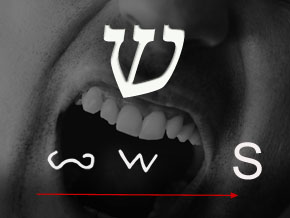
The pictogram depicts two teeth. Often describes chewing or crushing something.
161Princes have persecuted me without cause,
but my heart remains in wonder at your words (Hebr. davarim).
162I rejoice in your promise (Hebr. imrah)
like one who has found a great treasure that was lost. 163I hate and despise lies,
I love your teaching (Torah).
164Seven times a day I praise (I shout "hallelujah" to) you
for your righteous judgments (Hebr. mishpatim). [The number seven may describe seven times of prayer a day, although three is more common, see also . However, it is more likely that seven stands for perfection and wholeness – i.e. continuous prayer and gratitude to God. The reason why the Hebrew word for seven, sheva, is used here may also be to draw the reader's attention to the next verse, which consists of exactly seven words (this is the only occurrence in the entire Psalter). Even in the entire passage for , a fine structure can be discerned with three verses on either side of verses 164-165, forming a central unit.] 165Peace (Hebr. shalom – peace, wholeness, and harmony in all areas)
is great
for those who love
your teaching (Torah),
nothing
can bring them
down. [This verse consists of seven Hebrew words, the first of which is shalom. This is the only time the word appears in the entire Psalm 119. The word shalom is written with four letters , Lamed, Vav and Mem. Interestingly, the first letter of every other word (the first, third, fifth, and seventh words) in this verse is one of these four letters. Coded in every other first letter of this verse is the greeting of peace—shalom! Central to this seven-word verse is God's teaching – Torah! The letter is the twenty-first (3 x 7) letter of the alphabet! All this symbolism with the perfect number seven is also found in the twenty-first section of Psalm 119 (verses 161-168), which in turn is central to the seventh section with the last three letters , and (verses 153-176), gives extra emphasis. Those who put God's teaching at the center of their lives have perfect peace and nothing can bring them down! Something that is also illustrated literally with perfect balance in the language.] 166I have hoped for your salvation (rescue), Lord (Yahweh),
and have done (followed) your commandments (Hebr. mitzvot).
167My soul (I, my whole person) has kept (followed, obeyed) your testimonies (Hebr. )
and I love them infinitely.
168I have kept (followed, obeyed) your precepts (commandments, assignments – Hebr. ) and your testimonies (Hebr. ),
for all my ways are before you [you know].ת – Tav

The pictogram probably depicts two crossed sticks that marked a place. The Hebrew word "tav" means marking.
give me the ability to understand your word (Hebr. davar) [].
170Let my prayer come before your face,
save (lift up) me, according to your promise (Hebr. imrah) [God's promises in Scripture]. [Hebr. rina in can mean a cry of joy but also a cry of prayer. The word is deeply associated with sacrifice, the first occurrence being in that context, see . Since clearly deals with prayer, it is likely that this is the primary meaning intended here, while the duality of the song of rejoicing provides a nice introduction to the next two verses of the psalm, which deal with praise, see verses 171-172.] 171My lips shall overflow with praise (praise),
for you teach me your statutes (Hebr. chuqim).
172Let my tongue sing of your promise (Hebr. imrah),
for all your commandments (Hebr. mitzvot) are righteous (just).
173Let your hand help me,
for I have chosen [to obey] your precepts (commandments, assignments – Hebr. ).
174I have longed for your salvation (rescue, deliverance), Lord (Yahweh),
there is such wonderful joy (satisfaction) in your teaching (Torah).
175Let me (my soul; my whole person – all that I am) live and praise you,
and let your judgments (Hebr. mishpat) [your morality] help me.
176I have gone astray like a lost (dying, stray) sheep.
Come seek your servant,
for I have not forgotten your commandments (Hebr. mitzvot). [Most of the verses in this long psalm are composed of 5-7 words. The last verse () is the longest with a total of 9 words, spread over three lines instead of the usual two. This gives extra weight to the conclusion. The psalmist realizes that he is like a lost sheep, or more literally a "dying" sheep, completely dependent on God's mercy.]PILGRIM PSALMS (120-134)
Psalm 120 – I desire peace
This is the first of the fifteen pilgrim psalms, the "ascending songs" (Ps 120-134). These psalms were sung when people went up to the three week-long feasts celebrated each year in Jerusalem: the Feast of Unleavened Bread, Pentecost, and the Feast of Tabernacles, see .
Author: Unknown
Structure:
1. Trust, verses 1-2
2. Retribution, verses 3-4
3. Woe to me, verses 5-7
A pilgrim song (a pilgrimage song; "a song from/for those who walk up"). [No matter where you come from, you always walk up to Jerusalem.] 1201In my distress I cried out (raised my voice in prayer) to the Lord (Yahweh)
and he answered me.
2Lord (Yahweh), save (rescue) my soul (my self, my life) from lying (deceitful) lips,
from a deceitful (false, misleading) tongue. [Now the words of the Lord (Yahweh) are directed at an adversary and his deceitful words:]
3What will it [the deceitful tongue] give you [singular], and what more can it do for you,
you deceitful tongue?
4The sharp arrows of mighty men
with burning coals from broom bushes. [The roots were hard and worked well as charcoal.] 5Woe is me, for I dwell in Meshech [far upp north],
I live among the tents of Kedar [in the Arabian desert southeast of Israel]. [Meshech is the name of the descendants of Noah who lived in the north, either in northern Israel or in the region of Armenia. Their names are often mentioned together with Tubal and Magog, see The word means to pull up like a fish from the water or a root from the ground, or to draw a track, to draw a line. But it can also mean a seed or a possession.
Kedar was Ishmael's son, see . The word means "dark." By specifying areas in the north and east, the psalmist shows how he is like a nomad, away from the land.] 6My soul has lived too long among
those [litterally "him"] who hate peace (shalom). [The singular him strengthens the personal character of the sorrow.]
7I, peace (shalom) [I want peace, prosperity, wholeness; I am peaceful],
but when I speak, they are for war. [Literally, it says "I, peace." The word shalom means peace, completness and wholeness in all areas – nothing lacking. God's peace is deeply connected to God Himself.]Psalm 121 – I lift up my eyes to the mountains
This is the second of the fifteen pilgrim psalms – “the ascending songs” (Ps 120-134). These psalms were sung during the journey up to the three great feasts celebrated each year in Jerusalem.
Author: Unknown
Structure:
This psalm consists of four rhyming couplets. It is antiphonal, which means that a fore-singerfirst sings a passage and then another voice in the caravan (or an entire choir) repeats the same phrase. The psalm also has a chiastic pattern:
A help – come from, verses 1-2a
B heavens and earth,
C foot,
D The Lord will keep you (3 times) – he does not sleep, verses 3b-5a
C´ right hand,
B´ sun and moon,
A´ keep you – come in, verses 7-8
1211A pilgrim song (a pilgrimage song; “a song from/for those who walk up”). [No matter where you come from, you always walk up to Jerusalem.] I lift up my eyes to the mountains [that surround Jerusalem – Mount Zion and Mount Moriah].
From where shall my help come (enter – Hebr. bo)?
2My help comes from the Lord (Yahweh),
who made (appointet; set into function – Hebr. asah) heavens and earth. [In Hebrew word for heaven, shamajim, is always the dual form. The "two heavens" is interpreted as the visible sky and the spiritual abode of God. When both “heavens and earth” are mentioned, God is presented as the Creator of the entire universe, see . Here the word asah is used to mean “to make,” see ; .] 3He will not let your foot slip (he will not let you lose your footing) [lose your balance], he who preserves (protects; watches over) you will not rest (slumber). 4No, he who preserves (protects; watches over) Israel
will neither rest (slumber) nor sleep. 5The Lord (Yahweh) is the one who preserves (protects; watches over) you. The Lord (Yahweh) is your shadow (your protection) on your right hand. 6The sun shall not harm (destroy) you by day,
nor the moon by night. [A warrior held his shield in his left hand and was unprotected on his right side. The Lord stands on your right side and defends you. The sun and moon are thematically related to the heavens and earth in , but also introduce the concept of time, that God is the one who preserves you around the clock.] 7The Lord (Yahweh) will preserve (protect) you from all evil,
he will preserve your life (your soul).
8The Lord (Yahweh) will preserve (protect; watch over) your going out and your coming in [when you go out and when you come back—everything you do and undertake],
from now until eternity. [Going out is Hebr. bo, the same word translated “come” in and framing the psalm. Help and protection come from the Lord!]Psalm 122 – Let us go up to the house of the Lord
This is the third of the fifteen pilgrim psalms – "the ascending songs" (Ps 120-134). These psalms were sung during the journey up to the three great feasts celebrated each year in Jerusalem. Three of the ascending songs are attributed to David; this is the first of them. See also and . Together with , , and , Ps 122 has been called songs about Zion. Jerusalem and Zion are used as synonyms, where Zion often refers to the spiritual aspect—the temple and God's presence—while Jerusalem more often refers to the city itself—Israel's capital, the stones, the houses, and the people who live there. What is unique about this psalm is its focus on the city of Jerusalem.
The Hebrew name is Yerushalayim. In addition to singular and plural, Hebrew also has dual, which means two – the ending "-ajim" indicates this. The dual form of Jerusalem has sometimes been interpreted as the two mountains on which the city rests, but can also be taken literally to mean that the city signifies double peace. There is also the aspect of two cities, the heavenly and the earthly Jerusalem. In ancient Egyptian sources, the city is called "Ursalimmu," which means "foundation of peace/basis of peace."
Author: David
Structure: The words Lord, Jerusalem, house, and peace (shalom) are used three times. The psalm has a chiastic pattern:
A The psalmist and his friends, verses 1-2
B Jerusalem, verses 3-4
C Thrones for the judges – the house of David,
B Jerusalem, verses 6-7nbsp;B Jerusalem, verses 6-7
A The psalmist and his friends, verses 8-9
By (for) David. 1221I rejoiced when they said to me:
"Let us go up to the house of the Lord (Yahweh)"
2Our feet are standing
at (inside) your gates, Jerusalem. [The psalm begins with a pilgrim being told that it is time to go up to one of the three annual festivals in Jerusalem. In a moment between verses 1 and 2, the goal has been reached and the sight of the holy city is described.] 3Jerusalem, built as a city
where the houses stand together (close together, house by house without gaps).
4There the tribes go up,
the tribes of the Lord (Yahweh),
as a testimony to Israel to give thanks [with open hands—to praise, honor, and acknowledge],
to give thanks to the name of the Lord (Yahweh).
5There thrones have been set forth for the judges,
thrones for the house of David. 6Pray for the peace (shalom, prosperity in all areas) of Jerusalem;
may those who love you have every kind of success (Hebr. shala). []
7May peace (shalom, prosperity in all areas) reign within (inside) your walls,
and security (safety, abundance – Hebr. shala) in your palaces (fortresses). [The psalmist prays (Hebr. saalu) for God's peace (Hebr. shalom) and prosperity (Hebr. salom) over Jerusalem. Six of the ten words consist of the letters and Lamed, which emphasizes peace and wholeness in the prayer both visually and phonetically.]
8For the sake of my brothers and friends, I now say:
"Peace (shalom, all kinds of blessings) be with you."
9For the sake of the house of the Lord (Yahweh), our God (Elohim),
I will seek your good.Psalm 123 – Show us mercy, Lord
This is the fourth of the fifteen pilgrim psalms – "the ascending songs" (Ps 120-134). These psalms were sung during the journey up to the three great feasts celebrated each year in Jerusalem. The psalm is probably antiphonal, i.e., a fore-singersings a passage first and then another voice responds. The psalmist speaks directly to God in the introduction, the singular "I" in changing to the plural "our eyes" in . The song is a lament that ends by describing the oppression and difficult situation of the people. There are several double expressions and repetitions that reinforce the message – eyes, hand, and mercy.
Author: Unknown
Structure:
1. Expressions of trust, verses 1-2
2. Prayer and lamentation. verses 3-4
A pilgrim song (a pilgrimage song; "a song from/for those who walk up"). [No matter where you come from, you always walk up to Jerusalem.] 1231I lift up my eyes to you,
you who dwell (have your throne) in heaven.
2As the eyes of a servant look to the hand of his master,
as the eyes of a maid look to the hand of her mistress,
so our eyes look to the Lord (Yahweh), our God (Elohim),
until he shows us mercy (undeserved love; favor). 3Show us mercy (undeserved love; favor), Lord (Yahweh), show us mercy (undeserved love; favor),
for we [God's people, who have our hope in you] have been despised long enough now. [The repetition of the phrase "show us mercy" reinforces the desperation and sincerity of the prayer.]
4Our soul is filled to the brim with the scorn of the self-confident,
and the contempt of the arrogant (arrogants).Psalm 124 – The Lord on our side
This is the fifth of the fifteen pilgrim psalms – "the ascending songs" (Ps 120-134). These psalms were sung during the journey up to the three great feasts celebrated each year in Jerusalem. It is one of the three ascending songs attributed to David, see also and
Author: David
Structure:
1. Past victories, verses 1-5
2. Praise for what God has done, verses 6-7
3. Trust,
A pilgrim song (a pilgrimage song; "a song from/for those who walk up"). [No matter where you come from, you always walk up to Jerusalem.]
By (for) David. 1241If the Lord (Yahweh) had not been with us (on our side)
let Israel now say:
2"If the Lord (Yahweh) had not been with us,
on our side, when people rose up against us,
3then we would have been swallowed alive,
when their anger (hatred) burned (glowed) against us,
4then the waters would have drowned us,
the torrents would have overwhelmed us (our souls), 5the proud waters would have washed over our souls." [Throughout the Bible, seas and waters are used as symbols of peoples, multitudes, countries, and languages, see ; .] 6Blessed is the Lord (Yahweh)
who has not given us as prey to their teeth. 7We (our soul) have fled like a bird
from the snare of the fowler,
the snare has been broken
and we have fled. 8Our help is in the name of the Lord (Yahweh)
who made (formed, created) heaven and earth. []Psalm 125 – Like Mount Zion
This is the sixth of the fifteen pilgrim psalms – "the ascending songs" (Ps 120-134). These psalms were sung during the journey up to the three great feasts celebrated each year in Jerusalem.
Author: Unknown
Structure:
1. Trust in God's protection, verses 1-2
2. Transition from trust to prayer,
3. Transition from prayer to pronouncing peace over Israel, verses 4-5
A pilgrim song (a pilgrimage song; "a song from/for those who walk up"). [No matter where you come from, you always go up to Jerusalem.] 1251Those who trust in (rely on, put their hope in) the Lord (Yahweh) are like Mount Zion [the temple mount in Jerusalem]
which cannot be shaken (shaken) but stands firm (steadfast, stable) forever.
2As the mountains surround Jerusalem, so the Lord surrounds his people both now and forever. [Verses 1-2 form a chiasm in which an image of Zion and Jerusalem is used to illustrate God's protection. Jerusalem is located 800 meters above sea level in the mountainous region of Judea. All around the city, the mountains rise slightly higher than Jerusalem itself, especially to the east. Jerusalem itself is also a hilly city because it is located on several mountains. Here in the psalm, we can imagine the pilgrim celebrating a feast in Jerusalem, looking out over the surrounding mountains and likening them to God's protection surrounding God's people. The mountains, and especially Mount Zion, represent something firm and steadfast.] 3For the rod of wickedness [oppression from an evil king] will not rest
upon the land of the righteous
unless the righteous
put their hands to iniquity (deviate from the right path).
4Do good, Lord (Yahweh), to the good
and to those who have sincere (upright, standing) hearts.
5But those who turn aside on winding paths (crooked ways)
the Lord (Yahweh) will lead away with those who do evil.
Peace (wholeness, divine protection – Hebr. shalom) be upon Israel.Psalm 126 – Give us life again
This is the seventh of the fifteen pilgrim psalms – "the ascending songs" (Ps 120-134). These psalms were sung during the journey up to the three great feasts celebrated each year in Jerusalem. The psalm begins with the memory of what God has done and the joy it has brought. Based on this approach, a common prayer is formed that God will once again show his power and turn sorrow into joy. The psalm is often linked to – which begins the Babylonian captivity. This psalm probably describes the end of that period.
Author: Unknown, one suggestion is Ezra.
Structure: The psalm has 48 words (excluding the introduction), see ; . The word "bring back" (Hebr. shov) is used in verses 1 and 4.
1. Trust, verses 1-3
2. Appeal,
3. Praise, verses 5-6
A pilgrim song (a pilgrimage song; "a song from/for those who walk up"). [No matter where you come from, you always go up to Jerusalem.] Former joy
1261When the Lord (Yahweh) brought back the captives of Zion ...
it was as if we were dreaming (it felt completely unreal; we could hardly believe it was true).
[Probably refers to the return from exile, see ; . The verb for dreaming (Hebr. chalam) also means "to be strong; to become strong."] 
Israel's prime minister recited Psalm 126 at the signing of the peace treaty with Egypt in 1978. Pictured: Menachem Begin, Jimmy Carter, and Anwar Sadat during the negotiations at Camp David.
2Then our mouths were filled with laughter,
and our tongues with shouts of joy (loud triumphant cries of joy).
Then it was said among the nations:
"The Lord (Yahweh) has done great things for them!" 3The Lord (Yahweh) has done something great for us;
we are glad.The appeal
4Bring back our captives, Lord (Yahweh),
like the streams in the Negev [the desert in the south]. [The streams in the Negev desert in southern Israel are dry most of the year, but suddenly fill with flowing water for a few hours when the winter flood comes.]From sorrow to joy
[ forms a chiasm in which the contrast between tears and rejoicing is centrally framed by the verbs for sowing and reaping. The Hebrew preposition Bet (in) emphasizes how both sorrow and joy involve the whole person—they do not sow and reap with tears and rejoicing, but in tears and rejoicing.] 5Those who sow
in tears –
in joy (loud triumphant cries of joy)
they will reap. []
6He who goes out [walks back and forth] weeping (in sorrow),
carrying his [precious, last] seed –
he will [without doubt] return with shouts of joy (loud triumphant cries of joy),
carrying his sheaves. [He will reap a richly blessed harvest!]
[During sowing, people were completely dependent on rain. Fear and concern about drought or pest infestation could cause people to sow their seed while weeping—especially if the previous year had been a bad one. If the seed was the last they had left, they were completely dependent on a good harvest to come. The people of Israel endured difficult times, but they waited for God's promises to be fulfilled. The psalmist is absolutely certain that a time of joy and shouts of joy will come.]Psalm 127 – Unless the Lord builds the house ...
This is the eighth of the fifteen pilgrim psalms – "the ascending songs" (Ps 120-134). These psalms were sung during the journey up to the three great feasts celebrated each year in Jerusalem. The author of the psalm, Solomon, is known for his wisdom and for building the first temple in Jerusalem, the two themes of this psalm. The psalm gives instructions for living a righteous life and is categorized as one of the wisdom psalms, see also .
Author: Solomon
Structure:
1. The house, verses 1-2
2. Children, verses 3-5
A pilgrim song (a pilgrimage song; "a song from/for those who walk up"). [No matter where you come from, you always go up to Jerusalem.]
By (for) Solomon. 1271Unless the Lord (Yahweh) builds the house (family; temple – Hebr. bayit) [Solomon built the temple, see ]
those who build it labor in vain (in emptiness; futility).
Unless the Lord (Yahweh) guards (protects; watches over) the city,
the watchmen guard (watch) in vain.
[Their efforts will be unsuccessful and of no use unless God is with them.]
2It is meaningless for you to rise early
stay up late [work hard all day],
to eat the bread of toil—
he gives these [blessings] to those he loves (his friends) while they sleep. [At first glance, verses 1-2 and 3-5 may seem unrelated, but in Hebrew, the word for house bayit and the word for children (plural) banim are very similar.] 3Behold, children (Hebr. banim) are a heritage from the Lord (Yahweh),
the fruit of the womb is a reward.
4Like arrows in the hand of a mighty man (warrior)
are children born in one's youth.
5Blessed (happy, fortunate) is the man (warrior – Hebr. gever) [a man in his prime]
whose quiver is full of them.
They will not be put to shame
when they speak with their enemies at the gate. [The city gate was the place where people met when they had something that needed to be decided in court. Enemy here should perhaps be seen primarily as an opponent in a legal case, but also has a broader meaning.]Psalm 128 – The Lord blesses you from Zion
This is the ninth of the fifteen pilgrim Psalms – "the ascending songs" (Ps 120-134). These psalms were sung during the journey to the three great feasts celebrated each year in Jerusalem. This is a wisdom psalm that affirms how a healthy fear of God is fundamental to receiving the Lord's blessing. It is a fitting continuation of the previous psalm, which dealt with houses and children.
Author: Unknown
Structure:
1. Words of wisdom, verses 1-4
2. Priestly words, verses 5-6
A pilgrim song (a pilgrimage song; "a song from/for those who walk up"). [No matter where you come from, you always walk up to Jerusalem.] 1281Blessed (happy, fortunate) are all who fear (revere, respect) the Lord (Yahweh) [; ],
who walk (wander) in his ways (do what is right and pleasing to God),
2for he will eat the fruit of his labor.
You will be blessed (happy, fortunate) and it shall go well with you.
3Your wife will be like a fruitful vine
bearing abundant fruit in your home.
Your children will be like olive shoots
around your table. [The table, or dining table, is an important symbol of family unity in the Bible. To have a table where everyone gathers and where there is always a place for the widow, the fatherless, and the stranger is to have a family that lives in accordance with God's intentions for our life on earth. There is never a shortage of food there because God always blesses those who live according to His precepts.] 4Behold, the man (warrior) [a man in his prime]
who fears (reveres, respects) the Lord (Yahweh) will truly (indeed) be (become) blessed. 5The Lord (Yahweh) blesses you from Zion [the temple mount in Jerusalem]
and lets you see the good of Jerusalem
all the days of your life.
6May you live and see your grandchildren.
Peace (shalom, all God's blessings) be upon Israel!Psalm 129 – The Lord is righteous
This is the tenth of the fifteen pilgrim psalms – "the ascending songs" (Ps 120-134). These psalms were sung during the journey up to the three great feasts celebrated each year in Jerusalem.
Author: Unknown
Structure:
1. Past suffering, verses 1-3
2. Divine intervention,
3. Words of judgment, verses 5-8
A pilgrim song (a pilgrimage song; "a song from/for those who walk up"). [No matter where you come from, you always walk up to Jerusalem.] 1291How often (many times) have they been hostile to me, ever since my youth,
let Israel now say:
2How often (very often, many times) have they been hostile to me, ever since my youth,
but they have not overcome me. [The stay in Egypt was Israel's youth, see .] 3Plowmen have plowed my back,
they made their furrows long. [Prolonged suffering, also prophetic about Jesus, whose back was beaten.]
4The Lord (Yahweh) is righteous,
he has cut the bonds (ropes) of the wicked. [The word is used for the straps on the plow yoke that were attached to the ox's neck, see .] 5May all who hate Zion [the temple mount in Jerusalem]
be driven back in shame (disgrace).
6Let them be like grass on the roofs []
that withers away before it can even be pulled up,
7A reaper cannot fill his hand with it,
nor can the one who binds the sheaves fill his sheaf.
8No one passing by should say [be able to give a blessing during harvest time]:
"The blessing of the Lord (Yahweh) be upon you!
We bless you in the name of the Lord (Yahweh)."
[An example is Boaz greeting the harvesters, who then respond, see .]Psalm 130 – Out of the depths I cry to you, Lord
This is the eleventh of the fifteen pilgrim psalms – "the ascending songs" (Ps 120-134). These psalms were sung during the journey up to the three great feasts celebrated each year in Jerusalem. The psalm is probably antiphonal, i.e., a fore-singersings a passage first, and then another voice or a choir responds.
Author: Unknown
Structure:
1. Prayer – hear me, verses 1-2
2. Trust in the Lord, verses 3-4
3. Trust in the Lord, verses 5-6
4. Invitation to Israel to trust in the Lord, verses 7-8
A pilgrim song (a pilgrimage song; "a song from/for those who walk up"). [No matter where you come from, you always go up to Jerusalem.] 1301From the depths [of the ocean; a metaphor for a situation with insurmountable problems]
I call (I raise my voice in prayer) to you, Lord (Yahweh).
2Lord (Adonai), hear my voice,
let your ears hear the sound of my prayers [earnest, humble pleas for mercy and help]. 3If you, Lord (Yah – short form of Yahweh; signifies that he has always existed),
were to hold fast to (take account of) our sins,
who could stand before you [on the day of judgment]?
4But with you there is forgiveness (Hebr. ha slichah),
so that we may fear (revere) [honor] you. 5I wait for (look eagerly for; hope persistently for) the Lord (Yahweh)
– my whole being (my soul – Hebr. ) waits –
and I trust in his word (wait for what he will say).
6My whole being (my soul) [waits/longs] for my Lord (Adonai),
more than the watchmen for the morning,
more than the watchmen [long] for the morning. [The verse lacks a verb, but it is implied from , but with a new object – my Lord.] 7Israel, trust (wait eagerly) in the Lord (Yahweh),
for with the Lord (Yahweh) there is mercy (caring love – chesed),
and with him there is full deliverance (complete ransom to buy us free from sin).
8He will redeem (free) Israel
from all their sins (from the consequences of sin).Psalm 131 – Like a weaned child
This is the twelfth of the fifteen pilgrim psalms – "the ascending songs" (Ps 120-134). These psalms were sung during the journey up to the three great feasts celebrated each year in Jerusalem. This short psalm expresses trust and gratitude to God in a simple and uncomplicated way. It is one of the three ascending songs attributed to David, see also and . This short psalm is about a simple childlike trust in God. It is like an echo of David's response to Saul's daughter Michal after he danced before God, see .
Author: David
Structure:
1. Humility,
2. Trust in God,
3. Exhortation to Israel to trust in the Lord,
A pilgrim song (a song of ascents; "a song from/for those who walk up"). [No matter where you come from, you always go up to Jerusalem.]
By (for) David. 1311Lord (Yahweh), my heart is not proud,
I do not look down on others (my eyes are not haughty).
[Pride originates in the heart and is often expressed in a haughty gaze.] I do not devote myself to (do not walk in; do not pursue) great things,
to that which is too difficult [complex mysteries].
[I am content, able to let go of that which is beyond my understanding—God's great mysteries—which I am not yet ready to comprehend.] 2I have calmed and quieted my soul (my inner being),
like a weaned child [safe and quiet] resting in its mother's arms,
like a weaned child [no longer restlessly sucking] is my soul within me.
3Israel [God's people],
trust (have faith and confidence) in the Lord (Yahweh),
now and forever!Psalm 132 – Remember, Lord, for David's sake
This is the thirteenth of the fifteen pilgrim psalms – "the ascending songs" (Ps 120-134). These psalms were sung during the journey up to the three great feasts celebrated each year in Jerusalem.
Author: Unknown
Structure:
1. Prayer
a. David's promise to God, verses 1-5
b. The story of God's ark, verses 6-8
c. A prayer for the priest and the people,
d. A prayer for David,
2. Answer to prayer
a. God's promise to David, verses 11-12
b. God's response to the story of the ark, verses 13-15
c. A prayer for the priest and the people,
d. The answer to David's prayer, verses 17-18
A pilgrim song (a pilgrimage song; "a song from/for those who walk up"). [No matter where you come from, you always walk up to Jerusalem.] Prayer
1321Lord (Yahweh), remember David,
all his suffering,
2and how he swore, made his vow to the Lord (Yahweh)
and his promises to the Mighty One of Jacob.
3"I will not enter my [own] tent-house (tabernacle dwelling – Hebr. óhel bayit) [refers to the meeting tent (Hebr. óhel móed), see and ],
nor rest on my bed,
4nor will I give my eyes any sleep,
or close my eyelids,
5until I find a place for the Lord (Yahweh),
a resting place for the Mighty One of Jacob." 6Behold, we have heard that it is in Ephrathah [the area around Bethlehem, David's hometown],
we found it in the fields of Jaar.
[Jaar is the poetic short form for Kirjat Jearim where the ark was before David brought it home to Jerusalem, see .]
7Let us go to his dwelling place (tabernacle – Hebr. mishkan),
let us worship at his footstool.
8Arise (rise up), Lord (Yahweh), to your resting place,
you and the ark of your strength. 9Let your priests be clothed with righteousness,
and let your saints rejoice (raise loud triumphant shouts). 10For the sake of your servant David,
do not turn away your face from your Anointed One.God's answer
11The Lord (Yahweh) has sworn an oath to David,
a true promise that he will not take back.
From the fruit of your body
I will set one on your throne,
12if your children keep my covenant
and my testimonies (statutes – Hebr. ) that I will teach (instruct) them,
then your sons will forever
sit on your throne. 13The Lord (Yahweh) has chosen Zion [the temple mount in Jerusalem].
His desire is to have it as his dwelling place.
14"This is my resting place forever,
here I will dwell, for I have chosen it.
15I will richly bless her food.
I will satisfy all who are in need with bread. 16I will clothe her priests with salvation
and her godly ones will rejoice (raise loud triumphant shouts). 17There I will raise up a horn for David,
I have set a lamp [that will burn continually] for my Anointed One. [; ]
18I will clothe his enemies with shame,
but upon him his crown shall shine (shine, spread its bright light)." [Verses 17 and 18 are a prophecy about the Messiah, Jesus, when he comes in glory and will reign from Zion in the millennial kingdom.]Psalm 133 – Unity among God's people
This is the fourteenth of the fifteen pilgrim psalms – "the ascending songs" (Ps 120-134). These psalms were sung during the journey up to the three great feasts celebrated each year in Jerusalem. This short psalm (which is a movement in Hebrew) is both simple and clear, but at the same time very complex. The first verse says it all, followed by comparisons expressed in the phrases "like precious oil" and "like the dew on Hermon." One could say that the psalm begins, but never ends. We can sense how this psalm forms the background for Jesus' prayer for unity, see .
Author: David
Structure: The psalm is a single sentence in Hebrew. That alone speaks of unity and how blessed it is to have good friendships.
A pilgrim song (a pilgrimage song; "a song from/for those who walk up"). [No matter where you come from, you always go up to Jerusalem.]
By (for) David. 1331See how good and pleasant (beautiful) it is
for brothers (relatives, countrymen) who dwell (live together; literally: sit – Hebr. shevet)
in unity (united) [who are in agreement; have no internal disputes].
[Brothers is Hebr. achim, literally blood brothers (first used of Cain and Abel, see ), but also used for relatives, extended family, and by extension also villages and communities. In there is the first example where scarce resources are causing conflict in a family. Abraham then exclaims to his nephew Lot: "Let there be no strife between you and me, or between my herdsmen and yours. We are of the same family (achim)," see . A similar conflict also arises in .] 2Like the precious oil [] on the head
– it flows down over
the beard (chin, cheeks – Hebr. zaqan),
Aaron's beard,
the one that flows down
onto his colored robe. [Unlike the other priests, the high priest wore a robe with many colors. We often imagine a goatee, but here it is probably the priest's side locks (long sideburns, in Hebrew peijot, from the word for corner, see ) that lie against the robe that is referred to. Fragrant oil was used during celebrations, so the image here is one of joy and celebration, see ; . The oil was also used when a priest or king was crowned, see ; .] 3Like the dew on Hermon [in northern Israel]
– comes down on Mount Zion [the Temple Mount in Jerusalem]. [In a land with little rain, dew is vital for vegetation, crops, and life, see ; ; . The king's favor is as life-giving and refreshing as the dew on the grass, see . In , oil and dew form a pair, with oil representing rain.] For from there the Lord (Yahweh) commands his blessing—eternal life! [An interesting note about rain (and dew) is that it affects everyone, righteous and unrighteous alike, see . Living in forgiveness and harmony is an active decision of a believer, see , ; that affects the whole community. This psalm ends with a dizzying promise that in response to true unity, the Lord will command his blessing – eternal life.]Psalm 134 – Praise God all night long
This is the last of the fifteen pilgrim psalms – "the ascending songs" (Ps 120-134). These psalms were sung during the journey up to the three great feasts celebrated each year in Jerusalem. The fourteen preceding psalms leading up to Psalm 134 provide the reasons and background for the call here to praise God. The psalm has similarities with Psalm 150, which concludes the entire Book of Psalms.
Author: Unknown
Structure:
1. Call to praise, verses 1-2
2. Blessing,
A pilgrim song (a pilgrimage song; "a song from/for those who walk up"). [No matter where you come from, you always go up to Jerusalem.] 1341Behold, bless the Lord (Yahweh), all the servants of the Lord (Yahweh),
who stand all night in the house of the Lord (Yahweh).
2Lift up your hands to the sanctuary
and bless the Lord (Yahweh).
3May the Lord (Yahweh) bless you from Zion [the Temple Mount in Jerusalem],
he who made (formed, created) heaven and earth [].PSALMS 135-150
Psalm 135 – Praise the name of the Lord
The psalmist urges God's people to praise the Lord (Yahweh). God is incomparable to the gods of this world and has done great wonders for Israel.
Author: Unknown
Structure:
A Hallelujah,
B Call to praise God, verses 1b-4
C God is above all other gods, verses 5-7
D God's deeds for Israel, verses 8-14
E The gods of other nations compared to God, verses 15-18
D´ God's deeds for Israel, verses 8-14
C´ The gods of other nations compared to God, verses 15-18
B´ Call to bless God, verses 19-21a
A´ Hallelujah,
1351Praise the Lord (praise Yah – Hebr. )!
Praise the name of the Lord (Yahweh),
praise, you servants of the Lord (Yahweh).
2Yes, you who stand in the house of the Lord (Yahweh),
in the courts of the house of our God (Elohim).
3Praise the Lord (Yah), for the Lord (Yahweh) is good,
sing praises to his name, for it is pleasant.
4The Lord (Yah) has chosen Jacob [and his descendants] for himself,
and Israel as his own precious treasure. 5For I know that the Lord (Yahweh) is great,
and that our Lord (Adonai) is above all gods.
6Whatever the Lord (Yahweh) pleases, he has done,
in the heavens and on the earth,
in the seas and in all their depths.
7Who causes the mist to rise from the ends of the earth?
He makes lightning for the rain,
He brings forth the winds from His storehouses.
8Who struck down the firstborn in Egypt,
both humans and animals? []
9He sent signs and wonders into your midst, Egypt,
upon Pharaoh and upon his servants. [The ten plagues, see ]
10Who struck down many pagan peoples (nations)
and brought down mighty kings?
11Sihon, king of the Amorites,
and Og, king of Bashan []
and all the kingdoms of Canaan [; ],
12and gave their land as an inheritance,
an inheritance to Israel, his people.
13O Lord (Yahweh), your name endures forever,
your fame, Lord (Yahweh), through all generations.
14For the Lord (Yahweh) will judge his people,
and have mercy and comfort his servants.
15The idols of the nations are silver and gold,
made by human hands.
16They have mouths but cannot speak,
they have eyes but cannot see,
17they have ears but do not hear,
nor is there any breath in their mouths. 18Those who make them will become like them,
yes, all who trust (rely) on them.
[; ; ; ; ] 19O house of Israel, bless the Lord (Yahweh);
O house of Aaron [the priests], bless the Lord (Yahweh);
20House of Levi [all temple servants], bless the Lord (Yahweh),
you who fear (revere) the Lord (Yahweh), bless the Lord (Yahweh).
21Blessed is the Lord (Yahweh) from Zion [the temple mount in Jerusalem], he who dwells in Jerusalem.
Praise the Lord (praise Yah – Hebr. )!Psalm 136 – Give thanks to the Lord for his mercy
Each verse in the 26-verse psalm ends with the Hebrew phrase: ki olam chesed. It becomes like a refrain that literally translates as: "for his mercy – eternal," and describes how God's mercy and faithful love are eternal. This psalm is antiphonal, i.e., a leader first sings a phrase, which is then answered by the congregation/choir. This was prescribed by David and practiced 500 years later, see .
Author: Unknown
Structure:
1. Give thanks to God, verses 1-3
2. Give thanks to God the Creator, verses 4-9
3. Give thanks to God who guides and protects, verses 10-22
4. Give thanks to God who provides, verses 23-25
5. Give thanks to God,
1361Give thanks [with open hands – praise, honor, and acknowledge] to the Lord (Yahweh), for he is good,
for his mercy (caring, faithful love) endures forever (eternally).
2Give thanks [with open hands – praise, honor, and acknowledge] to the God of gods (Elohei elohim),
for his mercy (caring, faithful love) endures forever (eternally).
3Give thanks [with open hands – praise, honor, and acknowledge] the Lord of lords (Adonai Adonim),
for his mercy (caring, faithful love) endures forever (eternally). 4To him who alone performs great miracles,
forever (eternally) lasts his mercy (caring, faithful love).
5To him who made (created) the heavens with understanding (knowledge),
forever (eternally) lasts his mercy (caring, faithful love).
6To him who has spread out (expanded) the earth upon the waters [see ],
forever (eternally) lasts his mercy (caring, faithful love).
7To him who made the great lights [plural],
forever (eternally) his mercy (caring, faithful love) endures.
8To him who made the sun to rule over the day,
forever (eternally) his mercy (caring, faithful love) endures.
9To him who made the moon and stars to rule over the night,
forever (eternally) lasts his mercy (caring, faithful love). 10To him who struck down the firstborn of Egypt,
forever (eternally) lasts his mercy (caring, faithful love).
11To him who brought Israel out from among them [Egypt],
forever (eternally) his mercy (caring, faithful love) endures.
12With a mighty hand and an outstretched arm,
forever (eternally) his mercy (caring, faithful love) endures.
13To him who divided the Sea of Reeds (Hebr. jam sof) [Red Sea] in two,
forever (eternally) his mercy (caring, faithful love) endures,
14and let Israel pass through it [the Red Sea],
forever (eternally) his mercy (caring, faithful love) endures.
15To him who shook down (scattered, scattered – Hebr. naar) Pharaoh and his army in the Reed Sea,
forever (eternally) lasts his mercy (caring, faithful love).
16To him who led his people through the desert,
forever (eternally) his mercy (caring, faithful love) endures.
17To him who overthrows great kings,
forever (eternally) lasts his mercy (caring, faithful love).
18To him who overthrows mighty kings,
forever (eternally) his mercy (caring, faithful love) endures:
19Sihon, king of the Amorites,
his mercy (caring, faithful love) endures forever (eternally),
20and Og, king of Bashan,
forever (eternally) lasts his mercy (caring, faithful love).
21To him who gave their [the kings'] land as an inheritance,
forever (eternally) his mercy (caring, faithful love) endures.
22Yes, to an inheritance for his servant Israel,
forever (eternally) his mercy (caring, faithful love) endures. 23To him who remembered us in our lowliness [when we were slaves],
forever (eternally) his mercy (caring, faithful love) endures.
24To him who delivered us from our enemies (opponents),
forever (eternally) lasts his mercy (caring, faithful love).
25To him who gives bread (food) to all flesh (all living things)
forever (eternally) lasts his mercy (caring, faithful love). 26Give thanks [with open hands—praise, honor, and acknowledge] to the God of heaven (El),
for his mercy (caring, faithful love) endures forever (eternally).
Psalm 137 – By the rivers of Babylon
The psalm was written during the Babylonian captivity, 596-538 BC. Psalm 137 has some of the most beloved opening verses and the most terrifying conclusion of any psalm. The closing words cannot be understated. This is a genuine lament addressed to God with a desire for God's justice and vengeance for all those who fell victim when the Babylonians captured Jerusalem.
Author: Unknown
Structure:
1. The place is described, verses 1-3
2. The memory of Jerusalem, verses 4-6
3. Prayer for vindication, verses 7-9
1371By the rivers of Babylon [during the exile], there we sat down and wept,
when we remembered Zion [the temple mount in Jerusalem].
2On the willow trees in its midst
we hung our harps (kitharas – Hebr. kinnor).
3Those who led us into captivity asked us for the words of our songs,
our tormentors asked us to be cheerful:
"Sing one of the songs of Zion."
4How can we sing the Lord's (Yahweh's) song
in a foreign land?
5If I forget you, Jerusalem,
let my right hand forget ... [The sentence is incomplete. Poetically refers to the hand losing its ability to play again. The word for forgetting (Hebr. shachach) is also similar to tikhshakh, to wither away.]
6Let my tongue stick to the roof of my mouth,
if I do not remember you,
if I do not make Jerusalem
my highest joy.
7Remember, Lord (Yahweh), against the sons of Edom,
the day of Jerusalem [when the city fell],
they said, "Break down, break down,
even its foundations."
8O daughter of Babylon, who must be destroyed,
happy (blessed) is he who takes vengeance on you
for what you have done to us.
9Happy (blessed) is the one who takes your little ones
and smashes them against the rock. [] [This verse shows how we can leave all our feelings to God, even the hatred toward those who have hurt us or someone close to us. By speaking these words, we express our pain and leave it to God, knowing that one day he will judge every person fairly, see .]Psalm 138 – Because of your mercy and faithfulness
Psalm 138 is the first of eight psalms in book five attributed to David (Ps 138-145). It is an individual psalm of thanksgiving.
Author: David
Structure: The psalm can be divided into three parts, based on the three different groups before which the psalmist praises the Lord:
1. In the presence of other gods, verses 1-3
2. In the presence of the kings of the earth, verses 4-6
3. In the presence of enemies, verses 7-8
By (for) David. I want to thank
1381I want to thank [with open hands – praise, honor, and acknowledge] you with all my heart,
sing your praises before the gods (elohim).
[May refer to the heavenly host of angels, pagan idols, or God's council, see .]
2I want to worship, facing your holy temple,
and thank [with open hands – praise, honor, and acknowledge] your name
for your mercy (caring love) and your truth. [Throughout the Bible, mercy and truth are companions, see ; ; ; . The first time these words are mentioned together is in God's own testimony, see . Grace without truth becomes ineffective, while truth without grace becomes merciless. Both grace and truth are needed, and grace always comes first. For you have made your promise and your name greater than anything else! You have surpassed everything!] 3On the day I cried out (raised my voice in prayer), you answered me;
you strengthened me (gave me boldness) with [your] strength within me (my soul).All shall give thanks
4All the kings of the earth shall give thanks [with open hands—praise, honor, and acknowledge] you, Lord (Yahweh),
when they hear the words from your mouth. 5They shall sing of the ways of the Lord (Yahweh),
for the glory of the Lord (Yahweh) is great (a completely saturated divine presence, God's glory and weight are great).
6Even though the Lord (Yahweh) is exalted, he looks after the lowly (those who are far below) [for the humble into fellowship with him],
but the proud he knows [only] from afar.Gratitude regardless of circumstances
7Even though I walk through hardship (difficulties, problems), you keep me alive (you give me life, strength, and power);
you stretch out your hand against the wrath of my enemies.
Your right hand saves (delivers) me. 8The Lord (Yahweh) will complete his work for me.
Lord (Yahweh), your mercy (caring love) lasts forever;
do not abandon (cease) the work of your hands.Psalm 139 – You search me and know me
Psalm 139 is the second of eight psalms in book five attributed to David (Ps 138-145). It is a song praising God for his goodness and deliverance in a difficult situation. The verb for to know, to be familiar with, and to be intimate with (Hebr. jada) is used a total of six times (once each in verses 1, 2, 4, and 14, and twice in ). If we also include the word for knowledge (Hebr. daat – which derives from jada) in , there are a total of seven occurrences. In addition, David uses seven synonyms for jada (five different words, two of which are used twice): to examine (Hebr. chaqar – verses 1, 23), to discern (Hebr. bin – ), to see (Hebr. – ), to be familiar with (Hebr. – ) and to see (Hebr. – verses 16, 24). All of this reinforces the theme of the psalm, namely that God sees everything and knows his servant (verses 7-12).
Author: David
Structure:
1. God – you know me so well, verses 1-6
2. I cannot escape you, verses 7-12
3. You created me, verses 13-18
4. Prayer to God, verses 19-24
A psalm [song accompanied by strings] of (for) David. 1391Lord (Yahweh), you search (explore, examine, scrutinize) me
and know me.
2You know [exactly] when I sit and when I stand [feel every action];
you discern (understand) my motives from afar (even before I myself know them). []
3You examine (measure) my path [my daily activities—the public] and my bed [the private]—
you are familiar with all my ways (life choices, habits).
4For no word (Hebr. milah) has been formed on my tongue,
without you, Lord (Yahweh), knowing (being aware of) it.
5You surround (besiege, encircle) me – behind and in front (on all sides),
and you have laid your hand upon me.
6That knowledge is beyond my understanding (is indescribable/wonderful – Hebr. pili) [],
it is so high that I cannot comprehend it. [In a couple of rhetorical questions, David now praises God's great love and grace that reaches everywhere, see also, see also :]
7Where can I go (should I wander) from your Spirit?
Where can I flee from your face (your presence; literally: your faces)?
8If I ascend to heaven,
you are there,
and if I make my bed (make my bed) in Sheol (the grave, the underworld – the place of the dead) [the realm of death],
behold, you are [also] there! [literally: behold – you/you!]
9If I take [lift] the wings of the morning [move at the speed of light along a ray of sunlight at sunrise]
and settle [on the other side – on the islands that lie] farthest (outmost) in the sea [in the west],
10there too your hand will guide me,
and your right [hand] will hold (grasp) me.
11And if I say,
"Surely darkness will cover me [open its wide mouth; overwhelm, crush me, see ; ],"
even the night will be light for me. []
12No, darkness will not be too dark (darkened) to you,
but the night will shine like the day—darkness and light make no difference [to you]. [The verse ends literally: "as darkness as light." The two vertical extremes (the heavens and the underworld, see ) and the two horizontal extremes (east and west, see ) poetically describe that there is no place where God's Spirit cannot reach and His presence transform the situation!] 13For you created my kidneys [my inner being],
you wove (Hebr. sachach) me in my mother's womb. [; ; ] [The kidneys represent the most sensitive and vital function within us. The Hebrew word for weaving, winding, and braiding means to create a shielding and covering protection. The meaning therefore also becomes to surround, enclose, shield, enclose, cover, and protect.] 14I thank you [with open hands I praise, honor, and acknowledge you] because with great reverence (heartfelt respect)
I am (became) a wonderful (unique and separate) creation [exclusive and special as God's image].
Wonderful are your works,
and my soul knows this very well (I am most aware of this myself; I am truly intimately familiar with it).
15My body (skeleton) was not hidden from you
when I was formed in secret.
When I was woven together (like a fabric embroidered with different colors) in the depths of the earth, 16your eyes saw my unformed body (curled up, folded) [not yet developed, i.e., when I was just an embryo].
All my days were written in your book [the book of life, see ]
before they took shape, before any of them had come to be. 17How incomprehensible (precious)
are your thoughts about me, God (El) [the mighty, strong one]!
How immeasurably great
is the sum of them all!
18If I were to count them
they would be more than the grains of sand.
When I wake up [from my sleep, or from all my thoughts on this],
I am still with you. [The following four verses are sometimes omitted when the psalm is recited, but they are included in the psalm and provide background to why it was composed. The psalmist has been hurt and betrayed, suffering evil from people who hate God and rebel against him. In the midst of this chaos and opposition, this psalm speaks of trust, gratitude, and a heartfelt presence of God.] 19If only you would kill the godless, God (Eloha) [Elohim in the singular—the one God]!
Away from me, you bloodthirsty ones!
20Those who speak of you with deceit in their hearts,
they have brought your cities to ruin.
21Should I not hate those who hate you, Lord (Yahweh),
and despise those who rebel against you?
22I hate them with the strongest (complete, all-encompassing) hatred,
they have become my enemies. [David ends the psalm with the same verb he uses in the introduction, see verses 1b-2, but with an appeal instead of the indicative form "You search me and know me":] 23Search (examine, scrutinize) me, God (El),
and know (become intimately acquainted with; be personally involved in) my heart (my innermost being). []
Test (try, prove the authenticity of) me [as silver and gold are refined, see ; ]
and know [take care of] my troubled thoughts (my anxiety – Hebr. saraf). [The Hebr. word meaning "troubled thoughts" is in the plural and is used only here and in .]
24And see [then] if there is a destructive (painful) way in (in) me [a way that hurts you and harms me],
and lead me on the eternal path.
[The path that leads to eternal continuation in communion with God.]Psalm 140 – Protect me from evil people
Psalm 140 is the third of eight psalms in book five attributed to David (Ps 138-145). A prayer for protection.
Author: David
Structure:
The psalm is well structured in both chiasms and other patterns. The name of the Lord Yahweh appears seven times, see verses 2, 5, 7-9, 13. The chiastic pattern is:
A Violent people, verses 2-3
B Lips,
C Evil plans, verses 5-6
D God's sovereignty, verses 7-8
C´ Evil plans,
B´ Lips, verses 10-11
A´ Violent people,
God's ways, verses 13-14
Verses 2-4 contain 23 Hebrew words and end with Selah.
Verses 5-6 also contain 23 words and end with Selah.
Verses 7-9 contain 24 words and end with Selah.
Verses 10-12 contain 23 words.
To the leader. [Describes someone who stands out – who is brilliant and prominent in their field. Refers partly to the director of temple music but also to the Messiah, the brilliant morning star, see and the introduction to the Psalter.]
A psalm [song accompanied by strings], by (for) David. 1401Deliver me, Lord (Yahweh), from evil men,
preserve me from violent men, 2who carry evil in their hearts.
Every day they stir up war. 3They have sharpened (honed) their tongues like snakes,
the poison of vipers is under their lips.
Selah. [Probably a break for an instrumental interlude, a pause to reflect on what has just been sung.] 4Keep me safe, Lord (Yahweh), from the hand of the wicked,
preserve me from violent men,
who try to make my steps slippery (want to make me slip).
[ has the same theme as and is similar.] 5The proud have hidden a trap and rope for me,
they have laid a net by the roadside (along major routes),
they have set a snare for me.
Selah. [Probably a break for instrumental interlude, a pause to reflect on what has just been sung.] 6I have said to the Lord (Yahweh): "You are my God (El)."
Listen (turn your ear), Lord (Yahweh), to the sound of my prayers [earnest, humble pleas for mercy and help].
7Lord (Yahweh), Lord (Adonai), my strength of salvation,
who has held a shield over my head (protected my head as with a helmet) during the days of battle,
8Lord (Yahweh), do not let the desires of the wicked come to pass,
do not promote their evil intentions, so that they may exalt themselves.
Selah. [Probably a break for an instrumental interlude, a pause to reflect on what has just been sung.] 9On their heads (over the leader), who surround me,
let the evil from their own lips come upon them,
10let burning coals fall upon them,
let them be cast into the fire,
into the depths of the abyss, so that they may never rise again. 11A slanderer [literally: 'man of the tongue'; someone who gossips or spreads false rumors] shall not be established on the earth (shall not remain in the land),
violent and evil people shall be pursued with misfortune upon misfortune. 12I know that the Lord (Yahweh) will defend (literally: perform/do) the cause of the poor (the humble)
and the rights of the needy. []
13Truly, the righteous shall give thanks [with open hands—praise, honor, and acknowledge] your name,
those who stand upright (are honest, incorruptible, have high integrity) shall dwell in your presence (before your face).Psalm 141 – Help me guard my tongue
Psalm 141 is the fourth of eight psalms in book five attributed to David (Ps 138-145). A prayer and plea not to fall into bad company and be influenced by evil people.
Author: David
Structure:
1. Prayer for help, verses 1-2
2. Plea, verses 3-6
3. Preserve me, verses 7-10
A psalm [song accompanied by strings], by (for) David. 1411Lord (Yahweh), I call [raise my voice in prayer] to you, hurry to me,
Listen (turn your ear) to my voice when I call [raise my voice in prayer] to you!
2Let my prayers be like incense before you [; ],
my uplifted hands like the evening sacrifice. 3Set a guard, Lord (Yahweh), before my mouth,
watch over the door of my lips.
[Help me control my words, see ; ; .]
4Do not let my heart turn aside (incline, be drawn away) to evil things,
so that it becomes occupied with the deeds of wickedness,
with people who commit transgressions,
and do not let me eat of their delicacies [be partaker of their sin].
5Let the righteous strike me, it is mercy (loving kindness),
and rebuke me, it is oil on my head.
But my prayers are still against their wickedness.
6Their judges are cast down from the cliff,
and they shall hear my prov, for it is sweet. 7As when one plows and breaks up the earth,
so our bones will be spread at the opening (mouth) of Sheol (the grave, the underworld) [the gate/entrance to the place of the dead].
8For to you, Lord (Yahweh), Lord (Adonai), my eyes are [fixed],
in you I take refuge, do not pour out my soul (do not extinguish my life; do not let it flow away).
9Preserve me from the snare they have laid for me,
and from the violent man's trap.
10Let the wicked fall into their own nets,
while I may pass by unharmed.Psalm 142 – You are my refuge
Psalm 142 is the fifth of eight psalms in book five attributed to David (Ps 138-145). A psalm written in weakness, , and in a hopeless situation, see . David prays to God for protection and deliverance.
Author: David
Structure:
1. Prayer, verses 1-3a
2. Lamentation and trust, verses 3b-5
3. Hear me, verses 6-7
A song of wisdom [Hebr. maskil, a musical or literary term, can also mean "a well-written song"]. By David. A prayer. When he was in the cave. [The events probably take place in Adullam just southwest of Jerusalem, see , but another alternative is Ein Gedi by the Dead Sea, see . See also , which also mentions how David fled from Saul and was in the cave.] 1421I raise my voice and cry out to the Lord (Yahweh),
I raise my voice and pray to the Lord (Yahweh) for mercy (undeserved love; favor).
[The verse is a chiasm in which lamentation/distress is central and framed by the verbs pour out/tell:] 2I pour out,
before him (his face),
my lamentation (reflection, pondering quietly),
my distress (pressing situation)
before him (his face),
I tell him.
3When my spirit weakens within me,
you know my steps (my path).
On the path (my well-trodden walkway) where I walk
they have hidden a snare (trap) for me.
4Look at my right hand and see,
for there is no one who knows me.
I have nowhere to flee,
no one cares about (seeks, asks for) my soul (my life).
5I have cried out to you, Lord (Yahweh), I have said:
"You are my refuge,
my portion in the land of the living."
6Give heed (listen attentively) to my cry, for I am deeply bowed down,
rescue (snatch away) me from my persecutors
for they are too strong for me.
7Deliver me (my life, my soul) from the prison (closed doors),
so that I may give thanks [with open hands—praise, honor, and acknowledge] your name.
The righteous will be crowned for my sake,
for you will act graciously and abundantly toward me. [There is a clear messianic allusion in the last verse. Through Jesus' work of atonement, we are counted as righteous and crowned for his sake.]Psalm 143 – Teach me your will
Psalm 143 is the sixth of eight psalms in Book Five attributed to David (Psalms 138-145). It is a prayer for help from a person in deep crisis and has several recurring themes, especially from Psalms 140-142. Many verses are also found in other psalms written by David. Five times the word is used to describe the whole person with an emphasis on the soul and inner life, see verses 3, 6, 8, 11, and 12. The Hebrew meaning of soul differs from the Greek philosophical idea of an immortal soul separate from the body (as described in the ancient writings of Plato and Aristotle). When God created Adam, he breathed life into his body and he became a living being—a living soul, see .
Author: David
Quoted:
is quoted by Paul in
Structure: The psalm has two sections, which in turn have three paragraphs. Some words and phrases found in verses 1-3 and 11-12 frame the entire psalm: “in your righteousness,” “your servant,” “living,” “my life,” “enemy,” and the name of the Lord.
1. My life is in ruins, verses 1-6
2. Hear my prayer—I am your servant, verses 7-12
Part 1
1431Lord (Yahweh), hear my prayer,
listen (turn your ear) to my pleas (earnest, humble, and heartfelt prayers for mercy),
in your faithfulness, answer me
– in your righteousness ...
2Do not bring a lawsuit against your servant,
for before you no living [creature] is righteous [; ]. 3For the enemy has persecuted my soul (me – Hebr. )
he has crushed my life to the ground,
he has made me dwell in darkness,
like those who have been dead for a long time. []
4My spirit wastes away within me [],
my heart is appalled within me (is as if paralyzed). 5I remember the days of old [literally: “days from the east” – alluding to what has been];
I ponder (have thought about) [I reflect quietly]
your works [I recapitulate all that you have done],
I speak [I converse confidentially] of the deeds of your hands. []
6I stretch out my hands to you in prayer,
my soul (my inner being; my whole being) longs for you like parched land ... [The sentence is incomplete; it is an “aposiopesis.” Instead of describing how parched earth longs for water, the psalmist wants the reader to create an inner image of dry earth desperately thirsting for water in the scorching heat. An example in English is the expression: “just wait ...” Instead of ending the sentence, space is left for the reader's imagination to add their own words, thereby reinforcing what has just been said.] Selah. [Probably a break for an instrumental interlude, a pause to reflect on what has just been sung.]Part 2
[Now in verses 7-12, twelve exhortative verbs are stacked in rapid succession in a desperate plea to God:] 7Hurry to answer (see, pay attention to) me, Lord (Yahweh),
my spirit cannot endure any longer (my spirit is perishing; I have no strength left).
Do not hide your face from me,
lest I become like (resemble) those who go down to the grave (pit).
8Let me hear (heed, understand) [experience] your mercy (caring love) in the morning,
for in you I trust (rely).
Let me [personally] know (get to know) [show me] the way I should go,
for to you I lift up my soul (myself, my whole life, my inner being). [] [A new day dawns – David longs for the dawn of mercy after a time in the dark night of the soul, see .] 9Save (rescue) me from my enemies, Lord (Yahweh),
I flee to you for protection.
10Teach me (urge me; train me) to do your will (do your conditional grace – Hebr. ratson),
for you are my God (Elohim).
Let your good Spirit [which comes with your blessed presence]
lead me into level ground (into the land of righteousness – Hebr. b-erets mishor). 11For the sake of your name, Lord (Yahweh),
revive me [give me spiritual life anew, see also , , , , ] – in your righteousness,
lead my soul (me, my life, my inner being) out of distress [this narrow passage – this emotionally pressured situation],
12and in your mercy (caring love – Hebr. chesed)
silence (cut down; wipe out) my enemies,
and destroy all those who torment my soul (my life, my inner being) – for I am your servant.Psalm 144 – A joyful warrior
Psalm 144 is the seventh of eight psalms in book five attributed to David (Ps 138-145). The psalmist expresses his trust in God and asks for God's intervention in a coming battle. There is a certainty of God's blessing and victory.
Author: David
Structure: Verses 1-11 are in the first person singular and verses 12-15 in the first person plural.
1a. Praise the Lord, verses 1-2
1b. What is man, verses 3-4
1c. Prayer to God, verses 5-8,
1d. Repeat with refrain, verses 9-11
2. Words of confidence together, verses 12-15
To (by) David. [The Greek translation Septuagint has the addition "against Goliath".] Lamentation
1441Blessed be the Lord (Yahweh) my rock,
who trained my hand for war,
and my fingers for battle. [The Hebrew word for war, kerav, describes a hostile encounter. The word for battle, lacham, is closely related to the word for bread (Hebr. lechem) and can be interpreted both as close combat and as a struggle for sustenance.] 2My mercy (caring love),
and my stronghold,
my tower of defense (protection; my fortress, safe height),
and my deliverer,
my shield,
him in whom I take refuge,
who subdues peoples under me. [Each line in this verse is an attribute of God.] 3Lord (Yahweh), what is man,
that you take notice of him?
Or the son of man,
that you take account of him?
4Man is like a breath (a wind; vanity – Hebr. hevel),
his days are like a shadow that passes by. 5O Lord, let the heavens (universe) bow (curve) and come down [this alludes to the theory of relativity, see ],
touch the mountains so that they smoke.
6Cast forth lightning and scatter them,
send forth your arrows and confuse them (cause panic, turmoil).
7Stretch out your hands from on high,
save me and rescue (pull me away) from the many waters [which is a picture of different peoples]
from the hand of strangers,
8whose mouths speak falsehood,
and whose right hand is a right hand that lies. [See ] 9O God (Elohim), I will sing a new song to you,
on the ten-stringed harp [portable stringed instrument, from the word for skin, see also ] I will praise you,
10who gives salvation to kings,
who saves David, your servant, from the painful sword.
11Deliver me and rescue (snatch away) me from the hand of strangers,
whose mouths speak falsehood,
and whose right hand is a right hand that lies [].Common trust
[Now the form changes from I/me to we:]
12We, whose sons are like sprouting plants growing up in their youth,
whose daughters are like cornerstones, carved to fit in a palace.
13whose storehouses are full, offering all kinds of goods,
whose flocks multiply by the thousands and tens of thousands in the fields, 14whose oxen are well fed.
There are no cracks,
no one who goes into captivity,
no one who cries out in the streets. 15How blessed (happy, fortunate) is such a people!
Yes, blessed (happy, fortunate) is the people whose God is the Lord (Yahweh Elohim)!Psalm 145 – Alef-Bet of praise
Psalm 145 is the last of eight psalms in book five attributed to David (Ps 138-145). The word praise is used 46 times in psalms 145-150! Psalm 145 is the only one of all the psalms that has an introductory title "A song of praise by/for David," see . It is also an alphabetical psalm, where each verse begins with one of the twenty-two Hebrew letters.
Author: David
Structure: Alphabetical – one verse for each letter. The following psalms and passages have alphabetical patterns, see ; ; ; ; ; ; ; ; ; ; ; ; ; ; .
A song of praise by (for) David. א – Alef
1451I will exalt you, my God (Elohim), you King,
and I will praise (bless, bow down to, speak well of) your name, always and forever. [The first Hebrew letter is: א – Alef. The sign represents an ox. The letter symbolizes strength, the leader, the first and the most important. In this verse, it is the words "I will exalt" that begin with this letter. This reinforces that the first and most important decision we can make is to praise and bow down before God.]ב – Bet
2Every day I will praise (bless, bow down to, speak well of) your name,
always and forever. [The second Hebrew letter is: ב – Bet. The character depicts a tent or a house. The letter symbolizes the place where one lives, or those who are in the house – the family. In this verse, it is the word "Every day" that begins with this letter, reinforcing that I want to live and dwell in you, God, forever.]ג – Gimel
3Great is the Lord! He is worthy of all praise!
No one can measure his greatness (it is incomprehensible). [The third Hebrew letter is: ג – . The character depicts a camel. The letter symbolizes wealth and greatness. The word "Great" in this verse begins with this letter, reinforcing God's greatness.]ד – Dalet
4Generation after generation shall praise (speak well of) your deeds
and tell of your mighty strength. [The fourth Hebrew letter is: ד – . The character depicts a door. The letter represents being able to make decisions and choose the right path. The word "gender" begins with this letter and reinforces how God's word should be passed down from generation to generation.]ה – He
5Your majesty (beauty – Hebr. hadar) glory (weight) and honor
and [all] the wonderful things you have done (the words of your wonders) I want to ponder (think about, reflect on).
[The fifth Hebrew letter is: ה – He. The character depicts a person with outstretched hands. The meaning of the letter is to see, look, breathe, and to gain revealed insight into something great and important that has been pointed out. In this verse, it is the word "majesty" that begins with this letter, which illustrates how we should focus and look at the glory and honor of God's majesty, and how it gives the right perspective in our lives.]ו – Vav
6And people shall speak of your terrible deeds (which make people tremble with fear),
and I shall proclaim your greatness (glory). [The sixth Hebrew letter is: ו – Vav. The character depicts a tent peg, a hook, or a hanger. The letter symbolizes something that holds different parts together. The letter has the numerical value of six. This is the number of man, and therefore the letter often symbolizes man and humanity. In this verse, it is the word "And" that begins with this letter. This reinforces the connection with the previous verse. It is therefore important that we humans speak openly and tell others about what God does.]ז – Zajin
7They shall remember (spread the rumor of) your great overflowing goodness (the rumor spreads like a fountain spouting water),
and they shall sing about (enthusiastically raise shrill triumphant cheers over) your righteousness.
[The seventh Hebrew letter is: ז – Zajin. The character depicts a sword and symbolizes movement and zeal. The letter is used in the word "remember," emphasizing that God's word spreads quickly.]ח – Chet
8The Lord (Yahweh) is full of grace (undeserved love) and merciful (forgiving, compassionate, infinite mercy),
slow to anger and abundant (overflowing) in grace (caring love). [The eighth Hebrew letter is: ח – Chet. The character depicts a fence. The letter symbolizes something that binds together and encloses, physically like a fence or a wall, or socially like friendship and love. In this verse, there are three words that mean grace, two of which begin with this letter, highlighting how immense God's grace is. Part of God's grace is mercy, which is seen in the word rachamim, which describes a grace that is boundless, impossible to measure, but also mercy. The words chen and chesed refer to different types of love, chen is grace and undeserved love, while chesed is grace and caring love.]ט – Tet
9The Lord (Yahweh) is good to all,
and has mercy on (feels compassion for – Hebr. rachamim) [has a parent's love for] all he has created. [The ninth Hebrew letter is: ט – Tet. The character depicts a head and a tail and represents either a snake in a basket or a person bowing in humility. Paradoxically, the letter can symbolize both evil and good – either rebellion or goodness. In this verse, the word "good" begins with this letter, reinforcing the verse's message about God's goodness. The word for mercy, Hebr. rachamim, also shares its root with the word for womb, rechem. This gives the mercy in this expression an additional dimension of being nurturing and protective, just as the womb is the protector of the small, helpless, and defenseless child. Just as the unborn child is also completely dependent on the umbilical cord for nourishment, this word for mercy also has a dimension that shows that we are completely dependent on God's eternal mercy in order to even survive! This gives mercy, compassion, and pity much deeper dimensions than general benevolence.]י – Yod
10Everything you have created (all your works) shall give thanks (with open hands praise, honor, and acknowledge) you, Lord (Yahweh),
and your saints (those who follow you) shall bless (praise) you. [The tenth and smallest Hebrew letter is: י – Yod. The character depicts an arm or a closed hand. Since this letter is a dot, it is the beginning of all other letters, and often describes creation. The hand symbolizes strength and power. In this verse, the words "give thanks," "Lord," and "bless" begin with this letter, capturing both the meaning of lifting one's hands in praise to God and blessing Him, but also that God has created everything.]כ – Kaf
11They shall speak [proclaim and show] the glory of your kingdom (honor, weight, where there is a saturated, complete divine presence),
and tell of your power (strength). [The eleventh Hebrew letter is: כ – Kaf. The character depicts a palm. It can symbolize generosity, by reaching out to bless, but also to receive. In this verse, the word "glory" begins with this letter and describes how God's glory, his presence, is given as a free gift.]ל – Lamed
12To proclaim to the children of men (so that all humanity may know) his mighty deeds,
and the glorious majesty of his kingdom (glory and honor, so that all may share in the abundant, complete presence of God that reigns in his kingdom). [The twelfth Hebrew letter is: ל – Lamed. It is the tallest letter in the Hebrew alphabet. This makes it stand out in a text and be clearly visible, as it is the only letter that is so tall that it rises above the imaginary top line along the upper edge of the letters. The character depicts a shepherd's crook or ox whip. It often describes authority, or something that motivates and causes something to happen. The word "for" begins with this letter and connects this verse to the previous one. It is God's glory, described in the previous verse, that draws people to God and makes him known. Just as the letter Lamed is visible and stands out in the text, God's deeds are proclaimed to all people.]מ – Mem
13Your kingdom is an eternal kingdom (a kingdom for all time),
and your dominion endures from generation to generation. [The thirteenth Hebrew letter is: מ – Mem. The letter stands for water, people, nations, and languages. The word "kingdom" begins with this letter, reinforcing that God's kingdom lasts from generation to generation.] נ – Nun [Missing] [The fourteenth Hebrew letter is: נ – . The character depicts a fish and can mean heir, offspring, or waste, symbolizing the Fall. A verse beginning with the letter Nun should have been included here, but none of the Hebrew manuscripts contain such a verse. However, the Greek translation Septuagint and the Dead Sea Scrolls (Qumran Scrolls) contain the following text: "God keeps his promises, loving in all he does." Some English translations include this extra verse, others do not. The verse does not contradict God's character and is very similar to . The Core Bible chooses not to include this verse for the following reasons:
1. The verse is missing in all Hebrew manuscripts.
2. In the Dead Sea Scrolls, where it is included, verse twelve is missing entirely. In addition, the text "Blessed be the Lord and blessed be his name forever and ever" is added at the end of each verse.
3. According to Jewish tradition, David deliberately omitted to represent Israel's apostasy from God. He wants to remind us that God has the power to completely destroy and remove. The letter often represents "the fallen." The letter is part of the Hebrew word nephalim, which is translated as "giants" in . It was this sin and apostasy that caused God to send the flood, see .
4. There are also examples of other broken alphabetical psalms that do not include all the letters, e.g. ; ; ; .
It is a very effective way to deliberately break the pattern in the psalm and completely exclude the letter Nun. The total erasure clarifies the consequence of deliberately going against God.]
ס – Samech
14The Lord upholds (supports) all who are about to fall,
and raises up all who are bowed down (burdened, troubled). [The fifteenth Hebrew letter is: ס – . The character depicts a pillar and symbolizes support and stability. In this verse, it is the word "upholds" that begins with this letter, reinforcing that God is the one who lifts up and supports.]ע – Ajin
15All eyes wait (search for, look expectantly) for you
and you give them their food at the right time. [The sixteenth Hebrew letter is: ע – . The character depicts an eye or a water source. It often symbolizes prophetic insight and revelation. Here, it is the word "eyes" that begins with this letter.]פ – Pe
16You open your hand
and satisfy the needs of all living things. [The seventeenth Hebrew letter is: פ – . The character depicts a mouth. It often symbolizes speech and relationships, but also openness. Here, it is the word "opens" that begins with this letter.]צ – Tsade
17The Lord (Yahweh) is righteous in all His ways (in everything He does),
and shows mercy (caring love, is faithful to His promises) in everything He does. [The eighteenth Hebrew letter is: צ – . The character depicts a fish hook. It often symbolizes righteousness, and here it is precisely the word "righteous" that begins with this letter.]ק – qof
18Close [accessible] is the Lord (Yahweh) – to all who call upon (invoke) him,
to all who invoke (have called upon and continue to call upon) him in truth (faithfulness, certainty, honesty, sincerity). [The nineteenth Hebrew letter is: ק – . The character depicts the eye of a needle or the back of a head and is also an image of standing behind someone and helping. In this verse, the Hebrew words for "near" and "calls upon" begin with this letter, reinforcing the testimony that God is near to those who lift their voices in prayer to him.]ר – Resh
19He delights in satisfying those
who [in reverent worship] fear him. [He gives those who faithfully follow him what they ask for.]
He hears their cry and saves (delivers, rescues) them. [The twentieth Hebrew letter is: ר – . The character depicts the front of a head. Here, it is the words "takes delight in" that begin with this letter.]ש – Shin
20The Lord preserves all who love him,
but he will destroy the wicked. [The twenty-first Hebrew letter is: ש – . The character depicts two teeth, and often symbolizes crushing and destroying something, but also "chewing" and processing God's word. Here, the word "preserves" begins with this letter, which gives the meaning of contemplating and reflecting on God's word.]ת – Tav
21My mouth will speak the praise (praise) of the Lord (Yahweh).
Let all flesh (all that lives)
always praise His holy name forever. [The twenty-second Hebrew letter is: ת – . The sign represents a dot, a signature, or a cross. As the last letter, it is a signature and often symbolizes that which concludes and completes. The word "praise" (Hebr. tehilla) begins with this letter. It is the same word that also begins the psalm, so the entire psalm is framed by praise!]Psalm 146 – The Lord reigns forever!
Psalm 146 is the first of the five Hallelujah psalms that conclude the entire Book of Psalms (Ps 146-150). Psalm 145 ended with the words "My mouth will speak the praise of the Lord," see . That is exactly what happens now. The entire Psalter now ends with five psalms, Psalms 146-150, all of which begin and end with the Hebrew word "Hallelujah." The first part is "praise" and "Jah" is the short form of God's name. The word is sometimes used as an exclamation (interjection – "praise the Lord" or "let the Lord be praised"), but it is an imperative: "Praise the Lord!" It is an exhortation to others: "You shall praise the Lord"! The end of the Psalter reflects the beginning. The dream of God reigning fully, as presented in the first two psalms, Psalm 1-2, now finally exists. There will be a kingdom where God's law reigns and which will last for all eternity.
Author: Unknown
Structure:
A Introductory praise, verses 1-2
B Words of wisdom, verses 3-4
C God as creator and redeemer, verses 5-8b
B´ Prov of wisdom, verses 8c-9
A´ Concluding praise,
1461Praise the Lord (praise Yah – Hebr. )!
Praise the Lord (Yahweh) my soul.
2I will praise the Lord (Yahweh) all my life,
I will sing praises to my God (Elohim)
again and again, as long as my life lasts. 3Do not put your trust in princes [politicians and leaders in society, in their generosity and wealth],
or in any other son of man [any individual], who cannot deliver (save, rescue).
4The moment they give up the ghost (when the spirit leaves the body),
and they [their bodies] return to the earth,
all their plans (thoughts, projects) disappear. 5Blessed (happy, fortunate) is the one who has the God of Jacob (El) as his helper [the one who relies on God's power],
the one who has his hope in the Lord (Yahweh), his God (Elohim).
6He who formed the heavens and the earth,
the sea, and all that is in them,
who is always faithful,
7who gives justice to the oppressed (Hebr. mishpat),
who gives bread to the hungry.
[Now follow five short phrases describing what the Lord does:] The Lord (Yahweh) frees the prisoners.
8The Lord (Yahweh) gives sight to the blind.
The Lord (Yahweh) lifts up those who are bowed down (those who have lost heart).
The Lord (Yahweh) loves the righteous.
9The Lord (Yahweh) protects strangers,
he lifts up (strengthens) orphans and widows,
but he opposes the wicked (overturns their plans, makes their path crooked). 10He reigns (is king) forever, the Lord (Yahweh),
your God (Elohim), O Zion [the temple mount in Jerusalem],
from generation to generation.
Praise the Lord (praise Yah – Hebr. ).Psalm 147 – God's word restores Jerusalem
Psalm 147 is the second of the five Hallelujah psalms that conclude the entire Book of Psalms (Ps 146-150). Like all five of these psalms, this one also begins and ends with the word hallelujah. The psalm is classified as a communal hymn inviting praise to God for his power and all creation.
Author: Unknown
Structure:
1. Invitation to sing praise to God, verses 1-6
2. Invitation to sing and play in honor of the Lord, verses 7-11
3. Invitation to honor God, verses 12-20
1471Praise the Lord (praise Yah – Hebr. )!
It is good (blessed) to sing praises to our God [to stringed instruments],
yes, it is lovely (wonderful, beautiful – Hebr. ) and fitting (the only appropriate thing – Hebr. )! 2The Lord (Yahweh) rebuilds Jerusalem,
he gathers the scattered (deported) Israel.
3He heals (cures, repairs; stitches together) the brokenhearted [those who are broken and crushed],
and binds up their wounds [those who are in pain and sorrow].
4He determines the number of the stars,
he calls them all by name [gives them their own names].
5Great is our Lord (Adonai) [focus on God's greatness and power],
and abundant (mighty) in power,
his wisdom (understanding, intelligence) is without limit [it is unlimited and cannot be calculated or written down].
6The Lord (Yahweh) lifts up (helps, embraces, restores) the humble,
he casts down (forces down; humbles) the wicked to (against) the ground. 7Sing to the Lord with gratitude (sing songs of thanksgiving),
praise our God (Elohim) with the kinnor harp (kithara – Hebr. kinnor) [small harp, see ] to our God –
8[praise] him who covers the heavens with clouds,
who prepares rain for the earth,
who makes the grass grow (sprout; shoot up) on the mountains;
9he who feeds the animals, the young ravens that cry. [It is the Lord who is behind the entire cycle, from the clouds that bring rain to the grass that feeds the animals. Yes, he makes sure that even the smallest bird is fed, see also .] 10He [truly] does not take pleasure (delight) in the strength of the warhorse,
his favor does not rest (he does not rejoice) on the strong legs (thighs) of a man. [He is not impressed by human armies or a warrior's swiftness.]
11The Lord (Yahweh) takes pleasure (delight/joy) in those
who [in reverent worship] fear him,
who [eagerly and patiently] wait (hope) for his mercy (caring love). 12Jerusalem, praise (rejoice in; stand in silent admiration before – Hebr. shavach) the Lord,
Zion, praise (Hebr. halal) your God.
13For he strengthens the bars of your gates,
he blesses your children within you.
14He gives peace [he lets peace reign] at your borders,
he satisfies you with the finest wheat.
15He sends his promise (Hebr. imrah) to the earth,
his word (Hebr. davar) moves swiftly. [; ] 16He causes snow to fall like wool,
he scatters (sprinkles) frost like ashes.
17He hurls down his hail like crumbs.
Who can stand before his cold?
18He sends forth his word and melts (thaws away) the frozen (literally: them).
He sends forth his wind (Spirit, breath) [he exhales] – [and] the waters (waters) flow. 19He tells [boldly and openly] his word to Jacob.
His decrees ("engraved commandments") and precepts for Israel.
20He has not done so with any pagan people [any other nation],
and they have not known his judgments.
[As for his judgments, they do not know them personally.] Praise the Lord (praise Yah – Hebr. )!Psalm 148 – Hallelujah, all creation praises God's name
Psalm 148 is the third of the five Hallelujah psalms that conclude the entire Book of Psalms (Ps 146-150). As number three, it is placed in the middle, central to this group, and has several chiastic patterns. The word praise is the first and last word and frames the entire psalm. It is also used ten times within the psalm, bringing the total number of occurrences to twelve.
There are connections to the creation story throughout the psalm. One point of contact is the number seven and the seven days in the first chapter of the Bible. There are seven "praises" from heaven in verses 1-4. In the second part, 23 instances are mentioned that are to praise God from the earth. These are divided into 7 and 16. Together with the seven voices from heaven, there are a total of 30 voices praising God from heaven and earth.
Author: Unknown
Structure:
The psalm is well structured and touches on two domains: the heavens above and the earth.
1. Praise God from heaven, verses 1-6
2. Praise God from earth, verses 7-13
3. The Messiah and Israel's special place, .
1481Praise the Lord (praise Yah – Hebr. )! [The psalm begins and ends with the exhortation to praise the Lord, see . The Hebrew phrase hallelu-jah is often transliterated directly and has become a well-known expression in all languages for the exhortation to praise God's name. The verb hallelu means to praise. The word Jah is the first part of God's personal name Yahweh, which means the eternal one.] Praise God from the heavens [After the opening call to praise the Lord, Hebr. hallelu-jah, there follow seven imperatives of the Hebrew verb hallelu. It is a call to everything in heaven to praise and worship God. The heavens here contrast with the earth in , which is also called upon to praise God. Verses 2-4 mention seven actors who are all to praise God in heaven. The number seven represents perfection, so together with the seven verbs that call for praising God, it also numerologically indicates a perfect praise in heaven.]
Praise the Lord (Yahweh) from the heavens,
praise him in the heights [above the earth].
2Praise him, all you angels (messengers),
praise him, all you [heavenly] hosts.
3Praise him, sun and moon,
praise him, all shining stars.
4Praise him, heavens of heavens,
and you waters above the heavens. [] [ has an interesting structure in terms of how it sounds when spoken in Hebrew. There are six "Sch" sounds and nine "M" sounds. These two sounds also connect the verse phonetically with both the preceding and following verses. The word for "sun" in is Hebr. shemesh, and the theologically important word for "name" is Hebr. shem in . The six "Sch" sounds are also reminiscent of waves crashing against a rocky beach. In addition to all this, there is a phonetic reversal in the middle between the two lines in . This creates a phonetic chiasmus that is not only beautiful to listen to, but can also aid in the interpretation of the verse. The waters above the heavens refer to and could also refer to the sea of crystal that John saw before the throne, see ; .] 5Let them [all seven instances in the heavens mentioned in verses 2-4] praise the name of the Lord (Yahweh),
for he commanded, and they were created.
6He gave them their place (literally "made them stand") forever and ever,
he gave them a decree ("engraved commandment," fundamental law), and no one transgresses it. [The word "decree" here comes from the verb "to engrave," which indicates a permanent, unchangeable law. Based on the context, see verses 2-3, this ordinance here refers to natural laws such as the law of gravity. However, the word is also used for God's instructions to man, see , so God's moral laws are also included in the concept.]Praise God from the earth
[Verses 7-12 belong together as a unit. In verses 1-4, seven heavenly actors were presented who praised God from heaven. Now, in a similar way, praise from earth follows. A total of 23 individual classes are mentioned, which can be grouped into seven categories. The list is given at a rapid pace, and the word "praise" does not recur between each listing as it did for the heavenly entities. The enumeration begins with the invisible and unknown and becomes more and more concrete, ending with the crown of creation, man, see .] 7Praise the Lord (Yahweh) from the earth: [The seas:]
You great sea creatures (sea monsters)
and all the depths. [Immediately after the earthly domain is presented, two terms are mentioned: tanninim and tehomot. Instead of following the more common division into three parts with sea, earth, and sky, the seas and depths are included in the earthly domain. The Hebrew tanninim is the same word used in creation for the great sea creatures, see . The word is also used in connection with Leviathan and has mythological undertones describing the unknown and even evil, see ; ; ; ; . The second Hebrew word translated as "depths" is the same word used in . It can refer to everything created in the sea, see .]
[The atmosphere:]
8Fire and
hail,
snow
and smoke;
you stormy wind
that does (carries out) his word [command]. [The first line uses the usual terms for hail and snow. The words fire and smoke can be interpreted in different ways. If you view the verse as a chiastic pattern, hail and snow belong together, and fire and smoke form a natural group that, in addition to natural fire, could also refer to volcanic activity. There is a contrast between the heat of fire and the icy cold of hail, and between black smoke and white snow. Although the words do not usually have this meaning, fire can be interpreted as lightning in a storm together with hail. The smoke then refers to fog or clouds. The second part of is quite clear, and the message of the verse as a whole is that these natural phenomena obey God's commands.
The call for the earth to praise God begins with seven actors, see verses 7-8. The animals in the sea are invisible, while fire, wind, and storms are more concrete. In verses 9-12, the list continues with 16 very concrete actors such as landscapes, vegetation, animals, and finally humans. In the next four verses, 4 x 4, a total of 16 instances, are mentioned. The division with 4 nouns in each verse reinforces the earthly. The number 4 often stands for the world and all creation. There are four cardinal directions. Numerology with 7 + 4 + 4 + 4 + 4 reinforces the psalm's message that everything on earth should praise God.] [The landscape:]
9Mountains and all high places.
[The vegetation:]
Fruit trees [that provide food] and all [wild] cedar trees [used as building material].
[Animals:]
10Wild animals and all [domestic] livestock,
reptiles (reptiles and insects) and winged (flying) birds.
[People in leadership positions:]
11The kings of the earth and all peoples,
princes (leaders) and all judges on earth.
[All people:]
12You young men and young women,
old and young together. [All people regardless of social class, gender, or age are called upon to praise God from the earth!]
13Let them [all 7 groups, 23 instances, on earth mentioned in verses 7-12] praise the name of the Lord (Yahweh),
for only his name is exalted,
his majesty (glory) is above the earth and the heavens.
14He has raised up a horn for his people (given them power and success),
[a reason for] a song of praise for all your faithful (pious, loyal) followers,
for the children of Israel, the people who are close to him. [The horn of a wild ox is a metaphor for military strength and victory, see , . There are also strong messianic undertones here, see ; . A total of 30 instances are mentioned that are to praise God, and here at the end, the finale is the Messiah, who was 30 years old when he began his ministry, see ; . Jesus is the Messiah, the reason for our praise!]Praise the Lord (praise Yah – Hebr. )!Psalm 149 – Sing a new song to the Lord
Psalm 149 is the fourth of the five Hallelujah psalms that conclude the entire Book of Psalms (Ps 146-150). Psalm 149 has connections to Psalm 2. The psalm has a total of seven exhortations to praise God. It begins with the imperative "Sing to the Lord," followed by six verbs in the jussive form (describing a desire) and translated with the word "let" (verses 2, 3, and 5). The conclusion of the psalm also has a messianic perspective, see verses 8-9, and can be seen as a parallel to Ps. 2 in the introduction to the book.
Author: Unknown
Structure:
1. Let his saints praise and rejoice, verses 1-4
2. Praise with a double-edged sword, verses 5-9
1491Praise the Lord (praise Yah – Hebr. )! Part 1Sing to the Lord (Yahweh) a new song
and his praise in the assembly of the saints.
2Let Israel rejoice in its Creator,
let the children of Zion be glad in their King.
[The Jewish people are created.]
3Let them praise his name with dancing,
let them sing praises to him with tambourines and harps (kithara – Hebr. kinnor). [Different instruments reflect different emotions. Tambourines represent joy, dance, and victory, see . The harp is also associated with joy and new songs, see .]
4For the Lord (Yahweh) takes delight in his people.
He crowns the humble with salvation.Part 2
5Let the saints rejoice (triumph) in glory,
let them shout (raise loud triumphant shouts) on their beds (cushions).
[Day and night, or that the celebration continues all day until nightfall.]
6The praise of God (exaltation) will be in their throats (Hebr. garon) [they praise with full throats]
and a double-edged (literally: two-toothed) sword in their hands. []
[Praise is a weapon—a sword!] 7To execute vengeance upon the heathen (nations – Hebr. goj)
and reproof upon the peoples (Hebr. am).
8To bind kings in chains
and fetter their princes with iron.
9To execute the judgment written against them.
This is the glory of all his saints.
Praise the Lord (praise Yah – Hebr. )!Psalm 150 – Let everything that has breath praise the Lord
Psalm 150 is the final psalm that concludes the entire Book of Psalms. The psalm is also the last of the five Hallelujah psalms (Ps 146-150). The psalm is a call to praise with every instrument imaginable. The most common category of psalms in the Psalter is prayers, but the Psalter neither begins nor ends with such a prayer psalm. Psalm 1 is about following God's teaching and walking in God's way. One might think that the end result would be obedience to God's commandments, and certainly—obviously obedience is included as a by-product—but the goal and end result are described here in Psalm 150—praise, that everything that has breath should praise the Lord!
Author: Unknown
Structure:
1. Praise him for his greatness, verses 1-2
2. Praise him with instruments, verses 3-5
3. Let everything that has breath praise him,
1501Praise the Lord (praise Yah – Hebr. )! [The psalm begins and ends with the exhortation to praise the Lord, see . The Hebrew phrase hallelu-jah is often transliterated directly and has become a well-known expression in all languages for the call to praise God's name. The verb hallelu means to praise and has the meaning of blessing, bowing down, and speaking well of God. The word Jah is the first part of God's personal name Yahweh, which means "the eternal one."] God is great—praise him [Between the opening and closing hallelujahs, there are eleven imperatives of the verb hallelu. The first and last are addressed to God, and in between there are nine "Praise him."]
Praise God (El) in his sanctuary [here on earth],
praise him in his strong (mighty) fortress (the heavens). [; ]
2Praise him for his mighty (great) deeds,
praise him for his immense greatness. [Here in verses 1-2, we are urged to praise God in both the large and the small. His sanctuary refers to the temple in Jerusalem, where God has chosen to dwell among us. The heavens tell us that God is not only in our midst and in our hearts, but in all of his creation. In other words, there is no circumstance that can prevent us from praising God.]Praise with instruments
3Praise him with the [explosive] sound of the shofar (ram's horn),
praise him with [the gentle sounds of stringed instruments] the nevel lyre (psalter) and the Kinnor-harp (kithara). [Shofars were not used as instruments but to give signals. It is probably listed first here because it was often used to indicate that something was beginning, such as a festival. Now the song of praise begins! According to the Jewish historian Josephus, the Nevel-lyre had 12 strings. The Hebrew word nevel means skin and may indicate that the sound box was made of leather or that the shape of the instrument resembled a leather bag. The Kinnor-harp was also portable and smaller, with 10 strings. When both of these instruments are mentioned together, the total number of strings is 22—the same as the number of Hebrew letters! For more on the various stringed instruments, see ; .]
4Praise him with tambourines and dancing,
praise him with stringed instruments and flutes.
5Praise him with loud cymbals,
praise him with soft cymbals. [Verses 3-5 express opposites that are called upon to praise the Lord (Yahweh). The sharp, explosive, and strong sound of the shofar with a staccato feel, as opposed to the harp and lyre, which have relatively weak, gentle sounds with a legato feel. mentions tambourines and dancing, which give the impression of both loud sounds and wild, rapid movements, in contrast to stringed instruments and flutes, which have calmer sounds and tempos. first mentions large, almost clanging cymbals with a powerful sound, in contrast to small cymbals, which have a delicate and pleasant sound.]The finale – everything shall praise God
6May everything that has breath (all life that breathes, lives, has breath) praise the Lord (Yah). [Each stanza has now led up to the final crescendo in , which concludes this psalm and the entire Book of Psalms. Everything that has the ability to make a sound, because it breathes, is called upon to praise God.] Praise the Lord (praise Yah – Hebr. )!