Daniel
Captivity in Babylon
11
Daniel, Hananiah, Mishael, and Azariah were taken 1,500 miles from Jerusalem to Babylon in 605 BC in the first deportation.
Show in atlas

Nebuchadnezzar used about 15 million bricks for his construction projects in Babylon. Thousands of them were marked with his name and title in cuneiform: "Nebuchadnezzar, eldest son of Nabopolassar, king of Babylon, I am." The tablet in the picture is in the British Museum in London.
Upon arrival in Babylon, Daniel and his friends may have been castrated. This is supported by the fact that this was common among the king's servants at that time. There is also no mention of Daniel ever marrying or having children. In Isaiah's prophecy, written 100 years before these events, he warns that the vessels would be plundered and descendants of the royal house would be taken away and become eunuchs in Babylon, see . In Isaiah 56, which concerns returning Jews, eunuchs without children are mentioned as a special group, see . These biblical references have made this view common In Jewish tradition. What speaks against this is that it is not explicitly mentioned that Daniel was castrated. They were to be "without blemish," see , which, on the contrary, may indicate that they were not castrated. The word for eunuch (Hebr. saris) has several meanings. It can mean a castrated man, but also a high-ranking leader. Potiphar in Egypt was a saris who was married, see ; ; ; .] 5The king assigned them a daily portion of the king's own food and of the wine he himself drank. They were to be trained for three years and then serve the king. 6Among these [which indicates that there were other captured youths there from other countries—the Jewish historian Josephus mentions Phoenicia, Egypt, and Syria] were the following from Judah: Daniel [meaning "God is my judge"],
Hananiah [meaning "Yahweh is gracious"],
Mishael [meaning "Who is like God"] and
Azariah [meaning "Yahweh is a helper"].
[All four of these young men have God in their names. This shows that despite the apostasy in Israel, their parents had probably given them a godly upbringing, which meant that they did not stray from their faith in God, see .]
7But the chief of the court officials [Aspenas] gave them new names. [The reason was to connect them to Babylonian gods instead of the God of Israel.] He called Daniel Belteshazzar.
[Meaning "one who has Bel's favor," Bel was a general name for "lord" and probably referred to the greatest Babylonian god, Marduk, so Daniel was given a flattering name.]
He called Hananiah Shadrach.
[Meaning "illuminated by the sun god," which describes the polytheistic god Aku.]
He called Mishael Meshach.
[He gets a similar name. The last part is changed from "El," which means God, to "Aku," who is the Babylonian moon god. Mishael was literally "Who is like God?" His new name is "Who is like Aku?"]
Azariah he called Aved-Nego.
[Meaning "Servant of the shining Nebo, god of fire," a Babylonian god. In the Chaldean translation of , Lucifer is translated as Nebo.]
Daniel's devotion to God
8
The Ishtar Gate is one of eight gates leading into Babylon. It was discovered by German archaeologists in the late 19th century and can be seen at the Pergamon Museum in Berlin (which only houses the smaller first gate). The walls of the gate are decorated with images of lions, bulls, and dragons. The lions are symbols of the goddess Ishtar. The serpent-like dragon represents Marduk, the god of the city and fertility, who was said to grant eternal life.
God gives them wisdom
17God gave these four young men knowledge, the ability to study and learn from the scriptures, and wisdom. Daniel [also had a supernatural gift; he] understood all kinds of visions and dreams. [Every good gift comes from God, see .] 18When the time came for the king to have them brought in [after three years of study], they were brought before Nebuchadnezzar by the chief of the court officials [Aspenas]. 19The king spoke with them, and there was no one among them all who could compare with Daniel, Hananiah, Mishael, and Azariah. They were therefore allowed to serve the king. 20In all matters requiring wisdom and understanding, the king [Nebuchadnezzar] consulted them, and they proved to be ten times (literally "ten hands") wiser than all the diviners (scribes, from the word for pen) and enchanters in his entire kingdom. 21
The most famous tomb monument over Daniel's grave is located in the city of Susa in Iran. According to legend, his remains are buried there. The current building dates from 1870.
Daniel was born around 620 BC in Jerusalem. As a teenager, he was taken to Babylon in 605 BC. He remained there for at least 69 years. He gained influence in two great powers. Kings came and went, but Daniel always played a prominent role. When the Persian king Cyrus conquered Babylon in 539 BC, Daniel also found favor with him in the new Persian empire. Since Daniel had visions in the third year of Cyrus' reign, this means that he was in the country in 536 BC. At that time, he was over 80 years old. It is also at this advanced age that he is thrown into the lions' den, see Dan chapter 6. Although he is able to see the first group of Jews, led by Zerubbabel, return to Jerusalem, see Ezra 1:1-3, it is most likely that Daniel remained and died in Babylon. There are six different traditions about where he was buried: Babylon, Kirkuk and Miqdadiyah in Iraq, Susa and Malamir in Iran, and Samarkand in Uzbekistan.]Nebuchadnezzar's dream
21
On the left is Daniel and his friends' three years of training, and on the right is Nebuchadnezzar's reign. Nebuchadnezzar's dream should have occurred in the middle of Daniel's third year of training.
According to the Jewish historian Josephus, and in rabbinical literature, the second year of reign is counted from a different starting point, namely the rulers in Jerusalem. The last king is deposed in 597 BC, in which case these events take place 10 years after Daniel and his friends have completed their education. It is possible to interpret this as meaning that the examination in takes place before Nebuchadnezzar's dream, but it is more likely that the last part of the previous chapter, , is a summary and occurs after chapter 2. Verses 17-20 are also summarizing and do not necessarily have to have taken place before the events in chapter 2.
It is interesting that there are several parallels in Daniel's life with what happened to Joseph in Egypt. Pharaoh had dreams "two years later," see . Pharaoh woke up and was "troubled" and also summoned all the magicians and wise men, see .]The dream interpreters cannot interpret the dream
2
Clay tablet from 1800-1900 BC (over 1200 years earlier than the events in the Book of Daniel). A student has drawn a square and calculated the length of the diagonal to six decimal places of accuracy on a clay tablet held in his hand! Similar courses in algebra were probably included in Daniel's education. The Babylonian number system is base 60. That is why a circle is still divided into 360 degrees (6 x 60), hours have 60 minutes, and minutes have 60 seconds. (The clay tablet is called YBC7289 and is one of 45,000 items in Yale University's Babylonian collection.)
magicians (scribes, from the word for pen),
enchanters (exorcists, mediums who spoke with spirits),
sorcerers (engaged in occult witchcraft), and
dream interpreters (Chaldeans, an ethnic group but also the name given to a well-educated elite and priesthood in Babylon, who predicted the future based on mathematical calculations and the movements of the stars). [All four of these classes of wise men served as advisors to the king. They were also priests of various gods. The Chaldeans were known for studying the moon, stars, planets, and comets. All of this was well documented on tens of thousands of clay tablets. Many of them are found in museums around the world. Naburimannu, a Babylonian astronomer from this period, managed to calculate the length of the year to be 365 days, 6 hours, 15 minutes, and 41 seconds—only 26 minutes and 55 seconds too long. He wanted them to tell him what he had dreamed. They came in and stood before the king.] 3He said to them, "I had a dream that troubled me (shook my spirit), and I want to know what I dreamed."
[At this time, dreams were often associated with messages from the gods.] 4Then the dream interpreters (Chaldeans) spoke to the king in Aramaic [from now until chapter 7, the book is also written in the everyday language of the Chaldeans, Aramaic]: "May the king live forever! Tell your servants the dream, and we will interpret it." 5The king [Nebuchadnezzar] replied, "My decision is final. You must tell me what I dreamed and what it means. If you do not, you will be torn to pieces and your [families'] houses will be [demolished and] turned into piles of rubble. [See also ; , where the same words are used. Even today, in some parts of the Middle East, the houses of convicted criminals are demolished to erase their memory. In ancient times, there are also examples where temples and houses have been demolished and turned into public toilets to humiliate and dishonor the name of the former owner, see .] 6But if you tell me the dream and give me the interpretation, I will give you gifts, a reward [a special bonus, promotion], and great honor. Now tell me the dream and what it means!" [The Aramaic word azda, translated as "the decision stands" in , is unusual and is only used here and in . It has sometimes been interpreted as coming from the root azad, meaning "is gone from me," which has led to the interpretation that Nebuchadnezzar forgot what he dreamed. However, this is unlikely because the dream interpreters in are trying to get the king to tell them the dream.] 7They answered a second time: "O king, tell your servants what you have dreamed, and we will give the interpretation." 8The king [Nebuchadnezzar] replied, "I know what is going on; you are just trying to gain time because you know that my decision is final. 9If you do not tell me my dream, there is only one outcome for you [a sentence—death]! You have conspired together to tell lies and mislead me, believing that the situation will change. Therefore, tell me what I dreamed, and I will know that you can also give the correct interpretation!"[Why is Nebuchadnezzar willing to kill all his wise men and advisors? First, their inability to interpret the dream showed that they were not in touch with the gods they claimed to be in touch with. Second, the dream had made Nebuchadnezzar anxious, see . The dream of a human-like statue being crushed was ominous. Nebuchadnezzar had recently come to power, and perhaps a coup was being planned against him. This was not unusual at this time; two of the three subsequent rulers were assassinated immediately upon their accession to the throne. Nebuchadnezzar may have interpreted the dream as a warning that there was a traitor among his closest advisors.] 10Then the dream interpreters (Chaldeans) replied, "There is no man on earth who can tell the king what he asks. No king, however great, has ever asked such a thing of a diviner, sorcerer, or dream interpreter. 11What the king asks is impossible. Only the gods can reveal this to the king, but the gods do not dwell among men (literally: 'their home/dwelling is not with flesh')." 12When the king heard their answer, he was furious, completely enraged, and ordered that all the wise men [general term for the high social and religious class that was close to the king, see ] in Babylon be put to death. 13The order was proclaimed, and all the wise men were about to be executed. [The Aramaic verb is in the participle form, which indicates how imminent the events are.] They also searched for Daniel and his friends, to execute them as well [since they were also counted among this group].Daniel asks
14Then Daniel spoke with wise, well-chosen words to Arjoch, who was in charge of all the king's executioners and who had been sent to kill all the wise men in Babylon. 15He said to Arjoch, the king's commander, "Why is the king's command so urgent (severe)?" Arjoch then explained the situation to Daniel. 16Daniel went to the king [Nebuchadnezzar] and asked for time, so that he could tell him what the dream meant. 17Then Daniel hurried home and told his friends Hananiah, Mishael, and Azariah what had happened. 18He urged them to pray to the God of heaven to show them mercy and help them understand the secret, so that he and his friends and all the other wise men in Babylon would not lose their lives. 19Then the secret was revealed to Daniel in a vision at night, and Daniel praised the God of heaven. 20Daniel said: "Praise (bless) the name of God from eternity to eternity,
for he has wisdom and power!
21He determines times (general time, days, years) and seasons (a specific period of time, shifts – seasons),
removes and appoints kings.
[Which is what Nebuchadnezzar's dream is about.]
He gives wisdom to the wise,
and understanding to those who have understanding. 22He reveals what is deep and hidden.
He knows what is in the darkness,
and with him dwells the light.
[Daniel now concludes the prayer with thanksgiving. The prayer also becomes more personal, and the words I, my, you, we, and us are used.] 23To you, God of my fathers, I give thanks and praise,
for you have given me wisdom and power.
[I acknowledge that it is from you that this answer to prayer comes.]
You have now let me know what we asked you for.
For you have let us know the answer to the king's question [his dilemma]." Daniel interprets the dream
24Then Daniel went to Arjoch, who had been commissioned by the king [Nebuchadnezzar] to execute all the wise men in Babylon. Daniel said to him, "Do not kill the wise men in Babylon! Bring me to the king, and I will tell him what the dream means (give the interpretation)." 25Arach immediately took Daniel to the king [Nebuchadnezzar] and said, "I have found a man among the Jewish captives who can interpret the dream!" [Daniel's selflessness is evident when his first words to Arach are not to destroy "all the wise men of Babylon." This contrasts with Arjoch, who seems to want to take credit by saying that "he has found a man." However, one can sense his enthusiasm that the unpleasant task of executing all the wise men does not need to be carried out.] 26The king replied to Daniel, who had been given the name Belteshazzar: "Can you tell me what I dreamed and also interpret the dream?" 27Daniel answered the king: "The secret the king asks to know is something that no wise men, enchanters, diviners (writers, from the word for pen) or astrologers (from the word to carve, decide and determine) can reveal. 28However, there is a God in heaven who reveals (explains) what is hidden. He has let King Nebuchadnezzar know what will happen in the future (the last days, literally "the end of days"). This is your dream, the visions you saw in your mind while lying on your bed: 29
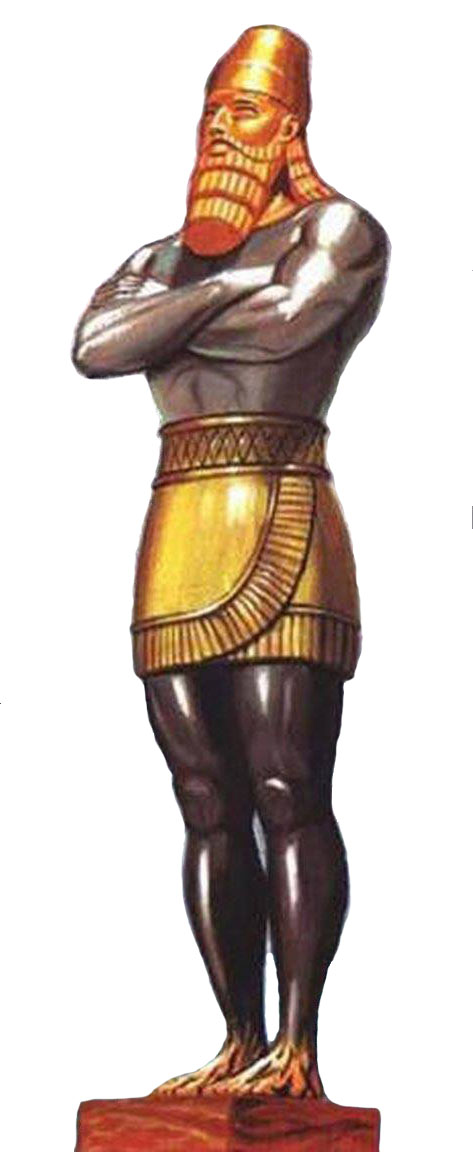
Nebuchadnezzar saw a statue in his dream.
32The head of the statue was made of pure gold.
The chest and arms were made of silver.
The belly and hips were made of bronze.
33The legs were made of iron.
The feet were partly iron and partly clay. [The statue is made of five different materials: gold, silver, copper, iron, and clay. The material in each section, from the head down to the feet, decreases in value but increases in strength. The decreased value may indicate moral decay in the subsequent kingdoms. The increased strength may indicate increased cruelty and harshness.] 34As you watched the statue, you saw a stone cut out [from a mountain], but without any human hand touching it. [This suggests that God did it.] It struck the statue's feet of iron and clay and crushed them. 35Then everything was crushed at once, the iron, the clay, the bronze, the silver, and the gold. Everything became like chaff from the threshing floors in summer. The wind caught them and carried them away, and nothing remained. But the stone that had struck the statue became a great mountain that filled the whole earth.The interpretation
36This was the dream. Now we [a humble way of saying that the interpretation was not his own, see ] will tell you what it means:Kingdom 1 – The Babylonian Empire
37You, O king, are the greatest king (King of Kings, see ; ) [here on earth]. The God of heaven has given you a kingdom, strength, power, and glory. 38God has given you all people (children of men), the wild animals of the earth, and the birds of the sky. You rule over them wherever they live. You are the head of gold. [The uppermost and first part of the statue is identified with King Nebuchadnezzar himself and his kingdom. The Neo-Babylonian Empire lasted for just under 100 years, until 539 BC. In the interpretation, the terms king and kingdom are used synonymously. It is not possible to have a kingdom without a king, nor a king without a kingdom.]Kingdom 2 – The Medo-Persian Empire
39After you, another kingdom [of silver, see ] will arise, one that is weaker (lower) than yours. [The Medo-Persian Empire was founded by Cyrus, who was king of Persia. He married the daughter of the king of Media, and the two peoples became one kingdom. Together they defeated Babylon in 539 BC. The two arms of silver nicely describe this kingdom, which lasted over 200 years. Babylon was an absolute monarchy where the king had all the power. In the Medo-Persian kingdom, the king was not above the law, see , , , .] Kingdom 3 – The Greek EmpireThen a third kingdom of copper [under Alexander the Great] will come and rule over the whole earth. [Alexander the Great began to reign in 336 BC. He defeated the Medes and Persians and conquered the entire known world until his death at the age of only 33. In , the kingdom is described as a goat with a large horn, followed by four horns in its place. This describes how his kingdom was divided among his four generals. The Greek Empire lasted for 250-300 years. The Greek soldiers had weapons made mainly of bronze.
Those who do not believe that the Bible can contain prophecy choose to interpret the second empire as Media and the third as Persia. They also date the Book of Daniel to a late date so that it was written after the events took place. However, what supports the Bible's credibility is that Media and Persia are usually referred to as one empire. They are clearly identified as one empire and represented by an animal – the ram, see . The Book of Daniel was also among the more than 900 manuscripts found near the Dead Sea in Qumran in 1947. There are fragments from all twelve chapters, and they date back to 150 BC. This means that the Book of Daniel must have been written much earlier in order to have been disseminated, copied, and included in the Qumran sect's library.]
Empire 4 – The Roman Empire
40The fourth kingdom will be strong like iron. Just as iron destroys and breaks everything [in its path, being the hardest of these metals], this kingdom will crush like iron, stamp and break [all other kingdoms]. [Five synonyms are used to describe the power of this fourth kingdom. It will destroy, smash, crush, trample, and break everything in its path.]
[In 65 BC, the Roman general Pompey defeated Syria, and in 30 BC, Augustus had defeated Egypt and taken over Jerusalem. The value of the metals in the vision decreases. This corresponds to how the emperor's power in the Roman Empire was weaker than in previous kingdoms. Iron, on the other hand, is the hardest, which corresponds to how its military strength was the strongest.] 41You saw that the feet and toes were partly of the potter's clay and partly of iron. [This probably describes the wet clay that the potter used to shape vessels, but the next step in the process may also be referred to in the next verse. When the material has dried and been fired in a kiln, it becomes hard but brittle. This means that it will be a divided kingdom. It will have some of the hardness (strength) of iron, as you saw that the iron was mixed with clay.] 42The fact that the toes of the feet were partly iron and partly clay means that the kingdom will be partly strong and partly weak (fragile). 43You saw the iron mixed with clay, in the same way people will mix with each other through human seed [DNA; through marriage], but still not stick together, just as iron cannot be united with clay. [Outwardly, iron and clay can be mixed, but there will be no lasting union between the materials.]The kingdom of God
44During the reign of these kings, the God of heaven will establish another kingdom that will never be destroyed [the kingdom of God]. Its power will not be handed over to any other people [as has happened in all the previous world empires]. It will crush and destroy all other kingdoms, but it itself will remain forever! 45You [King Nebuchadnezzar] saw how a stone was cut out of a mountain, but not by human hands. The stone crushed the iron, copper, clay, silver, and gold.
The great God has revealed to the king what will happen in the future. The dream is true and the interpretation is reliable." [Prophetically, verses 35 and 45 speak of Jesus—the cornerstone, see ; ; . Believers are called "living stones" in God's house, see . See also .] 46Then King Nebuchadnezzar fell on his face before Daniel and worshipped him. Nebuchadnezzar commanded that a sacrifice be brought and incense be burned to him. 47The king said to Daniel, "Your God is truly a God above other gods, a Lord above kings, and a revealer of secrets, since you have been able to reveal this secret." 48Then the king gave Daniel many gifts and set him in a high position in his kingdom. Nebuchadnezzar made him lord over the whole province of Babylon and set him over all the wise men of Babylon. 49At Daniel's request, the king appointed Shadrach, Meshach, and Abednego to administer the province of Babylon, while Daniel himself remained at the king's court.Daniel's three friends in the fiery furnace
Nebuchadnezzar makes a golden statue
31
The obelisk on Slottsbacken outside the palace in Stockholm is 30 meters high and has the same proportions as the statue that Nebuchadnezzar had erected.
Dura was a common name in Mesopotamia for a place surrounded by mountains or a wall. It may be between the two walls of Babylon, or up to a few miles south of the city. Archaeologists have found a large square brick foundation a mile south of Babylon. This may be the pedestal on which the statue stood. With a width of 6 cubits and a height of 60 cubits, with proportions of 1/10, the statue appears to have been an obelisk covered with gold. A height of 30 meters is not unrealistic; in the 280s BC, the Colossus of Rhodes was built, which was 33 meters high. Part of the statue may have been a depiction of a Babylonian god. The Greek historian Herodotus, active in the 400s BC, writes about a golden statue of the god Marduk in Babylon.] 2King Nebuchadnezzar summoned and gathered: the satraps (his highest representatives who were responsible for various provinces, the word means "protector of the land"),
the administrators (who may also have had military responsibilities)
and
the governors,
the advisers (chief judges),
the treasurers (responsible for taxes and finances),
the judges (the word means "protectors of the law"),
police chiefs
and
all the leaders in the provinces [lower-level government officials]
to attend the dedication ceremony for the statue that King Nebuchadnezzar had erected. [The Aramaic word for dedication is chanukka, which describes a religious ceremony, see . It is likely that they pledged allegiance to the king and the state. A hundred years earlier, the Assyrian king Ashurbanipal had gathered his highest councilors in Babylon to take an oath of allegiance. This event is known because a letter has been preserved from one of the councilors who was abroad and could not attend. He took his oath of allegiance in the place where he was, and it is mentioned that he did so surrounded by images of gods.
This is not a gathering for the general public. Nebuchadnezzar gathers the civil, military, and judicial leaders of his country. The exact meaning of the various titles and their areas of responsibility is not entirely known. The list seems to be in descending order of influence. There are three groups separated by the word "and." There are several hundred, perhaps thousands, in total. Later, Dareyavesh appoints 120 satraps over the kingdom, and over them three princes, of whom Daniel is one, see . Nebuchadnezzar appointed local leaders for distant provinces, one such example being Gedaliah, who was appointed to rule over Judah, see .] 3Then the satraps, the administrators and governors, the advisers, the treasurers, the judges, the police chiefs, and all the leaders of the provinces gathered for the [religious] dedication ceremony of the statue that King Nebuchadnezzar had built. They all stood before the statue that he had erected. 4Then a herald (the king's spokesman) cried out in a loud voice: "People, nations, and all language groups—this is what you are to do: 5
Stone tablet from Nineveh depicting a royal procession with harp music. Located at the British Museum in London. The tablet is dated to 650 BC.
horn (some kind of wind instrument, probably the horn of an animal),
flute (pipe, the Aramaic word is related to a Hebrew word for blowing and whistling),
zither (stringed instrument with between three and twelve strings),
lyre (trigon, small triangle-shaped instrument, probably with three strings for higher notes),
harp (Aramaic pesanterin, from Gk. psalterion – psalter, a triangular stringed instrument),
drum (wind or percussion instrument – Aramaic sumponeya; from Gk. symphonia or tympanon)
and all kinds of instruments,
you shall fall down and worship the golden statue that King Nebuchadnezzar has set up. [The first two instruments are probably wind instruments, followed by three different types of string instruments. The sixth instrument is the most difficult to identify. Common suggestions are bagpipes or drums. Based on inscriptions of orchestras from this period, and its placement in the list, it is probably some kind of percussion instrument.
The words for zither, harp, and drums/bagpipes are the only Greek loanwords in the Book of Daniel. The presence of these has sometimes been used as an argument for a later date of the book, but Greek musicians and instruments are mentioned in Assyrian writings before the time of Nebuchadnezzar.
There are several parallels with Revelation chapter 13. The beast from the earth makes an image that everyone must worship, and his number is 666, see . The number six recurs several times in this chapter. The statue is 60 cubits high and 6 cubits wide, see . There are also six instruments that are named and listed three times, see , , .] 6But whoever does not fall down and worship shall be thrown immediately into the burning furnace." [Furnaces were used at this time to burn bricks and melt metals. Nebuchadnezzar's construction projects required enormous quantities of bricks. The furnace that serves as punishment here may be the one used to build the statue. The temperature is probably around 1,000 degrees. Nebuchadnezzar considers himself a god and has his own version of hell.]
7So when all the people heard the sound of the horn, flute, zither, lyre, harp, and all the other instruments, they fell down and worshiped the golden statue that King Nebuchadnezzar had set up. Accusations against Shadrach, Meshach, and Abednego
8
Brick manufacturing in India. Bricks are sun-dried and then fired and hardened in the brick kiln visible in the background.
Their faith
13
Lime kiln on the Canary Islands.
The three Jewish boys, Hananiah, Mishael, and Azariah, make a statement of true faith. They refuse to bow down, regardless of whether they are saved or not, see ; . Does God have all power? Yes. Can God free believers from all problems and difficulties? Yes. Does God free believers from all difficult situations? No. Sometimes God allows trials, see . Sometimes the purpose of the trials is obvious, other times it is not, but God's desire is for His children to trust Him, see ; ; ; ; . God does not guarantee a problem-free life, but he promises to always be with us, see ; .]The deliverance
19
In his rage, Nebuchadnezzar ordered the furnace to be heated to maximum strength. A decision that cost him some of his best soldiers.
God frees his servants
24Suddenly, King Nebuchadnezzar stood up in alarm and asked his advisers, "Didn't we throw three men bound into the fire?"
"Yes, O king," they replied to the king. 25He replied, "But I see four men walking around freely in the midst of the fire! None of them are harmed, and the fourth looks like a son of God (literally 'son of the gods', a divine being)." [Nebuchadnezzar had a polytheistic view of God. For him, the phrase "son of God" is probably a spontaneous expression of the fact that the fourth person must be some kind of supernatural being. In , he says that it was an angel sent by the God of the Israelites. The angel may have been Jesus preincarnate, i.e., Jesus appearing as an angel of the Lord before taking human form, see .] 26Then Nebuchadnezzar went to the opening of the burning furnace and called out, "Shadrach, Meshach, and Abednego, servants of the Most High God! Come out, come out!"
Then Shadrach, Meshach, and Abednego came out of the fire. 27Then the satraps, prefects, governors, and the king's advisers gathered around and saw that the men were completely unharmed by the fire (the fire had no power over their bodies). Not a single hair on their heads was singed, their trousers (outer garments) were not damaged, and there was not even the smell of smoke on them! 28Nebuchadnezzar then spoke up and said, "Praise be to the God of Shadrach, Meshach, and Abednego, who sent his angel and rescued his servants. They trusted him and defied the king's command, risking their lives so they would not be forced to worship or serve any god other than their own God. 29I now give this command that anyone who speaks against the God of Shadrach, Meshach, and Abednego, whatever nation or language group he may be from, shall be torn to pieces and his [family's] house shall be [demolished and] become a heap of rubble [; ]. There is no other god who can save in this way!" 30Then the king promoted Shadrach, Meshach, and Abednego in the province of Babylon.Nebuchadnezzar's proclamation
41[The following three verses and the entire chapter 4 are unusual in many ways. It is a letter written by a pagan king.] [From:] King Nebuchadnezzar.
To all peoples, nations, and language groups throughout the earth: Peace and prosperity (literally: "may your peace/prosperity be great," a greeting phrase)! [Purpose of the letter:]
2I want to announce the signs and wonders that the Most High God has done for me. 3Great are his signs,
and mighty are his wonders!
His kingdom is an everlasting kingdom,
and his dominion endures from generation to generation! [Some of the mighty wonders Nebuchadnezzar experienced were:
• That God spoke to him through a dream, see chapter 2.
• How three men were miraculously preserved in the fiery furnace, see chapter 3.
• How he lost but regained his sanity and kingdom, see chapter 4.]Nebuchadnezzar's second dream – a tree being cut down
4
The ruins of ancient Babylon in present-day Iraq. Photo from the hill where Saddam Hussein began building his summer palace in 1983.
The vision
10
I saw a tree in the middle (center) of the earth,
and it was very tall. [Daniel identifies the tree as a symbol of Nebuchadnezzar himself and the Babylonian Empire. Its central location and spread in all directions describe how it permeates and influences the whole world. Trees are often used in the Bible: the tree of life stood in the middle of the Garden of Eden, see . Both the land of Assyria and the pharaoh of Egypt are likened to a tree by Ezek. 31:1-18. Jesus likens the Kingdom of God to a large tree, see . A clay tablet found in Babylon describes how Nebuchadnezzar's kingdom is likened to a tree.] 11The tree grew large and powerful. Its top rose high into the sky; it could be seen from the farthest reaches of the earth (the land, the kingdom). [This may be an allusion to arrogance, in the same way that the Tower of Babel rose up against the sky, see .] 12Its foliage was beautiful. It bore abundant fruit, enough food for everyone. The animals of the field found shade under it, and the birds of the sky built their nests among its branches. All living creatures (all flesh) were fed from it. 13[But that was not all; more happened.] In the visions that came [continued to come] as I lay on my bed, I saw a holy guardian (angel) coming down from heaven. [Literally two words: 'a guardian, someone who is awake and watches' followed by 'a holy one'. The expression is only found in this chapter, see verses 10, 13, and 23. The Gk. translation Septuagint translates it with Gk. angelo, which can be translated as angel or messenger.] 14He said in a loud voice [with great power]: 'Cut down the tree and cut off its branches,
clear away the foliage and scatter (throw away) the fruit.
Let the animals [that have had shelter] under the tree flee, and the birds leave the branches,
15but leave the stump with its roots in the ground. [Even though the tree is cut down, the life-giving root remains. This is an exact description of what will happen to Nebuchadnezzar when he goes mad and loses his kingdom, but regains it when he comes to his senses again. It also becomes very clear that the dream is about a person. From this point on, the tree and the stump are described as a human being with a heart and in terms of him and he.] Bound with chains of iron and bronze,
surrounded by the grass of the field:
Let him be moistened by the dew of heaven.
Let his lot be with the beasts among the crops of the field.
16Let his heart be changed from a human heart,
and let him have the heart of an animal [become confused, no longer behave humanly].
[There is a mental illness, lycanthropy, in which a person believes himself to be an animal.]
Let seven periods of time pass over him. [This probably refers to seven years.] 17This is determined by the guardians [see ],
and this is commanded by the holy ones [angels, see also ].
This is so that the living [all peoples] may know that the Most High rules over the kingdoms of men (humanity on earth).
He gives them to whomever he wants,
and can raise up the lowliest of men [to have the power to rule].' 18This was the dream that I, King Nebuchadnezzar, had. Now tell me, Belteshazzar [Daniel's Babylonian name, see ], what the dream means (give the interpretation). None of the wise men in my kingdom can interpret it, but you can, for the spirit of the holy gods is in you."Daniel interprets the vision
[Daniel's mercy is evident in how he conveys the interpretation. Daniel could have given the interpretation and then left, but instead we see Daniel's compassion. He is personally affected and finds it difficult to know how to convey the message. Daniel is not unemotional about the judgment of a pagan king who has taken him away from his homeland. His commitment is also evident in his concluding advice, where he appeals to Nebuchadnezzar to repent. Daniel's approach provides a biblical model for how a message of judgment is conveyed in love with practical instructions.] 19Daniel, who was called Belteshazzar, was at first visibly distressed (shocked, taken aback), filled with anxious (frightening) thoughts.
But the king said, "Belteshazzar, do not let the dream or its interpretation frighten you."
Belteshazzar [Daniel] replied, "My lord, if the dream had been about your enemies, and its meaning about your opponents! 20The tree that you saw growing and becoming powerful, whose top reached to the sky, visible throughout the world, 21whose foliage was beautiful and whose fruit was abundant, providing food for all, under which the animals of the earth lived and in whose branches the birds of the sky had their nests— 22that is you, O king! You have become great and powerful, your power reaches up to heaven and your dominion (power, influence) extends to the ends of the world. 23As for the holy guardian whom the king saw coming down from heaven, who said: 'Cut down the tree and destroy it,
but leave the stump with its roots in the ground.
Bound with chains of iron and bronze, surrounded by the grass of the field: Let him be moistened by the dew of heaven and live with the animals of the field, until seven periods of time [years] have passed over him.'
24Here is the meaning, O king; this is what the Most High has decreed to happen to you, my lord and king: 25You will be driven away from people and forced to live among the animals of the field. You will eat grass like an ox and be moistened by the dew of heaven. Seven periods of time [years] will pass (go over you), until you realize that the Most High [God] rules over all the kingdoms of the earth and gives them to whomever he wants. 26What was said [by the watchers] about the stump of the tree, that the roots would be left, means that you will regain your kingdom when you have understood (learned and realized) that it is [God in] heaven who has the power (reigns). 27Therefore, O king, obey (welcome) my advice: Break away (free yourself) from your sin [as when a yoke around the neck is broken] and do what is right [live righteously]; instead of doing what is evil, show undeserved mercy (Hebr. chanan) to the poor [Isaiah 1:17]. Then your prosperity (happiness, success) may continue."The king's dream comes true
28
The Hanging Gardens by Marten Heemskerck (1498-1574).

The Madness of Nebuchadnezzar, painting by William Blake (1795).
His dominion is an everlasting dominion!
His kingdom (royal rule) endures from generation to generation.
35The inhabitants of the earth are to be regarded as nothing [in comparison with God's rule, see ].
He does as he pleases with the hosts of heaven and with the inhabitants of the earth. No one can resist his [mighty] hand or [questioningly] say to him, 'What have you done? 36Then my sanity returned to me. My glory and splendor also returned, to the honor of my kingdom. My advisors and nobles sought me out. I was reinstated in my kingdom and given even greater greatness. [God honors those who honor him, see .] 37Therefore, I, Nebuchadnezzar, now praise, exalt, and honor the King of heaven. Everything he does is right (true) and just (righteous), and he can humble those who act arrogantly."Belshazzar's feast – the writing on the wall

In the Nabonidus Scroll, Nabonidus himself begins by writing how he worships the polytheistic god Sin and receives visions from the gods. He mentions that his eldest son is Belshazzar. The text also reveals his interest in searching for and restoring ancient temples. He is sometimes described as the first archaeologist! The scroll is kept at the British Museum in London.

The banquet hall probably had no roof but was an open space inside the palace. Painting by John Martin from 1854.
[It was not customary for women to be present, see, for example, , . About 50 years earlier, at the same time that Daniel was taken away, Nebuchadnezzar took these sacred vessels from Jerusalem, see . Thousands of vessels had been taken away, a list of which can be found in .
The text emphasizes Belshazzar's connection to Nebuchadnezzar. The words father and son are often used in a broader sense for successors in ancient times. In an Assyrian text commonly referred to as "the black obelisk" of Shalmaneser III, Jehu is called "the son of Omri," even though he was not his son. He was from a completely different family. It is likely that Belshazzar was related to Nebuchadnezzar. There is reason to believe that Nabonidus married one of Nebuchadnezzar's daughters, which would make Belshazzar Nebuchadnezzar's grandson. He was well aware of the story of how the vessels came to Babylon, see . The fact that the holy vessels of the God of Israel were held as spoils of war in Babylon showed, in Belshazzar's mind, that the Babylonian gods were more powerful than the gods of other peoples. Desecrating and drinking from these vessels on this particular evening was probably considered by the alcohol-influenced Belshazzar to be an excellent idea to demonstratively show Babylon's power, see .] 3Then they brought out the gold vessels that had been taken from God's temple in Jerusalem. The king, his nobles, his wives, and his concubines drank wine from them. 4As they drank, they praised their gods of gold, silver, copper, iron, wood, and stone. [Archaeological excavations in the southern part of Babylon have uncovered a palace with a large hall measuring 52 x 17 meters. Along one long side, opposite the entrance, was a podium where the throne may have stood. By comparison, the Blue Hall in Stockholm City Hall is 50 x 30 meters, and the Nobel Banquet has 1,300 invited guests.]The writing on the wall
5
Rembrandt's painting "Belshazzar's Feast" from the 17th century.
9King Belshazzar became even more terrified and turned pale (the color drained from his face). His nobles were also completely perplexed (shaken, stunned with fear because they did not understand what had happened).The queen remembers Daniel
10[Rumors of what had happened spread quickly throughout the palace.] When the queen [probably Nebuchadnezzar's wife or daughter] heard what the king and his nobles were saying, she went to the banquet hall. [The queen was not Belshazzar's wife, because his wives were already there, see . She must have been well respected because she enters the hall uninvited, and once there, she takes command. She is either Nebuchadnezzar's or Nabonidus' wife. If she is Nabonidus' wife, she is Belshazzar's mother and therefore probably also Nebuchadnezzar's daughter. She has first-hand information about Daniel's service at court, which is consistent with her being Nebuchadnezzar's wife or daughter.] She said, "May the king live forever! Do not let your thoughts frighten you, and do not be pale (do not let the color fade from your face). 11There is a man in your kingdom who has the spirit of the holy gods in him. In the days of your predecessor (father or perhaps grandfather) [see ], he proved to have insight (light), understanding, and wisdom like the gods. Your predecessor, King Nebuchadnezzar, put him in charge of the diviners (scribes, from the word for pen), the conjurers (exorcists, mediums who spoke with spirits), the dream interpreters (Chaldeans), and the astrologers (from the word to carve, decide, and determine). 12The man I am talking about is named Daniel, he was given the [Babylonian] name Belteshazzar []. He had an extraordinary spirit (a spiritual ability beyond the ordinary, see ), knowledge and ability to interpret dreams, solve riddles and solve complex problems (untangle knots). Call in Daniel. He can interpret (decipher) the writing on the wall."Daniel is called in
13So Daniel [now in his 80s] was brought before the king, and the king said to him, "You are Daniel, one of the Jewish captives whom my predecessor (father), the king, brought here from Judah! 14I have heard that you have the spirit of the gods in you, and that you have insight (light, clarity), understanding, and extraordinary wisdom. [Unlike , Belshazzar omits the word "holy." Both the queen and Nebuchadnezzar use the phrase "spirit of the holy gods," see ; , , . It seems that there is nothing holy to Belshazzar.] 15The wise men and enchanters were brought to me to read this writing and explain its meaning (give the interpretation), but they could not give any explanation. 16But I have heard about you, that you can give interpretations and answers to difficult questions. Read the text and explain what it means to me. If you can do this, I will clothe you in purple [give you royal status], hang a gold chain around your neck, and give you the third highest position in the kingdom."Daniel's response
17Then Daniel answered the king: "Keep your fine gifts for yourself or give them to someone else! But I will read the writing [on the wall] for you and tell you what it means (give the interpretation). [Daniel's refusal to accept the king's gifts is probably not due to pride or rudeness, but rather because he wants to avoid any misunderstanding that God's gifts can be bargained for. Before interpreting the text, Daniel speaks some serious words to the king. He begins by reminding him of the consequences of pride in Babylon's greatest king, Nebuchadnezzar, in verses 18-21. He concludes by condemning Belshazzar's deliberate act of blasphemy against the Most High God in verses 22-24. In Nebuchadnezzar's case, God gave a 12-month grace period before judgment fell, see . For Belshazzar, who should have known better, it is a matter of hours before the words come true, see . The fact that God writes on the wall shows that he wants repentance.] 18O king, the Most High God gave your predecessor (father, ancestor, perhaps grandfather) Nebuchadnezzar a kingdom, greatness, honor, and majesty. 19Because God had given him such great power, people from all nations, tribes, and language groups trembled before him.
He killed whom he wanted,
and spared whom he wanted.
He exalted (honored, promoted) whom he wanted,
and deposed (humiliated) whom he wanted.
20But when Nebuchadnezzar became proud and arrogant (his heart was lifted up and his spirit hardened so that he acted proudly), he was dethroned and stripped of his glory. 21He was driven away from people, and his heart became like that of an animal. He lived among wild donkeys and ate grass like an ox, and his body was moistened by the dew of heaven. This continued until he realized that God the Most High rules over the kingdoms of men and exalts whomever he wants to rule over them. 22
This administrative document is dated to the 24th of Kislev (Nov/Dec) in the 11th year of Nabonidus, king of Babylon. The text mentions a slave belonging to Bel-sharra-usur (Belshazzar), the king's son. The clay tablet is from Borsippa in southern Iraq from 545 BC and confirms that Belshazzar is acting as regent, even though his father Nabonidus is away in the oasis of Teima in Arabia and is still officially king. Located at the British Museum in London, ME 26740.
[According to Babylonian historical texts, Belshazzar was an officer in the army under Neriglissar's rule as early as 560 BC. This means that Belshazzar was old enough to play an important role in the army only two years after Nebuchadnezzar's death. Belshazzar grew up in Babylon, where his father Nabonidus was one of the leaders. Belshazzar may well have met Nebuchadnezzar in person. Even though he had seen with his own eyes how God had restored Nebuchadnezzar after seven years of mental illness and had read the letter with the testimony that Nebuchadnezzar had sent to everyone in the kingdom, he chose a different path.] 23Instead, you have set yourself up against the Lord of heaven. You took the vessels from his house [the temple in Jerusalem]. Then you, your nobles, your wives, and your concubines drank wine from them. You praised gods of silver and gold, bronze, iron, wood, and stone—gods that cannot see or hear or understand! But you have not honored the God who holds your next breath and your entire existence (all your ways) in his hand! [Instead, you have dishonored and blasphemed him—this is serious.] 24Therefore, he has sent this hand and written this. 25This is the writing (text) that is written: Mene (counted)
mene (counted)
tekel (weighed)
u-pharsin (and divided). [The Aramaic words can be interpreted as verbs or nouns. This must have complicated the interpretation and puzzled the wise men of Babylon. If the words are interpreted as nouns, they describe weights and coinage. One possible interpretation is to let the first word be a verb and the last three nouns: "counted: one mina, one shekel, and one half-shekel." If the words are verbs, the meaning becomes: "counted, counted, weighed, and divided." This is the correct interpretation, but even if the wise men had gotten that far, an explanation would be needed to clarify what is meant.]
26This is what the words mean (what will happen): Mene (counted) – God has counted the days of your kingdom and brought it to an end.
[The repetition "counted, counted" emphasizes how final this decision is.] 27Tekel (weighed) – you have been weighed on the scales and found wanting (insufficient, lacking).
28Peres (divided) – Your kingdom has been divided and will be given to the Medes and Persians."
[The words "peres" and Persians are similar, which may indicate that it is the Persian army, currently outside Babylon, that will divide the kingdom.] 29At Belshazzar's command, Daniel was clothed in purple [given royal status], a gold chain was hung around his neck, and he was proclaimed to have the third highest position in the kingdom. [Daniel knew that these were worthless gifts and titles in a kingdom that would fall in a few hours! It seems that Daniel nevertheless accepts the rewards that are foisted on him against his will, see . Perhaps protests in this situation would have led to him being accused of treason?] 30That same night, Belshazzar, king of the Chaldeans [the Babylonian people], was killed. 31Darius, the Medes, took over the kingdom. He was then 62 years old. [Cyrus had begun his military campaign against Babylon in early October 539 BC when he won the battle of Opis, 80 km north of Babylon. On October 11, he advanced another 20 km and captured Sippar. The Euphrates River flows straight through Babylon. By digging several canals to a depression just north of Babylon, the water level of the Euphrates was reduced enough for the army to get under the wall. Just before dawn on October 13, the Persian army marched into Babylon. The Greek historian Herodotus describes how a religious festival was being celebrated and the people were busy dancing and celebrating at dawn when the Persian army captured the city. Had they been on their guard, it would have been easy to defend the city from the walls surrounding the river. Cyrus himself arrived in the city 17 days later and was proclaimed its liberator. Jeremiah had previously prophesied that the Babylonians would rule for 70 years, see Jer 25:12. Interestingly, it was in 609 BC that Nebuchadnezzar's father Nabopolassar burned the last Assyrian stronghold in Harran. A few years earlier, he had plundered and burned the Assyrian capital Nineveh, and the survivors had fled to Harran. He besieged the city for several years until it fell in 609 BC. There are thus exactly 70 years between 609 BC (when the Babylonians became world rulers) and 539 BC, when they lost power to the Medes and Persians.]Daniel in the lions' den
New rule in Babylon

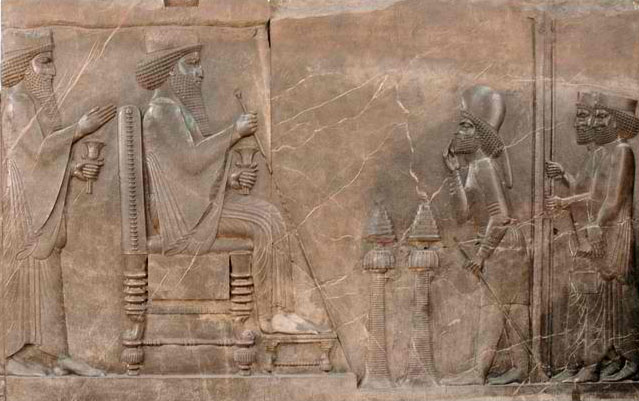
A relief carved on the steps to the great banquet hall in Persepolis in southern Iran depicts the later Persian king Xerxes I (519-465 BC) sitting on the throne and receiving honors.
"King Darius, live forever!
7All the ministers, governors, satraps, advisers, and governors (military leaders) of the kingdom have agreed on a royal decree (law) that should be issued: 'Anyone who, in the next 30 days, makes a request (prays) to any god or man other than you, the king, shall be thrown into the lions' den.'
[The word for group can also mean to storm or rush forward. It describes the mood and underlying urgency that existed in this gathering. The group was led by the two ministers and probably some representatives from the other groups. They made it sound as if they had secured everyone's support for the proposal. This was a lie, because Daniel did not agree with it.]
8Issue such a decree now, O king, and sign it [the document] so that, according to the unchangeable law of the Medes and Persians, it cannot be revoked." [Darius has just defeated Babylon. He comes from a different country and culture and needs to unite the empire. There are many decisions to be made in a short time, and this sounds like a good idea. In the Babylonian Empire, the king was above the law. In contrast, in the Medo-Persian Empire, everyone, even the king, was subject to the law, see ; . This is also consistent with Nebuchadnezzar's dream about the statue. He was the head of gold, and what followed—the chest and arms of silver—was a weaker empire, see . One reason the law could not be changed was that the Persians regarded their kings as gods—they were the image of Ormuzd, an ancient Iranian sky god. If the king changed his mind, he was not a god. There are several examples of this custom in history. A Greek historian describes how Darius III had a man killed, even though he knew he was innocent. It was a royal decision that could not be changed.] 9Therefore, King Darius had a written decree issued (he signed the document with the decree).Daniel is accused
10Even after Daniel found out that the new law had been enacted (signed and put into effect), he went to his house where he had a room on the roof with windows open toward Jerusalem. [Towards the west from Babylon.] There he knelt three times a day and thanked his God in the same way he always had. [The custom of praying towards the temple in Jerusalem is based on Solomon's words, see , , , . Daniel continues his habit of praying three times a day. He obeys God more than people, see . David writes how he prays in the evening, morning, and middle of the day, see (evening prayer is mentioned first because the Jewish day begins at sunset). In the temple in Jerusalem, the times for prayer were 9, 12, and 15, see also ; ; ; ; .] 11The men went there as a group (hurried, rushed in) and discovered Daniel praying for God's undeserved mercy (help). 12Then they went before the king and asked him about the royal decree: "Did you not issue a decree that no one may pray to any god or man except you, O king? Does it not say that anyone who violates it within the next 30 days shall be thrown into the lions' den?"
The king replied, "Yes, it is true (it is established) according to the law of the Medes and Persians, which cannot be revoked." 13Then they said to the king, "Daniel, one of the Jewish captives (literally 'one of the sons of the captives of Judah'), does not obey you or the decree you have signed. Three times a day he prays." [They want to make Daniel look bad. They emphasize that Daniel is not one of them. The only reason to mention that he was a captive was to humiliate him and cast suspicion on Daniel's intentions. Secondly, they say that Daniel's actions were not only against the law, but against the king himself. Not only did Daniel go against the king and the law, he did so deliberately three times a day. It was not just a misunderstanding but a deliberate act.]Daniel is thrown into the lions' den
14When the king heard this, he was very upset. The Aramaic word beesh is used here. It means "to smell bad" and is used figuratively to describe how "the whole situation stinks." What had happened was completely wrong, shameful, and unjust. The king understood how he had been deceived. He decided to do everything he could to save Daniel. Until sunset, he tried to find a way out. 15Then the men came in a group (did they conspire, did they rush forward) and said to him, "Remember, O king, that according to Median and Persian law, no decree of the king can be changed." 16Then the king [Darius] gave orders to bring Daniel and throw him into the lions' den, and the king said to Daniel, "Your God, whom you faithfully (constantly, regardless of circumstances) serve, he will save you!" 17A stone was brought and placed over the mouth of the den, and the king sealed it with his own seal and with the seals of his nobles, so that nothing could be changed concerning the decision made against Daniel. 18Then the king went to his palace. He ate nothing that evening (he fasted), and he did not allow any entertainment (music, dancing) to be brought to him. That night he could not sleep. 19Early the next morning, as soon as it began to get light, he got up and hurried to the lions' den. 20As he approached the den, he called out to Daniel with anxiety in his voice: "Daniel, servant of the living God! Has the God whom you faithfully (constantly, regardless of circumstances) worship been able to save you from the lions?" 21Then Daniel spoke to the king: "Your Majesty, long live the king! 22My God (Elah) has sent his angel to shut the lions' mouths so that they have not harmed me, because I was found innocent before God. Nor have I done anything wrong to you, Your Majesty." [Dan. does not say that he is a sinless man, see . However, he is innocent in this case, as he worshipped God and defied King Darius' decree prohibiting this.] 23The king was very pleased and ordered Daniel to be lifted out of the pit. So Daniel was lifted out of the pit, and he was not the least bit injured, because he had trusted (believed) in his God. 24Then the king ordered that the men who had accused Daniel (literally "eaten him alive") be brought and thrown into the lions' den. They, their wives, and their children were thrown into the den. The lions pounced on them before they reached the ground and tore them to pieces. [Both thematically and textually, this passage in chapter 6 is related to chapter 3, where Daniel's three friends are thrown into the fiery furnace. The same unusual word for accuse is used in and . Just as Nebuchadnezzar wrote a letter, so does Darius, see and .] 25Then King Darius wrote to all the peoples, tribes, and languages throughout the world: "With wishes for great peace (prosperity)!
26I hereby issue a new decree that in my kingdom, Daniel's God shall be feared and revered.
For he is the living God,
who remains forever.
His kingdom will not perish,
and his dominion will last until the end.
27He saves and delivers,
performs signs and wonders,
in heaven and on earth.
He is the one who saved Daniel from the power (hand) of the lions." 28Daniel was successful (promoted, honored, wealthy, and powerful) during the reign of Darius and (also) during the reign of Cyrus (Hebr. Koresh) of Persia. [The text can be read in two ways. Either it describes how Darius and Cyrus are two contemporary leaders. In that case, Darius is the governor whom Cyrus appointed over the city of Babylon, and who historically could be a general named Gubaru, see . The Hebrew conjunction Vav is usually translated as "and," but can also be translated as "also." In that case, the second part becomes an explanation and clarification: "also, that is, during the reign of the Persian Cyrus." Dan then indicates that the Median Darius, see , is the same person as the Persian Cyrus. What complicates the interpretation is that the same people have different names in different regions, which also applies to Daniel and his friends, see . Hopefully, future archaeological finds mentioning Darius' name will help in the interpretation here.]Daniel's first vision – four animals
[Chronologically, the visions in chapters 7 and 8 occur long before the events in chapters 5 and 6.] 71
Chapter 7 begins the concluding section of the Book of Daniel, which deals with his visions. Chronologically, chapters 7 and 8 come before chapter 5.
I saw the vision at night. In the vision, the four winds of heaven were blowing [which may refer to God’s judgment on the world; see ], and the great sea [humanity] was stirred up. [The great sea is often a reference to the Mediterranean Sea, which forms Israel’s western border (), but can also speak prophetically of peoples and nations in a state of unrest, chaos, and turmoil; see ; . Here, the meaning seems to be the political turmoil and the emergence of new kingdoms and superpowers. The Persian king Cyrus defeats the Medes in 550 B.C., and the emerging superpower of Medo-Persia takes shape—an event that will influence the entire course of world history. Interestingly, these momentous world events coincide with the time when Daniel has this vision.] 3Four great beasts rose from the sea, each one different from the other. [ makes it clear that these beasts represent four kings and their kingdoms. Even today, countries are associated with animals. For example, Sweden's coat of arms has two lions, dragons are associated with China, the eagle with the United States, etc. The symbolic nature of this vision is emphasized several times. Expressions such as "like" and "was like" are used. All these animals are predators, which describes the animals' character of hunting and how these kingdoms conquer other countries. It may be worth reflecting on the fact that the animal that Jesus and his kingdom are likened to is a lamb. The following four animals have a parallel in Nebuchadnezzar's vision in chapter 2 with the four parts of the statue.]1 (of 4) – A lion with eagle wings
4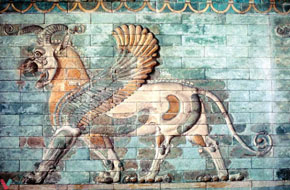
A lion with wings and a horse's neck adorns a glazed brick tile in Susa.
[The lion and the eagle are associated with the Babylonian kingdom. Nebuchadnezzar is compared to both of these images in the Bible, as a lion, see ; ; , , and as an eagle in ; ; ; . The lion was also one of Babylon's symbols. Over 100 lions adorned the famous Ishtar Gate. Statues of winged lions have been found in the ruins of Babylon, and it is believed that this was the symbol of the empire. Both the lion and the eagle are predators. The lion is the king of the land and the eagle is the king of the air.
The vision in which the wings are removed can symbolically describe what happened to Nebuchadnezzar when he was humbled in chapter 4. During the seven years he was insane, he did not go forth and conquer more territories. After his restoration, he no longer rules like a wild beast but has been given a human heart.]2 (of 4) – A bear
5Then I saw another beast [symbolizing a king and a kingdom, see ]. It looked like a bear. It stood on one side (was higher on one side) and had three ribs in its mouth, between its teeth. It was told, "Get up and eat a lot of meat!" [If the first kingdom is Babylon, then Medo-Persia follows, which is the next great power in world history. In chapter 8, it is clear that it is Media and Persia that are meant, see . The fact that one side is higher may indicate that Persia was the dominant power in the alliance. The three ribs could symbolize the three great victories – Babylon in 539 BC, Lydia in 546 BC, and Egypt in 525 BC.]3 (of 4) – A leopard
6After this [after the second beast], I saw another beast [symbolizing a king and a kingdom, see ]. It looked like a leopard with four wings on its back (sides) that looked like bird wings. The beast had four heads and was given great power (authority to rule). [The characteristics of a leopard are speed and bloodthirstiness. The four wings increase the speed of this already fast animal. This accurately describes the Greek empire, which conquered the entire known world at lightning speed. Alexander the Great became king at only 20 years of age in 336 BC. In less than 10 years, he had conquered the entire Medo-Persian Empire, all the way to the border with India. It is said that he then wept because there was no more territory to conquer. The fact that there were four wings may also allude to the four corners of the earth and that it would be a world empire.
The four heads may represent rulers, see ; ; , . The vision predicts that the Greek empire would split into four empires, and that is exactly what happened. Alexander died in 323 BC in the city of Babylon from alcohol poisoning, aged only 32. After internal strife, the empire was divided between four of his generals.]4 (of 4) – A terrible beast
7After this [after the third beast], I saw another beast [another kingdom, see ] in my visions at night. It was terrible, frightening, and very strong. [This fourth beast does not fit into any existing classification of an animal.] It had large iron teeth. It devoured and crushed, and what was left it trampled under its feet. It was different from the previous beasts and had ten horns. 8As I was contemplating (reflecting on) [the ten] horns, another horn sprouted up among them and pushed away three of the horns. It had eyes like human eyes and a mouth that spoke great things. [Great and blasphemous words, according to .]The fourth beast is destroyed
9I continued to watch. [Daniel had just seen in his vision how a small horn had emerged among the ten horns, while he watches this and contemplates it, the vision changes.] Thrones were set up,
and the Ancient of Days [God the eternal Father beyond all time, see also verses 13 and 22] sat down.
His clothes were white as snow,
and the hair on his head was like pure wool.
His throne was made of flames of fire,
and its wheels were made of burning fire. 10A river of fire flowed out
from his presence.
A thousand times a thousand served him,
and ten thousand times ten thousand stood ready to serve him.
He sat down to judge,
and books were opened. [Daniel's attention was now directed to the little horn.] 11I continued to watch, because [the little] horn spoke such big words. I continued to watch [in the vision] until the beast was killed and its body destroyed and thrown into the burning fire. 12[The last beast is completely destroyed.] As for the other [three] beasts, their power was taken away, but they were allowed to live for a set time and season (length of life was given to them). [This fits well with history. The three previous empires were absorbed into each other. The Persians and Medes took over the Babylonian Empire, which in turn was taken over by the Greeks, etc. In contrast, the fourth empire is completely destroyed and replaced by a new world order—the Kingdom of God. Similarly, the statue in chapter 2 does not collapse until the lowest part—the feet and toes of iron and clay—is struck by the stone, see , .]The kingdom of God
13In the visions of the night, I saw something else: I looked and saw a son of man,
coming with the clouds of heaven.
He approached the Ancient of Days [God the eternal Father beyond all time],
and was brought (escorted) before his presence.
14To him [the Messiah] was given power and glory and dominion (a kingdom, royal authority to rule),
and all peoples and tribes and languages shall serve (worship) him.
His dominion is an eternal dominion that shall never end,
and his kingdom (royal authority) shall never perish. An angel explains Daniel's vision
15I, Daniel, became troubled (impatient) in my spirit within me (in my shell). The visions I had seen in my head frightened (terrified) me. 16I went up to one of those standing there [an angel, perhaps Gabriel, who explains the vision, see ; ] and asked what all this could mean. He answered me and told me what it meant: 17"The four great beasts are four kings who will arise (rise up) on the earth [and rule over great kingdoms].
18But the holy ones, who belong to the Most High (Eljonin – plural), shall receive the kingdom (begin to reign).
They shall possess it (have it in their possession) forever, yes, for ever and ever."[The saints may refer to angels or sanctified humans, or both. The saints are also mentioned in verses 21 and 25, where they are subjected to persecution and opposition. The Aramaic Eljonin literally means "the Most High" in the plural. The phrase is used only here and in verses 22, 25, and 27. The expression corresponds to the Hebrew Elion, see . It is not uncommon for the plural to be used as an intensifying attribute; several Hebrew words such as life, heavens, water, etc., are almost always in the plural, indicating more dimensions and aspects than can be contained in the singular. Here, the plural form of "the Most High" probably emphasizes God's majesty, but also how he works "greatly" and in many different ways. In the same way that the Hebrew word for God, Elohim, is plural (but inflected as singular), we sense a hint of the triune God here in Eljonin as well!] [After this brief overview, Daniel wants to know more. The fourth beast in particular had aroused Daniel's interest.] 19I wanted to know the meaning of (the full truth about) the fourth beast. It was unlike any other, terrifying with iron teeth and bronze claws. [The claws are a new detail not mentioned in .] It crushed and devoured what it had killed, and then trampled and crushed what was left under its feet. 20I also wanted to understand the meaning of the ten horns on its head and the new [eleventh] horn that sprouted there. It had caused three horns to fall off, and it [the new horn] looked bigger than the other horns. It had eyes and a mouth that spoke big words. [It seemed to have taken over the leadership role among the horns.] 21As I watched, the horn [the eleventh new horn] began to wage war against the saints [] and defeated (had power over) them, 22until the Ancient of Days [God the eternal Father beyond all time, see also verses 9 and 13] came. He judged and gave the Most High (Eljonin) holy justice (an acquittal or the right to judge). Then the time came for the saints to take possession of the kingdom. [The angel now explains to Daniel the meaning of the fourth beast, the ten horns, the little horn, and the final kingdom of God.] 23Then he answered: "The fourth beast is a fourth kingdom that will come on the earth.
It will be different from all the other kingdoms.
It will devour the whole earth, trample it down, and crush it.
24The ten horns are ten kings who will arise (rise up, come to power) in this [fourth] kingdom.
After them [the ten kings], another king will arise (rise up, take power).
He will be different from the previous kings, and he will oppress (strike down) three kings. 25He will speak against the Most High. []
He will harass (wear down, tire out, torment) the saints of the Most High (Eljonin).
He will try (his intention is) to change times (holidays and holy days) and the law,
and they [the saints of the Most High] will be under his hand (rule),
for a time, times, and half a time [probably corresponding to 3.5 years]. [The Aramaic word for times is zeman, and describes a specific point in time. Times and the law probably refer to the Lord's (Yahweh's) feasts, see . It can also be interpreted as meaning that feasts will be changed by new laws. Other suggestions are that it refers to changes in how days and weeks are counted. After the French Revolution, a ten-day week system was used for a few years.
The last expression, "a time, times, and half a time," uses another Aramaic word for time (Aramaic aidan). This has to do with chronological time and probably corresponds to one year, and is most naturally interpreted in the expression in where Nebuchadnezzar is mad for seven times. In that case, the first expression "a time" corresponds to one year. The second, "times," is plural and is often interpreted as two years. The last, "half a time," corresponds to half a year. The sum of 1 + 2 + 0.5 is 3.5 years. This also corresponds to the number of days in , , . The expression is also found centrally in a chiasm in the Book of Revelation together with the same time period, also specified as 1,260 days and 42 months, see ; ; ; ; .]
26The judgment is carried out [the heavenly court gathers and decides against this arrogant last king].
His dominion (right to rule) shall be taken from him—destroyed and wiped out for all eternity!
27Then the kingdom
and dominion
and power over the kingdoms under heaven
shall be given to the people who are the holy ones of the Most High (Eljonin).
His kingdom is an everlasting kingdom, and all rulers shall serve and obey them." 28Here ends this account [of the dream and visions]. I, Daniel, was terrified by my thoughts [about what I had seen and understood would happen in the future], and my face turned pale (its radiance changed). But I kept all this [the dream and the angel's interpretation] in my heart (to myself). [This dream has many parallels with Nebuchadnezzar's dream of the statue in . There, the four kingdoms are described from a human perspective – precious metals that are beautiful and shiny. God, on the other hand, sees their inner character and describes them as wild beasts; see also where Jesus describes false prophets as ravenous wolves. Structurally, these two visions also belong together in the chiastic pattern found in the Book of Daniel; see the introduction. Together, these visions provide several details. There are also earlier examples where two dreams underline the truth in the dream. Pharaoh had two dreams about the coming famine, see , . Joseph receives the explanation that the reason there were two dreams was because the event was "determined by God and would happen soon," see .]Daniel's second vision—the ram and the goat

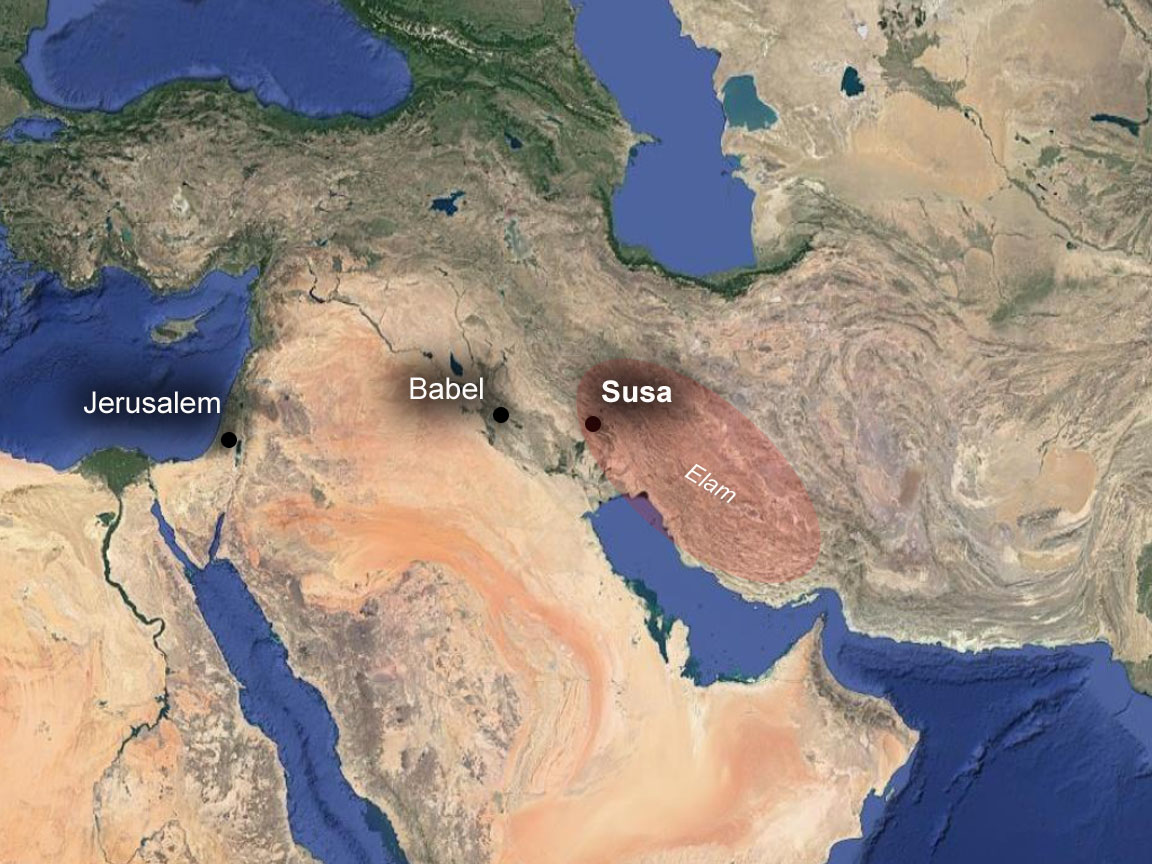
The city of Susa is located nearly 400 km east of Babylon.
Show in atlas
In his service in Babylon, Daniel had certainly visited Susa a few times. According to the Jewish historian Josephus, Daniel was physically present in Susa when he saw this vision, but the fact that he was in the king's service only a few days later suggests that he was not far from Babylon, see . Ulai was a 250-meter-wide dug canal northeast of the city.]The ram
[Dan now sees a vision of a ram and a goat. A little later, an angel explains the vision to Dan. The ram with two horns symbolizes the Medo-Persian Empire, see . A fitting image. The Greek historian Ammianus Marcellinus describes how the Persian commander wore a golden ram's head when he led the army.] 3I looked up and saw a ram with two horns standing by the canal. It had two long horns [representing Media and Persia]. One horn was longer (higher) than the other, and the longest grew last. [The Persians eventually became the dominant nation in this alliance. This detail also corresponds with the image of the bear "rising up on one side," see .] 4I saw the ram charging toward the west (the sea, i.e., the Mediterranean), north, and south. [Medo-Persia expanded its empire in these three directions, but not eastward.] No wild beast [other empire] could stand against it, and no one could rescue anything from its power. It did whatever it wanted and became powerful (acted arrogantly).The goat
[The angel also identifies the goat in plain language as the Greek empire, see .] 5While I was watching this (reflecting on what I had seen and trying to understand), I saw a goat [Greece] coming from the west [and challenging the ram]. It moved quickly across the whole earth without even touching the ground. The goat had a prominent horn on its forehead [Alexander the Great]. 6It came against the ram with the two horns, the one I had seen standing by the river [the Euphrates], and rushed at him in fierce anger (in the heat of its power). 7I saw [in my vision] how the goat came upon the ram in fury and broke off his two horns. The ram had no power to withstand him. The goat threw the ram to the ground and trampled him. No one could deliver the ram from the goat's violence (his hand). 8[This victory allowed the goat to take the ram's place.] The goat became even greater (acted even more arrogantly), but when it was at the height of its power, the large horn was broken off. Four other [horns] grew in its place, toward the four corners of the sky. [The four prominent horns refer to Alexander the Great's successors. After his death in 323 BC, the empire was divided for a period of twenty years with many conflicts among four of his generals. Cassander took Macedonia and Greece; Lysimachus took Thrace and Asia Minor; Seleucus took Syria and the area to the east; and Ptolemy took Egypt and Israel.]Four horns
9
The nature in Israel is magnificent. The picture shows a poppy field in the "beautiful country"!

Engraving by David Martin (1639-1721) illustrating Antiochus IV Epiphanes desecrating the temple.
The vision is explained
15While I, Daniel, was watching the vision, I tried to understand it. Suddenly, I saw someone who looked like a man (a mighty hero) standing in front of me. 16Then I heard a human voice over the Ulai [between the riverbanks] calling out, "Gabriel [an angel of God, his name means "man of God" or "warrior of God"], explain the vision to him." [In there is a similar description where a heavenly being hovers over the river water, except that there it is over the Tigris River. This verse is the first time an angel is mentioned by name in the Bible. The angel Gabriel also comes to Zechariah, John the Baptist's father, and Mary, see , . Michael, who is called the archangel, is the only other angel named in the Bible, see , ; ; ; .] 17So he [the angel Gabriel] came to the place where I was standing. When he came near, I was terrified and fell on my face, but he said to me, "Understand, O mortal, that [the fulfillment of] the vision concerns the last days." 18While Gabriel was speaking to me, I fell into a deep sleep (lost consciousness), with my face to the ground. [Compare John's similar experience in . The same words are also used about Jonah's "deep sleep" in the storm, see .] But Gabriel touched me and lifted me up again to where I had been standing. 19Then he [the angel Gabriel] said: "Now I will explain (reveal) to you what will happen in the last days of wrath, for this [vision] is about the last days. 20The ram you saw [by the river Ulai, see ], the one with the two [long] horns, is [represents] the kings of Media and Persia. 21The goat is [represents] the king of Greece (Javan), and the large horn between its eyes [symbolizes] the first king [Alexander the Great]. 22The horn that was broken off and the four others that grew in its place [] mean that four kingdoms will arise from his people, but they will not have his [the first king's, Alexander the Great's] strength. 23Towards the end of their kingdoms, when transgressions (sins, rebellion) have reached their limit, a shameless (brazen, insensitive) and cunning (crafty) king will arise.
[The word shameless literally means a person with a 'strong face', which suggests that he shows no emotion and has no compassion. In , the same word is used for a harsh nation that has no respect for the elderly or compassion for the younger generation. The word for 'cunning' is 'understanding riddles' and can describe him as someone who creates intrigue and is skilled at hiding his intentions. It can also be interpreted as him being a skilled politician who can resolve difficult political conflicts. Another interpretation is that it refers to involvement in occult activities.] 24His power will be great, but it is not his own.
[Suggests demonic influence, see also ; .]
He will cause terrible destruction.
He will succeed in everything he undertakes.
He will destroy many powerful [people] and the holy people.
25Through his knowledge (cunning), he will succeed in his deceit (fraud, having deceit in his hand).
He will have an arrogant attitude (become great in his own mind).
Without warning (with peace, in silence), he will destroy many.
[The meaning could be "with ease" or "through a false peace" or when all is quiet and peaceful.]
He will even rise up against the Prince of princes and be crushed, but not by human hands. 26The vision you have seen about [the 2,300] evenings and mornings is true. [This detail seems to be distinct.] But seal it up [so that it is preserved], for it refers to a distant future." 27I, Daniel, was completely exhausted. [The vision affected him both mentally and physically.] I was sick for several days [unable to get out of bed]. Then [when I regained my strength], I got up and returned to my service with the king [in Belshazzar's regime in Babylon]. I was terrified (astonished, helpless) by the vision, and no one could explain it. [Daniel had seen kings but no names and exact times.]Daniel's third vision – seventy-seven periods

There are three major waves of deportations and returns. Shortly after Daniel reads Jeremiah's prophecies, Cyrus' proclamation comes in 538 BC. This leads to the first group returning under the leadership of Zerubbabel. When they arrive, 70 years have passed since the first group was taken into captivity. It will also turn out that there are 70 years between the destruction of Jerusalem in 586 BC and the rededication of the temple in 516 BC.
Jer. remains in Jerusalem and writes several letters to his compatriots in Babylon. In one letter, probably written not long after Jerusalem was conquered in 597 BC, see , he reminds them that when 70 years have passed for Babylon, the Jews will be brought back to their land and that God wants to give them peace, a future, and hope, see . When Daniel reads these writings, he has been in Babylon for 66 years. Daniel realizes that there are only a few years left before what Jeremiah prophesied will come to pass. It turns out that in the same year that Daniel writes this, Cyrus will allow the Jews to return, and a first group will eventually travel back to rebuild the temple. The call to prayer in is one of the reasons why Daniel begins to pray when he reads this. Later, Zechariah will also refer to a 70-year period from the destruction of the temple in 586 BC until it was rebuilt and dedicated in 516 BC. It is interesting to see Daniel's view of the Scriptures. As early as the 500s BC, he refers to Jeremiah as the word of God. He also quotes from the Books of Moses and the Psalms in his prayer. See also 2 Chron. 36:20-22. Jeremiah had predicted 70 years of captivity, and Daniel believed in a literal fulfillment of the prophetic word.]Daniel's prayer
3Then I turned my face to the Lord God (Adonai Elohim). [Daniel turned his gaze toward heaven, see ; .] I sought him in prayer and supplication (earnest, humble, and heartfelt prayers for mercy) and fasted in sackcloth and ashes. [Daniel followed the Jewish custom of putting on uncomfortable, rough clothing made of goat or camel hair and sprinkling ashes on his head. An outward act that shows inner sorrow and genuine prayer, see ; ; , ; ; ; ; ; .] 4I prayed to the Lord (Yahweh), my God (Elohim), and confessed [praised God's greatness and acknowledged my personal sin and the sin of my people]: "I pray to you, Lord (Adonai), my God (El), the great and awesome (inspiring reverence and respect) one, who keeps the covenant and shows mercy (caring love) to those who love you and keep your commandments. [] 5We have
sinned (literally 'missed the mark') [Israel had failed to be a holy people],
done wrong (literally 'bent, turned', strayed from the right path, acted perversely, twisted),
been ungodly, and
strayed from your commandments and decrees.
6We have not listened to your servants the prophets, who spoke in your name to our kings, our leaders (princes), our ancestors (fathers), and to all the people of the land. 7Lord (Adonai), you are righteous—we are disgraced (ashamed). [The Hebrew has a strong contrast: literally 'to you righteousness—to us shame'. Since the captivity and destruction of Jerusalem in 586 BC, Israel has been publicly disgraced among the nations. So it is today with the people of Judah, the inhabitants of Jerusalem, and all Israel, both those who are near and those who are far away in all the countries where you have driven them, because they were unfaithful to you.] 8We must be ashamed (to us shame). Our kings, leaders (princes), and our ancestors (fathers) are ashamed, for we have sinned against you. 9Hos. With the Lord our God there is mercy (infinite grace) and forgiveness (Literally: 'to Adonai our Elohim there are mercies and forgivings', the plural form emphasizes God's great mercy and his abundant forgiveness), even though we have rebelled against him. 10We have not listened to the voice of the Lord our God. We have not followed (walked after) the teaching he gave us through his servants the prophets. [; ; ] 11The whole people of Israel abandoned your teaching (crossed a boundary) and turned away [from your way], refusing to obey (listen to your voice). That is the reason for the curse and oath in the teaching (Hebr. Torah) of Moses, God's servant [], because we have sinned against you. 12He kept his words that he had spoken against us and our leaders who ruled over us. [Literally 'judges who judged us', but probably refers to all leaders, see , who had deliberately led the people away from God.] The Lord brought a great calamity (this evil, suffering) [the ongoing exile] upon us. Nothing like what has happened to Jerusalem has ever happened under heaven. [; ] 13Just as it is written in the teaching of Moses (Hebr. Torah), all this evil (this disaster) came upon us. Despite this, we have not yet tried to reconcile ourselves with the Lord our God. [Literally, 'to appease his face'; to turn one's face toward someone is a sign of favor and goodwill.] We have not turned away from (ceased) our misdeeds (sins) and begun to seek (ask for, obey) your truth [your rules of life and your morals in your teaching]. 14Therefore, the Lord watched over the disaster (like a sentinel, and allowed it to come). [Quote from . The word "watch" is unusual and can be used both in the sense of being on guard against something happening and of watching and waiting after having prepared something that is about to happen. An example where the word is used in this way is in Jeremiah, which Daniel has just read, where God watches to tear down but also to build up, see .] The Lord our God is righteous in all he does, but we did not listen to his voice. 15Lord (Adonai) our God (Elohim), you used your power (used your strong hand) and brought your people out of Egypt []. This made your name known, as it is today. But we have sinned and been godless. [This verse is a summary of , the book that moved Dan. and inspired him to pray this prayer, see .] 16Lord, for the sake of all your righteousness (because you always do what is just and right), turn away your wrath and anger from your city Jerusalem, your holy mountain. Because of our sins and the guilt of our ancestors (fathers), Jerusalem and your people are mocked by all the peoples around us. [] 17[Daniel has prayed for the restoration of the city of Jerusalem, see , and now he continues to pray for the rebuilding of the temple.] Now, our God, hear the prayer and supplications (earnest, humble, and heartfelt pleas for mercy) of your servant. Let your face shine upon your sanctuary [the temple in Jerusalem], which lies in ruins. [] 18Incline your ear (listen carefully) and hear! [My prayer to you, but also the mockery of the people, see .]
Open your eyes and see our desolation [cities in ruins in our land] and the city [Jerusalem],
which is named after your name.
It is not because of our own righteous deeds that we come to you with our pleas (earnest, humble, and heartfelt prayers for mercy),
but because of your great mercy (infinite grace).
[Here, and in , rachamim is used, one of several Hebrew words for mercy and compassion. The word only appears in the plural in the Bible. It illustrates how God's mercy is infinite. A word that does not exist in the singular is impossible to count. It has no beginning and no end. This word shows the dimension of mercy that makes it unlimited.] 19Lord (Adonai), hear [our prayer]!
Lord (Adonai), forgive [our sin]!
Lord (Adonai), act!
Do not delay, my God (Elohim),
[not for my sake but] for your sake,
for your city
and your people who bear your name (are named after your name)." Gabriel's message about the 70 sevens
20While I was still speaking, praying, and confessing my sin and the sin of my people Israel before the Lord my God, and presenting my prayer before the holy mountain of God 21Gabriel came to me. [Before Daniel finished his prayer, God sent the answer to his prayer.] I had seen him in the previous vision [twelve years earlier, see ]. He came when I was completely exhausted, at the time of the evening sacrifice [3-4 p.m.], while I was still speaking and praying. [The word "utterly exhausted" can also mean "flying speed," in which case it describes how Gabriel came quickly. Both translations are possible, but the fatigue from prayer and fasting seems to fit better in the context, see ; , .] 22"But understand," he [the angel Gabriel] spoke to me and said, "Daniel, I have now come to make you wise and understand. 23As soon as you began to plead (in prayer for mercy) [today], a word [answer to prayer] went forth, and I have come to tell you, for you are greatly loved (precious). Pay attention to the word (listen carefully) so that you may understand the revelation. 
The system of sabbatical years began when the Israelites entered the land, see . When Solomon began building the temple, it was 480 years after the exodus from Egypt, see . God gives Solomon the same warning that the people will be scattered, see . It is mentioned that Solomon imposed heavy taxes on the people and that these sabbatical years were probably not observed, see ; . This resulted in the siege of Jerusalem in 605 BC and the fall of Jerusalem in 586 BC. It is worth noting that the northern kingdom fell as early as 722 BC. Their apostasy was greater than that of the southern kingdom. They did not even keep the Sabbath once a week or the other feast days, which may be the reason why their time ran out more quickly.
Major prophetic events have occurred every 490/500 years in Israel's history: - Abraham is born, ca. 1950 BC.
- Exodus from Egypt, ca. 1450 BC.
- First Temple inaugurated, 996 BC.
- Temple rededicated, 516 BC.
- Jesus is born 8-4 BC, dies and rises again 30 or 33 AD.
In the actual definition of the Jubilee year, there is some uncertainty in the wording as to whether the Jubilee year should be included or added to the 49th year so that the cycle becomes 50 years. This means that the cycle can vary between 490 and 500 years. The 40 years of wandering in the desert do not seem to be included, which means that there is a margin, see .] 24Seventy-seven periods [70 weeks of years, corresponding to 490 years] are determined (literally 'engraved' or 'cut out') over your people [the Jewish people] and your holy city [Jerusalem]. [A fixed period of time is 'cut off' that specifically concerns the Jewish people, Jerusalem, and Israel. The reason is:]
To put an end to transgression.
To seal sins.
To atone for (cover) guilt.
To establish eternal righteousness.
To seal the vision and prophecy (as with a seal).
To anoint (set apart for holy service) the most holy. [The most holy probably refers to the temple, and specifically to the City of God and the future temple in Jerusalem. Ezekiel was a contemporary of Daniel, and his vision in chapters 40-48 was not unknown.]

A timeline with a common interpretation of how the 70 seven-year periods can be illustrated, with a gap between the 69th and the last period.
restore and rebuild Jerusalem,
to an anointed one (messiah), a prince [will come],
there will be 7 seven periods [49 years].
During 62 seven periods [434 years]
it [the city of Jerusalem] shall be rebuilt,
with squares (marketplaces and streets) and defensive walls (or water systems),
even during difficult times. [; ] 26After the 62 sevens [434 years], an anointed one (Messiah) will be cut off (exterminated, executed, see ; ),
and he will have nothing (be no more). [Kings in Israel were anointed, so an anointed one or a messiah can refer to both a "normal" king and the coming Messiah. Even Cyrus is called "my anointed one" in . The last part is not entirely clear. What is it that he will no longer have? Based on the context, this king will cease to have the role of king/messiah for his people. It is also possible to interpret "have nothing" as meaning that he will be executed, poor and destitute. From a messianic perspective, this verse can describe how Jesus came as a servant to die for the sins of the world, destitute on the cross.]
The city and the sanctuary [Jerusalem and the temple] will be destroyed by the people [troops] of a coming leader,
its [the temple's] destruction will come like a flood [quickly and completely devastating]. [The temple was desecrated in 167 BC by Antiochus IV Epiphanes. In 70 AD, the Romans destroyed Jerusalem and the temple, something that Jesus also predicted, see .]
Until the end, it is determined (engraved) [predetermined by God's decision, see ; ]
that there will be war with destruction [plural]. 27He [a future leader – the Antichrist] will make a strong agreement (covenant)
with many peoples for a period of seven years [7 years].
After half of the seven years [3.5 years], he will abolish sacrifices and offerings.
On the wing of abominations, the destroyer will come.
[A wing is an image of something that spreads out and covers everything, see . Another interpretation is that it is in part of the temple, a "wing" of the building.]
This shall continue until the appointed end is poured out [a divine punishment comes, see ] upon the destroyer." [When Daniel receives this revelation, Jerusalem and the temple lie in ruins. It must have been encouraging to hear that the city and the temple would be rebuilt, but also painful to hear that a new destruction was foretold and that difficult times are appointed for the end.
There are many different interpretations and speculations about what the seventy-seven periods represent. The repetitive pattern common in biblical prophecies can be helpful in interpreting them. For example, the temple was desecrated in 167 BC by Antiochus IV Epiphanes, rededicated in 164 BC, and then destroyed again in 70 AD by the Romans. What is clear is that the time period refers to the Jewish people and Jerusalem, see . The prophecy begins with six Zech. things that will happen to the Jewish people during 70 seven periods – which probably corresponds to a period of 490 years. This period is in turn divided into three periods 7 + 62 + 1, where the last part has two halves. Translated into years, this corresponds to 49 + 434 + 3.5 + 3.5 years.
Jesus refers to the last part of this vision as a future event, see . Paul writes about it as something that has not yet happened, see . The connection to "half a time" and 3.5 years in Revelation also points to the end times, see ; , ; . As for the starting point, says that it is from a word about rebuilding Jerusalem. Three suggestions are common: - 538 BC – King Cyrus' word to Zerubbabel, see ; ; ; ; .
- 457 BC – King Artaxerxes' words to Ezra to resume temple service, see .
- 445 BC – King Artaxerxes' words to Nehemiah to rebuild the wall of Jerusalem, see .
Orthodox Jewish view
A common Jewish interpretation is to start from 605 BC. Adding 434 years brings us to 171 BC. It is then 7 years until 164 BC when the temple is purified. The 49 years refer to the time it took to complete the temple and are included in the 434 years. According to this view, this prophecy has been fulfilled.
Messianic view
Those who believe in Jesus' words in and also see that the revelation is messianic start the count at one of the three proclamations. The end date then falls at the birth of Jesus or his entry into Jerusalem. Most of the Church Fathers believed that this revelation referred to the Messiah. These verses in Daniel may have been the reason for the messianic expectation around the year 0. The group called "Herodians" in Jesus' time, see , saw Herod as an anointed king, a messiah. A few years after Jesus' birth, astrologers came from the East, probably Jewish descendants from Babylon who knew Daniel's prophecies, see . Simeon and Hannah were waiting for the Lord's Anointed One, see , . In the synagogue in Nazareth, Jesus reads from Isaiah about the year of jubilee and that the Scriptures are fulfilled, see
Most people with this interpretation add 7 + 62. The sum is then 69 seven periods, which corresponds to 483 years. Depending on the starting point and how you count, the result will vary. In short, there are three main lines of reasoning depending on the three different starting years: - 483 years from Cyrus' decree in 538 BC to Jesus' death.
David L Cooper has shown that there are certain ambiguities in the Persian Empire's chronology, which is based on the calculations of the Greek mathematician Ptolemy. If the Persian rule is not 205 years but only 123 years, the starting point becomes Cyrus' decree. Nehemiah and Jewish sources such as rabbinical works such as Seder Olam support a shorter chronology. The monk Dionysius, who devised our calendar in 525 AD, missed a few years. The birth of Christ occurred sometime between 8 and 4 BC. The main argument for this timeline is that the prophet Isaiah mentions Cyrus by name as the one who will issue the decree, see ; , and that the Jewish calendar is more reliable than the Greek one.
- 483 years from Artaxerxes' words to Ezra 457 BC to 27 AD – when Jesus began his ministry.
This calculation uses normal solar years of 365.25 days. In Dionysius' calendar, there is only one year between 1 BC and 1 AD, which means that one year must be added.
- 483 years from the words of Artaxerxes to Nehemiah 445 BC to 32 AD – when Jesus rode into Jerusalem on a donkey.
The calculation uses lunar years of 360 days instead of solar years of 365 days. The first person to come up with this was Sir Robert Anderson, who worked as a detective at Scotland Yard. He presented his calculations in a book at the end of the 19th century. The reason for using lunar years is that in , 30-day months are used to describe 3.5 years. The calculations are complex because calendars change and there are similar calculations that adjust the end date by about a year.
Since neither Jesus' birth nor death can be determined exactly, there is uncertainty. Those who hold this view do not ignore that certain parts have been fulfilled as shadows in what happened to Antiochus IV Epiphanes.
The prophetic clock seems to have stopped after 69 seven periods. One seven period remains. Jesus came as a suffering servant, but will also come as a king to reign. Paul speaks of Israel's hardening until the Gentiles have come in full number, see .]Daniel's fourth vision (chapters 10-12)
[Daniel is now in his 85th year. Two years earlier, the new Persian king Cyrus had given the Jews permission to return to Jerusalem, see . However, few Jews had left, and for those who did, the circumstances were difficult.
The vision itself takes place on a specific date, the 24th day of the spring month of Nisan, see . The Jewish Passover is celebrated on the 14th of Nisan, so during the three weeks described here, Passover has come and gone. Passover is celebrated in memory of the exodus from Egypt. Perhaps Daniel had found it difficult to rejoice in this holiday because so few had taken the opportunity to make a new "exodus" from Babylon. Instead, he had felt sorrow, see .
The vision occurs when Daniel is away from the city of Babylon and is by the Tigris River. The text does not say why, perhaps he was there on administrative business or to urge the Jews to return?
The structure of the last part of the Book of Daniel is:
1. Prologue –
2. Revelation –
3. Epilogue – .] Prologue 101In the third year of the reign of Cyrus (Koresh), king of Persia [536 BC], Daniel, also known as Belteshassar [the name he was given when he was taken captive ], received a message (word) revealed to him. [He sees another vision.] The message is true and concerns a great war (a difficult time, a great tribulation). He understood the message, and in the vision he gained insight into what it was about.
2At that time, I, Daniel, had been mourning for three weeks [Literally "three sevens of days," probably to distinguish this time from the seventy sevens in the previous chapter.] 3I ate no delicacies, no meat or wine touched my lips. [Daniel seems to have partially fasted from food, lived simply, and eaten only bread and water for three weeks.] I also did not anoint my body with oil until the three weeks had passed. [Anointing one's body with oil was common among the Jews and ancient peoples; the oil softened the skin and protected against the heat.] 4On the twenty-fourth day of the first month [Nisan, which falls in March/April, at the time of Passover], I was at the bank of the great river Tigris. [The Euphrates River flowed through the city of Babylon. Parallel to it, to the east, flows the Tigris River in present-day Iraq.] 5I looked up and saw a man standing there, dressed in linen clothes. He had a belt of gold from Ufas [Jer 10:9] around his waist. [The vision resembles that of Jesus in Rev 1:13] 6His body was like chrysolite (gold-colored topaz), his face like lightning, his eyes like flames of fire, and his arms and legs like shining bronze. The sound of his words was like the roar of a mighty thunder. [, , , , ; ; ] 7I, Daniel, was the only one who saw the vision. The men who were with me did not see it, but they were seized with great fear and ran to hide. 8I was left alone, and when I saw the mighty vision, all my strength left me. The color drained from my face, and I was left pale and weak. 9Then I heard the sound of his words, and when I heard it, I fell down in a stupor with my face to the ground. 10Then a hand touched me and helped me up (shaking) on my knees and palms. 11He [the man in the vision] said to me, "Daniel, you are greatly loved (precious). Pay attention to (understand) the words that I am about to speak to you. Get up, for now I have been sent to you." When he spoke these words to me, I got up but was still shaking. 12Then he said to me, "Do not be afraid, Daniel, from the first day that you set your heart to understand and to humble yourself before your God, your prov has been heard. I have been sent because of what you have said (your prayer). 13The prince of the kingdom of Persia withstood me for 21 days. Then Michael, one of the chief princes, came to help me, and I remained there with the kings of Persia. 14But now I have come to teach you what will happen to your people in the days to come, for the vision refers to the future." 15While he [the man in the vision] was speaking to me, I bowed my face to the ground and became speechless. [Daniel is overwhelmed by the answer to his prayer.] 16Suddenly, someone who looked like a son of man touched my lips [probably the angel Gabriel in human form, see ]. Then I opened my mouth and spoke to the one standing before me: "My lord (Hebr. adóni), because of the vision, great anguish has come upon me (like a woman in labor), and I am completely powerless. 17How can your servant [who is so weak] speak with you? My strength is gone, and I can hardly breathe." 18Then the one who looked like a man touched me again and strengthened me. 19He said, "Do not be afraid, you beloved man (you are precious in God's eyes, he takes pleasure in you)! Peace be with you (God's blessing in all areas)! Be strong, yes, be strong!"
As he spoke to me, I was strengthened. I said, "Let my lord speak now, for you have strengthened me." 20Then he said, "Do you understand why I have come to you? I must soon return to fight against the prince of Persia, and when I depart from him, the prince of Greece (Javan) will come. 21But I want to tell you what is written in the book of truth. No one helps me against these [spiritual princes of Persia and Greece] except Michael, your [the people of Israel's] prince.
111In the first year of the reign of Darius (Darejavesh) the Mede [two years earlier, in 538 BC], I stood there to strengthen and protect him. [The first verse of chapter 11 is related to and concludes the first part describing the circumstances surrounding the vision.]The vision – prophetic predictions
Four future Persian kings
[The following 35 verses contain at least 135 prophecies that have literally come true from Daniel's time in 536 BC until Antiochus IV's ravages in Israel, culminating in his desecration of the temple in 167 BC.] 2Now I will tell you the truth. Three kings [after the current Cyrus] will arise in Persia, and the fourth will be richer than any of the others. When he has become most powerful through his riches, he will use all his power against the kingdom of Greece (Java). [The kings of the Medo-Persian Empire after Cyrus were: - Cyrus' son Cambyses, 530-522 BC.
- Smerdis or Gaumata, 522 BC.
- Darius I, 522-486 BC.
- Xerxes I, 486-465 BC. He attempted to conquer Greece in 480 BC. He is mentioned in the Book of Esther, see .
Xerxes was the most powerful and influential of these four. He waged several wars against Greece during his reign.]A great Greek commander—Alexander the Great
3Then a powerful (warlike, rival) king will arise who will rule with great power and do as he pleases. [The Greek commander Alexander the Great ruled from 336 to 323 BC. He defeated the Persians and conquered the entire known world of that time in less than 10 years.] 4But when he [Alexander] has come [to power], his kingdom will fall apart and be divided according to the four corners of the sky. It will not fall to his descendants or remain as powerful as it was when he was in power. His empire will be overthrown and fall to others. [Alexander dies of fever, a few weeks after a drinking binge in Babylon in 323 BC. His two sons, Alexander IV and Heracles, are murdered. The empire is divided between four of his generals.]Protracted conflict between Syria and Egypt
5[Now the story is predicted from the death of Alexander the Great in 323 BC onwards. Verses 5-20 deal with the conflict between the two parts of the divided Greek empire. Since the Book of Daniel is about the Jews, the story focuses on the great powers north and south of Israel—the Seleucid Empire in the north and the Ptolemaic Empire in the south. In these verses, the general terms "the king of the south" and "the king of the north" are used. Since the conflict lasts for several generations, these kings are different people. The kings of the southern empire in Egypt are called Ptolemy I, II, etc. The kings of the northern Seleucid Empire in Syria are called Antiochus I, II, etc. The king [Ptolemy I – one of Alexander the Great's generals] in the south [Egypt] will become powerful. One of his princes will be more powerful than he [Seleucus I Nicator, who was also one of Alexander the Great's commanders], and his dominion will be great.]Egypt attempts to create an alliance through marriage
6After a few years [about 40 years], they shall make a covenant with each other, and the daughter of the king in the south [Berenice, who was the daughter of Ptolemy II] shall come to the king in the north [Antiochus II] to make an agreement [through marriage]. But she will not be able to retain the power she gains, nor will his power endure. She will be sacrificed along with those who brought her there, both her father and the man who once gave her power.
[Around 252 BC, the Egyptian king Ptolemy II sends his daughter, Berenice, together with an entourage, to marry the king in the north – Antiochus II. The alliance is intended to bring stability and increased power to both kingdoms, but it is fragile and lasts only a few years. Antiochus was already married and divorced his wife Laodice. Together with Berenice, he had a son. When Berenice's father died in 246 BC, her husband left her and returned to his first wife Laodice. Shortly thereafter, he dies, probably poisoned. Later that summer, Berenice, her son, and several prominent figures in the southern kingdom are murdered on Laodice's orders. The murder of Berenice led her brother in Egypt to declare war on the Seleucid Empire in the north.] 7But one from her family (a descendant of her roots) [Berenice's brother Ptolemy III] shall rise in his place (position) and march against the army of the northern king [Syria] and invade his stronghold [Seleucia, which was the port city of Antioch, or Antioch itself] and he shall attack (do what he wants with them) and be victorious. 8He shall also bring their gods, cast images (idols), and precious (valuable, highly esteemed) objects made of both silver and gold to Egypt. For a few years, he will leave the king of the north in peace. [Ptolemy III conquers Syrian idols, but also takes back Egyptian gods that the Persian Cambyses had brought with him when he conquered Egypt 300 years earlier, in 525 BC]. 9He [the king of the north] will attack the king in the south, but will return to his own kingdom.Antiochus III attacks Egypt
[The conflict continues for generations.] 10His [the king of the north's] sons shall prepare for battle and gather a mighty army, which shall surge forward like a torrent and march in. It shall come again, and the battle shall be fought all the way to the fortifications of the king of the south. [Seleucus II died in 226 BC. His sons, Seleucus III and Antiochus III, continued the wars against Egypt. Seleucus III was assassinated after reigning for only three years, and his brother Antiochus III came to power. He was called "the Great" because of his military successes. In 219-218 BC, he conquered Galilee and Samaria and took control of these Jewish areas from the Egyptians.] 11Then the king of the south [Ptolemy IV] will become angry and go out to fight against the king of the north [Antiochus III], who will raise a large army, but that army will be given into the other's hand. 12When the [Syrian] army is gone, he [the southern king Ptolemy IV] becomes arrogant (his heart is lifted up). He will kill thousands of soldiers, but will not continue to have the upper hand (be successful). [The battle at Rafah, in the southern part of the present-day Gaza Strip, was fought on June 22, 217 BC. According to the Greek historian Polybius, Ptolemy's Egyptian army consisted of 70,000 infantry, 5,000 cavalry, and 73 elephants, while Antiochus' army had 62,000 infantry, 6,000 cavalry, and 102 elephants. Here, Ptolemy won a great victory and the Egyptian army killed 10,000 Syrian soldiers.] 13Instead, the king in the north will gather a new army, larger than the previous one. After a few years, he will attack again with a large army and many weapons (supplies). [Ptolemy IV died under mysterious circumstances in 204 BC when he was in his 30s. His 6-year-old son Ptolemy V became heir to the throne. Antiochus III then seizes the opportunity and attacks Egypt together with Philip V of Macedon.] 14At that time, many other peoples will rise up against the king in the south [Ptolemy V]. Violent men from your own people [Jews] will [support Antiochus III] and revolt [against the Egyptians] to fulfill the prophecy, but they will fall.Syria advances
15Then the king of the north will come and build a siege wall and capture a fortified city. The army of the south will not have the strength to fight back, not even their best soldiers [elite soldiers] will be able to resist them. [In 199 BC, the Egyptian general Skopas met Antiochus III in northern Galilee at Panium—in Jesus' time Caesarea Philippi, now Banias. The Egyptians were defeated there, and Skopas fled to Sidon on the Mediterranean, a strongly fortified city, where he was forced to surrender in 198 BC.] 16He [Antiochus III from the north] who invades him [the king of the south] shall do as he pleases. No one shall be able to stand against him. He shall remain in "the glorious land" [Israel] with destruction (devastation) in his hand.Failed alliance with Egypt
17
A large black stone was found in 1799 by French soldiers near the city of Rosetta, close to Alexandria, during Napoleon I's campaign in Egypt. The stone bears an inscription issued by Ptolemy V Epiphanes in Memphis in 196 BC.
©wikimedia
Seleucus IV
20In his place, another shall arise [his son Seleucus IV]. He shall send a tax collector through the land that is the pride of his kingdom [Judea in Israel]. But after a few days, he shall be overthrown, though not through anger or battle. [After Antiochus III, his son Seleucus IV became king. He reigned from 187 to 175 BC. He sent his high-ranking official Heliodorus to collect taxes that were to go to the Romans. According to 2 Maccabees 3:7-40, Seleucus had given a secret order to plunder the temple in Jerusalem, but a frightening sight prevented Heliodorus from doing so. Seleucus reigned for only a few years. He did not die "in anger," like his father, who was lynched by an angry mob, or in battle. Instead, it was Heliodorus who poisoned him, perhaps with the help of the next ruler, Antiochus IV.]An evil king in the north – Antiochus IV Epiphanes
His path to the throne and early reign
[Verses 21-35 are the central part of this chapter. The eighth ruler of the Seleucid Empire in the north is Antiochus IV Epiphanes. He reigns from 175 to 163 BC. He is the same person referred to as "the little horn" in chapter 8, see . The passage contains many details because his actions had a major impact on Israel and the Jewish people.] 21The one who succeeds him [Seleucus IV] is a despised (vile, hated) man [Antiochus IV]. He does not have the dignity of a king. Unexpectedly, he takes over the empire through flattery (empty promises, cunning). [When Seleucus IV was murdered, his younger brother Antiochus IV took power. The rightful successor was actually Seleucus' son Demetrius, but he was sent to Rom. Antiochus IV took the title Epiphanes, which means "God revealed in human form," but the people preferred the similar-sounding Epimanes – a madman!]
22Armies will be swept away quickly [like a torrent of water after heavy rain] and crushed before him, as will a king who had a peace treaty with him. 23After making a covenant with him, he will act treacherously. He will go out and gain the upper hand with only a few people. [In 169 BC, the Egyptian king Ptolemy VI attempted to regain Israel and Phoenicia, which they had lost to Syria, but was defeated by Antiochus IV Epiphanes. Ptolemy was also captured. He was "broken," not killed. Ptolemy is called a "king of the covenant" because he agreed to ally himself with the Syrian Antiochus in exchange for their help in regaining the throne of Egypt, which his younger brother Ptolemy VII had taken. Antiochus was satisfied with such an agreement because it would help him gain a foothold in Egypt. However, Antiochus later broke this pact and allied himself with his brother Ptolemy VII to free his troops from Egypt.] 24Without warning, he shall enter the most fertile regions of the country [Egypt] and succeed in something that neither his fathers nor his ancestors have done. He shall distribute spoils, plunder, and goods [from the countries he plunders] to his people. He shall plan to capture fortified cities, but shall only succeed for a short time. [Antiochus IV captured Pelusium and besieged Naukratis and Alexandria in Egypt, among other places.]The First Egyptian War, 169 BC.
[This passage refers to Antiochus' first military campaign against Egypt in 169 BC. His victory over Ptolemy is described in .] 25He [Antiochus IV Epiphanes] will muster his strength and courage against the king of the south [Ptolemy VII] and come with a large army, but the king of the south will also prepare for battle with a very large and powerful army. However, he will not be able to resist because of the plans made against him. 26Those who eat his royal food [sit at his table in Egypt] will overthrow him. [Refers to Ptolemy's advisors Eulaeus and Lenaeus in Egypt.] His army will be swept away, and many will be struck down and fall. [The Egyptian king Ptolemy VI was captured by the Syrians, see . In Egypt, his younger brother Ptolemy VII then becomes king.] 27These two kings are evil in their minds. They sit together at the same table and speak lies, but they will not succeed, because the end is still delayed until the appointed time. [The northern king Antiochus IV and the captured southern king Ptolemy VI sit at the same table. Together they plan how to gain power over Egypt, but both make empty promises. They have some success in Egypt. They capture Egypt's second largest city, Memphis, and Ptolemy VI is installed as king there. At the same time, his brother Ptolemy VII rules over the largest city, Alexandria. Eventually, Ptolemy VI abandoned his alliance with the Syrians and ruled together with his brother in Egypt.] 28He [the king of the north – Antiochus IV] will return [from Egypt] to his country with much booty, but his heart will be against the holy covenant. [On his way to Syria, Antiochus IV suppresses a Jewish revolt and kills 40,000 Jews, and just as many are sold into slavery, see 2 Maccabees 5:12-14. He plunders the temple in Jerusalem with the help of an evil high priest, Menelaus, see 2 Maccabees 5:15-21. When he has accomplished his purpose, he will return to his country.]The Second Egyptian War 168 BC
29At a set time, he [the northern king, Antiochus IV] will then march out again against the South [168 BC], but this time it will not go as it did before. [This time he will not have the same success in Egypt.] 30Ships from Kittim [Roman ships from Cyprus in the west] will come against him and he will lose heart (become afraid). [Kittim was another name for the island of Cyprus, but also a term for the countries west of Egypt and Syria in general. Here it refers to the Roman fleet that came to Alexandria under the command of Gaius Laenas at the request of Ptolemy. Here, the fourth superpower, the Romans, is introduced, which will soon take over from the Greeks.] Persecution of the Jews Then he shall return [to Syria] and direct his wrath against the holy covenant and give free rein to his anger. He will return and honor (listen to) those who have abandoned the holy covenant. [In 167 BC, Antiochus IV turned his humiliation into anger against the Jewish people once again. He sent a commander named Apollonius to Jerusalem. He pretended to come in peace, but on the Sabbath day he attacked and killed many Jews and plundered the city, see 2 Maccabees 5:23-26. At the same time, he rewarded the Jews who supported his Hellenistic agenda, see 2 Maccabees 4:7-17.]
31Armies from him [the northern king, Antiochus IV] will come, and they will defile the sanctuary, the place of refuge, abolish the daily sacrifice, and set up the abomination of desolation. [A pagan object in the temple, see ; . This is also mentioned in 1 Macc 1:44-47, 54.] 32Then he shall speak flattering (ingratiating) words to those who have forsaken the covenant. But those of the people who know their God shall stand firm and endure. 33The wise among the people will give insight to many [explain what is happening]. Despite this, they will still fall for a time by the sword and fire, by exile (being taken away into captivity) and plunder [having their property confiscated]. 34But when they fall, they shall not be left without help, and many shall then join them for false motives. 35Some of the wise will fall, and they will be refined so that they become pure and spotless until the end of time. For the end is still delayed until the appointed time.A future leader who exalts himself above everything
36[So far, most Bible scholars agree that the vision dealt with events from Cyrus in Daniel's time until Antiochus IV. From onwards, there are two main interpretations of the person introduced as "the king." One is that the vision continues to refer to Antiochus IV, the other that it describes a future antichrist. Historically, there are problems in harmonizing the events with Antiochus' life. He did not set himself above all gods or worship an unknown god, see verses 36-37. He did not die in Israel, see , but in Persia.
Also, the context in the next chapter, which speaks of the end times, tribulation, and the resurrection of the dead, means that these verses must refer to someone other than Antiochus (who reigned from 215 to 164 BC). The tribulation fits best with what Jesus predicts in , see also and . In the New Testament, this person is referred to as "the man of lawlessness," see ; "the antichrist," see ; and "the beast," see . Dan. has also previously described this antichrist as "the little horn" in chapter 7 and "he," a coming leader, in .
Antiochus IV can be seen as a shadow image of a coming antichrist, so it is not surprising that both are described here.
The king [a future world leader] will do as he pleases, and he will exalt and exalt himself above every god (power – Hebr. el). Yes, against the God of gods (Hebr. El El) he will speak terrible things. Everything will succeed for him until the time of wrath is over, for what has been decided must happen.] 37He will not care about the gods (elohim) of his fathers, nor the one whom women love. He will not care about any god (eloha) [Elohim in the singular – the one God], but he will exalt himself above them all. [The main point of this description is the pride of the Antichrist; he places himself above everything and everyone. He will not care about the gods of his fathers, i.e., the religion of his own country. He seems to have an atheistic worldview without any gods at all. The phrase chemedat nashim in literally means "the one whom women love," but can also be translated as "love of women," in which case it would imply that he does not care about women at all. The word chemdah is also used in to refer to precious, valuable, highly esteemed objects. The theme of the verse is gods, so it could refer to a god that women in particular liked, e.g. Adonis or Tammuz, see . In Israel's history, it was often their wives who led them to worship other gods, as was the case with Solomon and Ahab, see ; . In that case, the phrase may be a parallel to the first phrase. He shall not care about the gods of his fathers, or the gods their wives worshipped.] 38Instead, he shall honor the god of fortresses. [His god will be military strength; verses 40-45 describe his wars.] He shall honor a god whom his fathers did not know with gold and silver and precious stones and other treasures. 39With the help of a foreign god, he will do whatever he wants with strong fortresses. He will show great honor to those who acknowledge him. He will let them rule over many, and he will distribute land to them as a reward.A great war
[Now a great war is described. Some see the "king" in as a different person than the "king of the north" here, but it is probably the same person. Many see the war described in and the one described here in verses 40-45 as the same war, just before the Lord's return.] 40But in the latter days, the king of the south [of Israel] will clash with him. The king of the north [of Israel] will then rush against him with chariots and horsemen and a large fleet. He will invade the countries and sweep through them like a flood. [Literally "flood over and wash them away."] 41He will also invade the glorious land [Israel], and many [countries or peoples] will fall, but these will escape his hand [tyranny]: Edom, Moab, and the foremost of the children of Ammon. [These three areas are ancient countries southeast of Israel, present-day Jordan.] 42He will stretch out his hand against many countries. Egypt will not escape [his wrath]. 43He will seize treasures of gold and silver and all kinds of precious things in Egypt. Libyans and Cushites [present-day Sudan and parts of Ethiopia] will follow him. 44Then he will hear rumors from the east and north that frighten him, and he will go out in great fury to destroy and annihilate many. 45He will set up his royal tents between the sea and the glorious mountain of the sanctuary. But he will go to his destruction, and no one will help him.The Last Days
121At that time, Michael, the great prince who stands guard over your people [the Jewish people], will arise. There will be a time of distress [difficulties] [here on earth] such as has not been since the beginning of the world until that time. But at that time your people will be saved, everyone who is written in the book [the Book of Life, ; ]. 2Many who have fallen asleep in the dust [are dead and buried] will be raised up [resurrected, brought back to life]: some to eternal life, others to shame [plural] and eternal horror (abhorrence). [One day all people will be resurrected and meet God, see ; ; .] 3The wise [] will shine like the light of the heavens [the sun and stars], and those who lead many to righteousness will shine like the stars for ever and ever. 4But you, Daniel, keep these words (do not write any more now, literally "finish the words") and seal this writing until the time of the end. Many shall go to and fro [may refer to increased travel, or that many shall search the book], and knowledge shall increase. [] 5When I, Daniel, looked up, behold, there were two others standing there, one on one bank of the river and one on the other bank. 6One of them asked the man dressed in linen, who was above the waters of the river:
"How long will these strange things continue [before the end comes]?" [How long will the tribulation, this difficult time that has no equal on this earth, continue, see .] 7I listened to the man dressed in linen above the waters of the river, and he raised his right and left hands toward heaven and swore by him who lives forever: "After a time, times, and half a time [3.5 years], when the power of the holy people is crushed, then all this will be completed." []
[Who is the man in linen clothes? It is probably the same person that only Dan saw, as described in the introduction to this last vision, see . It is probably Jesus that Dan sees there, now standing above the water and speaking. There is also a connection here to how God's Spirit hovered over the waters and God spoke at the beginning of time, see .] 8I heard it but did not understand, so I asked, "My lord (Hebr. adón), what will be the outcome of all this?" 9Then he [the angel] said, "Go, Daniel, for these words are to be kept secret and sealed until the time of the end." 10Many will be purified, made spotless and refined, but the wicked will continue to be wicked. None of the wicked will understand, but those who have insight will understand. 11From the time when the daily sacrifice is abolished and the abomination that causes desolation is set up, there will be 1,290 days. [Now more details are given about the final events of history. The great tribulation begins when the Antichrist abolishes sacrifices and offerings, see , and sets up something abominable in a future temple in Jerusalem. Jesus mentions that this will happen shortly before he returns, see . Antiochus IV erected an altar to Zeus, see . Exactly what the "abomination" is that the Antichrist will set up is not clear, but it will cause the daily sacrifice to cease, and the temple will be destroyed. In and , the time is specified as 3.5 years (corresponding to 42 months). If we calculate with 30 days per month, this amounts to 1,260 days. This number is mentioned in Revelation synonymously with 3.5 years and 42 months, see ; ; ; ; . Here in , a new number is mentioned, 1,290. That is 1,260 + 30 days. It seems that something important will happen one month after the tribulation has ended.] 12Blessed is the one who endures and reaches 1,335 days. [Another number is now introduced. Blessed is the one who longs for and reaches 1,335 days. Now another 45 days have been added to the 1,290 days mentioned in . Based on 1,260 days, this is an additional 75 days, which corresponds to 2.5 months. It refers to something positive, perhaps the feast in heaven or how the Messiah establishes the millennial kingdom, see ; .] 13But now go on to the end. [Be faithful for the rest of your life.] After you have rested, you will stand up and receive your share at the end of the days [of this age]." [The last word is literally jamin with an "n" at the end. It is usually interpreted as jamim for days, but can also mean "right hand." The expression as a whole then becomes "at the end of/the end of the right hand." God's right hand represents God's power and might. The right side is the most honorable place and also refers to the Messiah, see ; ; ; ; . Daniel was now closer to 90 years old, and this is probably the last vision he had before leaving earthly life. The promise of resurrection in now applies to Daniel.]