Joshua
Israel conquers Canaan (chapters 1-8)
The Word of God - Joshua is called
11And after the death of Moses, the servant of the Lord (Yahweh) [around 1406 BC, according to Jewish tradition 7 Adar (often in March) – after a 30-day mourning period, see ], the Lord (Yahweh) spoke to Joshua, the son of Nun, Moses' servant [east of the Jordan River in the plains of Moab, see ]. ["And it came to pass after" is the literal beginning of the Book of Joshua, and it is a transition from the last chapter of the previous book, which describes Moses' death in particular, see . The first time Joshua is mentioned is when Moses appoints him to lead the battle against the Amalekites, see . Joshua was also one of the twelve explorers, and Moses gave him a new name, see , , . He had been Moses' servant since his youth, see ; ; and was also appointed Moses' successor, see .
Thirty-eight years had passed since Joshua and Caleb had spied out the land from Kadesh-Barnea, see . At that time, Caleb was 40 years old, see . Joshua was probably the same age or younger (but over 20 years old, see ), which means that he is now 60-78 years old. Joshua will live another 40 years and die at the age of 110, see .] He [the Lord] said [to Joshua]: 2My servant Moses is dead. Now get up and cross this Jordan [the Jordan River near Jericho, just north of the Dead Sea], you and all these people, to the land I am giving to them – the children (sons) of Israel. 3Every place that the sole of your foot treads upon, I have given to you, as I promised Moses []. 
The area is roughly painted in a circle from south to north, then from east to west.
Show in atlas
4From the desert [wilderness, in the south]
and this Lebanon [the white mountain ranges in the north]
and as far as the great river,
the Euphrates River [in the east],
throughout the land of the Hittites [western Syria and the dominant of the seven peoples of the land of Canaan, see ; ]
and to the Great Sea [the Mediterranean Sea – towards the opening] where the sun sets [in the west] will be your territory (your border, coast). [This is a general description of the southern and northern borders towards the east and west. Here, the desert, mountains, river, and sea are mentioned, which gives a nice description of a land that consists of all kinds of nature! A more detailed account of each tribe's territory is given in , see also ; . Lebanon literally means "white," referring to the white, snow-covered mountain ranges in the north of present-day Lebanon. Here in is the only time it says "this Lebanon"; a similar expression is found in about "this Jordan." This may refer to the fact that the area was visible, with Lebanon representing the white snow-covered mountains in the north (including Hermon) that are visible from the Dead Sea on a clear day.
The land of the Hittites does not refer to their kingdom in present-day Turkey, but rather to the areas in western Syria that they occupied. This is also confirmed by contemporary Egyptian sources that refer to western and central Syria as "the land of the Hittites." In Abraham's time, the Hittites were located in the vicinity of Hebron in southern Israel. This people had colonies in the land of Canaan and were the strongest of the seven peoples there, see ; . It is likely that "the land of the Hittites" is used as a collective term for all these peoples, since they dominated the mountainous areas of Judea, but also included the area in western Syria.] 5No one (no man) will be able to stop you (stand against you) all the days of your life. As I was with Moses, so I will be with you [Joshua]. I will not leave you (fail you, let you down) or forsake (abandon, let go of) you. [; , ; ]First exhortation
[Joshua faces an enormous challenge in leading the people and conquering the land. Forty years earlier, the Israelites had wavered in their faith when they heard the report of the explorers, see . The same seven nations are still there, but so are God's promises. The exhortation "be strong and courageous" is repeated three times, see verses 6, 7, and 9. It has been said before, see , , , and will be said again later, see ; . This theme of courage runs like a thread from Caleb's calm and confident exhortation, see , through the entire book of Deuteronomy to Joshua's final exhortations, see ; . Here we can see a parallel to Jesus' Great Commission in . When Jesus leaves his disciples, he gives them the task of expanding God's kingdom throughout the world (take the land) with the promise that God is with them every day (I will not leave you or forsake you)!] 6Be strong (firm, confident, brave) and courageous (steadfast, alert, bold)! For you will divide the land
that I swore to give to their fathers as an inheritance.
Second exhortation
7Just be strong (firm, confident, brave) and very courageous (steadfast, alert, bold)!
[Same phrase as in verses 6 and 9, but with the adverb "just" and the intensifier "very".] Be careful to observe and follow (watch over; make sure to do)
all the teaching (Hebr. Torah) that my servant Moses has given (commanded) you.
Do not turn from it to the right or to the left [follow the instructions],
so that you may act wisely [with insight and understanding and have success]
wherever you go. 8Do not let this book of instruction (Hebr. Torah) [this manual]
leave your mouth.
Meditate on it [repeat it softly to yourself] day and night
– so that you carefully consider and follow (watch over; make sure to do) everything that is written in it –
for then you will succeed (literally: rush forward)
on your way
and you can act wisely [with insight and understanding and have success]. [Verses 7-8 have several parallel expressions. The verbs hear (Hebr. shamar) and do (Hebr. asah) are repeated in each verse. Hebrew does not have the word "and" between these words, which ties them even more closely together as a unit to "consider – follow." Right/left is associated with day/night, and "wherever you go" is associated with "your way." To ponder (Hebr. hagah) means to murmur and speak to oneself in a low voice, see also . Linguistically, the word "meditate" could be used, but since it is often associated with Eastern religion, it is important to emphasize the Scripture's exhortation to feed only on God's word, see ; , .] Third exhortation
9Have I not commanded you [now, see verses 6 and 7, but also earlier through Moses' words, see , , ]:
Be strong (firm, confident, brave) and courageous (steadfast, alert, bold)! Do not be terrified (afraid, frightened) and do not be dismayed (distressed, discouraged, depressed),
for the Lord (Yahweh) your God (Elohim) is with you wherever you go [in everything you do].
[Courage is the ability to overcome your fear and do something you are actually afraid of. Fear paralyzes, while boldness brings initiative and energy. In , God appointed Joshua as Moses' successor. Joshua was a man filled with the Spirit who had already shown courage (), but God nevertheless instructed Moses to strengthen Joshua in his mission, see ; . Even shortly before Moses ended his earthly days, he encouraged the entire people of Israel, and Joshua in particular, see , , . Now the Lord once again urges Joshua to be strong and courageous by standing firm and following God's teaching. Strengthened by the Lord, Joshua commands the people of Israel to prepare for the entry into the Promised Land, see verses 16-18. God strengthens and encourages those whom He calls! Joshua later conveys this important life experience in his exhortations to the people, see ; .] 10Joshua then commanded the leaders of the people (overseers) and said: 11"Go into the camp and command the people: 'Prepare sufficient provisions, for in three days you will cross this Jordan and take (conquer, occupy) the land that the Lord (Yahweh) your God (Elohim) is giving you to take. " [Israel's ownership of the land is unconditional, but taking and occupying it is up to them.] 12And Joshua spoke to the Reubenites, the Gadites, and the half-tribe of Manasseh, saying: 13Remember the word that Moses, the servant of the Lord (Yahweh), commanded you, saying, 'The Lord your God (Yahweh Elohim) gives you rest and will give you this land. 14Your wives and your little ones will remain in the land that Moses gave you on the other side of the Jordan, but you will cross over before your brothers, all the mighty men of valor, to help them, 15until the Lord (Yahweh) has given your brothers rest, just as you have, and they too have taken possession of the land that the Lord your God (Yahweh Elohim) is giving them. Then you will return to your own possessions, which Moses, the servant of the Lord (Yahweh), gave you on the other side of the Jordan toward the sunrise (in the east)." 16And they answered Joshua and said, "All that you have commanded us we will do, and wherever you send us, we will go. 17As we listened to Moses in everything, so we will listen to you, if only (provided that) the Lord our God (Yahweh Elohim) is with you as he was with Moses. 18Whoever rebels against your commands and does not listen to your words in everything you command him shall be put to death. Only be strong (firm, confident, courageous) and bold (steadfast, alert, brave)."Rahab hides two spies
21Joshua, the son of Nun, secretly sent two spies from Shittim [a city east of the Jordan River just north of the Dead Sea where the Israelites had been camped for a long time] and said: "Go into the land [west of the Jordan] and explore it, especially [the city] Jericho."
They set out and stopped at the house of a prostitute [built on top of the wall, probably near the gate of Jericho]. The woman's name was Rahab (Rachav), and they spent the night there. [This was a strategically good place to hide. The larger cities of Canaan were small kingdoms, each ruled by a local king. Despite the spies' caution, the guards at the city gate must have seen them.] 2The king of Jericho received the following report: "Important information!
Israeli men have come here tonight to explore the land."
3Then the king of Jericho sent this order to Rahab (Hebr. Rachav): "Hand over the men who came to you (your clients), those who came to your house, for they are here to explore the land." [In the Hebrew text, there is a sexual allusion to "came to you," which is probably why the Hebrew author adds "who came to your house," to clarify that they did not purchase her services.] 4But the woman took the two men—and hid (Hebr. tsafan) him [singular—the people of Israel]. [The Hebrew text has "hid him" in the singular. This may be an allusion to how Moses was hidden by his mother Jochebed, see . The next verse also contains a reference to how the Hebrew midwives (Shifra and Pua) concealed the truth from Pharaoh, see . Rahab similarly becomes a "midwife" for the Israelites before their "birth" as a separate nation in the land of Canaan.] Then she replied, "Yes, the men came to me [were my clients], but I did not know where they came from. 5When it got dark and the gate was about to be closed, they left. I don't know where they went, but hurry after them and you will catch up with them!" 6In fact, she had taken the men up to the roof and hidden them in the flax she had spread out there [to dry for use in producing linen cloth]. 7The king's men tried to find them on the road to Jordan, near the fords [where the Jordan River was often only half a meter deep]. The city gate was closed as soon as they set off after them. 8But before the men went to sleep, Rahab went up to the roof 9and said to them, "I know (have understood) that the Lord has given the land to you, terror has fallen upon us, and all who live in the land tremble (melt) before you. [The word melt describes a change that cannot be resisted. The Canaanites in Jericho were terrified of the Israelites and could do nothing about the situation.] 10We have heard how the Lord caused the Red Sea (Hebr. jam sof) [Red Sea] dry up when you left Egypt [], and how you defeated the two Amorite kings, Sihon and Og, on the other side of the [Jordan] River. [] 11When we heard this, we lost all courage and could hardly breathe in fear of you. For the Lord your God is God in heaven above and on earth below. 12Now swear to me by the name of the Lord, since I have shown you kindness, that you will show kindness to my family. Give me a sure sign of your faithfulness, 13that you will save the lives of my father and mother, my brothers, my sisters, and all who belong to them, so that they will not die." 14The men said to her, "If you die, we die too. If you do not tell (betray) us, we will show mercy to you when the Lord gives us the land." [The men pledge their own lives.] 15Then Rahab lowered them down through the window with a rope (Hebr. chevel). Her house was built as part of the city wall; she lived in the wall itself. [It was common at that time for houses to be built against the city wall, which benefited both the city, whose wall became wider and more stable, and the homeowner, who had a stable side to build the house against.] 16And she said to them, "Go up into the [Judean] mountains, so that your pursuers will not catch up with you, and hide there for three days until your pursuers have returned [to Jericho], then you can continue on your way [back to the camp on the other side of the Jordan]." 17And the men said to her, "We will be innocent (blameless) of the oath you have made us swear. 18Behold, when we enter the land, you shall tie this [hope] rope (Hebr. tiqvah) —a scarlet (Hebr. shani) braided cord (Hebr. chot)—in the window through which you let us down, and you shall gather into the house your father and your mother and your brothers and all your father's household. [This is a different rope than the one the spies were lowered down with in .] 19And it shall come to pass, that whosoever goeth out into the street by the door of thy house, his blood shall be upon his own head, and we shall not be guilty; and whosoever is with thee in the house, his blood shall be upon our head, if any man put his hand upon him (harm him). 20But if you tell any of this, we shall be innocent (blameless) of the oath you have made us swear." 21And she said, "According to your prov, so shall it be." And she sent them away, and they departed, and she tied the red cord (the "cord of hope" – Hebr. ) in the window. [Windows appear three times in this story, see verses 15, 18, and 21. Windows play a significant role in the stories of three other biblical women: Michal (), Sisera's mother (), and Jezebel (). All three women look out through a window in their palaces. They belong to the upper echelons of society, with no connection to the ordinary world outside. Rahab, on the other hand, is involved in her contemporary world, and her window becomes a way to communicate and connect with the outside world.
In , the Hebrew word chevel is used for rope. Here in verses 21 and 18, another word for rope is used (Hebr. ), which also means hope and expectation. There are similarities between how the Israelites smeared the blood of the lamb on the doorposts in Egypt and how Rahab lowers a scarlet rope of hope from her window. The parallel to Jesus' death and resurrection is also present here. In , the spies were lowered down a rope—the word also means pain and suffering. Three days later, there hangs a blood-red rope of hope that saves from destruction!] 22And they went and came to the mountains and stayed there for three days, until their pursuers had returned, and their pursuers searched for them on all roads but did not find them. 23Then the two men returned and went down from the mountain and crossed [the Jordan River] and came to Joshua, the son of Nun, and they told him everything that had happened to them. 24And they said to Joshua, "The Lord (Yahweh) has truly (indeed, most certainly) given the land into our hands, and moreover, all the inhabitants of the land tremble before us (melt away from our presence)." [Describing something they cannot possibly resist.]The Jordan stands still (chapters 3-4)
31Early the next morning, Joshua and all the Israelites set out from Shittim and came to the Jordan. They camped there before crossing [the Jordan River]. [Caleb was about 80 years old () and Joshua was probably a little younger; they had waited over 40 years for this opportunity to enter the Promised Land. They camped on the eastern side of the Jordan River. They crossed the Jordan on the 10th of Nisan, see , which corresponds to the month of April when the river flows over its banks, see .] 2
Model of the Ark of the Covenant, located at the Temple Institute in Jerusalem.
©Emanuel Gillberg
the Canaanites,
the Hittites,
the Hivites,
the Perizzites,
the Girgashites,
the Amorites,
the Jebusites." [Our spiritual struggle today is not against flesh and blood, but against spiritual forces, see . By looking at the meanings of the names of these peoples, we can see the areas that believers today need to conquer in order to gain complete freedom: - Canaanites – were merchants, our relationship with money
- Hittites – fear and dread
- Hivites – city, village, life, alternative lifestyles, dependence on this world, worldliness
- Perizzites – unprotected cities, no protective wall
- Girgashites – one who lives in the earth/clay
- Amorites – a tall people, pride and boastful speech
- Jebusites – trampling on others, impurity
There are three lists of these seven peoples, see ; ; . In the most common one, there are six of these, all except the Girgashites, see ; ; ; ; ; ; ; ; . In , the Moabites and Egyptians are also mentioned. There are two lists where the Canaanites are also missing, see ; . In the list in , the Hivites are not mentioned. The order is not the same but varies. Even in a Christian's life, there can be variation in the order of the areas that need to be conquered. The Israelites had different strategies for different peoples, and there are different strategies in spiritual warfare as well.]
[Joshua continues and gives the reason why they can trust that they will be victorious:] 11"Behold, the ark! The ark of the covenant of the Lord of all the earth (Adonai, focus on God's greatness and power) will go before you into [down into the river] Jordan. 12Now therefore take twelve men from the tribes of Israel, one man from each tribe. 13And it shall come to pass, when the priests who carry the ark of the covenant of the Lord (Yahweh) set the soles of their feet in the waters of the Jordan, that the Lord of all the earth (Adonai) will cause the waters of the Jordan to be cut off, even the waters coming from upstream, and they will stand in a heap (like a wall)." [This is reminiscent of how they crossed the Red Sea, see .] 14And it came to pass, when the people took down their tents to cross the Jordan, that the priests who carried the ark of the covenant were before the people, 15and when those who carried the ark came to the Jordan and the feet of the priests touched the surface of the water—for the Jordan overflowed all its banks throughout the harvest season— 16the waters that came from above stood still and rose up like a wall far away at the city of Adam [30 km north of Jericho], the city next to Tsaretan, and so it was all the way down to the Sea of Aravah, the Salt Sea (Dead Sea). It (the water) was completely cut off, and the people crossed over opposite Jericho. 17And the priests who carried the ark of the covenant of the Lord stood firmly on dry ground in the middle of the Jordan, while all Israel crossed over on dry ground, until the whole people had crossed the Jordan on dry ground. [The Jordan Valley is an earthquake-prone area because it forms the boundary between two continental plates. Around the area of Adam, the Jordan River winds around dams caused by previous earthquakes. The last major earthquake in this area was in 1927. At that time, the Jordan River was dammed up for 20 hours.] 41And it came to pass that when all the people were clean, they crossed the Jordan as the Lord (Yahweh) had spoken to Joshua, saying: 2"Take twelve men from the people, one man (literally "one man, one man" – Hebr. ish ehad ish ehad) from each tribe [the repetition emphasizes that all tribes should be represented], 3and command them, saying, 'You shall take twelve stones from the midst of the Jordan, from the place where the priests' feet stood, which are ready (prepared), and carry them with you and lay them down at the camp where you will spend the night.'" 4Then Joshua called the twelve men whom he had chosen from among the sons of Israel, one man from each tribe (literally: "one man, one man"). [The same emphatic repetition as in .] 5And Joshua said to them, "Go over before the Lord (Yahweh) your God (Elohim) to the middle of the Jordan, and each of you take up a stone on his shoulder, according to the number of the tribes of the sons of Israel, 6so that this may be a sign among you, so that when your sons ask in the future and say, 'What do these stones mean? 7then you shall say to them, 'Because the waters of the Jordan were cut off before the ark of the covenant of the Lord (Yahweh), when it crossed the Jordan, the waters of the Jordan were cut off, and these stones shall be a memorial to the sons of Israel forever. " [It was not unusual to erect memorial stones, see ; ; ; .] 8And the sons of Israel did as Joshua commanded, and took up twelve stones from the midst of the Jordan, as the Lord had spoken to Joshua, according to the number of the tribes of the sons of Israel. And they carried them over with them to the place where they camped and laid them down there. 9Joshua also set up twelve stones in the middle of the Jordan, in the place where the feet of the priests who carried the ark of the covenant had stood. And they are there to this day. 10The priests who carried the ark stood in the middle of the Jordan until everything was finished, as the Lord (Yahweh) commanded Joshua to speak to the people, according to all that Moses had commanded Joshua. And the people hurried to cross over. 11And when all the people were (ritually) clean, they crossed over, and the ark of the Lord (Yahweh) went on ahead, and the priests, before the people. 12And the sons of Reuben and the sons of Gad and half the tribe of Manasseh crossed over armed, before the sons of Israel, as Moses had spoken to them. 13About 40,000, ready and equipped for battle, crossed over in the presence of the Lord (Yahweh) to battle, to the plain of Jericho. 14On that day the Lord (Yahweh) made Joshua great in the sight of all Israel, and they revered (feared) him, as they had revered (feared) Moses, all the days of his life. 15And the Lord (Yahweh) spoke to Joshua, saying 16"Command the priests who carry the ark of the testimony to come up out of the Jordan." 17So Joshua commanded the priests, saying, "Come up out of the Jordan." 18And it came to pass that the priests who carried the ark of the covenant of the Lord (Yahweh) came up from the midst of the Jordan. And as soon as the soles of the priests' feet had touched dry ground, the waters of the Jordan returned to their place and overflowed all its banks as before. 19And the people came up out of the Jordan on the tenth day of the first month [Nisan] and camped at Gilgal on the east side of Jericho. 20And Joshua set up the twelve stones they had taken from the Jordan at Gilgal. 21And he spoke to the sons of Israel, saying, "When your sons ask their fathers in the future, saying, 'What do these stones mean? 22then you shall let your sons know, saying, 'Israel crossed this Jordan on dry ground. 23For the Lord your God (Yahweh Elohim) dried up the waters of the Jordan before you until you had crossed over, as the Lord your God (Yahweh Elohim) did to the Red Sea [see ], which he dried up before us until we had crossed over, 24so that all the peoples of the earth may know (have knowledge of) that the hand of the Lord (Yahweh) is mighty, and so that you may fear (revere) the Lord (Yahweh) your God (Elohim) forever.'"
Gilgal – the place they return to
Gilgal is located east of Jericho . Excavations at Khirbet el Mefjir, 3 km northeast of Jericho, in 1955 and 1972 confirm that it was inhabited at this time, but there are several archaeological sites further north that have not yet been excavated. The name Gilgal means a wheel, a circle, or something that rolls. The name has to do with what God is doing (), but there is also a nice connection to the role the place will play. Gilgal becomes Joshua's military base throughout the first period in the new land; it is here that they return after each military campaign, see , , ; . This is where the memorial stones are located (), and every time Joshua returned, they reminded him of God's promises. It was here that the men were circumcised () and the first Passover was celebrated (). It was also here that they ate the fruit of the land and received new provisions, which also meant that the manna ceased ().
The Israelites consecrate themselves – Passover
[Chapter 5 is the fourth section, and the central one of the first seven (chapters 1-8). The Israelites consecrate themselves before the Lord, and the crescendo is in when they celebrate Passover for the first time in the new land.] 51And it came to pass, when all the kings of the Amorites, who were beyond the Jordan to the west, and all the kings of the Canaanites, who were by the sea [the Mediterranean], heard how the Lord (Yahweh) had dried up the Jordan before the sons of Israel until they had all crossed over, their hearts melted [with fear], and their spirit was no longer in them because of the sons of Israel. [The word for melt signifies a change that cannot be resisted. The kings trembled with fear and could do nothing about the situation.] 2At that time, the Lord (Yahweh) said to Joshua, "Make yourself knives of flint and circumcise the sons of Israel a second time." [] 3And Joshua made flint knives and circumcised the sons of Israel at Givat-Haaralot [meaning: "the hill of the foreskins" or "the hill where one is considered uncircumcised"]. 4The reason Joshua circumcised them was this: All the people who had come out of Egypt—all the men of military age—had died in the desert on the way from Egypt. 5All the people who came out of Egypt were circumcised, but all the people who were born in the desert on the way out of Egypt had not been circumcised. [] 6For the sons of Israel wandered in the wilderness for 40 years, and even the warriors among the people who came out of Egypt perished, because they did not listen to the word of the Lord (Yahweh), wherefore the Lord (Yahweh) swore that he would not let them see the land that the Lord promised their fathers with an oath that he would give us [the author includes himself here], a land flowing with milk and honey. 7And he raised up their sons in their place, whom Joshua circumcised, for they were uncircumcised, because they had not been circumcised on the way. 8And it came to pass, when all the people were circumcised [all the men], that they rested in their place in the camp until they were healed. [The healing takes a few days, cf. . The circumcision took place no earlier than the 11th of Nisan. The entire male population at the time of the census before approaching Moab was about one million, see (603,550 + 23,000 Levites + those under 20 years of age). Of these, about 300,000 were 38 years old and already circumcised, which means that those who were now circumcised were about 700,000. There were still men left who could guard the camp and also prepare the Passover lamb for the 14th of Nisan, see .] 9And the Lord (Yahweh) said to Joshua, "Today I have rolled away (literally 'rolled away') the reproach (disgrace, shame) of Egypt from you." Therefore, the place is called Gilgal [which means "wheel" or "something that rolls"] to this day. 10And the sons of Israel camped in Gilgal [] and celebrated Passover on the plains of Jericho on the 14th day of the month []. 11And they ate of the produce of the land on the day after Passover, unleavened bread and roasted grain on the same day. 12And the manna ceased on the morning after they ate of the produce of the land. The sons of Israel no longer had manna [], but they ate of the fruit of the land of Canaan that year.The Commander of the Army of the Lord
13And it came to pass, when Joshua was by Jericho, that he lifted up his eyes and looked, and behold, there stood a man before him with his sword drawn in his hand. [; ] And Joshua went unto him, and said unto him, "Are you for us, or for our adversaries?" 14And he said, "No, but I am the commander of the army of the Lord (Yahweh). Now I have come." []
And Joshua fell on his face to the ground and bowed down and said to him, "What does my lord say to his servant?" 15And the commander of the Lord's (Yahweh's) army said to Joshua, "Take off your shoes from your feet, for the place where you stand is holy." And Joshua did so. [This encounter corresponds to Moses' encounter with God at the burning bush. Both Joshua and Moses needed these encounters with God himself before they entered into their missions, see .]Jericho falls
[This chapter is related to in the first chiastic structure in chapters 1-6. It also has its parallel in chapters 7-12. Here Rahab and her family are saved, and in the Hivites who lived in the city of Gibeon are saved.
Three different Hebrew words for ram's horn/shofar are used in this chapter. The general word for an animal horn is qeren. The words shofar and jóvel are used specifically for ram's horns. The shofar is often used as a war signal. The word jóvel means ram and ram's horn, but also jubilation. It was used as a signal for the year of jubilee, but not in war, see . The use of the word jóvel here links this event to the year of jubilee when people return to their inheritance.] 61Now Jericho was completely closed because of the sons of Israel. No one went out and no one came in. 2The Lord (Yahweh) said to Joshua, "See, I have given Jericho into your hand, along with its king and its mighty warriors. 3And you shall surround the city, all the warriors shall go around the city once. You shall do this for six days. 4And seven priests shall carry seven trumpets (Hebr. shofar jóvel) before the ark. And on the seventh day, you shall go around the city seven times, and the priests shall blow the trumpets. [In total, you shall go around the city 13 times.] 5And it shall come to pass, when they make a long blast on the horn (Hebr. ) and you hear the sound of the shofars, that all the people shall shout loudly (give a battle cry), and the walls of the city shall fall down (literally: "come down and be subdued") and the people shall go up, each straight ahead—before them." 6
The Seven Trumpets of Jericho, painting by James Tissot, 1902.

Excavations from the ancient city of Jericho (Tell es-Sultan). It is one of the world's oldest cities, and also the lowest, 258 meters below sea level.
"Cursed (utterly destroyed – Hebr. arar) is the man before the Lord (Yahweh)
whoever rises up and rebuilds this city of Jericho,
he shall lose his firstborn
when he lays its foundation
and his youngest son
when he sets up its gates."
[Archaeological inscriptions in Assyria show that it was not unusual for destroyed cities not to be rebuilt. However, none of these have an accompanying oath. Joshua's words here are similar to Moses' instructions in . Many years later, this curse is fulfilled when Hiel, a man from Bethel, rebuilds Jericho. He loses his firstborn son Aviram and his youngest son Segov, see ]
27So the Lord (Yahweh) was with Joshua, and he was respected throughout the land.Achan hides the spoil (chapters 7-8)
[Now the first chiasm turns and moves back. This passage is related to chapter 2. Here, discontent arises because of an unfaithful Israelite. He hides plundered spoils even though God commanded them not to do so. This story has its "mirror image" in chapter 2. There, encouragement comes to the Israelites from a Canaanite woman who hides two Israeli spies.] 71But the sons of Israel committed a transgression with the separated (consecrated) things. Achan, son of Carmi, son of Zimri, son of Zerah, of the tribe of Judah, took (stole) some of the devoted things, and the anger of the Lord (Yahweh) was kindled against the sons of Israel. 2
Ai is located southeast of Bethel and about 15 kilometers from Jericho.
Show in atlas

The Valley of Achor is often identified as the area in the Judean Mountains west of Qumran. Today it is a barren area that has prophetic promises of one day becoming a lush valley.
©Mujaddara

Joshua divides the army into two parts, a smaller group of 5,000 is ambushed west of the city while the rest of the army is placed north of the city.
Show in atlas
"Behold, you [a smaller group of 5,000 men, see ] shall lie in ambush against the city behind (on the other side; west of) the city, not far from the city, and be ready. 5And I and all the people who are with me will approach the city, and when they come out against us, we will flee before them. 6And they shall come out after us until we have drawn them away from the city, for they will say, 'They are fleeing from us as they did before. ' Then we shall flee before them. 7Then you shall rise up from the ambush and take the city, for the Lord (Yahweh) your God (Elohim) has given the city into your hand. 8And it shall come to pass, when ye have taken the city, that ye shall set the city on fire, according to the word of the Lord. Behold, I have commanded you." 9And Joshua sent them forth, and they lay in ambush and sat between Bethel and Ai on the west side of Ai. But Joshua remained among the people that night. 10
Around Ai (el-Maqatir) there are many valleys where the Israelites could be out of sight of the city.
God's Word – Joshua reads to the people

On the north side of Mount Ebal are archaeological excavations and what is believed to be Joshua's altar.

Mount Gerizim is visible on the left and Mount Ebal on the right. Joshua's altar is located on the far right (north). In the depression between the mountains lies the city of Shechem, which in Hebrew means "shoulder," a fitting name since the mountains look like two shoulders.
The rest of the land of Canaan (chapters 9-12)
[Previously, the opposition had consisted of individual cities, but now in this and the following chapter, the opposition comes from alliances of cities and their kings. The verse serves as an introduction in a similar way to .] 91And it came to pass that when all the kings who were beyond the Jordan in the hill country [the central highlands that later became the territory of Judah and Ephraim], in the Lowlands [Hebr. Shefelah – the lowlands between the Mediterranean coast and the hill country of Judah] and along the entire coast of the Great Sea [the Mediterranean] in front of (all the way up to) Lebanon,
the Hittites and Amorites,
the Canaanites,
the Perizzites,
the Hivites, and the Jebusites
heard this [how the Israelites had captured the cities of Jericho and Ai], 2they gathered together to fight against Joshua and Israel, as one man (literally, as one mouth).The Gibeonites deceive Israel – covenant
3But when the inhabitants of Gibeon [8 km southwest of Ai] heard what Joshua had done to Jericho and Ai, 4they acted cunningly and went away and pretended to be messengers, and put old sacks on their donkeys, and wine skins (that were) worn, used, and patched, 5and worn and repaired shoes on their feet, and worn cloaks over themselves. And all the bread in their provisions was dry and crumbly. 6So they went to Joshua at the camp in Gilgal and said to him and the men of Israel, "We have come from a distant land, so make a covenant with us." 7And the men of Israel said to the Hivites [as they afterwards appeared to be, see ], "If you live among us, how can we make a covenant with you?" 8But they answered Joshua, "We are your servants (Hebr. eved)."
And Joshua asked, "Who are you, and where do you come from?" 9Then they answered him, "Your servants have come from a very distant land, for the sake of the name of the Lord (Yahweh) your God (Elohim), for we have heard his fame and all that he did in Egypt, 10
The King's Highway was the important north-south trade route and military route east of the Jordan River.
Show in atlas
Givon [which was the leading one, see verses 3-4]
and Kefira
and Beerot
and Kirjat-Jearim. [These cities had an alliance, and are all only 1.5 miles from Jerusalem. They ended up in the territory of the tribe of Benjamin, see , .]
18And the sons of Israel did not strike them because the leaders of the congregation (assembly) had sworn an oath before the Lord (Yahweh), the God (Elohim) of Israel.
And the whole congregation grumbled (complained) against the leaders. [The people were probably worried that breaking God's instructions would have consequences, see ; .] 19But all the leaders said to the whole congregation [the people of Israel gathered there]: "We have sworn an oath before the Lord (Yahweh), the God of Israel (Elohim), so we cannot touch them now. 20This is what we will do to them and let them live. Let the wrath come upon us because of the oath we made to them." 21And the leaders said to them, "Let them live." So they became woodcutters and drew water for the whole congregation, as the leaders had spoken to them. 22And Joshua called them and spoke to them, saying, "Why did you deceive us and say, 'We are far away,' when you live among us? 23Therefore, you are now cursed (exterminated, completely destroyed—Hebr. arar). You shall never cease to be our slaves, both woodcutters and water carriers for the house of my God (Elohim)." 24And they answered Joshua and said, "Since it was surely told (Hebr. nagad nagad) to your servants how the Lord (Yahweh) your God (Elohim) commanded his servant Moses to give you all the land and to destroy all the inhabitants of the land before you, therefore we were utterly terrified (frightened, panicked) for our lives because of you and have done this. 25Now, we are in your hands. Do to us whatever seems good and right to you." 26And so he did to them and saved them from the hand of the sons of Israel, so that they did not kill them. 27And Joshua made them woodcutters and water carriers for the congregation [the people of Israel] and for the altar of the Lord (Yahweh), to this day [for all time], to the place which he shall choose. [The tabernacle was first moved to Shiloh (), then to Gibeon (), and finally to Jerusalem. After the exile, the Gibeonites were among those who repaired the walls (; ). The people of Kiriath Jearim, Kephirah, and Beeroth are also mentioned among those who returned, see ; . All these peoples had then become part of the Jewish people, in the same way as Rahab and other Gentiles who had received God's grace and been grafted in, see ; .]The southern kings are defeated
Five kings plan to attack Gibeon

View of Jerusalem from the Mount of Olives.
Hoham, king of Hebron,
and to Piram, king of Jarmoth,
and to Japhia, king of Lachish,
and to Devir, king of Eglon
and said: 4"Come up to me and help me, and let us strike Gibeon, for they have made peace with Joshua and with the sons of Israel." 5
View of the ruins where the great city of Givon once stood.
the king of Jerusalem,
the king of Hebron,
the king of Jarmuth,
the king of Lachish,
the king of Eglon
together, and they went up, they and their armies, and encamped opposite Gibeon and fought against them.The battle of Gibeon – first phase
6And the men of Gibeon sent messengers to Joshua at the camp in Gilgal [near Jericho] and said, "Do not withdraw your hand from your servants, but come up to us quickly and save us and help us, for all the kings of the Amorites who dwell in the hill country [Jerusalem, Hebron, Jarmoth, Lachish, and Eglon] have gathered together against us." 7So Joshua went up from Gilgal, he and all the people of war with him, and all the mighty men of valor. 8And the Lord (Yahweh) said to Joshua, "Do not be afraid of them, for I have given them into your hand; not one of them shall stand before you." 9So Joshua came upon them suddenly, having marched up from Gilgal all night long. [A distance of 30 km, with a steep climb from the Jordan Valley.] 10And the Lord (Yahweh) confused them (panic and turmoil broke out) before Israel, who struck them with a great slaughter at Gibeon, and they pursued them along the road up to Beit-Choron and struck them all the way to Azeqa [at the Elah Valley] and to Mackedah. [The chase went first northwest and then southwest, a distance of 30 km. Mackedah is located halfway between Lachish and Hebron, and not far from Eglon, i.e., centrally between the three southern cities.] 11And it came to pass, as they fled from Israel, as they went down from Beth-horon, that the Lord (Yahweh) cast down great stones [hail] from heaven upon them unto Azeqa, and they died. More died from the hail than those whom the sons of Israel struck with the sword. [The same word for hail (Hebr. barad) is also used for the sixth plague in Egypt, see ; .]The sun stands still
[This verse begins with Hebr. az and describes a parallel event. The hail and stones in are therefore probably related to the events in verses 12-13.] 12At that time, Joshua spoke to the Lord (Yahweh) on the day when the Lord (Yahweh) delivered the Amorites before the sons of Israel, and he said in the sight of Israel: "Sun, stand still (be silent – Hebr. dom) over Gibeon,
and you, moon, in the valley of Aijalon."
13And the sun stood still ("be silent" – Hebr. damam)
and the moon stood still (remained – Hebr. amad)
until the people had taken vengeance on all their enemies. Is this not written (recorded) in the book of Jashar ["the righteous"]? [The scroll of Jashar is mentioned again in and also in the Greek translation of . The event here was something extraordinary that was also recorded in other secular chronicles. No copies of it have yet been found. Jashar means "righteous," so the name of the book is the scroll of the righteous. And the sun stood still in the middle of the heavens [literally, in the middle of the sky] and was in no hurry to set for a whole day.] 14There has been no day like this, either before or since, when the Lord (Yahweh) listened to the voice of a man, for the Lord (Yahweh) fought for Israel. 15And Joshua returned, and all Israel with him, to the camp at Gilgal. [The events here begin with Joshua walking all night, see . A great storm with hailstones as large as stones fell upon the enemy armies. Then a strange event occurs that affects both the sun and the moon. That the sun and moon "become silent" can be described as them ceasing to do what they usually do. One suggestion is that it is a solar eclipse where the moon passes in front of the sun, but then it must also be something unique that made this day special, so that there has been no such event either before or since. The author seems to emphasize that the great thing was that God heard a man's prayer, rather than the miracle itself. The two previous great miracles—the waters of the Jordan River stopping at Adam () and the victory over Jericho ()—had been on God's initiative. This time it was in response to a man's prayer!]The southern kings are defeated
16
Mackedah is located a few kilometers west of Hebron.
the king of Jerusalem,
the king of Hebron,
the king of Jarmuth,
the king of Lachish,
the king of Eglon.
24And it came to pass, when they had brought these kings unto Joshua, that Joshua called for all the men of Israel, and said unto the captains of the men of war which went with him, "Come near, put your feet upon the necks of these kings." And they came near, and put their feet upon their necks. 25And Joshua said to them, "Do not be afraid, do not be discouraged, be strong and courageous, for this is how the Lord (Yahweh) will do to all our enemies whom we fight against." 26Then Joshua struck them and killed them and hung them on five trees, and they hung on the trees until evening. 27And it came to pass at the time when the sun went down, that Joshua commanded, and they took them down from the trees and threw them into the cave where they had hidden themselves, and they laid great stones before the cave entrance, to this day.The southern campaign ends
28And Joshua took Mackedah that day and smote it with the edge of the sword, and its king, he utterly destroyed them, and the souls that were therein, he left none remaining, and he did to the king of Mackedah as he had done to the king of Jericho.Libnah
29And Joshua went from Makkeda and all Israel with him to Libnah and fought against Libnah. 30And the Lord (Yahweh) also gave it and its king into the hand of Israel, and he smote it with the edge of the sword, and all the souls that were therein, he left none there, and he did to its king as he had done to the king of Jericho. [Livna has not been identified with certainty, but findings from excavations at Tell Burna in 2015 suggest that it may be the biblical Livna.]Lachish
31
On the left is the gate to the city of Lachish. Its proximity to the Via Maris trade route made Lachish an influential and economically important city, even for superpowers such as Assyria and Egypt.
Eglon
34And Joshua went from Lachish, and all Israel with him, to Eglon, and encamped against it and fought against it. 35And they took it on that day, and he struck it with the back of his sword, and he utterly destroyed all the souls that were therein on that day, as he had done to Lachish.Hebron
36And Joshua went from Eglon, and all Israel with him, to Hebron, and fought against it. 37And they took it and smote it with the edge of the sword, and its king and all its cities and all the souls that were therein, he left none, as he had done to Eglon, he utterly destroyed it and all the souls that were therein.Devira
38And Joshua returned, and all Israel with him, to Devira, and fought against it. 39And he took it and its king and all its cities, and they smote them with the edge of the sword, and utterly destroyed all the souls that were therein, he left none remaining, as he had done to Hebron, so he did to Debir and its king, as he had done to Libnah and its king.Summary – the southern campaign
40So Joshua smote all the country, the hill country [central highlands] and the Negev and the Lowland [Hebr. Shefelah – the lowlands between the Mediterranean coast and the hill country of Judah] and the slopes (mountain slopes; wadis – Hebr. aseda) [probably the slopes down to the Dead Sea east of the central hill country] and all their kings; he left none remaining, but utterly destroyed everything that breathed, as the Lord (Yahweh), the God of Israel (Elohim), had commanded. 41And Joshua defeated them from Kadesh Barnea [in the far south] all the way to Gaza [on the Mediterranean Sea] and all of Goshen [the area between Hebron and the Negev desert] all the way to Givon [just northwest of Jerusalem]. 42And all these kings and their lands Joshua took at one time (at once), because the Lord (Yahweh), the God of Israel (Elohim), fought for Israel. 43And Joshua returned, and all Israel with him, to the camp at Gilgal. [Same phrase as in . Gilgal is the base for military operations.]The northern kings are defeated
111
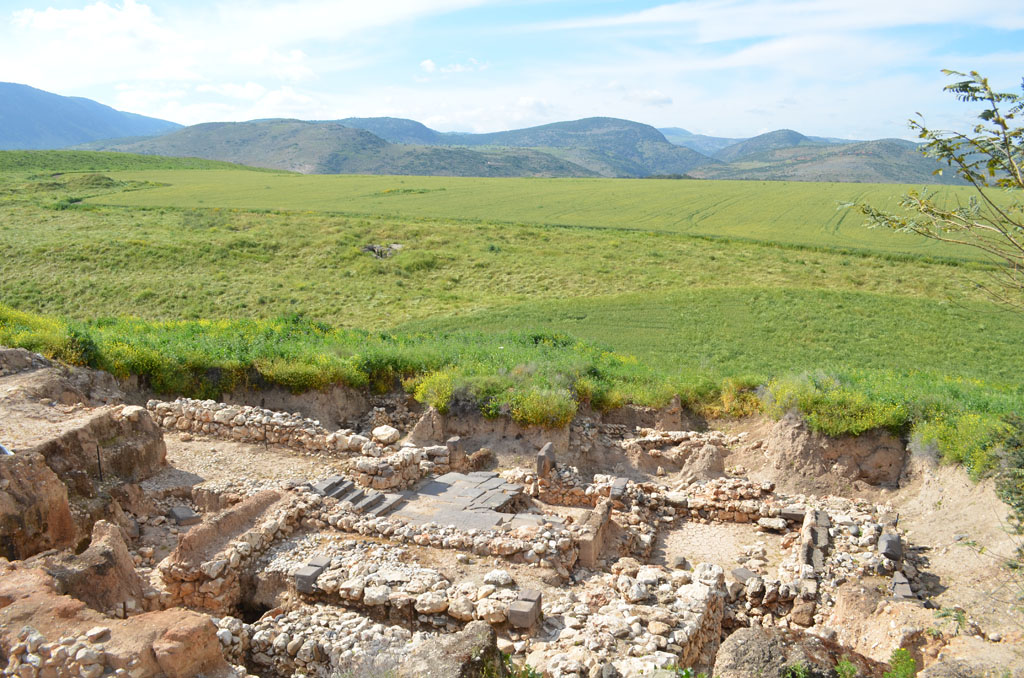
Chatsor (Hasor) was a large city; only the upper city has been excavated, but the lower city stretched across the entire field. Around 15,000–20,000 people are believed to have lived here, making it the largest city in the northern mountain region.
Jovav, king of Madon
and to the king of Shimron [present-day Tell Shimron in the Jezreel Valley]
and to the king of Achshaph
2and to the kings who were north in the hill country [northern Galilee – the hill country of Naphtali, see Josh 20:7]
and in the Arava (the wilderness, the heath) [the area around Jericho in the Jordan Valley] south of Kinneret [areas around the Sea of Galilee]
and in the Lowlands [Hebr. Shefelah – the lowlands between the Mediterranean coast and the Judean mountains] and in the area west of Dor by the sea [the Mediterranean],
3to the Canaanites in the east and west [the lowlands in the east and west]
and the Amorites [the highlands in the south]
and the Hittites
and the Perizzites
and the Jebusites in the mountainous region [around Jerusalem (Jebos), which had not yet been conquered]
and the Hivites under [the mountain] Hermon in the land of Mizpah [northern Israel; Hebr. mitspah means watchtower/lookout]. 4And they went out,
they and all their armies with them,
a great multitude, like the sand on the seashore,
with horses and chariots,
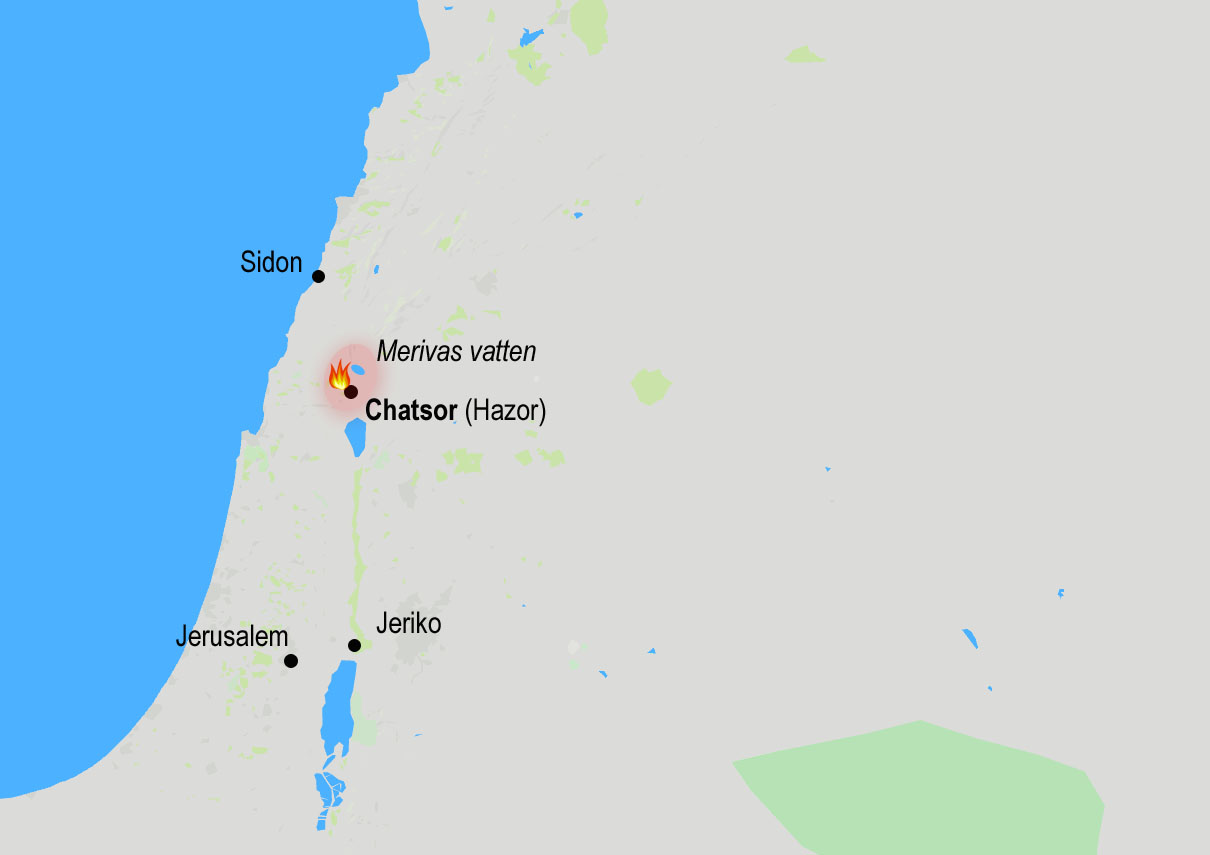
in great numbers. [Canaanite chariots from the late Bronze Age were light and had wheels with four spokes. They were drawn by two horses. According to the Jewish historian Josephus, this army consisted of 300,000 soldiers, 10,000 cavalrymen, and 20,000 chariots.] 5And all these kings gathered together and came and encamped together at the waters of Merom [literally: high lake; probably present-day Lake Hula, 15 km north of the Sea of Galilee, 4 km north of Chatzor] to fight against Israel. 6And the Lord (Yahweh) said to Joshua, "Do not be afraid of them, for tomorrow at this time I will deliver them all up slain before Israel; you shall cut the sinews of their horses and burn their chariots with fire." [A wounded horse could no longer be used in the cavalry, see also ; .] 7So Joshua suddenly (unexpectedly) came upon them, and all the people of war with him, at the waters of Merom [present-day Lake Hula] and attacked them. 8And the Lord (Yahweh) delivered them into the hand of Israel, and they defeated them and pursued them to great Sidon [on the Mediterranean coast in the northwest, see ] and to Misrephoth Maim ["burning waters" – hot springs; probably referring to a place or area near Sidon, see ] and the valley of Mizpeh to the east [northeast of Hazor], and smote them until none were left. 9And Joshua did to them as the Lord (Yahweh) had told him, he cut off the tendons of their horses and burned their chariots with fire. 10
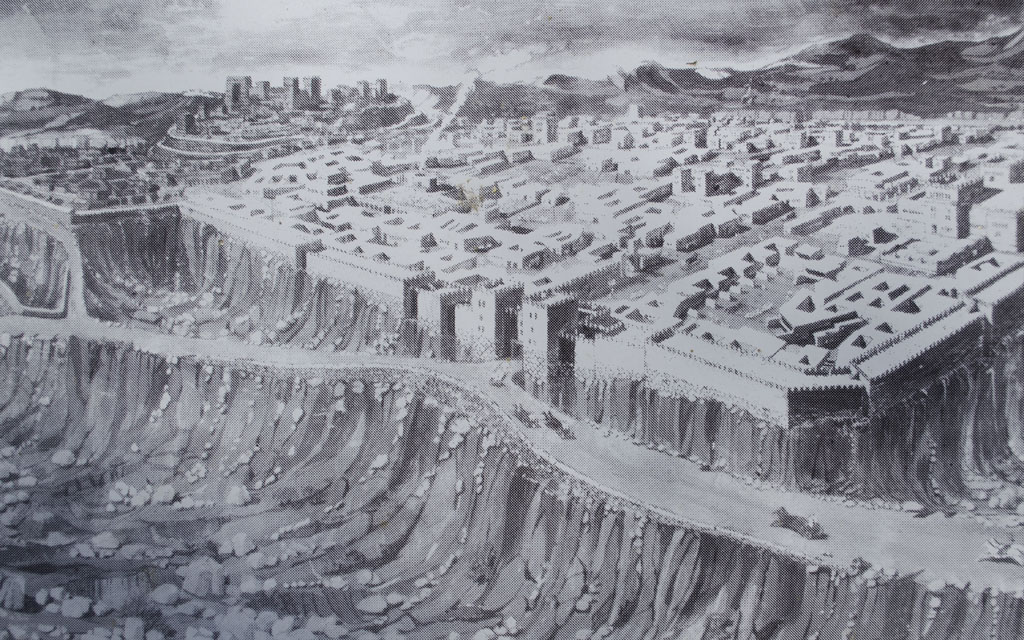
An artist's illustration of Chatsor.

A thick layer of ash confirms that the city was burned down.
And the land rested (was quiet; had peace) from war.Kings defeated
121These are the kings of the land whom the sons of Israel defeated, and whose land they occupied, on the other side of the Jordan toward the sunrise (eastern side), from the valley of Arnon to Mount Hermon and all the Arava to the east. 2Sihon, king of the Amorites [; ; ; ], who lived in Heshbon and ruled from Aroer, which is on the edge of the Arnon Valley and the middle of the valley and half of Gilead to the river Jabbok, the border of the sons of Ammon, 3and the Arabah (the wilderness, the wasteland) [the area around Jericho in the Jordan Valley] to the Sea of Kinnereth to the east [the area around the Sea of Galilee] and to the Sea of Arava, the Salt Sea [the Dead Sea], to the east, the road to Beit Hajeshimot to the south under the slopes of Pisgah [], 4and the border of Og, king of Bashan, the remnant of Rephaim who lived in Ashtaroth and in Edrei, 5and ruled on Mount Hermon and in Salcha and throughout Bashan to the border of the Geshurites and the Maacathites and half of Gilead to the border of Sihon, king of Heshbon. 6Moses, the servant of the Lord (Yahweh), and the sons of Israel defeated them, and Moses, the servant of the Lord (Yahweh), gave it [the land east of the Jordan] as an inheritance to the Reubenites, the Gadites, and the half-tribe of Manasseh [; ]. 7And these are the kings of the land whom Joshua and the sons of Israel defeated on the other side of the Jordan to the west, from Baal Gad in the valley of Lebanon [in the north] to the bare mountains that go up to Seir [Edom – in the south]. And Joshua gave it to the tribes of Israel as an inheritance according to their division, 8in the hill country [central highlands] and in the Lowlands [Hebr. Shefelah – the lowlands between the Mediterranean coast and the hill country of Judah] and in the Arava and on the slopes and in the desert and in the south (Negev). The Hittites, the Amorites, and the Canaanites, the Perizzites, the Hivites, and the Jebusites, 9King of Jericho – one,
King of Ai, which is beside Bethel – one,
10King of Jerusalem – one,
King of Hebron – one,
11King of Jarmuth – one,
King of Achish – one,
12King of Eglon – one,
King of Gezer – one,
13King of Devir – one,
King of Geder – one,
14King of Hormah – one,
King of Arad – one,
15King of Libnah – one,
King of Adullam – one,
16King of Makkedah – one,
King of Bethel – one,
17King of Tappuah – one,
King of Chefer – one,
18King of Aphik – one,
King of Sharon – one,
19King of Madon – one,
King of Hazor – one,
20King of Shimron Meron – one,
King of Achshaf – one,
21King of Taanach – one,
King of Megiddo – one,
22King of Kedesh – one,
King of Jokneam in Carmel – one,
23King of Dor in the territory of Dor – one,
King of Gojim in Gilgal – one,
24King of Tirtsah 1. [Tirtsah is located northeast of Shechem; present-day Tell el-Farah.] All the kings [were a total of] 31 [whom Joshua defeated, see ].The land is divided (chapters 13-24)
Land remaining to be conquered
[The last part of the book is also structured as a chiasm with the center where the distribution takes place in Shiloh where the tabernacle stands.
A. Introduction ()
B. Tribes outside Canaan ()
C. The Levites ()
D The hero from Kadesh: Caleb ()
E. Tribal allocation – not Rachel's children: Judah ()
F. Rachel's tribal allocation: Joseph ()
G. Center – allocation in Shiloh: seven tribes receive land through Yahweh's lot ()
F. Rachel's tribe allocation: Benjamin – next to Joseph ()
E. Tribal allocations – not Rachel's children: Simeon (within Judah) and others ()
D. The hero of Kadesh: Joshua ()
C. The Levites ()
B. Tribes outside Canaan ()
A. Conclusion ()] 131And Joshua was old and advanced in years (many years), and the Lord (Yahweh) said to him, "You are old and advanced in years (many years), and there is still much land to be occupied. 2This is the land that remains: the whole area of the Philistines and the whole area of the Geshurites 3from Shihor, which is before Egypt, to the border of Ekron northward, which is counted as Canaanite, the five Philistine leaders, Gaza and Ashdod and Ashkelon and Gittite and Ekron, even Avim. 4In the south, all the land of the Canaanites and Mera belonging to the Sidonians [descendants of Canaan from Sidon, see – from Sidon in present-day Lebanon] to Aphek to the border of the Amorites, 5and the land of the Gebalites and all Lebanon eastward (toward the sunrise) from Baal-Gad below Mount Hermon to the entrance of Hamath [in present-day southern Syria, not far from Tell Dan, see ], 6all the inhabitants of the hill country from Lebanon to Misrefot-Maim, all the Sidonians, I will drive them out from among the sons of Israel; you shall only divide it as an inheritance to Israel, as I have commanded you. 7Now divide this land as an inheritance to the nine tribes and the half-tribe of Manasseh." [The other two tribes (Reuben and Gad) and the other half of Manasseh had their inheritance east of the Jordan, see verses 8-33 and .]Division of the land east of the Jordan
8With him, the Reubenites and Gadites received their inheritance that Moses gave them on the other side of the Jordan to the east, as Moses, the servant of the Lord (Yahweh), gave them. 9from Aroer, which is on the edge of the Arnon Valley, and the city in the middle of the valley, and all the lowlands from Medeba to Dibon 10and all the cities of Sihon, king of the Amorites, who reigned in Heshbon, to the border of the sons of Ammon 11and Gilead and the border of the Geshurites and the Maacathites and all Mount Hermon and all Bashan as far as Salca 12the whole kingdom of Og in Bashan, who reigned in Ashtaroth and in Edrei, the same as the remnant of Rephaim, whom Moses smote and drove out. 13Nevertheless, the sons of Israel did not drive out the Geshurites or the Maacathites, so the Geshurites and the Maacathites dwell among the Israelites to this day. 14Only to the tribe of Levi he gave no inheritance. The burnt offerings [Hebr. isheh, see ] of the Lord (Yahweh), the God of Israel (Elohim), are their inheritance, as the Lord (Yahweh) spoke to him.Reuben
15And Moses gave to the tribe of the sons of Reuben according to their families. 16And their border is from Aroer, which is on the edge of the Arnon Valley, and the city that is in the middle of the valley, and all the lowlands to Medeva, 17Heshbon and all its towns in the lowlands, Dibon, Bamoth-Baal, and Beith-Baal-Meon, 18and Jahaz and Kedemoth and Mefaat, 19and Kiriathaim, and Zivmah, and Zeret-Shahar in the mountains of the valley, 20and Beth-Peor, and the slopes of Pisgah, and Beth-Jeshimoth, 21and all the cities in the lowlands, and all the kingdom of Sihon, king of the Amorites, who reigned in Heshbon, whom Moses defeated with the leaders of Midian, Evi and Rekem and Tsor and Hur (Hebr. Chor) and Reva, the princes of Sihon who lived in the land, 22and Balaam, son of Beor, the seer, whom the sons of Israel slew with the sword among the rest of the slain. 23And the borders of the sons of Reuben are the Jordan as their border. This is the inheritance of the sons of Reuben according to their families, the cities and their villages.Gad
24And Moses gave to the tribe of Gad, to the sons of Gad, according to their families. 25And their border was Jazer and all the cities of Gilead, and half the land of the children of Ammon, to Aroer, which is before Rabbah, 26and from Heshbon to Ramath-mizpeh and Betonim, and from Mahanaim to the border of Lidvir, 27and in the valley of Beth-Haram and Beth-Nimrah and Succoth and Zaphon, and the rest of the kingdom of Sihon, king of Heshbon, whose border is the Jordan to the farthest part of the Sea of Chinnereth beyond the Jordan to the east. 28This is the inheritance of the sons of Gad according to their families, the cities and their villages. 29And Moses gave an inheritance to the half-tribe of Manasseh, and it was for half of the sons of Manasseh according to their families. 30And the border was from Mahanaim, all the kingdom of Og, king of Bashan, and the villages of Jair, which are in Bashan, 60 cities. 31And half of Gilead and Ashtaroth and Edrei, the cities of the kingdom of Og in Bashan, were for the sons of Machir, the son of Manasseh, for half of the sons of Machir according to their families. 32This is the inheritance that Moses distributed in the plains of Moab beyond the Jordan east of Jericho. 33But Moses gave no inheritance to the tribe of Levi. The Lord (Yahweh), the God of Israel (Elohim), is their inheritance, as he promised them.the Levites
141And this is the inheritance which the children of Israel took in the land of Canaan, which Eleazar the priest and Joshua the son of Nun, and the heads of the fathers' houses of the tribes of the children of Israel, gave unto them. 2by lot for the inheritance, as the Lord (Yahweh) commanded through Moses for the nine tribes and for the half-tribe. 3For Moses had given the inheritance to the two tribes and the half-tribe beyond the Jordan, but to Levi he gave no inheritance among them. 4The sons of Joseph were two tribes, Manasseh and Ephraim. And they gave no part to the Levites in the land, except cities to dwell in with open country around them for their cattle and small livestock. 5As the Lord (Yahweh) commanded Moses, so the sons of Israel did, and they divided the land. [The Levites did not receive their own territory, only cities among the other tribes. However, Levites could own their own land for their livelihood, see ; ; .]Personal assignment – Caleb
[In the chiastic pattern, this passage is connected to , where Josh. 1, like Caleb here, receives his reward for the events at Kadesh-Barnea.] 6Then the sons of Judah came near to Joshua at Gilgal, and Caleb, the son of Jephunneh the Kenizzite, said to him: "You know (are intimately familiar with) the things that the Lord (Yahweh) spoke to Moses the man of God concerning me and you at Kadesh-Barnea. 7I was 40 years old when Moses, the servant of the Lord (Yahweh), sent me from Kadesh-Barnea to spy out the land, and I returned to him with words as they were in my heart. 8Nevertheless, my brothers who went up with me made the hearts of the people melt (become anxious, filled with fear), but I wholeheartedly followed my God (Elohim). 9And Moses swore on that day, saying, 'Truly, the land that your feet have trodden shall be an inheritance to you and your sons forever, because you wholeheartedly followed the Lord my God (Yahweh Elohim).' 10And now, behold, the Lord (Yahweh) has kept me alive, as he spoke, these 45 years from the time that the Lord (Yahweh) spoke these words to Moses while Israel was wandering in the wilderness. And now, I am 85 years old today. 11Yet I am as strong today as I was on the day Moses sent me away. As my strength was then, so is my strength now, to fight and to go out and to come in. 12Now therefore give me these mountains which the Lord (Yahweh) spoke of that day, for you heard that day how the Anakim were there, and the cities were large and fortified. It will be so that the Lord (Yahweh) is with me and will drive them out as the Lord (Yahweh) spoke." 13And Joshua blessed him and gave Hebron to Caleb, the son of Jephunneh, as an inheritance. 14Therefore, Hebron became the inheritance of Caleb, the son of Jephunneh the Kenizzite, to this day, because he wholly followed the Lord (Yahweh), the God of Israel (Yahweh Elohim). 15Hebron was formerly called Kiriath-Arba, which was the Arba who was the greatest man among the Anakim. And the land had rest (silence, peace) from war. [Arba is Hebrew for the number four, so Kiriath-Arba is "the city of four" or "Tetrapolis." There are various rabbinical explanations for the name: four patriarchs are buried there (Adam, Abraham, Isaac, and Jacob); four matriarchs are buried there (Eve, Sarah, Rebekah, and Leah); the city was the place from which Abraham set out when he fought four kings.]Leah's son Judah
[Now follows the division for the tribe of Judah. In the chiastic pattern, those who are not Rachel's children, i.e., Judah and Simeon, are now described. This passage is related to the passage about Simeon, who is also not a child of Rachel, see ] 151And the lot for the tribe of the sons of Judah according to their families was to the border of Edom, to the wilderness of Zin southward to the extreme border on the south. 2And their southern border was from the end of the Salt Sea (Dead Sea), from its southern bay (towards the Negev). 3And it goes south along the slopes of Akrabim and passes along Zin and goes up south of Kadesh-Barnea and passes along Chetsron and goes up to Adar and turns toward Karkaa, 4And it goes to Atsmon and on to the stream of Egypt, and the border goes out to the sea [the Mediterranean Sea]. This shall be your southern border. 5And the eastern border is the Salt Sea (Dead Sea) to the end of the Jordan.
And the border on the north side is from the bay (literally: tongue) of the sea [Dead Sea] at the end of the Jordan. 6And the border goes up to Beit-Chogla and passes north of Beit-Arava, and the border goes to the stone of Bohan, son of Reuben. 7And the border goes up to Devir from the valley of Achor and northward and toward Gilgal, which is opposite the slope of Adummim, which is the south side of the stream, and the border passes along the waters of Ein-Shemesh and goes from there to Ein-Rogel, 8and the border goes up to the valley of the son of Hinnom to the side of the Jebusites southward, that is, Jerusalem, and the border goes up to the top of the mountain that lies in front of the valley of Hinnom westward, which is the outer limit of the valley of Rephaim northward. 9And the border is drawn from the top of the mountain to the source of Neftoach's water and goes out to the cities on Mount Efron, and the border is drawn to Baalah, which is Kirjat-Jearim [13 km west of Jerusalem]. 10And the border turns from Baalah westward to Mount Seir and passes along the side of Mount Jearim in the north, that is, Chesalon, and goes down to Beit-Shemesh and continues to Timnah. 11And the border goes to the side of Ekron northward, and the border is drawn to Shikrona, and passes to Mount Baalah, and goes out at Javneel, and the border goes out at the sea [the Mediterranean Sea]. 12And the western border, the Great Sea [Mediterranean Sea], is its border. This is the border of the sons of Judah all around according to their families. 13And to Caleb, the son of Jephunneh, he gave a portion among the sons of Judah according to the commandment of the Lord to Joshua, Kiriath-Arba, the Arba whose father was Anak, that is, Hebron. 14And Caleb drove out the three sons of Anak, Sheshai and Ahiman and Talmai, the sons of Anak. 15And he went up against the inhabitants of Debir [south of Hebron, see ]. Debir was formerly called Kiriath-sepher [city of books]. [Devir was an important Canaanite holy city where records were also kept. The fact that it has several names indicates its importance, see also .] 16And Caleb said, "Whoever strikes Kirjat-Seph and takes it, to him I will give my daughter Achsah as a wife." 17And Othniel, the son of Kenaz, Caleb's brother, took it, and he gave him his daughter Achsah as his wife. 18And it came to pass, when she came to him, that she moved him to ask of her father a field: and she lighted from off her ass; and Caleb said unto her, What wilt thou? 19And she answered, "Give me a blessing; since you have given me the land of the South, give me also springs of water." And he gave her the upper springs and the lower springs. 20This is the inheritance of the tribe of the sons of Judah according to their families.The southern cities
21And the cities in the outermost parts of the tribe of the sons of Judah toward the border of Edom in the south are: Kavtsel and Eder and Jagor 22and Kina and Dimona and Adad 23and Kedesh and Hazor and Ithnan, 24Ziph, and Telem, and Bealoth 25and Hazor and Hadad and Kerioth and Chetsron, that is Hazor 26Amam and Shema and Molada 27and Hazer-Gadda and Cheshmom and Beit-Pelet 28and Chatzar-Shoal and Beer-Sheva and Biziotja, 29Baalah, and Ijim, and Etsem 30and Eltolad and Chesil and Chorma 31and Tsiklag and Madmanna and Sansanna 32and Levaot and Shilchim and Ajin and Rimmon
– a total of 29 cities with their villages. The lowland
33In the Lowlands [Hebr. Shefelah – the lowlands between the Mediterranean coast and the Judean hills]: Eshtaol and Tsorah [25 km west of Jerusalem, just north of Beit-Shemesh], and Ashna 34and Zanoah and Ein-Gannim, Tappoah and Enam 35Jarmot and Adullam, Socho and Azeka 36and Shaarajim and Aditajim and Gedera and Gederotajim
– 14 cities with their villages. 37Tsenan and Chadasha and Migdal-Gad 38and Dilan and Mitspeh [watchtower – a military outpost] and Joktel 39Lachish and Botskat and Eglon 40and Kabbon and Lachmas and Kitlish 41and Gederoth, Beit-Dagon and Naama and Mackedah
– 16 cities with their villages. 42
Sunrise from Tell Burna (biblical Livna). In the background to the east, Jerusalem, Bethlehem, and Hebron can be seen in the mountainous region.
– 9 cities with their villages.
45Ekron with its towns and villages, 46from Ekron to the sea [Mediterranean Sea], everything beside Ashdod with its villages. 47Ashdod, its towns and its villages, Gaza, its towns and its villages to the brook of Egypt. The Great Sea [Mediterranean Sea] is its border. The hill country
48And in the hill country: Shamir and Jattir and Socho 49and Dan and Kirjat-Sanna [the city of palm trees], that is Devir [] 50and Anav and Eshtemo and Anim. 51And Goshen and Cholon and Gilo
– 11 cities with their villages.
52Arav and Roma and Eshan 53and Janom and Beit-Tappoach and Afeka 54and Chumta and Kirjat-Arba, that is Hebron and Tsior
– 9 cities with their villages.
55Maon, Carmel, and Ziph, and Jotta 56and Jizreel and Jakdeam and Zanoach, 57Kain, Giva, and Timnah
– 10 cities with their villages.
58Chalchol, Beit-Tsor, and Gedor 59and Maarath and Beit-Anot and Eltekon
– 6 cities with their villages.
60Kirjat-Baal, that is Kirjat-Jearim, and Rabbah
– 2 cities with their villages. The desert
61In the desert: Beit-Arava, Middin, and Sechacha 62and Nivshan and Saltstaden and Ein-Gedi
– 6 cities with their villages. 63But the Jebusites, the inhabitants of Jerusalem, could not be driven out by the sons of Judah, and the Jebusites live with the sons of Judah in Jerusalem to this day.Rachel's son Joseph
[This passage concerns Rachel's son Joseph and his sons' inheritance. It is related to Benjamin in .] 161The lot for Joseph's sons went out from the Jordan at Jericho, at the waters of Jericho on the east, and went up from Jericho through the hill country to the wilderness, to Bethel. 2And it went out from Bethel-Loza and passed along the border of the Arkites to Ataroth, 3and it went down westward to the border of the Japhletites to the border of Lower Beth-Horon, to Gezer [halfway between Joppa and Jerusalem], and from there to the sea. 4And Joseph's sons, Manasseh and Ephraim, took their inheritance.Ephraim
5And the border of the sons of Ephraim according to their families was this. The border of the inheritance on the east was Atrot-Adar to Beit-Choron the upper, 6and the border goes westward, Michmethath is on the north, and the border turns eastward to Taanath-Shiloh and passes along it east of Janohah, 7and it goes down from Janocha to Ataroth and to Naara and reaches Jericho and goes out to the Jordan. 8From Tappoach the border goes west to the brook Kana, and from there it goes out to the sea. This is the inheritance of the tribe of the sons of Ephraim according to their families, 9along with the cities that were set apart for the sons of Ephraim in the midst of the inheritance of the sons of Manasseh, all the cities with their villages. 10But they did not drive out the Canaanites who lived in Gezer, and the Canaanites live in the midst of Ephraim to this day and became servants to do the heavy work.Manasseh
171And this is the lot of the tribe of Manasseh, for he was Joseph's firstborn, as Machir was Manasseh's firstborn [; ], the father of Gilead—because he was a warrior []—he had Gilead and Bashan. 2And the lot of the rest of the sons of Manasseh according to their families was for the sons of Abiezer, and for the sons of Helek, and for the sons of Asriel, and for the sons of Shechem, and for the sons of Shefer, and for the sons of Shemida; these were the sons of Manasseh, the son of Joseph, according to their families. 3But Zelophehad, the son of Hepher, the son of Gilead, the son of Machir, the son of Manasseh, had no sons, but daughters [; ], and these are the names of his [five] daughters: Mahlah, Noah, Hoglah, Milkah, and Tirzah. 4And they came near before the priest Eleazar and before Joshua the son of Nun, and before the leaders, and said, "The Lord commanded Moses to give us an inheritance among our brothers." Therefore, according to the command of the Lord, he gave them an inheritance among their father's brothers. 5And ten portions fell to Manasseh beside the land of Gilead and Bashan, which is on the other side of the Jordan, 6because the daughters of Manasseh had an inheritance among his sons, and Gilead belonged to the rest of the sons of Manasseh. 7And the border of Manasseh began from Asher, Michmethath, which is before Shechem [present-day Nablus in Samaria, see ], and the border went to the right to Ein-Tappoach. 8Tappoach land belonged to Manasseh, but Tappoach on the border of Manasseh belonged to the sons of Ephraim. 9And the border went down to the brook of Kanah south of the brook, with cities belonging to Ephraim among the cities of Manasseh, but the border of Manasseh is on the north side of the brook and goes from there to the sea [the Mediterranean Sea]. 10Southward is Ephraim, and northward is Manasseh, and the sea is his border, and it extends to Asher on the north and to Issachar on the east. 11In the territories of Issachar and Asher, Manasseh received:
Beit-Shean with its surrounding towns (literally: her daughters),
Jivleam with its surrounding towns (literally: her daughters), the inhabitants of Dor with its surrounding towns, the inhabitants of Ein-Dor with its surrounding towns, the inhabitants of Taanach with its surrounding towns, the inhabitants of Megiddo with its surrounding towns (literally: her daughters), three (the third) Nafot (height, hill). [The last two words in the verse are literally three nafot. The word means hill or mountainous region. It is a comment that could either refer to Dor (the third city in the list) and that it has an alternative name "Nafot Dor", as in . Or it refers to the geography of the last three cities located in the mountainous region, "the three mountain cities," and is then just a concluding comment.] 12But the sons of Manasseh could not drive out the inhabitants of these cities, for the Canaanites were determined to live in this land. 13And it came to pass, when the sons of Israel were strong (had grown large, become numerous), that they put the Canaanites to hard labor, but they did not drive them out completely. 14And the sons of Joseph spoke to Joshua, saying, "Why have you given me one lot and one portion as an inheritance? Behold, I am a great people, for the Lord (Yahweh) has blessed me greatly." 15And Joshua said to them, "If you are a great people, then go up to the forest and cut down for yourself there in the land of the Perizzites and the Rephaim, since the hill country of Ephraim is too crowded for you." [The hill country of Ephraim stretched from Bethel, north of Jerusalem, up to the plain of Jezreel.] 16And the sons of Joseph said, "The hill country is not enough for us, and all the Canaanites who live in the land's valley have iron chariots, both those in Beit-Shean and its villages and those in the valley of Jezreel." 17And Joshua spoke to the house of Joseph, to Ephraim and Manasseh, saying, "You are a great people and have great power (strength); you shall not have only one lot, 18but the hill country shall be yours, for though it is a forest, you shall cut it down, and the profit thereof shall be yours, for you shall drive out the Canaanites, though they have iron chariots and though they are strong."Distribution around Shiloh – 7 tribes
[This is the chiastic center of chapters 13-24.] 181And the whole assembly of the sons of Israel gathered together at Shiloh and set up the tent of meeting there, and the land was subdued before them. 2Among the sons of Israel, there remained seven tribes that had not yet received their inheritance. 3And Joshua said to the sons of Israel, "How long will you neglect (delay) going to take possession of the land that the Lord (Yahweh), the God (Elohim) of your fathers, has given you? 4Choose three men for each tribe, and I will send them, and they shall arise and go through the land and describe it, and they shall come to me. 5And they shall divide it into seven parts, Judah shall remain within its borders in the south, and the house of Joseph shall remain within its borders in the north. 6And you shall describe the land in its seven parts and bring the description to me, and I will cast lots for you before the Lord our God (Yahweh Elohim). 7But the Levites have no part among you, for the priesthood of the Lord is their inheritance, and Gad and Reuben and the half-tribe of Manasseh have received their inheritance on the other side of the Jordan, to the east, which Moses, the servant of the Lord (Yahweh), gave them." 8And the men arose and went, and Joshua commanded those who went to describe the land, saying, "Go and walk through the land and describe it, and come back to me, and I will cast lots for you here before the Lord (Yahweh) in Shiloh." 9And the men went and passed through the land and described it with the cities in seven parts in a book, and they returned to Joshua, to the camp at Shiloh. 10And Joshua cast lots for them in Shiloh before the Lord (Yahweh), and there Joshua divided the land to the sons of Israel according to their divisions.Rachel's son Benjamin
[The territory of Benjamin is the one described in most detail in 18 verses. This is probably due to its location between Judah in the south and Joseph (i.e., Ephraim) in the north.] 11And the lot fell to the tribe of the sons of Benjamin according to their families, and their inheritance was between the sons of Judah and the sons of Joseph.Northern border
12And their border on the north side was from the Jordan, and the border went up to the side of Jericho on the north, and went up through the hill country westward, and from there it went to the wilderness of Beth-Aven. 13And the border passed from there to Luz, to the side of Luz, that is, Bethel, southward, and the border went down to Atroth-Adar, to the mountains that are south of Beit-Choron, the lower one. [Same as the southern border of Josh's tribes, see Jos 16:1-4] Western border
14And the border turned and went south on the west side from the mountains that are in front of Beit-Choron southward, and went out from there at Kirjat-Baal, the same as Kirjat-Jearim, one of the cities of the sons of Judah; this was the west side.Southern border
15And the south side was from the outermost part of Kiriath-Jearim, and the border went westward and came to the water source of Neftoach. 16And the border went down to the outermost part of the mountains that lie in front of the valley of the sons of Hinnom, which is in the valley of Rephaim to the north, and it went down from the valley of Hinnom to the side of the Jebusites to the south and went down to Ein-Rogel. 17And it was drawn northward and went out at Ein-Shemesh and went to Geliot, which is opposite the slope of Adummim, and went down to the stone of Bohan, the son of Reuben. 18And it went along the side opposite the Arava to the north and went down to the Arava. 19And the border went along the side of Beit-Chogla northward, and the border went at the northern bay (literally: tongue) of the Salt Sea (Dead Sea) at the southern end of the Jordan. This is the southern border.Eastern border
20And the Jordan was the border on its eastern side. This was the inheritance of the sons of Benjamin, with its borders all around according to their families.Cities
21The cities of the tribes of the sons of Benjamin were, according to their families [12 cities in the east]: Jericho
and Beit-Chogla
and Emek-Ketsits
22and Beit-Arava
and Tsemaraim
and Bethel
23and Avim
and Para
and Ofra
24and Kfar-Amona
and Ofni and Geva. Twelve cities with their villages. [14 cities in the west:] 25Givon
and Rama
and Beerot
26and Mitspeh [watchtower – a military outpost]
and Kefira
and Motsa
27and Rekem
and Jirpeel
and Tarala
28and Zela, Eleph
and Jevosi, that is Jerusalem,
Giva [later this becomes Saul's hometown]
and Kirjat. Fourteen cities with their villages. This is the inheritance of the sons of Benjamin according to their families.Leah's son Simeon
191And the second lot fell to Simeon, to the tribe of the sons of Simeon according to their families, and their inheritance was in the midst of the inheritance of the sons of Judah. 2And they had as their inheritance [13 cities]: Beer-Sheba at Sheba
and Molada
3and Hazer-Shaloel
and Balah and Ezem
4and Eltolad
and Betol
and Horma
5and Ziklag
and Beit-Markavot
and Hazar-Sosa
6and Beit-Levaot
and Sharochen. Thirteen cities with their villages. 7Ain,
Rimmon
and Eter
and Ashan. Four cities with their villages. 8And all the villages that were around these cities as far as Baalot-Beer, as far as Ramah in the south. This is the inheritance of the sons of Simeon according to their families. 9From the lot of the sons of Judah was the inheritance of the sons of Simeon, for the portion of the sons of Judah was too large for them, so the sons of Simeon had their inheritance in the midst of their inheritance.Leah's son Zebulun
[The third lot fell to Zebulun, who is the first of five smaller tribes in the north whose boundaries are now described.] 10And the third lot fell to the sons of Zebulun according to their families, and the [southern] border of their inheritance was toward Sarid. 11And their border went up westward to Maralah and reached to Dabbashet, and it reached to the brook that is before Jokneam. 12And it turned from Sarid eastward toward the sunrise to the border of Kislot-Tabor, and it went to Dovrat and turned up to Jafia. 13And from there it went eastward to Gita-Chefer, to Et-Katsin, and it went out to Rimmon-Metoar to Nea. 14And the border turned on the north side to Hannaton [present-day Tell Hanaton; Hebr. Channaton means: gracious/beautiful] and went from there to the valley of Jiftachel. 
Bethlehem in Galilee is not far from Haifa, where the landscape is fairly flat. Southern Bethlehem is not included in any lists, which is why the prophet must clarify that it is in Bethlehem, Eftata, that the Messiah will be born ([Mic. 5:2]).
15and Katat
and Nachalal
and Shimron
and Jidala
and Bethlehem [in Galilee, just east of present-day Haifa on the plain north of Mount Carmel]. Twelve cities with their villages.
16This is the inheritance of the sons of Zebulun according to their families, these cities with their villages.Leah's son Issachar
17And the fourth lot fell to Issachar, to the sons of Issachar according to their families. 18And their border was [16 cities:] Jizreel
and Kesolot
and Shunem
19
In the winter of 2024, this scarab was found at the foot of Tel Rekhesh (biblical Anacharat) in southern Galilee. The scarab was a popular amulet and seal in ancient Egypt and was modeled after a beetle. It dates back to the 7th century BC.
©Anastasia Shapiro, Israel Antiquities Authority
and Shion
and Anacharath
20and Rabbith
and Kishion
and Evet
21and Remeth
and Ein-Ganim
and Ein-Haddah
and Beit-Patsets 22and the border extended to Tabor
and Shachatsim
and Beit-Shemesh [literally: "village of the sun" – in the territory of Issachar] and went from there to the Jordan. Sixteen cities with their villages. 23This is the inheritance of the tribes of the sons of Issachar according to their families, the cities with their villages.Asher, the son of Zilpah
24And the fifth lot fell to the tribe of the sons of Asher according to their families. 25And their border was [22 cities:] Chelkat
and Chali
and Beten
and Achshaf
26and Alam-Melech
and Amad
and Mishal
and it extended to Carmel westward and to Shichor-Livnat.
27And it turned eastward (toward the sunrise) to Beit-Dagon and reached to Zebulun and to the valley of Jiftachel northward at Beit-Emek and Niel, and it turned out to Kavol [] on the left. 28And Evron and Rechov and Chamon and Kana as far as the great Sidon [the city and the area around the city].
29And the border turned to Ramah and to the fortified city of Tyre, and the border turned to Chosa and went out there to the sea from Chevel to Achziva 30and Uma, and Aphek, and Rehob. Twenty-two cities with their villages. 31This is the inheritance of the sons of Asher according to their families, the cities with their villages.Bilhah's son Naphtali
32And the sixth lot fell to Naphtali, to the tribe of the sons of Naphtali according to their families. 33And their border went from [19 cities:] Chelef,
from Elon-Betsananim
and Adami-Nekev [may be one or two cities, in which case Tell Adami and Khirbet Bessum for Nekev]
and Javneel to Lakom
and from there to the Jordan.
34And the border turned westward to Aznot-Tabor
and went from there to Chokoka
and reached Zebulun in the south
and reached Asher in the west
and to Judah at the Jordan toward the sunrise (eastward).
35And the [15] fortified cities were Tsidim-Tser
and Hamath
and Rakath
and Kinnereth
36and Adama,
and Rama,
and Hazor,
37and Kedesh,
and Edrei,
and Ein-Hatzor,
38and Jiron
and Migdal-El
and Chorem
and Beit-Anat
and Beit-Shemesh [literally: "village of the sun" – in the territory of Naphtali]. Nineteen cities with their villages.
39This is the inheritance of the sons of Naphtali according to their families, the cities with their villages.Bilhah's son Dan
40And the seventh lot fell to the tribe of the sons of Dan according to their families. 41And the border of their inheritance was: Zorah [25 km west of Jerusalem, just north of Beit-Shemesh]
and Eshtaol
and Ir-Shemesh
42and Shaalabin
and Ajalon
and Jitla
43and Elon
and Timnah
and Ekron
44and Elteke
and Gibbeton
and Baalat
45and Jehud
and Bneibrak
and Gat-Rimmon
46and Mejarkon
and Rakon with the border opposite Jaffa. 47But the border of the sons of Dan was too narrow for them, so the sons of Dan went up and fought against Leshem and took it and struck it with the edge of the sword and occupied it and lived there and called Leshem Dan after the name of their forefather Dan. 48This is the inheritance of the sons of Dan according to their families, the cities with their villages.Personal Allocation – Joshua
49When they had finished dividing the land as an inheritance with its borders, the sons of Israel gave an inheritance to Joshua, the son of Nun, in their midst. 50As the Lord (Yahweh) had commanded [], they gave him [Joshua] the city he requested—Timnath-serah in the hill country of Ephraim. And he built a city and lived in it. 51These are the inheritance portions that Eleazar the priest and Joshua, the son of Nun, and the leaders of the tribes of the sons of Israel, the heads of their fathers' houses, distributed as inheritance in Shiloh before the Lord (Yahweh), at the entrance of the tent of meeting. Thus they finished dividing the land.The Levites and the cities of refuge
201And the Lord (Yahweh) spoke to Joshua, sayingCities of Refuge
2Speak to the sons of Israel and say, "Appoint for yourselves the cities of refuge, of which I have spoken to you through Moses [; ; ], 3so that the manslayer who kills another soul (person) by mistake or accident may flee there. They shall be a refuge for you from the avenger of blood. 4And he shall flee to one of these cities and stand at the entrance of the city gate and speak [explain his case] to the elders of the city, and they shall take him into the city and give him a place where he can live among them. 5And if the avenger of blood pursues him, they shall not deliver the manslayer into his hand, because he struck his neighbor unintentionally and did not hate him beforehand. 6And he shall dwell in that city until he can stand trial before the assembly, until the high priest who is then in office dies. Then the manslayer may return and come back to his own city and to his own house, to the city from which he fled." 7So they set apart [three cities west of the Jordan River:]
Kedesh in Galilee in the hill country of Naphtali, and
Shechem in the hill country of Ephraim, and
Kiriath-Arba, which is Hebron, in the hill country of Judah. 8And beyond [east of] the Jordan at Jericho, eastward, they set apart [also three cities:]
Bezer in the wilderness of the lowland from the tribe of Reuben, and
Ramoth in Gilead from the tribe of Gad, and
Golan in Bashan from the tribe of Manasseh. 9These [six cities of refuge] were the cities set apart for all the sons of Israel and for the stranger who lived among them. There, anyone who accidentally killed someone could flee so that he would not die by the hand of the avenger of blood before he stood before the assembly [and received a fair judgment].the cities of the Levites
211The leaders of the fathers' houses of the tribe of Levi came near the priest Eleazar and Joshua, the son of Nun, and the leaders of the fathers' houses of the sons of Israel, 2and spoke to them at Shiloh in the land of Canaan, saying, "The Lord (Yahweh) commanded through Moses to give us cities to dwell in with open country around them for our livestock." 3And the sons of Israel gave them from their inheritance according to the commandment of the Lord (Yahweh), these cities with open country around them. 4And the lot fell to the families of the Kohathites, the sons of Aaron the priest, who were Levites, and the lot fell to the tribe of Judah, and to the tribe of Simeon, and to the tribe of Benjamin, 13 cities. 5And the rest of the sons of Kohath received by lot for their families from the tribe of Ephraim and from the tribe of Dan and from the half-tribe of Manasseh—10 cities. 6And the sons of Gershon by their families were allotted from the tribe of Issachar, and from the tribe of Asher, and from the tribe of Naphtali, and from the half-tribe of Manasseh in Bashan, 13 cities. 7The sons of Merari, according to their families, received from the tribe of Reuben, from the tribe of Gad, and from the tribe of Zebulun, twelve cities. 8And the sons of Israel gave these cities to the Levites by lot, with open country around them, as the Lord (Yahweh) commanded through Moses. 9And they gave from the tribe of the sons of Judah and from the tribe of the sons of Simeon these cities that are named. 10And they were for the sons of Aaron of the family of the Kohathites, who were the sons of Levi, for the first lot was theirs. 11And they gave them Kiriath-Arba, which is Arba the father of Anak, the same as Hebron (Hebr. Chevrón), in the hill country of Judah, with the open land around it. 12But the fields of the city and its villages they gave to Caleb, the son of Jephunneh, as his possession. 13And to Aaron the high priest they gave Hebron with its open country around it, the city of refuge for a manslayer, and Libnah with its open country around it, 14and Jattir with the open land around it, and Eshtemoa with the open land around it, 15and Cholon with its open land around it, and Devir with its open land around it, 16and Ain with its open country around it, and Juttah with its open country around it, and Beth-Shemesh with its open country around it—nine cities from two tribes. 17And from the tribe of Benjamin, Givon with its open land around it, Geva with its open land around it, 18Anatot with the open land around it, and Almon with the open land around it—7 cities. 19All the cities of the sons of Aaron the high priest were 13 cities with the open land around them. 20And the families of the sons of Kohath, the Levites, the rest of the sons of Kohath, received their cities by lot from the tribe of Ephraim. 21And they gave them Shechem with its open country in the hill country of Ephraim, the city of refuge for a manslayer, and Gezer [halfway between Joppa and Jerusalem] with its open country, 22and Kibzaim with the open land around it, and Beit-Choron with the open land around it—four cities. 23And from the tribe of Dan, Eltekeh with the open land around it, Gibbethon with the open land around it, 24Ajalon with the open country around it, Gat-Rimmon with the open country around it—four cities. 25And from the half-tribe of Manasseh, Taanach with its open land around it, Gat-Rimmon with its open land around it—two cities. 26All the cities for the rest of the sons of the Kohathites were 10 with the open land around them. 27And to the sons of Gershon of the families of the Levites, from the half-tribe of Manasseh, they gave Golan in Bashan with its open country around it, the city of refuge for a manslayer, and Beeshtera with its open country around it—two cities. 28And from the tribe of Issachar, Kishion with the open land around it, Dovrat with the open land around it, 29Jarmoth with its open land around it, Ein-Ganim with its open land around it—four cities. 30And from the tribe of Asher, Mishal with the open land around it, Avdon with the open land around it, 31Chelkat with the open land around it, and Rechov with the open land around it—four cities. 32And from the tribe of Naphtali, Kedesh in Galilee with the open land around it, the city of refuge for a manslayer, and Chamot-Dor with the open land around it, and Kartan with the open land around it—3 cities. 33All the cities of the Gershonites according to their families were 13, with the open country around them. 34And to the families of the sons of Merari, the rest of the Levites from the tribe of Zebulun, Jokneam with the open land around it, Karta with the open land around it, 35Dimna with the open land around it, Nahalal with the open land around it—four cities. 36And from the tribe of Reuben, Bezer with the open land around it, and Jahaz with the open land around it, 37Kedemoth with the open land around it, and Meiphaath with the open land around it—four cities. [Verses 36-37 are missing in the Hebrew Masoretic Text. However, the text is preserved in a shorter version in some Hebrew manuscripts and in the Greek translation Septuagint. In there is a similar list.] 38And from the tribe of Gad, Ramoth in Gilead with the open land around it, the city of refuge for a manslayer, and Mahanaim with the open land around it, 39Heshbon with its surrounding open land, Jaazer with its surrounding open land—a total of four cities. 40All these were the cities of the sons of Merari according to their families, from the rest of the families of Levi, and their lot was 12 cities. 41All the cities of the Levites, 48 cities with the open country around them, in the midst of the possessions of the sons of Israel, 42these cities, each with the open land around it, so shall it be with all the cities. 43So the Lord (Yahweh) gave Israel all the land he had promised (sworn) to their fathers, and they took possession of it and settled there. 44And the Lord (Yahweh) gave them rest on every side, according to all that he had promised (sworn) to their fathers, and not one man of all their enemies stood against them, for the Lord (Yahweh) delivered all their enemies into their hand. 45Nothing was lacking of all the good things that the Lord (Yahweh) had spoken to the house of Israel. Everything came to pass (came to them).Division of the land east of the Jordan
221Then Joshua called the Reubenites, the Gadites, and the half-tribe of Manasseh 2and said to them, "You have kept (guarded, protected, preserved) all that the Lord (Yahweh)'s servant Moses commanded you, and have listened to my voice in all that I commanded you, 3you have not forsaken (abandoned) your brothers all these days until today, but have kept (guarded, protected, preserved) the charge that the Lord your God (Yahweh Elohim) commanded you. 4Now the Lord your God (Yahweh Elohim) has given rest to your brothers, as he promised them. Therefore, return now and go to your tents in the land where you have your possessions, which Moses, the servant of the Lord (Yahweh), gave you on the other side of the Jordan. 5But be very careful (watch over yourselves) to do the commandments (the clear commandments – Hebr. mitzvot) and the teaching (Hebr. Torah) that the Lord's (Yahweh's) servant Moses commanded (Hebr. tsavah) to you, to love the Lord your God (Yahweh Elohim) and walk in all his ways and keep (guard, protect, preserve) his commandments (clear commands) and cling to him and serve him with all your heart and with all your soul (person)." [] 6So Joshua blessed them and sent them away, and they went to their tents. 7And to the half-tribe of Manasseh Moses had given an inheritance in Bashan, but to the other half Joshua gave among their brothers beyond the Jordan to the west. When Joshua sent them away to their tents, he blessed them 8and spoke to them, saying, "Return to your tents with great prosperity, with a large amount of livestock, with silver and gold and bronze (copper alloy – Hebr. nechoshet) and iron and very beautiful clothing. Share the spoils of your enemies with your brothers." 9So the sons of Reuben and the sons of Gad and the half-tribe of Manasseh returned and left the sons of Israel. They went out from Shiloh, which is in the land of Canaan, to go to the land of Gilead [east of the Jordan River], to the land of their possessions which they had taken according to the commandment of the Lord (Yahweh) through the hand of Moses. [] 10And when they came to the area of the Jordan in the land of Canaan, the sons of Reuben and the sons of Gad and the half-tribe of Manasseh built an altar there by the Jordan, a large altar to look at. 11And the sons of Israel heard it said, "Behold, the sons of Reuben and the sons of Gad and the half-tribe of Manasseh have built an altar before the land of Canaan, in the region of the Jordan on the side facing the sons of Israel." 12And when the sons of Israel heard of it, the whole assembly of the sons of Israel gathered together at Shiloh, to go up and fight against them. 13And the sons of Israel sent Phinehas, the son of Eleazar the priest, to the sons of Reuben and to the sons of Gad and to the half-tribe of Manasseh in the land of Gilead, 14and with him ten leaders, one leader for each of the ancestral houses of the tribes of Israel. Each of them was a leader of his father's house among the thousands of Israel (clans, families – family groups). 15And they came to the sons of Reuben and to the sons of Gad and to the half-tribe of Manasseh in the land of Gilead, and spoke with them, saying: 16"Thus says the whole congregation of the Lord (Yahweh): What treachery is this that you have committed against the God (Elohim) of Israel, to turn away this day from following the Lord (Yahweh), when you have built this altar to rebel this day against the Lord (Yahweh)? 17Is not the sin of Peor enough for us, from which we have not cleansed ourselves to this day, even though a plague came upon the congregation of the Lord (Yahweh), 18so that you must turn away from following the Lord (Yahweh) today? And it will be that when you rebel against the Lord (Yahweh) today, tomorrow he will be angry with the whole congregation of Israel. 19And if the land you possess becomes unclean, then come over to the land of the Lord's (Yahweh's) possession, where the tabernacle of the Lord (Yahweh) is, and take possession among us, but do not rebel against the Lord (Yahweh) and do not rebel against us by building an altar beside the altar of the Lord our God (Yahweh Elohim). 20Did not Achan, the son of Zerah, commit a transgression concerning the holy things, and wrath fell upon the whole congregation of Israel? And that man alone did not perish in his sin." 21Then the sons of Reuben and the sons of Gad and the half-tribe of Manasseh answered and spoke to the leaders of the thousands of Israel (clans, families – family groups): 22"God, God the Lord (El, Elohim Yahweh) – God, God the Lord (El, Elohim Yahweh), he knows (is intimately acquainted with) and Israel he shall know (become intimately acquainted with), whether it is in rebellion or whether it is treacherous against the Lord (Yahweh), do not save us today, 23that we have built ourselves an altar to turn away from following the Lord (Yahweh), or to offer burnt offerings or food offerings or peace offerings on it, let the Lord (Yahweh) himself demand it, 24and if we have not done this out of concern, saying, "In times to come, perhaps your sons will come and speak to our sons, saying, 'What have you to do with the Lord (Yahweh), the God of Israel (Elohim)? 25For the Lord (Yahweh) has made the Jordan a boundary between us and you, the sons of Reuben and the sons of Gad, you have no part in the Lord (Yahweh), so your sons may cause our sons to cease to revere the Lord (Yahweh). 26Therefore, we said, 'Let us now prepare to build an altar, not for burnt offerings or sacrifices, 27but it shall be a witness between us and you and between our generations after us, that we may serve the Lord (Yahweh) before him with our burnt offerings and with our sacrifices and with our peace offerings, so that your sons may not say to our sons in the future, 'You have no part in the Lord (Yahweh). 28Therefore, we said, 'When they say this to us or to our generations in times to come, we will say, "Look at the pattern of the altar of the Lord (Yahweh) that our fathers made, not for burnt offerings, not for sacrifices, but as a witness between us and you. 29Far be it from us to rebel against the Lord (Yahweh) and turn away from following the Lord (Yahweh) by building an altar for burnt offerings, for food offerings, and for sacrifices beside the altar of the Lord our God (Yahweh Elohim) that stands before his tabernacle." 30And when the priest Phinehas and the leaders of the congregation, the leaders of the thousands of Israel (clans, families – family groups) who were with him, heard the words that the sons of Reuben and the sons of Gad and the sons of Manasseh spoke, it pleased them. 31And Phinehas, the son of Eleazar the priest, said to the sons of Reuben and the sons of Gad and the sons of Manasseh: "Today we know (we are intimately acquainted with) that the Lord (Yahweh) is in our midst, because you have not been treacherous toward the Lord (Yahweh), and have not delivered the sons of Israel to fall away from the hand of the Lord (Yahweh)." 32And Phinehas, the son of Eleazar the priest, returned from the sons of Reuben and from the sons of Gad out of the land of Gilead to the land of Canaan to the sons of Israel, and brought word. 33These words pleased the sons of Israel, and the sons of Israel blessed the Lord (Yahweh) and spoke no more of going up to fight against them, to destroy the land where the sons of Reuben and the sons of Gad lived. 34And the sons of Reuben and the sons of Gad gave the altar the name: It is a witness between us that the Lord (Yahweh) is God (Elohim).Summary
231And it came to pass after many days, when the Lord (Yahweh) had given Israel rest from all their enemies round about, and Joshua was old and advanced in years, 2that Joshua called all Israel, their elders and their heads (leaders) and their judges and their chiefs, and said to them, "I am old and have reached a ripe old age (have grown old). 3And you have seen all that the Lord our God (Yahweh Elohim) has done to all these nations for your sake, for the Lord our God (Yahweh Elohim) is the one who has fought for you. 4Behold, I have allotted to you an inheritance, according to your tribes, the lands that remain from the Jordan, with all the peoples that I have cut off (cut down) as far as the Great Sea [the Mediterranean] toward the sunset [westward]. 5And the Lord (Yahweh) your God (Elohim) will cast them out before you and drive them away from your sight, and you shall occupy the land that the Lord (Yahweh) your God (Elohim) has spoken to you. 6Therefore, you shall be very strong (firm, secure, brave) and keep (guard, protect, preserve) and do all that is written in the book of Moses' teaching (Hebr. Torah), so that you do not turn aside from it to the right or to the left, 7so that you do not become [assimilated] among these peoples who remain among you, do not mention the names of their gods, do not swear (take an oath) by them, do not serve them, and do not worship them, 8but hold fast (cling to, stick to) to the Lord your God (Yahweh Elohim) as you have done to this day. 9Therefore, the Lord (Yahweh) has driven out before you great and powerful nations, and no man has been able to stand against you to this day. 10One man of you has chased a thousand, because the Lord your God (Yahweh Elohim) is the one who has fought for you, as he has told you. 11Take great care (protect, preserve) yourselves, so that you love the Lord your God (Yahweh Elohim). 12If you in any way turn back and cling to the remnant of these nations that remain among you, and make marriages with them, and go in to them and they to you, 13know for certain that the Lord your God (Yahweh Elohim) will no longer drive these peoples from before you (from your sight), but they will become a snare and a trap for you, and a scourge on your side [the whip of the slave driver], and thorns in your eyes [that blind you] until you perish from the good land that the Lord your God (Yahweh Elohim) has given you. 14Behold, I am walking (now taking the next step) on the path that all [of us here] in the world must walk [], therefore consider with all your heart and with all your soul that not one thing of all the good things that the Lord your God (Yahweh Elohim) spoke over you has failed to come to pass, all has come to you, nothing is missing. 15And it shall come to pass, that as all the good things have come upon you which the Lord your God (Yahweh Elohim) has spoken over you, so the Lord (Yahweh) will bring all evil things upon you until he has destroyed you from this good land which the Lord your God (Yahweh Elohim) has given you, 16when you transgress the covenant of the Lord your God (Yahweh Elohim) which he commanded you, and go and serve other gods and worship them. Then the anger of the Lord (Yahweh) will be kindled against you, and you will perish quickly from the good land which he has given you."Israel renews its promise to God
241And Joshua gathered all the tribes of Israel at Shechem and summoned all the elders of Israel and their leaders and their judges and their commanders, and they stood before God (Elohim). 2And Joshua said to all the people, "Thus says the Lord (Yahweh), the God (Elohim) of Israel: Your fathers dwelt beyond the river [Euphrates]—Terah, the father of Abraham and the father of Nahor—and they served other gods. 3And I took your father Abraham from the other side of the river and led him through all the lands of Canaan and multiplied his seed and gave him Isaac. 4And to Isaac I gave Jacob and Esau, and to Esau I gave Mount Seir to possess it, and Jacob and his sons went down to Egypt. 5And I sent Moses and Aaron, and I afflicted Egypt according to all that I did in its midst, and afterward I brought you out. 6And I brought your fathers out of Egypt, and you came to the sea, and the Egyptians pursued your fathers with chariots and horsemen to the Reed Sea (Red Sea). 7And when they cried out to the Lord (Yahweh), he put darkness between you and the Egyptians, and let the sea wash over them, and your eyes saw what I did in Egypt, and you lived in the wilderness for many days. 8And I brought you to the land of the Amorites who lived beyond the Jordan, and they fought against you, and I gave them into your hand, and you possessed their land, and I destroyed them before you. 9Then Balak, son of Zippor, rose up and fought against Israel, and he sent for Balaam, son of Beor, to curse you. 10But I would not listen to Balaam, so he blessed you, and I delivered you out of his hand. 11And you crossed the Jordan and came to Jericho, and the men of Jericho fought against you, the Amorites, the Perizzites, the Canaanites, the Hittites, the Girgashites, the Hivites, and the Jebusites, and I delivered them into your hand. [; ] 12And I sent hornets ahead of you, which drove them out before you, two of the kings of the Amorites, not with sword or bow. 13And I gave you a land on which you had not labored, and cities which you had not built, and you dwelt in them; you ate the fruit of vineyards and olive groves which you had not planted. 14And now, fear the Lord (Yahweh) and serve him in purity and truth, and cast away the gods your fathers served beyond the River (Euphrates) and in Egypt, and serve the Lord (Yahweh). 15And if it seems evil to you to serve the Lord (Yahweh), choose today whom you will serve, whether the gods your fathers served beyond the River (Euphrates) or the gods of the Amorites, in whose land you dwell. But as for me and my house (my family), we will serve the Lord (Yahweh)." 16The people then answered [Joshua]: "We will never forsake the Lord and serve other gods! 17We know that the Lord is our God, he is the one who brought us and our fathers out of the land of Egypt, out of the house of slavery []. We remember how he has done great wonders before our eyes. He protected us on our journey and from the peoples we passed through. 18[We know that] the Lord has driven out all these peoples before us, including the Amorites who lived in the land. We also want to serve (worship) the Lord, for he is our God." 19And Joshua said to the people, "You cannot serve the Lord (Yahweh) for he is a holy God (Elohim). He is a jealous God (Hebr. El qana) []. He will not forgive your transgressions, nor your sins. 20If you reject the Lord (Yahweh) and serve other gods, then he will turn and do you harm and consume you, instead of doing you good." 21And the people said to Joshua, "No, but we will serve the Lord (Yahweh)." 22And Joshua said to the people, "You are witnesses against yourselves that you have chosen the Lord (Yahweh) to serve him." And they replied, "We are witnesses." 23[Joshua said:] "Now therefore, cast away the foreign gods that are among you, and incline (bow, turn) your hearts to the Lord (Yahweh), the God (Elohim) of Israel." 24And the people said to Joshua, "We will serve the Lord our God (Yahweh Elohim) and obey his voice." 25So Joshua made a covenant with the people that day and gave them a decree (literally "things engraved") and a commandment (binding legal decision) in Shechem. 26And Joshua wrote these words in the book of the law of God (Hebr. Torah), and he took a large stone and set it up there under the oak tree at the sanctuary of the Lord (Yahweh). 27And Joshua said to all the people, "Behold, this stone shall be a witness against you, for it has heard all the words that the Lord (Yahweh) has spoken to us; it shall therefore be a witness against you, lest you deny your God (Elohim)." 28Then Joshua sent the people away, each to his inheritance.Joshua dies
29And it came to pass after this, that Joshua the son of Nun, the servant of the Lord (Yahweh), died. He was 110 years old. 30And they buried him at the border of his inheritance in Timnath-Serah, which is in the hill country of Ephraim, north of Mount Gaash. 31And Israel served the Lord (Yahweh) all the days of Joshua, and all the days of the elders who outlived Joshua, who had known the works of the Lord (Yahweh) that he had done for Israel. 32And the bones of Joseph, which the sons of Israel brought up from Egypt, were buried in Shechem, in the field which Jacob bought of Hamor the father of Shechem for 100 pieces of silver (Hebr. qesitah), and it became the inheritance of the sons of Joseph. [The value of the silver coin qesitah is unknown, but it probably corresponds to a shekel. The Greek translation Septuagint translates the word as lamb, which was sold for a shekel, see also ; .] 33And Eleazar, Aaron's son, died, and they buried him on the hill of his son Phinehas, which had been given to him in the hill country of Ephraim.