Isaiah
11The vision of Isaiah (Hebr. Yeshayahu), son of Amoz, which he saw concerning Judah and Jerusalem (in those days, in those times) when - Uzziah [Hebr. Uzziyah; also called Azariah; 10th king of the Southern Kingdom, ca. 791-739 BC – a good king, but died a leper, see ],
- Jotham [11th king of the Southern Kingdom, ca. 759-742 BC – a good king, see ],
- Ahaz [12th ruler of the Southern Kingdom, ca. 735-715 BC – did evil, see ; ; ] and
- Hezekiah [Hebr. Chizkijaho; 13th king of the Southern Kingdom, ca. 715-686 BC – a good king and reformer, see ; ; ]
were kings of Judah. [Isaiah's father was named Amoz. His name is similar to that of the prophet Amos of Tekoa (who lived earlier in the mid-700s BC) and wrote the Book of Amos, see . Isaiah received his calling in 740 BC (, ) and his 50 years of service spanned the reigns of four kings until 686 BC. According to tradition, he was sawed in half as a martyr by Manasseh (Hezekiah's son), see ; .]Judgment and hope for Jerusalem (chapters 1-12)
The first 12 chapters of Isaiah form the first of seven major sections that make up the entire book. These chapters form a chiasm, with Isaiah's calling at the center of chapter 6.
A Introduction – Israel's disobedience ()
B Visions of future restoration ()
C Coming judgment on Judah ()
D Isaiah's calling ()
C´ Coming judgment on Judah ()
B´ Visions of future restoration ()
A´ Summary – Israel's future restoration ()
Call to repentance 2Listen, heavens,
and give ear (listen), O earth,
for the Lord (Yahweh) has spoken:
"I have nourished and brought up children,
but they have rebelled against me. [The expression 'Hear, O heavens, and give ear (listen), O earth!' is already used in , where the universe and creation are called as two witnesses to what God does on earth (). It is the same here when Zechariah wants the witnesses to hear what God says to Judah and Jerusalem.]
3The ox knows its owner
and the donkey its manger,
but Israel does not know,
my people do not understand." 4[Isaiah has delivered the Lord's message in verses 2-3. Now he speaks to the people:] Woe (Hebr. hój), a sinful nation,
a people weighed down by transgressions,
the offspring (children) of those who do evil,
sons who act corruptly.
They have forsaken the Lord (Yahweh),
they have despised the Holy One of Israel.
They have turned their backs on him (literally: 'become strangers – backside/back'). [They have departed from God.] 5Where will you be beaten again
when you stray further and further?
Your whole head is sick,
your whole heart is weak.
6From the sole of the foot to the head [corresponds to the expression: 'from head to toe']
there is nothing whole (Hebr. metom) [everything is out of balance, nothing is healthy].
Injuries, bruises, and open wounds,
not cared for, not bandaged, and without relief from oil.
7Your land is desolate,
your cities are burned with fire,
strangers devour your fields
before your eyes,
it is a desolation,
a destruction by strangers.
8The daughter of Zion [Jerusalem] is left like a hut in a vineyard,
like a shed in an orchard, like a besieged city.
9If the Lord of hosts (Yahweh Sebaot) had not left a small remnant,
we would have been like Sodom, we would have been like Gomorrah. 10Hear (obey) the word of the Lord,
you rulers of [another] Sodom,
receive (listen to) God's teaching (Hebr. Torah),
you people of [another] Gomorrah. 11"What is the purpose of all your many sacrifices [if they do not come from the heart]?" says the Lord (Yahweh).
"I cannot bear your burnt offerings
of deer and the fat of fattened calves [without obedience].
I have no pleasure
in the blood of bulls, lambs, and goats [without righteousness].
12When you come before my face,
who has asked that my courtyards [my holy temple] be trampled [by your unholy feet]?
[By running back and forth in superficial ceremonies and procedures.]
13Do not bring any more empty (false) sacrifices,
the smoke of them is abhorrent to me.
New moons and Sabbaths, proclaimed feasts
– I cannot bear your evil gatherings (liturgical ceremonies).
14Your new moons and your [hypocritical] feasts
are an abomination to my soul.
They have become a burden to me,
I am weary of bearing (receiving) them. 15When you stretch out your hands [in prayer for help],
I hide my eyes from you,
even if you pray many prayers,
I do not listen.
Your hands are full of blood, 16wash yourselves, make yourselves clean.
Remove your evil deeds
from my sight.
Stop doing evil (harm, planned evil), 17instead learn to do what is good (pleasant, right).
Seek justice,
rebuke the oppressor.
Defend the fatherless,
speak for the widow [in court]."
18"Come now, let us reason together (consider the options available; come to a settlement so that you may be acquitted) [],"
says the Lord (Yahweh).
"Though your sins are like scarlet,
they shall be as white as snow.
Though they are red like crimson,
they shall be white as wool.
19If you are willing and obey (my teaching),
you shall eat the good of the land. 20But if you refuse and rebel,
you will be consumed by the sword."
For the mouth of the Lord (Yahweh) has spoken.
21How the faithful city has become a harlot!
Once she was full of justice,
righteousness dwelt in her,
but now murderers dwell there. 22Your silver has become dross,
your wine is diluted with water. 23Your princes are rebellious
and friends with thieves.
All love bribes
and chase after gain.
They do not defend the orphan
and the widow's cause does not concern them.
24Therefore, declares (says, proclaims) the Lord, the Lord of hosts (Adonai Yahweh Sebaot),
the Mighty One of Israel:
"Woe! I will take vengeance on my enemies
and avenge myself on my adversaries. 25Then I will turn my hand against you,
purify your dross and remove all your alloy.
26I will restore your judges,
as it was from the beginning,
your counselors
as from the beginning.
After that, you will be called (given the name) the City of Righteousness,
the Faithful City.
27Zion [Jerusalem] shall be redeemed with justice,
and her penitents with righteousness. 28But there shall be destruction for transgressors and sinners together,
and those who forsake the Lord (Yahweh) shall be consumed.
29They shall be ashamed of the sacred oaks that you desired,
and embarrassed because of the gardens that you chose.
[The oaks and gardens represent places where idolatry was practiced and sexual orgies were held.]
30You will become like an oak with withering leaves,
like a garden without water.
31The mighty man shall be like a spark,
and his work like a spark;
both shall burn together,
and no one shall quench them. 21The word that Isaiah, son of Amoz, saw concerning Judah and Jerusalem.Pride and Judgment (chapters 2-4)
2It shall come to pass in the latter days,
that the mountain where the house of the Lord (Yahweh) is shall be firmly established
and be the highest mountain,
exalted above other heights,
and all nations shall stream there. 3Many peoples will come and say:
"Come, let us go up to the mountain of the Lord (Yahweh),
to the house of the God (Elohim) of Jacob,
that he may teach us his ways,
so that we may walk in his paths.
For instruction will go forth from Zion (come, be proclaimed)
and the word of the Lord (Yahweh) from Jerusalem. 4He will judge between the nations
and render justice for many peoples.
Then they shall beat their swords into plowshares [to cultivate the earth]
and their spears into pruning hooks [to prune trees].
Nation shall not lift up sword against nation,
nor shall they learn war anymore. 5You of the house of Jacob, come,
let us walk in the light of the Lord (Yahweh). 6You have forsaken your people, house of Jacob. For they were filled with diviners,
and they have clasped hands [made a covenant] with the children of strangers. 7Their land is filled with silver and gold,
there is no limit to their treasures (riches).
Their land is also filled with horses
and there is no limit to their chariots (they are countless).
8Their land is also filled with idols,
they worship the work of their hands,
what their own fingers have made. 9People bow down and men humble themselves,
they have no excuse.
10Enter into the rock and hide yourself in the earth for fear of the Lord (Yahweh)
and the glory of his majesty. 11The man with arrogant eyes will be humbled, the lofty will be brought low,
for the Lord (Yahweh) alone will be exalted on that day. 12For the Lord of hosts (Yahweh Sebaot) has decreed that a day will come [of judgment]
upon all who are proud (arrogant) and haughty (those who rise up against God)
and upon all who are exalted—they shall be humbled.
13Yes, [God's wrath will first come] upon all the cedars of Lebanon [west of the Jordan River] that are tall and proud,
and upon all the oaks of Bashan [east of the Jordan River].
14And [after that] upon all the high mountains
and the hills that are exalted,
15over all the high towers
and all the fortified walls,
16over all the ships of Tarshish,
yes, over all the beautiful ornaments [created only for luxury].
17The pride (arrogance) of men shall be brought low,
and the haughtiness of men shall be humbled (forced into humility).
Only the Lord (Yahweh) shall be exalted on that day. 18The idols shall completely disappear. 19People shall go into the caves of the rocks
and the holes of the earth,
because of the fear of the Lord (Yahweh)
and the splendor of his majesty,
when he rises to shake the earth. 20On that day, people will throw away their silver idols
and their gold idols
– which they have made to worship –
to moles [in the ground] and bats [in caves; ; ].
21They will go into the crevices of the rocks
and into the clefts of the mountains,
because of the fear of the Lord (Yahweh)
and the splendor of his majesty,
when he rises to shake the earth. []
22Stop trusting in man,
who breathes through his nose! [Man is fragile—if we stop breathing, we die, see also ; ]
What is he to be reckoned with? [Only God can be trusted. He is eternal. This verse is not included in the Greek translation Septuagint.] 31Behold, the Lord, the Lord of hosts (Adonai Yahweh Sebaot)
takes away support [military support; security and protection]
and sustenance [access to basic necessities] from Jerusalem and Judah,
all bread imports and all water supplies, 2mighty men and warriors,
the judges and prophets
and diviners and elders,
3the leader of 50 [soldiers, see , , ], and men of rank,
the counselors and the cunning charmers and the skilled sorcerers. 4And I will give them [inexperienced] young men (teenagers) as princes
and infants shall rule over them. 5And the people shall oppress one another,
every man his fellow, and every man his neighbor.
The young men (teenagers) shall be insolent toward the old
and the despicable toward the honorable. [In Hebrew culture, youth, and even more so children, are viewed negatively when it comes to leadership. There is great respect for the life experience and wisdom that old age brings. Therefore, older leaders are held in much higher regard than young leaders. God's statement that he will put children and infants in charge is an extreme way of saying that Jerusalem and Judah are not worthy of any real leaders.] 6A man shall take hold of his brother in his father's house:
"You have a cloak, become our leader
and let this hovel be under your hand."
7On that day he shall stand up [or raise his voice] and say:
"I do not want to be a leader, for in my house there is neither bread nor cloak.
You shall not make me leader of a people." 8For Jerusalem is in ruins
and Judah has fallen,
because their tongues (their speech) and their deeds are against the Lord (Yahweh),
they provoke the eyes of his glory (desecrate the presence of his glory). [This is an unusual metaphor. God's glory seems to be identified here with himself, as part of his innermost being; and to "provoke the eyes of his glory" is to force him to look at them with anger.] 9Their facial expressions testify against them,
and they tell of their sin like Sodom,
they hide nothing.
Woe to their souls,
for they have brought evil upon themselves! 10Tell (inform) the righteous that it is well (it will be fine),
for they shall eat the fruit of their deeds. 11Woe to the wicked, it will go badly for him,
for the work of his hands will be done against him (what he does to others will befall him). 12My people—infants [inexperienced young leaders] are their oppressors,
and women rule over them.
O my people, those who lead you to a dead end
and destroy the path of your steps. 13The Lord (Yahweh) stands up to respond
and stands up to judge the peoples. 14The Lord (Yahweh) wants to go to judgment
with the elders of his people, and with its princes:
"It is you who have eaten up the vineyards,
the poor's leftovers are in your houses. 15What do you mean by crushing my people
and making the faces of the poor hollow?" proclaims (says, declares) the Lord, the Lord of Hosts (Adonai Yahweh Sebaot). 16Moreover, the Lord (Yahweh) says:
"Because the daughter of Zion is arrogant (haughty)
and walks with her neck stretched out and her eyes raised,
walking around and being affected when she walks
and jingling (having little bells) on her feet,
17therefore the Lord (Adonai) will strike off the crown from the head of the daughter of Zion,
and the Lord (Yahweh) will expose her secret parts (nakedness)." 18On that day, the Lord (Adonai) will take away their adornment (beauty): the anklets and hairbands and moon jewelry, 19the earrings and bracelets and [long] veils, 20the headbands, and the anklets and the sashes, and the coats of mail, and the amulets, 21the rings and the nose jewelry, 22aprons, and cloaks, and capes and sacks (belts), 23and the fine garments, and the fine linen, and the turbans, and the veils (short veils). 24And it shall come to pass that instead of sweets (fresh food) there shall be rot,
and instead of girdles rags,
and instead of curled hair baldness,
and instead of tailored clothes hanging sackcloth,
burn marks instead of beauty. 25Your men shall fall by the sword
and your mighty men in battle.
26And her gates shall lament and mourn,
and she shall sit on the ground, utterly destitute. 41On that day, seven women shall take hold of one man [the war has taken a heavy toll on the male population] and cry out:
"We will eat our own bread,
and we will wear our own clothes.
Let us just bear your name,
take away our contempt [from not having a husband and children]." 2On that day, the branch of the Lord (Yahweh) [greenery in the land or a title for the Messiah, see ; ] will be beautiful and glorious, and the fruit of the land will be excellent and pleasing to the survivors of Israel. 3Then it shall come to pass that whoever remains in Zion [the temple mount in Jerusalem] and whoever remains in Jerusalem shall be called holy, all who are recorded among the living in Jerusalem. 4After the Lord (Adonai) has washed away the filth of the daughters of Zion and has cleansed the blood of Jerusalem from her midst with the spirit of judgment and with the spirit of burning, 5then the Lord (Yahweh) will create over the whole mountain of Zion and over her assemblies, a cloud by day and smoke and a shining flame of fire by night, and over all (this) the glory will be a wedding canopy (roof, shelter – Hebr. chuppah).
[The words are reminiscent of the cloud and fire that led and followed the children of Israel during their journey through the desert. All traditional Jewish weddings take place under a wedding canopy. The fabric attached to pillars resembles a bed canopy. The use of the word chuppah here shows how God's glory is like a roof that protects, but also associates with the deep communion that God desires with His people. Marriage is the strongest covenant that man can enter into. The Lord desires this total and mutual surrender and intimate relationship with His people.] 6Then there shall be a tabernacle of leaves to provide shade from the heat during the day and as a refuge and shelter from storms and rain.[From a human perspective, a tabernacle cannot provide any protection from storms and rain, and moreover, it can only provide limited shade because the roof must be sparse so that the stars can be seen through it at night. The tabernacle is a picture of God's perfect protection, and it is as such that it is used here as well.]Israel – the Lord's vineyard
[God often compares Israel to a vineyard, see ; ; ; ; ; . It is a well-known metaphor that Jesus also uses, see ; .] 51Let me sing to my beloved (dear friend – Hebr. jadid),
a song to my beloved (Hebr. dod) and his vineyard.
My beloved (Hebr. jadid) has a vineyard
on a fertile mountain.
2He dug it up
and cleared it of stones
and built a tower in its midst
and even carved out a vat (wine press) there.
And he expected it to yield good grapes,
but it yielded wild grapes [worthless grapes]. 3And now, inhabitants of Jerusalem and men of Judah,
judge, I pray you, between me and my vineyard.
4What more could have been done for my vineyard
that I have not done?
Why, when I expected it to yield good grapes,
did it yield wild grapes [worthless grapes]?
5I will tell you
what I will do to my vineyard.
I will remove its hedge
and it will be devoured,
I will break down its wall
and it will be trampled.
6And I will lay it waste;
it shall not be pruned (the vines shall not be tended) or hoed (the soil shall not be worked),
but thistles and thorns shall come up.
I will also command the clouds
not to rain any rain upon it. 7For the vineyard of the Lord of hosts (Yahweh Sebaots)
is the house of Israel,
and the men of Judah
are his beloved planting (in which he finds pleasure).
And he sought (waited for, expected) justice (Hebr. mishpat),
but found bloodshed (acts of violence – Hebr. mispach),
[he sought] righteousness (Hebr. tsedaqah),
but found cries of distress (cries of distress/pain – Hebr. tseaqa) [chaos and riots]. [The verse begins with a chiastic structure framed by vineyard and plantation. This is followed by two pairs of words that sound similar in Hebrew but have opposite meanings. The rest of the chapter consists of six verses that conclude this section.]First verse
8Woe to those who build houses side by side,
who add field to field,
until there is no more space,
and you are forced to live alone in the middle of the country. [This refers to the rich who systematically take over the land, which is against the rules of ownership, see ; . See also ; . The first verse now targets this elite in Judah who ignored justice for their own gain.] 9In my ear ... [I hear] the Lord of hosts (Yahweh Sebaot):
Surely many houses shall be desolate,
even great and fine (houses) shall have no one to dwell in them. 10For a vineyard of ten acres [about 10 acres] will yield a bat [about 30 liters]
and a homer of grain [the weight a donkey could carry] will yield an ephah [22-36 liters]. [The exact size of ten plowlands is unknown, but it is likely to be the area that ten pairs of oxen could plow in a day. This may correspond to the old Nordic unit of area, the acre (which corresponds to the area of land that could be sown with one barrel of seed). Hebr. chamor is a donkey, and a chomer is the weight that a donkey could carry. In both cases, the yield is very poor, only 10%.]Second verse
11Woe to those who rise early in the morning,
to get strong drink,
who stay up late
until wine excites them (intoxicates them). []
12And Kinnor-harp (kithara – Hebr. kinnor) [small harp] and Nevel-lyre (Hebr. nevel), tambourine and flute
and wine are at their feasts,
but they do not consider (count) the deeds of the Lord (Yahweh),
nor do they consider what he does with his hand. 13Therefore my people have gone into captivity,
for lack of knowledge (intimate understanding),
and their honorable men are starving
and the multitudes (the many) are afflicted with thirst.
14Therefore, Sheol (the underworld—the place of the dead) has enlarged its throat (increased its appetite)
and opened its mouth wide,
and down go their pride and tumult and commotion (crowds, multitudes, riches—Hebr. hamona)
and he who triumphs among them. 15And man is bowed down
and man is humbled
and the eyes of the haughty are humbled.
16But the Lord of hosts (Yahweh Sebaot) is exalted in righteousness,
and God (El), the Holy One, is holy in righteousness. 17Then the lambs shall feed as if they were in their pastures,
and in the places where the fat ones were abandoned, the wanderer shall eat.Third verse
18Woe to those who drag transgressions with ropes of vanity (deception)
and sin as if it were a cart rope. 19They say, "Let him hurry,
let him do his work quickly,
so that we may see it,
and let the counsel of the Holy One of Israel come near,
so that we may know it."Fourth verse
20Woe to those who call evil good,
and good evil.
Who exchange (distort, reverse the meaning of) darkness for light,
and light for darkness,
who exchange (distort, reverse the meaning of) bitter for sweet
and sweet for bitter.Fifth verse
21Woe to those who are wise in their own eyes
and consider themselves wise [that they are intelligent, can discern and understand]. Sixth and final verse
22Woe to those who are great drinkers of wine,
and warriors who mix strong drinks,
23who justify the wicked for a bribe
and deprive (twist) justice from the righteous. 24Therefore, as the tongue of fire devours the stubble (the dry grass)
and as the chaff is devoured in the flames,
so shall their root be rotten
and their blossom shall fly away like dust (go up in smoke),
because they have rejected the teaching of the Lord of Hosts (Yahweh Sebaots)
teaching (Hebr. Torah) and despised the promise of the Holy One of Israel. 25Therefore the anger of the Lord (Yahweh) burns against his people
and he has stretched out his hand against them and struck them.
And the mountains shake
and their corpses are like refuse in the midst of their streets.
For all this, his anger is not turned away
but he still stretches out his hand. [This phrase recurs later, see , , ; .]
26He will raise a banner for the nations far away,
and he will whistle for them from the ends of the earth (the farthest reaches),
and behold, they will come quickly. 27None of them shall be weary or stumble,
none shall slumber or sleep,
nor shall anyone's belt loosen from his hips,
nor shall any strap on his sandal break,
28[on them] whose arrows are sharp
and all their bows are strung,
their horses' hooves shall be counted as flint,
and their chariot wheels as a whirlwind.
29Their roar shall be like that of a lion,
they shall roar like young lions,
yes, they shall roar and take their prey and carry it away in safety,
and there shall be no one to deliver it. 30And they shall roar against them on that day
like the roaring of the sea,
and if anyone looks at the land,
they shall see darkness and distress,
and the light is dark in its cloud.Isaiah's calling – Holy, holy, holy
[King Uzziah was a good king on the whole and did many good things, see . However, his life ended in humiliation. He crossed the line that God had set that no king should also be a priest—this would not happen until the Messiah came who was both king and priest. He became a leper in his last years, see . The prophet Isaiah had every reason to be gloomy and disillusioned at the death of King Uzziah. However, there is a throne higher than the human throne!] 61In the year that King Uzziah (Hebr. Uzzijaho) died [ca. 740 BC], I saw [in a vision] the Lord sitting high and exalted on a throne, and the train of his robe filled the temple. 2Above him stood seraphim, each with six wings: with two they covered their faces, with two they covered their feet, and with two they flew. 3One called to another and said: "Holy, holy, holy
is the Lord of hosts (Yahweh Sebaot),
the whole earth is full of his
glory (weight, dignity) [saturated with his complete divine presence]."
4The foundations of the doorposts shook at the voice of the one who cried out, and the house was filled with smoke. 5Then I said: "Woe is me [expression of intense despair],
this is the end for me (I am already dead),
I have unclean lips
and I live among a people who have unclean lips.
My eyes have seen the King,
the Lord of hosts (Yahweh Sebaot)."
6Then one of the seraphim flew to me, and in his hand he had a burning coal that he had taken from the altar with tongs. [The Bible mentions different kinds of angels. Seraphim are angels associated with fire (the Hebrew verb for to burn is ). Therefore, it is logical that it is a seraph who takes a burning coal from the altar here.] 7And he touched my mouth with it and said, "Behold, this has now touched your lips, your guilt is taken away, and your sin is completely forgiven." 8Then I heard the voice of the Lord (Adonai) saying, "Whom shall I send?
And who will go for us [is there really anyone who wants to be our messenger]?"
Then I answered, "Here I am, send me!" [The expression "Here I am!" (Hebr. hineni) means "I am at your disposal" or "I am ready to take responsibility," see also .] 9And he said, "Go and tell this people:
You hear,
but you do not understand,
and you see,
but you do not perceive.
10Hard (let it grow fat) the heart of this people [so that they feel no emotions], and make their ears [dual form] heavy and blind (close) their eyes [dual form].
Otherwise they would see with their eyes [dual form],
and hear with their ears [dual form], and understand (be able to discern) with their hearts,
and turn back and be healed." [The first list has the order heart, ears, eyes. In the second, the order is reversed (eyes, ears, heart). It is from the heart that impurity flows into the ears and eyes (), but through the eyes and ears, healing reaches the heart ().] 11Then I said, "Lord (Adonai), how long?" He replied: Until the cities lie desolate
and without inhabitants,
the houses are without people,
and the land is completely desolate. 12The Lord (Yahweh) will drive the people far away
and the land will be completely abandoned.
[Literally: "and great is the abandonment in the midst of the land."]
13If there is still a tent there
it shall be consumed (burned up).
Like a terebinth or an oak whose stump
remains after it has been cut down,
so shall the holy seed be a stump. War against Aram (Syria)
71It happened in the days of Ahaz, son of Jotham, son of Uzziah (Hebr. Uzzijaho), king of Judah [735-715 BC], that King Rezin of Aram (Syria) [740-733 BC] and King Pekah, son of Remaliah, of Israel [Northern Kingdom, 752-732 BC] went up to Jerusalem to wage war against it. [; ] 2And it was told to the house of David [King Ahaz and his entire royal household], saying, "Aram has encamped in Ephraim." Then his [Ahaz's] heart, like the hearts of his people, began to tremble, as the trees of the forest tremble when the wind blows. 3Then the Lord (Yahweh) said to Isaiah, "Go out now and meet Ahaz, you and Shear Jashov [meaning 'a remnant shall return'], your son, at the end of the aqueduct [] by the upper pool, on the highway to the Fuller's Field [place where textiles were washed and dried], 4and say to him: Be vigilant (protect and preserve yourself) and be still (calm, quiet). You shall not fear or be dismayed by these two stumps with smoldering fire, because of the burning anger of Rezin of Aram, nor by the son of Hos. 5For Aram has planned to harm you, together with Ephraim and the son of Remaliah, saying, 6'Let us go up against Judah, terrorize them and divide them among ourselves, and appoint the son of Tabeel as king in its midst,' 7therefore, says the Lord, the Lord (Adonai Yahweh): It shall not happen (shall; literally: "rise up"),
it shall not come to pass. 8For Damascus is the head of Aram, and the head of Damascus is Rezin. Before 65 years have passed, Ephraim will be broken down and will no longer be a people.
9The head of Ephraim is Samaria, and the head of Samaria is Remaliah's son. If you do not believe, you will not see it." 10The Lord spoke further to Ahaz [king of Judah], saying: 11"Ask for a sign from the Lord (Yahweh) your God (Elohim). Ask for it from the depths (Sheol) or from the heights" [God urges him to ask for something out of the ordinary, he may ask for something miraculous. God wants him to choose him.] 12But Ahaz replied, "I will not ask or test the Lord (Yahweh)." [This was false humility; the real reason was that he had already made a covenant with Assyria and their gods. He had sent all the silver and gold in the temple there as a gift so that they would protect him. He had even sacrificed his own son to idols, see .] 13Then Isaiah said, "Listen carefully, descendants of David [King Ahaz and his entire royal house]! Isn't it bad enough that you are testing people's patience [with oppression and tyranny], must you also test the patience of my God [with hypocrisy, idolatry, and unbelief]? 14Therefore, the Lord (Adonai) himself will give you a sign: Behold, the virgin (the young unmarried woman – Hebr. almah) [who has not yet been with a man] will conceive and bear a son, and [she] will name him Immanuel (God with us). [In Hebrew thought, prophecies have multiple fulfillments. In its contemporary context, this word refers to a young woman having a son, and before the boy is more than 2-3 years old, the enemies will be defeated by Assyria. In Jewish tradition, this verse also became a prophecy about the birth of King Hezekiah, and even about a future Messiah. Matthew clearly links this prophecy to Jesus and quotes the Septuagint (the Gk. translation of the Old Testament), which uses the Gk. word parthenos, meaning virgin, see .] 15Butter (cheese, thick milk – Hebr. chema) and honey [the usual food for small children] he shall eat until he understands (when he knows) to refuse evil and choose good []. 16Before the boy understands to refuse evil and choose good, the land of two kings, which you fear (are afraid of), shall be forsaken. 17The Lord (Yahweh) will bring upon you, and upon your people, and upon the house of your fathers, such days as have not come since the day that Ephraim departed from Judah, the king from Assyria. 18On that day the Lord (Yahweh) will whistle for [call upon, see ] his fly at the springs of the Nile in Egypt and the bee in the land of Assyria. [The singular forms of fly and bee are used, which shows that it is not an entire army but something that irritates. The metaphors are well chosen, for the Assyrians, symbolized by a bee, were much more powerful and dangerous than the Egyptians, symbolized by a fly.] 19Then they shall come, all of them [both flies and bees – Egyptians and Assyrians], and shall build their nests in the deep riverbeds (wadis) and in the crevices of the rocks and in the thorn bushes and in all the water holes. 20On that day, the Lord (Adonai) will shave, with a razor from across the river, with the king of Assyria, the head and hair on the legs and also cut off the beard. 21On that day, a man shall tie up a calf and two sheep, 22And from the abundant milk they produce, he shall eat cream (fat milk, butter, cheese), for all who remain in the land shall eat cream (butter, cheese) and honey. 23On that day, every place where there were 1,000 vines (worth) 1,000 [shekels] of silver [a total of 11.5 kg] will (instead) grow thistles and thorns. 24They shall go there with bow and arrow, for the land shall be thistles and thorns. 25On all the hills that were cultivated with the hoe, you shall no longer walk for fear of thistles and thorns. Instead, it shall be (a place) for grazing oxen and wandering sheep. 81Then the Lord (Yahweh) said to me, "Take a large clay tablet and write on it with human writing (as humans usually write): Hasten destruction—the spoil is urgent! [Hebr. maher shalal hash-baz.]
2And I took reliable witnesses to write, Uriah the priest and Zechariah (Hebr. Zecharjaho), son of Jeverechjaho." 3Then I went to the prophetess, and she became pregnant and gave birth to a son. Then the Lord (Yahweh) said to me, "Give him the name Maher Shalal Hashbaz [meaning: 'Hasten destruction, the spoil hastens,' see ]. [The prophetess is believed to be Isaiah's wife. Apart from this unnamed woman, there are only four women who are called prophetesses in the Old Testament: Miriam, Moses' sister (); Deborah (); Huldah (; ) and Noadiah ().] 4For before the child has the knowledge to cry 'my father' or 'my mother', the wealth of Damascus and the spoils of Samaria will be carried away before (in front of) the king of Assyria." 5Then the Lord (Yahweh) spoke to me again and said: 6"Because this people has refused the waters of Shiloh [from the Gihon Spring via Hezekiah's tunnel to the Siloam Pool in Jerusalem, see ]
which flows gently (quietly),
and rejoices [instead] with Rezin [the king of Syria, see ]
and the son of Remaliah [Pechah, king of Samaria, see ],
7therefore (you shall) see how the Lord (Adonai) comes upon them
with water—mighty and strong—as from the river [Euphrates, when it floods in the spring],
namely the king of Assyria and all his glory [],
and he shall overflow all the channels
and go over all the riverbanks. [The army of the Assyrian king is likened to masses of water. Throughout the Bible, seas and waters are used as symbols of peoples, masses of people, countries, and languages, see ; .] 8And he shall sweep through Judah with a flood,
when he passes through, he shall reach even (up to) the neck,
his outstretched wings shall fill the breadth of your land
Immanuel (God with us)."
9Rise up, you nations, and you will be shattered;
listen, all you distant lands;
prepare yourselves [get ready for battle], but you will be shattered;
prepare yourselves [get ready for battle], but you will be shattered. 10Consult together and it shall come to nothing,
speak words and they shall lack substance (literally, not stand),
for God is with us (Hebr. ki immanu-El). 11For the Lord (Yahweh) spoke this to me with a strong hand, and admonished me not to walk in the ways of this people, saying: 12Do not say conspiracy
about everything that this people calls conspiracy,
nor fear what they fear,
do not count it as terrifying. 13You must keep holy the Lord of hosts (Yahweh Sebaot),
and let him be the one you revere
and let him be the one you fear.
14He shall be your holiness,
but a stumbling block [over which they stumble] and a rock of offense
to both houses of Israel
and a trap and a snare to the inhabitants of Jerusalem.
15Many of them will stumble
and fall and break (injure) themselves
and be ensnared and be taken (captured).
16Enclose the testimony,
seal up the teaching among my disciples. 17And I will wait for the Lord (Yahweh),
who hides his face from the house of Jacob,
and I will look for him. 18Behold, I and the children whom the Lord (Yahweh) has given me shall be as a sign and a wonder in Israel, from the Lord of hosts (Yahweh Sebaot) who dwells on Mount Zion [the temple mount in Jerusalem].A future vindication—the Messiah (8:19-11:9)
19And when they say to you, "Consult the spirits [demons] and the family spirits [ancestral demons], who whisper and mutter, should not a people seek their God (Elohim)? Should they consult the dead on behalf of the living, 20for instruction and for testimony?" Surely they shall speak according to this word, which has no light. 21And they [who have sought the occult instead of God] shall pass through it [the land] oppressed and hungry. And it shall come to pass, that when they are hungry, they shall be enraged and curse their king and their God (Elohim) [; ; , , ]. And whether they look upward [toward heaven] 22or look down toward the earth, they will see distress and darkness, the gloom of distress, and be driven into thick darkness [; ]. 91For there shall be no more night-black darkness [in the land] where there is now distress (compulsion, restriction) [no gloomy melancholy shall rest upon her]. In the past (in the first age), he let the land of Zebulun and the land of Naphtali be despised (cursed; without blessing), but afterward [later in the days to come], he will honor (give weight to) the area around the road by the [Galilee] Sea, the land on the other side of the Jordan, the Galilee of the Gentiles. [These two Israeli areas in the north were conquered by Assyria ten years before Isaiah wrote this, see . It was in this area around Capernaum that Jesus ministered and fulfilled this prophecy. See ; .] 2The people who walk (live) in darkness []
see a great light.
Over those who dwell (stay, sit) in the land of the shadow of death [where deep darkness, confusion, and misery prevail]
a light shines.
3You have made the people (the nation – Hebr. goj) great (numerous, powerful)
and you give them [the people] great joy.
They rejoice before your face,
as one rejoices at harvest time,
as men rejoice [dancing around and cheering – Hebr. gil]
when they divide the spoil [after a battle].
4For the yoke that weighed them down,
the crossbar on their shoulders and the rod of their tormentors (slave drivers) [for punishment]
you have broken down
in the same way as in the time of the Midianites [when Gideon was allowed to free the people, see ].
5Every soldier's war boots that marched
and made the ground vibrate,
and every cloak stained with blood
shall be burned and consumed by fire.
6For a child has been born to us,
a son has been given to us,
and the dominion (responsibility to rule)
rests (shall rest) on his shoulder (shoulders, back) [singular];
and his name [singular] is (shall be): Wonderful,
Counselor (one who gives advice, guides, plans, and helps),
Mighty God (El Gibbor),
Everlasting Father,
Prince of Peace. [In Hebrew, the word for name is singular. The name that follows consists of eight Hebrew words ( - - -). The meaning could be formulated as follows: He who helps in a wonderful and miraculous way – our mighty God, eternal Father and Prince of Peace. The last six words form three compound pairs, while the first two (wonder and counselor) can either stand alone or form a unit. If you combine the meaning of wonder (which is a singular noun) and counselor (which in the Hebrew text is actually a verb), you get: wonder-counselor or extraordinary strategist! If you divide it into two words, there are a total of five components in the name, which consists of eight words in its entirety. The number eight represents a new beginning and the number five represents grace! The Hebrew word for prince (sar) comes from the verbs to fight and to reign as king, i.e. "a fighting prince/prince". Sarah, the feminine form of sar, can be translated as "a fighting princess". Here, the word for fighting prince is combined with shalom – peace, wholeness and perfect harmony in all areas of life. God is also likened on several occasions to a warrior, see . The name El Gibbor is found only here and in .]
7
The pictogram for Mem depicts a wave and water. The Latin letter "m" is similar to the first letter from 2000 BC.
and have endless peace (prosperity, success, health – Hebr. shalom).
He shall reign from David's throne
and over his kingdom.
He will establish and support it through justice and righteousness,
from now until eternity.
It is the intense love (strong longing, desire) of the Lord of Hosts (Yahweh Sebaots) [for his people]
that will accomplish this. [In the promise of a child is introduced, and here in the theme continues. There is a linguistic detail in the Hebrew text of this verse that points to the virgin birth. In the phrase "his dominion shall be great" (Hebr. le-marbeh ha-misrah), the open form of the letter Mem (מ) is not used; instead, the closed form (ם) is used, which is normally used when the letter ends a word. According to the rabbis, this verse is about King Hezekiah. Because he did not praise God after his victory over Sennacherib's army, the open Mem was closed to a closed one. The royal line was closed until the true Messiah would come. Interestingly, this passage is a clear reference to Jesus, the lion of the tribe of Judah. The letter mem stands for water and life. Our letter M has retained its original graphic form and reflects the waves of water. Rabbis also associate the letter with the womb. The Hebrew letter looks like a belly, and a child is in water before it is born. A closed letter Mem is therefore a closed womb. Rabbis teach that this represents a virgin birth. It is also interesting that the Hebrew name of Jesus' mother Mary is Mirjam, a word that begins and ends with the Hebrew letter Mem.] 8The Lord (Adonai) sent a word against Jacob [the ten northern tribes],
and it strikes down [like lightning] in Israel,
9And all the people shall know (be intimately acquainted with),
even the inhabitants of Ephraim and Samaria,
who say with pride and arrogance in their hearts:
10"The bricks have fallen down
but we will build with hewn stone,
the sycamores have been cut down
but we will plant cedars in their place (in their stead)."
11Therefore, the Lord (Yahweh) has placed the adversaries of Rezin on a high place (high up) against him
and spurred on his enemies,
12the Arameans to the east and the Philistines to the west,
and they devour Israel with open mouths. [Refrain:]
For all this, his anger is not turned away
but he still stretches out his hand. [The phrase "For all this, his anger is not turned away" recurs three times in this chapter, see verses 17, 21. But also earlier in and later in .]
13Nevertheless, the people do not turn to him who strikes them,
nor do they seek the Lord of hosts (Yahweh Sebaot).
14Therefore, the Lord (Yahweh) will cut off both head and tail,
palm branches and reed staffs from Israel in one (single) day.
15The old man and the man of rank, he is the head,
and the prophet who teaches lies, he is the tail,
16for those who lead the people astray,
and those who are led by them are destroyed.
17Therefore, the Lord (Adonai) takes no pleasure in their young men,
nor does he have compassion on their fatherless and widows,
for all are ungodly and do evil,
and every mouth speaks recklessly (frivolously). [Chorus:]
For all this, his anger is not turned away,
but he still stretches out his hand. 18Wickedness burns like a fire,
it devours the thorns and thistles,
yes, it smolders deep in the forest
and it billows up in thick clouds of smoke.
19Through the wrath of Hos. (Yahweh Sebaot)
the land burns up,
and the people are fuel for the fire,
no man spares his brother. 20One cuts to the right
and is (remains) hungry
and eats the left,
but is not satisfied (full),
each one eats the flesh of his own arm (offspring).
21Manasseh [eats] Ephraim and Ephraim [eats] Manasseh,
and together [they turn] against Judah. [Chorus:]
For all this, his anger is not turned away
but he still stretches out his hand. 101Woe to those who engrave (Hebr. chaqaq) injustice (evil) [that which harms and breaks down, emptiness, idolatry]
as statutes ("engraved commandments" – Hebr. chuqim),
and over the scribes
who put sin into writing,
2to turn away the needy from [righteous] judgment
and take away justice from the poor among my people [, ; ],
so that widows may be ruined []
and they may prey upon the fatherless (orphans) [].
3And what will you do on the day of visitation [; ; ],
when destruction comes from afar?
To whom will you flee for help?
And where will you leave your glory (wealth)?
4They can do nothing but crouch (bow) under the captives
and fall under the dead (slain).
For all this, his anger is not turned away
but he still stretches out his hand.
[This is the fifth and last time this refrain recurs, see ; , , .] 5Woe to Assyria [Ashur – Syria personified], the rod of my anger,
in whose hand my wrath is like a rod. 6I send him against a godless nation [Judah has turned away from God – is godless, see ],
and against the people (who are the object of) my wrath [literally, the people of my wrath] I give him a mission []
to plunder and to take spoil
and to trample them down like mud (slime) in the street.
7But this is not what he means (intends),
nor does his heart think ("weave" – plan) so,
his goal (his heart desires) is to destroy
and exterminate (cut off) nations, not a few [but many].
8For he [their king] says: "Are not all my princes kings?
9Is not Calno [on the Tigris River, see ] like Carchemish [on the Euphrates, together representing northern Syria]?
Is not Arpad like Hamath [representing central Syria]?
Is not Samaria like Damascus [representing southern Syria]? [These three pairs of cities/regions represent the whole of Syria. The first city/region in each pair is the southern one, followed by the northern one in each part. Carchemish was later defeated by the Egyptian king Necho, but recaptured by Nebuchadnezzar, see also . Hamath was captured by Assyria in 753 BC. Damascus is also mentioned in .] 10As my hand has reached the kingdoms of the idols,
whose carved images surpass those of Jerusalem and Samaria.
11Should I not be able to do
– as I have done to Samaria and her idols –
also to Jerusalem and her idols?" 12Therefore, when the Lord (Adonai) has finished all his work (labor) on Mount Zion [the temple mount in Jerusalem] and over Jerusalem, I [the Lord] will punish the fruit of the king's arrogant heart in Assyria and the glory of his haughty appearance. 13For he has said:
"By the strength of my hand I have done this,
and by my wisdom, for I have understanding.
I have removed the boundaries of the people
and have plundered their treasures,
and have broken down the inhabitants like a mighty one.
14My hand has found the riches of the people like a bird's nest,
and as one gathers eggs that are abandoned,
so I have gathered the whole earth, and there was no one who stirred a wing,
or opened its mouth (beak) or chirped."
15Shall the axe boast against him who swings it?
Shall the saw exalt itself above him who saws with it?
As if a rod could move those who lift it up,
or as if a branch could lift up him who is not wood. 16Therefore, the Lord, the Lord of hosts (Adonai Yahweh Sebaot),
will send leanness among his fat ones,
and under his glory a flame will be kindled
like a burning fire. 17And the light of Israel shall be as a fire,
and his Holy One as a flame,
and it shall burn and devour his thorns
and his briers in one day. 18And the glory of his forests and his fruitful fields
he shall devour,
both soul and body,
and it shall be as when a sick man wastes away. 19And the remnant of the trees in his forest shall be few,
so that a young man can write (record) them. 20And it shall come to pass in that day, that the remnant of Israel
and those who have escaped of the house of Jacob,
shall no more again trust in him who smote them [the superpower Syria],
but shall truly trust in the Lord (Yahweh),
the Holy One of Israel.
21A remnant shall return, the remnant of Jacob [],
to God the Mighty One (El Gibbor).
22For though your people, Israel, are like the sand of the sea [; ; ; ],
only a remnant of them shall return,
destruction is determined,
a deluge (flood) of righteousness.
23For a completely determined extermination, the Lord, the Lord of Hosts (Adonai Yahweh Sebaot),
will do in the midst of the earth. 24Therefore, says the Lord, the Lord of hosts (Adonai Yahweh Sebaot):
"My people who dwell in Zion [Jerusalem],
do not fear Assyria,
even though he strikes you with the rod,
and lifts his staff against you, as Egypt did.
25For a little while, and the wrath shall be accomplished,
and my anger shall be turned to their destruction."
26And the Lord of hosts (Yahweh Sebaot) will stir up a scourge against him,
as when Midian was slaughtered at the rock of Oreb [when Gideon's small army defeated the Midianites with the help of the Lord, see ],
and as his staff was over the sea,
so shall he lift it up in the Egyptian manner (way, manner). []
27And it shall come to pass in that day, that his burden
shall depart from his shoulder,
and his yoke shall depart from his neck,
and the yoke shall be destroyed because of his fatness.
[Israel's new strength, because of the Lord's blessing or because of an Anointed One.] [Now 12 cities are listed, along a line from north to south towards Jerusalem. This is not the order that Sennacherib followed when he came against Jerusalem in 701 BC.] 28He has come over Aijal,
he has passed through Michmash,
he has laid up his tools (equipment brought with him).
29They have crossed the pass [at Michmas, see ],
they have set up their tents in Geva.
Rama trembles (shakes).
Giva-Shaol has fled. [] [Two different spellings are used here for the same place, Geva/Giva. The word means hill and is Saul's hometown, which is emphasized in the name Giva-Shaol. The most common form is the feminine Giva, but here the masculine form Geva is used first.]
30Cry aloud, O daughter of Gallim!
Listen, O Lajish, you poor Anatot. 31The madwomen flee here and there (wandering about, at a loss),
the inhabitants of Geva flee to safety. 32On this day he shall stand at Nov [Levitical city, probably just northeast of Jerusalem on Mount Scopus, see ],
shake his hand
toward Mount Zion (Temple Mount),
the hill of Jerusalem. 33Behold, the Lord, the Lord of hosts (Adonai Yahweh Sebaot),
will cut off the branches with terror,
and the tall ones will be bowed down,
and the exalted ones will be brought low.
34And he shall cut down the mightiest in the forest with iron,
and Lebanon shall fall before a mighty one. 111But a branch (a shoot) shall grow out of the stump of Jishai [David's father],
and a shoot shall sprout (bear fruit) from his roots.
2The Spirit of the Lord shall rest upon him.
A Spirit of wisdom and understanding [to see God's plan].
A Spirit of counsel and might [the ability to carry out these plans].
A Spirit of knowledge and the fear of the Lord (respect and reverence for the Lord).
3He shall have his delight (literally: 'his fragrance is') in obeying (fearing, worshipping) the Lord (Yahweh). [It is like a pleasing sacrifice, see ; ]
He shall not judge by what his eyes see (by outward appearance),
or by what his ears hear [based on hearsay].
4He shall judge the weak (helpless) righteously,
and with justice give justice to the humble of the earth.
He shall strike the earth with the rod of his mouth,
and with the breath of his lips (his words) he shall slay the wicked. 5Righteousness shall be the belt around his waist,
and faithfulness the belt around his hips. [In the millennial kingdom when Jesus reigns as king, creation will be restored.] 6The wolf shall dwell with the lamb,
the leopard shall lie down with the kid,
the calf and the young lion and the fatling together,
and a little child [young teenager] shall lead them. 7Cows and bears will graze side by side,
their young will lie down together,
and the lion will eat straw like the ox. 8A baby will play over a cobra's hole,
and a weaned child will stretch out its hand over a viper's den.
9No one will hurt (do harm; break down, destroy) or destroy (devastate) anywhere on my holy mountain [Zion; the temple mount in Jerusalem, see ],
for the earth will be full of the knowledge of the Lord (Yahweh), as the waters cover [fill] the sea. [Quoted by Hab. in .]Israel will be revamped (11:10-12:6)
10It shall come to pass that the branch of Yishai [David's father] shall stand as a banner (a signal flag, a clear sign) for the nations. The Gentile nations shall seek him for knowledge. His presence (dwelling) [on earth] shall be majestic (glorious, have weight and dignity, be saturated with the full presence of God). 11On that day (at that time), the Lord will stretch out his hand a second time to reclaim (restore) the remnant of his people, those who have been saved from Assyria, Egypt, Pathros [southern Egypt], Cush [present-day Ethiopia/Sudan], Elam, Shinar [Babylon], Hamath, and the coastal lands [the countries around the Mediterranean]. 12He will raise a banner (a signal flag, give a clear sign) for the nations
and gather the exiles of Israel;
he will gather the scattered of Judah,
from all corners of the earth. 13Then the jealousy (hatred) of Ephraim shall depart
and the enemies of Judah shall be cut off.
Ephraim shall not be jealous of Judah,
and Judah shall not vex Ephraim. 14They shall fly down over the shoulders of Philistia in the west,
together they shall crush the sons of the east,
they shall stretch out their hand over Edom and Moab,
and the sons of Ammon shall obey them.
15The Lord (Yahweh) will dry up the Gulf of Egypt
and wave his hand over the river with his scorching wind,
he will strike it (so that it splits) into seven streams
so that people can walk across dry-shod.
16There shall be a highway (raised road) [without hindrance]
for the remnant of his people who have been saved from Assyria,
as it was for Israel
when they went up out of the land of Egypt.
[A new and greater exodus shall take place!] [Now come two short songs of praise about salvation. Many expressions are taken from Moses and Miriam's song of praise after the Exodus from Egypt, as just mentioned in .] 121On that day (at that time) you shall say: "I thank (praise with open hands, honor and acknowledge) you, Lord (Yahweh),
for even though you were angry with me,
your anger has ceased (turned away),
and you comfort (have compassion on) me.
2Behold, God (El) is my salvation (rescue, deliverance – Hebr. jeshua),
I trust [in him] (am secure/confident) and do not fear,
for the Lord God (Yah Yahweh) is my strength (power) and my song of praise,
yes, he has become my salvation. [Moses praises the Lord with the same words in and the phrase is also used in . In Hebrew, the word for Lord is repeated: the short form Jah, followed by the name of God Yahweh (JHVH), which emphasizes God's immutability.] 3With joy (with gladness) you shall draw water,
from the springs of salvation." [There are different words for spring in Hebrew. Here, mayan describes a fresh spring flow of water from a cliff that has a reliable supply of water regardless of the season. Jesus quotes this verse when he speaks of the Holy Spirit on the last day of the Feast of Tabernacles—the day when water was drawn from the Pool of Siloam in Jerusalem, see , . The word for rejoicing is also found in , followed by cries for the groom and cries for the bride, and thus also refers to wedding joy!] 4On that day (at that time) you shall say: "Give thanks [with open hands – praise, honor, and acknowledge] to the Lord (Yahweh),
call upon his name [in thanksgiving and worship].
Make his deeds known among the peoples,
proclaim (remind them) [so that they remember] that his name is exalted. 5Sing praises (strike the strings; play) to the Lord (Yahweh), for he has done great (majestic, exalted) things,
let this be known throughout the earth. 6Shout for joy and rejoice, O inhabitants of Zion [alluding to Miriam and the women's song and dance, see ],
for the Holy One of Israel is great among (close to) you." God's judgment on the nations (chapters 13-27)
Here begins the second major section of the book of Isaiah with prophetic words against the nations. Chapters 13-27 have a sevenfold symmetry. The opening words against Babylon (chapters 13-14) are echoed in the final section on the fall of Judah's enemy (chapters 24-27). The fall of Babylon is described in chapter 21.
A The fall of Babylon and the restoration of Judah (chapters 13-14)
B Judah's neighbor Moab (chapters 15-16)
C Egypt and Ethiopia (chapters 17-20)
D Center – The fall of Babylon (chapter 21)
C´ Jerusalem and Egypt (chapter 22)
B´ Judah's neighbor Tyre (chap. 23)
A´ The fall of the city (Babylon) and the restoration of Judah (chaps. 24-27)
Babylon (chaps. 13-14) 131Message (prophecy, this burden) concerning Babylon, which was revealed to Isaiah, son of Amoz.
[The Hebrew word massa is a common term in prophetic literature that introduces a message from God, see ; ; . The word comes from a verb meaning "to carry," which suggests that the message is also demanding and, to some extent, burdensome. It appears 15 times in Isaiah. Exactly how Isaiah "sees" this message is not stated; it may have been a vision, a dream, or an insight based on some event. It begins with the prelude to a great war:]
2Raise a sign (flag, signal) on the treeless (bare) mountain [give a signal for battle],
lift up your voice to them [the Medes; to gather an army],
wave your hand [in welcome]
to enter the gates of the princes [the city's mighty main gates].
[The princes may refer to tyrannical leaders, see .]
3I have commanded my holy ones (set apart ones),
I have called my mighty ones for my wrath [to execute it],
even my proud jubilant ones. 4Listen! The noise of the mountains like that of a great people!
Listen! The tumult of the kingdoms of the nations coming together!
The Lord of hosts (Yahweh Sebaot) is mustering the leaders of war.
5They come from distant lands,
from the ends of the heavens,
the Lord (Yahweh) and his weapons of wrath,
to destroy the whole earth. 6Wail (cry, roar, shout), for the day of the Lord (Yahweh) is near (at hand) [to judge Babylon, see ; ],
as destruction from the Almighty (Shaddai) it shall come.
7Therefore, all hands shall become powerless
and every man's heart shall melt.
[Babylon was captured at night during Belshazzar's feast, see .]
8They shall be terrified (terrified),
anguish and pain shall seize them,
they shall have pains like a woman in labor,
they shall look at each other in dismay,
their faces are like flames of fire. [Literally: "faces like a flame of fire their faces". The flickering flame may describe how they are terrified, their blood rushing, and one moment they are completely red, then pale as death.] 9Behold, the day of the Lord (Yahweh) is coming,
cruel and full of wrath and burning anger,
to make the earth a desolate place
and to exterminate the sinners from it. 10For the stars of the heavens and their constellations [galaxies]
shall not give their light,
the sun shall be darkened as it goes forth,
and the moon shall not give its light. []
11And I will punish the world for its evil
and the wicked for their transgressions,
and I will put an end to the arrogance of the proud,
and I will bring down (humble) the haughtiness of tyrants. 12I will make a man rarer than fine gold,
people [rarer] than pure gold from Ophir.
13Therefore, I will make the heavens tremble,
and the earth will be shaken from its place [the earth will change its position in space]
because of the fury of the Lord of Hosts (Yahweh Sebaot)
and on the day of his burning anger (literally: burning nose). 14And it shall come to pass that, like the hunted gazelle,
and like sheep that no one gathers,
every man shall turn to his own people,
and every man shall flee to his own land. 15All who are found shall be pierced,
all who are captured shall fall by the sword. 16Their infants shall be dashed to pieces before their eyes,
their houses shall be laid waste, and their wives ravished. 17Behold, I will stir up the Medes against them,
who will not value silver
and take no pleasure in gold.
[This prophecy was first fulfilled in 539 BC when Cyrus the Mede conquered Babylon.]
18Their bows will smash the young men to pieces,
and they will have no pity on the fruit of the womb;
their eyes will not spare the children. 19And Babylon, the glory of kingdoms,
the beauty of the pride of the Chaldeans,
shall be as when God (Elohim) overthrew
Sodom and Gomorrah [].
20It shall never be inhabited,
no one shall dwell there from generation to generation,
nor shall the Arabs pitch their tents there,
nor shall the shepherds have their flocks there.
21But wild animals (Hebr. tsi; desert animals, perhaps wild cats) shall lie there,
and their houses shall be filled with howling animals (Hebr. oach; used only here, may refer to wolves, wild dogs, etc.),
and ostriches shall dwell there
and hairy goats (evil spirits, satyrs, forest demons – Hebr. sair) shall dance there.
22And jackals (wolves) shall howl (cry out) in their strongholds,
and wild dogs in their beautiful palaces,
her time is coming soon
and her days shall not be prolonged. 141The Lord will have mercy (eternal compassion, infinite mercy) on Jacob, and will choose Israel and will set (place, settle) them in their own land and the stranger with them, and they shall cling to the house of Jacob. 2And the people shall take them and bring them to their place, and the house of Israel shall possess them in the land that is appointed for the servants of the Lord (Yahweh) and for the servants and handmaids, and they shall take captive those who were their captives, and they shall rule over their oppressors. 3And it shall come to pass in that day, that the Lord shall give thee rest from thy oppressors, and from thy burdens, and from the hard service wherein thou wast made to serve, 4then you shall take up this saying (proverb, parable; song – Hebr. mashal) against the king of Babylon and say: "What an end the oppressor has come to!
An end to the torture (slave driving; heavy taxation)! [The word translated as torture (Hebr. madheva) is only used here and its meaning is not entirely known. It may derive from rahav, which has to do with great oppressive power. Another interpretation is that it comes from the word for gold (Hebr. zahav) and then either refers to the rod in , or that it has to do with taxation with gold coins. The latter interpretation is used in the Septuagint, which translates it with the Greek word epispoudastes, a supervisor who ensures that the state receives its share of the harvest, taxes, etc.] 5The Lord (Yahweh) has broken the rod of the wicked (ungodly)
and the sceptre of the tyrants [brutal rule],
6which struck the people in anger
with incessant blows,
which ruled the nations in anger
with persecution without restraint.
7The whole earth is at rest and quiet,
they begin to sing (burst into song).
8Yes, the cypress trees rejoice with you and the cedars of Lebanon:
'Now that you lie there [king of Babylon], no one will come up to cut us down.'
[Lebanon was known for its cedar trees, now the proverb is reversed, see .] 9Sheol (the underworld, the place of the dead) down below is stirred up (comes to life) for you,
to meet you when you come,
it stirs up the shadows (the deceased – Hebr. refaim) – all the goats [the leaders of the earth],
make all the kings of the lands rise from their thrones.
10All respond
and say to you:
'Have you also become weak like us?
Have you become like us?'
11Your splendor is brought down to Sheol (the underworld, the place of the dead),
and the alarm from your psalteries,
the worms are scattered under you [like a bed],
and the maggots cover you. 12How you have fallen from heaven,
O morning star (light bearer, the shining one; Latin: Lucifer), son of the dawn! [The phrase helel ben-shachar probably refers to Venus, the morning star. The megalomania of the king of Babylon is described in the following verses, and here there may be parallels with Satan and his fall.]
How you have been brought down (cut down) to the ground,
you who oppress (render powerless, cast lots for) the nations! 13And you say in your heart:
'I will ascend
to the heavens, above (above) the stars of God (El)
I will exalt my throne,
and I will sit on the mountain of assembly (Mount Zion, the temple mount in Jerusalem)
at the far north.
14I will ascend
above the heights of the clouds.
I will be like the Most High.'
15Nevertheless, you will be brought down to Sheol (the underworld, the place of the dead),
to the deepest place in the abyss (at the bottom of the pit). [] 16Those who saw you, who looked closely (at close range),
stare intently at you (it dawns on them):
'Is this the man who made the earth tremble,
who shook kingdoms,
17who made the world a wilderness
and destroyed its cities,
who did not open the prison doors?' 18All the kings of the nations, all of them, lie (rest) in glory [are buried with pomp and splendor],
each in his own house [family tomb].
19But you are cast out of your tomb,
like a loathed side shoot in the garments of the dead,
pierced by swords,
descending to the stones of the abyss,
like a carcass trampled underfoot.
20You shall not be gathered with them in the grave
because you have destroyed their land,
you have slaughtered their people.
The offspring of the wicked
shall never be mentioned by name again. 21Prepare to slaughter his children
for the sins of their fathers,
because they did not rise up and take the land
and fill the face of the earth with cities. 22I will rise up against them, declares (says, proclaims) the Lord of hosts (Yahweh Sebaot), and cut off (cut down) the name and remnant of Babylon, and the offspring and descendants, declares (says, proclaims) the Lord (Yahweh).
23I will make it a possession for bitterness
and water ponds,
I will sweep it with the broom of destruction,"
declares (says, proclaims) the Lord of hosts (Yahweh Sebaot). 24The Lord of hosts (Yahweh Sebaot) has sworn (made an oath) and said: "Surely, as I have planned, so shall it be,
and as I have intended, so shall it stand.
25I will break (crush) Assyria in my hand,
and trample him underfoot on my mountain.
Then his yoke will be removed from them,
and his burden will be taken from their shoulders.
26This is the purpose I have intended for the whole earth,
and this is the hand that is stretched out over all nations.
27For the Lord of hosts (Yahweh Sebaot) has decided,
and who can annul it?
And his hand is stretched out,
and who can make it withdraw?" 28In the year that King Ahaz died [around 715 BC], this message (prophecy, this burden) came: 29Do not rejoice, O Philistia, all of you,
because the rod that struck you is broken,
for out of the serpent's root shall come forth a basilisk,
and its fruit shall be a flying serpent.
30The firstborn of the poor shall eat
and the needy shall lie down in safety,
and I will kill your root with famine
and your remnant with slaughter. 31Howl (roar, howl), you gate,
cry out (scream in anguish), you city,
melt away, Philistine,
all of you,
for smoke is coming from the north
and there is no straggler in his ranks. [The word for melt signifies a change that cannot be resisted. People tremble with fear and cannot do anything about the situation.] 32What then shall we answer
the messengers of the land?
That the Lord (Yahweh) has founded Zion (the temple mount in Jerusalem),
and in her all the afflicted of the people shall take refuge. God's message to Moab
[Moab was Israel and Judah's neighbor east of the Jordan River. Many of the northern Moabite cities in this chapter once belonged to Israel. Among them are Heshbon and Elealeh, mentioned in , see . When Israel and Judah were strong, they controlled this area, but in Isaiah's day, Moab and other countries in the area were under attack from Assyria. Verses 1-4 list the major cities from south to north.] 151Message concerning (prophecy, burden upon) Moab. In one night, Ar [city south of the Arnon River, on the eastern side of the Dead Sea] in Moab,
laid in ruins,
in one night Kir [present-day city of Karak, also south of the Arnon] in Moab is destroyed,
laid in ruins. 2He has gone up to the temple [or a city called Bait] and to Divon,
to the high places to weep over [Mount] Nebo [where the idol Kemosh was worshipped, see also ]
and over Medeba [a city east of the Jordan River, see ; , ].
Moab [the whole country] cries out (in grief, pain, and shock);
every head is bald, every beard is shaved [as a sign of mourning].
3In their streets they are clothed in sackcloth,
on the roofs and in the squares,
all Lam, weeping profusely. 4Cheshbon [east of the Jordan, ; ; ]
and Elale [west of the Jordan, 3 km from Cheshbon, ; ; ] cry out,
their voices are heard as far as Jahaz [Levitical city east of the Jordan, see ; ; ].
Therefore the warriors of Moab cry aloud,
his soul faints (weakens, fades) within him. 5My heart cries out for Moab,
her refugees stretch out to Tsoar, like a three-year-old heifer [full of strength—or is it the name of a place, "Eglat-Shelishija"],
as Lochit rises, they go up with weeping, on
the road to Choronaim they raise a cry of doom. 6For the waters of Nimrim shall be laid waste,
for the grass withers away
and the pastures yield no grain,
there is nothing green (nothing that flourishes).
[Hebr. nimrim means "clear," probably referring to a stream that flows down to the Dead Sea from Moab, see also ]
7Therefore, the abundance [the spoils of war] they have received and gathered,
over the Willow Brook [may refer to the Arava Valley, which runs from the Dead Sea down to Eilat] shall be carried away. 8The cry of lamentation has gone around the borders of Moab;
its howling has reached Eglajim []
and its howling has reached Beer Elim [beyond the eastern border of Moab, see ].
9The waters of Dimon are full of blood,
I will bring more upon Dimon [area northwest of Damascus],
a lion that has escaped from Moab
will come upon him and upon the remnant of the land. 161Send lambs to the rulers of the land from Sela (the steep rock)
from the desert to the mountain of the daughters of Zion. 2For it shall come to pass that like fluttering birds,
like a scattered nest (bird's nest),
so shall the daughters of Moab be
at the fords of Arnon. 3Give counsel,
execute judgment,
make your shadow like the night [as a shelter] –
in the middle of the day [as protection from the scorching sun],
hide the outcasts,
do not betray the fugitive.
4Let my outcasts [God's people from Judah] dwell with you, Moab,
be a shelter for them from the face of the destroyer. [The Greek translation Septuagint reverses the meaning: "Let the vulnerable from Moab dwell with you (Judah)."]For the extortioner [perhaps referring to the Assyrians] will come to an end,
destruction will cease,
those who trample will disappear from the land.
5Through mercy (caring love, faithfulness – Hebr. chesed) a throne is established,
and one (person) shall sit upon it in truth (stable; secure – Hebr. emet), in David's tent,
one who judges and seeks justice
and is ready for righteousness. [Grace and truth (Hebr. chesed ve emet) are inseparable. They are always presented in the same order and are found in God's own testimony, see . Grace without truth becomes meaningless, while truth without grace becomes merciless.] 6We have heard of Moab's pride,
he is very proud,
even though his pride and his arrogance
and his arrogance, his groundless boasting. 7Therefore Moab shall lament for Moab,
all shall lament, for Qir-Cheres [often associated with the ancient capital of Moab; meaning "wall of clay shards"] raisin cakes you shall mourn,
severely afflicted. 8The fields of Cheshbon wither
and the wine of Shivma too,
whose chosen vines
were overpowered (trampled to the ground, destroyed) by the lords of the peoples,
they reached as far as Jaazer,
they wound their way into the wilderness,
her branches spread abroad,
they passed over the sea.
9Therefore, I will weep with those
who weep in Jaazer over Shivma's wine.
I will water you with my tears, Cheshbon and Elale,
for over your summer fruit and over your harvest the alarm of battle has fallen. 10Joy and gladness have been taken away from your fruitful fields,
and in your vineyard there is no song,
nor shall there be any shouting,
no tramplers treading the wine in the winepress.
I have silenced the cry of the grape harvest. 11Therefore my heart (bowels, stomach) moans like a kinnor harp for Moab,
and my heart [the strings of my heart vibrate] for Qir-Cheres [in Moab].
12And it shall come to pass, when one sees how Moab has exhausted himself
in the high places, that he shall come to his sanctuary and pray,
but he shall not prevail. 13These are the provisions that the Lord (Yahweh) spoke concerning Moab in times past. 14But now the Lord (Yahweh) has spoken and says: "Within three years, as the years are [carefully] counted by a hired worker, the glory of Moab shall be despised with its great multitudes, and the remnant shall be very small and without strength."Prophecy against Damascus
171Message about (prophecy, burden upon) Damascus.
Behold, Damascus shall cease (is no longer; literally "is turned away from") to be a city
and shall become a heap of ruins. 2The cities of Aroer [meaning "ruins"] are abandoned,
they shall be for flocks, which shall lie down and no one shall disturb them. [The city of Aroer is located in the land of Moab by the Arnon River valley in present-day Jordan east of the Dead Sea, see . Since it says cities in the plural, and the phrase literally is (Hebr. azavot air aroer) "the abandoned cities are ruins," the whole expression may be poetic, meaning that all of Damascus and its surroundings are ruins and abandoned. The Greek translation Septuagint translates it as "abandoned forever."] 3The fortresses shall disappear from Ephraim
and the kingdom from Damascus,
and the remnant of Aram shall be like the glory of the sons of Israel,
declares (says, proclaims) the Lord of Hosts (Yahweh Sebaot). 4And it shall come to pass in that day, that the glory of Jacob shall be made thin (vanish like smoke, disappear like mist)
and the fatness of his flesh shall wax lean (he shall become thin).
5And it shall be as when the reaper gathers the standing grain
and threshes the ears with his arm,
yes, they shall be as when one picks up the ears
in the valley of Rephaim [a fertile valley southwest of Jerusalem on the way to Bethlehem].
6But there shall be left to gather,
as when one beats down an olive tree,
two or three olives at the top of the uppermost branch,
four or five branches on the fruitful tree,
declares (says, proclaims)the Lord (Yahweh),the God of Israel (Elohim). 7On that day, man (Hebr. adam) will look to his Creator [instead of his strongholds, see ; ],
and his eyes will look upon the Holy One of Israel. [Literally: 'his two eyes']
8And she [mankind] shall not look to the altars [in Dan and Bethel, see ], the work of her (own) hands, nor shall she look to the fingers that made them, neither to the Asherah [pole for idol worship] nor to the sun stand [for worshiping the sun or incense altars]. 9On that day , her [man's, see ] strong citiesshall be like clearings and felled tree tops [the cities that the Amorites and Hivites abandoned] before the sons of Israel [when they conquered the land in Joshua's time]. Everything shall be (become) desolate. [The Hebrew is not entirely clear here, horesh veamir, has to do with forests and mountain tops or the forests on them, the Greek translation reads "the Amorites and the Hivites".] 10For you have forgotten the God (Elohim) of your salvation, and you have not paid attention to the rock of your stronghold; therefore you planted pleasant plants and set foreign (exotic) shoots among them. 11On the day you planted it, you let it sprout (alternative translation: you fenced it in), and in the morning you made the seeds blossom, (but the harvest became) a pile of branches on the day of sorrow and incurable pain. 12Woe! The rebellion of many peoples roars like the roaring sea, and the rush of countries rushes like the mighty waters rush. 13The countries shall rush like many waters rush, but he shall rebuke them, and they shall flee far away and shall be chased like chaff in the wind, and like something rolling (whirling) in the storm. [The image painted here is of threshing grain with the help of the winds on a high hill, where the wind carries away the light chaff while the heavy grains fall back to the ground. Hebr. galgal is something that whirls, like dry leaves, thistles, etc.] 14At evening there is terror, but before morning it is gone. This is their portion who destroyed us, and their lot who robbed us.Prophet against Kush in the south
181You land of buzzing wings,
which lies beyond (on the other side of) the rivers of Cush [south of present-day Ethiopia and Sudan],
2that sends ambassadors across the sea,
even papyrus boats on the waters.
Go, you swift-footed messengers, to a people
that is tall and has smooth (soft, shiny) skin [shaved hair],
to a terrible people (a people who have always been known for their wickedness and cruelty)
from the beginning until today, a people who are powerful and trample down,
whose land is divided by rivers. 3All you inhabitants of the world
and you who live on the earth,
when a banner is raised on the mountains,
see, take note,
and when you hear the shofar sound,
listen (hear)!
4For this the Lord (Yahweh) has spoken to me:
"I will be silent and I will look out upon my dwelling place,
like the heat of the sun,
like a cloud of dew in the heat of harvest."
5Before the harvest, when the blossoms are over
and the buds have become ripe grapes,
he shall cut off the branches with pruning hooks
and remove the shoots that sprout as cut-off branches. 6They shall be left together for the birds of prey of the mountains
and for the beasts of the field.
The birds of prey shall spend the summer on them
and the beasts of the field shall spend the winter on them.
7At that time, an offering shall be brought to the Lord of Hosts (Yahweh Sebaot)
from a people who are tall and have smooth skin,
and from a people who have been terrible from the beginning until today (a people who have always been known for their wickedness and cruelty),
a land that is powerful and tramples down,
whose land is divided by rivers,
to the place of the name of the Lord of Hosts (Yahweh Sebaot), Mount Zion (the temple site in Jerusalem).A prophecy over Egypt
191Message about (prophecy, burden over) Egypt.
Behold, the Lord (Yahweh) rides on a swift cloud
and comes to Egypt
and the idols of Egypt shall be removed in his presence,
and the heart of Egypt shall melt within it. 2And I will stir up Egypt against Egypt,
and they shall fight every man against his brother,
and every man against his neighbor,
city against city,
and kingdom against kingdom. 3And the spirit of Egypt shall be made empty (they shall lose their courage),
and I will frustrate their counsel,
and they shall seek to the idols,
and to the whisperers and the spirits (demons) and the family spirits (ancestral demons).
4And I will deliver Egypt
into the hand of a cruel master,
and a violent king shall rule over them,
declares (says, proclaims) the Lord, the Lord of hosts (Adonai Yahweh Sebaot).
5And the waters shall cease in the sea,
and the rivers shall dry up. 6And the rivers shall become stinking,
the streams of Egypt (Hebr. – singular) shall become small and dry up,
the reeds and rushes shall wither, 7the wetlands along the Nile,
by the banks of the Nile.
And everything that is sown by the Nile
shall become dry,
be driven away, and no longer be (exist).
8The fish shall lament,
and all who cast their fishing rods into the Nile shall mourn,
and those who spread their nets over the water
shall languish. 9In addition, those who work with combed flax
and those who weave cotton will be put to shame. 10Her foundations will be destroyed,
and all who make dams will be grieved in their souls. 11The princes of Zoan are complete fools,
the wisest advisors of Pharaoh are unreasonable advisors.
How can you say to Pharaoh,
"I am the son of the wise, the son of an ancient king?"
12Where are they now, the wise men?
Let them tell you now, and let them know
what the Lord of Hosts (Yahweh Sebaot)
has in mind for Egypt. 13The princes of Zoan have become fools,
the princes of No are deceived,
they have led Egypt astray,
which is the cornerstone of her tribes. 14The Lord (Yahweh) has mixed her with
a spirit of confusion (dizziness),
and they have caused Egypt to stagger (wobble) in every task,
as a drunk staggers (wobbles) in his vomit.
15Nor shall there be any work for Egypt
as head or tail, palm branch or reed. 16On that day Egypt shall be like a woman, and shall tremble and fear because of the shaking of the hand of the Lord of hosts (Yahweh Sebaots), which he shakes upon them. 17And the land of Judah shall become a terror to Egypt; as soon as one mentions it to them, they shall be afraid, because of the plans of the Lord of hosts (Yahweh of hosts) which he has planned against them. 18On that day there will be five cities in the land of Egypt that speak the language of Canaan and swear allegiance to the Lord of Hosts (Yahweh Sebaot). One of them will be called the City of Destruction (Hebr. ir ha-heres). [Refers to the city of On, in Greek Heliopolis ("city of the sun"), about 8 km northeast of Cairo.] 19On that day there shall be an altar to the Lord (Yahweh) in the midst of the land of Egypt, and a pillar at its border to the Lord (Yahweh). 20And it shall be a sign and a testimony to the Lord of hosts (Yahweh Sebaot) in the land of Egypt, for they shall cry out to the Lord (Yahweh) because of their oppressors, and he shall send them a savior and a defender to deliver them. 21And the Lord (Yahweh) will make himself known to Egypt, and the Egyptians will know (be intimately acquainted with) the Lord (Yahweh) on that day. They will worship with animal sacrifices and food offerings, and will make vows to the Lord (Yahweh) and fulfill them. 22And the Lord (Yahweh) will strike Egypt, strike and heal (cure), and they will return to the Lord (Yahweh), and they will implore him, and he will heal (cure) them. 23On that day there shall be a highway from Egypt to Assyria, and the Assyrians shall come to Egypt and the Egyptians to Assyria, and the Egyptians shall worship with the Assyrians. 24On that day Israel will be the third with Egypt and with Assyria, a blessing in the midst of the earth, 25because the Lord of hosts (Yahweh Sebaot) has blessed him and said, "Blessed is my people Egypt, and the work of my hands Assyria, and my inheritance Israel." 201In the year that Tartan came to Ashdod, when Sargon king of Assyria sent him (there), and he fought against Ashdod and took it, 2at that time the Lord (Yahweh) spoke through Isaiah, the son of Amoz, saying, "Go and take the sackcloth from your hips and take the shoes from your feet." He did so and walked around naked and barefoot. 3The Lord (Yahweh) said, "As my servant Isaiah has walked naked and barefoot for three years as a sign and warning to Egypt and Cush [present-day Ethiopia/Sudan], 4so the king of Assyria will lead away the captives of Egypt and the exiles of Cush [present-day Ethiopia/Sudan], young and old, naked and barefoot, with their buttocks uncovered, to the shame of Egypt. 5They will be terrified and filled with shame because they put their hope in Kush and boasted about Egypt." 6On that day, the inhabitants of the coastal land will say, "Behold, this is our expectation; we fled there for help and to be delivered by the king of Assyria. How can we now escape?"The fall of Babylon
211Message about (prophecy, burden over) the desert by the sea [probably Babylon and the area around the Euphrates River].
Like a whirlwind in the south [Hebr. negev] sweeps in,
it comes from the desert,
from a feared (terrible) land [the Medes].
2A terrible vision is revealed to me:
"The treacherous merchant deals treacherously,
and the spoiler spoils.
Go up, Elam!
Besiege, you Media!
I have put an end to all its sighing (silenced it)."
3Therefore my hips are filled with convulsions,
labor pains have seized me,
like the labor pains of a woman in childbirth.
I am bent over (lying in the fetal position) so that I cannot hear,
I am terrified so that I cannot see. 4My heart is confused,
terror has overwhelmed me,
the twilight I longed for
has turned (is no longer pleasant, has changed meaning) and made me tremble (with fear).
5They prepare the table,
they light the lamps,
they eat, they drink.
"Arise, princes,
anoint your shields (prepare for battle)!" 6For thus has the Lord (Adonai) said to me:
"Go, set watchmen,
let him tell what he sees.
7And when he sees an army (caravan),
riders in pairs,
an army (caravan) of donkeys,
an army (caravan) of camels [all this describes an Assyrian campaign],
he shall listen (pay attention – Hebr. qashav) carefully (Hebr. qashev),
very carefully (Hebr. qashev)."
8And he shall roar (bellow) like a lion:
"On (at the top of) the watchtower,
Lord (Adonai),
I stand all day long,
and I sit on my watch all night long.
9And behold, there comes an army of men,
riders in pairs.
And he spoke and said: Fallen, fallen is Babylon,
and all her carved idols are struck to the ground." 10My threshed ones, like grain on the threshing floor [literally: 'You my threshing, and children of my threshing floor' – Judah had been crushed by Babylon],
what I have heard from the Lord of Hosts (Yahweh Sebaot), the God of Israel (Elohim),
I have told you.Edom
11Message about (prophetic word, burden over) Doma [means "silence" and refers to Edom].
They call to me from Sheir:
"Watchman, how is the night?
Watchman, how is the night?"
12The watchman answers:
"The morning is coming, but also the night,
if you are going to ask, ask, return, come."
Arabia
13Message about (prophecy, burden upon) Arabia.
In the thickets of Arabia you shall be lodged,
you caravans of the Dedanim. 14Meet the thirsty with water, you inhabitants of the land of Tema,
meet the fugitive (stranger) with their bread [the bread that rightfully belongs to them]. [Tema is an oasis in the Arabian desert, whose people were descendants of Ishmael, see .] 15For they flee from the sword,
from the drawn sword
and from the bent bow
and from the terrible war.
16For thus the Lord (Adonai) has said to me: "Within a year, as a hired [careful] counts years, the glory of Kedar [area in northern Arabia] shall fall, 17and the remnant of the number of archers, the mighty men of the sons of Kedar, shall be diminished, for the Lord (Yahweh), the God of Israel (Elohim), has spoken."Jerusalem and Egypt
221Message about (prophetic word, burden over) the Valley of Vision [Jerusalem – the place of revelation and visions]. [The phrase "Valley of Vision" refers to Jerusalem, see verses 5, 8-10. It may refer to the Valley of Hinnom (in the New Testament, Gehenna), which was the place where child sacrifices and occult rituals were performed, see . Isaiah condemns the people who sought spirituality in other gods, the expression being ironic for "the valley of false visions." It may also be a hint that it was here in Jerusalem, where God's temple stood, that they would actually see the Lord.] What troubles you now,
since everyone has gone up on the rooftops [to sacrifice to idols, see ; ],
2you who are full of rebellion,
a tumultuous city, a place of joy?
Your slain are not slain with the sword,
not killed in war.
3All your rulers have fled together,
without a bow they are bound (captured),
all who were found by them are bound together,
they have fled far away.
[This is fulfilled in 701 BC during the Assyrian king Sennacherib's campaign against Jerusalem, see . It is also fulfilled in 586 BC .]
4Therefore, I say: Look away from me,
I will weep bitterly [],
make no effort to comfort me,
because of the destruction of the daughter of my people." 5It is a day of chaos (confusion)
and of trampling and of consternation from the Lord, the Lord of Hosts (Adonai Yahweh Sebaot) [; ].
In the Valley of Vision [Jerusalem], the wall is broken down (the support is removed—everything is undermined),
and a cry [for help is heard] up toward the mountain [the temple mount].
6And Elam carried the shield,
with an army of men, horsemen,
and Kir exposed the shield.
7And it came to pass when your chosen valleys were filled with chariots
and the horsemen took their places in battle array at the gate,
8and the protection of Judah was laid bare (that which covered Judah was removed),
that on that day you saw the armor in the forest house.
[May refer to the storehouse built by Solomon, see ]
9And you saw the transgressions in the city of David,
that they were many.
And you gathered the water
from the lower pool. [This was done by Ahaz and Hezekiah in the days of Isaiah, see . The pool may refer to Siloam and the underwater tunnel that Hezekiah had built from the Gihon Spring, see ; .] 10
The so-called Broad Wall (7-8 meters wide) runs through what is now the Jewish part of the Old City of Jerusalem. It is clear that it was built hastily and that stones from houses were used.
and broke down the houses to strengthen the wall.
11You also made a pool between the two walls
for the water from the old pool,
but you did not look to him who did this,
nor did you respect him
who formed it long ago. 12On that day, the Lord, the Lord of Hosts (Adonai Yahweh Sebaot), will call for weeping
and for lamentation and for girding oneself with sackcloth.
[Expressions of sorrow and also repentance.]
13And behold, joy and gladness,
slaughter oxen and kill sheep,
eat meat and drink wine.
"Let us eat and drink,
for tomorrow we shall die." 14And the Lord of hosts (Yahweh Sebaot) reveals himself to my ears: "Truly, this sin will not be atoned for until you die," says the Lord, the Lord of hosts (Adonai Yahweh Sebaot).
15
Inscription from a tomb in Siloam found in 1870. Located at the British Museum in London.
"Go! Take yourself [personally] to this servant (literally: 'someone who is to be of use' – Hebr. sachan) [but who proved to be of no use], to Shebna, who is over the house [the administrator responsible for the palace and/or temple in Jerusalem]. [The phrase "who was over the house" (Hebr. asher al habayit) describes a high-ranking position. The word house can mean anything from an ordinary household to a royal palace or a temple. During the divided kingdom, the phrase is used for a high position in both the southern and northern kingdoms, see ; . It was often the highest position in the palace, see ; . The position was sometimes held by the king's son, see . The position corresponds to the French title maior domus, which can be translated as steward or housekeeper. At the end of the 19th century, French archaeologist Charles Clermont-Ganneau found a tomb on the outskirts of the City of David at Siloam with the inscription: "the tomb of ... jahu asher al habayit". The beginning of the name had been removed. The tomb is dated to the 6th century BC. As recently as 2019, excavations in Jerusalem uncovered a stamp with the inscription: Adonai asher al habayit, which means "the Lord who is over the house."
Shevna was one of King Hezekiah's servants. He served both as secretary (, ) and in the position of "over the house." The medieval rabbi Rashi interprets the house as the temple, in which case he is the high priest, but it is more likely that he is in charge of the palace and the royal family. Isaiah would go and confront Shevna's pride, vanity, and false security with the following questions:] 16What have you here? And who have you here [what relatives of yours are here],
since you have carved out a tomb for yourself here?
You have carved out a tomb for yourself on the heights
and made yourself a dwelling in the rock.
17Behold, the Lord (Yahweh) will violently hurl you away (throw you with a throw) – [you] warrior,
with a firm grip seize you (turn you) [hold you fast, so you cannot flee].
18He will violently roll you up
and throw you like a ball to a large country,
where you will die and where the chariots will be your glory,
you shame of the house of the Lord (Adonai)!
19And I will push you from your post (military position),
and from your service (military rank) you shall be pulled down (demoted). 20And it shall come to pass in that day that I will call
my servant Eliakim, the son of Hilkiah (Hebr. Chilqijahos) [his meeting with Assyria is described in ],
21and I will clothe him with your robe
and gird him with your belt,
and I will entrust your regency into his hand,
and he shall be a father to the inhabitants of Jerusalem and to the house of Judah. [The name Eljakim, meaning "may God establish," has been found on several seal impressions at Tell Beit Mirsim, Beit-Shemesh, and Ramat Rahel. He served as an asher al habayit (royal servant) under King Hezekiah ; . The impressions from the seals have been found on pots dated to Hezekiah's reign in 701 BC.] 22And the key of the house of David []
I will place on his shoulder [],
and he shall open
and no one shall shut,
and he shall shut
and no one shall open. [Cf. ; ]
23And I will fasten him like a peg in a secure place, and he shall be a throne of honor to his father's house. 24They shall hang upon him all the glory and honor of his father's house, the offspring and descendants, all the small utensils from bowls to wine jugs. 25On that day," declares (says, proclaims) the Lord of hosts (Yahweh Sebaot), "the peg that was fastened in a secure place will give way, and it will be cut down and fall, and what hung on it will be cut off," for the Lord (Yahweh) has spoken.Tyre and Sidon are laid waste
231Message about (prophecy, burden upon) Tyre.
Woe to you, ships of Tarshish [large ships that sailed as far as Spain],
for it [Tyre] is destroyed, so that there are no houses, no entrance (port),
from the land of the Kittim [Cyprus – Hebr. erets Kittim]
it will be revealed [the news of this will come] to them. 2Be still [mourn in silence], you inhabitants of the coast,
you merchants of Sidon – those who crossed the seas have filled you [with merchandise, riches, and prosperity].
3Across the great waters
came the grain of Shichor;
the harvest of the Nile was her income
and she was the market of the nations.
4Be ashamed, Sidon, for the sea has spoken, the stronghold of the sea says: "I have not been in labor, I have not given birth,
I have not raised young men, I have not brought up virgins."
5When they hear (the message comes) to Egypt,
they will be painfully wounded by what they hear about Tyre.
6Pass over Tarshish. Woe to you inhabitants of the coastland. 7Is this your joyful city
whose feet in former times,
in days of old,
carried her far away on journeys?
8Who has devised this against Tyre,
the crowned city,
whose merchants (Hebr. ; the same word as the people of Canaan) are princes,
whose travelers are the honorable of the earth?
9The Lord of hosts (Yahweh Sebaot) has devised it
to defile the pride of glory,
to bring to contempt all the honorable of the earth. 10Flood your land like the Nile, daughter of Tarshish!
There is no longer any belt. 11He has stretched out his hand over the sea,
he has shaken the kingdoms,
the Lord (Yahweh) has given orders concerning Canaan
to destroy its strongholds. 12And he said, "You shall no longer rejoice, O oppressed virgin, daughter of Sidon.
Arise, go over to the land of the Kittim [Cyprus, but also the countries to the west – Hebr. erets Kittim],
nor shall you have rest there. 13Behold, the land of the Chaldeans [Babylon], this people is no more [it no longer exists as a people].
Assyria gave this land to wild animals (Hebr. tsi; desert animals).
They set up their siege towers,
they overthrew its palaces
and made it a ruin.
14Woe to you, ships of Tarshish,
for your stronghold is destroyed. 15And it shall come to pass in that day that Tyre shall be forgotten for 70 years, according to the days of the king (calendar). When the 70 years are over, it shall be with Tyre as in the song of the harlot: 16Take your kithara (Hebr. kinnor) [small harp], go around the city,
you long-forgotten harlot,
compose (play) beautiful melodies, sing many songs,
so that you may be remembered. 17And it shall come to pass after the end of the 70 years that the Lord (Yahweh) will remember Tyre and she shall return to her occupation and shall trade with all the kingdoms of the world on the face of the earth. 18And her profit and her occupation shall be consecrated to the Lord (Yahweh), it shall not be valued or stored up, for her profit shall be for those who dwell before the Lord, to eat their portion, and for splendid (magnificent, decent) clothing.The fall of the city (Babylon) and the restoration of Judah (chapters 24-27)
241See (Hebr. hinneh – refers to a future event),
The Lord (Yahweh) empties (Hebr. ) the earth
and destroys (Hebr. ) it
and turns the surface of the land upside down
and scatters [scatters, see ] its inhabitants. []
2And it shall come to pass,
as with the people, so with the priest,
as with the servant, so with his master,
as with the maid, so with her mistress (lady),
as with the buyer, so with the seller,
as with the lender, so with the borrower,
as with the creditor, so with the debtor.
[All will be affected, see also , ; ; .]
3The earth shall be emptied (the earth shall be completely emptied),
and the plunderer shall be plundered (it shall be completely despised),
for the Lord (Yahweh) has spoken this word. [The words empty (Hebr. ) and plundered (Hebr. ) are doubled in Hebr. for emphasis.]
4The earth mourns and withers,
the world fades and withers,
the exalted people of the earth fade away. [Alternative translation: the high places fade away, the people of the earth.] 5The earth is defiled by its inhabitants,
because they have transgressed the teaching,
violated the statutes (things engraved),
broken the eternal covenant.
6Therefore, a curse has devoured the earth,
and those who dwell there have been found guilty,
therefore the inhabitants of the earth have wasted away
and few men are left. 7The wine mourns (fails), the vine withers (dries up),
all joyful hearts sigh.
8The merriment of the tambourines rests (gets a Sabbath rest – Hebr. ),
the noise of the joyful falls silent,
the joy of the kithara rests (gets a Sabbath rest). [; ]
9They do not drink wine with song,
strong drinks are bitter to those who drink them. 10The place of emptiness is broken down (the gathering place has become desolate),
all the houses are closed so that no one can enter. 11There is a cry in the streets amid the wine,
all joy is darkened,
the joy of the land is gone.
12In the city, desolation remains,
and the gates are in ruins.
13For this is how it will be in the midst of the earth
among the peoples,
as when an olive tree is beaten down (at harvest time),
as when the after-harvest is done when the grape harvest is finished.
14The murmurers (those who murmur) raise their voices, they sing,
for the majesty of the Lord (Yahweh) they cry out from the sea.
15Therefore, honor the Lord (Yahweh) in the lights (the lands of the east), on the islands of the sea [in the west],
the name of the Lord (Yahweh), the God of Israel (Elohim).
16From the ends of the earth we hear songs: "Glory to the righteous."
But I say, "I am wasting away, I am wasting away,
woe is me.
The traitors act treacherously,
yes, the traitors act very treacherously."
17Terror, abysmal depths, and traps are upon you, inhabitants of the earth. 18And it shall come to pass that he who flees from the sound of terror
shall fall into the abyss,
and he who comes up from the midst of the abyss
shall be caught in a trap,
for the windows on high are open
and the foundations of the earth are shaken. 19The earth is broken up,
has been completely broken up,
the earth is crumbled into pieces,
the earth shakes and staggers. 20The earth rolls back and forth like a drunkard
and sways here and there like a hut (shack)
and its transgressions are heavy
upon it, and it shall fall and not rise again.
21And it shall come to pass in that day, that the Lord (Yahweh) shall punish
the high ones in the height, and the kings of the earth upon the earth.
22And they shall be gathered together
as prisoners are gathered in the prison cell
and locked up in the prison,
and after many days they shall be punished.
23Then the moon shall be ashamed and the sun ashamed,
for the Lord of hosts (Yahweh Sebaot) shall reign
on Mount Zion and in Jerusalem, and before his elders shall be glory.A song of praise to the Lord
[Chapters 13-24 describe God's judgments upon nations and cities. The entire chapter 25 is a hymn of praise to the Lord of Hosts who subdues his enemies and reveals himself as king on Mount Zion () before the whole earth, to the great joy and comfort of all who wait for him.] 251Lord (Yahweh), you are my God (Elohim)!
I will exalt you, I will praise your name!
For you have done a wonderful thing (a marvelous miracle) [],
[your] decisions (wise counsel, plans) from ancient times – [are, are fulfilled, stand firm in] faithful truth. [In Hebrew, the sentence ends: emonah omen. Both words (faithfulness and truth/trustworthiness) come from the verb – to believe, trust, confirm, support, build up, nurture, nurture, and stand firm. When Hebrew repeats words, it is to emphasize and underline. The word for decision (Hebr. etsah) is in the plural (Hebr. esot) and can refer to "all God's decisions," but the plural form can also emphasize that something is completely inevitable, as in , where the word for death is in the plural. The plural form esot and the double emphasis emonah omen underscore and reinforce how absolutely uncompromisingly true and faithful God's wise decisions are. See also ; ; .] 2For you have made the city a heap of stones [representing world rulers and their proud cities],
fortified (cut off – inaccessible) place (gathering place – Hebr. qirjah) into ruins.
The palace of foreigners (lofty stronghold) is no [longer] a city,
never again shall it be rebuilt. [City is in the indefinite form, but the associations go to Babylon and Nineveh, which lie in ruins today, see ; ; . Two words for city are used, Hebr. ir, which denotes a fortified city with a surrounding wall and gates, while Hebr. qirja denotes a city without a surrounding wall (translated here as town). The word has its origin in gathering and being a meeting place. The word for fortified is batsir, which often describes a fortified city, but comes from the word to demarcate, but can also mean cut off or remote. The parallelism here could be that the large fortified city (Hebr. ir) has no better protection than the unfortified locality (Hebr. qirja) in the countryside—the Lord has made both into a heap of stones and a ruin.] 3Therefore, a strong (violent, cruel) [pagan] people shall honor you,
the town (gathering place) [collective singular for surrounding cities] with cruel (merciless) pagans shall fear you.
4For you have been a refuge (protection; a shelter) for the weak [],
a refuge for the poor in their distress (danger, hardship),
a shelter from the storm (from torrential rain/downpour),
a shelter from the heat [of the sun].
Yes, the breath of the ruthless (cruel, violent)
is like a storm (downpour) against a wall [lashing like a winter storm against a side wall/protective barrier], 5is like [the sun's] heat in a dry landscape.
You shall subdue (humiliate; suppress – Hebr. kana) the noise (commotion, rebellion) of strangers,
as [the sun's] heat [is dampened and subsides] in the shadow of a cloud.
The victory song of the merciless (cruel tyrants) will be silenced (subdued; humbled; suppressed – Hebr. anah). 6And on this mountain [Jerusalem], the Lord of Hosts (Yahweh Sebaot) will prepare
a [great] feast for all peoples (nations from all countries).
A feast of rich food, a feast of aged wine
– of rich, savory (marrow-rich) dishes and aged, clarified wine. [In Jerusalem, on Mount Zion, God has already planned and prepared for a great banquet when Jesus returns to establish the millennial kingdom. The last part reads literally: "a feast of fats, a feast of lees, marrow-rich fats, filtered lees." Fat was considered a delicacy. Wine with lees is wine in which the seeds have been allowed to ripen in the wine.] 7Yes, on this mountain he will devour (destroy; literally: he has devoured)
the veil (the superficial face-covering cloak) that is [tightly] wrapped
over all peoples,
the covering (cast image) that is spread (intertwined, woven)
over all pagan peoples. [Which prevents them from seeing God, see .]
8He will swallow up (destroy; has swallowed up) death forever (in victory – Hebr. netsach)! [When Paul quotes this passage in , he uses the Septuagint – the Greek translation of the Old Testament.] And the Lord God (Adonai Yahweh) will wipe away (wipes/has wiped) the tears
from all faces [; ];
yes, he will remove (he is doing/has done away with) the humiliation (shame, dishonor, scorn, contempt) of his people
from the whole earth
– for the Lord (Yahweh) has spoken. 9And on that day it shall be said: "Behold, this is our God (Elohim)!
We have waited for (hoped for; longed for) him, and he will save (rescue, deliver) us.
Here is the Lord (Yahweh) – we have waited for him.
Let us rejoice and be glad in (his) salvation!"
10For the hand of the Lord (Yahweh) shall rest on (over) this mountain,
and Moab is trampled under him,
as straw is trampled in the dunghill (manure pile).
11He stretches (stretched) out his hands (literally: his hand) in the midst of it [the dung heap],
as the swimmer stretches out his hands to swim,
and his pride is drawn down [The Lord crushed and lowered his pride]
along with [all] the arts of his hands (tricks; inventions and dirty tricks).
12And your high towers of defense (fortifications; the high strongholds/safe heights of your walls)
he brought down,
pulled down (lowered, crushed) them and struck (brought) them to the ground,
down into the dust.A song of praise
[This entire chapter is a song, written for the redeemed when the Messiah reigns. Isaiah describes it as if he is there, both seeing and hearing how the people express their gratitude and praise to God.] 261On that day [when all creation is restored, see ], this song will be sung in the land of Judah: We have a strong city,
walls and fortifications he has chosen for salvation. []
2Open the gates [, ; ; ; ],
so that the righteous people (the righteous nation) may enter
– [those] who watch over (protect, preserve – like a guardian) faithfulness (truths; plural – all truth; in all areas of truth).
3Those who are steadfast in their minds [rely on God and allow their thoughts to be shaped by him]
you preserve (guard, protect) in peace, peace (in perfect peace – Hebr. shalom shalom) [],
for he trusts (rely on) you. [; ]
[Here and in , peace is repeated twice. This is the Hebrew way of emphasizing and giving emphasis. The word describes complete harmony in all areas of life: peace, tranquility, rest, good relationships, health, and prosperity. mentions the city, which refers to Jerusalem, whose Hebrew name is Yeroshalayim. In addition to singular and plural, Hebrew also has dual, which means two—the ending "-ayim" indicates this. The dual form of Jerusalem has sometimes been interpreted as the two mountains on which the city rests, but it can also be taken literally to mean that the city signifies double peace. In ancient Egyptian sources, the city is called "Ursalimmu," which means "the foundation of peace/the basis of peace."]
4Trust in (rely on; be secure/confident in) the Lord (Yahweh) forever (eternally) [take refuge in him],
for in the Lord Yahweh there is an eternal rock (eternal strength – Hebr. tsor).
[In Hebrew, there are two words for the Lord in the second stanza: the short form Yah followed by the full name of God Yahweh. The repetition emphasizes God's immutability. The basic text's tsor is a massive mountain that figuratively speaks of strength and a fixed point, see .] 5He has broken down (humiliated) those who dwell on high [they have been forced to bow down],
the strong (impressive, exalted) city has been brought down,
it is leveled to the ground,
brought to the dust.
6The foot shall trample it down,
even the feet of the poor—the steps of the afflicted. 7The trampled path to righteousness is straight,
the upright make the pathof righteousness smooth (even, easy to walk on).
8Even on the path of your commandments (binding legal decisions), Lord (Yahweh), we have waited for you,
to your name and to your remembrance (memory) is the longing of our whole being (the hope of our soul). []
9I, my whole being (soul – Hebr. ), have longed for you during the night [; ],
yes, my spirit within me has sought you early (at dawn; honestly, sincerely),
for when your decrees (binding legal decisions) prevail on earth,
the inhabitants of the world learn righteousness.
10If you show [only] mercy (allow undeserved love to be shown – Hebr. chanan) to the wicked,
he will never learn what righteousness (justice) is,
even in the land of the upright (the righteous) he will act unjustly (be permeated by evil – Hebr. ) [] and not see the majesty of the Lord (Yahweh). 11Lord (Yahweh), your hand is lifted up [ready to act]
but they do not see;
they shall see with shame your zeal (your deep passion and love – Hebr. qinah) for the people,
fire shall consume your adversaries. 12Lord (Yahweh), you shall command (confirm) peace (shalom) for us,
for you have truly done all our work for us.
13Lord (Yahweh) our God (Elohim),
other lords beside you have had supremacy over us,
to you alone we mention your name. 14The dead do not live,
the shadows (the deceased – Hebr. rafaim) do not rise,
in the end you have disciplined and destroyed them
and let their memory fade. 15You have gathered to yourself from among the peoples, Lord (Yahweh),
you have gathered to yourself from among the peoples honor (glory, weight – Hebr. kavod)
to the ends of the earth. 16Lord (Yahweh), in distress they sought you,
in silence they poured out a prayer when your chastisement was upon them. 17Like a pregnant woman approaching the time of her delivery,
in pain and crying out in her labor pains,
so we have been before your face, Lord (Yahweh).
18We have been pregnant, we have been in pain,
we have given birth to wind,
we have not brought about any deliverance in the land,
nor have the inhabitants of the earth come to life. [The Hebrew word for "to be pregnant" here is in the form herajon and is written with five letters: he, resh, yod, vav, and nun. The numerical value of this word is 271 (5+200+10+6+50). A pregnancy lasts between 266 and 280 days, with the number 271 being the median!] 19Your dead shall live,
my dead bodies shall rise [],
awake and sing,
you who dwell in the dust,
for your dew is like the dew of light
and the earth shall give birth to the shadows (the deceased – Hebr. rafaim). 20Come, my people, enter your chambers
and shut your doors behind you,
hide yourself for a moment,
until the wrath has passed. 21For behold, the Lord (Yahweh) is coming forth from his place (dwelling)
to visit the inhabitants of the earth for their sin,
the earth shall reveal her blood
and shall not hide her slain (slaughtered). 271On that day,
the Lord (Yahweh) will punish Leviathan, the swift (fleeting, slippery) serpent,
and Leviathan, the writhing serpent,
and kill the dragon that is in the sea.
[The root word for Leviathan means to twist and turn, and it seems to describe a sea monster with reptilian features, see ; ; . Texts found in the city of Ugarit, along the northern Syrian coast, mention the sea monster Lotan. It is a mythical ancient monster that represents chaos and evil. Isaiah uses these mythological images when he describes God's ultimate victory over evil. One day, the Lord will punish Leviathan, the serpent and the dragon in the sea. The Psalms also mention Leviathan and how God will break all his heads, see ; . The last book of the Bible also describes a sea monster with seven heads that is clearly identified with the ancient serpent—Satan, see ; . In the Book of Job, Leviathan is described in great detail, see .] 2On that day [when Leviathan, i.e., the devil, is destroyed once and for all, see ] –
I will sing about a wonderful vineyard! [The vineyard is a symbol of Israel, may refer to the land of Israel in Isaiah's time or the millennial kingdom] 3I, the Lord (Yahweh), guard the vineyard.
I water it regularly (at every moment).
I guard it day and night
so that no one can harm it. 4I am not angry (there is no wrath in me). [I am not angry with the vineyard, I care for it.]
If thorns and thistles [enemies against me] were to march against me in battle. [Then there are two options.]
I can go up against them and burn them up.
5Or they can seek refuge with me (take my strength and surrender to me),
and seek peace (shalom) with me.
Yes, let them seek my peace (shalom – peace and all kinds of prosperity and blessing) with me [that is my greatest desire]. 6In days to come (in future generations), Jacob will take root.
Israel will flourish and sprout
and fill the whole surface of the earth. 7Has he struck him
as he struck those who struck him?
Or is he struck
after (in the likeness of) the slaughter of those who were slaughtered by him?
8In full measure when you send her away,
you shall contend with her,
he has taken her away
with his fierce wind on the day of the east wind.
9Therefore, Jacob's sin shall be atoned for by this,
and this is all the fruit of the removal of his sin,
when he breaks down all the stones of the altar,
like limestone broken into pieces,
so that the Asherah [pole for idol worship] and the sun god do not rise again.
10The fortified city is alone,
a dwelling place abandoned and forsaken like the desert,
where calves shall graze
and where they shall lie down and devour its branches. 11When its branches wither, they shall be broken off,
women shall come and set them on fire (use them for fuel),
for it is a people without understanding,
therefore he who created them shall have no mercy (compassion, pity – Hebr. rachamim) on them,
and he who formed them shall have no grace (undeserved love – Hebr. chanan) toward them. 12And it shall come to pass in that day, that the Lord (Yahweh) shall cause the flood (flow) of the river to return (stop, hinder) to the stream of Egypt, and ye shall be gathered one by one, O ye sons of Israel. 13And it shall come to pass in that day, that a great shofar (ram's horn) shall be blown, and they shall come who were lost in Assyria, and they who were scattered in Egypt, and they shall worship the Lord (Yahweh) on the holy mountain in Jerusalem.A collection of woes (chapters 28-35)
Now follows a section with six woes, see ; , ; ; ; . The last two chapters (34-35) are thematically related to the message that began in chapter 28. Just as the first two sections of the book (1-12 and 13-27) end with victory and joy, this section ends in the same way.
The Lord judges Samaria – the enemy in the north First verse
281Woe to the proud crown of Ephraim's drunkard,
his glorious beauty is a fading flower
on the head of the fertile valley [the city of Samaria in the northern kingdom]
with those who are struck by wine.
2Behold, the Lord (Adonai) is strong and mighty,
like a hailstorm, like a devastating storm,
like a storm with mighty waters that cause flooding,
which are thrown down upon the earth with violence. 3Underfoot shall be trampled the proud crown
of Ephraim's drunkards,
4and the withering flower of his honorable beauty
that is on the head [the hill] of the fertile valley,
[that city—Samaria] shall be like the first fig harvest before summer,
as soon as anyone [Shalmaneser] sees it and gets it in his hand, he devours it.
5On that day, the Lord of Hosts (Yahweh Sebaot)
shall be a crown of glory
and a beautiful diadem
for the remnant of his people,
6and a spirit of justice
for the one who sits in judgment,
and strength
for those who repel the battle at the gate.
7But these roll in wine
and stagger in strong drink,
the priest and the prophet stagger with strong drink,
they are confused because of wine,
they stagger because of strong drink,
they err in vision [when they prophesy],
they stagger in judgment (judgment).
8All tables are filled with filthy vomit
and no place is clean.
[Verses 9-10 are probably the drunks' mocking response to Isaiah's warnings. He is referring to Isaiah and, by extension, the Lord and his words, see .] 9Who shall he [Isaiah/the Lord] teach (instruct) knowledge?
And who will he make listen (understand, take in the message)?
Those who are weaned from milk,
those who are taken from the breast?
[An expression for small children who were usually breastfed until between the ages of 3 and 5.]
10For it is precept upon precept,
precept upon precept,
line upon line (literally: "measuring line"),
line upon (to) line,
a little [teaching] here, a little there. [The Hebrew phrase is: ki tsav latsav, tsav latsav, qav laqav, qav laqav, zeir sham. The phrase is repeated in . mentions small children, which leads to an interpretation that this sounds like a child's incomprehensible babbling. In English, "blah blah blah blah etc." However, the words also have meaning, and if tsav is taken as a form of tsavah, it becomes precept upon precept. It may be the people who mock and ridicule the words of the prophets. They repeat God's precepts and mimic them.]
11For with stammering lips
and with a foreign tongue [in an unknown language] he shall speak to this people,
12to whom he has said:
"This is rest, give rest to the weary,
and this is refreshment."
But they do not hear.
13So the word of the Lord (Yahweh) to them [the same phrases as in are repeated:] precept upon precept,
precept upon precept,
line upon line,
line upon line,
a little here, a little there.
They go and fall backward,
they are wounded, ensnared, and captured.
14Therefore, hear the word of the Lord (Yahweh), you scoffers (mockers),
you who rule over the people [here] in Jerusalem. [; , , ; ]
15For you have said, "We have made a covenant with death,
and with Sheol (the underworld, the place of the dead) we have an agreement,
when the scourge passes by
it will not strike us
for we have made lies our refuge
and in falsehood we have our hiding place."
16Therefore, thus says the Lord God (Adonai Yahweh):
Behold, I lay in Zion a stone [cornerstone],
a tested cornerstone,
a precious (rare) well-founded foundation.
Whoever believes (trusts) [rely on it] shall never [need] flee (shall not hurry away). [Here the Greek translation Septuagint has "should never be ashamed," meaning "absolutely need not be put to shame or feel disgrace," see ; ] 17I will make justice the measuring line
and righteousness the plumb line,
and hail will sweep away the refuge of lies
and waters will flood the hiding places. 18And your covenant with death will be annulled,
and your agreement with Sheol (the underworld, the place of the dead) will not stand,
when the scourge passes by, you will be trampled by it.
19As often as it passes by, it shall catch you,
morning after morning it shall pass by,
by day and by night,
it shall be pure terror when one understands the message.
20The bed is too short for a man to stretch out in,
and the blanket too narrow (small) when he wraps himself in it. 21For the Lord (Yahweh) will rise up as on Mount Peratsim [],
he will be angry as in the valley of Givon [],
for he will do his work, his work is wonderful,
and perform his task, his task is perfect. 22Therefore, cease your mockery,
lest your bonds be strengthened,
for I have heard from the Lord (Adonai), the Lord of hosts (Yahweh Sebaot),
a destruction determined,
upon the whole land. 23Listen (give your ear) and hear my voice,
pay attention and hear my promise (speech).
24Does the one who plows plow all day long to sow?
Does he continue to break up the ground and harrow incessantly?
25No, when he has made the ground smooth,
then he scatters dill and spreads cumin
and sows wheat in rows
and barley in its appointed place
and spelt at its edge,
26for he [God] has instructed his commandments (binding legal decisions) [given man wisdom to cultivate the earth, see ],
and his God (Elohim) has taught him.
27For dill is not threshed with a threshing sledge,
nor is a cartwheel driven over cumin,
but dill is beaten with a rod
and cumin with a stick. 28The grain is crushed,
but not forever,
one does not constantly drive one's rattling cart wheels over it,
it shall not be threshed to pieces.
29This too comes from the Lord of Hosts (Yahweh Sebaot).
Wonderful are his counsels and great his wisdom.
The coming Assyrian siege of Jerusalem
The second verse
291Woe to Ariel, Ariel ["Lion of God, Lion of God" – poetic name and repetition for Jerusalem],
the city where David encamped.
Add year to year,
let the feasts come around. [Here in verses 1, 2, and 7 is the only time the name Ariel is used in Isaiah. It consists of the word for lion (Hebr. ari) and the general word for God (Hebr. el). It refers poetically to the city of Jerusalem.] 2I will make Ariel [the lion; symbolic name for Jerusalem – Hebr. ariel] be in anguish,
and there shall be mourning and lamentation
and she shall be to me like a [brave or sacrificial] lion (Hebr. ariel).
3And I will encamp against you all around,
and I will besiege you with a rampart
and I will raise fortified walls against you,
4and break you down so that you speak from the ground,
and your promise (speech) shall be low from the dust,
and your voice shall be like a ghostly voice from the ground,
and your promise (speech) shall creak from the dust.
[This refers to human promises to the Lord that are not kept.] 5But the multitude of your enemies shall be as small grains
and the multitudes of the terrible ones as chaff that is blown away,
it shall happen suddenly (unexpectedly, in an instant).
6There shall be a visitation from the Lord of Hosts (Yahweh Sebaot)
with thunder (lightning) and earthquake and great noise,
whirlwind and storm and flames of consuming fire.
7And the multitudes of the heathen nations who fought against Ariel [the Lion – Jerusalem],
all who fought against her and the siege works against her
and those who caused her anguish,
shall be like a dream, a vision of the night.
8And it shall be as when a hungry man dreams,
and behold, he eats but he wakes up and his soul is empty (his inner being is empty),
or as when a thirsty man dreams,
and behold, he drinks, but he wakes up and behold, he is weak and his soul is hungry,
so shall the multitudes of all the nations be
that fought against Zion. 9Make yourselves stupid and be stupid,
blind yourselves and be blind,
you who are drinkers, but not with wine,
not with strong drinks. 10For the Lord (Yahweh) has poured out upon you a spirit of deep sleep
and has closed your eyes—the prophets [so they cannot see],
and your heads—the seers—he has covered [to sleep, see ]. 11And the vision of all this has come to you as written words that are sealed, which are given to a learned man and he is told, "Read this, I beg you," and he replies, "I cannot, for it is sealed." 12and the writing is given to one who is not learned, and it is said, "Read this, I beg you," and he replies, "I cannot, for I am not learned (literate)." 13And the Lord (Yahweh) says:
"As much as this people has come near
and honored me with their mouth and their lips,
they have moved their hearts far from me
and their reverence for me is a learned human command."
14Therefore, behold, I will again do an amazing thing among this people,
amazing wonders,
and I will make the wisdom of the wise worthless
and the understanding of the prudent be hidden.The third verse
15Woe to those who try to hide their counsel from the Lord (Yahweh), their work is done in darkness, and they say, "Who sees us?" and "Who knows (has knowledge of) us?" 16You twisted ones! Should the potter be treated like clay? Should the object say to the one who made it, "He did not make me," or the shaped thing say to the one who shaped it, "He does not understand!"Everything changes when Jesus returns
17Is it not just a moment until Lebanon [known for its great forests and barren mountains] becomes farmland, and farmland is counted as forests? [A total change will take place when Jesus returns to reign.] 18The deaf will hear the words when they are read from the scroll,
and the eyes of the blind will see through deep darkness. 19The oppressed (humble) will then rejoice more and more in the Lord (Yahweh),
and the poorest among the people will rejoice (sing and dance with joy) before the Holy One of Israel. 20For the tyrants are gone,
those who blasphemed (were ruthless) are no more,
and all who loved to do evil (enjoyed hurting others) are exterminated. – 21those who bore false witness against the innocent (those who, through their accusatory words, caused a person to be seen as a sinner and lawbreaker),
who ensnared the mediator at the gate [where the elders judged]
and withheld the rights of the innocent through false accusations. 22Therefore, the Lord (Yahweh), who delivered (redeemed) Abraham [], says concerning the house of Jacob:
"Jacob shall not be ashamed,
nor shall his face grow pale,
23when he sees his children [even Gentiles, see ; ],
the work of my hands in his midst,
that they may sanctify my name,
yes, they shall sanctify my name, the Holy One in Jacob,
and shall stand in awe of the God of Israel (Elohim).
24Those who have a confused spirit [] shall come to understanding (gain intimate knowledge)
and those who murmur (grumble) shall learn righteous speech (learning)."Warning—do not trust in Egypt
The fourth verse
301Woe to the rebellious sons,
declares (says, proclaims) the Lord (Yahweh),
who take counsel, but not from me,
and who make plans, but not from my Spirit,
so that they add sin to sin (transgression to transgression).
2Who go down to Egypt
without consulting me,
who take refuge in the strongholds of Pharaoh,
and seek shelter in the shadow of Egypt.
3Therefore, Pharaoh's strongholds will become your shame
and the shelter in Egypt's shadows your confusion.
4For his princes are in Zoan,
and his messengers have come to Hanes.
5They shall all be ashamed of a people
that cannot profit them,
they are not helpful or profitable,
but a shame and even a reproach. 6Message (prophetic word, this burden) concerning the wild animals of the south (Negev):
Through the land (filled) with trouble and distress, from which come lionesses and lions,
the viper and the poisonous flying creature (bird).
They carry their riches on the shoulders of young donkeys,
and their treasures on the humps of camels,
to a people who have no gain from them. 7For Egypt's help is vanity and emptiness,
therefore I call the land "Rahav, which does nothing." [Hebr. rahav means "pride," see also .] 8Now go and write this for them on tablets
and engrave it on a scroll (book)
so that it may remain for future days
forever and ever.
9For it is a rebellious people whose sons lie,
the sons refuse to listen to the Lord's (Yahweh's) teaching.
10They say to the seers, "Do not see,"
and to the prophets, "Do not prophesy truth (straightforward, honest—truth/justice/righteousness) to us,
speak to us pleasant things,
prophesy delusion. 11Depart from the way (get out of our way),
turn aside from the path,
make sure that the Holy One of Israel disappears (falls silent)
from our sight (before our faces)." 12Therefore, says the Holy One of Israel:
Because you despise these words
and trust in oppression
and dishonesty and stand on (lean on) it,
13therefore this injustice will be to you
like a crack spreading in a high wall, ready to fall,
whose fall will come suddenly in an instant. 14And he will break it like a potter's vessel is broken,
breaking it into pieces without restraint,
so that among the pieces there will not be found a single shard
suitable for fetching fire from the hearth
or water from the cistern.Trust in the Lord
[This is the central passage in chapters 28-35.] 15Thus says the Lord God (Adonai Yahweh), the Holy One of Israel:
"In (through) repentance (return) and rest [being deeply rooted]
you will be saved (rescued),
in quietness (stillness) and trust
is your strength, but you do not want it." [The Hebrew words for repentance and quietness are rich words with multiple meanings. Repentance (Hebr. ) also means to return and to sit down. The word peace (Hebr. ) means to come down or to let something sink deep. In this context, it means that the Israelites should not rely on Egypt, but return to the Lord and become deeply rooted in him, see also .] 16And you say, "No, we will flee on horses,"
therefore you will flee,
and "We will ride on the swift,"
therefore those who pursue you will be swift. 17A thousand will flee
at the threat of one,
at the threat of five
you will flee,
until you are left
like a flagpole on a mountaintop
and like a banner (flag) on a hill.
[Like a pole without a flag, see ; .] 18Therefore, the Lord (Yahweh) will delay,
so that he may show mercy (undeserved love – Hebr. chanan) toward you,
and therefore he will be exalted,
so that he may show boundless mercy (infinite compassion – Hebr. rachamim) to you,
for a just God (Elohim) is the Lord (Yahweh),
happy (blessed) are all those who wait for him. 19For the people of Zion who live in Jerusalem shall weep no more, he shall surely show mercy (undeserved love – Hebr. chanan) toward you, when he hears the cry of your voice he shall answer you. 20Even though the Lord (Adonai) has given you little bread and little water, your teacher will no longer hide himself, but your eyes will see your teacher. 21And your ears shall hear a word behind you, saying, "This is the way, walk in it," when you turn to the right and when you turn to the left. 22And you shall defile your carved images covered with silver and your cast images covered with gold; you shall cast them away as something unclean, and you shall say to them, "Be gone!" 23And he will give rain for your seed that you have sown in the ground, and the bread will multiply in the ground, and it will be rich and abundant. On that day, the cattle will graze in large pastures. 24The ox and the young donkey that plow the ground shall eat tasty fodder that has been sifted with the shovel and with the wind. [It is customary to sift the chaff from the wheat by throwing it up with a shovel into the air when the wind is blowing just right so that the wind can blow away the chaff while the grains fall to the ground.] 25And it shall be on every high mountain and every high hill, streams and watercourses on the day of the great slaughter, when the towers fall. 26And the light of the moon shall be as the light of the sun, and the light of the sun shall be multiplied sevenfold, as the light of seven days, in the day that the Lord (Yahweh) binds up the injury of his people and heals their wounds. 27Behold, the name of the Lord (Yahweh) comes from afar
with burning anger and thick smoke rising up.
His lips are full of wrath
and his tongue is a devouring fire. 28His breath is a rushing stream
that divides even to the neck,
to sift the nations with the sieve of destruction,
and a bridle in the jaws of the peoples that carries them away. 29You shall have songs
like those sung at night when celebrating a holy feast,
and joy in your hearts
like when someone walks with a flute to come to the mountain of the Lord (Yahweh), the rock of Israel. 30The Lord (Yahweh) will make his glorious voice heard
and will show the light that comes down from his arm
with furious anger and flames of consuming fire,
with bursting clouds and a rainstorm and hailstones. 31By the voice of the Lord (Yahweh), Assyria shall be dismayed,
the rod with which he struck. 32And in every place where the chosen rod passes,
which the Lord (Yahweh) lays upon him,
it shall be with tambourines and harps (Hebr. kinnor),
and in the battle they fight, he shall fight with them.
33For a place of cremation (Hebr. – a pit of fire/burial place) [probably referring to the place Tofet in the Valley of Hinnom, see ; ; ] has been ready for a long time,
ready for the king, deep and large,
its stake is fire
and much wood,
the breath of the Lord is like a stream of sulfur
that ignites it. Warning—do not trust in Egypt
The fifth verse
311Woe to those who go down to Egypt for [to seek] help
and trust in their horses
and put their confidence in chariots, because they are many [],
and in horsemen because they are very powerful,
but do not look to the Holy One of Israel [for deliverance]
nor seek the Lord (Yahweh).
2But he too is wise and brings evil
and does not take back his words,
but will rise up against the houses (families) of the wicked
and against the help of those who sin. 3For the Egyptians are men
and not God (El),
their horses are flesh
and not spirit,
so when the Lord (Yahweh) stretches out his hand,
both the helper shall stumble
and the helped shall fall,
and they shall perish together. 4For thus says the Lord (Yahweh) to me:
"Like a lion,
yes, a young lion, growling (contemplating quietly – Hebr. hagah, see ; ) at its prey,
even though many shepherds
are called together against it,
it is not frightened by their cries
or startled by their noise (clanging of weapons),
so the Lord of Hosts (Yahweh Sebaot) shall come down [as the Lion of Judah, see ]
and fight on Mount Zion and on its hills. 5As birds fly [hover above their nest and guard it],
so the Lord of hosts (Yahweh Sebaot) [with all his heavenly armies] protects (guards) Jerusalem;
he protects (guards)
and saves, hovers over (Hebr. pasach, see , , ; ) and delivers." 6Return (come back) to him from whom you have deeply strayed, O sons of Israel. 7On that day (at that time) every man shall [see how worthless these false idols are and] cast away his idols of silver, and his idols of gold, which his own hand has made as a sin. 8Then Assyria [which you fear so much now] shall fall by the sword, not by the sword of a man,
and the sword, which is not of man, shall devour (destroy) him. []
And he shall flee from the sword [God's sword]
and his young men shall be put to forced labor [taxed heavily, see ; ].
9His rock shall vanish because of terror (fear)
and his princes shall be terrified at the trial,
declares (says, proclaims) the Lord (Yahweh),
whose flame is in Zion [the temple mount in Jerusalem],
and his furnace in Jerusalem.Coming attack on Jerusalem
321Behold, a king shall reign in righteousness,
princes shall rule with justice. 2And a man shall be as in a hiding place from the wind,
and as a refuge from the tempest,
as for waters in a dry place,
and as the shadow of a great rock in a weary land. 3And the eyes of those who see shall not be closed,
and the ears of those who hear shall be alert. 4Even the heart of the restless (quick; thoughtless; those who often make hasty decisions) shall understand knowledge,
and the tongue of the stammerer shall be ready to speak plainly (unhindered).
5A worthless person shall no longer be called generous,
the fool shall not be said to be noble. 6For the wicked fool (Hebr. naval) shall speak foolishly (wickedly – Hebr. nevalah) and his heart shall commit sin, to practice wickedness and speak evil [directly addressed] to the Lord (Yahweh),
and make the hungry soul empty (take away what can satisfy the hungry) []
and cause the thirsty to drink no more. 7The greedy man's tools are evil,
he gives shameful advice
to destroy the humble with words of lies
and speak condemnation to the needy. 8But the generous give generously
and with generosity they shall remain standing (be upright, not fall). 9Arise, you women who are courageous,
and listen to my voice,
you secure daughters,
give ear to my words of promise. 10After a year and days [in just over a year], you will be troubled,
you secure women,
for the grape harvest will fail,
the harvest will not come. 11Tremble, you women who are brave,
be anxious, you secure ones,
undress and make yourselves naked
and wrap sackcloth around your loins (hips).
12Beat your breasts for the lovely fields,
for the fruitful vine,
13for the land of my people
where thorns and thistles grow,
for all the joyful houses
and all the joyful cities (that no longer exist).
14For the palaces will be abandoned,
the city of commotion (bustling life) will be deserted,
the walls and towers will become caves (dens) forever,
a joy for wild donkeys, a pasture for flocks. 15Until the Spirit is poured out upon us from on high
and the desert becomes a fruitful field,
and the fruitful field is counted as a forest.
16Then justice will dwell in the desert,
and righteousness will abide in the fruitful field. 17The work of righteousness shall be peace (shalom)
and the consequence of righteousness (fruit) shall be tranquility (stillness) and security forever.
18And my people shall dwell in peaceful dwellings
and in secure dwellings
and in quiet resting places.
19And hail shall strike down the forest,
but the city shall sink into the valley. 20Happy are those who sow beside all waters,
who let the feet of the ox and the donkey be free.The sixth verse
331[The sixth and last verse in chapters 28-35.] Woe to you [Assyria] who destroys [the hostile nations, see verses 3-4] but has not been destroyed, and who acts treacherously without having been treacherous to you.
When you have finished destroying,
you will be destroyed,
and when you have grown tired of acting treacherously,
they will act treacherously against you. 2Lord (Yahweh), be gracious (show undeserved love – Hebr. chanan) to us,
we have waited for you.
Be our arm (strength) [that lifts us up] every morning,
our salvation in times of adversity (troubles, times of unrest).
3At the sound of battle, the people flee,
when you lift yourself up, the nations scatter.
4What you have spilled is gathered like caterpillars gather,
like locusts jump, they jump on it.
[The image of locusts destroying the harvest is described in detail in and .] 5The Lord (Yahweh) is exalted, for he dwells on high,
he has filled Zion [the temple mount in Jerusalem] with justice and righteousness. 6The stability (truth) of your times (decisive moments that completely change the situation) shall be
a storehouse of salvation, wisdom, and knowledge (intimate familiarity)
and reverence (fear of God) for the Lord (Yahweh) [],
which is his treasure. [The introduction to the verse is literally: "shall come/have faithfulness/stability/truth your times". Although the exact meaning is not known, the message is clear that God is the one who gives stability and has times and seasons in his hand. Based on , the core message is that times and seasons of security and stability come when the people fear the Lord and seek his wisdom and knowledge.] 7Behold, their mighty men cry out in the streets [the streets; the open spaces],
their peacemakers weep bitterly,
8the highways are deserted,
travelers are absent,
he has broken the covenant,
he has despised the cities,
he takes no account of people.
[This was fulfilled in 701 BC when Sennacherib broke his promises, see .]
9The land mourns and languishes,
Lebanon is ashamed, it withers (rots).
Sharon [the coastal strip northwest of Jerusalem] is like a wilderness
and Bashan [fertile area east of the Sea of Galilee] and Carmel [mountain range towards Haifa] are shaken.
[They become bare, leaves fall off or fruit is shaken down.] 10Now I will rise, says the Lord (Yahweh),
now I will be exalted,
now I will lift myself up [show my strength and power].
11You bear chaff,
you shall bring forth stubble,
your breath is a fire that shall devour you.
12The nations will be burned to lime [as when limestone is heated to a high temperature and turns into lime; see ],
just as cut [dried] thorns [easily] burn in the fire. 13Listen!
You who are far away,
[hear] what I have done.
You who are near,
consider (see) my strength. 14The sinners in Zion are afraid,
trembling (fear) has besieged (surrounded) the wicked:
"Who among us shall dwell with the consuming (devouring, literally: eating) fire?
Who among us will dwell with the everlasting fire?"
[Here is a background to the fire in Gehenna and the second death in the lake of fire, see .] 15But those who walk (live) righteously [; ]
and speaks rightly (straightforwardly, sincerely, truthfully),
who despises the gain of oppression,
who refuses to take a bribe in his hands (literally: "shakes off, to hold bribes in his hands"),
who closes his ears from hearing about blood [proposals to murder],
and closes his eyes from seeing evil [that which is sinful; ; ; ],
16he shall dwell on high,
his place of defense [Hebr. masad; the same word as the famous ancient fortress Masada in the Negev desert] shall be the rocks,
his bread shall be given him,
his water shall be secured. 17Your eyes shall see the king [Hezekiah, see , but also prophetically – the Messiah] in his glory, they shall see a land that spreads out in the distance [a vast land; literally: 'a land with distances (plural)'].
18Your heart shall remember the terror (the terrible shall be but a memory) [you shall ask yourself]:
"Where is he who counted (wrote, kept records) [for taxation, military service, spoils, etc.]?
Where is he who weighed [gold and silver]?
Where is he who counted the towers [to report to the enemy how strong the city was]?"
19You shall not see the violent people,
a people with deep speech (dark voices) that you cannot perceive,
with a stammering tongue that you cannot understand. 20Look at Zion [the temple mount], the city of our solemn assemblies,
your eyes shall see Jerusalem, a peaceful dwelling,
a tent that shall not be moved,
its tent pegs (tent poles) shall not be pulled up,
nor shall any of its tent ropes be broken (come loose, break).
21There the Lord (Yahweh) will be with us in majesty,
in a place of broad rivers and streams,
where no galleys with oars [fleet of warships] will come,
nor will mighty ships [large merchant ships] pass by. 22The Lord (Yahweh) is our judge,
the Lord (Yahweh) gives us ordinances (literally "things engraved," indicating permanent, unchanging laws),
the Lord (Yahweh) is our king,
He will save (rescue) us. 23Your ropes (ropes, tackle) are loose,
they do not hold the mast steady,
they do not spread the sails,
then the spoils of a great waste are divided,
the lame take their spoils. 24The inhabitants [of Zion] shall not say, "I am sick (weak),"
the people who live there shall have their sins forgiven. [The image of ropes for tents and sails from verses 20-21 continues here. The ropes to the masts are loose, causing the ship to capsize on the wide river and become easy prey for its opponents. It is not entirely clear whether the ship refers to Assyria or to Jerusalem and its current situation before the restoration, see . In , there is a parallel between the word sick and sin. An illness does not have to be a direct consequence of a specific sin, but at the same time we know that it was in the Fall in ; that decay and illness were introduced. These words are also mentioned together in , see also ].The Lord judges Edom—the enemy in the south
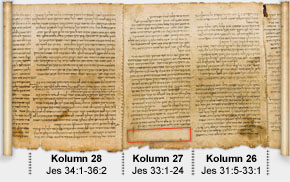
Columns 26, 27, and 28 from the Great Isaiah Scroll, which is housed in the Israel Museum in Jerusalem. At the bottom of column 27, there is a deliberate break of three lines.
and you peoples, pay attention.
Let the earth hear and all that is in it,
the world,
and all that comes forth from it. 2For the Lord (Yahweh) is angry (like a branch that is broken; the relationship is broken – Hebr. ) with all the nations,
and has burning anger (fever – Hebr. ) against their leaders.
He has utterly destroyed them,
he has delivered them up to be slaughtered. 3Their slain (slaughtered) shall be cast out
and the stench of their carcasses shall rise,
and the mountains shall melt from their blood. 4And all the hosts of the heavens shall be dissolved,
and the heavens shall be rolled up like a scroll,
and all their leaders shall wither (dry up), like leavesfrom the vine wither [and fall down]
and withering [leaves; shriveled fruit] from the fig tree.
[Here it is implied how the many dimensions of the heavens shall be rolled up, see .] 5For my sword has drunk its fill in the heavens,
behold, it shall come down upon Edom
and upon my banished people for judgment. 6The sword of the Lord (Yahweh) is dripping with blood,
it is covered (made thick) with fat,
[it drips] with the blood of lambs and goats,
[completely smeared] with the fat of rams' kidneys,
for the Lord (Yahweh) has a sacrifice in Bozrah
and a great slaughter in the land of Edom.
7And the wild ox shall come down with them
and the bullocks (young bulls) with the oxen,
and their land shall be drunk with blood,
and its dust [ground/earth] shall be covered with (made thick with) the fat
8For the Lord (Yahweh) has a day of vengeance,
a year of reward (repayment) for the battle of Zion.
9And its streams shall be turned into pitch (thick, black viscous liquid),
and its dust [Mark] into sulfur, and its land shall become like burning sulfur.
10Neither night nor day shall it be quenched,
its smoke shall rise forever,
from generation to generation it shall lie desolate,
never in eternity shall anyone pass through there. 11But the pelican and the bittern shall possess it,
and the owl and the raven shall dwell there,
and he shall stretch out confusion
over it and the plumb line of emptiness.
12For her nobles, no one there shall be called to the kingdom,
and all her princes shall be nothing. 13Thorns shall grow up in her palaces,
nettles and thistles in her fortresses,
and it shall be a dwelling place for wild dogs,
a haunt for ostriches. 14And wild cats shall be with jackals,
and the hairy goat (satyr, forest demon – Hebr. ) shall call to his companion;
yes, there the night creature (the owl; literally "she of the night" – Hebr. ) may rest [stay for a short while]
and find a place to rest. [According to Jewish tradition, the hairy goat is a demonic creature, a male nature spirit, half human and half goat (the result of an unnatural sexual relationship, see ). The word is used here in parallel with lilit, which comes from the Hebrew word for night (), is in a feminine form, and is only used here in the Bible. According to Jewish mythology, Lilit was Adam's first wife, who later became a female demon that haunts infants. It is probably these and similar myths that Paul warns the congregation in Crete against indulging in . In this context, with surrounding references to various animal species, lilit refers more to some kind of nocturnal animal, but also with a connection to the occult. Since she broods, see , it could be a barn owl, which is a relatively common and well-known species throughout the Middle East. It is active at night and has a screeching call that is really eerie, like a "demon" in the night. In addition, it is largely white, which can give a spooky feeling if you see it swooping by in the darkness of night.] 15There the lizard (Hebr. ; masculine form) will build its [feminine form] nest
and she [the barn owl – the creature of the night, see ] will lay [eggs] and hatch (split, break open, powerfully divide into two) []
and brood under its shadow,
yes, there the falcons shall gather,
each with its mate.
16Search the scroll of the Lord (Yahweh) and read:
None of these shall be missing,
none shall be without its mate,
for my mouth has commanded
and its Spirit (breath) has gathered them.
17And he has cast lots for them,
and his hand has divided it into areas (literally with lines).
They shall possess it forever,
from generation to generation they shall dwell there. 351The wilderness (open, uninhabited areas) and the desert (dry places without a reliable supply of water)
shall rejoice,
and the wilderness [Arava, desert area in the ravine between the Dead Sea in the north and the coast in the south]
shall blossom like an autumn crocus (lily, meadow saffron, narcissus).
2It shall burst into bloom,
it shall rejoice with joy and singing!
It shall have the glory (honor) of Lebanon [which is its green cedar forest, see ].
It shall have the majesty (splendor) of [Mount] Carmel and Sharon. [Mount Carmel is known for its majesty, and Sharon is the plain between the Mediterranean Sea and the mountains of central Israel, known for its fertility.]
They shall see the glory (honor) of the Lord, the majesty (splendor) of our God. 3Strengthen feeble hands,
strengthen trembling (weak) knees. 4Say to those who are afraid (in panic, literally "whose hearts beat fast"):
"Be strong, do not fear, for your God will come with vengeance.
With God's retribution, he will come to save (redeem) you." 5Then the eyes of the blind shall be opened,
and the ears of the deaf shall hear.
6Then the lame will leap like a deer,
and the tongue of the mute will sing for joy.
For springs of water will burst forth in the wilderness (open, uninhabited areas)
and streams of water in the desert (the Arava desert region)
7Burned Mark (scorching sand) will become a lake,
and thirsty Mark will become springs of water.
Where jackals once lived and lay stretched out
reeds and grass will grow. 8And there shall be (exist, become) a highway (a paved and elevated thoroughfare – Hebr. maslol), yes, a road,
it shall be called "The Holy Road (The Road of Seclusion/The Road of Seclusion)".
No unclean person shall travel on it,
but it is for those [the others] who walk on the road [it is reserved for those whom he guides].
And fools [those who despise God's wisdom] shall not wander (shall not walk around; turn in; waver, hesitate; get lost) on it.
9No lions shall be there,
no bloodthirsty beasts shall be on the road—they shall not be there.
Only the redeemed [those whom the Lord has freed from captivity]
shall walk on it, 10those whom the Lord (Yahweh) has redeemed shall return by that way.
They shall enter Zion with shouts of joy.
Everlasting joy shall crown them,
joy and gladness shall overwhelm (surprise, seize) them,
sorrow and sighing shall flee away.The Assyrian threat (chapters 36-39)
The rise of King Hezekiah (2 Kings 18)
The first part of the book is written in poetic style, shifting to prose in chapters 36-39, and then becoming poetic again in chapters 40-66. This writing style thus forms a stylistic chiasm. It also serves as a marker indicating that this passage is central to the entire book. Chapters 36-39 consist of seven episodes arranged in a chiastic pattern:
A A hostile Assyrian envoy ()
B Hezekiah's distress and appeal to the Lord () C Sennacherib's mocking message to Hezekiah ()
D Hezekiah's prayer to the Lord ()
C´ The Lord's response to Sennacherib's taunts () B´ Hezekiah's illness and appeal to the Lord ()
A´ A "friendly" Babylonian envoy (irony) ()
The thematic symmetry of the chiasm takes precedence over the chronological order; the events in chapters 38-39 occur before the events in 36-37:
725-722 BC Assyria besieges Samaria, the Israelites go into exile
715 BC Hezekiah becomes king of Judah
705 BC Sennacherib becomes king of Assyria
701 BC Sennacherib invades Judah
681 BC Sennacherib is murdered by two of his sons ()
361 Now it came to pass in the fourteenth year of King Hezekiah of [Judah, the southern kingdom] [701 BC], that Sennacherib (Hebr. Sancheriv), king of Assyria, came up against the fortified cities of Judah and captured them. 2
The inscription on this relief reads: Sennacherib, the mighty king, king of the land of Assyria, sitting on the judgement throne, at the entrance to the city of Lachish. I give permission for their slaughter.
Eljakim, son of Hilkiah (Hebr. Chilqijaho) [], who was over [in charge of the palace in Jerusalem],
and the scribe Shebna []
and Joah, the son of Asaph, the recorder,
came to him. 4And the commander (Hebr. ravshake) said to them: "Now tell [your king] Hezekiah: Thus says the great king, the king of Assyria [Sennacherib]: On what confidence do you rely? 5I say: It is only empty prov (mouth weather), for counsel and strength are for battle. Who do you trust, since you have rebelled against me? 6Behold, you trust in this reed of split reeds, in Egypt, which, if you lean on it, will go into your hand and pierce it. Such is Pharaoh, king of Egypt, to all who trust in him. 7But you may say to me, 'We trust in the Lord our God (Yahweh Elohim).' Is it not he whose high places [sacrificial sites, often on high ground, see ; ; ] and altars [your king] Hezekiah has removed, and has said to Judah and Jerusalem, 'You shall worship before this altar'? [The Assyrian commander mistakenly assumes that the other high places were places where the Lord (Yahweh) was worshipped and that limiting sacrifices to Jerusalem alone would offend him. These high places and altars were not the way the God of Israel was to be worshipped, see .] 8Now therefore, I pray, make a wager with my lord, the king of Assyria, and I will give you 2,000 horses if you can do your part to put riders on them. 9How can you turn away from a leader, and the least of my lord's servants, so that you put your trust in Egypt for horses and riders? 10Have I come up against this land to destroy it without the Lord (Yahweh)? The Lord (Yahweh) has said to me, 'Go up against this land and destroy it. 11
The Assyrian commander speaks to the people in Hebrew. Illustration by Scottish artist William Hole, 1846-1917.
"Listen to the words of the great king—the king of Assyria! 14Thus says the king [the ruler of the world at that time]:
Do not let [your king] Hezekiah deceive you, for he will not be able to deliver you. 15Do not let Hezekiah make you trust in the Lord (Yahweh) and say that the Lord (Yahweh) will surely save us, for this city will not be given into the hand of the Assyrian king. 16Do not listen to Hezekiah, for thus says the king of Assyria: Make peace with me and come out to me, and each of you shall eat of his own vine and each of his own fig tree, and each of you shall drink the water of his own cistern, 17until I come and take you away to a land like your own, a land of grain and wine, a land of bread and vineyards. 18Beware lest Hezekiah persuade you, saying, 'The Lord (Yahweh) will deliver us.' Has the god of any other country delivered his land from the hand of the king of Assyria?
19Where are the gods of Hamath and Arpad?
[Two cities in central Syria that the Assyrians defeated during their campaigns, see ]
Where are the gods of Sepharvaim?
[Sepharvaim (meaning "the two scribes"), a city in northern Syria on the eastern side of the Euphrates that Assyria had captured.]
Have they delivered Samaria out of my hand? [The Assyrian king Shalmaneser V (727-722 BC) began the siege against Hoshea because he made a covenant with Egypt (). Sargon ended the siege, mentioning the number of Israelites taken captive as 27,280.] 20Which of all the gods of the nations have delivered these nations out of my hand, that the Lord (Yahweh) should deliver Jerusalem out of my hand?" [The words in verses 4-20 correspond almost verbatim to . It is likely that an official transcription of the speech was made and was available in the archives.] 21But they remained silent and did not answer him a word, for the king's command was, "Do not answer him." 22Then [the three men]
Eljakim, son of Hilkiah (Hebr. Chilqijaho), who was in charge of the palace (literally: 'was over the house') [in Jerusalem],
and the scribe Shebna
and Joah, the son of Asaph, the recorder,
to Hezekiah with their clothes torn [as an outward sign of mourning] and told him the words of the commander (Hebr. ravshakes).Hezekiah's distress and appeal to the Lord
371And it came to pass, when King Hezekiah heard it, that he rent his clothes and covered himself with sackcloth and went into the house of the Lord (Yahweh) [the temple in Jerusalem]. [Unlike Ahaz, who refused to ask the Lord for a sign, see .] 2And he sent Eliakim, who was in charge of the palace (literally: 'over the house') [in Jerusalem], and Shebna the scribe, and the elders of the priests, covered with sackcloth, to the prophet Isaiah, son of Amoz. 3And they said to him, "Thus says Hezekiah: This is a day of distress and rebuke and disgrace, for the child is ready to be born, but there is no strength to bring it forth. 4Perhaps the Lord your God (Yahweh Elohim) will hear the words of the commander (Hebr. ravshake), whom his master, the king of Assyria [Sennacherib], has sent to mock the living God (Elohim), and will rebuke the words that the Lord your God (Yahweh Elohim) has heard, therefore pray for the remnant that remains." 5So the servants (Hebr. eved) of King Hezekiah came to Isaiah. 6And Isaiah said to them, "This is what you shall say to your master, thus says the Lord (Yahweh): 'Do not be afraid of these words that you have heard, with which the young men (Hebr. naar) of the king of Assyria have reviled me. 7Behold, I will give him a spirit [make him change his mind], and he shall hear a rumor and shall return to his own land, and I will cause him to fall by the sword in his own land.'" [See verses 37-38.]Sennacherib's mocking message to Hezekiah
8And the commander (Hebr. ravshake) returned and found the king of Assyria fighting against Libnah, for he had heard that he had left Lachish. [Livna has not been identified with certainty, but findings from excavations at Tell Burna in 2015 and in recent years suggest that it may be the biblical city of Livna.] 9
Tel Burna (biblical Livna) seen from the west.
Hezekiah's prayer to the Lord
14Hezekiah received the letter from the messenger's hand and read it, and Hezekiah went up to the house of the Lord (Yahweh) and spread it out before the Lord (Yahweh). 15And Hezekiah prayed to the Lord (Yahweh) and said: 16"Lord of hosts (Yahweh Sebaot), God (Elohim) of Israel, who sits above the cherubim. You are God (Elohim), you alone among all the kingdoms of the earth. You have made the heavens and the earth. 17Turn your ear (listen carefully), Lord (Yahweh), and hear (listen), open your eyes, Lord (Yahweh), and see, and hear the words of Sennacherib, which he has sent to mock the living God (Elohim). 18It is true, Lord (Yahweh), that the king of Assyria has destroyed all the countries and their lands, 19and has thrown their gods into the fire, for they are not gods, but the work of human hands, wood and stone, therefore they have been destroyed. 20Now, Lord our God (Yahweh Elohim), save us from his hand, that all the kingdoms of the earth may know (have intimate knowledge of) that you alone are Lord (Yahweh)." the Lord's answer
21Then Isaiah, the son of Amoz, sent word to Hezekiah, saying, "Thus says the Lord (Yahweh), the God (Elohim) of Israel, because you have prayed to me against Sennacherib, king of Assyria, 22is this word that the Lord (Yahweh) has spoken concerning him. The virgin daughter of Zion
has despised you and laughed at your mockery,
the daughter of Jerusalem
has shaken her head at you. 23Whom have you mocked and blasphemed?
And against whom have you raised your voice?
Yes, you have lifted your eyes high against the Holy One of Israel. 24Through your servants
you have mocked the Lord (Yahweh) and said:
'With my chariots
I will come to the high mountains,
to the innermost parts of Lebanon,
and I have cut down its tall cedars,
and its choice cypress trees,
and I have come to its highest heights
and the forests with its fruit-bearing fields.
25I have dug [wells in distant lands]
and drunk water
and with the soles of my feet
I have dried up all the rivers of Egypt.'
26Have you not heard?
Long ago I did it,
in ancient times I created it,
now I have let it happen, it is done,
this fortified city shall be laid waste
in a heap of ruins.
27And your inhabitants
have a short hand (without power),
they are afraid and ashamed,
they are like the grass of the field
and like the green herbs,
like the grass on the roof
and like a cornfield before it has grown up.
28I know (am intimately acquainted with) your sitting
and your going out and your coming in
and your rage against me.
29Because of your rage against me
and because your rebellion has come up to my ears,
therefore I will put my hook in your nose,
and my bridle in your lips,
and I will turn you back
the way you came.
30And this shall be the sign for you [Hezekiah]:
This year you shall eat what grows of itself,
and the second year what springs up in the same way,
and the third year you shall sow and reap
and plant vineyards and eat their fruit.
31And the remnant of the house of Judah that has escaped
shall again take root downward and bear fruit upward.
32For out of Jerusalem shall go forth a remnant,
and out of Mount Zion those who survive.
The zeal of the Lord of hosts (Yahweh Sebaots)
shall do this.
33Therefore, the Lord (Yahweh) says concerning the king of Assyria:
He shall not come into this city
nor shoot an arrow there,
nor come before it with a shield,
nor build a ramp against it [and capture Jerusalem].
34He shall return by the way he came,
and he shall not come to this city,
declares (says, proclaims) the Lord (Yahweh).
35For I will defend this city to save it for my own sake
and for the sake of my servant David." 36And the angel (messenger) of the Lord (Yahweh) went forth and struck down 185,000 [soldiers] in the camp of Assyria, and when they rose early in the morning, behold, all the bodies (like carcasses) were dead! 37So Sennacherib, king of Assyria, departed and returned and settled in Nineveh. 38And it came to pass, when he worshipped in the house of his god Nisroch, that his sons Adrammelech and Sharezer smote him with the sword [this happened in 681 BC], and they fled to the land of Ararat. And his son Esarhaddon reigned in his stead. 381At this time [around 700 BC], Hezekiah became terminally ill. The prophet Isaiah, son of Amoz, came to him and said, "Thus says the Lord: Set your house in order, for you shall die and not recover." [Hezekiah had no son to inherit the throne, so he needed to look after his house and appoint a successor. The political situation was also very unstable because the Assyrian army was threatening to invade the country.] 2Then Hezekiah turned his face to the wall [away from his servants, in seclusion] and prayed to the Lord (Yahweh). 3He said, "Remember, Lord (Yahweh), how I have walked before you in faithfulness and with a devoted heart, doing what is good in your sight." Hezekiah began to weep bitterly. 4Then the word of the Lord (Yahweh) came to Isaiah. He said 5"Go and tell Hezekiah, 'This is what the Lord (Yahweh), the God (Elohim) of your father David, says: I have heard your prayer,
I have seen your tears.
Behold, I will add 15 years to your life;
6and save you and this city
from the hand of the Assyrian king.
I will protect this city.' " Human life span is 120 years
In the 1960s, science confirmed that human life span is biologically limited to 120 years, see . In an article in the journal Nature, November 9, 2000, Hayflick (the man behind the discovery in the 1960s) writes that aging is not a disease. He writes that even if cures were found for the most common fatal diseases in old age (cardiovascular disease, stroke, and cancer), it would only extend life expectancy by an estimated 15 years.
[Three years later, Hezekiah has a son, Manasseh. He is 12 years old when he comes to the throne, see ; . Sequentially, verses 21-22 come between verses 6-7, cf. , but in the chiastic pattern and structure, the placement is not strange.] 7[Isaiah replied:] "And this shall be the sign to you from the Lord (Yahweh), that the Lord (Yahweh) will do these things that he has spoken. 8Behold, I will cause the shadow on the sundial, which has gone down on the sundial of Ahaz, to return backward ten steps." So the sun returned ten steps, by the steps it had gone down. 9The writing of Hezekiah, king of Judah (Hebr. michtav, see ) when he had been sick and was healed of his sickness: 10I said (thought): At noon of my days
I shall go to the gates of Sheol (the entrance to the underworld, the place of the dead) [],
I am deprived of the rest of my years.
11I said: I will not see the Lord (Yah – short form of Yahweh),
not even the Lord (Yah) in the land of the living,
I will not see people
anymore with the inhabitants of the world. 12My dwelling place is torn up
and carried away from me like a shepherd's tent,
like a weaver [rolling up what he has woven], I have rolled up my life. [; ]
He [the Lord] will cut me off from the loom.
Before day turns to night, you will put an end to me.
13The more I make myself like a lion until morning,
the more all my bones are broken,
from day to night you will put an end to me. 14Like a swift, a swallow,
I cry out (mumble),
I murmur (speak softly – Hebr. hagah) like a dove,
I cannot look up, Lord (Adonai),
I am depressed, be my security. [The text is reinforced with words that resemble bird calls.] 15What shall I say?
He has spoken to me and he has done it,
I will walk carefully (gently)
all my years over the bitterness in my soul. 16Lord (Adonai), from these things man lives
and there is also life for my spirit,
therefore you restore me
and make me alive (restore my health and let me live)!
17Behold, to my peace (shalom) [something good has come from]
my bitter bitterness,
in your love you have delivered me (my soul)
from the depths of destruction,
for you have cast all my sins
behind your back.
18For Sheol (the underworld, the place of the dead) cannot praise you,
death cannot extol you,
those who go down to the grave
cannot hope for your truth.
19The living, the living, they shall praise you,
as I do today.
The fathers of children
shall make your truth known (well known, intimately familiar knowledge).
20The Lord (Yahweh) is ready to save me.
Therefore I will sing songs to stringed instruments
all the days of my life
in the house of the Lord (Yahweh). 21Isaiah said, "Let them take a fig cake and put it as a bandage on the boil, and he shall recover." 22Hezekiah asked, "What is the sign that I may go up to the house of the Lord (Yahweh)?"Hezekiah's fall
391At that time, Merodach-Baladan, son of Baladan, king of Babylon, sent a letter and a gift to Hezekiah, for he had heard that he had been sick and had recovered. 2And Hezekiah was glad and showed them his treasure house, the silver and gold, the spices and the precious oil, and his entire armory and everything among his treasures; there was nothing in his house or in his possessions that Hezekiah did not show them. 3Then Isaiah the prophet came to King Hezekiah and said to him, "What did these men say? And where did they come to you from?" And Hezekiah said, "They came to me from a distant land, from Babylon." 4Then he said, "What did they see in your house?" And Hezekiah answered, "They saw everything in my house; there is nothing among my treasures that I have not shown them." 5Then Isaiah said to Hezekiah, "Hear the word of the Lord of hosts (Yahweh Sebaots): 6Behold, the days are coming when everything in your house, and all that your father has stored up until this day, will be carried away to Babylon; nothing will be left, says the Lord (Yahweh). 7And your sons who will come from you, whom you will bear, they will take away, and they will become servants in the palace of the king of Babylon." 8Then Hezekiah said to Isaiah, "The word of the Lord (Yahweh) that you have spoken is good." He added, "For there will be peace (shalom, peace and prosperity) and truth in my days (during my lifetime)."Promise of peace and tranquility (chapters 40-48)
Now follows the fifth of the book's seven parts. The third and central part (chapters 36-39) is the book's chiastic center. In a chiastic pattern, the theme reverses after the third part, making parts five and six (chapters 40-66) the book's second major part. Most scholars agree that there is a thematic shift here in chapter 40, which is entirely consistent with the chiastic pattern. So far, the book has been about Jerusalem, the enemy Assyria, and the current judgment. From now on, it is about a coming salvation.
Good news for Jerusalem! 401"Comfort, comfort (help, encourage; give new hope to) my people,"
says your God (Elohim).
2"Speak tenderly to the heart of Jerusalem,
and call out to her [call her]
for her time of military service is over,
for her mercy (conditional mercy – Hebr. ratsah) is complete,
for she has received double from the hand of the Lord (Yahweh) for all her [he has made her pay double for all her] sins." 3A voice cries out:
"Prepare the way [remove all obstacles] for the Lord (Yahweh)
in the desert (the wilderness – Hebr. midbar),
build (level) a highway (an elevated thoroughfare)
in the wilderness (Hebr. aravah) for our God (Elohim).
[; ; ; ]
4Every valley (ravine) shall be exalted
and every mountain and hill shall be made low.
The uneven terrain shall be made level
and the inaccessible places shall become smooth ground. 5Yes, the glory (honor, weight, dignity, splendor—Hebr. kavod) [fully saturated presence] of the Lord (Yahweh) shall be revealed,
and all people (all flesh) shall see it together [at the same time]
—for the mouth of the Lord (Yahweh) has spoken." [Before a king arrived in a country, a messenger was sent to prepare for his arrival. He urged the people to repair old roads and build new ones to facilitate the king's arrival. That valleys should be raised and mountains lowered also speaks figuratively of the consequences of the ministry of John the Baptist and Jesus – the lowly and humble shall be lifted up, while the high and self-righteous shall be humbled, see ; .] 6One voice says, "Cry out (proclaim, preach),"
and another asks, "What shall I cry out (proclaim, preach)?" [The voice of the Lord answered:] "All people (all flesh) are like grass,
and all their grace (the caring love of people – Hebr. chesed) is like the flower of the field.
[Equally changeable and temporary, see ; .] 7The grass withers, the flower fades,
when the Lord's wind (spirit, breath) blows on them.
Humanity is truly like grass.
8The grass withers, the flower fades,
but the word of God stands (has power) forever [will always come true]." 9Go up on a high mountain, O Zion,
who brings good news.
Shout it out, O Jerusalem,
who brings good news.
Shout, do not be afraid!
Tell the cities of Judah, "Here is your God!" 10Behold, the Lord (Adonai, focus on God's greatness and power),
the Lord (Yahweh) comes as a victorious warrior,
his arm shows his power (his military power reigns for him).
Behold, he brings with him reward [blessings to his people],
his prize (spoils of victory) goes before him. 11He feeds his flock like a shepherd:
He gathers the lambs in his arms,
he carries them in his bosom (close to his heart)
and gently leads the mother sheep (literally: 'those who give milk'). [He shows the way to the ewes that have suckling lambs, he protects them and leads them to water sources where they can rest and regain their strength. The last word in the verse is nahal, which is translated as "gently leads", the same word that is also used in .]Creator of all
12Who has measured (Hebr. madad) the waters [the waters of the sea] in the hollow of his hand
and determined (measured, distributed – Hebr. tiken) [calibrated the distance between] the heavens with his outstretched fingers [a span; the distance between the thumb and little finger, half a cubit (23 cm)]?
Encompassed (gathered, measured) the dust of the earth in a third measure [probably referring to the sea measure (the usual household measure of about 7-12 liters) which was a third of an ephah]
and weighed the mountains with scales and the hills with a balance?
13Who has measured the Spirit of the Lord (Yahweh)
and has been his advisor so that he can instruct him?
14From whom did he take counsel, and who instructed him
and taught him the right way,
and taught him knowledge
and made him know (be intimately acquainted with) good judgment? 15Behold, the nations are like a drop in a bucket
and are counted as small grains of dust on a scale,
the islands are like dust (thin, narrow) [so small that they can hardly be weighed].
16Lebanon is not enough fuel (its forests are useless wood),
its wild animals are not fit for burnt offerings. 17All countries are nothing before him,
they are counted by him as things of no value and are vain. 18To whom then will you liken God (El)?
Or what will you compare him to?
19The image [a small idol, often 10-25 cm high] – which the craftsman has cast
and the goldsmith has overlaid with gold,
the silversmith has cast silver chains for?
20A stonecutter is set apart,
he chooses a tree that will not take root,
he seeks out a skilled craftsman
to set up an idol that cannot be moved (cannot be shaken). 21Don't you know?
Don't you hear?
Hasn't it been told to you from the beginning?
Have you not understood the foundations of the earth?
22[The Bible teaches scientific facts such as that the earth is round, long before this was accepted in science.]
He sits above the circle of the earth (the round earth),
and its inhabitants are like [small] grasshoppers,
[he] who stretches out the heavens like a curtain
and spreads them out like a tent to dwell in,
23He makes princes come to nothing,
he makes the judges of the earth come to nothing. 24They have planted insufficiently,
their sowing is insufficient,
it has taken root insufficiently in the ground,
when he blows on it, it crumbles
and the whirlwind carries it away like chaff. 25"To whom can you compare me?
Who is my equal?" says the Holy One [].
26Lift up your eyes to the heavens [the sky]:
Who created all these [the stars]?
It is he who brings them out like a numbered host [the stars are likened to a patterned army]
and calls them all by name.
Because of his great power and strength
not one of them is missing.
27How can you say, Jacob,
and speak thus, Israel [Jacob and Israel are used synonymously for the twelve tribes]: "My way is hidden from the Lord (Yahweh),
and my judgment passes by my God (Elohim)." [The words may refer to the coming exile to Babylon, see . In times of trial and suffering, questions may arise as to whether the Lord sees what I am going through and whether he will bring justice?]
28Do you not know (are you not well acquainted with)?
Have you not heard?
The Lord (Yahweh) is an everlasting God (Elohim),
the creator of the whole world (the ends of the earth).
He does not grow tired or weary,
his understanding is unfathomable (impossible to fully explore).
29He [does not grow weary, see , instead it is he who] gives strength to the weary (physically exhausted; worn out)
and to the powerless (those without vitality; those lacking vigor and reproductive, life-giving abilities)
he multiplies strength. [It is the Lord who gives the strength needed to carry out the task, see also ; . However, the following examples show that pure human physical strength is not enough in the long run:] 30Even young boys can get tired and need to rest,
young men (literally: chosen ones, i.e., "the strongest" – elite soldiers) can stumble and fall. 31But those who [persistently] wait (hope) for the Lord (Yahweh)
shall renew their strength ("glide forward" – continue with vigor): They shall lift up their wings (raise their wings/feathers)
like eagles.
They shall run (rush forward)
without growing weary (catching their breath; gasping).
They shall walk (continue, go)
without fainting (losing heart; slumping; fainting).
[The eagle symbolizes strength and freedom. It flies at high altitudes and has a broad perspective. The expression "renew their strength" may refer to the process when the eagle molts its plumage—new feathers grow out and it becomes young again, see . The Greek translation Septuagint translates "without growing weary" as "without hunger."]God is greater than all idols
411Be silent (leave alone, be deaf, say nothing, hold your tongue) near (close to, with) me, you islands (coastal countries),
and let the peoples renew (grow, sprout, flourish like plants that gain new strength in spring) their strength (power).
Let them come near and then let them speak,
let us come together (draw near to one another) together to judge. 2Who [besides God] has raised anyone from the east (sunrise),
who calls for righteousness to his steps [literally: legs/feet]? [The Persian king Cyrus (600-530 BC) came from the east, see . also mentions the north—which correctly describes how he came via Babylon in the north. The text does not say that Cyrus himself is righteous, but he does what is righteous and frees the Jews from their captivity.] He gives (places) the countries before him
and lets him rule over kings.
His sword reduces them to dust,
his bow reduces them to chaff that blows away (goes with the wind).
3He pursues them and moves on (crosses over) in peace (safety, security – shalom).
He does not tread the well-known (broad) path with his feet.
[He refuses to walk on the highways of wickedness.]
4Who has formed and made it?
He who has called the generations from the beginning.
I, the Lord (Yahweh) – am the first
and the last in eternity – I am He (the Eternal and forever the same). [The first (Hebr. rishon) has its root in the word for head. The last (Hebr. acharonim) is in the plural! Therefore, it means that he is the eternally last; there can never be anything or anyone after him. In the Hebrew text, centrally between the first and the last, there is also the word et (written in Hebrew with the first letter Alef and the last ). It is a particle that is never translated, but corresponds to the Greek alpha and omega, see . Here, the expression the first and the last appears twice in the same sentence. In Hebrew, this means that this is an absolute truth that is uncompromising and can never change.]
5The islands (coastal countries) saw it and trembled,
the ends of the earth shook (shook as if by an earthquake),
they approached and came, 6each one helped his neighbor
and each one said to his brother, "Be strong (firm, confident, brave)!" [Heb. is used several times in this chapter. The meaning is to take a firm hold of someone or something (verses 9, 13), but also figuratively to instill courage and be brave, as in this verse and in , , .] 7The carpenter strengthens (encourages) the goldsmith,
and he who uses the hammer (encourages) the one who works at the anvil,
and says of the solder, "It is good,"
and he fastens it with nails so that it will not be moved. 8Israel, my servant,
Jacob, whom I have chosen [],
descendant of Abraham, my friend [; ; ; ],
9whom I have taken [taken by the hand to lead back] from the ends of the earth,
called from its farthest corners
and to whom I have said:
You are my servant,
I have chosen you,
I will not reject you.
10Do not be afraid (do not fear),
for I am with you;
do not be dismayed [do not look around anxiously],
for I am your God (Elohim).
I will strengthen you [make you steadfast, bold, and alert],
yes, I will help (assist, rescue, surround) you,
yes, I will uphold (support) you with my righteous right hand (literally: my righteousness right)! [The word for hand or arm is not included in the original Hebrew text, see also . In this type of context, "my right" refers to the right arm or hand. Another example is when Jacob blesses and stretches out his hands, see . God's right hand is an expression of God's mighty power, i.e., how he intervenes, protects, and preserves, see ; .] 11Behold, all who were angry with you
shall be put to shame and confounded.
Those who argued against you
shall be brought to nothing and perish (disappear, cease to exist).
12You will look for them but not find them,
those who were hostile toward you,
they will be completely destroyed—nothing,
those who waged war against you. [A threefold escalation of enemies is given here in verses 11-12, from anger, verbal confrontation to outright war! There is also a chiastic pattern in verses 9-10 and 13-14 with the Hebr. words chazaq (taken/holding), "your right hand," "I will help you," and "do not fear" at the end.] 13For I, the Lord (Yahweh) your God (Elohim),
who holds (upholds, strengthens) your right hand (literally: your right),
say to you: "Fear not (never be afraid),
I will help you."
14Fear not (never be afraid), O worm Jacob,
and you men of Israel,
I will help you, declares (says, proclaims) the Lord (Yahweh),
your Redeemer—the Holy One of Israel.
15Behold, I will make you into a new threshing sledge
with sharp teeth,
you shall thresh the mountains and grind them to small pieces
and make the hills like chaff. 16You shall blow on them, and the wind shall carry them away,
and the whirlwind shall scatter them,
but you shall rejoice in the Lord (Yahweh).
In the Holy One of Israel shall be your glory. 17The poor and needy search for water,
but there is none,
and their tongues are parched with thirst.
I, the Lord (Yahweh), will answer them.
I, the God of Israel (Elohim), will never forsake them.
18I will open rivers on the bare heights
and springs in the midst of the valleys.
I will turn the wilderness into a watery lake
and the dry land into springs of water.
19In the desert I will plant
cedars and acacia trees, myrtles and olive trees (literally oil).
In the wasteland I will plant
cypresses, plane trees [large trees – up to 40 meters high] and larch trees together.
20So that they may see and know (deep, intimate knowledge)
and consider and understand together,
that it is the hand of the Lord (Yahweh)
that has done this, and that it is the Holy One of Israel who has created it.Can the idols foresee the future?
21Present (construct) your case, says the Lord (Yahweh),
put forward your reasons (causes, explanations), says the King of Jacob.
22Let them bring them [the idols] forward
and tell us what will happen (in the future).
The former things, what were they?
Tell us, so that we may consider (literally: set our hearts on) them
and know how they have been fulfilled.
Or let us hear what is to come. 23Tell us about the things that will happen hereafter,
so that we may know that you are gods.
Yes, do good or do evil,
so that we may be amazed [when we all look around] together. 24Behold, you are nothing
and your work is nothing,
an abomination is he who chooses you (chooses to believe and trust in you).
25I have raised up one from the north, and he is coming,
from the rising of the sun, one who calls on my name,
and he shall come upon the leaders
like boiling mortar and like the potter who treads clay. 26Who has told us from the beginning, so that we may know (have deep, intimate knowledge),
and from before time began (before time started),
so that we may say that he is right?
There is no one to tell,
nor anyone to hear,
nor anyone to listen to your words.
27I will give a sign to Zion [the temple mount in Jerusalem]: "See (Hebr. hineh), see (Hebr. hen) them,"
and to Jerusalem a messenger with good news. 28I look around [among the idols], but there is no man [no one who can speak prophetically]
– no one among them who can give advice,
no one I could ask and get an answer from. 29Behold, all their work is futile (emptiness, nothingness),
their cast images (idols) are wind and confusion. 421Here is my servant (faithful representative) whom I uphold (give strength to, support),
my chosen one to whom I give grace (whom my soul delights in, conditional grace – Hebr. ratsah).
I have given him my Spirit,
he shall spread justice (judge fairly, reveal the truth and God's will) among the nations. 2He shall not cry out or raise his voice (he is silent despite great pain),
his voice shall not be heard in the streets.
3A bruised reed he will not break,
and a smoldering wick he will not extinguish [the servant, Jesus, will heal broken lives].
He will spread justice in truth. 4He will not be extinguished or broken down,
until he has revealed what justice is on earth.
The distant sea countries (islands)
eagerly await his teaching (Hebr. Torah). 5Thus says the one God (El), the Lord (Yahweh),
he who created the heavens (universe) and stretched them out (expanded them) [; ],
he who spread out the earth and everything that lives on it (everything that is born on earth),
he who gave life (breath of life) to mankind, and spirit to all who walk on it. [The Lord now speaks to the Messiah:]
6I, the Lord (Yahweh), have called you in righteousness (to reveal what is right and wrong, and to live righteously).
I will hold you by the hand,
and keep you safe.
I will give you as a covenant [a mediator] for the people [Israel, see ; ],
as a light for the Gentiles (nations) [].
7You will open the eyes of the blind
and bring out prisoners from the dungeon,
those who sit in the darkness of the prison. [The Lord now turns to the people:]
8I am the Lord (Yahweh), this is my name.
My glory (honor, weight, dignity; saturated divine presence) [is unique and] I will not give it to anyone else,
no idols (human-carved idols) can receive my praise.
9What has been said before has come to pass [prophetic words have come true],
now I tell you new things.
Before it appears (like a seed, before it sprouts),
I let you hear about it.
10Sing to the Lord (Yahweh) – a new song [; ; ; ],
his praise from the ends of the earth,
you who go down to the sea and all that is in it,
the islands and their inhabitants.
11Let the desert and its cities raise their voices,
the villages where Kedar dwells [a nomadic tribe in northern Arava between Edom and Babylon],
let the inhabitants of Selah [the capital of Edom, probably present-day Petra] rejoice,
let them shout from the tops of the mountains.
12Let them give glory (honor, weight – Hebr. kavod) to the Lord (Yahweh)
and proclaim his praise in the islands.
13The Lord (Yahweh) will advance like a mighty man (hero),
he will stir up jealousy (zeal) like a warrior,
He will shout, yes, he will shout loudly (with a strong voice),
he will prove himself mighty (invincible) against his enemies. 14For a long time I have been silent,
I have been quiet and restrained myself (restrained myself),
now I will cry out like a woman in labor,
gasping and pantingatthe same time. 15I will destroy the mountains and hills
and dry up all their herbs
and I will dry up the rivers (literally turn them into islands, dry land)
and I will dry up the lakes (pools of water).
16And I will lead the blind on a road they do not know,
on paths they do not know I will guide them.
I will make the darkness light before them
and the rough places smooth.
This I will do
and it shall not be undone.
[The repetition is the Hebrew way of emphasizing and underlining that this will indeed happen.]
17They shall turn back (be turned back),
and be greatly ashamed (very much), those who trust in carved images,
who say to cast idols, "You are our gods."Israel—turn to me
18[This is the central part of chapters 40-48. A call to repentance.]
Listen, (hear) you deaf,
and see, you blind, so that you may see. 19Who is blind, if not my servant?
Or deaf, like my messenger whom I have sent?
Who is blind like the one who is wholehearted,
and blind like the servants of the Lord (Yahweh)?
20Seeing much [all evidence of God's goodness, see ; ; ; ],
but not keeping (guarding, protecting, preserving) [not remembering],
opening their ears,
but not hearing.
21The Lord (Yahweh) was pleased,
for the sake of his righteousness,
that he would make the teaching (Hebr. Torah) great and glorious.
22But this is a robbed and plundered people,
all are stuck in holes and they are hidden in prisons,
they are like prey and no one frees them,
lost and no one says, "Restore."
23Who among you will give ear (listen) to this?
Who will heed and listen for times to come?
24Who gave Jacob as prey and Israel to be plundered?
Was it not the Lord (Yahweh)?
He against whom we have sinned and whose ways they did not walk,
nor were they obedient to his teaching (Hebr. Torah).
25Therefore, he has poured out the fury of his wrath upon him,
and the power of battle, and set fire around him,
and he knows nothing, and it burns
him, because he did not take it to heart. 431Now the Lord (Yahweh) says,
he who created you, Jacob,
he who formed you, Israel:
"Do not fear, for I have redeemed you [from captivity].
I have called you by name, you are mine. 2When you pass through (walk through) the waters, I am with you,
and the rivers will not drown you [will not overwhelm or carry you away].
When you walk through fire, it will not burn you (you will not be scorched),
and the flame will not consume you (will not consume/burn/harm you). [The verse begins with the conjunction ki, which is translated as because, for, or when. In this verse, ki serves as a confirmation that you can go through difficulties precisely because he is with you. The first example with water and streams means crossing or passing through a ford or similar crossing. Here, the reader can associate this with how the Israelites crossed the Red Sea and the Jordan River (; ). The last example was literally fulfilled by Dan.'s three friends (), but the prophecy undoubtedly also has a broader meaning about God's protection in difficult circumstances. The question is not if we will encounter them, but when. See also ; .] 3For I am the Lord (Yahweh) your God (Elohim),
the Holy One of Israel, your Savior.
I gave Egypt [to Babylon] as ransom (payment) for you,
Cush [present-day Ethiopia/Sudan] and Seba [a province in Ethiopia, probably not the same as Sheba] in exchange for you [so that you might be free].
4Because you are precious in my eyes,
because I honor you and love you,
therefore I give people in exchange for you,
and other nations in exchange for your life." 5
Boat with Jews who made aliyah on July 18, 1947.
from the east I will bring your seed (your descendants)
and from the west I will gather them. 6I will say to the north, "Give them up!"
and to the south, "Do not hold them back,
bring my sons from afar
and my daughters from the ends of the earth,
7everyone who is named after my name
and whom I have created (Hebr. bara) for my glory,
I have formed (sculpted, designed – Hebr. yatsar) him,
yes, I have made (Hebr. asah) him." [The Hebrew word for "to go up" is , see e.g. . In modern Hebrew, the word is used for someone who returns to Israel, one makes "alija". Between 1948 and 2021, over 3 million Jews have made aliyah. In 2021, there were 15 million Jews in total in the world (of which about 15,000 were in Sweden) and just under half (6.9 million) lived in Israel. In Sweden, increased anti-Semitism has led to more and more Jews choosing to move to Israel.]Can the idols foresee the future?
8The blind who have eyes shall be led,
and the deaf who have ears. 9All nations are gathered together,
and the tribes are assembled.
Who among them can explain this
and tell what is to come?
Let them bring their testimony,
so that they may be judged,
and let them hear (listen)
so that they may say, "True!"
10"You are my witnesses," declares (says, proclaims) the Lord (Yahweh),
"My servant whom I have chosen,
to know me, believe (trust, rely on) me,
and understand that I am God (El, the mighty, strong one).
No god was formed before me,
and none shall come after me.
11I, I am the Lord (Yahweh),
and besides me there is no Savior (one who can save).
12I have told [foretold the future] and saved (delivered) you, and shown myself to you [that I was your God, you have heard and seen me].
Then there were no foreign gods among you.
You are my witnesses, declares (says, proclaims) the Lord (Yahweh). I am God (El, the mighty, the strong).
13Yes, even before the day existed [before light was created, i.e., from the beginning of time],
and from this day forward, I am the same.
No one can resist what I do (take anything from my hand).
I will act (work), and who could prevent it (undo it)? 14Thus says the Lord (Yahweh),
your Redeemer, the Holy One of Israel: For your sake, I have sent [an army] against Babylon,
and I will put them to flight (break down their locked gates),
the Chaldeans (Babylonians) in ships that were their joy [pride].
[This describes how Babylon will be defeated by Cyrus, and how they will try to flee by boat along the Euphrates to the Persian Gulf.]
15I am the Lord (Yahweh), your Holy One.
The creator of Israel, your King. 16Thus says the Lord (Yahweh)
who makes a way through the sea,
a path through mighty waters,
17who led out chariots and horses,
together with a mighty army there [to perish].
They fell never to rise again,
they were wiped out, extinguished like a burning wick. [.]
18Do not dwell on what has been [do not remind yourselves of these past events]
and do not concern yourselves with [do not focus on the things] that were before.
19Behold, I am doing [about to do] something new []!
It is already growing [sprouting like a plant]—do you not notice it (should you not be intimately acquainted with it)?
Yes, I will make a way in the wilderness [; ],
streams (rivers) in the desert.
20The animals of the field will honor me,
jackals and ostriches,
for I will pour out (give) water in the wilderness
– streams (rivers) in the desert to give my chosen people to drink. []
21The people whom I have created (formed, designed) for myself,
they shall recount (list) my praises [in praise with instruments]. [Verses 16-17 describe how Pharaoh's army perished. The exodus from Egypt and the dramatic events of the first Passover have been remembered for generations since then. The exhortation is now twofold: do not think about the punishment (exile) and do not invoke previous victories. The Lord, who made a way through the sea, is also the one who will now make a way through the desert and there abundantly quench the thirst of his own people. Just as the animals of the desert will honor the Lord, so now his own people will be able to see his new deeds and praise him.] 22Yet you have not called upon me, O Jacob,
nor have you labored (tired yourself) on my behalf, O Israel. 23You have not brought me burnt offerings,
nor have you honored me with your sacrifices.
I have not burdened you with food offerings
nor tired you with incense.
24You have not bought me any sweet spices,
nor have you satisfied me with the fat of your sacrifices.
Instead, you have burdened me with your sins
and wearied me with your transgressions. 25I, yes I, am the one who blots out your transgressions for my own sake,
and I will not remember your sins. 26Remember me (remind me), let us reason (discuss) together,
bring up your case,
so that you may be justified.
27Your first father sinned [may refer to Jacob, see ; ]
and your mediators have transgressed against me. 28Therefore, I have profaned the princes in the sanctuary
and I have delivered Jacob to destruction
and Israel to reproach. 441But now listen [even though you have sinned, see ], O Jacob, my servant,
O Israel, whom I have chosen. 2Thus says the Lord (Yahweh),
who created you,
who formed you in the womb and who helps you: Fear not, my servant Jacob,
you Jesurun, whom I have chosen. [Jesurun is a loving poetic title for Israel, probably meaning "the righteous one."]
[Like a gentle gardener tending his garden:]
3I will pour water on the thirsty ground,
and streams on the dry land.
I will pour out my Spirit on your children,
my blessing on your descendants.
4They shall grow up among the green grass,
like poplar trees by the water streams.
5Then one [of these returning Jews] will say, "I belong to the Lord (Yahweh),"
another will be called [by others] by the name of Jacob,
another will write with his hand [as when signing a contract]: "The Lord's own,"
and be addressed [by others] with the honorable (highly esteemed) name Israel. [The Jewish people shall no longer be mocked and despised.] 6Thus says the Lord (Yahweh), the King of Israel,
and his Redeemer, the Lord of Hosts (Yahweh Sebaot): I am the first and I am the last [I am eternal],
besides (beside) me there is no God (Elohim).
7Who [which of all these idols] is like me?
Cry out and tell (literally: 'Cry out and let it be told to her'),
yes, present (give an account of) everything that has happened [in history, how all the prophetic words have come true] since I established the eternal (ancient) people. [Called Abraham to become a great people, see .]
Let them [try to get the idols to] tell what is to come [what is imminent],
and what will happen [will ultimately happen in the coming ages].
8Do not fear and do not be terrified (do not be paralyzed by fear).
[In the face of what is to come, namely the fall of Babylon and the liberation of the Jews.]
Have I not long ago made you hear about this and told you?
You are my witnesses. Is there any God (Eloha) [Elohim in the singular – the one God] besides me?
No, there is no other rock, I know of none. 9Those who shape (Hebr. yatsar) a carved image are all vain,
and their lovely things bring no success (advantage)
and their own witnesses see nothing
and know nothing (lack knowledge), so they shall be put to shame. 10Who has formed a god,
or a cast image that is of no use?
11Behold, all who follow them shall be put to shame,
and the craftsmen, gifted among men,
let them all gather together, let them stand up,
they shall fear and be put to shame together. 12The smith takes [uses, sharpens] his tool (some kind of axe – Hebr. maatzad)
and works in the coals and works it [the piece of metal] with the hammer
and works with his strong arm,
he becomes hungry and his strength fails,
he drinks no water and becomes weak. 13The carpenter stretches out the line [measures the length]
and makes a mark with the pencil,
he matches it to the drawing
and he marks it out with the tools,
and makes it like a man
according to the man's form, to live in the house [as a household god – idol].
14He cuts down cedars for himself
and takes a cypress and an oak
and lets them grow strong among the trees of the forest.
He plants a pine tree and the rain nourishes it (literally: the rain makes it big).
15Then a man uses it as fuel
and he takes it and warms himself,
yes, he lights it and bakes bread,
he makes a god and worships it,
he makes a carved image and falls down before it.
16He burns half of it in the fire,
with that half he eats meat,
he roasts it and is satisfied,
he also warms himself and says:
"Haha (Hebr. heach – an expression of foolish irony), now I am warm, I see the flames."
17From what is left over, he makes a god (Hebr. el), yes, a carved idol.
He falls down before it and praises it
and prays to it and says:
"Deliver me, for you are my god (Hebr. el)."
18They do not know, nor do they understand,
for their eyes are smeared (puss-filled) so that they cannot see
and their hearts so that they cannot understand. 19And no one takes it to heart (thinks about it; literally: 'lets it return to the heart'),
nor is there knowledge (intimate understanding) or understanding to say:
"I have burned half of it in the fire
and I have also baked bread on its coals,
I have grilled the meat and eaten it,
shall I then make an abomination of the rest?
Shall I fall down before the log of wood?"
20He feeds (nourishes, herds—follows) ashes [emptiness, that which is burned, which cannot give any nourishment], his deceived heart leads him astray,
so that he cannot free his soul (his life)
nor say,
"Is there not a lie in my right hand (literally: my right)?" 21Remember these things, Jacob,
and Israel, for you are my servant.
I have formed (created) you,
you are my own servant Israel,
you shall not forget me. 22I have blotted out, like a thick cloud, your transgressions,
and like a cloud, your sins.
Return to me,
for I have redeemed you. 23Sing, O heavens, for the Lord (Yahweh) has done it,
shout, O depths of the earth (the lowest places of the earth),
break forth into song, O mountains
and forests and every tree in them,
for the Lord (Yahweh) has redeemed Jacob
and glorifies himself in Israel. 24Thus says the Lord (Yahweh)
your Redeemer and the one who formed you in the womb:
I am the Lord (Yahweh)
who created everything,
who stretched out the heavens (universe) all by myself,
who hammered out the earth all by myself. [Here, the Hebrew word nata (to expand, to stretch out) is used for the heavens, the universe, and the word , which means to expand, to make larger, to hammer out like a sheet of metal for the earth. Here we sense an expanded universe and more dimensions than space and time, see also .] 25It frustrates (disturbs, irritates) the sign-readers of deceivers
and angers the seers,
it turns the wise upside down
and makes their knowledge foolishness. 26It confirms the words of his servants
and fulfills the counsel of his messengers,
who say to Jerusalem, "She shall be inhabited,"
and to the cities of Judah, "They shall be built up
and I will raise up their ruins."
27Who says to the depths, "Dry up, and I will dry up your rivers." 28Who says of Cyrus, "He is my shepherd and shall fulfill all my desires,"
and says to Jerusalem, "She shall be rebuilt,"
and to the temple, "My foundation shall be laid." 451Thus says the Lord (Yahweh) to his anointed,
to Cyrus, whose right hand [his power] I strengthen
to subdue nations before him,
and to loosen the belts of kings,
to open doors before him,
so that the gates will not be shut:
2"I will go before you
and make crooked places straight,
I will break copper doors in pieces
and cut iron bars in two,
3and I will give you the treasures of darkness [hidden in windowless rooms that existed in Babylon and Sardis, among other places],
and hidden riches from secret places,
so that you may know (be familiar with, understand, be intimately acquainted with)
that I am the Lord (Yahweh) who calls you by your name,
the God of Israel (Elohim).
4For the sake of Jacob, my servant,
and Israel, my chosen one,
I have called you by your name,
I have named you,
though you do not know (are not intimately acquainted with) me. 5I am the Lord (Yahweh), there is no other.
Besides me there is no god (elohim) [idol].
I have girded you
though you have not known (been intimately acquainted with) me,
6so that from the rising of the sun (in the east)
to the west [where it sets]
it may be known that there is none beside me.
I am the Lord (Yahweh) and there is no other.
7I form (like a potter) the light
and create darkness,
I make peace (complete harmony; wholeness in all areas – Hebr. shalom)
and create disaster [; ],
I am the Lord (Yahweh) who does all these things. [Verses 1-7 have spoken of Cyrus as a model of God's anointed, chosen king, see ; . can be applied to Cyrus, but also to the coming Messiah.] 8Rain down, you heavens (clouds) above,
let righteousness flow (pour down) from the clouds (clouds).
Let the earth open up [receive], and give salvation as fruit (result),
[The Lord's offspring, the Messiah, is described as the fruit of the land, see ]
and let deliverance grow up together [with salvation].
I, the Lord (Yahweh), create this. [] 9Woe to him who quarrels (finds himself in a tight spot) with his creator,
like a shard among the pots of the earth.
Does the clay say to the potter, "What are you doing?"
or the work [the finished result]: "He [my creator] has no hands?"
10Woe to him who says to his father, "Why did you beget me?"
Or to a woman, "Why did you give birth to me?" [Here the woman is accused of not having had an abortion.]
11Thus says the Lord (Yahweh), the Holy One of Israel and its Creator:
"Ask me about things to come, concerning my sons,
and concerning the work of my hands, command me. 12I have made the earth
and created man upon it.
I, with my own hand, have stretched out (expanded) the heavens (universe)
and all its hosts I have appointed (chosen, determined to be there).
13I have raised him up in righteousness
and I make his ways high,
he shall build my city
and he shall set free my exiles,
not for payment
or reward,"
says the Lord of hosts (Yahweh Sebaot). [This happened about 200 years later when the Jews were allowed to return from captivity in Babylon and rebuild Jerusalem and its temple under Ezra and Nehemiah.] 14Thus says the Lord (Yahweh):
"The workers of Egypt and the merchants of Cush [Ethiopia and Sudan]
and the tall men of Sheba [Saudi Arabia]
shall all come over to you and be your slaves,
they shall follow you,
in chains they shall come over
and they shall fall down before you and they shall plead with you:
"God (El) truly dwells with you,
and there is no other, there is no other God (Elohim)."
15Truly, you are a God (El) who hides himself,
the God (Elohim) of Israel, the Savior. 16They shall be put to shame, yes, they shall be confounded, every one of them,
they shall go into confusion together, those who make idols.
17Israel, who is saved (rescued) by the Lord (Yahweh) with an everlasting salvation,
you shall not be put to shame or be confused, not for all eternity.
18For thus says the Lord (Yahweh)
who created the heavens (the universe),
he is God (Elohim)
who formed the earth and made it,
he established it,
he did not create it in vain,
he formed it to be inhabited:
"I am the Lord (Yahweh) and there is no other."
19I have not spoken in secret,
in a place of darkness,
I did not say to the seed of Jacob:
"Seek me in vain (formless; as in chaos – Hebr. tóho)".
I, the Lord (Yahweh), speak righteousness,
I declare what is right (reveal justice).
The Lord is higher than all idols
20Gather yourselves together and come,
come near together, you who are scattered among the nations.
Those who carry their wooden idols have no knowledge,
they pray to a god (power – Hebr. el) who cannot save (rescue).
21Tell them and bring them near,
yes, let them receive counsel together.
Who has announced this from ancient times [east – Hebr. kedem; the direction where we see both backward and forward]
and has told it from long ago?
Is it not I, the Lord (Yahweh)?
And there is no other god besides me,
a righteous God (El) and a Savior.
There is no other besides me. [The repetition that occurs here and in several of the preceding verses is the Hebrew way of emphasizing something and underlining that this is indeed the case. There is no other god besides the Lord Yahweh.] [The Lord continues, see :]
22"Turn to me (look to me) and be saved, all you ends of the earth,
for I am God (El) and there is no other.
23I have sworn by myself,
what I say is true,
my word is firm:
All shall bow the knee to me,
all tongues shall swear allegiance to me.
24They shall say of me:
'Only in the Lord (Yahweh) is righteousness and strength.' "
All who have turned their anger against him
shall come to him in shame.
25In the Lord, all the seed of Israel shall be justified and glorified. 461Bel [Babylonian idol – Enlil, and later Marduk] bows down, Nebo [the idol Nabu] bows down,
their idols are for animals and livestock,
things they carry around that become a burden,
a load that tires the animals. 2They bow down, they bow together,
they cannot let go of the burden
and they themselves have gone into captivity. 3Listen to me, house of Jacob
and remnant of the house of Israel,
you who are carried by me from birth,
who are carried from the womb. 4Even in old age I am the same,
until your hair is gray I will carry you,
I have created you and I will carry you;
yes, I will carry you and I will deliver (save) you.
5To whom will you liken me and make me equal
and compare me, that we may be alike?
6You who are generous with gold in your bags
and weigh silver on the scales,
you who hire the goldsmith to make it into a god (power – Hebr. el)
to fall down before and worship,
7he is carried on shoulders, he is carried around
and placed in his place and he stands there,
he does not move from his place on his own,
when someone calls to him he cannot answer and cannot save from difficulties.
8Remember this and be assured,
take it to heart, you sinners.
9Remember (think about) the former things of old [what I did in the past]
for I am God (El; mighty, divine), and there is no other.
I am God (Elohim), and there is no one like me,
10who at the beginning declaring (proclaiming) the end [foretetold future events, see ; ; ],
and from long ago [declared] what has not yet happened,
saying, "My counsel will stand,
and I will do all that I please (desire, take pleasure in)."
11I who call a bird of prey from the east,
from a distant land, one who carries out my counsel.
Yes, I have spoken,
yes, I will let it happen;
I have made a plan,
yes, I will put it into action.
12Listen to me, you hard-hearted
who are far from righteousness:
13My righteousness is near,
it will not be far off,
and my salvation will not be delayed.
And I will place salvation in Zion [the temple mount in Jerusalem],
my glory in Israel. [This is a promise about Jesus giving us his salvation and righteousness when he goes to the cross in Jerusalem.]The fall of Babylon (chapters 47-48)
[These last two chapters, which deal with how the Lord is greater than all idols (chapters 40-48), describe the fall of Babylon. This seventh section is thematically related to the first in chapter 40, which dealt with the good news for Jerusalem.] 471Come down and sit in the dust,
you virgin daughter of Babylon,
sit on the ground without a throne,
daughter of the Chaldeans,
for you will no longer be called
beautiful or delicate (noble).
2Take the millstones and grind flour,
take off your veil [may refer to married status, see or symbol of wealth, see ],
tear off (lift up) your skirt, bare your thigh,
wade through the rivers [those with wealth had porters who carried them across the fords].
3Your nakedness will be exposed,
your shame will be seen.
I will take vengeance
and let no man interfere. 4Our Redeemer, the Lord of hosts (Yahweh Sebaot),
his name is the Holy One of Israel! 5Sit in silence and go into darkness,
daughter of the Chaldeans,
for you shall no longer be called
the mistress of kingdoms. 6I was angry with my people,
I profaned my inheritance
and gave them into your hand
and you showed them no mercy (compassion, pity – Hebr. rachamim),
you laid your heavy yoke
on the old men. 7And you said, "Forever
I shall be a strong queen (leader – chief mistress),"
so that you do not take these things to heart
nor remember the end (reflect on what has happened). 8Therefore, listen to this, you who indulge in pleasures,
who sit securely
and say in your heart:
"I [in my own majesty], and there is no one by my side (no one else shall compete with me),
I shall not sit as a widow,
nor shall I know childlessness."
9But these two things will come upon you in an instant,
childlessness and widowhood, in full measure they will come upon you,
because of your many sorceries
and the great abundance of your magical enchantments.
10You have felt secure in your wickedness,
you have said, "No one sees me."
Your wisdom and your knowledge have perverted you,
and you have said in your heart,
"I [in my majesty], and there is no one beside me (no one else shall compete with me)."
11But evil will come upon you,
you will not know how to ward it off,
and misfortune (catastrophe) will fall upon you,
and you will not be able to push it away,
and destruction will come upon you suddenly,
before you know (have any idea) it. 12Come forward now with your magic
and your abundance of sorcery,
with which you have worked since your youth,
perhaps you will be able to win,
perhaps you will prevail.
13You are exhausted by the multitude of your counselors,
now let the astrologers, the stargazers, the monthly forecasters stand up,
and save you from the things
that are coming upon you.
14Behold, they shall become like stubble (what remains after a field of grass has been burned),
the fire shall burn them,
they shall not be able to free themselves
from the power of the flames,
there shall be no coal for warmth,
no fire to sit before. 15This is what will happen to those you have worked with,
those who have traded with you since your youth;
they will wander away, each to his own.
No one will save you. 481Listen to this, O house of Jacob,
named after the name of Israel
and descended from the sources of Judah [from the tribe of Judah],
who swear by the name of the Lord (Yahweh)
and use the name of the God of Israel (Elohim),
but not in truth (in an honest way), and not in righteousness. 2For you call (name) yourselves after the holy city [Jerusalem]
and you lean on (rely on) the God of Israel (Elohim).
The Lord of hosts (Yahweh Sebaot) is his name. 3I have declared the former things long ago,
they went forth from my mouth and I brought them to pass,
in a moment I made them and they came to be. 4Because I know (am intimately acquainted with) that you are rebellious
and your neck is iron,
and your forehead bronze,
5therefore I have told you long ago,
before it happened I have made you hear it,
otherwise you would say:
"My idols have done them,
and my carved images and my cast images have commanded them."
6You have heard all this and seen it,
will you not tell it?
I have let you hear new things from this time [the deliverance from Babylon through Cyrus, see , but also the hope of the Messiah],
yes, even hidden (concealed) things that you do not know (have intimate knowledge of) [, ; , ].
7They are created now [something new is happening right now through a prophetic word], and not long ago
and before this day you did not hear them,
otherwise you would have said:
"Behold, I know (am familiar with, am intimately acquainted with) them."
8You did not hear, you did not know,
from before your ears were not opened,
for I knew (was intimately acquainted with) that you would act (behave) very treacherously (unfaithfully),
and you were called a transgressor from the womb.
9For my name's sake I will restrain my anger,
and for my glory I will spare you, so that I do not destroy (cut off) you.
10See, I have refined you, but not like silver,
I have tested you in the furnace of affliction.
11For my own sake, for my own sake [here the Hebrew repeats itself to give emphasis and weight—it is for God's own sake and nothing else] I will do it,
for how could I profane myself?
And my glory I will not give to another. 12Listen to me, Jacob
and Israel, my called ones (chosen ones, set apart ones).
"I am He.
I am the first, and even more (truly) the last." [; ; ; ; ]
13Yes, my hand has truly laid the foundations of the earth
and my right hand has stretched out the heavens.
When I called them
they stood together. [Verses 14-16 have many prophetic undertones; the words refer in part to King Cyrus, but go deeper to touch on the promise of the Messiah and the outpouring of the Spirit on the Day of Pentecost.] 14Gather together, all of you, and listen.
Who among them has told these things?
He whom the Lord (Yahweh) loves will show his satisfaction (also means bow down) over Babylon
and show his arm over the Chaldeans.
["He" in this verse speaks prophetically of Jesus when he returns and deals with all who have come against Jerusalem, see .]
15I, I have spoken,
I have called him,
I have brought him forth
and he shall make his ways prosperous (flourishing, successful). 16Come near to me, listen to this:
From the beginning, I have never spoken in secret,
from the time that was, there I am (I am in that place),
and now the Lord God (Adonai Yahweh) has sent me
and his Spirit. 17Thus says the Lord (Yahweh) your Redeemer—the Holy One of Israel:
"I am the Lord (Yahweh) your God (Elohim),
who teaches you to gain profit (for prosperity, gain—Hebr. jaal) [the only time the word is used positively, cf. ; ]
and guide you in the way you should go.
18Oh, that you would listen to my commands!
Then your peace (complete harmony; wholeness in all areas – Hebr. shalom)
be like a river [abundant and overflowing, see also ]
and your righteousness like the waves of the sea (which wash onto the shore continuously).
19Your seed (offspring, descendants) would be like the sand [; ; ; ],
and the offspring of your womb [your children] like its seed,
their name shall not be cut off (cut down),
nor be destroyed from before my face (in my sight). 20Go out from Babylon,
flee from the Chaldeans [Babylonians].
Proclaim with a singing voice,
tell this,
say it to the ends of the earth,
say: 'The Lord (Yahweh) has redeemed his servant Jacob,
21and they did not thirst when he led them through the desert,
he made water flow from the rock for them,
he split the rock
and water gushed out.' " [; ; ] 22"There is no peace (shalom)," says the Lord (Yahweh), "for the wicked." [The same phrase, but with Elohim instead of Yahweh, recurs in .]The suffering servant (chapters 49-54)
The servant introduced in now speaks here himself. Verses 5-6 describe how he is called to restore Israel, which means that the reference to Israel in cannot refer to the people in exile, but to the ideal image of Israel personified. The word Israel means "God triumphs," so it may also be a reference to how the Messiah will conquer and triumph!
Restoration for Jerusalem and her children 491Listen to me, you coastal lands,
hear, you distant peoples!
The Lord called me while I was still in my mother's womb,
he named me while I was still in my mother's womb.
2He made my mouth like a sharp sword,
and hid me in the shadow of his hand (he protected me).
He made me a sharp arrow,
and hid me in his quiver. 3And he said to me, "You are my servant, Israel [the ideal image of Israel; Hebr. – God triumphs],
in whom I will be honored (glorified)."
4But I replied, "I have labored (worked) in vain,
I have used my strength for nothing and vanity,
but nevertheless (with certainty) my right is with the Lord (Yahweh)
and my reward (reward) with my God (Elohim)." 5Now the Lord (Yahweh) says, he who created me as his servant while I was still in my mother's womb,
that I may bring Jacob back so that Israel may be gathered to him. [In the Hebrew worldview, prophecies have multiple fulfillments. The Jews would be brought back from Babylonian captivity, but the prophecy also has a fulfillment that we see in our time when the Jews are back in the land of Israel. There is also a prophecy here to be brought back from the greatest captivity of them all—sin.] I want to be honored in the eyes of the Lord, for the Lord is the source of my strength.
[Even if the servant were to be misunderstood, despised, and rejected by the people, he has his honor and strength in the Lord.] 6He [the Lord now speaks prophetically about his servant Messiah and] says: "It is not enough for you, my servant,
to restore the tribes of Jacob
and bring back the survivors of Israel.
I will make you a light to the Gentiles,
so that you may bring my salvation (deliverance) to the ends of the earth."
[Paul and Barnabas quote this verse in .]
7This is what the Lord (Yahweh),
the Redeemer of Israel, his Holy One,
says to the one whom men despise,
whom the nations abhor,
a servant under rulers: "Kings shall see [Jesus become a light to the Gentiles] and arise,
princes shall bow down,
because of the Lord (Yahweh) who is faithful,
the Holy One of Israel who has chosen you."
8This is what the Lord says [God the Father's words to his son, the Messiah]:
"In a time of grace (conditional grace – Hebr. ratson), I will answer you,
on the day of salvation, I will help you.
I will protect you and make you
a covenant for the people [the people in the singular always refers to Israel, see ].
The land will be established (rebuilt),
and the abandoned plots of land will be distributed. 9You shall say to the prisoners, 'Come out,'
to those who are in darkness, 'Come forth.'
They shall find pasture along the roads,
bare heights [mountains with little or no vegetation – Hebr. ] shall be their pastures.
10They shall neither hunger nor thirst,
the heat of the desert and the sun shall not harm them.
He who has mercy on them shall lead (Hebr. nahag) them,
to fresh water sources he shall gently guide (Hebr. nahal) them. 11I will make all my mountains a road (Hebr. derech)
and my highways (Hebr. mesilah) shall be high (wide, easy to travel on) and lofty." 12Behold, these shall come from afar
and these from the north and from the west
and these from the land of Sinim [China].
13Sing for joy, O heavens!
Rejoice, O earth!
Break forth into singing, O mountains!
For the Lord (Yahweh) has comforted his people,
and has mercy on his afflicted ones.
14But Zion [Jerusalem, and its inhabitants who have been captured and taken to Babylon] says:
"The Lord (Yahweh) has forsaken me, my Lord (Adonai) has forgotten me."
[The Lord answered:]
15Can a woman forget her nursing child?
Would she not have compassion on the child she bore (the fruit of her womb; literally: 'son of her womb')?
Even if a mother were to forget her children [, ],
I would never forget you. 16Look at my hands, I have engraved you on my palms.
[Our hands are constantly in our field of vision, and it was common to tie a ring around one's finger to remember a close friend, see .]
Your walls [which are now demolished] are constantly before my eyes.
17Your sons will hurry, your destroyers
and those who devastate will depart from you. 18Lift up your eyes and look around,
all those who gather together and come to you.
I live (because, as surely as I live), declares (says, proclaims) the Lord (Yahweh),
you shall surely (truly) adorn yourself with them all as with an ornament,
and gird yourself with them as a bride (girds herself with her bridal attire).
19For your ruined and devastated places
and your land that has been destroyed,
will now be too small for its inhabitants,
and those who devoured you will be far away. 20The sons of your painful loss
will then say in your ears:
"The place is too small for me,
give me space so that I can live here."
21Then you will say (think) in your heart:
"Who has given me these?
Was I not robbed of my children,
childless and a refugee,
wandering here and there (with nowhere to go)?
And who has raised these?
Behold, I was left alone,
these, where were they?" 22Thus says the Lord God (Adonai Yahweh):
Behold, I will lift up my hand to the nations
and set up my banner to the peoples,
and they shall carry your sons in their arms,
and your daughters they shall carry on their shoulders.
23And kings shall be their foster fathers,
and queens their nursing mothers.
They shall bow down to you with their faces to the ground
and lick the dust [dust] from your feet,
and you shall know (be acquainted with, be intimately familiar with) that I am the Lord (Yahweh),
for those who wait for me shall not be put to shame. 24Shall the prey be taken from the mighty
or the captives be delivered from the victor?
25But thus says the Lord (Yahweh):
Even the captives of the mighty (strong) shall be taken away
and the spoil of the terrible shall be delivered,
and I will contend with him who contendeth with thee,
and I will save (rescue) my sons. 26And I will feed those who oppressed you with their own flesh,
and they shall be drunk with their own blood as with sweet wine,
and all flesh [all people] shall know (be well acquainted with; be intimately familiar with) that I, the Lord (Yahweh), am your Savior and your Redeemer, the Mighty One of Jacob.The Suffering Servant and the Sin of Israel
501Thus says the Lord:
"Where is your mother's divorce certificate with which I sent her away?
Or to whom of my creditors have I sold you?
Behold, for your transgressions you were sold,
and for your sins your mother was sent away. 2Why, when I came, was there no one there? Why, when I called, was there no one to answer? Is my hand too short to redeem (liberate – Hebr. pedot) []?
Or do I lack the power to save (deliver)?
Behold, with my rebuke I dry up the sea [],
I turn rivers into a desert [],
their fish are stranded
because there is no water, and they die of thirst. 3I clothe the heavens with darkness
and make sackcloth to cover them."
4The Lord God (Adonai Yahweh) has given me the tongue of the learned [to hear like a disciple—willingly, obediently, and joyfully, see ],
so that I may know how to sustain the weary with a word (what to say to encourage the weary).
He awakens [me, my ear, my desire] morning after morning [; ],
he awakens my ear to hear as one who is taught.
5The Lord God (Adonai Yahweh) has opened my ear [and I do what he says],
I have not been rebellious
or turned back [moved away from God's will].
6I gave my back to those who beat it,
my cheeks to those who pulled out my beard,
I did not hide my face from humiliation and spitting. [This is a prophecy about Jesus, see ; ; ; ; . They beat his back. It is not explicitly stated that the soldiers tore off his beard, but according to other sources, this treatment was common in connection with the abuse Jesus suffered before his crucifixion.] 7But the Lord God (Adonai Yahweh) helps me,
so I did not feel the humiliation.
Therefore, I have made my face hard (immovable) like the hardest stone,
I know that I will not be put to shame.
8The one who declares me righteous is near.
Who then will accuse me?
Let us stand together [in court].
Who is my adversary?
Let him come near me.
9Behold, the Lord God (Adonai Yahweh) helps me,
who dares challenge me?
They shall all be worn out like a garment,
Mal shall consume them.
10Who among you fears (reveres, respects) the Lord
and hears the voice of his servant?
Even if he walks in darkness and sees no light,
he shall trust in the name of the Lord
and rely on his God.
11Behold, all you who kindle a fire
to surround yourselves with hearths,
walk in the light of your flame
and among the hearths you have kindled.
This is what you will receive from my hand
– you will lie down in pain.
[Lighting your own light instead of walking in God's light leads to punishment for sin.]The Lord will save his people
511Listen to me,
you who strive for (pursue, truly desire) righteousness,
you who seek (study to gain more knowledge of) the Lord (Yahweh).
Look at the rock [from which] you were hewn,
at the quarry (grave; "well" – Hebr. bor) from which you were dug out (picked out).
2Look at Abraham, your father, and Sarah, who bore you. When I called him, he was alone (childless), but I blessed him and multiplied him. 3Yes, the Lord will comfort Zion [the temple mount in Jerusalem],
he will comfort all her ruins.
He will make her desert like Eden,
her wasteland like the garden of the Lord (Yahweh).
Joy and gladness will be heard there,
thanksgiving and the sound of melody (singing accompanied by instruments).
4Pay attention to me, my people (Hebr. am),
listen to me, my tribe (Hebr. leom) [Israel].
for teaching (Hebr. Torah) shall proceed from me,
I shall let my justice rest like a light for the peoples [all the peoples of the earth].
5My righteousness is near,
my salvation is on the way,
my arms shall judge the peoples.
The coastal lands eagerly await (with expectation) me,
and put their hope in my arm.
6Lift up your eyes to the heavens!
Look at the earth below! [Both the universe and the earth, which seem so stable, will one day pass away.]
For the heavens will vanish like smoke (dissolve, thin out, and disappear),
and the earth will wear out (be torn apart) like a garment,
and its inhabitants will die like mosquitoes.
But my salvation will remain forever,
my righteousness will not be broken down (abolished).
7Listen to me, you who know (are intimately familiar with) righteousness,
the people in whose hearts my teaching (Hebr. Torah) is found.
Do not fear the reproach of men,
nor be dismayed by their reviling. 8For Mal will eat them like clothing
and Mal will eat them like wool [Mal is a moth that attacks textiles, and moths are butterflies whose larvae attack textiles],
but my righteousness will be forever
and my salvation for all generations.
[Literally: to the generation of generations; i.e., to the last of all generations.] 9[The phrase "Awake" here in recurs in and in . It emphasizes and frames the text.]
Wake up! Wake up!
Put on your strength, O arm of the Lord (Yahweh)!
Wake up as in days of old [Hebr. kedem; east – the direction where God meets man and we see both backward and forward],
generations of old.
Are you not the one who cut Rahav [poetic name for Egypt] to pieces,
who pierced the dragon (sea monster – Hebr. tanin)?
[Hebrew rahav means "pride," see .]
10Are you not the one who dried up the sea,
the waters of the great deep,
who made a way in the depths of the sea
for the redeemed to pass over? []
11The redeemed of the Lord shall return
and come singing (with songs of joy) to Zion [the temple mount in Jerusalem].
Everlasting joy shall be upon their heads.
They shall have joy and gladness
and sorrow and sighing shall flee away. 12I, yes, I am the one who comforts you.
Who are you, who are afraid of people who will die,
and of human children who will become like grass?
13And have forgotten the Lord (Yahweh) your creator,
who stretched out (rolled out) the heavens [like a scroll that is opened and then rolled up at the end of time, see , here we also sense curved space and more dimensions than space and time, see also ; ]
and laid the foundations of the earth,
and fears continually every day because of the wrath of the oppressor
as he prepares to destroy.
Where is the wrath of the oppressor? 14He who has been bowed down shall be quickly set free,
and he shall not die and fall into the depths of the abyss,
nor shall he lack bread. 15For I am the Lord (Yahweh) your God (Elohim),
who stirs up the sea so that its waves roar,
the Lord of hosts (Yahweh Sebaot) is his name. 16I have put my word in your mouth
and covered you with the shadow of my hand,
so that I may establish the heavens
and lay the foundations of the earth
and say to Zion [the temple mount in Jerusalem]: "You are my people"!Jerusalem will be saved
[This is the fifth and central part of chapters 49-54.] 17Wake up! Wake up!
Arise, Jerusalem,
who has drunk from the hand of the Lord (Yahweh),
the cup of his wrath.
You have drunk the dregs of the cup of trembling (terror),
yes, you have drunk it to the dregs.
[Trembling is in the verb form hitpael – which indicates that one trembles with indescribable terror, see also .]
18There is no one to guide her, of all the sons she has borne,
nor is there anyone to take her by the hand, of all the sons she has raised. 19These two things have befallen you,
who will mourn for you?
The devastation and destruction, the famine and the sword,
who will comfort you?
20Your sons are fainting,
they lie in the streets [literally: at the head of the streets],
like antelopes in a net,
they are full of the Lord's (Yahweh's) wrath,
of God's rebuke. 21Therefore, listen to this, you afflicted
and drunk, though not with wine,
22Thus says the Lord your Lord (Adonai Yahweh) and your God (Elohim)
who pleads the cause of his people []:
"Behold, I have taken from your hand
the cup of trembling (terror),
the cup of my wrath,
that you shall drink it no more (once again; never again).
23I will put it [the cup of punishment] in the hand of those who have afflicted you [Jer 25:17, 26, 28],
who have said to you (your soul):
'Bow down, so that we may walk over you (trample you)'
and you have made your back into the ground,
a street for them to walk over (trample) []."The suffering servant will save his people
521Wake up, wake up! [Be ready—it is time now!]
Put on your garments of glory, Jerusalem,
the holy city.
For no more uncircumcised and ritually unclean shall enter you. 2Shake off the dust [dirt] and rise up
– sit on your throne, Jerusalem.
Free yourself from the bonds that bind your neck,
you imprisoned daughter of Zion [the temple mount in Jerusalem].
3Thus says the Lord (Yahweh):
"You were sold for nothing
and without silver (money) you shall be redeemed (Hebr. gaal)." 4Yes, thus says the Lord God (Adonai Yahweh): First my people went down to Egypt and lived there temporarily as strangers. Then Assyria (Ashor) oppressed them without reason. 5And now, what is this, declares (says, proclaims) the Lord (Yahweh), since my people are taken away for nothing? Those who rule over them roar and shout, declares (says, proclaims) the Lord (Yahweh), and always, every day, my name is despised, blasphemed, and reviled. [The Lord's name is all his covenant names, but in this context he presents himself as Goel – the redeemer of all people.] 6Therefore, my people shall know my name,
and therefore, on that day, they shall know that I am the one who says, "Here I am!" [That day means two things. First, the day when Jesus is crucified. Only a few Jews understood what was happening at that time. The first to realize and acknowledge it were some of the Roman soldiers, see . That day can also refer to the day we are still waiting for, when all Jews will see whom they have pierced, see .] 7How lovely (long-awaited) are the footsteps of the messenger on the mountains,
as he approaches with good news (of victory) and peace (Hebr. shalom),
he who brings good news and proclaims salvation (liberation),
and says to Zion [God's holy city, Jerusalem]: "Your God reigns (is king)!" [Quoted in .]
8Listen! Your watchmen raise their voices,
together they shout for joy,
for they will see with their own eyes the Lord returning to Zion [the temple mount in Jerusalem].
9Break forth into joy together, you ruins of Jerusalem,
for the Lord comforts his people [], he redeems Jerusalem. [The verb redeems is in Hebrew gaal and the one who redeems is a goel. Redemption is a central concept in the Bible, see ; ; ; . The central focus of Jesus' ministry here on earth is to be the Redeemer of humanity, our Goel. Jesus the Messiah fulfills that mission when he goes to the cross and voluntarily pays the price required for our redemption, see ; ; ; ; .
The Hebrew name for Jerusalem is Yerushalayim. In addition to singular and plural, Hebrew also has a dual form, which means two, indicated by the ending ayim. The dual form of Jerusalem has sometimes been interpreted as the two mountains on which the city rests, but it can also be taken literally to mean that the city signifies double peace. From God's perspective, Jerusalem is the center of the world. There is also an interesting observation that, linguistically speaking, the languages of the world also point to Jerusalem. The written languages east of Jerusalem are read from right to left, while the languages west of Jerusalem are read from left to right. This means, among other things, that Jerusalem represents not only Israel and the Jews, but the whole world and all of humanity. God redeems the whole world.] 10The Lord (Yahweh) reveals his holy arm (his strength and power) before the eyes of all the nations,
all the ends of the earth shall see the salvation of our God.
[Prophecy that the whole world will hear the gospel of Jesus.]
11Leave, leave, depart from the place,
touch no unclean thing.
Leave her midst (center).
Purify yourselves, you who bear the Lord's (Yahweh's) belongings.
[Vessels, shovels, and other tools used in the temple. Objects that had been stolen, see ; .]
12You shall not go out in haste [as during the Exodus from Egypt, see , ]
nor shall you flee (as one flees for one's life, in panic)
for the Lord (Yahweh) walks before you
and the God of Israel (Elohim) is your rear guard [protecting you from attacks from behind and ambushes].
[During the Exodus from Egypt, God protected the Israelites from Pharaoh's attack when they crossed the Red Sea, see . He also led them through the desert. Here it is prophesied how they will return from Babylon, how the Lord will go before and behind them.]The suffering servant will bear our sin (52:13-53:12)
The following paragraph is structured as a chiasm, with the central part found in .
A The mystery – the Lord's servant exalted yet humiliated,
B Explanation – a root shoot, our reaction,
C He took all our sin,
B´ Explanation – like a lamb, their actions against him,
A´ The solution to the riddle – atonement,
Exalted, yet humiliated
13Behold, my servant shall act with great wisdom (perform his mission perfectly; be successful)!
He will be lifted up (exalted; lifted up as a sacrifice to God – Hebr. jarom),
be lifted up (lift up and take away, forgive sins, suffer – Hebr. nasa),
and be set high (get the highest position, reign – Hebr. gava). [Jesus the Messiah is the suffering servant who will obey the Father and do only what He says. Three different Hebrew words are used here, all of which mean to lift up or exalt. At the same time, the three words have additional meanings that emphasize that this exaltation includes both becoming a sacrifice, suffering, and ultimately triumphing and becoming supreme over all else.] 14Yes, many were terrified (disturbed) to see him.
[Some manuscripts have "you" instead of "him," in which case the words are directed directly to the servant.]
His appearance was so disfigured that he no longer looked like a man,
his form was unlike that of a human being (sons of men, Adam's descendants).
15He will bless (reconcile, ritually purify, awaken wonder in – Hebr. nazah) many Gentiles;
kings will be shocked (stunned) by him,
for they will see something that has never been told them,
and they will understand something they have never heard of.
[Jesus' crucifixion, death, and resurrection inspire wonder; the verse is quoted in .] [The Hebrew word nazah appears 24 times in the Old Testament. It is used when the high priest "sprinkles blood" in a sacrifice of atonement or God "sprinkles water" to cleanse, see ; . The Greek translation Septuagint uses "arouse wonder".]A root shoot
[Now follows the second level of the chiasmus that began in the previous chapter. The riddle presented in now begins to be explained. Verses 1-3 are thematically related to verses 7-9. Here, a parable about a plant sprouting shoots is used.] 531Who believed what we have just heard [that the servant would be exalted, see ]?
To whom was the arm (power) of the Lord revealed (stripped bare – Hebr. galah)? [This verse poses two questions. The first challenges the reader to try to understand the mystery of how the suffering servant would be exalted as just described. Here, the reader is the subject. In the second question, the reader is the object. The verb "believed" in the first question parallels "revealed" in the second question. The first verb is active and requires a response from the listener to believe the message. The second is passive, indicating that someone else must be responsible for the revelation. Our responsibility is to believe, but on the other hand, how can we believe if it is not revealed? This very issue, from verses 7-8 of this chapter, is expressed by the Ethiopian court official in his conversation with Philip, see .
Even in the choice of words for how the Lord's arm (his strength) will be "revealed," there is a prophetic foreshadowing of the Messiah's suffering. The word revealed (Hebr. galah) also means to be stripped naked and treated as a prisoner (). This is fulfilled when Jesus is stripped naked, dishonored, and captured (; ). The arm of the Lord is also an expression of God's omnipotence (that he does what he wants), but it also implies that his righteousness demands judgment over sin.
Through the "arm of the Lord," the servant shows his power when he judges sin, but at the same time is prepared to redeem, rescue, and save every person from sin. Israel had not seen God's military power used by the servant, Jesus.] 2For he [God's servant, the redeemer] grew up before him like a tender plant (infant),
like a root out of dry ground.
He had no special appearance or high status (royal splendor) that caught our attention,
nothing amazing about his appearance that would make us want to follow him. 3He was despised (scorned) and abandoned by (was short-lived and fleeting among) people [],
a man who experienced sorrow [physical and mental pain]
and had personal experience of illness (weakness, and being beaten and abused).
People turned their eyes away from him,
he was despised and worthless in our eyes.
[Public opinion considered him insignificant.]He took all our sin
[Verses 4-6 are the central part of the chiasm, with as the climax. Here, the revelation is given that the suffering servant willingly becomes a redeemer who pays the ultimate price for the sin of humanity. A necessary condition for being a redeemer (Hebr. goel) is that it be done willingly and voluntarily, see Lev. 25:25; Ruth 4:3-10. The sentence begins with the Hebr. word achen, which gives emphasis and stress.] 4Yes (truly), it was our infirmities (weaknesses) that he lifted up (took upon himself) [[Matt. 8:17]],
and our sorrows [physical and spiritual pains] he bore [as a heavy burden, see ];
and we—we saw him as beaten (punished),
tormented by God (Elohim) [afflicted by God's punishment], and humbled (humiliated).
5He was pierced (wounded) [] for our transgressions [our open rebellion against God],
crushed (weighed down) for our sins (wrongdoings, debts).
The punishment [that we rightfully deserve] was laid on him
so that we might have peace (complete harmony; wholeness in all areas – Hebr. shalom)
and through his wounds [wounded body]
we are (become) healed (cured, healthy) [both physical and spiritual healing has come to us]. 6We have all gone (we all went) astray like sheep,
each [of us] has gone (went; turned) his own way.
The Lord (Yahweh) laid all our sin (wrongdoing, injustice, guilt) [our entire punishment] upon him. [In Hebrew, the literal wording is: "each one has gone to his own face," which corresponds to the expression "to go where your nose points." The exact wording of the last stanza is: "JHVH has placed (let come between) all our sin in him." Sin (Hebr. avon), which here is in the singular (cf. ), also includes all transgressions (Hebr. pesha), i.e., breaking the law and failing to live up to the Torah—God's teaching with all the commandments conveyed through Moses.]Sacrificed like a lamb
[Now follow three verses that are thematically related to verses 1-3. There, the mystery of the root shoot was explained; here, the image of a lamb silently going to slaughter is used. Jesus did not argue with his opponents, see ; ; ; ; ] 7He was tormented (oppressed) and he humbled himself,
he did not open his mouth,
like a lamb led to the slaughter
and like a sheep silent before its shearers,
he did not open his mouth.
8He was led away after an unjust judgment,
but who ponders (thinks about; reflects on) this? [No one cared.]
Yes, he was cut off [like a branch from a tree] from the land of the living [he was killed],
because of my [his own] people's transgression [open rebellion against God].
9His grave was among the wicked [together with criminals, see ],
but with (among) a rich man [he was laid in a wealthy man's tomb, see , ] at (in) his death [plural],
because he had committed no wrong
and there was no deceit in his mouth (he had spoken no lie) []. [The word death is plural (literally "in his deaths")! The plural form is a grammatical device that indicates that something that is obviously singular is extra important, sometimes even big or very big, but above all inevitable. There is no alternative, no compromise, no other way. Jesus had to die in order to redeem us—there is no other option. Hebrew also has multiple meanings, and since "death" is plural, it also means many deaths, cf. . This becomes a prophetic message that Jesus dies for many – for all of us, for all of humanity, for every single individual, because he takes on many deaths when he dies. The word is not limited by any number, therefore it is an infinite number of deaths, which means that no one is left out. In other words, Jesus takes all death that exists and defeats it!]The mystery of atonement solved
[In this concluding passage, verses 10-12 (which is thematically related to ), it is revealed how it is God's will that his anointed servant becomes the sacrifice of atonement. Although Jesus was crucified by evil people, his death was predetermined by God, see . Jesus was not a martyr, and it was not an accident—Jesus was the sin offering for the sins of the world, see Lev. 7:1-10. Jesus not only took our guilt, but he became our guilt. Unlike the guilt offering (), he did not merely cover the guilt, but carried it away, see .] 10It was the will of the Lord (Yahweh) to crush him [burden him with the sin of the world]
– to make him sick (weak).
If his life becomes (his soul makes itself) a guilt offering,
he shall see his seed [spiritual descendants] (seeds) and a long life,
and the will of the Lord (Yahweh) shall be accomplished through his hand.
11Through the suffering he (his soul) has endured [the burden he bore]
he shall see [great fruit; many descendants] and be satisfied (content; completely satisfied).
By knowing [having a close personal relationship with] him, my servant—the Righteous One—
he shall bring righteousness to many—for he bore [like a beast of burden or a slave] their sins (transgressions, unrighteousness; debts, punishment). [It says "to many," not "to all." This does not mean that his redemption is limited. It applies to everyone, but just as the redeemer (Hebr. goel) must pay for the redemption voluntarily, it is also entirely voluntary to allow oneself to be redeemed. God, who lives in the eternal perspective, already knows in advance that not all people will choose to be redeemed. This is reflected in the word "many" here.] 12Therefore, I will give him his share among the mighty (as a king) [in the Kingdom of God],
and he will be allowed to share the spoils with the mighty—
for he was prepared to die,
and was counted as a sinner (criminal, offender),
when he bore (lifted up) the sins (guilt, punishment) of many,
and interceded for the transgressors (prayed for the sinners) [].
Isa. 53 – the forbidden chapter
Isa. 53 is sometimes called "the forbidden chapter" because it is not included in the plan for Sabbath text reading. During the Saturday morning service in the synagogue, a passage from the Books of Moses (Torah reading) is read, followed by a passage from the prophets (the so-called Haftarah reading). This is a long-standing tradition. The Torah reading began in the time of Ezra, while the Haftarah reading came about during the Maccabean period when the Greeks banned Torah reading for a few years. When Jesus in reads a passage from the prophets, it is precisely this tradition that is being referred to. Sometime after Jesus' death and resurrection, it was decided to exclude this passage from the reading because it caused "argumentation and great confusion." Today, (48th week – Shoftim) and the following week (49th week – Ki Tetze), i.e. is simply skipped!
ⓘ More about reading plans in Jewish tradition
Restoration for Jerusalem and her children
541Sing, you barren woman
who has not given birth!
Open your mouth and sing, and let your mouth shout for joy,
you who have not been in labor!
For the children of the desolate woman are more numerous,
they are more than the children of the married woman, says the Lord (Yahweh).
[Quoted by Paul in .]
2Make the place large,
expand it for your tents,
stretch out the tent cloths of your tabernacle;
hold nothing back (do not be sparing),
lengthen your tent ropes
and strengthen your pegs [to which you attach the tent ropes]. [Now simple tent pegs are not enough; larger and stronger stakes are needed! Hebrew uses both the word for tent and the word for tabernacle. In it is explicitly stated that God "tabernacles" – takes up residence and camps – with us. When redemption is a mutual reality, the Holy Spirit dwells in a believer. There is also a prophetic model here based on the location of the twelve tribes, which form a cross with the tabernacle at the intersection, see .] 3For to the right and to the left you shall spread abroad (break into new ground)
and your seed (your descendants) shall inherit the lands (the nations of the Gentiles)
and they shall populate the desolate cities (fill them with inhabitants again).
4Do not be afraid,
for you will not be put to shame!
Do not be embarrassed,
for you will no longer be humiliated.
You will forget the shame of your youth
and you will no longer remember the disgrace of your widowhood. [The fact that we are all likened to widows here is related to the fact that the most important task of a redeemer is to ensure that when someone becomes a widow, there are children of the deceased man, so that no part of the land falls into the wrong hands due to the lack of heirs. We are all, both men and women, part of Jesus' bride when we are saved, see ; .] 5For he [masculine plural] who is your husband (lord) [owns the right to you] is he [masculine plural] who created (who creates) you [is your Creator],
the Lord of hosts (Yahweh Sebaot) is his name.
Your Redeemer (Hebr. goel) is the Holy One of Israel, he who is called the God (Elohim) of all the earth. 6For like a woman with a forsaken and mourning spirit,
the Lord (Yahweh) called upon you,
like a rejected young wife, says God (Elohim).
7For a brief moment I abandoned you,
but with great mercy (eternal mercy; literally 'many mercies' – Hebr. gadol rachamim) I will gather you again. 8For a moment I hid my face from you in fierce anger,
but in everlasting kindness (infinite loving-kindness, faithfulness – Hebr. chesed) I will show my kindness (mercy – Hebr. rachamim) to you,
says the Lord, your Redeemer. [Refers partly to the time when the people of Israel were taken captive to Babylon, but also to future events. Two different words for mercy are used here.] 9For me, this is like Noah's flood [ – this time can be likened to Noah's days],
when I promised that Noah's flood would never again cover the earth [].
In the same way, I now promise never to be angry with you again
or to rebuke you (clearly show you what you have done wrong and correct you).
10Yes, even if the mountains recede (crumble, disappear – Hebr. mosh)
and the heights sway (shake),
my mercy (loving care; faithfulness – Hebr. chesed) will not depart (disappear – Hebr. mosh) from you
and my covenant of peace will not waver (shake),
says he who has mercy on (loves, is gracious to – Hebr. racham) you, the Lord (Yahweh). 11You were struck [city of Jerusalem], cast about by storms without comfort.
Behold, I will set your stones in beautiful colors and lay your foundations with sapphires. 12I will make your crowns (tops, upper parts) of rubies
and your gates of carbuncles
and your entire enclosure (boundary, that which surrounds your neighborhood, space) of precious stones. 13All your sons (children) shall be taught by the Lord (Yahweh),
and your sons (children) shall have great peace (great tranquility, stillness, rest; complete harmony – Hebr. rav shalom).
14You shall be grounded (deeply rooted) in righteousness,
you shall be far from oppression,
you shall not fear (be afraid)
and destruction shall not come near you.
15If they conspire against you [if enemies devise evil plans, see ], it is not from me;
those who conspire against you shall fall upon you (be captured by you).
16Behold, I have created the smith who blows on the coals
and makes (shapes, manufactures) a weapon for its purpose,
and I have created the destroyer who devastates.
17No weapon that is forged [no accusation that takes shape] against you
shall have [any] success (shall rush forward; shall succeed)
and every tongue (voice – also meaning: slanderer, talker) that rises (stands) in judgment against you [with judgmental statements and accusations]
you shall condemn (refute; dismiss; declare guilty) [in court].
This [peace, righteousness, security, and victory over opposition] is the inheritance (lot, gift) of the servants (slaves) of the Lord (Yahweh),
and their righteousness (justification, defense) comes from me, proclaims (says, declares) the Lord (Yahweh).Judgment – restoration (chapters 55-66)
Now comes the seventh and final part of the book. These messages (like the first ones in chapters 1-12) are a combination of prophetic words that not only touched on Isaiah's contemporaries, but also a future restoration. The last 11 chapters conclude the book of Isaiah. This section is also structured as a chiasm and summarizes many themes from throughout the book. Central to this are three poems in chapters 60-62 in which the Lord's anointed servant proclaims the news of God's kingdom.
A All nations are invited,
B Contrast between evil and good servants,
& C Prayer for repentance,
D The anointed servant proclaims the kingdom,
C´ Prayer for repentance,
E Prayer for repentance,
E Prayer for repentance,
E´ Prayer for repentance,
E´ Prayer for repentance,
C´ Prayer for repentance,
B´ Contrast between evil and good servants,
A´ All nations are invited,
Invitation 551Listen (hey, woe)! [The Hebrew word hój is used during funerals as a cry of woe. Here, Isaiah seems to use it to call for attention, but at the same time we sense a tone of sadness in the expression. In verses 2-3, the most common Hebrew word for listening is used – shama, see also .] Anyone thirsty? [An individual personal question.]
Come [plural – everyone is welcome] to the waters!
Even those who have no money (no silver)
– come, buy grain and eat!
Yes, come and buy grain without money
and without (at no) cost wine and milk.
[Come and get for free what usually costs money.]
2Why do you spend money on (weigh out silver for) what is not bread (food)
and your wages (the result of your labor) on what does not satisfy?
Listen (Hebr. shama)! Listen carefully to me
and eat what is good (nourishing)
and let your soul rejoice in abundance (enjoy fatness – i.e., delicious dishes).
3Incline your ear (listen carefully) [your ear singular; emphasizes personal responsibility to hear] and come (walk together) [the verb is plural] to me,
listen, and your soul shall live!
I will make an everlasting covenant with you,
just as I promised David with faithful love (caring love – Hebr. chesed). [See ]
4Behold, I have made him [David, as a representative of the Messiah, or the Messiah]
a witness to the peoples,
a prince and ruler over the peoples. 5Behold, you [Israel] shall call upon a nation you do not know,
and a people you do not know shall come running to you,
for the sake of the Lord (Yahweh) your God (Elohim), the Holy One of Israel,
who has given you your glory. 6Seek [rev] (come forth, approach; ask for) the Lord (Yahweh) while he may be found (while he can be reached),
call upon (cry out to) him while he is near.
7The wicked must abandon their ways [leave their old lifestyle]
and the sinful (those who do wrong and practice false emptiness) their thoughts (plans).
When they turn to the Lord (Yahweh), he will show love (mercy, grace),
when they turn to God (Elohim), he will give great forgiveness. [; ] 8For my thoughts (plans, purposes) are not your thoughts,
and your ways are not my ways,
declares (says, proclaims) the Lord (Yahweh). [Literally: for my thoughts are not your thoughts, nor are your ways my ways, i.e., your way of thinking and acting cannot be compared to God's way.] 9For [just] as the heavens are (float) higher than the earth,
so are my ways higher than your ways,
and my thoughts (plans, purposes) higher than your thoughts.
10For as the rain and snow
fall from the heavens (literally: the heavens),
and do not return there
without watering the earth
and causing it to bear fruit and greenery (grow, sprout)
– so that it yields seed for the sower (seed for the one who sows) and bread for the eater (bread for the one who eats) –
11so shall it be with my word that goes out from my mouth:
It shall not return to me empty-handed (in vain, fruitless, ineffective),
but having accomplished what I have desired (delighted in; rejoiced in),
and successfully done (succeeded in) what I sent it out for. [God's word refers to all of God's promises in Scripture. Here in chapter 55, several promises are mentioned both before and after this passage, see verses 3-7 and 12-13.] 12For you shall go out with joy
and be led forth in peace (complete harmony; wholeness in all areas – Hebr. shalom).
The mountains and hills shall burst into song
and all the trees of the field shall clap their hands. 13Instead of thorns,
[large majestic] cypress trees shall grow,
and instead of nettles (some kind of desert plant; from the verb to burn),
myrtle (Hebr. hadas) shall grow. [Bridal wreaths of myrtle and the tree are associated with weddings and joy.]
It shall be a memorial to the Lord (Yahweh),
an everlasting sign that shall not be cut down. 561Thus says the Lord (Yahweh).
"Preserve (keep, guard, protect) justice
and practice righteousness,
for my salvation is near to break forth
and my righteousness shall be revealed (visible).
2Happy (blessed) is the person who does this
and the children of men who hold fast to it.
Who keeps (guards, protects, preserves) the Sabbath without profaning it (not defiling or desecrating it)
and keeps (guards, protects, preserves) his hand [away] from doing evil. 3Let not the stranger who has joined himself to the Lord (Yahweh) speak, saying,
'The Lord will surely separate me from his people',
nor let the eunuch say,
'Behold, I am a dead tree.' "
4For thus says the Lord (Yahweh)
concerning the eunuch who keeps (guards, protects, preserves) my Sabbaths
and chooses the things that please me
and rejoices in my covenant:
5To them also I will give, in my house and within my walls,
a memorial better than sons and daughters.
I will give them an everlasting memorial
that shall not be cut off. 6Even strangers who join themselves to the Lord
and follow him,
who love the name of the Lord (Yahweh)
and wish to be his servants
– all who keep (guard, protect, preserve) the Sabbath so that they do not profane it,
and stand fast to my covenant –
7all of them I will bring to my holy temple
and I will give them joy in my house of prayer.
Their burnt offerings and sacrifices
shall be acceptable (pleasing; conditional grace – Hebr. ratson) on my altar,
for my temple shall be called
a house of prayer for all peoples. [; ; ]
8Thus says (declares, proclaims) the Lord God (Adonai Yahweh)
who gathers the dispersed of Israel:
I will gather still more
besides those who are already gathered. 9All you wild beasts of the field, come and devour [Israel],
yes, all you wild beasts of the forest [come and eat]. [The wild beasts symbolize the pagan nations.]
10All his watchmen are blind,
they are without knowledge,
they are like dumb dogs,
they cannot bark,
they lie down and dream
and love to sleep.
11Yes, the dogs are greedy,
they do not know when they have had enough.
They are shepherds who cannot understand,
they all go their own way,
each one for his own gain, every one of them.
12Come, I will fetch wine
and we will fill ourselves with strong drinks.
Tomorrow will be like today
and even more abundant.Israel's unfaithfulness and idolatry
571The righteous perish (disappear, vanish)
and no one takes it to heart (notices it).
People full of grace (caring love – Hebr. chesed) are taken away,
but no one thinks that the righteous are preserved from (taken away from the sight of; from seeing) the coming evil. 2He enters into peace (tranquility, stillness, rest – complete harmony) [in contrast to the persecution here on earth].
Those who walk in their sincerity (righteousness) – they rest on their beds [the rest of death]. 3But you—come here, you sons of sorceresses,
descendants of adulterers and harlots. 4Whom do you mock (deride and laugh at)?
Against whom do you open your mouth wide and stick out your tongue?
Are you not children of transgression
and offspring of falsehood?
5
Child sacrifice to the idol Molech, by Charles Foster, 1897.
and under every leafy tree,
who slaughter children in the valleys [child sacrifices to Molech, see ; ; ],
under the clefts of the rocks.
6In the smooth stones of the valley you have your portion,
they are your lot.
Over them you have poured out drink offerings,
you have sacrificed food offerings [].
Shall I allow myself to be silent in the face of these things? [The fact that the Hebrew word hem (they) is repeated twice reinforces that these smooth stones used as sacrificial altars are something sacred and genuine that one devotes oneself to wholeheartedly, which does not please the Lord, since he alone should have this devotion. There is also a play on words with the expression chalka, which is repeated twice in the first sentence. The word means both "smooth" and "to have one's share" or "one's lot," and can also refer to a "secluded place."] 7On top (at the top) of a high and exalted mountain you have placed your bed,
there you also go to offer your sacrifices. 8And behind the door and the doorpost
you have set up your memorials.
For you have gone up from (left) me,
you have enlarged your bed
and chosen those whose bed you love,
whose hand you have seen.
9And you went to the king [Hebr. melech – may refer to the idol Moloch (Hebr. Moloch)] with olive oil (anointing oil, fragrant skin creams)
and you multiplied your perfumes and sent your representatives far away,
yes, all the way down to Sheol (the underworld, the place of the dead).
10You grew weary from your long journey,
yet you did not say, "It is hopeless."
You found renewed strength,
so you did not grow weak. 11For whom have you been afraid and feared that you would fail?
As for me, you have not remembered me and have not taken it to heart.
Have I not been silent for a long time?
Therefore, you do not revere (respect, fear) me.
12I will tell you about your righteousness and your deeds,
they will not be of any benefit to you (give you any gain).
13When you cry out (for help),
let those [your idols] whom you have gathered (around you) save you,
but the wind will carry them far away,
a breath will carry them away.
But whoever takes refuge in me
shall possess the land and shall inherit my holy mountain. 14He shall say:
"Build, build, clear the way,
remove the stumbling blocks [all obstacles] from the path of my people." [; ; ] 15Thus says the high and lofty One who inhabits eternity, whose name is Holy:
I dwell in the high and holy place,
but also with the contrite and lowly of spirit,
to revive the spirit of the lowly,
to revive the heart of the contrite. 16I will not contend (fight) forever [against my people, Israel],
nor will I always be angry,
for then [if I remained angry] their spirit would waste away (perish) before me,
the souls that I myself have created. 17Because of his greedy transgressions, I became angry
and struck him, I hid myself and was angry.
But he continued to stray
and walked in the ways of his heart (greedy ways).
18I have seen his ways and will heal him.
I will guide him and repay him with comfort, him and those who mourn for him. 19To him who is far away and to him who is near:
"Peace, peace (Hebr. shalom shalom; double peace, tranquility, wholeness—complete harmony),"
says the Lord (Yahweh) who creates the fruit of the lips. "I will heal him." [Here, shalom appears twice. This is the Hebrew way of emphasizing and giving emphasis because it is something extra important, see also .] 20But the wicked are like a troubled sea,
which cannot rest
and whose waters cast up mire and dirt. 21"There is no peace (shalom)," says my God (Elohim), "for the wicked." [The same phrase, but with Yahweh instead of Elohim, is found in .]Religious hypocrisy (chapters 58-59)
581Cry aloud (with a strong voice, at the top of your lungs), do not hold back,
lift up your voice like a shofar (ram's horn)
and tell my people of their transgressions
and the house of Jacob of their sins. 2Seek me daily and find your joy and satisfaction in knowing (having intimate knowledge of) my ways,
like a land that does what is right and does not neglect the commandments of its God (binding legal decisions, commandments relating to law and justice).
They ask for my righteous decrees
and find joy in drawing close to their God (Elohim). 3"Why have we fasted when you do not see us?
Why have we humbled ourselves when you do not take notice?"
Behold, on your fast days you go about your business (affairs) as usual
and perform all your tasks. 4Behold, you fast while there are strife (divisions, factions), quarrels (contention),
and you strike with the fist of wickedness (physical fights, vicious verbal attacks, malicious exploitation of the weak).
Do not think that your voice will be heard on high,
if you continue to fast in this way. 5Is this the kind of fasting I want?
A day when you feel pain just because you refrain from food, hang your head like a straw, and spread sackcloth and ashes under you?
Is this what you call fasting,
a day that allows the Lord to show mercy (conditional mercy – Hebr. ratson)? [As special clothing for mourning and fasting, sackcloth was used to wrap oneself in or tie around the hips. Ashes or dirt were also sprinkled over the head, and people both sat and lay on sackcloth.] 6No, this is the fast I want:
Loose the bonds of wickedness (loose the bonds of injustice).
Tear apart the ropes of heavy burdens.
Set the oppressed free (from slavery),
break every yoke.
7Share your bread with the hungry.
Give shelter to the homeless oppressed.
When you see someone naked, clothe him.
Do not turn your back on those who are your flesh and blood.
8Then your light will break forth like the dawn,
and your healing will come quickly.
[Literally, "a long bandage will be rolled on your wounds to heal you."]
Your righteousness will go before you,
and the glory (honor, splendor) of the Lord will follow you and protect you. 9Then you shall call, and the Lord (Yahweh) shall answer.
You shall call (desperately) and he shall answer, "Here I am."
If you remove all kinds of yokes [that oppress people],
stop pointing fingers [mocking others],
and no longer speak evil (sin, lies, slander).
10If you give yourself (your soul) to the hungry
and satisfy the soul of the afflicted,
then light will rise for you in the darkness,
your light will be like the light of noon. 11The Lord will guide you continually (continuously, all the time)
and satisfy your soul in drought and make your bones strong.
You shall be like a well-watered garden,
like a spring whose waters never fail.
12You will rebuild ancient ruins.
You will restore foundations laid long ago
and you will be called the repairer of broken walls,
the restorer of streets with dwellings. 13If you refrain from doing what pleases you on the Sabbath,
on my holy day,
and call the Sabbath your delight,
and honor what the Lord (Yahweh) holds holy,
if you honor him and refrain from doing your own ways (walk your own paths)
[and refrain] from finding your own pleasure [your own pursuits] and speaking words [about it].
14then you shall rejoice in the Lord (Yahweh)
and I will let you ride over the heights of the earth
and I will satisfy you with the inheritance of your father Jacob,
for thus has the mouth of the Lord (Yahweh) spoken. 591Behold, the Lord's (Yahweh's) hand is not shortened, so that it cannot save (rescue),
nor is his ear heavy, so that it cannot hear.
2Because of your misdeeds,
you and your God (Elohim) have been separated,
and your sins have hidden his face from you,
so that he cannot hear. 3Because your hands are stained with blood
and your fingers with sin,
your lips have spoken lies,
your tongue has muttered (chattered to itself) evil. 4No one proclaims righteousness,
and no one judges in truth.
They trust in vanity and speak lies,
they give birth to evil and bring forth iniquity.
5They hatch the eggs of the basilisk (lizard, poisonous snake)
and weave the spider's web,
whoever eats their eggs dies
and what is crushed becomes a viper. 6Their webs shall not become clothing,
nor shall anyone cover themselves with their work.
Their work is a work of iniquity,
the work of evil is in their hands.
7Their feet rush toward evil
and they hurry to shed innocent blood.
Their thoughts are sinful thoughts,
destruction and ruin are (follow) in their wake.
8They do not know the way of peace (shalom)
and there is no justice where they walk.
They have made crooked paths for themselves
and those who walk there have no knowledge of peace (shalom).
9Therefore, justice is far from us,
nor does righteousness overcome us.
We seek light, but darkness surrounds us,
we seek clarity, but we walk in darkness.
10We grope along the wall like the blind,
yes, like those who have no eyes, we grope.
We stumble in the middle of the day as in the twilight.
We are in a dark place just like the dead.
11We groan (lament) like [hungry] bears
and coo sadly (mutter grumbling – Hebr. hagah hagah) like doves.
We seek justice, but there is none,
we seek salvation, but it is far from us.
12Our transgressions are many before you
and our sins testify against us.
Our transgressions are present before us
and we know our misdeeds all too well (we are deeply familiar with them),
13to transgress and deny the Lord (Yahweh)
and turn away from following our God (Elohim),
to speak deceitfully and perversely,
to give birth to and utter false words from the heart.
14Justice is pushed back,
the fear of God (righteousness, reverence for God and the sacred) is distant (far away).
Truth is weakened in the marketplace (falls due to repeated attacks),
morality (justice) cannot even enter [the courtroom].
15Truth is missing (has disappeared, there is no longer any honesty),
those who turn away from evil become a target [become victims of evil people and are plundered].
The Lord saw this,
and it pained him that there was no justice. 16He saw that there was no man [who stepped forward],
he was shocked (astonished) that no one intervened (stood in the gap, mediated between God and man, prayed).
So he took matters into his own hands (his own arm gave him victory),
and his own righteousness upheld him.
17He wore [the longing for] righteousness as a breastplate,
and salvation (deliverance) as a helmet on his head.
He put on the garment of vengeance
and wore jealous love as a cloak.
18According to their deeds
I will repay them,
rage to his opponents,
retribution to his enemies,
to [the distant] islands (coastal countries) he shall pay wages (give them their just punishment).
19So they shall fear (revere) the name of the Lord (Yahweh) from the west,
and the weight of his glory from the rising of the sun (east).
He shall come like a narrow (Hebr. tsar) [rushing] river
driven by (fleeing from) the Spirit of the Lord (Yahweh). [Depending on how translators choose to define the subject of the verb "he shall come," there are two ways to interpret this verse. The most natural interpretation of the text is that it is the Lord who continues to be the subject in the second part of the verse and that it is the Lord who is "he." The Greek translation of the verse from the 2nd century BC interprets it this way and translates it as "the wrath of God shall come like a mighty river." What has led some to translate it the opposite way (that it is "the enemy" who is coming) is that the Hebrew word tsar can be used both as an adjective meaning "narrow/cramped" and as a noun meaning "enemy." The Hebrew text has the vowel sign for adjective, but if one overlooks that, one could translate it as "When an enemy pours forth ...". There are verses where Egypt is likened to the waters of the Nile, see , so that could be one interpretation, but there is no definite article, so "the enemy" is not correct, but rather "an enemy". The context of the chapter, and the mention of the Lord in the introduction to the verse, make it likely that it is the name and glory of the Lord that pours forth like a river and a wind and cleanses away sin. If we also include the finale in the next verse, which mentions the Redeemer who is to come (), this also supports this interpretation.] 20A Redeemer will come to Zion [the temple mount in Jerusalem]
and to those who turn from their transgressions in Jacob,
declares (says, proclaims) the Lord (Yahweh). 21For me, this is my covenant with them, says the Lord (Yahweh). My Spirit that is upon you and my word that I have placed in your mouth shall never depart from your mouth or from the mouth of your seed (your children) or from the mouth of your seed's seed (your grandchildren), says the Lord (Yahweh), from now and forever.The glory of Zion
Chapter 60, which is the central part of chapters 56-66, is itself a chiasm, with the passage about the Lord restoring Jerusalem at its center:
A God's light (verses 1-3)
B Nations bring gifts (verses 4-7)
C Strangers will bring your children to you (verses 8-9)
D The Lord will restore Jerusalem (verses 10-13)
C´ The children of your tormentors will come to you (verses 14-16)
B´ Nations will bring gifts (verses 17-18)
A´ The Lord will be your light (verses 19-22)
God's light and glory
601Arise [from the depression and apathy that circumstances have kept you in]!
Be light [reflect God's light]!
For your light is coming (has come) and
the glory (honor, weight, dignity, splendor) [fully saturated presence]of the Lord (Yahweh) is rising (shining forth; has risen) upon you. 2For behold, darkness shall cover the earth,
and thick darkness (deep fog; gloom, melancholy, gloom) the peoples,
but over you the Lord (Yahweh) shall rise (shine forth, rise),
and his glory shall be seen (revealed; appear) upon you. 3And the nations shall come (have walked) to your light,
and kings to the brightness of your rising (sunrise; your clear dawn light).
[Here, the splendor of Mount Zion (Jerusalem) is likened to a sunrise that the peoples and leaders of the world will be able to follow; see also .]Nations will bring gifts
4Lift up your eyes (gaze) and look around!
They gather and come to you.
Your sons come from afar,
your daughters are carried [Hebr. aman – escorted safely by foster parents, see ] on the arm (literally: at the side).
5Then you will see and be radiant,
your heart will marvel (tremble) and be filled with joy.
The abundance of the sea (riches, or people from distant lands) will be brought to you,
and the prosperity of the Gentiles will come to you. 6Hordes of camels shall cover you [walk on your roads, Jerusalem],
young camels from Midian and Ephah [present-day Saudi Arabia].
All the merchants of Sheba [who once came to do business]
shall bring gold and frankincense and proclaim the praise (glory) of the Lord.
7All the flocks of Kedar [in the Arabian desert, east of Syria] shall be gathered to you,
the deer of Nebaioth [east of Jordan] shall be available as sacrifices.
They shall be sacrifices that bring mercy (conditional mercy – Hebr. ratson) on my altar,
when I glorify my majestic temple.
[Both Nevajot and Kedar were sons of Ishmael, see . They were nomads and shepherds who settled east of the Jordan River. In Assyrian records of military campaigns, Kedar (called Qidri/Qadri there) is mentioned. In an account of a military campaign, Ashurbanipal (reigned 669-632 BC) boasts about the sheep, donkeys, and camels he took as spoils from Kedar, see also .]Your children come from afar
8Who are these that fly like a cloud,
that fly like doves to their nests?
9Surely the islands shall wait for me
and the ships of Tarshish shall come first
to bring your sons from afar,
their silver and their gold with them,
for the name of the Lord (Yahweh) your God (Elohim)
and for the Holy One of Israel,
because he has glorified you.Jerusalem shall be established
10[This passage is the central part of the chiasm in chapter 60.]
Strangers shall build up your walls
and their kings shall serve you.
In my anger I struck you,
but in my mercy (conditional mercy – Hebr. ratson)
I have shown you mercy (unlimited mercy, eternal compassion – Hebr. rachamim).
11Your gates shall be open continually,
day and night, they shall not be shut,
so that the riches of the nations may be brought to you
and their kings in procession. 12The land and kingdom that do not want to serve you shall perish,
these lands shall be completely destroyed.
13The glory (weight) of Lebanon shall come to you,
the cypress, the plane tree, and the larch tree together,
to beautify my holy place,
and I will make the place of my feet honorable.Children will come
14[Verses 14-16 are thematically related to verses 8-9]
The sons of your tormentors shall come and bow down before you,
and all those who despised you shall bow down at your feet,
and they shall call you the city of the Lord (Yahweh),
Zion—the Holy One of Israel. 15Because you have been forsaken and hated
so that no one has passed through you,
I will make you an everlasting pride (excellence),
a joy from generation to generation. 16You will suck the milk of nations,
and you will suck the breasts of kings,
and you will know (be familiar with; be intimately acquainted with) that I, the Lord (Yahweh), am your Savior and your Redeemer, the Mighty One of Jacob. []The gold of the nations
17[Verses 17-18 are thematically related to verses 4-7.]
Instead of bronze, I will give you gold,
and instead of iron, I will give you silver,
and instead of wood, bronze,
and instead of stone, iron.
I will also make peace (success, prosperity—Hebr. shalom) your overseer
and righteousness your master ("slave driver").
18No longer shall [the sound of, talk of] violence (terror, lawlessness – Hebr. chamas) be heard in your land,
nor [shall the sound of, talk of] oppression (war) and destruction be heard within your borders.
You shall call your walls salvation (rescue),
your gates praise. [Lords in is Hebr. nagas, translated as slave drivers in . Here it is in the plural and is used ironically to reinforce the change that is to take place. Jerusalem has previously been ruled by tyrants, but now it is personified success and vindication that will "dominate" and rule the city.]God's light
19[Verses 19-22 are thematically related to verses 1-3.]
The sun shall no longer be your light by day,
nor shall the moon shine upon you with its light.
The Lord shall be your everlasting light,
the glory of your God shall shine upon you [; ].
20Your sun shall never set,
your moon shall never wane,
for the Lord is your everlasting light,
your days of sorrow are over. 21Then all your people will be righteous,
and they will possess the land forever.
Like a shoot that I have planted,
the work of my hands, to glorify me. 22The smallest shall become a thousand [a tribe of its own],
the least a great nation.
I, the Lord, will make it happen quickly,
when the time is right.Good news – the Lord's jubilee year

In 1946, the large Isaiah Scroll (1QIsa) was found in Qumran on the northern shore of the Dead Sea. The image shows three columns with Isaiah 61:1-2 marked. These were the lines Jesus read in the synagogue in Nazareth.
for the Lord (Yahweh) has anointed (chosen) me
to encourage (proclaim good news to) the poor (the humble).
He has sent me to help (heal, bind up the wounds of) those who have broken hearts,
proclaim (declare) freedom for the captives,
and liberty (open prison doors) for the bound,
2proclaim a year of grace (conditional grace – Hebr. ratson) from the Lord (Yahweh),
and a day of vengeance for God.
[Judgment will take place when Jesus returns to establish the millennial kingdom, see .]
To comfort all who mourn, 3strengthen those who mourn in Zion,
give them a headdress [beautifully decorated headdress for celebration and joy]
instead of ashes [which were thrown on the head in times of mourning],
oil of joy
instead of mourning,
festive clothing for praise
instead of gloom (a heavy spirit).
They shall be called the terebinths of righteousness [a strong, durable type of wood],
planted by the Lord (Yahweh) to glorify him. [In Hebr., there is a play on words between head covering (Hebr. peer) and ashes (Hebr. efer). Both words have the same consonants but different sequences, and thus different vowels. The word for head covering comes from the root paar, which means "to honor."] 4They shall rebuild the ancient ruins,
they shall rebuild the former desolations
and they shall renew the ruined cities,
which have been destroyed for generations. 5Strangers shall stand and feed your flocks,
and strangers shall be your farmers and your vintners. 6You shall be called priests of the Lord (Yahweh)
and you shall be called ministers of the Lord.
You shall eat the wealth of the nations
and in their splendor you shall rejoice. 7Instead of your shame, you will have a double portion [of honor, inheritance, see ],
instead of disgrace, they will sing for joy.
[Alternative translation: For your shame was double, and it pleased them (the opponents who said): "Confusion is their portion."]
Therefore, they shall possess double in their land,
eternal joy shall belong to them. 8For I, the Lord (Yahweh), love righteousness.
I hate robbery in unrighteousness (with transgressions) [].
I will give them their reward in truth,
and I will make an everlasting covenant with them. 9Their seed (offspring, children) shall be known among the nations
and their descendants among the peoples.
All who see them shall acknowledge them,
that they are the seed (children, descendants) whom the Lord (Yahweh) has blessed. 10The Lord (Jahveh) fills me with great joy,
and my heart rejoices in God,
for he has clothed me with the garments of salvation,
and wrapped me in the robe of righteousness.
I am like a bridegroom adorned with a headdress,
like a bride wearing her jewels.
11For as the earth brings forth its shoots,
and as a garden causes what is sown in it to spring up,
so the Lord (Adonai) the Lord (Yahweh) will cause righteousness and praise to spring up before all the nations. [The servant of the Lord (upon whom the Spirit of the Lord is) – the Messiah – continues to be the one who speaks, see ; .] 621For Zion's sake [the temple mount in Jerusalem] I will not keep silent,
and for Jerusalem's sake I will not give up,
until her righteousness shines out like the dawn
and her salvation like a burning torch. 2And the nations shall see your righteousness
and all kings your glory,
and you shall be called by a new name
which the mouth of the Lord (Yahweh) shall bestow upon you.
3You will be a crown of beauty in the hand of the Lord (Yahweh),
a royal diadem in the open hand of your God (Elohim). [; ; ]
4You will never again be called Forsaken [Hebr. azav, see also ],
nor will your land ever again be called Desolate [Hebr. shmama].
Instead, you will be called "My joy is in her" [Hebr. Chephziba, the same name as Hezekiah's wife, see ]
and your land "The Married One" (Hebr. beula),
for the Lord rejoices in you
and your land shall be married [to you].
5For as a young man marries a virgin,
so shall your sons marry you,
and as a bridegroom rejoices over his bride,
so shall your God (Elohim) rejoice over you. 6On your walls, Jerusalem, I have set watchmen [to watch for good news, see ];
all day and all night—they shall never be silent.
You who remind the Lord (Yahweh) [in prayer],
give yourselves no rest,
7and give him no rest until he establishes
and makes Jerusalem a praise in the earth.
[Compare with Messiah, see ; ; .] 8The Lord (Yahweh) has sworn by his right hand
and by his strong arm [by his power, see ]:
"Truly, I will no longer give your grain to your enemies to eat
and strangers will not drink the wine you have labored for. 9Those who have cultivated it shall eat it
and praise the Lord (Yahweh)
and those who have gathered it
shall drink it in the courts of my sanctuary."Promises of victory
10[The sixth unit in the last section (55-66) gives promises to the righteous. It begins with imperatives (verses 10-11) and ends with the prophet's prayer, see .]
Draw forth (enter), draw forth (enter) – through the gates,
prepare (pave, clear) the way for my people! [; ]
Make a highway (build, raise up), make a highway (build, raise up) – a highway (spacious road),
clear it of stones. [; ]
Raise a banner (flag) over the people [that they may follow as they march in, see , ; ]. 11Behold, the Lord (Yahweh) has proclaimed (announced, trumpeted)
to the ends of the earth:
"Say to the daughter of Zion [Jerusalem; ]:
Behold, your salvation is coming!
Behold, he has brought his reward
and his recompense goes before him." []
12They shall call them the Holy People,
the redeemed of the Lord (Yahweh),
and you shall be called "Sought After" (Chosen),
a city no longer forsaken. [The prophet opens with the question of who it is that suddenly stands before him from the city of Bozrah in Edom, see . Isaiah now sees the Lord as a warrior returning to Zion, see , ; ; .] 631Who is this coming from Edom [south of the Dead Sea]
in garments dyed red from Bozrah [meaning: sheepfold/fortress; a city in Edom]?
This one who is magnificent in his attire,
majestic in his grandeur and strength? "It is I, who speak in righteousness,
mighty to save."
2"Why is your clothing red
and why does your garment look as if it has been trampled in the winepress?"
3"I alone have trodden my winepress [; ; ]
and of the people there was no one with me.
I trod them in my anger,
yes, I trod them in my wrath
and in my fury I trampled them.
The blood from their hearts spattered my clothes
so that I stained my entire garment.
4The day of vengeance that was in my heart
and the year of my redemption has come. 5I looked (searched, sought) but there was no one to help
and I was astonished that there was no one to support me.
Therefore, my own arm has given me salvation
and my fury has supported me.
6I trampled the peoples in my anger
and made them drunk with my fury
and I poured out the blood (life) of their hearts upon the earth." 7I will remember (keep in mind, as a memorial) the Lord's (Yahweh's) mercy (caring love, faithfulness),
the Lord's praise [plural],
for all that the Lord has richly bestowed (granted) upon us
and the great goodness to the house of Israel that he has bestowed (granted) upon them,
abundant mercy (compassion – Hebr. rachamim) [plural] and the abundance of grace (loving kindness – Hebr. chesed) [plural]. [It is unusual for both rachamim and chesed to be in the plural, but this only emphasizes the total abundance and boundlessness of both kinds of grace mentioned here.] 8For he says, "Surely, they are my people,
children (sons) who shall not be treated falsely";
so he became their savior. 9In all their affliction he was afflicted,
and the angel (messenger) of his presence saved them. In his love and in his compassion he redeemed them
and he lifted them up and carried them
all their days forever. [The angel of his presence is a way of saying that he was there himself, though in a form that hid his full divine glory. This can be compared to the angel at the ford of Jabbok with whom Jacob wrestled, see , or the angel over the Lord's army whom Joshua met before entering the land, see .] 10But they rebelled
and grieved his Holy Spirit,
so he turned to be their enemy,
and he himself fought against them. 11Then his people remembered the days of old,
the days of Moses.
Where is he who brought them up out of the sea
with the shepherds over his flock?
Where is he who placed
his Holy Spirit in their midst?
12What made his glorious arm
walk at Moses' right hand?
Who divided the waters before them,
to give him an everlasting name?
13Who led them through the depths,
like a horse in the wilderness, without stumbling?
14Like cattle going down into the valley,
the Spirit of the Lord (Yahweh) makes them rest.
So you led your people,
to make your name glorious. 15Look down from heaven and see
from your holy and majestic dwelling place.
Where is your zeal and your mighty deeds,
your inner longing (literally: the sound of bowels) and your infinite mercy (compassion – Hebr. rachamim)? It is withheld from me.
16For you are our Father,
for Abraham did not know us
and Israel did not honor us.
You, Lord (Yahweh), are our Father,
our Redeemer from eternity is your name.
17Lord (Yahweh), why do you cause us to err from your ways
and harden our hearts from the fear of God?
Return for the sake of your servants,
for the sake of your inheritance. [May refer to the people or the land.]
18For a short time your holy people were driven out [alt. translation: "For a short time your holy people possessed it"],
our adversaries trampled down your sanctuary.
19We have become like those over whom you have never ruled,
like those who are not named after your name.
641Oh, that you would rend the heavens and come down,
so that the mountains might tremble at your presence. 2As when fire ignites the thicket
and the fire causes the water to boil,
make (in the same way) your name known to your adversaries,
so that the nations tremble and quake in your presence.
3When you do amazing things that we have not even sought (looked for),
oh, that you would come down, so that the mountains might tremble in your presence!
4From eternity no one has heard,
no ear has received,
nor has any eye seen a god besides you,
who acts on behalf of those who wait for him.
5You met him who delighted in practicing righteousness in his ways,
who constantly remembered you.
Behold, you became angry,
and (because) we sinned incessantly on them (our ways),
is it possible that we will be saved?
6We are all unclean (defiled) people,
our so-called righteous deeds are like a defiled garment (used sanitary napkin),
and we all wither like leaves,
our sins carry us away like the wind. [The Hebrew phrase used here is beged ida, which literally translates as "cloth/garment menstruation." The Bible thus compares our own righteous deeds to a used sanitary napkin—that's how bad our own righteousness is. This distasteful analogy shows how this is really not something we should boast about before God.] 7No one calls upon (cries out to, prays to) your name,
or even makes an effort to understand (seek, find) you.
You have hidden your face from us,
and have consumed us (let us waste away, melt) through our own sin. [The word for melt signifies a change that cannot be resisted. People tremble with fear and cannot do anything about the situation.] 8And yet, Lord (Yahweh), [despite our sin, see verses 6-7] you are [after all] our Father.
We are the clay and you are our potter,
we are all the work [a molded result] of your hand.
[; ; ]
9Do not be angry forever, Lord (Yahweh),
do not remember our sin forever.
Look upon us, we pray,
we are all your people. 10Your holy city has become a wilderness,
Zion [the temple mount in Jerusalem] has become a wilderness, Jerusalem a wasteland. 11Our holy and wonderful house [temple], where our fathers praised you,
has been burned with fire
and all our joyful things have been destroyed.
12Will you abandon yourself (betray your own principles) for these things, Lord (Yahweh)?
Will you remain silent and torment us even more?The Finale—The Lord's Answer to Prayer
651I gave access to those who did not ask for me;
I was there for those who did not seek me.
I said, "Here I am, here I am"
to a people who had never been called by my name. 2I have stretched out my hands all day long
to a rebellious people,
who walk in ways that are not good,
[who walk] after their own ideas and thoughts,
3a people who provoke me
to my face all the time,
who sacrifice in the gardens
and burn incense on bricks. [God's altar is built of uncut stone (), not mass-produced bricks as in human construction (). Bricks are also associated with slavery, see .]
4They sit among the graves
and dwell in the tombs,
they eat pork [unclean animals, see ; ],
and the broth of the inedible is in their pots. 5They say, "Stand back, don't come near me,
for I am holier than you."
These are the smoke in my nostrils,
a fire burning all day long.
6Behold, it is written before me:
I will never be silent, but will repay them,
yes, I will repay them into their own bosom.
7Your own transgressions and the transgressions of your fathers together,
says the Lord (Yahweh),
which you have sacrificed on the mountains
and blasphemed me with on the hills.
Therefore, I will first measure out their reward in their bosom. 8Thus says the Lord (Yahweh):
"As when a healthy grape is found in a cluster
and someone says, 'Do not destroy it
for there is a blessing in it,'
so I will do for the sake of my servant,
I will not destroy them all.
9I will bring forth a seed from Jacob
and from Judah an heir to my mountains,
and my chosen ones will inherit it
and my servant shall dwell there. 10Sharon shall be filled with flocks,
and the valley of Achor shall become a place for flocks to lie down,
for my people who have sought me. 11But you who have forsaken the Lord (Yahweh),
who have forgotten my holy mountain,
who prepare a table for Gad [Babylonian god of "prosperity/happiness"]
and offer spiced wine in full measure to Meni [Babylonian god of "fate"],
12I will decree the sword for you,
you shall all be bowed down to slaughter,
because I called you but you did not answer,
and when I spoke you did not listen.
Instead, you did what was evil in my sight
and chose what I never approved."
13Therefore, thus says the Lord God (Adonai Yahweh):
"Behold, my servant shall eat,
but you shall be hungry.
Behold, my servant shall drink,
but you shall be thirsty.
Behold, my servant shall rejoice,
but you shall be ashamed.
14Behold, my servant shall sing with the joy of his heart,
but you shall cry out in the anguish of your heart and groan in the bitterness of your spirit. 15Your name shall be given to be used
as a curse by my chosen ones:
'Thus shall the Lord God (Adonai Yahweh) slaughter you',
but he shall call his servants by other names,
16so that whoever blesses himself in the land [Israel]
shall bless himself with God's truth (Hebr. Elohim Amen),
and whoever swears an oath in the land
shall swear by God's truth (Hebr. Elohim Amen),
because the former troubles (all evil, sin, and sickness) are forgotten,
because they are hidden from my eyes. [Now God sees everything through what Jesus did on the cross, and therefore everything is hidden behind the cross, Jesus' atonement, so that God can no longer see it. Here, amen is used as an adjective. It means firm, true, and reliable. Here, the descriptive name "God Amen" is formed, emphasizing that God keeps his promise and is reliable. For other names, see ; ; .] 17Behold, I am ready to create
new heavens and a new earth.
All that has been [the former heavens, the earth, all previous events and memories]
shall not be remembered, no one shall think of them again.
18No, rejoice and be glad forever
in what I create,
for behold, I create Jerusalem to be a source of joy,
and her people to be happy.
19I will rejoice in Jerusalem
and be glad in my people.
The sound of weeping and mourning (cries of pain and anguish)
will never be heard there again.
20There will no longer be infants who live only a few days
or old people who have not lived out their days [no one will die prematurely].
Anyone who dies at the age of 100 will be considered a young man,
and the sinner who dies at the age of 100 will [be considered] despised. [The verse can also be interpreted to mean that it will be a long time before God punishes. Regardless of the exact meaning of the last phrase, the point is that the definition of when a person is young will change. See also .] 21They shall build houses and dwell in them
and they shall plant vineyards and eat their fruit. 22They shall not build
for another to live in,
they shall not plant
for another to eat,
for as the days of a tree
so shall be the days of my people
and my chosen ones
shall rejoice long in the work of their hands. [People will live as long as a tree, that is, several hundred years. Fig trees usually live to be 400 years old, and olive trees can live to be more than 1,000 years old. Most trees in the area live to be many hundreds of years old.] 23They shall not labor in vain,
nor be exposed to war and terror (sudden fear – Hebr. behalah),
for they are the blessed seed of the Lord (Yahweh)
and their children with them. 24It shall come to pass that before they call,
I will answer them,
and while they are still speaking,
I will hear them. 25The wolf and the lamb shall feed together
and the lion shall eat straw like the ox
and the earth shall be the serpent's food.
They shall not hurt nor destroy
on all my holy mountain," says the Lord (Yahweh). 661Thus says the Lord (Yahweh):
"The heavens are my throne
and the earth my footstool.
Where is the house that you will build for me?
And where is the place of my rest?
2All these things my hand has made
and all these things have come to be,"
declares (says, proclaims) the Lord (Yahweh).
"But on this one I will look,
the one who is humble and has a broken (contrite, repentant) spirit,
who trembles at my word.
3He who kills an ox
is like one who kills a man.
He who sacrifices a lamb
is like one who breaks a dog's neck.
He who sacrifices a grain offering
is like one who sacrifices pig's blood.
He who makes a memorial offering of incense
is like one who blesses an idol.
These are the ones who walk their own ways
and their souls delight in their abominations.
4So I will choose their punishment
and I will bring back their fear upon them,
because no one answered when I called,
when I spoke they did not listen,
but they did what was evil in my sight
and chose what I do not delight in." 5Hear the word of the Lord (Yahweh),
you who tremble at his word:
Your brothers who hate you,
who have cast you out for my name's sake, have said,
"Let the Lord (Yahweh) be glorified
so that we may see your joy!"
But they shall be put to shame.
6Listen (a sound, a voice)!
A rebellion from the city.
Listen (a sound, a voice)!
It comes from the temple.
Listen (a sound, a voice)!
The Lord (Yahweh) is taking vengeance on his enemies.
7Before she [Zion – Jerusalem, see ] has felt any pains, she gives birth;
before her pains come, she has given birth to a son (man – Hebr. zachar). [It will happen quickly, cf. quickly (Gk. tachos) in .]
8Who has heard such a thing?
Who has seen such a thing?
Can a country be born in a single day?
Can a nation come into being in a moment?
As soon as Zion went into labor
she gave birth to her sons. 9Shall I bring to completion what I have made,
and not let it come forth (be born)? says the Lord (Yahweh).
Shall I, who bring to completion what I have made,
then close the womb? says your God (Elohim).
10Rejoice with Jerusalem and be glad with her,
all you who love her,
rejoice and be glad with her,
all you who mourned for her,
11so that you may nurse and be satisfied
at her comforting breast.
Drink deeply and with pleasure
from her overflowing splendor and glory. 12For thus says the Lord (Yahweh):
"Behold, I am ready to bring peace (shalom—success, happiness, and every kind of blessing, health, and prosperity)
upon her [Jerusalem] like a flooding river,
and the wealth (glory, honor) of the nations like a rushing stream.
[A riverbed overflowing.]
Then you shall be nursed,
carried on the hip (side)
and rocked on the knee (play and laugh – feel exuberant joy).
13Like the [man – son who has now grown up] who is comforted (calmed, soothed) by his mother,
so I will comfort you – yes, in Jerusalem you will be comforted." [Verses 7-9 describe how a people and a country are born. In , the child is carried, then grows and is carried on the hip and rocked on the knee, see . Here in , the Hebrew word ish is used, which is the word for an adult man. In Jewish tradition, a person is considered an adult at the age of 13. Isaiah could very well have used other words to describe a child, such as in , but the Lord seems to want to emphasize that the people—whom he previously saw as his little nursing children—have now grown up and therefore stand before him as adult men. See also .] 14And when you see this, your heart shall rejoice,
and your bones [in your body] shall flourish (come to life) like grass [you shall flourish to your inner strength].
The hand (strength) of the Lord
shall be known [revealed in an intimate, close, and personal way] to his servants
– and his wrath
to his enemies. 15For behold, the Lord (Yahweh) will come with fire
and his chariots will be like a whirlwind,
to repay his wrath with fury
and his punishment with flaming fire.
16By fire the Lord (Yahweh) will fight, and by his sword,
with all flesh, those who are slain by the Lord will be many. 17Those who sanctify themselves and purify themselves
to go to the gardens
and follow someone in the midst,
who eats pork, distasteful things, and mice,
shall be consumed together,
declares (says, proclaims) the Lord (Yahweh).
18For I know well your deeds and your thoughts.
The time has come when I will gather all nations and languages (tongues), and they shall come and see my glory. 19I will perform a sign among them, and I will send those who escape among them to the countries, to Tarshish, Pol, and Lod, who draw the bow, to Tubal (Hebr. Toval) and Javan, to the distant islands that have not heard of my greatness, nor seen my glory, and they shall tell of my glory among the nations. 20They shall bring all your brothers from all the nations as an offering to the Lord (Yahweh), on horses and in chariots, on litters and on mules and on swift animals, to my holy mountain Jerusalem, says the Lord, as the sons of Israel bring their offerings in clean vessels into the house of the Lord (Yahweh). 21From them I will also take for the priests and Levites, says the Lord (Yahweh). 22For as the new heavens and the new earth, which I will make, shall remain before me, declares (says, proclaims) the Lord (Yahweh), so shall your seed and your name remain. 23And it shall come to pass, that from one new moon to another, and from one Sabbath to another, all flesh shall come to worship before me, says the Lord (Yahweh). 24And they shall go forth and look upon the carcasses of those who have rebelled against me, for their worms shall not die, nor shall their fire be quenched, and they shall be an abhorrence to all flesh.
[Jesus uses this expression in where he teaches to do everything to enter the kingdom of God and not be cast into Gehenna, see .]